Query-Adaptative Locality Sensitive Hashing
Herv´
e J´
egou, Laurent Amsaleg, Cordelia Schmid, Patrick Gros
To cite this version:
Herv´
e J´
egou, Laurent Amsaleg, Cordelia Schmid, Patrick Gros. Query-Adaptative Locality
Sensitive Hashing.
ICASSP 2008 - IEEE International Conference on Acoustics, Speech,
and Signal Processing, Mar 2008, Las Vegas, United States.
IEEE, pp.825-828, 2008,
<
10.1109/ICASSP.2008.4517737
>
.
<
inria-00318614
>
HAL Id: inria-00318614
https://hal.inria.fr/inria-00318614
Submitted on 15 Mar 2011
HAL
is a multi-disciplinary open access
archive for the deposit and dissemination of
sci-entific research documents, whether they are
pub-lished or not.
The documents may come from
teaching and research institutions in France or
abroad, or from public or private research centers.
L’archive ouverte pluridisciplinaire
HAL
, est
destin´
ee au d´
epˆ
ot et `
a la diffusion de documents
scientifiques de niveau recherche, publi´
es ou non,
´
emanant des ´
etablissements d’enseignement et de
recherche fran¸
cais ou ´
etrangers, des laboratoires
publics ou priv´
es.
QUERY-ADAPTATIVE LOCALITY SENSITIVE HASHING
Herv´e J´egou
1, Laurent Amsaleg
2, Cordelia Schmid
1and Patrick Gros
31
INRIA Grenoble, LJK ;
2CNRS, IRISA ;
3INRIA Rennes, IRISA
ABSTRACT
It is well known that high-dimensional nearest-neighbor retrieval is very expensive. Many signal processing methods suffer from this computing cost. Dramatic performance gains can be obtained by using approximate search, such as the popular Locality-Sensitive Hashing. This paper improves LSH by performing an on-line selec-tion of the most appropriate hash funcselec-tions from a pool of funcselec-tions. An additional improvement originates from the use ofE8lattices for
geometric hashing instead of one-dimensional random projections. A performance study based on state-of-the-art high-dimensional de-scriptors computed on real images shows that our improvements to LSH greatly reduce the search complexity for a given level of accu-racy.
Index Terms— Search methods, Image databases, Quantization, Database searching, Information retrieval.
1. INTRODUCTION
Nearest neighbor search is inherently expensive due to thecurse of
dimensionality[1, 2]. This operation is required in many
applica-tions. In quantization, for example, it is used when assigning vectors to unstructured codebooks. In image retrieval or object recognition, the numerous descriptors of an image have to be matched with those of a descriptor dataset (direct matching) or a codebook (in bag-of-features approaches). Approximate nearest-neighbor (ANN) algo-rithms have been shown to be an interesting way of dramatically
improving the search speed, and are often a necessity. Severalad
hocapproaches have been proposed for vector quantization (see [3]
for references), when finding the exact nearest neighbor is not ex-actly necessary, as long as the reconstruction error is limited. More specific ANN approaches performing content-based image retrieval using local descriptors have been proposed [4, 5]. Overall, one of the most popular approximate nearest neighbor search algorithms is the Euclidean Locality-Sensitive Hashing (LSH) [6, 7]. LSH has been successfully used for local descriptors [8] and 3D object index-ing [7, 9].
In this paper, we build upon LSH to further improve its perfor-mance. Our main contribution is the following. First, we define a criterion that measures the expected accuracy of a given hash func-tion with respect to the queries. At query time, this allows us to select on-line from a pool of hash functions the most appropriate ones. This improves the accuracy of the search. As in [10], a lattice replaces random projections, but theE8lattice [11, 12] is preferred
over the Leech lattice as it is much cheaper to compute. Overall, our improvements turn the LSH into a query-adaptive locality sensitive lattice-based hashing that we call QA-LSH. We demonstrate the im-provement over LSH in the context of searching high dimensional vectors, namely the state-of-the-art 128-dimensional SIFT [4] local descriptors, obtained from a set of images.
2. BACKGROUND
This section presents the background for LSH andE8 lattices
re-quired to understand the remainder of this paper. 2.1. Locality-Sensitive Hashing
Indexingd-dimensional descriptors with the Euclidean version of
LSH [7] proceeds as follows. Thenvectors of the codebook are
first projected onto a limited set ofmdirections characterized by the d-dimensional vectors(ai)1≤i≤mof norm 1. Each directionai is randomly drawn from an isotropic random generator.
For a given vectorxand for each directionirepresented by its vectorai, a real-valued hash functionhr
j(x)is defined as hri(x) =h
x|aii −bi
w , (1)
where w is the quantization step chosen according to the data
(see [7]), the offsetbiis uniformly generated in the interval[0, w) and where the inner producthx|aiiis the projected value of the vec-tor onto the directioni. The hash functionhr
i produces a real value which is subsequently rounded to an integer, as
hi(x) =⌊hri(x)⌋. (2)
The family of hash functionsH={hi}1≤i≤mis adapted to the case where the distance between vectors is Euclidean. If two vectors xandyare such thathi(x) = hi(y),yis close toxwith a good
probability. Conversely, ifxand yare far from each other, then
hi(x)6=hi(y)with a high probability.
A single hash function ofHis not discriminative enough by itself, because only one direction amongdis used to partition the vectors. Therefore a second level of hash functions, based on the familyH, is subsequently defined. This level is formed by a family oflfunctions constructed by concatenating several functions fromH. Hence, each functiongiof this family is defined as
gj= (hj,1, . . . , hj,k), (3)
where the functionshj,iare randomly chosen from the setHof hash functions. At this point, a vectorxis indexed by a set oflvector of integersgj(x) = (hj,1(x),· · ·, hj,k(x))∈Zk.
The next step stores the vector identifier within the cell associated with this vector valuegj(x). Since most of the cells are empty, a universal hash functionu1 is used to obtain from the vectorgj(x) an integer lying in the interval[0, c). The quantitycshould be high enough to avoid, with high probability, the collision of two distinct integer vectors. For a vectory = y1,· · ·, yk, the functionu1 is
defined [7] as u1(y) = k X i=1 ri′ai ! modP ! modc, (4)
wherePis a prime (e.g.,P= 232
−5) andr′
iare random integers. The integeru1(gj(x))indexes a bucket in the hash table associated with the hash functiongj.
To further reduce the collision probability (e.g., ifc is chosen small to reduce the memory usage), a second hash functionu2
simi-lar tou1can be used (see [7]):
u2(y) = k X i=1 r′′iai ! modP, (5) where ther′′
i are random integers different from ther
′
i. In that case, the integeru2(gj(x))is stored together with the vector identifiers in the bucket indexed byu1(gj(x)).
At run time, the query vectorqis treated in the same way as the database elements, i.e., it is projected onto each of thelrandom lines, producing a set oflinteger vectors{g1(q),· · ·, , gl(q)}.The algo-rithm keeps track of the vector identifiers encountered in thel buck-ets associated with the query, returning a short-list of vector identi-fiers. The nearest neighbor is found by performing an exact search within this short-list. For big datasets, this last step is the bottleneck in the algorithm.
As the benefits of using LSH are important for large datasets only, its efficiency will be measured by the number of vectors in the short-list for which we have to perform an exact search, i.e., the efficiency is assumed to be a linear function of the short-list length. Note, however, that in practice we have to keep in mind that the first steps of the algorithm may be slow if the parameters are set too large, in particular the number of hash functionsl.
2.2. TheE8lattice
Lattices have been widely studied in mathematics and physics, but some lattices have also been shown to be of high interest in quantiza-tion [3, 11]. For a uniform distribuquantiza-tion, this gives better performance than any scalar quantizer [3]. Moreover, in contrast to unstructured sets of points, finding the nearest lattice point of a vector can be per-formed with an algebraic method [13]. This problem is referred to
asdecoding, due to the application in compression.
A lattice is a discrete subset ofRddefined by a set of vectors of the form
{x=u1a1+· · ·+udad|u1,· · ·, ud∈Z} (6) where the vectorsa1,· · ·, adare some linearly independent vectors ofRd′,d′
≤ d. In this paper, we will only consider lattices such thatd′ =d. Hence, denoting byA= [a
1· · ·ad]the matrix whose columns are the vectorsaj, the lattice is the set of vectors spanned by Auwhenu∈Zd. With this notation a point of a lattice is uniquely identified by the integer vectoru. Note that taking the diagonal ma-trix forAamounts to defining a regular grid of hypercubes.
In this section, we will on focus the hyper-diamond latticeE8
which offers the best quantization performance for uniform 8
-dimension vectors. As Conway and Sloane [12] point out, “It is worth drawing attention to the remarkably low value of the mean-squared error forE8”. Although the Leech lattice offers still slightly
better quantization performance, our choice is motivated by the fact that the Leech lattice decoding requires significantly more opera-tions, as for most high-dimensional lattices [13].
TheE8lattice can be defined based on another8-dimensional
lat-tice, theD8lattice, which is the set of point ofZ 8
whose sum is even, e.g.(1,1,1,1,1,1,1,1)∈D8whereas(0,1,1,1,1,1,1,1)∈/D8.
Denoting by 1
2 the vector(0.5,0.5,0.5,0.5,0.5,0.5,0.5,0.5), the
E8lattice is defined as the union
E8=D8∪(D8+1
2), (7)
whereD8+1
2is the set of points ofD8translated by the vector 1 2, in particular1 2 ∈D8+ 1 2.
The decoding of a given vectorxfor the latticeE8 can be done
by performing the decoding for both the latticeD8 and the lattice
D8+1
2. The decoding ofxforD8proceeds as follows [12]:
• the nearest integer vector ofxis found by rounding the
com-ponents ofxto the nearest integers;
• if the sum of this integer vector is even, then this vector is the nearest point of the latticeD8;
• otherwise the second nearest integer vector is searched. This
is done by searching for the component ofxwhich is the
far-thest from an integer. This value is then rounded in the “bad way” [12] instead of the best rounding.
For example, ifx = (1.2,1.2,1.2,1.2,1.2,1.1,1.8,1.4), then the closest integer vector is (1,1,1,1,1,1,2,1). Since its sum
is odd, it does not belong to D8. Hence, x is decoded as
(1,1,1,1,1,1,2,2), since1.4is the component to be rounded in the bad way.
The decoding for D8 + 1
2 is equivalent to decode the vector
x− 1
2 for the D8 lattice and to add
1
2 to the resulting vector.
E.g.,x− 1
2 = (0.7,0.7,0.7,0.7,0.7,0.6,1.3,0.9) is decoded as (1,1,1,1,1,1,1,1), giving(1.5,1.5,1.5,1.5,1.5,1.5,1.5,1.5)for the latticeD8+1
2.
The final decoding step forE8consists in comparing the distance
betweenxand the closest vectors obtained fromD8andD8+1
2and
in retaining the closest one. Hence, in our example,xis decoded as E8(x) = (1,1,1,1,1,1,2,2). The overall decoding requires 104 operations [14], which is much lower than the 3595 floating point operations needed for the Leech lattice [15]. Note that more effi-cient algorithms exist for theE8lattice [14] (about 20 operations).
The algorithm of Conway and Sloane has been chosen for ease of presentation. Note also that there exists a suboptimal decoding algo-rithm for the Leech lattice that requires 519 operations [16].
3. QUERY-ADAPTIVE LSH (QA-LSH)
In this section, we first show that the probability of a given hash function returning the correct nearest neighbor is strongly correlated with a criterion that can be efficently computed without parsing the bucket. By exploiting this criterion and by usingE8lattices as hash
functions instead of random projections, we define an enhanced vari-ation of the LSH, referred to as QA-LSH, which outperforms the original version in terms of the trade-off between retrieval accuracy and complexity.
3.1. Hash function relevance criterion
Let us consider the toy example in Fig. 1. The area under the curve corresponds to the probabilityP(hi(x)=6 hi(N N(x)))that a pro-jected query descriptorhr
i(x)is not quantized in the same bucket as its projected nearest neighborhr
i(N N(x)). For the sake of illustra-tion, we assume here that the distance between the projected query descriptor and its projected nearest neighbor is Gaussian.
The figure illustrates the intuition that the position of the
pro-jection ofxwithin the interval of sizew has a strong impact on
aix bi
aix bi
quantization step w
Fig. 1. Toy example: probability that both a descriptor and its noisy version are quantized in the same bucket under a Gaussian noise assumption.
same bucket. This position can be defined as the absolute value
|hr
i(x)−(hi(x) + 0.5)|, which lies between0(the projected value is centered) and0.5. This quantity gives some information on the relevance of the hash function used: lower values are better.
For a given queryx, this information is used to define a relevance criterionλ(gj)for the hash functionsgj. Let us consider the real and integer hash functionshr
j,iandhj,iassociated withgj. The criterion is defined as λ(gj) = s X k (hr j,i(x)−(hj,i(x) + 0.5))2. (8) Under the assumption that the directionsaj,iassociated with the hash functionshj,iform an orthonormal basis1of thek-dimensional subspace onto which the dataset vectors are projected, the quantity λ(gj)corresponds to the distance of the projected vector from the center of thek-dimensional Voronoi cell. Note that0 ≤λ(gj) ≤
√
k/2.
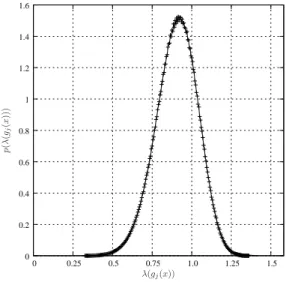
Fig. 2 shows the interest of the proposed criterion to measure the relevance of the different hash functions. It was generated using a set of SIFT descriptors randomly extracted from a large set of images. Given a hash functiongj, it shows the probability that a given SIFT descriptor is hashed in the same bucket as its nearest vector in the dataset. For a given query, this suggests choosing the hash functions gj(x)that provide the best expected relevance. It should be com-pared with Fig. 3, which gives the probability distribution function (PDF) of the proposed criterion on the same dataset. From these fig-ures one can deduce that most of the hash functions used to retrieve the nearest neighbor have a low relevance.
3.2. Lattices as hash functions
The space partition resulting from the random projections is im-proved by using quantizers which are better suited to the Euclidean distance. Lattices are a natural choice, as they offer very good quan-tization properties for the mean square error dissimilarity measure used in Euclidean spaces. This has recently motivated the use of Leech lattices to perform the geometric hashing in LSH [10]. How-ever, as explained in subsection 2.2, the interest of this Lattice in this context is mainly theoretical, as its decoding has a high compu-tational cost. Therefore, this lattice is of interest only if the dataset
1Note that fordhigh enough the inner product between two isotropically
drawn unitary vectorsxandyis fairly approximated by a normal law of
zero-mean and variance1/d. Hence, ford= 128, two directionsai
1andai2are
almost orthogonal with very high probability.
0.1 0.2 0.3 0.4 0.5 0.6 0.7 0.8 0.9 1 0 0.25 0.5 0.75 1.0 1.25 1.5 √ k/2 P ( gj ( N N ( x )) = gj ( x ) | λ ( gj ( x )) λ(gj(x))
Fig. 2. Empirical probability that a SIFT descriptor (of dimension
128) is hashed into the same bucket as its nearest neighbor in a vector set comprising 50 000 elements ;w= 0.2, k= 10.
to be searched is extremely large, otherwise the lattice computation step is the bottleneck in the search.
We propose using theE8 lattice instead, which offers excellent
quantization properties together with a low decoding cost, as shown in subsection 2.2. For each hash function we randomly draw 8 com-ponents of a given input vectorx, producing a8-dimensional vector xi,8. The hash functions of Eqn. 2 are then replaced by
hi(x) =E8 „ xi,8−bi w « , (9)
whereE8(·)represents the decoding function associated with the
lat-ticeE8,biis a8-dimensional random offset andwis a normalization factor defining the lattice cell size via a homothetic transformation. In contrast to random projections,hi(x)is an integer vector, not a scalar value. The construction of the functionsgjin Eqn. 3 is still valid, but here thegjare the concatenation of the integer vectorshi. The square of the relevance criterionλ(gj)of Eqn. 8 is easily de-rived, by summing the square distances between the different vectors hj,iand their corresponding lattice points. Note that this quantity is obtained as a by-product of theE8lattice decoding algorithm.
3.3. The algorithm QA-LSH
The core ideas behind our QA-LSH algorithm are 1) usingE8
lat-tices as hash functions and 2) selecting the most appropriate hash functions using the proposed relevance criterion.
For this purpose, at query time we select thel′
hash functions with the highest relevance for the queryx, i.e. the ones minimiz-ingλ(gj(x)), instead of using all the hash functionsgj. Only the buckets associated with thesel′
hash functions will be parsed and the corresponding vectors retrieved. Therefore, quite a large set ofl hash functions{gi}can be used. The main limitation is the amount of memory required to store the hash tables. The selection of the best hash functions is not a time consuming process, as the rele-vance criterion is obtained as a by-product of the lattice decoding. For a reasonable number of hash functions, the bottleneck of the al-gorithm remains the last step of the “exact” LSH alal-gorithm, i.e., the search for the exact nearest neighbors within the short-list obtained
0 0.2 0.4 0.6 0.8 1 1.2 1.4 1.6 0 0.25 0.5 0.75 1.0 1.25 1.5 λ(gj(x)) p ( λ ( gj ( x )) )
Fig. 3. Empirical PDF of the relevance criterionλ(gj(x));w =
0.2, k = 10. Note that for such a density, the value may be greater than 1, as for a normal distribution of variance lower than 1
2π.
by parsing the buckets. UsingE8 lattices instead of random
pro-jections only impacts the hash function calculation: the rest of the algorithm remains identical.
4. SIMULATION: QA-LSHvsLSH
This simulation compares our QA-LSH algorithm with standard E2LSH [10] as described in Subsection 2.1. For this purpose, we measure the proportion of 128-dimensional SIFT descriptors (ran-domly extracted from a large set of images) correctly assigned to
their exact closest element in a descriptor set composed ofk =
50 000vectors. The objective is to measure the percentage of dataset elements for which an exact search has to be performed to obtain a given level of accuracy. This measure accurately reflects the compu-tational cost for very large datasets, where the most time-consuming task is the exact search within the subset returned by the algorithm.
Fig. 4 shows that our new approach clearly outperforms the orig-inal LSH in terms of the trade-off between accuracy and efficiency measured by the number of vectors returned in the short-list. Note that for both algorithms, only the results associated with the sets of parameters (wandk) that perform well have been displayed.
5. CONCLUSION
We have presented an improved version of the popular approximate nearest neighbor search algorithm LSH. Our version uses the lattice structure and on-line selection of the quantization cells, leading to a better compromise between speed and accuracy.
6. REFERENCES
[1] C. B¨ohm, S. Berchtold, and D. Keim, “Searching in high-dimensional spaces: Index structures for improving the performance of multimedia
databases,”ACM Computing Surveys, vol. 33, no. 3, pp. 322–373, 2001.
[2] K. Beyer, J. Goldstein, R. Ramakrishnan, and U. Shaft, “When is
”near-est neighbor” meaningful?” inIntl. Conf. on Database Theory, 1999,
pp. 217–235. QA-LSH 0 0.2 0.4 0.6 0.8 1 0.001 0.01 0.1 1
proportion of nearest neighbors correctly found
% of the database retrieved LSH
Fig. 4. Comparison of our method QA-LSH with E2LSH for the assignment of SIFT descriptor to a dataset of SIFT descriptors.
[3] R. M. Gray and D. L. Neuhoff, “Quantization,”IEEE Trans. on
Infor-mation Theory, vol. 44, pp. 2325–2384, Oct. 1998.
[4] D. Lowe, “Distinctive image features from scale-invariant keypoints,” Intl. Jrnl. of Computer Vision, vol. 60, no. 2, pp. 91–110, 2004.
[5] H. Lejsek, F. H. ´Asmundsson, B. J´onsson, and L. Amsaleg, “Scalability
of local image descriptors: A comparative study,” inACM Conf. on
Multimedia, 2006.
[6] M. Datar, N. Immorlica, P. Indyk, and V. Mirrokni, “Locality-sensitive
hashing scheme based on p-stable distributions,” inSymp. on
Compu-tational Geometry, 2004, pp. 253–262.
[7] G. Shakhnarovich, T. Darrell, and P. Indyk,Nearest-Neighbor Methods
in Learning and Vision: Theory and Practice. MIT Press, Mar 2006, ch. 3.
[8] Y. Ke, R. Sukthankar, and L. Huston, “Efficient near-duplicate
detec-tion and sub-image retrieval,” inACM Conf. on Multimedia, 2004, pp.
869–876.
[9] B. Matei, Y. Shan, H. Sawhney, Y. Tan, R. Kumar, D. Huber, and M. Hebert, “Rapid object indexing using locality sensitive hashing and
joint 3D-signature space estimation,”IEEE Trans. on Pattern Analysis
and Machine Intelligence, vol. 28, no. 7, pp. 1111 – 1126, July 2006. [10] A. Andoni and P. Indyk, “Near-optimal hashing algorithms for near
neighbor problem in high dimensions,” inSymp. on the Foundations of
Computer Science, 2006, pp. 459–468.
[11] J. Conway and N. Sloane, “Voronoi regions of lattices, second moments
of polytopes, and quantization,”IEEE Trans. on Information Theory,
vol. 28, no. 2, pp. 211–226, 1982.
[12] ——, “Fast quantizing and decoding algorithms for lattice quantizers
and codes,”IEEE Trans. on Information Theory, vol. 28, no. 2, pp.
227–232, 1982.
[13] E. Agrell, T. Eriksson, A. Vardy, and K. Zeger, “Closest point search in
lattices,”IEEE Trans. on Information Theory, vol. 48, no. 8, pp. 2201–
2214, 2002.
[14] M. Ran and J. Snyders, “Efficient decoding of the gosset, coxeter-todd
and the barnes-wall lattices,” inSymp. on Information Theory, 1998.
[15] A. Vardy and Y. Be’ery, “Maximum-likelihood decoding of the leech
lattice,”IEEE Trans. on Information Theory, vol. 39, no. 4, pp. 1435–
1444, 1993.
[16] O. Amrani and Y. Be’ery, “Efficient bounded-distance decoding of the hexacode and associated decoders for the leech lattice and the golay