www.energynetworks.org
Engineering Recommendation G59
Issue 3 Amendment 1 August 2014
RECOMMENDATIONS FOR THE
CONNECTION OF GENERATING PLANT TO
THE DISTRIBUTION SYSTEMS OF LICENSED
DISTRIBUTION NETWORK OPERATORS
First published, June 1985
Amendments since publication
Issue Date Amendment
G59/1 1991 Revised incorporating Amendment 1 (1992) and Amendment 2 (1995) G59/2 2010 Revised - replaced two previous Engineering Recommendations, ER
G59/1 and its associated Engineering Technical Report ETR 113, and ER G75/1.
G59/2-1 2011 Revised Amendment 1 – Appendix A13.1 - Change to DC injection current limits
G59/3 Nov 2013 Correction of error.
The error relates to the British Standard which is to be used to determine the ‘flicker’ contribution from small wind turbines.
References to this standard are found at 9.6.2.1 and 13.8.5.5 of ER G59/3. The standard that should be referred to is BS EN 61400-12. However, the standard that was referred BS EN 61400-21was incorrect. Therefore, to correct this error, the two references (i.e. at 9.6.2.1 and 13.8.5.5) have been changed and the description of the standard corrected at 3.2 (page 9) of ER G59/3. This will now read:
BS EN 61400-12-1:2006 Wind turbines. Power performance
measurements of electricity producing wind turbines. G59/3-1 2014 Revised RoCoF settings in Section 10.5.7
© 2014 Energy Networks Association
All rights reserved. No part of this publication may be reproduced, stored in a retrieval system or transmitted in any form or by any means, electronic, mechanical, photocopying, recording or otherwise, without the prior written consent of Energy Networks Association. Specific enquiries concerning this document should be addressed to:
Operations Directorate Energy Networks Association 6th Floor, Dean Bradley House
52 Horseferry Rd London SW1P 2AF
This document has been prepared for use by members of the Energy Networks Association to take account of the conditions which apply to them. Advice should be taken from an appropriately qualified engineer on the suitability of this document for any other purpose.
Contents
Foreword ... 5
1 Purpose ... 6
2 Scope ... 6
3 Normative references ... 8
4 Terms and definitions ... 10
5 Legal Aspects ... 15
6 Connection Application ... 17
6.1 General ... 17
6.2 Application for Connection ... 19
6.3 System Analysis for Connection Design ... 20
7 CONNECTION ARRANGEMENTS ... 22
7.1 Operating Modes ... 22
7.2 Long-Term Parallel Operation ... 22
7.3 Infrequent Short-Term Parallel Operation ... 22
7.4 Switched Alternative-Only Operation ... 24
7.4.1 General ... 24
7.4.2 Changeover Operated at HV ... 25
7.4.3 Changeover Operated at LV ... 25
7.5 Balance of Generating Unit output at LV ... 26
7.6 Generation Unit capacity for single and split LV phase supplies ... 26
7.7 Voltage Management Units in Customer’s premises ... 27
8 EARTHING ... 28
8.1 General ... 28
8.2 HV Generating Plant ... 28
8.3 LV Generating Plant ... 33
9 NETWORK CONNECTION DESIGN AND OPERATION ... 39
9.1 General Criteria ... 39
9.2 Network Connection Design for Generating Plant... 39
9.3 Generating Plant Performance and Control Requirements ... 41
9.4 Fault Contributions and Switchgear Considerations ... 43
9.5 Voltage Limits and Control ... 45
9.6 Power Quality ... 46 9.7 System Stability ... 49 9.8 Island Mode ... 50 10 PROTECTION ... 52 10.1 General ... 52 10.2 Protection Requirements ... 52
10.3 Loss of Mains (LoM) ... 53
10.4 Additional DNO Protection ... 57
10.5 Protection Settings ... 59
11 INSTALLATION, OPERATION AND CONTROL INTERFACE ... 75
11.1 General ... 75
11.2 Isolation and Safety Labelling ... 76
11.3 Site Responsibility Schedule... 77
11.4 Operational and Safety Aspects ... 78
11.5 Synchronizing and Operational Control ... 79
12 TESTING AND COMMISSIONING ... 80
12.1 General ... 80
12.2 Procedures and Witnessing Requirements ... 80
12.3 Commissioning Tests / Checks required at all Power Stations ... 81
12.4 Additional Commissioning requirements for Non Type Tested Generating Units ... 82
12.5 Periodic Testing... 84
12.6 Changes at the Installation ... 84
13 APPENDICES ... 86
13.1 Generating Unit Type Test Sheet ... 88
13.2 Generating Plant Installation and Commissioning Confirmation ... 100
13.3 Generating Plant Installation and Commissioning Tests... 103
13.4 Generating Plant Decommissioning Confirmation... 111
13.5 Application for connection of Type Tested Generating Units with total aggregate Power Station capacity <50kW 3 phase or 17kW single phase. ... 112
13.6 Additional Information Relating to System Stability Studies ... 114
13.7 Loss of Mains (LoM) Protection Analysis ... 117
13.8 Type Testing of Generation Units of 50kW three phase, or 17kW per phase or less. Guidance for Manufacturers. ... 126
13.8.5 Separate Specific Technology Requirements ... 136
13.8.5.1(C1.1) Domestic CHP ... 136
13.8.5.2(C1.2) Photovoltaic ... 136
13.8.5.3(C1.3) Fuel Cells ... 136
13.8.5.4(C1.4) Hydro... 136
13.8.5.5(C1.5) Wind ... 137
13.8.5.6(C1.6) Energy Storage Device ... 137
13.9 Main Statutory and other Obligations ... 137
13.10Example calculations to determine if unequal generation across different phases is acceptable or not. ... 141
13.11Guidance on Risk Assessment when using RoCoF LoM Protection for Power Stations in the 5MW to 50MW range ... 143
Foreword
This Engineering Recommendation (EREC) is published by the Energy Networks Association (ENA) and comes into effect from August 2013. It has been prepared and approved for publication under the authority of the Great Britain Distribution Code Review Panel.The approved abbreviated title of this engineering document is “EREC G59”, which replaces the previously used abbreviation “ER G59”.
1 Purpose
1.1 The purpose of this Engineering Recommendation (EREC) is to provide guidance on the connection of Generating Plant to the Distribution Systems of licensed
Distribution Network Operators (DNOs). It is intended to address all aspects of the connection process from standards of functionality to site commissioning, such that
Customers, Manufacturers and Generators are aware of the requirements that will be made by the local DNO before the Generating Plant will be accepted for connection to the Distribution System.This Engineering Recommendation replaces Engineering Recommendation EREC G59/2 and EREC G59/2-1.
1.2 The guidance given is designed to facilitate the connection of Generating Plant whilst maintaining the integrity of the Distribution System, both in terms of safety and supply quality. It applies to all Generating Plant within the scope of Section 2, irrespective of the type of electrical machine and equipment used to convert any primary energy source into electrical energy.
1.3 This EREC is intended to provide guidance to Generators and DNOs. The mandatory requirements governing the connection of Distributed Generating Plant are generally set out in the Distribution Planning and Connection Code 7 (DPC7) of the Distribution Code and in the Connection Conditions (CC) of the Grid Code. In the event of any conflict with this EREC, the provisions of the Distribution Code and Grid Code will prevail.
2 Scope
2.1 This EREC provides guidance on the technical requirements for the connection of
Generating Plant to the Distribution Systems of licensed DNOs. For the purposes of this EREC, a Generating Plant is any source of electrical energy, irrespective of the prime mover and Generating Unit type. This EREC applies to all Generating Plant
which is not in the scope of EREC G83 or is not compliant with EREC G83 requirements.1 EREC G59 describes a simplified connection procedure for connection of a Type Tested single Generating Unit of less than 17kW per phase or 50kW three phase, or the connection of multiple Type Tested Generating Units with a maximum aggregate capacity of less than 17kW per phase or 50kW three phase, per Customer
installation, provided that any existing connected Generating Units are also Type Tested.
2.2 This EREC does not provide advice for the design, specification, protection or operation of Generating Plant itself. These matters are for the owners of plant to determine.
—————————
1 Engineering Recommendation EREC G83/2 – Recommendations for the connection of small-scale embedded generators (up to and including 16 A per phase) in parallel with public low-voltage distribution networks. This Engineering Recommendation provides guidance on the technical requirements for the connection of
Generating Units ratedup to and including 16 A per phase, single or multi-phase, 230/400 Volts AC. The recommendations cover the connection of Generating Units, either single or multi-phase within a single Customer’s installation up to the limit of 16A per phase, and multiple Generating Units in a close geographic region with a limit of 16A per phase in each customer installation, under a planned programme of work.
2.3 Specific separate requirements apply to Generating Plant comprising Generating Units less than or equal to 16A per phase and these are covered in EREC G83. However, Generating Units ≤16A per phase that have not been Type Tested in accordance with EREC G83 or whose technology type is not covered by one of the EREC G83 annexes should comply with the requirements set in this document. Section 6 of this document provides more guidance on how to apply this document to
Generating Units that are below the 16A threshold but do not meet the requirements of EREC G83/2.
2.4 The connection of mobile generation owned by the DNO, EREC G83/2 compliant
Generating Units or offshore Transmission Systems containing generation are outside the scope of this Engineering Recommendation.
2.5 This document applies to systems where the Generating Plant can be paralleled with a Distribution System or where either the Generating Plant or a Distribution System with Generating Plant connected can be used as an alternative source of energy to supply the same electrical load.
2.6 The generic requirements for all types of Generating Plant within the scope of this document relate to the connection design requirements, connection application and notification process including confirmation of commissioning. The document does not attempt to describe in detail the overall process of connection from application, through agreement, construction and commissioning. It is recommended that the ENA publication entitled – “Distributed Generation Connection Guide” is consulted for more general guidance.
2.7 Medium and Large Power Stations are, in addition to the general requirements of this EREC, bound by the requirements of the Grid Code. In the case of Large Power Stations, the Grid Code will generally apply in full. For Medium Power Stations, only a subset of the Grid Code applies directly, and the relevant clauses are listed in DPC7 of the Distribution Code.
2.8 This EREC is written principally from the point of view of the requirements in Great Britain. There are some differences in the requirements in Great Britain and Northern Ireland, which are reflected in the separate Grid Codes for Great Britain and Northern Ireland, and the separate Distribution Code for Northern Ireland. These documents should be consulted where necessary, noting that the numbering of sections within these documents is not necessarily the same as in the Distribution Code for Great Britain and the Grid Code for Great Britain.
2.9 The separate synchronous network operating in the Shetland Isles has specific technical challenges which are different to those of the Great Britain synchronous network. This EREC is not in itself sufficient to deal with these issues
3 Normative references
The following referenced documents, in whole or part, are indispensable for the application of this document. For dated references, only the edition cited applies. For undated references, the latest edition of the referenced document (including any amendments) applies.
3.1 Statutory Requirements
Health and Safety at Work etc Act (HASWA): 1974
The Health and Safety at Work etc Act 1974 also referred to as HASAW or HSW, is the primary piece of legislation covering occupational health and safety in the United Kingdom. The Health and Safety Executive is responsible for enforcing the Act and a number of other Acts and Statutory Instruments relevant to the working environment.
Electricity Safety, Quality and Continuity Regulations (ESQCR): 2002
The Electricity Safety, Quality and Continuity Regulations 2002 (Amended 2006) - Statutory Instrument Number 2665 -HMSO ISBN 0-11-042920-6 abbreviated to ESQCR in this document.
Electricity at Work Regulations (EaWR): 1989
The Electricity at Work regulations 1989 abbreviated to EaWR in this document. 3.2 Standards publications
BS 7671: 2008 Requirements for Electrical Installations
IEE Wiring Regulations: Seventeenth Edition.
BS 7430: 1999
Code of Practice for Earthing.
BS 7354
Code of Practice for Design of Open Terminal Stations.
BS EN 61000 series*
Electromagnetic Compatibility (EMC).
BS EN 61508 series*
Functional safety of electrical/ electronic/ programmable electronic safety-related systems.
BS EN 60255 series*
Measuring relays and protection equipment.
BS EN 61810 series*
BS EN 60947 series*
Low Voltage Switchgear and Controlgear.
BS EN 60044-1: 1999
Instrument Transformers. Current Transformers.
BS EN 60034-4:2008
Methods for determining synchronous machine quantities from tests.
BS EN 61400-12-1:2006
Wind turbines. Power performance measurements of electricity producing wind turbines.
IEC 60909 series*
Short-circuit currents in three-phase a.c. systems. Calculation of currents.
IEC TS 61000-6-5: 2001
Electromagnetic Immunity Part 6.5 Generic Standards. Immunity for Power Station and Substation Environments.
IEC 60364-7-712: 2002
Electrical installations of buildings – Special installations or locations – Solar photovoltaic (PV) power supply systems.
ENA Engineering Recommendation G5
Planning levels for harmonic voltage distortion and the connection of non-linear equipment to transmission and distribution networks in the United Kingdom.
ENA Engineering Recommendation G74
Procedure to meet the requirements of IEC 909 for the calculation of short-circuit currents in three-phase AC power systems.
ENA Engineering Recommendation G83
Recommendations for connection of small-scale embedded Generators (up to 16 A per phase) in parallel with public low voltage distribution networks.
ENA Engineering Recommendation P2
Security of Supply.
ENA Engineering Recommendation P18
ENA Engineering Recommendation P28
Planning limits for voltage fluctuations caused by industrial, commercial and domestic equipment in the United Kingdom.
ENA Engineering Recommendation P29
Planning limits for voltage unbalance in the UK for 132 kV and below.
ENA Technical Specification 41-24
Guidelines for the design, installation, testing and maintenance of main earthing systems in substations.
ENA Engineering Technical Report ETR 124
Guidelines for actively managing power flows associated with the connection of a single distributed generation plant.
ENA Engineering Technical report ETR 126
Guidelines for actively managing voltage levels associated with the connection of a single distributed generation plant.
ENA Engineering Technical report ETR 130
The application guide for assessing the capacity of networks containing distributed generation.
* Where standards have more than one part, the requirements of all such parts
shall be satisfied, so far as they are applicable. 4 Terms and definitions
For the purposes of this document, the following terms and definitions apply.
Note: Except where otherwise stated, the terms defined in this section shall have the same meaning as in the Grid Code and the Distribution Code.
Act
The Electricity Act 1989 (as amended.including by the Utilities Act 2000 and the Energy Act 2004).
Authority
The Gas and Electricity Markets Authority established under Section 1 of the Utilities Act 2000 The Gas and Electricity Markets Authority established under Section 1 of the Utilities Act 2000.
Connection Agreement
An agreement between the DNO and the User or any Customer setting out the terms relating to a connection with the DNOs Distribution System.
Connection Point
An Entry Point or an Exit Point of the Distribution System as the case may be.
Customer
A person who is the owner or occupier of premises that are connected to the
Distribution System.
Customer's Installation
The electrical installation on the Customer's side of the supply terminals together with any equipment permanently connected or intended to be permanently connected thereto.
Distribution Code
A code required to be prepared by a DNO pursuant to Standard Licence Condition 21 (Distribution Code) of a Distribution Licence and approved by the Authority as revised from time to time with the approval of, or by the direction of, the Authority.
Distribution Licence
A distribution licence granted under Section 6(1)(c) of the Act.
Distribution System
An electricity Distribution System operated by a holder of a Distribution Licence.
Distribution Network Operator (DNO)
The person or legal entity named in Part 1 of the Distribution Licence and any permitted legal assigns or successors in title of the named party.
Entry Point
The point at which an Embedded Generator or other Users connect to the DNO’s
Distribution System where power flows into the DNO’s Distribution System under normal circumstances.
Embedded Generator
A Generator including a Customer with own generation whose Generating Unit is/are connected to the DNO’s Distribution System or to another authorised distributor connected to the DNO’s Distribution System.
Exit Point
The point of supply from the DNO’s Distribution System to a User where power flows out from the DNO’s Distribution System under normal circumstances.
Generator
A person who generates electricity under licence or exemption under the Electricity Act 1989 (as amended by the Utilities Act 2000 and the Energy Act 2004) or the Electricity (Northern Ireland) Order 1992 and whose Generating Plant is directly or indirectly connected to a Distribution System. For avoidance of doubt, also covers any competent person or agent working on behalf of the Generator. Often referred to as a distributed or Embedded Generator. Also for the avoidance of doubt any Customer
with generation connected to that Customer’s Installation is a Generator.
Generating Plant
A Power Station including any Generating Unit therein.
Generating Unit
Any apparatus which produces electricity.
Grid Code
The code which the NETSO is required to prepare under its Transmission Licence
and have approved by the Authority as from time to time revised with the approval of, or by the direction of, the Authority.
High Voltage (HV)
A voltage exceeding 1000V AC or 1500V DC between conductors, or 600V AC or 900V DC between conductors and earth.
Installer
A person who carries out the installation of Generating Unit(s) on behalf of a
Generator and who carries out some of the functions required of a Generator during the installation and commissioning phases of a Power Station.
Interface Protection
The electrical protection required to ensure that any Generating Unit is disconnected for any event that could impair the integrity or degrade the safety of the Distribution System. The interface protection is typically not all installed at the interface between the DNO and Customers network.
Large Power Station
As defined in the Distribution Code.
Low Voltage (LV)
A voltage normally exceeding extra-low voltage (50V) but not exceeding 1000V AC or 1500V DC between conductors or 600V AC or 900V DC between conductors and earth.
Manufacturer
A person or organisation that manufactures Generating Units which can be Type Tested to meet the requirements of this Engineering Recommendation if it is of a suitable size
Medium Power Station
As defined in the Distribution Code.
National Electricity Transmission System Operator (NETSO)
National Grid Electricity Transmission (NGET) in its capacity as operator of the National Transmission System.
Point of Common Coupling
The point on a Distribution System, electrically nearest the Customer’s Installation,
at which other Customers are, or may be, connected.
Point of Supply
The point of electrical connection between the apparatus owned by the DNO and the
Customer.
Power Station
Generating Units(even where sited separately), which are owned and/or controlled by the same Generator and may reasonably be considered as being managed as one
Power Station. For the purpose of this document a single Generating Unit will also be described as a Power Station.
Power System Stabiliser (PSS)
Equipment controlling the output of a Generating Unit in such a way that power oscillations of the machine are damped. Input variables may be speed, frequency, or power or a combination of variables.
Small Power Station
As defined in the Distribution Code.
Step Voltage Change
Following system switching, a fault or a planned outage, the change from the initial voltage level to the resulting voltage level after all the Generating Unit automatic voltage regulator (AVR) and static VAR compensator (SVC) actions, and transient decay (typically 5 seconds after the fault clearance or system switching have taken place), but before any other automatic or manual tap-changing and switching actions have commenced.
Supplier
a. A person supplying electricity under an Electricity Supply Licence; or
b. A person supplying electricity under exemption under the Act; in each case acting in its capacity as a supplier of electricity to Customers.
System
An electrical network running at various voltages.
System Stability
The ability of the System, for a given initial operating condition, to regain a state of operating equilibrium, after being subjected to a given system disturbance, with most
System variables within acceptable limits so that practically the whole System remains intact.
Synchronism
The condition under which a Generating Unit or System is connected to another
System so that the frequencies, voltage and phase relationships of that Generating Unit or System, as the case may be, and the System to which it is connected are similar within acceptable tolerances.
Total System
The integrated system of connected Generating Plant, Transmission System, Distribution Systems and associated electrical demand.
Transmission Licence
The licence granted under Section 6(1)(b) of the Act.
Transmission System
A system of High Voltage lines and plant owned by the holder of a Transmission Licence and operated by the NETSO, which interconnects Power Stations and substations.
Type Tested
A Generating Unit design which has been tested by the Manufacturer, component manufacturer or supplier, or a third party, to ensure that the design meets the requirements of this EREC, and for which the Manufacturer has declared that all products supplied into the market will be constructed to the same standards, and with the same protection settings as the tested product.
User
A term used in various sections of the Distribution Code to refer to the persons using the DNO’s Distribution System.
5 Legal Aspects
5.1 The operation and design of the electricity system in Great Britain is defined principally by the Electricity Act (1989 as amended), the Electricity Safety Quality and Continuity Regulations (ESQCR) 2002, as well as general considerations under the Health and Safety at Work Act (HASWA) 1974 and the Electricity at Work Regulations (EaWR) 1989. A brief summary of the main statutory obligations on DNOs, Generators and Users is included as Appendix 13.9.
5.2 Under section 21 of the Electricity Act, Generators may be required to enter into a bespoke Connection Agreement with the DNO. Such a Connection Agreement will specify the terms and conditions including technical, operating, safety and other requirements under which Generating Plant is entitled to remain connected to the
Distribution System. It is usual to include site specific commercial issues, including recovery of costs associated with the connection, GDUoS (Generator Distribution Use of System) charges and the applicable energy loss adjustment factors, in Connection Agreements. It is also common practice by some DNOsto collect the technical issues into a subordinate “Technical and Operating Agreement” which is given contractual force by the Connection Agreement.
5.3 DNOs are required by their licences to have in force and comply with the Distribution Code. Generators will be bound by their licences or by their Connection Agreements, or both, to comply with the Distribution Code.
5.4 In accordance with DPC5.4 of the Distribution Code, when details of the interface between a Generating Plant and the Distribution System have been agreed a site responsibility schedule detailing ownership, maintenance, safety and control responsibilities will be drafted. The site responsibility schedule and operation drawing shall be displayed at the point of interconnection between the DNO’s and Generator’s systems, or as otherwise agreed.
5.5 The DNOs have statutory and licence obligations within which they have to offer the most economic, technically feasible option for connecting Generating Plant to their
Distribution Systems. The main general design obligations imposed on the DNOs are to:
a. maintain supplies to their Customers within defined statutory voltage and frequency limits;
b. ensure that the Distribution Systems at all voltage levels are adequately earthed;
c. comply with the “Security of Supply” criteria defined in EREC P2;
d. meet improving standards of supply in terms of customer minutes lost (CMLs) and the number of customer interruptions (CIs);
e. facilitate competition in the connection, generation and supply of electricity. 5.6 Failure to meet any of the above obligations will incur legal or regulatory penalties. The
first two criteria, amongst others, define the actions needed to allow islanded operation of the Generating Plant or to ensure that the Generating Plant is rapidly disconnected from the Distribution System under islanded conditions. The next two criteria influence the type of connection that may be offered without jeopardising regulated standards.
5.7 General conditions of supply to Customers are also covered by Regulation 23 of the ESQCR 2002. Under Regulation 26 of the ESQCR 2002 no DNO is compelled to commence or continue a supply if the Customer’s Installation may be dangerous or cause undue interference with the Distribution System or the supply to other
Customers. The same regulation empowers the DNO to disconnect any part of the
Customer’s Installation which does not comply with the requirements of Regulation 26. It should also be noted that each installation has to satisfy the requirements of the HASWA 1974 and the EaWR 1989.
5.8 Regulations 21 and 22 of the ESQCR 2002 require installations that have alternative sources of energy to satisfy Regulation 21 in relation to switched alternative supplies, and Regulation 22 in the case of sources of energy running in parallel with the
Distribution System.
5.9 Under Regulation 22 of the ESQCR 2002, no person may operate Generating Plant in parallel with a public Distribution System without the agreement of the DNO.
5.10 All Generators have to comply with the appropriate parts of the ESQCR.
5.11 The general requirements for Generators wishing to connect their Generating Plant to a Distribution System are contained in the Distribution Code.
5.12 It is important to note that both the Distribution Code and Grid Code use the terms
Large, Medium and Small in relation to Power Stations. These terms are defined in the Codes and various parts of the Codes apply to different size Power Stations, with generally no Grid Code requirements applying to Small Power Stations. Any collection of Generating Plant under the control of one owner or operator in one installation is classed in the Codes as a Power Station.
5.13 Generators with Medium Power Stations will have to comply with a few specific Grid Code clauses. The requirement for these clauses is contained in DPC7 of the
Distribution Code.
5.14 Power Stations that are to be connected to a Distribution System and contain
Generating Units that trade in the wholesale market as Balancing Mechanism Units or have for other reasons become a party to the Balancing and Settlement Code and/or National Grid’s Connection and Use of System Code, will then have to comply with the
Grid Code requirements for Generating Plant.
5.15 Information, which should assist Generators wishing to connect to the Distribution System at High Voltage (HV), will be published by the DNO in accordance with condition 25 of the Distribution Licence. This is known as the Long Term Development Statement (LTDS). The general form and content of this statement is specified by Ofgem and covers the existing Distribution System as well as authorised changes in future years on a rolling basis.
5.16 Under the terms of the Electricity Act 1989 (as amended), generation of electricity is a licensed activity, although the Secretary of State, may by order2 grant exemptions. Broadly, generating stations of less than 50MW are automatically exempt from the need to hold a licence, and those between 50MW and 100MW may apply to DECC for an exemption if they wish.
5.17 Generators who are licensed will be required to become parties to the Balancing and Settlement Code and to the Connection and Use of System Code. They will also be bound in their licences to comply with the Grid Code and the Distribution Code. 5.18 Generators will need appropriate contracts in place for the purchase of any energy that
is exported from the Generators’ Power Stations, and for any energy imported. For this purpose the Generator will need contracts with one or more Suppliers, and where the Supplier does not provide it, a meter operator agreement with the appropriate provider.
5.19 Generatorswishing to trade ancillary services for National Grid purposes will need appropriate contracts in place with the National Grid Electricity Transmission in its role asGreat Britain System Operator.
6 Connection Application
6.1 General
This document describes the processes that shall be adopted for both connection of single Generating Unitsand installations that comprise of a number of Generating Units The process for the connection of single or multiple Type TestedGenerating Units with an aggregate installed capacity of less than or equal to 16A per phase is described in EREC G83; the connection of other Generating Units (ie Generating Units outside the scope of EREC G83) is covered by this Engineering Recommendation.
Where an installation comprises multiple Generating Units the application process and commissioning requirements should be based on the Power Station capacity (ie the aggregate capacity of all the Generating Units to be installed in any one installation), and whether the individual Generating Units are Type Tested.
Where a new Generating Unit is to be connected to an existing installation then the table below will apply to theaggregate capacity of the complete installation irrespective of technology. Only the new Generating Unit will be required to meet protection requirements of this Engineering Recommendation.
—————————
6.1.1 The following table describes key differentiating features between Power Station capacity that influence the application, connection and commissioning process. Power Station capacity (ie the aggregate capacity of all the Generating Units to be installed in any one installation).
≤ 16A per phase
> 16A per phase
≤ 50kW 3 phase (or 17kW 1 phase)3 > 50kW 3 phase (or 17kW 1 phase) All Capacities Approval Status of individual Generating Units G83 compliant Not G83 compliant G59 or G83 Type Tested Equipment G59 Type Tested Equipment Not G59 Type Tested Consent required prior to connection DNO to carry out impact assessment / electrical studies
As G83 YES YES YES YES
Protection Requirements As G83 As G59/3. Section 10 As G59/3. Section 10 As G59/3. Section 10 As G59/3 Section 10 Commissioning Tests As G83 As G59/3 Sections 12.3 and 12.4 As G59/3 Section 12.3 As G59/3 Section 12.3 As G59/3 Sections 12.3 and 12.4 Witness testing required by DNO No4 At the discretion of the DNO5 As G59/3 section 12.1.45 At the discretion of the DNO5 YES – for HV, but at the discretion of the DNO for
LV5
6.1.2 Generating Unit(s) ≤ to16A per phase and EREC G83 compliant
A connection procedure to facilitate the connection and operation of Type Tested Generating Units with aggregate installed capacity of less than or equal to 16A per phase in parallel with public Low VoltageDistribution System is given in EREC G83 and is not considered further in this document.
—————————
3The rationale for the break points is the support and penetration envisaged for “microgeneration” as captured in
the 2006 Climate Change and Sustainable Energy Act 2006, which defines microgeneration as up to 50kWe.
4DNOs may inspect selected installations, but without imposing a charge.
6.1.3 Generating Unit(s) ≤ to16A per phase and not EREC G83 compliant
Where the Generating Unit does not meet the requirements of EREC G83 either because the technology is not covered by one of the technology annexes or because the Generating Unit has not successfully been through the type testing process the connection process shall follow that for larger Generating Units as described in this document.
6.1.4 Generating Unit(s) EREC G59 Type Tested (>16A per phase but ≤ 50kW 3 phase (or 17 kW 1 phase))
The use of Type Tested equipment simplifies the connection process, the protection arrangements and reduces the commissioning test requirements. The process is described in this document.
6.1.5 Generating Unit(s) not EREC G59 Type Tested or > than50kW 3 phase (or 17kW 1 phase)
The connection process for these Generating Units is described in this document. When making a connection application for Medium and Large Power Stations, there are requirements that should be considered in addition to the general requirements identified in this document.
Medium and Large Power Stations are bound by the requirements of the Grid Code. In the case of Large Power Stations, the Grid Code will generally apply in full. For
Medium Power Stations, only a small subset of the Grid Code applies directly, and the relevant clauses are listed in DPC7 of the Distribution Code.
Where Grid Code requirements apply, under the Distribution Code it is the
Generator’sresponsibility to comply with the Grid Code requirements.
6.2 Application for Connection
6.2.1 Information about the Generating Unit(s) is needed by the DNO so that it can assess the effect that a Power Station may have on the Distribution System. Section DPC7 and the Distribution Data Registration Code (DDRC) of the Distribution Code detail the parameters to be supplied by a Customer wishing to connect Generating Unit(s)
that do not comply with EREC G83 to a Distribution System. DPC7 also enables the
DNO to request more detailed information if required.
6.2.2 Less than or equal to 16A per phase and EREC G83 Compliant Generating Unit
The application process is described in EREC G83 and is not considered further in this document.
6.2.3 Less than or equal to 16A per phase and not EREC G83 compliant Generating Unit
The Generator should apply to the local DNO for connection using the DNOs standard application form (available from the DNOs website). On receipt of the application, the
DNO will assess whether any Distribution System studies are required and whether there is a requirement to witness the commissioning tests. In some cases studies to assess the impact on the Distribution System may need to be undertaken before a firm quotation can be provided to the Customer. On acceptance of the quote, any works at the connection site and any associated facilitating works will need to be completed before the Generating Unit can be commissioned. On successful completion of the commissioning tests, the DNO will sanction permanent energisation of the Generating Unit.
6.2.4 Power Stations >16A per phase but ≤ 50kW three phase (or 17kW single phase)
comprising Generating Units Type Tested to EREC G59 or EREC G83 (excluding G83/1 and G83/1-1)
The application shall be made using the form in Appendix 13.5 which should include the Type Tested Reference Number. Where a reference number is not available the
Generator or Installer shall provide the DNO with a Type Test report as per Appendix 13.1 confirming that the Generating Unit has been Type Tested to satisfy the requirements of this Engineering Recommendation. Guidance to Manufacturers on type testing is included in Appendix 13.8 of this document. On receipt of the application, the DNO will assess whether any Distribution System studies are required and whether there is a requirement to witness the commissioning tests. 6.2.5 Power Stations which include any non-Type TestedGenerating Units or any Power
Stations >50kW three phase (or 17kW single phase)
The connection process is similar to that described in 6.2.3 above, although detailed system studies will almost certainly be required and consequently the Generator might need to provide additional information. The information should be provided using the standard application form (generally available from the DNOs website). The data that might be required will all be defined within DPC7 and DPC8 and the Distribution Data Registration Code (DDRC) of the Distribution Code.
6.3 System Analysis for Connection Design
6.3.1 DNOs use a variety of modelling tools to undertake system analysis. Their exact needs for data and models will vary dependent on the voltage level, size, and location of the connection. Generally the DNO will seek the key information from the
Generator via the application forms referred to in 6.2 above. Occasionally the DNO
may also need additional data for modelling purposes and will seek this information in accordance with the ‘Distribution Data Registration Code’ (DDRC) within the
Distribution Code as part of the connection process.
6.3.2 In the course of planning and designing a power system, it is often necessary to model a small section of the wider system in detail. This could be an embedded system at 132kV or less, which is connected to the Transmission System (400/275kV) via one or more step-down transformers.
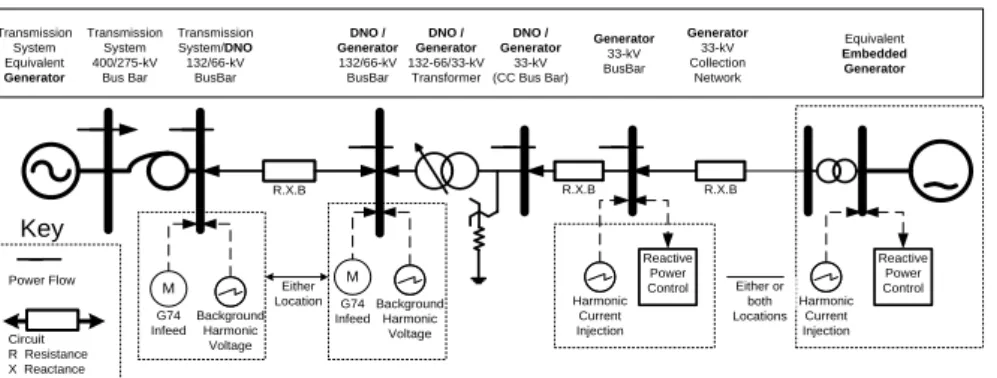
6.3.3 For plant connected at HV, it is generally necessary to build an equivalent model of the
Distribution System. An example is shown as Fig 6.1 below.
R.X.B M G74 Infeed R.X.B R.X.B Reactive Power Control Background Harmonic Voltage Harmonic Current Injection Transmission System 400/275-kV Bus Bar Equivalent Embedded Generator M G74 Infeed Transmission System/DNO 132/66-kV BusBar DNO / Generator 132/66-kV BusBar DNO / Generator 33-kV (CC Bus Bar) Generator 33-kV BusBar Transmission System Equivalent Generator Key Power Flow Background Harmonic Voltage Either Location Circuit R Resistance X Reactance B Suseptance Harmonic Current Injection Reactive Power Control Either or both Locations DNO / Generator 132-66/33-kV Transformer Generator 33-kV Collection Network
Fig 6.1 Example equivalent Total System representation
This model will typically include equivalent source representing existing Generating Plant fault level arising from asynchronous plant (EREC G74), interconnection impedances, loads, and possibly the Generator’s proposal for reactive compensation plant. The parameters of these elements will depend upon the selection of the boundary nodes between the equivalent and detailed networks in the model.
6.3.4 It may be beneficial to model some of the ‘active’ elements in full detail. Supergrid, grid primary and other transformers can be considered active for the purpose of determining voltage control limits. Knowledge of the voltage control set points, transformer tap changer deadbands, and control methods is often essential. Also a knowledge of which items of Generating Plant are mainly responsible for the range of fault contributions offered at the connection point by the DNO is a useful addition. Fault contribution may also arise from other rotating plant – shown here as an equivalent asynchronous motor (EREC G74).
6.3.5 This equivalent Total System model will not accurately represent the fast dynamic (sub second) behaviour of the active elements within the Distribution and Transmission System.
6.3.6 For synchronous machines, control systems for Generating Units and prime movers have traditionally been provided and modelled in transparent transfer-function block diagram form. These models have been developed over many years and include lead/lag elements, gains, limiters and non-linear elements and may be tuned to obtain a satisfactory response for the particular Generating Unit and grid connection. The requirement to submit models in this form for directly connected synchronous
Generating Units is written into the Grid Code and Distribution Code.
6.3.7 For other generation technologies, the Grid Code includes the requirement to submit validated detailed models in respect of non-synchronous Generating Units which are aggregated into a ‘Power Park Module’ and where they are also classed as Medium or Large Power Stations.
6.3.8 The Distribution Code has a similar requirement of the Generator where the DNO
deems it necessary to ensure System Stability and security. The DDRC accepts models of both Synchronous/Asynchronous and Series Converter Connected
Generating Units.
6.3.9 DNOshave a Grid Code obligation (CC 3.3) to ensure that validated detailed models are obtained in respect of Medium Power Stations embedded within their
Distribution Systems unless they are connected at a voltage level below that of the lower voltage side of the relevant supergrid transformer. This requires the Generating Plant manufacturer to submit a Generating Unit or Power Park model in a format suitable for the NETSO usually in a documented block diagram format.
6.3.10 For the DNOs own purposes, should a model be required, it would normally be requested in a compiled form suitable for use with the particular variety of power system analysis software they use. Recently there is a move by Manufacturers to create ‘black-box’ models of their Generating Units or Power Parks using their
Generating Units. These are programmed for compatibility with industry standard power analysis modelling packages. This is in order to protect the Manufacturers intellectual property and so lessen the need for confidentiality agreements between parties. There are potential advantages and disadvantages to this approach, but must be generally welcomed provided that the two main disadvantages of this approach, as described below, can be resolved:
a. The model must not be software ‘version’ specific ie will work in all future versions, or has an assurance of future upgrades for a particular software package;
b. The Manufacturer must provide assurance that the black box model correctly represents the performance of the Generating Unit for load flow, fault level and transient analysis for the typical range of faults experienced by DNOs.
7 CONNECTION ARRANGEMENTS
7.1 Operating Modes
7.1.1 Generating Plant may be designed for one of three operating modes. These are termed long-term parallel operation, infrequent short-term parallel operation and switched alternative-only operation.
7.2 Long-Term Parallel Operation
7.2.1 This refers to the frequent or long-term operation of Generating Plant in parallel with the Distribution System. Unless otherwise stated, all sections in this Engineering Recommendation are applicable to this mode of operation.
7.3 Infrequent Short-Term Parallel Operation
7.3.1 This mode of operation typically enables Generating Plant to operate as a standby to the DNOs supply. A short-term parallel is required to maintain continuity of supply during changeover and to facilitate testing of the Generating Plant.
7.3.2 In this mode of operation, parallel operation of the Generating Plant and the
Distribution System will be infrequent and brief and under such conditions, it is considered acceptable to relax certain design requirements, such as protection requirements, that would be applicable to long-term parallel operation.
7.3.3 As the design requirements for Generating Plant operating in this mode are relaxed compared with those for long-term parallel operation, it is necessary for the DNO to specify a maximum frequency and duration of short-term parallel operation, to manage the risk associated with the relaxed design requirement.
The Generating Plant may be permitted to operate in parallel with the DNOs Distribution System for no more than 5 minutes in any month, and no more frequently than once per week. If the duration of parallel connection exceeds this period, or this frequency, then the Generating Plant must be considered as if it is, or can be, operated in Long-Term Parallel Operation mode. An alternative frequency and duration may be agreed between the DNO and the Generator, taking account of particular site circumstances and Generating Plant design. An electrical time interlock should be installed to ensure that the period of parallel operation does not exceed the agreed period. The timer should be a separate device from the changeover control system such that failure of the auto changeover system will not prevent the parallel being broken.
7.3.4 The following design variations from those in the remainder of the document are appropriate for infrequent short-term parallel operation:
a. Protection Requirements – Infrequent short-term parallel operation requires only under/over voltage and under/over frequency protection. This protection only needs to be in operation for the time the Generating Plant is operating in parallel. A specific Loss of Mains (LoM) protection relay is not required, although many multifunction relays now have this function built in as standard. Similarly, additional requirements such as neutral voltage displacement, intertripping and reverse power are not required. This is based on the assumptions that as frequency and duration of paralleling during the year are such that the chance of a genuine LoM event coinciding with the parallel operation is unlikely. However, if a coincidence does occur, consideration must be given to the possibility of the Generating Plant supporting an island of Distribution System as under voltage or under frequency protection is only likely to disconnect the Generating Plant if the load is greater than the
Generating Plant capacity. Consequently it is appropriate to apply different protection settings for short term parallel connection. As this Generating Plant will not be expected to provide grid support or contribute to system security, more sensitive settings based on statutory limits would compensate for lack of LoM protection. Ultimately, if an island was established the situation would only persist for the duration of the parallel operation timer setting before generation was tripped.
b. Connection with Earth – It is recommended that the Generating Unit’s star points or neutrals are permanently connected to earth. In that way, the risks associated with switching are minimized and the undesirable effects of circulating currents and harmonics will be tolerable for the timescales associated with short-term paralleling.
c. Fault Level – There is the need to consider the effect of the Generating Plant contribution to fault level. The risks associated with any overstressing during the short term paralleling will need to be individually assessed and the process for controlling this risk agreed with the DNO.
d. Voltage rise / Step Voltage Change - Connections should be designed such that the operation of a Generating Plant does not produce voltage rise in excess of statutory limits. In general this should not be an issue with most Short-Term Parallel Operation as at the time of synchronising with the mains most sites will normally be generating only sufficient output to match the site load. Therefore the power transfer on synchronising should be small, with the
Generating Unit ramping down to transfer site load to the mains. If the
Generating Unit tripped at this point it could introduce a larger StepVoltage Change than would normally be acceptable for loss of Generating Plant
operating under a long-term parallel arrangement but in this event it could be regarded as an infrequent event and a step change of up to 10% as explained in Section 9.5 would be acceptable.
e. Out-of-phase capabilities - All newly installed switchgear should be specified for the duty it is to undertake. Where existing switchgear which might not have this capability is affected by short-term paralleling it is expected that it will not be warranted to replace it with gear specifically tested for out-of-phase duties, although the owner of each circuit breaker should specifically assess this. Clearly the synchronizing circuit breaker (owned by the Generator) must have this certified capability. For the avoidance of doubt it is a requirement of the Electricity at Work Regulations that “no electrical equipment shall be put into use where its strength and capability may be exceeded in such a way as may give rise to danger.” Paragraph 9.4.6 below provides more information on the assessment of such situations.
7.3.5 Some manufacturers have developed fast acting automatic transfer switches. These are devices that only make a parallel connection for a very short period of time, typically 100 - 200ms. Under these conditions installing a conventional G59 protection with an operating time of 500ms is not appropriate when the parallel will normally be broken before the protection has a chance to operate. There is however the risk that the device will fail to operate correctly and therefore a timer should be installed to operate a conventional circuit breaker if the parallel remains on for more than 1s. The switch should be inhibited from making a transfer to the DNO network whilst voltage and frequency are outside expected limits.
7.4 Switched Alternative-Only Operation
7.4.1 General
7.4.1.1 Under this mode of operation it is not permissible to operate Generating Plant in parallel with the Distribution System. Regulation 21 of the ESQCR states that it is the
Generator’s responsibility to ensure that all parts of the Generating Plant have been disconnected from the Distribution System and remain disconnected while the
Generating Plant is operational. The earthing, protection, instrumentation etc. for this mode of operation are the responsibility of the Generator, however where such
Generating Plant is to be installed, the DNO shall be given the opportunity to inspect the equipment and witness commissioning of any changeover equipment and interlocking.
7.4.1.2 The changeover devices must be of a ‘fail-safe’ design so that one circuit controller cannot be closed if the other circuit controller in the changeover sequence is closed, even if the auxiliary supply to any electro-mechanical devices has failed. Changeover methods involving transfer of removable fuses or those having no integral means of preventing parallel connection with the Distribution System are not acceptable. The equipment must not be installed in a manner which interferes with the DNOs cut-out, fusegear or circuit breaker installation, at the supply terminals or with any metering equipment.
7.4.1.3 The direct operation of circuit-breakers or contactors must not result in the defeat of the interlocking system. For example, if a circuit-breaker can be closed mechanically, regardless of the state of any electrical interlocking, then it must have mechanical interlocking in addition to electrical interlocking. Where an automatic mains fail type of
Generating Plant is installed, a conspicuous warning notice should be displayed and securely fixed at the Point of Supply.
7.4.2 Changeover Operated at HV
7.4.2.1 Where the changeover operates at HV, the following provisions may be considered by the Generator to meet the requirements of Regulation 21 of the ESQCR:
a. An electrical interlock between the closing and tripping circuits of the changeover circuit breakers;
b. A mechanical interlock between the operating mechanisms of the changeover circuit breakers;
c. An electro-mechanical interlock in the mechanisms and in the control circuit of the changeover circuit breakers;
d. Two separate contactors which are both mechanically and electrically interlocked.
Electrically operated interlocking should meet the requirements of BS EN 61508. 7.4.2.2 Although any one method may be considered to meet the minimum requirement, it is
recommended that two methods of interlocking are used wherever possible. The Generator must be satisfied that any arrangement will be sufficient to fulfil their obligations under ESQCR.
7.4.3 Changeover Operated at LV
7.4.3.1 Where the changeover operates at LV, the following provisions may be considered by the Generator to meet the requirements of Regulation 21 of the ESQCR:
a. Manual break-before-make changeover switch;
b. separate switches or fuse switches mechanically interlocked so that it is impossible for one to be moved when the other is in the closed position; c. An automatic break-before-make changeover contactor;
d. Two separate contactors which are both mechanically and electrically interlocked;
Electrically operated interlocking should meet the requirements of BS EN 61508. 7.4.3.2 The Generator must be satisfied that any arrangement will be sufficient to fulfil their
obligations under ESQCR.
7.5 Balance of Generating Unit output at LV
7.5.1. EREC G83 allows the connection of Type Tested Generating Units≤16A per phase
without consultation with the DNO. Connection of single phase units up to 17kW under EREC G59 is allowable, but this requires application to the DNO and may not be possible in many cases for technical reasons depending on point of connection and network design.
7.5.2. A solution to these voltage issues and phase imbalance issues may be to utilise 3-phase Generating Units (the same export power will result in lower voltage rises due to decreased line currents and a 3 phase connection will result in voltage rises of a sixth of those created by a single phase connection), or to use multiple single phase
Generating Units connected across three phases. If these individual Generating Units are of differing ratings, current and voltage imbalance may occur. To maintain current and voltage imbalance within limits the Installer shall consider the phase that each Generating Unit is connected to in an installation. In addition the DNO may define to an Installer the phases to which the Generating Units in any given installation should be connected.
7.5.3. An Installer should design an installation on a maximum unbalance output of 16A between the highest and lowest phase. Where there are a mixture of different technologies, or technologies which may be operational at different times (eg. wind and solar) Generating Units shall be connected to give a total imbalance of less than 16A based on assumed worst case conditions, those being:
a. One Generating Unit at maximum output with the other(s) at zero output –all combinations to be considered.
b. Both / all Generating Units being at maximum output
A Generating Unit technology which operates at different times due to location eg east and west facing roofs for PV, must allow for the PV on one roof to be at full output and the PV on the other roof to be at zero output.
7.5.4 In order to illustrate this requirement examples of acceptable and unacceptable connections have been given in Appendix 13.10.
7.6 Generation Unit capacity for single and split LV phase supplies
7.6.1 The maximum aggregate capacity of Generation Plant that can be connected to a single phase supply is 17kW. The maximum aggregate capacity of Generation Plant that can be connected to a split single phase supply is 34kW.
7.6.2 There is no requirement to provide intertripping between single phase inverters where these are installed on multi-phase supplies up to a limit of 17kW per phase (subject to balance of site output as per section 7.5). A single phase 17kW connection may result in an imbalance of up to 17kW following a Distribution System or Generating Unit
outage. However the connection design should result in imbalance under normal operation to be below 16A between phases as noted above.
7.6.3 Power Stations with a capacity above 17kW per phase are expected to comprise three phase units. The requirement to disconnect all phases following a fault in the
Customers Installation or a Distribution System outage applies to three phase inverters only and will be tested as part of the type testing of the Generating Unit. In some parts of the country where provision of three phase networks is costly then the
DNO may be able to provide a solution using single or spilt phase networks for Power Stations above the normal limits as set out above.
7.7 Voltage Management Units in Customer’s premises
7.7.1 Voltage Management Units are becoming more popular and use various methods, in most cases, to reduce the voltage supplied from the DNO’s System before it is used by the Customer. In some cases where the DNOs System voltage is low they may increase the voltage supplied to the Customer. Some technologies are only designed to reduce voltage and can not increase the voltage.
7.7.2 The use of such equipment has the advantage to the Customer of running appliances at a lower voltage and in some cases this can reduce the energy consumption of the appliance. Some appliances when running at a lower voltage will result in higher current consumption as the device needs to take the same amount of energy from the
System to carry out its task.
7.7.3 If a Voltage Management Unit is installed between the Entry Point and the Generating Unit in a Customers Installation, it may result in the voltage at the Customer side of the Voltage Management Unit remaining within the limits of the protection settings defined in section 10.5.7.1 while the voltage at the Entry Point side of the unit might be outside the limits of the protection settings. This would negate the effect of the protection settings.Therefore this connection arrangement is not acceptable and all Generating Units connected to DNO LV Systems under this Engineering Recommendation must be made on the Entry Point side of any Voltage Management Unit installed in a
Customers Installation.
7.7.4 Customers should note that the overvoltage setting defined in section 10.5.7.1 is 4% above the maximum voltage allowed for the voltage from the DNO System under the ESQCR and that provided their Installer has designed their installation correctly there should be very little nuisance tripping of the Generating Unit. Frequent nuisance tripping of a Generating Unit may be due to a fault in the Customers Installation or the operation of the DNO’s System at too high a voltage. Customers should satisfy themselves that their installation has been designed correctly and all Generating Units
are operating correctly before contacting the DNO if nuisance tripping continues.. Under no circumstances should they resort to the use of Voltage Management Units installed between the Entry Point and the Generating Unit.
8 EARTHING
8.1 General
8.1.1 The earthing arrangements of the Generating Plant shall satisfy the requirements of DPC4 of the Distribution Code.
8.2 HV Generating Plant
8.2.1 HV Distribution Systems may use direct, resistor, reactor or arc suppression coil methods of earthing the Distribution System neutral. The magnitude and duration of fault current and voltage displacement during earth faults depend on which of these methods is used. The method of earthing therefore has an impact on the design and rating of earth electrode systems and the rating of plant and equipment.
8.2.2 To ensure compatibility with the earthing on the Distribution System the earthing arrangements of the Generating Plant must be designed in consultation and formally agreed with the DNO. The actual earthing arrangements will also be dependent on the number of Generating Units in use and the Generators system configuration and method of operation. The system earth connection shall have adequate electrical and mechanical capability for the duty.
8.2.3 HV Distribution Systems operating at voltages below 132kV are generally designed for earthing at one point only and it is not normally acceptable for HVCustomers or
HV Generators to connect additional HV earths when operating in parallel. One common exception to this rule is where the Generating Plant uses an HV voltage transformer (VT) for protection, voltage control or instrumentation purposes and this VT requires an HV earth connection to function correctly.
HV Distribution Systems operating at 132kV are generally designed for multiple earthing, and in such cases the earthing requirements should be agreed in writing with the DNO.
8.2.4 In some cases the DNO may allow the Generator to earth the Generator’s HV System when operating in parallel with the Distribution System. The details of any such arrangements shall be agreed in writing between the relevant parties.
8.2.5 Generators must take adequate precautions to ensure their Generating Plant is connected to earth via their own earth electrodes when operating in isolation from the
Distribution System.
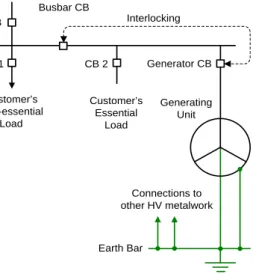
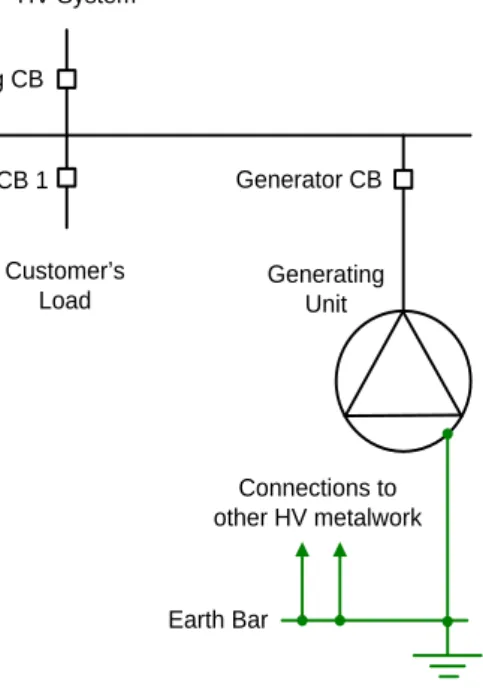
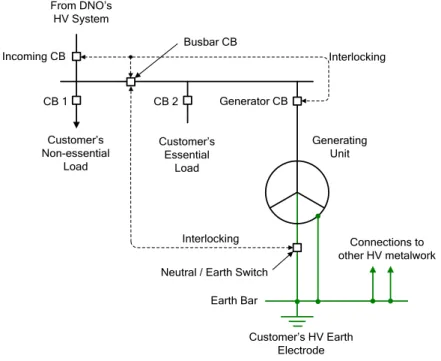
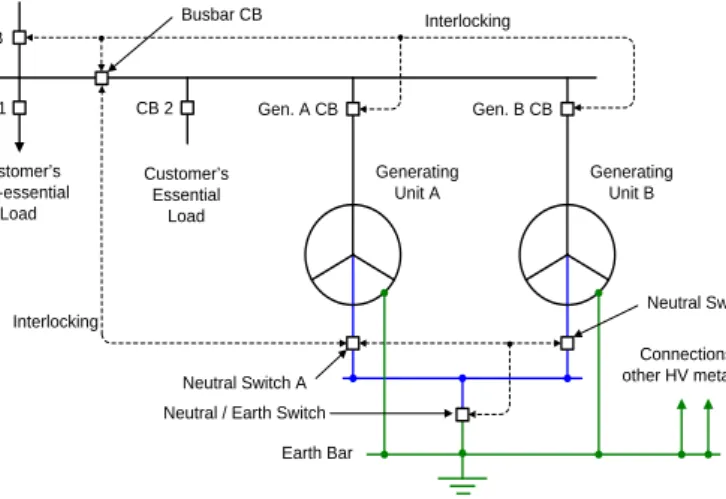
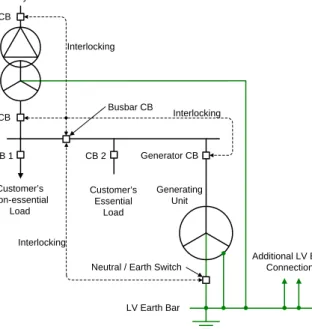
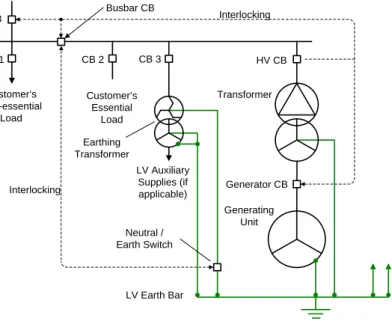
8.2.6 Typical earthing arrangements are given in figures 8.1 to 8.4.
8.2.7 Earthing systems shall be designed, installed, tested and maintained in accordance with ENA TS 41-24, (Guidelines for the design, installation, testing and maintenance of main earthing systems in substations), BS7354 (Code of Practice for Design of Open Terminal Stations) and BS7430 (Code of Practice for Earthing). Precautions shall be taken to ensure hazardous step and touch potential do not arise when earth faults occur on HV systems. Where necessary, HV earth electrodes and LV earth electrodes shall be adequately segregated to prevent hazardous earth potentials being transferred into the LV Distribution System.
Figure 8.1 -Typical Earthing Arrangement for an HV Generating Unit Designed for Independent Operation (ie Standby Operation) Only
Earth Bar Incoming CB Generator CB From DNO’s HV System Generating Unit Customer’s HV Earth Electrode Customer’s Essential Load Customer’s Non-essential Load CB 1 CB 2 Connections to other HV metalwork Busbar CB Interlocking NOTE:
(1) Interlocking between busbar CB and Generator CB is required to prevent parallel operation of the
Figure 8.2 - Typical Earthing Arrangement for an HV Generating Unit Designed for Parallel Operation Only
Earth Bar Incoming CB Generator CB From DNO’s HV System Generating Unit Customer’s HV Earth Electrode Customer’s Load CB 1 Connections to other HV metalwork NOTE:
Figure 8.3 -Typical Earthing Arrangement for an HV Generating Unit Designed for both Independent Operation (ie Standby Operation) and Parallel Operation
Earth Bar Incoming CB Generator CB From DNO’s HV System Generating Unit Customer’s HV Earth Electrode Customer’s Essential Load Customer’s Non-essential Load CB 1 CB 2 Connections to other HV metalwork Busbar CB
Neutral / Earth Switch Interlocking
Interlocking
NOTE:
(1) Protection, interlocking and control systems are designed to ensure that busbar CB is open when the
Generating Unit operates independently from the DNO system.
(2) When the Generating Unit operates independently from the DNO system (ie busbar CB is open) the neutral / earth switch is closed.
(3) When the Generating Unit operates in parallel with the DNO system (ie busbar CB is closed) the neutral / earth switch is open.
Figure 8.4 -Typical Earthing Arrangement for two HV Generating Units Designed for both Independent Operation (ie Standby Operation) and Parallel Operation
Earth Bar Incoming CB Gen. A CB From DNO’s HV System Generating Unit A Customer’s HV Earth Electrode Customer’s Essential Load Customer’s Non-essential Load CB 1 CB 2 Busbar CB Generating Unit B Connections to other HV metalwork Gen. B CB Neutral Switch A Neutral Switch B
Neutral / Earth Switch
Interlocking
Interlocking
NOTE:
(1) Protection, interlocking and control systems are designed to ensure that busbar CB is open when the
Generating Units operate independently from the DNO system.
(2) If one Generating Units is operating independently from the DNO system (ie busbar CB is open) then its neutral switch is closed and the neutral / earth switch is closed.
(3) If both Generating Units are operating independently from the DNO system (ie busbar CB is open) then one neutral switch is closed and the neutral / earth switch is closed.
(4) If one or both of the Generating Units are operating in parallel with the DNO system (ie busbar CB is closed) then both neutral switches and the neutral /earth switch are open.
8.3 LV Generating Plant
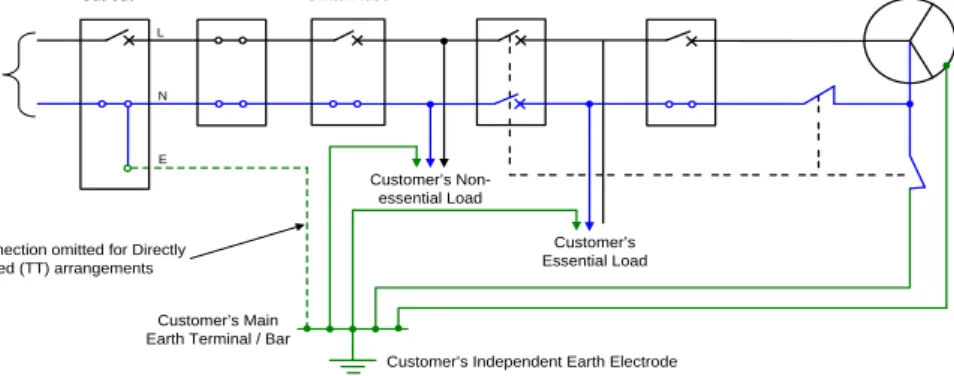
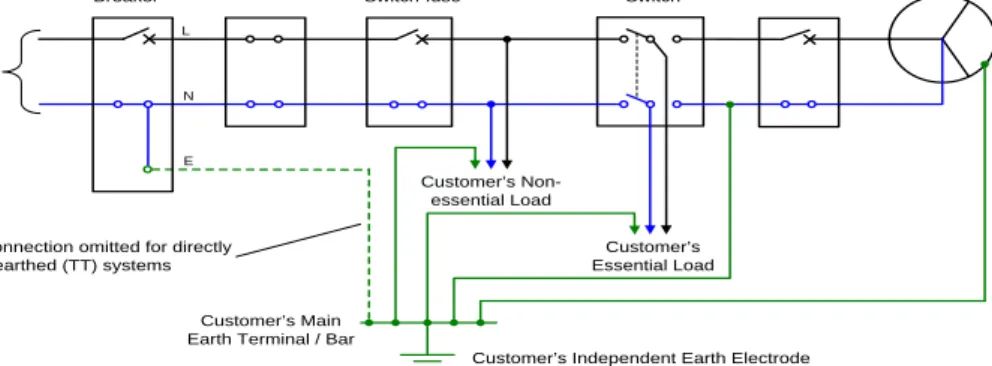
8.3.1 LV Distribution Systems are always solidly earthed, and the majority are multiple earthed.
8.3.2 The specific earthing requirements for LV connected Generation Plant are described in DPC7.4.
![Figure 8.8 - Typical Earthing Arrangement for an LV Generating Unit Embedded within a Customer LV System and Designed for Parallel Operation Only Generating Unit3 Pole Circuit Breaker or Switch-fuseMetering EquipmentDNO Cutout or Circuit Breaker[3] C](https://thumb-us.123doks.com/thumbv2/123dok_us/9328758.2811367/37.1262.364.760.287.483/earthing-arrangement-generating-embedded-operation-generating-fusemetering-equipmentdno.webp)