Learner Satisfaction in a Collaborative Online Learning Environment Harvinder Kaur Dharam Singh
Abstract
An investigation of learners’ satisfaction in an online learning environment can lead to improvement in designing of an online course or its task, and gives the course facilitator the opportunity to re-focus computer integrated learning environment. In this paper, five key areas of online learning environments, vis. peer interaction, tutor support, online task, technology support, and knowledge acquired will be examined in order to calibrate learner satisfaction. Learners’ satisfaction for a course called “Learning Skills for Open and Distance Learners” within online discussion forum in Open University Malaysia’s learning management system will be the focus of this study. Research data is collected via questionnaire and learners reflection of their learning in the online forum. It is hope that the model shared in this paper for an effective collaborative online learning, will provide insights to the course facilitators to create an interactive and deep learning environment.
1.0 Introduction
With a herd of online learning courses available, little research has been done to investigate the learners’ satisfaction in an online learning environment. Pressure grows to identify the contributing factors of learners’ satisfaction, in particular in the collaborative online learning environment. Evaluating these factors has an acute merit for the success of collaborative online learning. Abas (2005) reported that collaborative online learning promotes constructivist learning, often advocated as being most suitable for adult learners. As aptly stated by Shea-Schultz & Fogarty (2002), that learning starts with the learner not the teacher, collaborative online learning is the pedagogy that centres the learners. Collaborative online discussion forums involve a learner or a group of learners posting a question, statement or summary of readings on the discussion forums and encouraging other learners to respond. According to Paloff and Pratt (2001), unlike traditional face-to-face classroom, the success of online distance learning is in developing a sense of community in the group of participation.
The Open University Malaysia (OUM) has recently, developed a model for Collaborative Online Learning (COL) to support the interactive online curriculum as an extension of the traditional face-to-face learning (Abas, 2005). OUM has employed blended learning, where, learner interaction online, like learner interaction in face-to-face tutorials, is an important component of its blended approach to learning besides the self-managed learning through the printed modules, electronic software and digital collection provided by the university’s digital library.
The face-to-face meetings at OUM are structured for 10 hours, which are done over 5 to 3 sessions of tutorial depending on the long or short semesters. Indeed the face-to-face meeting does not suffice the learners’ interaction needs. As such, online learning support is crucial, as it has the potential to fulfil the learning needs of these learners via virtual interactions with their peers and tutors.
This paper draws on research into experiences and perceptions of the learners with regard to learning online, in particular online discussion forum in OUM’s Learning Management System (myLMS). The learners involved in this study were newly enrolled learners who undertook a course called Learning Skills for Open and Distance Learners. The study reports on the learners’ experiences and perceptions of the peers’ participation, online facilitators moderation, challenges of the online task, technology support and knowledge acquired.
2.0 Purpose of Study
This study was conducted with the following objectives:
1. To identify factors that are most indicative of learner satisfaction with regards to involvement in a collaborative online learning environment. In this paper, five factors are involved: peers’ participation, online facilitators moderation, challenges of the online task, technology support and knowledge acquired for the collaborative online learning assignment of the Learning Skills for Open and Distance Learners course; and
2. To compare regards to learner preference for online 3.
4. and face-to-face interaction. In this paper five main areas of preference are explored: peers’ participation, online facilitators moderation, challenges of the online task, technology support and knowledge acquired for the collaborative online learning assignment of the Learning Skills for Open and Distance Learners course.
3.0 Problem statement
As many learners were not active in the online discussion forums and some tutors were not optimising the online teaching-learning facilities. Online collaborative learning is emphasised and the development of participatory learning communities to promote construction of knowledge. However, the concern is, are the learners satisfied with their learning in such structured setting? It is pertinent to investigate learners’ satisfaction for better online discussion forum designs.
Astin (1993) defines learner satisfaction as the learner’s perception pertaining to their college experience and perceived value of the learning attained while attending an educational institution. Satisfaction influences the learners’ level of motivation (Chute, Thompson & Hancock, 1999), which is an important psychological factor in academic success (American Psychological Association, 1997). Level of satisfaction has impact on the retention rate (Astin, 1993). Student satisfaction information is useful to improve the course (Chute, Thompson & Hancock, 1999).
From an investigation on learner and teacher perception, (McIssac, Blocher and Mahes, 1999) suggest that distance education online classes to provide immediate feedback, incorporate discussions, promote interaction ans social presence and employ collaborative learning strategies. In another research, Laurillard (2002) analyses what student needs from learning technologies. In her book, she underpins that there must be “a continuing iterative dialogue between a teacher and student, which reveals participants’ conceptions, and the variations between them” and the medium can be online environment. This implies to what we call as collaborative learning. Collaborative learning term is defined as “an instruction method in which students work in groups toward a common academic goal” (Gokhale, 1995). Similarly, Graham & Misanchuk, (2004) describes that collaborative groups have one common goal and all group members work together to contribute to the group’s work. Gokhale (1995) reported that shared learning provides opportunities for the learners to engage in discussions to achieve higher levels of thoughts and critical thinking and retain information longer than learners who work individually. Webb et al. (1997) also reported that group work tends to advantage below-average learners. However, Laurillard (2002), concludes that discussion between learners may not necessarily lead them to what they suppose to learn, as such, tutor support is needed.
Interestingly in a research by Armitt et al. (2002), depth or quality learning depend on the online instructor, as learners do not spontaneously collaborate in a peer group. The instructor or the tutor needs to set his/her expectations regarding when and how to collaborate. Salmon (2000) in her book relates the desirable characteristics of online instructors: confident, constructive, developmental, facilitating, knowledge sharing and creative. These qualities will help in providing effective collaborative groups. On the other hand Cox et. al. (2000) pointed that though technology allows higher-level discussion between learners but online instructors are not well known to the online facilitation skills. They say their study confirms that an online instructor should be interactive, and should exhibit skills in weaving, summarising, knowledge building and managing off topic contributions for building good online group processes. Online instructor facilitation is the main predictor of the online collaborative learning. As such, besides being content experts, tutors need skills of facilitation.
Having considered tutor’s support, we turn to peer interaction. Interaction among online participants is vital to the establishment and growth of online communities (Barab & Duffy, 2000; Cummings et al., 2002). However, the question that we need to answer is are learners prepared to learn themselves or are they dependent on their tutor? According
to French (1999) learners are reluctant to switch to a role where they are required to do self-directed learning. She continues to say that, change is imperative to meet the present demands of learning via technology where “both the teachers and learners are simultaneously ‘guides’ and ‘sages,’ as all of us are continual learners and peer teachers”. Nevertheless, interaction via collaborative learning can lead to positive outcomes (APA, 1997).
Traditionally, support and guidance for assignment preparation in an open and distance learning was given in a one-way delivery mode, through the guidance notes to assignment writing or model answers. In addition, written feedback on assignments is also made available after the assignment submission. The use of ICTs provides an interactive feature to this guidance and feedback (MacDonald, 2001). Collaborative online discussion forum is the platform to support the communication and guidance for the learners in resolving the difficulties in interpreting the requirements of written assignments and writing it appropriately. Hence, assignment needs to be designed as such that it allows increased interactivity and collaboration as well as offers learner to develop higher cognitive skills.
Studies have shown that technology is an important aspect in determining the learners satisfaction with their course. Bonk & Cunningham (1998) findings reveals that collaborative tools can improve learner satisfaction in the online learning environment. Learners’s success are determined by their accessibility to reliable equipment and familiarity with the technology used in learning the course (Belanger & Jordan, 2000). Learners who have reported frustration with technology in the course revealed lower satisfaction level (Chong, 1998; Hara & Kling 2000). Online access was rated as one of the most important factors influencing learner satisfaction (Bower & Kamata, 2000). Knowledge
Collaborative “interactions promote a more integrated understanding of course content through the individual connecting the pieces of knowledge together” (Carlson & George, 2004). In a study, it was reported that participants believed that online learning is an opportunity for active acquisition of knowledge (Abu & Daing, 2002).
5.0 Methodology
A survey was conducted in the researcher’s class consisting of 32 learners via a questionnaire. The instrument used for this study was a structured questionnaire to identify if the factors such as peer interaction, tutor support, online task, technology support, and knowledge acquired influence respondents satisfaction in the collaborative online learning assignment discussion; and to determine factors that are most indicative for learner satisfaction in a collaborative online discussion forum. The quantitative data was analysed using the SPSS.
6.0 Findings and Discussion 6.1 Demographics of the sample
There were 32 learners responded to the questionnaire from the researcher’s tutorial class. A total of 53.1 percent were male respondents. All respondents are registered under the Faculty of Information, Technology and Multimedia, with 83.9 percent for Bachelor programme and 16.1 percent for Diploma programme. A majority of the learners that is 62.5 percent were in the range of 20 – 30 years of age, followed by 28.1 percent for the age group of 31 – 40 year of age. The survey showed 87.5 percent owned a personal computer, and everyone had access to the Internet as well as had attempted to access the online discussion forum. A majority of the learners accessed Internet from the office (56.3 percent), 21.9 percent surfed in the cyber-café and 18.8 percent from home. When asked on the frequency of access to the OUMH1103 Assignment discussion forum, 34.4 percent accessed more than 3 times a week, 31.3 percent accessed 2 – 3 times a week and 25 percent accessed once a week. The information is depicted in Table 1.
Table 1: Frequency of Access of OUMH1103 Assignment Discussion Forum No of times of accessing OUMH1103 Assignment discussion
forum
Frequency Percent
Once every 2 weeks 3 9.4
Once every week 8 25.0
2- 3 times a week 10 31.3
> than 3 times a week 11 34.4
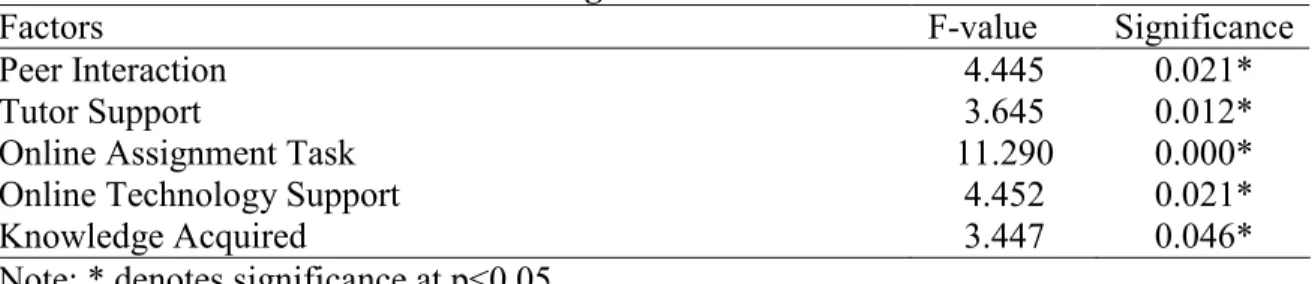
The main findings of this study are that the learners in the researcher’s class were basically satisfied with the online tutor support, peer interaction, assignment task and technology support and for acquiring new knowledge (refer to Table 2). There is significant relationship between learner satisfaction in a collaborative online discussion forums with all the five factors analysed in this study.
Table 2: ANOVA on factors affecting learner satisfaction in the collaborative online discussion forum for OUMH1103 Assignment
Factors F-value Significance
Peer Interaction 4.445 0.021*
Tutor Support 3.645 0.012*
Online Assignment Task 11.290 0.000*
Online Technology Support 4.452 0.021*
Knowledge Acquired 3.447 0.046*
However, Table 3 shows that learners in the research class has valued tutor support as the most crucial factor with a mean of 1.44 and standard deviation 0.619. Furthermore, learners also agreed that they have gain new knowledge with a mean 1.97 and standard deviation 0.547. This indicates that the discussion was helpful in completing their assignments. Online task is the least impact on the learners satisfaction with a mean of 2.19 and standard deviation of 0.738, reveals that not all learners have enjoyed and benefited from the collaborative discussion. It is vital that the interesting discussion topics are integrated into the assignment task as well as clearly structured task or activities are incorporated.
Table 3: Mean ranking, standard deviation and Cronbach’s Alpha coefficients of the agreement of the factors influencing the learners satisfaction in the researcher’s class
Factors Means Standard deviation Cronbach’s α
coefficient
Tutor Support 1.44 a 0.619 0.9287
Knowledge Acquired 1.97 a 0.547 1.0000
Online Technology Support 2.03 a 0.782 0.5159
Peer Interaction 2.10a 0.539 0.6783
Online Assignment Task 2.19 a 0.738 0.8803
Note: a the means are determined by using a five-point Likert scale from strongly agree (1) to strongly disagree (5)
More than 65 percent of the respondents with a mean of 1.34 and standard deviation of 0.484, strongly perceived that online tutor support is an important factor for them in the collaborative online discussion forum. Similarly, 58.6 percent of the respondents, with a mean 1.41 and standard deviation of 0.501, perceived flexibility as influential factor as shown is Table 4. Learners perceived that tutor facilitation as the most important factor for their learning in the online discussion forums. Learners were satisfied with the flexibility of the collaborative online learning that fitted their demanding career. They were able to participate in the online discussion forum at anytime and anywhere at their convenience.
Table 4: Percentage, mean ranking and standard deviation of factors that will affect learner satisfaction in a collaborative online discussion forum
Factors Percentage Yes No Means Standard deviation Tutor Support 65.5% 34.5% 1.34 0.484 Flexibility 58.6% 41.4% 1.41 0.501 Peer Interaction 44.8% 55.2% 1.55 0.506
Online Technology Support 41.4% 58.6% 1.59 0.501
Internet Access 34.5% 65.5% 1.66 0.619
Knowledge Acquired 34.5% 65.5% 1.66 0.484
Online Assignment Task 31.0% 69.0% 1.69 0.471
Interestingly, 61.3 percent of the respondents testified as satisfied with their learning by participating the online discussion forum for the OUMH1103 Assignment and the others were not. The reasons for their satisfaction is shown in Table 5.
Table 5: Learners’ reasons for testifying satisfaction or non-satisfaction Reasons for Satisfaction Reasons for Non-satisfaction
“I have not enough time participate discussion online. I used the Internet only on my working hours”
When asked if they would prefer online discussion forums than to face-to-face sessions, only 30 percent indicated their preference and the majority of the respondents (40 percent) were unsure of their preferences as shown in Table 6. As predicted, majority of the respondents agreed that they will save more time in by discussing in the online than face-to-face sessions. Among the reasons reported by the learners for not …..
Table 6: Percentage and standard deviation of learner agreement on preference of learning in the online discussion forum for OUMH1103 Assignment
Learner preference 1 2 3 4 5 Missing
data
Mean Standard
Deviation I would prefer online discussion
forums than to face-to-face
discussions
3.3 26.7 40.0 20.0 10.0 2 3.07 1.015
I save more time by discussing online than face-to-face sessions
I am happy that I participated in the online discussion forum
21.9 53.1 25.0 0 0 0 2.03 0.695
7.0 Conclusion
The results from this survey do not represent the context of online learning at OUM. The study is limited to a small group of sample in the researcher’s tutorial class and learners perception on the satisfaction level for the five factors may differ from one tutor to another. Hence, this research needs to continue to see whether the effects are the same with groups facilitated by other tutors within the same course. However, in general these results are indicative of possible trends with regards to the first semester learners at OUM.
Based on the findings, we can conclude that all the five factors studied, peer interaction, tutor facilitation, online assignment task, technology support and knowledge acquired do impact learner satisfaction. However, tutor support is deemed to be the most influential element in determining learner satisfaction.
8.0 References
Gokhale, Anuradha, A. (1995). Collaborative learning enhances critical thinking. Journal of Technology Education, 7(1), 22-30. [Online]. Available:
http://scholar.lib.vt.edu/ejournals/JTE/jte-v7n1/gokhale.jte-v7n1.html [2005, Aug. 18] Barab, S.A. & Duffy, T. (2000). From practice fields to communities of practice. In D. Jonassen, & S. M. Land. (Eds.), Theoretical Foundations of Learning Environments (pp. 25-56). Mahwah, NJ: Lawrence Erlbaum Associates.
Cummings, J.A., Bonk, C.J., & Jacobs, F.R. (2002). Twenty-first century college syllabi: Options for online communication and interactivity. Internet and Higher Education, 5(1), 1-19.
Graham, C.R. & Misanchuk, M. (2004). Computer-mediated learning groups: Benefits and challenges to using groupwork in online learning environments. Chapter 8 in Roberts Tim. S., Online collaborative learning: theory and practice. USA: Idea Group Inc.
McIssac, M., Blocher, J.M & Mahes, V. (1999). Student and teacher perceptions of interaction in online computer mediated communication. Educational Media International, 36(2), 121-131.