Strategy-Proofness Versus Efficiency in Matching with
Indifferences: Redesigning the NYC High School Match
(Article begins on next page)
The Harvard community has made this article openly available.
Please share
how this access benefits you. Your story matters.
Citation
Abdulkadiroglu, Atila, Parag A. Pathak, and Alvin E. Roth. 2009.
Strategy-proofness versus efficiency in matching with
indifferences: Redesigning the NYC high school match. American
Economic Review 99(5): 1954-1978.
Published Version
doi:10.1257/aer.99.5.1954
Accessed
February 18, 2015 5:02:02 PM EST
Citable Link
http://nrs.harvard.edu/urn-3:HUL.InstRepos:11077572
Terms of Use
This article was downloaded from Harvard University's DASH
repository, and is made available under the terms and conditions
applicable to Open Access Policy Articles, as set forth at
http://nrs.harvard.edu/urn-3:HUL.InstRepos:dash.current.terms-of-use#OAP
Strategy-proofness versus Efficiency in Matching with
Indifferences: Redesigning the NYC High School Match
∗
Atila Abdulkadiro˘
glu
†Parag A. Pathak
‡Alvin E. Roth
§This version: November 2008
forthcoming,
American Economic Review
Abstract
The design of the New York City (NYC) High School match involved tradeoffs among efficiency, stability and strategy-proofness that raise new theoretical questions. We ana-lyze a model with indifferences–ties–in school preferences. Simulations with field data and the theory favor breaking indifferences the same way at every school –single tie breaking– in a student-proposing deferred acceptance mechanism. Any inefficiency associated with a realized tie breaking cannot be removed without harming student incentives. Finally, we empirically document the extent of potential efficiency loss associated with strategy-proofness and stability, and direct attention to some open questions.
∗We thank Susan Athey, Neil Dorosin, Aytek Erdil, Onur Kesten, Fuhito Kojima and Tayfun S¨onmez for
helpful comments, and seminar participants at various universities and conferences. We are especially grateful to the co-editor and three anonymous referees for helpful comments. For financial support, Abdulkadiro˘glu gratefully acknowledges an Alfred P. Sloan Research Fellowship and an NSF-CAREER award, Pathak thanks the Spencer Foundation, and Roth thanks the NSF.
†Duke University, email: [email protected], address: Department of Economics, Duke
Univer-sity, Durham NC, 27708.
‡Society of Fellows and MIT, email: [email protected], address: Department of Economics, Massachusetts
Institute of Technology, Cambridge, MA 02142.
§Harvard University, email: [email protected], address: Department of Economics, Harvard University,
In 2003-04, the authors of this paper assisted the New York City Department of Edu-cation (NYCDOE) in redesigning the student assignment mechanism used to match over 90,000 entering students to public high schools each year (Atila Abdulkadiro˘glu, Parag A. Pathak and Alvin E. Roth 2005). The old system - three rounds of a decentralized process of offers, acceptances, and wait lists with counterproductive incentives and insuf-ficient offers to clear the market - was replaced with a more centralized single-offer system based on a student-proposing deferred acceptance algorithm adapted to satisfy various constraints of the NYCDOE.
The NYCDOE initially contacted us because they were familiar with the design of the medical match (see Roth 1984, Roth and Elliot Peranson 1999). And much of the theory on which the design of the new student assignment mechanism was based involves the same kind of matching theory (see Abdulkadiro˘glu and Tayfun S¨onmez 2003). But much of the prior theory of two-sided matching concentrates on the case that all parties have strict preferences, mainly because indifferences in preferences were viewed as a “knife-edge” phenomenon in applications like labor markets (cf. Roth and Marilda Sotomayor 1990). In contrast, a primary feature of school choice in NYC and in other cities including Boston (in which a new design was implemented in 2006, see Abdulkadiro˘glu, Pathak, Roth, and S¨onmez 2005, 2006) is that there are indifferences–ties– in how students are ordered by at least some schools. How to break these ties raised some significant design decisions, which have potentially important strategic and welfare consequences (cf. Aytek Erdil and Haluk Ergin 2008). This paper describes those decisions, and evaluates them both empirically and with the aid of some new theory involving the tradeoffs among efficiency, stability, and strategy-proofness.
In two-sided matching models (David E. Gale and Lloyd S. Shapley 1962), there are two disjoint sets of agents, students and schools. Every agent is an active strategic player with preferences over the agents in the other set.1 A matching of students to schools (that
respects the relevant capacity constraints) isstable if it is individually rational and there is noblocking pair of a student and a school who each prefer to be assigned to one another than to their mate in the matching.2 Stable matchings are Pareto efficient with respect to the set of all agents, and in the core of the market whose rules are that any pair of agents 1
Gale and Shapley (1962) phrased their discussion in a school choice context as a “college admissions” problem and studied the set of stable matchings. Michel Balinski and S¨onmez (1999) considered the theory of two-sided matching in relation to college admissions where ordering of students at colleges are determined via students’ scores at an entrance exam. Abdulkadiro˘glu and S¨onmez (2003) introduced the problem of student assignment in school choice. Gale and Shapley already considered non-strict preferences (albeit obliquely), but concentrated on the case of strict preferences.
2
Stable matchings may be relevant even when all schools are passive. In this case, stable matchings eliminate “justified envy.” See Abdulkadiro˘glu (2005), Abdulkadiro˘glu and S¨onmez (2003) and Abdulkadiro˘glu, Pathak, Roth and S¨onmez (2006) for discussion in the context of Boston’s new student assignment mechanism.
on opposite sides of the market may be matched (subject to capacity constraints) if and only if they both agree. The current system in NYC involves some schools that are active strategic players that rank students in terms of preferences, while others use exogenous criteria–priorities– to passively rank students. When schools actively rank students, if there is a blocking pair, the school has an incentive to circumvent the match to enroll the students it would prefer. This was an important feature of the old system in NYC, when some schools concealed capacity in an effort to be matched later with preferable students.3 Empirical observations suggest that centralized matching mechanisms in labor markets are most often successful if they produce stable matchings (Roth 1991, 2002, 2008). Therefore, the fact that both schools and students are active participants in New York called for a stable matching algorithm for the NYC High School Match.
A second desideratum guiding the design was that the school match process should promote student welfare to the extent possible; that is, it should beefficient for students. Indeed, the old system was not even capable of generating enough offers to clear the market and “[i]t [was] not unusual for up to 45 percent of students who apply to schools outside their neighborhood to be rejected by all their choices,” after which they would be assigned administratively, without regard for their stated preferences.4 When preferences are strict, a class ofdeferred acceptance algorithms identify a stable match that is optimal for one or the other sides of the market, in the sense that every agent on one side of the market does at least as well at their optimal stable matching as at any other stable matching (Gale and Shapley 1962).
A third concern was the gaming aspect of the old system. Some schools gave higher priority to those students who ranked them as a first or second choice. This information was made public in the Directory of Public High Schools by NYCDOE. Consequently, students were forced to make a strategic decision while ranking schools. As a result,
strategy-proofness for students, which requires that it should be a dominant strategy to state true preferences, became the third goal of the design. There do not exist any stable mechanisms that are strategy-proof for all agents. None are strategy-proof for schools matched to more than one student, but thestudent-proposing deferred acceptance mechanism,which produces the student-optimal stable matching, is strategy-proof for the students (Lester E. Dubins and David Freedman (1981), Roth (1982, 1985)).
One way to think about these three design concerns is that Pareto efficiency for the students is the primary welfare goal, but that stability of the matching, and strategy-proofness in the elicitation of student preferences are incentive constraints that likely 3
E.g. the Deputy Chancellor of Schools, quoted in the New York Times (11/19/04): “Before you might have a situation where a school was going to take 100 new children for 9th grade, they might have declared only 40 seats, and then placed the other 60 outside the process.”
4
have to be met for the system to produce substantial welfare gains over the old system.5 One goal of the present paper is to assess empirically how much student welfare is lost by meeting these constraints, by comparing the outcomes that result from Pareto improve-ments among students due to relaxing these constraints (if these improveimprove-ments could actually be achieved) with the best student outcomes that can be achieved by a stable and strategy-proof mechanism. Another goal is to make clearer theoretically the tradeoff between strategy-proofness and student welfare. From this point on, we will mostly be concerned with student welfare and incentives, and we will speak about Pareto efficiency and strategy-proofness with respect to students only.
Student assignment in school choice, introduced by Abdulkadiro˘glu and S¨onmez (2003) as an application of matching theory, requires the consideration of a model that allows for indifferences in school’s preferences. When school preferences are not strict, there will not in general exist a unique stable match for each side of the market that is weakly Pareto optimal for that side, rather there will a non-empty set of stable matches that are weakly Pareto optimal for agents on that side. It will be useful in what follows to call any member of that set for studentsa student-optimal stable matching.6
With the the student-proposing deferred acceptance algorithm as the basis of the new system, the mechanism must specify how to order equivalent students from the point of view of schools with limited space. For instance, one can assign each student a distinct number, break ties in school preferences according to those assigned numbers, then apply the deferred acceptance algorithm to the strict preferences that result from the tie break-ing. This preserves the stability and strategy-proofness of the student-proposing deferred acceptance algorithm. However, tie breaking introduces artificial stability constraints (since, after tie breaking, schools appear to have strict preferences between students for whom they are indifferent), and these constraints can harm student welfare. In other words, when the student-proposing deferred acceptance algorithm is applied to the strict preferences that result from tie breaking, the outcome it produces may not in fact be a student-optimal stable matching in terms of the original preferences.
Nevertheless, some forms of tie breaking may be preferable to others. One of the first design decisions we confronted was whether to assign numbers to each student at each school (multiple tie breaking), or to give each student a single number to be used for tie breaking at every school (single tie breaking). Computations with simulated and then actual submitted preferences indicated that single tie breaking had superior welfare prop-5
Strategy-proofness can also be a goal in itself, as was the case in the design of the Boston school choice system, where it came to be seen as a criterion of equal access for families with different degrees of sophistication about the system.
6
See Bob Day and Paul Milgrom (2007) for a similar treatment of the core for auctions with non-transferable utility, and its relation to matching.
erties.7 The computations based on the revealed preferences will be discussed in Section 2. Proposition 2 provides some theoretical insight into the difference. We observe that if there is a matching produced by student-proposing deferred acceptance with multiple tie breaking that cannot be produced by deferred acceptance with single tie breaking, then the matching is not a student-optimal stable matching.8
However, single tie breaking can also lead to a matching which is not a student-optimal stable matching. Thus there will sometimes be a potential opportunity to improve on the outcome of deferred acceptance with single tie breaking. Theorem 1, our main theoretical result, implies that there exists no strategy-proof mechanism (stable or not) that Pareto improves on the deferred acceptance algorithm with single tie breaking. That is, the potential inefficiency of student-proposing deferred acceptance with single tie breaking is the cost of strategy-proofness.
This theorem does not speak to the magnitude of the tradeoff to expect in real school choice plans. We take a step towards investigating this question using student preference data from New York City. Our simulations reveal significant costs of imposing strategy-proofness: about 1,500 students or 1.9% of 8th graders in our sample could be matched to schools they prefer over their assignment from deferred acceptance with single tie breaking without harming any others, if the same preference information could be elicited by a non-strategy-proof mechanism. A further (approximately) 4,300 students or 5.5% of 8th graders in our sample could improve their assignment if we relaxed the stability constraint, if the same rates of participation could be elicted by an unstable mechanism. In contrast, in Boston, the welfare cost of strategy-proofness and stability are negligible. These results raise new questions concerning when potential efficiency gains exist, and whether they can be realized.
The rest of the paper is organized as follows. Section 2 describes the model. Section 3 presents our main theoretical and empirical results. The last section concludes.
1
Model
A matching problem consists of a finite set of studentsI(for “individuals”) and a finite set of schoolsS. Each school s∈S hasqs available seats. Amatching is a correspondence µ:I∪S→ S∪I such that each student is assigned either to only one school or herself, 7
Tayfun S¨onmez also played an important role in some of the early discussions of this.
8
That the manner of tie breaking has important consequences for the outcome of deferred acceptance algo-rithms (when stability is an issue) contrasts in a surprising way with the case of one-sided matching. Pathak (2006) shows the strategy-proof top trading cycles mechanism that produces efficient (but not stable) match-ings is unaffected by the choice of multiple versus single tie breaking, when all schools are indifferent between students.
and the number of students matched at each school is less than or equal to its capacity. Ifµ(i) =i, i remains unmatched. If|µ(s)|< qs,some seats at schoolsremain unfilled.
Every student ihas a strict preference relationPi over schools and being unmatched, S∪ {i}. A school is acceptable to a student if she strictly prefers to be matched to that school over being unmatched. Let sRis′ if sPis′ or s = s′. Every school s has a weak
preference relation Rs over students and keeping unfilled seats, I ∪ {s}. A student i is
acceptable to a schoolsifsprefers to be matched toi,iRss. Let≻sand∼srepresent the
asymmetric and symmetric parts of Rs,respectively. To simplify, we assume that either i≻ssors≻si, but noti∼ss. Throughout the paper, we will assume that the preference
relation of a school s over subsets of students is responsive to Rs. This means that a
school’s preferences over groups of students is such that, for any group of studentsI′ with |I′|< q
s, the school prefers I′∪ {i}to I′∪ {j}if and only if i≻sj, and prefers I′∪ {i}to I′ if and only ifi≻
ss (Roth 1985). For I′ ⊂I, let PI′ = (Pi)i∈I′ and let P−i = (Pj)j6=i.
We defineRS′ and R−s similarly. We fix I, S,RS, and q throughout the paper.
When schools actively rank all students, this model reduces to the college admissions model. When every school is indifferent between all students, it reduces to the house allo-cation model where there are potentially multiple places in each house. More importantly, the model allows both types of schools, as well as schools with several indifference classes simultaneously.
A matching µ is individually rational if it matches every x ∈I ∪S with agent(s) that is(are) acceptable for x. A matching µ is blocked by (i, s) if sPiµ(i), and either
[|µ(s)| < qs and i ≻s s] or [i ≻s i′ for some i′ ∈ µ(s)]. µ is stable if µ is individually
rational and not blocked by any student-school pair (i, s). A matching µ dominates
matchingν ifµ(i)Riν(i) for all i∈ I, and µ(i)Piν(i) for somei∈ I. A stable matching µ is a student-optimal stable matching if it is not dominated by any other stable matching. A matchingµ is efficientif there is no other matching (stable or not) which dominates it.
A direct mechanism ϕ is a function that maps every (PI, RS) to a matching. For x∈I∪S,letϕx(PI;RS) denote the set of agents that are matched toxbyϕ. A mechanism ϕisdominant strategy incentive compatible (DSIC)fori∈I if for every (PI, RS)
and every P′
i,
ϕi(PI;RS)Riϕi(Pi′, P−i;RS).
DSIC for schools is defined similarly. A mechanism isstrategy-proof if it is DSIC for all students.9
9
When preferences are strict, there is no mechanism that is DSIC for students and schools (Roth 1982), and there is no mechanism that is DSIC for schools (Roth 1985). These negative results generalize directly to our model. Fuhito Kojima and Pathak (forthcoming) show that, as markets get large with bounded preference lists, the ability of schools to manipulate through misstating either their preferences or their capacities gets small.
We say that a mechanism ϕdominatesψ if
for all PI : ϕi(PI;RS)Riψi(PI;RS) for alli∈I, and
for somePI :ϕi(PI;RS)Piψi(PI;RS) for some i∈I.
The mechanisms we will consider are based on the student-proposing deferred ac-ceptance algorithm, which for a given profile of strict preferences, produces the unique student-optimal stable matching. The algorithm is defined as follows:
Step 1: Each student proposes to her most preferred school. Each school tentatively assigns its seats to its proposers one at a time in the order of its preference. When all of its seats are tentatively assigned, it rejects all the proposers who remain unassigned. In general, at
Step k: Each student who was rejected in the previous step proposes to her next preferred school. Each school considers the set of students it has been holding and its new proposers. It tentatively assigns its seats to these students one at a time in the order of its preference. When all of its seats are tentatively assigned, it rejects all the proposers who remain unassigned.
The algorithm terminates when no student proposal is rejected. Each student who was tentatively assigned to some school when the algorithm ended is now assigned to that school.
Note that the student-proposing deferred acceptance algorithm can be adapted to our economy with indifferences, by using any tie breaking procedure to convert the school preferences into strict preferences, and then applying the algorithm above. A tie-breaker, which is a bijection r : I → N, breaks ties at school s by associating Rs with a strict preference relation Ps as follows: iPsj⇔[(i≻sj) or (i∼sj and r(i)< r(j))].
We focus on single tie breaking and multiple tie breaking rules. A single tie breaking rule uses the same tie-breaker at each school, while a multiple tie breaking rule may use a different tie breaker at each school. For a particular set of tie breakers τ = (rs)s∈S,
let the mechanism DAτ be the student-proposing deferred acceptance algorithm acting
on the preferences (PI, PS), where Ps is obtained from Rs by breaking ties using rs, for
all s. Define DA-STB to be the mechanism DAτ where τ is a single tie breaking rule,
and DA-MTB whereτ is a multiple tie breaking rule. The dominant strategy incentive compatibility of the student-proposing deferred acceptance mechanism for every student implies that DAτ is strategy-proof for any τ.
When preferences are strict, there is no individually rational matching (stable or not) that is preferred to the unique student-optimal stable matching by every student, but even
when preferences are strict, there may be unstable matchings at which some students do better than the student-optimal stable match and no student does worse (Roth 1982). In our model, there may be multiple student-optimal stable matchings. This weak Pareto efficiency result generalizes for every student-optimal stable matching.10
Proposition 1. Ifµis a student-optimal stable matching, there is no individually rational matchingυ (stable or not) such that υ(i)Piµ(i) for alli∈I.
1.1
The Model and the New York City HS Match
The model defined above captures the main features of the New York City HS Match. However, there are some differences between the model and the actual New York City system. We briefly discuss three differences here (and in more detail in the Appendix). First, the New York City HS match consists of multiple rounds. Multiple rounds are used to accommodate the placement of students into Specialized High Schools, which account for about 4,000-5,000 seats a year, as well as to place unassigned and appealing students at the conclusion of the main process. Second, in the main round of the mechanism, students can only rank up to 12 schools of their choice. Across years of the new system, between 72%-80% of applicants rank fewer than 12 schools. Finally, students in the top 2% of the grade 7 English Language Arts test score distribution are guaranteed their assignment if they rank a particular type of program, known as Educational Option, as their first choice.
Each of these differences affect the dominant strategy properties of the mechanism.11
However, as detailed in the Appendix, the consequences of these constraints are relatively small. Moreover, the issues we consider in the rest of the paper are present even in the absence of these constraints.12 For our empirical analysis, we will focus on the initial rank order lists of non-Specialized schools. These rank order lists are used to assign the vast majority of applicants. We will use all rank order lists, including those that rank 12 schools, treating those stated preferences as true preferences. The Appendix shows that the students who rank 12 schools do not have an incentive to misreport their relative ordering of schools, so we can in fact treat a student who receives a higher ranked school as a obtaining a welfare improvement. We do not include students who are in the top 10
Proofs not in the text are in the appendix.
11
Guillaume Haeringer and Flip Klijn (2006) analyze the school choice problem when there is a constraint on the number of schools a student may rank. They identify necessary and sufficient conditions on the priorities needed to guarantee stability. Pathak and S¨onmez (2008) show how a student-proposing deferred acceptance mechanism where participants can rank at most k schools is manipulable at each preference profile that the mechanism where participants can rank at mostl schools is manipulable, whenk < l.
12
For readers concerned with these idiosyncratic constraints, we report additional empirical analysis from Boston’s school choice system which does not have these idiosyncratic features.
2% and who rank an Educational Option program as their first choice in our calculations because these students receive their stated top choice. The Appendix contains a thorough discussion of these constraints and their magnitudes.13
1.2
Motivating Examples
In this section, we develop the main ideas via two examples.
Example 1. (Tie-breaking does not always yield student-optimal stable matchings.) Tie-breaking has important welfare consequences. Suppose that school s1 is indifferent
among students, studentsi1, i2, i3 and schoolss2 and s3 have the following strict
prefer-ences: Student Preferences s2Pi1s1Pi1s3 s1Pi2s2Pi2s3 s1Pi3s2Pi3s3 School Preferences i1∼s1 i2 ∼s1 i3 i2≻s2 i1 ≻s2 i3 i3≻s3 i1 ≻s3 i2 The stable matchings are the following:
µ1 = i1 i2 i3 s1 s2 s3 ! , µ2 = i1 i2 i3 s2 s1 s3 ! , µ3= i1 i2 i3 s3 s2 s1 ! .
Note that µ1, µ2 and µ3 are produced by the student proposing deferred acceptance
algorithm (DA) when the indifference in s1’s preferences is broken as i1 ≻s1 i3 ≻s1 i2,
i2 ≻s1 ix ≻s1 iy and i3 ≻s1 ix ≻s1 iy, respectively. However, µ2 dominates µ1 despite µ1 being stable. That is, DA need not produce a student-optimal stable matching even if ties at schools are broken the same way.
An interesting comparison of single versus multiple tie breaking can be obtained via the following variation of Example 1: If none of the schools strictly ranks students, then the student-proposing deferred acceptance algorithm with single tie breaking always yields a student-optimal stable matching. On the contrary, the student-proposing deferred ac-ceptance algorithm with multiple tie breaking yields the suboptimal matching µ1 when
ties at schools are broken asi1 ≻s1 i3≻s1 i2, i2 ≻s2 i1≻s2 i3 and i3 ≻s3 i1 ≻s3 i2.In fact, Proposition 2 below states that given any problem, any matching that can be produced by deferred acceptance with some multiple tie breaking, but that cannot be produced by deferred acceptance with any single tie breaking is not a student-optimal stable matching. 13
Specifically, we consider that preference lists are capped at 12, that some schools give priority to students with top 2% reading scores if those students rank them first, and that the matching algorithm is conducted in multiple rounds. Because market design involves the application of theory to complex environments (which are known to the designers in great detail), it is useful to make clear how closely a simple model corresponds to the actual environment, and what consequences follow from the differences.
In Example 1, what happens if one attempts to improve student welfare when DA yields the suboptimal matchingµ1? We demonstrate in the following example that such
welfare improvement yields loss of strategy-proofness.
Example 2. (Welfare enhancement involves losing strategy-proofness.)
Consider Example 1 and the student proposing deferred acceptance mechanism when the ties at s1 are broken as i1 ≻s1 i3 ≻s1 i2. We will refer to that mechanism as DA
τ.
When the students’ preference profile is given as in Example 1, which we refer asP, DAτ
producesµ1. Suppose that there is a strategy-proof mechanism ϕ that dominates DAτ,
and in particular producesµ2 under P.
Consider the following preference profile P′, which we obtain by changing i
1’s prefer-ences in P: s2Pi′1s3P ′ i1s1 s1Pi2s2Pi2s3 s1Pi3s2Pi3s3. UnderP′, DAτ produces µ′ = i1 i2 i3 s3 s2 s1 ! .
SinceϕdominatesDAτ,ϕmust also produceµ′ under (P′;R
S). Note thati1 is matched
withs3,her second choice, atµ′.But theni1can manipulateϕunderP′by misrepresenting
her preferences ass2Pi1s1Pi1s3,because thenϕmatches her with s2,which she prefers to
s3, the school she is matched with by reporting truthfully. Therefore no such
strategy-proof mechanism exists for this problem.
Theorem 1, our main result, generalizes this insight.
2
Welfare Consequences of Tie Breaking
In the course of designing the New York City High School Match, policymakers from the Department of Education were concerned with the fairness of tie breaking. Even after the decision to use a student-proposing deferred acceptance algorithm, they believed that each student should receive a different random number at each program they applied to and this number should be used to construct strict preferences of schools for students. Through simple examples and simulations, we suggested that single tie breaking might have superior welfare properties to multiple tie breaking. The DOE remained unconvinced until student preferences had already been submitted, and computational experiments could be conducted comparing single and multiple tie breaking using actual data from the first round in 2003-04.
Table 1 presents a comparison of the distribution of school assignments based on the preferences submitted by Grade 8 applicants in New York City 2006-07. The column la-beled Deferred Acceptance Single Tie Breaking (DA-STB) reports the average number of students receiving their top choice, second choice, and so on under the student-proposing deferred acceptance algorithm with a single-tie breaking rule, where tie-breakers are drawn independently from a uniform distribution a total of 250 times. For instance, on average 32,105.3 students are matched to their first choice, while 5,613.4 are unassigned. Simula-tion standard deviaSimula-tions are reported in parentheses.
The second column reports the average number of students receiving their top choice, second choice, and so on under the student-proposing deferred acceptance algorithm with a multiple-tie breaking rule (DA-MTB), where tie-breakers are drawn independently from a uniform distribution across each school. The column reports the average from 250 inde-pendent draws from a uniform distribution. In contrast to DA-STB, on average 29,849.9 students, or 2,255.4 fewer students receive their top choice under DA-MTB. The distri-butions produced by the two mechanisms are statistically different (two-sided, Wilcoxon
p < 0.001), with the mean rank received under DA-STB being less than DA-MTB.14 While the mean and the number of students receiving their top choices are higher under DA-STB than DA-MTB, the simulations reveal that there is no stochastic dominance ordering (weaker than Pareto dominance) between the two mechanisms. For example, the number of students receiving their 7th choice or better is greater under DA-STB, while the number receiving their 8th choice or better is greater under DA-MTB. However, note that more than 89% of applicants receive their 7th choice or better.
The greater number of students obtaining one of their top choices in a similar simula-tion and in the first year of submitted preference data convinced New York City to employ a single tie-breaker in their assignment system. The following result provides some insight into the difference in the distribution of matchings produced by DA-STB and DA-MTB.
Proposition 2. For any (PI, RS), any matching that can be produced by deferred
acceptance with some multiple tie breaking, but that cannot be produced by deferred acceptance with any single tie breaking is not a student-optimal stable matching.
In other words, the set of student-optimal stable matchings is included in the set of stable matchings generated by a DA-STB, which is a subset of the set of stable matchings generated by a DA-MTB.15 This result has no direct implication for the distribution of matchings produced by both mechanisms ex ante. As we observed in the simulations, 14
All statistical tests in this paper are based on the Mann-Whitney-Wilcoxon rank-sum test.
15
A similar version of this result which states that every student-optimal stable matching can be produced by some DA-STB was discovered independently by both Erdil (2006) and Lars Ehlers (2006). A natural question is if there is a smaller set of tie breaking rules that will yield any student-optimal stable matching. To see that there is not, consider a problem in which allnstudents have the same preferences over all schools and all schools are indifferent between students. There aren! student-optimal stable matchings, which correspond exactly to
DA-STB and DA-MTB cannot be compared by stochastic dominance, a welfare criterion that relies only on ordinal information about preferences. In New York City, 2006-07, out of the 250 draws of DA-STB, none are student-optimal. This is also the case for DA-MTB. In case of a matching that is not a student-optimal stable matching, one can easily imagine Pareto improving the matching. Our next result states that such improvements harm incentives: any mechanism that can Pareto improve DA with some tie breaking rule is not strategy-proof.
Theorem 1. For any tie breaking rule τ, there is no mechanism that is strategy-proof and dominatesDAτ.
Proof. We begin by establishing the following property of a matching that dominates a stable matching.
Claim: Suppose thatν dominatesµ=DAτ(P
I;RS) for a given tie-breaking ruleτ. Then
the same set of students are matched in bothν and µ.
If there exists a student who is assigned under µand unassigned underν,thenν(i) =
iPiµ(i),which implies thatµis not individually rational, a contradiction. So every student
assigned under µ is also assigned under ν. Therefore |ν(S)| ≥ |µ(S)|. If |ν(S)| > |µ(S)| then there exists some s ∈ S and i ∈ I such that |ν(s)| > |µ(s)| and ν(i) = s 6= µ(i). This implies that there is a vacancy at sunderµ and iis acceptable for s. Furthermore,
sPiµ(i) since ν dominatesµ. These together imply that µ is not stable, a contradiction.
So |ν(S)| = |µ(S)|. Then the same set of students are matched in both ν and µ since |ν(S)|=|µ(S)|and every student assigned underµis also assigned underν.This completes the proof of the claim.
FixRS. Suppose that there exists a strategy-proof mechanismϕand tie-breaking rule r such thatϕdominates DAτ. There exists a profileP
I such that ϕi(PI;RS)RiDAτi(PI;RS) for all i∈I, and ϕi(PI;RS)PiDAτi(PI;RS) for somei∈I.
We will say that the matching ϕ(PI;RS) dominates the matching DAτ(PI;RS), where DAτ(P
I;RS) denotes the student optimal stable matching for (PI;PSτ).
Let si =DAτi(PI;RS) and ˆsi =ϕi(PI;RS) denote i’s assignment underDAτ(PI;RS)
and ϕ(PI;RS),respectively, where ˆsiPisi.
Consider profileP′
I = (Pi′, P−i), wherePi′ ranks ˆsias the only acceptable school. Since DAτ is strategy-proof,s
i=DAτi(PI;RS)RiDAτi(PI′;RS), and sinceDAiτ(PI′;RS) is either
ˆ
si or i, we conclude that DAτi(PI′;RS) = i. Then the Claim proved above implies that ϕi(PI′;RS) =i.
Now consider the economy where (P′
I;RS) are the actual preferences. In this case, i could state Pi and be matched to ϕi(PI;RS) = ˆsi, which under Pi′ she prefers to ϕ(PI′;RS) =i. This shows that ϕis not strategy-proof. ⋄
In other words, any inefficiency associated with a realized tie breaking cannot be removed without harming student incentives. This result has close connections to three other results. First, Erdil and Ergin’s (2008) new algorithm, stable improvement cycles, can be used to find a student-optimal stable matching that Pareto dominates the outcome of student-proposing deferred acceptance with any tie breaking rule. They show that no student-optimal stable mechanism, such as their stable improvement cycles mechanism, is strategy-proof. Theorem 1 implies a stronger result, namely that it not possible for any strategy-proof mechanism to Pareto improve upon deferred acceptance with tie breaking. Onur Kesten (2004) shows that when preferences are strict, there is no strategy-proof and Pareto efficient mechanism that Pareto dominates the deferred acceptance mechanism. Again, Theorem 1 gives a tighter bound, i.e. even when the efficiency requirement is relaxed, no strategy-proof mechanism can Pareto improve upon deferred acceptance with some tie breaking, with or without strict preferences. Finally, neither serial dictatorship nor top trading cycles dominates deferred acceptance with single tie breaking (since they are both strategy-proof), although neither one is dominated by deferred acceptance, since both are Pareto efficient for students. Thus, there is a tradeoff between strategy-proofness and efficiency, a tradeoff that hinges on stability. Deferred acceptance with tie breaking, a stable mechanism, is on the efficient frontier of all strategy-proof mechanisms. Given the importance of stability and strategy-proofness, this theorem, combined with the evidence from the simulations with field data and Proposition 2, supports NYC’s selection of DA-STB, even though it does not always yield a student-optimal stable matching.
This result also allows us to interpret the lack of student-optimality associated with a tie breaking rule as the cost of providing straightforward incentives to students. In Table 1, the third column labeled Student-Optimal Stable Matching reports the average number of students receiving their first choice, second choice, and so on in a student-optimal stable matching. This matching was computed by starting from a particular DA-STB in column (1), and employing the stable improvement cycles procedure of Erdil and Ergin (2008).16 The third column shows that 32,701.5 students receive their top choice in a student-optimal stable matching, which is an improvement of 596.2 students on average. In column (4), we report the average improvement in the ranking of the match received in the student-optimal stable matching from DA-STB. For instance, 633.2 students on average receive a school that is ranked one place higher on their rank order list under the student-optimal stable matching i.e. a student who received her nth choice under DA-STB, receives her (n−1)th choice in a student-optimal stable matching. Similarly, 16
338.6 students on average improve on their rank order list by two places, i.e. go from their
nth choice under DA-STB, to their (n−2)th choice in a student-optimal stable matching. In total, 1,487.5 students on average receive a more preferred matching in the student-optimal stable matching. This represents the cost of strategy-proofness associated with DA-STB. The distribution of the student-optimal stable matching is statistically different from DA-STB (one-sided,p <0.001).17
2.1
Welfare Cost of Stability
The student-optimal stable matching is not dominated by any other stable matching. However, it is not necessarily an efficient matching and thus can be dominated by an efficient matching. In this section, we compute the cost of stability by finding an efficient matching that dominates the student-optimal stable matching.
The empirical exercise starts with a student-optimal stable matching. We next find all welfare-enhancing swaps among assigned students across schools. These swaps are computed by Gale’s top trading cycles algorithm, which is explained in detail in the Supplementary Appendix. After students trade among themselves, the resulting efficient matching will dominate the student-optimal stable matching. Table 2 reports the results of this exercise. Column (1) is the same column as Table 1’s column (3) and is the student-optimal stable matching. The next column, labeled Efficient Matching, reports the average number of students across the 250 independent draws of the student-optimal stable matchings from column (1) receiving their top choice, second choice, and so on in the efficient matching. In 2006-07, in Grade 8, 34,707.8 students on average receive their first choice, which is an improvement of 2,602.6 students. The next columns report the magnitude of the improvement students obtain in the efficient matching. Column (4) shows that a total of 4,296.6 students obtain a school that is better than the school that they obtained in a student-optimal stable matching. Of these students, 1,819.7 or 42.4% go from their nth choice to their (n−1)th choice. The distribution of efficient matching is statistically different from the student-optimal matching (one-sided,p <0.001).
Each of the welfare improving swaps among the students will lead to the formation of a blocking pair of a student and a school. If the blocking pair involves a student and a school that actively ranks applicants, then both the student and school will prefer to be matched with each other, and have incentives to circumvent the match. If the blocking pair involves a student and a school that only uses various fixed priorities (i.e. passively ranks applicants), then the student involved in the blocking pair will have higher priority than the student who receives the school in the efficient matching.
The last two columns of Table 2 report both types of blocking pairs that result from 17
In an earlier version of this paper, we computed the same empirical exercise for 2003-04, 2004-05, and 2005-06 in New York. The quantitative results are of similar magnitudes.
the efficient matching. The total number of students involved in at least one blocking pair is 34,898.8 on average, which corresponds to a total of 57,046 blocking pairs involving a student and school on average across the simulations. More than 90% of the blocking pairs involve a student and an “Educational option” program, while about 7% of the remaining blocking pairs involve a “Screened” program.18 Since both of these program
types submit a rank order list on students, this type of violation of stability may lead programs to circumvent their assignment by matching with different students after the placements have been announced.
Of the students involved in a blocking pair, 22,287.5 or 63.9% are involved in a blocking pair at one school. 6,707.8 or 19.2% of students are involved in a blocking pair at two schools. There are even 3.2 students on average who are involved in a blocking pair at 12 schools. These students are unassigned, but in the efficient matching, there is a student who is assigned with either lower priority or lower ranking at each of their 12 choices. Taken together, this table shows that while 4,296.6 students on average could potentially benefit from moving to an efficient matching, the consequence would be blocking pairs involving 34,898.8 students and the majority of these blocking pairs could potentially undermine pairwise incentives.19
2.2
Comparison to Boston
In 2005-06, Boston Public Schools changed their assignment system to one based on the student-proposing deferred acceptance algorithm with a single tie breaker (see Abdulka-diro˘glu, et. al (2005, 2006)). This gives us an opportunity to investigate the quantitative magnitudes of the constraints imposed by strategy-proofness and stability in a different market, in which the idiosyncratic features of NYC are absent.20
Boston differs from NYC in at least two important ways. First, school choice in Boston takes place at three entry points, elementary, middle and high school and involves approximately 3,000-4,000 students at each of these levels. Second, the schools in Boston do not actively rank applicants, and instead employ a priority structure based on location and where siblings are enrolled.
Table 3 reports the average choice received by elementary school applicants in Boston 18
Appendix A2 contains a description of the admissions criteria employed at both Educational Option and Screened programs.
19
In an earlier version of this paper, we computed the same empirical exercise for 2003-04, 2004-05, and 2005-06 in New York. The quantitative results are of similar magnitudes.
20
The situation in Boston is different from that in NYC in a number of important respects, which we discuss elsewhere. For our present purpose, the main difference, we think, will be that the pattern of preferences in Boston is different than in NYC, due in large part to different geographic and transportation situations, and to the fact that in Boston, the preferences are for younger children.
in 2006-07.21 The layout of the table mirrors Table 1. The number of students who receive their top choice under DA-MTB (column (2)) is 2,157.3, while 2,251.8 students receive their top choice under DA-STB (column (1)), a difference of 94.5 students on average. The overall distribution of DA-MTB and DA-STB is statistically different (two-sided,
p <0.001). There is a small difference between DA-STB and the student-optimal stable matching in Boston. Column (3) reports that 2,256.6 students obtain their first choice in the student-optimal matching, a difference of 4.8 from DA-STB. The difference for this grade and year is statistically significant at conventional levels (one-sided, p= 0.01), but for other grades, the difference is no longer significant.
In light of Proposition 2, we also computed how many of the stable matching produced by DA-STB are in fact student-optimal. In contrast to NYC, where none of the matchings produced by DA-STB are student-optimal stable matchings, in Boston we find that 6% of the matchings produced by DA-STB are in fact student-optimal stable matchings. However, the small difference between the student-optimal stable matching in Boston and the outcome of DA-STB suggests that DA-STB in Boston is very close to producing student-optimal stable matchings. Therefore, the costs of obtaining strategy-proofness by using the DA-STB instead of the student-optimal stable matching are small.
We also computed the difference between the student-optimal stable matching and an efficient matching in Boston. For grade K2, in 2006-07, we found on average 0.26 students received a better school. The distribution of student-optimal stable matchings was not statistically different from the distribution of efficient matchings (one-sided, p = 0.45). The number of blocking pairs in the efficient matching for Boston’s K2 2006-07 is 1.07 averaging over 250 draws, and only 12% of matchings (30 out of 250 draws) have any blocking pairs. That is, deferred acceptance with single tie breaking in Boston produces a match that is very close to being a student-optimal stable match, and this is in turn very close to being an efficient match. The costs of strategy-proofness and stability in Boston are therefore low.
3
Discussion
3.1
What happened in NYC after the new system was
adopted?
As of 2008, the new matching system in New York City has assigned nearly half a million students to high school. Figure 1 shows the distribution of assignments received by stu-21
In an earlier version of this paper, we computed the same empirical exercise for elementary, middle and high school applicants in 2005-06 and 2006-07 in Boston. The quantitative results are of similar magnitudes.
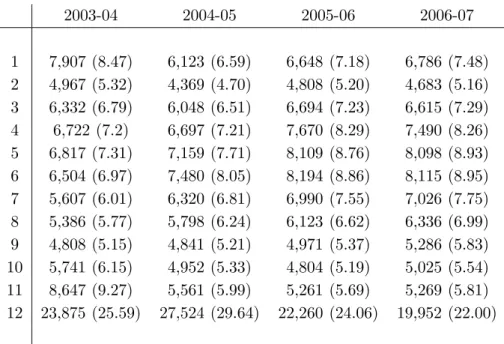
dents after the Main Round for the first four years of the new mechanism.22 In 2003-04, 31,021 students received their first choice. In 2006-07, 6,249 more students received their first choice. Moreover, the cumulative distribution in 2006-07 has a higher percentage of students receiving one of their top k choices or better (for k= 1, ...,12) than in 2003-04. In 2005-06, 38,727 students receive their top choice, the largest of the first four years, but this is partially due to a larger applicant pool. The percent of applicants is about 43%, which is almost the same percentage as in 2006-07. Note that these improvements took place without any further change in the matching algorithm.
There are many factors that might contribute to the improving performance of the match over time. For instance, guidance counselors and school officials have become more familiar with how the system works. Another change is that the city introduced extensive high school fairs, which help families determine what programs are good matches for their students. While a complete study of the factors that have led to changes in the performance of the match is beyond the scope of this paper, it is worth mentioning two factors that may have played a role.
First, the total capacity of the programs (measured by how many students were as-signed) was higher in later years than the first year. While there is considerable variation across programs, many of the highly desirable programs declared more seats in later years. For instance, Townsend Harris High School, one of the most popular screened schools, as-signed 216 applicants in 2003-04 and 346 in 2006-07. This type of change might be expected from a mechanism that produces a stable outcome, since stability removes most of the incentive to withhold positions to fill later, one of the features of the system before 2003.
The second factor is that many programs are ranking more applicants. From the first to the second year of the match, the number of students who were ranked by programs (counting a given student as many times as he is listed by some program) went from about 121,000 to about 213,000. In the old mechanism, many programs only considered students who listed them as their top choice. In the new mechanism, schools do not see how they were ranked by applicants, so some schools have to consider a larger set of applicants. Staff members at the NYC DOE have told us that after the first year, they have strongly encouraged programs to rank more applicants, so that they avoid having vacancies after the match. Many schools seem to have adapted to the new system in these two ways.
3.2
Formal theory and practical design
This paper reports both formal theory and practical design, so it is useful to take a moment to think about the close connections between the two, the gaps between them, 22
The data includes both 8th and 9th grade applicants, as well as students who rank educational option programs as their top choice, so the numbers are not directly comparable to Table 1.
and also about how these gaps might be reduced.
We study the interaction between strategy-proofness, stability, and student welfare by considering a strategic model in which the choices facing the students and schools are only what preferences to submit. As we discuss in Appendix A3, this model is a fairly close approximation—although only an approximation–to the situation facing students in NYC when they contemplate how to rank schools. The requirement that matchings be stable implicitly recognizes that students and schools may in reality have wider strategic options that allow them to match with each other outside the matching system, as they did under the prior, unstable mechanism.
Since no stable mechanism is strategy-proof for schools, but there are strategy-proof and stable mechanisms for students, there is no way to completely satisfy the two com-peting design objectives of stability and strategy-proofness for all agents. The argument for focusing on strategy-proofness for students rather than schools in NYC and in other school choice environments is not only because it lifts a burden from students and families. Economists and social planners like strategy-proofness because it yields valuable student preference data. (And in New York City, schools revealed by submitted preferences to be unpopular have been closed.23) Market designers and school policy-makers like it because it allows simple advice to be given to families about how to participate in the matching system.
For instance, NYC School Chancellor Joel Klein stated (NY Times 10/24/03) that the “changes are intended to reduce the strategizing parents have been doing to navigate a system that has a shortage of good high schools.” Furthermore, Peter Kerr, another NYCDOE official, wrote (NY Times 11/3/03): “The new process is a vast improvement... For example, for the first time, students will be able to list preferences as true preferences, limiting the need to game the system. This means that students will be able to rank schools without the risk that naming a competitive school as their first choice will adversely affect their ability to get into the school they rank lower.” In every year since 2003-04, the High School directory makes a point to advise families to express their preferences truthfully. In Boston, too, strategy-proofness was a major factor in deciding to move to a new school choice system (cf Abdulkadiro˘glu, et. al. 2006).
Moreover, the efficiency losses we calculate for students are only identifiable because we have preferences that we can take as a reasonable approximation of true preferences, since they were elicited from an algorithm that is strategy-proof for the large majority of students. As Theorem 1 makes clear, any algorithm that would improve on DA-STB from an efficiency point of view would not be strategy-proof for students. Nothing is yet known about what kinds of preferences one could expect to be strategically submitted to 23
See e.g. Elissa Gootman, ”Lafayette Among 5 High Schools to Close,” New York Times, December 14, 2006 for a report that cites demand data in the match as a reason for the closing of South Shore high school.
such a mechanism, or what their welfare consequences would be. Consequently, there is room for more work to further illuminate the tradeoff between efficiency and strategy-proofness. In particular, for what kinds of preferences will there be substantial efficiency loss with DA-STB (as in New York but not in Boston)? Can these efficiency losses in fact be reduced by alternative mechanisms? (cf. Abdulkadiro˘glu, Che and Yasuda 2008, Erdil and Ergin 2008, and Kesten and ¨Unver 2008)24
Likewise, since the mechanism in NYC is not strategy-proof for schools, it is also important to understand under what circumstances we expect schools to be able to act strategically. One design decision that reduced how much NYC schools can manipulate was to stop letting them see students’ rank order lists (see Appendix A2). Some of the remaining ways in which the mechanism is not strategy-proof for schools are ameliorated by the size of the system (Kojima and Pathak, forthcoming).25
On the other hand, for students, a feature of the information environment in NYC and Boston that market designers can not change and simply have to work with is that it is easy for parents and students to observe which schools are popular. So, a mechanism that is theoretically manipulable by moving popular schools higher in submitted preferences may in fact also be practically manipulable in this way in school choice environments.26
This comparison between students and schools suggests that a productive way for theory and practical market design to advance together as we consider mechanisms that are not strategy-proof for all agents will be to include explicit discussion about information environments. This will need to be at least partly an empirical discussion, since the most relevant kinds of manipulations may depend on what information is in fact available to participants, and what kinds of manipulations are observed in the field.27
24
Erdil and Ergin (2008) take some preliminary steps in this direction by analyzing strategic behavior in their stable improvement cycles mechanism when students have symmetric beliefs. In contrast, Abdulkadiro˘glu, Che and Yasuda (2008) and Kesten and ¨Unver (2008) study efficiency from an ex-ante point of view. In particular, Abdulkadiro˘glu, Che and Yasuda (2008) introduce signaling of preference intensities in tie-breaking to improve efficiency from an ex-ante point of view without harming students’ incentives; Kesten and Unver (2008) introduce a stable and constrained ordinally efficient lottery mechanism. Featherstone and Niederle (2008) consider another ex ante perspective on the tradeoffs between incentives and efficiency.
25
Under the old NYC system, which produced unstable outcomes, schools had an incentive not to reveal their full capacity so that they could match afterwards with preferred students. This motivation is addressed by the stability of the current system, but no stable mechanism completely eliminates the possibility of manipulation by withholding capacity (S¨onmez 1997, 1999). However Kojima and Pathak (forthcoming) show that these incentives become small as the market becomes large in an appropriate way.
26
Budish and Cantillon (2008) study the Harvard Business School allocation mechanism for MBA class as-signments. They show theoretically that it is manipulable by moving popular classes higher in the submitted rankings, and then observe empirically that it seems to be manipulated this way in practice. This is a direction in which it might also be fruitful to investigate mechanisms like stable improvement cycles.
27
In just this way, initial work on kidney exchange focused on strategy-proofness for patients and surgeons and involving patient/donor information (Roth, S¨onmez, and ¨Unver 2004, 2005). After gaining some experience
3.3
Conclusions
This paper fills in some of the new theory demanded by the design of school choice mechanisms, and shows empirically that the efficiency costs of strategy-proofness need not be small. But we are much less sure how to measure the costs of not having a strategy-proof mechanism.
When we began the design of the NYC high school match in 2003, we had a lot of highly relevant theory to draw on, but as we looked into the particular requirements of the NYC school match, we found ourselves running into problems beyond the available theory, and using data, simulations and examples to make design decisions for which no reliable theory yet existed. In the present paper, we develop some of the theory we would have liked to have in 2003, and provide support for some of the design decisions made in a more timely way on the basis of those early simulations and examples. In doing so, we raise some new theoretical questions, to which it would be helpful to have answers before the next major design (or redesign) of school matching systems.
As economists are more often asked to design practical markets and allocation mech-anisms, this kind of feedback between theory, data, and design seems likely to become familiar.
with the new multi-hospital clearinghouses that were formed, there are new incentive concerns about whether transplant centers will withhold patient-donor pairs that can be matched internally (Roth 2008).
References
[1] Abdulkadiro˘glu, Atila, Parag A. Pathak, and Alvin E. Roth (2005), “The New York City High School Match,”American Economic Review, Papers and Proceedings, May 2005.
[2] Abdulkadiro˘glu, Atila, Parag A. Pathak, Alvin E. Roth, and Tayfun S¨onmez (2005), “The Boston Public School Match,” American Economic Review, Papers and Pro-ceedings, May 2005.
[3] Abdulkadiro˘glu, Atila, Parag A. Pathak, Alvin E. Roth, and Tayfun S¨onmez (2006), “Changing the Boston Mechanism: Strategyproofness as Equal Access,” Unpublished mimeo, Harvard University.
[4] Abdulkadiro˘glu, Atila and Tayfun S¨onmez (2003), “School Choice: A Mechanism Design Approach,” American Economic Review, 93: 729-747.
[5] Abdulkadiro˘glu, Atila (2005), “College Admissions with Affirmative Action, ” Inter-national Journal of Game Theory, 33: 535-549.
[6] Abdulkadiro˘glu, Atila, Yeon-Koo Che, and Yosuke Yasuda (2008), “Expanding “Choice” in School Choice,” Unpublished mimeo, Duke University.
[7] Balinksi, Michel and Tayfun S¨onmez (1999), “A Tale of Two Mechanisms: Student Placement,”Journal of Economic Theory, 84: 73-94.
[8] Budish, Eric and Estelle Cantillon (2008), “Strategic Behavior in Multi-Unit Assign-ment Problems: Theory and Evidence from Course Allocation,” Unpublished mimeo, Harvard.
[9] Day, Robert and Paul Milgrom (2007), “Incentives in Core-Selecting Auctions,” In-ternational Journal of Game Theory, 1432-1470.
[10] Dubins, Lester E. and David A. Freedman (1981), “Machiavelli and the Gale-Shapley Algorithm,”American Mathematical Monthly, 88: 485-494.
[11] Ehlers, Lars (2006), “Respecting Priorities when Assigning Students to Schools,” CIREQ, February 2006.
[12] Erdil, Aytek (2006), “Two-sided Matching with Ties.” University of Chicago, PhD Dissertation submitted to the Department of Mathematics.
[13] Erdil, Aytek and Haluk Ergin (2008), “What’s the Matter with Tie-breaking? Im-proving Efficiency in School Choice,”American Economic Review, 98: 669-689. [14] Featherstone, Clayton and Muriel Niederle (2008), “Manipulation in School Choice
Mechanisms,”working paper, Stanford.
[15] Gale, David and Lloyd Shapley (1962), “College Admissions and the Stability of Marriage,”American Mathematical Monthly, 69: 9-15.
[16] Haeringer, Guillaume and Flip Klijn (2006), “Constrained School Choice,” Unpub-lished mimeo, Universitat Aut´onoma de Barcelona.
[17] Kesten, Onur (2004), “Student Placement to Public Schools in the US: Two New Solutions,” Unpublished mimeo, University of Rochester.
[18] Kesten, Onur and ¨Unver, M. Utku (2008), “A Theory of School Choice Lotteries: Why Ties Should Not Be Broken Randomly,” Unpublished mimeo, Carnegie Mellon University and Boston College
[19] Kojima, Fuhito and Parag A. Pathak (forthcoming), “Incentives and Stability in Large Two-Sided Matching Markets,” American Economic Review.
[20] Pathak, Parag A. (2006), “Lotteries in Student Assignment,” Unpublished mimeo, Harvard University.
[21] Pathak, Parag A. and Tayfun S¨onmez (2008), “Comparing Mechanisms by their Vulnerability to Manipulation,” Unpublished mimeo, MIT.
[22] Roth, Alvin E. (1982), “The Economics of Matching: Stability and Incentives,”
Mathematics of Operations Research, 7: 617-628.
[23] Roth, Alvin E. (1984), “The Evolution of the Labor Market for Medical Interns and Residents: A Case Study in Game Theory.” Journal of Political Economy, 92: 991-1016.
[24] Roth, Alvin E. (1985), “The College Admissions Problem is Not Equivalent to the Marriage Problem,”Journal of Economic Theory, 36: 277-288.
[25] Roth, Alvin E. (1991), “A Natural Experiment in the Organization of Entry Level Labor Markets: Regional Markets for New Physicians and Surgeons in the U.K.”
American Economic Review, 81: 415-440.
[26] Roth, Alvin E. (2002), “The Economist as Engineer: Game Theory, Experimental Economics, and Computation as Tools of Design Economics.” Econometrica, 70: 1341-1378.
[27] Roth, Alvin E. (2008), “What Have We Learned from Market Design?” Economic Journal, 118: 285-310.
[28] Roth, Alvin E. and Elliot Peranson (1999), “The Redesign of the Matching Market for American Physicians: Some Engineering Aspects of Economic Design.”American Economic Review, 89: 748-780.
[29] Roth, Alvin E., Tayfun S¨onmez and M. Utku ¨Unver (2004), “Kidney Exchange.”
Quarterly Journal of Economics, 119: 457-488.
[30] Roth, Alvin E., Tayfun S¨onmez and M. Utku ¨Unver (2005), “Pairwise Kidney Ex-change,” Journal of Economic Theory, 125: 151-188.
[31] Roth, Alvin E. and Marilda Sotomayor (1990), Two-Sided Matching: A Study in Game-Theoretic Modeling and Analysis, Cambridge: Cambridge University Press. [32] S¨onmez, Tayfun (1997), “Manipulation via Capacities in Two-Sided Matching
Mar-kets,”Journal of Economic Theory, 77: 197-204.
[33] S¨onmez, Tayfun (1999), “Can Pre-Arranged Matches be Avoided in Two-Sided Matching Markets?” Journal of Economic Theory, 86: 148-156.
Appendices
A1. Proofs from Main Text
Proof of Proposition 1. Suppose that µis a student-optimal stable matching for the profile (PI, RS). Construct PS from RS as follows: For every i, j such that µ(i) 6=µ(j)
and i∼µ(i) j, let iPµ(i)j. The tie breaking among other students can be done arbitrarily.
Then the student-proposing deferred acceptance algorithm producesµfor (PI, PS).That
is, µ is the unique student-optimal stable matching for some (PI, PS) such that PS is
consistent withRS.Then, from Roth (1982), there is no matchingν (stable or not) that
is individually rational under (PI, PS) and ν(i)Piµ(i) for all i∈I.
To the contrary, suppose that there is a matchingν that is individually rational under (PI, RS) and ν(i)Piµ(i) for all i ∈ I. Since PS is consistent with RS, ν is individually
rational under (PI, PS) as well. Thenν(i)Piµ(i) for alli∈I contradicts withµbeing the
student-optimal stable matching for (PI, PS). ⋄ Proof of Proposition 2. The result will directly follow from showing for every preference profile (PI, RS) and every student-optimal stable matching µ for that preference profile,
there is a single ordering of students r such thatDAr(P
I, RS) =µ.
Suppose thatµis a student-optimal stable matching at some (PI, RS). For each school s, consider the students who prefer sto their assignment in µ and are ranked highest in
Rs among such students,
B(s) ={i:sPiµ(i) and iRsj for everyj such thatsPjµ(j)}.
LetB(S) =∪sB(s).
LetA be the set of students in B(S) who are assigned to a school underµ: A={i∈
B(S) :µ(i)∈S}. A stable improvement cycle consists of students{i1, ..., in} ⊂A, n≥2,
such that il ∈B(µ(il+1)) and µ(il+1)Pilµ(il) for l = 1, ..., n where l+ 1 is replaced by 1 whenl=n(Erdil and Ergin, 2008). Sinceµ is student-optimal, there does not exist any stable improvement cycle (Corollary 1, Erdil and Ergin, 2008).
Construct a directed graph with vertices (nodes) A and a directed edge from node i
to node j if µ(j)Piµ(i) and jRµ(j)i; that is, i envies j’s school place and the school j is
assigned to is indifferent betweeniand j. Since there is no stable improvement cycle, the directed graph must be acyclic.
We will construct an ordering based on this directed graph utilizing two properties of the graph. First, there is a node with no incoming edges. To see this, suppose that every node has at least one incoming edge. Then since there are a finite number of nodes, starting from any node we can always leave a node by an incoming edge until we return to a visited node, which leads to a cycle, and a contradiction. Second, after removing a
node, we still have a directed acyclic graph, since if there is a cycle after removing a node, then there must be a cycle in the original graph.
Construct an ordering ρ : A → {1, ...,|A|} as follows: find a node with no incoming edges. Remove this node and all its outgoing edges. Set the value ofρof this node to|A|. By the two properties above, when we remove this node we still have a directed acyclic graph and there will be a node with no incoming edges. From this graph, we iterate the process and set the value ofρ of the next node to|A| −1, and so on.
Next, construct an ordering r:I →Nof students as follows:28 For everyj, k ∈A, set
r(j)< r(k) if ρ(j)< ρ(k). For every i∈I−B(S) and j∈A, setr(i)< r(j). Finally, for every studentl∈B(S)−A, set r(j)< r(l) for all j∈A.
Let ν =DAr(P
I, RS). We will show that ν =µ. Suppose to the contrary that there
existsj ∈I such that µ(j) 6=ν(j). Since µis student-optimal (and since students’ pref-erences are strict), there exists somei∈I such that µ(i)Piν(i). LetC ={i:µ(i)Piν(i)}
be the set of students who prefer µ to ν. For any ik ∈ C, let ik+1 = ν(µ(ik)), or ν(ik+1) =µ(ik). Sinceν is stable, there is no blocking pair, so ik+1Rµ(ik)ik.
The proof by contradiction has three steps. First, we will show that for any ik ∈C,
the student who is matched to µ(ik) underν, ik+1, also prefers her assignment under µ
toν and so is in C. Next, we will show that in the course ofDAr(P
I, RS), studenti∈C
can only be displaced by some other student in C. Finally, we argue that ik could have
displaced ik+1, only if ik+1 were displaced herself. Therefore, no member of C can be
rejected first, and soC must be empty.
To show the first step, note that µ(ik+1) 6= ν(ik+1). Suppose that ν(ik+1) =
µ(ik)Pik+1µ(ik+1).Then ikRµ(ik)ik+1 by stability of µso that by constructionik+1∼µ(ik)
ik. But then ik+1 ∈ B(µ(ik)) so that r(ik) < r(ik+1). Then since ik ∈ C, µ(ik) = ν(ik+1)Pikν(ik), which contradicts with stability of DA
r(P
I, RS) = ν. Therefore µ(ik+1)Pik+1ν(ik+1),so ik+1 ∈C.
We prove the second step by contradiction. Suppose that there is some i ∈ C and
j∈I−C such thatµ(i)Pjν(j) andjRµ(i)i.Sincej ∈I−C,we haveν(j)Rjµ(j) therefore µ(i)Pjµ(j). Then stability of µ implies that j ∼µ(i) i, which in turn implies that j ∈
B(µ(i)) so that r(i) < r(j). Therefore, no i ∈ C is rejected by µ(i) in DAr(P
I, RS) in
favor of anyj∈I−C such thatµ(i)Pjν(j). This implies that every i∈C is rejected by µ(i) in DAr(P
I, RS) in favor of some i′ ∈C− {i}.
Finally, in the process of DAr(P
I, RS), no ik ∈ C will be rejected by µ(ik) before ik+1 = ν(µ(ik)) is rejected by µ(ik+1). Therefore, no i ∈ C will be rejected by µ(i) in
DAr(P
I, RS),so thatC =∅,i.e. ν(i)Riµ(i).Then optimality ofµimpliesν(i) =µ(i) for
alli∈I. ⋄
28
Recall that lower numbers means a student is more preferred, i.e. r(i) = 1 means that studentiis the most preferred student.
A2. Description of New York City High School
Admissions
Each fall, about 90,000 eligible students are asked to work with their families and guidance counselors to fill out a high school application form for the following school year. Nearly 95% of students who participate in the admissions process are 8th graders, and the rest are 9th graders, many of whom were enrolled in middle schools that include grade 9. Students receive their application in early October and the rest of the fall is devoted to gathering information about various school options. Typically, in late October or early November, students who are interested in attending one of the Specialized High Schools29 in New York City take the Specialized High School Admissions Test (SHSAT). Between 25,000 and 30,000 students take the SHSAT exam every year. The Specialized High Schools account for between 4,000 and 5,000 school seats a year.
In late November or early December, all students are asked to rank up to twelve schools/programs on the High School Application form. Students who have taken the SHSAT also may submit a separate rank order list expressing their preferences for spe-cialized high schools.
Besides the specialized schools in New York City, there are three types of schools, known as mainstream schools: 1) schools that actively evaluate applicants and submit a ranking to the mechanism, 2) schools that do not evaluate applicants, and instead employ priorities, which are determined not at the school, but by the Department of Education, to order students and 3) schools at which a fraction of seats are reserved for students who are explicitly ranked by the school, while the rest are automatically categorized into priority groupings set by the DOE.
“Screened” and “audition” schools are examples of the first type of school, at which staff review applicants based on criteria ranging from 7th grade academic performance, attendance and disciplinary actions to auditions, portfolio submissions, and interviews.30 “Unscreened” schools are examples of the second type of school. Priorities include ge-ographic location, current middle school, or other criteria.31 Finally, the third class of 29
Specialized High Schools include Brooklyn Technical, High School (HS) of Math and Science at City College, Stuyvesant, Queens HS for Science at York College, HS of American Studies at Lehman College, and the Bronx HS of Science. Fiorello H. LaGuardia HS of Music & Art and Performing Arts is also a Specialized High School where entrance is determined by audition and a review of academic records. After the new matching mechanism was adopted for the 2003-04 school year, Staten Island Technical High School and Brooklyn Latin School also became Specialized High Schools.
30
For example, Townsend Harris in Flushing NY, one of the most academically rigorous screened schools, evaluates students based on their test scores, attendance and punctuality. At Towsend Harris, all students are required to have a minimum 90th percentile on Math and Reading standardized tests as well as a minimum grade point average of 90 in June of 7th grade when being considered for a 9th grade seat.
31