l
Marcelo Arancibia, Iván Oliva & Francisco Paiva
Valdivia (Chile)
Meaning Processes mediated through
a Protagonists’ Collaborative
Learning Platform
Procesos de significación mediados por una plataforma de aprendizaje
colaborativo desde los protagonistas
v Dr. Marcelo Arancibia-Herrera is Professor in the Faculty of Philosophy and Humanities at the Universidad Austral de Chile (Chile, South America) ([email protected]).
v Dr. Ivan Oliva-Figueroa is Professor in the Faculty of Philosophy and Humanities at the Universidad Austral de Chile (Chile, South America) ([email protected])
v Francisco Paiva-Cornejo is Psychologist and Research Scholar in the Graduate School of the Faculty of Philosophy and Humanities at the Universidad Austral de Chile. (Chile, South America) ([email protected]).
DOI: http://dx.doi.org/10.3916/C42-2014-07
ABSTRACT
The use of Information and Communication Technologies (ICT) in the classroom requires the creation of contextua-lized proposals which foster in students collaboration and the use of resources to hand. This paper shows the results obtained in the analysis of the signification process which teachers and students have built through their participation in a project implementing collaborative didactic designs using ICT, in particular social networking. Focus groups were for-med with 102 students and interviews with 21 teachers took place in two stages (pre- and post-), and they participated in 21 learning experiences developed at 12 schools in southern Chile. Main results reveal a positive assessment of the experience related to the motivational effects of the use of ICT and social networking among students; a considerable change in the didactic interaction inside the classroom; an interest in the possibility of collaborating with students from different contexts and from different regions; a lack of knowledge of the Web 2.0 resources available on the part of teachers, and some negative considerations on the inappropriate use of the Internet. In conclusion, the meaning-creation process of the protagonists enabled this study to gain relevant qualitative information related to didactic, technological and logistic factors in the development of learning experiences through a virtual learning platform.
RESUMEN
El uso de tecnologías de la comunicación (TIC) en el aula escolar requiere la creación de propuestas contextualizadas que fomenten la colaboración y el uso de recursos cercanos a los estudiantes. El presente artículo muestra los resultados asociados a los procesos de significación, que profesores y estudiantes construyeron desde su participación en un pro-yecto en el que se implementaron diseños didácticos colaborativos con uso de TIC, en particular de redes sociales. Se efectuaron grupos focales con 102 estudiantes y entrevistas en profundidad a 21 profesores, en dos momentos (pre y post), quienes participaron de 21 experiencias didácticas ejecutadas en 12 colegios en el sur austral de Chile. Los prin-cipales resultados revelan que existe una alta valoración de la experiencia vinculada principalmente a los efectos moti-vadores que provocan las tecnologías y redes sociales en los estudiantes, el cambio en la interacción didáctica al interior de las aulas, el interés ante la posibilidad de colaborar con estudiantes de otros contextos escolares geográficamente dis-tantes, el desconocimiento, por parte de profesores, de los recursos de la Web 2.0 y aprensiones ante el uso indebido de los recursos que provee Internet. En conclusión, la investigación permitió levantar desde los procesos de significación de sus protagonistas, información cualitativa relevante en torno a las implicancias didácticas, tecnológicas y logísticas de la ejecución de experiencias de aprendizaje colaborativo mediadas por una plataforma virtual de aprendizaje.
KEYWORDS / DESCRIPTORES
Web 2.0, social networking, ICT, collaborative learning, digital competences, learning, virtual platform. Web 2.0, redes sociales, TIC, aprendizaje colaborativo, competencias digitales, aprendizaje, plataforma virtual.
Comunicar, n. 42, v. XXI, 2014, Media Education Research Journal; ISSN: 1134-3478; pages 75-85
Accepted: 01-08-2013 / Preprint: 15-11-2013 Published: 01-01-2014 / RECYT Code: 21878
1. Introduction
In many countries educational innovation proces-ses have mainly focused on the successful introduction of ICT in schools. Although technological needs are partially covered in school learning, there are still pro-blems with the adoption of digital competences on the part of teachers and students (Gutierrez & Tyner, 2012). Nevertheless in Chile, «several studies showed a very low degree of transformation in school and classroom practices, and the same actors of the system perceived the poor impact of the policies implemen-ted» (Enlaces, 2010: 81). This shows how complex it is to introduce ICT in a school system where ana -chronistic structures continue to resist innovative pro-cesses.
Diverse authors (Arancibia & al., 2010; Sigalés & al., 2009) coincide that the process of adaptation and adoption of ICT in the school context has been diffi-cult due to their multidimensional characteristics. On the other hand, to implement an educational proposal for ICT use requires taking into consideration the Social Web, because its character has transformed all the didactic strategies planned before its emergence, forcing a rethink of pedagogical practices. Contreras et al. (2009) show that this change essentially transforms interaction as the students transit from a Web dedica-ted to reading to one that is a mixture of reading and writing, creation and publication; from readers they become authors, thus transforming the mediations be -tween users and content.
Even though several papers exist on the use of tools on the Social Web for learning, little has been said about the experiences of applying them to lear-ning platforms in schools oriented to the assessment of the observations of students and their experiences of learning mediated by ICT (Tay & al., 2013).
In that sense this paper emphasizes the voice of teachers and students, the actors that are mainly ig -nored by public policy makers but who will be expec-ted to meet their demands.
2. Signification processes in the use of ICT in stu-dents and teachers
In general the relationship between ICT and tea-chers is analyzed as an isolated action, as if this rela-tionship with these technologies was merely as techni-cians disconnected from global society and the social and cultural environment. Yet this link is complex; it includes actors, rules and emotions that constantly influence this process. In this sense it is very difficult to clarify the influences of actors and the school commu-nity when identifying the factors involved in ICT use
(Valverde & Fernández, 2013). Following these ideas, the issues that influence the relationship between ICT and teachers have to do with cultural factors, training, identity, interest and management. Mominó and others (2008) organized those factors into two catego-ries: the first connected to situations of access, connec-tions, software, time and technical and administrative support, tasks that do not depend directly on the school staff but which influence the willingness and interest they show; the second category refers to the influence of the beliefs of the school staff regarding ins-truction and learning with ICT. In this sense, modif-ying practices is a difficult task because of the difficulty entailed in the conceptual change and the deeply held theories that lie behind the didactic action (Schnotz & al., 2006).
According to the previous classification by adding other perspectives we can interpret that the behavior underpinning the relationship between teachers and ICT is extremely varied and influenced by different factors in school culture. At the same time authors like Cebrián (2005) demand an ideal profile of the teacher who must take ICT into consideration in the exercise of his profession.
The existing relation between students and ICT also corresponds to a complex scenario because many of the characteristics originate outside the school. At present, the process of ICT adoption in adolescents is automatic (Erstad & al., 2013). Children and youngs-ters are surrounded by information that comes from the television and Internet.
Even though the school represents a very impor-tant place for connection to the Internet and use of resources for both wealthy and more vulnerable chil-dren, the research carried out by PNUD (2006) shows a social divide in terms of usage that amounts to a step backwards in students’ acquisition of knowledge in school, transforming the most vulnerable users who were previously active into potential functional digital illiterates (Arancibia, 2004).
Colás and collaborators (2013) state that there are cultural and social conditions that influence interest and characteristics in the use of the Web, which opens up an interesting space when identifying how to include educational activities according to expected outcomes and the way to present them, that is to say, according to the role of the school as an important place for diminishing social divides.
3. Collaborative learning mediated by ICT
Recent studies on collaborative learning mediated by ICT are centered more on interactions than on © ISSN: 1134-3478 • e-ISSN: 1988-3293 • Páginaa 75-85
Comunicar,
42,
XXI,
effects. The idea of collaborative learning is «to deve-lop ways to increase the probability that those types of interaction might occur between students with greater potential from the point of view of the process of the joint construction of significance» (Onrubia & al., 2008: 234). Therefore, it is vital to know what makes teacher and students decide on the practical uses of ICT in the classroom, and to ascertain their ex-post assessment of that usage.
In the last five years, the influence of Web 2.0 has given us the clue to understanding collaboration in the learning processes mediated
by ICT because it enables a two-way relationship by means of the utilization of collective intelligence in which the user provides the content. The Social Web offers new opportunities to participate in collaborative learning activities (Crook & al., 2008), which re -inforces a demand for a new pedagogy (Grenfell, 2013) that not only facilitates the creation of individual content but also encourages sharing and co-building, which in turn will increase the possibility of peer evaluation based on the
evi-dence of the joint construction of learning. We cite what Crook (2012:64) said in relation to learning pat-terns that facilitate the use of the Social Web in the classroom: 1) Investigate (research): it creates new structures for data organization, it searches for new sources and tools to enable access to information that is varied and plural; 2) Literate: digital media offer new ways to represent and offer tools that encourage the development of new ways of expression; 3) Collaborate: the concept of joint activity expands and remains flexible as it is based on the coordination that exists within the structures of participation in the net-work, it also offers new tools that facilitate intimate and intense collaborative activities. 4) Publish: The Web 2.0 platform en courages users to create material for use on the social networks.
4. The Kelluwen Experience
Kelluwen proposes implementing Collaborative Didactic Design (CDD) with the use of Web 2.0 resources. This didactic-methodological proposal encourages classroom work with tools from the Social Web and a virtual platform (www.kelluwen.cl/app).
It this virtual space, teachers can consult and use 16 CDDs that work with regular curriculum units. Although the topics presented are in accordance with those proposed by the Ministry of Education, the didactic aim goes further by incorporating a creative and dialog-like use of Internet resources. The CDD selects an app from the Social Web and converts this tool into an active part of the school scenario.
Kelluwen proposes a B-learning modality (Bartolomé, 2004) because it is an initiative that seeks to revitalise the classroom by means of the pedagogical
conditions and infrastructures that this presents. Thus, the proposal combines classes in the computer lab, in a regular classroom and, potentially, at home, so that the technology becomes a support to learning that takes place in different locations.
Collaboration and a deeper horizontal relationship between professor-student is a central purpose of this model. The collaboration is played out in two spaces: the development of group activities where 3 to 5 stu-dents participate, the twin classroom relationship in which work using the same CDD is carried out in dif-ferent geographical points. The twin classroom set-up enables students to evaluate and express their opinions of other students’ work based on the evidence of lear-ning. This work is guided by a rubric provided by the platform, coordinated by automatic devices that allow them to follow the progress of the groups and the gra-ding of their peers at the same stage of progress in the CDD.
All this is evidence that the learning process is an act of dialog-like collaboration (Aubert & al., 2011) that happens inside and outside the classroom. When a stu-dent carries out a task in the classroom he in teracts
Comunicar,
42,
XXI,
2014
In the last five years, the influence of Web 2.0 has given us
the clue to understanding collaboration in the learning
processes mediated by ICT because it enables a two-way
relationship by means of the utilization of collective
intelli-gence in which the user provides the content. The Social
Web offers new opportunities to participate in collaborative
learning activities.
© ISSN: 1134-3478 • e-ISSN: 1988-3293 • Pages 75-85
Comunicar,
42,
XXI,
2014
directly with his teacher and peers, and the product of this task will also be eviden-ce of learning shared and evaluated among peers.
The CDD used makes for a located didactic expe-rience that provides the modelling for the
collabora-tive activities among peers and with twin classrooms, where the student must self-regulate his learning pro-cess in relation to the tasks he carries out with others (Álvarez, 2009), this being an interaction that happens in the virtual thread of the Kelluwen platform.
In this way the proposal aims to stimulate the development of disciplined content, starting from the creation of evidence of learning through the procedu-res of search, selection, construction and publication (Crook, 2012). Learning, as seen this way, is an exer-cise associated to the capacity of the students to colla-borate in the elaboration of the product that can be seen on Web 2.0. For example, a video produced by students in Valdivia City, the capital of the region of rivers in Chile, can be seen and commented on by stu-dents in a rural location like Hualaihué, 300 kilometers away.
To meet the central objectives of Kelluwen, this research presents and analyzes some interesting quali-tative information oriented to observation that charts the feelings and contributions of students and teachers from different units associated with the project.
A series of interviews and focus groups implemen-ted in 2010-2011 were analyzed in relation to the didactic, technological and logistical implications of the process of carrying out the CDD.
5. Method
The study should be understood as an observation of the second order, based on the observers’ observa-tions and their remarks. Following Arnold (2004), the nucleus of interest was to observe what those obser-ved state and describe, «what they observe», also taking into account how they classify such remarks and differentiations, «how they observe». In this sense, the macro-orientations centered on the beginning of synergy, based on the identification of related sets of distinctions and not only on the analytical and causal reduction of components and outlying processes. That is to say, remarks that support a few in relation to others in the context of the qualitative implications associated with the implementation of DDC supported by the Web 2.0 in school classrooms.
5.1. Resources for the generation of information
The strategies for the generation of information contemplated in-depth interviews with teachers and focus groups with students from the schools in the pro-ject (Table 1).
The development of in-depth interviews and focus groups was defined within the framework of communicative control but not by managing events, rather by stimulating the processes of observation on each communicative level of the study. The interview processes were, therefore, flexible and dynamic, invol-ving a conversation opened by talking about risks (Taylor & Bogdan, 1987). The focus groups, conside-ring students’ enthusiasm for multi-criteria construction and for their potential for participation and self-know-ledge, made it possible to turn these discussion groups into dynamic devices for self-reflection (Thorn, 2007).
5.2. Criteria for the selection of the key informants
Considering the predominantly qualitative nature of the study, a structural selection of informants was carried out, to include teachers and students from 7th to 10th grade at educational establishments involved in the Kelluwen project in 2010-2011.
5.3. Communicative levels of the phase
The communicative levels were defined as the pertinent spaces of communication for the study, in this case, all those topics that generated meaning for the key informant in the context of his participation in the project. This implies that the processes of distinc-tion that were to the base for the remarks of the infor-mants were those that were fixed by them; they thought about the aspects of 2.0 that would generate meaning for students and teachers in the communica-tive context opened up by the qualitacommunica-tive implications associated with the implementation of didactic strate-gies supported by the Web in every context.
5.4. Analysis and interpretation of the information
The interviews and focus groups were transcribed in their entirety, respecting the informed consent of the reporters and protecting the identity and remarks made
Comunicar,
42,
XXI,
2014
by these subjects. First, a codification process was ini-tiated that complemented strategies of an inductive and deductive nature. To do so, a counterfoil of codes was generated deductively, which was projected from the principal theoretical bases of the project (with emphasis on the dimensions associated with the tech-nological mediations and their implications in the dyna-mics of learning), and inductively, from the preliminary analysis of qualitative regularities and the appearance of emergent categories from the diverse expressions and representative remarks at each stage of the project and from the relative structural position of the infor-mants (students and teachers).
From the convergence of these instances, we developed a coding process that enabled the final two levels of analysis. First we analyzed and compared the frequency distribution with the aim of characterizing diachronically the observational field which moved the distinctions generated by key informants as a way of contrasting pre- and post- project.
Secondly we analyzed the effects of association of the codes from a systemic perspective. The criteria used as an indicator for the association was the co-occurrence of codes within the same semantic field, the latter defined as each unit of intervention from an informant in the context of a specific question. The Jaccard coefficient (0.00001 tolerance) was the speci-fic indicator or occurrence of adjacent overlapping segments, which was the basis for the construction of dendrograms and global interaction network codes.
The complementary methodological and interac-tion frequency analysis of observed codes assumes communicative events not only of relevant frequency diversity and coding, but also the effects of the interac-tion of these elements on the meaning of complex net-works of observation.
6. Results
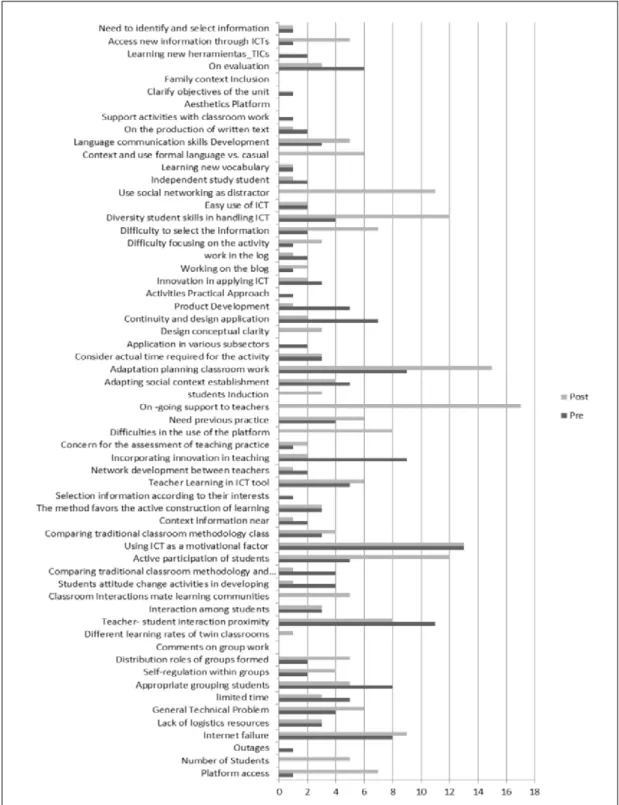
Figure 1 presents a diachronic analysis frequency coding of the interviews comparing the pre- and post-project instances and then the co-occurrence.
6.1. Diachronic analysis of frequency coding: teachers
According to Figure 1, based on the coding of interviews prior to the project, in relation to the expec-tations of teachers regarding their participation in the project we observed a high frequency of codes asso-ciated with innovation processes in teaching and the updating of new learning tools. Another predominant factor in teacher observations of design-based digital platforms relates to the expectations of participants
regarding the influence of this methodology in stimula-ting students, in which they specifically highlighted the positive effects on motivation attributed to work with ICT.
We can point to the expectations related to skills that students display in the management of ICT tools, in which there is a perceived expectation of the advan-ced knowledge of these tools in the youth population in contrast to the skills of the adult population. Another category reiterated by teachers in this first interview was the grouped observations related to the induction and training needs of teachers for the implementation of the project. In this dimension, some teachers men-tioned the importance of carrying out higher-level pre-practice activities with students.
In the post-implementation phase there were simi-larities to pre-implementation but also some differen-ces; new categories of analysis emerge that reflect gra-dual differences compared to the initial observations. First, teachers reinforce expectations about students’ motivation for using ICT. This is complemented by observations related to «active student participation» which translates into behavior observed by teachers that link the motivation of their students to the «adjust-ments» or to CDD flexibility.
Also, with the expectation of the ease with which students work with ICT, there emerge differences that involve a broad and diverse range of these abilities, suggesting that these would not be consistent across the study population. At the same time, there are new differences that shape the analysis categories related to the needs and difficulties faced by teachers in imple-menting the project and the need for continued sup-port to solve those problems, mainly «technical», in managing the platforms or software.
Teachers make observations related to the propo-sed Kelluwen communicational space, which include occasional difficulties with the informal language used by students. Together with this, teachers perceived that the use of social networks, given their potentially distracting characteristics, sometimes make classroom work difficult.
6.2. Diachronic analysis of frequency coding: Students
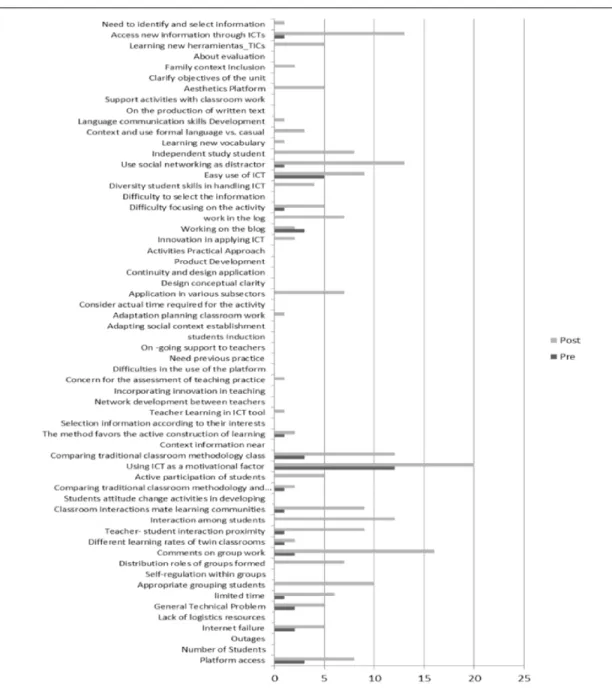
Figure 2 identifies those categories that occurred most frequently in the case of students. In the instance of pre-project monitoring it was possible to encode marginal discursive elements with little regularity, sig-naling a weak substrate of significance about the pro-ject obpro-jectives and didactic nature. However, there emerges a high valuation of the «use of ICT as a
moti-© ISSN: 1134-3478 • e-ISSN: 1988-3293 • Pages 75-85
vational factor» alluding to the students demonstrating a preference for this type of interactive tools. This identifies the expectation of ease of use for learning mediated by ICT tools.
In the post-instance phase significant differences
emerge after the previous instance that have various qualitative implications post-implementation. The use of ICT as a motivational factor and ease of use of ICT regularly appear in the second assessment with stu-dents. This is complemented with observations
com-Comunicar,
42,
XXI,
2014
Comunicar,
42,
XXI,
2014
paring this collaborative methodology to the expository dynamic of a traditional classroom.
Another prominent category is related to the sense of student self-employment that enabled this methodo-logy, which is an aspect assessed according to the diversity of skills that students have in the use of these tools and the ability to regulate their own learning. In addition, students also noted as a strength the access to information by using interactive tools.
One important issue is related to the effects on the interaction between students and the relationship with
their teacher; this students emphasize that this metho-dology produces a more favorable climate in the class-room. In terms of the students working in groups, it is possible to observe meanings related to the formation of groups and organizational forms within the groups, and there were cases where the work experienced was deemed to be unbalanced as a result of the func-tions distributed within the group.
Finally, comments emerge on the use of social net-works in project activities, which some claim impeded the progress of the group given their distracting nature.
© ISSN: 1134-3478 • e-ISSN: 1988-3293 • Pages 75-85
Comunicar,
42,
XXI,
2014
6.3. Interaction analysis (co-occurrence) coding
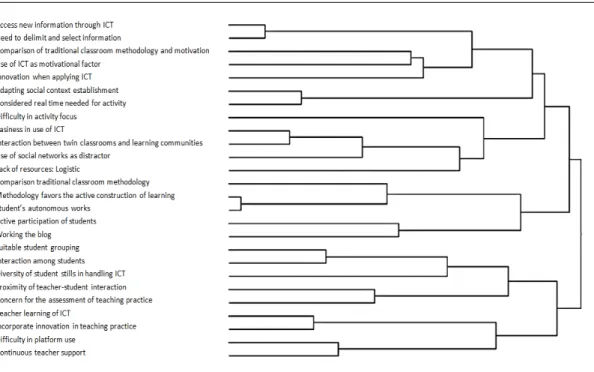
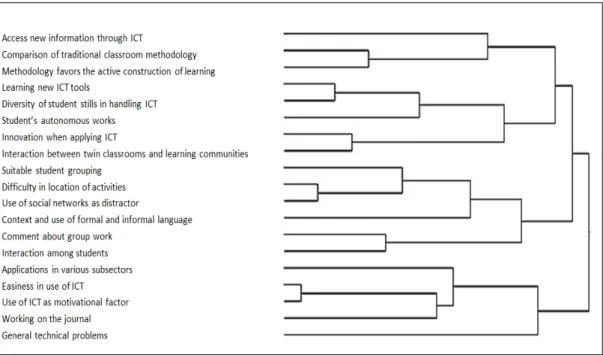
Expanding and complementing the coding fre-quency analysis, we ran an analysis of patterns of asso-ciation between codes using as an indicator the coding of co-occurrence events. When analyzing the categories presented, it is possible to observe recurrent inter -actions between the various codes, while maintaining regularities throughout the investigation or by genera-ting mainstreaming in the groups of teachers and stu-dents.
From the teaching perspective (figure 3), it is impor-tant to note the close interaction of the co-occurrence of the codes «Access to new information through ICT» and «Need to delimit and select information». This involves a significant tension between the dimensions of access and organization of information in pedagogical terms. At the same time, teachers and students also highlight the fact that the platform allows greater access to informa-tion, but, according to the teachers, this is also in corre-lation to the difficulty entailed in analyzing and organizing information appropriately.
There also emerges a significant relationship be -tween the codes associated with the «active construc-tion of learning» and «student self-employment». In this sense, we could identify a trend that is a focus of interaction based on learning for which the approa-ches of teachers are consistent with an overview of the methodology that favors the collaborative building of knowledge.
At the same time, both teachers and students (figu-re 4) make observations on the ease of use of ICT for young people which were significantly associated with the notion of ICT use as a positive factor in the moti-vational dimension. Students in particular make com-parisons between the project methodology of the expository practices, emphasizing their participatory and autonomous characteristics.
Another analysis domain was associated to the idea of «Student ease of use of ICT» in relation to «twin classroom interaction and learning community». This suggests the importance of the skills of young people in the management of technology as an enabler of learning interaction phenomena and of coping with increasing degrees of complexity and interest in ICT-mediated peer contact.
Also, ICT management skills are far from homoge-neous in the study population, and teachers express the need to consider the timing required to complete the activities, referring to the different learning rates of participating students. Finally, there is an association shared by teachers and students in their observations on group work by students and the use of social net-works as a development distracter for focusing activity sessions.
7. Discussion and conclusions
Both points of the analysis revealed high expecta-tions of the positive effects of the use of digital
forms in motivating students: «I feel a sense of renewal in my profession, I have always been permanently in training and I think I have not done so for the past two years, (...) I am eager to continue in training, knowing new ways of working with this virtual learning, which I find complicated right now».
Teachers observe this motivation through the ac -tive participation of students. This is consistent with the observations of students through comparisons be -tween these methods and the traditional expository methodology. They highlight active participation in the project, revealing glimpses of a new emerging lear-ning-oriented pedagogy (Grenfell, 2013). Likewise, they identify some strengths of the DDC that promote an active and collaborative construction of knowledge (Onrubia & al., 2008). In this sense, the ability to select information according to their own interests plays an important role: «It’s just so good for students, it is attractive; it’s boring for them to be in a class where the teacher is explaining a Power Point presen-tation or something like that. So this makes it a much more participatory experience, which raises questions and stimulates them to get together as a group to res-pond».
So students associate this feature of the participa-tory methodology with a higher degree of self-regula-tion and autonomy in their work. In this sense, they value the autonomous work that Kelluwen enables, as they may advance at their own pace and regulate their own learning (Álvarez, 2009). However they
recogni-ze, together with teachers, that sometimes the simulta-neous use of social networking disrupts the sequence CDD development.
Another expectation shared by teachers and stu-dents relates to the skills that stustu-dents have today to handle ICT tools in the second assessment; both tea-chers and students observe that these skills are different and that these characteristics are not homoge -neous in the study population, which affects the possi-bilities for interaction in the joint-construction proces-ses of learning, so the tasks required in school are not comparable to the intuitive learning young people acquired on the social web (Erstad & al., 2013 ). This emphasizes, for example, aspects related to social sta-tus in relation to the resolution of technology jobs (Colàs & al., 2013), which potentially contributes to the configuring of functional informational illiterates (Arancibia, 2004).
From a collaborative perspective, teachers and students agree that CDD favors varying degrees of interaction among them. Students in particular observe positive effects in the interaction with their peers. In this dimension, for example, teachers and some stu-dents found that group formation for the development of group work was adequate, referring to the process of diagnosis made in the first session. Students note the positive effects of the interaction between students participating in the project. However, there were some negative experiences in which they observed that the formation of groups did not help in the internal
Comunicar,
42,
XXI,
2014
distribution of tasks. However, collaboration is not a substantive element and it was not highlighted expli-citly, but rather through the transformation of modes there emerged closer interaction between students and teachers with the formation of working groups.
Informants also noted that the platform offers stu-dents greater access to information, but as teachers noted, it entailed difficulties in the ability to select, organize and analyze data pertinently: «The selection of information was a little slow, perhaps because they are unaccustomed to this kind of work », «Maybe what they find most difficult is the ability to analyze informa-tion, to summarize it in their own words; at this point, they have not yet developed that skill».
It also emerges from teachers’ observations is the epistemological tension between access to information and knowledge organization and ICT-mediated lear-ning spaces, as to the «need to limit and select informa-tion beforehand» thus observing tradiinforma-tional teaching beliefs that still underlie innovation (Schnotz & al., 2006).
According to the purpose of the research -oriented to survey and analyze qualitative information relating to the schemes of observation, meanings and contribu-tions of students and teachers- we can conclude that the significance processes of the actors tended to gra-vitate to the teaching implications, technology and logistics for implementing collaborative learning expe-riences mediated by ICT. In convergence with the theoretical framework of the research, beyond the face value of the results presented, it was possible to characterize the observational matrices that shape school culture in terms of innovation which meant the use of social web content and methodology (Crook & al., 2008), as well as the emerging collaborative dyna-mics and critical position in relation to the technologi-cal imperative representing contemporary digital hypermediacy (Contreras & al., 2009).
As a limitation of the research it is necessary to cla-rify that Kelluwen is an experience that is part of an overall approach to ICT-mediated collaborative lear-ning. However, it has specific theoretical, operational and contextual specifications that preclude a generali-zation or replication of the results beyond the record qualitative research paradigm in which it was enrolled. In terms of projections, it is necessary to continue to nurture a research program aimed at clearly recogni-zing the correlation between macro social processes and observational dynamics in school, while noting the importance of instances of interaction and joint mea-ning (Onrubia & al., 2008) on the technological mediations of school learning.
Notes
1Kelluwen: this word comes from Mapudungún (the Mapuche
lan-guage of the indigenous peoples of Chile) and means «work among all». Kelluwen started at the beginning of 2010, and was funded by FONDEFCONICYT with the sponsorship of Research Mana -gement at the Universidad Austral de Chile (www.uach.cl), which involved a gradual and collaborative process for the formation of an educational community to work with schools in southern Chile (www.kelluwen.cl).
Supported by: the National Committee of Science and Technology (CONICYT), and the Fund for the Promotion of Scientific and Technological Development (FONDEF), Code D80i-1074 (201012). Universidad Austral de Chile, Valdivia, Chile. Research Mana -gement, Universidad Austral de Chile. Project budget: U$ 420,000.
References
ÁLVAREZ, I. (2009). Evaluar para contribuir a la autorregulación del aprendizaje. Electronic Journal of Research in Educational Psy -chology 19,1.007-1.030.
ARANCIBIA, M. (2004). Una propuesta para trabajar en las escuelas con Internet: gestión del conocimiento y comunidades de aprendi-zaje. Estudios Pedagógicos, 30, 111122. (DOI: http://dx.doi. org/ -10. 4067/S0718-07052004000100007).
ARANCIBIA, M., SOTO, C.P. & CONTRERAS, P. (2010). Concep -ciones del profesor sobre el uso educativo de las TIC asociada a procesos de enseñanza-aprendizaje en el aula escolar. Estudios Pedagógicos, 36, (1),23-51. (DOI: http://dx.doi.org/10.4067/S0718-07052010000100001).
ARNOLD, M. (2004) Recursos para la investigación sistémico/cons-tructivista. In F. OSORIO(Ed.), Ensayos sobre socioautopoiesis y epis temología constructivista. Santiago de Chile: Universidad de Chile.
AUBERT, A., FLECHA, A., GARCÍA, C., FLECHA, R. & RACIONERO, S. (2011). Aprendizaje dialógico en la sociedad de la información. Barcelona: Hipatia.
BARTOLOMÉ, A. (2004). Blended Learning. Conceptos básicos. Píxel-Bit, 23, 720 (www.sav.us.es/pixelbit/pixelbit/articulos/n23/ -n23art/art2301.htm) (05-09-2013).
CEBRIÁN, M. (2005). Tecnologías de la información y la comunica-ción para la formacomunica-ción docente. Madrid: Pirámide.
COLÁS, P. GONZÁLEZ, T. & DEPABLOS, J. (2013). Juventud y redes sociales: Motivaciones y usos preferentes. Comunicar, 40 (XX), 15-23. (DOI: http://dx.doi.org/10.3916/C40-2013-02-01).
CONTRERAS, P., ARANCIBIA, M. & CÁRCAMO, L. (2009). Hiperme -dios y cooperación: la Web 2.0 y su incidencia en los procesos edu-cativo. In M. SEGURA& B. ONETTO(Eds.), Diálogos culturales II. Interfaces viciadas, comunicación visual y otras mediaciones.(pp. 177-221). San José de Rio Preto (Brazil): Bluecom.
CROOK, CH., FISHER, T. GRABER, R., HARRISON, C. & LEWIN, C. (2008). Implementing Web 2.0 in Secondary Schools: Impacts, Ba -rriers and Issues.Research Report (www.becta.org.uk) (05-09-2013). CROOK, C. (2012). The Digital Native in Context: Tensions Asso -ciated with Importing Web 2.0 Practices into the School Setting. Oxford Review of Education, 38, (1), 6380 (DOI: http://dx.doi. org/ -10.1080/03054985.2011.577946).
ESPINA, M. (2007) Complejidad, transdisciplina y metodología de la in -vestigación social. Utopía y Praxis Latinoamericana, 12, (38), 29-43. ENLACES(Ed.) (2010). El libro abierto de la informática educativa. Lecciones y desafíos de la red Enlaces. Santiago: Enlaces. ERSTAD, O., GILJE, Ø. & ARNSETH, H.C. (2013). Vidas de apren-dizaje conectadas: Jóvenes digitales en espacios escolares y comu-nitarios. Comunicar, 40 (XX), 8998. (DOI: http://dx.doi.org/10.39 -© ISSN: 1134-3478 • e-ISSN: 1988-3293 • Pages 75-85
Comunicar,
42,
XXI,
16/C40-2013-02-09).
Grenfell, J. (2013). The Best of All Worlds: Immersive Interfaces for Art Education in Virtual and Real World Teaching and Learning Environments. US-China Education Review, 3, (6),391-406. GUTIÉRREZ, A. & TYNER, K. (2012). Educación para los medios, alfabetización mediática y competencia digital. Comunicar, 38 (XIX), 31-39. (DOI: http://dx.doi.org/10.3916/C38-2012-02-03). MOMINÓJ., SIGALÉSC. & MENESESJ. (2008). La escuela en la so -ciedad de red. Internet en la educación primaria y secundaria. Bar -celona: Ariel.
ONRUBIA, J., COLOMINA, R. & ENGEL, A. (2008). Los entornos vir-tuales de aprendizaje basados en el trabajo en grupo y el aprendizaje colaborativo. In C. COLL& C. MONEREO(Eds.), Psicología de la educación virtual. (pp. 233-252). Madrid: Morata.
PNUD (2006). Desarrollo humano en Chile. Las nuevas tecnologías ¿un salto al futuro?Santiago: Ograma.
SCHNOTZ, W., VOSNIADOU, S. & CARRETERO, M. (2006). Cambio conceptual y educación. Buenos Aires: Aique.
SIGALÉS, C., MOMINÓ, J., MENESES, J. & BADIA, A. (2009). La integra-ción de Internet en la educaintegra-ción escolar española. Barcelona: Ariel. TAY, L.Y., LIM, C., LYE, S., NG, K. & LIM, S. (2011). Open-source Learning Management System and Web 2.0 Online Social Soft -ware Applications as Learning Platforms for an Elementary School in Singapore. Learning, Media and Technology, 36, (4), 349-365. (DOI: http://dx.doi.org/10.1080/17439884.2011.615322). TAYLOR, S.J. & BOGDAN, R. (1987). Introducción a los métodos cua litativos de investigación: La búsqueda de significados. Barce -lona: Paidós.
VALVERDE, J., FERNÁNDEZ, M. & REVUELTA, F. (2013). El bienestar subjetivo ante las buenas prácticas educativas con TIC: su influencia en el profesorado innovador. Educación XX1, 16, (1), 255-280 (DOI: 10.5944/educxx1.16.1.726).
Comunicar,
42,
XXI,