o
Attribution — You must give appropriate credit, provide a link to the license, and indicate if
changes were made. You may do so in any reasonable manner, but not in any way that
suggests the licensor endorses you or your use.
o
NonCommercial — You may not use the material for commercial purposes.
o
ShareAlike — If you remix, transform, or build upon the material, you must distribute your
contributions under the same license as the original.
How to cite this thesis
Surname, Initial(s). (2012). Title of the thesis or dissertation (Doctoral Thesis / Master’s
Dissertation). Johannesburg: University of Johannesburg. Available from:
SOUTH AFRICAN CLOTHING AND TEXTILE INDUSTRIES
A thesis Submitted in Partial Fulfilment of the Degree of
D Phil in ENGINEERING MANAGEMENT
In the
POSTGRADUATE SCHOOL OF ENGINEERING MANAGEMENT
At the
FACULTY OF ENGINEERING AND THE BUILT ENVIRONMENT
Of the
UNIVERSITY OF JOHANNESBURG
By
MS
KHATHUTSHELO MUSHAVHANAMADI
2019
Supervisor: Prof JHC Pretorius
Co-Supervisor: Dr A Vermeulen
i | P a g e
Declaration
I
Khathutshelo Mushavhanamadi declare that this thesis entitled
Developing an integrated
Enterprise Resources Planning framework for South African Clothing and Textile
Industries
which I hereby submit at the University of Johannesburg, Faculty of Engineering and the Built Environment, School of Engineering Management, fora Doctor of Philosophy in
engineering management
, is my own work and has not been submitted to any other university.Signature
ii | P a g e
Acknowledgements
This thesis is dedicated to my son
Oratile Rifhemaanda
, and unborn son
Fholisani Jr (FJ)
Rinae
for all the courage, support, and motivation.
It is indeed the end of my journey in obtaining a Doctor of Philosophy in Engineering
Management.
I owe a thank you to my supervisor Prof. Jan-Harm Pretorius, and Co-Supervisor: Dr. Andre
Vermeulen, for the guidance they gave me throughout my studies.
My deepest gratitude goes to my late father Advocate Ailwei Mushavhanamadi, who
has inspired me to pursue my academic goals.
My mother Lizah Nevondo(
thank you
for teaching me that the key to success is through education)
, my sister Murendeni
Nevondo, and my colleagues: Dr Takalani Nemarumane, Dr Yves Ndala Mulongo, and Dr
Anup Pradhan for all the support in my studies.
I would like to thank University of Johannesburg for giving me the opportunity, and all the
necessary support to complete my studies. It is a pleasure to thank everyone who helped
me write my thesis successfully.
Vhandalala fuvhuvhu udola vhufa ha tombo.
iii | P a g e
Abstract
This research recommends development of an integrated Enterprise Resource Planning (ERP) framework for South African clothing and textile industries, mainly is Small Medium Enterprise (SME). The study and framework will cover ERP Critical Success Factors (CSF), namely: Vision and planning of Project, Choice of an ERP system, Support from Top Management, Project Management, Project Champion, Business Process Re-engineering, Communication, User Training and Education, and Organizational Resistance); ERP implementation process, challenges and benefits of implementing an ERP system. The framework will be used as a plan of implementing an ERP system in Clothing and Textile industries.
The study used Mixed Method approach to identify benefits, critical success factors, and challenges in the ERP industries. Two slightly different questionnaires were designed, of which 18 were sent to clothing and textile industries, and 101 were sent to ERP specialists around South Africa. The majority of the respondents were from Gauteng. More than six companies using different ERP system were part of the respondents. The target populations were: directors, managers, supervisors, and also employees. Descriptive statistics, reliability indices, factor analysis, and gap analysis were used to analyse the data. The use of questionnaires was an advantage because while data collection and analysis was time consuming, the data were analysed using SPSS. Majority of the respondents were aware and understood ERP systems and implementation that is why the feedback was remarkable. To ensure that the model is realistic and usable practically by SME’s business managers, though the framework was based on the ERP literature review, and feedback from ERP specialist, it will be tested in SME’s companies for practical experience, and that it can be used. Research questions and objectives for the study allowed the researcher to investigate reasons why SME’s would show interest in ERP, though there might be limited budget, resources and time. The framework should be very useful for SME’s employees who do not have ERP knowledge or expertise. Due to a lack of resources and information for ERP adoption in SME’s, this framework should play a big role by giving them an opportunity to implement new systems.
Key words: Enterprise Resource Planning (ERP), Small Medium Enterprise (SME), Critical
iv | P a g e
Contents
Declaration... i Acknowledgements ... ii Abstract ... iii List of Figures ... ix List of Tables ... xiGlossary of terms and acronyms ... xiii
CHAPTER 1: INTRODUCTION ... 1 1.1 Background ... 1 1.2 Problem statement ... 4 1.3 Research Goal ... 4 1.4 Research Objectives... 4 1.5 Research Questions ... 5
1.6 Purpose of the research ... 5
1.7 Methods ... 5
1.8 Significance of the study ... 6
1.9 Benefits of the study ... 6
1.10 Structure ... 6
CHAPTER 2: CRITICAL ANALYSIS OF PREVIOUS STUDIES ON ENTREPRISE RESOURCE PLANNING ... 8
2.1 Introduction ... 8
2.2 Descriptive analysis ... 8
2.3 Distribution of studies per subject area ... 9
2.4 Analysis of studies per type of publication ... 10
2.5 Categorization and clustering of literature review in ERP ... 11
2.5 ERP Frameworks ... 18
2.6 Conclusion ... 20
CHAPTER 3: ERP LITERATURE REVIEW ... 21
3.1 The ERP System ... 23
3.2 ERP Evolution ... 24
3.3 ERP Implementation ... 25
3.4 Benefits and Critical factors of an of ERP system ... 26
3.4.1 Top Management Support ... 28
3.5.2 Team Composition and Teamwork ... 28
3.5.3 Cooperation and Communication ... 28
3.5.4 Business Plan and Vision ... 28
3.5.5 Project Management ... 28
3.5.6 Vendor Support... 29
v | P a g e
3.5.8 User Involvement / Training/Education ... 29
3.5.9 Data accuracy ... 29
3.5.10 Change Management ... 29
3.6 Stages of ERP System ... 30
3.6.1 Project preparation ... 30
3.6.2 ERP choice ... 30
3.6.3 Implementation stage ... 30
3.6.4 Final preparation... 30
3.6.5 Live run ... 30
3.6.6 Business Process Reengineering (BRP) and ERP Systems... 30
3.7 Reasons for ERP failure ... 31
CHAPTER 4: CLOTHING AND TEXTILE INDUSTRIES IN CHINA ... 32
4.1 Background ... 32
4.2 Introduction ... 32
4. 2.1 Market size ... 34
4.2.2 Textile ... 34
4.2.3 Clothing ... 34
4.3 Social aspects of clothing and textile in SME ... 37
4.3.1 Employment and Wages ... 37
4.3.2 Employment trends... 38
4.4 Labour, health and environmental standards ... 39
4.5 Gender ... 39
4.6 The influence of trade and other policies ... 40
4.6.1 Trade policy ... 40
4.7 Raw Materials Input ... 40
4.7.1 Cotton... 40 4.7.2 Silkworm Cocoon ... 41 4.7.3 Wool ... 41 4.8 Wholesale ... 42 4.9 Sales Agent ... 42 4.10 Retail ... 42 4.11 Online Retail ... 42 4.12 Conclusion ... 42
CHAPTER 5: CLOTHING AND TEXTILE INDUSTRIES IN ZIMBABWE ... 44
5.1 Introduction ... 44
5.2 ... 45
5.3 Development of the Clothing& Textile Industry in Zimbabwe ... 48
vi | P a g e
5.4 Clothing ... 49
5.5 Cotton and Yarn... 52
5.6 Crisis and challenges in Zimbabwe cotton-clothing Industries ... 53
5.7 Leather and Footwear ... 53
5.8 Second-hand clothing, illegal imports, and government policy ... 54
5.9 Conclusion ... 56
CHAPTER 6: CLOTHING AND TEXTILE INDUSTRIES IN SOUTH AFRICA ... 57
6.1 Background ... 57
6.2 Industry Size ... 58
6.3 Number of Clothing Companies by Province ... 59
6.4 Tariff rates in the South African textiles and clothing sectors ... 60
6.5 Wages in South African clothing and textile industry ... 61
6.6 Market and trends in SA Clothing and Textile Industry ... 61
6.7 Analysis of sector dynamics ... 62
6.8 Challenges and weaknesses in the Clothing and Textile Industries ... 63
6.9 Imports and Exports of clothing and textile inputs ... 64
6.10 Policies in South African Clothing and Textile Industries ... 66
6.11 Clothing and Textile Framework ... 66
6.12 Reason for choosing China and Zimbabwe Literature review... 68
6.13 Total manufacturing in SADC Clothing and textile industry ... 69
6.14 Conclusion ... 70
CHAPTER 7: RESEARCH METHODS ... 71
7.1 Introduction ... 71
7.2 Research design and method ... 71
7.3 Research Area and Population ... 74
7.4 Sampling size ... 74 7.5 Data collection... 75 7.5.1 Primary data ... 75 7.5.2 Secondary data ... 77 7.6 Data Analysis ... 77 7.6.1 Descriptive Analysis ... 77 7.6.2 Factor Analysis ... 78
7.6.3 Exploratory reliability analysis ... 78
7.6.4 Correlation ... 79
7.7 Validity ... 79
7.8 Ethical consideration ... 80
7.9 Conclusion ... 81
vii | P a g e
8.1 Introduction ... 82
8.2 Descriptive Analysis: Biographic Information (ERP specialists) ... 82
8.2.1 Respondents demographic ... 82
8.3 Descriptive Statistics ... 92
8.3.1 Respondents per nine critical success factors ... 92
8.3.2 Measuring quality of implementation and outcome ... 99
8.4 Factor Analysis ... 108
8.4.1 Results from ERP Critical Success Factors ... 108
8.4.2 Results from measuring quality of implementation and outcome ... 132
8.5 Exploratory reliability analysis... 149
8.5.1 Exploratory reliability statistics: Critical success factors ... 149
8.5.2 Exploratory reliability Summary item statistics: Critical success factors ... 150
8.5.3 Exploratory reliability analysis: Measuring quality of implementation... 151
8.5.4: Exploratory reliability analysis: Rating quality of factors relevant to a company ... 152
8.6 Tests of Normality ... 153
8.7 Results from Correlation ... 154
8.8 Gap Analysis ... 164
8.8.1 List of attributes for information used in the company ... 164
8.8.2 List of factors relevant to a company ... 165
8.9 Results from open ended responses ... 168
8.10 Descriptive Analysis: Clothing and Textile Industries ... 211
8.10.1 Introduction ... 211
8.10.2 Descriptive Analysis: Biographic Information ... 211
8.11 Results from open ended responses ... 216
8.12 Conclusion ... 222
CHAPTER 9: ERP FRAMEWORK DEVELOPMENT ... 223
9.1 Introduction ... 223
9.2 ERP FRAMEWORK ... 224
9.2.1 Vision and planning of Project. ... 225
9.2.2 Choice of an ERP system ... 225
9.2.3 Support from Top Management ... 226
9.2.4 Project Management ... 226
9.2.5 Project Champion ... 227
9.2.6 Business Process Re-engineering ... 228
9.2.7 Communication... 228
9.2.8 User Training and Education ... 229
9.2.9 Organizational Resistance ... 229
viii | P a g e
Chapter 10: RECOMMENDATIONS AND CONCLUSIONS ... 231
10.1 Introduction ... 231
10.2 Conclusion on Research Questions ... 231
10.2.1 How can a holistic Enterprise Resource Planning Framework can be developed for the Small and Medium South African Clothing and Textile Enterprise? ... 231
10.2.2 What motivates business organisations to implement ERP into their business activities? ... 232
10.2.3 How efficient is the current ERP framework implemented by large manufacturing companies? ... 236
10.2.4 How do several investors in C&T sector make sense of the need for ERP implementation? ... 240
10.2.5 How does clothing and textile sector view Enterprise Resource Planning decisions to the different institutional and economic contexts within which they operate? ... 242
10.2.6 What are the drivers and barriers to implement a strategic framework for ERP in SMEs, mainly in C&T business? ... 243
10.2.7 What are the flaws of previous ERP frameworks in the current literature review? ... 244
10.3 Limitations of the study ... 245
10.4 Contributions of the study ... 245
10.5 Recommendation for future study ... 245
10.6 Conclusion of the study ... 247
LIST OF REFERENCES ... 248
ix | P a g e
List of Figures
Figure 1.1 Clothing industries in Soweto ... 2
Figure. 2.1 trend of articles published over the last two decades ... 8
Figure 2.2: Distribution of studies per subject area ... 9
Figure. 2.3. Publications per document type ... 10
Fig 2.4 the proposed conceptual model and research hypotheses, Yang et al (2010 )... 19
Figure 2.5 ERP Adoption model for midsize businesses, Alizai (2014) ... 20
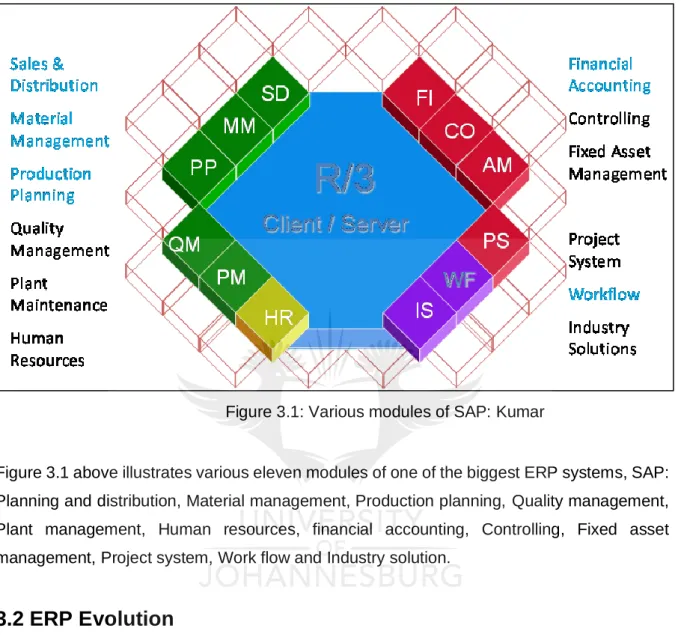
Figure 3.1 Various modules of SAP: Kumar ... 24
Figure 4.1 Employment of clothing manufacturing in China, 1980-2008 (Zhang et al, 2015) ... 37
Figure 4.2 Formal employment in the textiles and clothing industries in 2008-2018 ... 38
Figure 5.1: Textile and Clothing Linkages, Joshi (2013) ... 46
Figure: 5.2 Zimbabwe registered C&T companies from 2000-2014. (Majoni, 2015 ... 47
Figure 5.3 Employment, retrenchment, job losses and union membership in textile industries (Kanyenze,2006). ... 48
Figure 5.4 employment, retrenchment, job losses and union coverage in clothing Industries. Kanyenze (2006) ... 49
Figure: 5.5 Textile Production Phase, Buka (2016). ... 50
Figure 5.6 Imports of Textile Goods: 2000–2012 (Makasi and Govender 2007... 51
Figure 5.7 Exports of textile goods: 2000–2012. (Makasi and Govender 2007) ... 51
... 52
Figure 5.8 Cotton and Yarn, (Nyoni 2015) ... 52
Figure 6.1 Map of South Africa ... 57
Figure 6.2: Number of clothing companies by province: 1990 – 2001, Flaherty, D. (2002) ... 59
Figure 6.4 SA: Exports of textile and clothing inputs, by product group, 2003–2007 ... 64
Aranoff et al (2000). ... 64
Figure 6.5 SA: Imports of clothing and textile inputs, by product group, 2003–2007. (Aranoff et al 2009). ... 65
Figure 6.6 Clothing and Textile Framework; Ramdass (2007) ... 67
Figure 7.1 Gauteng Map ... 74
Figure 8.1: Distribution of sample by age group ... 83
Figure 8.2: Distribution of sample per highest qualification ... 84
Figure 8.3: Respondents’ current position ... 85
Figure 8.4: Respondents per working experience ... 86
Figure 8.5: Respondents per business type ... 87
Figure 8.6: Respondents per business function ... 88
Figure 8.7: Respondents per business ERP Type ... 89
Figure 8.8: Duration of use of system per respondent. ... 90
Figure 8.9: Respondents per different ERP use ... 91
Figure 8.10 Customer’s satisfaction ... 99
Figure: 8.11 Scree plot for vision and planning of the project ... 110
Figure: 8.12 Scree plot for choice of an ERP system ... 112
Figure: 8.13 Scree plot for support from top management ... 115
Figure: 8.14 Scree plot for project management ... 117
Figure: 8.15 Scree plot for project champion ... 120
Figure: 8.16 Scree plot for Business Process Re-engineering ... 123
Figure: 8.17 Scree plot for communication ... 126
Figure: 8.18 Scree plot for user training and communication ... 128
Figure: 8.19 Scree plot for Organizational Resistance... 131
Figure: 8.20 Scree plot for quality of implementation of the ERP system: Before implementation. ... 134
x | P a g e
Figure 8.24: Gap analysis chart: List of attributes ... 165
Figure 8.25: Gap analysis chart, List of factors ... 167
Figure: 8.27 Respondents demographic per current position ... 214
Figure: 8.28 Respondents demographic per experience ... 215
Figure: 8.29 Respondents demographic per business type ... 215
Figure 9.1: An integrated Enterprise Resource Planning framework for South African clothing and Textile industries (author’s construction) ... 224
xi | P a g e
List of Tables
Table 2.1 Categorization and clustering of literature review in ERP. ... 11
Table 3.1 below reveal critical success factors of an ERP ... 27
See overleaf for favourite brands. ... 35
Table 4.1: Most popular Brands in China. (Irun, 2017) ... 36
Table 5.1: Clothing and Textile, and Total Manufacturing Employment in SADC 1998, (Muradzikwa,2001) 45 Table 6.1 A contrast of the WC and KZN clothing sectors: Barnes (2005) ... 62
Table 6.2 Weaknesses in Clothing Industries. Morris & Reed (2008) ... 64
Table 6.3: Environment Policy and Economics of SA’s C&T Sectors. (Salinger et al, 1999)... 66
Table 6.4 Overall technical textile market rankings (Top Markets Report Technical Textiles, 2016) ... 68
Table 6.5 Overall Technical Textile Market Rankings: (Top Markets Report Technical Textiles, 2016) ... 69
Table 7.1 Business type ... 75
Table 7.2 Business function ... 76
Table 7.3 Types of ERP system. ... 77
Table: 7.4 Correlation Interpretation ... 79
Table 8.1: Vision and Planning of project ... 92
Table 8.2: Choice of an ERP system ... 93
Table 8.4: Project Management ... 94
Table 8.5: Project Champion ... 95
Table 8.6: Business Process Re-engineering ... 96
Table 8.7: Communication ... 97
Table 8.8: User Training and Education ... 98
Table 8.9: Organizational Resistance ... 98
Table 8.11 Use the ERP adopted by a company... 100
Table: 8.12 Statistics of attributes before implementation... 101
Table: 8.13 Statistics of attributes AFTER ERP implementation ... 101
Table: 8.14: Total number of respondents BEFORE implementation of the ERP system... 103
Table: 8.15: Factors Statistics before ERP implementation... 104
Table: 8.17: Factors Statistics AFTER ERP implementation ... 107
Table: 8.18: Correlation Matrix ... 109
Table: 8.19: KMO and Bartlett's Test ... 109
Table: 8.20: Total Variance Explained ... 109
Table 8.21 Factor Matrix... 110
Table 8.22: Correlation Matrix ... 111
Table 8.23: KMO and Bartlett's Test... 111
Table 8.24: Total Variance Explained ... 112
Table 8:25 Rotated Factor Matrix ... 113
Table 8:26 CorrelationMatrix ... 114
Table 8:27 KMO and Bartlett's Test ... 114
Table 8:28 Total Variance Explained ... 114
Table: 8.29 Factor Matrix... 115
Table: 8 .30 Correlation Matrix ... 116
Table: 8 .31 KMO and Bartlett's Test ... 117
Table: 8 .32Total Variance Explained ... 117
Table: 8 .33: Rotated Factor Matrix ... 118
Table: 8.34: Correlation Matrix ... 119
Table: 8 .35: KMO and Bartlett's Test ... 119
Table: 8 .36: Total Variance Explained ... 120
Table: 8 .37: Rotated Factor Matrix ... 121
Table: 8 .38: Correlation Matrix ... 122
xii | P a g e
Table: 8 .40: Total Variance Explained ... 123
Table: 8 .41: Rotated Factor Matrix ... 124
Table 8.42: Correlation Matrix ... 125
Table: 8 .43 KMO and Bartlett's Test ... 125
Table: 8 .44 Total Variance Explained ... 125
Table: 8 .45 Factor Matrix ... 126
Table: 8 .46 Correlation Matrix ... 127
Table: 8 .47 KMO and Bartlett's Test ... 128
Table: 8.48 Total Variance Explained ... 128
Table: 8 .49 Rotated Factor Matrix ... 129
Table: 8 .50 Correlation Matrix ... 130
Table: 8 .51 KMO and Bartlett's Test ... 130
Table 8.52 Total Variance Explained ... 131
Table 8.53 Factor Matrix... 132
Table 8.54 Correlation Matrix ... 133
Table 8.55 KMO and Bartlett's Test... 133
Table 8.56 Total Variance Explained ... 133
Table 8.57 Rotated Factor Matrix ... 134
Table 8.58 Correlation Matrix ... 135
Table 8.59 KMO and Bartlett's Test... 136
Table 8.60 Total Variance Explained ... 136
Table 8.61 Factor Matrix ... 137
Table 8.77 Non-parametric correlations ... 159
Table 10.1 Motivation for business organization to implement ERP into its business activities. ... 232
Table 10.2 Efficiency of current ERP framework in large companies... 237
Table 10.4 How the clothing and textile sector views ERP decisions ... 242
xiii | P a g e
Glossary of terms and acronyms
BPR (Business Process Re-engineering), is method of changing organisations in which linked tasks are required to get a specific corporate outcome are redesigned.
Data accuracy: It indicates to whether data kept are the accurate values, and to be accurate, data values should be the correct value and should be characterised in a reliable and unambiguous form.
Communication: Sharing information amongst the task team. This is a process of understanding, and a way of linking individuals. It is also an important role for management, because companies cannot function without proper communication amongst department and workers.
Change management: This can be defined as a way that gives guidance on how people should plan and support each other for successfully accepting change in order to drive achievement and outcomes in business.
C&T (Clothing and Textile): How the raw material is transformed into finished clothing. It is about designing, manufacturing, and advertising of clothing and footwear and other related textile products.
CSF (Critical Success Factors): Refers to procedures which an organization relies on for its existence. This is very different in each business, and it disclose business’s goals and objectives. CSF applies business analytics.
DTI (Department of Trade and Industry): The department of the SA government with accountability for commercial and industrial policy.
ERP (Enterprise Resource Planning): Software that permits businesses to automate and incorporate several of their industry procedures, share mutual database and corporate practices through the enterprise, and deliver information in real time.
ERP Choice: A procedure of choosing a suitable ERP package, and a functioning team is established to classify all of the corporate needs through critical enterprise.
ERP Evolution: ERP systems started to develop in the 1960s when adapted software packages that concentrated on inventory control were presented to manufacturing businesses.
ERP final preparation: This is the stage of finishing of the testing, end user education and training, system organisation and cut over activities.
ERP Implementation: This is a procedure with continuous returns that comprise choosing and organising a key in a business to manage and integrate the significant parts of its business operations.
xiv | P a g e
ERP vendors: They are responsible for development of all ERP packages, because they invest time and energy in researching and developing, to assist in creating ERP packaging solutions.
ESAP (Economic Structural Adjustment Programme): These are economic policies that needs to be followed by all countries for them to qualify for new loan from the World Bank and the International Monetary Fund, and also assist in repayment of old debts which are owed to the World Bank, commercial banks and governments .
Implementation stage: This phase covers the determination of the plan choice to the system fitting and cut over. In this period, members of the selected and the
development’s principles and processes are established
Live run stage: The changes from pre-production background to the live system. Go live and support.
MRP II (Manufacturing Resource Planning): this is the extended MRP with importance placed on incorporation of Engineering, Manufacturing, Marketing, purchasing and financial planning.
MRP (Material Requirements Planning): This is a computer-based information system which transforms master schedule requirements for all end items into time-phased requirements for subassemblies, components, and raw materials.
MFA (Multifibre Arrangement): A global trade agreement on clothing and textile that took place from year 1975-2004. This agreement imposed shares on the amount of Clothing and Textiles which are exported from developing countries to developed countries.
Planning and distribution: It is a method that involves the process of encompassing the delivery of goods, in which quality and quantity, to specific location, in a specified time
Production planning: It is a process which takes place inside a manufacturing company, and it involves making sure that adequate raw materials, staff and other necessary items are procured and the creation of all finished goods according to a specified schedule .
Project Champion: This refers to a person with authority or an expert in a company, who is responsible for completing a given task/ project. This person should be nominated by management to take control or supervise of a specific project, right from the start to the final stage.
Project management: This can be defined as organizing, planning, directing, and controlling of resources to complete the specific aims, goals and objectives of a particular project.
Project preparation: The scheduling phase for the project, where vital planned choices about project objectives, implementation scope, planning, budgeting, implementation arrangement must be made, and the project business and significant teams established.
xv | P a g e
Raw Materials: Unprocessed materials (inputs or resources), that firms use in manufacturing processes to produce finish goods
Retail: Sales of goods to community in small quantities for the purpose of use rather than for resale.
SHC (Second-hand Clothing): Clothes previously owned by others, before reselling them.
SME (Small and Medium Enterprise): These are independent and non-subsidiary Companies which hire a limited number of employees (50 to 250).
SADC (Southern African Development Community): This is an inter-governmental organization, whose goal is to further socio-economic cooperation and incorporation as well as party-political and security cooperation amongst sixteen southern African states.
Suppliers: Also known as vendors, they supply goods or services which are received by buyers.
Supply chain management: The incorporation of the activities that procure services and material, transform those materials and services into intermediate goods and the final product, and deliver final product to customers.
Top management support: Top Management is responsible for leading and supporting the Enterprise Resource Planning implementation crew.
Trade policy: Rules and agreements that governor imports and exports to foreign countries.
User training and education: This is the most important goal for ERP implementation, and it is used to develop the user awareness of the system and increase the knowledge and understanding of education and educational programme.
Visioning and planning of ERP: Identifies the Critical Success Factors’ clear
objectives, management expectations, benefits from ERP implementation development, industry vision, suitable ERP implementation plan, and drive behind ERP implementation.
WTO (World Trade Organization): This is the world-wide organization that deals with the rules of trade amongst states.
ZTMA (Zimbabwe Textiles Manufacturers Association): representative body that is recognized in Zimbabwe’s textile industry
ZTWU (Zimbabwe Textile Workers’ Union): This is an organisational structure, with the gender composition of 55% women and the organization is divided into eight structures, with only one representative form each commission who is from the managing advisory committee.
Page | 1
CHAPTER 1: INTRODUCTION
1.1 Background
Small and Medium Enterprise (SME) cooperatives play an important role in the development of the economy, because they create employment opportunities and also boost economic activity. Due to job creation and employment opportunities that these SME offers, they have a significant place in developing South Africa’s economy. For SMEs to adopt new technologies like an Enterprise Resource Planning (ERP) system should reduce cost, reduce time, create better efficiencies in business, and expand business initiatives. There is a need to implement ERP systems in clothing and textile industries, because according to Almuharfi, (2014), ERP systems were introduced with an idea of strengthening both operations of business and also improve productivity which can play a significant role in handling the flow of workloads. Ziemba & Oblak, (2013) argue that businesses are interested in progress of Information Technology (IT) which can handle business workloads, because company operations usually rely on effective technologies to plan and manage systems.
A critical assessment of previous studies will be used to analyse ERP methods published for the past 20 years. In previous years, ERP was only introduced to large industries; nevertheless, there is a need and special considerations of SME in terms of technology. Most of Clothing &Textile (C&T) businesses in South Africa are Small to Medium Enterprises, as characterised by the number of employees and annual turnover of less than R1.5 million, even though they are registered with the Department of Trade and Industry (DTI). Communication amongst higher management, staff, and other shareholders contribute to reduction efficiency and inefficiencies. Adequate training can increase employees’ performance by decreasing the period necessary to study and operate new systems. Nevertheless, due to lack of funds and resource considerations, companies are frequently forced to only partly achieve training requirements. Globalization of the marketplace is showing new markets for SMEs to enter the business environment previously dominated by large business. Principles such as scope, total number of staff, and capital requirements differentiate small businesses from big ones. SMEs face difficulties because of numerous resource restrictions postponing their plans and performance competences, yet they still assist with a main role in supporting the effectiveness of larger companies. As a result, they should concentrate on offering quality products with reliable, consistent delivery to their clients to stay abreast of increasing competition.
The study will focus on clothing cooperatives which are based in Gauteng. These started operating in early 2000, and presently have more than 100 employees. Their target markets include manufacturing school uniforms, but they also manufacture clothes such as traditional clothing, suites, wedding gowns, etc. This it can be seen from the Figure 1.1 below
Page | 2
Figure 1.1 Clothing industries in Soweto
During the Information Technology stage, ERP systems were introduced to the C&T businesses in different countries. Some of the ERP vendors with good knowledge of the system decided to establish their own ERP businesses some years ago as a business plan. Nevertheless, as the size of South African C&T cooperatives is usually small or medium, and there was no demand for an ERP software, because it was intended to manage large businesses. The situation in C&T cooperatives needs an adaptation in technology global ERP software businesses which is very expensive for SME (C&T) cooperatives, for example: JD Edwards and SAP. This software is not appropriate to the model of cooperatives for many companies, so there was no need to introduce an ERP system. Their only interest was to manage the manufacturing division and increase production. Introducing an ERP system means that there would be rearrangement of the business as well. The main benefit of ERP is that it delivers a chance to regulate the business process and update the structure, rather than improving output only. The regulation develops the objective of management since it significantly decreases the possibility of backlogs and sets up the basis for further improvement.
Page | 3
Fadelmoula and Abdulaziz (2018), explained that the latest few years have witnessed an increase in ERP system’s adoption through corporations in different industries. The fundamental driver of ERP adoption is to gain a range of operational, managerial, organizational, and IT infrastructural benefits promised by ERP systems. However, recent research has found that organizations are adopting ERP system in order to meet some existing challenges regarding data or because of competitive advantages. The system facilitates corporations in finding the best commercial enterprise methods in keeping with standard computerized integration. The system facilitates the appropriate flow of information between parts of the organization (Shah et al, 2011). According to Dlodlo (2011), the process on ERP installation requires a range of assets yet the costs are high. However, no matter the high costs associated with ERP implementations, a significant percentage on these implementations do not meet some of the minimum requirements in business in particular in the Small and Medium Enterprise (SME).
ERP systems were introduced in the early 1960s. The improvement by ERP begins with the control of inventory. After the package deal was developed into Material Requirements Planning (MRP), during the 1970s which provided full assistance in scheduling and control. In the 1980s it was developed into Manufacturing Resource Planning (MRP II), so much was aimed at expanding the effectiveness of manufacturing by technologies incorporations, because of information control. The extension of MRP II produced ERP systems (Sowan yet Tahboub, 2015). According to Beheshti (2006), an ERP system is a set of enterprise modules or applications, which connect the business parts of a company such as financial, accounting, manufacturing, and Human Resource (HR); it constitutes the pairing of a compactly built, standalone system with a shared platform of a flow of information throughout the whole business. Ajit et al (2014) regard an ERP as a process-oriented Information Technology system which supports an integration of resource planning in the business enterprise in conformity with integrating various systems as an alternative to the existence a standalone application.
Previous research on ERPs mostly emphasizes the adoption stage with little focus on the systems post-implementation. There is a lack of a logical framework to classify procedures for assessing the benefits of ERP post-implementation. The current literature falls short of developing a business case for ERP adoption by manufacturing SMEs. Presently there is a lack of frameworks to determine influences on structural performance. The current literature lacks logical studies on ERP’s influence on continuous improvement in SMEs, and there is no indication that successful companies earned any performance-improvements because of excellent management.
Page | 4
1.2 Problem statement
The implementation of an ERP system allows SME to improve their businesses and productivity with the communication and business relationship between ERP vendors, suppliers and other parties. It is very challenging for SME to decide on the adoption and implementation of an ERP system because of the size of the industry and lack or limited resources. Some of the SMEs are not implementing an ERP system because of lack of knowledge, whereas some had heard about the system, but they worry that it might fail. The system has a capacity to integrate business functions, e. g. Human Resource, Supply chain, Finance, Production, Marketing, etc. Lack of information about the appropriate ERP solution for SME needs a comprehensive choice criterion for selection of applications. It is vital for SME managers to experience success of the application processes, clear dedication and understanding of the adoption stages, factors, and implementation. To address these backdrops, the research problem of this study was the development of a novel integrated enterprise resource planning framework for the South African small and medium clothing and textile industries. This will enable the small and medium Clothing and Textile companies to gain competitive advantage within the national and international markets.
1.3 Research Goal
The overall research goal of this study is to develop an integrated ERP framework for South African Clothing and Textile cooperatives.
1.4 Research Objectives
To achieve the research goal of this study as presented in the previous section, the following objectives should be achieved:
• To determine critical success factors linked to ERP system implementation.
• To examine previous ERP frameworks in the literature review.
• To determine what drives companies to introduce ERP system into their companies.
• To examine the efficiency of the current ERP framework implemented by large manufacturing companies.
• To determine how clothing and textile sector view Enterprise Resource Planning decisions to the different institutional and economic contexts within which they operate.
• To determine how several investors in the C&T sector make sense of the need for ERP implementation.
• To classify the drivers and barriers to implement a strategic framework for ERP in SMEs, mainly in C&T business.
• To develop a strategic framework to implement an ERP system successfully in South African Clothing and Textile cooperatives.
Page | 5
1.5 Research Questions
In order to achieve the different objectives of this study as presented above, this study will seek to answer to the following questions:
• What are the critical success factors in ERP implementation?
•
What are the flaws of previous ERP frameworks in the current literature review?
• What motivates business organisations to implement ERP in their business activities?
• How efficient is the current ERP framework implemented by large manufacturing companies?
• How does the C&T sector view Enterprise Resource Planning decisions to the different institutional and economic contexts within which they operate?
• How do several investors in C&T sector make sense of the need for ERP implementation?
• What are the drivers and barriers to implement a strategic framework for ERP in SMEs, mainly in C&T business?
• How can a holistic Enterprise Resource Planning Framework can be developed for the Small and Medium South African Clothing and Textile Enterprise?
• How will the implementation of ERP improve at Clothing and Textile Sector?
1.6 Purpose of the research
This research investigates the constraints and factors relating to Enterprise Resource Planning adoption by Small and Medium Enterprise businesses in Gauteng, for the purpose of developing a practical and viable Enterprise Resource Planning adoption model that would eventually be useful to Clothing and Textile Small and Medium Enterprise business managers considering ERP implementation. It is, therefore, believed that developing a comprehensive Enterprise Resource Planning model based on the identified gaps, will allow Clothing and Textile to improve their businesses and productivity with the communication and business relationship between Enterprise Resource Planning vendors, suppliers and other parties. It is very challenging for Small and Medium Enterprise to decide on the adoption and implementation of an Enterprise Resource Planning system because of the size of the industry and lack or limited resources.
1.7 Methods
The study will use mixed methods which will assist with analysing factors of an ERP adoption, this will be based on companies that have already adopted an ERP system. A hundred implementers who are consist of ERP experts from industries (medium and large) will answer questionnaires. Those implementers will be selected from SA, especially in Gauteng. SME cooperatives in C&T sectors will also fill in questionnaires, to identify and find out if there is need for and ERP adoption in their companies. Data collection will be used to develop and test an ERP model.
The advantage of using mixed methods was that respondents were able to use the very same open-ended questions and closed ended questions in one instrument. The use of questionnaires was good because
Page | 6
data collection and analysis was time consuming, even though they were analysed using SPSS. The use of questionnaires was suitable, compared to interviews, because there was no need to put pressure on respondents to instruct them on how to answer. The majority of the respondents were aware and understood ERP system and implementation; that is why the feedback was very interesting.
1.8 Significance of the study
After assessing number of studies, gaps in previous studies have been identified in Clothing and Textile industries. It is believed that the study will improve small, medium, and large cooperatives in the implementation of an Enterprise Resource Planning by giving them knowledge and background skills and understanding of all steps of the implementation.
1.9 Benefits of the study
This report will benefit a range of South African companies which are implementing an Enterprise Resource Planning System.
1.10 Structure
The research consists of the following 10 chapters, list of references and annexures:
Chapter 1. Introduction: Background of the study, problem statement, research question, objective of the study, significant of the study, benefits of the study and research methodology overview.
Chapter 2. Critical analysis of previous studies on Enterprise Resource Planning: The chapter aim at critically appraise previous studies developed with the aim of promoting and encouraging the implementation of Enterprise Resource Planning in manufacturing or service sector. This will aid in identifying the weaknesses of the frameworks identified in the current literature on the implementation of Enterprise Resource Planning.
Chapter 3. ERP Literature review: Discussion of ERP background, evolution, implementation, stages, challenges, reason for failure and Critical Success Factors.
Chapter 4. Clothing and Textile Industries in China: Background of clothing industries, challenges, market size, and employment.
Chapter 5. Clothing and Textile Industries in Zimbabwe: Background of clothing industries, challenges, market size and Zimbabwe employment. Zimbabwe was chosen because it was the best country in SADC that can be used for clothing and textile industries’ literature review. There were a number of studies which were published on Zimbabwe clothing and textile industries, and a study by Muradzikwa (2001), indicated a total number of manufacturing in Zimbabwe being the second highest with 139 000 companies. In
Page | 7
SADC, Zimbabwe had a total of 18 200 Clothing and Textile industries, with South Africa being the highest with the total number of 136 824.
Chapter 6. Clothing and Textile Industries in South Africa: Background of clothing industries, challenges, and employment.
Chapter 7. Research methods:The study used mixed method to identify benefits, critical success factors, and challenges in the ERP industries. A total of 119 questionnaires were filled out, out of those 119, 18 were sent to clothing and textile industries, and 101 were sent to ERP specialist around South Africa, where the majority of the respondents were from Gauteng. Descriptive statistics, reliability, factor analysis, and gap analysis were used in the study.
Chapter 8. Data analysis and interpretation: The chapter aims at analysing and discussing the research findings of this study. Four types of company size were targeted such as, Micro enterprise; Small enterprise; Medium enterprise; and large enterprises. 119 respondents participated in the research survey of this study, out of which 101 experts in the field of Enterprise Resource Planning and 18 participants that were not familiar with the tool ERP system (for clothing and textile industries).
Various analyses were conducted, hence the chapter was divided into four main sections. The chapter discuss and analyses the results related to descriptive analysis; analysing the findings associated with reliability analysis; analyse the findings related to factor analysis and gap analysis.
Chapter 9. ERP framework development: The chapter will focus on the development of ERP framework, and critical success factors that will be used in Clothing and Textile industries, to integrate the success of an ERP system. For an actual ERP implementation, the appropriateness of an application is a necessity. According to Aberdeen (2006) the cost of ERP applications has been reduced, and the applications are affordable for SMEs to buy and implement. The implementation of ERP in SMEs might be regarded from the viewpoint of applying the success factors previously recognised for larger companies to a different set of smaller entities, though SMEs are different from their larger business counterparts.
Chapter 10. Recommendation and conclusion: This chapter revealed several plans intended to overcome some barriers and challenges for implementing ERP and issues relating to the use of ERP applications. To implement ERP system in SMEs, the researcher suggested some recommendations, with the expectation that they will be adopted and implemented.
Page | 8
CHAPTER 2: CRITICAL ANALYSIS OF PREVIOUS STUDIES ON
ENTREPRISE RESOURCE PLANNING
2.1 Introduction
For any research work, one should make a significant contribution to the body of knowledge of a research field. This will assist to position the ongoing scientific research work in the literature. To this end, the present chapter aim at critically appraise previous studies developed with the aim of promoting and encouraging the implementation of Enterprise Resource Planning in the manufacturing or service sector. This will aid in identifying the weaknesses of the frameworks existing in the current literature on the implementation of Enterprise Resource Planning. Therefore, the chapter start by giving an overview of a number of articles published over the last two decades regardless of the subject areas or journals where they were published. Secondly, the chapter presents the number of studies on Enterprise Resource Planning published per subject area from 1997-2017. Thirdly, the chapter presents the amount of works on Enterprise Resource Planning published by publication type (journal article or conference paper) over the past two decades. Lastly, the chapter critically analyses the best journal articles published from 1997-2017. Only the best journal article per year will be critically assessed in order to identify the gaps in the current literature. The analysis will take into account the size of company used as a case study. This include both Small and Medium Enterprises as well as large firms, the research methodology used (Qualitative or Quantitative), and the country in which the study was conducted.
2.2 Descriptive analysis
This sub-section aims at presenting the number of studies published over the past two decades, from 1997-2017. The reason is to give the reader a clear background on the trend of ERP studies from various scholars and industrial experts.
Figure. 2.1: Trend of articles published over the last two decades
0 5 10 15 20 25 30 1995 2000 2005 2010 2015 2020 Tr en ds of s tudi es pe r yea r
Page | 9
From the Figure 2.1 above, it can be discerned that the trend of ERP studies conducted over the past two decades (1997-2017). This shows that ERP has gained great attention from different scholars as well as industrial experts. For example, in 1997 only seven research articles were published, however, this number has changed after a decade with the publication of research articles on ERP amounting to 14 papers. This means an increase of 50% of papers published over 1997-2007. It can also be observed that the number of studies conducted on ERP field between 2007 -2017 has decreased when comparing to the first decade cover the year 1997-2007. Thus, from this backdrop on the studies covering ERP field, our study will seek to investigate the implementation of ERP in Small and Medium Clothing and Textile Enterprises, with South Africa is selected as the chief case study. The reason is because, Clothing and Textile industry has got the potential to boost the current South African economic crisis.
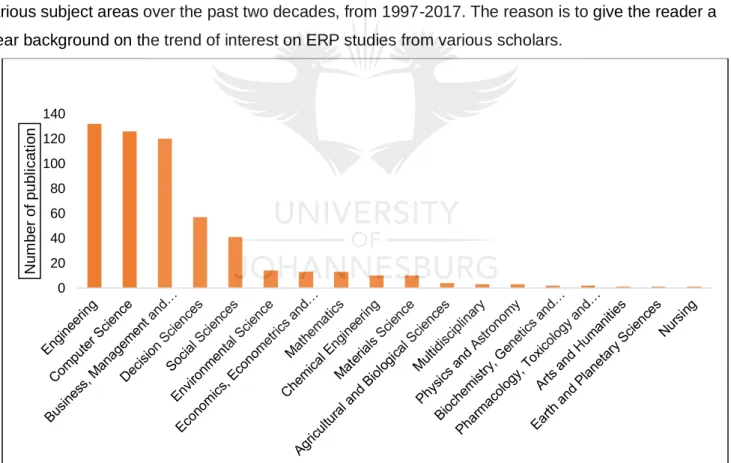
2.3 Distribution of studies per subject area
This sub-section aims at presenting distribution of previous studies found in the current literature on various subject areas over the past two decades, from 1997-2017. The reason is to give the reader a clear background on the trend of interest on ERP studies from various scholars.
Figure 2.2: Distribution of studies per subject area
Figure 2.2 illustrates the grouping of papers by business with the total number of 286 for the past 20 years (1997-2017). Papers are categorized into different business, grouping by business is significant because activities and organizations are not the same amongst businesses. The highest number of publications is in Engineering (132), Computer science (126), and Business management and accounting (120), and lowest numbers are in Arts and Humanities, Earth and Planetary sciences; and Nursing with one each.
0 20 40 60 80 100 120 140 N u m b e r o f p u b li ca ti o n
Page | 10
2.4 Analysis of studies per type of publication
This sub-section aims at presenting distribution of previous studies found in the current literature on various subject areas over the past two decades, from 1997-2017. The reason is to give the reader a clear background on the trend of interest on ERP studies from various scholars and industrial experts.
Figure. 2.3: Publications per document type
Figure 2.3 illustrates the total number of papers by document type, where more articles are published. It is worth noticing that the highest number is in articles with a total of 162. The top two constitute 90% whereas 28 additional papers are published in different reviews, 8 book chapters, 4 short surveys, 2 notes, and 1 conference review. Therefore, 286 papers comprised a sample are available in six different document type. This demonstrates the total publication in the past 20 years (1997 to 2017).
162 96 13 8 4 2 1 N um ber s o f ar ti cl es Article Conference Paper Review Book Chapter Short Survey Note Conference Review
Page | 11
2.5 Categorization and clustering of literature review in ERP
Page | 12
Author and
Year Cluster Application Area Company Size Location
C&T Manufacturing SME LARGE
Sun et al (2015) Computer in industry x x China
Beheshti et al. (2014) Competitiveness Review
X x USA
Moalagh (2013) International Journal of production research x x Iran
Staehr et al (2012) Journal of the Association for Information
System x x
Australia Lee et al (2011) International Journal advanced manufacturing
technology x x
London
Lee et al (2010) Industrial Management and Data Systems x X South Korea
Esteves (2009) Journal of Enterprise Information Management x X Spain
Helo (2008) Industrial Management and Data Systems x X Thailand
Woo (2007) Journal of Manufacturing Technology
Management x x
China Botta-Genoulaz (2006) International Journal of Production Economics Service x France
Zhang et al (2005) International Journal of Production Economics x x China
Yen et al (2004) International Journal of Production Economics x x USA and Taiwan
Mabert et al (2003) European Journal of Operational Research x x USA
Mandal et al (2002) International Journal of Production Economics
x x
Australia, New Zealand, North America, Asia, and United Kingdom
Chen (2001) Business Process Management Journal x x Australia
Parr et al (2000) Proceedings of the 3rd Hawaii International
Conference on System Sciences
Manufacturing and
service x
implementation, but businesses do not necessarily know how to exploit them. Hence, the authors used a step-by-step valuation and development process for ERP implementation in three corporations. First, a five stage ERP implementation model was suggested. Second, around 80 Critical Success Factors from the literature were explained into Key Performance Indicators, which are related with each ERP implementation stage by 10 local ERP specialists. Third, the weights of the KPIs were planned by means of the Dumpster–Shafer technique and the assessment of 10 specialists. Throughout the implementation procedure, the authors measured the performance of ERP at every phase and corrective activities were recognised if that performance is below the expected level. An implementation flowchart was established based on a five phase model and the philosophy of continuous improvement. Nevertheless, the authors have made significant contribution to the body of knowledge on ERP implementation. But they didn’t look at ERPs within SMEs, particularly in C&T industry. Against this backdrop, a study will seek to develop a holistic framework that will incorporate the SMEs sector.
Beheshti et al (2014), conducted a study that aimed at examining the key elements that contribute to successful ERP implementation systems in United States manufacturing companies. The study reveals some informative insights into exactly how manufacturing companies use ERP systems in USA. Three firms had implemented ERP systems for more than eight years, each using various types of software. The remaining firms had been using ERP software between six and eight years, with each respondent in this period group also using different ERP vendors. When examining the studies for finding the chosen ERP software brand name, it became obvious that no single ERP vendor leads the field with the manufacturing companies in Virginia. However, the study does not incorporate the challenges faced by SMEs in ERP implementation.
Moalagh et al (2013) suggests a practical framework for evaluating a company’s ERP
post-implementation success using recent models over an uncertain logical network procedure. The concept of ERP success is break down into three main parts, including managerial success, organisational success, and individual achievement. The authors argued that using this framework, the company’s ERP system success can be determined, and the compulsory improvement projects can be planned to promote the success level. The proposed framework has been applied the Iran turbine manufacturing firm, to measure the firm’s ERP post implementation success. However, despite the fact that the proposed framework was
Page | 14
successfully tested in manufacturing firms, but the study does not consider the issues related to SMEs industries.
Staehr et al (2012) examined the post-implementation periods in four manufacturing companies in Australia. The reason for this study was since the authors found that there is still not an adequate understanding regarding the issues affecting ERP implementation within manufacturing firms. In their study, they have identified nine themes that explain “how” and “why” and form the components of a framework for understanding the achievement of business benefits in the post-implementation period. Additionally, they have identified new themes and the underlying relationships between them that explain and increase our understanding of how and why organizations have or have not achieved business benefits from ERP systems. Nevertheless, the authors have made significant contribution to the body of knowledge on ERP implementation. Once again the study did not look at our domain.
Lee et al (2011) argued that ERP system implementation in a worldwide manufacturing
context, and the product data management incorporation is one of the vital solutions to success. Hence Lee et al (2011), in their study recommended digital manufacturing as the main tool of data incorporation between Product Data Management and ERP. Digital manufacturing, as a technology possessing the physical and rational computer demonstrating and simulation technique for real manufacturing, delivers the methodology for converting
Engineering Bill Of Materials to the Manufacturing Bill Of Materials (MBOM) that suits the particularities of each manufacturing location, based on the procedure and resource models which reveal the particularities of each manufacturing location. It also delivers the methodology for MBOM confirmation and the procedure and resource model incorporation. By means of such process, the MBOM and the process and resource data, confirmed and suitable for each manufacturing location, can be directed to the ERP system. As with above studies, the framework developed in this study is not comprehensive since it does not cover the issues related to SMEs industry, particularly C&T industry. Therefore, this research will develop an integrated framework that will aim at addressing these omissions.
Lee et al (2010) developed a model to investigate the influence of structural support on Behavioural Intention concerning ERP implementation based on the Technology Acceptance Model. The results of the study show that the structural support is a significant influence for perceived usefulness (PU) and perceived ease of use (PEOU). PU and PEOU appear to lead to an advanced level of interest in the ERP system and Behavioural Intention to use the system. The most pertinent conclusion of the study is that structural support is definitely related to acceptance of Technology Acceptance Model. The survey data used in research
Page | 15
are collected from SME firms in South Korea. Notwithstanding, the authors have made significant contribution to the body of knowledge on ERP implementation. But, the results of this study are not conclusive because the authors did not look at the issues blocking a successful implementation of ERP within SMEs in the C&T industry.
Esteves (2009) conducted an empirical study that aimed at outlining the benefits of ERP implementation in Spain. He argued that the ERP benefits requires a long-term orientation is compulsory in order to find a successful understanding of the possible benefits that ERP might bring. Therefore, this study proposes that ERP benefits understanding measurements are consistent, and that supervisors must observe ERP long-term benefits understanding the ERP post-implementation. Moreover, new ERP updates and maintenance projects should consider the results of ERP benefits, understanding auditing to evaluate ERP configuration, rectify possible errors, and increase the effectiveness of several anticipated ERP benefits. Though the study emphases the issues that impact ERP benefits understanding, it fails to distinguish between several issues that might impact the understanding of these benefits, such as size and type of firm, ERP systems implemented, and the structural context. Furthermore, the authors failed to look at the issues possibly preventing a successful implementation of ERP in SMEs C&T industry.
Helo (2008) conducted a study that aimed at examining the ERP implementation from the consultants’ and software vendors’ opinion. The findings of this study are linked to current literature on ERP systems. The consultants’ views display the same outcomes with studies conducted with firms using ERP systems. The implementers’ opinion shows obvious challenges of using consistent ERP packages for numerous requirements on different levels. Though the sales performances tend to highlight the overall drive and flexibility of software packages, the problems concerning customization and ordinary system remains. The implementers’ opinion highlights challenges in operations: production planning, materials management, sales and marketing. The results of the review triangulate and explain numerous features found in the preceding study. From the consultants’ opinion growth in production planning and difficult products are particularly required. Notwithstanding, the authors have made significant contribution to the body of knowledge on ERP implementation in the SMEs manufacturing industry. But they failed to look at the issues preventing a successful implementation of ERP within C&T SME’s industry. From this background, our study will seek to develop a holistic framework that will incorporate the SMEs sector.
Page | 16
Woo (2007) developed a study focusing on assessing the ERP implementation knowledge of managing a Chinese company. The objective was to deliver Chinese enterprises implementing ERP with understanding about ERP implementation CSF. Building of a case study of the firm using semi-structured interviews of the leaders involved in the ERP implementation procedure as well as checking up of firm documents supported by literature. The main findings of the study are that the CSF for the case firm for implementing ERP is related to its Western counterparts. This study found that when an effort is made to adapt the implementation to the Chinese culture, organisation and style of the firm, implementation is successful. As with above studies, the framework developed in this study is not completely applicable since it does not cover the issues related to SMEs industry, particularly the C&T industry. Therefore, the current research will develop an integrated framework that will aim at addressing these oversights.
Botta-Genoulaz (2006), conducted a study that aimed developing an understanding into how services approach ERP implementation. Evaluation of ERP developments, particularly in services, completed by six case studies were undertaken. We classify and discuss several features of services, which are biased towards manufacturing. Key characteristics classified deal with comprehensive or incomplete incorporation, product or client orientation, the importance of labour, human factor. In conclusion, trends in standardization and integration seen in the industrial sector are also developing in services, but in different ways. As with above studies, the framework developed in this study is not wholly appropriate to our study since it does not cover the issues related to SMEs industry, particularly C&T industry.Zhang
et al (2005) conducted research on a framework of ERP systems implementation success in China which was an empirical study. Moreover, they stated that ERP system is one of the best extensively acknowledged adoptions to attain competitive advantage for manufacturing firms. Furthermore, Zhang et al (2005) claimed that the successful implementation rate of ERP is very low, and several companies did not attain anticipated goals in China. This study improves a framework by changing ERP implementation success. However, the issue with this particular study is that it does not incorporate the challenges faced by SMEs when it comes to ERP implementation.
Yen et al (2004) argued that businesses across the world have made considerable investments in installing ERP systems. In the time under consideration, implementing ERP systems has proven capriciously tough, and the final benefits have been undefined. Numerous researchers have decided that the failures are typically the outcome of company difficulties instead of technical problems. ERP systems affect a company’s strategy, establishment, and philosophy. The previous study has recognized the necessity for
Page | 17
scheduling an ERP implementation at the strategic level but proposed no exact strategies. Using qualitative research at five US and Taiwanese manufacturing companies, this study examined the relationship amongst ERP implementation practices and a company’s competitive strategy. The findings confirm the study proposal, that ERP implementation must be associated with a competitive strategy. Exact guidelines are recommended for designing the strategy. Moreover, two additional recognised variables, nation-wide culture and government/business rules, as being vital to ERP implementation in multi-national settings. Managerial responses to the results and upcoming study matters are discussed. Once again, this study is not pertinent to our domain.
Mabert et al (2003) observed that various business organisations across the globe have been introducing ERP system into their business activities. However, the authors have argued that ERP has been successfully implemented in only a few companies whilst the majority of companies are struggling to implement it, especially SMEs. From this drift, Mabert et al (2003) conducted a study that aimed at examining and identifying significant differences within the methods employed by businesses that monitored their implementations on a basis of relationship between time and budget. This is compared to the ones that failed to make use of information gathered by means of qualitative research methods concerning manufacturing firms in United States. The results obtained by Mabert et al (2003) showed that several diverse elements working from pre-implementation scheduling to system configuration impact implementation which supervisors would have to consider when implementing main systems like ERP. However, the authors have made significant contribution to the body of knowledge on ERP implementation. But they were not concerned with issues preventing a successful implementation of ERP within SMEs, particularly C&T industry. From this backdrop, in our study will seek to develop a holistic framework that will incorporate the SMEs sector.
Mandal et al (2002), stated that an organizational competitiveness relies on the efficiency of data flow and consequently the material flow. Data systems particularly computer-based ones significantly contribute to the actual communication in a company whether it be manufacturing or services. In light of this statement, Mandal et al (2003), conducted a study that aimed at assessing the requirements of ERP system at different locations, conformation of SAP R/3 to meet those requirements, problems in implementing the system, and the benefits of doing so. However, the ERP framework developed in this study is not relevant since it does not address the issues related to the implementation of ERP within SMEs. Hence, our study will seek to address this by developing a holistic ERP framework.
Page | 18
Parr et al (2000) argued that there is evidence that shows that most ERP implementations exceed their budget and their time allocations. They went on to observe that most of studies that were conducted previously aimed at assessing ERP implementation with the goal of providing an ERP framework focusing on maximising organisational efficiencies. In pursuit of this, Parr et al (2000), conducted a study that aimed at presenting a taxonomy of ERP implementation categories in manufacturing and service sectors. They developed the taxonomy out of a variety of past studies and by means of qualitative research methods. They further claim that understanding the variations amongst these groups is vital if researchers are to do case study investigations of the implementation of ERP, otherwise judgements are being made concerning ERP implementation projects which are fundamentally lopsided. Decisions based on unequal cases are integrally not valid. The classification of implementation groups is also offered as a tool for implementation supervisors to define the possibility of an ERP implementation plan. This is prior to an analysis of the complexity requirements of the project procedures. However, the framework developed in this study is not pertinent to the current study.
2.5 ERP Frameworks
Yang et al (2010 ) Developed the hypotheses and research model as illustrated in figure 2.4 The goal of the research was to examine the impact of ERP benefits on Supply Chain Management competency. The purpose of the study was to suggest and test a model of the relationship amongst the benefits to Impacts on SCM competencies, and Taiwanese IT industries of their adoption of ERP system .The model focused on two arears, namely: The benefits of ERP and the Supply Chain Management competencies. The developed model consists of five benefits of an ERP system, which are Information Technology infrastructure, managerial, operational, organizational, and strategic. The model also constructs of competencies of Supply Chain Management which include behavioural processes, planning and control, and operational.
The purpose of the model was to examine the relationship between Supply Chain Management competencies and ERP adoption benefits. For a study to examine, what groups of ERP benefits can forecast the competency of SCM, the research hypothesis and the model were used. The study underlines the significant role that an ERP system plays in the operation of supply chain organisations. The managerial, operational and strategic benefits are important predictors for the Supply Chain Management.