and the Graduate School of the University of Oregon
in partial fulfillment of the requirement for the degree of Master of Science CAPSTONE REPORT University of Oregon Applied Information Management Program Continuing Education 1277 University of Oregon Eugene, OR 97403-1277 (800) 824-2714
Reducing IT Costs and
Increasing IT Efficiency
by Integrating
Platform-Virtualization in the
Enterprise
Erik R. Rasmussen
Network Administrator
Harland Financial Solutions
Approved by
_____________________________________________ Dr. Linda F. Ettinger
Reducing IT Costs and Increasing IT Efficiency by Integrating
Platform-Virtualization in the Enterprise
Erik R. Rasmussen Network Administrator Harland Financial Solutions
Abstract
Selected literature, published between 1999 and 2009, is examined in relation to reducing IT cost and increasing IT efficiency through implementation of platform-virtualization within the enterprise. Virtualization can reduce IT cost through server consolidation, test and development agility, licensing consolidation, standardization, and/or power and physical space consolidation. It can also increase IT efficiency through centralized administration and/or security, support of legacy systems, reduction of server downtime, and/or providing the staff training on a new technology.
Table of Contents Abstract... 3 Table of Contents ... 5 Introduction... 8 Problem...8 Significance...9 Purpose...11 Audience / Outcome...12 Research Limitations...13
Data Analysis Plan Preview...15
Writing Plan Preview...16
Definitions... 18
Research Parameters ... 23
Research Questions and Sub-Questions...23
Key search terms...24
Search Strategy...25
Key search terms....25
Sub-topic Search Terms....26
Server and software virtualization....26
Virtualization technologies existing today....26
Security concerns with virtualization....26
Technical Specifications....27
Documentation Approach...27
Evaluation Criteria...27
Preliminary Search Results... 29
Data Analysis Plan...34
Writing Plan...38
Annotated Bibliography ... 41
Review of the Literature... 61
Introduction...61
Brief Chronology of Virtualization...62
Business Function #1: Reducing IT Costs...65
Business Function #2: Increasing IT Efficiency...73
Conclusion………...……… 76
References... 83
Figures
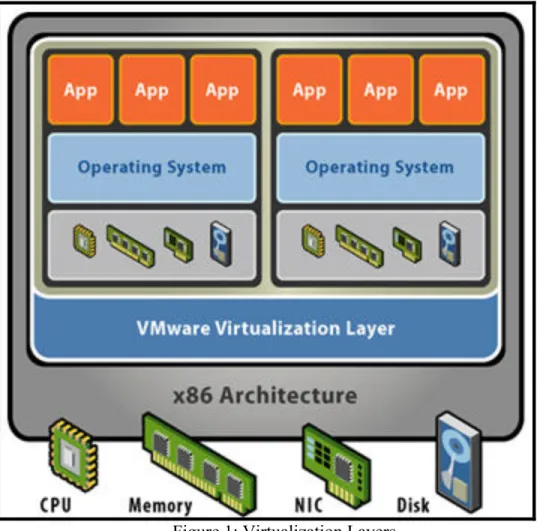
Figure 1: Virtualization Layers... 64
Tables Table 1: Preliminary search results... 34
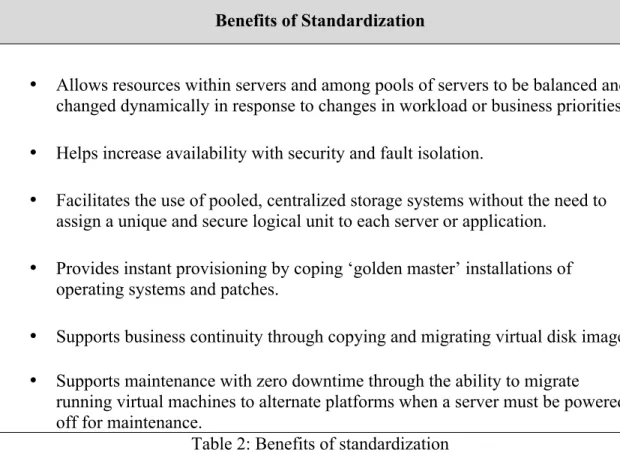
Table 2: Benefits of standardization... 71
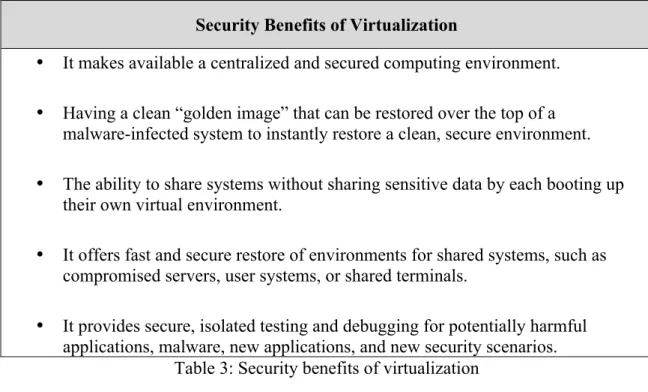
Table 3: Security benefits of virtualization. ... 73
Introduction
Problem
Each year, organizations worldwide spend billions of dollars on their information
technology (IT) infrastructure (Ramanathan & Bruening, 2004). Business’s today are under ever increasing pressure to reduce operational costs while still ensuring that flexibility, service delivery levels, and business efficiency continue to improve. Organizations are investing considerable time, effort, and hard cash to achieve this (Conoops, 2007). Data center environments are becoming more complex and heterogeneous, with correspondingly higher management costs (VMware, 2006). As part of an effort to rein in operations cost increases, Golden and Scheffy (2007) suggest that a platform-virtualization model offers the opportunity to reduce overall system administration costs in comparison to non-virtual environment, by
reducing the overall number of machines that need to be utilized.
This study examines platform-virtualization, which encompasses the virtualization of the physical hardware and the operating systems that reside on that hardware. Ramanathan and Bruening (2004) state, “Platform virtualization can be defined as the creation of a logically partitioned computing system that runs on top of an actual platform. While virtualization has been applied to storage and servers, the concept of platform-virtualization goes further to include all layers of the platform – from applications and operating software to platform components, processors and interconnects. Virtual platforms are perceived by users – and function in all respects – as if they were physical computers” (p. 1).
Yang (2008) defines platform-virtualization as a technique used to replicate the functionality of real hardware platform so that one physical machine can host more than one
system level software without conflict. Hamm (2005) states, “virtualization has the potential to dramatically change the way corporate computing is done. With servers, it lets one physical machine behave like a half-dozen virtual machines, and it also makes it possible to move an application from one machine to another on the fly” (p. 2). The Strategic Counsel (2007) states “server virtualization is becoming a mainstream technology, having been adopted by at least 39% of worldwide organizations with more than 500 employees” (p. 4).
Significance
According to The Strategic Counsel (2007), there is a strong link between server virtualization and top business drivers for IT. As identified by The Strategic Counsel survey respondents, top business drivers for IT are: reducing IT costs, increasing IT efficiency; improving organizational or business performance; and improving IT service levels. The Strategic Counsel also finds that “the benefits of server virtualization are clear and extremely well aligned with organizational expectations and actual server virtualization use cases. Primary benefits include improved server / system utilization rates; improved server reliability and uptime; and improved business continuity and disaster recovery” (p. 21).
The term “business driver” refers to factors in the industry or the broader business environment that either impact the financial institution or provide opportunity for business expansion (Bruel & Price, 2007). Business functions are related to (“business drivers”, 2008) and refer to a series of logically related activities or tasks (such as planning, production, sales)
performed together to produce a defined set of results. The Great Britain Office of Government Commerce (2002) states “business drivers are the attributes of a business functions that drive the behavior and implementation of that business function in order to achieve the strategic business objectives of the company. In other words, business drivers are the primary reasons the business
wants to employ the business function…” (Information Technology Infrastructure Library (ITIL), p. 15).
Virtualization technologies allow IT organizations to consolidate multiple workloads onto a single server, resulting in more efficient use of each server, and fewer of them to install, support, and manage (Sun, 2008). Kennedy (2007) states, “In some client situations, a more comprehensive virtualization solution is required, such as hosting a legacy application on a new operating system. In that case, it may be best to isolate an application within a complete,
virtualized OS environment — the classic "virtual machine" approach. This enables you to run an application within the OS image of your choice while still supporting migration to, and integration with, newer or otherwise incompatible OS platforms” (p. 31). It is a way of maximizing physical resources to maximize the investment in hardware (Ou, 2006). Mann (2007) states “Virtualization has many significant advantages, both for IT and for the business as a whole. These success factors are contributing to specific competitive advantage, cost reduction, and productivity benefits for many organizations” (p. 2).
Platform virtualization has proven to reduce the total cost of ownership (TCO) in the organization. Van Doorn (2006) demonstrates three examples of this reduction:
1. Increases system utilization (current servers have less than 10% utilization). 2. Reduces hardware (25% of the TCO).
3. Conserves space, electricity, and cooling (50% of the operating costs of a data center).
environment. Schwab (2006) states “virtualization and streaming allow for easier software migration, including system backup and recovery, which can make it extremely valuable as a disaster recovery or a business continuity planning solution. Virtualization can duplicate critical servers, so that it does not need to maintain expensive physical duplicates of every piece of hardware for disaster recovery purposes. Disaster recovery systems can even run on dissimilar hardware” (p. 8).
Purpose
The purpose of this literature review is to examine the potential advantages and
disadvantages of migrating from a non-virtual environment to a hardware-virtualization model in support of information system administration in the enterprise, with emphasis on two IT business functions provided by The Strategic Counsel (2007): reducing IT costs and increasing IT
efficiency. (Two other business functions noted by The Strategic Counsel but not examined in this study include improving organizational or business performance and improving IT service levels). As an example, Samoilenko (2007) provides a preliminary list of some of the key factors associated with such a migration:
1. Compatibility and support (which could be related to the business function of “increasing IT efficiency”).
2. Licensing (which could be related to the business function of “reducing IT costs”). 3. Planning deployment (which could be related to the business function of “increasing IT
4. Return on Investment (ROI) (which could be related to the business function of “reducing IT costs”).
5. Staff/Support Training (which could be related to either business functions: reducing IT costs and increasing IT efficiency).
The goal during data analysis is to identify the factors for consideration when migrating from an existing environment to a virtual one in relation to IT cost and efficiency. The reported advantages and disadvantages of each factor when migrating to a hardware-virtualization model are examined in relation to these two selected IT business functions.
Audience / Outcome
This document is intended for IT professionals, specifically system administrators; however it should be reviewed by stakeholders involved, with or interested in, installing and/or migrating systems to a virtual environment. For this review, a system administrator is defined as a person who manages the computer systems in an organization, who can create and manage accounts and groups, understands how operating systems perform, access control, understands how to set account policies and user rights, is familiar with how to set up auditing and read audit logs, and can configure other similar system-related functionality (Kirch, 2007). The intent is to provide these IT professionals with enough knowledge to discuss the business justification to move to a hardware-virtualization environment or to maintain the platform-specific model with company stakeholders.
The outcome of this review is presented in the form of an annotated framework that describes factors for consideration in relation to two pre-selected key IT business functions,
when migrating the environment from a platform-specific to a virtual one proposed by The Strategic Counsel (2007): reducing IT costs, and increasing IT efficiency. The annotated framework is presented in two main categories. The first is the background of virtualization for the purpose of establishing context. Second are factors, along with advantages and
disadvantages, for consideration when migrating from an existing environment to a virtual one, framed from the perspective of the two pre-selected IT business functions. For example, a factor for consideration within the IT business function of “reducing IT cost” is hardware
consolidation. An advantage of hardware consolidation is described by Mann (2007) who states “Server consolidation and improved server utilization is another major benefit from
virtualization, and is one of the traditional drivers as well. Enterprises can combine the workload from multiple underutilized physical machines into a single physical system. This dramatically reduces overall hardware spending, as it requires far fewer physical systems for the same application workload” (p. 3).
Research Limitations
Time frame. Collection of materials for this literature review is focused on those
published from 1999 to 2009. In some cases, articles prior to 1999 are used when they pertain to discussions of the foundation of the virtual platform technology. The 1999 date was selected because it is based on a significant milestone in the overall development of virtualization. Virtualization has long been used in the mainframe and large system world as a safe and reliable method of improving IT efficiency (Gabriel Consulting Group, 2007). However, on February 8, 1999, VMware introduced the first x86 virtualization product, ("VMware Virtual Platform", n.d) based on earlier research by its founders at Stanford University.
Selection criteria. The primary sources for the literature are retrieved from ACM Portal, Clusty, EBSCO Host, Google, Google Scholar, IEEE Digital Library, Summit, and WorldCat. Preference is based on relevance to the topic, depth of analysis, and date published (Leedy & Ormrod, 2005). As a member of IEEE, this researcher has access to articles not available to the general public. Limited availability materials are noted in the references list and are available from www.ieee.org.
Audience. This document is intended for IT professionals, specifically system
administrators, but should be reviewed by stakeholders involved with or interested in installing and/or migrating systems to a virtual environment. The intent is to provide these IT professionals with enough knowledge to discuss with stakeholders, the business justification to move to a hardware-virtualization environment or to maintain the non-virtual environment within the company.
Topic definition. Platform-virtualization refers to partitioning the physical machines’ memory into separate and isolated "virtual machines", designed to simulate multiple machines within one physical machine. Partitioning enables multiple copies of the same or different operating systems to run on the hardware, and also prevents applications from interfering with each other (Computer Desktop Encyclopedia, 2008). A virtual infrastructure has become a powerful enabler for consolidating servers, for running applications in multiple operating system environments, for simplifying administration and for lowering operating costs (Intel, 2005).
Topic focus. In this study, the emphasis is focused on how platform virtualization has the potential to impact two closely related business functions; reducing IT costs and increasing IT efficiency. These two IT business functions were preselected from a set of four that included
reducing IT costs; increasing IT efficiency; improving organizational or business performance; and improving IT service levels (The Strategic Counsel, 2007). These two IT business functions were selected for this study because they have the most impact on the day-to-day operations of a company.
Reduction of IT costs was selected because of its importance to the reduction of the total cost of ownership (TCO). TCO is defined as including the cost of the hardware, software and upgrades as well as the cost of the in-house staff and/or consultants that provide training and technical support (Computer Desktop Encyclopedia, 2008). Increasing IT efficiency was selected because of its importance to the demands for operational support overall across the company. Many IT departments are faced with the need to provide more capabilities under shrinking budgets. Small and medium-size businesses (SMB) are trying to balance increasing IT budget demands with constricting IT budget funds (Eddy, 2008). Increasing IT efficiency can be linked to the concept of return on investment or ROI. To improve return on investment ROI and reduce TCO, organizations need to make the most of what is already in place.
What will not be included. This review does not focus on benchmark reviews of
hardware, installation or configuration of different hardware or software solutions, review all the possible platforms or operating systems that can support a virtual environment, or
recommend/promote a specific vendor’s solution.
Data Analysis Plan Preview
The larger approach to data analysis selected for this study is the data analysis spiral (Leedy & Ormrod, 2005, p. 151, figure 1). This spiral has four steps to follow: first the selected reference materials are organized, then they are perused for a gain of overall sense, next they are
classified into groups based on predetermined criteria, and lastly they are synthesized to create the final report. A more specific approach is added as a guide during the synthesis step. Using a content analysis process from Busch et al. (2005) known as conceptual analysis, the data to be collected from the selected references is coded as factors for consideration when migrating from an existing environment to a virtual one, including the potential advantages and disadvantages of each factor. Factors collected for this report are coded in relation to categories corresponding to the two pre-selected IT business functions which form the focus of this study: reducing IT costs and increasing IT efficiency (The Strategic Counsel, 2007).
Writing Plan Preview
A literature review helps provide meaningful context to a research project within already existing research (Obenzinger, 2005). Data collected during the conceptual analysis process from existing research are presented in an annotated framework format. The framework begins with headings followed by information about the two areas: background of virtualization, followed by factors for consideration when migrating to a virtualization model in the enterprise, in relation to two pre-selected IT business functions: reducing IT costs and increasing IT
efficiency and the advantages and disadvantages of these two factors.
The factors are structured according to a “thematic” organizational pattern, examining virtualization as a current option for organizations rather than focusing on the history of the technology. Thematic reviews of literature are organized around a topic or issue, rather than the progression of time (Literature review, 2007). In this case the themes are defined by the two pre-selected IT business functions. An outline of the anticipated organization of information is presented below:
1) A brief and selected history and background of virtualization, as a way to establish context.
2) A description of two pre-selected key IT business functions and related lists of factors for consideration, pertaining to the migration process. Including a review of the reported advantages and disadvantages of each factor when migrating the current environment to a virtual one.
Definitions
The definitions section presents terms used in the literature review. Definitions are designed to describe concepts, environments, terms and things that relate to virtualization and virtualization environments, as these concepts are utilized in this study. Terms are mined from literature reviews, initial concept terms, and key word searches.
Business drivers: The factors in the industry or the broader business environment that either impact the financial institution or provide opportunity for business expansion (Bruel & Price, 2007).
Business functions (Business Process): Series of logically related activities or tasks (such as planning, production, sales) performed together to produce a defined set of results
(BusinessDictionary, n.d.).
Data center: Computer facility designed for continuous use by several users, and well equipped with hardware, software, peripherals, power conditioning and backup, communication
equipment, security systems, etc. (BusinessDictionary, n.d.).
Emulation: The binary translation of one instruction set into another, whether from x86 instructions to PowerPC instructions, or from x86 instructions to virtualized x86 instructions (Microsoft, 2003).
Enterprise: A business organization (def. #2) (Collins Essential English Dictionary 2nd Edition, 2006).
Hardware virtualization: Partitioning the computer's memory into separate and isolated "virtual machines" simulates multiple machines within one physical computer. It enables multiple copies of the same or different operating systems to run in the computer and also prevents applications from interfering with each other (Computer Language Company, n.d.).
Host operating system: A virtual machine monitor or host called a hypervisor to enable multiple operating system instances to run on a single physical server (Goth, 2007).
Guest operating system: The guest operating system running on a layer above the hypervisor. It can also run within an operating system, with the guest OS running on the third layer above the hardware (Goth, 2007).
Hypervisor: A thin layer of software that generally provides virtual partitioning capabilities that runs directly on hardware, but underneath higher-level virtualization services (VMware, 2006). Information Technologies (IT) Infrastructure: Set of tools, processes, and methodologies (such as coding/programming, data communications, data conversion, storage and retrieval, systems analysis and design, systems control) and associated equipment employed to collect, process, and present information (BusinesDirectory, n.d.).
Legacy application: An older application that is often no longer supported (Microsoft, 2003). Legacy operating system: An older operating system, often incompatible with up-to-date hardware. Virtual machines allow you to run legacy operating systems on new hardware (Microsoft, 2003).
Legacy Systems: Existing computer system that provides a strategic function for a specific part of a business (BNET, n.d.).
Migration: A change from one hardware or software technology to another. Moving data from one storage system to another (data migration). Moving data and applications from one computer to another (TechWeb, 2008).
Non-virtual environment: All of the resources on the physical computer are permanently dedicated to the applications running on that computer (Kirch, 2006).
Paravirtualization: The name for another approach to server virtualization. In this approach, rather than emulate a complete hardware environment, the virtualization software is a thin layer that multiplexes access by guest operating systems to the underlying physical machine resources (Golden & Scheffy, 2007).
P2V: Term for physical-to-virtual when discussing environment migration (Vanover, 2007). Partitioning: The ability to run multiple operating systems on a single physical system and share the underlying hardware resources (VMware, 2006).
Platform Virtualization: A technique used to replicate the functionality of real hardware platform so that one physical machine can host more than one system level software without conflict (Yang, 2007).
Return on Investment (ROI): The monetary benefits derived from having spent money on developing or revising a system (Computer Language Company, n.d.).
Language Company, n.d.).
Server Virtualization: Server virtualization is where the base hardware of a system is virtualized, allowing multiple guest operating environments to run directly on top of the hardware, without requiring a complete host Operating System (Schwab, 2006).
SMB: Small to Medium-sized Business also called "SME" (small to medium-sized enterprise) typically refers to companies with 25 to 500 employees; however, some SMB/SME ranges use an upper limit of 5,000 employees (Computer Language Company, n.d.).
Streaming: A subset of other virtualization technologies, which provides a way for software components, including applications, desktops, and complete Operating Systems, to be
dynamically delivered from a central location to the end-user over the network (Schwab, 2006). Total Cost of Ownership (TCO): Includes the cost of the hardware, software and upgrades as well as the cost of the in-house staff and/or consultants that provide training and technical support (Computer Language Company, n.d.).
Virtual Machine Monitor (VMM): Software that runs in a layer between a hypervisor or host operating system and one or more virtual machines that provides the virtual machine abstraction to the guest operating systems. With full virtualization, the virtual machine monitor exports a virtual machine abstraction identical to a physical machine, so that standard operating systems (e.g., Windows 2000, Windows Server 2003, Linux, etc.) can run just as they would on physical hardware (VMware, 2008).
X86 virtualization: Refers to the Intel x86 family of CPU chips, which includes the Core, Pentium and preceding models such as the 486 and 386. x86-based computers, including
machines with x86-compatible CPUs from AMD and others, make up the world's largest hardware platform (EconomicExpert, n.d.).
Research Parameters
Information in the research parameters section of the document provides an overview of the methods used to develop the literature review. There are eight sub-sections including:
1. Research questions and sub-questions. 2. Key Search Terms.
3. Search Strategy.
4. Documentation Approach. 5. Evaluation Criteria.
6. Preliminary Search Results. 7. Detailed Data Analysis Plan. 8. Detailed Writing Plan.
The sub-sections detail how the research is conducted and evaluated, and provide an explanation as to how the mined data will be presented.
Research Questions and Sub-Questions
A set of main and sub-research questions guide the search strategy for this report. The main question “What is the potential impact of integrating a hardware-virtualization model over an existing single-server model in the enterprise?” Relevant sub-questions that spawned from the main question are:
• What is the history of virtualization in the enterprise?
• What key IT business functions are likely to be most involved in a virtualization migration?
• What potential benefits exist when implementing a virtual environment? • What potential drawbacks exist when implementing a virtual environment?
Key search terms
“To increase the chances of retrieving relevant information from a search you need to create a description of the subject of interest. This takes the form of a set of words or phrases, which are known as ‘search terms’ or ‘keywords’“(Hewett, 2002, p. 16).
Initial search terms were known by this researcher from previous experience and through reading technology trade publications. New terms and keywords emerged from the initial search and helped focus and further develop the final search terms used for the inquiry.
The set of search terms used: • “Virtualization”
• “Virtualization total cost of ownership/ Virtualization TCO” • “Virtualization Performance”
• “Platform Virtualization” • “Virtualization benefits”
• “Virtualization return on investment/ Virtualization ROI” • “Virtualization drawbacks”
• “Virtualization Development” • “Virtualization Security” • “Hypervisor”
Search Strategy
Keywords and search terms were used for inquiries in this literature review. The tools, terms, and sources used are outlined below.
Search Engines.The primary search engines used for this literature review are Clusty, Google, Google Scholar, Summit, and WorldCat. These search engines have had the most consistent and relevant results.
Databases.ACM Digital Library, EBSCO Host, IEEE Digital Library, are the databases have had the most relevant results during the data gathering phase. As a member of IEEE, this researcher has access to articles not available to the general public. Limited availability materials are noted in the references list and are available from www.ieee.org.
Search Terms. References to support the literature review are collected by using the search terms and the controlled vocabularies listed below. This researcher knew many terms initially, however, some new terms are incorporated into the search as more knowledge of the topic is gained.
Key search terms.
• “Virtualization”
• “Platform Virtualization” • “Enterprise Virtualization”
Sub-topic Search Terms.
• “Pros and Cons”
• “Advantages and drawbacks” • “Return on Investment (ROI)” • “Total Cost of Ownership” • “VM/VMM Host”
• “x86 Virtualization”
Server and software virtualization.
• “Application Virtualization” • “Software Virtualization”
Virtualization technologies existing today.
• “Virtualization Technology (VT)” • “Virtual Machine Monitor”
Security concerns with virtualization.
• “Threat” • “Risk”
• “Virtual Machine Discovery”
Technical Specifications.
• “Open Virtual Machine Format” • “Hypervisor”
Documentation Approach
Literature is mined using the World Wide Web as the sole source for scholarly texts and documents (Leedy & Ormrod, 2005). Once literature is retrieved, it is cataloged electronically into folders that directly correspond to the three main categories: a) history of virtualization, b) factors for consideration to reduce IT costs when migrating from an existing environment to a virtual one, and c) factors for consideration to increase IT efficiency when migrating from an existing environment to a virtual one. Both factors also include the potential advantages and disadvantages of each factor during the migration to the new model. Results are stored in a final set of electronic folders with sub-folders that correspond to the sections of the literature review. These sub-folders are labeled with the specific area of interest: history; factors – cost –
advantages; factors – cost – disadvantages; factors – efficiency – advantages; factors – efficiency – disadvantages; and so on, as well as a category labeled factors – other (relating to articles that have useful information but are not able to be put into a specific category).
Evaluation Criteria
Literature is initially evaluated based on relevance to the topic and selected time frame 1999 to 2009. In some cases, articles prior to 1999 are used when they pertain to discussions of the foundation of the virtual platform technology. Article preference is based on relevance to the
topic, depth of analysis, and date published. Article quality and credibility is determined based on three criteria: 1) Search location – if the literature is published in a scholarly journal, industry trade journal or referenced in a determined scholarly search engine or database, it is deemed credible; 2) If the literature is written for a more advanced audience, for example, IT
professionals rather than general audience overviews, it is deemed as a quality piece of literature; and 3) If the article is not a focused advertisement for a specific product, then it is deemed as potentially credible article. All other articles that did not fit these criteria are discarded.
Critical evaluation of selected information sources and credibility of the literature is based on the following five criteria (Smith, 2008):
1) Authority – What are the author’s credentials, reputation among peers, what is the association with a reputable institution or organization? 2) Objectivity – Is there bias, does the author state the goals of the
publication, and does the information appear valid and well researched? 3) Quality – Is it well organized, are there spelling, grammar or
typographical errors?
4) Coverage – Is other material used and referenced, what facts, statistics, evidence is used and are there gaps?
5) Currency – How recently is the research completed?
Preliminary Search Results
The primary search engines and databases for this report are ACM Digital Library, Clusty, EBSCO Host, Google Scholar, IEEE Digital Library, Summit, and WorldCat are the most useful search engines for this research inquiry.
The most productive database for this report is the IEEE Digital Library. As a member of IEEE, this researcher has access to articles not available to the general public. Limited
availability materials are noted in the references list and are available from www.ieee.org. EBSCO Host, Summit, and ACM Portal also have accurate results, however, in some cases, acquiring the resource was more difficult to receive. Based on the most relevant hits from a search engine, WorldCat was the most beneficial search engine. Google Scholar and Clusty also had positive results, however in many cases; the number of articles that had to be mined for relevant information was prohibitive. Table1 illustrates the search engines used and the results.
Search Engine /
Database Search Terms Results Quality of Results
“Virtual Machine” 1,079 Fair to Low - Too many articles
“Enterprise
Virtualization” 5 Fair - Some good articles UO Libraries Catalog
(EBSCO Host) Academic Search
Premier
“Hardware
Search Engine /
Database Search Terms Results Quality of Results
“Platform
Virtualization” 2 N/A
“Server Virtualization” 144 Good - many articles to choose from.
“Virtual Machine” 147 Poor - Few related articles
“Enterprise
Virtualization” 12
Good - Relevant articles to choose from.
“Hardware
Virtualization” 2 N/A
“Platform
Virtualization” 0 N/A
Summit
“Server Virtualization” 26 Fair - Some good articles
ACM Portal
Search Engine /
Database Search Terms Results Quality of Results
“Enterprise
Virtualization” 332
Fair - Some good articles
“Hardware
Virtualization” 862
Good - Relevant articles to choose from.
“Platform
Virtualization” 731
Fair - Some good articles
“Server Virtualization” 969 Good - Relevant articles to choose from.
“Virtual Machine” 95,500 Poor - Too many articles
“Enterprise
Virtualization” 61
Fair - Some good articles
“Hardware
Virtualization” 501
Fair - Some good articles
Google Scholar
“Platform
Search Engine /
Database Search Terms Results Quality of Results
“Server Virtualization” 486 Good - many articles to choose from.
"Virtual Machine" 100 Fair to Low - Too many articles
“Enterprise
Virtualization” 3 Poor - No related articles
“Hardware
Virtualization” 100 Fair to Low - Too many articles
“Platform
Virtualization” 29 Poor - Not a lot of related articles IEEE Digital Library
“Server Virtualization” 77 Poor - Not a lot of related articles
“Virtual Machine” 2,947 Fair to Low - Too many articles WorldCat
“Enterprise
Virtualization” 41
Good - many articles to choose from.
Search Engine /
Database Search Terms Results Quality of Results
“Hardware
Virtualization” 56 Good - many articles to choose from.
“Platform
Virtualization” 20 Poor - No related articles
“Server Virtualization” 131 Good - many articles to choose from.
“Virtual Machine” 3,032,000 Fair to Low - Too many articles
“Enterprise
Virtualization” 3,531,000 Fair to Low - Too many articles
“Hardware
Virtualization” 2,969,000 Fair to Low - Too many articles Clusty
“Platform
Search Engine /
Database Search Terms Results Quality of Results
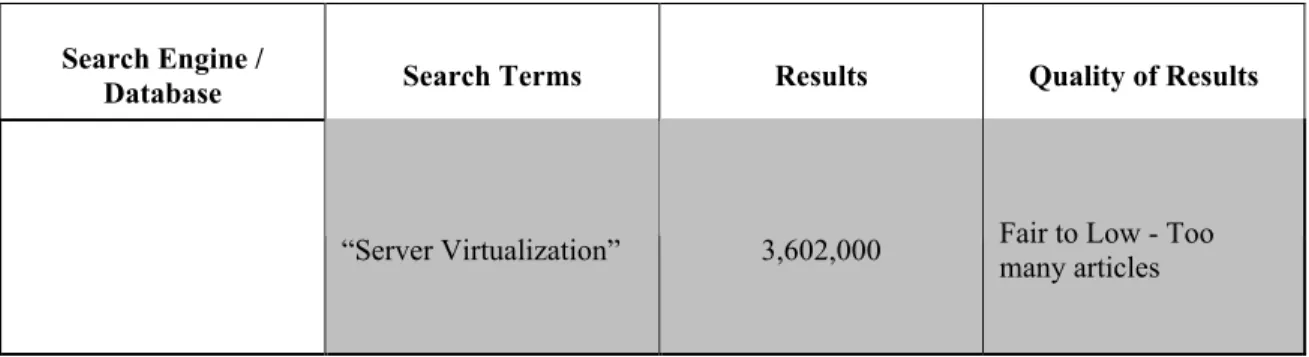
“Server Virtualization” 3,602,000 Fair to Low - Too many articles
Table 1: Preliminary search results
Data Analysis Plan
The references collected for this report are initially qualitatively analyzed by using the data analysis spiral (Leedy & Ormrod, 2005, p. 151). This spiral has four steps to follow: first the selected reference materials are organized, then they are perused for a gain of overall sense, next they are classified into groups based on predetermined criteria, and lastly they are synthesized to create the final report.
The data analysis process used in this study to support the synthesis step is called ‘conceptual analyses’. In conceptual analysis, a concept is chosen for examination, and the analysis involves quantifying and tallying its presence (Busch et al., 2005). The focus of the process is on two main aspects of virtualization integration, which form the key concepts used for coding: reducing IT costs and increasing IT efficiency. Sub concepts that are coded for are related to the advantages and disadvantages in relation to the two pre-selected IT business functions, such as return on investment and total cost of ownership. Server virtualization has identifiable benefits that are aligned with organizational expectations, business drivers for IT, and actual server virtualization use cases (The Strategic Counsel, 2007). Drawbacks can include cost accounting (hardware, license compliance); human issues (training); vendor support (lack of
license flexibility); system management complexity; and security (possible new threats) (Mann, 2007).
These aspects of virtualization integration form the key concepts used to design the specific conceptual analysis process. Coding proceeds through a series of eight selective reduction steps (Busch et al., 2005). These steps include:
1. Level of analysis. The level of analysis for the coding process is based on sets of words and phrases. These words and phrases have been identified as:
o Reducing IT costs. o Increasing IT efficiency.
2. Number of concepts to code for. The initial different concepts or phrases that will be coded for are:
o “Cost” o “History” o “Efficiency” o “Virtualization”
o “Return on Investment” / “ROI” o “Total Cost of Ownership” / “TCO” o “Pros and Cons”
3. Code for existence or frequency of a concept. The data is coded for existence as well as frequency of concepts and terms. The number of times the term is used can indicate the relevance as well as importance of the term within the document. It is understood that the number of times a term is used may not always indicate the relevance in the literature. Because of this, translation rules are setup to help offer a level of consistency and coherence. These rules are defined in step 5: Rules for coding text. If a term or concept is found within the literature, it is flagged. The more flagged terms or concepts, the stronger the probability the literature is valid for review. All term and concept hits will be reviewed to ensure that the literature is relevant to the topic or sub-topics. The decision to code for both existence and frequency is possible because of software that will be used to assist in coding process. The software that will be used, Word Count Machine 2.5.1
(http://wordcounter.profusehost.net/), has the ability to find the term as well as count the number if times the term is used.
4. How to distinguish among concepts. A narrow level of generalization is applied when mining the data. Search terms and coding for existence should focus enough on the concepts that a wide level of generalization is not necessary.
5. Rules for coding texts. Translation rules offer a level of consistency and coherence. Taking the terms and phrases from step 1: level of analysis; articles are coded for the existence of the term or phrase. A translation rule
stipulates that only references to the listed terms or phrases will be coded. This will ensure consistency in the coding process.
6. Decide what to do with irrelevant information. Information deemed irrelevant will be reexamined as a possible direction to relevant data once the initial coding is completed.
7. Code the text. Two methods of coding are used for this literature review. Coding by hand, a manual process of reading the article and writing the concept occurrences, is more time consuming, but more effective to really mine the material collected. The second method is automated with the use of a word context analyzer: Word Count Machine 2.5.1. Using this tool will speed the process of mining the data for key words and phrases; however, it will take an added step to copy the data from downloaded PDF format and paste it into the analyzers.
8. Analyzation of results. Concepts are reviewed throughout the mined text and aligned with one of the major coding concepts, identified in process step 2: The number of concepts to code for. Concepts that can be aligned in one of these major areas: virtualization history, reducing IT cost, or increasing IT efficiency is maintained as part of the data analysis findings. Concepts that cannot be aligned are rejected as irrelevant data.
Writing Plan
The Writing Plan guides the development of the Review of Literature section of the document and follows the “thematic” organizational pattern, examining virtualization as a current option for organizations rather than focusing on the history of the technology. Thematic reviews of literature are organized around a topic or issue, rather than the progression of time (Literature review, 2007). However, progression of time may still be an important factor in a thematic review.
Obenzinger (2005) identifies seven key rhetorical patterns that literature reviews typically follow. This review follows the “Road Map” rhetorical pattern which is defined as: “the
researcher traces the history of knowledge in this field, one achievement after another, one study building on the work of the previous one, all of which points to one destination which happens to be the current work” (Obenzinger, 2005, p. 4). The rhetorical pattern supports the goal of this literature review by compiling and synthesizing relevant data collected, and the outcome will provide IT professionals with enough knowledge to discuss the business justification to move to a hardware-virtualization environment or to maintain the platform-specific model with company stakeholders.
Data mined from articles that have been deemed relevant to this review focus on two main aspects of virtualization integration: reducing IT costs and increasing IT efficiency. Information selected during data analysis and deemed relevant to the topic is combined into a detailed framework with three main headings. Sub-topics identified during the coding process are included. The anticipated outline, based on preliminary data review, follows:
1. Background of virtualization. A. Timeline of virtualization. B. Early Mainframe virtualization. C. Modern x86 platform virtualization. 2. Factors for Consideration.
A. Reducing IT Costs.
•Server consolidation.
•Test and Development Agility •Licensing Consolidation. •Power utilization.
•Physical space consolidation. B. Increasing IT Efficiency.
•Centralized Security.
•Centralized Administration (reporting, server management, log reviews, etc.)
•Legacy Systems Support. •Reduction of Downtime.
•Staff Education. 3. Conclusion
Annotated Bibliography
The references included in the Annotated Bibliography are selected as the foundation for the “Review of the Literature” section. Each of the twenty-two selections includes an abstract that summarizes the content of the selection for the reader. The researcher’s comments are also included for clarification as to how the reference is used in support of this study. Evaluation of author’s credibility was done by following guidelines presented by Smith (2008). Smith (2008) states, “In evaluating the credibility of an information source there are several key areas to consider:
• The Authority of the author and the publisher: Are they well qualified to speak to the topic at hand?
• The Objectivity of the author. • The Quality of the work. • Coverage of the work.
• Currency: When was the research completed and how recently the work published?” As a member of IEEE, this researcher has access to articles not available to the general public. Limited availability materials are noted in the References list and are available from
www.ieee.org.
Chao, W. (2006). The Pros and Cons of Virtual Machines in the Datacenter. Retrieved
Abstract: This article discusses the pros and cons of today's virtual machine technology to help you determine whether the cost of implementing virtual machine technology is worthwhile. Should the VM benefits outweigh the drawbacks in your multi-server
datacenter, virtual machine technology can provide more reliability, easier manageability, and lower overall cost for your organization.
Comment: Features and benefits sections explain the key benefits of virtual machine technology: isolation, standardization, consolidation, ease of testing, and mobility. Discusses some of the drawbacks and challenges of virtual machine technology:
concentration risk, cost, performance penalty, hardware support, and software licensing. The challenge of deploying virtual machine technology is figuring out whether the benefits outweigh the costs in your situation. This article is used to support the advantages and disadvantages sub-section of the document. This article is credible
because the author has been active in the business of technology for many years, has been involved with software and hardware since the mid 1980s. He has been writing Web-based software in a variety of languages and on different platforms since 1994. The article is published in an online technology journal that specializes in IT software and hardware development.
Conoops, A. (2007). Virtualization: Big Picture. Business Trends Quarterly. Retrieved January 4, 2009 from: http://btquarterly.com/?mc=virtualization-big-picture&page=virt-viewresearch
Abstract: This article discusses the some of the challenges that businesses are facing and how virtualization can assist in today’s business environments. It discusses the
discusses some ways how virtualization should be used, some of the options that virtualization offers to the business, and what some of the future offerings will be in virtualization.
Comment: This article is used to support the business aspects of the review including the “Test and Development Agility”, “Server Consolidation”, “Business Continuity”, and general advantages and disadvantages of this study. This article is used to support the advantages and disadvantages sub-section of the document. This article is credible because the author is the Operations Director of the Virtualization Academy. He has 25 years of IT experience, primarily within operations. He has worked both in the financial management and the intellectual property management industries. During this time he has delivered and managed many different operational solutions on a range of platforms including IBM AS/400, Novel, and Windows. In 1996, he joined Computer Patent Annuities, one of the world's largest intellectual property management organizations, and became Senior Manager Global Technology in 1999 with responsibility for developing, delivering, and managing a strategic global IT infrastructure.
Duntemann, J. (2005). Inside the Virtual Machine.PC Magazine, 24(16), 66-101. Retrieved November 24, 2008, from http://www.pcmag.com/article2/0,2817,1854434,00.asp
Abstract: This article focuses on virtual PCs. Virtualization of operating systems is one of those things that is hard to understand until one has actually seen it work. Special software creates a CPU mechanism called a virtual machine (VM), in which Windows can run under Windows, in a window, as can Linux, OS/2 Warp, Solaris, or almost any other operating system written for x86 hardware. The virtualization software is called a
virtual machine manager (VMM) or hypervisor. The virtual machine created by the VMM is an emulation of a completely independent PC. Virtualization's implications for software developers, beta testers, and support professionals are immense. No more one-OS-per-PC and no more waiting for an OS to boot up before use. An OS running in a VM is available instantly. A VM and its OS held in suspension as a disk file can be restored in seconds, with running applications and utilities, right where they were when the VM was suspended. Virtual PC for Mac had long allowed Windows and Windows apps to run on PowerPC-based Macs.
Comment: This article provides a good overview of how the virtual environment operates, including an introduction to the hypervisor and other technical details. This article is used to support the background of virtualization as well as historical section of the document, as well as provides information on the different mechanisms that make up a VM. This article has credibility because it is published in a popular technology trade publisher (Ziff-Davis), the author is an accomplished technology writer and editor. He is the Editor-in-Chief of Visual Developer magazine, former editor of Turbo Technix and PC Techniques, the "Structured Programming” columnist for Dr. Dobb's Journal, and has written and edited more than twenty programming books.
Figueiredo, R., Dinda, P., & Fortes, J. (2005). Resource Virtualization Renaissance.Computer, 38(5), 28-31. Retrieved November 14, 2008, from the Institute of Electrical and Electronics Engineers, Inc.
index.jsp?&pName=computer_level1_article&TheCat=1005&path=computer/homepage/0505&f ile=gei.xml&xsl=article.xsl&
Abstract: Virtualization technologies encompass a variety of mechanisms and techniques used to address computer system problems such as security, performance, and reliability by decoupling the architecture and user perceived behavior of hardware and software resources from their physical implementation. This article focuses on virtual machine monitors (VMMs), a key component of virtual machines that provides a layer between software environments and physical hardware that is programmable. A discussion is presented on the various perspectives of VMMs.
Comment: This article concerns the history of virtual technology as well as details of how the virtual machine monitor operates. This article is used to support the history and background of the virtual machine section of the document. This article appears to be credible because it is published by a peer-reviewed publication (IEEE Computer Society). The authors are credible based on their qualifications published in the article:
Renato Figueiredo is an assistant professor in the Department of Electrical and Computer Engineering at the University of Florida. His research interests are in distributed
computing, operating systems, and computer architecture. Figueiredo received a PhD in computer engineering from Purdue University.
Peter A. Dinda is an assistant professor at Northwestern University, where he holds the Lisa Wissner-Slivka and Benjamin Slivka Junior Chair in Computer Science. His research interests are in parallel and distributed systems, performance analysis, and adaptive systems. He received a PhD in computer science from Carnegie Mellon University.
José Fortes is a professor and a BellSouth Eminent Scholar at the University of Florida, where he is also the director of the Advanced Computing and Information Systems Laboratory. His research interests are in the areas of distributed computing and
information processing, computer architecture, and nano-computing. Fortes received a PhD in electrical engineering from the University of Southern California.
Golden, B., & Scheffy, C. (2007). Virtualization for Dummies. Hoboken, N.J. Wiley.
Abstract: A guide to virtualization covers such topics as server virtualization, managing a virtualization project, software options, using VMware Server, and implementing XenExpress.
Comment: A version of the popular “Virtualization for Dummies” book. It includes some biases because of the sponsors it was modified for – Sun and AMD; however, it is still a very good resource on all aspects of virtualization (history, advantages and disadvantages.) This book is deemed credible because it is published by a well-known publisher (Wiley Publishing), and there is sufficient coverage of the concept, the material is current – published in 2008, and the writing is technical in nature.
The Strategic Counsel (2007). Global Server Virtualization Survey -Summary Report. Retrieved November 23, 2008 from
http://www.ca.com/files/SupportingPieces/consolidatedreport52607v1.pdf
Abstract: Organizations are looking at deploying virtualization for multiple reasons. Whether you are curious, still in the planning stages or already engaged in deployment,
this independent global study, of 800 surveyed organizations, highlights the mixed results companies are experiencing with server virtualization—as well as critical success factors discovered by early adopters. Learn how organizations are deploying virtualization and the benefits and challenges they experienced.
Comment: This article contains ROI information as well as best practices information. This article is used to support the advantages and disadvantages (in relation to the IT business function of cost) section of the document. This document is a commissioned survey for CA (formerly Computer Associates International, Inc.), of 969 private and public organizations with a minimum of 500 employees. The survey intent was to determine the deployment incidence, trends and timetables associated with server
virtualization; organizations’ motivations for moving to virtualized server environments; organizations’ IT management issues and constraints with heterogeneous virtualized server environments; and organizations’ return from server virtualization deployment. The survey asked IT executives and managers who are specifically final and key decision-makers and influencers for server virtualization to detail their organizations’ server virtualization deployments or plans in the following areas:
• Current and future adoption and timelines; • Implementation status and areas;
• Technology and business drivers for virtualized server environments; • Key issues in managing virtualized environments;
• Key virtualization benefits, barriers and best practices; and, • Return on investment and cost savings.
It is a technical article written for IT professionals (CA is an IT management software provider).
Hamm, S. (2005). A Virtual Revolution. Business Week, 3938, pp. 98-102. Retrieved November 15, 2008 from: http://www.businessweek.com/magazine/content/05_25/b3938622.htm
Abstract: Focuses on new software that makes computing cheaper and more efficient, and accelerates the power shift from sellers to buyers. Discussion of the benefits of virtualization, a major trend in computing; How virtualization software allows one computer server to act like several, so one server can run more than one program; Implications for corporate customers; Advantages for people who buy and manage computers; Views of analysts.
Comment: This article is used to support the history and the advantages and
disadvantages sections of the document. This is a credible article because it is published in reputable periodical – BusinessWeek, a part of the McGraw-Hill companies. The author is a senior writer for BusinessWeek and focuses on globalization, innovation and leadership.
Kennedy, R. (2007). Application and Desktop Virtualization. InfoWorld, 29(7), 28-32. Retrieved November 8, 2008 from InfoWorld Web site:
http://www.infoworld.com/article/07/02/12/07FEvirtualapp_1.html
Abstract: The article discusses application and desktop virtualization. An example that virtualization is not just for the data center is application virtualization wherein products that insulate running programs from the underlying desktop. Eliminating the support
draining configuration problems that plague conventional desktop implementations is the idea behind application virtualization. One approach to application virtualization is to use products such as Altiris software virtualization solution (SVS) which employs a brute force method that installs a filter driver in the Windows file system code stack to intercept and redirect I/O calls from SVS-managed applications. Another is hosting a legacy application on a new operating system.
Comment: This article is used to support the history and advantages and disadvantages of this study. This article is credible because it is published in InfoWorld - a leading publisher of technology information. The author is a contributing editor of the InfoWorld Test Center. The article meets the date range requirements so it is relevant to the review, and it is a high quality article – technically written for an IT professional or systems engineer level.
Kirch, J. (2007). Virtual Machine Security Guidelines. The Center for Internet Security. Retrieved November 30, 2008 from
http://www.cisecurity.org/tools2/vm/CIS_VM_Benchmark_v1.0.pdf
Abstract: This white paper addresses security concerns that apply generally to Virtual Machine technologies. The recommendations contained within are vendor neutral and should apply to most virtualization deployments. Recommendations are based on a variety of public sources and input from members of the Center for Internet Security (CIS).
Comments: This whitepaper is used to support the advantages and disadvantages (security) section of the document. This whitepaper is credible for many reasons. The
quality of work is for an IT security expert that is interested in securing a virtual environment. The paper was written for The Center of Internet Security (CIS) provides benchmarks, scoring tools, software, data, information, suggestions, ideas, and other services and materials from the CIS website or elsewhere as a public service to Internet users worldwide.
Kline, T., & Whyms, R., (2007) Investigating the Use of Virtual Servers to Improve the Restoration Process of an Active Directory Forest. University of Maryland, Baltimore Center for Information Technology Services. Retrieved November 29, 2008 from http://net.educause.edu/ir/library/pdf/MAC07088.pdf
Abstract: This power point presentation is primarily covers a disaster recovery solution for an Active Directory environment that is based on virtual machines. Section two of the presentation provides an overview of virtualization technology and how it can be
implemented in the environment.
Comment: Using virtualization as a disaster recovery option. Good graphic to reference on the layers of a virtual setup. The presentation provides some historical information as well as advantages and disadvantages of virtualization, including information on disaster recovery. The authors appear to be authorities in the field of virtualization. The
presentation is written for the Center for Information Technology Services at the University of Maryland, Baltimore. Presentation quality, coverage, and currency make this a credible article.
Mann, A. (2007). The Pros and Cons of Virtualization.Business Trends Quarterly. Retrieved November 27, 2008 from http://www.btquarterly.com/?mc=pros-cons-virtualization&page=virt-viewresearch
Abstract: The article provides a breakdown of advantages and disadvantages of implementing a virtualization into the enterprise. The article also discusses the most common virtualization technologies.
Comment: A detailed overview of the advantages and disadvantages of virtualization. This article is credible because the author is a Senior Analyst, has over 20 years
experience with large-scale Enterprise systems software on mainframe, midrange, server and desktop systems. The periodical, Business Trends Quarterly, establishes a dynamic forum where business strategy experts and IT decision-makers analyze existing enterprise systems and challenges from an IT solutions standpoint.
Nair, R., & Smith, J. (2005). The Architecture of Virtual Machines. Computer, 38(5), 32-38. Retrieved November 19, 2008 from the Institute of Electrical and Electronics Engineers, Inc. http://ieeexplore.ieee.org/Xplore/login.jsp?url=/iel5/2/30853/01430629.pdf?arnumber=1430629)
Abstract: This article explores the architecture of virtual machines (VM). Virtualization has become an important tool in computer system design, and virtual machines are used in a number of sub-disciplines ranging from operating systems to programming
languages to processor architectures. Because VM implementations lie at architected interfaces, a major consideration in the construction of a VM is the fidelity with which it implements these surfaces. Some of the important interfaces and implementation layers in a typical computer system are illustrated.
Comment: Very detailed article describing the hardware/software marriage that makes virtualization work. Article can be beneficial for hardware aspects of how VM’s work and how to save hardware cost by using VM’s. This article is used to support the history and the advantages and disadvantages (hardware/software) section of the document. This article is credible because it was published by a peer-reviewed publication (IEEE
Computer Society). The authors are both professionals in their respective fields. Smith is a professor in the department of Electrical and Computer Engineering at the University of Wisconsin-Madison. Nair is a research staff member at the IBM T.J. Watson Research Center.
Ou, G. (2006). Introduction to sever virtualization. Retrieved December 1, 2008 from TechRepublic Web site: http://articles.techrepublic.com.com/5100-10878_11-6074941.html
Abstract: This article offers an introduction to server virtualization, from what virtualization is and why to use it, to when to use virtualization, to how to migrate physical servers to virtual servers, and more.
Comment: This is an article that describes the advantages and disadvantages of virtualization. The article also discusses licensing and migration – physical 2 virtual (P2V) issues, and what to watch for (all the eggs in one basket). This article is used to support the advantages and disadvantages section of the document. This article is credible because the author is Technical Director of TechRepublic. Former IT consultant
specializing in Servers, Microsoft, Cisco, Switches, Routers, Firewalls, IDS, VPN, Wireless LAN, Security, and IT infrastructure and architecture. The online periodical,
TechRepublic, is part of the CBS Interactive brand, which is a premier online content network.
Posey, B. (2003). The pros and cons of server virtualization. Retrieved November 29, 2008 from TechRepublic Web site: http://articles.techrepublic.com.com/5100-10878_11-5057662.html
Abstract: Server virtualization combines many Web sites onto one server. This article looks at situations in which server virtualization is best used and discusses the benefits and potential problems.
Comment: Introduces some cons of virtualization – Scalability, Security and “bleed over” (when the contents of one virtual sever affect other virtual servers). This article is used to support the advantages and disadvantages (cons) section of the document. This article is credible because the author has written over 3,000 technical articles and written or contributed material to 27 books. He as also served as CIO for a chain of hospitals, as well as was in charge of IT security for Fort Knox. The online periodical, TechRepublic, is part of the CBS Interactive brand, which is a premier online content network.
Ramanathan, R.M., & Bruening, F. (2004). Virtualization: Bringing Flexibility and New Capabilities to Computing Platforms. Retrieved November 11, 2008 from Intel Web site: ftp://download.intel.com/technology/computing/archinnov/teraera/download/virtualization_0604 .pdf
Abstract: The perceived complexities of computing systems are a deterrent to their pervasive adoption by users. The convergence of computing and communications can drive continuing growth, but this growth will not be sustainable unless we can find new
ways to transparently manage complexities and hide them from users. This paper provides a conceptual overview of a new concept – platform virtualization – that can be used to provide end-users with future computing systems that are as easy to use as consumer electronics equipment. Virtual platforms promise to make future computers more autonomous, reliable and trusted, making them an almost invisible tool in our day-to-day lives. Platform virtualization is a key enabler of new usage models designed to make these goals a reality. It is the road to the future of computing.
Comment: Detailed article on the benefits of virtualization. There is the possibly of bias because the paper is authored by Intel employees. This article is used to support the general advantages and disadvantages of virtualization segment of the document. When evaluating the credibility of a document, it is possible that this on the verge of not being credible because it is an Intel presentation, which has a high possibility of having a bias since Intel is involved with manufacturing and sales of virtualization components. However, it is included because it is writing for a professional audience, it is relevant to the topic, and the authors and company they represent are recognized in the field as authorities for the technology.
Reuben, J.S. (2007). A Survey on Virtual Machine Security. Helsinki University of Technology. Retrieved November 29, 2008 from
http://www.tml.tkk.fi/Publications/C/25/papers/Reuben_final.pdf.
Abstract: Virtualization plays a major role in helping the organizations to reduce the operational cost, and still ensuring improved efficiency, better utilization and flexibility of existing hardware. "Virtualization is both an opportunity and a threat - says Patrick
Lin, Senior director of Product Management for VMware". This paper presents a
literature study on various security issues in virtualization technologies. Our study focus mainly on some open security vulnerabilities that virtualization brings to the
environment. We concentrate on security issues that are unique for virtual machines. The security threats presented here are common to all the virtualization technologies available in the market; they are not specific to a single virtualization technology. We provide an overview of various virtualization technologies available in the market at the first place together with some security benefits that comes together with virtualization. Finally we provide a detailed discussion of several security holes in the virtualized environment. Comment: This paper covers the history of virtualization as well as details on specific security issues that can become an issue: guest-to-guest attack, denial of service, external modification of a VM and external modification of the hypervisor. This article is used to support the historical as well as advantages and disadvantages (security) section of the document. This paper is credible because it is a scholarly research paper written for the Helsinki University of Technology. It is written with good coverage of the topic and good quality of the writing.
Samoilenko, A. (2007) Key Problems of Virtualization Deployment. Byrds Research & Publishing. Retrieved December 1, 2008 from http://ixbtlabs.com/articles2/cm/virtualization-problems-page1.html
Abstract: Virtualization technologies radically change the standard approach to deploying an IT infrastructure. Despite all evident advantages of virtualization, its