1 Page 1-7 © MAT Journals 2017. All Rights Reserved
Master Cleaner Robot
1
Reena Rani, 2 Lavi Agarwal, 1
Neha Singh, 1Smriti Usha, 1Shubham kumar
1U.G. Scholars, Dept. of E&C Engg., MIT Moradabad Ram Ganga Vihar, Phase II, Moradabad (244001), India
2Assistant Professor, Dept. of E&C Engg., MIT Moradabad Ram Ganga Vihar, Phase II, Moradabad (244001), India
Abstract
Is cleaning only the responsibility of the karamcharis? Do citizens have no role in this? We have to change this mindset.” – Narendra Modi
This article represents the mechanism of how will robot climb the stairs while cleaning with aid of the vacuum cleaner. This Robot will climb along the stair after being guided by some rigid mechanical structure. Its mechanical design consists of combination of tri wheels at its front and back being driven by DC motor for climbing stairs. In this paper we have discussed how this master cleaner robot would replace human effort to carry out mundane tasks in places like offices, hospitals, industrial and military automation, security systems and hazardous environments. Detailing regarding the vacuum cleaner is also mentioned briefly in the paper. There is a lot of scope for improvement and this model can be further modified and used in various other applications such as carrying heavy loads and thus further reducing human effort. In this paper we present the structure, design and implementation application of a climbing robot.The main application of this robot is to clean the surface with aid of the vacuum cleaner.
Keyword- DC gear motors, tri-wheels, vacuum cleaner
INTRODUCTION
SWACHH ,a word which gives an important message , i.e ,cleaning is the first duty of every individual because only in the clean environment a person can do work freely ,can concentrate ,can perform the task more efficiently. Also clean environment is necessary for the animals for their livelihood and for a better and improved ecosystem.
Amidst of cleaning there comes cleaning of the staircases ,since cleaning of the staircases is the most difficult task and people usually ignore as a result of which accidents occurs (falling from the staircases ,etc) ,in addition these accidents ,due to the garbage the site stinks ,breeding
grounds for the insects ,insightful ,unhealthy.
So this terminator of dust will perform the task of cleaning the stairs in addition with cleaning the floor .and this terminator of dust is remote controlled ,so it becomes very easy and interesting to clean the stairs and the floor both .[1]
This will reduce the dependence upon the manual aid and will perform the task more efficiently.
ORGANIZATION OF THE PAPER The initial section of this paper consists of a literature review of some past attempts made in the area of our interest. The paper further gives a detailed discussion of
2 Page 1-7 © MAT Journals 2017. All Rights Reserved problem identification and its solution.
The solution of the problem is suggested by the proposed design of vacuum cleaner under the category ‘Proposed Design ’. The discussion deepens further under the section ‘Results and Discussion’. Then the conclusion is given with some probable future changes in the design. The past work done in this area is also appreciable and we have taken much reference from the past attempts.[2] But further changes might be possible in the proposed design in this paper as stated in the ‘conclusion’ section.
LITERATURE REVIEW
Saltaren R. (2006) MSRox has hybrid
mechanism called Star-Wheel because of both walking and rolling capabilities.
Markus Eich(2008) This paper suggests
the use of stairclimbing robots for the disaster mitigation process ,in this robot sensors are required in addition with the camera.
Shubham Kumar, Neha Singh, Reena
Rani, Smriti Usha: This paper shows the
study of different climbing robot which can be used for climbing on plane surface, stairs and rough terrains. He explained the comparison of all robots and shows the project proposed by us. He shows how it is different from existing model by adding some new features i.e. tri wheels, vaccum cleaner, wooden frame, remote control.
(a) (b)
Fig.1: (a) Vacuum cleaner (b) Remote control
Shubham Kumar, Neha Singh, Reena
Rani, Smriti Usha: He further carried out
research paper on the explanation of circuit diagram with more modifications in the proposed block diagram and further introduced the circuit diagram of the transmitter and its working in his paper.
BLOCKDIAGRAM
The block diagram of the terminator of dust is given below and it’s explanation is done effectively.
Fig.2: Block Diagram Of TOD
RF-Transmitter: It detects the signal, if
we press any key at transmitter then it will send signal at the receiver end port and also perform detection at the Rx end. .Through encoder it goes towards the rf transmitter.[3-5] rf transmitter is used to transmit the signals towards the receiver end.
RF-Receiver: When we will send signal
from transmitter end then this port will be responsible for catching the signals from Tx side. At the receiver end rf-receiver is implemented, the rf- receiver is used to receive the signals which are emitting from the transmitter end.[7]
Antenna: Helical antenna’s are used
which possess the range of 10cm for this terminator of dust.
In our model we used helical antenna. A helical antenna is used at one end of the
3 Page 1-7 © MAT Journals 2017. All Rights Reserved transmitter of length 10 cm and frequency
range between 433 to 443 MHZ.
Encoder: Encoder are used to translate
rotary or liner motion into a digital signal. Usually this is for the purpose of monitoring or controlling motion parameter such as speed, rate, direction, distance or position.Ht12E IC is used in transmitter.[6]
Decoder- Ht12d IC is used. After the
RF-receiver the decoder is applied to decode the coming signals from the transmitter decoder is a combinational logic circuit that converts a binary integer value to an associated pattern of output bits.[9] They are used in a wide variety of applications, including data demultiplexing, seven segment displays, and memory address decoding.
Antenna- The wireless transmission is
done through the antennas. The antenna used here is the helical antenna. the range of the antenna is 10cm.And this antenna is applied at both transmitter and the receiver end.[10]
Amplifier- Then the amplifier is applied
to strengthen the power of the signals. so that the fading signals do not lost and are recovered.
Motor- At the output motor is
implemented. The motor is simply the dc motor of [60] rpm. The motors are used to drive the robot in all directions.
PROBLEM IDENTIFICATION AND ITS SOLUTION
The major problem faced by us in the initial phase was of the vacuum cleaner, i. e, whether to implement a high power vacuum cleaner or not. By implementing a high power vacuum cleaner the overall budget plus the complications were increasing. Thus creating an entangled situation.[8]
DESIGN AND IMPLEMENTATION OF PROPOSED SYSTEM
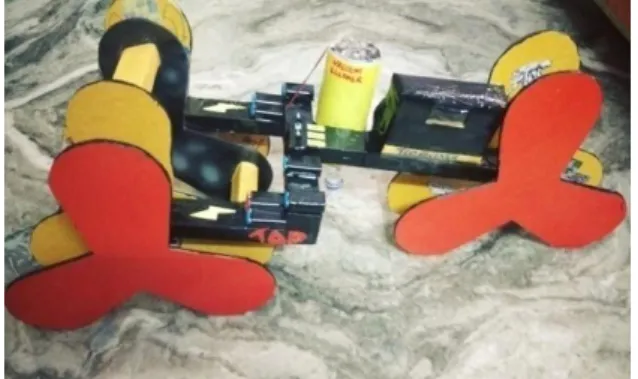
Terminator of dust, is climbing with aid of tri wheels. The front part of the robot consist of four tri-wheels and at back two
tri wheels are implemented which are generally used for the support at the back and the robot will climb upon the stairs very smoothing and efficiently.[11-13]
This combination of tri-wheels is attached with the wooden platform And the vacuum cleaner is implemented between the wooden platform and it is implemented such that it can clean the surface very efficiently since much space is present amid of the wooden platform.[14]
Working
Terminator of dust is wirelessly connected to the transmitter and receiver through the rf remote and we used two button in remote for moving in backward and forward direction With the help remote robot can run easily backward and forward direction.[15] And our project body was prepared with the electronic component like resistance, diode, pcb and capacitor and also made with mechanical component.
4 Page 1-7 © MAT Journals 2017. All Rights Reserved
Fig.:4 Simulation of receiver
Transmitter: A helical antenna is used at
one end of the transmitter of length 10 cm and frequency range between 433 to 443 MHz. Pin 14 is used to enable I.C. Resistance R1 is used to modulate with the internal oscillations of I.C.The capacitor is used to improve the Stability of the circuit. A 9 volt battery is applied at one end of the transmitter in order get the circuit work. [16].The terminals 1 – 9 of IC1 are grounded. It contains two switches for the motion of robot so that it can move in upward and downward direction easily. Ht12e IC is used which is an encoder IC. A resistance of 1M is used to modulate with the internal oscillations of the IC and other resistance that are used of 1k because they prevents the garbage value to reach these pins. A capacitor of 100uf is used to improve the stability of circuit.[17].
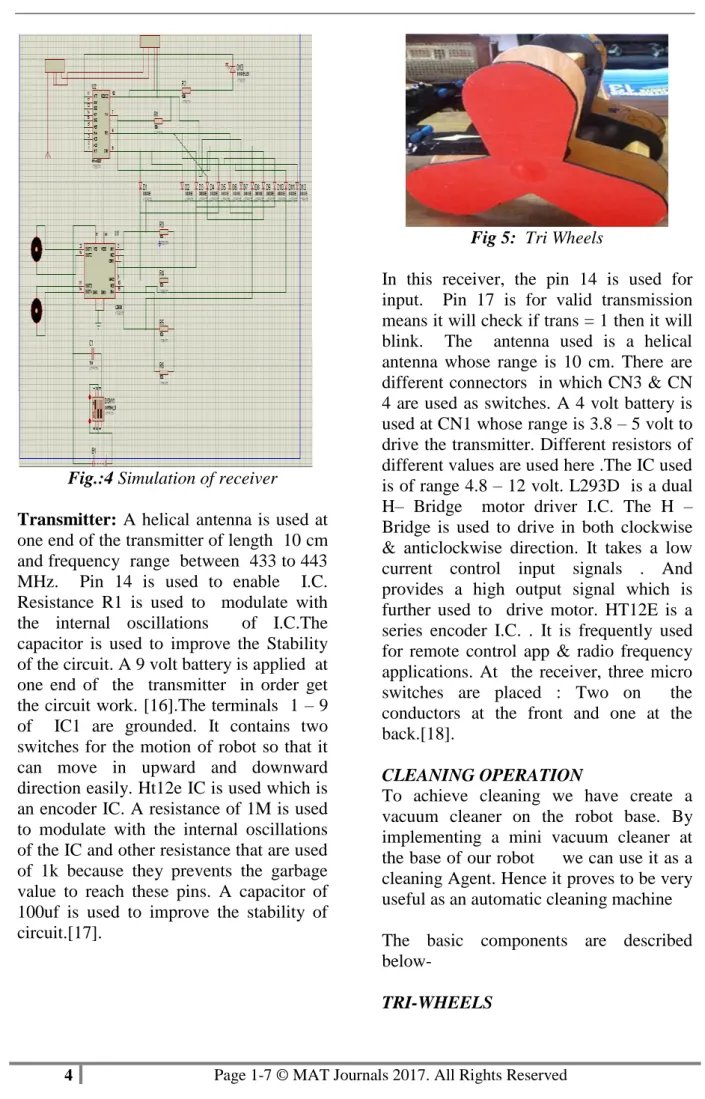
Fig 5: Tri Wheels
In this receiver, the pin 14 is used for input. Pin 17 is for valid transmission means it will check if trans = 1 then it will blink. The antenna used is a helical antenna whose range is 10 cm. There are different connectors in which CN3 & CN 4 are used as switches. A 4 volt battery is used at CN1 whose range is 3.8 – 5 volt to drive the transmitter. Different resistors of different values are used here .The IC used is of range 4.8 – 12 volt. L293D is a dual H– Bridge motor driver I.C. The H – Bridge is used to drive in both clockwise & anticlockwise direction. It takes a low current control input signals . And provides a high output signal which is further used to drive motor. HT12E is a series encoder I.C. . It is frequently used for remote control app & radio frequency applications. At the receiver, three micro switches are placed : Two on the conductors at the front and one at the back.[18].
CLEANING OPERATION
To achieve cleaning we have create a vacuum cleaner on the robot base. By implementing a mini vacuum cleaner at the base of our robot we can use it as a cleaning Agent. Hence it proves to be very useful as an automatic cleaning machine The basic components are described below-
5 Page 1-7 © MAT Journals 2017. All Rights Reserved Tri wheels are used to climb up the robot
upon the stair cases, i.e ,tri wheels enables any machine in enhancing its efficiency that is to say if a machine can run on the flat surface than with the added feature ,i.e. tri wheels it can easily and efficiently climb the stairs without any hindrance. We created the tri-wheels design capable of climbing stairs by reducing the force input and making it easier to move a cart upstairs. [20].The tri-wheels setup will be use across all type surfaces. A Tri wheel consists of the gears as well as the dc geared motor. With the aid of these two components tri wheels works.
Fig.6: Top view of model of terminator of dust
RESULT
The proposed design aims to provide a cost effective , light-weight and portable device which can be used to reduce the cumbersome of people involved in different fields,i.e., schools, offices ,metro’s ,shopping malls ,railway stations and various other places wherever the task of cleaning is required. Our research has led us to implement the design presented in this paper, but even more efficient designs can be made which may overcome the difficulties faced by our design of “stair cleaning robot”.
Fig 7: Complete view of model Terminator of Dust
CONCLUSION
So Terminator Of Dust will contribute in the field of cleaning i.e. cleaning stairs and floors both with aid of vacuum cleaner. A vacuum cleaner comprises of a hollow cylinder in which there is fan placed attached to a suction cup added to a motor which is used to create vacuum and suck the garbage from the even or odd places. FUTURE SCOPE
Further this stair cleaning robot has vast scope. Since besides cleaning the staircases it can clean the walls thus it can prove it selves as a perfect and most efficient machine.
Further it is also possible that we can add a special feature along with the vacuum cleaner and that is a wiping device so that it can prove to be more and more efficient machine.
REFERENCES
1. G. T. Sibley, M. H. Rahimi, G. S. Sukhatme, “Robomote: a tiny mobile robot platform for large-scale ad-hoc sensor networks”, IEEE International Conference on Robotics and Automation, ICRA '02,
vol.2,2002, pp.1143-1148.
2. W. F. Phillips and C. E. Hailey, “Review of attitude representations used for aircraft kinematics,” Journal
6 Page 1-7 © MAT Journals 2017. All Rights Reserved of Aircraft, vol. 38, no. 4, pp. 718–737,
Jul.-Aug. 2001.
3. A. Arora, E. Ertin, R. Ramnath, M. Nesterenko, W. Leal, “Kansei: high-fidelity sensing tested”, IEEE Internet Computing, vol.10, 2006,pp. 35- 47. 4. H. Utz, S. Sablatnog, S. Enderle, G.
Kraetzschmar, “Miro–
5. middlewarefor mobile robot applications”, IEEE Transactions on Robotics and Automation, vol.18, 2002, pp. 493- 497.
6. Sung Kyun Lim Dong Il Park Yoon Keun Kwak Byung-Soo Kim Sang-Won Jeon, “ Variable geometry single-tracked mechanism for a rescue robot” , Workshop, 2005 IEEE International Safety, Security and Rescue Robotics. 7. Gaston, J. Raahemifar, K. Hiscocks, P
“ A cooperative network of reconfigurable stair-climbing robots”, ISCAS 2006. Proceedings. IEEE International Symposium on Circuits and Systems, 2006.
8. Akhtaruzzaman, M.; IzzatiBt Samsuddin, N.; Bt Umar, N.; Rahman, M.;” Design and development of a wall climbing Robot and its control system” 12th International Conference on Computers and Information Technology, 2009. ICCIT '09.
9. G. Metta, P. Fitzpatrick, L. Natale,YARP: “Yet another Robot Platform”, International Journal of Advanced Robotic Systems, vol. 3, 2006, pp.43-48.
10.Chirag Gupta, Ayan Majumdar, "Design of Shrimp inspired rover with extended climbing ability", in the Proc. of National Conference on Recent Trends in Mechatronics, Nanotechnology and Robotics, National Institute of Technology, Rourkela,2006, pp 523-530
11.Anil E. Magare, Amit Kulkarni, Amit P. Kudva, Dhananjay A. Ipparthi,(2007) “Vertical and Horizontal Surface Traversing Robot:
Design Approach”, in the Proc. of Global Conference on Production and Industrial Engineering by National Institute of Technology ,Jalandhar, 2007 , Session 3A , pp 1-6.
12.Sandeep H.Deshmukh; Devesh Yadav & Binni Chowalloor, Asst.Professor , “Developing of Stair Climbing Transporter”, 13th National Conference on Mechanisms and Machines (NaCoMM07), IISc, Dec12-13,2007,Bangalore,India.
13.Sandeep H. Deshmukh, Sakthivel P. & Srikanth Sankaran, “Computer Aided Design and Interfacing Of EOT Crane” in the Proc. of Global Conference on Production and Industrial Engineering, National Institute of Technology, Jalandhar, 2007.
14.Sandeep H. Deshmukh, Sakthivel P. & Srikanth
Sankaran, “Computer Aided Design and Interfacing Of
EOT Crane” in the Proc. of Global Conference on Production
and Industrial Engineering ,National Institute of
Technology, Jalandhar, 2007, Session 4A , pp 1-6
15.Beisun Ma, Jiapin Chen and Xiang Yu, "Wall Climbing Robot for Measuring Oil Tank's Volume [J]", Journal Of Shanghai Jiaotong university, vol. 30, no. 11, pp. 159-164, 1996.
16.Ryo Kurazume and Shigeo Hirose, "Development of a Cleaning Robot System with cooperative Positioning System" in Autonomous Robots, vol. 9, no. 3, pp. 237-246, 2000, Springer.
17. T. Houston and R. Metzger,
Combination wheelchair and walker apparatus. U. S. Patent 5 137 102, August 1992.
18.[17]. E. J. Lefferts, F. L. Markley, and M. D. Shuster, “Kalman filtering for spacecraft attitude estimation,” Journal of Guidance, Control, and Dynamics, vol. 5, no. 5, pp. 417–429, Sept.-Oct. 1982.
7 Page 1-7 © MAT Journals 2017. All Rights Reserved 19.G. Glez-de-Rivera, J. Garrido and R.
Ponticelli, "Design considerations of a small UAV platform carrying medium payloads", Design of Circuits and Integrated Circuits (DCIS) Conference on.
20.Koki Kikuchi, Naoki Bushida, Keisuke Sakaguchi, Yasuhiro Chiba, Hiroshi
Otsuka, Yusuke Saito, Masamitsu Hirano and Shunya Kobayashi “A Wheel-based Stair-climbing Robot with a Hopping Mechanism” , Chiba Institute of Technology, Japan.
21.J. J. Craig, Introduction to Robotics, chapter 2, pp. 55–56, Addison-Wesley, 2nd edition, 1989.