C O V E R F E A T U R E
including the Simple Object Access Protocol (SOAP) for transmitting data, the Web Services Description Language (WSDL) for defining services, and the Business Process Execution Language for Web Services (BPEL4WS) for orchestrating services.
SOC lets developers dynamically grow application portfolios more quickly than ever before by
• creating compound solutions that use internal orga-nizational software assets, including enterprise infor-mation and legacy systems, and
• combining these solutions with external components possibly residing in remote networks.
The visionary promise of SOC is that it will be possi-ble to easily assempossi-ble application components into a loosely coupled network of services that can create dynamic business processes and agile applications that span organizations and computing platforms.3Such ser-vices will go well beyond simply exchanging informa-tion—the dominating mechanism for application integration today—to accessing, programming, and inte-grating application services encapsulated within old and new applications.
Key to realizing this vision is the service-oriented architecture. SOA is a logical way of designing a soft-ware system to provide services either to end-user
Service-oriented computing promotes the idea of assembling application components
into a network of services that can be loosely coupled to create flexible, dynamic business
processes and agile applications that span organizations and computing platforms. An SOC
research road map provides a context for exploring ongoing research activities.
Michael P. Papazoglou,
Tilburg UniversityPaolo Traverso
, Istituto per la Ricerca Scientifica e TecnologicaSchahram Dustdar
, Vienna University of TechnologyFrank Leymann
, University of StuttgartT
he service-oriented computing (SOC) paradigm uses services to support the development of rapid, low-cost, interoperable, evolvable, and massively distributed applications. Services are autonomous, platform-independent entities that can be described, published, discovered, and loosely cou-pled in novel ways. They perform functions that range from answering simple requests to executing sophisti-cated business processes requiring peer-to-peer rela-tionships among multiple layers of service consumers and providers. Any piece of code and any application component deployed on a system can be reused and transformed into a network-available service.Services reflect a “service-oriented” approach to pro-gramming that is based on the idea of composing appli-cations by discovering and invoking network-available services to accomplish some task.1This approach is inde-pendent of specific programming languages or operating systems. It lets organizations expose their core compe-tencies programmatically over the Internet or various networks such as cable, the Universal Mobile Tele-communications System (UMTS), xDSL, and Bluetooth using standard XML-based languages and protocols and a self-describing interface.
Web services are currently the most promising SOC-based technology.2They use the Internet as the commu-nication medium and open Internet-based standards,
Service-Oriented Computing:
State of the Art and Research
Challenges
applications or other services distributed in a network, via published and discoverable interfaces. A well-constructed, standards-based SOA can empower an organization with a flexible infrastructure and process-ing environment by provisionprocess-ing independent, reusable application functions as services and providing a robust foundation for leveraging these services.
SOC spans many intricately interwoven concepts, protocols, and technologies that originate in a wide range of disciplines including distributed computing systems, computer architectures and middleware, grid computing, software engineering, programming languages, database systems, security, and knowledge representation. Given this tremendous complexity, as well as the need to merge technology with an under-standing of business processes and organization struc-tures, research activities are very fragmented.
To provide the means for consolidating and stream-lining current SOC research efforts, as well as prioritiz-ing important gaps, we examine ongoprioritiz-ing projects in the broader context of a road map that embraces four piv-otal, inherently related research themes: service foun-dations, service composition, service management and monitoring, and service-oriented engineering. A com-prehensive review of the state of the art and standards in each area identifies open problems and bottlenecks to progress.
SOC RESEARCH ROAD MAP
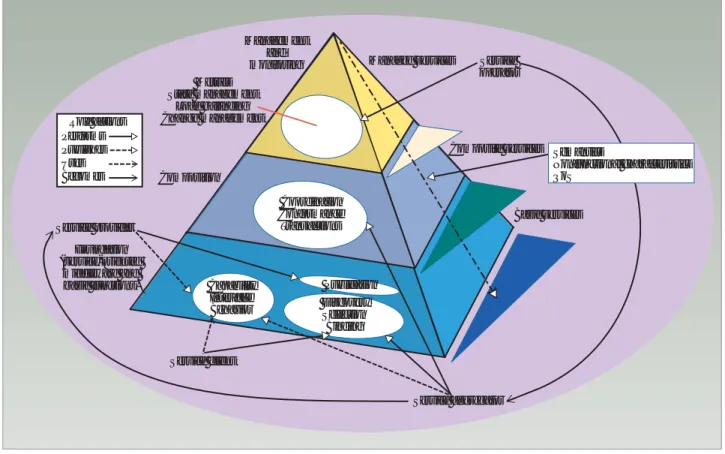
The SOC research road map, shown in Figure 1, intro-duces an extended SOA1that separates functionality into three planes: service foundations at the bottom, service composition in the middle, and service management and monitoring on top. This logical stratification is based on the need to separate
• basic service capabilities provided by a middleware infrastructure and conventional SOA from more advanced service functionality needed for dynami-cally composing services,
• business services from systems-centered services, and • service composition from service management. The perpendicular axis indicates service characteristics that cut across all three planes including semantics, non-functional service properties, and quality of service. QoS encompasses important functional and nonfunctional attributes such as performance metrics (for example, response time), security attributes, transactional integrity, reliability, scalability, and availability. Traditionally, QoS quantifies the degree to which applications, systems, net-works, and other IT infrastructure elements support avail-ability of services at a required performance level under all access and load conditions. Web services environments also demand greater availability of applications and
Composition Service provider Capability Interface Behavior Publication Discovery Selection Binding Service client Service operator Managed services Basic services Service aggregator Management and monitoring Metrics State management Load balancing Change management Performs Publishes Uses Becomes Role actions Coordination Conformance Transactions
Composite services Semantics
Nonfunctional characteristics QoS Foundation (service-oriented middleware and basic functions)
Figure 1. SOC research road map.The architectural layers provide a logical separation of functionality, while the perpendicular axis indicates service characteristics that cut across all three planes.
are coalescing into the concept of the enterprise service bus.4,5The ESB’s two key objectives are to
• loosely couple the systems taking part in the inte-gration, and
• break up the integration logic into distinct, easily manageable pieces.
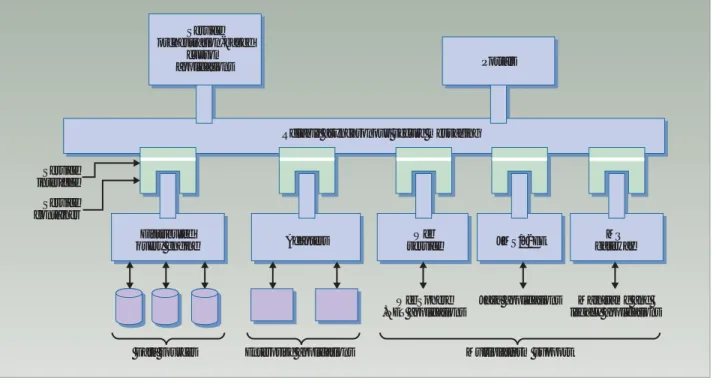
The ESB is an open-standards-based message back-bone designed to enable the implementation, deploy-ment, and management of SOA-based solutions. It is a set of infrastructure capabilities implemented by middleware tech-nology that enable an SOA and alle-viate disparity problems between applications that run on heteroge-neous platforms and use diverse data formats. The ESB supports ser-vice, message, and event-based interactions with appropriate ser-vice levels and manageability. Conceptually, it has evolved from the store-and-forward mechanism found in middleware products to an enterprise appli-cation integration solution that combines, for exam-ple, application servers and integration brokers, Web services, XSLT, and orchestration technologies.6The ESB provides an implementation backbone for an SOA that treats applications as services.
An emerging concept for the ESB is the container model. In this model, a “container” for the service run-time implementation exposes the service functionalities and nonfunctional properties to the external world via the network. It establishes connectivity and message exchange patterns and provides support and facilities such as transactions, security, performance metrics, dynamic configuration, and services discovery. In addi-tion, the container performs data and protocol adap-tation, and it monitors the internal behavior and state of services.
Figure 2 shows a simplified view of an ESB that inte-grates a J2EE application using the Java Message Service, a .NET application using a C# client, an IBM WebSphere MQ application that interfaces with legacy applications, and external applications and data sources using Web services. A distributed query engine, nor-mally based on XQuery or the Structured Query Language, enables the creation of data services to abstract the complexity of underlying data sources.
The ESB enables a more efficient value-added inte-gration of numerous different application components by positioning them behind a service-oriented façade and applying Web services technology to the problem. A primary use case is for the ESM to act as the inter-mediary layer between a portal server and the back-end data sources that the portal server must interact with. introduce increased complexity in terms of accessing and
managing services.
The SOC research road map also defines several roles. The service requester or client and provider must both agree on the service description (WSDL definition) and semantics that will govern the interaction between them for Web services to interact properly in composite appli-cations. A complete solution must address semantics not only at the terminology level but also at the levels that Web services are used and applied in the context of busi-ness scenarios—the busibusi-ness process and protocol levels. Thus, a client and provider must
agree on the implied processing, con-text, and sequencing of messages exchanged between interacting ser-vices that are part of a business process. In addition to the classical roles of service client and provider, the road map also defines the roles of service aggregator and operator.
Finally, Figure 1 illustrates that ser-vice modeling and serser-vice-oriented engineering—service-oriented
analy-sis, design and development techniques, and methodolo-gies—are crucial elements for creating meaningful services and business process specifications. These are an impor-tant requirement for SOA applications that leverage Web services and apply equally well to all three service planes.
SERVICE FOUNDATIONS
The service foundations plane consists of a service-oriented middleware backbone that realizes the runtime SOA infrastructure. This infrastructure connects het-erogeneous components and systems and provides mul-tiple-channel access to services over various networks including the Internet. It lets application developers define basic service functionality in terms of the descrip-tion, publishing, finding, and binding of services.
In a typical service-based scenario, a provider hosts a network-accessible software module—an implementa-tion of a given service—and defines a service descripimplementa-tion through which a service is published and made discov-erable. A client discovers a service and retrieves the ser-vice description directly from the serser-vice, possibly through metadata exchange or from a registry or repos-itory such as UDDI. The client uses the service descrip-tion to bind to the provider and invoke the service. Service provider and client roles are logical constructs, and a service can exhibit characteristics of both. Service aggregators group services provided by other providers into a distinct value-added service and can themselves act as providers.
State of the art
The requirements to provide a capable and manage-able integration infrastructure for Web services and SOA
Service modeling and
service-oriented engineering
are crucial elements for
creating meaningful
services and business
process specifications.
both the service provider and requester. It also involves adding semantic annotations and including descriptions of QoS characteristics—for example, in the DARPA Agent Markup Language, Web Ontology Language, or other semantic markup languages—to service definitions in WSDL and then registering these descriptions. Achieving automated service discovery requires explic-itly stating requesters’ needs—most likely as goals that correspond to the description of desired services—in some formal request language.
SERVICE COMPOSITION
The service composition plane encompasses roles and functionality for aggregating multiple services into a sin-gle composite service. Resulting composite services can be used as basic services in further service compositions or offered as complete applications and solutions to ser-vice clients. Serser-vice aggregators accomplish this task and thus become service providers by publishing the service descriptions of the composite service they create. The aggregators also enforce policies on aggregate service invocations.
State of the art
Currently, developers widely use the terms “orches-tration” and “choreography” to describe business inter-action protocols that coordinate and control collaborating services.
Orchestration describes how services interact at the message level, including the business logic and execution order of interactions under control of a single end point. It is an executable business process that can result in a A portal is a user-facing aggregation point of various
resources represented as services—for example, there can be retail, divisional, corporate employee, and busi-ness partner portals.
Research challenges
Major research challenges for service foundations in the near future include the following:
Dynamically reconfigurable runtime architectures.
The services runtime infrastructure should automati-cally leverage distributed service components and resources to create an optimal architectural configura-tion according to both a particular user’s requirements and the application characteristics.
End-to-end security solutions.Validating the
secu-rity aspects in SOA-based applications requires a full system approach to test end-to-end security solutions at both the network and application level. The Web Services Road Map jointly developed by IBM and Microsoft has similar concerns.7
Infrastructure support for data and process
inte-gration.The runtime infrastructure should provide
uni-form consistent access to all data by all the applications that require it, irrespective of the data format, source, or location. It should also integrate service-based applica-tions into processes and integrate processes with other processes into end-to-end constellations that span mul-tiple institutions.
Semantically enhanced service discovery.The main
challenge of service discovery is using automated means to accurately discover services with minimal user involvement. This requires explicating the semantics of
Service orchestration-based
custom
applications Portals Reliable asynchronous secure messaging
Distributed query engine Web service MQ gateway Adapters Mainframe and legacy applications Java applications WebSphere .NET applications JMS/J2EE
Data sources Enterprise applications Multiplatform support Service
interface Service container
long-lived, transactional, multistep process model. With orchestration, one of the business parties involved in the process always controls the business-process interactions. Orchestration is achieved via BPEL4WS and other XML-based process standard definition languages.8
Choreography is typically associated with the public (globally visible) message exchanges, rules of interac-tion, and agreements that occur between multiple busi-ness-process end points rather than a specific business process executed by a single party. Service choreogra-phy is achieved via the Web Services Choreograchoreogra-phy Description Language (WS-CDL),9which specifies the common observable behavior of all
participants.
This sharp distinction between orchestration and choreography is rather artificial, and the consensus is that they should coalesce in a sin-gle language and environment.
Research challenges
Some of the most notable re-search challenges for service com-position in the near future include the following:
Composability analysis for replaceability,
compat-ibility, and process conformance.Service conformance
ensures a composite service’s integrity by matching its operations with those of its constituent component ser-vices. It imposes semantic constraints on the component services and guarantees that constraints on data that component services exchange are satisfied. Service con-formance comprises both behavioral concon-formance as well as semantic conformance. The former guarantees that composite operations do not lead to spurious results, while the latter ensures that they preserve their meaning when composed and can be formally validated.
Dynamic and adaptive processes. Services and
processes should equip themselves with adaptive service capabilities so that they can continually morph themselves to respond to environmental demands and changes with-out compromising operational and financial efficiencies. In this context, the challenge is to provide techniques and support for dynamic service compositions that are self-configuring, -optimizing, -healing, and -adapting.
QoS-aware service compositions.Service
composi-tions must be QoS-aware10—that is, understand and respect one another’s policies, performance levels, secu-rity requirements, service-level agreement (SLA) stipu-lations, and so on. For example, knowing that a new business process adopts a Web services security standard from WS-Security is not enough information to enable successful composition. The client needs to know if the services in the business process actually require WS-Security, what kind of security tokens they are capable of processing, and which one they prefer.
Business-driven automated compositions.
Service-oriented applications should abstract away the logic at the application or business level, such as order process-ing, from non-business-related aspects at the system level, such as the implementation of transactions, secu-rity, and reliability policies. This abstraction should enable the composition of distributed business processes and transactions.11
SERVICE MANAGEMENT AND MONITORING
When composing services, developers must be able to assess the health of systems that implement Web services as well as the status and behavior patterns of loosely coupled applica-tions. Service management spans a range of activities, from installation and configuration to collecting met-rics and tuning, to ensure responsive service execution. It typically in-volves gathering information about the managed-service platform, ser-vices and business processes, and managed-resource status and per-formance via root-cause failure analysis, SLA monitoring and reporting, service deploy-ment, and life-cycle management and capacity planning.
Service monitoring involves monitoring events or information produced by the services and processes; monitoring instances of business processes; viewing process-instance statistics, including the number of instances in each state (running, suspended, aborted, or completed); viewing the status, or a summary, of selected process instances; and suspending, resuming, or termi-nating selected process instances.
State of the art
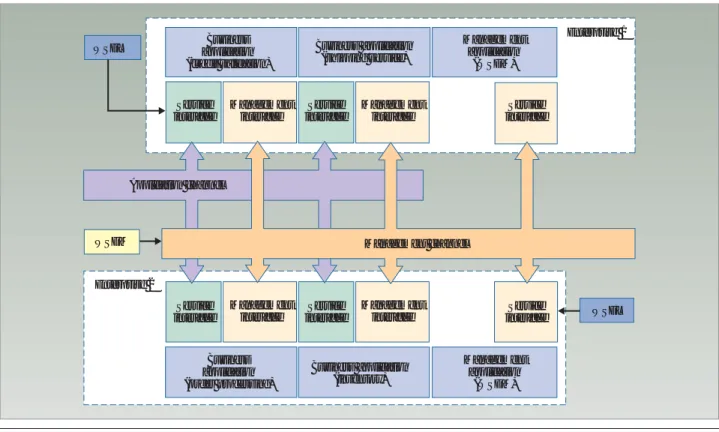
Figure 3 illustrates a conceptual Web services archi-tecture that provides a continuous connection between the application and management channels. Manageable resources include hardware and software resources, both physical and logical—for example, software appli-cations, hardware devices, servers, and so on. Their management capabilities are exposed as Web services that implement various management interfaces, such as those defined in the Web Services Distributed Manag-ement (WSDM) specification.
The management channel offers functionality such as availability and performance management, configura-tion management, capacity planning, asset protecconfigura-tion, job control, and problem determination. A WSDL doc-ument, resource properties schema, metadata docu-ments, and, potentially, a set of management-related policies describe a resource’s management interface.
The application in Figure 3 comprises business processes that integrate basic services such as credit val-idation, shipping, order processing, and inventory
ser-Service compositions must
understand and respect one
another’s policies, performance
levels, security requirements,
service-level agreement (SLA)
vices originating from two collaborating enterprises. Resource managers provide detailed performance sta-tistics that
• support assessment of the application’s effectiveness, • permit complete visibility into individual business
processes and transactions,
• guarantee consistency of service compositions, and • deliver status notifications when a particular
activ-ity is completed or a decision condition is reached. To achieve consistent management of end-to-end Web services, WSDM defines a protocol for interoperability of management information and capabilities in a distributed environment via Web services. It attempts to solve dis-tributed system management problems through two com-panion specifications: Management Using Web Services (MUWS) addresses the use of Web services technologies as the foundation of a modern distributed systems manage-ment framework, while Managemanage-ment of Web Services (MOWS) specifies the requirements for managing Web services themselves just like any other resource.12
Research challenges
The use of autonomic capabilities in conjunction with service-level management provides an evolutionary approach in which autonomic computing capabilities anticipate runtime system requirements and resolve
problems with minimal human intervention.3,11Some of the most notable research challenges for the near future include the following:
Self-configuring management services.These must
configure themselves automatically to adapt to differ-ent environmdiffer-ents in which they can be installed and optimized for particular uses.
Self-adapting management services.These must
adapt dynamically to changes in the environment and market using policies provided by IT professionals. Such changes could include deploying new instances of a par-ticular kind of service or removing existing ones, or even dramatically changing runtime system characteristics.
Self-healing management services.These must
discover, diagnose, and react to disruptions. They should detect system malfunctions and initiate policy-based corrective actions without disrupting the run-time environment.
Self-optimizing management services.These must
monitor resources automatically and tune themselves to meet end-user or business needs. Self-optimizing man-agement services improve overall utilization or ensure the timely completion of particular business transactions.
Self-protecting management services.These must
anticipate, detect, identify, and protect against threats. Self-protecting components can detect hostile activi-ties—such as unauthorized access and use, virus infec-tion and proliferainfec-tion, and denial-of-service attacks—as
Management application (WSDM) Business application (shipping service) Service interface WSDL Enterprise 2 WSDL Enterprise 1 Application channel Management channel Service interface Service interface Service interface Service interface Service interface Management interface Management interface Management interface Management interface WSDM Business application (credit validation) Management application (WSDM) Business application (inventory) Business application (order processing)
Figure 3. Web services management architecture.The architecture provides a continuous connection between the application and management channels.The application comprises business processes that integrate basic services originating from two collaborating enterprises.
they occur and take corrective actions to reduce their vulnerability.
SERVICE DESIGN AND DEVELOPMENT
A well-constructed SOA can empower a business with a flexible infrastructure and processing environ-ment by provisioning independent, reusable auto-mated business processes as services and providing a robust foundation for leveraging these services. SOAs must rely on an evolutionary software engineering approach that partly builds upon earlier processes including component-based development and business process modeling.
State of the art
Many developers think they can port existing com-ponents to Web services by creating wrappers and leav-ing the underlyleav-ing component untouched. Because component methodologies focus on the interface, many developers assume that these methodologies apply equally well to service-oriented architectures.
The software industry now widely implements a thin SOAP/WSDL/UDDI veneer atop existing applications or components that implement the Web services, but this is insufficient for commercial-strength enterprise appli-cations. Unless the component’s nature makes it suitable for use as a Web service, and most are not, properly delivering components’ functionality through a Web ser-vice takes serious redesign effort.1
Older software development paradigms for object-ori-ented and component-based development13,14 cannot be blindly applied to SOA and Web services as they do not address SOA’s key elements: services, information flows, and components realizing services.15These methodolo-gies satisfy only some of the requirements of SOC appli-cations and fail when they independently attempt to develop service-oriented solutions.
Research challenges
Major research challenges for service design and devel-opment in the near future include the following:
Engineering of service applications. SOA-based
applications require a service-oriented engineering methodology16that enables modeling the business envi-ronment, including key performance indicators of busi-ness goals and objectives; translates the model into service design; deploys the service system; and tests and manages the deployment.17
Flexible gap-analysis techniques.Gap analysis
pur-poses a business process and services a realization strat-egy by incrementally adding more implementation details to an abstract service/process interface. Such a strategy considers several service-realization possibili-ties such as green field development, top-down and bot-tom-up development, meet-in-the-middle development, and development based on reference models.
Service versioning and adaptivity. Developers
should introduce techniques to analyze business processes in detail instantaneously, discover and select suitable external services, detect problems in service interactions, search for alternative solutions, monitor service-execution sequences step by step, and appropri-ately upgrade and version services.
Service governance.Due to the cross-organizational
nature of end-to-end business processes composed from various service fragments that different organizations must maintain separately, service governance is a chal-lenging issue. The potential composition of services into business processes across organizational boundaries can function properly and efficiently only if the services are effectively governed for compliance with QoS and pol-icy requirements. Services must meet the functional and QoS objectives within the context of the business unit and the enterprises within which they operate.
S
ervice-oriented computing is a vast and enormously complex subject, embracing many technologies that must be integrated in an intricate manner. By focus-ing on the inherently related themes of service founda-tions, service composition, service management and monitoring, and service design and development, researchers can make requisite connections among diver-sified activities, find links in hitherto neglected spheres of work, and align ongoing and future projects in a more meaningful and coherent manner. This in turn will lead to a harmonization of research expertise and more inter-operable SOC solutions. ■References
1. M.P. Papazoglou, Web Services: Principles and Technology, Prentice Hall, 2007.
2. S. Weerawarana et al., Web Services Platform Architecture:
SOAP, WSDL, Policy, Addressing, BPEL, WS-Reliable Messaging, and More, Prentice Hall, 2005.
3. F. Leymann, “Combining Web Services and the Grid: Towards Adaptive Enterprise Applications,” Proc. CAiSE 05
Work-shops, vol. 2, FEUP Edições, 2005, pp. 9-21.
4. D. Chappell, Enterprise Service Bus, O’Reilly Media, 2004. 5. F. Leymann, “The (Service) Bus: Services Penetrate Everyday
Life,” Proc. 3rd Int’l Conf. Service-Oriented Computing (ICSOC 2005), LNCS 3826, Springer-Verlag, 2005. 6. M.P. Papazoglou and W-J. van den Heuvel, “Service-Oriented
Architectures: Approaches, Technologies and Research Issues,” VLDB J., vol. 16, no. 3, 2007, pp. 389-415. 7. “Security in a Web Services World: A Proposed Architecture
and Roadmap,” v1.0, 7 Apr. 2002, IBM/Microsoft; http:// msdn2.microsoft.com/en-us/library/ms977312.aspx. 8. T. Andrews et al., “Business Process Execution Language for
Web Services,” v1.1, 5 May 2003, IBM developerWorks; www.ibm.com/developerworks/library/specification/ws-bpel.
9. N. Kavantzas, “Web Services Choreography Description Language 1.0,” editor’s draft, 3 Apr. 2004, W3C; http:// lists.w3.org/Archives/Public/www-archive/2004Apr/att-0004/ cdl_v1-editors-apr03-2004-pdf.pdf.
10. F. Rosenberg, C. Platzer, and S. Dustdar, “Bootstrapping Per-formance and Dependability Attributes of Web Services,”
Proc. IEEE Int’l Conf. Web Services (ICWS 06), IEEE Press,
2006, pp. 205-212.
11. M.P. Papazoglou and B. Kratz, “Web Services Technology in Support of Business Transactions,” Service-Oriented
Com-puting and Applications J., vol. 1, no. 1, 2007, pp. 51-63.
12. H. Kreger et al., “Management Using Web Services: A Pro-posed Architecture and Roadmap,” v1.0, 2 June 2005, Com-puter Assoc./HP Development Co./IBM; ftp://www6.software. ibm.com/software/developer/library/ws-mroadmap.pdf. 13. F. Bachmann et al., Volume II: Technical Concepts of
Com-ponent-Based Software Eng., 2nd ed., tech. report CMU/
SEI-2000-TR-008 ESC-TR-2000-007, Software Eng. Inst., Carnegie Mellon University, May 2000.
14. P. Herzum and O. Sims, Business Component Factory: A
Comprehensive Overview of Component-Based Development for the Enterprise, John Wiley & Sons, 2000.
15. A. Arsanjani, “Service-Oriented Modeling and Architecture,” 9 Nov. 2004, IBM developerWorks; www-106.ibm.com/ developerworks/library/ws-soa-design1.
16. U. Zdun and S. Dustdar, “Model-Driven Integration of Process-Driven SOA Models,” to appear in Int’l J. Business
Process Integration and Management, 2007.
17. C. Ghezzi, “Service-Oriented Computing: Where Does It Come From? A Software Engineering Perspective,” keynote address, 3rd Int’l Conf. Service-Oriented Computing, Ams-terdam, Dec. 2005.
Michael P. Papazoglou is the chair of computer science and
director of the Infolab in the Department of Information Systems and Management at Tilburg University, Tilburg, the Netherlands. His research interests include distributed systems, service-oriented computing, enterprise application integration, and e-business technologies and applications. Papazoglou received a PhD in computer systems engineer-ing from the University of Edinburgh. He is an IEEE Com-puter Society Golden Core member and distinguished visitor. Contact him at [email protected].
Paolo Traverso is director of information technology at the
Fondazione Bruno Kessler, Istituto per la Ricerca Scientifica e Tecnologica, FBK-IRST, Trento, Italy. His research inter-ests include automated planning, automated verification and synthesis, and service-oriented applications. Traverso received a Laurea in electronic engineering from the Uni-versity of Genoa. He is a member of the IEEE Computer Society and the ACM. Contact him at [email protected].
Schahram Dustdar is a full professor of computer science,
director of the Vienna Internet Technologies Advanced Research Lab, and head of the Distributed Systems Group of the Information Systems Institute at the Vienna Univer-sity of Technology, Vienna, Austria. He is also honorary professor of information systems in the Department of Computer Science at the University of Groningen, the Netherlands. His research interests include service-oriented architectures and computing, mobile and ubiquitous com-puting, complex and adaptive systems, and context-aware computing. Dustdar received a PhD in business informat-ics from the University of Linz, Austria. He is a member of the IEEE Computer Society and the ACM. Contact him at [email protected].
Frank Leymann is a full professor of computer science and
director of the Institute of Architecture of Application Sys-tems at the University of Stuttgart, Stuttgart, Germany. His research interests include service-oriented computing and middleware, workflow- and business-process management, programming in the large, transaction processing, integra-tion technology, and architecture patterns. Leymann received a PhD in mathematics from the University of Bochum, Bochum, Germany. He is a member of the Ger-man Computer Society. Contact him at frank.leyGer-mann@ iaas.uni-stuttgart.de.