Title Page
TEACHER LEARNING THROUGH THE DIALOGIC SPACE OF A LESSON STUDY CYCLE
by
Jessica Beblo Hiles
Bachelor of Music, Westminster College, 2002 Master of Education, University of Pittsburgh, 2010
Submitted to the Graduate Faculty of the School of Education in partial fulfillment
of the requirements for the degree of Doctor of Education
University of Pittsburgh 2018
ii
UNIVERSITY OF PITTSBURGH SCHOOL OF EDUCATION
This dissertation was presented by
Jessica Beblo Hiles
It was defended on November 20, 2018
and approved by
Patricia Crawford, Ph.D., Associate Professor, Instruction and Learning
R. Gerard Longo, Pd.D., Clinical Associate Professor, Administrative and Policy Studies Co-Chair: Cynthia Tananis, Ed.D., Associate Professor, Administrative and Policy Studies Dissertation Advisor: Noreen Garman, Ph.D., Professor, Administrative and Policy Studies
iii
Copyright © by Jessica Beblo Hiles 2018
iv
TEACHER LEARNING THROUGH THE DIALOGIC SPACE OF A LESSON STUDY CYCLE
Jessica Beblo Hiles, Ed.D. University of Pittsburgh, 2018
Lesson study is a Japanese practice where teachers conduct a systematic inquiry into their pedagogical practice by closely examining a lesson and its delivery. Lesson study in the U.S. has become a more generalized term for similar collaborative cycles that vary greatly, based on their context. Professional development modalities in the U.S. can be one-dimensional and lack sustainability without ongoing support. There is a need for professional development that nurtures teacher learning, reflection and growth in an ongoing, authentic and supportive environment. This study will explore teacher dialogue and reflection, and any resulting learning and growth, during a lesson study cycle, interpreted from a Japanese lesson study framework.
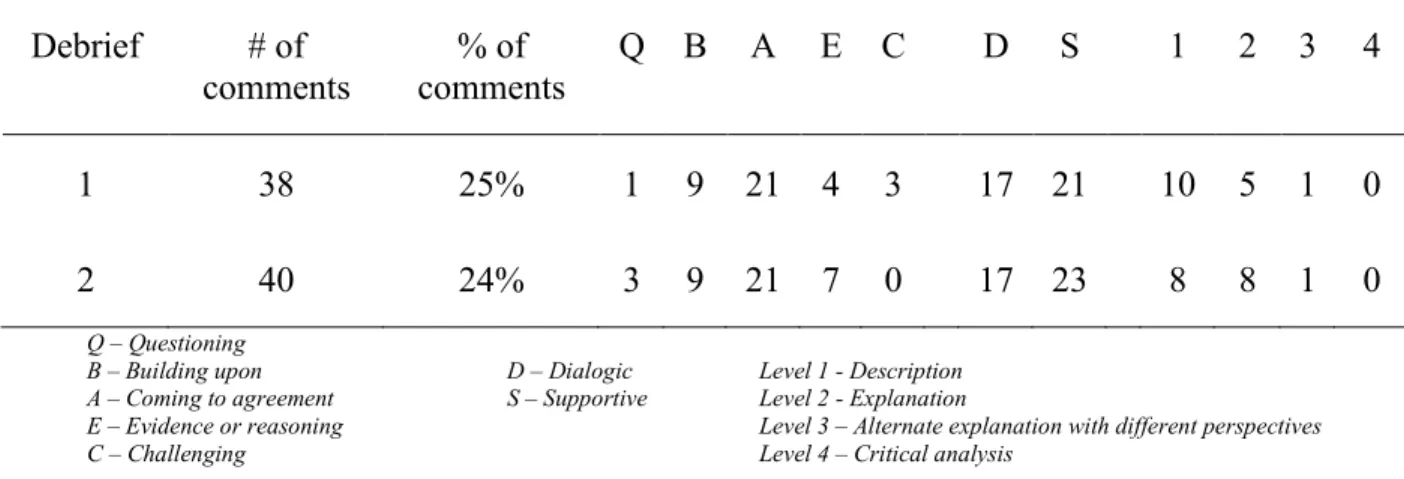
The study will focus on the dialogue during the lesson debriefs through an analysis of the comments - their depth of reflection, their role in the conversation (i.e., building, providing evidence, questioning, challenging or supporting) and their contribution as a dialogic or supportive move. Participant post-study reflections will also be analyzed for their depth of reflection. Teacher observation notes will be analyzed for observed mathematical practices. An analysis of the data through qualitative and quantitative lenses will attempt to determine if the dialogic space of a community of practice engaged in lesson study can be an effective forum for encouraging and generating teacher reflection and growth. Of particular interest in this study, is how professional dialogue influences each participant’s reflective insights on their own practice and contributes to the development of a collective knowledge base.
v
Table of Contents
Preface ... xii
1.0 Introduction ... 1
1.1 Background of the Problem ... 1
1.2 Statement of the Problem ... 2
1.3 Purpose of the Study ... 2
1.4 Research Questions ... 4
1.5 My Story ... 4
1.6 Definition of Lesson Study ... 6
1.6.1 Forms of Lesson Study in Japan ... 6
1.6.2 Forms of Lesson Study in the United States ... 8
1.6.3 Stages of Lesson Study ... 9
1.6.3.1 Stage 1: Choose a Topic ... 9
1.6.3.2 Stage 2: Plan the Research Lesson ... 10
1.6.3.3 Stage 3: Teach the Research Lesson ... 11
1.6.3.4 Stage 4: First Post-Lesson Discussion ... 13
1.6.3.5 Stage 5: Revise or Revisit the Lesson ... 14
1.6.3.6 Stage 6: Teach the Lesson a Second Time ... 15
1.6.3.7 Stage 7: Second Post-Lesson Discussion ... 15
1.6.3.8 Stage 8: Final Reflections and/or Research Lesson Report ... 16
vi
2.1 The Story of Lesson Study in Japan ... 17
2.1.1 A Historical Lens on Japanese Education and Lesson Study ... 17
2.1.2 The Japanese Educational Landscape ... 18
2.1.2.1 Japanese Curriculum ... 19
2.1.2.2 Japanese Classrooms ... 21
2.1.2.3 Japanese Professional Development ... 22
2.2 The Transfer of Lesson Study Outside of Japan ... 25
2.2.1 Early Roots of Lesson Study in the United States ... 25
2.2.2 Emergence of Lesson Study in Pittsburgh, PA ... 28
2.2.3 Challenges to Translating Lesson Study in the U.S. ... 33
2.2.4 Difference between Japanese and American Education Systems ... 36
2.2.5 Continued Lesson Study Research ... 37
2.3 Mathematics Teaching and Learning ... 39
2.3.1 Math as a Context for Lesson Study ... 41
2.3.2 Lesson Planning Processes ... 43
2.3.3 Math Focus in this Study ... 44
2.3.4 Live Observations of Lessons ... 47
2.3.4.1 Kidwatching ... 47
2.3.4.2 Professional Noticing ... 49
2.4 Adult Learning ... 50
2.4.1 Effective Professional Development ... 51
2.4.2 How Teacher Beliefs Shape Teaching and Learning ... 53
vii
2.4.4 Characteristics of Collaborative Professional Learning ... 57
2.4.4.1 Lesson Study as a Framework for Professional Development ... 57
2.4.4.2 Requirements of Practitioners of Lesson Study ... 59
2.4.4.3 Conditions that Support Lesson Study ... 60
2.4.4.4 Motivation to Participate in Lesson Study ... 61
3.0 Theoretical Framework ... 62
3.1 Sociocultural Theory ... 62
3.2 Dialogic Theory ... 64
3.3 Reflective Practice ... 66
3.4 The Dialogic Space of a Lesson Study Cycle ... 68
3.5 Methodological Challenges ... 68
4.0 Methodology ... 71
4.1 Rationale for Study Method and Design ... 73
4.1.1 Teacher Incentive ... 74
4.2 Setting and Participants ... 75
4.2.1 Conditions Supporting the Study ... 77
4.2.2 The Process ... 78
4.3 Ethical Considerations ... 79
4.4 Data Collection: Learning as Reconstruction of Experience ... 80
4.5 Data Analysis ... 85
4.5.1 Individual Participant Contributions to the Lesson Debriefs ... 86
4.5.2 Collaborative Implications for Dialogic Moves ... 99
viii
4.5.4 Comparison of Individual Reflections and Collaborative Reflection ... 108
4.5.5 Teacher Observations of Standards of Mathematical Practice ... 111
4.6 Accuracy and Representation ... 114
5.0 Lessons Learned ... 116
5.1 What is the Story of Lesson Study: Japanese Roots and the Movement in the U.S.?...116
5.2 How Does Lesson Study Support Professional Development for Teachers? What is the Incentive for Teachers to Choose to Participate in a Lesson Study Cycle? ... 119
5.3 What Happens when a Team of Teachers Engages Lesson Study? ... 120
5.4 What are the Lessons Learned from Engaging in Lesson Study? ... 121
5.5 Further Research ... 123
Appendix A ... 126
Appendix B ... 128
ix List of Tables
Table 1. Attributes of Effective Math Instruction ... 40
Table 2. Comparison of Traditional Professional Development & Lesson Study ... 53
Table 3. How Teacher Beliefs Shape Classroom Practice ... 54
Table 4. PA Core Standards for Mathematical Practice, 2013 ... 81
Table 5. The Five Roles of Comments in Conversation ... 83
Table 6. Levels of Reflection ... 84
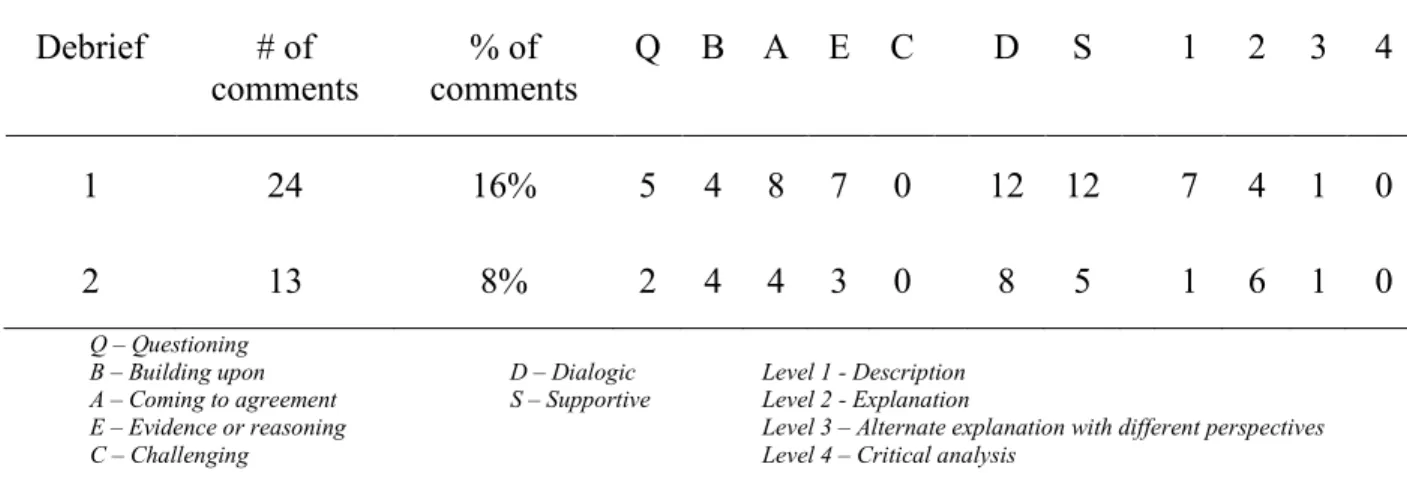
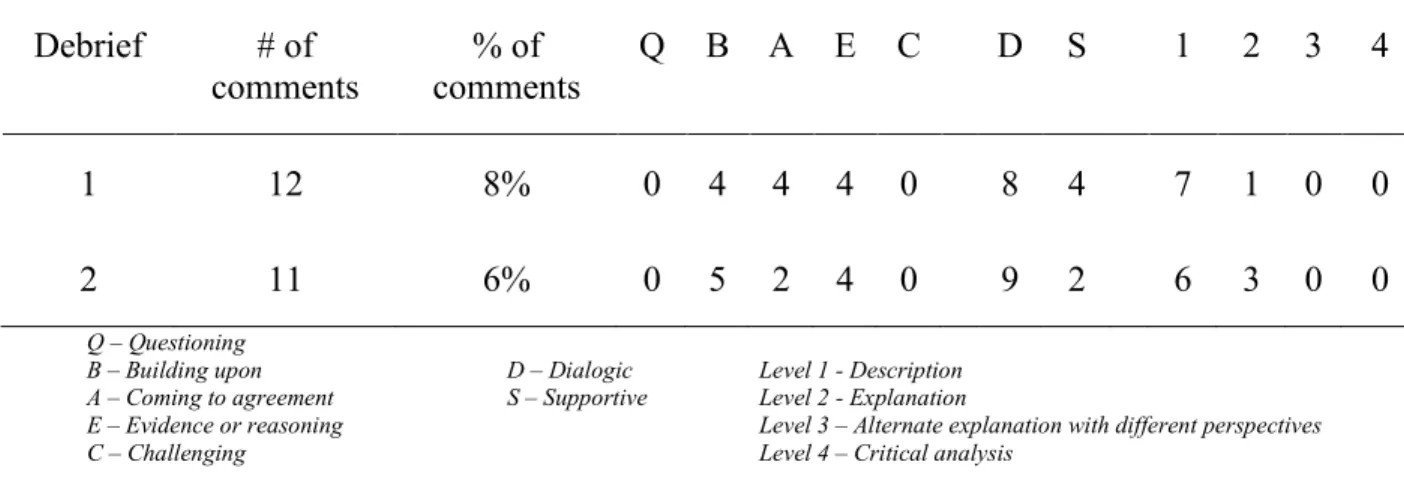
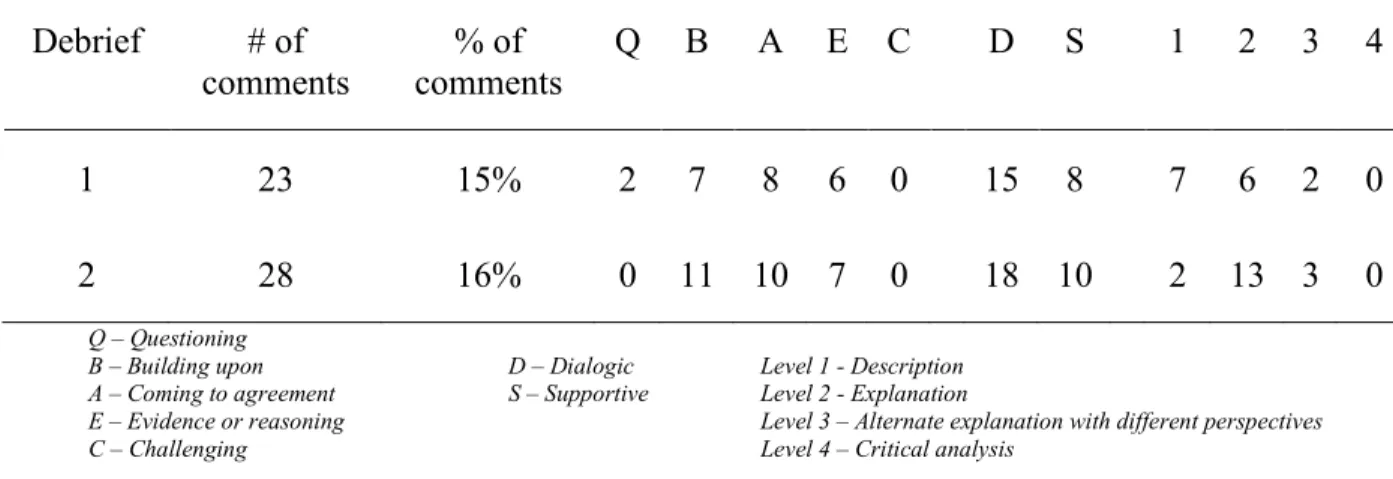
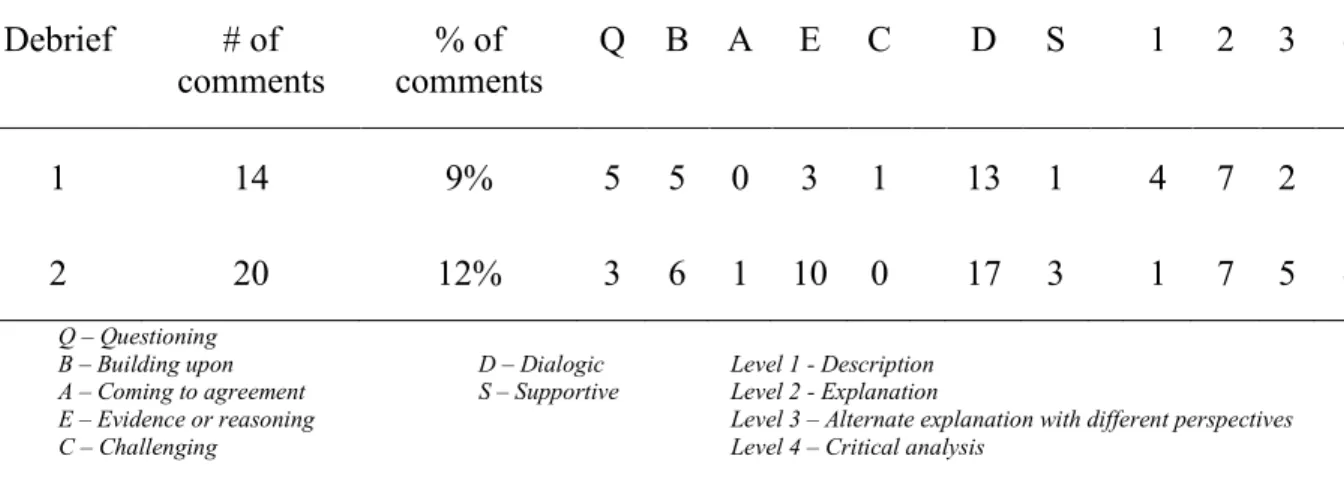
Table 7. Teacher 2 Lesson Debrief Data ... 86
Table 8. Teacher 3 Lesson Debrief Data ... 89
Table 9. Teacher 1 Lesson Debrief Data ... 91
Table 10. Teacher 4 Lesson Debrief Data ... 93
Table 11. Knowledgeable Other 1 Lesson Debrief Data ... 95
Table 12. Knowledgeable Other 2 Lesson Debrief Data ... 97
Table 13. Dialogic Moves Beginning with Evidence and Reasoning ... 100
Table 14. Dialogic Moves Beginning with Questioning ... 101
Table 15. Dialogic Moves Beginning with Building Upon Ideas ... 102
Table 16. Dialogic Moves Beginning with Challenging ... 103
Table 17. Dialogic Moves Beginning with Coming to Agreement ... 104
Table 18. Five Roles of Comments in Conversation During the Debriefs ... 106
Table 19. Dialogic and Supportive Moves During the Debriefs ... 107
x
Table 21. Levels of Reflection During the Post-Study Reflection ... 109
Table 22. Standards for Mathematical Practice During Observation 1 ... 112
Table 23. Standards for Mathematical Practice During Observation 2 ... 113
Table 24. Math Science Collaborative Lesson Study Events 1997-2010 ... 126
xi List of Figures
xii Preface
A journey of a thousand miles begins with a single step (Chinese proverb). The dissertation process has been a journey of many single steps towards coming to know and coming to be. I have deep appreciation for those who walked ahead of and beside me throughout the process. May this study be an inspiration to those who will walk behind me with their work.
• My family - for their support and encouragement of my studies and career, and for being patient as I learn how to balance life
• My administrative colleagues, past and present – for seeing something in me and my work, and for encouraging me to pursue Educational Leadership and to achieve the Ed.D.
• My colleagues and “school family” – for embodying a spirit of collaboration and team commitment, and for what they have taught me about effective teaching and learning, meaningful professional development and reflection
• My dissertation committee – for sharing so much of their expertise and insight, guiding my exploration of this topic
• My children and my students – may this be an example of life-long learning and persistence, and may your educational journeys be enhanced as a result
1
1.0Introduction
Four kindergarten teachers, seated in tiny student chairs at a hexagon-shaped table, are huddled around a laptop, viewing a YouTube video. A bustle of dialogue and activity ensues, as they brainstorm ideas and select materials, like Unifix cubes, picture books, crayons, and worksheet activities. While it may sound like preparation for a traditional math lesson, it is really a team of teachers engaging in a lesson study cycle1. The video and supplies are part of a research lesson designed to introduce students to the concept of decomposing numbers and to engage the teachers in collaboration and reflection focused on teaching and learning.
1.1Background of the Problem
The current field of education is cluttered with white noise - state and federal mandates, a flood of instructional materials, ever-changing technology, an increase in the basic needs of our students and time constraints. Teachers, who often find themselves teaching in isolation, can be overwhelmed, limiting their capacity to be reflective and effective in their practice. Professional development modalities can be one-dimensional - taking the form of a workshop or consultation, where a perceived expert delivers pre-packaged, scripted training, aloof from the teachers’ context,
1Lesson study is a process developed in Japan that brings together teachers to collaborate on a research lesson - writing it, teaching it, observing the students, reflecting upon it and revising it, teaching it again, reflecting upon it and revising it again.
2
and often for the initial part of implementation, without ongoing support. These approaches can lack rich dialogue, in a sustained environment.
1.2Statement of the Problem
There is a need for professional development that nurtures teacher learning, reflection, and growth in an ongoing, authentic, and supportive environment. This study will explore teacher dialogue and reflection, and any resulting learning and growth, during a lesson study cycle, interpreted from a Japanese lesson study framework. It will attempt to determine if the dialogic space of a community of practice engaged in lesson study can be an effective forum for encouraging and generating teacher reflection and growth.
1.3Purpose of the Study
This study will explore the experiences of teachers as they engage in a professional development process known as lesson study, in an attempt to determine how, if at all, professional dialogue can deepen teachers’ reflections about their own practice. A team of kindergarten teachers will facilitate a lesson study process, presenting in this study as the following steps: (1)
3
selection of a topic; (2) collaboration to research and write a lesson plan;2 (3) observation of students while one teacher teaches the lesson; (4 & 5) analysis, reflection, and lesson revision during a team debrief; (6) observation of students while a second teacher teaches the lesson; (7) analysis, reflection and lesson revision during a second team debrief; and (8) a final reflection.
This lesson study cycle will occur within one month during the spring of the school year surrounding a math lesson on decomposing numbers within 10. There are several motives for this focus area. We have recently adopted a new primary text for math instruction - the opportunity to collaborate on the a lesson has the potential to increase the teachers’ content knowledge, thoughtful decision-making and reflective action teaching math with the strategies introduced in the new text. In addition, the hands-on, collaborative nature of math problem-solving creates a forum for rich student dialogue and opportunities for utilizing multiple strategies or approaches. The observation and study of the students during a live lesson provides a different lens through which teachers can see their students.
Of particular interest in this study, is how professional dialogue influences each participant’s reflective insights on their own practice and contributes to the development of a collective knowledge base. In Pennsylvania, teachers are evaluated with a clinical observation or differentiated supervision - where they choose from the following modes: Professional Learning Community (PLC), action research, peer observation or portfolio. Lesson study is engaged by a Community of Practice (akin to a PLC), naturally involves action research, is an enriched approach to peer observation and can document a process towards an exemplar lesson and deep reflection
2 In this study, a lesson plan is a document that outlines the learning objectives, aligning PA Core standards, essential questions, student demographics, assessments, instructional sequence, instructional materials, and researched resources.
4
(in a portfolio format). This creates a dialogic space for lesson study within the greater framework of professional development, supervision, and evaluation.
1.4Research Questions
The potential lesson study has for positively impacting teacher professional development, with specific emphasis on student observation skills and reflection through dialogue is significant. Context matters. For this potential to be fully realized, the conditions that support lesson study must be considered and a system of sustainable support must be established. This study attempts to address these elements through the exploration of four research questions.
RQ1: What is the story of lesson study: Japanese roots and the movement in the U.S.? RQ2: How does lesson study support professional development for teachers? What is the incentive for teachers to choose to participate in a lesson study cycle?
RQ3: What happens when a team of teachers engages lesson study? RQ4: What are the lessons learned from engaging in lesson study?
1.5My Story
I have encountered lesson study multiple times in my career and it continues to resurface in professional experiences. My first introduction was while reading The Teaching Gap by Stigler and Hiebert (1999). I have continued to feed my interest by reading about it in professional journals and guidebooks by practitioners who have translated lesson study experiences for
5 American teachers.
I experienced professional sharing at Japanese-American teacher exchange meetings during a study abroad trip sponsored by the Japan Memorial Fulbright Program (JMF) in July of 2008. The purpose of the program, funded by the Japanese government, was to connect Japanese teachers and American teachers in a forum for professional exchange. The Japanese education system, from preschool to university, emphasizes continued professional growth and the sharing of effective practices3, a core part of the JMF program.
My American teacher colleagues and I visited a university, high school, middle school, primary school, and kindergarten. Each school visit involved classroom observations, school tours, interaction with students and an open conversation with teachers from the institution. While lesson study was not a component of the study trip, classroom observations and professional dialogue - key components of lesson study - were significant parts of the school visits. During these professional dialogues, it was evident our Japanese host teachers were just as interested in learning about American approaches to teaching and learning, as we were eager to learn from them. I can vividly picture two lines of tables facing each other. The Japanese educators sat along one side and the American educators sat along the other side, bridged by our translators, who kept busy as we tried to squeeze as many questions and conversations into our short time together. This mindset of continuous growth and development lays a firm foundation for the work of lesson study, where teachers collaborate to learn from their students and from each other.
6
During my time as an administrator, I have been committed to building a collective knowledge base with my staff and to integrating collaborative learning experiences into our professional development. I see the potential for lesson study to help structure professional collaboration in a way that helps teachers share their expertise and their learning with each other. It can be a vehicle for collaboration, professional growth, and reflection.
1.6Definition of Lesson Study
Lesson study, as conducted in Japan, follows a widely-accepted process and often fulfills any of three purposes: (1) to solve an educational problem through the development of new curriculum or instructional approaches, (2) to enable individual practitioners to freshly examine their own practice in order to improve it, or (3) to stimulate a shared community of practice amongst teachers within a setting (Ishikawa et al., 2001; Lewis, 2002c). Mathematics educator, Takahashi Nakamura, notes that the purpose of the lesson study shapes the process (Lewis, 2002c). Lesson study in the U.S. is a more generalized term that is loosely used to name interpretations or adaptations of the Japanese approach.
1.6.1 Forms of Lesson Study in Japan
Lesson study is a translation of the Japanese term, “jugyou kenkyuu,” where “jugyou” means “live instruction” and “kenkyuu” means “research” or “study” (Isoda, Stephens, Ohara, & Miyakawa, 2007). At its origin, lesson study is a Japanese practice where teachers conduct a
7
systematic inquiry into their pedagogical practice by closely examining a lesson and its delivery (Fernandez, 2002).
There are multiple forms of lesson study in Japan, each serving different purposes (Fujii, 2016; Lewis, 2000, 2002c, 2016). School- or district-based lesson study (“kounai kenkyuu jugyou”) is nearly universal in Japanese schools (NEPRI, 2011). It is conducted by schools 1-3 times a year, is engaged by grade levels or content areas, and often centers on a school-wide research theme (Fernandez & Yoshida, 2004). These studies can take place within a school or involve cross-school teams across a district (Lewis, 2002c). Japanese elementary teachers are generalists who teach all content areas, so lesson studies provide opportunities to deepen their knowledge of a content area and to share their learning with their study group (Murata & Takahashi, 2002). These types of lesson studies contribute to a shared vision of education and to systematic and consistent instructional and learning improvement (Watanabe, 2011).
University-school partnerships serve as forums for the exploration of or implementation of new curriculum and instructional methods (Lewis, 2016). University-affiliated schools often host public research lessons (“koukai kenkyuu jugyou” or “gakushuu kenkyuu happyoukai”), attracting teachers from across the country (Lewis & Tsuchida, 1998). Classrooms become living laboratories where teachers have access to research and support from content-area experts. These lesson studies may be funded by local or national grants for the purpose of researching an identified area (Lewis, 2002c). In this forum, teachers try innovative approaches, informed by research, which often lead to the publication of lessons, articles, books, and textbooks, further disseminating the practice (Lewis & Tsuchida, 1997). It also allows for university-based educators to see how innovations are experiencing success or falling short in schools across Japan (Lewis, 2016).
8
advancement in their area (Lewis, 2016). National organizations hold research lessons as part of conferences designed to disseminate best practices (Lewis, 2002c). In addition, the teachers’ union or a private group of voluntary teachers may convene to conduct lesson studies on areas of personal or organizational interest or current social issues.
1.6.2 Forms of Lesson Study in the United States
When lesson study was originally introduced in American educational discourse in the 1990s, it was called a “research lesson” (Lewis & Tsuchida, 1997). It generated widespread interest with Stigler and Hiebert’s (1999) publication of The Teaching Gap, which reported the findings of the TIMSS video study4 comparison of teaching and learning in three countries - Japan, Germany, and the United States. Stigler and Hiebert (1999) credited lesson study for Japan’s “structured problem-solving” approach in mathematics, which became a major impetus behind the American exploration of lesson study.
Lesson study has become a generalized term for collaborative cycles in which teachers engage in any combination of the following: study curriculum content and instructional resources; plan instruction; and observe, discuss and reflect upon the instruction, using data collected during observation to determine implications for teaching and learning (Fujii, 2013). The live lesson is at the heart of the lesson study cycle (Lewis, 2016). These practice-based cycles have the potential
4The video component of the Third International Mathematics and Science Study (TIMSS) was the first attempt made to collect and analyze videotapes from the classrooms of national probability samples of teachers at work (Stigler & Hiebert, 1997 in Shimizu, 1999).
9
to impact instruction and four basic inputs to instruction - teachers’ knowledge, teachers’ beliefs and dispositions, teacher learning community and curriculum.
1.6.3 Stages of Lesson Study
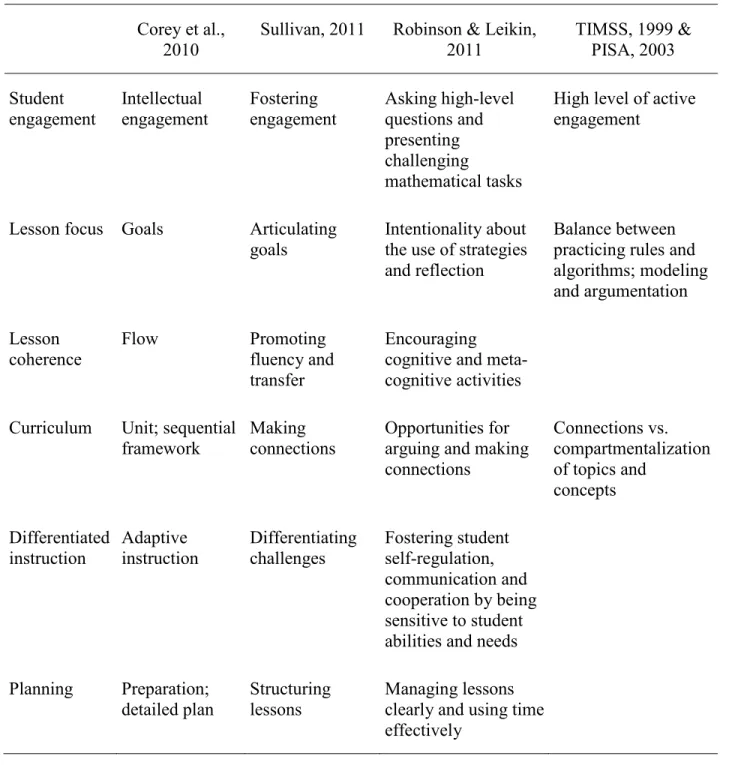
There are some variations on the number of and name of the stages in a lesson study, but they all follow a similar flow in the inquiry cycle. Lewis (2002c) identifies four stages: goal-setting and planning, research lesson, lesson discussion, and consolidation of learning. Fujii (2016) identifies five stages: goal-setting, lesson planning, research lesson, post-lesson discussion, and reflection. Yoshida (1999) identifies eight stages: choose a topic, plan a lesson, teach a lesson, evaluate the lesson and reflect on its effect, revise the lesson, teach the revised lesson, evaluate and reflect, and share the results. While a single lesson is often the medium, lesson study is not just about a single lesson, it is about the teaching of an entire unit or content area and places significant emphasis on the development of students as people and as learners (Lewis, 2002c). 1.6.3.1Stage 1: Choose a Topic
For the purposes of this study, the lesson study cycle will be identified through eight stages. It begins with a question or topic (Fujii, 2016) to define the problem or identify the goal (Watanabe, 2011). The research theme is developed through consideration of the students’ current understanding with relation to their overall learning goals, long-term and short-term (Lewis, 2002c; Lewis & Hurd, 2011; Stepanek, Appel, Leong, Mangan, & Mitchell, 2007). Student work, performance assessments and achievement or growth data is sometimes helpful in narrowing the focus of the lesson study (Lewis & Hurd, 2011). Content goals identify the specific concepts or
10
understandings that students will develop; process goals identify the skills or habits of mind that students will develop and lesson goals focus on specific student outcomes for the lesson (Stepanek et al., 2007).
This initial step involves “kyouzai kenkyuu,” the careful study of academic content and instructional materials (Takahashi, Watanabe, Yoshida, & Wang-Iverson, 2005). Teachers investigate the intended learning trajectory through a review of curriculum standards and research into teaching and learning considerations, including possible misconceptions. They deliberate about approaches, manipulatives and materials that may be used and tasks that may be presented to the students. Lesson study facilitators recommend that teachers study the best lessons available, which allows them to learn how others teach the content (Lewis, 2002b). A review of multiple resources allows comparison and requires teachers to discern which elements support their lesson objectives or student population. Through this process, teachers can deepen their knowledge of the content area and hone their instructional planning skills. Comparing Western and Eastern mindsets, Liping Ma (1999 in Lewis & Hurd, 2011, p .68) observes, “American educators assume that you need to learn content knowledge before you can plan lessons . . . [Japanese] teachers think you learn content knowledge by planning lessons.”
1.6.3.2 Stage 2: Plan the Research Lesson
The second stage is to development (Lewis & Hurd, 2011). The lesson plan, developed as a communicative document, captures a shared understanding of teaching and learning intentions - an image of the intended lesson (Wake, Swan, & Foster, 2016). It serves as both a guide for the teacher and the planning team, but also as a reference for observers, giving them context for the teaching and learning process (Watanabe, 2002).
11
It should be noted that not all Japanese research lessons are prepared collaboratively (Tolle, 2010). Some lessons are prepared by a single teacher, with or without collegial input, to be observed by colleagues for professional feedback. A common Japanese lesson plan template describes the lesson in three columns - tasks, anticipated student responses, and instructional considerations. The plans often include both correct and incorrect student responses - considering how students might response to given tasks. A basic idea underlying lesson study is that the content, wording, and presentation of a problem or activity can affect student learning, illustrating how important intentional language and sequencing of activities is to the effectiveness of the lesson (Lewis & Hurd, 2011; Stepanek et al., 2007).
The plan does not need to be an original plan, but may be (Lewis, 2002c). It is better to teach an existing lesson that is strong, than to teach an original lesson that is not effective. When teachers build upon existing lessons, focusing on continuous improvement, the profession is elevated.
1.6.3.3 Stage 3: Teach the Research Lesson
During the third stage, a teacher teaches the research lesson while the members of the planning team, other colleagues and often, a knowledgeable other, observe and collect data (Lewis, 2002c; Lewis & Hurd, 2011). The observers focus on student comments and actions, rather than on teaching moves, in an effort to gain insight into the students’ thinking and learning. Often the observers collect specific data, which can include detailed narrative records - what they said and wrote, how they used the materials, what specific supports encouraged understanding, and what obstacles arose during the lesson (Lewis, Perry, & Hurd, 2004). Observation notes can also address how students solved a problem and how many solved it a particular way, whether or not a
12
lesson’s goal was understood or misunderstood, and how it was understood or misunderstood (Tolle, 2010). These data give deeper insight to the teaching and learning process. The lesson observers do not interfere with teaching or learning during the lesson, they simply collect the anecdotal data. Their interference could cause a distraction from the natural interaction between the students and the teacher and this could also impact the authenticity of the data collected (Takahashi & Yoshida, 2004).
Data collection helps to slow down the flow of instruction to study it (Lewis & Hurd, 2011). A well-designed data collection system during the lesson supports a rich post-lesson discussion. Sometimes observers watch the entire class, noting generalizations. Sometimes observers follow a small group of students through the entire lesson. Both formats have value and are particularly powerful when paired to cross-reference observations and conclusions. Observers may also be assigned specific tasks - to record all questions asked by the students, how frequently specific students respond to teacher questions and prompts, or other questions developed specifically for the research lesson (Stepanek et al., 2007). While tests and student work may offer information on what to improve, lesson study adds the layer of how to improve (Lewis, 2002c).
From the perspective of the teacher teaching the lesson, Takahashi (2001) suggests that teachers carefully develop the lesson activities and then forget the lesson plan and instead, teach the students by looking at their faces. Other facilitators suggest that the teacher not deviate from the research plan, but to be flexible, if necessary (Takahashi, 2006). The individual team must determine which approach to take, based on their objective with the study. When lessons are treated as dynamic and flexible within the framework established by the team, the plan is not a single path to the goal, but more like a map around the topic that helps to reach the destination.
13
Through the process, teachers begin to apply a new lens to their teaching - the lens of researcher (Fernandez, Cannon, & Chokshi, 2003).
1.6.3.4Stage 4: First Post-Lesson Discussion
The lesson is debriefed during a comprehensive dialogue in the fourth stage that assesses the lesson and reflects upon its effect (Fujii, 2016; Watanabe, 2011). This post-lesson discussion is the heart of lesson study and the most important part of the deep, constructive process (Tolle, 2010). It is important to consider the public nature of collaboration and to recognize this stage requires vulnerability from the participants to be honest and to focus their conversation on the teaching and learning process and not on specific teachers or students (Lewis & Hurd, 2011). This vulnerability can be eased and the collaboration can be facilitated by assigning roles, like facilitator, note taker, recorder, timekeeper and others, depending upon the culture of the team. A good agenda can assist with safe and productive discussions.
In Japan, the post-lesson discussion is often a formal business affair, comparable to a thesis or conference presentation (Tolle, 2010). The facilitator gives an overview of the presentation, followed by a welcome and introduction of guests by a school administrator. The presenting teacher says a few words about the lesson and what was or was not accomplished. The audience is then encouraged to ask questions for a period of time, followed by time for the audience to make suggestions. The data collected by the observers provide the research foundation on which the discussion proceeds - a level of classroom research not often seen in education. An expert in the field (“koshi”) may make some closing comments or address unresolved topics and then the facilitator or administrator concludes the debrief.
14
lesson and unit design and other topics related to teaching and learning (Lewis, 2002c; Lewis & Hurd, 2011). The use of student work helps to make connections and provides evidence of student thinking - a process the Japanese call, “neriage,” or polishing/kneading (Takahashi, 2006). During this stage, participants can explore what went well and what did not go as planned and consider any unexpected outcomes (Tolle, 2010). The purpose is to discuss the lesson and not to evaluate the teacher (Stepanek et al., 2007). If an administrator is participating in the lesson study, he or she is serving as a participant and not an evaluator.
In Japan, critical feedback is a mark of respect - colleagues offer criticism because they expect that one can improve and because there is something in one’s teaching worth improving upon (Lewis & Hurd, 2011). This stage of lesson study attempts to make specific aspects of professional learning explicit and provides time and space for this to occur alongside colleagues (Wake et al., 2016).
1.6.3.5Stage 5: Revise or Revisit the Lesson
The primary emphasis of the lesson revision is to gain insights into teaching and learning and to inform the design of future lessons, not specifically to revise the lesson plan (Takahashi & McDougal, 2016). However, the goal of improving practice can be realized through a lesson revision and learning how to adjust a lesson is a valuable skill set for teachers (Lewis & Hurd, 2011). One can learn a significant amount from an imperfect lesson, perhaps even more than from a polished lesson (Stepanek et al., 2007). The core purpose of the discussion should focus on how to move students to think more deeply and this requires teachers to share their strategies, spreading knowledge across the profession and developing shared insights (Lewis & Hurd, 2011).
15
deepen their own content knowledge or knowledge of student thinking, their understanding of teaching and learning and their commitment to improvement of their own practice and that of their colleagues (Lewis & Hurd, 2011). A hope is that teachers increase instructional coherence across classrooms and their collective sense of efficacy, nurturing a school-wide culture of learning from practice. Revising and re-teaching provide a means for teachers to try out and compare different strategies or approaches (Stepanek et al., 2007).
1.6.3.6Stage 6: Teach the Lesson a Second Time
Evidence collected and post-lesson discussion reflection informs changes to the lesson for the second teaching (Stepanek et al., 2007). Revisions address problems and student misunderstandings identified in the first teaching presentation. According to Makoto Yoshida, re-teaching the lesson “increases opportunities for teachers to learn from one another and reinforces the valuable skills of lesson observation, discussion, and adaptation that are fundamental to improvements of teaching” (Lewis, 2002c, p. 43).
1.6.3.7Stage 7: Second Post-Lesson Discussion
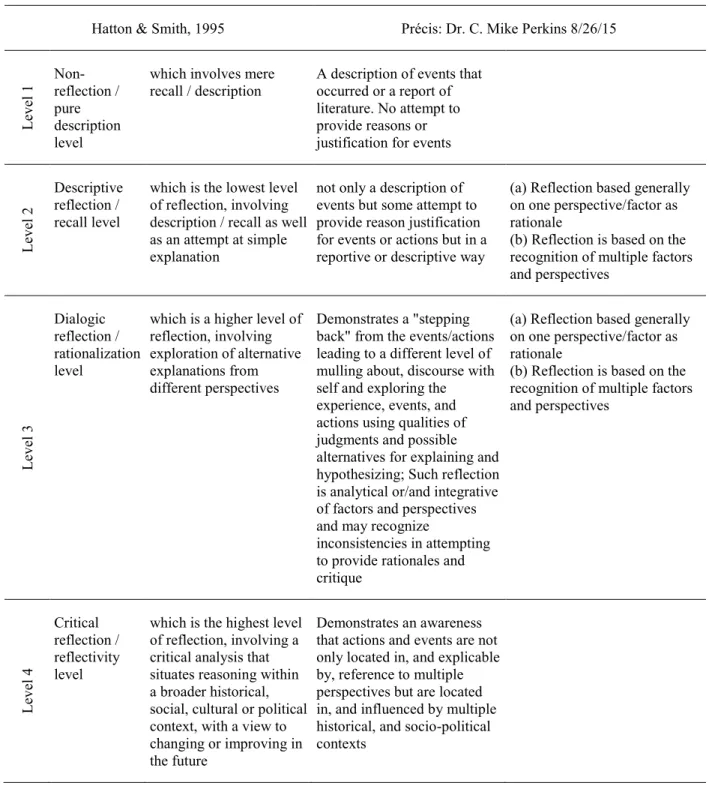
The seventh stage involves assessment of and reflection upon the process and recognition of the resulting learning (Fujii, 2016). Reflection helps learners to identify and examine beliefs and values from different perspectives (Brookfield, 1986). It helps learners understand how their beliefs and assumptions shape their experiences and the meaning they create from their experiences (Merriam & Caffarella, 1999 in Stepanek et al., 2007).
16
1.6.3.8Stage 8: Final Reflections and/or Research Lesson Report
The cycle can be documented with a report that summarizes the process and projects next steps, further research, or additional professional development needs (Lewis, 2002c; Lewis & Hurd, 2011). The report can include agendas, notes from the meetings, records of the background research, unit plans, drafts of the research lesson, and the final copy of the lesson plan. There is value in documenting the process of observing and debriefing.
The lesson study cycle is not seen as final, but as an ongoing process, that does not necessarily give an answer to the research question, but provides a deeper understanding of the focus area (Fujii, 2014). It is as much about the process, as it is about the lesson, and is most effective when integrated into other ongoing work (Lewis & Hurd, 2011).
17
2.0Review of the Literature
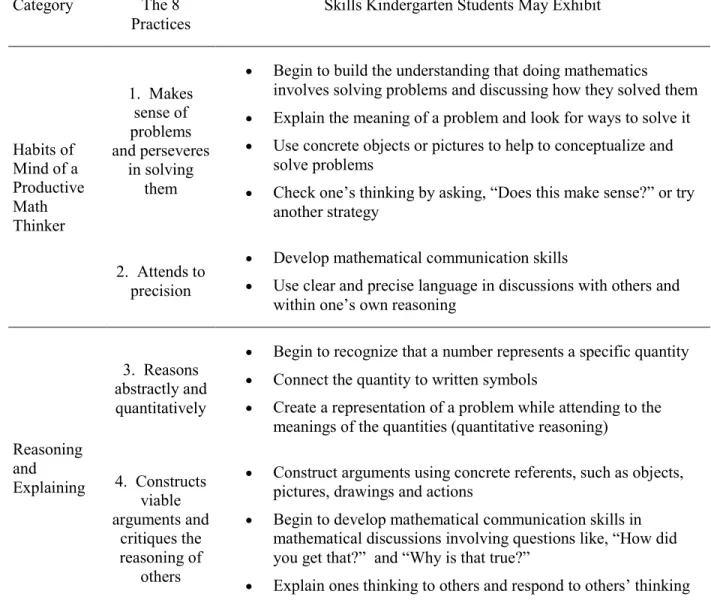
This study weaves together several elements through the exploration of an interpretation of lesson study as a framework for professional development. Due to the role lesson study plays in this study, it is important to consider its story - its historical evolution in Japanese education systems, its transfer to the U.S. and the impurities that surface in educational contexts outside of Japan. The specific focus on the post-lesson discussion as a dialogic space, ripe for individual and collective reflection and professional growth, requires an intentional focus on adult learning, communities of practice and attributes of effective professional development. The emphasis lesson study places on watching students closely during the observation and the focus math lessons often receive through lesson study requires a closer look at mathematical teaching and learning processes. This review of literature will journey through these elements.
2.1The Story of Lesson Study in Japan
2.1.1 A Historical Lens on Japanese Education and Lesson Study
Japanese lesson study (“jug you kenkyuu”) began during the Meiji Era when the Education Ministry’s Education Order of 1872 established education code (Fernandez & Chokshi, 2002; Nemoto, 1999; Isoda, 2007). Japanese education during this period developed, in part, to institutionalize and perpetuate Japanese cultural identity (White, 1987). The Education Ministry issued additional orders for each school level that, throughout the decade that followed, led to the
18
establishment of a comprehensive school system - the foundation for the modern education system in Japan (Nemoto, 1999). Lesson study emerged with the founding of the Tokyo Normal School and Elementary School, which were affiliated with the University of Tsukuba, and was instituted top-down, by the government, as an establishment of the school system (Isoda, 2010).
At its inception, lesson study involved the observation of teaching methods in whole classroom teaching, which were introduced in these schools and were progressive, compared with traditional approaches (Isoda, 2010). Teacher’s Canon was published by the Normal School in 1873 and articulated the observation etiquette that was expected during lesson study. The first known lesson study guidebook for teachers in Japan, Reform the Methods of Teaching, was released in 1883 and focused on Pestalozzian methodology, an approach to teaching through questioning (“hatsumon”) to develop students who think by themselves. The changes also involved a shift to an object lesson, modeled after Western approaches (Makinae, 2010). According to Pestalozzian theory, all cognition is based on one’s intuition - we recognize things by intuition, then form a concept. Teaching, therefore, should not start from reading books, it should begin with the observation of a familiar object, as this is more natural to development. Throughout history, teachers have made the system their own, learning from each other within their school and across school communities.
2.1.2 The Japanese Educational Landscape
Features of the Japanese educational landscape seem to create supportive conditions for lesson study (Lewis, 2002b). Japanese cultural values, like strong work ethic and the pursuit of perfection, lay a foundation for lesson study. Teachers develop a culture of teaching. Japanese
19
teachers have a high regard for their professional roles and responsibilities - the academic, social-emotional, physical and mental development of their students - and this regard shapes how they conduct lessons (Okano & Tsuchiya, 1999).
In Japanese schools, teachers’ desks are located in a communal workroom, not their classrooms. This arrangement facilitates informal communication, interdependence, and camaraderie amongst teachers (Okano & Tsuchiya, 1999). They value routine informal sharing of their experiences and this serves as an ongoing, embedded vehicle for professional growth. The success of a lesson study group requires the development of a shared professional culture through collective participation (Birman, Desimone, Porter, & Garet, 2000). In Japanese teaching culture, observing one another’s lessons is routine, and constructive feedback and reflection are valued (Lewis, 1995). Through providing opportunities to observe and deliberate on teaching and learning, lesson study contributes to a school culture of sharing and collective growth - supporting the classrooms and school as a learning community (Watanabe, 2002).
2.1.2.1Japanese Curriculum
Japanese teaching and learning are dictated by the National Curriculum and Course of Study, which focuses on academic, social-emotional and ethical development (Lewis, 1995). Emphasis is placed on connections between learning and daily life, and strong consideration is given to how students feel about the content, in addition to what they know about it.
The Education Ministry determines the National Curriculum and authorizes and compiles textbooks for all levels, to ensure a standardized education (Nemoto, 1999). The compilation of textbooks is a lengthy and thoughtful process. Exemplar lessons, refined through research and lesson study processes, comprise the content (Archer, 2016). Japanese teachers use the textbooks
20
as a starting point and continue to enrich the lessons through their own research.
The Course of Study presents guidelines for each content area. Each school determines its own instructional materials, within these guidelines, while taking into account its own circumstances and community situation. All textbooks must be approved by the Education Ministry or published under the Ministry’s copyright, in an effort to ensure equality of opportunity, proper content and improvement of standards nationwide (Nemoto, 1999).
The National Curriculum is frugal - The TIMSS study documents that Japanese 8th grade science textbooks cover eight topics, compared with an average of 65 topics in U.S. 8th grade science textbooks (Schmidt, McKnight, & Raizen, 1997). Teachers have more time to cover less topics in greater detail, so they can devote time to studying the most effective ways to present it.
The Japanese Ministry of Education advises tracking student progress in the National Course of Study in four areas: (1) interest, motives, and attitudes; (2) students’ thinking; (3) knowledge and understanding; and (4) skills and procedures (Schmidt et al., 1996 in Corey, Peterson, Lewis, & Bukarau, 2010). There is an intimate relationship between lesson studies, textbooks and the National Course of Study (Lewis, Tsuchida, & Coleman, 2002 in Lewis & Perry, 2003). Advances in one arena tend to reshape the other arenas. New elementary lessons are expected to prove themselves in public research lessons before they are included in textbooks. Teacher-authors of textbooks are typically very active in lesson study, incorporating successful new approaches into textbook revisions.
General stability of Japanese policy may enable educators to concentrate on policy changes that do occur - for example, the National Course of Study is revised on 10-year cycles (Lewis, 2002b). In contrast, U.S. educators are often expected to implement new programs and to show results within just a year of two.
21
In Japan, a higher percentage of time is focused on instruction, with less time devoted to curriculum alignment and materials selection, due to the frugal, focused curriculum (Lewis, 2002b). U.S. teachers spend a significant amount of time selecting and adapting curricula, aligning curricula with state or district standards and finding or writing lessons to fill in the gaps. The pyramids in Figure 1 show how time is allocated in U.S. and Japanese schools. The U.S. triangle stands precariously on it tip, without a large enough basis of classroom practice, observation, and discussion to support it in a stable fashion.
Figure 1. Teachers’ Activities to Improve Instruction 2.1.2.2Japanese Classrooms
There is a focus in Japan on supporting the whole child (Lewis, 2002b). Teachers see their job as raising children - promoting social, ethical, emotional, physical, and intellectual development, particularly at the elementary level.
22
Cooperative learning has a long history in Japan, with the first studies being published in the early 1900s (Lewis, 1995). Cooperative learning is a common strategy in Japanese classrooms, where students work together, interdependently, in small, mixed-ability teams. The Bazu Method, a type of cooperative learning that derives its name from the “buzz” of conversation that accompanies it, suggests an energy about learning. Japanese teachers and students explicitly define and reflect upon the social goals of the group work - helping, friendship, and responsibility. Learning is a social enterprise that involves listening to other ideas, reconciling differences, and problem solving. Discovery learning, where students explore areas of interest or curricular topics on their own terms, is also significant in Japanese pedagogy (White, 1987).
A strong operating force in Japanese classrooms is an emphasis on process (Lewis, 1995). The objective is not limited to obtaining a correct answer, it is also important to be engaged in a wholehearted way, to collaborate and consider others’ thinking and to reflect on one’s work. “Hansei” (self-critical reflection) supports discipline, group formation, and development. To encourage this Japanese teachers carefully plan intentional, purposeful questions, or “hatsumon,” to stimulate students’ thinking (Dubin, 2009). With thoughtful questions, teachers can guide students to a better understanding of the problem and how it relates to the greater sequence of learning.
2.1.2.3Japanese Professional Development
Lesson study has been the primary mechanism for professional development for both prospective teachers and practicing teachers since the Japanese public education system started (Lewis & Tsuchida, 1998). The Educational Ministry created a standardized teacher-training curriculum, which is required at all universities (Nemoto, 1999). All newly qualified teachers are
23
required to participate in a yearlong induction training under the guidance of a master teacher, while simultaneously engaging in teaching and other educational activities at their school. Continuing education, on the job, reflects Japan’s cultural commitment to self-improvement (Jones & Jones, 2006; Nemoto, 1999).
Japanese educators consider teaching to be research (Watanabe, 2018). This orientation is different than teacher-as-researcher - in Japan, teachers are researchers. They talk about their research agendas. From this perspective, it is natural for Japanese teachers to engage in lesson study. Individual research occurs in their classrooms, daily, and collaborative research occurs during their lesson study cycles.
There is a strong commitment to learning in Japanese culture (White, 1987). Study, like any activity in Japan worth pursuing, is an opportunity to commit great amounts of effort to a task. The word, “benkyoo” (study), connotes the intensity of effort required to learn. Study or work is considered an opportunity to achieve success and teachers are expected to continually improve their professional knowledge to support their students’ development and to develop themselves (Okano & Tsuchiya, 1999). Working together is a natural way of being in their school culture. Teachers more regularly engage in voluntary informal study groups outside of working hours. A higher number of professional journals for teachers are produced by teachers, than by university academics (Sato, 1994 in Okano & Tsuchiya, 1999).
Japanese educators have instituted a learning system, “kounaikenshuu” - a continuous process of school-based professional development (Stigler & Hiebert, 1999). It consists of a diverse set of activities that contribute to school improvement, which frequently includes lesson study, placing professional growth in the context of the classroom. Lesson study’s framework is highly collaborative and grounded in practice - two features of professional development that have
24
been identified as powerful in supporting change in both teachers and in the academic performance of their students (Darling-Hammond, Chung Wei, Andree, & Richardson, 2009). Through an engaging research process, teachers can develop three critical lenses - as researcher, curriculum developer and student (Clarke et al., 2013). Japanese teachers may spend multiple years investigating a research theme, working to revise and improve each research lesson through several iterations of planning and reflection (Ermeling & Graff-Ermeling, 2014).
Corey, Lemon, Gilbert, and Ninomiya (2016) identify key elements of Japanese professional development that emerged during their collaboration with lesson study teams in Japan: (1) Professional development with actual students adds depth - it is professional learning in real time with a classroom of students. (2) Learning is the goal and mathematical thinking is the key. An analysis of the connections between teacher actions and the mathematical thinking of students seems to be the guide for Japanese teachers in their teaching decisions. (3) Sharing lesson plans increases learning opportunities. Lesson plans contain details that enable teachers to better understand their craft and to adapt the lesson to work with their learners. (4) Collaboration builds a shared knowledge base for teaching and a shared vocabulary for talking about teaching and learning. (5) Professionals work hard to be the best teachers possible. The Japanese colleagues in this study demonstrated a deep love for teaching, a strong desire for success and a refined knowledge of their craft. These principles are embedded into their professional development and their daily classroom practice.
25
2.2The Transfer of Lesson Study Outside of Japan
Lesson study was introduced outside of Japan in the late 1990s (Yoshida, 1999) and in the past decade has been explored in the U.S., Australia, Singapore, England, Finland and elsewhere (Robinson & Leikin, 2011). The early discourse was focused more on the process steps, lacking an emphasis on the philosophical underpinnings, and did not account for differences in cultural mindsets surrounding education (Yoshida, 1999). A shortfall of some lesson study endeavors is that they are interpretations in isolation of authentic exposure to or experiences with Japanese lesson study (Takahashi & McDougal, 2016). Some lesson study cycles follow the Japanese steps and some are modified to fit the needs of the individual organization - time, staff, resources, and other variables. As Doig and Groves (2012 in Wake et al., 2016) suggest, there is a need to adapt, rather than adopt, the Japanese model when engaging in lesson study outside of Japan.
Chenoweth (2000) makes a powerful observation that illustrates variation between the educational mindsets: “When a brilliant American teacher retires, almost all of the lesson plans and practices that he or she developed also retire. When a brilliant Japanese teacher retires, he or she has left a legacy to be enhanced by future teachers.” Lesson study is a vehicle for preserving and transmitting exemplar teaching and learning.
2.2.1 Early Roots of Lesson Study in the United States
Several teacher-researchers were influential in introducing the U.S. to lesson study. Catherine Lewis’ exploration and research of lesson study in Japan began in 1993 followed by the release of the TIMSS results in 1995, which propelled lesson study to an international stage (Lewis,
26
2002c). Around the same time, Makoto Yoshida, with the guidance of Professor Jim Stigler, conducted an ethnographic study that examined school-based lesson study at a public elementary school in Japan, for his dissertation at the University of Chicago (Watanabe, 2018). The findings of Yoshida’s dissertation contributed to the chapter discussing systematic improvement of teaching through lesson study in The Teaching Gap by Stigler and Hiebert (1999), which sparked interest in lesson study among U.S. teachers, researchers and educational policymakers (Lewis, 2002b). By 2005, lesson study had spread to at least 125 school districts in 32 U.S. states, an active listserv of more than 900 members exchanged advice and public research lessons were hosted in various regions of the U.S. (Lewis, 2015).
U.S.-based Japanese educators and visiting Japanese educators have served as lesson study facilitators, commentators and consultants (Lewis, 2015). The Japanese Schools of New York-Greenwich and Chicago, regular full-time schools that use Japanese curriculum and cater to Japanese nationals in the U.S., have hosted public research lessons. The Chicago Lesson Study Group launched in 2002 to investigate how to improve the teaching and learning of measurement in the elementary and middle school grades (Takahashi & Yoshida, 2004).
The roots of lesson study at Paterson School #2 in New Jersey date back to the spring of 1997 when the principal, Lynn Liptak, and 8th grade teachers attended a district-sponsored workshop focused on viewing the TIMSS videotapes comparing math lessons in Japan and the U.S. (Lewis, 2002c). Several teachers, on their own initiative, began to orient their lessons to a pattern of instruction observed in the Japanese lessons - pose an interesting word problem and have the students work to solve the problem and present their solution methods. Through this exploration, the Mathematics Study Group, a team of ten volunteer teachers in grades 1-8 and the principal, formed as part of a grassroots initiative (Lewis, 2002c; Takahashi & Yoshida, 2004).
27
Through a partnership with Makoto Yoshida and Clea Fernandez of Teachers College, Paterson also collaborated with teachers from the Greenwich Japanese School and the original study group grew to 16 teacher participants (Lewis, 2002c; Watanabe, 2018). Lesson study became part of a school-based initiative to provide consistent and coherent math education. Paterson School #2 hosted the first U.S. public research lesson on February 28, 2000.
Lewis also led a team that conducted research on the transfer of lesson study to an American setting in her work with the San Mateo-Foster City School District in San Francisco, California beginning during the 2000-2001 school year (Perry, Lewis, & Akiba, 2002; Watanabe, 2018). Jackie Hurd, a 3rd grade teacher and math coach, experienced lesson study in Japan at an international mathematics conference during the summer of 2000 (Lewis, 2002c). She shared her learning with her three math-coach colleagues, and together, they became the initial team. With district support, through release time and stipends, they generated interest with 28 teachers, representing eight schools. The teams collaborated outside of school hours and were compensated (Perry et al., 2002). This grassroots effort was supported through personal initiative - drawing on videotapes, protocols from the Lesson Study Research Group (2004) and a visit to see research lessons at the Greenwich Japanese School - to inform their practice. At the end of the first year, the original team led a 2-week summer workshop co-designed with the lesson study team at Mills College and other math specialists. Over the course of three years, the lesson study community grew to include 78 participants in smaller teams and involved summer workshops to allow for more collaboration time, professional development, and support. These examples illustrate the variations in how lesson study has been translated in the U.S. (Lewis, 2002c). In November of 2002, the first lesson study conference was held in Connecticut, succeeded by another the following year, with participants attending from across the U.S. (Watanabe, 2018). Even with
28
these sites for lesson study, the range of Japanese lesson study models available in the U.S. is limited (Perry et al., 2002). Lesson study in each of these forums varies from a standard norm, because it is personalized to the individual context of each situation. Beginning in 2012, a number of U.S. mathematics teachers have participated in the Lesson Study Immersion Program organized by Project IMPULS of Tokyo Gakugei University, observing lesson study in Japan, firsthand, and learning about it at its source (Watanabe, 2018).
2.2.2 Emergence of Lesson Study in Pittsburgh, PA
Lesson study established a presence in the Pittsburgh region in the early 2000s through the work of the Math & Science Collaborative5, currently housed at the Allegheny Intermediate Unit 3. The Math & Science Collaborative is devoted to strengthening math and science education by coordinating efforts and focusing resources throughout Southwestern Pennsylvania. The organization hosts programming for teachers and students, conducts research, and connects schools with businesses and math-science organizations.
The foundation for the Collaborative’s lesson study exploration was laid in 1997 when they developed and facilitated a professional development series with support from the Mid-Atlantic Eisenhower Consortium6 entitled, “Making Standards and TIMSS Work for the Region” (Bunt,
5 Additional information about the Math & Science Collaborative can be found at their website: http://www.aiu3.net/Level2.aspx?id=480
6 The Mid-Atlantic Eisenhower Consortium for Mathematics and Science Education is a partnership which brings together RBS with other key agencies in the region to improve mathematics and science education for all students. A significant body of their work centers on TIMSS studies, analysis and findings.
29
2014-2015). The Trends in International Math and Science Studies considered not only achievement test results, but also an analysis of curriculum - both the intended curriculum and the achieved curriculum - through a review of textbooks, teacher surveys and the video study of sample schools in Japan, Germany, and the U.S. (Bunt, 2018). District teams who participated in the TIMSS-focused professional development received a TIMSS toolbox, containing the reports of the TIMSS findings and the videotapes of classroom lessons from the three countries. The teams engaged the content and took their learning back to their district.
The mobilizer of this engagement with the TIMSS results was the Collaborative’s Managing Director, Dr. Nancy Bunt. Bunt (2018) had attended a conference about the TIMSS results and met Bill Schmidt, mathematics professor at the University of Michigan, whom she referred to as the “father of TIMSS in the U.S.” She identified three tenets of Schmidt’s work: (1) curriculum in the U.S. is a mile wide and an inch deep (suggesting curriculum covers too much content and not enough depth); (2) tracking students is a pernicious evil (sorting out opportunities for kids to learn based on initial outcomes); and (3) the nature of instruction matters (going beyond intended curriculum to the role of the teacher in instruction) (Bunt, 2018).
The Collaborative’s TIMSS professional development series faced a challenge - a PA exceptionalism, or feeling that the national study results did not have significance for the Region. Bunt (2018) expanded upon this, discussing how teachers have a preconception of how to teach, based upon how they were taught - a cultural script for teaching that is passed on each generation. This receptivity towards changing one’s notions of how to teach tends to decrease even more in the upper level coursework in high school and college. This mindset barrier led to the Collaborative’s 1999 TIMSS Repeat, a Benchmarking Project for school districts in Southwestern Pennsylvania, which emulated the international study for eighth grade classrooms in the Region
30
(Bunt, 2014-2015). The results of this study were published in a Regional Report on Math and Science Education with the International Educational Study Center at Boston College.
Recognizing the imperative to have a system of support for teachers’ exploration of effective practices in teaching and learning, the Math & Science Collaborative created Teacher Leader Academies in elementary math, secondary math, secondary science, middle school math and early learners (Bunt, 2018). These two-year academies brought together teachers in the region and focused on how to make changes in instructional practice through professional development using the TIMSS video studies and other professional development outlets. In an effort to expand the support system within the districts, the Collaborative introduced Lenses on Learning in 2003, a 10-day workshop to engage principals in the work of the academies.
Participants expressed interest in extending the Teacher Leadership Academies and lesson studies became an integral part of the third year, beginning in 2006, when Catherine Lewis facilitated training (Math & Science Collaborative, 2015). To prepare for this endeavor, the Math & Science Collaborative leadership team read Stigler and Hiebert’s The Teaching Gap (1999), studied the research on lesson study and collaborated with Lewis and other lesson study authorities around the country to learn what approaches were being implemented effectively. The Collaborative defines lesson study as “an ongoing professional learning activity” (Bunt, 2009, p. 4). This became the vehicle for teachers to make the instructional changes they discussed during their prior years in the Teacher Leadership Academies (Bunt. 2018).
31
time the Collaborative engaged lesson study, the Network Connections7 professional development days featured public lessons, sometimes taught by authorities in lesson study and sometimes taught by local teachers. In 2006, Bill Jackson of the Paterson, N.J. lesson study group taught the public lesson. Each lesson was followed by a debrief, which “sheds light on the most important aspect of Lesson Study - the thinking and learning of the students” (Bunt, 2009, p. 4). [See Appendix A: Math Science Collaborative Lesson Study Events 1997-2010]
In addition to the Teacher Leadership Academy lesson studies and the public lessons featured at the Network Connections, the Math & Science Collaborative hosted Learning Laboratories in the summers beginning in 2007, where participants honed their skills for observing students (Shaneyfelt, 2009). The work of Deborah Ball, Dean of the School of Education at the University of Michigan, inspired the Learning Laboratories (Bunt, 2018). She extended learning for her education majors into the summer through teaching summer classes where her college students could observe, in a fishbowl style, then debrief with her after the lesson to discuss what they observed, explicitly. The Collaborative replicated this approach with a summer school program for 5th grade students who had failed math in a local school district.
These intensive professional development experiences at the Learning Laboratories invited 4th and 5th year Teacher Leaders and Administrators from the Lenses on Learning group to observe and gather evidence of one student’s thinking and learning during a lesson (Shaneyfelt, 2009). Teachers in higher education were also invited to participate, giving them a lens of learning in the early grades. This model of having secondary and higher education teachers learn from
32
elementary teachers about instructional strategies, while also serving to mentor the elementary teachers in math-specific content, built a two-way path of respect and increased the pedagogical skills of all participants (Bunt, 2018). As an extension of lesson study, this “fishbowl approach” allowed participants to explore the observation and analysis of student learning on a deeper level (Shaneyfelt, 2009). The lesson was taught by Math & Science Collaborative project directors, while participants observed their designated student, looking for evidence of learning defined by targeted skills: (1) making predictions and pursuing a solution; (2) manipulating materials to solve a problem effectively; (3) providing responses that reflect real, personal thinking; and (4) challenging and questioning each other. The participants also interviewed their designated student at the end of the experience for insight into their learning (Bunt, 2018).
Reflections by the participants illustrated their learning - “Everyone can learn if you can…listen to the student and his/her particular learning style. Learn to watch and listen to how your students learn” (Shaneyfelt, 2009, p. 30). The participants demonstrated a shift in their thinking - “We need to focus on the student and not the task. The only way to see if a student truly understands, can verbalize, can apply knowledge and can thus show us on [assessments] is to listen and watch them in small groups and one-on-one” (Shaneyfelt, 2009, p. 30). The Project Directors highlighted the power of the professional development forum: “Given the opportunity to focus on one student enables one to see the complexity of individual student learning. In the minute-to-minute decision-making process of teaching, it is easier to make decisions based on what is perceived as understanding” (Shaneyfelt, 2009, p. 31).
Although lesson study is not a focal point currently, the Math & Science Collaborative has maintained its focus on learning lessons, through its recent engagement of collaborative learning lessons. Prior to this, much of their emphasis was on facilitating walkthroughs where teacher
33
participants could learn from colleagues through observing in their classroom and refining their student observation skills. The principles of lesson study remain; however, they present themselves in these other forms of collaborative professional learning.
Bunt (2018) identified an ongoing challenge to the lesson study engagement of the Math & Science Collaborative was the perception teachers had of lesson planning and a narrow focus of the outcome of lesson study limited to the actual lesson plan. In the U.S., teachers often view lesson planning as tasks they are completing daily or weekly within a unit. Lesson study, when viewed through the lens of planning and refining a single lesson, is considered time-intensive, and is overwhelming if teachers have a misconception that it is a process to be applied to every lesson. Bunt (2018) emphasized a lesson study though the lens of “a learning study, more than a lesson study,” and called for a shift in mindset to teachers learning about learning. It is a process for learning through one closely studied lesson that can be applied to other lessons. In later years of the Teacher Leader Academies, the Collaborative emphasized growth mindset as a way of fostering a shared learning environment and helping to shape a concept of teacher leaders as lead learners.
2.2.3 Challenges to Translating Lesson Study in the U.S.
Lesson study does not naturally transfer from a Japanese setting to an American setting, but requires some translation and accommodation due to the variations in education systems. Lewis (2002b) cautions that lesson study experiences in the U.S. diverge substantially from the Japanese approach. Lesson study is emerging in schools throughout the country, but it may not be
34
implemented with fidelity8 or may lose its influence like other educational innovations. Features of lesson study need to be adapted for the varying educational environment in U.S. schools. Castori (2002) suggests that aligning lesson study with practitioner research would give it more definition. She also believes in the need to find effective ways to adapt it to the schooling routines within our educational system.
Most U.S. teachers engaging in lesson study have not had the opportunity to work with Japanese teachers who can model the process, therefore, many examples of lesson study in the U.S. diverge substantially from the Japanese approach (Lewis, 2002c). This results in lesson study experiences that lack the nuanced understanding that is necessary to use lesson study in the way it was intended (Chokshi & Fernandez, 2004).
Other challenges to implementation include a lack of a shared, frugal curriculum, limited exemplar lesson examples on specific topics, the need for guidelines on how to observe, discuss, and revise lessons and a deficit of shared planning and observation time during the school day. Through her research, Lewis (2002) has found that American schools that have experienced success have several conditions in place - a tradition of collaboration, an interest in teachers’ inquiry, a shared curriculum, and administrative support for teacher-led learning.
In many lesson study experiences the foundational step of gaining knowledge and insight into the content area and student thinking is omitted, in an effort to get started with the functional steps of writing the lesson and teaching it (Takahashi et al., 2005). While lesson study in Japan is conducted as part of a school-wide focus that involves the entire staff, lesson study in the U.S. is