Bringing Computer Science Education to Secondary School:
A Teacher First Approach.
Tom Neutens
IDLab, Department of Information Technology, Ghent University - imec
Ghent, Oost-Vlaanderen, Belgium [email protected]
Francis wyffels
IDLab, Department of Information Technology, Ghent University - imec
Ghent, Oost-Vlaanderen, Belgium [email protected]
ABSTRACT
The Progra-MEER professional development workshop is a one year program organized collaboratively by the computer science departments of three Flemish universities. It aims to improve the computer science knowledge of in service teachers in a physical computing context. Since Flemish schools are starting to implement STEM in their schools, the program links computer science to STEM and project based learning.
This paper gives a description of the design and implementation of the program while providing an analysis of its strengths and weaknesses. We show that the program leads to the successful implementation of different physical computing projects. However, it needs to further support the practical project implementations while spending more attention on assessment and context definition. Additionally, the program has to invest more effort in creating a sustainable community of practice so knowledge and experiences can still be shared even after the program has finished.
KEYWORDS
Computer science education, STEM education, teacher professional development, physical computing
1
INTRODUCTION
The Europe2020 strategy requires European union member states to improve their labor supply by promoting productivity and em-ployability using an apt supply of relevant knowledge, skills and competences [1]. However, based on data from the Flemish em-ployment services [2], the number of students graduating with a degree in or related to engineering has remained stagnant over the past five years. Meanwhile, job market demand for people with these technical profiles remains high and cannot be matched by the the number of graduates within these subjects [3]. Consequently, the Flemish department of education aims to encourage children to pursue a more technical educational career. To accomplish this, they published the STEM action plan which provides 10 dimensions educators have to work along to successfully implement STEM in their school. However, since the plan was released in 2012, a ma-jor challenge has been to reeducate teachers to prepare them to teach STEM [19]. Within the current educational context, begin-ning STEM teachers face two main challenges. Firstly, they have to broaden their content knowledge to other domains. Since STEM is a new subject, many teachers from other sciences are assigned to teach this new subject. However, these teachers often have limited content knowledge about subjects other then their own. For exam-ple, a chemistry teacher has limited knowledge about subjects like:
mathematics, computer science or electronics. Secondly, a more extensive collaboration with other teachers is required. Since STEM is a cross disciplinary subject it is impossible for one teacher to be an expert in all STEM disciplines. Collaboration between teachers is tantamount to a successful STEM course [9].
This paper presents the implementation and evaluation of a teacher professional development program called Progra-MEER. Progra-MEER focuses on improving the computer science and elec-tronics knowledge of teachers while also encouraging collaboration. The decision to focus on computer science and electronics, and not for example biology, is based on the observation that computer sci-ence and electronics are not well established topics in the current Flemish education system. Furthermore, the Flemish government has no official computer science curriculum. Additionally, these subjects are a significant part of STEM education and should be mastered by a STEM teacher.
In the following sections we first provide a theoretical basis for the design of our professional development program. Next, we give a detailed description of the program. Finally, we elaborate on the most notable outcomes of our program.
2
SUPPORTING THEORY
2.1
Professional development
Many different professional development models exist. In [15], Kennedy provides nine continual professional development pro-gram models and classifies them according to their ability to support autonomy and their capacity to transform practice. Based on these criteria, the models are grouped into three categories depending on their purpose: (1) Transmission, with the main goal of letting teachers implement government reforms. (2) Transformative, giv-ing teachers sufficient autonomy to shape reforms themselves and (3) Transitional, have the capacity to implement reforms as well as promote autonomy.
Selecting the right type of professional development program has to be combined with an effective implementation. As described in [11, 12], an effective professional development program has the following characteristics: (1) Supportive, supporting teacher moti-vation and commitment to the learning process. (2) Job-embedded, directly address their specific needs and concerns. (3) Instructional focus, emphasize subject area content and pedagogy. (4) Collab-orative, promote active and interactive learning experiences. (5) Ongoing, involves a combination of contact hours, duration, and coherence. These five criteria mostly encompass the criteria for effective professional development described by other authors like
Lee et al. [17]. Gailbe et al. [10] add formative and summative eval-uation with the aim of improving the program as an extra criterion for successful professional development programs.
2.2
Pedagogical principles
STEM is often associated with active and collaborative instructional strategies. This association is not coincidental, multiple studies have shown the positive effect of active and collaborative instructional strategies on students’ learning outcomes and motivation [7, 8, 18]. Building upon these two strategies, project based learning is often the preferred technique when implementing STEM in K-12 edu-cation. It combines active and collaborative learning and extends it with moments of inquiry [4]. Zeid et al. [23] extend the idea of STEM project based learning even further. Aside from traditional inquiry, they add practical problem solving to the learning process. Traditional science inquiry lets students formulate a hypothesis, check it, and state a result. Practical problem solving lets students start with a problem, gives time to brainstorm about possible so-lutions, lets them design and implement their solution, and finally validate the effectiveness of the solution. This design process can be repeated in an iterative manor to reach a better solution. Zeid et al. [23] show the effectiveness of this strategy in high school STEM education.
2.3
Physical computing
Finding a way to integrate computer science into a STEM course while maintaining sufficient motivation and excitement about the subject is sometimes challenging. Multiple strategies have been described in literature. In [13] App inventor for Android is used to familiarize STEM students with some basic computer science concepts. Furthermore, in [5] the authors describe the integration of programming in a STEM course through a visual programming environment. However, the most prevalent method of integrating computer science into STEM education is through physical com-puting. It combines computation with a physical system enabling it to be easily combined with other STEM disciplines. In literature, multiple examples exist of successful integration of physical com-puting into STEM education. In [22] they use robotics to integrate computing in STEM and in [20] they do it through the creation of smart textiles.
3
PROGRA-MEER
In the rest of this paper, we describe the design, implementation, and results of the Progra-MEER professional development program. Its name is derived from the dutch words "programmeren" (= program-ming) and "meer" (= more), it represents the workshop philosophy of wanting to teach more than programming alone. Progra-MEER fist started in the fall of 2015 as a result of a collaboration between the two largest Flemish universities: Ghent University and KU Leu-ven (Catholic University of LeuLeu-ven). The collaboration emerged from their common goal of improving computer science educa-tion in Flemish secondary schools, which was highly necessary, according to an earlier report of the Royal Flemish Academy of Belgium [21]. To achieve their goal, the partners applied for and received funding through the Google CS4HS support program. This funding enabled the partners to setup a five full day professional
development program spanning across the 2015-2016 school year. After a successful implementation, the program was continued in the 2016-2017 school year. That year, the partnership was extended. Hasselt University joined the partnership allowing the program to have an outreach across the whole of Flanders.
In the first year, the program had two parallel tracks, one at Ghent University and one at KU Leuven. Both tracks worked within a physical computing context and had the same instructors. In the second year, the physical computing track was only offered at Ghent University. However, a new track about algorithms was offered at all three participating universities. All these tracks will be offered again in the 2017-2018 school year. In this paper we focus on the physical computing track and describe its implementation and evolution.
3.1
Target audience
Since computer science had to be integrated in all stages of Flemish secondary education, the program allowed for a broad target audi-ence. This resulted in a participant group of "in-service" teachers with many different backgrounds. All secondary school age groups as well as many different fields of study were represented in the participant group. The program organizers did not allow for more than two participants to come from the same school since the pro-gram could only handle a limited amount of participants and the outreach across Flanders had to be as broad as possible.
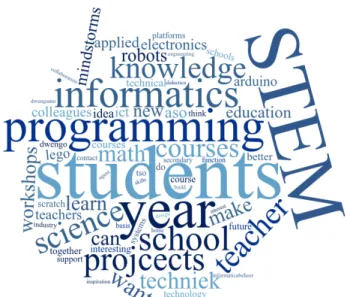
The program registration form included the question: "Why do you want to participate in this workshop?". When analyzing the an-swers to these questions, three main motivations emerge. The lion’s share of participants want to expand their knowledge about pro-gramming and electronics because they had to teach a new STEM course at their school. Since the Flemish department of education released their STEM guidelines, many schools are integrating a new STEM course in their curriculum. However, schools often do not have qualified teachers for these new courses. A second signifi-cant motivator is expanding current knowledge. Many participants already teach informatics, electronics or programming but want to stay up to date. The last and smallest motivator are colleagues, some participants indicate that a colleague has recommended them to take the course. Figure 1 shows a word cloud generated from the answers the participants gave to the question asked on the regis-tration form. Analyzing the word cloud shows a high occurrence of the words STEM, skills, and knowledge, supporting the main motivator. Other words like: informatics, techniek (the name of a course in the first two years of secondary school) and programming support the second motivator. The word colleagues supports the third motivator.
3.2
Goals
Computer science is a mostly non existent subject in Flemish sec-ondary education. This information gap is an expanding problem since a significant part of the modern job market requires at least a basic set of computational thinking skills. Closing this gap is a multifaceted problem. It requires substantial legislative effort to in-clude computer science into the curriculum. Moreover, it demands a mental shift in students, teachers and school administrators making them recognize the importance of computer science. Furthermore, it needs considerable teacher knowhow to be integrated effectively. 2
Figure 1: Most frequently occurring words in the answer to the question: "Why do you want to participate in this work-shop?". The word cloud indicates the main motivator is ac-quiring new knowledge and skills to be able to teach STEM in their schools.
Progra-MEER works on two of these requirements. It aims to im-prove teacher knowhow while simultaneously informing teachers about the importance of computer science facilitating their mental shift.
As a result of legislative decisions, the most effective way to improve computer science content in secondary school, within the current educational context, is by incorporating it into STEM. Con-sequently, the professional development program devotes itself to training participants on how to integrate computer science into STEM. The benefit of this approach is that it establishes the pedagog-ical context for the program. STEM usually adopts a project based learning pedagogy. This pedagogy has been shown to have posi-tive effects on student learning outcomes and motivation. Showing participants the value of project based learning and providing sug-gestions for a successful implementation are some of the program’s key objectives.
As described in section 2.1 and 2.2, collaboration is a considerable part of successful professional development as well as STEM edu-cation. Consequently, it should receive sufficient attention during Progra-MEER. The ultimate goal is to be the spark for a sustainable community of practice onto which teacher can rely for information and support even after the program has finished. Forcing collabo-ration is difficult and can have adverse effects. Therefore, Progra-MEER aims to stimulate collaboration in a non forceful way by creating a shared responsibility while having attention for teacher autonomy [14].
3.3
Program structure
Progra-MEER spans across the full school year, the first session taking place at the end of September or beginning of October and the last session at the end of May. In between those sessions there are three more sessions, one before the new year and two after. The first session informs participants about the content and structure of the program. Additionally, it includes a social "ice breaker" game enabling participants to get to know each other.
During the second session, participants get acquainted with the different physical computing platforms used in the workshop. They do this in the form of a carousel where groups of two participants spend 40 minutes with each platform. The groups get mixed when moving to the next platform facilitating further social interaction. At the end of day two the participants get time to brainstorm about which physical computing project they want to realize in their classroom. The results of this brainstorm are the basis for their homework. By the next session, they are required to design a poster presenting their project. This poster has the following requirements: (1) Have a project title. (2) Present the target audience (age and field of study). (3) State students prior knowledge. (4) Provide a duration and timeline. (5) Describe used educational methods. (6) Provide arguments for the selected platform. (7) List the links with computer science. (8) Give an overview of the connections with other fields of study.
At the beginning of the third session, the participants’ posters are displayed on the wall. The way posters are displayed is not coincidental, they are clustered by the program organizers based on similarity stimulating spontaneous collaboration between those participants. Each participant gives an elevator pitch style presenta-tion to inform other participants about his or her project. Thereafter, groups containing between two or three people are formed. These groups then proceed with a brainstorm session in which they merge their ideas into one. Figure 2 shows the brainstorm guide, partici-pants use this page to think about the context of their project. In the center of the page they write the name of their project, around it they specify: learning objectives, student background, didactical activity types and technical aspects of the project. On the back-side of the page, they should define the assessment strategies they will use. After the brainstorm, the groups have time to further familiarize themselves with the platforms they will use in their project. This is done by choosing one of the provided exercises and working through it during the rest of the afternoon. At the end of this session, participants are informed that they should develop their project further by the next session. No specific requirements were imposed but some progress should be made so they could ask questions during the next session.
The fourth session mostly provides the participants with time to work on their projects while multiple domain experts are available for questions. Most of the preparations should be finished by the end of this session since, during the period between the fourth and fifth session, the participants should tryout their project in one of their classes.
During the fifth and final session, the participants have to present their project during a poster session. Similarly to the poster they made between session two and three, additionally, it should report on their experiences during the implementation in their classroom.
Apart from the poster session, some participants are asked to give a short presentation presenting their experiences.
LEERDOELEN ACHTERGROND
WERKVORMEN TECHNISCH
Figure 2: Activity brainstorm aid. Center: Project title. Top left: Learning objectives. Top right: Student background. Bottom left: didactical activity types. Bottom right: Techni-cal aspects of the project. On the backside of the page, par-ticipants write the project assessment strategies.
4
OUTCOMES
4.1
Projects
The professional development program resulted in multiple inter-esting projects. These projects are varied in context and content. In the following paragraphs we elaborate on some examples.
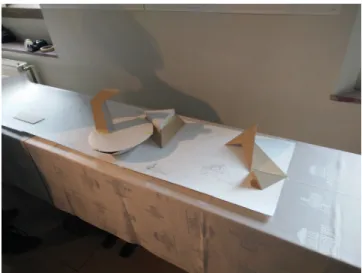
Project Theremin used an Arduino compatible microcontroller together with a sonar sensor and piezoelectric buzzer to create a digital theremin, a musical instrument you can play without touching it. It was executed in the fourth year of secondary art school over a period of six weeks. Each week the students could work on their project for one hour in groups of two or three. The students did have some basic programming knowledge since the year before they learned the basic control structures in Scratch. To further integrate the project into the curriculum, the participating informatics teacher collaborated with a graphical design teacher in his school. In graphic design class the students had to design and build a case for their theremin in a Russian constructivist style. Figure 3 show some examples of the designs made by students. After the program the project was developed further, the teacher together with the program organizers. This resulted in a free booklet for teachers describing the project1.
Another project let the students create a small scale paramotor. The project used an Arduino to control two dc motors which had propellers attached to them. The Arduino itself was controlled re-motely using a smartphone through a bluetooth connection. The smartphone application was written using MIT App inventor. Sadly this project turned out to be too ambitious. The participating teach-ers were not able to create a working paramotor. Consequently, 1http://www.dwengo.org/sites/default/files/addFiles/startgids-grafisch.pdf
Figure 3: Examples of theremin designs in Russian construc-tivist style.
the full project was never performed in a classroom. However, some parts of the project, like bluetooth communication between a smartphone and Arduino, did.
4.2
Student responses
The main goal of Progra-MEER is to improve the computer science knowledge of teachers within a physical computing context. We chose our context since it should be a motivating factor for students. To confirm this assumption, we sent out a survey to the participat-ing teachers askparticipat-ing them to let their students fill out the survey after they had a class about physical computing. This resulted in a set of 87 responses. The survey itself measured intrinsic moti-vation for programming and electronics and is based on the self determination theory [6]. The questionnaire had 18 questions, 9 about programming and 9 about building electronic circuits rated on a seven point Likert scale. Survey participants came from third (69%), fourth (1.1%), fifth (16.1%), and sixth (13.8%) year of secondary school with respective ages 14 to 15, 15 to 16, 16 to 17, and 17 to 18 years old. 81.6% were boys, 12.6 % girls, the rest of the group se-lected a different gender option. On average the scores are positive. The sample group scored an average of 4.45 on the programming questions and 4.51 on the electronics questions both on a 1 to 7 scale. However, when separating the group into boys and girls, we see a remarkable difference. The boys score a global average of 4.67 while the girls only score 3.67. When comparing both groups using a Students t-test we see a significant difference (p < 0.005) on 6 of the 18 questions, 4 of these are programming related and 2 are related to building electronic circuits. Analyzing these questions we see that girls like programming and electronics significantly less then boys. Additionally, girls think programming is less interesting and that they are less competent at it. However, looking at the other questions, girls do not feel more stressed when programming or building electronic circuits and do not feel less like they are worse at it than other students in the classroom.
These results are noteworthy but are provisional. Since a sig-nificant part of the teachers participating in the workshop teach in more technically oriented fields of study, the survey population contains a certain bias. Consequently, these results are not gener-alizable. Furthermore, the number of girls who participated in the study is small, only 11. Nevertheless, the more negative position of the girls does seem to be a general trend, not all negative responses are from the same class or teacher. There are more negative re-sponses across all classes, teachers, and age groups. Additionally, girls have a less positive attitude towards programming than to-wards building electronic circuits. Finding a reason for this is hard based on the available data. It might be that they prefer a more physical challenge, however, other factors might influence the bias like: previous experiences, the idea that programming is a "boy" thing, or a lack of basic knowledge about programming.
5
DISCUSSION
Progra-MEER aims to facilitate the transition to strong STEM edu-cation. It supports government reforms while providing sufficient liberty to teachers in forming their own vision on how STEM should be thought. Looking back at literature, Progra-MEER aligns with the criteria for successful professional development. It supports teacher motivation by providing sufficient autonomy, participants are encouraged to work on their own ideas while receiving support-ive feedback and apt technical support. Furthermore, the program is partially tailored to their needs and encourages them to apply the learned principles in their own classrooms. During the program, collaboration is encouraged and its values are often highlighted. Through various social interactions and activities, Progra-MEER aims to be the spark of a sustainable community of practice.
Despite this alignment with literature, some practical problems have surfaced during the program. Generally, supporting autonomy by letting teachers suggest their own projects and helping them succeed works. However, making teachers apply their new knowl-edge in their classrooms is more challenging. The program requires teachers to test the project they developed in one of their courses during the second semester. The number of participants who do is low. Multiple causes can be associated with this issue, some teachers need more time to process the newly acquired information before applying it. The plan on integrating their new knowledge into one of their courses by the next school year. Another cause might be the limited time between the creation of the project and the final poster session. For some teachers, this period of two months was too short to implement their project. To prevent this from happening in the future, Progra-MEER will shift its sessions to earlier moments in the school year providing participants with more time to implement their project in one of their courses. Additionally, the first sessions of the program will include small assignments that teachers have to perform in their classrooms. This should get the participants acquainted with the idea that they immediately have to apply the newly acquired knowledge during their classes.
Another significant limitation of the program is the ability to create a long term sustainable community of practice. The program includes many opportunities for collaboration, shows the value of sharing information, and provides a way for teachers to share the projects they created. However, in practice this does not lead to a
strong community of practice in which teachers share information and experiences. In the future it would be interesting to think about how we can further encourage participants to keep collaborating even after they have finished the program.
A final noteworthy weakness is the limited attention spent on the assessment of project based learning. During the project brain-storm participants spend a small amount of time thinking about how the project will be evaluated. However, during the following sessions not much attention is given to assessment. Since accurate assessment plays a vital role in project based learning it should be present.
We are still convinced that a physical computing context is a good choice for the program. It provides a logical link between computer science and other STEM disciplines. Additionally, it easily combines practical assignments and theoretical thinking into a practical problem solving process. However, looking at the results of the student survey, more time should be spent on the importance of defining a project context which also attracts girls. Since literature has shown that this is possible [16], it is important that teachers are aware of the influences of context on motivation and try to take this into account when creating course material.
6
CONCLUSIONS
This paper describes how different criteria for successful profes-sional development can be applied in practice. We describe a pro-gram structure and multiple assignments that help teachers to im-prove their content knowledge, imim-prove collaboration, and provide them with important pedagogical knowledge about project based learning, this while supporting teacher autonomy by providing them with sufficient liberty to learn about what they want to know or do.
Despite many positive elements, the program has some shortcom-ings. The application of their new knowledge inside their courses should be further encouraged as well as long term sustainable col-laboration between participants. Additionally, there should be more attention for accurate assessment of project based learning and the definition of attractive contexts for all different student groups.
ACKNOWLEDGMENTS
The work is supported by UGent, KULeuven, and UHasselt and is partially funded by the Google CS4HS program https://www.cs4hs. com/.
REFERENCES
[1] [n. d.]. Europe2020, guidelines for the employment policies of the Member States for 2015. http://eur-lex.europa.eu/legal-content/EN/TXT/?uri=OJ%3AJOL_2015_ 268_R_0005. ([n. d.]). Accessed: 2017-08-03.
[2] [n. d.]. Graduation statistics. https://www.vdab.be/trendsdoc/schoolverlaters/ detail/default.shtml. ([n. d.]). Accessed: 2017-08-03.
[3] [n. d.]. High job market demand. https://www.vdab.be/trendsdoc/ vacatureanalyse/knelpuntberoepenlijst2016.pdf. ([n. d.]). Accessed: 2017-08-03. [4] Phyllis C Blumenfeld, Elliot Soloway, Ronald W Marx, Joseph S Krajcik, Mark Guzdial, and Annemarie Palincsar. 1991. Motivating project-based learning: Sustaining the doing, supporting the learning.Educational psychologist26, 3-4 (1991), 369–398.
[5] Leônidas de Oliveira Brandão, Yorah Bosse, and Marco Aurélio Gerosa. 2016. Visual programming and automatic evaluation of exercises: An experience with a STEM course. InFrontiers in Education Conference (FIE), 2016 IEEE. IEEE, 1–9. [6] Edward L Deci, Haleh Eghrari, Brian C Patrick, and Dean R Leone. 1994.
Facil-itating internalization: The self-determination theory perspective.Journal of personality62, 1 (1994), 119–142.
[7] James Fairweather. 2008. Linking evidence and promising practices in science, technology, engineering, and mathematics (STEM) undergraduate education.
Board of Science Education, National Research Council, The National Academies, Washington, DC(2008).
[8] Scott Freeman, Sarah L Eddy, Miles McDonough, Michelle K Smith, Nnadozie Oko-roafor, Hannah Jordt, and Mary Pat Wenderoth. 2014. Active learning increases student performance in science, engineering, and mathematics.Proceedings of the National Academy of Sciences111, 23 (2014), 8410–8415.
[9] Kathleen Fulton and Ted Britton. 2011. STEM Teachers in Professional Learning Communities: From Good Teachers to Great Teaching.National Commission on Teaching and America’s Future(2011).
[10] Edmond Gaible and Mary Burns. 2005. Using Technology to Train Teachers: Appropriate Uses of ICT for Teacher Professional Development in Developing Countries.Online Submission(2005).
[11] Jana Hunzicker. 2010. Characteristics of Effective Professional Development: A Checklist.Online Submission(2010).
[12] Jana Hunzicker. 2011. Effective professional development for teachers: A checklist.
Professional development in education37, 2 (2011), 177–179.
[13] Murat Karakus, Suleyman Uludag, Evrim Guler, Stephen W Turner, and Ahmet Ugur. 2012. Teaching computing and programming fundamentals via App Inven-tor for Android. InInformation Technology Based Higher Education and Training (ITHET), 2012 International Conference on. IEEE, 1–8.
[14] Geert Kelchtermans et al. 2006. Teacher collaboration and collegiality as work-place conditions. A review.Zeitschrift fÃ1/4r PÃÂď dagogik52, 2 (2006), 220–237. [15] Aileen Kennedy. 2005. Models of continuing professional development: a
frame-work for analysis.Journal of in-service education31, 2 (2005), 235–250.
[16] Winnie WY Lau, Grace Ngai, Stephen CF Chan, and Joey CY Cheung. 2009. Learning programming through fashion and design: a pilot summer course in wearable computing for middle school students. InACM SIGCSE Bulletin, Vol. 41. ACM, 504–508.
[17] Irene A Lee, Maureen Psaila Dombrowski, and Ed Angel. 2017. Preparing STEM Teachers to offer New Mexico Computer Science for All. InProceedings of the 2017 ACM SIGCSE Technical Symposium on Computer Science Education. ACM, 363–368.
[18] Joel Michael. 2006. Where9s the evidence that active learning works?Advances in physiology education30, 4 (2006), 159–167.
[19] Tom Neutens et al. 2016. Teacher professional development through a physi-cal computing workshop. InProceedings of the 11th Workshop in Primary and Secondary Computing Education. acm, 108–109.
[20] Kylie Peppler. 2013. STEAM-powered computing education: Using e-textiles to integrate the arts and STEM.Computer(2013), 1.
[21] Giovanni Samaey, Jacques Van Remortel, Hugues Bersini, Yvan Bruynseraede, Jan Dekelver, Frederik De Laender, Dirk Deschoolmeester, Paul Gistelinck, Bern Martens, Lennart Martens, et al. 2014. Informaticawetenschappen in het leer-plichtonderwijs. (2014).
[22] Sandra Schulz and Niels Pinkwart. 2015. Physical computing in stem education. InProceedings of the Workshop in Primary and Secondary Computing Education. ACM, 134–135.
[23] Ibrahim Zeid, Jessica Chin, Claire Duggan, and Sagar Kamarthi. 2014. Engineering based learning: a paradigm shift for high school STEM teaching.International Journal of Engineering Education30, 4 (2014), 867–887.