This is a repository copy of
Continuous time resource selection analysis for moving
animals
.
White Rose Research Online URL for this paper:
http://eprints.whiterose.ac.uk/148566/
Version: Accepted Version
Article:
Wang, Y., Blackwell, P.G. orcid.org/0000-0002-3141-4914, Merkle, J.A. et al. (1 more
author) (2019) Continuous time resource selection analysis for moving animals. Methods
in Ecology and Evolution. ISSN 2041-210X
https://doi.org/10.1111/2041-210x.13259
This is the peer reviewed version of the following article: Wang, Y. , Blackwell, P. , Merkle,
J. and Potts, J. (2019), Continuous time resource selection analysis for moving animals.
Methods Ecol Evol. Accepted Author Manuscript. doi:10.1111/2041-210X.13259. This
article may be used for non-commercial purposes in accordance with Wiley Terms and
Conditions for Use of Self-Archived Versions.
[email protected] https://eprints.whiterose.ac.uk/
Reuse
Items deposited in White Rose Research Online are protected by copyright, with all rights reserved unless indicated otherwise. They may be downloaded and/or printed for private study, or other acts as permitted by national copyright laws. The publisher or other rights holders may allow further reproduction and re-use of the full text version. This is indicated by the licence information on the White Rose Research Online record for the item.
Takedown
If you consider content in White Rose Research Online to be in breach of UK law, please notify us by
Continuous time resource selection analysis for
1moving animals
2Y. Wang
1, P.G. Blackwell
1, J.A. Merkle
2and J.R. Potts
1∗ 31School of Mathematics and Statistics, University of Sheffield, Hicks Building, Hounsfield Road, Sheffield
4
S3 7RH, UK 5
2
Wyoming Cooperative Research Unit and Department of Zoology and Physiology, University of Wyoming, 6
Laramie, WY, USA 7
∗ Correspondence: E-mail: [email protected]
8
9
Short title: Continuous time resource selection analysis 10
Word Count: 7000 11
Abstract
12
1. Resource selection analysis (RSA) seeks to understand how spatial abundance covaries with environ-13
mental features. By combining RSA with movement, step selection analysis (SSA) has helped uncover 14
the mechanisms behind animal relocations, thereby giving insight into the movement decisions underly-15
ing spatial patterns. However, SSA typically assumes that at each observed location, an animal makes 16
a ‘selection’ of the next observed location. This conflates observation with behavioural mechanism and 17
does not account for decisions occurring at any other time along the animal’s path. 18
19
2. To address this, we introduce a continuous time framework for resource selection. It is based on 20
a switching Ornstein-Uhlenbeck (OU) model, parameterised by Bayesian Monte Carlo techniques. Such 21
OU models have been used successfully to identify switches in movement behaviour, but hitherto not 22
combined with resource selection. We test our inference procedure on simulated paths, representing both 23
migratory movement (where landscape quality varies according to season) and foraging with depletion 24
and renewal of resources (where the variation is due to past locations of the animals). We apply our 25
framework to location data of migrating mule deer (Odocoileus hemionus) to shed light on the drivers of 26
migratory decisions. 27
28
3. In a wide variety of simulated situations, our inference procedure returns reliable estimations of 29
the parameter values, including the extent to which animals trade-off resource quality and travel dis-30
tance (within 95% posterior intervals for the vast majority of cases). When applied to the mule deer data, 31
our model reveals some individual variation in parameter values. Nevertheless, the migratory decisions 32
of most individuals are well-described by a model that accounts for the cost of moving and the difference 33
between instantaneous change of vegetation quality at source and target patches. 34
35
4. We have introduced a technique for inferring the resource-driven decisions behind animal movement 36
that accounts for the fact that these decisions may take place at any point along a path, not just when the 37
animal’s location is known. This removes an oft-acknowledged but hitherto little-addressed shortcom-38
ing of stepwise movement models. Our work is of key importance in understanding how environmental 39
features drive movement decisions and, as a consequence, space use patterns. 40
1
Introduction
41
Resource selection is a fundamental tool for understanding the drivers behind spatial distributions of 42
animals (Manly et al.(2002)). Applications not only include estimation of the distribution and abun-43
dance of species, but also prediction of species diversity, representation of interactions of species, and 44
identification of key spatial features of the landscape (e.g. Chetkiewicz & Boyce (2009), Lendrumet al. 45
(2012), Boyce (2006), McLoughlinet al.(2010)). Furthermore, the role of movement as a primary cause 46
of spatial patterning is becoming increasingly evident (Cagnacci et al. (2010), Thurfjell et al. (2014)) 47
and formally integrated into the resource selection framework (Moorcroft & Barnett (2008), Avgaret al. 48
(2016)). This has diverse applications including home range formation (Merkleet al. (2017)), compe-49
tition (Vanak et al. (2013)), disease spread (Merkle et al. (2018)), territorial interactions (Potts et al. 50
(2014b)), and predator-prey dynamics (Bastille-Rousseauet al.(2015)). 51
Step Selection Analysis (SSA) has provided the main tool for incorporating movement into resource 52
selection (Fortinet al.(2005), Foresteret al.(2009), Thurfjellet al.(2014)). It relies on comparing move-53
ment between two successive location fixes (called a ‘step’) with various possible steps potentially avail-54
able to the animal. As well as explicitly incorporating movement into the resource selection framework, 55
SSA has recently been extended to estimate movement and resource selection parameters simultaneously, 56
termed integrated step selection analysis (iSSA; Avgaret al. (2016)). The iSSA procedure corrects for 57
any error implicit in the choice of distribution for ‘available’ steps, and can be used to parameterise a 58
mechanistic model of animal movement. In addition, appropriate modelling of resource selection at the 59
level of the individual step can link it to the long-term utilisation distribution (Michelotet al.(2018)). 60
However, both SSA and iSSA implicitly assume that movement decisions occur on the same scale as 61
the observation frequency (McClintocket al.(2014)), or the scale of a regular subsample of the observa-62
tions (Pottset al.(2014c)). These assumptions may result in misleading interpretations of inferences from 63
data, and in particular make it tricky to work with irregularly sampled data (McClintocket al.(2014), 64
Thurfjellet al.(2014)). To avoid these issues, it makes sense to model the animal path as a continuous 65
track, where decisions may have occurred at any point along that track, then fit this continuous-time 66
model to the data. 67
Continuous-time modelling frameworks for animal movement have existed for some time. An early 68
example is that of Blackwell (1997). There, a switching Ornstein-Uhlenbeck (OU) process was proposed, 69
which is flexible enough to capture a wide range of animal movement patterns, and has thus gained 70
increasing popularity over the years. It has the advantage of being amenable to rigorous and efficient 71
parameterisation by data using Bayesian Monte Carlo methods (Blackwell (2003)) and has recently been 72
extended to incorporate spatial heterogeneity (Harris & Blackwell (2013), Blackwellet al.(2016)). This 73
opens the question as to whether it can be combined with resource selection analysis (RSA) to model 74
animal decisions as they move in continuous time. 75
Several continuous-time models have already been developed to incorporate resource selection. John-76
sonet al.(2008) was one of the first such studies. This study proposed various possible models for the 77
distribution of a location along path, conditional on the knowledge of all previous locations. However, 78
although the models themselves were defined in continuous time, they all model movement from one 79
measured location to the next, so do not account for the possibility of behavioural changes between 80
location fixes. 81
On the other hand, the approach of Hanks et al. (2015) does deal with between-observation be-82
havioural switches. This method discretises space into a lattice and models movement as jumps between 83
neighbouring lattice sites, building on previous work by Hooten et al. (2010) and Hanks et al.(2011). 84
Behavioual switches are possible at any nearest-neighbour jump, not just those that correspond to mea-85
sured locations. However, the implicit assumption of the model in Hankset al.(2015) is that the spatial 86
scale of discretisation represents the scale of behavioural decisions. In reality, animal movement decisions 87
may play out on multiple scales, with localised considerations (e.g. moving around a small obstacle or 88
over a fence) balanced with longer-term goals (e.g. moving to the next foraging patch or continuing 89
a migratory journey). Furthermore, this technique only considers movement in response to proximate 90
resources (e.g. a local resource gradient). In reality, animals may be attracted to resources that are quite 91
some distance away, due to long-term memory processes. A continuous-time framework is needed that 92
is flexible enough to account for such a variation of possibilities. 93
Here, we extend the switching OU framework of Blackwell et al. (2016) to incorporate resource 94
selection in two separate ways. The first considers resources as objects that have an attractive pull 95
on animals, which may take place over a considerable spatial scale (e.g. in migratory cases). If it is 96
beneficial to move to a new area to gain access to better resources, taking into consideration the cost of 97
moving there, then the animal becomes attracted to that area. In mathematical terms, this corresponds 98
to a switch in the OU process. Otherwise, the animal stays in the vicinity of its current position. At 99
any point, the best possible attractor on the landscape could switch, causing the animal to change its 100
movement mode. We consider cases both where the landscape undergoes seasonal changes and where 101
the quality of resources depends upon the past positions of the animal (through resource depletion and 102
renewal). 103
The second modification is implemented separately from the first and takes a rather different ap-104
proach to modelling animal movement. Here, rather than assuming the animal assesses the whole land-105
scape and moves towards the most desirable goal, we assume that the animal considers only proximate 106
aspects of the terrain and, as such, has a tendency to move up the resource gradient. This is similar to 107
Hankset al.(2015) but framed within a switching random walk framework. In doing this, the animal’s 108
path does not need to be discretised (as in Hanks et al.(2015)). However, by using efficient Bayesian 109
Monte Carlo methods developed over a series of papers (Blackwell (2003), Harris & Blackwell (2013), 110
Blackwellet al.(2016)), inference is still possible within a reasonable time-frame. We compare our frame-111
work with that of Hanks et al.(2015), testing for both speed and precision of inference by application 112
to paths simulated from the model proposed in this paper. 113
We tested our modelling and inference method on both simulated and real trajectories. The simu-114
lated trajectories model (a) migratory behaviour, (b) movement due to resource depletion and renewal 115
in both patchy and lattice landscapes, and (c) resource-gradient following in a fixed (lattice) landscape. 116
Real trajectories were measured from mule deer (Odocoileus hemionus) migrations in the Greater Yel-117
lowstone Ecosystem. Our simulation analysis demonstrates the ability of our method to infer parameters 118
with reasonable accuracy. The application to mule deer data demonstrates that migratory timings may 119
be explained by a simple trade-off between resource quality and travel distance. We include, in the Sup-120
porting Information, code for performing inference and simulating all trajectories used in this manuscript 121
(instructions are found in Supplementary Appendix H). 122
2
Methods
123
2.1
Modelling framework
124
In this section, we model movements in response to the environment in two scenarios. In the first 125
situation, we assume that animals have complete knowledge of the environment and bias their movements 126
towards the most attractive location in space. Then we consider the other extreme, where animals only 127
have information about local conditions. 128
2.1.1
Movements in response to resource change in the whole landscape
129A commonly used continuous-time movement model is the OU process, which describes a biased random 130
walk with drift towards an attraction centre. The general formalism is given as follows 131
dx(t) =B(x(t)−µ(t))dt+ ΛdW(t). (1)
Here,x(t) is the animal’s location at timetinn-dimensional space,µ(t) is the attraction centre at time 132
t, B is an n by n matrix controlling the tendency towards the attraction centre, Λ is the covariance 133
matrix, and W(t) is an n-dimensional Wiener process. Under the process given by Equation (1), the 134
probability of an animal being at locationx(t+τ) at timet+τ, given that it was at x(t) at timet, is 135
x(t+τ)|x(t)∼M V N(µ(t) +eBτ(x(t)−µ(t)),Λ−eBτΛeB′τ), (2)
whereτ is a (small) time interval and M V N stands for “Multi-variate normal”. 136
Throughout this paper, we work in two dimensions, so thatBand Λ are 2×2 matrices. Furthermore, 137
we assume B = −bI and Λ = vI with b, v > 0 and I the 2×2 identity matrix, so that there is 138
no correlation between the horizontal and vertical coordinates. Larger b leads to a stronger tendency 139
toward the attraction centre and faster approach to the attraction centre when far away from it, while 140
larger v induces a wider range of wandering near the central point. Hence we refer to b as the drift 141
coefficientandv thediffusive coefficient. 142
To determine the attraction centreµ(t) in the OU process in Equation (2), a function is incorporated 143
into our modelling framework to evaluate the attractiveness of a location or an item in space. For this, 144
we choose a commonly used functional form known as aresource selection function (RSF) and defined 145
as follows (Boyceet al.(2002)) 146
w(x) = exp(β1z1(x) +β2z2(x) +· · ·+βkzk(x)), (3)
wherexis a location in space,z(x) = (z1(x),· · · , zk(x)) is the vector of predictor covariates, consisting
147
of possible factors affecting selection decision – for example, some kind of vegetation, predator pressure, 148
distance to a road, etc. (Manly et al.(2002)) – and β1,· · ·, βk are coefficients representing the relative
149
weight of each factor. We assume that the animal has complete knowledge of the available space and 150
decides its destination µ(t) at timet by comparing the attractiveness of all potential target locations, 151
given by Equation (3) (cf. Avgar et al. (2017)), then moves towards the most attractive destination. 152
That is, 153
µ(t) =µi where w(µi) = max
j∈Ωw(µj). (4)
Here,µi is the centre of a resource unit, which may be a patch or an item, and Ω indexes the collection
154
of all resource units, which is finite. In most typical situations, µ(t) will be unique, because Equation 155
(3) will normally involve continuous covariates, and so each resource unitµj is likely to have a different
156
value of w(µj) associated to it. In this study, we only consider such situations, so there is never an
157
arbitrary choice between resource units of precisely equivalent quality. 158
2.1.2
Movements following local resource gradient
159The OU model described above assumes the animal has complete knowledge of the landscape when 160
making a decision. At the other extreme, we might assume that the animal only has proximate knowledge 161
of the landscape. For this, we model animals as following the local resource gradient. This can be 162
described by a processx(t) satisfying a stochastic differential equation with constant drift term (Preisler 163
et al.(2004)) 164
dx(t) =αρ(t)dt+ΣdW(t), (5) where α is a governing the drift speed, ρ(t) is a unit vector representing the direction of drift, Σ is 165
ann×n matrix controlling the diffusive aspects of movement. Here we use a two-dimensional (Euler-166
Maruyama) approximation of the conditional distribution of the process defined by Equation (5), which 167
is valid for smallτ. This is given as follows 168
x(t+τ)|x(t)∼M V N(x(t) +αρ(t)τ,Στ), (6)
wherex(t) is the animal’s position at timet. We assume Σ =σ2
IwhereI the 2×2 identity matrix and 169
σis a scalar constant. The model in Equation (6) contrasts with that of Equation (2) in that the former 170
assumes animals respond to a local resource gradient, whereas the latter models animals as choosing a 171
target location from the landscape to move towards. 172
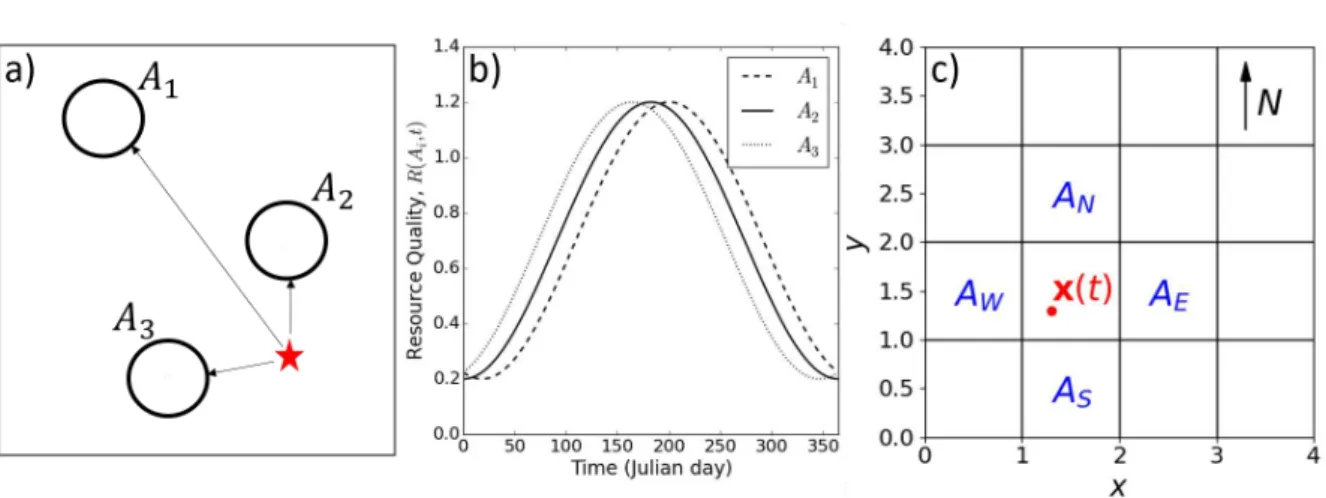
Figure 1: Panel (a) illustrates the patch selection model (Equations 1-4). Assume the
animal is at the red star. In this simplified illustration, there are just three possible
patches it can choose to move towards,
A
1, A
2,
and
A
3(in real situations there may be
many more). The animal’s choice is determined by both the patch quality, which may
vary over time, and the distance to the patch. Panel (b) gives example curves of how
the patch quality of each patch may vary over time, each in the format of Equation (11).
Panel (c) illustrates the gradient following model (Equations 5-8). The animal is located
at position
x
(
t
) at time
t
. Patches
A
N,
A
W,
A
Eand
A
Sare the adjacent squares to
the patch where the animal is located.
N
,
W
,
E
,
S
stand for the north, west, east and
south respectively. When calculating the resource gradient in the nearby area of
x
(
t
), the
resource qualities in the four adjacent patches are considered, which means the animal
only assesses resource qualities in neighbouring areas to determine its moving direction.
We assume that animals move in a rasterised landscape, that is, one subdivided into a square or 173
rectangular lattice. Hereafter we will consider a square lattice for simplicity. We determine the drift 174
directionρ(t) in Equation (6) by considering the resource qualities in the four adjacent squares (North, 175
East, South, West) to the one where the animal is located. Here, the resource gradient is given as follows 176 (cf. Preisleret al.(2013)): 177 ∇w(x(t)) := w(AE)−w(AW) ∆x , w(AN)−w(AS) ∆y , (7)
where x(t) is the animal’s position at time t, w(AE), w(AW), w(AN), and w(AS) are the resource 178
selection weightings (Equation 3) for the adjacent patchesAE,AW,AN andAS in the east, west, north,
179
and south respectively (Figure 1). We use ∆xto denote the distance between the centres of patchesAE
180
andAW while ∆y is the distance from the north patch to the south patch. Notice that, whilst there are
181
also diagonally adjacent squares (NW, NE, SE, SW), it is sufficient to use just four to define the resource 182
gradient, as shown in Equation (7). Then the vectorρ(t) in Equation (6) is defined as the normalised 183 vector of∇w(x), 184 ρ(t) = ∇w( x(t)) |∇w(x(t))|. (8)
Note that we model our drift speed as constant (α) rather than letting it vary with the magnitude of 185
∇w(x). This means that the average speed of the animal across a time intervalτis kept constant, rather 186
than being allowed to become arbitrarily large. However, the model could easily be adjusted so that 187
ρ(t) =∇w(x) if the user believes that to be more appropriate for their particular study species. 188
2.1.3
Locations between observations
189In each of the above movement models, we assume that the animal can potentially make a decision 190
to reassess its movement state at any instant in continuous time. To represent this, reassessments 191
occur according to a Poisson point process with rate κ, as in Blackwell et al. (2016) (see Appendix 192
A in Supporting Information). This process means that the time intervals between reassessments are 193
exponentially distributed with parameterκ. At each reassessment time, we deterministically decide the 194
movement state, which is defined by either the attraction centreµ(t) in Equation (2) or directionρ(t) in 195
Equation (6). The movement state is decided by comparing the relative quality of resources in different 196
patches, using Equations (3-4), or calculating the resource gradient using Equation (7). 197
The fact that the choice of target location is deterministic, based on a complex evaluation of the 198
environment, contrasts with the stochastic switching of Blackwell et al. (2016), where the transition 199
rates are relatively simple functions of habitat and time. One could, in principle, extend our model so 200
that animals choose an attraction centre with a probability, based on the relative quality of each site. 201
However, this introduces extra model complexity that may not increase realism, so we have chosen to 202
model a deterministic switching process for simplicity. 203
2.2
Inference by Markov chain Monte Carlo algorithm
204
Having constructed the modelling frameworks, we use a Markov chain Monte Carlo (MCMC) algorithm, 205
based on Blackwell et al. (2016), to parameterise the models from movement data. For details of the 206
algorithm, see Appendix A in Supporting Information. 207
The MCMC algorithm comprises two main parts, one of which updates the movement trajectory by 208
simulation and the other updates parameters. To take into consideration the fact that animals can make 209
a decision to move at any time, we augment the observed data with points where the animal might have 210
changed its destination. In every iteration, we select an interval from the observed data and generate 211
a simulated path consisting of points where the switches of destinations might happen during the time 212
of the selected interval. Subsequently, we compare this simulated path with the selected interval in 213
existing trajectory by calculating the Hastings ratio, conditional on observed data points. After deciding 214
whether to accept the proposal trajectory or not, we update the parameters conditional on the accepted 215
trajectory (see Blackwellet al. (2016) for details). 216
2.3
Simulations
217
We test the MCMC algorithm on four classes of movement models. The first models migration, so 218
we assume that the animal moves in response to seasonally changing resource qualities. In the second 219
and third types of model, the resource quality depletes and renews according to the animal’s foraging 220
patterns. The last is a gradient-following model, where the animal only compares resource qualities in 221
the surrounding area to decide its direction. 222
2.3.1
Migration model
223The first test of our inference method (Section 2.2) uses a very simple model of migration, whereby the 224
decision to migrate is a trade-off between the quality of a patch, which may be a destination range or 225
a stopover site, and how far it is away from the animal. Although migratory routes tend to be fixed, 226
the decision as to when to move to the next patch is not. Rather it is determined by how the quality 227
of patches over the migratory route are changing over time (e.g. due to green-up). We hypothesise that 228
movement to the next patch will occur when the animal will make sufficient foraging gains from the 229
next patch to make the movement worth while. The decision to migrate is thus caused by patch quality 230
varying over time, so we use an adjusted form of Equation (3), which includes time as a variable: 231
w(µ, t) = exp(β1R(µ, t) +β2|µ−x(t)|), (9)
wherez(µ, t) = (R(µ, t),|µ−x(t)|) is the vector of predictor covariates withR(µ, t) the resource quality 232
in a potential target locationµandx(t) the animal’s position at timet. We assumeβ1>0 andβ2<0,
233
representing the animal’s inclination for resources and aversion to distant places. Note that a similar 234
quality/distance trade-off for patch selection was also used by Mitchell & Powell (2004) in the slightly 235
different context of modelling home range formation. 236
In practice, since our aim is to use the patch that maximises Equation (9) as the movement centre, 237
comparing the value of Equation (9) is equivalent to comparing a constant multiple of its exponent. 238
Moreover, we can only inferβ1/β2from data instead of inferringβ1 andβ2simultaneously, because any
239
proposed values forβ1andβ2with ratio close toβ1/β2will lead to the same attraction centre. Therefore,
240
it suffices to consider a simplified version of Equation (9) as follows 241
w(µ, t) = exp(βR(µ, t)− |µ−x(t)|), (10)
whereβ =−β1/β2 is termed theresource coefficient.
242
Our model landscape consists of N non-overlapping patches, denoted by Ai, i ∈ {1,· · ·, N}. The
243
centre of patchAi is denoted byµi= (xi, yi) withy1≤y2· · · ≤yN, ordered by latitude. We assume the
244
resource quality changes periodically over the year and shifts corresponding to the latitude. The resource 245
quality R(Ai, t) in patchAi at time t (Julian day) is assumed to be a cosine function with period 365
246
days and shift controlled by (yi−y1)/(yN−y1), the relative latitude difference:
247 R(Ai, t) =acos 2π 365t− yi−y1 yN −y1 π +m, (11)
whereaand mare the amplitude and mean of resource quality andyi is they-coordinate of the centre
248
ofAi (Figure 1b).
249
We generated migration trajectories by sampling from the model described above with various values 250
of the drift coefficient,b, the diffusion coefficient,v, and the resource coefficient,βin the following ranges: 251
0.1≤b≤0.8, 2≤v≤30, and 1.5≤β ≤8.5. These are chosen to produce simulations showing migration 252
patterns on a 90×160 unit2landscape with 10 randomly generated non-overlapping food patches. These 253
implicitly include the winter and summer ranges and stopover sites between them. 254
We tested the MCMC algorithm on these simulations with resource qualities being given a priori. 255
We used a normally distributed prior for each parameter value with a mean equal to the real parameter 256
value and a standard deviation of 2. Example output is given in Figure 2a, illustrating migration from 257
the winter range in the south to the summer range in the north and back to the south over a year. We 258
used the MCMC algorithm to infer drift and diffusion coefficients (b and v respectively) from the OU 259
process in Equation (2), together with the resource coefficient, β, from the RSF in Equation (10). To 260
investigate the effectiveness of the MCMC algorithm when dealing with missing data, we carried out the 261
inference using every 5th data point, shown as red triangles in Figure 2a. We also investigated the effect 262
of finer rarification for certain simulated datasets from our study. This made very little difference to the 263
inference (details in Supplementary Appendices D-E). 264
2.3.2
Depletion-renewal models in a patchy landscape
265In Section 2.3.1, we assumed that animals do not contribute in any significant way to the change of 266
resource quality (e.g. Illius et al.(2002)). In this section, we assume that the resource quality changes 267
according to the residential time of the animal in a food patch (e.g. Mitchell & Powell (2007), Van Moorter 268
et al. (2009)). As in the migration model, we describe a situation where an animal moves in pursuit 269
of quality food using the combination of the OU process and a RSF, introduced in Section 2.1.1. For 270
example, this may represent how an animal forages in its home range with complete knowledge of the 271
environment (e.g. Ford (1983)). As in Section 2.3.1, to test our inference method in a simple case, we 272
assume that the decision to move to a patch is a trade-off between the quality of a patch and the distance 273
to it and use the RSF given by Equation (10). 274
We simulate movements using Equations (2-4) in a landscape with food patchesAi,i∈ {1,· · ·, N},
275
assuming that the resources either are consumed (if the animal is present) or renewed (otherwise). 276
Specifically, if the animal is foraging in patchAi at time t, that is, x(t)∈Ai, then the resource quality
277
R(Ai, t) in patchAi decreases exponentially while those in other patches grow logistically, so that (Ford
278
(1983), Van Moorteret al.(2009)) 279 R(Aj, t+τ) = R(Aj, t)e−djτ ifj =i, KjR(Aj, t)erjτ Kj+R(Aj, t)(erjτ−1) forj6=i, (12)
wheredj,rj andKj are the depletion rate, growth rate and carrying capacity in patchAj respectively
280
andτis a (short) time-step. For simplicity, here we assume that the growth and depletion rates and the 281
carrying capacity are the same in each patch, and thus denotedr,dandK respectively. 282
We tested the inference procedure on simulations generated with various values of the drift coefficient, 283
b, the diffusion coefficient, v, and the resource coefficient, β in the following ranges: 0.05 ≤ b ≤ 0.5, 284
1700≤v≤3500 and 0.5≤β≤5. We used a 2000×2000 unit2 landscape with 10 randomly generated 285
non-overlapping food patches. Figure 2b shows an example of simulated trajectories of movements 286
depending on resource depletion or renewal in a patchy landscape. We tested the MCMC algorithm with 287
growth (r), depletion rate (d), and carrying capacity (K) being given. We used a normally distributed 288
prior for each parameter value with a mean equal to the real parameter value and a standard deviation 289
of 2. We then inferredbandvin the OU process (Equation 2) andβin Equation (10) using the Bayesian 290
Monte Carlo algorithm. In principle, one could attempt to infer all five parameters (r, d, K, b, v) using 291
our inference procedure, but we found that it was not usually possible to obtain precise inference in 292
this case, so we would advise users to try to measurer, d,andK directly. An example of such a direct 293
method is given by Fortinet al.(2002). 294
2.3.3
Depletion-renewal models in a raster landscape
295Although there are many real-life situations where resource patches are disjoint and known (e.g. Merkle 296
et al.(2014), Sawyer & Kauffman (2011)), often resources change continuously over the landscape and 297
are represented in data by a square grid (a.k.a. raster; e.g. Potts et al.(2014a)). To test whether our 298
inference procedure is effective at determining resource attraction in such situations, we model movement 299
on a square grid of resources that deplete and renew over time. In this case, the centre of each square in 300
the grid is a potential attraction centre of the OU process (Equation 2). 301
We started each simulation with homogeneous resource type in every square, which shares the same 302
carrying capacity,K, depletion and growth rates,dand r, across the land (e.g. Figure 2c). The initial 303
resource quality was equal to the carrying capacity and the resource quality in timeτfrom timetforward 304
was calculated using Equation (12) in Section 2.3.2. We tested our inference procedure on simulations 305
of the model in Equations (2-4) generated with 0.05 ≤b ≤ 0.14, 0.05 ≤v ≤0.5 and 0.2 ≤β ≤ 2 on 306
a 3×3 grid composed of unit squares. We carried out the MCMC algorithm on the assumption that 307
d, rand K are known and attempted to infer the movement coefficients b and v in the OU process in 308
Equation (2) and the resource coefficientβ in Equation (10). As for the other simulations, we used a 309
normally distributed prior for each parameter value with a mean equal to the real parameter value and 310
a standard deviation of 2. 311
2.3.4
Gradient-following models
312When landscape rasters are large, it may not be computationally feasible to test every square to see if 313
it is an attractive centre. Instead, we take a different modelling approach, assuming that the animal 314
tends to move up the local resource gradient, rather than towards a prime destination. This means that 315
animals are predominantly using local perception rather than memory (cf. Bracis & Mueller (2017)). 316
Figure 2d illustrates such a trajectory in a landscape with three different resource qualities, which are 317
assumed to be static. 318
Here, the movement process is described by Equation (6) with direction corresponding to the resource 319
gradient calculated using Equations (7) and (8). We define the RSF in Equation (7) to be the resource 320
quality at a square. The parameters to be inferred areαandσfor the drift term and covariance matrix 321
in Equation (6). We tested the MCMC algorithm on simulations constructed with 0.1 ≤α, σ≤1 on a 322
10×10 grid consisting of unit squares with 3 resource qualities. As with the other simulated trajectories, 323
we used a normally distributed prior for each parameter value with a mean equal to the real parameter 324
value and a standard deviation of 2. We also compared our framework with that of Hankset al.(2015), 325
testing for both inference speed and precision by application to simulated paths (details in Supplementary 326
Appendix G). In total, for our study we analysed 45 simulated paths for the Migration model, 30 for 327
the Patch depletion/renewal model, 30 for the Raster depletion/renewal model, and 20 for the Gradient 328
following model. 329
2.4
A case study of mule deer data in the Greater Yellowstone
330
Ecosystem
331
We used GPS collar data from 28 adult (>1.5 years of age) female mule deer captured using a netgun 332
fired from a helicopter near Cody, Wyoming (USA). Collars (ATS, Iridium, Isanti, Minnesota, USA) 333
were programmed to take a fix every 2 hours, and we used data collected from March-August 2016. All 334
deer were captured following protocols consistent with the University of Wyoming standards. 335
Before employing the MCMC inference procedure introduced in Section 2.2, we identified foraging 336
patches by grouping data points where an animal stayed within a 3-km radius area for at least 3 days. 337
Subsequently, the average longitude and latitude of locations inside the patches were regarded as the 338
attraction centre (Figure 4a). For our data, these patches were quite straightforward to identify, being 339
obvious just by looking at the location data (Figure 4a; Supplementary Video SV1), and the deer have 340
high fidelity to these sites (Sawyer & Kauffman, 2011). However, this may not be true for all datasets 341
on migratory movement. For each attraction centre, we extracted the values of the normalised difference 342
vegetation index (NDVI) and instantaneous rate of green-up (IRG) for Julian days 1 to 250 from the 343
corresponding pixels in the images (Figures 4c). NDVI and IRG data were compiled from the MODIS 344
satellite based on the methods of Bischofet al.(2012) and Merkle et al.(2016). 345
Our model is based on Equation (10) for decision making and the OU process in Equation (2) for movement, and can be written out in full as follows
x(t+τ)|x(t)∼M V N(µ(t) +e−bτ(x(t)−
µ(t)), vI(1−e−2bτ)), (13) µ(t) = argmaxi∈Ω[exp(βR(µi, t)− |µi−x(t)|)], (14)
where Ω indexes the set of attraction centres (centres of the foraging patches). We used our MCMC 346
algorithm to parameterise two different models from data. The first was the NDVI Model, whereR(µi, t)
347
is the NDVI value of patchiat timet. The second was the IRG Model, whereR(µi, t) is the IRG value
348
of patchiat timet. We used the Deviance Information Criterion (DIC) (Spiegelhalteret al.(2002)) for 349
model selection. 350
3
Results
351
3.1
Testing MCMC inference on simulations
352
3.1.1
Migration model
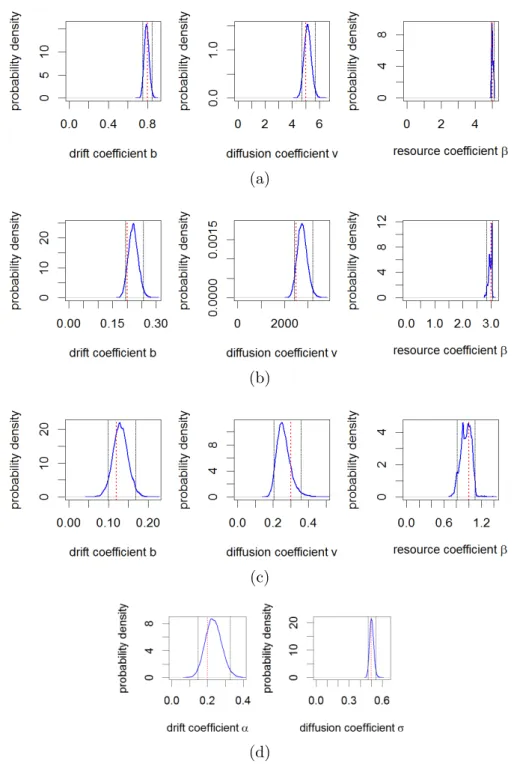
353Figure 3a shows the posterior distributions derived by applying MCMC inference on the trajectory shown 354
in Figure 2a. The posterior distributions captured the real values of parameters used in simulations to 355
a good degree of accuracy with the real values lying within a 95% quantile interval of the posterior 356
distributions, indicated by black dashed lines in Figure 3a. 357
When applying the MCMC algorithm on the migration model, the sampling chains converged within 358
similar numbers of iteration in about 20 minutes (on a single thread of an i5 2.0GHz processor in a 359
Windows desktop) regardless of various values for parameters used in simulation (Figure S1 in the Sup-360
porting Information). It took longer for the chains to converge when the number of proposed switching 361
points increases (Figure S2a,b). However, the performance of estimation was not affected by the amount 362
of proposed points (Figure S2c-e). Although the value of increasing κ was insignificant here, it might 363
become important when the frequency of state switch is much higher than observation. 364
As one would expect, the chains converged faster when the initial value of the drift coefficient,b, was 365
closer to the real value, in cases when the diffusion coefficient, v, and the resource coefficient, β, were 366
fixed at real values (Figures S3a,b). However, the initial value ofv had little impact on converging time 367
(Figures S3c,d), while the chains converged faster when the initial value of β was near the real value 368
(Figures S3e,f). 369
As for accuracy, the real values ofb,vandβ were within 95% central posterior intervals of the esti-370
mated values for about 2/3, 4/5 and 1/2 simulations respectively (Figure S4, Table S1). (See Appendices 371
B, F in Supporting Information for more details.) However, where they did deviate from these intervals 372
the deviations were generally quite small (a discrepancy of less than about 25% in all cases). 373
3.1.2
Resource depletion-renewal models in a patchy landscape
374The 95% central posterior interval of each posterior distribution in Figure 2b contains the real values 375
(Figure 3b), showing that our inference procedure has good accuracy in this case. 376
The algorithm was able to converge within 26,000 iterations (approximately 55 minutes) in most cases 377
(Figure S5 in the Supporting Information). It took longer for the chains to converge when the initial 378
value ofbwas far away from the real value, whereas the initial values ofv andβ had little influence on 379
the time before converging (Figure S6). Whileb andvwere captured by 95% central posterior intervals 380
for most cases, β was overestimated when the values of v or β used in simulations were higher (Figure 381
S7, Table S1) (See Appendix C in Supporting Information for more details.) 382
3.1.3
Resource depletion-renewal models in a raster landscape
383For the case shown in Figure 2c, the posterior distributions captured parameters successfully, as shown 384
in Figure 3c, despite that it is not straightforward to identify the attraction centres simply by eyeballing 385
the trajectory. 386
In general, the convergence time of the algorithm was independent of the values of coefficients used 387
in simulations (Figures S8 in the Supporting Information). However, starting the algorithm with initial 388
values closer to real values usually led to faster convergence, as one would expect (Figure S9). 389
The performance of the MCMC algorithm using every 5th data point was similar to that using 390
every 3rd point, but the discrepancy between sample means ofβ and real values was lower when more 391
observations were considered (Figures S10,11,12). (See Appendix D in Supporting Information for more 392
details.) 393
3.1.4
Gradient-following models
394In the case shown in Figure 2d, the posterior distributions successfully captured the real values within 395
95% central posterior intervals. 396
The value of the drift speed, α, used to generate a simulated trajectory had no obvious impact on 397
the time when MCMC chains converged (Figure S13a in the Supporting information). On the other 398
hand, the chains tended to converge quicker when largerσwas used in simulation (Figure S13b). There 399
was no clear relationship between the convergence time and initial values for the MCMC algorithm when 400
inferring parameters from the simulation in Figure 2d (Figure S14). Initial values near real values did 401
not guarantee faster convergence. On the contrary, the algorithm converged after fewer iterations when 402
the initial values of αwere more than 10 times larger than the real value (Figure S14b). This might 403
result from the slower convergence of the sampling chain ofσ, which dominated the overall converging 404
time, and fluctuations in the chains caused by the augmentation of data points. In general, the accuracy 405
of estimatingσimproved significantly when more data points were used in the inference procedure, while 406
the accuracy of estimatingαwas less affected by the density of data (Figures S15,16). (See Appendix 407
E in Supporting Information for more details.) Our comparison with the method of Hankset al.(2015) 408
reveals that our method shows that our method is more precise (e.g. the posterior standard deviation of 409
αwas more than an order of magnitude smaller than the equivalent measure from the model of Hanks 410
et al.(2015)) on data simulated from our model. 411
3.2
Applying MCMC inference on the mule deer data
412
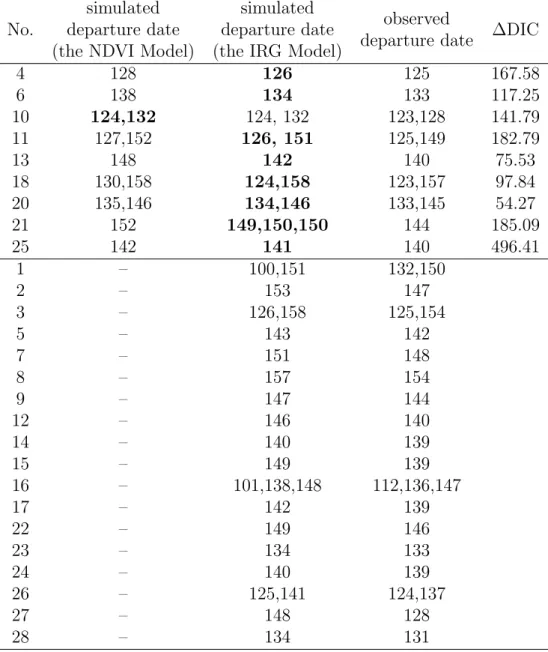
When fitting the IRG Model to the deer data, the MCMC algorithm converged for 27 of the 28 individuals, 413
whereas the NDVI Model only converged for 9. This gives some preliminary indication that the NDVI 414
model is not a good model for these data. In the 9 cases where both the NDVI and IRG Models led to 415
convergent MCMC results (e.g. No. 4, Table 1), the DIC was used to determine the better model. This 416
reveals that the NDVI Model is a better fit for one of the deer (No. 10) and the IRG Model for the other 417
eight (Table 1), confirming our preliminary indications. For those cases where MCMC chains converged, 418
we used the posterior mean of β of the best fit model to calculate the simulated departure dates of 419
migration, shown together with the real departure dates in Table 1. The estimated departure dates were 420
defined to be the dates when a switch of movement centre had occurred according to the RSF. The 421
observed departure dates were the dates when locations occurring outside a patch and towards another 422
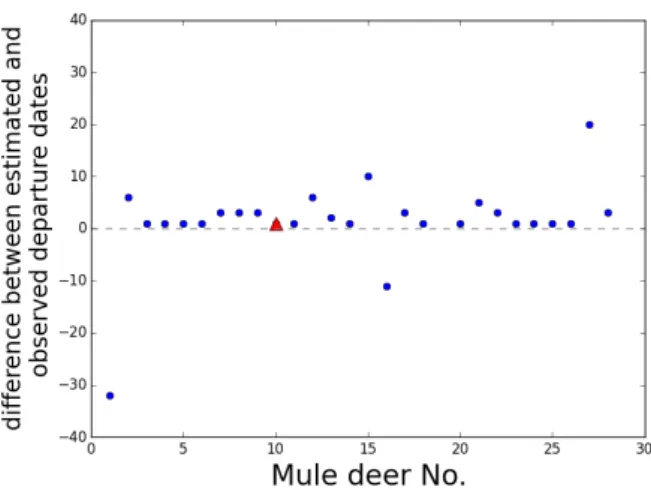
patch were first observed. The agreement was generally good, suggesting that, when a model can be 423
fitted to the data, the timing of migration can be explained by a simple trade-off between relative NDVI 424
or IRG values and the distance between successive patches, but usually IRG is a better measurement to 425
use (Figure 5). 426
However, for one individual (No. 21, Table 1), the inference procedure estimated that the individual 427
left a patch, and was attracted to it again for a very short time soon after migrating. This is probably 428
not a behavioural feature, though, since it was not observed in the data. Rather, this is likely to be a 429
quirk resulting from small up-and-down fluctuation in the IRG around the time of migration. 430
Figure 4a gives an example migratory path of an individual, which can be compared with the 431
simulated path from the best-fit model (Figure 4b). Supplementary Video SV1 shows an animation of 432
both these paths superimposed (red dots are the observed locations and blue are simulated). In the 433
best-fit model, the attraction centre changed fromµ1 toµ2on the 126th day of the year (Table 1). This
434
is very close to the actual date of departure from winter range observed from data and is marked by an 435
arrow in Figure 4c. Finally, the posterior distributions for this example are given in Figure 4d, where 436
we observe a significant difference between the posterior mean and zero for each parameter (p <10−5
). 437
4
Discussion
438
We have constructed models of resource selection in continuous time, based on a switching random walk 439
process, and parameterised using a Bayesian Monte Carlo algorithm. We have demonstrated that our 440
method can be applied in a wide range of scenarios, including both movements driven by the evaluation 441
of resources at the landscape scale, and those that simply follow local resource gradients. In broad terms, 442
our model animals first (a) assess location and quality of different resources (either proximately or across 443
the whole landscape), to decide the general direction of movement, then (b) move according to a process 444
that incorporates not only the resource-based decision, but also some stochasticity to account for any 445
unknown factors governing movement. Such stochastic continuous-time models allow us to make use 446
of well-developed, flexible inference procedures (Blackwellet al. (2016)). When applying our inference 447
No.
simulated
departure date
(the NDVI Model)
simulated
departure date
(the IRG Model)
observed
departure date
∆DIC
4
128
126
125
167.58
6
138
134
133
117.25
10
124,132
124, 132
123,128
141.79
11
127,152
126, 151
125,149
182.79
13
148
142
140
75.53
18
130,158
124,158
123,157
97.84
20
135,146
134,146
133,145
54.27
21
152
149,150,150
144
185.09
25
142
141
140
496.41
1
–
100,151
132,150
2
–
153
147
3
–
126,158
125,154
5
–
143
142
7
–
151
148
8
–
157
154
9
–
147
144
12
–
146
140
14
–
140
139
15
–
149
139
16
–
101,138,148
112,136,147
17
–
142
139
22
–
149
146
23
–
134
133
24
–
140
139
26
–
125,141
124,137
27
–
148
128
28
–
134
131
Table 1: The comparison of models for the mule deer data. For cases where the switch of
movement centre occurred on two days, the numbers for the Julian dates are separated
with a comma. Figures in bold indicate the model with smaller DIC value on that
individual.
algorithm to simulated data, where all the parameter values governing the movement are known, we 448
were able to estimate the input parameters, including those governing the trade-off between maximising 449
resource intake and minimising travel costs, with good accuracy. As such, our method can reliably 450
capture important aspects of the processes underlying movement decisions. 451
Our framework can be viewed as generalising ideas from several previous studies. The study of 452
Hankset al.(2015) developed a gradient following algorithm that allows for behavioural switches between 453
observed locations. This is similar to our gradient-following model, yet relies upon discretising the path 454
into presence or absence on pixels of a square lattice, whereas ours considers the full, continuous path. A 455
comparison of our method with that of Hankset al.(2015) on a path simulated from our model revealed 456
that in this case our method is more precise. However, this is not surprising, as we would expect a better 457
fit from a model that accurately mimics the true movement process. Employing the model in Hankset al. 458
(2015), Brennanet al.(2018) attempted better understanding of habitat preferences by considering the 459
impact of corridor choice on speed during migration, while we focus on the movement direction decided 460
by identifying the destination. Breedet al. (2017) gives a model of patch-to-patch movement, based on 461
a switching OU process, but where only the decision toleavea patch depends on environmental features. 462
Ours generalises this by modelling patch-to-patch movements as dependent on the source patch, the 463
target patch, and the distance between them. 464
In this study, we have examined gradient-following and patch selection models separately. In prin-465
ciple, it would be possible to combine these. One would begin by writing down a stochastic differential 466
equation that combines the processes in Equations (1) and (5) then derive from these the distribution of 467
movement across a short time-interval (similar to Equations 2 and 6). This distribution can then be fed 468
into the inference algorithm described in Section 2.2. Of course, such a model would be more complex 469
than those described here, so would likely require more running time and a good dataset to achieve 470
accurate inference. 471
We have focused on a few simple situations where the main factor in movement decisions is resource 472
quality. However, being based on a resource selection function (RSF), our framework has potential 473
to incorporate as wide a variety of movement covariates as in traditional resource- or step-selection 474
analysis. For example, topography (Potts et al. (2014c)), interactions between animals (Vanak et al. 475
(2013)), memory effects (Merkle et al. (2017)), barriers and corridors (Panzacchi et al. (2016)) have 476
all been incorporated into step-selection analysis and so could, in principle, be incorporated into our 477
modelling framework. 478
Classical step selection analysis tends to examine resource selection from one measured location to 479
the next (Thurfjell et al. (2014)). However, it has occasionally been used to measure patch-to-patch 480
movements (e.g. Merkleet al. (2014)) and this is similar in flavour to our patch-based models. On the 481
other hand, our raster-based models are more appropriate for studies where distinct patches are less 482
clear. In this case, it is often far less clear what spatio-temporal scales are being used by the animal 483
to make selection decisions. However, to use step selection analysis, one is forced either to make an 484
a priori choice of scale or perform a complicated model selection procedure (Bastille-Rousseau et al. 485
(2018)). Our approach has the advantage that the spatio-temporal scale of decision-making emerges 486
from the interface between the landscape and the movement processes, and is not tied to the frequency 487
of the location data. In addition, the flexibility of the switching random walk framework means that 488
our models have potential to include variation in behavioural modes in different parts of space (Harris & 489
Blackwell (2013)) or in different states such as encamped and exploratory states (Moraleset al.(2004)). 490
Indeed, the switching OU framework used here has recently been used to model state-switching 491
correlated random walks (Michelot & Blackwell (2019)). This makes use of the same code base as the 492
code used for inference here, so is ready to be combined with our models. Furthermore, although we 493
have developed our techniques for use with single animal tracks, there is ongoing work to incorporate 494
collective movement and animal interactions into the switching OU framework (Niuet al.(2016)), which 495
could be important for the study of mule deer (Sawyer et al., 2006). Therefore we intend for future 496
studies to factor group movement into continuous-time resource selection. 497
To demonstrate how our techniques can be applied to real data, we assessed the underlying mecha-498
nisms behind migration in mule deer. Our results support two hypotheses related to migration. First is 499
the Forage Maturation Hypothesis, which posits that as plants grow herbivores face a trade-off between 500
forage quality and quantity and therefore will select forage patches at intermediate stages of growth 501
(Fryxell (1991), Hebblewhiteet al.(2008)). Second is the Green Wave Hypothesis (Drentet al.(1978)), 502
which is the spatial manifestation of the Forage Maturation Hypothesis (Merkle et al. (2016)). The 503
Green Wave Hypothesis posits that animals migrate to acquire high-quality foods that are propagated 504
as resource waves in space and time. For migratory herbivores, resource waves often correspond to the 505
onset of spring along the migration route (Aikenset al.(2017)). The Green Wave Hypothesis has been 506
tested in a variety of species of both birds and mammals (van Wijket al. (2012), K¨olzschet al.(2015), 507
Merkleet al.(2016)). 508
We used a model where the animal trades-off the relative quality of resources at source and target 509
locations with the effort of moving from one to the other (using distance between patches as a proxy for 510
effort). We used two proxies for resource quality of a patch: NDVI and IRG. The former represents an 511
index of green forage biomass, and the latter represents an index of intermediate forage biomass (Bischof 512
et al.(2012)). Similar to the findings of Aikenset al.(2017) and Merkle et al.(2016) for mule deer, our 513
results suggest that the movements of most individual mule deer could be explained by IRG. The use 514
of growthrate(IRG), rather thanabsolutequality of biomass (NDVI) suggests that movement is caused 515
predominantly by theprocessof change, i.e. green-up. This is consistent with the idea of ‘surfing a green 516
wave’: tracking the places at which rate of change is greatest. Note that for one individual, however, 517
the model using NDVI did fit better (No. 10, Table 1). Nonetheless, the resulting best-fit models 518
tend to anticipate the migratory times well (Table 1, Figure 5), and simulated paths are qualitatively 519
similar to the real paths (Supplementary Video SV1). Therefore our method has potential to test various 520
hypotheses explaining migratory movement, and resource-driven movement in general. 521
In conclusion, we have developed a flexible framework for continuous-time inference of resource 522
selection decisions in moving animals. The switching random-walk model, combined with Bayesian 523
Monte Carlo inference, generalises several previous methods, and has potential to be extended to a wide 524
range of scenarios. Whilst the inference speed is sufficient for paths of several hundred data-points, it 525
may prove too slow with modern-era tracks that can contain millions (Hays et al.(2016)). Therefore a 526
significant future challenge would be to develop either methods for speeding-up inference significantly 527
(K´alm´an filters may be an appropriate technique here: e.g. Fleming et al. (2017)), or rarefying high-528
resolution data to extract key locations in the path that represent animal decisions (Pottset al.(2018)). 529
Indeed, the key limiting factor for speed is the number of MCMC samples required for convergence. 530
Better data, sampled at behaviourally-meaningful locations, may have a clearer signal thus requiring 531
less time for the MCMC procedure to converge, even if the datasets might be larger. In summary, 532
our framework represents an important methodological step in understanding resource-use decisions by 533
moving animals. 534
Acknowledgements
535
This work is supported in part by a scholarship provided by Ministry of Education of Taiwan (YW). 536
We thank Mu Niu and Th´eo Michelot for contributions to the code that we adapted in building our 537
inference procedure. Collection of the mule deer data was supported by the Wyoming Game and Fish 538
Department, the Nature Conservancy of Wyoming, and the Knobloch Family Foundation. We thank two 539
anonymous reviewers, an associate editor and the senior editor, Bob O’Hara, for comments that have 540
helped improve the manuscript. 541
Author Contributions
542
JRP, PGB conceived and designed the research; YW performed the research; JAM provided data; PGB 543
provided code for inference; YW, JRP led the writing of the manuscript. All authors contributed critically 544
to the drafts and gave final approval for publication. 545
Data Accessibility
546
Data used in this manuscript are archived on Data Dryad atdoi:10.5061/dryad.f9p3dq4. 547
References
548
1. 549
Aikens, E.O., Kauffman, M.J., Merkle, J.A., Dwinnell, S.P., Fralick, G.L. & Monteith, K.L. (2017). 550
The greenscape shapes surfing of resource waves in a large migratory herbivore. Ecol. Lett., 20, 551
741–750. 552
2. 553
Avgar, T., Lele, S.R., Keim, J.L. & Boyce, M.S. (2017). Relative Selection Strength: Quantifying 554
effect size in habitat- and step-selection inference. Ecol Evol, 7, 5322–5330. 555
3. 556
Avgar, T., Potts, J.R., Lewis, M.A. & Boyce, M.S. (2016). Integrated step selection analysis: bridging 557
the gap between resource selection and animal movement. Methods Ecol Evol, 7, 619–630. 558
4. 559
Bastille-Rousseau, G., Murray, D.L., Schaefer, J.A., Lewis, M.A., Mahoney, S.P. & Potts, J.R. (2018). 560
Spatial scales of habitat selection decisions: implications for telemetry-based movement modelling. 561
Ecography, 41, 437–443. 562
5. 563
Bastille-Rousseau, G., Potts, J.R., Schaefer, J.A., Lewis, M.A., Ellington, E., Rayl, N., Mahoney, 564
S. & Murray, D.L. (2015). Unveiling trade-offs in resource selection of migratory caribou using a 565
mechanistic movement model of availability. Ecography, 38, 1049–1059. 566
6. 567
Bischof, R., Loe, L.E., Meisingset, E.L., Zimmermann, B., Van Moorter, B. & Mysterud, A. (2012). 568
A migratory northern ungulate in the pursuit of spring: jumping or surfing the green wave? Am. 569
Nat., 180, 407–424. 570
7. 571
Blackwell, P.G. (1997). Random diffusion models for animal movement. Ecol Modell, 100, 87–102. 572
8. 573
Blackwell, P.G. (2003). Bayesian inference for Markov processes with diffusion and discrete compo-574
nents. Biometrika, 90, 613–627. 575
9. 576
Blackwell, P.G., Niu, M., Lambert, M.S. & LaPoint, S.D. (2016). Exact Bayesian inference for animal 577
movement in continuous time. Methods Ecol Evol, 7, 184–195. 578
10. 579
Boyce, M.S. (2006). Scale for resource selection functions. Diversity Distrib., 12, 269–276. 580
11. 581
Boyce, M.S., Vernier, P.R., Nielsen, S.E. & Schmiegelow, F.K. (2002). Evaluating resource selection 582
functions. Ecol Modell, 157, 281–300. 583
12. 584
Bracis, C. & Mueller, T. (2017). Memory, not just perception, plays an importnat role in terrestrial 585
mammalian migration. Proc. R. Soc. B, 284, 20170449. 586
13. 587
Breed, G.A., Golson, E.A. & Tinker, M.T. (2017). Predicting animal home-range structure and 588
transitions using a multistate Ornstein-Uhlenbeck biased random walk. Ecology, 98, 32–47. 589
14. 590
Brennan, A., Hanks, E.M., Merkle, J.A., Cole, E.K., Dewey, S.R., Courtemanch, A.B. & Cross, P.C. 591
(2018). Examining speed versus selection in connectivity models using elk migration as an example. 592
Landscape Ecol, 33, 955–968. 593
15. 594
Cagnacci, F., Boitani, L., Powell, R.A. & Boyce, M.S. (2010). Animal ecology meets GPS-based 595
radiotelemetry: a perfect storm of opportunities and challenges. Phil. Tran. R. Soc. B, 365, 2157– 596
2162. 597
16. 598
Chetkiewicz, C.L.B. & Boyce, M.S. (2009). Use of resource selection functions to identify conservation 599
corridors. J. Appl. Ecol., 46, 1036–1047. 600
17. 601
Drent, R., Ebbinge, B. & Weijand, B. (1978). Balancing the energy budgets of arctic-breeding geese 602
throughout the annual cycle: a progress report. Verh. Ornithol. Ges. Bayern., 23, 239–264. 603
18. 604
Fleming, C.H., Sheldon, D., Gurarie, E., Fagan, W.F., LaPoint, S. & Calabrese, J.M. (2017). K´alm´an 605
filters for continuous-time movement models. Ecol. Inform., 40, 8–21. 606
19. 607
Ford, R.G. (1983). Home range in a patchy environment: optimal foraging predictions.Integr. Comp. 608
Biol., 23, 315–326. 609
20. 610
Forester, J., Im, H. & Rathouz, P. (2009). Accounting for animal movement in estimation of resource 611
selection functions: sampling and data analysis. Ecology, 90, 3554–3565. 612
21. 613
Fortin, D., Beyer, H., Boyce, M.S., Smith, D., Duchesne, T. & Mao, J.S. (2005). Wolves influence elk 614
movements: behavior shapes a trophic cascade in Yellowstone National Park.Ecology, 86, 1320–1330. 615
22. 616
Fortin, D., Fryxell, J.M. & Pilote, R. (2002). The temporal scale of foraging decisions in bison.Ecology, 617
83, 970–982. 618
23. 619
Fryxell, J.M. (1991). Forage quality and aggregation by large herbivores. Am. Nat., 138, 478–498. 620
24. 621
Hanks, E.M., Hooten, M.B. & Alldredge, M.W. (2015). Continuous-time discrete-space models for 622
animal movement. Ann. Appl. Stat., 9, 145–165. 623
25. 624
Hanks, E.M., Hooten, M.B., Johnson, D.S. & Sterling, J.T. (2011). Velocity-based movement modeling 625
for individual and population level inference. PLOS ONE, 6, e22795. 626
26. 627
Harris, K.J. & Blackwell, P.G. (2013). Flexible continuous-time modelling for heterogeneous animal 628
movement. Ecol Modell, 255, 29–37. 629
27. 630
Hays, G., Ferreira, L., Sequeira, A., Meekan, M., Duarte, C., Bailey, H., Bailleul, F., Bowen, W., 631
Caley, M. & Costa, D. (2016). Key questions in marine megafauna movement ecology. Trends Ecol. 632
Evol., 31, 463–475. 633
28. 634
Hebblewhite, M., Merrill, E. & McDermid, G. (2008). A multi-scale test of the forage maturation 635
hypothesis in a partially migratory ungulate population. Ecol. Monogr., 78, 141–166. 636
29. 637
Hooten, M.B., Johnson, D.S., Hanks, E.M. & Lowry, J.H. (2010). Agent-based inference for animal 638
movement and selection. J Agric Biol Environ Stat, 15, 523–538. 639
30. 640
Illius, A.W., Duncan, P., Richard, C. & Mesochina, P. (2002). Mechanisms of functional response and 641
resource exploitation in browsing roe deer. J. Anim. Ecol., 71, 723–734. 642
31. 643
Johnson, D.S., Thomas, D.L., Ver Hoef, J.M. & Christ, A. (2008). A general framework for the 644
analysis of animal resource selection from telemtry data. Biometrics, 64, 968–976. 645
32. 646
K¨olzsch, A., Bauer, S., Boer, R., Griffin, L., Cabot, D., Exo, K.M., van der Jeugd, H.P. & Nolet, 647
B.A. (2015). Forecasting spring from afar? Timing of migration and predictability of phenology along 648
different migration routes of an avian herbivore. J. Anim. Ecol., 84, 272–283. 649
33. 650
Lendrum, P.E., Anderson Jr., C.R., Long, R.A., Kie, J.G. & Bowyer, R.T. (2012). Habitat selection 651
by mule deer during migration: effects of landscape structure and natural-gas development.Ecosphere, 652
3, 82. 653
34. 654
Manly, B., McDonald, L., Thomas, D., McDonald, T. & Erickson, W. (2002). Resource selection by 655
animals: statistical analysis and design for field studies. 2nd edn. Springer Netherlands. 656
35. 657
McClintock, B.T., Johnson, D.S., Hooten, M.B., Ver Hoef, J.M. & Morales, J.M. (2014). When to be 658
discrete: the importance of time formulation in understanding animal movement. Movement Ecol, 2. 659
36. 660
McLoughlin, P.D., Morris, D.W., Fortin, D., Vander Wal, E. & Contasti, A.L. (2010). Considering 661
ecological dynamics in resource selection functions. J. Anim. Ecol., 79, 4–12. 662
37. 663
Merkle, J.A., Cross, P., Scurlock, B.M., Cole, E., Courtemanch, A., Dewey, S. & Kauffman, M.J. 664
(2018). Linking spring phenology with mechanistic models of host movement to predict disease trans-665
mission risk. J. Appl. Ecol., 55, 810–819. 666
38. 667
Merkle, J.A., Fortin, D. & Morales, J.M. (2014). A memory-based foraging tactic reveals an adaptive 668
mechanism for restricted space use. Ecol Lett, 17, 924–931. 669
39. 670
Merkle, J.A., Monteith, K.L., Aikens, E.O., Hayes, M.M., Hersey, K.R., Middleton, A.D., Oates, B.A., 671
Sawyer, H., Scurlock, B.M. & Kauffman, M.J. (2016). Large herbivores surf waves of green-up during 672
spring. Proc. R. Soc. B, 283, 20160456. 673
40. 674
Merkle, J.A., Potts, J.R. & Fortin, D. (2017). Energy benefits and emergent space use patterns of an 675
empirically parameterized model of memory-based patch selection. Oikos, 126. 676
41. 677
Michelot, T. & Blackwell, P.G. (2019). State-switching continuous-time correlated random walks. 678
Methods in Ecology and Evolution. 679
42. 680
Michelot, T., Blackwell, P.G. & Matthiopoulos, J. (2018). Linking resource selection and step selection 681
models for habitat preferences in animals. Ecology. Accepted Author Manuscript. 682
43. 683
Mitchell, M.S. & Powell, R.A. (2004). A mechanistic home range model for optimal use of spatially 684
distributed resources. Ecol. Modell., 177, 209–232. 685
44. 686
Mitchell, M.S. & Powell, R.A. (2007). Optimal use of resources structures home ranges and spatial 687
distribution of black bears. Anim. Behav., 74, 219–230. 688
45. 689
Moorcroft, P. & Barnett, A. (2008). Mechanistic home range models and resource selection analysis: 690
a reconciliation and unification. Ecology, 89, 1112–1119. 691
46. 692
Morales, J.M., Haydon, D.T., Frair, J., Holsinger, K.E. & Fryxell, J.M. (2004). Extracting more out 693
of relocation data: building movement models as mixtures of random walks. Ecology, 85, 2436–2445. 694
47. 695
Niu, M., Blackwell, P.G. & Skarin, A. (2016). Modeling interdependent animal movement in continuous 696
time. Biometrics, 72, 315–324. 697