Social Network Analysis Based on BSP Clustering Algorithm
Gong Yu
School of Business Administration China University of Petroleum
ABSTRACT
Social network analysis is a new research field in data mining. The clustering in social network analysis is different from traditional clustering. It requires grouping objects into classes based on their links as well as their attributes. While traditional clustering algorithms group objects only based on objects’ similarity, and it can't be applied to social network analysis. So on the basis of BSP (business system planning) clustering algorithm, a social network clustering analysis algorithm is proposed. The proposed algorithm, different from traditional clustering algorithms, can group objects in a social network into different classes based on their links and identify relation among classes.
INTRODUCTION
Social network analysis, which can be applied to analysis of the structure and the property of personal relationship, web page links, and the spread of messages, is a research field in sociology. Recently social network analysis has attracted increasing attention in the data mining research community. From the viewpoint of data mining, a social network is a heterogeneous and multi-relational dataset represented by graph (Han & Kamber, 2006).
Research on social network analysis in the data mining community includes following areas: clustering analysis (Bhattacharya & Getoor, 2005; Kubica, Moore and Schneider, 2003), classification (Lu & Getoor, 2003), link prediction (Liben-Nowell & Kleinberg, 2003; Krebs, 2002). Other achievements include PageRank (Page, Brin, Motwani and Winograd, 1998) and Hub-Authority (Kleinberg, 1999) in web search engine.
In this paper, clustering analysis of social network is studied. In the second section, a social network clustering algorithm is proposed based on BSP clustering algorithm. The algorithm can group objects in a social network into different classes based on their links, and it can also identify the relations among classes. In the third section, an example of social network clustering algorithm is presented, and then the conclusion and the future work direction are given.
SOCIAL NETWORK ANALYSIS BASED ON BSP CLUSTERING
There has been extensive research work on clustering in data mining. Traditional clustering algorithms (Han & Kamber, 2006) divide objects into classes based on their similarity. Objects in a class are similar to each other and are very dissimilar from objects in different classes.
Social network clustering analysis, which is different from traditional clustering problem, divides objects into classes based on their links as well as their attributes. The biggest challenge of social network clustering analysis is how to divide objects into classes based on objects’ links, thus we need find algorithms that can meet this challenge. The BSP (business system planning) clustering algorithm (Gao, Wu and Yu, 2002) is proposed by IBM. It designed to define information architecture for the firm in business system planning. This algorithm analyses business process and their data classes, cluster business process into sub-systems, and define the relationship of these sub-systems. Basically BSP clustering algorithm uses objects(business processes)and links among objects(data classes)to make clustering analysis. Similarly social network also includes objects and links among these objects. In view of the same pre-condition, the BSP clustering algorithm can be used in social network clustering analysis.
According to graph theory, social network is a directed graph composed by objects and their relationship. Figure 1 shows a sample of social network, the circle in the figure represents an object; the line with arrow is an edge of the graph, and it represents directed link between two objects, so a social network is a directed graph.
Figure 1: A sample of social network.
In figure 1, Let
O
ibe an object in social network (i
=
1
...
m
), letE
j which means directed link between twoobjects, be a directed edge of the graph (
j
=
1
...
n
).After definition of objects and directed edges, we can also define reachable relation between two objects. There are two kinds of reachable relation among objects, shown as following:
1) One-step reachable relation: if there has directed link from
O
itoO
jthrough one and only one directed edge, thenO
itoO
jis a one-step reachable relation. For instance in figure 1 there has a directed link from1
O
toO
2through the directed edgeE
1,O
1toO
2is one-step reachable relation.2) Multi-steps reachable relation: if there has directed link from
O
itoO
jthrough two or more directededges, then
O
i toO
j is a multi-steps reachable relation. For instance in figure 1 has a directed link from1
O
toO
4through directed edgesE
1andE
5, thenO
1toO
4is a 2-steps reachable relation.After these definitions, we can use BSP clustering algorithm to analyses a social network. The analysis processes are as following steps:
Generate edge creation matrix and edge pointed matrix
First according to the objects and edges in the graph, define two matrix
L
candL
p.Let
L
cbe am
×
n
matrix which means the creation of edges. In the matrix,L
c(
i
,
j
)
=1 denotes objectO
iconnects with the tail of edgeE
j, which means that objectO
icreates the directed edgeE
j.L
c(
i
,
j
)
=0 denotesO
idoesn’t connect with the tail of edgeE
j, which meansE
jisn’t created by objectO
i.For example in figure 1 object
O
1connects with the tail ofE
1, then it meansO
1createsE
1, soL
c(
1
,
1
)
=
1
;O
doesn’t connect with the tail of edgeE
, then it meansE
is not created byO
, soL
(
1
,
2
)
=
0
.O1
O3
O6
O5
O2
O4
E1
E2
E3
E4
E5
E6
E7
E8
E9
E10
Let
L
p be am
×
n
matrix which means the pointed relations of edges. In the matrix,L
p(
i
,
j
)
=1 denotesobject
O
iconnects with the head of edgeE
j , which means objectO
i is pointed to by the directed edgeE
j.)
,
(
i
j
L
p =0 denotesO
idoesn’t connect with the head of edgeE
j, which meansE
jdoesn’t point toO
i.For example in figure 1 object
O
2 connects with the head ofE
1, which meansO
2 is pointed to byE
1,so
L
p(
2
,
1
)
=
1
. ButO
2doesn’t connect with the head of edgeE
2 , then it meansE
2 doesn’t point toO
2, soL
p(
2
,
2
)
=
0
.Calculate one-step reachable matrix between objects
After the definition of
L
candL
p, we can calculate one-step reachable matrix between objects through the followingequation.
⎟
⎠
⎞
⎜
⎝
⎛
=
∧
=
=
=
•
=
∨
=m
j
m
i
j
k
l
k
i
l
g
L
L
G
c Tp n k j i T p c(
(
,
)
(
,
)),
1
,...,
,
1
,...,
1 , (1)
∧
is Boolean product,∨
is Boolean sum.
G
(
i
,
j
)
=
1
meansO
itoO
jis a one-step reachable relation,G
(
i
,
j
)
=
0
means there hasn’t a one-step reachable relation fromO
itoO
j. ThroughG
, we can calculate all one-step reachable relation between objects.Calculate multi-steps reachable matrix between objects
Besides one-step reachable relation, there are multi-steps reachable relations between objects too. We also need calculate multi-steps reachable matrices (2-steps, 3-steps, …, m-1-steps).
According to graph theory and the BSP clustering algorithm, we can calculate multi-steps reachable matrix
G
2,
G
3,
G
4,...,
G
m−1. Following equations show the calculation of multi-steps reachable matrix:G
G
G
2=
•
=⎟
⎠
⎞
⎜
⎝
⎛
=
∧
=
=
∨
=g
i
k
g
k
j
i
m
j
m
g
m k j i(
(
,
)
(
,
)),
1
,...,
,
1
,...,
1 , 2 (2)G
G
G
3=
2•
G
G
G
4=
3•
……G
G
G
m−1=
m−2•
These matrices include 2-steps, 3-steps… m-1-steps reachable relations between objects. Now we can know n-steps reachable relation between two objects through
G
2,
G
3,
G
4,...,
G
m−1.Calculate reachable matrix
Because we only consider whether reachable relations exist between two objects, but do not care these relations are one-step or multi-steps, so we need calculate reachable matrix
R
based onG
,
G
2,
G
3,
G
4,...,
G
m−1 . The calculation ofR
is shown as following equation:1 2
...
∨
−∨
∨
=
mG
G
G
I
R
(3)∨
is Boolean sum,I
is unit matrix.1
)
,
(
i
j
=
R
means reachable relation exists fromO
itoO
j, but the reachable relations existing in matrixR
is notmutual, for instance
R
(
i
,
j
)
=
1
means reachable relation exists fromO
itoO
j,but it doesn’t means reachable relation exists fromO
jtoO
i. Mutual reachable relations between two objects are important in a social network, sowe need calculate mutual reachable matrix based on
R
.Calculate mutual reachable matrix and generate clusters
The mutual reachable matrix can be calculated through following calculate equation.
T
R
R
Q
=
∧
(4)∧
means Boolean productIn the matrix
Q
(
i
,
j
)
=
1
means there are mutual reachable relation betweenO
iandO
j. In a social network if twoobjects that have mutual reachable relation, they should belong to the same class, thus we can cluster based on
Q
.Thus according to mutual reachable matrix
Q
, we can divide a social network into classes based on strong sub-matrices inQ
or adjustedQ
. While strong sub-matrix is defined as follows.Strong sub-matrix: if all elements in a sub-matrix of
Q
are 1, this sub matrix is strong sub-matrix.Identify relationships among classes
After clustering of social network, we also need identify relationship among clusters. This can be done through generated clusters and one-step reachable matrix
G
. If there is one-step reachable relation between two objects in different classes, we can say directed links exist between classes. ThroughG
we can identify all relations among classes.After pervious 6 steps, we can divide a social network into classes. Social network clustering analysis algorithm can be given:
Input:
L
c: Edge creation Matrixp
L
: Edge pointed matrixBegin T u c
L
L
G
=
•
for k=3 to m doG
k−1=G
k−2•
G
1 2...
∨
−∨
∨
=
mG
G
G
I
R
TR
R
Q
=
∧
kC
Q
−
>
(C
k,Q
)->Relation (C
k) Endk
C
Q
−
>
means generating clusters through mutual reachable matrixQ
, and (C
k,Q
)->Relation(C
k) meansidentifying relationships among clusters base on clusters and one-step reachable matrix
G
.EXAMPLE
Now an example is given to show process of the cluster analysis of social network. Suppose a social network as figure 1 shows. According to the figure, we can give the edge creation matrix
L
c and edge pointed matrixL
pas following.⎟
⎟
⎟
⎟
⎟
⎟
⎟
⎟
⎠
⎞
⎜
⎜
⎜
⎜
⎜
⎜
⎜
⎜
⎝
⎛
=
1
0
0
0
0
0
0
0
0
0
0
0
1
0
0
0
0
0
0
0
0
1
0
1
0
0
0
0
0
0
0
0
0
0
1
0
1
0
0
0
0
0
0
0
0
1
0
0
1
0
0
0
0
0
0
0
0
1
0
1
cL
⎟
⎟
⎟
⎟
⎟
⎟
⎟
⎟
⎠
⎞
⎜
⎜
⎜
⎜
⎜
⎜
⎜
⎜
⎝
⎛
=
0
1
0
0
0
0
0
0
0
0
0
0
0
1
0
0
0
0
0
0
1
0
1
0
1
1
0
0
0
0
0
0
0
0
0
0
0
1
0
0
0
0
0
0
0
0
0
0
0
1
0
0
0
0
0
0
1
0
1
0
pL
According to the social network clustering algorithm,
L
candL
p, clustering the social network show as following steps:Calculate one-step reachable matrix between objects
⎟ ⎟ ⎟ ⎟ ⎟ ⎟ ⎟ ⎟ ⎠ ⎞ ⎜ ⎜ ⎜ ⎜ ⎜ ⎜ ⎜ ⎜ ⎝ ⎛ = ⎟ ⎟ ⎟ ⎟ ⎟ ⎟ ⎟ ⎟ ⎠ ⎞ ⎜ ⎜ ⎜ ⎜ ⎜ ⎜ ⎜ ⎜ ⎝ ⎛ • ⎟ ⎟ ⎟ ⎟ ⎟ ⎟ ⎟ ⎟ ⎠ ⎞ ⎜ ⎜ ⎜ ⎜ ⎜ ⎜ ⎜ ⎜ ⎝ ⎛ = 0 0 1 0 0 0 0 0 1 0 0 0 1 1 0 0 0 0 0 0 1 0 0 1 0 0 1 0 0 1 0 0 0 1 1 0 0 1 0 0 0 0 0 0 0 0 0 0 0 1 0 0 0 0 0 0 1 0 1 0 1 1 0 0 0 0 0 0 0 0 0 0 0 1 0 0 0 0 0 0 0 0 0 0 0 1 0 0 0 0 0 0 1 0 1 0 1 0 0 0 0 0 0 0 0 0 0 0 1 0 0 0 0 0 0 0 0 1 0 1 0 0 0 0 0 0 0 0 0 0 1 0 1 0 0 0 0 0 0 0 0 1 0 0 1 0 0 0 0 0 0 0 0 1 0 1 T G
Calculate multi-steps reachable matrix between objects
⎟ ⎟ ⎟ ⎟ ⎟ ⎟ ⎟ ⎟ ⎠ ⎞ ⎜ ⎜ ⎜ ⎜ ⎜ ⎜ ⎜ ⎜ ⎝ ⎛ = • = 1 1 0 0 0 0 1 1 0 0 0 0 0 0 1 0 0 0 1 1 0 1 1 0 1 1 0 1 1 0 0 0 1 0 0 1 2 G G G ⎟ ⎟ ⎟ ⎟ ⎟ ⎟ ⎟ ⎟ ⎠ ⎞ ⎜ ⎜ ⎜ ⎜ ⎜ ⎜ ⎜ ⎜ ⎝ ⎛ = • = 0 0 1 0 0 0 0 0 1 0 0 0 1 1 0 0 0 0 0 0 1 0 0 1 0 0 1 0 0 1 1 1 0 1 1 0 2 3 G G G ⎟ ⎟ ⎟ ⎟ ⎟ ⎟ ⎟ ⎟ ⎠ ⎞ ⎜ ⎜ ⎜ ⎜ ⎜ ⎜ ⎜ ⎜ ⎝ ⎛ = • = 1 1 0 0 0 0 1 1 0 0 0 0 0 0 1 0 0 0 1 1 0 1 1 0 1 1 0 1 1 0 0 0 1 0 0 1 3 4 G G G ⎟ ⎟ ⎟ ⎟ ⎟ ⎟ ⎟ ⎟ ⎠ ⎞ ⎜ ⎜ ⎜ ⎜ ⎜ ⎜ ⎜ ⎜ ⎝ ⎛ = • = 0 0 1 0 0 0 0 0 1 0 0 0 1 1 0 0 0 0 0 0 1 0 0 1 0 0 1 0 0 1 1 1 0 1 1 0 4 5 G G G
Calculate reachable matrix based on one-step and multi-steps reachable matrix 5 2
...
G
G
G
I
R
=
∨
∨
∨
=⎟
⎟
⎟
⎟
⎟
⎟
⎟
⎟
⎠
⎞
⎜
⎜
⎜
⎜
⎜
⎜
⎜
⎜
⎝
⎛
1
1
1
0
0
0
1
1
1
0
0
0
1
1
1
0
0
0
1
1
1
0
0
0
1
1
1
1
1
1
1
1
1
1
1
1
Calculate mutual reachable matrix , generate clusters
T
R
R
Q
=
∧
⎟
⎟
⎟
⎟
⎟
⎟
⎟
⎟
⎠
⎞
⎜
⎜
⎜
⎜
⎜
⎜
⎜
⎜
⎝
⎛
∧
⎟
⎟
⎟
⎟
⎟
⎟
⎟
⎟
⎠
⎞
⎜
⎜
⎜
⎜
⎜
⎜
⎜
⎜
⎝
⎛
=
1
1
1
1
1
1
1
1
1
1
1
1
1
1
1
1
1
1
0
0
0
1
1
1
0
0
0
1
1
1
0
0
0
1
1
1
1
1
1
0
0
0
1
1
1
0
0
0
1
1
1
0
0
0
1
1
1
0
0
0
1
1
1
1
1
1
1
1
1
1
1
1
⎟
⎟
⎟
⎟
⎟
⎟
⎟
⎟
⎠
⎞
⎜
⎜
⎜
⎜
⎜
⎜
⎜
⎜
⎝
⎛
=
1
1
1
0
0
0
1
1
1
0
0
0
1
1
1
0
0
0
0
0
0
1
1
1
0
0
0
1
1
1
0
0
0
1
1
1
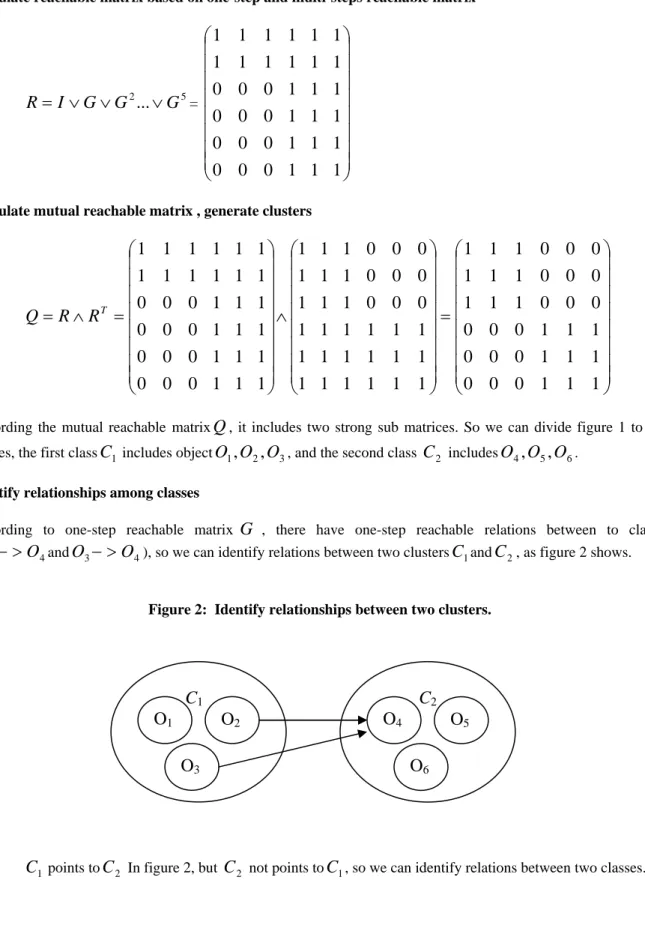
According the mutual reachable matrix
Q
, it includes two strong sub matrices. So we can divide figure 1 to two classes, the first classC
1 includes objectO
1,
O
2,
O
3, and the second classC
2 includesO
4,
O
5,
O
6.Identify relationships among classes
According to one-step reachable matrix
G
, there have one-step reachable relations between to classes (O
2−
>
O
4andO
3−
>
O
4), so we can identify relations between two clustersC
1andC
2, as figure 2 shows.Figure 2: Identify relationships between two clusters.
1
C
points toC
2 In figure 2, butC
2 not points toC
1, so we can identify relations between two classes.C
1O
1O
2O
3C
2O
4O
5O
6CONCLUSION
In this paper based on BSP clustering algorithm, an algorithm of social network clustering analysis is proposed. It divides a social network into different classes according to objects in the social network and links between objects, and it also can identify relations among clusters.
Main disadvantage of this algorithm is that it uses matrices to store edges and reachable relations, in a real social network these matrices will be very huge, can’t load into main memory. But because these matrices are very sparse, so we can design an efficient data structure to overcome this shortcoming.
Also in our algorithm the edges between objects have same weight, however in real world such edges may have different weights. Meanwhile the property of each cluster has not been analyzed. these will be solved in our future research.
REFERENCES
Bhattacharya I, Getoor L.(2004). Iterative Record Linkage for Cleaning and Integration. Proceeding SIGMOD 2004 workshop on research issues on data mining and knowledge discovery, Paris, France,11-18.
Gao X, Wu S, Yu B. (2002). Management Information System. Beijing: Economy and Management Press (in Chinese).
Han J, Kamber M. (2006). Data Mining: Concepts and Techniques 2nd edition. San Francisco: The Morgan Kaufmann Publishers.
Kleinberg J. ( 1999). Authoritative sources in a hyperlinked environment. Journal of the ACM, 5,604–632. Krebs V. (2002). Mapping networks of terrorist cells. Connections,24,43-52.
Kubica J, Moore A, Schneider J. (2003). Tractable Group Detection on Large Link Data Sets. Proceeding 3rd IEEE international conference on data mining, Melbourne, FL,573-576.
Liben-Nowell D, Kleinberg J. (2003). The Link prediction problem for social networks. Proceeding 2003 international conference on information and knowledge management, New Orleans, LA,556-559.
Lu Q, Getoor L. Link-based classification. (2003). Proceeding 2003 international conference on machine learning, Washington DC, 496-503.
Page L, Brin S, Motwani R, Winograd T. (1998). The PageRank citation ranking: Bring order to the web. Technical report, Stanford University.