Este documento está disponible para su consulta y descarga en Memoria Académica, el repositorio institucional de la Facultad de Humanidades y Ciencias de la Educación de la Universidad Nacional de La Plata, que procura la reunión, el registro, la difusión y la preservación de la producción científico-académica édita e inédita de los miembros de su comunidad académica. Para más información, visite el sitio
www.memoria.fahce.unlp.edu.ar
Esta iniciativa está a cargo de BIBHUMA, la Biblioteca de la Facultad, que lleva adelante las tareas de gestión y coordinación para la concre-ción de los objetivos planteados. Para más informaconcre-ción, visite el sitio www.bibhuma.fahce.unlp.edu.ar
Licenciamiento
Esta obra está bajo una licencia Atribución-No comercial-Sin obras derivadas 2.5 Argentina de Creative Commons.
Para ver una copia breve de esta licencia, visite
http://creativecommons.org/licenses/by-nc-nd/2.5/ar/.
Para ver la licencia completa en código legal, visite
http://creativecommons.org/licenses/by-nc-nd/2.5/ar/legalcode.
2012, vol. 12
Orientación y Sociedad
Cita sugerida
Hiebert, B. (2012) A framework for demonstrating the value of human services [En línea] Orientación y Sociedad, 12. Disponible en Memoria Académica:
http://www.memoria.fahce.unlp.edu.ar/art_revistas/pr.5552/pr.5552.pdf
A framework for
demonstrating the value of
human services
A FRAMEWORK FOR DEMONSTRATING THE VALUE OF HUMAN SERVICES
Bryan Hiebert *
Abstract
Practitioners and agency managers agree that evaluation is important. However, counsellors seldom evaluate their work with clients in a way that permits making a causal link between the services clients receive and that changes they experience. A framework has been developed for evaluating changes in client knowledge, skills, attitudes, and beliefs and assessing the impact of those changes on the client’s life and on the broader society in which the client lives. The framework also includes a system for tracking the interventions used with a client and the resources needed to successfully implement those interventions. The framework has been used in a variety of counselling situations, educational settings, and guidance initiatives, to provide evidence that there services clients receive are having an impact on the clients life.
Key Words: Evaluation, Evaluating counselling, Prove it works, Demonstrating value.
Two trends that are becoming increasingly more prominent in all human services settings (e.g., mental health, school guidance, career services, health services) are outcome-focused interventions and evidence-based practice. The foundational goal in outcome-focused interventions centers around demonstrating how clients (students, learners, etc.) change as a result of the interventions (programs, instruction, etc.) they receive. The foundational goal in evidence-based practice it so be better able to address
*
Professor Emeritus, Faculty of Education, University of Calgary, Canada. E-mail: Bryan Hiebert [email protected]
concerns about what sorts of interventions, delivered under what circumstances, work best with what kinds of people, striving to achieve what sorts of goals. When these two trends are addressed adequately, it is possible for practitioners (teachers, counsellors, youth workers, career advisors, etc.) to provide convincing evidence that links learner (client) change to the program (intervention) in which they participated. (See Baudouin, et al., 2007.)
Even though these two trends are prominent in professional organizations (Dozois, 2011) and emphasized from funders (HRSDC, 2011), generally speaking, counsellors do not evaluate their work with clients. For example, a survey of almost 1,000 practitioners working in the career and employment field (Conger, Hiebert, & Hong-Farrell, 1993) indicated that 40% of respondents admitted to never evaluating their work with clients, and 35% of the remainder indicated that they evaluated their effectiveness during the client interview (presumable by asking the client if they found the session helpful). In a more recent survey of evaluation practices (Lalande & Magnusson, 2007) one third of the respondents did not answer the question regarding how they evaluated their work with clients, and while 35% indicated that they did collect client data, the data pertained to things like client flow, types of client problems, counsellor time use, etc., data that do not address how much clients changed as a result of the services they received. These two studies paint a picture of evaluation practices in Canada, however conversations with at international conferences suggest that the situation is similar in many other countries.
To gather evidence that addresses both evidence-based practice concerns and outcome-focused intervention, the Canadian Research Working Group on Evidence-Based Practice in Career Development (CRWG) has adopted a variation on a simple
described briefly below. The framework has been used extensively to evaluate career development interventions, but it also is appropriate in other types of counselling settings, mental health settings, physical health settings, other human services settings, and educational settings (Hiebert & Charles, 2008; Hiebert, Domene, & Buchanan, 2011). For ease of reading in this paper, I have used the term client when referring to people who are receiving services, but I could also have used terms like: learner, student, or patient. In a similar vein, I have used the term practitioner to refer to people who are providing services, but I could also have used terms like, counsellor, teacher, youth worker, career advisor, nurse, or physician. Thus, although I have used the terms client and practitioner, I encourage readers to substitute the appropriate terms for the settings in which they are working.
The framework that the CRWG has developed centers around the needs and goals of clients. In planning an appropriate intervention, it is important to examine the context in which clients live. This includes factors such as: ethnicity, culture, significant others, structure of opportunity, past learning history, previous history of working on the situation under examination, etc. A client’s context can have limiting or facilitating influences on the types of interventions that are possible, on the success of any intervention undertaken, and also on what outcome expectations are reasonable. In the process of examining client context, it usually is possible to identify the types of
needs a client would like to see addressed and to set explicit goals that a practitioner and client will work on together. The approach to intervention and evaluation is based on practitioners and clients working together in a collaborative relationship where goals, outcome expectations, and indicators of success are negotiated and mutually agreed on by practitioners and clients, and where appropriate by third party stakeholders. Once the goals are set, planning the intervention (How will we accomplish the goals?) and the evaluation (How will we tell that the goals have been accomplished?) can begin.
Constructing an intervention plan and an evaluation plan begins by identifying the types of changes that a client will (hopefully) experience as a result of the intervention, and developing a method for documenting that the changes have taken place (i.e., the indicators of change). Going on a road trip provides a useful metaphor. The journey begins by identifying a destination. Once the destination is clear, then the route can be planned. Sometimes, people enjoy just going for a drive in the country with no particular destination in mind. In those cases, enjoying the process is the main goal. However, if the travellers want to end up at a specific place, then it is important to have agreement on what is the end point before beginning the journey. Thus, the starting point in planning client change interventions is to get clarity on the outcomes being sought and the indicators of success that will be used to gauge progress towards the ultimate goal.
Outcomes
An outcome is the specific result of an intervention, including changes in client competence (knowledge and skills), changes in client personal attributes (e.g., optimism, confidence, etc.), changes in client situation, and/or broader changes for the client (e.g., employment status, health status, etc.) and/or community (e.g., less violence, higher quality of life, etc.). These broader outcomes usually can be thought of
as the impact of the changes in client competence or changes in client personal attributes. The changes in client knowledge and skill (learning outcomes) should be described in a way that permits them to be linked directly to the intervention being used. The personal attribute outcomes usually are not addressed directly in an intervention, however they usually are likely by-products that accompany the knowledge clients acquire or the skills clients attain. For example, as a result of learning more effective job search skills, clients become more optimistic about being able to manage their career futures, a finding born out by recent research (Hiebert, et al., 2012). The ultimate end goal of an intervention most often involves some sort of change in a client’s life or in some broader societal context (impact outcomes). For example, clients might learn about the role that deep relaxation can play in helping people reduce stress (knowledge) and with practice might learn how to place their body in a state of deep relaxation (skill). Using the knowledge and practicing the skill likely will result in the client being less stressed (personal attribute), which in turn might result in fewer headaches (impact), or fewer interpersonal hassles (impact), or fewer absences from work (impact). Similarly, a client attending an anger management workshop might acquire knowledge and skill regarding anger management and as a result might feel less angry and less irritable, and as a result might experience fewer family anger outbursts, or less spousal abuse, or fewer arguments with co-workers.
Self-assessments of learner outcomes. My colleagues and I on the CRWG (see http://www.crwg-gdrc.ca) have been working on a way to assess changes in learner competencies (knowledge, skills, and personal attributes) that has high validity and reliability and is closely matched to the stated outcomes of an intervention. One of the problems with a traditional pre-post approach to measuring client change is that people don’t know what they don’t know. To illustrate, people taking a workshop on
interpersonal communication might be asked to rate their communication skills at the beginning and end of the workshop. At the beginning many people think that their communication skills are reasonably good and they rate themselves quite high. During the workshop, as they get to know more about what constitutes good communication, they realize that their knowledge about interpersonal communication, as well as their skills for communicating effectively, are not as good as they initially thought. At the end of the workshop, when they are asked to rate themselves again, the ratings often are lower than they were at the beginning, even though they have learned a lot and have acquired more adequate levels of skills. This is because their measuring stick has changed as they developed greater knowledge about interpersonal communication. Thus the post-test scores end up being lower than the pre-test scores, even though positive change has occurred (see Hiebert, 2012; Posavac, 2011; Robinson & Doueck, 1994).
One way to address this problem is through a form of retrospective assessment,
which we have called Post-Pre Assessment. The procedure is described in detail
elsewhere (Hiebert, 2012), and so will be only summarized briefly below. The Post-Pre
Assessment process creates a consistent measuring stick for both pre and post
assessments. This process is used ONLY at the end of a workshop. When a workshop
is finished, participants are asked to use their current frame of reference to create a common measuring stick for assessing their competence before and after the workshop. For example, in the SAME workshops designed to prepare students for their roles as mentors, at the end of a workshop we ask them: “Regarding the workshop you have just
participated in, and knowing what you know now about talking with other students
about racism and diversity, how would you rate your readiness to be a Student Mentor
done only at the end of the workshop (hence the name “post-pre assessment), but it asks people to self-assess their competencies before and after their participation in the workshop, using the same measuring stick, i.e., “Knowing what you know now about talking with other students about racism and diversity …”
For the actual self-assessments, we use a variation on a 5-point Likert scale, which we refer to as a Decision-Making Approach (rather than a judgement-making approach). We ask participants to first of all decide if their knowledge, or skill, or personal attributes are OK or Not OK (Acceptable or Not Acceptable, Adequate or Not Adequate, Sufficient or Insufficient, etc.). Then once they have decided which side of the fence they are on, we ask them to assign a rating, 0=not adequate, 1=not really adequate but almost OK, 2=adequate but just barely, 4=exceptional, or 3=somewhere between minimally OK and exceptional. The order in the previous sentence is deliberate, rather than ask people to rate acceptable as 2 or 3 or 4, we ask them if the performance is barely OK (2), exceptional (4), or somewhere in between the two (not barely OK but not yet exceptional=3). Through trial and error, we have found a high degree of inter-rater reliability and also intra-rater reliability when using this approach. The high validity comes from indexing the survey items to the stated learner outcomes for the workshop.
Outcomes and outputs. In the work of the CRWG, we distinguish between outcomes and outputs. We reserve the term outcome to refer to changes that clients experience. We use the term outputs to refer to the products or artefacts produced during an intervention. Thus, a resume, portfolio, cover letter, list of job leads, etc., that are created as part of a job search workshop are outputs. They are not outcomes because they do not indicate client change. Similarly, time logs and “To Do” lists
produced during a time management workshop are outputs; artefacts intended to help people manage their time better or complete the tasks they begin (which are outcomes).
A note on personal attribute outcomes. Personal attribute outcomes include things like: attitudes (e.g., belief that change is possible, internal locus of control), intrapersonal factors (e.g., confidence, motivation, self-esteem), and client independence (e.g., client self reliance, client initiative, client independent use of resources). There is some debate about whether or not personal attribute outcomes are in fact learning outcomes. Rather than get into a debate about this, we have identified them as a separate category of outcomes, acknowledging that some people may view these as learning outcomes and others may not. Sometimes personal attribute outcomes are referred to as “precursors” (Hiebert, 1994: Killeen, White, & Watts, 1993; Maguire & Killeen, 2003), for they often mediate between skill and knowledge attainment and the life-impact outcomes. They speak to the client’s willingness (ability) to put learning into action. There is widespread agreement that these personal attributes are important and that it most often is difficult to obtain the desired amount of impact it these personal attributes are not addressed. We suggest that these types of client outcomes need to be identified and addressed in their own right and trustworthy methods need to be developed to evaluate these variables.
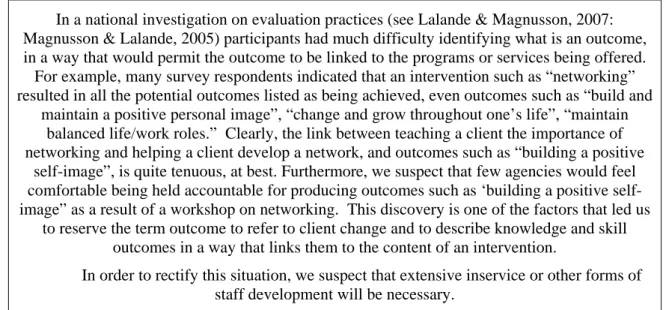
In a national investigation on evaluation practices (see Lalande & Magnusson, 2007: Magnusson & Lalande, 2005) participants had much difficulty identifying what is an outcome, in a way that would permit the outcome to be linked to the programs or services being offered.
For example, many survey respondents indicated that an intervention such as “networking” resulted in all the potential outcomes listed as being achieved, even outcomes such as “build and
maintain a positive personal image”, “change and grow throughout one’s life”, “maintain balanced life/work roles.” Clearly, the link between teaching a client the importance of networking and helping a client develop a network, and outcomes such as “building a positive
self-image”, is quite tenuous, at best. Furthermore, we suspect that few agencies would feel comfortable being held accountable for producing outcomes such as ‘building a positive self-image” as a result of a workshop on networking. This discovery is one of the factors that led us
to reserve the term outcome to refer to client change and to describe knowledge and skill outcomes in a way that links them to the content of an intervention.
In order to rectify this situation, we suspect that extensive inservice or other forms of staff development will be necessary.
Figure 2. Stories From The Field: What is an outcome?
A note on impact outcomes. Impact outcomes are the spin-off effects that derive from the learning outcomes, or perhaps from the personal attribute outcomes. They are the “ultimate, hoped-for” end result of an intervention. Agencies and funders need to collaborate and reach agreement on what impacts can be reasonably expected. For example, when children are violent in school, they might be in homes where violence is a frequent way of resolving disagreements. Therefore, it might be useful to work with parents (or have a referral agency work with the parents) in order to achieve a hoped for gain of having less playground violence at school. For example, in times of low unemployment, or in geographic regions where the job market is robust, it might be reasonable to expect high placement rates following completion of a work search program. However, in times of high unemployment it might not be reasonable to expect that all people who participate in a work search program will end up finding jobs. In economically disadvantaged areas, there might be lower job mobility because people believe that any job is better than no job, but there might also be greater social unrest because people have not found work that is personally meaningful. In areas where there is high cultural and ethnic diversity, it might be useful to implement a program aimed at
increasing acceptance and reducing discrimination in order to achieve greater social acceptance and greater employability. It is important to have realistic goals and the legitimacy of the ultimate and hoped-for outcomes needs to be a matter of negotiated agreement on the part of all stakeholders involved in providing services.
Processes
Processes refer to the intentional activities that practitioners and clients undertake in the hopes of fostering client change. Interventions include the interactions of practitioners with clients or third parties as well as the components of the programs and services that are instrumental in achieving the client outcomes being sought. Processes can be grouped into two broad categories: Generic and specific.
Generic interventions are those practitioner actions that are part of most interactions with clients or third parties, regardless of the nature of the client’s problem or the goals being sought. For example, a strong working alliance between practitioner and client has been shown to be important in facilitating client change. Thus, developing a strong working alliance likely will be part of virtually all interventions. Similarly, teaching a client to reframe an unpleasant event and view it as an opportunity for growth could be part of several interventions and could contribute to achieving numerous client goals.
Specific interventions are more singularly focused than generic interventions. They usually are linked directly to client goals and outcomes, or linked to interactions with third parties that are intended to foster client change. Specific interventions can be part of interactions with clients directly or they can be bundled together as part of programs or workshops. In school settings, specific interventions represent the curriculum being used and the instructional methods that are appropriate for the curriculum. In counselling settings they are the intervention plan for helping a client
move from where they are now to where they want to be in the future, i.e., the actions intended to produce the hoped for outcomes.
In the work of the CRWG, we have found that it is useful organize the types of programs and services that an agency offers into categories according to the topic or problem that is being dealt with. We suggest using topical headings (e.g., career decision-making, stress, anger management, etc.) as the organizing tool rather than organizing programs and services according to the type of intervention (e.g., workshops, individual counselling, etc.). The topic or content of an intervention is related directly to the type of client change being sought. Using a topical organizing system also recognizes that the topics might be addressed in programs or other services in a variety of different ways, e.g., through counselling, teaching, workshop facilitation, guidance, and made available to client in a variety of different ways, e.g., in a group setting, a classroom, through individual counselling, or guided self-help. The mandate of the agency, the expertise of the staff, and the learning styles of the clients typically all come into play when deciding how the interventions are implemented.
Based on reports from the field and the national survey referred to earlier, the following framework has been developed for organizing the kinds of specific interventions that are used to
initiate and/or sustain client change in career services settings. The first four categories (career decision making, job-specific skills enhancement, job search, and job maintenance) represent
typical interventions used to achieve learning outcomes. A fifth category (career-related personal development) pertains to personal attributes related to employment or employability.
While most agencies offering career services do not have a mandate to offer personal counselling, when there is a personal issue, such as lack of self-confidence, that is affecting a
client’s ability to pursue career goals, it is important to address that issue as part of a career intervention. A sixth category (other) is to acknowledge that an important and legitimate part of
providing comprehensive career services is to be able to recognize when someone may need to be referred, for example, to a de-tox program prior to beginning work aimed more directly at
finding employment.
Most agencies likely will find it useful to develop a similar type of organizing system for the types of interventions and services they provide.
An important next step in developing a comprehensive evaluation plan is to map the client learning outcomes onto the interventions. Agencies will need to be very clear about the client outcomes that they want to be held accountable for, and then to identify where in the programs or services they offer are the components that are likely to produce those outcomes. Sometimes a fun activity will end up being removed from a program or workshop because it does not relate directly to any of the expected outcomes. On the other hand, the mapping may reveal that an outcome does not get addressed in any of the processes included in the intervention. In such cases, the list of outcomes may need to be revised by removing an outcome, or the intervention may need to be revised to include a component that connects directly to the outcome being sought. The mapping of interventions onto outcomes will need to be quite detailed and likely will be quite specific to an agency or a program, but using a common organizing system to identify the outcomes and the interventions will help to identify what is reasonable to expect from the services being offered. It is important that the process of mapping learning outcomes onto interventions and onto the indicators of change, is collaborative: evaluators, curriculum developers, and practitioners working together to agree on a common understanding of the outcomes, interventions, and indicators of success that are relevant to the program being evaluated.
This approach is considerably different from traditional program evaluation practices, where a so-called objective outsider is hired to pass judgement on the effectiveness of a program. The belief underlying the approach described in this paper is that the most useful evaluation data, and the data that can best be used to improve the quality of programs, comes from the people who are delivering the program. From the beginning, the outcomes (learner destinations) are identified, the indicators of progress and indicators of success are developed, and then the curriculum (or intervention) is
created, and suitable tracking mechanisms are developed to provide evidence that the curriculum is being followed and learners are progressing toward the ultimate outcomes that have been identified. This approach has been referred to as “Backwards Curriculum Design” by the Association for Supervision and Curriculum Development (Wiggins & McTighe, 2005). First the end point is clearly defined, then the processes and the indicators of progress are developed.
Intervention adherence. An important part of evidence-based practice involves documenting the processes followed by both service providers and service recipients, as well as any significant others that potentially could be affecting the achievement of outcomes. In order to claim that an intervention is responsible for producing a client outcome, we must be able to say with confidence that both service provider and client have followed the intervention plan. There are many examples in our field where an intervention appears to be ineffective, but closer scrutiny reveals that the intervention plan has in fact not been followed.
Inputs
The resource base that an agency can access has a major influence on the programs and services that an agency can offer and on the agency’s ability to offer quality services. Reciprocally, certain interventions require specific and sometimes unique resources in order to be implemented successfully. The ultimate goal in evaluating services and also in planning interventions is to be able to link the changes clients experience to the services they received and to the resource base required for successful delivery of those services. Stated reciprocally: Given the resource base, an agency can offer certain services, which in turn will likely result in corresponding client changes. Thus, it is important to track the resources used when delivering services. This includes factors such as: funding (e.g., budget, special grants), staff (e.g., number of
staff, competencies of staff, level of staff training), service guidelines (e.g., agency mandate, funder requirements), infrastructure (e.g., physical facilities, support staff, consultants), community resources (e.g., other professionals, volunteers, libraries, internet cafes). Once the resource base needed to offer a successful service has been identified, those data can be used to justify the need to maintain the resource base, or to expand it so that new services can be provided.
Total Quality Service Factors
Quality Service Factors do not link directly to client outcomes and therefore are not included in the evaluation framework described in this paper. However, they have an effect on the general operation of an agency and therefore are important. We know that a client who gets rude treatment from a receptionist or encounters a dismissive attitude by a group facilitator, likely will receive a less-than-best outcome from even a very good program. A list of quality service factors might include items such as: Client satisfaction, client relationship with the agency (clients return for service, clients are self reliant), stakeholder satisfaction, employer satisfaction (this could be also an impact outcome if job stability was a goal), level of service utilization, number of clients seen, types of client problems addressed, number of visits made by a client, wait time for receiving services, number of applicants for services, agency reputation, ability to fund-raise. Even though these factors sometimes are thought of as outcomes, they are not indicators of client change, per se. Therefore, we suggest that they be regarded as separate from intervention planning and outcome evaluation. We suggest also that agencies and funders include client change as an important factor when thinking of
Total Quality Service. Ultimately, reducing client wait list time or increasing the number of clients seen is not really useful if the services are not resulting in client change.
Summary and Conclusions
Frequently, the reactions of practitioners to program evaluation is negative. Program evaluation prompts dysfunctional beliefs, such as: evaluation will inhibit creativity, evaluation is a veiled attempt to terminate our program, our program is exemplary and therefore does not need to be evaluated, or staff perceptions are more valid than evaluation data (Posavac, 2011). We tend to think of the beliefs, attitudes,
perceived value, perceived threat, associated with evaluation as the Psychology of
Evaluation patterned after the Psychology of working (Blustein, 2006). The central
components in the Psychology of Working are survival and power, social connection,
and self-determination. When these three conditions are addressed adequately, workers
tend to be satisfied with their work roles. The goal in creating a positive Psychology of
Evaluation is to make sure that the three conditions are met adequately.
The approach to evaluation described in this paper can provide a strong
foundation for creating a positive Psychology of Evaluation. A study currently in
progress provides support for this premise. The project involved seven front-line practitioners facilitating a mentor training program. There was a belief initially that evaluation was mainly concerned with discovering short-comings in their program. After working with the framework described in this paper, the practitioners began to embrace the evaluation process and saw it as a useful learning tool that helped to clarify the purposes of their work and make it more effective. The practitioners appreciated the collaborative approach to evaluation and saw it as being responsible for much of the positive reaction to the evaluation process. When the practitioners were asked to name one thing that stood out in their minds regarding the evaluation approach being used, the most predominating themes that emerged centered around the collaborative approach and the open communication style of the evaluators. The practitioners also reported that
the evaluation process helped them gain a more clear understanding of the objectives of the program and helped them feel more confident that their clients were receiving a better quality program as a result. This type of feedback provides a testament to the powerful impact that a collaborative evaluation process, such as the one described in this paper, can have on providing quality services to clients and building confidence and optimism within practitioners.
Any comprehensive plan for evaluating the effectiveness of any intervention needs to incorporate a systematic method for gathering data on all three components of the framework depicted in Figure 1. In order to get an accurate picture of which interventions work best, with which types of learners, under which circumstances, it is necessary to examine the learner outcomes, the processes used to obtain those outcomes, and the resources (inputs) needed to enact the processes. This is best done through collaborative interactions between evaluators, curriculum designers, program developers, and practitioners, to make sure evaluation scheme is completely integrated
with service delivery. The approach works best when a Backwards Curriculum Design
approach is used, where the outcomes are decided before the service or program is developed, and where program development and evaluation development occur simultaneously and in an interactive manner. Thus program evaluation is intertwined with program development, and is not bolted on to the side of programs already developed and implemented. This type of collaborative approach helps to ensure that the outcomes desired from a program are explicit and measurable, and that the outcomes are clearly linked to the activities that are contained in the program. This sort of linkage is useful for illustrating a causal connection between the content of the program and the student changes that occurred.
Note. Comprehensive descriptions of ways in which this evaluation approach has been used and a compendium of tools used in field trials incorporating this
framework can be found on the web site of the Canadian Research Working Group on
Evidence-based Practice in career Development (CRWG), http://www.crwg-gdrc.ca/index.html
Received: 23-04-2012 Accepted: 27-07-2012
References
Baudouin, R., Bezanson, M. L., Borgen, W., Goyer, L., Hiebert, B., Lalande , V., Magnusson, K., Michaud, G., Renald, C., & Turcotte, M. (2007). Demonstrating value: A draft framework for evaluating the effectiveness of career development
interventions. Canadian Journal of Counselling, 41, 146-157.
Blustein, D. L. (2006). The Psychology of Working. New Jersey: Lawrence Erlbaum.
Conger, D. S., Hiebert, B., & Hong-Farrell, E. (1993). Career and employment
counselling in Canada. Ottawa, ON: Canadian Labour Force Development Board.
Dozois, D. J. (2011). Training in professional psychology: The content and process of
learning. Psynopsis, 33(4), 7.
Hiebert, B. (1994). A framework for quality control, accountability and evaluation:
Being clear about the legitimate outcomes of career counselling. Canadian
Journal of Counselling, 28, 334-345.
Hiebert, B. (2012). Post-Pre Assessment: An innovative way for documenting client
change. Guidance Perspectives Around the World. Available from:
http://iaevg.org/crc/ resources.cfm?subcat=200,202&lang=en
Hiebert, B., & Charles, G. (2008). Accountability and Outcomes in Health and Human
Services: Changing Perspectives for Changing Times. Calgary, AB: Canadian Outcomes Research Institute. Available from: http://bryanhiebert.ca/research/files /CORI_Issue1_web.pdf .
Hiebert, B., Domene, J. F., & Buchanan, M. (2011). The Power of Multiple Methods and Evidence Sources: Raising the Profile of Canadian Counselling Psychology
Research. Canadian Psychology, 52, 265-275.
Hiebert, B., Bezanson, L., O'Reilly, E., Hopkins, S., Magnusson, K., & McCaffrey, A. (2012). Assessing the Impact of Labour Market Information: Final Report on Results of Phase Two (Field Tests). Ottawa, ON: Canadian Career Development
Foundation (CCDF). Retrieved from http://www.crwg-gdrc.ca/crwg/index.php/research-projects/lmi.
HRSDC (Human Resources and Skills Development Canada). (2011). What works in career development services? Measuring the results of labour market integration services. Gatineau, QC: Human Resources and Skills Development Canada Policy Research Directorate.
Killeen, J., White, M., & Watts, A. G. (1993). The Economic Value of Careers Guidance. London, England: Policy Studies Institute.
Lalande, V., & Magnusson, K. (2007). Measuring the Impact of Career Development Services in Canada: Current and Preferred Practices. Canadian Journal of Counselling, 41, 146-157.
Magnusson, K., & Lalande, V. (2005). The state of practice in Canada in measuring career service impact. Ottawa, ON: Canadian Career Development Foundation. Retrieved from CRWG website: http://www.crwg-gdrc.ca/crwg /index.php /research-projects/state-of-practice.
Maguire, M. & Killeen, J. (2003). Outcomes from career information and guidance services. Paris: Organization for Economic Cooperation and Development.
Posavac, E. J. (2011). Program evaluation: Methods and case studies (8th ed.). New York: Prentice Hall.
Robinson, E. A. R., & Doueck, H. J. (1994). Implications of the pre/post/then design for evaluating social group work. Research on Social Work Practice, 4, 224-239. Wiggins, G., & McTighe, J. (2005). Understanding by design. Alexandria, VA: