Preface ... viii
1. Introduction to Hibernate ... 1
1.1. Preface ... 1
1.2. Part 1 - The first Hibernate Application ... 1
1.2.1. The first class ... 1
1.2.2. The mapping file ... 3
1.2.3. Hibernate configuration ... 4
1.2.4. Building with Ant ... 6
1.2.5. Startup and helpers ... 6
1.2.6. Loading and storing objects ... 8
1.3. Part 2 - Mapping associations ... 10
1.3.1. Mapping the Person class ... 10
1.3.2. A unidirectional Set-based association ... 11
1.3.3. Working the association ... 12
1.3.4. Collection of values ... 13
1.3.5. Bi-directional associations ... 14
1.3.6. Working bi-directional links ... 15
1.4. Part 3 - The EventManager web application ... 16
1.4.1. Writing the basic servlet ... 16
1.4.2. Processing and rendering ... 17
1.4.3. Deploying and testing ... 18
1.5. Summary ... 19 2. Architecture ... 20 2.1. Overview ... 20 2.2. Instance states ... 22 2.3. JMX Integration ... 22 2.4. JCA Support ... 23 2.5. Contextual Sessions ... 23 3. Configuration ... 25 3.1. Programmatic configuration ... 25 3.2. Obtaining a SessionFactory ... 25 3.3. JDBC connections ... 26
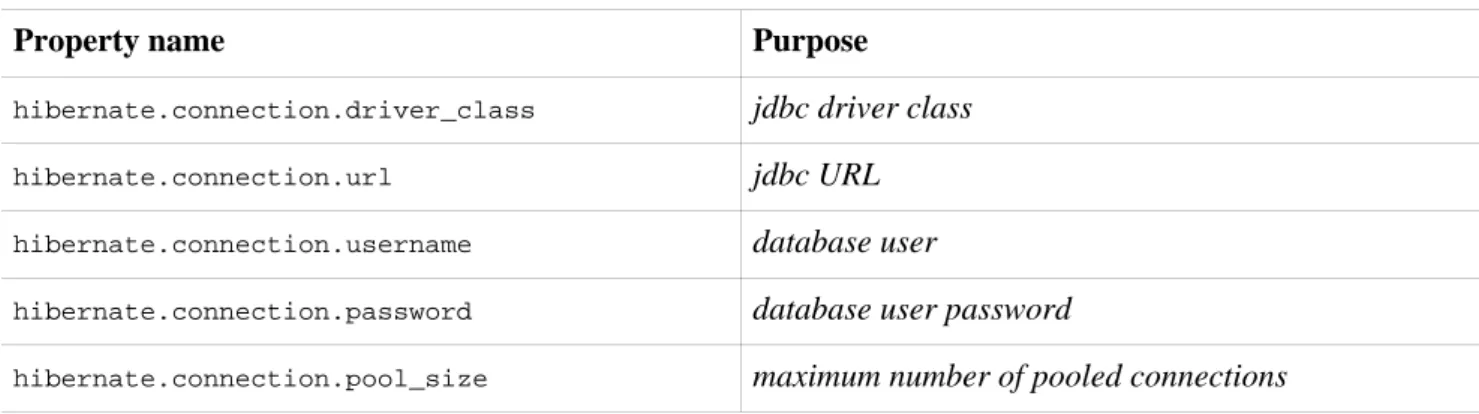
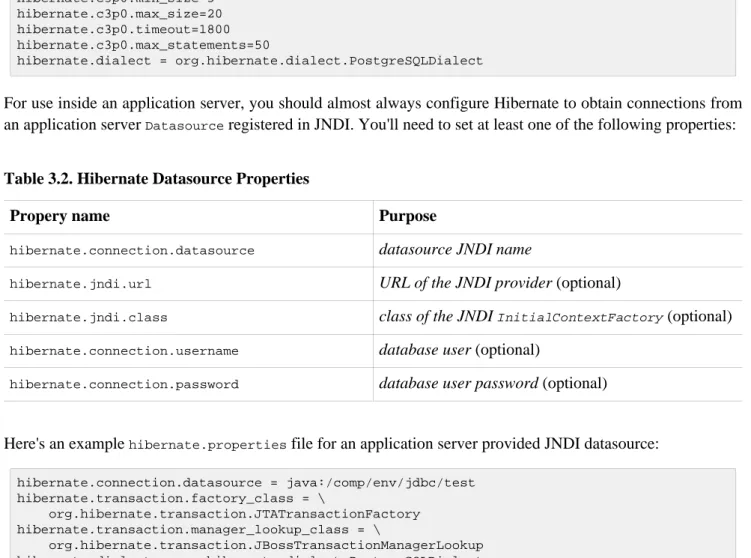
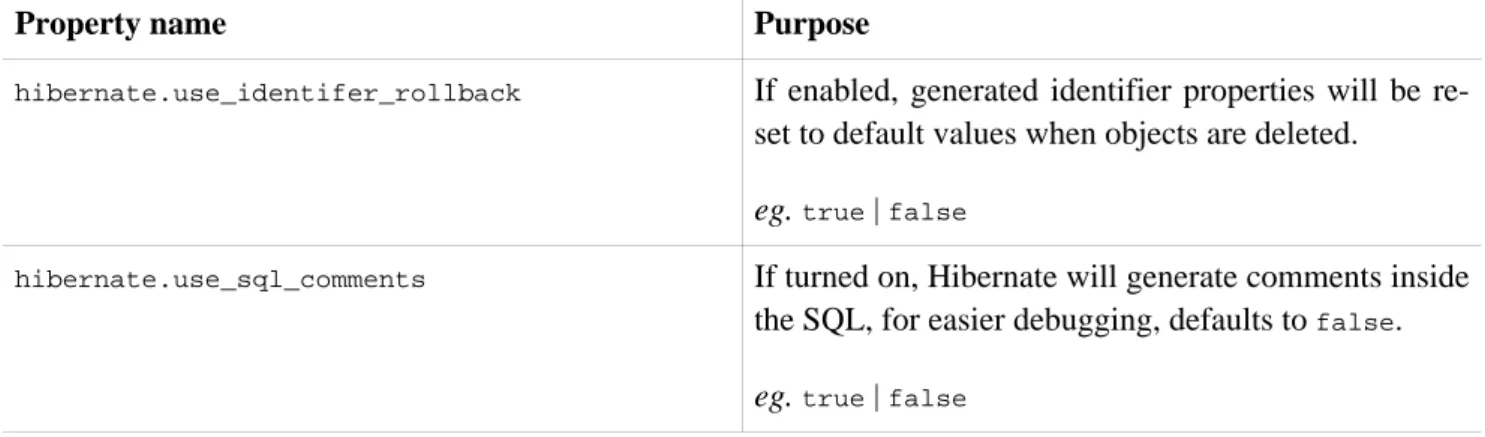
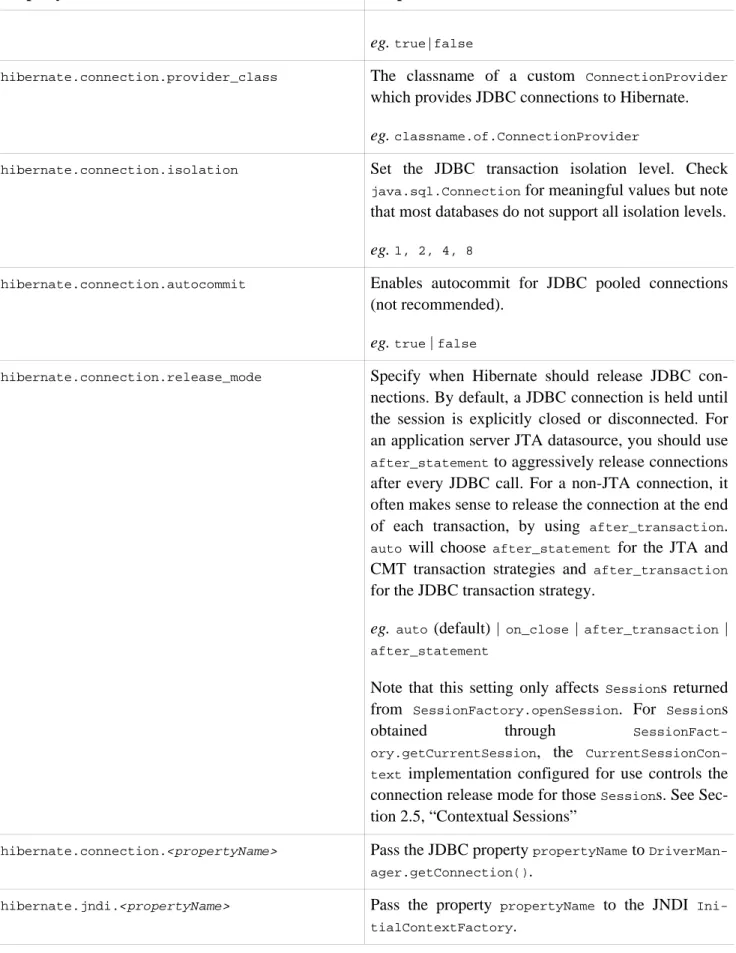
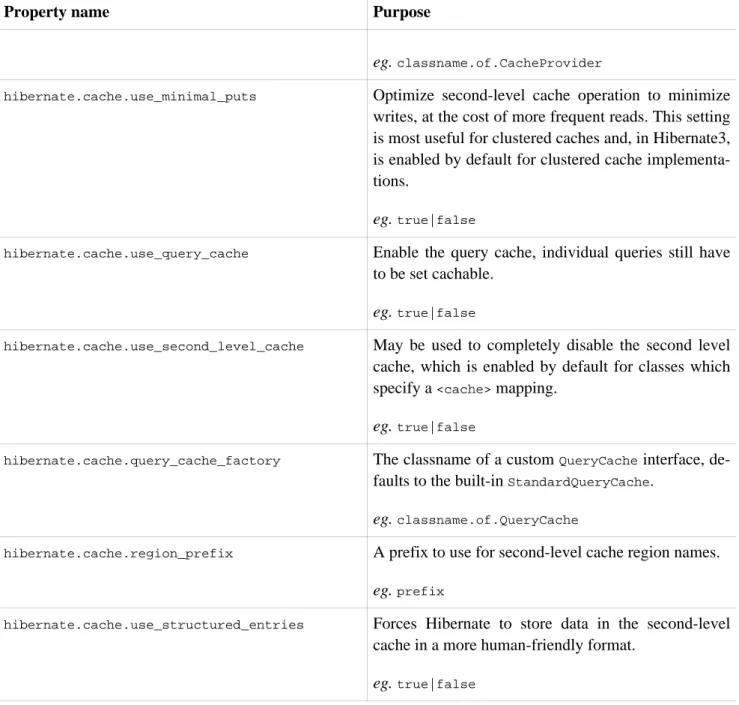
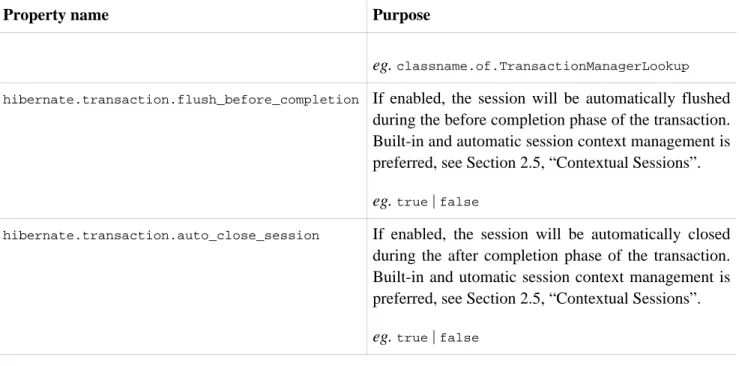
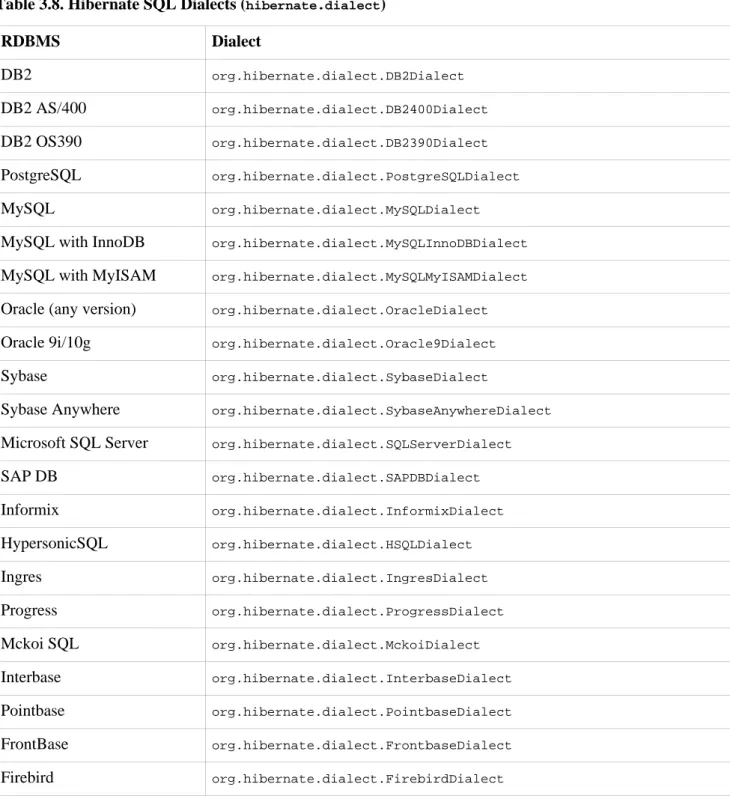
3.4. Optional configuration properties ... 27
3.4.1. SQL Dialects ... 33
3.4.2. Outer Join Fetching ... 34
3.4.3. Binary Streams ... 34
3.4.4. Second-level and query cache ... 34
3.4.5. Query Language Substitution ... 34
3.4.6. Hibernate statistics ... 34
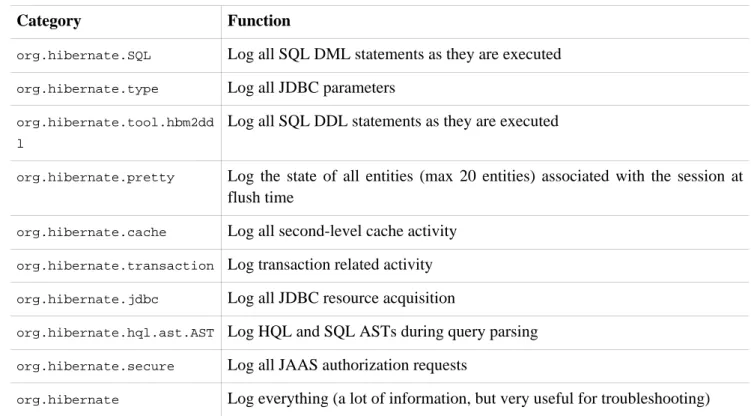
3.5. Logging ... 34
3.6. Implementing a NamingStrategy ... 35
3.7. XML configuration file ... 36
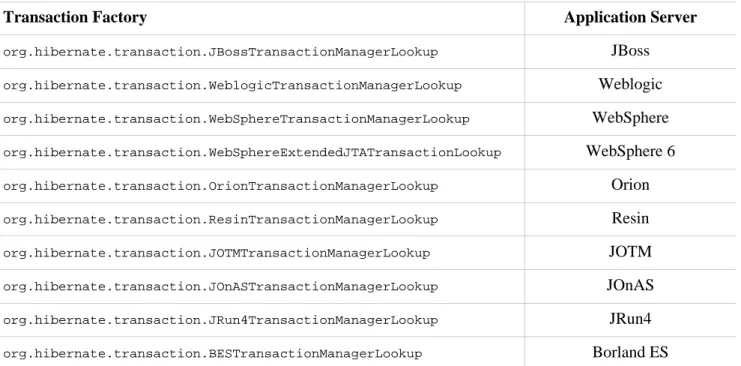
3.8. J2EE Application Server integration ... 36
3.8.1. Transaction strategy configuration ... 37
3.8.2. JNDI-bound SessionFactory ... 38
3.8.3. Current Session context management with JTA ... 38
3.8.4. JMX deployment ... 39
4.1. A simple POJO example ... 41
4.1.1. Implement a no-argument constructor ... 42
4.1.2. Provide an identifier property (optional) ... 42
4.1.3. Prefer non-final classes (optional) ... 42
4.1.4. Declare accessors and mutators for persistent fields (optional) ... 43
4.2. Implementing inheritance ... 43
4.3. Implementing equals() and hashCode() ... 43
4.4. Dynamic models ... 44
4.5. Tuplizers ... 46
5. Basic O/R Mapping ... 48
5.1. Mapping declaration ... 48 5.1.1. Doctype ... 49 5.1.2. hibernate-mapping ... 49 5.1.3. class ... 50 5.1.4. id ... 52 5.1.4.1. Generator ... 53 5.1.4.2. Hi/lo algorithm ... 54 5.1.4.3. UUID algorithm ... 54
5.1.4.4. Identity columns and sequences ... 54
5.1.4.5. Assigned identifiers ... 55
5.1.4.6. Primary keys assigned by triggers ... 55
5.1.5. composite-id ... 55 5.1.6. discriminator ... 56 5.1.7. version (optional) ... 57 5.1.8. timestamp (optional) ... 58 5.1.9. property ... 58 5.1.10. many-to-one ... 60 5.1.11. one-to-one ... 61 5.1.12. natural-id ... 63 5.1.13. component, dynamic-component ... 63 5.1.14. properties ... 64 5.1.15. subclass ... 65 5.1.16. joined-subclass ... 65 5.1.17. union-subclass ... 66 5.1.18. join ... 67 5.1.19. key ... 68
5.1.20. column and formula elements ... 68
5.1.21. import ... 69
5.1.22. any ... 69
5.2. Hibernate Types ... 70
5.2.1. Entities and values ... 70
5.2.2. Basic value types ... 71
5.2.3. Custom value types ... 72
5.3. Mapping a class more than once ... 73
5.4. SQL quoted identifiers ... 73
5.5. Metadata alternatives ... 74
5.5.1. Using XDoclet markup ... 74
5.5.2. Using JDK 5.0 Annotations ... 75
5.6. Generated Properties ... 76
5.7. Auxiliary Database Objects ... 76
6. Collection Mapping ... 78
6.2. Collection mappings ... 78
6.2.1. Collection foreign keys ... 80
6.2.2. Collection elements ... 80
6.2.3. Indexed collections ... 80
6.2.4. Collections of values and many-to-many associations ... 81
6.2.5. One-to-many associations ... 83
6.3. Advanced collection mappings ... 83
6.3.1. Sorted collections ... 83
6.3.2. Bidirectional associations ... 84
6.3.3. Bidirectional associations with indexed collections ... 85
6.3.4. Ternary associations ... 86 6.3.5. Using an <idbag> ... 87 6.4. Collection examples ... 87 7. Association Mappings ... 90 7.1. Introduction ... 90 7.2. Unidirectional associations ... 90 7.2.1. many to one ... 90 7.2.2. one to one ... 90 7.2.3. one to many ... 91
7.3. Unidirectional associations with join tables ... 92
7.3.1. one to many ... 92
7.3.2. many to one ... 92
7.3.3. one to one ... 93
7.3.4. many to many ... 93
7.4. Bidirectional associations ... 93
7.4.1. one to many / many to one ... 94
7.4.2. one to one ... 94
7.5. Bidirectional associations with join tables ... 95
7.5.1. one to many / many to one ... 95
7.5.2. one to one ... 96
7.5.3. many to many ... 97
7.6. More complex association mappings ... 97
8. Component Mapping ... 99
8.1. Dependent objects ... 99
8.2. Collections of dependent objects ... 100
8.3. Components as Map indices ... 101
8.4. Components as composite identifiers ... 101
8.5. Dynamic components ... 103
9. Inheritance Mapping ... 104
9.1. The Three Strategies ... 104
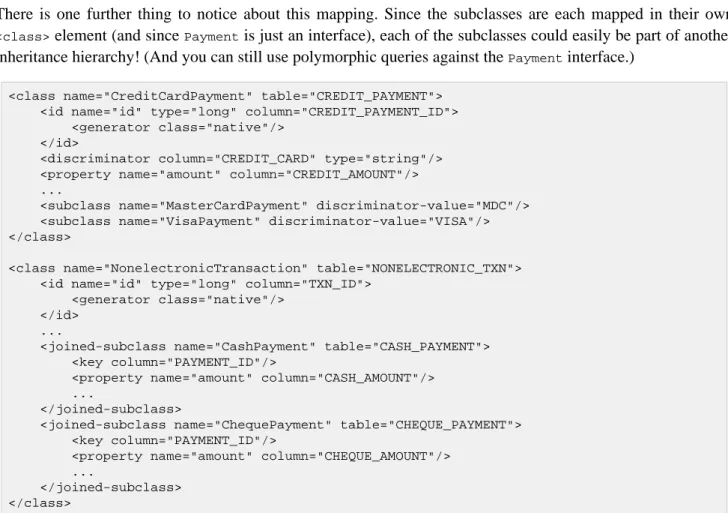
9.1.1. Table per class hierarchy ... 104
9.1.2. Table per subclass ... 105
9.1.3. Table per subclass, using a discriminator ... 105
9.1.4. Mixing table per class hierarchy with table per subclass ... 106
9.1.5. Table per concrete class ... 106
9.1.6. Table per concrete class, using implicit polymorphism ... 107
9.1.7. Mixing implicit polymorphism with other inheritance mappings ... 108
9.2. Limitations ... 108
10. Working with objects ... 110
10.1. Hibernate object states ... 110
10.2. Making objects persistent ... 110
10.4. Querying ... 112
10.4.1. Executing queries ... 112
10.4.1.1. Iterating results ... 113
10.4.1.2. Queries that return tuples ... 113
10.4.1.3. Scalar results ... 113
10.4.1.4. Bind parameters ... 113
10.4.1.5. Pagination ... 114
10.4.1.6. Scrollable iteration ... 114
10.4.1.7. Externalizing named queries ... 115
10.4.2. Filtering collections ... 115
10.4.3. Criteria queries ... 116
10.4.4. Queries in native SQL ... 116
10.5. Modifying persistent objects ... 116
10.6. Modifying detached objects ... 117
10.7. Automatic state detection ... 117
10.8. Deleting persistent objects ... 118
10.9. Replicating object between two different datastores ... 119
10.10. Flushing the Session ... 119
10.11. Transitive persistence ... 120
10.12. Using metadata ... 121
11. Transactions And Concurrency ... 123
11.1. Session and transaction scopes ... 123
11.1.1. Unit of work ... 123
11.1.2. Long conversations ... 124
11.1.3. Considering object identity ... 125
11.1.4. Common issues ... 126
11.2. Database transaction demarcation ... 126
11.2.1. Non-managed environment ... 127
11.2.2. Using JTA ... 128
11.2.3. Exception handling ... 129
11.2.4. Transaction timeout ... 129
11.3. Optimistic concurrency control ... 130
11.3.1. Application version checking ... 130
11.3.2. Extended session and automatic versioning ... 131
11.3.3. Detached objects and automatic versioning ... 131
11.3.4. Customizing automatic versioning ... 132
11.4. Pessimistic Locking ... 132
11.5. Connection Release Modes ... 133
12. Interceptors and events ... 135
12.1. Interceptors ... 135
12.2. Event system ... 136
12.3. Hibernate declarative security ... 137
13. Batch processing ... 139
13.1. Batch inserts ... 139
13.2. Batch updates ... 139
13.3. The StatelessSession interface ... 140
13.4. DML-style operations ... 140
14. HQL: The Hibernate Query Language ... 143
14.1. Case Sensitivity ... 143
14.2. The from clause ... 143
14.3. Associations and joins ... 143
14.5. The select clause ... 145
14.6. Aggregate functions ... 146
14.7. Polymorphic queries ... 146
14.8. The where clause ... 147
14.9. Expressions ... 148
14.10. The order by clause ... 151
14.11. The group by clause ... 151
14.12. Subqueries ... 152
14.13. HQL examples ... 152
14.14. Bulk update and delete ... 154
14.15. Tips & Tricks ... 154
15. Criteria Queries ... 156
15.1. Creating a Criteria instance ... 156
15.2. Narrowing the result set ... 156
15.3. Ordering the results ... 157
15.4. Associations ... 157
15.5. Dynamic association fetching ... 158
15.6. Example queries ... 158
15.7. Projections, aggregation and grouping ... 159
15.8. Detached queries and subqueries ... 160
15.9. Queries by natural identifier ... 160
16. Native SQL ... 162
16.1. Using a SQLQuery ... 162
16.1.1. Scalar queries ... 162
16.1.2. Entity queries ... 163
16.1.3. Handling associations and collections ... 163
16.1.4. Returning multiple entities ... 163
16.1.4.1. Alias and property references ... 164
16.1.5. Returning non-managed entities ... 165
16.1.6. Handling inheritance ... 165
16.1.7. Parameters ... 165
16.2. Named SQL queries ... 166
16.2.1. Using return-property to explicitly specify column/alias names ... 167
16.2.2. Using stored procedures for querying ... 168
16.2.2.1. Rules/limitations for using stored procedures ... 168
16.3. Custom SQL for create, update and delete ... 169
16.4. Custom SQL for loading ... 170
17. Filtering data ... 171
17.1. Hibernate filters ... 171
18. XML Mapping ... 173
18.1. Working with XML data ... 173
18.1.1. Specifying XML and class mapping together ... 173
18.1.2. Specifying only an XML mapping ... 173
18.2. XML mapping metadata ... 174
18.3. Manipulating XML data ... 175
19. Improving performance ... 177
19.1. Fetching strategies ... 177
19.1.1. Working with lazy associations ... 178
19.1.2. Tuning fetch strategies ... 178
19.1.3. Single-ended association proxies ... 179
19.1.4. Initializing collections and proxies ... 180
19.1.6. Using subselect fetching ... 182
19.1.7. Using lazy property fetching ... 182
19.2. The Second Level Cache ... 183
19.2.1. Cache mappings ... 183
19.2.2. Strategy: read only ... 184
19.2.3. Strategy: read/write ... 184
19.2.4. Strategy: nonstrict read/write ... 184
19.2.5. Strategy: transactional ... 185
19.3. Managing the caches ... 185
19.4. The Query Cache ... 186
19.5. Understanding Collection performance ... 187
19.5.1. Taxonomy ... 187
19.5.2. Lists, maps, idbags and sets are the most efficient collections to update ... 188
19.5.3. Bags and lists are the most efficient inverse collections ... 188
19.5.4. One shot delete ... 188
19.6. Monitoring performance ... 189
19.6.1. Monitoring a SessionFactory ... 189
19.6.2. Metrics ... 189
20. Toolset Guide ... 191
20.1. Automatic schema generation ... 191
20.1.1. Customizing the schema ... 191
20.1.2. Running the tool ... 193
20.1.3. Properties ... 194
20.1.4. Using Ant ... 194
20.1.5. Incremental schema updates ... 195
20.1.6. Using Ant for incremental schema updates ... 195
20.1.7. Schema validation ... 195
20.1.8. Using Ant for schema validation ... 196
21. Example: Parent/Child ... 197
21.1. A note about collections ... 197
21.2. Bidirectional one-to-many ... 197
21.3. Cascading lifecycle ... 198
21.4. Cascades and unsaved-value ... 199
21.5. Conclusion ... 200
22. Example: Weblog Application ... 201
22.1. Persistent Classes ... 201
22.2. Hibernate Mappings ... 202
22.3. Hibernate Code ... 203
23. Example: Various Mappings ... 207
23.1. Employer/Employee ... 207
23.2. Author/Work ... 208
23.3. Customer/Order/Product ... 210
23.4. Miscellaneous example mappings ... 212
23.4.1. "Typed" one-to-one association ... 212
23.4.2. Composite key example ... 212
23.4.3. Many-to-many with shared composite key attribute ... 214
23.4.4. Content based discrimination ... 215
23.4.5. Associations on alternate keys ... 215
Preface
Working with object-oriented software and a relational database can be cumbersome and time consuming in today's enterprise environments. Hibernate is an object/relational mapping tool for Java environments. The term object/relational mapping (ORM) refers to the technique of mapping a data representation from an object model to a relational data model with a SQL-based schema.
Hibernate not only takes care of the mapping from Java classes to database tables (and from Java data types to SQL data types), but also provides data query and retrieval facilities and can significantly reduce development time otherwise spent with manual data handling in SQL and JDBC.
Hibernates goal is to relieve the developer from 95 percent of common data persistence related programming tasks. Hibernate may not be the best solution for data-centric applications that only use stored-procedures to implement the business logic in the database, it is most useful with object-oriented domain models and business logic in the Java-based middle-tier. However, Hibernate can certainly help you to remove or encapsulate vendor-specific SQL code and will help with the common task of result set translation from a tabular represent-ation to a graph of objects.
If you are new to Hibernate and Object/Relational Mapping or even Java, please follow these steps:
1. Read Chapter 1, Introduction to Hibernate for a tutorial with step-by-step instructions. The source code for the tutorial is included in the distribution in thedoc/reference/tutorial/directory.
2. Read Chapter 2, Architecture to understand the environments where Hibernate can be used.
3. Have a look at theeg/directory in the Hibernate distribution, it contains a simple standalone application.
Copy your JDBC driver to thelib/directory and editetc/hibernate.properties, specifying correct
val-ues for your database. From a command prompt in the distribution directory, typeant eg(using Ant), or
under Windows, typebuild eg.
4. Use this reference documentation as your primary source of information. Consider reading Hibernate in
Action (http://www.manning.com/bauer) if you need more help with application design or if you prefer a
step-by-step tutorial. Also visit http://caveatemptor.hibernate.org and download the example application for Hibernate in Action.
5. FAQs are answered on the Hibernate website.
6. Third party demos, examples, and tutorials are linked on the Hibernate website.
7. The Community Area on the Hibernate website is a good resource for design patterns and various integra-tion soluintegra-tions (Tomcat, JBoss AS, Struts, EJB, etc.).
If you have questions, use the user forum linked on the Hibernate website. We also provide a JIRA issue track-ings system for bug reports and feature requests. If you are interested in the development of Hibernate, join the developer mailing list. If you are interested in translating this documentation into your language, contact us on the developer mailing list.
Commercial development support, production support, and training for Hibernate is available through JBoss Inc. (see http://www.hibernate.org/SupportTraining/). Hibernate is a Professional Open Source project and a critical component of the JBoss Enterprise Middleware System (JEMS) suite of products.
1.1. Preface
This chapter is an introductory tutorial for new users of Hibernate. We start with a simple command line applic-ation using an in-memory database and develop it in easy to understand steps.
This tutorial is intended for new users of Hibernate but requires Java and SQL knowledge. It is based on a tu-torial by Michael Gloegl, the third-party libraries we name are for JDK 1.4 and 5.0. You might need others for JDK 1.3.
The source code for the tutorial is included in the distribution in thedoc/reference/tutorial/directory.
1.2. Part 1 - The first Hibernate Application
First, we'll create a simple console-based Hibernate application. We use an Java database (HSQL DB), so we do not have to install any database server.
Let's assume we need a small database application that can store events we want to attend, and information about the hosts of these events.
The first thing we do, is set up our development directory and put all the Java libraries we need into it. Down-load the Hibernate distribution from the Hibernate website. Extract the package and place all required libraries found in/libinto into the/libdirectory of your new development working directory. It should look like this:
. +lib antlr.jar cglib.jar asm.jar asm-attrs.jars commons-collections.jar commons-logging.jar hibernate3.jar jta.jar dom4j.jar log4j.jar
This is the minimum set of required libraries (note that we also copied hibernate3.jar, the main archive) for Hi-bernate at the time of writing. The HiHi-bernate release you are using might require more or less libraries. See the
README.txtfile in thelib/directory of the Hibernate distribution for more information about required and
op-tional third-party libraries. (Actually, Log4j is not required but preferred by many developers.) Next we create a class that represents the event we want to store in database.
1.2.1. The first class
Our first persistent class is a simple JavaBean class with some properties:
package events;
import java.util.Date; public class Event {
private Long id; private String title; private Date date; public Event() {} public Long getId() {
return id; }
private void setId(Long id) { this.id = id;
}
public Date getDate() { return date;
}
public void setDate(Date date) { this.date = date;
}
public String getTitle() { return title;
}
public void setTitle(String title) { this.title = title;
} }
You can see that this class uses standard JavaBean naming conventions for property getter and setter methods, as well as private visibility for the fields. This is a recommended design - but not required. Hibernate can also access fields directly, the benefit of accessor methods is robustness for refactoring. The no-argument construct-or is required to instantiate an object of this class through reflection.
Theidproperty holds a unique identifier value for a particular event. All persistent entity classes (there are less
important dependent classes as well) will need such an identifier property if we want to use the full feature set of Hibernate. In fact, most applications (esp. web applications) need to distinguish objects by identifier, so you should consider this a feature rather than a limitation. However, we usually don't manipulate the identity of an object, hence the setter method should be private. Only Hibernate will assign identifiers when an object is saved. You can see that Hibernate can access public, private, and protected accessor methods, as well as (public, private, protected) fields directly. The choice is up to you and you can match it to fit your application design.
The no-argument constructor is a requirement for all persistent classes; Hibernate has to create objects for you, using Java Reflection. The constructor can be private, however, package visibility is required for runtime proxy generation and efficient data retrieval without bytecode instrumentation.
Place this Java source file in a directory calledsrcin the development folder, and in its correct package. The
directory should now look like this:
. +lib
<Hibernate and third-party libraries> +src
+events Event.java
1.2.2. The mapping file
Hibernate needs to know how to load and store objects of the persistent class. This is where the Hibernate map-ping file comes into play. The mapmap-ping file tells Hibernate what table in the database it has to access, and what columns in that table it should use.
The basic structure of a mapping file looks like this:
<?xml version="1.0"?>
<!DOCTYPE hibernate-mapping PUBLIC
"-//Hibernate/Hibernate Mapping DTD 3.0//EN"
"http://hibernate.sourceforge.net/hibernate-mapping-3.0.dtd"> <hibernate-mapping>
[...]
</hibernate-mapping>
Note that the Hibernate DTD is very sophisticated. You can use it for auto-completion of XML mapping ele-ments and attributes in your editor or IDE. You also should open up the DTD file in your text editor - it's the easiest way to get an overview of all elements and attributes and to see the defaults, as well as some comments. Note that Hibernate will not load the DTD file from the web, but first look it up from the classpath of the ap-plication. The DTD file is included inhibernate3.jaras well as in thesrc/directory of the Hibernate
distri-bution.
We will omit the DTD declaration in future examples to shorten the code. It is of course not optional.
Between the twohibernate-mappingtags, include aclasselement. All persistent entity classes (again, there
might be dependent classes later on, which are not first-class entities) need such a mapping, to a table in the SQL database:
<hibernate-mapping>
<class name="events.Event" table="EVENTS"> </class>
</hibernate-mapping>
So far we told Hibernate how to persist and load object of classEventto the tableEVENTS, each instance
repres-ented by a row in that table. Now we continue with a mapping of the unique identifier property to the tables primary key. In addition, as we don't want to care about handling this identifier, we configure Hibernate's iden-tifier generation strategy for a surrogate primary key column:
<hibernate-mapping>
<class name="events.Event" table="EVENTS"> <id name="id" column="EVENT_ID">
<generator class="native"/> </id>
</class>
</hibernate-mapping>
Theidelement is the declaration of the identifer property,name="id"declares the name of the Java property
-Hibernate will use the getter and setter methods to access the property. The column attribute tells -Hibernate which column of theEVENTS table we use for this primary key. The nested generator element specifies the
identifier generation strategy, in this case we usednative, which picks the best strategy depending on the
con-figured database (dialect). Hibernate supports database generated, globally unique, as well as application as-signed identifiers (or any strategy you have written an extension for).
Finally we include declarations for the persistent properties of the class in the mapping file. By default, no properties of the class are considered persistent:
<hibernate-mapping>
<class name="events.Event" table="EVENTS"> <id name="id" column="EVENT_ID">
<generator class="native"/> </id>
<property name="date" type="timestamp" column="EVENT_DATE"/> <property name="title"/>
</class>
</hibernate-mapping>
Just as with theidelement, thenameattribute of thepropertyelement tells Hibernate which getter and setter
methods to use. So, in this case, Hibernate will look for getDate()/setDate(), as well as get-Title()/setTitle().
Why does thedateproperty mapping include thecolumnattribute, but thetitledoesn't? Without thecolumn
attribute Hibernate by default uses the property name as the column name. This works fine fortitle. However, dateis a reserved keyword in most database, so we better map it to a different name.
The next interesting thing is that thetitlemapping also lacks atypeattribute. The types we declare and use in
the mapping files are not, as you might expect, Java data types. They are also not SQL database types. These types are so called Hibernate mapping types, converters which can translate from Java to SQL data types and vice versa. Again, Hibernate will try to determine the correct conversion and mapping type itself if thetype
at-tribute is not present in the mapping. In some cases this automatic detection (using Reflection on the Java class) might not have the default you expect or need. This is the case with thedateproperty. Hibernate can't know if
the property (which is ofjava.util.Date) should map to a SQLdate, timestamp, or timecolumn. We
pre-serve full date and time information by mapping the property with atimestampconverter.
This mapping file should be saved asEvent.hbm.xml, right in the directory next to theEventJava class source
file. The naming of mapping files can be arbitrary, however thehbm.xmlsuffix is a convention in the Hibernate
developer community. The directory structure should now look like this:
. +lib
<Hibernate and third-party libraries> +src
+events Event.java Event.hbm.xml
We continue with the main configuration of Hibernate.
1.2.3. Hibernate configuration
We now have a persistent class and its mapping file in place. It is time to configure Hibernate. Before we do this, we will need a database. HSQL DB, a java-based SQL DBMS, can be downloaded from the HSQL DB website. Actually, you only need thehsqldb.jarfrom this download. Place this file in thelib/directory of the
development folder.
Create a directory calleddatain the root of the development directory - this is where HSQL DB will store its
data files. Now start the database by runningjava -classpath lib/hsqldb.jar org.hsqldb.Serverin this
later. If you want to start with a fresh database during this tutorial, shutdown HSQL DB (pressCTRL + Cin the
window), delete all files in thedata/directory, and start HSQL DB again.
Hibernate is the layer in your application which connects to this database, so it needs connection information. The connections are made through a JDBC connection pool, which we also have to configure. The Hibernate distribution contains several open source JDBC connection pooling tools, but will use the Hibernate built-in connection pool for this tutorial. Note that you have to copy the required library into your classpath and use dif-ferent connection pooling settings if you want to use a production-quality third party JDBC pooling software. For Hibernate's configuration, we can use a simplehibernate.properties file, a slightly more sophisticated hibernate.cfg.xmlfile, or even complete programmatic setup. Most users prefer the XML configuration file:
<?xml version='1.0' encoding='utf-8'?> <!DOCTYPE hibernate-configuration PUBLIC
"-//Hibernate/Hibernate Configuration DTD 3.0//EN"
"http://hibernate.sourceforge.net/hibernate-configuration-3.0.dtd"> <hibernate-configuration>
<session-factory>
<!-- Database connection settings -->
<property name="connection.driver_class">org.hsqldb.jdbcDriver</property> <property name="connection.url">jdbc:hsqldb:hsql://localhost</property> <property name="connection.username">sa</property>
<property name="connection.password"></property> <!-- JDBC connection pool (use the built-in) --> <property name="connection.pool_size">1</property> <!-- SQL dialect -->
<property name="dialect">org.hibernate.dialect.HSQLDialect</property> <!-- Enable Hibernate's automatic session context management --> <property name="current_session_context_class">thread</property> <!-- Disable the second-level cache -->
<property name="cache.provider_class">org.hibernate.cache.NoCacheProvider</property> <!-- Echo all executed SQL to stdout -->
<property name="show_sql">true</property>
<!-- Drop and re-create the database schema on startup --> <property name="hbm2ddl.auto">create</property>
<mapping resource="events/Event.hbm.xml"/> </session-factory>
</hibernate-configuration>
Note that this XML configuration uses a different DTD. We configure Hibernate'sSessionFactory- a global
factory responsible for a particular database. If you have several databases, use several <session-factory>
configurations, usually in several configuration files (for easier startup).
The first four property elements contain the necessary configuration for the JDBC connection. The dialect propertyelement specifies the particular SQL variant Hibernate generates. Hibernate's automatic session
man-agement for persistence contexts will come in handy as you will soon see. Thehbm2ddl.autooption turns on
automatic generation of database schemas - directly into the database. This can of course also be turned off (by removing the config option) or redirected to a file with the help of theSchemaExportAnt task. Finally, we add
the mapping file(s) for persistent classes to the configuration.
looks for a file calledhibernate.cfg.xmlin the root of the classpath, on startup.
1.2.4. Building with Ant
We'll now build the tutorial with Ant. You will need to have Ant installed - get it from the Ant download page [http://ant.apache.org/bindownload.cgi]. How to install Ant will not be covered here. Please refer to the Ant manual [http://ant.apache.org/manual/index.html]. After you have installed Ant, we can start to create the build-file. It will be calledbuild.xmland placed directly in the development directory.
A basic build file looks like this:
<project name="hibernate-tutorial" default="compile"> <property name="sourcedir" value="${basedir}/src"/> <property name="targetdir" value="${basedir}/bin"/> <property name="librarydir" value="${basedir}/lib"/> <path id="libraries"> <fileset dir="${librarydir}"> <include name="*.jar"/> </fileset> </path> <target name="clean"> <delete dir="${targetdir}"/> <mkdir dir="${targetdir}"/> </target>
<target name="compile" depends="clean, copy-resources"> <javac srcdir="${sourcedir}" destdir="${targetdir}" classpathref="libraries"/> </target> <target name="copy-resources"> <copy todir="${targetdir}"> <fileset dir="${sourcedir}"> <exclude name="**/*.java"/> </fileset> </copy> </target> </project>
This will tell Ant to add all files in the lib directory ending with.jarto the classpath used for compilation. It
will also copy all non-Java source files to the target directory, e.g. configuration and Hibernate mapping files. If you now run Ant, you should get this output:
C:\hibernateTutorial\>ant Buildfile: build.xml copy-resources:
[copy] Copying 2 files to C:\hibernateTutorial\bin compile:
[javac] Compiling 1 source file to C:\hibernateTutorial\bin BUILD SUCCESSFUL
Total time: 1 second
It's time to load and store someEventobjects, but first we have to complete the setup with some infrastructure
code. We have to startup Hibernate. This startup includes building a globalSessionFactoryobject and to store
it somewhere for easy access in application code. ASessionFactorycan open up newSession's. ASession
represents a single-threaded unit of work, theSessionFactoryis a thread-safe global object, instantiated once.
We'll create aHibernateUtilhelper class which takes care of startup and makes accessing aSessionFactory
convenient. Let's have a look at the implementation:
package util;
import org.hibernate.*; import org.hibernate.cfg.*; public class HibernateUtil {
private static final SessionFactory sessionFactory; static {
try {
// Create the SessionFactory from hibernate.cfg.xml
sessionFactory = new Configuration().configure().buildSessionFactory(); } catch (Throwable ex) {
// Make sure you log the exception, as it might be swallowed
System.err.println("Initial SessionFactory creation failed." + ex); throw new ExceptionInInitializerError(ex);
} }
public static SessionFactory getSessionFactory() { return sessionFactory;
} }
This class does not only produce the globalSessionFactory in its static initializer (called once by the JVM
when the class is loaded), but also hides the fact that it uses a static singleton. It might as well lookup the Ses-sionFactoryfrom JNDI in an application server.
If you give theSessionFactorya name in your configuration file, Hibernate will in fact try to bind it to JNDI
after it has been built. To avoid this code completely you could also use JMX deployment and let the JMX-capable container instantiate and bind aHibernateServiceto JNDI. These advanced options are discussed in
the Hibernate reference documentation.
PlaceHibernateUtil.javain the development source directory, in a package next toevents: .
+lib
<Hibernate and third-party libraries> +src +events Event.java Event.hbm.xml +util HibernateUtil.java hibernate.cfg.xml +data build.xml
This should again compile without problems. We finally need to configure a logging system - Hibernate uses commons logging and leaves you the choice between Log4j and JDK 1.4 logging. Most developers prefer Log4j: copylog4j.propertiesfrom the Hibernate distribution (it's in the etc/directory) to yoursrc
to have more verbose output. By default, only Hibernate startup message are shown on stdout. The tutorial infrastructure is complete - and we are ready to do some real work with Hibernate.
1.2.6. Loading and storing objects
Finally, we can use Hibernate to load and store objects. We write anEventManagerclass with amain()
meth-od:
package events;
import org.hibernate.Session; import java.util.Date;
import util.HibernateUtil; public class EventManager {
public static void main(String[] args) { EventManager mgr = new EventManager(); if (args[0].equals("store")) {
mgr.createAndStoreEvent("My Event", new Date()); }
HibernateUtil.getSessionFactory().close(); }
private void createAndStoreEvent(String title, Date theDate) {
Session session = HibernateUtil.getSessionFactory().getCurrentSession(); session.beginTransaction();
Event theEvent = new Event(); theEvent.setTitle(title); theEvent.setDate(theDate); session.save(theEvent); session.getTransaction().commit(); } }
We create a newEvent object, and hand it over to Hibernate. Hibernate now takes care of the SQL and
ex-ecutesINSERTs on the database. Let's have a look at theSessionandTransaction-handling code before we run
this.
A Session is a single unit of work. For now we'll keep things simple and assume a one-to-one granularity
between a HibernateSessionand a database transaction. To shield our code from the actual underlying
transac-tion system (in this case plain JDBC, but it could also run with JTA) we use theTransactionAPI that is
avail-able on the HibernateSession.
What doessessionFactory.getCurrentSession()do? First, you can call it as many times and anywhere you
like, once you get hold of yourSessionFactory (easy thanks toHibernateUtil). ThegetCurrentSession()
method always returns the "current" unit of work. Remember that we switched the configuration option for this mechanism to "thread" inhibernate.cfg.xml? Hence, the scope of the current unit of work is the current Java
thread that executes our application. However, this is not the full truth. A Session begins when it is first
needed, when the first call to getCurrentSession() is made. It is then bound by Hibernate to the current
thread. When the transaction ends, either committed or rolled back, Hibernate also unbinds theSession from
new unit of work. This thread-bound programming model is the most popular way of using Hibernate.
Have a look at Chapter 11, Transactions And Concurrency for more information about transaction handling and demarcation. We also skipped any error handling and rollback in the previous example.
To run this first routine we have to add a callable target to the Ant build file:
<target name="run" depends="compile">
<java fork="true" classname="events.EventManager" classpathref="libraries"> <classpath path="${targetdir}"/>
<arg value="${action}"/> </java>
</target>
The value of theactionargument is set on the command line when calling the target: C:\hibernateTutorial\>ant run -Daction=store
You should see, after compilation, Hibernate starting up and, depending on your configuration, lots of log out-put. At the end you will find the following line:
[java] Hibernate: insert into EVENTS (EVENT_DATE, title, EVENT_ID) values (?, ?, ?)
This is theINSERTexecuted by Hibernate, the question marks represent JDBC bind parameters. To see the
val-ues bound as arguments, or to reduce the verbosity of the log, check yourlog4j.properties.
Now we'd like to list stored events as well, so we add an option to the main method:
if (args[0].equals("store")) {
mgr.createAndStoreEvent("My Event", new Date()); }
else if (args[0].equals("list")) { List events = mgr.listEvents();
for (int i = 0; i < events.size(); i++) { Event theEvent = (Event) events.get(i);
System.out.println("Event: " + theEvent.getTitle() + " Time: " + theEvent.getDate()); }
}
We also add a newlistEvents() method: private List listEvents() {
Session session = HibernateUtil.getSessionFactory().getCurrentSession(); session.beginTransaction();
List result = session.createQuery("from Event").list(); session.getTransaction().commit();
return result; }
What we do here is use an HQL (Hibernate Query Language) query to load all existingEventobjects from the
database. Hibernate will generate the appropriate SQL, send it to the database and populateEventobjects with
the data. You can create more complex queries with HQL, of course. Now, to execute and test all of this, follow these steps:
• Runant run -Daction=storeto store something into the database and, of course, to generate the database
schema before through hbm2ddl.
• Now disable hbm2ddl by commenting out the property in your hibernate.cfg.xmlfile. Usually you only
leave it turned on in continous unit testing, but another run of hbm2ddl would drop everything you have stored - the createconfiguration setting actually translates into "drop all tables from the schema, then
re-create all tables, when the SessionFactory is build".
If you now call Ant with-Daction=list, you should see the events you have stored so far. You can of course
also call thestoreaction a few times more.
Note: Most new Hibernate users fail at this point and we see questions about Table not found error messages regularly. However, if you follow the steps outlined above you will not have this problem, as hbm2ddl creates the database schema on the first run, and subsequent application restarts will use this schema. If you change the mapping and/or database schema, you have to re-enable hbm2ddl once again.
1.3. Part 2 - Mapping associations
We mapped a persistent entity class to a table. Let's build on this and add some class associations. First we'll add people to our application, and store a list of events they participate in.
1.3.1. Mapping the Person class
The first cut of thePersonclass is simple: package events;
public class Person { private Long id; private int age;
private String firstname; private String lastname; public Person() {}
// Accessor methods for all properties, private setter for 'id' }
Create a new mapping file calledPerson.hbm.xml(don't forget the DTD reference at the top): <hibernate-mapping>
<class name="events.Person" table="PERSON"> <id name="id" column="PERSON_ID">
<generator class="native"/> </id> <property name="age"/> <property name="firstname"/> <property name="lastname"/> </class> </hibernate-mapping>
Finally, add the new mapping to Hibernate's configuration:
<mapping resource="events/Person.hbm.xml"/>
We'll now create an association between these two entities. Obviously, persons can participate in events, and events have participants. The design questions we have to deal with are: directionality, multiplicity, and collec-tion behavior.
1.3.2. A unidirectional Set-based association
We'll add a collection of events to thePersonclass. That way we can easily navigate to the events for a
particu-lar person, without executing an explicit query - by callingaPerson.getEvents(). We use a Java collection, a Set, because the collection will not contain duplicate elements and the ordering is not relevant for us.
We need a unidirectional, many-valued associations, implemented with aSet. Let's write the code for this in
the Java classes and then map it:
public class Person {
private Set events = new HashSet(); public Set getEvents() {
return events; }
public void setEvents(Set events) { this.events = events;
} }
Before we map this association, think about the other side. Clearly, we could just keep this unidirectional. Or, we could create another collection on theEvent, if we want to be able to navigate it bi-directional, i.e. an-Event.getParticipants(). This is not necessary, from a functional perspective. You could always execute an
explicit query to retrieve the participants for a particular event. This is a design choice left to you, but what is clear from this discussion is the multiplicity of the association: "many" valued on both sides, we call this a
many-to-many association. Hence, we use Hibernate's many-to-many mapping:
<class name="events.Person" table="PERSON"> <id name="id" column="PERSON_ID">
<generator class="native"/> </id>
<property name="age"/> <property name="firstname"/> <property name="lastname"/>
<set name="events" table="PERSON_EVENT"> <key column="PERSON_ID"/>
<many-to-many column="EVENT_ID" class="events.Event"/> </set>
</class>
Hibernate supports all kinds of collection mappings, a<set>being most common. For a many-to-many
associ-ation (or n:m entity relassoci-ationship), an associassoci-ation table is needed. Each row in this table represents a link between a person and an event. The table name is configured with thetableattribute of thesetelement. The
identifier column name in the association, for the person's side, is defined with the<key>element, the column
name for the event's side with thecolumnattribute of the<many-to-many>. You also have to tell Hibernate the
class of the objects in your collection (correct: the class on the other side of the collection of references). The database schema for this mapping is therefore:
_____________ __________________ | | | | _____________ | EVENTS | | PERSON_EVENT | | | |_____________| |__________________| | PERSON | | | | | |_____________| | *EVENT_ID | <--> | *EVENT_ID | | |
| EVENT_DATE | | *PERSON_ID | <--> | *PERSON_ID |
| TITLE | |__________________| | AGE |
|_____________| | FIRSTNAME |
| LASTNAME | |_____________|
1.3.3. Working the association
Let's bring some people and events together in a new method inEventManager: private void addPersonToEvent(Long personId, Long eventId) {
Session session = HibernateUtil.getSessionFactory().getCurrentSession(); session.beginTransaction();
Person aPerson = (Person) session.load(Person.class, personId); Event anEvent = (Event) session.load(Event.class, eventId); aPerson.getEvents().add(anEvent);
session.getTransaction().commit(); }
After loading a Personand an Event, simply modify the collection using the normal collection methods. As
you can see, there is no explicit call toupdate()orsave(), Hibernate automatically detects that the collection
has been modified and needs to be updated. This is called automatic dirty checking, and you can also try it by modifying the name or the date property of any of your objects. As long as they are in persistent state, that is, bound to a particular HibernateSession(i.e. they have been just loaded or saved in a unit of work), Hibernate
monitors any changes and executes SQL in a write-behind fashion. The process of synchronizing the memory state with the database, usually only at the end of a unit of work, is called flushing. In our code, the unit of work ends with a commit (or rollback) of the database transaction - as defined by thethreadconfiguration option for
theCurrentSessionContextclass.
You might of course load person and event in different units of work. Or you modify an object outside of a
Session, when it is not in persistent state (if it was persistent before, we call this state detached). You can even
modify a collection when it is detached:
private void addPersonToEvent(Long personId, Long eventId) {
Session session = HibernateUtil.getSessionFactory().getCurrentSession(); session.beginTransaction();
Person aPerson = (Person) session
.createQuery("select p from Person p left join fetch p.events where p.id = :pid") .setParameter("pid", personId)
.uniqueResult(); // Eager fetch the collection so we can use it detached Event anEvent = (Event) session.load(Event.class, eventId);
session.getTransaction().commit(); // End of first unit of work
// Begin second unit of work
Session session2 = HibernateUtil.getSessionFactory().getCurrentSession(); session2.beginTransaction();
session2.update(aPerson); // Reattachment of aPerson session2.getTransaction().commit();
}
The call toupdatemakes a detached object persistent again, you could say it binds it to a new unit of work, so
any modifications you made to it while detached can be saved to the database. This includes any modifications (additions/deletions) you made to a collection of that entity object.
Well, this is not much use in our current situation, but it's an important concept you can design into your own application. For now, complete this exercise by adding a new action to theEventManager's main method and
call it from the command line. If you need the identifiers of a person and an event - thesave()method returns
it (you might have to modify some of the previous methods to return that identifier):
else if (args[0].equals("addpersontoevent")) {
Long eventId = mgr.createAndStoreEvent("My Event", new Date()); Long personId = mgr.createAndStorePerson("Foo", "Bar");
mgr.addPersonToEvent(personId, eventId);
System.out.println("Added person " + personId + " to event " + eventId);
This was an example of an association between two equally important classes, two entities. As mentioned earli-er, there are other classes and types in a typical model, usually "less important". Some you have already seen, like anintor aString. We call these classes value types, and their instances depend on a particular entity.
In-stances of these types don't have their own identity, nor are they shared between entities (two persons don't ref-erence the samefirstnameobject, even if they have the same first name). Of course, value types can not only
be found in the JDK (in fact, in a Hibernate application all JDK classes are considered value types), but you can also write dependent classes yourself,AddressorMonetaryAmount, for example.
You can also design a collection of value types. This is conceptually very different from a collection of refer-ences to other entities, but looks almost the same in Java.
1.3.4. Collection of values
We add a collection of value typed objects to thePersonentity. We want to store email addresses, so the type
we use isString, and the collection is again aSet: private Set emailAddresses = new HashSet(); public Set getEmailAddresses() {
return emailAddresses; }
public void setEmailAddresses(Set emailAddresses) { this.emailAddresses = emailAddresses;
}
The mapping of thisSet:
<set name="emailAddresses" table="PERSON_EMAIL_ADDR"> <key column="PERSON_ID"/>
<element type="string" column="EMAIL_ADDR"/> </set>
The difference compared with the earlier mapping is theelementpart, which tells Hibernate that the collection
does not contain references to another entity, but a collection of elements of typeString(the lowercase name
tells you it's a Hibernate mapping type/converter). Once again, thetableattribute of the setelement
determ-ines the table name for the collection. Thekeyelement defines the foreign-key column name in the collection
table. Thecolumnattribute in theelementelement defines the column name where theStringvalues will
actu-ally be stored.
Have a look at the updated schema:
_____________ __________________ | | | | _____________ | EVENTS | | PERSON_EVENT | | | ___________________ |_____________| |__________________| | PERSON | | | | | | | |_____________| | PERSON_EMAIL_ADDR | | *EVENT_ID | <--> | *EVENT_ID | | | |___________________| | EVENT_DATE | | *PERSON_ID | <--> | *PERSON_ID | <--> | *PERSON_ID |
| TITLE | |__________________| | AGE | | *EMAIL_ADDR |
|_____________| | FIRSTNAME | |___________________|
| LASTNAME | |_____________|
You can see that the primary key of the collection table is in fact a composite key, using both columns. This also implies that there can't be duplicate email addresses per person, which is exactly the semantics we need for a set in Java.
You can now try and add elements to this collection, just like we did before by linking persons and events. It's the same code in Java:
private void addEmailToPerson(Long personId, String emailAddress) {
Session session = HibernateUtil.getSessionFactory().getCurrentSession(); session.beginTransaction();
Person aPerson = (Person) session.load(Person.class, personId);
// The getEmailAddresses() might trigger a lazy load of the collection aPerson.getEmailAddresses().add(emailAddress);
session.getTransaction().commit(); }
This time we didnt' use a fetch query to initialize the collection. Hence, the call to its getter method will trigger an additional select to initialize it, so we can add an element to it. Monitor the SQL log and try to optimize this with an eager fetch.
1.3.5. Bi-directional associations
Next we are going to map a bi-directional association - making the association between person and event work from both sides in Java. Of course, the database schema doesn't change, we still have many-to-many multipli-city. A relational database is more flexible than a network programming language, so it doesn't need anything like a navigation direction - data can be viewed and retrieved in any possible way.
First, add a collection of participants to theEventEvent class: private Set participants = new HashSet();
public Set getParticipants() { return participants;
}
public void setParticipants(Set participants) { this.participants = participants;
}
Now map this side of the association too, inEvent.hbm.xml.
<set name="participants" table="PERSON_EVENT" inverse="true"> <key column="EVENT_ID"/>
<many-to-many column="PERSON_ID" class="events.Person"/> </set>
As you see, these are normalsetmappings in both mapping documents. Notice that the column names in key
and many-to-many are swapped in both mapping documents. The most important addition here is the in-verse="true"attribute in thesetelement of theEvent's collection mapping.
What this means is that Hibernate should take the other side - thePersonclass - when it needs to find out
in-formation about the link between the two. This will be a lot easier to understand once you see how the bi-directional link between our two entities is created .
1.3.6. Working bi-directional links
First, keep in mind that Hibernate does not affect normal Java semantics. How did we create a link between a
Personand anEventin the unidirectional example? We added an instance ofEventto the collection of event
references, of an instance ofPerson. So, obviously, if we want to make this link working bi-directional, we
have to do the same on the other side - adding aPersonreference to the collection in anEvent. This "setting the
link on both sides" is absolutely necessary and you should never forget doing it.
Many developers program defensive and create a link management methods to correctly set both sides, e.g. in
Person:
protected Set getEvents() { return events;
}
protected void setEvents(Set events) { this.events = events;
}
public void addToEvent(Event event) { this.getEvents().add(event); event.getParticipants().add(this); }
public void removeFromEvent(Event event) { this.getEvents().remove(event);
event.getParticipants().remove(this); }
Notice that the get and set methods for the collection are now protected - this allows classes in the same pack-age and subclasses to still access the methods, but prevents everybody else from messing with the collections directly (well, almost). You should probably do the same with the collection on the other side.
What about theinversemapping attribute? For you, and for Java, a bi-directional link is simply a matter of
set-ting the references on both sides correctly. Hibernate however doesn't have enough information to correctly ar-range SQLINSERT andUPDATEstatements (to avoid constraint violations), and needs some help to handle
it, to consider it a mirror of the other side. That's all that is necessary for Hibernate to work out all of the issues when transformation a directional navigation model to a SQL database schema. The rules you have to remem-ber are straightforward: All bi-directional associations need one side asinverse. In a one-to-many association
it has to be the many-side, in many-to-many association you can pick either side, there is no difference. Let's turn this into a small web application.
1.4. Part 3 - The EventManager web application
A Hibernate web application uses Session and Transaction almost like a standalone application. However,
some common patterns are useful. We now write an EventManagerServlet. This servlet can list all events
stored in the database, and it provides an HTML form to enter new events.
1.4.1. Writing the basic servlet
Create a new class in your source directory, in theeventspackage: package events;
// Imports
public class EventManagerServlet extends HttpServlet { private final SimpleDateFormat dateFormatter =
new SimpleDateFormat("dd.MM.yyyy"); // Servlet code
}
ThedateFormatteris a tool we'll need later to convertDateobjects from and to strings. It makes sense to only
have one formatter as a member of the servlet.
The servlet handles HTTPGETrequests only, hence, the method we implement isdoGet(): protected void doGet(HttpServletRequest request,
HttpServletResponse response) throws ServletException, IOException { try {
// Begin unit of work
HibernateUtil.getSessionFactory()
.getCurrentSession().beginTransaction(); // Process request and render page...
// End unit of work
HibernateUtil.getSessionFactory()
.getCurrentSession().getTransaction().commit(); } catch (Exception ex) {
HibernateUtil.getSessionFactory()
.getCurrentSession().getTransaction().rollback(); throw new ServletException(ex);
} }
The pattern we are applying here is called session-per-request. When a request hits the servlet, a new Hibernate
Session is opened through the first call to getCurrentSession() on the SessionFactory. Then a database
don't use the auto-commit mode in applications).
Next, the possible actions of the request are processed and the response HTML is rendered. We'll get to that part soon.
Finally, the unit of work ends when processing and rendering is complete. If any problem occured during pro-cessing or rendering, an exception will be thrown and the database transaction rolled back. This completes the
session-per-request pattern. Instead of the transaction demarcation code in every servlet you could also
write a servlet filter. See the Hibernate website and Wiki for more information about this pattern, called Open
Session in View—you'll need it as soon as you consider rendering your view in JSP, not in a servlet.
1.4.2. Processing and rendering
Let's implement the processing of the request and rendering of the page.
// Write HTML header
PrintWriter out = response.getWriter();
out.println("<html><head><title>Event Manager</title></head><body>"); // Handle actions
if ( "store".equals(request.getParameter("action")) ) { String eventTitle = request.getParameter("eventTitle"); String eventDate = request.getParameter("eventDate"); if ( "".equals(eventTitle) || "".equals(eventDate) ) {
out.println("<b><i>Please enter event title and date.</i></b>"); } else { createAndStoreEvent(eventTitle, dateFormatter.parse(eventDate)); out.println("<b><i>Added event.</i></b>"); } } // Print page printEventForm(out); listEvents(out); // Write HTML footer out.println("</body></html>"); out.flush(); out.close();
Granted, this coding style with a mix of Java and HTML would not scale in a more complex application—keep in mind that we are only illustrating basic Hibernate concepts in this tutorial. The code prints an HTML header and a footer. Inside this page, an HTML form for event entry and a list of all events in the database are printed. The first method is trivial and only outputs HTML:
private void printEventForm(PrintWriter out) { out.println("<h2>Add new event:</h2>"); out.println("<form>");
out.println("Title: <input name='eventTitle' length='50'/><br/>");
out.println("Date (e.g. 24.12.2009): <input name='eventDate' length='10'/><br/>"); out.println("<input type='submit' name='action' value='store'/>");
out.println("</form>"); }
ThelistEvents()method uses the HibernateSessionbound to the current thread to execute a query: private void listEvents(PrintWriter out) {
List result = HibernateUtil.getSessionFactory()
.getCurrentSession().createCriteria(Event.class).list(); if (result.size() > 0) {
out.println("<table border='1'>"); out.println("<tr>");
out.println("<th>Event title</th>"); out.println("<th>Event date</th>"); out.println("</tr>");
for (Iterator it = result.iterator(); it.hasNext();) { Event event = (Event) it.next();
out.println("<tr>"); out.println("<td>" + event.getTitle() + "</td>"); out.println("<td>" + dateFormatter.format(event.getDate()) + "</td>"); out.println("</tr>"); } out.println("</table>"); } }
Finally, thestoreaction is dispatched to thecreateAndStoreEvent()method, which also uses theSessionof
the current thread:
protected void createAndStoreEvent(String title, Date theDate) { Event theEvent = new Event();
theEvent.setTitle(title); theEvent.setDate(theDate);
HibernateUtil.getSessionFactory()
.getCurrentSession().save(theEvent); }
That's it, the servlet is complete. A request to the servlet will be processed in a singleSession and Transac-tion. As earlier in the standalone application, Hibernate can automatically bind these ojects to the current
thread of execution. This gives you the freedom to layer your code and access theSessionFactoryin any way
you like. Usually you'd use a more sophisticated design and move the data access code into data access objects (the DAO pattern). See the Hibernate Wiki for more examples.
1.4.3. Deploying and testing
To deploy this application you have to create a web archive, a WAR. Add the following Ant target to your
build.xml:
<target name="war" depends="compile">
<war destfile="hibernate-tutorial.war" webxml="web.xml"> <lib dir="${librarydir}"> <exclude name="jsdk*.jar"/> </lib> <classes dir="${targetdir}"/> </war> </target>
This target creates a file calledhibernate-tutorial.warin your project directory. It packages all libraries and
theweb.xmldescriptor, which is expected in the base directory of your project: <?xml version="1.0" encoding="UTF-8"?> <web-app version="2.4" xmlns="http://java.sun.com/xml/ns/j2ee" xmlns:xsi="http://www.w3.org/2001/XMLSchema-instance" xsi:schemaLocation="http://java.sun.com/xml/ns/j2ee http://java.sun.com/xml/ns/j2ee/web-app_2_4.xsd"> <servlet> <servlet-name>Event Manager</servlet-name> <servlet-class>events.EventManagerServlet</servlet-class> </servlet>
<servlet-mapping>
<servlet-name>Event Manager</servlet-name> <url-pattern>/eventmanager</url-pattern> </servlet-mapping>
</web-app>
Before you compile and deploy the web application, note that an additional library is required:jsdk.jar. This
is the Java servlet development kit, if you don't have this library already, get it from the Sun website and copy it to your library directory. However, it will be only used for compliation and excluded from the WAR package. To build and deploy call ant war in your project directory and copy the hibernate-tutorial.war file into
your Tomcatwebappdirectory. If you don't have Tomcat installed, download it and follow the installation
in-structions. You don't have to change any Tomcat configuration to deploy this application though.
Once deployed and Tomcat is running, access the application at
ht-tp://localhost:8080/hibernate-tutorial/eventmanager. Make sure you watch the Tomcat log to see
Hi-bernate initialize when the first request hits your servlet (the static initializer inHibernateUtilis called) and to
get the detailed output if any exceptions occurs.
1.5. Summary
This tutorial covered the basics of writing a simple standalone Hibernate application and a small web applica-tion.
If you already feel confident with Hibernate, continue browsing through the reference documentation table of contents for topics you find interesting - most asked are transactional processing (Chapter 11, Transactions And
Concurrency), fetch performance (Chapter 19, Improving performance), or the usage of the API (Chapter 10, Working with objects) and the query features (Section 10.4, “Querying”).
2.1. Overview
A (very) high-level view of the Hibernate architecture:
This diagram shows Hibernate using the database and configuration data to provide persistence services (and persistent objects) to the application.
We would like to show a more detailed view of the runtime architecture. Unfortunately, Hibernate is flexible and supports several approaches. We will show the two extremes. The "lite" architecture has the application provide its own JDBC connections and manage its own transactions. This approach uses a minimal subset of Hibernate's APIs:
Hi-bernate take care of the details.
Heres some definitions of the objects in the diagrams:
SessionFactory (org.hibernate.SessionFactory)
A threadsafe (immutable) cache of compiled mappings for a single database. A factory forSession and a
client of ConnectionProvider. Might hold an optional (second-level) cache of data that is reusable
between transactions, at a process- or cluster-level. Session (org.hibernate.Session)
A single-threaded, short-lived object representing a conversation between the application and the persistent store. Wraps a JDBC connection. Factory forTransaction. Holds a mandatory (first-level) cache of
per-sistent objects, used when navigating the object graph or looking up objects by identifier. Persistent objects and collections
Short-lived, single threaded objects containing persistent state and business function. These might be ordin-ary JavaBeans/POJOs, the only special thing about them is that they are currently associated with (exactly one)Session. As soon as theSession is closed, they will be detached and free to use in any application
layer (e.g. directly as data transfer objects to and from presentation). Transient and detached objects and collections
Instances of persistent classes that are not currently associated with aSession. They may have been
instan-tiated by the application and not (yet) persisted or they may have been instaninstan-tiated by a closedSession.
Transaction (org.hibernate.Transaction)
(Optional) A single-threaded, short-lived object used by the application to specify atomic units of work. Abstracts application from underlying JDBC, JTA or CORBA transaction. ASession might span several Transactions in some cases. However, transaction demarcation, either using the underlying API or Trans-action, is never optional!
ConnectionProvider (org.hibernate.connection.ConnectionProvider)
(Optional) A factory for (and pool of) JDBC connections. Abstracts application from underlying Data-sourceorDriverManager. Not exposed to application, but can be extended/implemented by the developer.
TransactionFactory (org.hibernate.TransactionFactory)
(Optional) A factory for Transaction instances. Not exposed to the application, but can be extended/
implemented by the developer.
Extension Interfaces
Hibernate offers many optional extension interfaces you can implement to customize the behavior of your persistence layer. See the API documentation for details.
Given a "lite" architecture, the application bypasses the Transaction/TransactionFactory and/or Connec-tionProviderAPIs to talk to JTA or JDBC directly.
2.2. Instance states
An instance of a persistent classes may be in one of three different states, which are defined with respect to a
persistence context. The HibernateSessionobject is the persistence context:
transient
The instance is not, and has never been associated with any persistence context. It has no persistent identity (primary key value).
persistent
The instance is currently associated with a persistence context. It has a persistent identity (primary key value) and, perhaps, a corresponding row in the database. For a particular persistence context, Hibernate
guarantees that persistent identity is equivalent to Java identity (in-memory location of the object).
detached
The instance was once associated with a persistence context, but that context was closed, or the instance was serialized to another process. It has a persistent identity and, perhaps, a corrsponding row in the data-base. For detached instances, Hibernate makes no guarantees about the relationship between persistent identity and Java identity.
2.3. JMX Integration
JMX is the J2EE standard for management of Java components. Hibernate may be managed via a JMX
stand-ard service. We provide an MBean implementation in the distribution,
org.hibernate.jmx.HibernateService.
For an example how to deploy Hibernate as a JMX service on the JBoss Application Server, please see the JBoss User Guide. On JBoss AS, you also get these benefits if you deploy using JMX:
• Session Management: The HibernateSession's lifecycle can be automatically bound to the scope of a JTA
transaction. This means you no longer have to manually open and close the Session, this becomes the job
of a JBoss EJB interceptor. You also don't have to worry about transaction demarcation in your code any-more (unless you'd like to write a portable persistence layer of course, use the optional Hibernate Transac-tionAPI for this). You call theHibernateContextto access aSession.
• HAR deployment: Usually you deploy the Hibernate JMX service using a JBoss service deployment
descriptor (in an EAR and/or SAR file), it supports all the usual configuration options of a Hibernate Ses-sionFactory. However, you still have to name all your mapping files in the deployment descriptor. If you
decide to use the optional HAR deployment, JBoss will automatically detect all mapping files in your HAR file.
Consult the JBoss AS user guide for more information about these options.
Another feature available as a JMX service are runtime Hibernate statistics. See Section 3.4.6, “Hibernate stat-istics”.
2.4. JCA Support
Hibernate may also be configured as a JCA connector. Please see the website for more details. Please note that Hibernate JCA support is still considered experimental.
2.5. Contextual Sessions
Most applications using Hibernate need some form of "contextual" sessions, where a given session is in effect throughout the scope of a given context. However, across applications the definition of what constitutes a con-text is typically different; and different concon-texts define different scopes to the notion of current. Applications using Hibernate prior to version 3.0 tended to utilize either home-grownThreadLocal-based contextual
ses-sions, helper classes such asHibernateUtil, or utilized third-party frameworks (such as Spring or Pico) which
provided proxy/interception-based contextual sessions.
Starting with version 3.0.1, Hibernate added theSessionFactory.getCurrentSession()method. Initially, this
assumed usage ofJTAtransactions, where the JTAtransaction defined both the scope and context of a current
session. The Hibernate team maintains that, given the maturity of the numerous stand-aloneJTA Transaction-Managerimplementations out there, most (if not all) applications should be usingJTAtransaction management
whether or not they are deployed into aJ2EEcontainer. Based on that, theJTA-based contextual sessions is all
you should ever need to use.
However, as of version 3.1, the processing behindSessionFactory.getCurrentSession() is now pluggable.
To that end, a new extension interface (org.hibernate.context.CurrentSessionContext) and a new
config-uration parameter (hibernate.current_session_context_class) have been added to allow pluggability of the
scope and context of defining current sessions.
See the Javadocs for theorg.hibernate.context.CurrentSessionContextinterface for a detailed discussion
of its contract. It defines a single method,currentSession(), by which the implementation is responsible for
tracking the current contextual session. Out-of-the-box, Hibernate comes with three implementations of this in-terface.
• org.hibernate.context.JTASessionContext - current sessions are tracked and scoped by a JTA
transac-tion. The processing here is exactly the same as in the older JTA-only approach. See the Javadocs for de-tails.
• org.hibernate.context.ThreadLocalSessionContext - current sessions are tracked by thread of
execu-tion. Again, see the Javadocs for details.
• org.hibernate.context.ManagedSessionContext - current sessions are tracked by thread of execution.