Psychology Theses & Dissertations Psychology
Summer 2016
The Relationship Between Resilience, Attachment,
and Emotional Coping Styles
Jennika K. Jenkins Old Dominion University
Follow this and additional works at:https://digitalcommons.odu.edu/psychology_etds Part of theDevelopmental Psychology Commons
This Thesis is brought to you for free and open access by the Psychology at ODU Digital Commons. It has been accepted for inclusion in Psychology Theses & Dissertations by an authorized administrator of ODU Digital Commons. For more information, please [email protected].
Recommended Citation
Jenkins, Jennika K.. "The Relationship Between Resilience, Attachment, and Emotional Coping Styles" (2016). Master of Science (MS), thesis, Psychology, Old Dominion University, DOI: 10.25777/0wcx-gr47
EMOTIONAL COPING STYLES
by
Jennika K. Jenkins
B. S. May 2011, Georgia College & State University
A Thesis Submitted to the Faculty of
Old Dominion University in Partial Fulfillment of the Requirements for the Degree of
MASTER OF SCIENCE PSYCHOLOGY
OLD DOMINION UNIVERSITY August 2016
Approved by:
James F. Paulson (Director) Michelle L. Kelley (Member) Robin J. Lewis (Member)
THE RELATIONSHIP BETWEEN RESILIENCE, ATTACHMENT, AND EMOTIONAL COPING STYLES
Jennika K. Jenkins Old Dominion University, 2016
Director: Dr. James F. Paulson
The construct of resilience has been widely associated with the ability to adequately cope with stressors, which leads to positive long-term health outcomes. Attachment and emotional coping style literatures have both been tentatively linked to resilience, with dismissive and secure attachment styles as well as the repressive coping style positively associated with resilience. However, both avoidantly attached and repressive individuals employ coping strategies that allow them to dissociate from negative emotions, which seems to contradict the stress adaptive quality of resilience. The goal of this study was to explore the theoretical parallel between the attachment and emotional coping styles literature as well as to examine the mediating effect of emotional coping in the relationship between attachment and resilience.
A convenience sample of 266 participants (110 men; 156 women) completed online questionnaires regarding attachment, trait anxiety, defensiveness, and resilience. It was expected that attachment behaviors would theoretically coincide with the
dimensional characteristics underlying emotional coping styles (defensiveness and trait anxiety) as well as uniquely predict odds of belonging to categories of emotional coping styles; attachment avoidance and anxiety would differentially predict resilience; and emotional coping style dimensions would mediate the relations between attachment behaviors and resilience. Results of regression and path analyses revealed that
attachment avoidance was negatively associated with defensiveness and attachment anxiety positively predicted trait anxiety. Both attachment anxiety and avoidance negatively predicted resilience. Exploratory analyses revealed that defensiveness
positively predicted resilience whereas trait anxiety negatively predicted resilience. Trait anxiety mediated the relationship between attachment anxiety and resilience. Results suggest that repressive and avoidant individuals display similar coping strategies, but possess unique motivations for employing these strategies. The findings call into
question the efficacy of relying on the construct of resilience as an indicator of well-being and it is suggested that health providers implement a physiological stress assessment in conjunction with traditional measures of resilience and well-being.
This thesis is dedicated to my grandmother, Dianne Farquharson. Without whom, I would not be who I am today.
ACKNOWLEDGMENTS
This thesis would not have been possible without the support of many important people. Primarily, I would like to thank the members of my thesis committee, including Dr. James Paulson, Dr. Michelle Kelley, and Dr. Robin Lewis, for their willingness to provide constructive feedback and invest in my professional development. I would like to extend special thanks to Dr. Michelle Kelley, not only for opening my eyes as to how I can become a better writer, but also for providing invaluable support as both a mentor and a friend.
I would especially like to thank my advisor, Dr. James Paulson, for his countless hours of mentoring and support that he has provided me in the duration of this project. I have always appreciated his ability to keep the humor in our work as well as encourage me to pursue my interests. I am extremely lucky to be able to work with him.
Finally, I would like to thank my friends and family for always believing in me and making my success a matter of fact rather than a possibility in their eyes.
Specifically, I would like to thank Brittany Hollis, Amy Stamates, and Rebecca Garden, for keeping me grounded, honest, and encouraging me to believe in myself.
TABLE OF CONTENTS Page LIST OF TABLES ... ix LIST OF FIGURES ...x Chapter I. INTRODUCTION ...1 RESILIENCE ...4
RESILIENCE AS A STRESS-RESISTANT ATTITUDE ...7
ATTACHMENT THEORY ...8
ADULT ATTACHMENT ...10
ATTACHMENT BEHAVIORS ...13
EMOTIONAL COPING STYLES ...15
ATTACHMENT BEHAVIORS, EMOTIONAL COPING STYLES, AND RESILIENCE ...19
PURPOSE OF THE CURRENT STUDY ...20
II. METHOD ...28 PARTICIPANTS ...28 PROCEDURE ...33 OVERVIEW OF MATERIALS ...33 III. RESULTS. ...40 PRELIMINARY ANALYSES ...40 HYPOTHESIS TESTING ...45 IV. DISCUSSION ...60
ATTACHMENT BEHAVIORS AND THE CONTINUOUS DIMENSIONS OF EMOTIONAL COPING STYLES ...60
ATTACHMENT BEHAVIORS AND EMOTIONAL COPING STYLES ...64
ATTACHMENT BEHAVIORS AND RESILIENCE...67
EMOTIONAL COPING STYLES AND RESILIENCE ...68
MEDIATING ROLE OF EMOTIONAL COPING STYLES ...69
CLINICAL IMPLICATIONS ...70
FUTURE RESEARCH ...71
STRENGTHS AND LIMITATIONS ...72
V. CONCLUSIONS ...75
Page APPENDICES
A. INFORMATION SHEET ...90
B. EXPERIENCES IN CLOSE RELATIONSHIPS–RELATIONSHIP STRUCTURES ...92
C. MARLOWE-CROWNE SOCIAL DESIRABILITY SCALE ...96
D. TAYLOR MANIFEST ANXIETY SCALE ...98
E. DEMOGRAPHIC QUESTIONNAIRE...100
LIST OF TABLES
Table Page
1. Demographic Characteristics of Final Sample ... 32
2. Psychometric Properties of Measurements ... 34
3. Correlations between Relational Attachment Composite Variables and Study Variables ... 41
4. Descriptive Statistics of Study Measures ... 43
5. Correlations between Study Variables ... 43
6. T-test results for the Effect of Gender on Study Variables ... 44
7. Standardized Regression Coefficients for Hypothesis 1 ... 47
8. Categorization of Emotional Coping Styles Using Median Splits ... 48
9. Frequency of Emotional Coping Styles ... 48
10. Multiple Logistic Regression Results of Attachment Behaviors on Emotional Coping Styles ... 51
11. Standardized Regression Coefficients for Hypothesis 2 ... 53
12. Standardized Regression Coefficients for Hypothesis 2 Exploratory Analysis .... 54
13. Standardized Regression Coefficients for Trait Anxiety and Defensiveness on Resilience ... 54
14. Standardized Regression Coefficients for Trait Anxiety and Defensiveness Interaction Analysis ... 55
15. Direct Effect Standardized Path Coefficients for Hypothesis 3 ... 57
LIST OF FIGURES
Figure Page
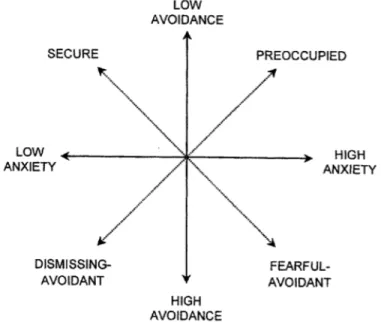
1. The two dimensions of avoidance and anxiety for attachment styles
as seen in Fraley & Shaver, 2000, pg. 145... 12
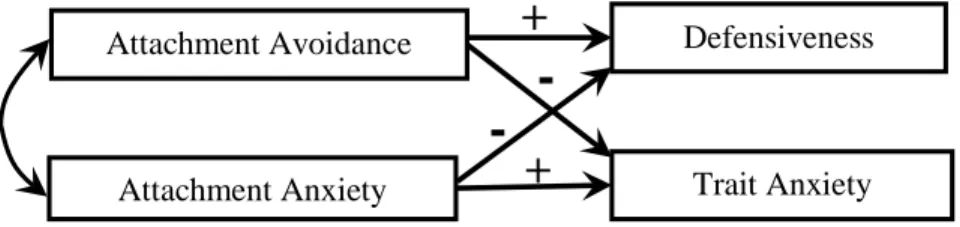
2. Hypothesized relations between attachment behaviors and ECS dimensions ... 22
3. Directional hypothesis of odds ratio relationships between attachment behaviors and Low-Anxious ECS ... 23
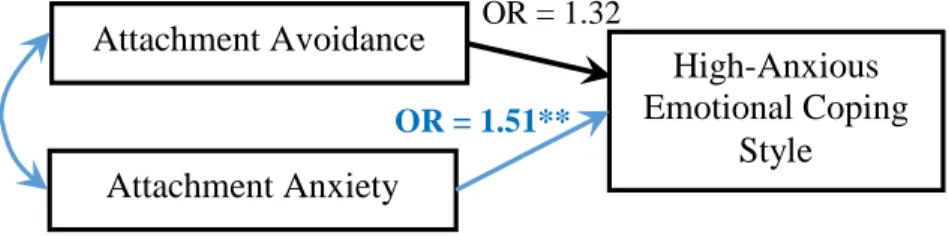
4. Directional hypothesis of odds ratio relationships between attachment behaviors and High-Anxious ECS ... 24
5. Directional hypothesis of odds ratio relationships between attachment behaviors and Defensive High-Anxious ECS ... 24
6. Directional hypothesis of odds ratio relationships between attachment behaviors and Repressive ECS ... 25
7. Hypothesized relations between attachment behaviors and resilience ... 25
8. Hypothesized relationships between attachment behaviors, emotional coping style dimensions, and resilience ... 27
9. Process of data cleaning ... 30
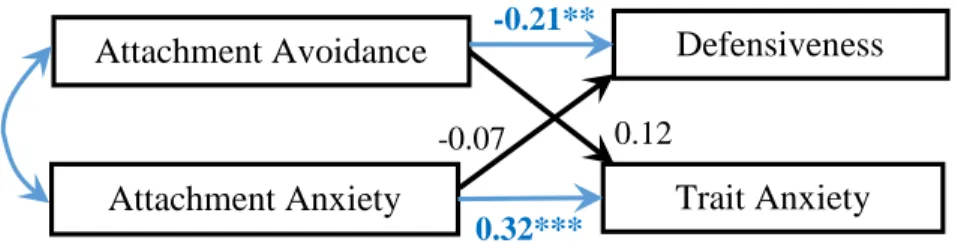
10. Multiple regression results for hypothesized relations between attachment and emotional coping style dimensions ... 46
11. Logistic regression results for Low-Anxious ECS ... 49
12. Logistic regression results for High-Anxious ECS ... 49
13. Logistic regression results for Defensive High-Anxious ECS ... 50
14. Logistic regression results for Repressive ECS ... 50
15. Multiple regression results for relations between attachment behaviors and resilience ... 52
16. Direct effect standardized path coefficients for relations between attachment behaviors, ECS dimensional variables, and resilience ... 58
CHAPTER I INTRODUCTION
Adult physical and psychological well-being has been shown to be linked with resilience (Burns & Anstey, 2010; Cederblad, 1996; Karreman & Vingerhoets, 2012; Miller, 2003). Resilience is generally conceptualized as the ability of an individual to achieve a positive outcome when exposure to negative or risky environments would predict a negative outcome (Rutter, 2007). The construct of resilience is weak in that it is confirmed retrospectively, rather than predicted, because the identification of resilience is necessarily dependent on the identification of adversity. Similarly, ambiguity in the definition and measurement of adversity exists, which further confounds the construct of resilience. However, regardless of adversity, resilience is often conceptualized as a strong, stress-resistant attitude (Condly, 2006) that aids the ability to effectively cope with situations that less resilient individuals struggle with. Recent investigations of resilience explore possible mechanisms underlying the construct in the attempt to find potential predictive indicators of resilience. Similarly, the current study attempted to discover the potential predictive power of attachment behaviors and emotional coping styles in regard to resilience.
Attachment is thought to initially evolve via the emotional interactions between parent and child. The development of these primary bonds influences how individuals interrelate in different relationships throughout their lifespan (Ainsworth & Bell, 1970; Bowlby, 1977). Attachment styles are discrete patterns of behavior that are characteristic of the ability to navigate interpersonal interactions. These patterns of behavior facilitate the ability of an individual to both self-regulate emotions as well as seek out and accept
social support when coping with life stressors, which is a necessary mechanism
underlying resilience. Research regarding the association of specific attachment styles with resilience, as measured by a stress-resistant attitude, has found that both dismissive attachment and secure attachment styles are associated with greater resilience, whereas fearful and preoccupied attachment styles are not (Karreman & Vingerhoets, 2012). The inconsistency regarding resilience among attachment styles raises the question of how certain individuals are cultivating the stress-resistant attitude characteristic of resilience and whether there are underlying mechanisms that can account for the differences observed.
Individuals with secure and dismissive attachment styles are distinct in their patterns of coping with interpersonal relationships and personal stressors. Compared to individuals with dismissive attachment styles, securely attached individuals are more likely to rely on social support systems when stressed (Mikulincer & Shaver, 2003). Dismissive individuals, however, are more likely to develop a strong, self-reliant attitude in which they avoid depending on others when coping with stress (Bowlby, 1977; Main & Solomon, 1986). Comparatively, those with fearful and preoccupied attachment styles tend to seek out social support when stressed, but remain dissatisfied with their
interactions with others, leading them to ineffectively cope with stressors. Individuals with fearful attachment styles tend to desire support, but experience intense anxiety about displaying vulnerability and therefore withdraw from peers whereas preoccupied
individuals exaggerate their need for support and often fail to gain the support they believe they require in order to cope with stressors (Mikulincer & Shaver, 2003). Each attachment style demonstrates distinct approaches for interacting with their social support
systems when coping with stress. A difference in emotional coping styles may underlie these discrepancies and may similarly help to explain why particular attachment styles are more likely to demonstrate resilience whereas others are not.
A small number of studies have linked attachment styles to emotional coping styles. However, within this limited research, it has been demonstrated that individuals with a repressive coping style are more likely to also have an avoidant attachment style (Vetere & Myers, 2002). Similarly, Coifman and colleagues (2007) determined that repressive copers are better able to cope with significant stress and demonstrate high levels of resilience (Coifman, Bonnano, Ray, & Gross, 2007). These studies provide evidence for potential connections between these three constructs.
Emotional coping styles are comprised of distinct patterns of behavior indicative of individual differences in the ability to cope with stressors in general (Myers, 2000; Weinberger, Schwartz, & Davidson, 1979). There are a total of four emotional coping styles: low-anxious, which is denoted by low levels of both anxiety and defensiveness when stressed; high-anxious, which is characterized by high levels of anxiety, but low levels of defensiveness when stressed; defensive high-anxious, which is illustrated by high levels of defensiveness and anxiety when stressed; and repressive coping style, which is characterized by a self-report of low anxiety, but a contradictory high level of physical anxiety (suggesting a dissociative style of coping), and high defensiveness when stressed. Differences in individual emotional coping styles may potentially expand upon the known coping functions of attachment styles and help further understand the link between attachment styles and resilience.
This study aims to expand upon previous research regarding attachment styles and resilience by (a) investigating the specific associations between attachment styles and emotional coping styles and (b) exploring the potential mediating effect that emotional coping styles may exert on the relationship between attachment styles and resilience.
Resilience
Resilience is generally defined as an individual’s achievement or maintenance of positive outcomes regardless of adverse experiences or risky environments that would normally predict a negative outcome (Rutter, 2007). Resilient individuals are able to better cope with extreme stressors than others who suffer the same experiences (Rutter, 2013). However, some ambiguity in the definition and measurement of resilience exists. For example, there are discrepancies in the literature as to what constitutes an “adverse environment” or “extreme stressor.” Researchers have explored resilience in situations of a single stressful event (Bonnano, 2004; Miller, 2003), a collective accumulation of negative life experiences (Luthar, Cicchetti, & Becker, 2000), and scientifically
scrutinized, prevalent risk factors, such as maltreatment and abuse in childhood (Rutter, 2013).
The ambiguity regarding the construct of adversity contributes to the overall confusion regarding resilience. Some researchers maintain that the construct of resilience should be limited to experiences of adversity across development (Luthar et al., 2000) while other researchers insist that resilience should be broadened to include all
individuals who display strength after facing hardship (Campbell-Sills, Cohan, & Stein, 2006; Miller, 2003). This confusion persists because adverse experiences in childhood may affect developmental processes that in turn promote resilience (Cicchetti, Rogosch,
Lynch, & Holt, 1993), in addition, characteristics of resilience may be promoted by individual differences in temperament or IQ (Rutter, 1990). It remains unclear whether the quality of adversity experienced affects resilience or if resilience is simply an inherent characteristic of the individual that allows more effective coping. If the type of
experienced adversity interacts with subsequent resilience, then it is imperative to clarify the degree of influence one factor has on the other. Rutter (2013) maintains that
resilience cannot be properly studied unless the risk factor and corresponding
maladaptive outcome have a clear causal relationship that has been established a priori. Otherwise, broad categories of potential risk factors can be mistaken as having a
substantial influence on potential outcomes when no relationship actually exists. Because of this potential risk, resilience must be understood in the context of hardship.
Because resilience is thought to occur when an individual maintains a
psychological equilibrium when faced with adversity (Miller, 2003), the construct itself is studied retrospectively. Resilience is usually identified when the context of experienced adversity is understood, commonly making the identification of resilience a dichotomous observation tied to a specific context. For example, when resilience is studied in regard to the loss of a loved one, the behaviors an individual displays when coping with this stress may be indicative of resilience, but the resilience identified is tied to the context of the personal loss. Resilience may be better understood as a continuous variable that assesses the degree to which an individual is able to cope with adverse situations (Condly, 2006). An individual who is deemed resilient may not maintain high levels of resilience in all adverse situations with which they are faced. Understanding the
construct of resilience as a continuous variable allows for fluctuations in coping with adverse circumstances.
As the construct currently stands, there are few definitive predictive factors that account for the occurrence of resilient characteristics. The investigation of resilience has mainly focused on uncovering individual characteristics that constitute resilience such as coping strategies (Beasley, Thompson, & Davidson, 2003), attitudes or self-perceptions (Burns & Anstey, 2010), or protective mechanisms such as temperament or IQ (Rutter, 1990). However, until a consensus can be achieved regarding what constitutes
“adversity” and its specific relationship with resilience, it is doubtful that these investigations will provide any clarity on the construct.
Regardless of the operational definition of adversity, those identified as resilient tend to demonstrate a pervasive, stress-resistant attitude (Staudinger, Marsiske, & Baltes, 1993; Watt, David, Ladd, & Shamos, 1995; Werner, 1995). This attitude has been described as “a dogged [determined attitude]… that they would conquer their circumstances, that they were people of worth and value, and that they had the inner resources to succeed” (Condly, 2006, p. 218-219). The prevalence of this attitude within resilient individuals has led some researchers to operationally define resilience as simply “a stress-resistant attitude, related to the appraisal of oneself as able to cope with
stressors” (Connor & Davidson, 2003; Karreman & Vingerhoets, 2012, p. 821). For the purposes of this paper, resilience was defined as a stress-resistant attitude as Karreman and Vingerhoets defined it in their 2012 study.
Resilience as a Stress-Resistant Attitude
In general, resilience is a construct that is inferred from observing the behavior and outcomes of individuals that have experienced significant stress (Rutter, 2012). Qualitative interviews with resilient individuals indicate a consistent belief that they are able to overcome negative circumstances and have the inner strength to succeed (Condly, 2006). This confidence in their ability to overcome may be due to “steeling effects,” which indicates a decreasing of vulnerability to stress through repeated exposure (Rutter, 2012). The more that an individual is exposed to stressful situations, the more said individual will become confident in their ability to cope. However, steeling effects are subject to individual differences such as age and environment. Repeated exposure to stress could sensitize an individual to stress and lead to psychological dysfunction rather than increased resilience (Elder, 1974).
Although the mechanisms underlying resilience are still being investigated, the concept is consistently marked by an attitude of perseverance, which undoubtedly facilitates successful coping (Wagnild, 2009). Individuals that maintain this stress-resistant attitude have demonstrated positive physical and psychological health outcomes (Cederblad, 1996; Connor & Davidson, 2003; Rutter, 1985), with higher levels of
resilience associated with lower reports of psychiatric or somatic ailments (Miller, 2003). Similarly, resilient individuals have reported experiencing more positive emotions and social support than less resilient individuals (Bonnano, 2004; Luthar et al., 2000). Given the protective potential of resilience, the construct is a worthwhile pursuit of study.
Attachment Theory
Attachment theory addresses the interrelationships and bonds between human beings throughout the lifespan (Bowlby, 1977) and is thought to influence the
development of emotional coping (Cassidy, 1994). Attachment is initially developed within the first nine months of life via the interactions between an attachment figure and infant (Ainsworth & Bell, 1970; Bowlby, 1977). The attachment figure is thought to represent a secure base for the child so that they may explore their environment yet return for safety when feeling threatened (Ainsworth & Bell, 1970). When distressed children seek out their attachment figure for security, attachment behaviors are easily observable. Ainsworth and colleagues (1978) initially identified attachment styles through
observation of parent-child interactions via the Strange Situation paradigm. Patterns of behavior characteristic of specific attachment styles emerged, including: secure,
anxious/ambivalent, and avoidant attachment styles (Ainsworth & Bell, 1970; Ainsworth, Blehar, Waters, & Wall, 1978). Securely attached children are characterized by the attempt to maintain proximity and contact to the primary caregiver, especially after a brief separation. Securely attached children seek out their attachment figure for comfort and are subsequently comforted by this person when distressed. Anxious/ambivalent children simultaneously seek and resist contact with their attachment figure when distressed. These children want to be comforted by their attachment figure, but may distrust the figure’s ability to comfort. Children within this category of attachment are generally more distressed by separation and have more difficulty calming their arousal. Finally, avoidantly attached children do not seek proximity to their attachment figure when distressed. Instead, they tend to avert their gaze and generally ignore the parent. If
the parent attempts to pick up the child to give comfort, the child does not resist or encourage contact, but remains relatively passive. This passive behavior seems to indicate a marked distrust in the ability of the attachment figure to provide comfort from distress (Ainsworth et al, 1978).
The interactions between the attachment figure and child allow the child to develop an understanding of how to both express and regulate their own emotional states (Cassidy, 1994). The quality of these interactions necessarily informs the attachment style that arises. Early attachment experiences influence a multitude of processes such as coping, stress management, emotional regulation, and overall psychological well-being (Cassidy, 1994; Ditzen, Schmidt, Strauss, Nater, Ehlert, & Heinrichs, 2008; Maunder, Lancee, Nolan, Hunter, & Tannenbaum 2006; Mikulincer, & Shaver, 2007). Although this primary attachment may attenuate over time given new opportunities for attachment, the original parent-child attachment commonly persists and influences the ability of an individual to develop affectional bonds throughout the lifespan (Bowlby, 1977; Fraley, Vicary, Brumbaugh, & Roisman, 2011).
Attachment theory maintains that attachment behaviors are indicative of an internal, representational model of others and self that allows learned expectations of behavior to guide how an individual copes with relationships and stressors throughout life (Bartholomew, 1990; Bowlby, 1980; Main, Kaplan, & Cassidy, 1985). In essence, individuals develop expectations about everyday social interactions and these expectations guide their interactions with others and themselves. If an individual develops an attachment style that is marked by confidence in positive interactions (or a positive view of others), then this person usually has the ability to rely on others when in
distress and to cope with stressors in a healthy way. On the other hand, subscribing to an attachment style that promotes distrust in others discourages an individual to ask for help from others when distressed and leads to a lowered ability to cope with stressors. The model of attachment can be utilized to explain certain psychopathologies and emotional distress within relationships by understanding the deviations from normal, healthy attachment development, which lead to a distorted internal model (Bowlby, 1977). Attachment theory has evolved not only explain the interactions between parent and child, but also to explain later adult attachments between friends, peers, and romantic partners (Ainsworth, 1982; Ainsworth, 1989; Fraley & Shaver, 2000; Hazan & Shaver, 1987).
Adult Attachment
Research in adult attachment has suffered from an overreliance on childhood representations and infant attachment styles that may or may not continue to be appropriate in adulthood (Fraley & Shaver, 2000; Hazan & Shaver, 1987). As a
consequence of this overreliance, research on attachment throughout the lifespan utilized the attachment style to the primary caregiver in order to attempt to explain later
attachment dysfunctions in relationships with others, such as a romantic partner or a best friend. Although the primary attachment style tends to remain stable throughout life, once a new attachment figure becomes available to an individual, it is possible that negative attachment behaviors (such as anxious and/or avoidant behaviors) can positively change over time.
Similarly, discrepancies regarding the attachment behavior of avoidantly attached adults emerged, with contradictory reports of both an active fear of closeness as well as a
general emotional detachment in relationships to individuals other than the parental figure. In response to these discrepancies, Bartholomew (1990) proposed a four-category model that differentiated between two forms of adult avoidance of intimacy: dismissive-avoidant and fearful-dismissive-avoidant. This model of adult attachment mimics the internal, representational model of the self and others originally proposed by Bowlby. However, qualms about the dimensions of the internal model arose (Brennan, Clark & Shaver, 1998; Fraley & Waller, 1998). Fraley and Shaver (2000) proposed that an internal
working model based on a concept of self and others was both inconsistent with empirical evidence regarding the attachment behaviors typical of preoccupied attachment style as well as unlikely to be consistent among the attachment systems of species other than human beings. Based on the work of Brennan, Clark, and Shaver (1998), researchers proposed that individual differences in attachment could more appropriately be distinguished using the behavioral dimensions of anxiety and avoidance instead of the conceptualizations of self and others. Within this framework, anxiety refers to the apprehension concerning rejection from others whereas avoidance corresponds to the uneasiness with intimacy and dependency (Brennan et al., 1998). Fraley and Shaver (2000) maintain that the internal working models of the attachment system are most useful when conceptualized using terms appropriate to how the attachment system is actually affected and the reconceptualization of the model fosters greater continuity of the attachment system from infancy to adulthood. Therefore, the internal models of
Bartholomew’s attachment styles were redefined as: secure: low avoidance, low anxiety; preoccupied: low avoidance, high anxiety; dismissing avoidant: high avoidance, low anxiety; and fearful avoidant: high avoidance, high anxiety (Fraley & Shaver, 2000; see
Figure 1). This model of attachment is currently the most accepted and dominant model of adult attachment.
Investigations regarding the categorical or dimensional nature of attachment styles followed the reconceptualization of attachment (Fraley & Waller, 1998). Fraley and colleagues (2015) performed a taxometric analysis of attachment and discovered that continuous measures of attachment avoidance and anxiety were superior to categorical representations of attachment styles (Fraley, Hudson, Heffernan, & Segal, 2015). Continuous measures of attachment behaviors allows for a more distinguished approach to understanding individual differences within the attachment system and were therefore utilized for the current study.
Figure 1. The two dimensions of avoidance and anxiety for attachment styles as seen in
Attachment Behaviors
The attachment system consists of both anxious and avoidant attachment behaviors that are enacted in order to increase proximity to an attachment figure (Bowlby, 1969, 1982). The attachment system is relatively prototypical in that attachment behaviors developed in early childhood maintain a stable influence over subsequent attachment opportunities (Fraley, Vicary et al., 2011). Due to the fact that the attachment system is developed early in the lifespan, observed attachment behaviors may be largely unconscious actions influenced by learned expectations in childhood. A notable difference between childhood and adult attachment is that adults are able to elicit a mental image of their attachment figure, such that specific attachment behaviors may not be directly observable (Mikulincer & Shaver, 2007). For securely attached people, this mental representation prompts positive, supportive thoughts and allows them to appropriately manage stress. However, mental attachment figure representation may elicit more negative associations for insecurely attached people, leading them to ineffectively cope with stress.
Both in childhood and adulthood, the attachment system is activated by any perceived threats to security. While in distress, individuals seek their attachment figure for comfort and assess whether the attachment figure is attentive to their needs. If the attachment figure is adequately attentive, security is reestablished. However, in the event that the attachment figure is not responsive to needs, hyperactivating (anxious attachment behaviors) or deactivating (avoidant attachment behaviors) strategies are employed in the attempt to regain security (Mikulincer & Shaver, 2007).
Anxious Attachment Behaviors. Within the attachment system, those who employ hyperactivating strategies are exceptionally sensitive to potential threats as well as their attachment figure’s responsiveness to their need for comfort. If the attachment figure is perceived as unresponsive, these individuals redouble their efforts to gain support and protection. Any perceived failure of attachment figures to adequately
respond to their needs is attributed to their own personal shortcomings, which leads to the reinforcement of a negative self-image (Cassidy, 1994). These individuals are perceived as immature and overly dependent on others, often showing excessive concern with gaining others’ approval (Bartholomew, 1990; Bowlby, 1977). Anxiously attached individuals tend to exaggerate the seriousness of their problems, their inability to cope, and their need for aid (Cassidy & Berlin, 1994; Mikulincer & Shaver, 2003), which may lead to engagement in maladaptive behaviors such as being overly helpful to others in order to gain favor and engaging in risky sexual intercourse. Those with higher attachment anxiety also can engage in controlling or clinging behaviors in attempt to guarantee an attachment figure’s attention (Mikulincer & Shaver, 2007), leading to increased anger and hostility within partner conflicts (Simpson, Rholes, & Phillips, 1996). These behaviors can promote relationship dysfunction as well as emotional maladjustment.
Avoidant Attachment Behaviors. Avoidant behaviors are indicative of
strategies to allow the individual to deny the need for an attachment figure and therefore deactivate the attachment system. Avoidant individuals inherently avoid intimacy and dependency within relationships in order to avoid the feeling of vulnerability and
from perceived threats (Mikulincer & Shaver, 2007), leading them to distance themselves from others and display compulsive self-reliance (Bowlby, 1977; Main & Solomon, 1986). This emotional dissociation is a learned method of managing stress within interpersonal relationships and within the self. Dissociation is considered “a way of organizing thought and attentional processes in response to implicit social injunctions from primary attachment figures ‘not to know,’” or a “defensive process [that is a] socially constructed way of relating” in order to accommodate the pressure experienced within early attachment interactions to not acknowledge distress (Dutra, Bureau, Holmes, Lyubchik, & Lyons-Ruth, 2009, p. 391). The dissociation of negative emotion becomes the primary method of coping for avoidantly attached individuals, which subsequently impairs their ability to regulate their biological stress response and may result in a lack of awareness regarding potential causes or consequences of psychological distress
(Diamond, Hicks, & Otter-Henderson, 2006; Dutra et al., 2009; Roth & Cohen, 1986; Spangler & Grossman, 1993). In fact, possessing an avoidant attachment style explained more variance in emotional dissociation than self-reported trauma in adults (Dutra et al., 2009; Nilsson, Holmqvist, & Jonson, 2011; Ogawa, Sroufe, Weinfield, Calson, & Egeland, 1997).
Emotional Coping Styles
The emotional dissociation observed within avoidantly attached individuals has also been noted within the literature on stress and coping. A persistent discrepancy exists between individual self-reports of anxiety and behaviorally observed anxiety as
report experiencing relatively low anxiety in comparison to physiological assessments of anxiety, which makes accurately measuring coping difficult.
In order to address this discrepancy, Weinberger et al. (1979) introduced a method for measuring emotional coping styles using the Marlowe-Crowne Social Desirability Scale to measure defensiveness (M-C SDS; Crowne & Marlowe, 1964) and the Taylor Manifest Anxiety Scale to measure anxiety (TMAS; Bendig, 1956; Taylor, 1953). The M-C SDS is used in order to identify those who are likely to underreport experienced anxiety through the measurement of defensiveness, whereas the TMAS is used to
measure trait anxiety. If an individual displays scores that indicate high defensiveness, it is likely that their self-reported anxiety scores incorrectly represent the actual
physiological experience of anxiety. This method of measuring coping allows researchers to better study different emotional coping styles without the use of
biofeedback machines. The scores on each of the scales are taken in conjunction in order to identify four distinct coping styles: low-anxiety, high-anxious, defensive high-anxious and repressive coping styles (Weinberger et al., 1979).
Emotional coping is defined as the use of “cognitive strategies to alter subjective experience” (Weinberger & Davidson, 1994, p. 588). Weinberger, Schwartz, and Davidson (1979) discuss emotional coping styles as a collection of semi-permanent individual differences that promote a style of coping rather than merely a collection of coping strategies. In other words, the cognitive strategies that are utilized to regulate emotional states arise from developmental experiences so that the strategies become innate reactions to stress instead of consciously chosen methods of coping. Emotional coping styles are similar to traditional attachment styles in that they consist of categories
that contain patterns of behavior unique to each coping style (Myers, 2000). Research has shown that attachment behaviors have a considerable influence on emotional coping strategies (Cassidy, 1994; Mikulincer, & Shaver, 2007), however, little research has been conducted that correlates attachment with specific emotional coping styles as defined by Weinberger and colleagues.
Low-Anxious. The low-anxious (LA) group reports a low score on the TMAS and a low score on the M-C SDS. This group is generally characterized by openness to experience and interpersonal relationships and a lack of defensiveness. Individuals in the LA group are better able to manage stress than the other coping styles (Weinberger et al., 1979).
High-Anxious. The high-anxious (HA) group reports high anxiety scores and low defensiveness scores. This group generally displays traits such as shyness, lack of assertiveness, and fearfulness of interpersonal contact (Weinberger et al., 1979). This group tends to ineffectively cope with stressors when compared to the LA group due to increased sensitization to potential stressors (Weinberger, 1990; Weinberger et al., 1979).
Defensive High-Anxious. The defensive high-anxious (DHA) group reports high anxiety scores and high defensiveness scores. Compared to the HA group, individuals who fall within the DHA group tend to show intermediate anxious behavior when presented with stressors (Asendorpf & Scherer, 1983). The most notable difference between HAs and DHAs is that HA individuals are more likely to personally disclose their level of anxiety whereas DHAs are not as likely to disclose such information (Weinberger et al., 1979). Although DHAs report a high defensive score similar to the
repressive group, studies have found that they do not share the repressor’s dissociative style of coping (Asendorpf & Scherer, 1983; Derakshan & Eysenck, 1997a).
Repressors. The repressive coping group, otherwise referred to as repressors (REP), report low anxiety, but high defensiveness on the scales. Interestingly, REPs score significantly lower on the TMAS than LAs (Kahn & Schill, 1971). Repressors are characterized by dissociation from their somatic, affective states and their perceptions of experienced stress (Weinberger, 1990). Although REPs tend to self-report a low
experience of distress, biofeedback methods have revealed they experience contradictory high levels of physiological states that indicate high stress (Weinberger et al., 1979). Research suggests that REPs maintain a rigid self-perception which leads to the unconscious and automatic avoidance of negative affect and experiences (Sherman & Cohen, 2002). This method of coping seems to affect overall functioning and is not isolated to one particular context (Barger, Kircher, & Croyle, 1997; Weinberger, 1990). REPs are less likely to recall negative autobiographical memories (Geraerts,
Merckelback, Jelicic, & Smeets, 2006), to report higher optimism for negative events than the other coping styles (Myers & Reynolds, 2000), and to consider any negative events that may happen to them to be due to forces outside their control (Weinberger, 1990).
It is important to note that REPs are not overly positive, but instead, the defensive avoidance of negativity results in more disclosure of positive attitudes when compared to the disclosure of negative attitudes (Myers, 2010). For example, when asked to self-report perceptions of parents on close-ended surveys, REPs are more likely to claim healthy, warm, and loving relationships with parents. However, when asked about
parental perceptions in a semi-structured interview situation, REPs disclose more
accurate, negative perceptions of their parents. REPs are more likely to display parental dislike and indifference when compared to non-REPs (Myers & Brewin, 1994) and are more likely to subscribe to an avoidant attachment style (Vetere & Myers, 2002). These findings indicate that REPs are more apt to disclose negative information as long as they have the opportunity to disclose positive information as well (Weinberger, 1990; Myers, 2010).
REPs may rely on the belief that not acknowledging internal cues of distress allows them to avoid the issue at hand (Weinberger, 1990). If there is no problem acknowledged, then there simply is no problem. Although this method of coping can actually be beneficial when dealing with psychological stress and adjustment (Coifman et al., 2007; Contrada, Czarnecki, & Li-Chern Pan, 1997; Langens & Morth, 2003), it also comes with physical health risks. REPs make up 30-50% of populations with chronic illnesses (Cooke, Myers, & Derakshan, 2003; Myers, Davies, Evans & Stygall, 2005). In 2012, Mund and Mitte conducted a meta-analysis which revealed that REPs are at a higher risk than non-REPs for developing ailments such as hypertension, cancer, and cardiovascular diseases. Interestingly, studies have also found that REPs are more likely to succeed in regulating health issues that are under their control, such as asthma,
diabetes, and dental care, but are not as successful with health conditions that are out of their control, such as cancer (Myers et al., 2005).
Attachment Behaviors, Emotional Coping Styles, and Resilience
Both attachment and emotional coping styles are thought to develop from early experiences in childhood that lead to specific patterns of behavior in social and personal
interactions (Bowlby, 1977; Weinberger & Davidson, 1994). Little research has been conducted linking attachment to emotional coping styles. A study conducted by Vetere and Myers (2002) found that REPs are more likely to have an avoidant attachment style than non-REPs. However, because their study examined repressive coping specifically, it did not document coping among individuals with other forms of attachment. Also, the study was conducted using Hazan and Shaver’s three-category model of attachment rather than continuous, dimensional attachment behaviors. Due to these discrepancies, more research is required to investigate the possible correspondence between attachment and emotional coping styles.
Attachment and emotional coping styles have both been tentatively linked to resilience (e.g., Coifman et al, 2007; Karreman & Vingerhoets, 2012). However, these studies are limited in focus and methodology. Coifman and colleagues (2007) focused on demonstrating the resilient tendencies of REPs when compared to nonREPs and did not investigate the varying levels of resilience among all of Weinberger’s four emotional coping styles. Similarly, Karreman and Vingerhoets (2012) utilized a categorical assessment of attachment style in regard to resilience, which limits the ability to
understand individual differences within these categories. The current study intended to further explore the relationships between attachment, emotional coping styles, and resilience by investigating all emotional coping styles and utilizing a continuous measurement of relevant variables.
Purpose of the Current Study
Research has demonstrated a link between attachment styles and resilience, in which secure and dismissive attachment styles were associated with high levels of
resilience, but preoccupied and fearful attachment styles were not associated with resilience (Karreman & Vingerhoets, 2012). While the patterns of resilience
demonstrated by secure, preoccupied, and fearful attachment individuals are consistent with attachment theory, dismissively attached individuals display a contradictory high level of resilience. Given the fact that dismissive attachment is categorized as an insecure attachment style along with preoccupied and fearful, one would assume that individuals with dismissive attachment style would demonstrate low levels of resilience. This discrepancy may be due to differences in emotional coping styles within the
differing attachment styles. Despite the evidence supporting the relationship between attachment and emotional coping, little to no research has been conducted using Weinberger’s four emotional coping styles. Similarly, tentative evidence has
demonstrated a link between the repressive coping style and resilience (Coifman et al., 2007), which further encourages investigation within this topic. The association between emotional coping styles and attachment styles may provide insight into why some
attachment styles are more likely to demonstrate resilience than others.
There are two main purposes of the current study. The first goal is to link the literatures regarding attachment and emotional coping styles. If met, this can further our understanding of emotional coping styles by allowing us to explore the influence of early attachment relationships on the development of coping in general. More specifically, this study aims to examine the association between dismissive attachment and repressive coping, which may allow us to illuminate some underlying explanation for the contradictions observed within repressive coping.
The second goal is to explore the role that emotional coping plays in examining the relationship between attachment behaviors and resilience. Due to the lack of research associating Weinberger’s four emotional coping styles with attachment behaviors, as well as evidence that suggests a relationship between attachment and resilience, the following hypotheses are proposed:
H1: The attachment behaviors of anxiety and avoidance will significantly relate to the emotional coping style dimensions of defensiveness and trait anxiety (see Figure 2).
Figure 2. Hypothesized relations between attachment behaviors and ECS dimensions.
In order to understand the relationships between attachment behaviors and emotional coping styles, as well as to more fully demonstrate a parallel between the attachment and emotional coping literature, additional hypotheses, investigating emotional coping styles in their traditional categorical representations, are required. I expect when exploring specific patterns among emotional coping styles that:
Attachment Avoidance Attachment Anxiety Defensiveness Trait Anxiety
+
+
-+
H1a: As attachment anxiety increases, the odds of belonging to the low-anxious emotional coping style decreases and as attachment avoidance increases, the odds of belonging to the low-anxious emotional coping style decreases (see Figure 3).
Figure 3. Directional hypothesis of odds ratio relationships between attachment
behaviors and Low-Anxious ECS.
H1b: As attachment anxiety increases, the odds of belonging to the high-anxious emotional coping style increases and as attachment avoidance increases, the odds of belonging to the high-anxious emotional coping style decreases (see Figure 4).
Attachment Avoidance Attachment Anxiety Low-Anxious Emotional Coping Style
-
-+
Figure 4. Directional hypothesis of odds ratio relationships between attachment behaviors and High-Anxious ECS.
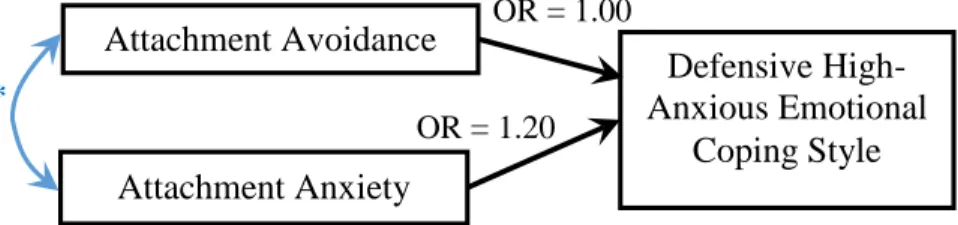
H1c: As attachment anxiety increases, the odds of belonging to the defensive
high-anxious emotional coping style increases and as attachment avoidance increases, the odds of belonging to the defensive high-anxious emotional coping style increases (see Figure 5).
Figure 5. Directional hypothesis of odds ratio relationships between attachment
behaviors and Defensive High-Anxious ECS.
Attachment Avoidance Attachment Anxiety High-Anxious Emotional Coping Style
-
+
+
Attachment Avoidance Attachment Anxiety Defensive High-Anxious Emotional Coping Style+
+
+
H1d: As attachment anxiety increases, the odds of belonging to the repressive emotional coping style decreases and as attachment avoidance increases, the odds of belonging to the repressive emotional coping style increases (see Figure 6).
Figure 6. Directional hypothesis of odds ratio relationships between attachment
behaviors and Repressive ECS.
H2: As attachment avoidance increases, resilience increases and as attachment anxiety increases, resilience decreases (see Figure 7).
Figure 7. Hypothesized relations between attachment behaviors and resilience.
Attachment Avoidance Attachment Anxiety Repressive Emotional Coping Style
+
-+
Attachment Avoidance Attachment Anxiety Resilience+
-+
H3: The relationships between attachment avoidance and attachment anxiety and resilience would be mediated by the emotional coping style dimensions of trait anxiety and defensiveness (see Figure 8).
F igur e 8. H ypot he si ze d r el at ions hi ps be tw ee n a tta chm ent be ha vi or s, em ot iona l c opi ng s tyl e di m ens ions , an d r es ili en c e.
CHAPTER II METHOD
Participants
Participants were conveniently sampled from Amazon’s Mechanical Turk (MTurk), which is a “crowdsourcing platform” that allows access to a more diverse population (Mason & Suri, 2012, p. 1; Paolacci, Chandler, & Ipeirotis, 2010). To be eligible, participants must have been between the ages of 18 to 29 and maintain current residency in the United States. Incentives for the study included a total of one dollar for completion of the study (Horton & Chilton, 2010). An a priori power analysis was calculated for the path model (i.e., hypothesis 3) using the N:q rule of 20 participants per parameter (Kline, 2011). There were a total of 13 parameters within the path analysis for this study, yielding a total required sample size of 260 participants.
A total of 433 individuals attempted the survey and 365 individuals completed the survey. Fifty seven participants reported being over the age of 29 and three participants reported living outside of the United States and therefore were ineligible to complete the study. Eight participants did not complete the survey and were therefore dropped from the analyses. After assessing and removing all cases terminated due to disqualification (n
= 68), I analyzed the remaining survey cases (n = 365) visually in order to detect “straight-line” data and failed attention checks. Several responses were rejected due to failed attention checks (n = 37), seven of which were straight-line data quality. Twenty-four cases were rejected due to IP addresses located outside of the United States (n = 24), as detected via Qualtrics survey software. These rejected responses did not receive the
incentive for completing the study and were not included in analyses. All participants that completed the survey with a completion time less than five minutes were dropped from analyses (n = 37). Finally, one participant failed to report their gender and was therefore excluded in the analyses. The final sample included a total of 266 participants (see Figure 9).
Figure 9. Process of data cleaning.
Of the 266 participants, 41.4% were men (n = 110) and 58.6% were women (n = 156) and the mean age of participants was 25.70 (SD = 2.63). Most participants reported relationship statuses of single (53.0%; n = 141) and married or civil union (24.1%, n =
64). Sample ethnicity included Caucasian (75.9%; n = 202), African American (9.4%; n
=25), Hispanic (4.9%; n = 13), Asian (6.4%; n = 17), Native American (0.4%; n = 1), and Multiracial (3.0%; n = 8) participants. Detailed demographic characteristics of the sample are reported in Table 1. The American Psychological Association ethical guidelines for the protection of human subjects were followed (see Appendix A for the information sheet given to all participants before the study).
Table 1
Demographic Characteristics of Final Sample (N = 266)
Variable N % Gender Female 156 58.6 Male 110 41.4 Ethnicity Caucasian 202 75.9 African-American 25 9.4 Hispanic 13 4.9 Asian 17 6.4 Native American 1 0.4 Multiracial 8 3.0 Education High School 26 9.8 Some College 79 29.7 Associate Degree 32 12.0 Bachelor Degree 103 38.7 Graduate School 26 9.8 Sexual Orientation Heterosexual 232 87.2 Gay / Lesbian 8 3.0 Bisexual 23 8.6 Pansexual 2 0.8 Relationship Status Single 141 53.0 Married / Civil Union 64 24.1 Living with Partner 51 19.2 Divorced / Separated 10 3.8
Procedure
The study was made available online through Amazon’s MTurk crowdsourcing platform. Participants on MTurk were recruited and compensated a total of one dollar upon successful completion of the study. The participants read a brief overview about the purpose of the study, gave their consent to participate, and completed the survey online. The survey included the measures listed below as well as questions regarding demographic information. Survey completion time averaged around 15 minutes. All materials and procedures were reviewed by Old Dominion University’s Institutional Review Board.
Overview of Materials
Listed below are the materials that were utilized in this study. Psychometric properties for each measure can be found in Table 2.
Experiences in Close Relationships-Relationship Structure Questionnaire
(ECR-RS; Fraley, Heffernan, Vicary, & Brumbaugh, 2011). The ECR-RS scale consists of 36 total items and assesses attachment in regard to 4 different target relationships: mother, father, romantic partner, and best friend. A total of 9 items are asked for each target relationship, yielding a total of 36 items for the scale. Participants are asked to rate each item on a scale of 1 (strongly disagree) to 7 (strongly agree). Sample statements include “I find it easy to depend on this person” and “I often worry that this person doesn’t really care for me” (see Appendix B). Each subscale yields a total of two continuous scores, one regarding avoidance and one for anxiety, and higher scores
indicate higher levels of the attachment behavior. The avoidance and anxiety scores were averaged across relationships to calculate a composite score for each (e.g., Fraley,
Heffernan, et al., 2011; Fraley, Niedenthal, Marks, Brumbaugh, & Vicary, 2006). These composite scores ranged from 1.0 to 5.38 for attachment avoidance and 1.0 to 6.08 for attachment anxiety. The ECR-RS scale demonstrated adequate to good internal
consistency within this study (αs ranging from .89 to .94; see Table 2) and has exhibited convergent and discriminant validity in previous research (Fraley, Heffernan, et al., 2011).
Marlowe-Crowne Social Desirability Scale (M-C SDS; Crowne & Marlowe, 1960). The M-C SDS is utilized to measure defensiveness for the classification of emotional coping styles. In 1964, Crowne and Marlowe reported that their original concept of social desirability necessarily measured a type of “self-protective and defensive” personality trait (p. 233) that necessarily engaged repressive defenses in response to social disapproval (Millham & Kellogg, 1980), which makes this scale an
excellent tool in measuring possible defensiveness in emotional coping. Similarly, Weinberger, Schwartz, and Davidson demonstrated convergent validity for this construct by determining that higher scores on the M-C SDS were indicative of the cognitive avoidance of anxiety that is characteristic of repressive copers (1979). The scale consists of a total of 33 items answered employing the forced choice of true or false. Sample items include, “I have never intensely disliked anyone” and “No matter who I’m talking to, I’m always a good listener” (see Appendix C). Possible scores range from 0-33, with each social desirable answer given by the participant receiving a total of 1 point. The sum of the items indicates the level of defensiveness of the participant. The scale demonstrated good internal consistency in this study (α = .87).
Taylor Manifest Anxiety Scale (TMAS; Bendig, 1956; Taylor 1953). The TMAS measures trait anxiety and was used both continuously as well as in conjunction with the M-C SDS in order to categorize coping styles within the sample. The scale consists of a total of 28 items and is answered utilizing forced choice true/false options. Sample items include, “I worry quite a bit over possible troubles” and “I sweat very easily even on cool days.” Scores can range from 0-28, with each answer indicating anxiety receiving one point (anxious answers denoted on scale; see Appendix D); the sum of all items yield a composite score for level of anxiety. The TMAS has exhibited good internal consistency (α = .91) within this study and construct validity within previous studies (e.g., Siegman, 1956) making it a reliable choice for assessing anxiety.
For the purposes of this study, the TMAS and M-C SDS were utilized both independently as continuous scores as well as categorically. The use of continuous measures allows us to more adequately understand the nuances of emotional coping
styles as they relate to other variables in the model. However, the method of employing the M-C SDS and TMAS scales in conjunction to categorize emotional coping styles is the most prevalent method used in research today. The original article by Weinberger, Schwartz, and Davidson (1979) detailing this method has been cited a total of 1,115 times, with 204 citations occurring between 2010 and 2015. Within this article,
researchers demonstrated adequate construct validity for the employment of these scales in assessing emotional coping styles by utilizing both physiological and self-report approaches to demonstrate theoretically consistent discrepancies between differing styles (Weinberger et al., 1979). In order to adequately explore the influence that emotional coping styles have on the other constructs within this study, the variables of trait anxiety and defensiveness were assessed continuously as well as in the traditional, categorical conceptualization.
In order to categorize participants into emotional coping styles, scores on both the TMAS and the M-C SDS were coded into either high or low categories using median splits (Barger et al., 1997). Scores for both measures were assessed in conjunction for categorization of coping style.
Connor-Davidson Resilience Scale (CD-RISC; Connor & Davidson, 2003). The CD-RISC measures individuals’ stress-resistant attitudes, which are thought to indicate their resilience (Campbell-Sills, Forde, & Stein, 2009). The measure consists of a total of 25 items that participants rate on a scale of 0-4 where 0 means not true at all, 1 means
rarely true, 2 means sometimes true, 3 means often true, and 4 means true nearly all the
time. The participant is asked to rate each item based on whether or not it is applicable to their experiences over the last month. Sample items include “I am able to adapt when
changes occur” and “I am not easily discouraged by failure.” Scoring involves summing the total of all items using the designated 0-4 markers. The full possible range of scores is 0-100, with higher scores indicating greater resilience. This scale demonstrated excellent internal consistency in this study (α = .94) and has previously been shown to have good test-retest reliability (r = .87) as well as convergent and divergent validity (Connor & Davidson, 2003) making it a sufficient measure for assessing resilience.
Demographic information. Participants completed a demographic questionnaire that collected information regarding age, gender, ethnicity, education, sexual orientation, and marital status (see Appendix E).
Amazon’s Mechanical Turk (MTurk). MTurk is an online marketplace that helps companies and researchers find people to perform tasks (Buhrmester, Kwang, & Gosling, 2011). It is commonly referred to as a crowdsourcing platform, which is generally defined as an arena where an individual is able to have a “job outsourced to an undefined group of people in the form of an open call” (Howe, 2006; Mason & Suri, 2012, p. 1). The human intelligence tasks (HITs) are advertised to “workers” on the site, who are considered independent contractors (Mason & Suri, 2012) that complete the task asked of them at the agreed upon compensation provided. Similarly, “requesters” are the individuals who provide the tasks to complete for compensation. Requesters can be companies, researchers, or any other type of individual who is interested in having workers complete a task.
MTurk samples provide more demographic diversity than standard Internet and university samples (Burhmester et al., 2011) and behave in similar ways as typical laboratory subjects (Horton, Rand, & Zeckhauser, 2011; Paolacci, et al., 2010; Rand,
2012). Horton and associates (2011) conducted a total of three laboratory experiments on MTurk and the results of their studies successfully replicated laboratory findings. These studies provide compelling support for the use of MTurk as an adequate tool in the collection of data (Landers & Behrend, 2015).
Data Quality. MTurk allows requesters to limit access to studies based on worker reputation, which is a percentage given for how often a worker’s submissions are
accepted or rejected by the requester (Mason & Suri, 2012). Peer, Vosgerau, and Acquisti (2014) assessed the effect of reputation on data quality through the use of
attention check questions and found that workers with high reputation (above 95%) rarely failed attention checks and the use of attention checks only served to increase data quality for low reputation workers. The current study included a total of five attention checks used to screen data quality and accept or reject worker submissions. Because of the included attention checks, the study utilized workers with reputation levels above 75% rather than the more restrictive 95% reputation level (Peer et al., 2014) in order to generate the required sample size for analyses.
CHAPTER III RESULTS
Preliminary Analyses
Data were first examined for missing values and outliers. Boxplots revealed no univariate outliers (i.e., outside three standard deviations) on any variables. Missing data ranged from 0% to 1.5% on all items. Little’s missing completely at random (MCAR; Little, 1998) test was completed and found that all scales were MCAR except for the mother attachment subscale of the ECR-RS (p < .001). Given less than 5% of data were missing from all scales, which is argued to be negligible missingness (Schafer, 1999), the missing data from the mother attachment subscale was treated as missing at random (Tabachnick & Fidell, 2001). All missing data were addressed through expectation maximization imputation.
In order to determine that different attachment relationships did not differentially relate to study variables, composite scores were created for each target relationship as well as a global composite score for avoidance and anxious attachment behaviors. Bivariate correlations demonstrated no major differences between individual relationship scores and the global attachment score (see Table 3). Therefore, analyses were
performed with the global attachment composite score.
All data were normally distributed and unimodal. Descriptive statistics for all study variables are presented in Table 4.
T
ab
T ab le 3 C ont inue d
Table 4
Descriptive Statistics of Study Measures
Measure M (SD) Range [Mix, Max] Skewness (SE) Kurtosis (SE) ECRS Avoidance 2.97 (0.95) 4.38 [1, 5.38] 0.03 (0.15) -0.48 (0.30) ECRS Anxiety 2.65 (1.30) 5.08 [1, 6.08] 0.69 (0.15) -0.28 (0.30) CD-RISC 66.05 (17.10) 97.00 [3, 100] -0.54 (0.15) 0.51 (0.30) M-C SDS 15.06 (6.68) 33.00 [0, 33] 0.31 (0.15) -0.19 (0.30) TMAS 12.21 (7.34) 28.00 [0, 28] 0.16 (0.15) -1.11 (0.30)
Note. N = 266; ECRS Avoidance = Experiences in Close Relationships – Relationship
Structure Global Attachment Avoidance; ECRS Anxiety = Experiences in Close
Relationships – Relationship Structure Global Attachment Anxiety; CD-RISC = Connor Davidson Resilience Scale; M-C SDS = Marlowe Crowne Social Desirability Scale; TMAS = Taylor Manifest Anxiety Scale.
Prior to hypothesis testing, a series of analyses were completed to assess whether demographic variables significantly related to any variables of interest. Primarily,
bivariate correlations were completed to assess the association of age with all variables of interest (see Table 5). Age was found to be negatively correlated with Attachment
Anxiety and Trait Anxiety and was therefore inserted into analyses as a covariate.
Table 5
Correlations between Study Variables
Measure 1 2 3 4 5 6 1. Attachment Avoidance -- 2. Attachment Anxiety .595** -- 3. Defensiveness -.241** -.170** -- 4. Trait Anxiety .306** .400** -.358** -- 5. Resilience -.485** -.392** .340** -.578** -- 6. Age -.088 -.141* -.026 -.148* .110 -- *p < .05, **p < .01.
Next, a series of independent samples t-tests were conducted to determine whether there were significant differences by gender regarding all variables of interest. Gender was found to be significantly related to Trait Anxiety, such that females
demonstrated higher anxiety than males, t(264) = 3.19, p = .010 (see Table 6). Therefore, gender was inserted as a covariate in analyses.
Table 6
T-test Results for the Effect of Gender on Study Variables
Males Females M SD M SD t-test Attachment Avoidance 2.96 0.86 2.97 1.00 0.05 Attachment Anxiety 2.49 1.16 2.76 1.38 1.67 Defensiveness 14.57 6.38 15.40 6.88 0.99 Trait Anxiety 10.53 6.50 13.39 7.67 3.19* Resilience 66.56 17.38 65.69 16.95 -0.41 *p < .05.
Using a univariate ANOVA, ethnicity was found to be marginally associated with
Attachment Anxiety, F(5, 255) = 2.22, p = .053, partial η2= .042. The demographic
variable of ethnicity was dummy coded (Caucasian = 0, n = 202; Other ethnicities = 1; n
= 64; see Table 1 for a breakdown of ethnicities). A follow-up independent t-test
revealed a significant difference between Caucasians (M = 2.52, SD = 1.24) and all other ethnicities (M = 3.05, SD = 1.42) on Attachment Anxiety, t(264) = -2.84, p = .005, in which Caucasians demonstrated lower levels of Attachment Anxiety than all other
Finally, a univariate ANOVA revealed that relationship status was significantly related to Attachment Avoidance, F(3, 256) = 3.11, p = .027, partial η2= .035. Post hoc
tests indicated a significant difference between single participants (M = 3.14, SD = 0.95) and married participants (M = 2.58, SD = 0.88) only, p < .001, such that single
participants demonstrated higher levels of Attachment Avoidance than married participants. Therefore, the demographic variable of relationship status was dummy coded (Single = 0; n = 141; Other relationship statuses = 1; n = 125) and inserted into analyses as a covariate. The demographic variables of education and sexual orientation were not significantly related to any variables of interest.
Hypothesis Testing
Hypothesis 1. Hypothesis 1, which stated that the attachment behaviors of anxiety and avoidance would significantly relate to the emotional coping style
dimensions of defensiveness and trait anxiety, was assessed via two separate multiple regressions. First, Defensiveness was regressed on Attachment Avoidance, Attachment
Anxiety, age, ethnicity, and relationship status. Contrary to the hypothesized positive
relationship between Attachment Avoidance and Defensiveness, it was found that
Attachment Avoidance negatively associated with Defensiveness, β = -0.21, t(259) =
-2.81, p = .005, partial r2= .028. Similarly, the hypothesized negative relationship between Attachment Anxiety and Defensiveness was not confirmed, as no relationship was found between these two variables, β = -0.07, t(259) = -0.93, p = .352, partial r2= .003.
In the second multiple regression, Trait Anxiety was regressed on Attachment