A Mixed-Method Study of Educator Knowledge and Practice Related to Student Socio-moral Development
Kelly Joelle Rizzo
Department of Graduate and Undergraduate Studies in Education
Submitted in partial fulfillment of the requirements for the degree of
Doctor of Philosophy
Faculty of Education, Brock University St. Catharines, Ontario
Abstract
A Mixed-Method Study of Educator Knowledge and Practice Related to Student Socio-moral Development
The purpose of this study was to explore elementary educators’ knowledge of moral development, how this knowledge relates to their beliefs and sense of efficacy pertaining to character education practices and the socio-moral reasoning of their students. It was hypothesized that educators’ beliefs and practices related to character education would reflect their pedagogy rather than knowledge of moral development theory. It was further hypothesized that there would be differences in student socio-moral reasoning
specifically the beliefs and desires that guide actions would differ based on grade and gender. This mixed-method study employing self-report questionnaires, open response vignettes, and semi-structured educator interviews yielded quantitative and qualitative data. Findings indicated socio-moral reasoning of students differed according to grade (age) and gender. Knowledge of moral development theory was found to vary among participants however some practices employed by educators did align with a social cognitive approach to moral development. Significant variables identified consistently among educator and student participants included, autonomy, social competence, sense of school community, and supportiveness. These variables, in conjunction with a sense of fairness, have been identified elsewhere as foundational to moral development (Nucci, 2009), and intrinsic motivation (Ryan & Deci, 2000) and are relevant to educators working to develop student socio-moral reasoning as an aspect of character.
Key words: moral development, character education, socio-moral reasoning, educator practices, Elementary school
Acknowledgements
As this work could not have been completed without the support of many, it is appropriate to acknowledge the contributions of these individuals here. To my advisor, Sandra Bosacki, I am most grateful for her willingness to share her knowledge with me and for the continuous encouragement that she gave. Telling me the work I was doing had value and was important made a difference! To my committee members, John Novak Larry Morton and Tanya Kaefer, I wish to convey my appreciation for their questions and the meaningful feedback they offered which helped to shape the final work. I must also thank Dr. Larry Nucci for his generosity in sharing the UIC questionnaire, his instrument by design, and for corresponding with me so readily to answer all of my questions. Thank you to the teachers and students who participated in this study so enthusiastically and to the administrators who supported it initially in their schools. Finally, thank you to my friends and family, in particular my husband, who provided me with encouragement during the challenging times.
When we sometimes doubt ourselves, as human beings tend to do, it is important that others see the possibility in what we are trying to accomplish and encourage us to persevere.
"Desire is the key to motivation, but it's determination and commitment to an unrelenting pursuit of your goal - a commitment to excellence - that will enable you to attain the success you seek." -Mario Andretti
Table of Contents
Page
Abstract ……… ii
Acknowledgments ……… iii
List of Tables………. vi
List of Figures……… vii
CHAPTER ONE: INTRODUCTION TO STUDY……….. 1
General Statement of the Problem ……… 1
Definition of Terms ……….. 7
Purpose and Educational Rationale ……….. 10
Outline of Remaining Chapters ……….22
CHAPTER TWO: LITERATURE REVIEW AND PRESENT STUDY…………. 24
Moral Development Theories: Childhood and Adolescence ……… 26
Educational Pedagogy: Establishing Classroom Culture ……….. 40
Character Education: Elementary School Context ………50
Elementary School Educators: Knowledge and Practice ……….. 62
Social Cognition: Children’s/Youth’s Judgment and Motivation ………….64
Summary of the Present Study ………..75
CHAPTER THREE: RESEARCH QUESTIONS, HYPOTHESES AND METHOD………..……... 80
Study Rationale ………. 80
Research Questions ………... 88
Hypotheses ……… 90
Method ……….. 91
Data Analyses Outline ………..110
CHAPTER FOUR: RESULTS………..117
Quantitative Results………...117
Qualitative Results ………139
Summary of Key Findings ………207
Chapter Summary ……….213
CHAPTER FIVE: DISCUSSION ……….218
Discussion Related to Research Questions ………...219
Hypotheses Confirmation and Disconfirmation ………....227
Discussion of Key Findings ………...243
Summary ………296
CHAPTER SIX: CONCLUSIONS ………298
Limitations of Measures ………298 Methodological Issues ………...301 Limitations………..303 Future Directions ………....307 Concluding Remarks ………. .311 References ………. 322
Appendix A: The University of Illinois at Chicago (UIC) Moral Development and Education Questionnaire (modified) ……….. 346
Appendix B: Child Development Project Student Questionnaire for Elementary School Students (modified)………...355
Appendix C: Structured Interview Questions for Educators………..362
Appendix D: Vignette Scoring Rubric………363
Appendix E: Vignette Coding Guide for Inter-rater Assessment with Student Responses………. ………364
List of Tables
Table Page
1 Participant Structure for the Current Investigation……… 96 2 Final Vignette Scenarios given for Student Response………103 3 Mean Scores for Six Scales from the Modified Child Development
Project Questionnaire………. 120 4 Mean Score for Multiple Choice Scale from the Modified Child
Development Project Questionnaire……….. 121 5 Intrinsic and Extrinsic Mean Scores with Index Ratio……….. 122 6 Mean Scores: Social Competence, Conflict Resolution,
Intrinsic and Extrinsic Motivation by Grade………. 125 7 Mean scores: Social Competence, Conflict Resolution,
Intrinsic and Extrinsic Motivation by Gender………... 126 8 Student Questionnaire Scales Pearson Correlation (r) ………..130 9 Comparison of Significant Pearson Correlations (r)
in Student Scales for Female and Male Participants………...…131 10 Comparison of Significant Pearson Correlations (r)
in Student Scales for Grade……….133 11 Student Responses to Social Vignettes: Motivation (Desire)
and Rationale (Beliefs)……….. 142 12 Domain Subordination/Coordination (Beliefs) Based on Grade………146 13 Domain Subordination/Coordination (Beliefs) Based on Gender…………..149 14 Relational, Instrumental, Combined, and Other
Motivation Frequencies Based on Grade………... 158 15 Relational, Instrumental, Combined, and Other
Motivation Frequencies Based on Gender………. 161 16 Descriptive Statistics for Part A and B of the Educator
Questionnaire………. 172 17 Descriptive Statistics for Each Item from Part A of the
Educator Questionnaire………..174 18 Descriptive Statistics for Each Item from Part B of the
List of Figures
Figure Page
1: Data Triangulation: A Visual Representation ………... 138 2: Vignette 2: Domain Subordination/Coordination (Beliefs),
N = 68………. 144
3: Vignette 1: Domain Subordination/Coordination (Beliefs),
N = 68………. 145
4: Vignette 2: Domain Subordination/Coordination (Beliefs)
Based on Grade……….. 147
5: Vignette 2: Relational, Instrumental, Combined, and
Other Motivation, N = 68………... 155 6: Vignette 1: Relational, Instrumental, Combined, and
Other Motivation, N = 68………... 156 7: Vignette 2: Relational, Instrumental, Combined, and
Other Motivation (Desire) Based on Grade………....159 8: Vignette 1: Relational, Instrumental, Combined, and
Other Motivation Frequencies Based on Grade………. 160 9: Part A Moral Development Knowledge for Educator Participants…………173 10: Part B Efficacy/Beliefs TTL for Educator Participants………..176
11: Interview Themes Mind Map ……….206
CHAPTER ONE: INTRODUCTION TO THE STUDY
The purpose of this chapter is to introduce the problem under investigation in the current study as well as the educational rationale. To assist the reader, terms used within are defined in this chapter. Finally, the remaining chapters will be outlined briefly.
General Statement of the Problem
In one form or another educators have for all time instructed youth in matters of socio-moral development. In the past 2 decades a growing emphasis on youth
socialization has resulted in an institutionalized effort known as character education, (McClellan, 1999). Despite these efforts student judgment does not consistently result in positive socio-moral outcomes. Children still cause harm to one another or are unfair to one another, despite being able to articulate how they should have conducted themselves. Enhanced educator understanding and intentional practices related to student socio-moral development may play a critical role in promoting positive inter- and intrapersonal development in youth and yield benefits to society at large by increasing the frequency of positive socio-moral outcomes.
Better understanding of the task, including an appreciation of the relationship between beliefs, desire, and action, is anticipated to be a necessary part of this process. Where beliefs are understood to be reflective of the worldview of an individual and are generally passive in nature, desire is the motivation to transform this view to suit the needs or wants of an individual (Sokol, Chandler, & Jones, 2004). In this sense, desires drive action, and are informed by beliefs. According to Nucci (2001), the bridge linking
knowing the good to, doing the good is desire “to do what is moral, rather than engage in
consideration for principles of justice and human welfare, and will be considered moral outcomes for the remainder of this study. For these purposes, such individuals will also be considered socially competent. Socially competent children tend to be more focused on relational goals, that is, maintaining relationships, than more aggressive children, who tend to focus mainly on instrumental or personal gain (Arsenio & Lemerise, 2004). Relations between individuals and the context for learning are integral to human development, (R. Lerner & Overton, 2008) and can be mutually beneficial (Bronfenbrenner & Evans, 2000).
The purpose of this mixed-method study was to explore relations between educator knowledge of moral development, their sense of efficacy and beliefs pertaining to character education, and the socio-moral reasoning of students. In terms of student socio-moral reasoning, this study explored Canadian elementary school students’ thoughts and feelings regarding principles of human welfare, justice, and social conventions, as well as different types of motivation.
In recent educational history within North America, England, and Australia, there has been a resurgence of interest in character education (McClellan, 1999; Nucci, 2009; Revell & Arthur, 2007; White & Warfa, 2011). For example, the Ontario Ministry of Education mandated all schools K-12 to implement character education effective September 2007 (Ontario Ministry of Education, 2006, 2007). Education historically responds to society’s changing needs (Nucci, 2006). The current focus in Ontario may be viewed as a response to perceived social and moral decay (Bennett, 1998; Putnam, 2003) or a time of rapid adjustment where historical injustices are challenged (Turiel, 2002) and educational institutions attempt to keep up.
Schools within the Catholic system have a religious mandate complete with values and beliefs expected of every member of that community:
In Catholic schools our foundational beliefs about teaching, learning, the profile of the learner, exit outcomes, essential and specific learnings, and program modification all relate directly to our foundational beliefs about the life and work of Jesus Christ and the tradition of the Roman Catholic
community which seeks to embody those beliefs, (The Institute for Catholic Education, 1996, p. 5).
Character education within the Catholic education system must support these
foundational beliefs.1 By way of contrast, Public education systems are typically
culturally and religiously diverse, and for this reason, it is the public education context that is of specific interest in the current investigation.
Simultaneously, research in educational practice for the instruction of literacy and numeracy knowledge and skills has seen a shift from a teacher-directed, to a teacher- facilitated model. This marks a significant change in what happens in classrooms with respect to instructional practice, as the level of control over learning becomes more of a shared responsibility. For example, a gradual release of responsibility model moves from teacher-directed tasks to independent tasks for students and is based at least in part on Vygotsky’s zone of proximal development (1978). This model also serves to shift the focus from teaching to learning. The practice of inquiry as a foundation for learning for both students and teachers has seen a greater presence in educational literature (see for example, Cochran-Smith & Lytle, 2009; Militello, Rallis, & Goldring, 2009),
emphasizing that educators do not know all the answers and like their students, must pursue knowledge to answer their questions. Dewey (1986) introduced the term “warranted assertibility” (p. 16) to replace the term “knowledge” and to emphasize the value of understanding why we come to know something, or the process, and not only what we come to know, or the content. Educators may serve the purpose of ‘mediator’ between content and student thinking, thereby supporting student learning. The Ontario Ministry of Education advocates this type of learning environment, suggesting that it will support the development of strong student self-efficacy (Ontario Ministry of Education, 2011).
Neiman (2008) argued that, to make sense of the world around us, it is critical that individuals seek justice, not simply rewards and punishments. This understanding is achieved through reflection and cannot be handed down from generation to generation simply as dogmatic rules, particularly in a secular society. Further, humankind must be able to envision and embrace possibilities if an improved reality is ever to be created. Part of what education must accomplish then, is to cultivate in our youth the ability to imagine something better and the desire to act upon these ideals. This calls for guidance from adults, educators, and parents alike. How such guidance is provided is relevant here.
The ease with which information can be accessed through technology including advanced electronic communication tools means an educator is no longer the sage on the
stage but rather the guide on the side, helping youth to navigate the sea of information
available to them and use it effectively in their decision making. Educators must know their students as well as the curriculum and understand how to engage learners in their classrooms to benefit fully from an inquiry approach to learning and development.
Technology at the point of learning is increasingly viewed as a tool to support student engagement through the inquiry process. The result is full school reform, a
transformation of practice for educators, with the intent of equipping youth with the anticipated skills for the future. Incorporated in this preparedness is advanced development of moral literacy, including the capacity to think critically and respond appropriately in highly complex, novel, and at times disorderly situations that do not conform to any prepackaged rules (Larson, 2011). The ability to imagine something better for humankind, thinking beyond anything that has been done before will be key.
Most commonly, school reform has focused upon educator practices targeting intellectual advancement of children rather than improving socio-moral capacities (Watson, Battistich, & Solomon, 1998). Teachers make countless decisions in a day about their instruction of students, how to cultivate and maintain a classroom climate, and be responsive to student needs. According to Cochran-Smith and Fries (2005), the
knowledge and beliefs of educators impact their practice and ultimately the development of their students. Given that professional development of any kind is rarely undertaken for matters of socio-moral development (Nucci, Drill, Larson, & Browne, 2005; Revell & Arthur, 2007), how then are educators prepared with the knowledge and understanding to influence their beliefs and practices so they might meet the expectation of assisting parents in developing morally literate youth capable of coping with the complexities of the world they will one day inherit?
Moral development through character education has enjoyed some attention from researchers in different corners of the world including the United States, United
of information between practitioner and researcher would occur to assist both
practitioners and researchers in productively continuing their work. This assumption is not borne out in the literature (Schuitema, Ten Dam, & Veugelers, 2008). Educators typically receive little or no formal training for their professional learning (Nucci, et al., 2005; Revell & Arthur, 2007) apart from their own professional reading or attendance at conferences, which may or may not focus on current research-based findings. Further, relations between practitioners and researchers are not uniformly established in
educational settings. Despite their initiative to become better informed, educators may not acquire or embrace the knowledge and skills necessary to ensure their practices are
consistent with positive socio-moral development of youth.
Confounding issues may include an ill-defined purpose of character education (Benninga, Berkowitz, Kuehn, & Smith, 2006), differing interpretations of moral and how morality is advanced (e.g., Is it a social, cognitive, or other process?) (Turiel, 2002), terminology confusion, including understanding of character, moral reasoning, judgment, and social competence, as well as a lack of research related to home-grown strategies and overgeneralized outcomes attributed to branded programs (Berkowitz & Bier, 2004; United States Department of Education, 2006). The purpose of this study was to explore: 1) educators’ knowledge of moral development and their sense of efficacy and beliefs regarding character education, in relation to; 2) elementary school students’ socio-moral reasoning; and 2) their use of instrumental or relational motivation in their reasoning. Long-term goals of this study were to raise the awareness of educators and researchers about the complexity of developing socio-moral reasoning in elementary school age students and further the scholarly discourse in this area.
Most research examining socio-moral development of youth evaluates branded programs (e.g., Tribes) in schools or takes place in laboratories or other artificial
environments, using standard dilemma-type questions (see Kohlberg, 1971; U.S. Dept. of Education, 2006 for examples). Typically the living Petri dish of the classroom or school environment, where real situations are encountered daily, requiring guidance from adults in the learning community to support student engagement of moral reasoning and action, is not the milieu for study. Therefore an anticipated outcome was to address this gap in the literature by using a Canadian elementary school based context for participation, focusing specifically on classrooms where no particular branded program for character education is employed within a large southwestern Ontario public school board. Through raising awareness about the complexity of developing socio-moral reasoning, this study may also assist in improving the conditions for educator learning, and ultimately, student outcomes, in Ontario’s public school system.
Definition of Terms
The following terms are used throughout this study to define key constructs and are defined below:
1. Morality: pertains to matters of harm, justice, and rights; it must be universal, obligatory, and free from the dictates of authority (Turiel & Smetana, 1984). It incorporates three elements: moral thought or reasoning, moral emotion, and moral action (Rest, 1984). According to Blasi (1980), not only is action the final criterion for determining morality, but that action must be intentional and not by any other means.
2. Moral outcomes: given the definition above, are outcomes that honour principles of justice and human welfare and will be indicative of relational values.
3. Character: According to Berkowitz and Bier (2004), “character is a complex set of psychological characteristics that enable an individual to act as a moral agent” (p. 73). Hunter (2000) defines character as the amalgamation of three properties: moral
discipline, defined as “the ability to inhibit and direct one’s passions, desires and
habits within a larger moral order;” moral attachment, “one’s affirmation of
commitment to a community and its moral ideals;” and moral autonomy, “the ability of an individual to freely make ethical decisions” (p. 2).
4. Moral judgment or reasoning are terms that have been used interchangeably to describe the cognitive processes activated in first understanding a situation,
coordinating any conflicting concerns, and then planning a response. More recently, a distinction has been made such that moral reasoning is the thinking that ultimately drives moral judgment (Greene & Haidt, 2002), the planned action. According to a number of developmental studies (see Turiel, Hildebrandt, & Wainryb, 1991 for example), the ways in which information is processed in order to understand and plan a response is impacted by “informational assumptions” (Wainryb & Turiel, 1995, p. 293). The basis for these assumptions depends upon the previous experiences of the individual which may include: understood scientific fact as well as religious
upbringing, and reflect what the individual believes to be true. Greene and Haidt (2002) have, through study of impairments to different regions of the brain, also concluded that emotion plays a significant role in moral judgment. While there is debate about the level of conscious reasoning versus intuition present in moral
judgment (see Cushman, Young, & Hauser, 2006 for example), for the purposes of this study, moral reasoning, is considered the thinking process that drives moral judgment. Moral judgment, the conclusion reached by an individual, is composed of three components: belief, desire (which may include emotion), and planned action. 5. Theory of mind is those unobservable processes that develop in infants, through
childhood, and beyond which enable an individual to process and respond to external stimuli (Flavell, Miller, & Miller, 2002). Only through the development of theory of mind can an individual explain and predict the actions of others (Flavell, et al., 2002) and inasmuch respond or act suitably given his/her beliefs and desires. Theory of mind then becomes the basis for social understanding and as such will have bearing on the development of an individual’s social competence as the sum total of
interpersonal skills.
6. Social competence has as its core effective functioning within a social context, where effective functioning is comprised of social accomplishments, global judgment of competence, and peer acceptance (Cavell, 1990). With respect to effective
functioning related to morality specifically, Nucci (2001) describes socially
competent youth as possessing a desire to do what is moral in a given situation rather than focus on other goals, such that their reasoning and actions are closely aligned. What is moral is considered to pertain to principles of justice and human welfare. Therefore, socially competent youth will not choose personal gain over these principles (Arsenio & Lemerise, 2004).
7. The term socio-moral is used throughout this study to describe the interaction between social and moral meaning making. The term is hyphenated to be consistent
with other literature in the field (see Keller & Edelstein, 1991; Narvaez & Lapsley, 2014 for example).
Purpose and Educational Rationale
In 2006 the Ontario Ministry of Education formally mandated the delivery of character education throughout Kindergarten to Grade 12 classrooms across the province. This mandate does apply to both the Catholic and public school systems. Catholic school boards have a religious doctrine on which to base their approach to character education (Ontario Ministry of Education, 2007). Yet within a secular and pluralistic society, no such platform exists, and cultural and religious diversity abound. For this reason the focus for this study was within the context of the public school system.
While the Ministry did provide a discussion paper for representatives of boards of education to begin the process, they failed to provide any formal professional
development and learning for front line practitioners either in the form of in-service or a guiding principles document upon which educators might have some basis for common understanding and approach to character education. There has been an apparent lack of direction with respect to a preferred character education approach based on moral development theoretical frameworks and available research. Taken together, these two factors leave educators very much to their own devices in determining how to deliver the character education mandate in Ontario. These circumstances are not uniform across Canada, as the Alberta Ministry of Education did, in 2005, produce a guiding principles document (The Heart of the Matter: Character and Citizenship Education in Alberta Schools), which they followed with a 2 day professional development plan to assist educators in the delivery of character education in Alberta schools (personal
communication, Alberta Minister of Education’s offices). This study sought to raise educators’ and researchers’ awareness about the complexity of developing socio-moral reasoning in elementary school age students and further the scholarly discourse in this area. Incorporated into this complexity is educator understanding of moral development theory as well as their sense of efficacy and beliefs regarding the delivery of character education. Finally, this study sought to improve the conditions for educator learning, and ultimately, student outcomes, in Ontario’s public school system.
This three-phase study explored educator knowledge of moral development, their beliefs and sense of efficacy pertaining to character education practices, and student socio-moral reasoning and judgment. Through this exploration it was hoped conditions under which moral outcome type behaviour among students was more frequently reported would be identified. Data from educators as well as students were gathered through the use of questionnaires. Semi-structured educator interviews for three of the educator participants were also conducted in an effort to deepen understanding of the complex processes at work.
The methodology for this study follows three distinct phases. The first began with educators as the unit of analysis. To gather information about their knowledge of moral development theory and beliefs pertaining to character education practices a three-part questionnaire, The University of Illinois at Chicago (UIC) Moral Development and Education Questionnaire (Nucci, et al., 2005) was employed. The second phase gathered information from students regarding their perspectives on their classroom and school, their socio-moral reasoning, including their beliefs and desires (motivation). To obtain this information a questionnaire previously used to measure the impact of the Child
Development Project, (see Battistich, 2003; Battistich, Schaps, Watson, Solomon, & Lewis, 2000; Battistich, Schaps, & Wilson, 2004) was employed. Finally, to provide further insight into teacher beliefs and classroom practices, interviews were conducted with a smaller sample of educators (n = 3). Quantitative data collected are reported separately from qualitative data in the results chapter, and are then discussed together during the discussion.
Specifically, there were seven research questions under consideration in the present study. The first question was are there relations between educator knowledge of moral development and sense of efficacy and beliefs pertaining to character education delivery? A second question was, does educator sense of efficacy and beliefs pertaining to character education differ based on school setting, years of experience, or grade taught?
Earlier research by Nucci, Drill, Larson, and Browne (2005) that investigated outcomes for preservice educators when moral development theory and character
education practice components were added to course work aligned with findings from the current investigation. According to Cochran-Smith and Fries (2005), the educational practices of teachers, including those used to establish learning conditions, are
determined in large part by their knowledge and beliefs. Identifying to what extent and in what ways educators use knowledge of moral development theory to guide character education practices they choose to employ was the first goal. Hayward (1999) explored the impact of community factors on levels of control exercised by educators in their classrooms. It was anticipated that findings from the second question would add to this earlier study. It was expected that community factors as perceived by educators, such as
poverty and crime rates, together with educator values and experiences, would influence the practices educators applied in public system schools and the subsequent experiences of students.
The related hypotheses were, first, that educators have limited knowledge of formal moral development theory and instead rely on educational pedagogy related to classroom management to guide their work, and second, that each educator participant would employ different practices intended to enhance student socio-moral development based on their beliefs and sense of efficacy and also on the culture of each school setting. Findings related to these research questions may be helpful in guiding policy makers in identifying areas and methods for further professional development to support full and effective implementation of character education in the province of Ontario, specifically within the public school system.
To explore for relations between educator practices and the learning experiences for students, four research questions were developed. These were intended to address student socio-moral reasoning and judgment relative to classroom learning experiences. Student learning; a socially mediated process is affected by the environment created by educators (Vygotsky, 1934/1986). First, is there a difference in student socio-moral beliefs based on learning conditions? Second, is there a difference in student socio-moral desires (motivation) based on learning conditions? Third, under what conditions are students likely to subordinate and or coordinate the social and moral domains in complex social situations? Fourth, under what conditions do students report behaviour consistent with caring relationships to result in positive moral outcomes? The hypotheses related to these four questions was that students will differ in their socio-moral reasoning (in their
beliefs and desires), their abilities to subordinate and or coordinate the social and moral domains in complex social situations, and in their inclination to use caring relationships in their decision-making depending on gender and grade.
Finally, given that school culture and climate are determined in part by educator pedagogy but also through the actions of all members of the school learning community, the seventh question seeks to determine if any relation exists between socio-moral
reasoning and self-reported behaviour of students across participating elementary schools relative to described school culture and educational pedagogy implemented in
participating classrooms. The hypothesis was that schools where students and staff are practiced in using principles of justice, human welfare, and relationships as the basis for decision making, a warm and supportive school culture and climate would also be reported.
This study furthers the moral development through character education discourse by focusing on the moral development theoretical knowledge of educators relative to their beliefs and practices related to character education. It was hypothesized that educators would be predisposed to beliefs and strategies which were aligned with their educational pedagogy which may be indicative of their schooling and upbringing experiences rather than direct theoretical moral development knowledge. Without clear understanding of the social, cognitive, and emotional elements related to socio-moral development, it would be difficult for educators to know how to proceed with specific educational strategies (Lapsley, 2008). The knowledge and beliefs of educators are translated into practice, and these practices ultimately affect student development (Cochran-Smith & Fries, 2005). Given this, the knowledge, beliefs, and practices of
educators deserve further study to explore implications for students and to identify conditions under which preferred outcomes are likely.
This three-phase mixed-method study incorporated questionnaires as well as educator interviews to obtain more complete answers to the questions under
investigation. A total of 75 participants were drawn from a population of JK–8 schools within a large southwestern Ontario public school board. There were three schools from which participants were obtained, each representing a different demographic: inner city urban, suburban, and rural. In the urban setting there were two participating classrooms: Grade 3 and Grade 5. In the suburban setting there were three participating classrooms: Grade 3, Grade 5 and Grade 8, and finally, in the rural setting there were two
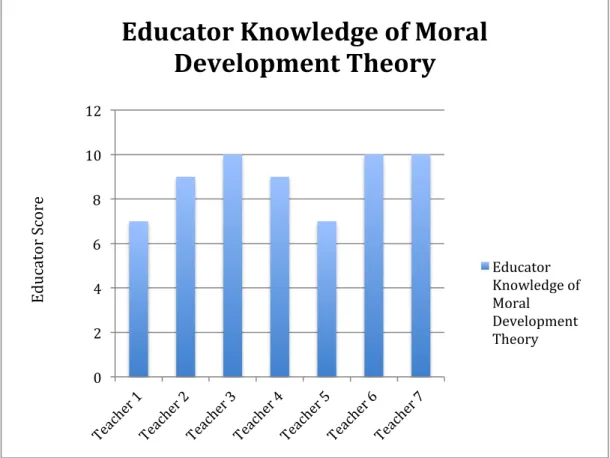
participating classrooms: Grades 3 and 8. The total number of educator participants was seven and the total number of student participants was 68: 34 female and 34 male. It was hoped that more educators would have participated, also increasing the number of
potential students from which to draw participants, however, the school year in which this study was conducted was a particularly challenging one, with many educators feeling overwhelmed with obligations related to assessing and reporting student progress. The study proceeded with the available participants, and serves as a reminder of the
challenges of conducting research in the milieu of the classroom.
In the first phase of this study, the unit of analysis was the educator, and the measure employed was, The University of Illinois at Chicago (UIC) Moral Development and Education Questionnaire (Nucci, et al., 2005). This instrument was modified slightly and was piloted prior to this study commencing. This instrument was intended to collect data on educator knowledge of moral development, beliefs and sense of efficacy in
influencing student moral development and classroom management strategies, as well as some demographic data. An additional question on this survey asked if participants would be willing to participate in a follow-up semistructured interview with the researcher.
The second phase of this study involved students in the classroom of each participating educator. All students from the classes of each of the educator participants were invited to complete a separate questionnaire. This instrument had been used
previously to measure the impact of the Child Development Project (see Battistich, 2003; Battistich, et al., 2000; Battistich, et al., 2004). This universal program attempts to mediate the needs of the individual with the need for positive social relationships by finding balance between intra- and interpersonal needs (Battistich, 2008) which is suggestive of social competence and therefore relevant to the current study. The student questionnaire focused on ethical sensitivity/judgment, motivation, conflict resolution, and perception of climate. It was modified with three additional vignette scenarios depicting social, moral, and mixed (both social and moral elements are present) domain situations to better reflect current investigational needs.
Four of the seven educator participants indicated a willingness to be interviewed for the third phase of this study (ideally there would have been at least one participant volunteer for each grade in each participating school as it was possible to have schools with multiple classes of the same grade). The schools randomly selected however did not have multiple classes of each target grade, and attempts to secure additional participants in other schools that also met the criteria (K-8 settings without a branded program in place) were not successful. The intent was to include participants with a range of responses from each of the three sections from the UIC questionnaire (knowledge of
moral development theory, sense of efficacy, classroom management strategies, and school demographics) to explore for differences in approaches used by these educators. Given the small sample size of educators, all who indicated interest were invited to an interview. Three interviews were conducted and, for reasons unknown to the researcher, the fourth volunteer failed to respond to further communication to set an interview time. The low teacher response rate to the original study invitation may be reflective of a challenging school year as the Ministry introduced a new report card fraught with difficulties that led many teachers to spend excessive amounts of time in preparation of report cards that year. Thus, perhaps due to the new professional demands and
obligations, many teachers found that their time and schedule were challenged. There were three main parts to this interview that paralleled the sections of the student questionnaire but utilized different questions. Each of the three parts constituted an overall focus: sense of classroom as community, social/interpersonal development, and social/moral development. The purpose of collecting these interview data was to explore, pedagogy, including educator sense of efficacy, and classroom practices in greater detail, and to confirm student self-reported behaviour.
Descriptive statistics were performed first to determine means, standard deviations, kurtosis, and skewedness for each section of the educator and student
questionnaires respectively. For educators these data were further explored qualitatively by analyzing individual responses of each educator for every survey item, looking for any differences or trends in responses. For student participants inferential statistics were also conducted based on the results of the descriptive statistics obtained. Statistical results are reported separately for educators and students in Chapter Four.
This was a multivariable study interested in exploring for relations as well as differences based on two independent variables. For student data these included: grade and gender (setting was not considered as not all grades are represented in all three settings). Dependent variables included: influence, supportiveness, sense of school community, self-esteem, autonomy, social competence, conflict resolution, intrinsic motivation, extrinsic motivation, socio-moral beliefs, instrumental and relational motivation. For educator data independent variables included: school setting, years teaching, and grade taught. Dependent variables were moral development knowledge and sense of efficacy and beliefs pertaining to delivery of character education.
2 (gender) by 3 (grade) ANOVAs were performed to identify any interactions between gender and the three grades (Grade 3, 5, and 8). Finding none, multiple one-way ANOVA tests were employed to explore for differences between gender and grades on each of the scales (dependent variables) from the student questionnaire. 1 x 7 ANOVAs were also conducted to explore for differences by classroom. To explore for any relations among dependent variables, Pearson correlations were conducted for all the subscales of the student questionnaire. Qualitative data were obtained through educator interviews and student vignettes. Educator interviews were transcribed and coded for themes. In
addition, the content of each interview was analyzed holistically to elaborate on
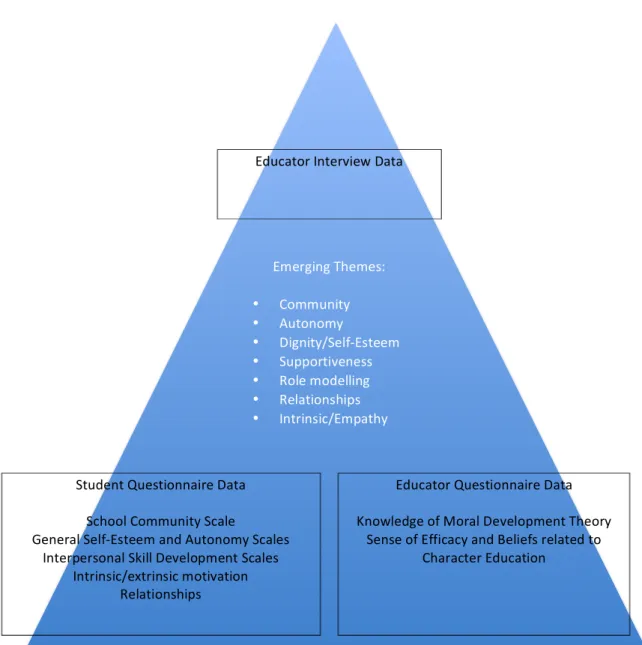
individual educator pedagogy and practices. The data obtained from the student responses to the social vignettes were analyzed to explore for any differences between gender and grade in student beliefs and desires. These data were reported as frequencies/percentages and were analyzed further for emerging themes or trends in student responses. Qualitative findings were triangulated with quantitative findings to provide more thorough understanding of
results of these analyses are reported first separately as quantitative and qualitative data in Chapter Four, and then in relation to each question under investigation as part of the discussion in Chapter Five.
An explanatory correlational design allows the researcher to investigate to what extent two (or more) variables covary (Creswell, 2008). Mixed-method designs and the use of triangulation of data have been identified as beneficial in the social sciences context (Creswell, 2009) and are especially valuable when the phenomenon under investigation is believed to be complex in nature (Cohen & Manion, 1981). For these reasons, this study followed a mixed-method design such that both quantitative and qualitative data and analyses were employed to explore the variables under investigation.
Transcribed interview material collected from educator participants during phase three were analyzed and compared for emerging themes. Educator interviews were coded according to emerging themes related to the following pedagogical elements: sense of classroom as community, development of social/interpersonal skills of students, development of socio-moral reasoning of students, and class culture/climate. Each interview was also analyzed holistically to further elaborate on each of the educators’ pedagogy and practices. Student responses to the vignette questions from their
questionnaire were coded to identify themes related to (a) beliefs/socio-moral reasoning, (coordinating or subordinating social or moral elements) and (b) desire/motivation for action (relational or instrumental goals). These themes were compared to the responses of the educators on their questionnaires and interviews. These data are anecdotal in nature.
Since there is limited research available which addresses first, relations between educator knowledge of moral development and beliefs and practices pertaining to
socio-moral reasoning and judgment of students, this study aims at first, raising
awareness of this gap, and second, providing some empirical data at an exploratory level. This study provided examples of some strategies employed by educators in relation to their beliefs and understanding of moral development theory. Further, it highlighted the occurrence of relational or instrumental motivation, and justice and human welfare principle-based or social convention-based reasoning reported among public elementary school age children. This three-phase study focused on educators (phases 1 and 3) and elementary school age children (phase 2) from Grades 3, 5, and 8. Some differences between groups were evident and are described further in the results and discussion sections of this study. Further study into later adolescence may also be warranted to determine differences relative to maturational development.
This study used the social cognitive moral development theory, domain theory, as a lens for interpreting educator and student understanding of socio-moral reasoning (Nucci & Turiel, 2009), incorporated a social information processing model to consider motivation that leads to action (Crick & Dodge, 1994) and used a bioecological model (Bronfenbrenner & Evans, 2000) and relational theory (Lerner & Overton, 2008) to explore reciprocal relations between participants and their surroundings.
The findings of this study contribute to the moral development through character education literature first, by identifying some variation in knowledge of moral
development and feelings of efficacy related to character education among educators. Second, it highlights differences in the socio-moral reasoning (beliefs/desires) and judgment of female and male students in different grades. Finally, it provides examples of strategies employed to create learning conditions conducive to positive socio-moral
development in concert with academic development. This, according to Leming (2008), is perhaps even more important than identifying “what works” in character education. Findings from this study were used to make recommendations on how the Ontario Ministry of Education might better support educators in their task of advancing socio-moral development of all children.
In conclusion, this three-phase mixed-method study explored elementary school educators’ knowledge of moral development, their beliefs and sense of efficacy
pertaining to the delivery of character education, and the socio-moral reasoning and judgment of female and male students in different grades. The first phase focused on educators. Data were collected through the completion of a modified version of the University of Illinois at Chicago (UIC) Moral Development and Education Questionnaire (Nucci et al., 2005). The second phase explored student socio-moral reasoning, the beliefs and desires that govern their planned actions. Specifically student beliefs were explored for their use of moral principles of justice and human welfare and/or social conventions to govern judgment. Student desires were explored for the use of relational or instrumental motivation as their rationale for judgment. This phase employed a
modified version of the Child Development Project student questionnaire (see Battistich, 2003; Battistich, et al., 2000; Battistich, et al., 2004). The final phase, semistructured educator interviews, provided greater insight into beliefs and classroom practices of educators as they support both the academic and the socio-moral development of their students.
Outline of Remaining Chapters
Following this introduction, the second chapter provides an overview of the current and relevant research in the fields of character education, moral development theory, instructional/leadership pedagogy of educators, student reasoning and judgment. This study covers several disciplines, including educational pedagogy, philosophical and psychological approaches to moral development, and character education practices. It was necessary to provide the reader sufficient background understanding relative to the current study and yet not muddy the waters with irrelevant details. For this reason research relating to elementary school age children was the focus when these disciplines and the overlap that exists between them was explored.
Chapter Three outlines the specific research questions and hypotheses of the current mixed-method study, including the rationale for the design, and leads into the methodology. It is here that participants are described in conjunction with the measures employed and the procedures followed. This chapter describes some of the limitations of these measures as well as the statistical analyses applied. Chapter Four provides the results of this mixed-method study. It is divided into quantitative and qualitative sections incorporating results from educator and student participants. Part one pertains to
quantitative data obtained through the student questionnaire and includes descriptive and inferential statistics (ANOVAs, and correlational analyses). The qualitative section incorporated the educator questionnaire descriptive statistics, and included an item analysis of the educator questionnaire, the student vignettes, and the educator interview analyses. The qualitative data reported are intended to clarify the quantitative data obtained in this investigation. Chapter Five is a discussion of the findings relative to the
questions and hypotheses from this investigation. The implications of these findings are also discussed, and recommendations for further investigation of identified areas of interest related to educator knowledge of moral development, their sense of efficacy and beliefs pertaining to character education practices, and reported student socio-moral reasoning are presented. Chapter Six outlines the limitations of this study, including methodological issues identified, and offers final thoughts for consideration.
CHAPTER TWO: LITERATURE REVIEW AND PRESENT STUDY Research in the fields of moral development theory and character education practice has seen renewed interest in recent North American, British, and Australian history (McClellan, 1999; Nucci, 2009; Revell & Arthur, 2007; White & Warfa, 2011). However, investigation into educator knowledge and understanding of moral
development theory relative to their character education beliefs and practices and the moral reasoning and judgment of students is absent from the literature. Educator practices have the potential to greatly impact student learning, whether that impact is in areas of academic subject matter or socio-moral development and as such is worthy of study.
Accepting that educator knowledge and beliefs influence their practices (Cochran-Smith & Fries 2005) and therefore the conditions for learning created in
classrooms/schools, there may be educational significance in research that illuminates relations between what educators know about moral development and do with respect to character education, and student socio-moral reasoning and judgment. Such research may help with the identification of conditions that support student socio-moral development. According to R. Lerner and Overton (2008), it is essential to determine whether specific conditions, predicated on theory, are related to positive development outcomes. The potential for educators to impact student development generally, and the lack of research regarding relations between educator moral development knowledge, their sense of efficacy and beliefs pertaining to character education, and student socio-moral reasoning within the context of Canadian elementary schools, provides the rationale for the present study.
The purpose of this chapter is to critically review the available literature (both theoretical and empirical) pertaining to socio-moral development of elementary school age children as well as the pedagogy and character education practices of educators for this population. Given that socio-moral development is such a vast and complex matter, aspects of psychological, philosophical, and pedagogical theories and practices will be discussed.
There are four main parts to this literature review intended to give the reader sufficient background information and understanding, and to provide support for the need for the current study. An examination of past and present psychological theories
including further clarification of terminology relating to moral development will set the stage. Incorporated in this portion of the review are relevant philosophical underpinnings related to these psychological theories. A general overview of educational pedagogy follows and addresses the nature of pedagogic practices, including leadership style, in elementary classrooms as they influence classroom/school culture and climate. Next, studies related to character education practices in elementary schools (with an emphasis on North America, the UK, and Australia) are examined and include studies that measure educator knowledge of moral development. Finally, this review incorporates empirical studies relating to the behaviour of elementary school age children to explore the beliefs and desires/motivation that influence student judgment, including planned action. By better understanding the purposes served by student actions, it may become more
Moral Development Theories: Childhood and Adolescence
The study of moral development from a psychological perspective has broadened substantially in recent decades and incorporates not only a range of psychological
theories (e.g., social and cognitive) but also links to other disciplines including
philosophy, sociology, and biology (Killen & Smetana, 2006). Four main psychological frameworks of moral development theory, including their links to earlier philosophical theories, are the focus for this review. They include behaviorist theory, structural (cognitive) developmental stage theory, cognitive developmental theory and social cognitive theory. Each of these theoretical frameworks places more or less emphasis on matters of the individual, reasoning, and the impact of their surrounding environment. In addition to these rational approaches, some supporting literature of a nativist perspective is also provided, as the long-standing debate about whether moral development is nature or nurture continues (Haidt, 2012).
Two main philosophical theories have provided foundational concepts from which psychological theories have evolved. The behaviorist theoretical approach has been linked previously to the work of Aristotle (Leming, 2008), suggesting that virtuous behaviour was a matter of habit formation. Through repetitious experience, individuals learn to apply the attributes deemed by society to be good and desirable for life. Such attributes are obtained through the tutelage of the young by parents and teachers
including mentors until such external guidance or direct instruction is no longer deemed necessary. Understood in this way, moral development would not be possible without the guidance of members of a community (Narvaez, 2006) including members of the
practice but rather the result of “guided reflection” (p. 719), suggesting that behaviour is not without relation to thought and therefore may not be as different from the
philosophical position of Kant, the second philosophical theorist, who posited that moral development is related to the advancement of cognitive capacities to resolve issues encountered (Lapsley, 2008). Each of the following theories has roots in one of these philosophical approaches, creating a kind of antimony in understanding and explaining moral developmental processes.
The earliest psychological perspective of moral development theory to gain popularity was based in behaviorism, which began with the seminal work of Edward Thorndike and was based on Freud’s psychoanalytic theory (1930/1955). The premise for behaviorism is essentially that behaviour is learned based on stimulus-response pairings. Applied to moral development, children would be expected to learn morality as it were, by repetitious experiences with direct instruction by adult role models. Specific traits of morality would be reinforced until the transmission of values was complete (Wynne & Ryan, 1983). This implies a highly structured, rule-bound relationship between adult and child where children are rewarded for conforming to the rules and punished when they do not. The expectation would be for a child to behave according to the rule they had
learned, regardless of the situation. Thus, a child who learned the rule for honesty should be able to articulate the appropriate or honest course of action (the rule) and then
demonstrate honesty in their behaviour across all situations. In fact this has not been borne out in research where a “disconnect” between thought and action has been found, suggesting there may be other mediating variables at play. This “rule-based response” has
also been problematized as diminishing the ability of students to participate in democratic processes within a global society (Webster, 2010).
Former students of Edward Thorndike, Hartshorne and May (1928) conducted their seminal research to assist Thorndike in the development of test material to assess the moral aspects of an individual’s character (as cited in Leming, 2008). Their findings have been referred to in much of the moral development literature to date (see Cunningham, 2005; Nucci, 2001; F. Power, Higgins, & Kohlberg, 1989 for example). Hartshorne and May found little consistency between responses on measures and observed performance. This finding led them to conclude that there are no such things as ideal traits that form the collective character of an individual and that application of any trait of good character was tied to the situation, not innate capacity. The argument that some aspects of character are innate has been supported elsewhere (see Haidt, 2012; Noddings, 2012), suggesting there is a biological basis for some behavioural tendencies, such as aggression serving a protective instinct. Rather than question which is stronger, learned behaviour or natural instincts, it may prove more fruitful to examine the relations between individuals and the context in which they exist, establishing where mutually beneficial (where the individual and the family, school, community benefit) influences occur and how these relations change both the system and the individual over time (R. Lerner & Overton, 2008). This becomes the work of developmental scientists interested in increasing the probability of positive outcomes for youth, the family, and the community at large (R. Lerner & Overton, 2008) and for this reason is relevant to the current investigation.
From the 8,000 student participants in the Hartshorne and May study they expected to find some who were virtuous most of the time and some who were not. In
fact they found virtually all 8,000 participants would lie, steal, cheat or act selfishly in certain circumstances. This led researchers Hartshorne and May to conclude that good character is “situation specific”; through experience, certain responses to situations yield better results than others and are therefore more likely to be replicated in novel but similar situations (Nucci, 2001).
Environmental influences, including people, symbols, and objects in the immediate environment are thought to influence human development based on a bio-ecological model (Bronfenbrenner & Evans, 2000; Bronfenbrenner & Morris, 1998). The reciprocal and dynamic interaction between persons and their environment over time influence competence in intellectual, socio-moral, or physical domains and ultimately, ability to direct behavioural outcomes. According to R. Lerner and Overton (2008), examining alignment between context and individuals over time must occur in settings critical to human development, including the family, school, and community.
Bronfenbrenner (2005) argues this is how to promote positive development. R. Lerner and Overton extend this thinking to specify that by isolating what features within what context, and at what point in development, results in what kind of outcomes, will increase opportunity to optimize positive outcomes.
Based on the findings of Hartshorne and May in conjunction with the bio-ecological framework for understanding human development, and the developmental systems and relations metatheory, an argument can be made for reasoning concomitant with environmental or contextual experiences. This approach becomes a greater focus with the work of cognitive developmental theorists such as Jean Piaget.
Jean Piaget (1932/1965) studied the socio-moral development of children, specifically the progression of judgment made by children through distinct and logical stages. Each stage builds upon the previous one, creating a cumulative effect on
judgment, and represents growing autonomy in decision making. Piaget argued that while a child progresses developmentally in his or her character formation, it is in concert with their environment. They will not learn by being told by adults, and this advancement will not happen until they are developmentally ready and have the correct kinds of
experiences from which to learn (Haidt, 2012). In large part these experiences were related to parent–child relations. Piaget went on to describe two types of parent-child relationships that would either promote or impede moral development. The first of the two relationships focuses more on obedience to authority and is considered heteronomous morality because behaviour is regulated by a sense of obedience rather than
self-regulation (DeVries, 1997). This type of relation is one of coercion, using rules to dictate expected conduct, and resembles a pure behaviourist approach. The child in this case has no responsibility for reasoning about the moral course of action; he or she simply follows the rules given. This approach has potential problems, including the failure to develop the capacity to reason for oneself and the development of dependency on others. Piaget cautioned that this type of relation actually reinforces the need for behaviour to be governed by others rather than the children themselves and could lead to problems later when behavioral control is not as easily done (DeVries, 1997).
The second type of morality described by Piaget is more internally driven and is associated with a more cooperative parent–child relation. The child is autonomous in his or her decision making, relying on his or her personal convictions to guide his or her
thinking (DeVries, 1997). This ability is possible because the parent has provided ongoing developmentally appropriate opportunities for the child to learn to consider the needs and feelings of others as well as their own perspective when making choices. It was Piaget’s position that through continuous interactions based on principles of cooperation, a child learns the importance of social reciprocity, the cornerstone for both moral and cognitive development. These interactions may be parent–child or child–child centred. The work of Piaget laid the foundation for further research and theoretical claims pertaining to moral development in children, including work by Lawrence Kohlberg, which attempts to delineate stages of moral development based on the principle of justice.
Lawrence Kohlberg, a seminal researcher in the field of moral development, studied morality from a structural (cognitive) developmental perspective during the 1960s and ’70s. Kohlberg elaborated on the use of judgment in determining a course of action, as introduced by Piaget (1932/1965). Kohlberg’s findings led him to conclude that children progress naturally through distinct stages of moral development where the level of judgment is advanced based on the ability to apply the principle of justice in the rationale for action. Kohlberg was interested in quantifying progress in moral reasoning by applying a structure (Haidt, 2012; Reimer, 1977). He identified three major levels, the preconventional, conventional, and postconventional, or principled level. Within these three levels, six stages of development were conceived: (a) heteronomous morality, (b) instrumental purpose and exchange, (c) mutual interpersonal expectations, relationships and conformity, (d) social system and conscience, (e) social contract or utility and individual rights, and finally (f) universal ethical principles (Power et al., 1989). Each of these stages represents unique structures of reasoning. The six stages of development
produce a cumulative positive effect on moral judgment as the individual progresses from early stage structured responses based on heteronomy and instrumental (or egocentric) gain to those reflecting greater autonomy and universal principles for the greater good, at the more advanced stages of reasoning. Movement through this continuum represents growth in the moral development of the individual and occurs naturally, according to Kohlberg, over a lifetime. However, he does acknowledge that not all adults demonstrate moral reasoning at the final stage (Power et al., 1989), which has been one of the
challenges with Kohlberg’s theory.
At the heart of each stage are understanding of justice, related motivation for making the right choice, and the level of freedom in making each judgment, which then leads to action. The earliest motivation is avoidance of punishment, which evolves into serving individual needs while recognizing that others have interests also. By stage three the individual has a need to be a good person in the opinion of others and that of the individual him/herself. The rationale then shifts to obligation to maintain the system and eventual recognition that the welfare of all people depends on established laws and duties. The final stage is the acceptance of universal moral principles and a desire to abide by them (Power et al., 1989). As Kohlberg (1971) discovered, individuals may choose the same action to dilemma situations, however the rationale for those choices follows different structured stages of reasoning. The more advanced stages incorporate a rationale based less on fear of punishment and more on the ability to prioritize needs according to what is just (Reimer, 1977). The unifying premise of the Kohlberg model for moral development is an understanding of “justice” not as a distinct value but as an evolving process, which underlies an individual’s capacity for moral judgment (Power et
al., 1989). The individual’s conceptualization of fairness evolves through each of the six stages and guides choices between right and wrong.
Like Piaget, Kohlberg found that to develop moral reasoning that would support their judgment, children needed to gain experiences within their environment and the people in it. In fact, one of Kohlberg’s noted findings, according to Haidt (2012), was that the most morally developed youth were the ones who had opportunity to understand alternative points of view through role–taking experiences in their natural environment. Haidt further identified hierarchical relationships such as those commonly found between adults and children impede role–taking, since a child may struggle to put him/herself in the place of an adult; however, egalitarian relations, such as the relationships between peers, invite such role-taking opportunities and may actually promote more advanced reasoning. Based on the work of Piaget and Kohlberg and the assumption that education is often considered an extension of parenting, it is possible that similar relations and outcomes would be observed in classroom environments between educators and students and even further, as suggested by Haidt, as students interact with their school community. Thus the present study took place within school settings and considered specifically the interactions among educators and students within these learning communities.
Promotion of moral judgment is not simply learning a set of socially accepted behaviours or rules; it is a structural capacity and, once it is developed, although performance is situationally varied, the capacity resides within the individual to apply (Power et al., 1989). This is a distinguishing feature from the earlier behaviourism approach to moral development that essentially described behaviour as being controlled by factors external to the individual, and an extension of the earlier work of Jean Piaget.
It is also among the challenges faced by Kohlberg’s theory, which include: inconsistency of moral stage expression within individuals across different situations (Carpendale & Krebs, 1992), the lack of association between reasoning and action relating to Kohlberg’s stages (Blasi, 1980; Colby & Damon, 1992), instability of stages (Nucci & Turiel, 1978), and the ability of young children (e.g., 4 years of age) to differentiate moral matters from social convention (Nucci & Turiel, 1978; Smetana, 1981).
From the preceding psychological frameworks, disconnect between thought and action, the ability of young children to reason at a moral stage, and the instability of stages required further inquiry and explanation. A fourth psychological theory, known as social cognitive domain theory, offers a different proposition with the intention of
addressing these issues (Nucci & Turiel, 2009). Of note is the shift away from stages or advancing autonomy to the identification of distinct domains. Unlike Kohlberg’s theory, social conventions are not gradually replaced by more universal principles of morality; instead, these elements coexist and can be activated at any time (Nucci, 2006; Turiel, 1974). This approach makes a distinction between three possible domains in which an individual operates: moral universal, social convention, and personal, and argues that failure to act in ways consistent with knowledge/reasoning may in fact be due to an inability to prioritize conflicting domains. Ideally, an individual is able to shift the weight given to each of the three domains to reflect the circumstances of the situation, including differences in cultural norms (Turiel et al., 1991) however, failure to weight elements in the situation may help explain actions taken by an individual which do not match reasoning abilities.
Social domain theory began as a study into apparent directionality difficulties with Kohlberg’s stage theory. When Kohlberg discovered some older adolescents and young adults reverting back to earlier preconventional stages of reasoning, there was great concern as this progression in reverse is contradictory to principles of structural stage theory (Nucci, 2008) which claims that once established, the stages are stable and do not allow for regression. In examining the reasoning and judgments exercised by these young adults in Kohlberg’s dilemmas, Turiel (1974) determined that there were in fact interactions between social conventions and concepts of fairness and human well-being which may account for the apparent regression. Perhaps more important, Turiel found that children, regardless of age, judged moral transgressions differently from social convention transgressions. Where social transgressions were judged based on the
presence or absence of a rule to govern such behaviour (e.g., forms of address, running in school halls), moral transgressions (e.g., hitting a peer) were judged on the impact these decisions had upon the welfare of others (Nucci, 2008). This discovery is a contradiction to the earlier work of Kohlberg that claimed the young were not capable of moral
reasoning until cognitive levels were more advanced and autonomous.
The third domain to be distinguished in social domain theory is that of personal preference. According to Nucci (2008) this element is critical to the establishment of autonomy and individual identity; as well, it is necessary to maintain boundaries between self and others. Parents typically communicate items for personal choice with children from very young ages (e.g., “What would you like to wear today?”) as a means for