UC Irvine
UC Irvine Electronic Theses and Dissertations
Title
Resource-Aware Predictive Models in Cyber-Physical Systems Permalink https://escholarship.org/uc/item/32n1g8v1 Author AMIR, MARAL Publication Date 2019 Peer reviewed|Thesis/dissertation
UNIVERSITY OF CALIFORNIA, IRVINE
Resource-Aware Predictive Models in Cyber-Physical Systems DISSERTATION
submitted in partial satisfaction of the requirements for the degree of
DOCTOR OF PHILOSOPHY in Computer Science
by
Maral Amir
Dissertation Committee: Professor Tony Givargis, Chair Professor Alex Nicolau Professor Ian G. Harris
Portion of Chapter 2 ©2017 IEEE Portion of Chapter 3 ©2017 IEEE Portion of Chapter 4 © 2017 ACM Portion of Chapter 5 ©2018 IEEE All other materials ©2019 Maral Amir
DEDICATION
To my parents, Shahin Sadraie and Morteza Amir, for their unconditional love and support, and for always believing in me.
TABLE OF CONTENTS
Page
LIST OF FIGURES vi
LIST OF TABLES viii
ACKNOWLEDGMENTS ix
CURRICULUM VITAE x
ABSTRACT OF THE DISSERTATION xii
1 Introduction 1
1.1 Cyber-Physical Systems . . . 1
1.2 Model-Based Design . . . 3
1.2.1 Model Predictive Control . . . 3
1.2.2 Physical Models . . . 4
1.3 Reconfigurable Predictive Models . . . 6
1.4 Thesis Contributions and Organization . . . 7
2 HES Machine: Harmonic Equivalent State Machine Model 9 2.1 Introduction . . . 9 2.2 Related Work . . . 12 2.3 Contributions . . . 14 2.4 Methodology . . . 16 2.4.1 Decomposition . . . 16 2.4.2 Synthesis . . . 17 2.5 Experimental Results . . . 21
2.5.1 Implementation and Setup. . . 21
2.5.2 Analysis and Verification . . . 23
2.6 Conclusion . . . 28
3 Machine Learning HES Model 30 3.1 Introduction . . . 30
3.2 Related Work . . . 32
3.3 Contributions . . . 34
3.4.1 Model Architecture . . . 36
3.4.2 HES Machine Tuning Parameters . . . 41
3.4.3 MPC Formulation . . . 41
3.5 Experimental Results . . . 44
3.5.1 Setup . . . 44
3.5.2 Model Performance Metrics . . . 47
3.5.3 Implementation for Path Tracking Application . . . 47
3.6 Conclusion . . . 52
4 Switching Predictive Control Using Machine Learning HES Model 53 4.1 Introduction . . . 53
4.2 Related Work . . . 55
4.2.1 Motivational Case Study . . . 57
4.3 Contributions . . . 59
4.4 Switching Model Predictive Control . . . 60
4.5 HES Model as Reconfigurable Predictive Model . . . 62
4.5.1 State Machine Generator Block . . . 64
4.5.2 Harmonic Predictor Block . . . 65
4.6 Switching Algorithm . . . 71
4.7 Experimental Results . . . 76
4.7.1 Experimental Setup . . . 76
4.7.2 Comparison to State-of-the-Art . . . 77
4.8 Conclusion . . . 84
5 Priority Neuron: A Resource-Aware Neural Network for Cyber-Physical Systems 85 5.1 Introduction . . . 85
5.2 Related Work . . . 86
5.3 Contributions . . . 89
5.4 Method . . . 91
5.4.1 Application of Neural Networks in Model Predictive Control . . . 91
5.4.2 Architecture of Priority Neuron Neural Network as a Predictive Model in MPC . . . 92
5.4.3 Training Algorithm to Prioritize Neurons . . . 95
5.4.4 Model Reconfiguration of PNN Model . . . 98
5.4.5 Decay Matrix . . . 100
5.4.6 Other Types of Neural Networks . . . 102
5.5 Experimental Results . . . 103
5.5.1 Experimental Setup . . . 103
5.5.2 Simulation to Collect Training Data . . . 103
5.5.3 PNN Training . . . 105
5.5.4 Comparison to State-of-the-Art Methodologies . . . 107
6 Concluding Notes and Future Directions 114
6.1 Main Contributions . . . 115 6.2 Future Research . . . 116
LIST OF FIGURES
Page
1.1 Model predictive control loop. . . 4
2.1 Hardware-in-the-loop testing for power train system model. . . 11
2.2 High level architecture of the proposed framework illustrates the HES machine model generation process. . . 15
2.3 5-State synchronous state machine with the inverse of the signal harmonic frequency as the period. . . 18
2.4 HES Machine’s generated signal of ECG and NEDC. . . 22
2.5 Analyses for different parameter configurations. . . 24
2.6 Time complexity and error analysis of the proposed HES model with respect to ”Time Resolution” parameter. . . 26
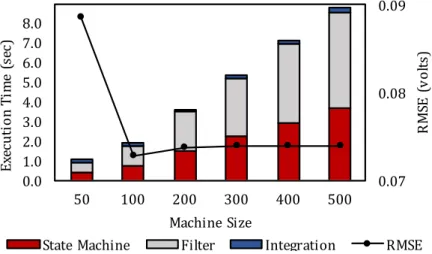
2.7 Time complexity and error analysis of the proposed HES model with respect to ”Machine Size” parameter. . . 26
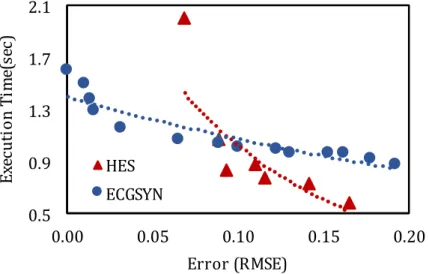
2.8 Comparison of execution time versus error for the proposed model HES and state-of-the-art ECGSYN. . . 27
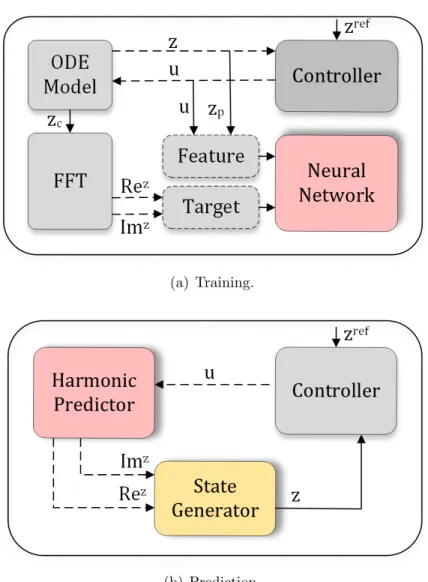
3.1 Training and Prediction phases of the Harmonic Predictor block in MPC. . . 40
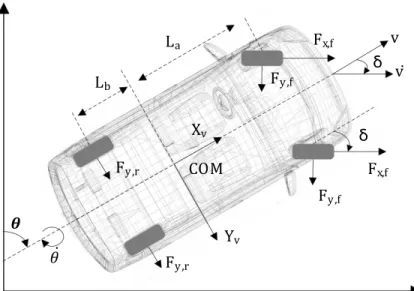
3.2 Schematic view of the vehicle model. . . 46
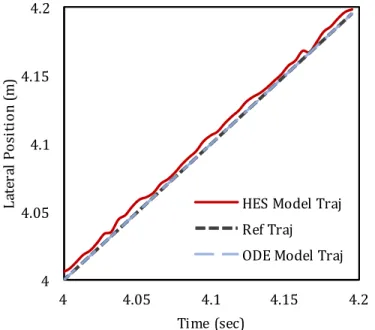
3.3 Analysis of performance for HES model and ODE model in trajectory tracking application. . . 49
3.4 Comparison and analysis of execution time for ODE model and HES model. 51 3.5 ”Time Resolution” analysis considering RMSE for the HES Model . . . 51
4.1 Comparison of execution time for ODE and HES models. . . 58
4.2 General Switching Model Predictive Control Architecture. . . 61
4.3 Switching model predictive control loop with HES as the predictive model. . 63
4.4 Concurrent state machine architecture. . . 65
4.5 Training and prediction for Harmonic Predictor block [5]. . . 67
4.6 Schematic view of the vehicle model [5]. . . 69
4.7 Training and prediction for the switching algorithm. . . 75
4.8 Test error for neural network model in Harmonic Predictor block. . . 77
4.9 Performance comparison of ODE and HES models. . . 78
4.10 The simulation results of the MPC using the HES model as the predictive model. . . 79
4.12 Comparing σopt as a function of (e, d) and as a function of σstatet. . . 80
4.13 Switching predictive control application for path tracking. The red line shows the computed position of HES model in the single granularity control mode and the blue star markers represent the computed position for HES model in the switching control mode. . . 81
4.14 HES model granularity levels. . . 82
4.15 Performance analysis of HES model in two switching and single granularity modes. . . 83
5.1 Priority Neuron Network (PNN) model. . . 94
5.2 The model reduction process for a three-layer fully-connected NN with priority size p=4. . . 99
5.3 Weight parameters of hidden layer. . . 101
5.4 Weight parameters of output layer. . . 101
5.5 Schematic view of the vehicle model. . . 106
5.6 Performance of PNN for different ranges of weight decay coefficients. . . 107
5.7 Performance of PNN for different priority sizes. . . 107
5.8 Comparing activation values of neurons with respect to their ordinal number. 109 5.9 Performance comparison of three resource-aware approaches. In Figure 5.9(c) we show the probability distribution of error for test data. . . 111
LIST OF TABLES
Page 2.1 Complexity analysis of the ECGSYN state-of-the-art model with respect to
”frequency” parameter. . . 27 3.1 Error analysis for NN with respect to variations in number of steps in the
prediction horizon. . . 45 3.2 Error comparison of ODE model and HES model for different step size in the
prediction horizon. . . 50 3.3 Execution time comparison of ODE model and HES model for different step
size in the prediction horizon. . . 50 5.1 Comparing the training process . . . 110 5.2 Comparing memory reduction with respect to error. . . 112
ACKNOWLEDGMENTS
I would like to express my gratitude to my adviser, Professor Tony Givargis. He has helped me become a better and stronger person and has motivated me to develop skills needed to grow as a successful individual in the society.
I would like to thank the rest of my dissertation committee members, Professor Alex Nicolau and Professor Ian G. Harris for their time and support.
I am forever thankful to my parents who have always given me courage, hope and support and to whom I owe all my success. Shahin Sadraie and Morteza Amir, you two are forever my heroes and I am grateful for all your love and kindness that help me reach my dreams. I am deeply grateful to my sisters, Ghazaleh Amir and Maryam Amir for all their love and protection and for always being there for me.
I am grateful to my friends and colleagues at UC Irvine, who had an impact on me during this significant journey. I would like to thank Korosh Vatanparvar, Laleh Aghababaie Beni, Forough Arabshahi, Sajjad Taheri, Bryan Donyanavard, Majid Namaki Shoushtari, Mahdi Abbaspour Tehrani, and Hamid Mirzaei Buini for their friendship, feedback and guidance. I would like to thank Dr. Hakan Kardes for his invaluable support and words of encour-agement during my hardest times. I want to thank Professor Hamid Mahmoodi for all his advice and for setting a good example as a person.
I must thank my dear friends Mahta Alavi, Prousha Tavakol, Raha Borazjani, Tamoochin Khalajhedayati, and Shervin Zalishahr for their support and the great memories we have created together.
I want to thank UC Irvine graduate division, NSF (Grant Number 1563652) and the school of ICS for providing funding opportunities during my PhD program.
I also thank ACM and IEEE for permissions to include parts of chapters 2, 3, 4, and 5 of my dissertation, which were originally published in IEEE International High Level Design Validation and Test Workshop, IEEE International Conference on Computer-Aided Design, ACM Transactions on Design Automation of Electronic Systems, and IEEE Transactions on Computer-Aided Design of Integrated Circuits and Systems.
CURRICULUM VITAE
Maral Amir
EDUCATION
Doctor of Philosophy in Computer Science 2019
University of California, Irvine Irvine, CA
Master of Science in Computer Science 2019
University of California, Irvine Irvine, CA
Master of Science in Computer Engineering 2014
San Francisco State University San Francisco, CA
RESEARCH EXPERIENCE
Graduate Student Researcher 2014–2018
University of California, Irvine Irvine, CA
Graduate Student Mentor (NASA CIPAIR Program) Summer 2013-2014
San Francisco State University San Francisco, CA
TEACHING EXPERIENCE
Teaching Assistant: Advanced Operating Systems Summer 2017-2018
University of California, Irvine Irvine, CA
Teaching Assistant: Embedded Systems Spring 2016-2018
University of California, Irvine Irvine, CA WORK EXPERIENCE
Data Science Intern June 2019 - Dec 2019
REFEREED JOURNAL PUBLICATIONS
Priority Neuron: A Resource-Aware Neural Network for Cyber-Physical Systems
2018
IEEE Transactions on Computer-Aided Design of Integrated Circuits and Systems (TCAD)
Switching Predictive Control Using Reconfigurable State-Based Model
2018
ACM Transactions on Design Automation of Electronic Systems (TODAES)
REFEREED CONFERENCE PUBLICATIONS
Hybrid State Machine Model for Fast Model Predictive Control: Application to Path Tracking
2017
International Conference On Computer Aided Design (ICCAD)
HES Machine: Harmonic Equivalent State Machine
Model Generation Tool for Cyber-Physical Systems
2017
ABSTRACT OF THE DISSERTATION
Resource-Aware Predictive Models in Cyber-Physical Systems By
Maral Amir
Doctor of Philosophy in Computer Science University of California, Irvine, 2019
Professor Tony Givargis, Chair
Cyber-Physical Systems (CPS) are composed of computing devices interacting with physical systems. Model-based design is a powerful methodology in CPS design in the implementation of control systems. For instance, Model Predictive Control (MPC) is typically implemented in CPS applications, e.g., in path tracking of autonomous vehicles. MPC deploys a model to estimate the behavior of the physical system at future time instants for a specific time hori-zon. Ordinary Differential Equations (ODE) are the most commonly used models to emulate the behavior of continuous-time (non-)linear dynamical systems. A complex physical model may comprise thousands of ODEs that pose scalability, performance and power consumption challenges. One approach to address these model complexity challenges are frameworks that automate the development of model-to-model transformation.
In this dissertation, a state-based model with tunable parameters is proposed to operate as a reconfigurable predictive model of the physical system. Moreover, we propose a run-time switching algorithm that selects the best model using machine learning. We employed a metric that formulates the trade-off between the error and computational savings due to model reduction.
Building statistical models are constrained to having expert knowledge and an actual under-standing of the modeled phenomenon or process. Also, statistical models may not produce
solutions that are as robust in a real-world context as factors outside the model, like disrup-tions would not be taken into account. Machine learning models have emerged as a solution to account for the dynamic behavior of the environment and automate intelligence acquisi-tion and refinement. Neural networks are machine learning models, well-known to have the ability to learn linear and nonlinear relations between input and output variables without prior knowledge. However, the ability to efficiently exploit resource-hungry neural networks in embedded resource-bound settings is a major challenge.
Here, we proposed Priority Neuron Network (PNN), a resource-aware neural networks model that can be reconfigured into smaller sub-networks at runtime. This approach enables a trade-off between the model’s computation time and accuracy based on available resources. The PNN model is memory efficient since it stores only one set of parameters to account for various sub-network sizes. We propose a training algorithm that applies regularization techniques to constrain the activation value of neurons and assigns a priority to each one. We consider the neuron’s ordinal number as our priority criteria in that the priority of the neuron is inversely proportional to its ordinal number in the layer. This imposes a relatively sorted order on the activation values. We conduct experiments to employ our PNN as the predictive model in a CPS application. We can see that not only our technique will resolve the memory overhead of DNN architectures but it also reduces the computation overhead for the training process substantially. The training time is a critical matter especially in embedded systems where many NN models are trained on the fly.
Chapter 1
Introduction
1.1
Cyber-Physical Systems
The term cyber-physical systems (CPS) refers to a generation of systems that are composed of computing devices interacting with the physical world. The expanded capabilities of the physical world through computation, communication ,and control is the key to many emerging advanced technologies. In today’s applications, CPS is designed to control physical plants such as industrial machines, land vehicles, medical equipment, spacecraft, jet engines, etc. The control systems that are implemented to manage these complex physical systems also have a relatively high level of complexity.
Sequential methodologies [50] are well-established techniques to cope with the complexity of designing CPSs. The idea is, first, to select a promising physical system, then define the controller and finally address design challenges of the embedded computer system. To this end, system and control engineers have developed novel engineering methods based on time and frequency domain processing, state space modeling, filtering, prediction, optimization, and advanced control technologies. At the same time, computer scientists have pioneered in
advancing computing techniques, programming languages, embedded system architectures. Such sequential separation of decisions reduces the complexity of the design efforts. However, like most greedy approaches, the overall solution is unlikely to be the best possible design due to missed trade-offs between cyber and physical design knobs.
CPS is effectively developed in a real world environment in which its control system is connected to a ”real physical system”. However, important criterion for efficient development and testing of CPS may include three factors: cost, time-to-market, and safety. The multi-dimensional and demanding design cycle of CPS motivates developers to leverage techniques that reduce development duration and cost. Moreover, difficulty and safety considerations in online testing of CPS with real systems lead to a need for simulation and offline design methodologies with high accuracy.
CPS research has emerged as solution to integrate the science and engineering principles and requires professionals from multiple fields from computer science and network engineer-ing to automation and control to collaborate closely. Emergengineer-ing CPS solutions is based on developing computer and network systems while monitoring and controlling the physical pro-cesses on the basis of environmental perception. This integration facilitates real-time, safe, reliable development of computing devices interacting with the physical systems through net-work commutations. The data acquisition modules in physical systems collect data through advanced sensing devices in CPS system and pass data to the computing devices. These com-puting devices complete a given task such as fault detection, signal processing data security processing ,and feedback control through actuation technologies.
1.2
Model-Based Design
Model-based design is a powerful methodology that utilizes mathematical models in CPS design. Modern CPS design approaches is based on synergistic interaction of software, hardware, and physical aspects with equal importance. Therefore, physical models have to be treated as equally important as cyber models. Fast executable models of physical systems are needed especially for Model-based Predictive Control (MPC) or real-time Hardware-In-the-Loop (HIL) simulations.
1.2.1
Model Predictive Control
Model Predictive Control (MPC), also known as Receding Horizon Control (RHC), is an advanced model-based control method. MPC makes explicit use of a model of the physical system to estimate its behavior for a given stream of inputs in a predetermined prediction horizon. The predicted outputs depend on the past inputs/outputs, and the future control signals [17]. As shown in Figure 1.1, these future control signals are calculated by the optimizer taking into account the cost function and enforced constraints. The cost function usually takes the form of a quadratic function of errors between the predicted output signal and the reference trajectory. In the standard approach, Ordinary Differential Equations (ODE) are employed as the predictive model to represent the dynamic behavior of a physical system. Iterative methods to approximate a solution for non-linear ODEs have introduced challenges in the design of embedded MPCs in terms of scalability, performance, and power consumption [31].
The computational overhead in traditional MPC grows exponentially with the length of the prediction horizon [11]. Research shows that a stable MPC controller requires a sufficiently large prediction horizon [47]. On the other hand, short prediction horizons are preferred
Figure 1.1: Model predictive control loop.
for improved prediction accuracy of predictive models. This is because harmful effects of the poor estimates are amplified over a long prediction horizon time. Here, the problem is addressed by proposing an MPC approach that uses an adaptive prediction horizon with respect to quality measures [23]. However, the numerical effort needed in order to solve the optimal control problem for a long prediction horizon still remains significant.
1.2.2
Physical Models
Physical models that capture and emulate the behavior of real physical systems have gained extensive research attention in CPS design. The dynamic behavior of a physical system is typically calculated from the physical laws governing the mechanical, electrical and ther-modynamic attributes of the system. The variations of physical quantities such as motion, velocity, pressure, volume and temperature as a function of time or space, may be captured as a set of equation-driven models, e.g. ODEs. As such, system engineers model physical problems using mathematical equations, and then solve these equations to study the behavior of the targeted cyber physical system.
Complex models of physical systems may be comprised of thousands of non-linear Ordinary Differential Equations (ODE), requiring considerable computing power to execute. These ODE models introduce challenges in terms of scalability, performance, power consumption and accuracy [31, 62]. Discretization methods (Euler, zero-order hold, etc.) are applied
to transform the continuous-time differential equations into discrete-time equivalents, ap-propriate for numerical computing. The discretized differential equations are solved using numerical algorithms. Iterative solutions are used to solve the non-linear ODE models of physical systems, where a series of linear equations are solved iteratively to converge to the solution for the non-linear ODEs [52]. Therefore, the computation complexity of solving or-dinary differential equations may grow with respect to type of the discretization algorithm, numerical ODE solver, number and order of the ordinary differential equations in the physi-cal model. Moreover, the demand for higher accuracy and more mathematiphysi-cally sound CPS solutions cause an increase in resource and energy consumption that must be taken into account during the design cycle [59].
The work in [9] proposes a state space model of a physical system augmented with state and output disturbance variables. The dynamic behavior of a physical system can be de-scribed using state machine-based models. The state machines are comprised of states and transitions between those states that are triggered with respect to conditional expressions or predicates. State machines may be used to break complex systems into manageable states and state transitions. Therefore, state-space representation of physical systems can be re-formulated as concurrent state machines with time-interval behavior, where a global clock conducts the trigger to update the state variables and output actions.
Another method that is proposed to handle the computational issue associated with MPC systems is to use accelerated predictive models of the physical system. Different variants of NNs (e.g., recurrent neural networks [14]) hold promising performance for time-series prediction as they can easily be built to predict multiple steps ahead all at once. These models are well-known to have the ability to learn linear and non-linear relations between input and output variables without prior knowledge [27]. However, the use of NN models for long prediction horizon MPC problems could raise scalability and computational complexity challenges. The state-of-the-art methodologies are focused on reducing the size of the NN
models without significantly affecting the performance [70, 73, 97]. These methodologies leverage the intrinsic error tolerance property of the NN models due to their parallel and distributed structure. Therefore, model reduction schemes could be exploited to employ the NN as the predictive model in the MPC loop. Several recent studies have focused on rescaling the size of the NN to adjust the resource usage on the embedded platform with respect to response time, power, and accuracy targets [74]. In other words, several sizes of the neural network are available at runtime to manage resources for inference time-, safety-, and energy-constrained tasks. Moreover, continuous learning of neural networks in data-driven modeling [87], transfer learning techniques [44], and adaptive modeling [38] impose significant training-time constraints at runtime.
1.3
Reconfigurable Predictive Models
A real physical system is under constant change from the effects of the environment. More-over, limited hardware resources impose a burden on the development of CPS applications. In model-based design applications such as MPC, the complexity of the model under control has a direct influence on the global performance of the system. Specifically, different levels of complexity for the target physical system shall be provided by the user for a specific ap-plication. The work in [100] evaluates the performance of a hybrid controller to steer a car in straight and curved trajectory segments. It suggests employing a relatively more advanced model of the vehicle dynamics [72] in curvature path as opposed to fast and simple kinematic model of the vehicle to follow straight lines on the path. Therefore, it has been recognized that predictive models that can be reconfigured to adjust their accuracy from coarse-grained time critical situations to fine-grained scenarios in which safety is paramount are central in designing resource-constrained cyber-physical systems.
1.4
Thesis Contributions and Organization
In this dissertation, we propose novel abstraction techniques to address trading off gran-ularity against complexity in predictive models for cyber-physical systems. Our proposed abstraction formulations can be dynamically reconfigured to different precision granularities at runtime. The organization of the rest of this thesis can be summarized as follows:
• In Chapter 2 a Harmonic Equivalent State (HES) Machine model generation frame-work is proposed. This model captures sampled data of a physical signal as the input in respective time windows. HES Machine generates reconfigurable state-machine model of the physical system with an intrinsic disturbance feature to adjust the overall model accuracy with respect to proposed tuning parameters for dynamic accuracy. Moreover, the execution time of the model may be adjusted in tradeoff with accuracy in order to adapt to coarse-grained time critical situations or fine-grained safety critical sce-narios. The main contribution of the proposed modeling framework is the inclusion of frequency domain properties in signal synthesis to adopt the reconfigurability feature to the model. Also, as opposed to ODE equivalents, the proposed framework do not perform compute-intensive and iterative tasks to solve the proposed physical model. The input to this model is constrained to be periodic.
• In Chapter 3 machine learning is employed to use the previously introducedHES Ma-chine model in non-periodic runtime applications. That is, the output of the proposed physical model can adapt to variations in inputs at runtime. ODE models are employed to train the proposed model at design-time. The effectiveness of the proposed model is evaluated in a closed-loop MPC for path tracking application. The performance of the model is compared with state-of-the-art ODE-based models, in terms of execution time and model accuracy.
performance in terms of execution time and model accuracy is improved. The machine learning model is modified to better estimate the dynamic behavior of the physical system. A novel switching model predictive control methodology is proposed based on HES Machine as the predictive model. Machine Learning techniques are employed to design this runtime switching algorithm that determines the optimal granularity level of the current predictive model in use. Simulation experiments are conducted to evaluate the switching controller in a path tracking application containing curved and straight routes.
• in Chapter 5 a reconfigurable Neural Networks (NN) model is proposed. This NN model can be reconfigured to various network sizes at runtime while storing only one set of weight parameters for memory efficiency. a training algorithm is developed that controls the priority of each neuron in the computation of the model’s output. Reg-ularization techniques are applied to enforce a priority on each neuron. The neuron’s ordinal number is considered as our priority criteria in that the priority of the neuron is inversely proportional to its ordinal number. Therefore, the NN model can be recon-figured to smaller sizes by eliminating low priority neurons. This approach allows the trade-off between the model’s computation time and accuracy in resource-constrained systems.
Chapter 2
HES Machine: Harmonic Equivalent
State Machine Model
2.1
Introduction
In this chapter, we present a framework to generate a Harmonic Equivalent State (HES) Ma-chine model of the physical systems. One of the merits of the proposed state maMa-chine-based model is that the state machines can eliminate execution of compute-intensive and iterative tasks for describing the behavior of the physical systems. The model accommodates recon-figurable parameters that allow the user to have trade-off between accuracy and execution time in CPS design. For validation purposes, we compare our model performance with state-of-the-art models in terms of execution time and accuracy. The simulation results indicate that our generated HES model executes 38% faster than ODE-based equivalent model with same level of model accuracy.
Model-based design in Cyber-Physical Systems (CPS) provides abstraction and modeling techniques to integrate the dynamics of the physical processes with software and
communi-cation components. As opposed to desktop computing, CPS should be dynamically recon-figurable and adapt to changes in the environment. Application-specific disturbance models may be included to predict the effect of unknown physical disturbances that perturb system behavior and incorporate these effects on the input and state variables for control system design. Complex CPS applications such as in industrial machines, land vehicles, medical equipment, spacecraft, jet engines require new computer-aided methods for modeling, simu-lation and offline design. These methodologies are influenced by the need for lower time to market and higher quality, reliability and safety for the CPS design.
In the literature, some research has applied Hardware-in-the-Loop (HIL) real-time simulation as a technique to improve estimation accuracy and validate the developed strategies. In real-time simulation methods, the input and output signals show the same real-time-dependent values as the real dynamic system. The HIL technique aims to model the real world scenarios in an abstracted environment in which the ”real physical system (plant)” is replaced with the ”simulated physical system”. The models of the physical systems may be employed to emulate their real behavior with regards to the laws of physics and enable execution of test scenarios that would be prohibitively dangerous in a real system. Moreover, the physical model should account for the impact of measurable and unmeasurable intruding components caused by the surrounding environment (e.g. wind, noise, etc.) in order to evaluate and verify the robustness of the system under test. Therefore, dynamic model reduction in terms of accuracy may benefit HIL in emulating real-life scenarios during testing and verification.
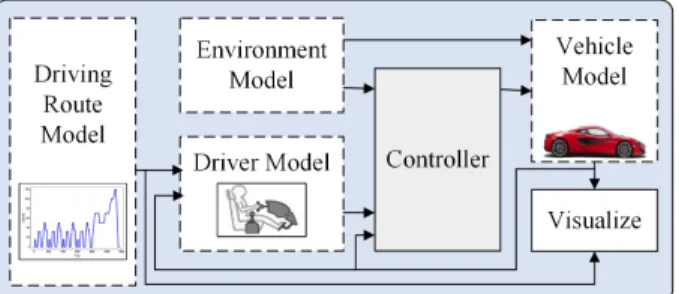
Figure 2.1 illustrates the application of a real-time HIL simulation to test the performance of theController Unit in a closed-loop powertrain system model [86]. ThePowertrain block includes a group of fully assembled components, e.g. engine, transmission, drive shafts, differentials, etc., that generate power and transfer it to the road surface. The power con-sumption in the loop is also dependent on the speed of the vehicle which may be modeled as a time-varying variable in a Driving Route Model block. For this purpose, the standard
driving cycles such as NEDC, ECE and UDDS [90, 91] as a set of sampled data from the environment may be applied.
Figure 2.1: Hardware-in-the-loop testing for power train system model.
Another use of model-based design in CPS application is Model Predictive Control (MPC). MPC systems are a class of control algorithms that estimate the behavior of the physical system under control through the use of computational models. The control inputs are optimized to drive the predicted outputs of the model towards the desired trajectory. Closed-loop performance of MPC algorithms is directly correlated with the accuracy of the physical model. Two general techniques to eliminate the steady-state offset error in the closed-loop systems are: 1) including the tracking error in the objective function of the controller, 2) augmenting the predictive model with a data-based disturbance model [71]. Most industrial MPC applications add a constant step disturbance to the output of the physical model to consider the impact of the disturbance in the closed-loop system. The work in [66] proposes a robust MPC algorithm in which a linearized model of a ship is integrated with a wind disturbance model to solve the problem of the ship’s control actions in the presence of wind disturbance. This approach requires the user to design a disturbance model and integrate it in the loop with predictive model of the physical system [96]. The state-of-the-art modeling techniques for HIL simulations and MPC applications followed by our contributions are summarized in Section 2.2.
2.2
Related Work
In control system study, the model of the physical system is developed to conform with dynamical system analysis and control system design requirements; that is, simplification and adaptation with respect to state of the system is required [77]. In model-based design applications such as MPC or real-time HIL simulations, the complexity of the model under control has direct influence on the global performance of the system. Specifically, different levels of complexity for the target physical system shall be provided by the user for a specific application. The work in [26] proposes an integrated library of electro-hydraulic models with different complexities. The purpose of the work is to provide the appropriate model with regards to the domain and timing requirements in design-time. However, run-time dynamic disturbance caused by the environment remains neglected.
Complex physical system models may be implemented as thousands of ODEs. The ODE description of a system requires approximations via solver methods such as Euler and Runge-Kutta, to be suitable for computations in computing devices [78]. The demand for more accurate and mathematically sound CPS solutions, cause an increase in resource utilization and energy consumption [59]. Research in model-based design techniques for CPS have in-troduced solutions to overcome some of the challenges induced by the complexity of ODE models. One approach is to implement the ODEs on Field-Programmable Gate Arrays (FPGA) using Lookup Tables (LUTs) to speed up simulation and enable parallel execu-tion [45]. In general, even though the FPGA implementaexecu-tion of ODE models may improve the execution efficiency for real-time applications, it has implementation challenges regarding limited resources especially for complex ODE models. Hence, a better approach of modeling and solving of ODE may be required to reduce the complexity not only on FPGAs but also on general CPUs.
a discrete-time solution prior to FPGA implementation. Here, a state space meta model is introduced to model the ordinary differential equation and the respective discrete-time solu-tion. Atlas Transformation Language (ATL) [49] is employed as the framework to implement the model transformation. Here in this work, the experimental results are based upon simple first order differential equations and their technique may not be applicable to more complex ODE physical models. Moreover, the proposed meta models may still carry the complexity of thousands of ODEs, resulting in an implementation overhead that is prohibitive in most constrained system architectures.
The work in [48] proposes a state-based heart model generated from real specifications to be used in a closed-loop system. Implantable cardiac pacemakers monitor and repair the abnormalities in heart rhythms. HIL simulation of a pacemaker is essential to test and verify its functionality with respect to a heart model prior to real implantation. The heart model is implemented in Simulink environment and the HDL coder toolbox is used to generate Verilog code for hardware implementation. The proposed approach is application specific which requires user expertise to implement the model of the heart. Moreover, relying on the HDL coder toolbox for more complex models may require fundamental modifications in the generated Verilog code.
One solution to challenges that arise from the complexity of the ODE-based physical models is frameworks and associated tools that automate model generation and transformation for the target application [75]. Model transformations conduct automated and semi-automated mapping of one or couple of models into another alternative models in order to incorporate flexibility and compatibility in model-based design for CPS [6].
2.3
Contributions
In this work we present an automation framework to generate dynamic state machine model of a physical system augmented with a disturbance feature for Cyber-Physical Systems (CPS) applications. The model accommodates reconfigurable parameters that allow the user to have tradeoff between accuracy and execution time in CPS design. The accuracy of the physical signal may get adjusted during runtime to adopt to the system performance and robustness in the case of sudden changes that may impact the system dynamics. Our contributions in this work can be summarized as follows:
1. Designing a dynamic reconfigurable state machine model for targeted physical systems. 2. Providing tunable parameters to adjust the granularity of the generated model for
adap-tation to coarse-grained time critical situations or fine-grained safety critical scenarios. 3. Develop an automated framework to generate the model and its executable C code. The
code may be implemented in a hardware-in-the-loop for final system testing and inte-gration. Design objectives, model accuracy, and execution time, facilitate the evaluation and verification of the model for embedded systems implementation.
The rest of the chapter is organized as follows; Section 2.4 describes the proposed automated framework that captures physical systems as a set of generated state machine equivalents. We demonstrate the performance of our framework using two benchmarks and present the results in Section 2.5. Finally, we state our conclusions in Section 2.6.
! "+1 Harmonics ! "+1 Real Coefficients ! " +1 Imaginary Coefficients !
"+1 Concurrent Synchronous State
Machines
N Sampled Input Signal
N Sampled Generated Signal
FFT
Filter
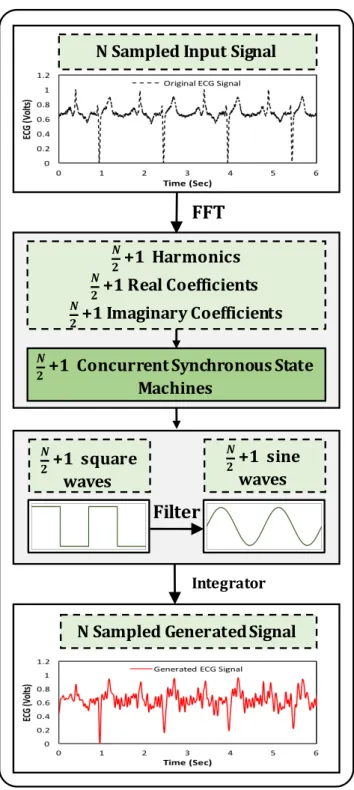
Integrator ! " +1 square waves ! " +1 sine wavesFigure 2.2: High level architecture of the proposed framework illustrates the HES machine model generation process.
2.4
Methodology
The high-level architecture of the proposed framework is depicted in Figure 2.2. The whole framework is based on the concept of signal decomposition and synthesis to generate a re-configurable state machine model of a target physical system. The input to the framework is sampled signal of size N. Fast Fourier Transform (FFT) algorithm is employed to decom-pose the signal and derive the frequency information. A synthesis algorithm is presented to integrate the decomposed components of the physical signal in the form of a set of concurrent state machines. The synthesis algorithm employs (N /2+1) inverse of the signal harmonic frequencies and respective FFT coefficient values, as the periods and output magnitudes of concurrent state machines respectively. Band-pass filter is used to translate the output square waves of the concurrent state machine models into sinusoidal signals. The sinusoidal output signals, one per state machine, represent the signal harmonic components. Finally, the harmonic components are integrated to generate a dynamic state machine model for the target physical system. The decomposition (analysis) and synthesis algorithms are described in details in the following sections.
2.4.1
Decomposition
The input to the proposed framework is N number of samples for a given physical signal in time windows of length T. The FFT algorithm is used to derive the frequency spectrum of the physical signal on each time window. Later on, this frequency domain information is employed to synthesize the signal into a state machine model representation.
Frequency Domain Information
The FFT algorithm on a sampled signal of size N decomposes the signal into a series of (N /2+1) sine and cosine wave components which are referred to as basis functions. The process of calculating the frequency domain information of the signal from time domain representation is called decomposition and the inverse process is signal synthesis [79]. The basis functions are a set of sine and cosine waves oscillating at signal harmonic frequencies. For a sample signal represented as array x[] of size N in time domain, the FFT algorithm calculates the frequency domain signals X[] as two arrays of size (N /2+1). The arrays contain the coefficients (amplitudes) of the sine and cosine components as imaginary part
imX[] and real part reX[] of X[] respectively for harmonic frequencies f rX[]. The output values of the FFT algorithm, f rX[], reX[], and imX[] are defined as input parameters for the subsequent synthesis process.
2.4.2
Synthesis
The synthesis function for sampled signal x[i] of size N is represented in equation 2.1 [79]. The arraysreX[] andimX[] are the normalized coefficients of the sine and cosine waves with index k running from 0 to N/2 for the respective harmonic frequencies.
x[i] =
N/2
X
k=0
reX[k]cos(2πki/N) +
N/2
X
k=0
imX[k]sin(2πki/N) (2.1)
HES Machine Synthesis Algorithm
State machines can be used to break complex systems into manageable states and state transitions. Therefore, the state machine model of computation fits the synthesis function
components as concurrent state machines with time-interval behavior. A global clock con-ducts the trigger to update the state variables and output actions. The components of the physical signal may all be generated by a five-state synchronous harmonic state machine (HES Machine). S1 Elapsed Time >/ 0123 45 / Magnitude1 = Real × +@ Magnitude2 = Imag × (+@) S3 S4 S2 Elapsed Time >/ 0123 45 / Magnitude1 = Real × +@ Magnitude2 = Imag × (−@) Elapsed Time >/ 0123 45 / Magnitude1 = Real × −@ Magnitude2 = Imag × (−@) Other/ Elapsed Time ++ Elapsed Time >/ 0123 45 / Magnitude1 = Real × −@ Magnitude2 = Imag × (+@) Other/ Elapsed Time ++ Other/ Elapsed Time ++ Other/ Elapsed Time ++ -1
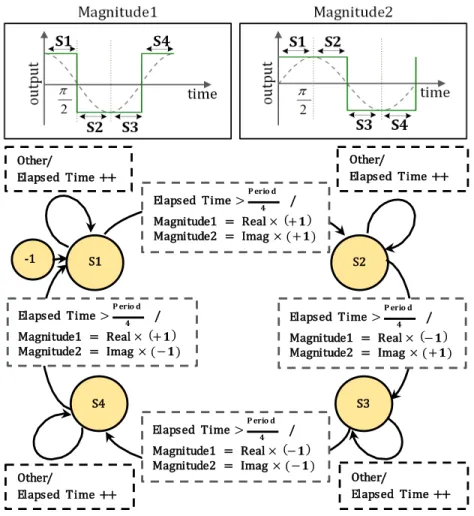
Figure 2.3: 5-State synchronous state machine with the inverse of the signal harmonic fre-quency as the period.
The architecture of the five-state synchronous harmonic equivalent state machine is depicted in Figure 2.3. Each state machine is designed to represent a harmonic frequency component of the physical signal. Outputs of each state machine are two square wave signals approximating the sine and cosine components in equation 2.1. The square waves will later be integrated into the synthesis function. Inverse of the harmonic frequency is the period and FFT coefficient values are the magnitudes for the corresponding square waves. One period of the square
wave signals is divided into four phases that are represented by the outputs of the states S1,
S2,S3, and S4. The transitions between theses four states and phases are triggered at each
Period/4 elapse of time. Finally, (N /2+1) harmonic equivalent concurrent state machines are integrated to synthesize the physical signal. We have utilized this five-state synchronous state machine architecture for our model to highlight the strength of state machines in representation of physical systems.
Algorithm 1 illustrates the structure of the Tick function for the executable state machine model of computation. HES[i] represents a data structure that includes associated data values per harmonic state machine. Here, iis the index for harmonic state machine ranging from 0 to (N /2+1). The parameter HESsize stores the number of concurrent harmonic state
machines which are synthesized in a signal synthesis process and may be selected as frame-work parameters for design configuration. The output array values computed by the FFT algorithm, reX[] and imX[] and f rX[], are placed in the HES data structure to represent
HES[i].real, HES[i].imag and HES[i].periodrespectively. The variable HES[i].elapsedT ime
is tracked on each call of theTick function. When (HES[i].elapsedTime≥ HES[i].period/4) condition evaluates to true, a state transition occurs and an output action is determined with respect to the current state. N samples of signals are fed into the HES machine model generator in intervening time windows ofT. Each execution of theTickfunction updates the
HES[i].elapsedT imevariable by addingTresvalues. The values for the new time window are
evaluated when the HES[i].elapsedT ime variable surpasses the value T and resets to zero.
The generated square waves are to be translated into sinusoidal equivalents to represent the sine components of the original physical signal. A band-pass filter is applied to attenuate the unwanted square wave frequencies. (N /2+1) sinusoidal signals are integrated to synthesize the decomposed signal according to Equation 2.1. The tool generates an executable C code in state machine representation for the physical signal to be implemented on a target platform.
ALGORITHM 1: Global Tick Function
Input: index of the state machinei 1 global variable HES
2 global variable magnitude1,magnitude2 3 const TimeResolution
4 switch HES[i].statedo 5 case−1
6 HES[i].state= S1 7 caseS1
8 if HES[i].elapsedTime≥HES[i].period/4 then 9 HES[i].state= S2
10 HES[i].elapsedTime= 0
11 else
12 HES[i].state= S1 13 caseS2
14 if HES[i].elapsedTime≥HES[i].period/4 then 15 HES[i].state= S3
16 HES[i].elapsedTime= 0
17 else
18 HES[i].state= S2 19 caseS3
20 if HES[i].elapsedTime≥HES[i].period/4 then 21 HES[i].state= S4
22 HES[i].elapsedTime= 0
23 else
24 HES[i].state= S3 25 caseS4
26 if HES[i].elapsedTime≥HES[i].period/4 then 27 HES[i].state= S1 28 HES[i].elapsedTime= 0 29 else 30 HES[i].state= S4 31 otherwise 32 HES[i].state=−1 33 switch HES[i].statedo 34 caseS1
35 magnitude1[i][HES[i].N1] =HES[i].real×1.0magnitude2[i][HES[i].N1] =HES[i].imag×1.0 36 caseS2
37 magnitude1[i][HES[i].N1] =HES[i].real× −1.0magnitude2[i][HES[i].N1] =HES[i].imag×1.0 38 caseS3
39 magnitude1[i][HES[i].N1] =HES[i].real× −1.0 magnitude2[i][HES[i].N1] =HES[i].imag× −1.0 40 caseS4
41 magnitude1[i][HES[i].N1] =HES[i].real×1.0magnitude2[i][HES[i].N1] =HES[i].imag× −1.0
42 otherwise
43 magnitude1[i][HES[i].N1] =HES[i].real×1.0magnitude2[i][HES[i].N1] =HES[i].imag×1.0 44 HES[i].elapsedTime+ = TimeResolution
45 HES[i].N1+ + 46 return
HES Machine Tuning Parameters
Two tuning parameters HESsize and Tres are proposed to adjust the HES Machine model in
order to meet system requirements (e.g., accuracy and timing).
1. Machine Size (HESsize) is the number of harmonic concurrent state machines to be
integrated during the synthesis process ranging from 1 to (N /2+1). The model accu-racy may be adjusted with respect to this parameter by inclusion/elimination of certain harmonic frequencies.
2. Time Resolution (Tres) parameter indicates the smallest time unit in the proposed
framework by which the generated state machine will be executed. The proposed frame-work tracks the value of Tres as an actual wall-clock (real) time. The parameter Tres
specifies the timer values for the periodic programmable interval timers to trigger the interrupt service routine (ISR).
2.5
Experimental Results
2.5.1
Implementation and Setup
Simulation experiments are conducted using data for real physical signals and the global clock of the state machine model is updated by interrupt handlers of the operating system. The framework is implemented using C/C++ programming language in order to enable it to be highly portable for compilation and execution. The process from data acquisition to model generation is automated and reconfigurable with respect to model parameters. Our specific experiments were performed on a PC with a quad-core Intel Core i5 and 8 GB of DDR3 RAM. The performance of the proposed model generation framework is evaluated using two examples of ECG signal and NEDC signal. It needs to be noted that one of
0 0.2 0.4 0.6 0.8 1 1.2 0 1 2 3 4 EC G (V ol ts ) Time (Sec)
HES Generated ECG ECG
(a) Comparing the original ECG signal with the HES Machine generated output signal.
0 0.2 0.4 0.6 0.8 1 1.2 0 200 400 600 800 Ve lo ci ty (m /s ) Time (Sec)
HES Generated NEDC NEDC
(b) Comparing the original NEDC signal with the HES Machine generated output signal.
Figure 2.4: HES Machine’s generated signal of ECG and NEDC.
the merits of our framework is its applicability to any example and application of physical signals.
• ECG Signal: The electrocardiogram (ECG) digitized signal is provided by PhysioBank [30] as the reference signal. The signal consists of 7200 double-sized sample values recorded with 720 Hz sampling frequency and 12-bit resolution in T=10-seconds window of time. The model is reconfigured at run-time to serve for HIL testing of implantable medical devices such as pacemaker, smart ECG monitor, etc. [10].
• NEDC Signal: The New European Driving Cycle (NEDC) is selected from driving cycle standards (ECE, UDDS, etc.) that are typically employed in model-based vehicle design applications [90]. The NEDC signal contains vehicle velocity data that is captured from a Simulink block [1]. The signal is 8192 double-sized values sampled at frequency of 10 Hz in T=819.2-seconds window of time. The generated dynamic HES Machine model may be reconfigured at run-time to emulate the system behavior in presence of environment disturbance or mis-prediction of trajectory.
The generated signal models of the proposed framework for ECG and NEDC examples are compared in Figures 2.4(a) and 2.4(b) with their original signals. The results justify the validity of our proposed model generation framework for signal synthesis and state machine model generation with average of 0.1% error in model accuracy.
2.5.2
Analysis and Verification
Performance Metrics
Two performance metrics of execution time and precision are considered for comparing the performance of our HES Machine model with state-of-the-art models.
• Execution Time: is the time required by the computer to perform a given set of com-putations.
• Root Mean Squared Error (RMSE):is the quality factor to measure the error between the values evaluated by the model and the corresponding expected values for N number of samples. RM SE = r (P (Expected−Evaluated)2) N (2.2) Parameter Analysis
The performance of the proposed state machine model generation framework is evaluated under variations of two parameters by which the model may be configured:
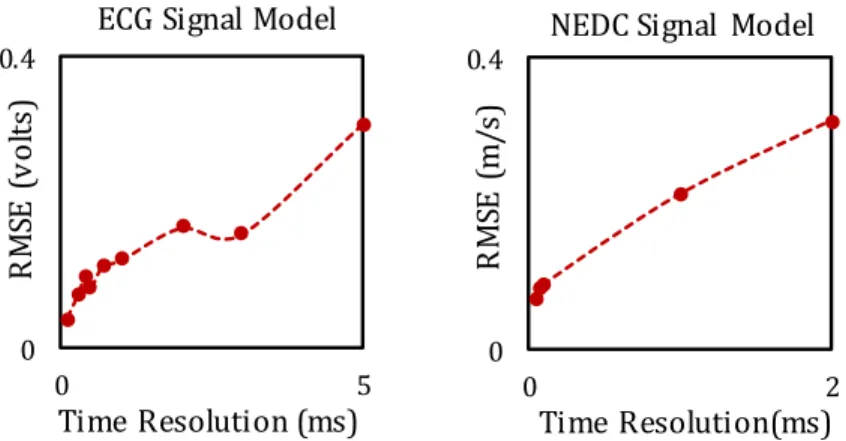
1. Time Resolution (Tres): Figure 2.5(a) illustrates the change in model accuracy for
NEDC and ECG examples with respect to variations in Tres parameter values. The
results shows improvement in model accuracy for smaller values of Tres in case of need
for finer physical model.
2. Machine Size (HESsize): the variations in model accuracy with respect to different
0.1 0.3 0.02 0.08 0 200 RM SE Eu cl id ea n D is t. Quality Factor ECG Signal Model
Euclidean RMSE 0.07 0.09 50 500 RM SE ( vo lts ) Machine Size ECG Signal Model
0 0.4 0 5 RM SE ( vo lts ) Time Resolution (ms) ECG Signal Model
0 0.2 0 0.2 0 200 RM SE Eu cl id ea n D is t. Quality Factor NEDC Signal Model
0 0.4 0 2 RM SE ( m /s ) Time Resolution(ms) NEDC Signal Model 0.07 15 150 1500 RM SE ( m /s ) Machine Size NEDC SignalModel
(a) ”Time Resolution” analysis considering the RMSE metric, for ECG and NEDC.
0.1 0.3 0.02 0.08 0 200 RM SE Eu cl id ea n D is t. Quality Factor ECG Signal Model
Euclidean RMSE 0.07 0.09 50 500 RM SE ( vo lts ) Machine Size ECG Signal Model
0 0.4 0 5 RM SE ( vo lts ) Time Resolution (ms) ECG Signal Model
0 0.2 0 0.2 0 200 RM SE Eu cl id ea n D is t. Quality Factor NEDC Signal Model
0 0.4 0 2 RM SE ( m /s ) Time Resolution(ms) NEDC Signal Model 0.07 15 150 1500 RM SE ( m /s ) Machine Size NEDC SignalModel
(b) ”Machine Size” analysis considering the RMSE metric, for ECG and NEDC.
Figure 2.5: Analyses for different parameter configurations.
model improves for larger values ofHESsize. In our experiments, the harmonic frequencies
and their corresponding state machines are sorted in ascending order to select HESsize
number of state machines for integration. Other selection algorithms may be applied in accordance with target application which may further improve the precision of the generated model.
Comparison to State-of-the-Art
We evaluated the performance of the proposed framework and generated model in compar-ison with an ODE-based ECG signal generator, ECGSYN [65]. The model in [65]
emu-lates the quasi-periodic waveform of the ECG signal by tracing around a limit cycle in x-y plane. The ECG signal is generated by using a series of exponentials formulated to follow PQRST-waveform in the z-direction. (P, Q, R, S, T) represent the peaks in ECG signal for one complete heartbeat. The model of motion dynamics is defined as a set of following differential equations ˙ x=αx−ωy (2.3) ˙ y=αx+ωy (2.4) ˙ z =− X i∈P,Q,R,S,T ai∆θiexp(−∆θi2/2bi2)−(z−z0) (2.5)
where ω is the angular velocity,α equals to (1−px2 +y2) and ∆θ equals to (θ− θ
i)%2π.
Also, θ = arctan(y, x) and ai and bi are model coefficients. The fourth-order Runge-Kutta
method [84] is applied to solve the ordinary differential equation model. The performance of HES and ECGSYN models in terms of execution time and accuracy is evaluated for time interval of T=16 seconds. The functions involved in execution of the HES model are FFT function, state machine, band-pass filter, and integration for signal synthesis. The experimental results in Figures 2.6 and 2.7 illustrate the behavior of the generated HES model in terms of execution time and accuracy based on variations in framework parameters:
Tres and HESsize. The execution time overhead of the generated HES model is attributed to
three main functions: state machine, filter and integrator. The figure shows variations in execution time for different model parameter configurations. Table 2.1 shows the execution time values for state-of-the-art model ECGSYN with respect to corresponding accuracy of the model. The frequency fs represents the step size for the ODE solver and is considered
The results in Figure 2.6 shows that the execution time increases as the model accuracy improves with smaller values for Tres parameter. Moreover, Figure 2.7 show that smaller
values of HESsize reduce the execution time since less number of state machines are to be
generated and integrated. As shown in the picture, for HESsize larger than a certain value,
the change in model accuracy will be marginally negligible. We can use this property to improve the execution time for coarse-grained time critical situations. The generated ECG signal with fs=720 is considered as the reference signal for HES and ECGSYN models to
be evaluated; that is, this reference signal is given as the input to our proposed framework
0.00 0.02 0.04 0.06 0.08 0.10 0.12 0.14 0.16 0.18 0.0 0.2 0.4 0.6 0.8 1.0 1.2 1.4 1.6 1.8 2.0 2.2 2.4 RM SE ( vo lts ) Ex ec ut io n Ti m e (s ec )
Time Resolution (sec)
State Machine Filter Integration RMSE
Figure 2.6: Time complexity and error analysis of the proposed HES model with respect to ”Time Resolution” parameter.
0.07 0.08 0.09 0.0 1.0 2.0 3.0 4.0 5.0 6.0 7.0 8.0 50 100 200 300 400 500 RM SE ( vo lts ) Ex ec ut io n Ti m e (s ec ) Machine Size
State Machine Filter Integration RMSE
Figure 2.7: Time complexity and error analysis of the proposed HES model with respect to ”Machine Size” parameter.
0.5 0.9 1.3 1.7 2.1 0.00 0.05 0.10 0.15 0.20 Ex ec ut io n Ti m e( se c) Error (RMSE) HES ECGSYN
Figure 2.8: Comparison of execution time versus error for the proposed model HES and state-of-the-art ECGSYN.
Table 2.1: Complexity analysis of the ECGSYN state-of-the-art model with respect to ”fre-quency” parameter. 720 0.988 0.000 718 0.966 0.178 715 0.960 0.176 710 0.956 0.164 705 0.949 0.151 700 0.949 0.170 690 0.949 0.179 650 0.911 0.244 600 0.919 0.213 RMSE (volts) ECGSYN Model Execution Time (sec) !"
to generate the equivalent of reconfigurable HES model. For fairness of comparison, the execution time of the proposed HES model is compared with ECGSYN for the same range of accuracy as shown in Figure 2.8. The results for HES model is derived for HESsize=50
which includes 50 harmonics in synthesis of the generated signal. The experimental results show that for same level of model accuracy, the HES model may be executed 38% faster than ECGSYN model.
in contrast to ODE models (ECGSYN). The proposed state machine-based model do not execute compute-intensive and iterative tasks to describe the behavior of a physical system. Moreover, concurrent operation of the state machines are perfectly suitable for intrinsic parallel characteristics of physical systems. In other words, it allows multiple sub-state machines to react to a set of events at the same time. In general, the time complexity of a solver to solve N samples of ordinary differential equations may grow with respect to c0N, where c0 is a constant factor defined by the type of the discretization algorithm, numerical ODE solver, number and order of the ordinary differential equations in the physical model. On the other hand, the time complexity of the proposed HES model grows with the term
cN, where c is determined by the model parameters HESsize and Tres. Therefore, our HES
Machine model is suitable for systems that are more tolerable against model error in tradeoff for reduction in execution time. Here, the ECGSYN includes three simple first-order ordinary differential equations which results in small value ofc0. However, we expect that execution of the HES model equivalent to more complex ODE models with larger values ofc0 will present even smaller values for execution time.
2.6
Conclusion
In this work, we presented an automated model generation framework for physical systems in CPSs. The proposed method utilizes frequency information properties to generate a dy-namic state machine model of the physical system. Two tuning parameters are provided to adjust the granularity of the generated model for adaptation to coarse-grained time critical situations or fine-grained safety critical scenarios. Simulation is conducted to evaluate per-formance of the framework and model using two real physical signals of ECG and NEDC. Moreover, the generated state machine model is compared with ODE-based state-of-the-art equivalent model in terms of accuracy and execution time. The simulation results indicate
that our generated model surpasses the state-of-the-art model by 38% in execution time for same level of model accuracy. The proposed dynamic state machine system may be an excellent replacement for complex ODE solvers when used for testing or embedding CPSs.
Chapter 3
Machine Learning HES Model
3.1
Introduction
Cyber-Physical Systems (CPS) in today’s applications are designed to control physical plants such as industrial machines, land vehicles, medical equipment, spacecraft, Unmanned Aerial Vehicles (UAVs), jet engines, etc. The control systems that are implemented to manage these complex physical plants also have relatively high level of complexity. Model-based design is a powerful methodology for the implementation of CPS control systems. For instance, Model Predictive Control (MPC) is typically implemented in CPS applications, e.g., path tracking of autonomous vehicles [76], HVAC control in electric vehicles [90, 91] and formation flying spacecraft [15]. MPC refers to a range of control algorithms in which a dynamic model of the physical system is used to predict the future outputs in a determined horizon [83]. These future outputs of the system are estimated with respect to known input and output values up to the current state and future control signals. An optimization problem is evaluated as a parametric quadratic function to calculate the set of future control inputs subject to constraints enforced by the environment and the dynamic of the system.
Ordinary Differential Equations (ODE) are the most commonly used models to replicate the dynamic behavior of the real physical system in presence of environmental constraints. The ODE models are derived from the conservation laws of physics. A complex physical model may be formulated as thousands of non-linear ODEs which pose scalability, performance, and power consumption issues. Iterative methods are applied to solve non-linear ODEs using quadratic programming paradigms [53]. The execution time of this non-linear programming problem may grow with regards to the algorithms used for discretization and integration of the ODE models and the number or order of ODEs representing the dynamic behavior of the physical system. Development and implementation of techniques to resolve the execution time of non-linear complex ODEs for online control systems are fundamental requirements in CPS design.
A real physical system is under constant change from the effects of the environment. There-fore, we are in need of methodologies to adapt the system to environmental changes and determine the CPS application behavior in respond to such changes. In model-based design applications such as MPC, the complexity of the model under control has a direct influence on the global performance of the system. Specifically, different levels of complexity for the target physical system shall be provided by the user for a specific application. The work in [100] evaluates the performance of a hybrid controller to steer a car in straight and curved trajectory segments. It suggests employing a relatively more advanced model of the vehicle dynamics [72] in curvature path as opposed to fast and simple kinematic model of the vehi-cle to follow straight lines on the path. The state-of-the-art modeling techniques to design physical models in model-based CPS applications followed by our contributions in this work are summarized in section 3.2.
3.2
Related Work
Cyber-physical systems integrate various engineering areas such as control-, computer-, mechanical-, and network engineering. The complex and heterogeneous design aspects of CPS requires methodologies to combine the corresponding disciplines. Physical models that capture and emulate the behavior of the real physical system have gained extensive research attention in CPS design. A wide variety of physical phenomena such as heart motion, the flow of electric signal and chemical reactions are well described by equations in the litera-ture. Complex physical systems models may be implemented as thousands of ODEs. The mathematical modeling of fuel cells as a power resource in automobile applications is used to explore the reduction in CO2 emissions [64]. The model-based design approach in a vehicle simulation software (ADVISOR) evaluates the operation of fuel cell models under physical settings such as temperature variation in different driving cycles (NEDC, UDDS [12]).
Complex ODE models introduce challenges in terms of scalability, performance, power con-sumption, and accuracy [31]. The ODE description of a system requires approximations via solver methods such as Euler and Runge-Kutta, to be suitable for computations in computing devices [78]. The demand for more accurate and mathematically sound CPS so-lutions, cause an increase in resource utilization and energy consumption [59, 88]. Research in model-based design techniques for CPS has introduced solutions to overcome some of the challenges induced by the complexity of ODE models. One approach is to implement the ODEs on Field-Programmable Gate Arrays (FPGA) using Lookup Tables (LUT) to speed up the simulation and enable parallel execution [45]. In general, even though the FPGA implementation of ODE models may improve the execution efficiency for real-time applica-tions, it has implementation challenges regarding limited resources, especially for complex ODE models. Hence, a better approach to modeling and solving of ODE may be required to reduce the complexity not only on FPGAs but also on general CPUs.
Another technique to resolve the challenges raised from complex ODE models is model-to-model transformations and developing frameworks and tools to automate this process. Model transformation introduces flexibility and compatibility in model-based design. Frameworks have been developed to perform automated and semi-automated model transformation [75]. A heart-on-a-chip model [48] is introduced to employ timing behavior of the heart signal and generate different state-based heart conditions as hardware-in-the-loop to test pacemaker software. The heart model is implemented in the Simulink environment and the HDL coder toolbox is employed to generate Verilog code for hardware implementation. The proposed approach is application specific which requires user expertise to implement the model of the heart. Moreover, relying on the HDL coder toolbox for more complex models may require fundamental modifications in the generated Verilog code.
The work in [100] proposes a hybrid MPC method for path planning in path following applications. The technique considers two models of vehicle dynamics with different levels of complexity as predictive models in an MPC application. A metric is introduced based on values of speed and steering angle to select among the two predictive models. The level of complexity for the selected predictive model determines the tradeoff in accuracy for execution time. The technique is application specific and limited to only two levels of complexity for the vehicle model. Moreover, the overhead for complex ODE models remains unresolved.
The observations from state-of-the-art to design physical models in model-based CPS appli-cations, categorize the approaches as follows:
• Application specific models of the physical system are selected at design-time. This approach is bounded to existing mathematical models of the target physical system.
• Ordinary Differential Equation models are commonly used to replicate the dynamic be-havior of the physical system. The execution time of non-linear ODE models is often impeding real-time analysis of cyber-physical systems in model-based techniques, e.g.,
MPC.
• Real hardware implementation approaches on FPGA and model-to-model transformation solutions are proposed to overcome the bottlenecks raised from ODE complexity.
3.3
Contributions
Relative to existing literature, we extended our work in Chapter 2. Our contributions in this work can be summarized as follows:
1. We include a harmonic prediction module in our HES [4] model design. This module enables runtime prediction of output signal in physical system given control inputs. 2. We conduct simulation using ODE model of the physical system to collect training data. 3. We evaluate the effectiveness of our predictive machine learning HES model in application
of MPC for path tracking.
The Harmonic Predictor block is developed to enable the adaptive feature of the proposed model in run-time applications. The control inputs are given to the Harmonic Predictor block to generate the harmonic information of output signalz(t). Machine learning techniques are applied to develop the Harmonic Predictor block as a prediction model to fit the relation between the control input vector~uand the harmonic information vectors Re~z and Im~ z.
The rest of the chapter is organized as follows. In Section 3.4 the architecture of the pro-posed methodology, tuning parameters, and MPC formulation is described in details. We demonstrate the workings and effectiveness of our framework for path tracking application in Section 3.5. Finally, we state our conclusions in Section 3.6.
3.4
Methodology
In this work, we introduce the Hybrid Harmonic Equivalent State Machine model of a phys-ical system to be integrated in control systems for fast and dynamic performance to model-based design approaches. The proposed model is the includes frequency domain properties to synthesize the outputs of the dynamic model for hybrid accuracy. Moreover, the execution time of the model may be adjusted in tradeoff with accuracy to adapt the model coarse-grained time critical or fine-coarse-grained safety critical maneuvers. The model uses notions of state, input, outputs, and dynamics to describe the behavior of a system as following:
z(t) =f(s, ~u) (3.1)
where~u represent the vector data of control inputs for a specific time window which we call the HES Horizon. The variable z(t) stands for the measured output of the system dynamics at time instant t. The state variables of the proposed model are presented as s ∈ States. The high-level architecture for the proposed model contains two main blocks:
1. State Machine Generator. 2. Harmonic Predictor.
This State Machine Generator block is introduced in Chapter 2 Section 2.4. We give a more elaborated explanation here. This block captures frequency information of the output signal for the determined HES Horizon and generates the reconfigurable output signal for the target physical system. The generated output can be reconfigured by the proposed tuning parameters which are introduced in sections 3.4.2. The inputs to State Machine Generator block are vectors Re~z and Im~z of size (N /2+1) which represent the real and imaginary