University Library
. _ L0l!ghhprough
1IIII'Umverslty
AuthorlFiling Title ...
f.l.
.':-:.fB.:.€R:'S
'~'I
....~:··ij
., ... .
...
T
Class Mark ... . Please note that fines are charged on ALL
PERFORMANCE ANALYSIS OF MIXTURES OF FIXED AND MOBILE
TRANSACTIONS OVER WIRELESS COMPUTING ENVIRONMENTS
By
AHMAD H ALQEREM
A thesis submitted in partial fulfilment of the requirements for the degree of
Doctor of Philosophy in Computer Science
Loughborough University
© AHMADHAL-QEREM2008
,
.-.~
Loughborough University ,_'A-Pill<i'i(lt0n J ,;.0r~ry "~'.>"~' Datel.3h/~
ClassT
AceOt-D'3bb
'blfIT
No.Acknowledgment
I am truly fortunate to have received the love and support of so many friends and colleagues throughout my graduate career and it would be impossible to properly acknowledge them all. The Computer Science Department at Loughborough University is an exciting, rewarding place to study. Many thanks to the faculty, graduate students and staff who make it so.
It has been a great privilege for me to work with Dr Waiter Hussak, an exceptional researcher and teacher, who introduced me to concurrency control theory as well as database systems and mobile computing; He has been extraordinarily patient and supportive, having been always available for discussion and responding speedily to research reports. I would like to take this opportunity to thank him for his continued encouragement and guidance throughout the course of my research. My sincere thanks go to Dr Helmet Bez for his constructive comments and suggestions.
I am grateful to my parents and family, especially to my father hussien who built in me the resolve to fight it out, and to my mother fattom who was always there when I needed her. Their relentless encouragement was perhaps the single most influential factor in my education since childhood. And thanks to my brothers (wajeah, nazeah, abu hanean, belal and tareq) and sisters (rokaya, asma and kawlah) for everything they had to offer.
Finally, I am grateful for the invaluable love, understanding and support shown by my wife Manal and my son Hadi during my graduate life.
Abstract
As technological advances are made in software and hardware, the feasibility of accessing information "any time, anywhere" is becoming a reality. In a mobile computing environment, a potentially large number of mobile and fixed users may simultaneously access shared data; therefore, there is a need to provide a means to allow concurrent managernent of transactions. Specific characteristics of mobile environments make traditional transaction management techniques no longer appropriate. This is due to a fact that the ACID properties of transactions are not simply followed, in particular the atomicity property. Thus, transaction , management models adopting weaker forms of atomicity are needed.
In the first part of this thesis, a performance evaluation of three common execution strategies for mobile transactions, the mobile host strategy (MHS), the fixed host strategy (FHS), and the combined host strategy (CHS), is conducted. A MHS strategy determines that the execution of mobile transactions always 'take place at the mobile host, a FHS strategy determines that the execution of mobile transactions always take place at the fixed host, and a CHS strategy provides the flexibility to execute mobile transactions at both hosts. The significant contribution of the evaluation is that the effects of the presence of fixed host transactions are identified and included in the evaluation, To do so an execution framework for mobile transactions is proposed. The main underlying feature of the framework is the relaxation of the basic atomicity property for transactions. This is achieved by defining a mobile transaction as a set of subtransactions where each subtransaction consists, in turn, of basic and complementary subtransactions. The execution place of basic and complementary subtransactions is based on the execution strategy in operation. As wired and wireless environments are integrated, the choice of execution strategy is critical for the performance of the system. Our results show that neither a MHS nor a FHS are optimal in all situations and the wasted wireless resources can be substantial. A combined strategy CHS at least matches the best performance of the FHS and MHS and shows better performance than both in many cases.
In the second part of this thesis we extend the two fundamental approaches of locking-based and optimistic con currency control for standard concurrent transaction environments, to the case of environments containing mixtures of standard (fixed host) and mobile transactions. Recent other studies have suggested that the optimistic concurrency control (OCC) protocols outperform the locking-based protocols in mobile database systems (MDBS). However, the OCC protocols suffer from the problem of multiple transaction restarts. The restarting problem is more intensified in mixed transactions environments where both fixed and mobile transactions coexist in the system. We propose effective concurrency control approaches for such environments to address this problem. Two approaches namely Lock-Mix and OCC-Mix are given - the former is a lock based approach which utilizes features of both the OCC and two-phase locking protocols, whereas the latter is an optimistic-based approach which combines optimistic and timestamp protocols. The main objectives ofthese approaches is to overcome the limitations of the wireless environment by avoiding restarts and blocking of mobile transactions by other fixed or mobile transactions while stilI providing the opportunity for the fixed transactions to finish their execution.
The characteristics of the Lock-Mix and OCC-Mix approaches are examined in detail. A simulator is built and experiments are conducted. The results show that the performance of these approaches is consistently better than using a traditional concurrency protocols over a wide range of system settings. In particular, these approaches provide a more significant performance gain in mixed transaction environments.
Table of contents
ACKNOWLEDGMENT ... 11
ABSTRACT ... 111
TABLE OF CONTENTS ...
v
LIST OF FIGURES ... IX LIST OF TABLES ... XII LIST OF ACRONYMS ... XIII CHAPTER 1 ... 1
INTRODUCTION ... 1
1.1 ATOMICITY RELAXATION ... 1
1.1.1 Mobile transaction processing ... 2
1.1.2 Limitations of the existing works: ... 4
1.1.3 Transaction decomposition ... ... 5
1.2 CONCURRENCY CONTROL ... 7
1.2.1 Con currency control background ... 8
1.2.1.1 Conflict detection ... 8
1.2.1.2 Conflict resolution ... 9
1.3 THESIS CONTRIBUTIONS ... 11
1.4 THESIS ORGANIZATION ... 12
CHAPTER 2 ... 14
TRANSACTIONS PROCESSING BACKGROUND ... 14
2.1 DATABASE AND TRANSACTION CONCEPT ... 14
2.1.1 Database transactions ... ... 15
2.1.2 The ACID properties ... 16
2.1.3 Concurrency control of transactions ... 17
2.1.4 Recovery concepts ... ... 25
2.2 TRANSACTION PROCESSING SYSTEMS ... 28
2.2.1 Essential components of a transaction processing system .... ... 28
2.2.2 Distributed transaction processing systems ... 30
2.3 MOBILE DATABASE ARCHITECTURE ... 33
2.4 MOBILE COMPUTING VERSES DISTRIBUTED COMPUTING ... 39
2.5 TRADITIONAL TRANSACTION MODELS ... 41
2.5.1 Flat transaction model ... 41
2.5.2 Nested transaction model ... 42
2.5.3 Multilevel transaction model... ... 43
2.5.4 Sagas transaction model.. ... 44
2.5.5 Split and Join transaction model ... 46
2.5.6 Flexible transaction model: ... 46
2.6.1 Reporting and Co-transaction model ... ... 48
2.6.2 Pro-motion transaction model ... 49
2.6.3 Base-Tentative transaction model .. ... 51
2.6.4 Clustering transaction model ... ... 53
2.6.5 Pre-write transaction model ... ... 54
2.6.6 Pre-serialization transaction model ... 55
2.6.7 Kangaroo transaction model ... 57
2.6.8 Moflex transaction model ... ... 59
PROMOTION ... 62
2.7 MOBILE DATA MANAGEMENT ... 63
2. 7.1 Cache consistency ... 63
2. 7.2 Data replication ... 65
2. 7.3 Query processing .... ... 67
CHAPTER 3 ... 70
EVALUATION OF TRANSACTION EXECUTION STRATEGIES ... 70
3.1 MOBILE TRANSACTION CONTEXT ... 70
3.1.1 Architectural context ... ... 70
3.1.2 Execution models ... 71
3.1.2.1. Complete execution on the wired network ... 72
3.1.2.2 Complete execution on a MH ... 72
3.1.2.3 Distributed execution between a MH and the wired network ... 72
3.1.2.4 Distributed execution among several MHs ... 73
3.1.2.5 Distributed execution among MHs and FHs ... 73
3.1.3 Modes %perations ... ... 74
3.2 MOBILE VERSUS FIXED TRANSACTIONS ... 75
3.3 MOBILE DATABASE ARCHITECTURE ... 75
3.4 EXECUTION STRATEGIES: ... 77
3.4.1 Fixed Host Execution Strategy (FHS) ... 77
3.4.2 Mobile Host Execution Strategy (MHS): ... 77
3.4.3 Combined Execution Strategy (CHS): ... 78
3.5 EXECUTION FRAMEWORK ... 81
3.6 PERFORMANCE EVALUATION ... 85
3.6.1 Simulation Model ... 86
3.6.2 System Parameters ... ... 88
3. 6. 3 Experiment Results and Discussion ... 90
CHAPTER 4 ... 101
CONCURRENCY PROBLEM FOR MIXTURES OF TRANSACTIONS ... 101
4.1 INTRODUCTION ... 101
4.1.1 Without readjusting serialization order ... 101
4.1.2 Dynamically readjusting serialization order ... 102
4.2 MIXED SYSTEM MODEL ... 103
4.3.1 Blocking Delay ... 105
4.3.2 Bandwidth variability ... : ... 105
4.3.3 Effect of bandwidth variability ... 106
CHAPTER 5 ... 111
CONCURRENCY CONTROL APPROACHES ... 111
5.1 LOCK-MIX APPROACH ... 112
5.1.1 Problems with a locking approach ... ... 112
5.1.2 Problems with an
aee
approach ... 1155.1.3 Qualitative comparisons .. ... 116
5.1.4 Approach details ... ... 117
5.2 OCC-MIXAPPROACH ... 124
5.2.1 Time interval versusjixed timestamp ... 124
5.2.2 Forward versus backward validation ... 125
5.2.2.1 Forward Validation ... 126
5.2.2.2 Backward Validation ... 127
5.2.3 Approach details ... 127
5.2.3.1 Adjustment of times tamp interval ... 128
5.2.3.2 Final timestamp selection ... 140
CHAPTER 6 ... 143
PERFORMANCE EVALUATION ... 143
6.1 SIMULATION MODEL ... 143
6.2 PARAMETER SETTING ... 145
6.3 PERFORMANCE METRICS ... 146
6.4 EXPERIMENTS AND RESULTS ... 147
6.4.1 Experiment 1: Impact of mobility ... 147
6.4.1.1 Power consumption ratio ... 147
6.4.1.2 Disconnection ... 150
6.4.1.3 Throughput ... 152
6.4.1.4 Restart ratio ... 154
6.4.2 Experiments 2: Impact of transaction length ... 158
6.4.2.1 Restart ratio ... 158
6.4.2.2 Disconnection ... 160
6.4.3 Experiments 3: Impact of data contention ... 162
6.4.3.1 Restart ratio ... : ... 162
6.4.3.2 Adjustment rate ... 164
6.4.4 Experiments 4: Impact of workload .. ... 165
6.4.4.1 Power consumption ratio ... 165
6.4.4.4 Rollback frequency ... 168
5.4.5 Experiments 5: Impact of p -value and '7 -value ... 172
6.4.6 Experiments 6: Impact of (J' -value ... 175
CHAPTER 7 ... 178
BIBLIOGRAPHY ' ... 182
List of Figures
FIGURE2. 1: TRANSACTIONAL PROGRAMMING MODEL .•...•... 15
FIGURE2. 2:' CONCURRENCY PROBLEMS ... 18
FIGURE2. 3: SERIAL SCHEDULES .•...•...•...•...•...•...•. 19
FIGURE2. 4: CONFLICT SERIALIZABLE AND NON-CONFLICT SERIALIZABLE SCHEDULES ...•... '" ...•... 20
FIGURE2. 5: SERIALIZATION GRAPH ...•...•...•...•...•...•...•...• 21
FIGURE2. 6: VIEW SERIALIZABLE SCHEDULE ...•...•...•... 22
FIGURE2. 7: THE VALIDATION PROCEDURE OF A TRANSACTION ... 24
FIGURE2. 8: UNDO LOGGING AGAINST REDO LOGGING ...•... 26
FIGURE2. 9: RECOVERABILITY VERSUS SERIALIZABILITY ...•... 27
FIGURE2. 10: A CASCADING ABORT SCENARIO ...•... 28
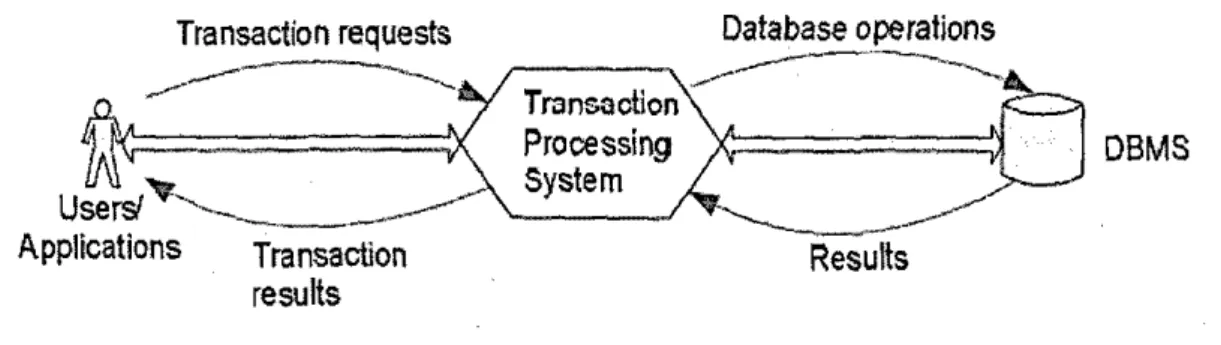
FIGURE2. 11: DATAFLOW OF TRANSACTION-ORIENTED DATABASE SYSTEMS ... 29
FIGURE2. 12: TRANSACTION PROCESSING SYSTEM COMPONENTS ...•... 29
FIGURE2. 13: DISTRIBUTED TRANSACTION PROCESSING SYSTEMS ... 31
FIGURE2. 14: LOCAL AND GLOBAL TRANSACTIONS •...•...•... 32
FIGURE2. 15: MOBILE DATA BASE ARCHITECTURE ..•...•...•... 33
FIGURE2. 16: FLAT TRANSACTION MODEL. ...•... 42
FIGURE2. 17: NESTED TRANSACTION MODEL ...•... 43
FIGURE2. 18: COMPENSATING AND CONTINGENCY TRANSACTIONS .•....•...•....•...• 44
FIGURE2. 19: A SUCCESSFUL SAGAS ...•...•...•...• 45
FIGURE2. 20: AN UNSUCCESSFUL SAGAS ...•...•...•...• 45
, FIGURE2. 21: SPLIT AND JOIN TRANSACTION MODEL ...•... 46
FIGURE2. 22: REpORTING AND CO-TRANSACTION ... 49
FIGURE2. 23: COMPACTS AS OBJECTS ...•... 50
FIGURE2. 24: PRO-MOTION TRANSACTION ARCHITECTURE ... 51
FIGURE2. 25: TwO-TIER TRANSACTION MODEL. ... : ...•... 52
FIGURE2. 26: WEAK-STRICT TRANSACTION MODEL ... 54
FIGURE2. 27: PRE-WRITE TRANSACTION MODEL ... 55
FIGURE2. 28: PRE-SERIALIZABLE TRANSACTION MODEL ....•...•... ~. 56
FIGURE2. 29: KANGAROO TRANSACTION MODEL ..•...•...•.... 58
FIGURE2. 30: MOFLEX TRANSACTION MODEL ...•...•...• 60
FIGURE3. 1: ARCHITECTURE OF MOBILE DATABASE SYSTEMS ...•... 76
FIGURE3. 2: DECISION FLOW OF CHS ...•...•...•...•... 80
FIGURE3. 3: EXECUTION FRAMEWORK FOR THE THREE STRATEGIES ...•...•... 83
FIGURE3.4: MOBILE TRANSACTION PROCESSING ALGORITHM ... 85
FIGURE3. 5: THE SIMULATION MODEL OVERVIEW ... 87
FIGURE3. 6: RESPONSE TIME FOR MOBILE TRANSACTION (8W<=100) ...•. 90
FIGURE3. 7: RESPONSE TIME FOR FIXED TRANSACTION (8W<=100) ...•. 91
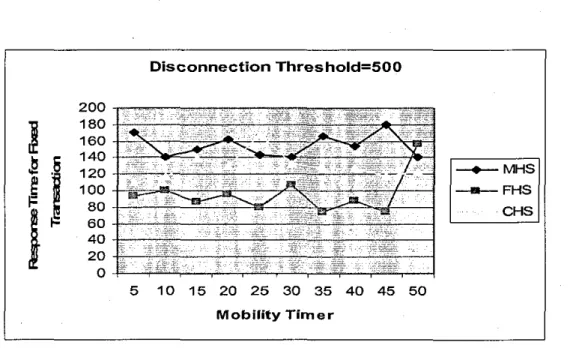
FIGURE3. 10: RESPONSE TIME FOR MOBILE TRANSACTION (BW<=500) ... 94
FIGURE3. 11: RESPONSE TIME FOR FIXED TRANSACTION (BW<=500) ... 94
FIGURE3. 12: POWER CONSUMPTION (BW<= 100) ... 95
FIGURE3. 13: POWER CONSUMPTION (BW<= 500) ... 95
FIGURE3. 14: POWER CONSUMPTION (BW<= 1000) ... 96
FIGURE3. IS: THROUGHPUT FOR MOBILE TRANSACTIONS (BW<= 500) ... 96
FIGURE3. 16: THROUGHPUT FOR FIXED TRANSACTIONS (BW<= 500) ... 97
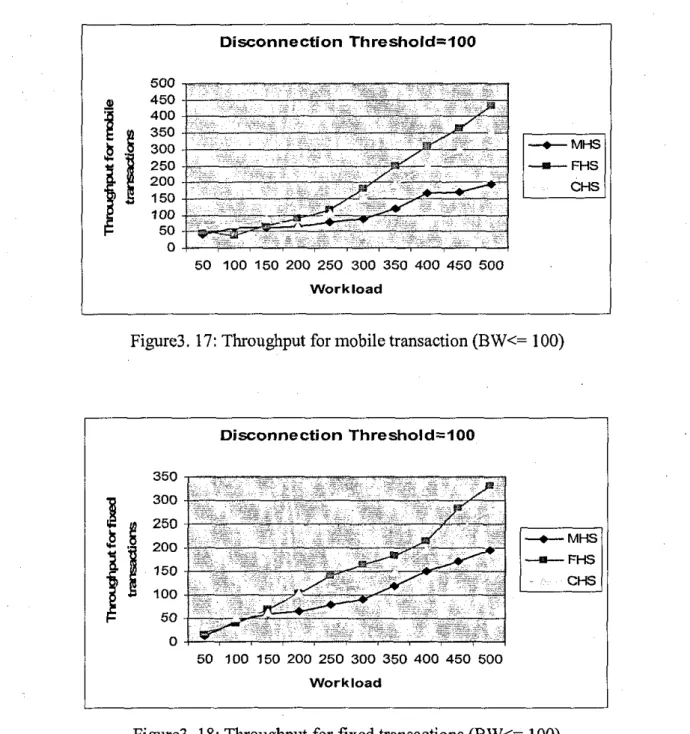
FIGURE3. 17: THROUGHPUT FOR MOBILE TRANSACTION (BW<= 100) ... 98
FIGURE3. 18: THROUGHPUT FOR FIXED TRANSACTIONS (BW<= 100) ... 98
FIGURE3. 19: THROUGHPUT FOR MOBILE TRANSACTIONS (BW<= 1000) ... 99
FIGURE3. 20: THROUGHPUT FOR FIXED TRANSACTIONS (BW<= 1000) ... 99
FIGURE4. I: MIXED SYSTEM MODEL ... 104
FIGURE4. 2: MIXED TRANSACTIONS INTERLEAVING OPERATIONS ... 106
FIGURE4. 3 : DELAY DUE TO BANDWIDTH VARIABILITy ... ; ... 109
FIGURE5. 1: 2PL INTERLEAVING EXAMPLE ... 114
FIGURE5. 2:
aee
INTERLEAVING EXAMPLE ... 116FIGURE5. 3: LOCK REQUEST FOR MOBILE AND FIXED TRANSACTIONS ... 119
FIGURE5. 4: EXECUTE FIXED LOCK REQUEST.. ... 120
FIGURE5. 5: EXECUTE MOBILE LOCK REQUEST ... 121
FIGURE5. 6: EXECUTE UNLOCK REQUEST ... 121
FIGURE5. 7: LOCK-MIX INTERLEAVING EXAMPLE ... 123
FIGURE5. 8: FORWARD VALIDATION ... 126
FIGURE5. 9: BACKWARD VALIDATION ... 127
FIGURES. 10: ADJUSTMENTOFTI (TA) AT THE READ PHASE ... 129
FIGURE5. 11 : ITERATE READSET/WRITESET OF VALIDATING TRANSACTION ... 13 0 FIGURE5. 12: FORWARD ADJUSTMENT ... 132
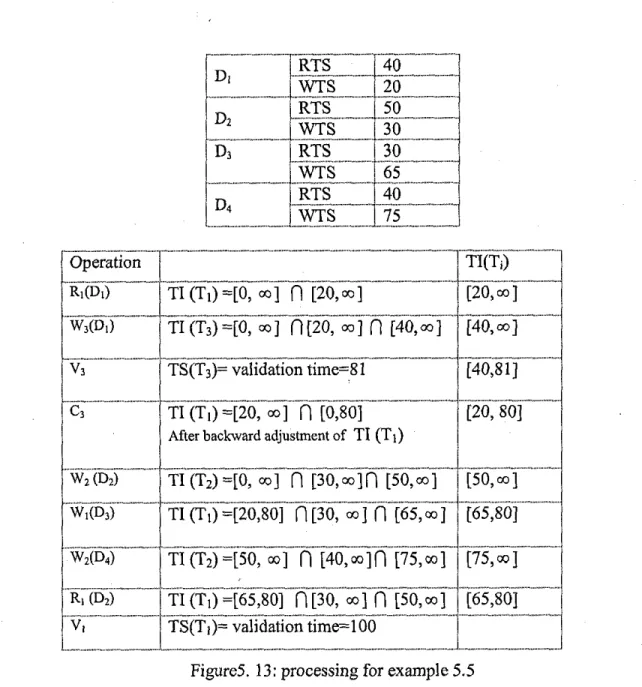
FIGURE5. 13: PROCESSING FOR EXAMPLE 5.5 ... 133
FIGURE5. 14: PROCESSING FOR EXAMPLE 4.6 ... 136
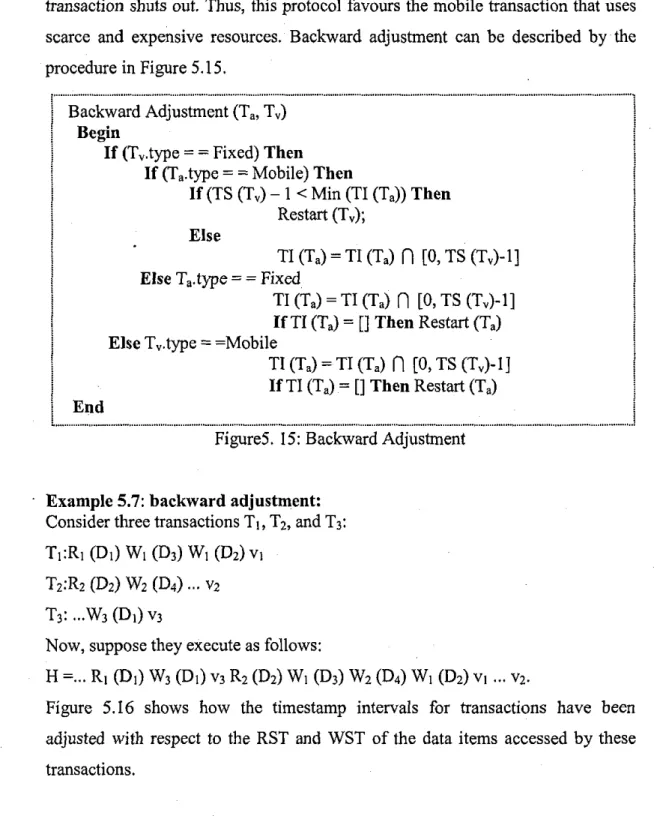
FIGURE5. IS : BACKWARD ADJUSTMENT ... 13 7 FIGURE5. 16: PROCESSING FOR EXAMPLE 5.7 ... 138
FIGURE5. 17: SELECT COMMIT TIMESTAMP ... 141
FIGURE5. 18: UPDATE DATA, ITEMTIMESTAMPS ... 141
FIGURE6. I: WIRELESS PART OF MIXED TRANSACTION ENVIRONMENT ... 144
FIGURE6. 2: POWER CONSUMPTION RATIO (MT = 20%) ... 149
FIGURE6. 3: POWER CONSUMPTION RATIO (MT = 50%) ... 149
FIGURE6. 4: POWER CONSUMPTION RATIO (MT = 80%) ... 150
FIGURE6. 5: MOBILE TRANSACTION ABORTS DUE TO DISCONNECTION (MT = 20%) ... 151
FIGURE6. 6: MOBILE TRANSACTION ABORTS DUE TO DISCONNECTION (MT = 50%) ... 151
FIGURE6. 7: MOBILE TRANSACTION ABORTS DUE TO DISCONNECTION (MT = 80%) ... 152
FIGURE6. 8: THROUGHPUT OF MOBILE TRANSACTIONS (MT = 20 %) ... 153
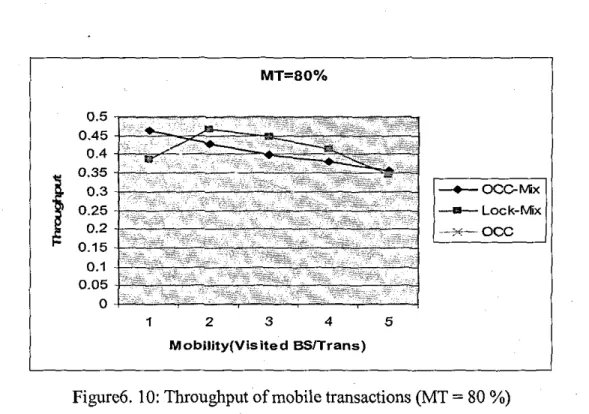
FIGURE6. 9: THROUGHPUT OF MOBILE TRANSACTIONS (MT = 50 %) ... 153
FIGURE6. 11: RESTART RATIO FOR MOBILE TRANSACTIONS (MT = 20 %) ... 155
FIGURE6. 12: RESTART RATIO FOR FIXED TRANSACTIONS (MT= 20 %) ... 155
FIGURE6. 13: RESTART RATIO FOR MOBILE TRANSACTIONS (MT = 50 %) ... 156
FIGURE6. 14: RESTART RATIO FOR FIXED TRANSACTIONS (MT = 50 %) ... 156
FIGURE6. 15: RESTART RATIO FOR MOBILE TRANSACTIONS (MT= 80 %) ... 157
FIGURE6. 16: RESTART RATIO FOR FIXED TRANSACTIONS (MT = 80 %) ... 157
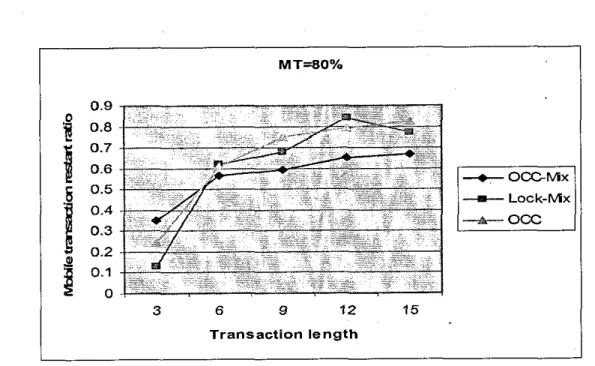
FIGURE6. 17: RESTART RATIO FOR MOBILE TRANSACTIONS (MT = 20 %), TL ... 159
FIGURE6. 18: RESTART RATIO FOR MOBILE TRANSACTIONS (MT = 50 %), TL ... 159
FIGURE6. 19: RESTART RATIO FOR MOBILE TRANSACTIONS (MT= 80 %), TL. .... 160
FIGURE6. 20: MOBILE TRANSACTION ABORTS DUE TO DISCONNECTION (MT = 20%) ... 161
FIGURE6. 21: MOBILE TRANSACTION ABORTS DUE TO DISCONNECTION (MT = 50%) ... 161
FIGURE6. 22: MOBILE TRANSACTION ABORTS DUE TO DISCONNECTION (MT = 80%) ... ; ... 162
FIGURE6. 23: RESTART RATIO FOR MOBILE TRANSACTIONS (MT= 20 %) ... 163
FIGURE6. 24: RESTART RATIO FOR MOBILE TRANSACTIONS (MT = 50 %) ... 164
FIGURE6. 25: RESTART RATIO FOR MOBILE TRANSACTIONS (MT= 80 %) ... 164
FIGURE6. 26: ADIUSTMENT RATE ... 165
FIGURE6. 27: POWER CONSUMPTION RATIO (MT= 20%) ... 167
FIGURE6. 28: POWER CONSUMPTION RATIO (MT= 50%) ...•... 167
FIGURE6. 29: POWER CONSUMPTION RATIO (MT = 20%) ... 168
FIGURE6. 30: MOBILE TRANSACTION ROLLBACK FREQUENCY (FT = 20%) ... 170
FIGURE6. 31: FIXED TRANSACTION ROLLBACK FREQUENCY (FT = 20%) ... 170
FIGURE6. 32: MOBILE TRANSACTIONS ROLLBACK FREQUENCY (FT = 50%) ... 171
FIGURE6. 33: FIXED TRANSACTIONS ROLLBACK FREQUENCY (FT = 50%) ... 171
FIGURE6. 34: MOBILE TRANSACTIONS ROLLBACK FREQUENCY (FT = 80%) ... 172
FIGURE6. 35: FIXED TRANSACTIONS ROLLBACK FREQUENCY (FT = 80%) ... 172
FIGURE6. 36: PCR AT DIFFERENT Ii -VALUES ... 173
FIGURE6. 37: PCR AT DIFFERENT 1] - VALUES ... 174
FIGURE6. 38: FIXED TRANSACTION RESTART RATIO AT DIFFERENT 1] AND Ii -VALUES ... 174
FIGURE6.39:PCRATDIFFERENT1] ANDfl-VALUES ... 175
FIGURE6. 40: FIXED ROLLBACK FREQUENCY AT DIFFERENT er -VALUE ... 176
List of Tables
TABLE2. 1: LOCK COMPATIBILITY MATRIX ...•.•....•... 24
TABLE2. 2: CHARACTERISTICS OF MOBILE ENVIRONMENT ...•... 38
TABLE2. 3: DISTRIBUTED ENVIRONMENTS VERSUS MOBILE ENVIRONMENTS ... 39
TABLE2. 4: COMPARISON OF TRADITIONAL TRANSACTIONAL MODELS ...•... 47
T ABLE2. S: HAND-OVER CONTROL RULES OF SUBTRANSACTIONS .•...••... 61
TABLE2. 6: COMPARISON OF MOBILE TRANSACTIONS MODELS ...•... 62
T ABLE3. 1 : COMMUNICATION PARAMETERS •...•.•...•...•...•...•.•...•.... 89
TABLE3. 2: FIXED HOST PARAMETER ...•... 89
TABLE3. 3: MOBILE HOST PARAMETERS ...•...•..•... 90
TABLES. 1: OPERATIONS INTERLEAVING FOR EXAMPLE 4.1 ... 113
TABLES. 2: COMPATIBILITY MATRIX FOR LOCK-MIX ...••... 120
- - _ . -
- - - ,
LIST OF ACRONYMS
ACID FT MT MDB MH FH GDB GT MST IT. KM KT LLT LTM MH MSS BSC MSC MTM MU TMOCC
2PL DAA PCR FHS MHS CHS Treq Drcq CC SGs TSO MGL DM SGT DFV TSH TLAtomicity, Consistency, Isolation, And Durability. Fixed Transaction
Mobile Transaction Mobile Database System Mobile Host
Fixed Host Global Database Global Transaction Mobile Sub Transaction Jocy Transaction
Kangaroo Model Kangaroo Transaction Long-Lived Transactions Local Transaction Manger Mobile Host
Mobile Support Station Base Station Controller Mobile Switching Centre Mobile Transaction Manager Mobile Unit
Transaction Manager
Optimistic Concurrency Control Two Phase Locking
Data Access Agent
Power Consumption Ratio Fixed Host Execution Strategy Mobile Host Execution Strategy Combined Host Execution Strategy Transaction Request
Data Request
Concurrency Control Serialization Graphs
Time Stamp Ordering Multi-Granularity Locking Data Manager
Serialization Graph Testing Dynamic Finite Versioning Time Stamp History. Transaction Length
CHAPTER 1
Introduction
1.1 Atomicity relaxation
Transaction processing in mobile databases imposes further limits on both functionality and performance over those of traditional transaction management. Transaction management requirements in mobile database systems are different from those in conventional database systems. Many new mobile applications require advanced transaction processing, where traditional transaction properties, especially the atomicity and isolation properties, are challenged. The flat transaction structure is often abandoned in favour of some form of nested transaction model, atomicity is replaced by "semantic atomicity", and serializability (which is the correctness criterion guaranteeing isolation) is replaced by some non-serializable correctness criterion. There are a variety of concurrency control techniques guaranteeing different flavours of non-serializability. These techniques often use semantic information about transactions and/or objects to guarantee correctness for concurrent transactions while at the same time allowing more concurrency.
One particular problem in mobile applications is the need to support long-lasting transactions. The duration of a long-lasting transaction may cause serious performance problems if it is allowed to lock resources until it commits. This may either force other transactions to wait for resources for an unacceptable long time, or it may increase the likelihood of transaction abort. Aborting a long-lasting transaction may have a negative effect on both response time and throughput. If the long transaction has a flat structure, a failure will cause the whole transaction to be undone and possibly re-executed. This is a very expensive recovery strategy, especially if the failure occurred after executing most of the transaction.
- -
---1.1.1 Mobile transaction processing
To support mobile transactions, the transaction processing models should accommodate the limitations of mobile computing, such as unreliable communication, limited battery life, low bandwidth communication, and reduced storage capacity. Mobile computations should minimize aborts due to disconnection. Operations on shared data must ensure correctness of transactions executed on both stationary and mobile hosts. The blocking of a transaction's executions on either the stationary or mobile hosts must be minimized to reduce communication cost and to increase concurrency. Proper support for mobile transactions must provide for local autonomy to allow transactions to be processed and committed on the mobile host despite temporary disconnection.
Semantic based transaction processing models [58, 59] have been extended for mobile computing in [60] to increase concurrency by exploiting commutative operations. These techniques require caching a large portion of the database or maintaining multiple copies of many data items. In [60], fragmentability of data objects have been used to facilitate semantic-based transaction processing in mobile databases. Each fragmented data object has to be cached independently and manipulated synchronously. That is, on request, a fragment of data object is dispatched to the MH. On completion of the transaction, the mobile hosts return the fragments to the BS. Fragments are then integrated in the object in any order and such objects are termed as re-orderable objects. This scheme works only in the situations where the data objects can be fragmented like sets, stacks and queues.
In [61], the concept oftransaction proxies is introduced to support recovery. For each transaction submitted to a MH, a dual transaction called proxy is submitted to the base station. The proxy transaction includes the updates of the original transaction. Proxy transactions take periodic backups of the computation performed at mobile hosts. Similar to the above, in [62], the notion of twin transaction was introduced which essentially replicates the process of executing transactions. In the twin transaction model, each write's request will be mirrored
and two equivalent transactions will be created. In this way, if a mobile host is disconnected, the transaction execution can still proceed.
D}TIamic object clustering has been proposed in mobile computing in [63, 64].
It assumes a fully distributed system, and the transaction model is designed to maintain the consistency of the database. The model uses weak read, weak-write, strict-read and strict-write. The decomposition of operations is done based on the consistency requirement. Strict-read and strict-write have the same semantics as normal read and write operations invoked by transactions satisfying ACID properties. A weak-read returns the value of a locally cached object written by a strict-write or a weak-write. A weak-write operation only updates a locally cached object, which might become permanent on cluster merging if the weak-write does not conflict with any strict-read or strict-write operation. The weak transactions use local and global commits. The local commit is the same as pre~commit of [30] and global commit is the same as final commit of [30]. However, a weak transaction after local commit can abort and is compensated. In [30], a
pre-committed transaction does not abort; hence requires no undo or compensation. A weak transaction's updates are visible to other weak transactions whereas pre-writes are visible to all transactions.
An 'open' nested transaction model has been proposed in [25] for modelling mobile transactions as a set of subtransactions. They introduce reporting and co-transactions. A reporting transaction can share its partial results, can execute concurrently and can commit independently. Co-transactions are like co-routines and are not executed concurrently. The model allows transactions to be executed on disconnection. It also supports unilateral commitment of subtransactions, compensating and non-compensatable transactions. The author claims that the model minimizes wired as well as wireless communication cost. However, not all the operations are compensated [25], and compensation is costly in mobile computing.
A kangaroo transaction (KT) model was given in [31]. It incorporates the property that transactions in a mobile computing hop from a base station to another as the mobile unity moves. The mobility of the transaction model is captured by the use of split transactions [26]. A split transaction divides ongoing transactions into serializable subtransactions. An earlier created subtransaction is committed and the second subtransaction continues its execution. The mobile
transaction is split when a hop occurs. The model captures the data behaviour of the mobile transaction using global and local transactions. The model also relies on compensating transactions in case a transaction aborts.
1.1.2 Limitations of the existing works:
Actually, there is a big gap between academic research and commercial products on mobile transactions. In academic research, the mobile support stations play very important roles in the processing of mobile transactions. While in commercial products, mobile hosts and database servers communicate directly, i.e., the role of the mobile support stations does not exist. Moreover, commercial products mainly focus on disconnected transaction processing, while the mobility of mobile hosts is not taken into consideration. The following are the main limitations of the existing work regarding the academic research in the mobile transaction field.
• The lack of some fundamental support for mobile transactions is an issue. There are different views what a mobile transaction is. Many models consider mobile transactions as transactions that are submitted to or initiated from the mobile hosts other models require that mobile hosts must take part in the execution of mobile transactions [MBOl]. These different attitudes cause incompatibility and incoherence between mobile transaction processing systems.
• The common architecture of mobile transaction enviromnents relies heavily on the mobile support stations that are stationary and wired connected with the database servers. A difficulty is to extend the capacity of mobile transaction processing systems. The bottleneck problem can occur when there are many mobile hosts within a mobile cell and the distribution of the transaction processes among mobile hosts must be carried out through the mobile support stations.
• The lack of specific detail for how the is the execution is take place at both host (MH, FH) which is consider as an assumption by some of mobile transaction models found in the literature.
• Most of the previous work in transactions model did not consider the effect of fixed transactions on mobile and vies versa .
• Sharing partial results among mobile transactions is not fully dealt with. The existing approaches like delegation operations that support sharing of data among transactions may not be adequate because it requires a tight cooperation between delegator and delegatee transactions. Furthermore, the issue of distributed transaction execution among mobile hosts has not been addressed.
1.1.3 Transaction decomposition
Decomposing the transaction into a number of subtransactions is one way of dealing with these problems. Each subtransaction is typically executed and committed/aborted independently of the top level transaction. This makes it
possible to abort some part of a transaction without aborting the whole long-lasting transaction. An aborted subtransaction can be re-executed or an alternative subtransaction can be executed instead of the one that failed. Such a transaction execution gives a semantic form of atomicity, instead of the conventional strict form of atomicity. Decomposing transactions may also positively affect the concurrency of transactions. Since subtransactions commit independently of the top level transaction, locks held by the sub transaction may be released at subtransaction commit time. If the unlocked resources are made publicly available at subtransaction commit time, this will increase concurrency in the system. However, early release of locks will also affect recovery, in that conventional rollback is no longer sufficient. Compensation is needed if the results of a subtransaction are made publicly available before commit of the top level transaction. Decomposition of transactions is one approach, used in several transaction processing techniques, to adapt transaction processing to the mobile computing environment.
Wide area and wireless computing suggest that there will be more competition for shared data since it provides users with the ability to access information and services through wireless connections that can be retained even while the user is moving. Further, mobile users will have to share their data with others. Those users may have access to the shared data by reliable wired communication (i.e.
fixed host transactions) or unreliable wireless communication (Le. mobile host transactions). The task of ensuring consistency of shared data becomes more difficult in mobile computing because of limitations of wireless communication and restrictions imposed due to mobility and portability [24].
Access to the future information systems through mobile computers will be performed with the help of·mobile transactions. Research in mobile database systems (MDBS) has received a lot of interest in the past decade [47, 48, 49, 50, 51,52,53]. Transactions in a mobile database system are usually associated with relaxations of ACID properties because of their long-lived nature and limitations inherited from the wireless environment. Any abortion of a mobile transaction may result in a high cost associated with scarce wireless resources, whilst fixed transactions might only cause a little degraded level of system performance. In the past two decades, researchers have proposed various transaction models either to tackle the isolation and atomicity properties of mobile transaction or guarantee the consistency of mobile transaction. Most of the previous studies in mobile database systems assume that the system consists of only one single type of transaction (i.e. mobile transaction), without paying any attention to the effect of interaction between both types of transactions sharing the same databases simultaneously. In these studies, different assumptions are made on the system and transaction models, e.g., the execution strategy and structure of the transactions, so that different scheduling techniques can be engineered to satisfy the different requirements of mobile transactions. However, little work has been done in the development of an integrated approach that can handle mobile database systems satisfactorily containing a mixed population of fixed and mobile transactions simultaneously.
As the fixed and mobile transactions continue to interact, it's become apparent that the dichotomy must be resolved not only at the atomicity relaxation level, but at the lower, isolation levels as well. As an initial step in this direction is the first· phase of this study which aim to propose a unified framework which has been used later as a basis for evaluating a different execution strategies and then go more in depth into isolation level in the second phase of this study.
1.2 Concurrency control
Many variations of concurrency control (CC) schemes have been introduced to improve concurrency and system performance [68], [69], [70], [71], [72] and [73] in conventional database environments. Recently, there have been several studies dealing with CC in mobile databases addressing the transaction scheduling aspect [74], [75],[76], [77], [78] and [79] These CC schemes are mainly extended or adapted from existing CC schemes, such as two phase locking, optimistic CC schemes, and multi version schemes, to mobile environments. Some of the CC schemes are more naturally adaptable to mobile requirements, while others are less so. For example, it's not practical for a mobile transaction to hold the lock on a certain data item and then disconnect, as this will cause performance degradation for both mobile. and other fixed host transactions running concurrently on the system and sharing the same database access [80].
Several techniques have been developed from conventional CC schemes to cope with wireless requirements, especially for transaction processing in broadcasting environments, such as Multi-Version Broadcast [74], Serialization Graph [77] and [81], Broadcast Concurrency Control with Time Stamp Interval (BCC-TI) [79] and Certification Report [76]. The analysis and drawbacks ofthese methods can be found in [82]. Some of these methods only support client read-only transactions [76], and some of them could have substantial processing overhead [77]. Protocol inefficiency is also introduced in some of these solutions because of the support of strict global serializability as the correctness criterion. It
becomes necessary to design a new broadcast concurrency control protocol to overcome these drawbacks. Most importantly, in order to improve transaction processing efficiency, we need to overcome the problems caused by global serializability which is very difficult to achieve in distributed broadcast environments.
In other types of mobile computing environments such as distributed and multi-database systems, most existing work concentrates on proposing a mobile transaction model and an execution framework for the model over these environments and uses the same traditional con currency techniques at the database server.
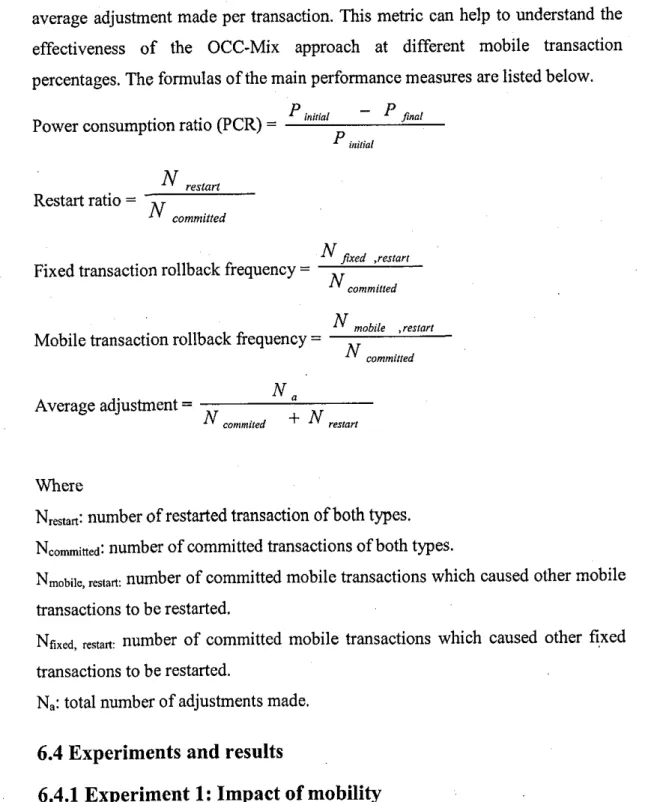
No work has been done in the field of processing of mixtures of transactions. One of the main objectives of this thesis is to address this problem. We will propose a suitable concurrency approaches that take into account the wireless constraints of the mobile computing environment and, at the same time, cater for fixed host transactions which use tolerable resources. In addition to the wireless requirements, other major differences exist between conventional and mobile database systems. For example, while transaction response time and throughput are usually the perfonnance metrics to measure conventional database systems, additional performance measures will be introduced to distinguish between the performance of different concurrency protocols in mobile database systems with mixture of transactions.
1.2.1 Concurrency control background
Concurrency control schemes have the responsibility to ensure that although transactions are executed concurrently with interleaving operations, the committed or certified transactions can be ordered or given a certification time stamp ordering so that the net effect on the database is equivalent to the execution of these transactions in a serial order. Note that, after a transaction is committed, its effect on the database becomes pennanent. The CC design space can be classified, into optimistic and pessimistic approaches, along several dimensions: conflict detection, conflict resolution, serialization rule and order, and run policy. Such a classification provides us with a nice framework from which various techniques for achieving serializability and improving performance can be better illustrated.
1.2.1.1 Conflict detection
There are two ways to detect a conflict: either before the data item access or after the data item access. The former is referred to as the pessimistic approach. The latter is referred to as the optimistic approach, where checking for serializability is done later at the certification time. Several mechanisms can be used to facilitate the detection process, such as locks, time stamps and serialization graphs (SGs) [83]. For each of these mechanisms, there is one type of pessimistic CC scheme using it exclusively for conflict detection. For example, two-phase locking (2PL) schemes use locks, time stamp ordering (TSO) schemes use time stamps, and
serialization graph testing (SOT) schemes use serialization graphs. For optimistic concurrency control (OCC) [73J, however, anyone of the three mechanisms can be used to detect conflicts at the certification time. For a lock based scheme, a lock must first be obtained before an access is made to a data item. However, different access modes and compatibility matrices can be used to allow for more concurrency. For example, read (shared) and write (exclusive) modes are often introduced to distinguish between read and write accesses in a 2PL scheme. A read lock is only compatible with other read locks; a write lock is incompatible with any other lock. When locks are used by an OCC scheme, an additional type oflock mode, referred to as a weak lock, can be introduced as well [84J, [72]. A weak lock, which is in contrast to the normal (strong) lock, is only used to indicate that a data item is being accessed. It is compatible with other weak locks and the strong locks of shared mode, but is incompatible with the strong locks of exclusive mode. In addition, an extension can also be made in 2PL to allow each transaction to use a different data item size that is most appropriate for its execution. This is referred to as multi-granularity locking (MOL) [85J. For a TSO scheme, each transaction is assigned a time stamp before execution. For each data item access, the transaction's time stamp is checked against the time stamp of the last transaction that has accessed the same data item to determine whether the predefined time stamp order can be maintained. For an SOT scheme, the CC manager maintains an SO that represents the execution ordering of all the transactions in the history, and checks for cycles. In general, information about a transaction cannot be deleted at commit time. It can be deleted only after the committed transaction will not, at any time in the future, be involved in a cycle of the SO.
1.2.1.2 Conflict resolution
Once a conflict is detected, a conflict resolution mechanism needs to be put in place. A conflict resolution mechanism needs to decide which candidate transaction(s) (the lock requester or lock holders) to penalize, and choose an appropriate action and a suitable timing for the action. There are two possible actions that are most frequently used: blocking (or wait) and abort (or restart). (Two other alternatives are multiversioning, and dynamically readjusting the
serialization order, which will be discussed later.) If a conflict is detected before
the data item access, either blocking or abort can be used to resolve the conflict. However, if a conflict is detected after the data item access, only abort is appropriate. An alternative to blocking for conflict resolution is delaying commit. That is to say, instead of waiting for a lock, the transaction is waiting for the commit order. This can be implemented in a multiversion scheme and other locking schemes like the ordered-sharing schemes in [86]. As to a suitable timing for an action, it is immediate for blocking, but it can be either immediate or delayed, e.g., delayed until the certification time, for abort.
We consider different performance goals in processing fixed and mobile transactions at the same time. The performance goal in processing mobile transactions is to minimize the amount of wasted wireless resources, while the performance goal in processing fixed transactions is to maximize the system throughput (or to minimize the mean response time, for example).
As astute readers may notice, conventional concurrency control protocols used in scheduling mixture of mobile and fixed transactions often ignore the performance requirements of fixed transactions. For example, most of the traditional concurrency control protocols resolve. access conflicts based on the idea of both transactions type experience the same type of resources. When they are applied to a mixture environments, it is likely to waste more wireless recourses due to blocking and restarting overhead of mobile transactions, due to data conflicts. This may cause the poor response times of fixed host transactions too. How to explore the balance and trade-off between the performances of the two types of transactions is one of the main objectives in the second phase of this study.
1.3 Thesis contributions
The following is a summary of the major contributions of this dissertation:
• We propose an execution framework for mobile transaction processing and anal yze the impact on mobility of mobile transaction processing under different execution strategies.
• We develop a model representing mixed transactions systems which captures both fixed and mobile characteristics of transactions. The model provides a basis forthe performance study of general concurrency control approaches in such mixed environments.
• We study the effect of bandwidth variability on transaction processing in mixed transactions systems. Mainly, we present the effect of using a 2-phase locking protocol mathematically and analyse it by estimating the delay caused by the mobile transaction on other fixed and mobile transactions.
• We propose two adaptable concurrency control approaches suitable for mixtures of transactions. One is based on locking, cal1ed the 'Lock-Mix' approach; the other is based on optimistic concurrency control paradigms and is called the 'OCC-Mix' approach.
• We conduct extensive evaluations, through simulation experiments, of the concurrency control approaches. The results demonstrate that using these approaches reduces wastage of scarce and expensive resources of mobile computing environments. In particular, we shoW' that these approaches provide significant performance gains over an optimistic concurrency control protocol for environments with mixtures of mobile and fixed transactions under a wide range of operating conditions.
1.4 Thesis organization
The remainder of this thesis is organized as follows. In Chapter 2, we first revisit the basic concepts of database transactions, and discuss how these concepts are achieved in practical systems. Next, we briefly go through the architecture of transaction processing systems in centralized and distributed environments. We survey several selected transaction models and transaction processing systems that have been purposely developed to support transaction processing in mobile environments. We recap some traditional transaction models whose features could be used in mobile environments. Traditional transaction models are reviewed along with a discussion of their importance to mobile environments. Mobile transaction models and mobile transaction processing systems, that have been developed recently, are surveyed in Chapter 2. We also review the data management issues in mobile computing environments. In Chapter 3, we exploit a particular relaxation of ACID properties, commonly used in mobile transaction models when building execution frameworks. We evaluate the impact of mobility and disconnection, on processing of mobile transactions under different execution strategies, through simulation, and discuss the results. In Chapter 4 the basic concurrency problem for environments with mixtures of fixed host and mobile transaction systems is defined. We consider the effect of bandwidth variability on scheduling a mixture of mobile and fixed host transactions, and use this to motivate our proposed concurrency control approaches in Chapter 5. The proposed concurrency control approaches, those of 'Lock-Mix' and 'OCC-Mix', presented in Chapter 5. In Chapter 6, we investigate the performance of these approaches in mixed transaction environments for different percentages of mobile transactions. The performance of these protocols are evaluated and compared against an OCC protocol under different workload and operating conditions. We show that wastage of wireless resources is reduced substantially by applying these approaches. Finally, Chapter 7 summarizes the salient results of our research, and gives a concluding discussion.
--
----~~~~~~~~~~~~~---~--1CHAPTER2
TRANSACTIONS PROCESSING BACKGROUND
In this chapter, we first revisit the basic concepts of database transactions in section 2.1, and discuss how these concepts are achieved in practical systems. Next, in section 2.2, we briefly go through the architecture of transaction processing systems in centralized and distributed environments. Then, in section 2.3, mobile database systems are described. The difference between the mobile and distributed computing is explained in section 2.4. We survey several selected transaction models and transaction processing systems that have been purposely developed to support transaction processing in mobile environments. We will also recap some traditional transaction models whose features could be used in mobile environments. Traditional transaction models are reviewed in section 2.5. We discuss why they are important, and how these models can be used in mobile environments. Mobile transaction models and mobile transaction processing systems that have been developed recently are surveyed and commented on in section 2.6. Finally, we review the data management issues in mobile computing environments in section 2.7.
2.1 Database and transaction concept
A database is a collection of data items that is gathered over a period of time, and safely stored for further examination or analysis [1]. A database is usually accompanied by a data structure and a set of constraint rules that specify what information a data item represents. For example, in an employee database, the employee age is an integer number and must be greater than eighteen and less than sixty five. A database state is a collection of all the stored data values of all the data items in the database at a specific time [2]. A consistent state of a database is a database state in which all the data values fulfil all the constraint
rules of the database .. A set of operations is usually provided to support users in retrieving or modifying data items in the database. These provided operations can be simple, for example read and write operations, or more complex operations, for example deletion or modification operations. To assist users to perform much more complex operations rather than reading from and writing to the database, a piece of specialized software called a database management system (DBMS) is accommodated in the database. In general, a DBMS not only provides an easy-to-use and friendly interface to easy-to-users for accessing and manipulating the database, but also manages all the database operations. In addition, the DBMS also protects the database from unauthorized users.
2.1.1 Database transactions
Users can interact with the database by one or many database operations. The database operations can be gathered together to form a unit of execution program that is called a transaction [3]. In other words, a transaction is a logical execution unit of database operations. A transaction transforms the database from one consistent state to another consistent state. Figure 2.1 presents a programming model of a transaction.
r .. ·""···,,···,', ... •···· .. ·· ... ···· ... " .... , ... ,'" •• ," ... " ... " ... ,,,,,, ... ···1
j
Begin transaction (initial consistent state)j
:
1.: One or-more database
ope~ations
-If (reach new _consistent _state) Then Commit_transaction (new _consistent_state) Else
Abort_transaction (initial_ consistent_state)
: i
f ... " .... , ... , ... , ••••••.••••• "." ... , ... .1
Figure2. 1: Transactional programming model
A transaction program starts from an initial consistent state of the database by invoking a Begin _transaction method call. After that, one or a set of database operations of the transaction program are executed. When these database operations are completed, i.e., a new consistent database state is established as designed, the transaction program saves this new consistent state into the database by calling the Commit _transaction method. The Commit _transaction call ensures
that all the database operations of the transaction program are successfully executed and the results of the transaction are safely saved in the database. If there is any error during the execution of the transaction program, the initial consistent state of the database is re-established by the Abort _transaction call. The
Abort_transaction call indicates that the execution of the transaction program has
failed and this execution does not have any effect on the initial consistent state of the database. The transaction is said to be committed if it has successfully executed the Commit_transaction call, otherwise it is aborted. A transaction is called a read-only transaction if all of its database operations do not alter any database state.
2.1.2 The ACID properties
In a database system, there may be a large number of transactions that are executed concurrently, i.e., the shared data items in the database are read and possible written by many transactions at the same time. Each transaction must ensure that it always preserves the consistency of the database system. In order to retain and to protect the consistency of the database system, transactions will have the following ACID (Atomicity, Consistency, Isolation, and Durability) properties [3]:
• Atomicity. Either all database operations of a transaction program are successfully and completely executed, or none of the database operations of this transaction program are executed.
• Consistency. A transaction must always preserve and protect the consistency of the database, i.e., it transforms the database from one consistent state to another. In other words, the result of a transaction that has committed fulfils the constraints of the database system.
• Isolation. An on-going transaction must not interfere with other concurrent transactions, or be able to view intermediate results of other concurrent transactions. In other words, a transaction is executed as if it is the only existing execution program on the database system at any given time.
• Durability. The result of a transaction that has successfuIJy committed is permanent in the database. The consistent state of the database is always survived despite any type of failures.
The ACID properties of a transaction ensure that: (1) a transaction always keep the database in a consistent state, (2) a transaction does not disturb other transactions during their concurrent execution processes, and (3) the consistent state of the database system that is established by a committed transaction withstands software or hardware failures. In order to achieve the ACID properties, normalJy, two different sets of protocols named concurrency control protocols and recovery protocols are needed [2].
2.1.3
Con currency
control oftransactionsIn this section, we discuss the problems that can occur in a database system in which there are many transactions being executed concurrently. In other words, we answer the question of why there is a need of concurrency control in the database system. We also review different techniques that ensure the correctness of transaction execution. To illustrate and to simplify the analyses without losing generality, we assume that each transaction possesses the folJowing characteristics:
• Transaction 1) starts by a Begin_transaction caIJ that is denoted by Bi.
• A database operation 0pi(X) on a data item X is either a read operation Ri(X) or a write operation Wi(X). In general, more complex operations on a database system can be modelJed via read and write operations.
• Transaction Ti ends by either a Commit_transaction caIJ denoted by G, or an
Abort transaction - caIJ denoted by Ai. ,
Some typical problems which are caused by the concurrent execution of transactions are: lost update, dirty read, and unrepeatable read [3]. These problems are presented in Figure 2.2
T,
r,
T, T,I
R,P\)I
I
R,(X)I
I
W,(x)I
I
R,Ix)I
~
I
W,(X)I
R,(X) R,IX) W,(X)I
W,Ix)I
W,M C,I
C,I
C,I
R,II')I
I
R,IY)I
R,Iv)I
W,MI
I
W,MI
I
~,I
I
C,I
W,(:I)c,
Lost update Dirty read Unrepeatable read
Figure2. 2: Concurrency problems
First, the lost update occurs when two transactions TJ and Tz try to write the same data item X. In the figure, transaction T20verwrites the value of data item X that was, prior to that, written by transaction TI. The dirty read occurs when transaction Tz reads the value of data item X that is written by transaction TI before the transaction TJ commits. If transaction TI aborts, transaction T2 has been operating on an invalid data value. Finally, the unrepeatable read happens if a transaction executes the same read operation at different times, and obtains different data values. In Figure 2.2, the read operations of transaction T2 return two different values of X: before and after the write operation of transaction TI. The concurrency problems can be solved if the DBMS can schedule these database operations of transactions in an execution order in which no transaction interferes with other, i.e., fulfils the isolation property of transactions. The execution order that sequentially contains all the database operations of all concurrent transactions is called the schedule or history of transactions [4]. The order of database operations of one transaction must be retained in the schedule of all transactions. A schedule is a serial schedule if, for any pair of transactions, all the database operations of one transaction follow all the database operations of another transaction. In other words, the isolation property of transactions is ensured in a serial schedule. Figure 2.3 (we omit the commitment and the abortion operations of transactions in the schedule) presents the possible serial schedules of transactions T 1 and T2.
Tl Tz
Schedule SI ,--_R_l{X...;..)_"'-,11{,-X),-R_l(_Y,-) W_1{Y";')--l11 Rz{X) Rz(X) W2{X)
Tz T1
Schedule S, Rz{X) R2(X} Wi,X} I LI _R_l..:...{X..:...n_N...:.1{X...:.,_R--,'{Y--,l_W_'{Y:....:.-l - '
Figure2. 3: Serial schedules
The main disadvantage of the serial schedule is that transactions must be executed serially, i.e., the concurrent execution of transactions does not exist in a serial schedule. This may decrease the performance of the database system. To deal with this drawback, the concept of serializable schedule [4J is normally used. A
schedule is serializable if it is equivalent to a serial schedule. The remaining question is how to determine if a schedule is a serializable schedule. In other words, we need to clarify the "equivalent" term. Two examples of the equivalent serializability are: conflict serializability and view serializability [1
J.
Conflict serializability is based on the concepts of conflicting operations. The idea behind conflicting operations is that: for two sequentially executed operations OpI thenOP2 that belong to two transactions TJ and TJ, respectively, if their order is interchanged, i.e., Opz then OPI, the results of at least one of the involved transactions will possibly be changed. In other words, two database operations that belong to two different transactions are conflicting if they access the same data item in the database and at least one of them is a write operation [1
J.
Two consecutive operations, which are not in conflict, can be swapped or interchanged in a schedule without any effect on the transaction behaviour. Two schedules are said to be conflict equivalent if one can be turned into another by swapping thepairs of non-conflict operations [1]. A schedule is conflict serializable if it is conflict equivalent to a serial schedule. Figure 2.4 illustrates some conflict serializable (CS) schedules. Both the schedules CSI and CS2 (in Figure 2.4) are conflict serializable with the serial schedule SI (in Figure 2.3), while the schedule non-CSJ is not conflict serializable. Moreover, the schedule CSI can be turned into the schedule CSz by sequentially swapping pairs of non-conflict operations
Schedule eSt
' "
----
..-~~ .. _---_ .. --_ ....
--Schedule CS:!
Schedule non·CS3
... --~.. Read·Write conflict operation ... --•. --.. ~ Wr~e·Write conflict operation Figure2. 4: Conflict serializable and non-conflict serializable schedules
A schedule S can be validated if it is conflict serializable by analyzing a
serialization graph [4
J.
A serialization graph (SO) is a directed graph that isconstructed in two steps as follows:
1. Each node labelled T; in the SO represents a corresponding transaction T; in the scheduleS.
2. For any pair of operations, Op; and OPj, that conflict in the schedule S, where Op; precedes 0Pj, add an edge from T; to 1} in the SO.
The schedule S is conflict serializable if the constructed SO has no cycles [4]. In Figure 2.5, the serialization graphs of schedules CS!, CS2 and non-CSJ (in the Figure 2.4) are constructed. For schedules CS! and CSl, the corresponding SO do not contain any cycle, i.e., the schedules are conflict serializable. On the other hand, the SO of the schedule non-CS3 does contain a cycle THT2-+T!, i.e., it is not conflict serializable.
SG for non-CS)
Figure2. 5: Serialization graph
View serializablity is a weaker condition that guarantees that a schedule is serializable. Two schedules SI and S2 are said to be view equivalent if the following conditions hold: (I) any read operation in either schedule returns the same data value, and (2) if a write operation Wi(A) is the last operation on data
itemXin SI, Wi(A) must also be the last operation onXin S2
[ll.
Thus, the viewequivalent conditions ensure that (I) all the transactions read the same data values, and (2) the final database states are identical.
If
a schedule is view equivalent to a serial schedule, it is said to be view serializable. Figure 2.6 illustrates a view serializable schedule. The serial schedule SI presents the sequential order schedule of transactions TJ, Tl, and T3. The schedule VS2 is not a conflict serializable schedule because of conflicting operation pairs ((WI(X). R2(A)) and ((W2(y).WI(Y)). However, the schedule VS2 is a view seriaJizable schedule because: (I) all
the read operations RI(y). R2(X) and R3(X) return the same data values of data items Y and X as in the serial schedule SI; and (2) all the write operations WI(X)
and W3(Y) are the last write operations on the data items X and Y as in the serial
schedule Si. The main disadvantage of view serializability is that, verifying view serializable schedule problem has been shown to be a NP-complete problem, i.e., it is not likely that a polynomial time algorithm for this problem will be found [5].
Schedule S,
Schedule VS!
44('---"" Read·Wite ccnftict operation «---~ WrHe·Wite ccnflict operation
Figure2. 6: View serializable schedule
To assure that a schedule S is serial equivalent, the database system must keep track of conflicting operations in the schedule S, construct the SO of the schedule S, and check for a cycle in the constructed SO. This process repeats every time when a new database operation arrives to the database system, and requires a lot of computing resources and processing time. Due to the overhead of checking serialization graphs, one normally requires that a completion of the execution schedule of
all
committed transactions is available before the verifying algorithm can be carried out. This is not true in real-world transaction processing systems where transactions are dynamically and continuously submitted to the transaction processing system. Concurrency control protocols, in fact, do not check for serializability, but are used to ensure that a sequence of executable database operations submitted from on-going transactions can form a serializable schedule. 'There are two main approaches for concurrency control protocols [1]: pessimisticand optimistic. For the pessimistic approach, a database operation is checked if it could cause a non-seriaIizable schedule before it is executed. The database operation is rejected, i.e., the transaction is aborted, if it may potentially lead a schedule into a non-serializable schedule. For the optimistic approach, the submitted database operation is immediately executed as if there is no conflict between this database operation and database operations of other transactions. When a transaction begins to commit, a certification process, in which the transaction will be validated against other transactions, is carried out. If none of
the database operations of this transaction breaks the serializability, the transaction is allowed to commit, otherwise the transaction is aborted. Locking and timestamp ordering protocols are two common concurrency control protocols that are mostly used in the pessimistic approach. Concurrency control by the locking protocol requires that a transaction must request an appropriate lock on a data item before its database operation can be accepted for executing. In other words, a lock plays a role as an execution license for the database operation. One usually applies two types of lock: shared (read) and exclusive (write) [3]. A shared lock can be granted to many transactions at the same time, while an exclusive lock can only be assigned to one transaction at a time (see Table 2.1 for the lock compatibility matrix which shows what kind of lock combination are allowed or not). SeriaIizabiIity among transactions can be guaranteed by a 2 -phase locking (2PL) protocol [4]. The 2PL protocol requires that a transaction must. obtain all its locks (in growing phase) before it can release any lock (in shrinking phase). Strict 2PL is a locking protocol that only allows a transaction to release exclusive locks after it has committed or aborted. Concurrency control by using timestamp ordering guarantees serializability among transactions based on the following time quantities: (1) the starting time or timestamp of each transaction
TS, and (2) the read and write timestamp values for each data item X, denoted by
Read_TS(X) and Write_TS(X) respectively. These read or write timestamp values correspond to the timestamp value of the latest transaction that successfully reads or writes the data item X A timestamp can be a computer system clock or any logical counter maintained by the database system. When a transaction submits a database operation on a data item X, the timestamp TS of the transaction will be checked against the current read Read_TS(X) and write Write_TS(X) timestamp values of the data item. The outcome of this timestamp checking procedure is either the database system accepts the submitted database operation and the new timestamp value is updated for