Robot Controllers for Highly Dynamic Environments
With Real-time Constraints
Von der Fakult¨at f¨ur Mathematik, Informatik und Naturwissenschaften der Rheinisch-Westf¨alischen Technischen Hochschule Aachen zur Erlangung des akademischen Grades eines Doktors der Naturwissenschaften genehmigte Dissertation
vorgelegt von Diplom-Informatiker
Alexander Antoine Ferrein
aus Hilden
Berichter: Universit¨atsprofessor Gerhard Lakemeyer, Ph.D. Universit¨atsprofessor Michael Beetz, Ph.D.
Tag der m ¨undlichen Pr¨ufung: 20. Dezember 2007
Acknowledgements
First of all, I would like to thank my supervisor Gerhard Lakemeyer for several reasons. He convinced me to start the quest on mobile robots and with this giving me this great opportunity and experience of being part of the RoboCup project. During the recent years he always gave the right advice at the right time in his very subtle way. His way of giving sublte (mostly) reinforcement (positive as well as negative) very much enforced my scientific education and development, and I would like to thank him for the trust that our efforts will come to some good end, and for his patience and understanding that sometimes making things run in reality takes longer than expected. In this context I have to underline that I am very grateful for his respect of the practical work we have done during the last years. His passion to sit in early morning hours with the RoboCup team to debug something at some tournament site is well remembered. Finally, I would like to thank him for his valuable comments on earlier versions of this thesis, helping to make it a coherent and hopefully (formally) sound document. I am grateful to Michael Beetz who kindly accepted the task of the second reviewer of this thesis.
I’m indebted to many people supporting this work during the last years. It may sound a little bit like an acceptance speech at the Grammys, but I do owe a lot to the following people. I have to thank the Knowledge-based Systems Group for the great support of our endevours, in particular (in the order of appearance) Gero Iwan, Hendrik Grosskreutz, G ¨unter Gans, Frank Dylla, Christian Fritz, Vazha Amiranashvili, Jens Classen, Stefan Schiffer, and Daniel Beck; Dominik Schmitz for listening to my complaints on many train rides, for his valuable comments and solution ideas on several problems; and the whole group of people working at Computer Science V. I have to thank all the members of the AllemaniACs RoboCup team. The members over the last five years were (in alphabetical order): Daniel Beck, Florin Bley, Masrur Doostdar, Frank Dylla, Benjamin von Eicken, Christian Fritz, Carsten Gester, Claudia G ¨onner, Lutz Hermanns, Yuxio Hu, Stefan Jacobs, Mirko Kohns, Savas Konur, Alexandros Matsikis, Christoph Mies, Tim Niem¨uller, Martin Rous, Stefan Schiffer, Nils Springob, Andreas Strack, Pei Tang, Philipp Vorst, and Jost Wunderlich. With such a long list of people one cannot pinpoint the reasons for my gratefulness in detail. I just want to remark that some of these people I owe much and that these people should know that I know! Thanks for the good times, but also for the hard times we went through together. I was able to learn a lot from all of them in so many respects; the working together (which was not always a pleasure) let me learn so much and will be well remembered. I would also like to thank the AllemaniACs@Home team (Stefan and Tim and Masrur) explicitly for their outstanding performance during last RoboCups showing that our robots are not only bulky but that the approach works in practice!
Next, I want to thank the German Science Foundation (DFG) and the Ministry of Science and Education (MSWF) of North-Rhine Wesfalia for the financial support of the RoboCup project. Further, I’m also grateful for the financial support of Computer Science V, personified through Mathias Jarke and Gerhard Lakemeyer, and the Bonn-Aachen Institute of Technology.
Thanks to Tom Waits and to Linkin Park for providing the right background atmosphere during the long hours of the writing this document.
I am deeply indebted to Tessa Oliver inter alia for proof-reading the whole thesis. Her com-ments and advice finally made this document ’human-readable’. I want to thank my family for their support during recent years. In the end, I have to thank Tanja for her love and her sup-port especially during the time of writing this thesis, always having understanding for “I’d like to but, . . .”.
Abstract
The fields of mobile autonomous robotics and cognitive robotics are active research fields. In the last decade progress has become more and more visible. The reason for this is that the sys-tems became more affordable, there were side effects to automobile industries (driving assistance systems) which make use of similar methods, and that activities like RoboCup (robotic soccer) became more present in the media. Additionally, there are efforts to standardize software and hardware components. In recent years several successful applications showed that mobile robots can interact with their environment and fulfill meaningful and useful tasks. Nevertheless, many questions on how to design autonomous mobile robots remain open and are subject to active re-search in this field. For problems like navigation, collision avoidance, and localization, robust approaches have been proposed which are widely used. The question of how such robots can act intelligently, has wide-spread ideas and approaches.
In this thesis we propose an approach to the problem of intelligent decision making (delibera-tion) for robots or agents which moreover have to decide under real-time constraints in adversarial domains, i.e. multi-agent domains where opponents have contrary goals and try to foil the goals of the opposing team. Agents can be seen as non-embodied robots acting in simulated environ-ments. Our account is based on the logical agent high-level programming language Golog. Golog is based on the situation calculus, a powerful logical calculus for reasoning about actions and change. During recent years several extensions for integrating concurrency and sensing, dealing with continuous change, and applying decision theory have been made. The question we are con-cerned with in this thesis is how these different approaches can be put together in such a way that an agent is enabled to come to intelligent decisions while acting in dynamic, adversarial real-time domains. The crucial point is that deliberation in general is computationally expensive, but nev-ertheless is needed to come to intelligent decisions. On the other hand, the robot must be able to react quickly to changes in the environment, because otherwise an opponent might take advantage. We propose the language READYLOGas an approach to intelligent decision making especially in dynamic real-time domains. READYLOGis a GOLOGfamily language and combines features known from other dialects in one framework. It is based on the situation calculus and offers proba-bilistically projecting a given world situation into the future, dealing with a continuously changing world, coming with an efficient implementation and a mechanism to progress the internal database. READYLOGespecially makes use of decision-theoretic planning as a means to intelligent decision making. Several alternatives in the robot program are left open and READYLOGchooses the most promising one against a background optimization theory. As decision-theoretic planning is com-putationally costly, we are looking for ways to reduce the complexity of planning. One possibility which we propose is to make use of options, which are macro-actions in the decision-theoretic context.
We show several detailed applications of READYLOGin dynamic real-time domains. These range from interactive computer games to robotic soccer, simulated as well as with real robots. READYLOGhas been successfully applied for several soccer agents which participated in the in-ternational RoboCup world championships. As we are also dealing with real robots, we also discuss several new approaches and extensions in the field of robotics, like a new robust laser-based navigation algorithm. Finally, as READYLOGcomes with a formal logical semantics it is well-suited to model behavior in a general way. We started to develop a formal soccer theory for robots based on human soccer knowledge. The formalization language we used is READYLOG.
Zusammenfassung
Die Forschungsfelder
”Mobile Autonome Robotik“ und”Kognitive Robotik“ sind aktive Fel-der und werden intensiv bearbeitet. Der Fortschritt auf diesen Gebieten ist besonFel-ders in den letzten 10 Jahren sichtbar geworden. Ein Grund f ¨ur die verst¨arkte Wahrnehmbarkeit dieser Forschungs-gebiete ist, dass Robotersysteme g¨unstiger in der Anschaffung und Entwicklung werden. Es gibt vermehrt Querbeziehungen zur Automobilindustrie im Bereich von Fahrerassistenzsystemen, wo ¨ahnliche Methoden f¨ur ¨ahnliche Problemstellungen eingesetzt werden. Davon profitiert die Roboterforschung u.a., da durch die Massenproduktion in der Automobilindustrie z.B. Sensorik billiger wird. Weiterhin sind Initiativen wie RoboCup, die Weltmeisterschaft der Fußballroboter, st¨arker pr¨asent in den Medien. Dar¨uber hinaus gibt es Bem¨uhungen, sowohl Robotik-Software als auch Robotik-Hardware zu standardisieren und damit f ¨ur eine breitere Basis verf ¨ugbar zu machen. Anwendungen zeigen, dass mobile Roboter in der Lage sind, mit ihrer Umwelt zu interagieren und Aufgaben erfolgreich zu erf ¨ullen. Eine Vielzahl offener Probleme existiert, und nach L ¨osungen wird intensiv geforscht. F ¨ur Probleme wie Navigation, Kollisionsvermeidung oder Lokalisierung gibt es mittlerweile robuste Algorithmen. Welche Methoden Agenten oder Roboter intelligent handeln lassen, ist auf der anderen Seite noch nicht so offensichtlich.
In dieser Arbeit wird ein Ansatz zur intelligenten Entscheidungsfindung (Deliberation) f ¨ur Roboter oder Softwareagenten, die Entscheidungen unter Echtzeitbedingungen unter Einfluss von Gegenspielern treffen m ¨ussen, vorgeschlagen. Agenten sind hier als nicht-physikalische Roboter, die in simulierten Umgebungen agieren, zu sehen. Der vorgestellte Ansatz fußt auf der logik-basierten Hochsprache GOLOG. GOLOGselber basiert auf dem Situationenkalk ¨ul, ein m¨achtiges logisches Kalk¨ul, um Schl¨usse ¨uber Aktionen und deren Effekte zu ziehen. F ¨ur GOLOG wur-den verschiewur-dene Erweiterungen vorgeschlagen, die kontinuierliche Dom ¨anen betrachten, neben-l¨aufiges Ausf¨uhren von Aktionen erlauben oder entscheidungstheoretisches Planen unterst ¨utzen. Eine Frage, der in dieser Arbeit nachgegangen wird, ist, wie man diese unterschiedlichen Er-weiterungen integrieren kann, so dass ein Agent, der in einer Echtzeitdom ¨ane, in der auch Gegen-spieler agieren, zu intelligenten Entscheidungen kommen kann. Das Hauptproblem liegt darin, dass Deliberation im Allgemeinen rechenintensiv ist. Sie wird jedoch ben ¨otigt, um zu intelligen-ten Entscheidungen zu kommen. Auf der anderen Seite muss ein Agent oder Roboter in solchen Dom¨anen schnell reagieren, da der Gegner sonst jede Verz ¨ogerung ausnutzen k ¨onnte.
Wir schlagen mit dieser Arbeit die Sprache READYLOGals einen Ansatz zur intelligenten Entscheidungsfindung in dynamischen Echtzeitdom¨anen vor. READYLOGgeh¨ort der GOLOG -Sprachfamilie an und vereint verschiedene Charakteristiken, die von anderen Dialekten bekannt sind. Wie GOLOGberuht READYLOGauf dem Situationenkalk¨ul und bietet die M¨oglichkeit, probabilistische Projektionen durchzuf ¨uhren oder auf eine sich kontinuierlich ver¨andernde Welt zu reagieren. Das Laufzeitsystem von READYLOGimplementiert dar ¨uber hinaus einen Progres-sionsmechanismus der internen Wissensbasis. Eines der Hauptmerkmale von READYLOGist die M¨oglichkeit zum entscheidungstheoretischen Planen. Das Agentenprogramm l¨asst verschiedene Handlungsalternativen offen. Die Beste dieser Alternativen wird mittels einer Optimierungsthe-orie von READYLOGzur Laufzeit ausgew¨ahlt. Da entscheidungstheoretisches Planen rechen-intensiv ist, suchen wir weiterhin nach Wegen, die Komplexit¨at des Planens zu senken. Eine M¨oglichkeit, von der Gebrauch gemacht wird, ist die Einf ¨uhrung von sogenannte Makroaktionen oder Optionen.
Im weiteren Verlauf der Arbeit werden in verschiedenen detailliert beschriebenen Anwendun-gen die M¨oglichkeiten des Einsatzes von READYLOGin dynamischen Echtzeitdom¨anen aufge-zeigt. Die Anwendungen reichen von Agenten in interaktiven Computerspielen bis hin zu Roboter-fußball, sowohl mit Softwareagenten als auch mit
’echten‘ Robotern. READYLOGwurde erfolgre-ich zur Implementierung von Fußballrobotern, die bei internationalen RoboCup-Meisterschaften teilnehmen, genutzt. Da sich unsere Anwendungen auf Roboter beziehen und einige Beitr¨age auf diesem Gebiet u.a. zur laser-basierten Navigation gemacht wurden, befasst sich ein Teil der Arbeit mit mobilen Robotern. Ein anderer Teil beschreibt den Einsatz von READYLOGzur Ver-haltensspezifikation. Wir haben READYLOGmit der zugrundeliegenden formalen Semantik dazu benutzt, Fußballstrategien zu formalisieren, um diese dann auf dem Roboter einsetzen zu k ¨onnen und dadurch das Verhalten der Roboter zu verbessern. READYLOGerwies sich hier als sehr aus-drucksstark.
Contents
1 Introduction 1
1.1 Intelligent Robots and Agents: (Mobile) Autonomous Systems . . . 1
1.2 Methods and Models for Making Them Behave Intelligently . . . 4
1.3 Goals and Contributions of this Thesis . . . 5
1.4 Outline . . . 9
2 Related Work 11 2.1 Reasoning about Action and Change . . . 11
2.1.1 Hierarchical Task Networks . . . 11
2.1.2 Incorporating Uncertainty: Markov Decision Processes . . . 12
2.1.3 The Situation Calculus . . . 14
2.1.4 ES: The Situation Calculus without Situations . . . 15
2.1.5 Other Approaches to Reasoning about Action and Change . . . 16
2.2 The Robot Programming Language Golog . . . 20
2.3 Robot Controllers . . . 24
2.3.1 Control Architectures . . . 24
2.3.2 Non-Logic-Based Robot Programming Languages . . . 25
2.3.3 Recent (Cognitive) Robotics and Agent Applications . . . 27
2.4 Discussion . . . 29
3 Mathematical Foundations 31 3.1 Markov Decision Processes . . . 31
3.1.1 Decision-theoretic Planning . . . 33
3.1.2 Reinforcement Learning and the Link to DT Planning . . . 34
3.2 Bayes Filtering for Robot Localization . . . 36
3.2.1 Kalman Filter . . . 37
3.2.2 Particle Filter . . . 38
3.3 Reasoning about Action and Change . . . 40
3.3.1 Situation Calculus . . . 41
3.3.2 Golog . . . 45
3.3.3 The Transition Semantics and Guarded Action Theories . . . 49
3.3.4 ccGolog and pGolog . . . 52
3.3.5 Off-line Decision-theoretic Golog . . . 56
3.4 Summary . . . 61 xi
4 A Golog Dialect for Real-time Dynamic Domains 63
4.1 Readylog Semantics . . . 65
4.1.1 Overview . . . 65
4.1.2 Reifying Programs as Terms . . . 65
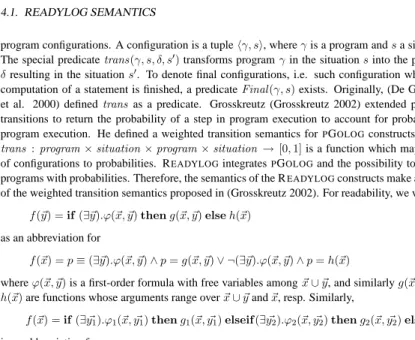
4.1.3 Trans and Final . . . 66
4.2 On-line DT Planning with Passive Sensing . . . 72
4.2.1 Discussion: Soutchanski’s On-line DTGolog . . . 75
4.2.2 Extending Passive Sensing . . . 77
4.2.3 Execution Monitoring for Policies . . . 80
4.2.4 Extending Stochastic Action Models . . . 83
4.3 Speeding Up Planning . . . 93
4.3.1 Options . . . 94
4.3.2 Caching, Pruning and an Any-time Algorithm . . . 105
4.4 The Readylog Interpreter . . . 109
4.5 Discussion . . . 121
5 Simulated Readylog Agents 123 5.1 Unreal Readylog Bots . . . 123
5.1.1 UNREALTOURNAMENT2004 . . . 123
5.1.2 Modeling UNREALin READYLOG. . . 125
5.1.3 Experimental Results . . . 129
5.2 Robotic Soccer . . . 130
5.2.1 The RoboCup Initiative . . . 130
5.2.2 Action Selection in 2D Soccer Using Probabilistic Projections . . . 135
5.3 Summary and Related Work . . . 139
6 Embodied Readylog Agents 143 6.1 Introduction . . . 143
6.2 Robot Control Software . . . 144
6.3 Laser-based Collision Avoidance on a Mobile Robot . . . 147
6.4 Laser-based Localization with Many Distance Measurements . . . 159
6.5 Fusing Sensor Values . . . 166
6.6 Robotic Soccer in the Middle-Size League . . . 172
6.7 A Service Robotics Application . . . 179
CONTENTS xiii
7 Qualitative State Space Abstractions 185
7.1 Introduction . . . 185
7.2 Formalizing Soccer Strategies . . . 186
7.2.1 The Organization of Soccer Knowledge . . . 186
7.2.2 Deriving the Specification of Soccer Tactics . . . 190
7.3 A Qualitative World Model for the Robotic Soccer Domain . . . 194
7.3.1 World Model Categories . . . 194
7.3.2 Modeling Relative Positional Information . . . 197
7.3.3 Modeling Semantic Regions . . . 201
7.3.4 Reachability, Free Space, and More . . . 203
7.4 A DT Plan Library for Abstracted Plans . . . 205
7.4.1 Solving Decision-theoretic Plans in an Abstract Way . . . 205
7.4.2 Generating a DT Plan Library . . . 207
7.4.3 Experimental Results from the Simulation League . . . 209
7.5 Summary and Related Work . . . 212
8 Conclusion 215
Index 221
List of Figures
3.1 Decision tree search . . . 35
3.2 Relationships between learning, planning and acting . . . 36
4.1 Overview of Readylog constructs . . . 68
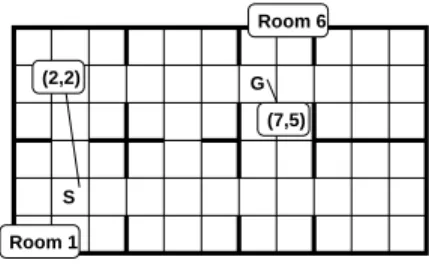
4.2 The Maze Domain . . . 72
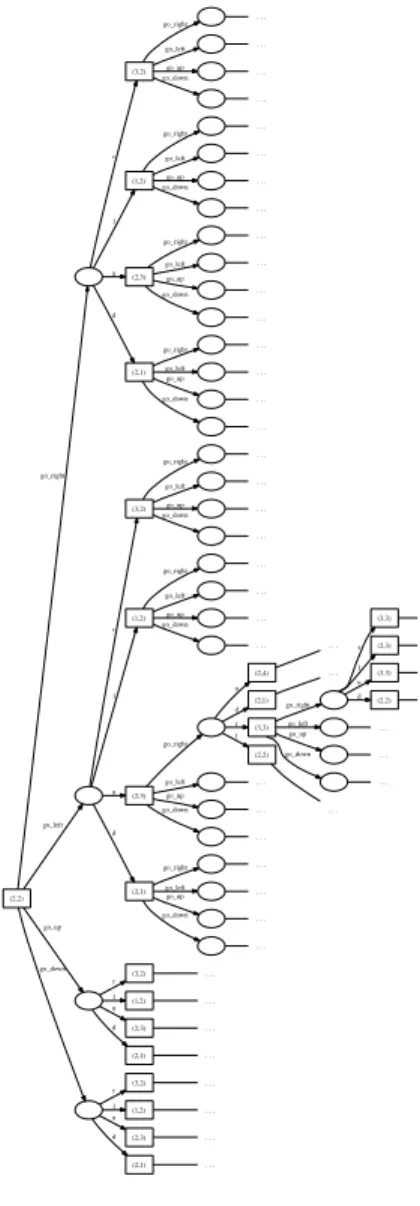
4.3 Decision Tree for the Maze Domain . . . 74
4.4 Optimal Policy for the Maze . . . 75
4.5 The Extended Architecture . . . 79
4.6 The Maze Domain with Macro-Actions . . . 94
4.7 Options for the Maze66 domain. . . 95
4.8 Run-time comparison between ordinary stochastic actions and options. . . 104
4.9 Pruning the decision tree . . . 107
5.1 A scene from the interactive computer game UNREALTOURNAMENT2004. . . 125
5.2 Double pass scenario . . . 136
5.3 Execution traces of the pass sender and receiver in the double pass situation . . . 140
6.1 The “AllemaniACs” System . . . 144
6.2 Examples of integrating obstacles in the occupancy grid map. . . 148
6.3 Derivation of solution . . . 151
6.4 Collision-free triangle . . . 152
6.5 Example traces . . . 154
6.6 Velocity distributions of ROBOCUPMiddle-Size league games . . . 156
6.7 Comparison of the DWA with our method . . . 158
6.8 Example run for global localization of MCL. . . 160
6.9 Sensor model for a single distance measurement. . . 161
6.10 Multi-map of the a local bank building . . . 162
6.11 Accuracy of MCL . . . 165
6.12 Fusion techniques . . . 167
6.13 Comparison of the methods . . . 170
6.14 Sample Trajectories with their estimates . . . 171
6.15 A scene from the RoboCup 2004 against the Osaka team (right-hand side). . . 173
6.16 Game situations . . . 177
6.17 Plan tree . . . 178
6.18 Technical Challenge at the RoboCup Championships 2004 in Lisbon. . . 180 xv
7.2 Strategic Soccer Diagrams. . . 188
7.3 Three different ways to build up a play. . . 189
7.4 Tactical regions on the soccer pitch . . . 190
7.5 Extended diagram 21 from (Lucchesi 2001) . . . 192
7.6 Delaunay triangulation and Voronoi for the counter attack . . . 194
7.7 Categories of world model representations. . . 195
7.8 Different levels of granularity for the orientation from (Hern ´andez et al. 1995) . . 197
7.9 Different levels of granularity for the distance relation . . . 199
7.10 Distance and orientation relation compared to polar coordinates. . . 200
7.11 The double-cross calculus by (Freksa and Zimmermann) . . . 202
7.12 Semantic regions on the playing field. . . 203
7.13 Free space and pass-way vacancy. . . 204
7.14 The algorithm executed by a macro-action. . . 209
7.15 Outplay an Opponent. . . 210
List of Tables
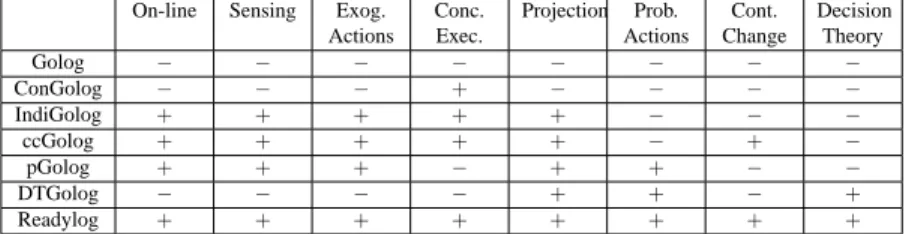
4.1 Features of Golog Languages . . . 645.1 UNREALdeathmatch results. . . 129
5.2 UNREALCapture the Flag results. . . 130
6.1 Position Losses . . . 166
QUOD QUALE SIT, NON EST MEUM DICERE, PROPTEREA QUOD MINIME SIBI QUISQUE NOTUS EST ET DIFFICILLIME DE SE QUISQUE SENTIT.
Marcus Tullius Cicero, De Oratore, III, 33
What the difference might be is not for me to say, for the reason that everyone knows themselves the least and it is the hardest to judge oneself.
Worin der Unterschied bestehe, kommt mir nicht zu, zu sagen, deshalb, weil jeder sich am wenigsten kennt und am schwierigsten ¨uber sich selbst urteilt.
Chapter 1
Introduction
Mobile robotics has been an active research field for the last four decades. One major application for robots is in production plants. Robots solder and braze cars with high precision and also varnish components. These robots raise the efficiency of automation. Besides possible negative effects for the employment markets of current economies, it has the positive effect that robots can fulfill tasks which are too dangerous or unsanitary for humans. The more interesting field, from the Artificial Intelligence (AI) research perspective, is the field of mobile autonomous intelligent robots. These are robots which act in natural environments and fulfill their tasks in an intelligent way. In this thesis, we are concerned with controllers for autonomous mobile robots (or agents) and ways how they can come to intelligent decisions in dynamic real-time domains. Before we set the mission statement for this thesis, we define what autonomous mobile robots mean in our understanding and briefly give an overview of what one can understand by the term intelligent from an AI perspective.
1.1
Intelligent Robots and Agents: (Mobile) Autonomous Systems
The diversity in the developments of robotic systems nowadays and coupled with the widely spread different software approaches to the control software of these systems, makes it hard to find a com-mon denominator. The tasks for mobile robots are very specific, ranging from assembly robots in production plants to soccer playing robots. Each task has specific demands, each robot therefore has sensors and actuators adapted to the task. The control software must be highly integrated to fulfill the real-time requirements of the environment. This makes it very difficult to establish stan-dards in this field. One approach to create a common software platform is the Microsoft Robotics Studio (Microsoft 2006) which comes with driver sofware for many commonly used sensors and actuators and a 3D simulation environment. Another interesting open source project is the Oro-cos Project (which stands for Open Robot Control Software). The European community funded this joint project of the K.U.Leuven in Belgium, the LAAS Toulouse in France, and KTH Stock-holm in Sweden. Within this short-term project an open source real-time toolkit, a kinematics, and a Bayesian filtering library were implemented (Orocos 2007). Whether or not these advances will be crowned by success or if the community will accept and use such tools, it neverthelessshows that some efforts are being undertaken to provide standard software tools in this field. Be-sides researchers and professionals, hobbyists are also building robot systems. Today, many web sites exist which give useful hints on how to build motor controllers, how to derive odometry etc. (e.g. (dmoz.org/Computers/Robotics 2007)). But research still deals with fundamental problems like light-weight energy supply, motor devices, appropriate sensors and actuators on the engineer-ing side. On the control software side some achievements have been made, like robust navigation, and localization, at least with regard to wheeled robots. Research on humanoid robots is still in its infancy though good progress is observable. When it comes to robots acting intelligently in an autonomous way, even more unsolved problems exist.
Bekey (2005) defines autonomy as: “Autonomy refers to systems capable of operating in real-world environments without any form of external control for extended periods of time”. In this sense he concludes that living systems are autonomous systems, which “[...] survive in a dynamic environment for extended periods, maintain their internal structures and processes, and exhibit a variety of behaviors (such as feeding, foraging, and mating).” The difference with robots or agent systems is that these are created by humans. Based on this he defines a robot as “a machine that senses, thinks, and acts”. The term autonomous robot control seems contradictory as autonomy implies the capability of something to take care of itself, and control is connoted with some form of human intervention. Bekey states that control is needed on several layers in a robotic system and that these control structures exhibit behavior as “foraging” which is connected to autonomy (in the robotic context this could mean that the robot is aware of the fact that it needs to recharge its batteries and returns to the charging station). High-level control “is required to ensure that the robot does not harm any humans or equipment of other robots”.
According to Murphy (2000), who briefly reviews the history of robots, robots are perceived as anthropomorphic, mechanical, and literal-minded servants. The acceptance of non-anthropo-morphic creatures like robot systems existing today is due to the fact that robots are mechanical, and thus wheeled robots are accepted as robots although they are not anthropomorphic. Murphy (2000) defines an intelligent robot as “a mechanical creature which can function autonomously”, where intelligent means that the robot does not perform tasks mindlessly which is seen as the opposite of factory automation. Autonomy indicates “that the robot can operate, self-contained, under all reasonable conditions without requiring recourse to a human operator” and “that a robot can adapt to changes in its environment [...] or itself [...] and continue to reach its goal”.
We are aiming at mobile autonomous robotic systems which act in an “intelligent” way. The field of research on mobile intelligent autonomous robots is also called Cognitive Robotics. Those systems have been built for over 30 years. Beginning in the 70’s with the robot Shakey (Nil-son 1984) which was the first robotic system to which one can assign the attributes mobile, au-tonomous, and intelligent, major improvements have been made. One successful application was the Rhino project (Burgard et al. 1998). The robot Rhino was operating over several days in the Deutsche Museum, Bonn, as a museum tour-guide. It operated safely in the very crowded mu-seum, interacting with visitors. These kind of applications are called service robotics applications. There are numerous other examples. Pineau et al. (2003) used robots to support elderly peo-ple in nursing homes. The robot reminded the elderly to take their medicine and guided them to their examinations. Another intriguing application for mobile autonomous systems is the DARPA
1.1. INTELLIGENT ROBOTS AND AGENTS: (MOBILE) AUTONOMOUS SYSTEMS 3 Grand Challenge (Buehler et al. 2007). In the 2006 competition an autonomous vehicle had to drive about 200 miles through the Mojave Desert. DARPA advertised the Grand Challenge with a prize money of 2 million USD. The team from Stanford was able to win the challenge (Thrun 2006; Montemerlo et al. 2006). For other examples of successful robotics applications we refer to textbooks on robotics (e.g. (Arkin 1998; Kortenkamp et al. 1998; Murphy 2000; Bekey 2005; Thrun et al. 2005)).
A bit less spectacular than driving through a desert (and with much less prize money), but nevertheless very interesting and challenging, is the application of soccer playing robots (Kitano et al. 1997; RoboCup 2006) which affords some form of intelligent behavior. The ambitious goal is to be able to win against the FIFA soccer world champion with a team of humanoid robots by 2050. To inspire research on robotics and Artificial Intelligence research there are annual tournaments where research groups compete with their teams against each other. During these competitions promising approaches are evident. The exchange of knowledge of the participating research groups is further speeding up the development of these systems. The soccer application is of special interest as the robots are facing an adversarial dynamic real-time domain. Different leagues are organized in RoboCup which focus on different aspects of research on intelligent robots or agent systems. (We will not go into details here and refer to Chapter 5.2 where we discuss the soccer domain in detail.) Besides the soccer playing activities, other fields of mobile robotics are covered. There are Rescue Leagues where the goal is to seek injured people in an urban disaster area, or the service robotics league RoboCup@Home, where the robot should fulfill helper tasks in a household.
But the focus for intelligent systems is not restricted to robot systems. With respect to high-level control and decision making of such systems, we also have to keep in mind agent systems in general. Wooldridge and Jennings (1995) give a weak notion of an agent. According to this “[...] the term agent is used to denote a hardware or (more usually) software-based computer system that enjoys the following properties: autonomy [...]; social ability [...]; reactivity [...]; pro-activeness”. The stronger notion they give addresses, besides the already mentioned attributes, properties that are “[...] either conceptualised or implemented using concepts that are more usually applied to humans” (Wooldridge and Jennings 1995) (see also (Wooldridge 2002)). Goodwin gives the following properties of agents in (Goodwin 1995): (1) successful, i.e. the agent can accomplish its tasks; (2) an agent is called capable, if it possesses all the effectors needed to fulfill the tasks; (3) perceptive, which means it can distinguish the salient characteristics of the world it acts in, (4) it is predictive, if its model of the world is accurate enough to correctly predict how it can or cannot achieve the tasks; (5) agents are called interpretive if they can interpret their sensor readings correctly; (6) rational if it chooses to perform commands that it predicts to achieve the task; and (7) sound, if it is predictive, interpretive, and rational. Other characteristics assigned to intelligent agents are mentalistic notions, such as knowledge, belief, intention and obligation (Shoham 1993), mobility (White 1999), veracity (Galliers 1988, pp. 159–164), or benevolence (Rosenschein and Genesereth 1988, p. 91). The rationality property of an agent or robot can be seen as an action selection problem. Maes (1989) formulates the action selection problem as “how can an agent select ’the most appropriate’ or ’the most relevant’ next action to take at a particular situation?”
This draws the picture of what we are concerned with in this thesis. We are dealing with mobile autonomous robot (agent) systems which act in an intelligent way (mobility should not be taken too literally regarding agent systems) in the sense given above and with ways in which intelligent decisions for choosing appropriate actions can be made. There are many different approaches to the action selection and decision making problem. They range from Behavior-based AI to Knowledge-based AI (we discuss the different approaches and paradigms in the next chapter).
1.2
Methods and Models for Making Them Behave Intelligently
How can we model intelligent behaviors for autonomous robots or agents? The classical approach is from Knowledge-based AI, based on theorem proving (Green 1969). It makes use of a sense-plan-act cycle, that is, the robot gathers new sensory information, starts a planning process about its future course of actions, and performs them. With this scheme the robot Shakey (Nilson 1984) planned its tasks. The planner worked on a STRIPS representation (Fikes and Nilson 1971) (we discuss this approach in the next chapter). The decision making works, roughly, as follows. The robot has several actions each with a precondition and an effect. The task is, given an initial state and a goal state, to find a sequence of actions which fulfills the preconditions of the goal state. Again, there is a vast number of publications on planning methods. One such planning approach is partial order planning and its derivatives (Penberthy and Weld 1992; Weld 1994). Another approach is to use task nets which are organized hierarchically instead of planning with basic actions. This approach is called hierarchical task network (HTN) planning (e.g. (Sacerdoti 1975; Tate 1977; Erol et al. 1994b; Erol et al. 1996; Firby 1996)). Other techniques are so-called practical reasoning techniques, where the knowledge is encoded in forms of procedures (recipes) (e.g. (Georgeff and Lansky 1986; Myers 1996)). Relying on a sense-plan-act cycle bares the risk of not being reactive enough (especially in the early times when computation power was comparatively low). Once a plan was constructed it was performed regardless of the current state of the world which might have changed due to long planning times.To overcome this problem, the plan cycle was simply ignored. This lead to so-called behavior-based systems. One prominent example of a huge number of approaches of Behavior-behavior-based AI is the work of Brooks (1991). The behavior is exhibited directly from the sensor readings without an explicit world model representation. The paradigm states that intelligent behavior emerges from this sense-act scheme (see also (Arkin 1998) for a thorough treatment of this topic). While this approach works adequately for tasks on lower levels (choosing between, say, localization and col-lision avoidance) there is doubt that this approach alone is a suitable model for robots interacting in a dynamic environment in an intelligent way as described above. The reactive paradigm clearly has advantages in being able to react quickly to changes in the environment. To combine to pros of both approaches numerous hybrid architectures were proposed thereafter. The idea is to per-form the plan step asynchronously to a sense-act cycle. Examples of hybrid architectures in the literature are (Arkin 1989; Gat 1992; Simmons 1994; Bonasso et al. 1997; Konolige et al. 1997)
Learning techniques can also be deployed sucessfully. To give an example, we can look at the robotic soccer domain. Here, work exists showing that these kind of techniques pay off for the control problems of a mobile robot or agent. Looking at recent proceedings of the RoboCup
1.3. GOALS AND CONTRIBUTIONS OF THIS THESIS 5 Symposium (Polani et al. 2004; Nardi et al. 2005; Bredenfeld et al. 2006; Lakemeyer et al. 2007) one notices that a lot of control problems are solved by applying learning techniques. One example for a learning architecture can be found in (Stone 2000). On all layers (motion control, behaviors, decision making) of the described control architecture of a soccer agent in the 2D Simulation league, learning techniques are successfully deployed. Riedmiller and Merke (2002) describe applications of reinforcement learning of autonomous (soccer) agents. While these applications concentrate on the behavior level, some extensions exist to approximate the behavior policy for a team of agents (e.g. (Lauer and Riedmiller 2000)). (Multi-agent reinforcement) learning is an active research field, but to the best of our knowledge, learning methods are currently suited best to learning single behaviors like intercepting a ball or avoiding collisions with other players.
For high-level decision making one problem with learning might be that, in general, these techniques are not adaptive and flexible enough to adopt quickly to a new environmental situation. Thus, like with hybrid robot system architectures, the most promising approach to high-level de-cision making is probably to also use hybrid techniques here. Two such approaches which take advantage of this idea are the high-level robot programming languages Golog (Levesque et al. 1997) and RPL (McDermott 1991; Beetz 1999). Golog and its descendants, for example, com-bine the idea of robot programming with planning based on the formal logical language of the situation calculus (McCarthy 1963). RPL follows more a reactive approach (although a projec-tion mechanism for RPL programs exists) and in the latest version, combines programming with learning (Beetz et al. 2004). (We discuss the related work on this field in the next chapter.) Other techniques for decision making concentrate on the uncertainty of sensors, actuators and the envi-ronment the robot interacts with. Techniques in this field are decision-theoretic planning (DTP, e.g. (Puterman 1994; Boutilier et al. 1999)) and reinforcement learning (RL, e.g. (Kaelbling et al. 1996; Sutton and Barto 1998)). Based on a utility function and some notion of the uncertainty of its own actions the agent or robot estimates (in the case of DTP) or tries out (in the case of RL) the best course of action in each situation (more details about both techniques are given Chapter 3).
1.3
Goals and Contributions of this Thesis
To summarize, several methodologies, methods and techniques to the control problem of an au-tonomous robot or agent interacting with its environment in an intelligent way, exist. They range from explicit programming via learning approaches to complete deliberative planning techniques. Of special interest are adversarial, highly dynamic real-time domains. A robot is faced with the dynamics and real-time requirements of the world in each real world scenario it is operating in. But the real-time and dynamic requirements we mean here refer to the high-level decision making of the robot or agent. In those domains the robot is moving fast and decisions about which actions to perform have to be taken in fractions of a second. Moreover, there are opponents that try to foil its plans and have contrary goals.1
1We want to stress that we are not given hard real-time constraints, but real-time constraints. We are not dealing
with aircrafts or medical devices where a failure leads to a catastrophe. The time scale for the low-level system here is about 40-50 Hz, high-level control runs at about 10 Hz and slower. See for example (Musliner et al. 1995) for a discussion of real-time AI.
One such domain that we focus on and which inspired several design decisions is the already mentioned soccer domain. It has the aforesaid characteristic. To give an example, a robot dribbling with the ball means it is an adversarial real-time domain. It tries to reach its target position without losing the ball. For the control modules this means that they always have to provide appropriate actuator commands in the needed time frame. If the motion control, for example, cannot keep up with its decision time, the robot might decelerate and lose the ball. As an example for the real-time requirements of the high-level decision making think of a robot staying in front of the ball. The robot deliberates what to do with the ball, evaluating sensor values where the opponent goal keeper might be positioned, if it is possible to score directly, or it makes some complex plan about passing the ball to a better positioned teammate. If all this takes too long, an opponent will simply steal the ball rendering all efforts of the robot about its future actions useless.
This shows that the high-level control of a robot in such domains must be reactive enough to avoid such situations. On the other hand, it seems advantageous to provide some form of deliberation in order to analyze the current situation of the world, think about different alternatives of what to do and choose one which, against the current knowledge background of the robot about the world, is rational: i.e. exhibits intelligent behavior intentionally.
Between the two extremes of the reactive and the pure deliberative paradigm we are aiming at a robot programming language which is capable of integrating the advantages from both worlds. It must be able to react quickly to a new situation and reason about which future courses of actions to take, for example in the soccer scenario, playing a deliberate attack over the left wing. Further-more, the language for high-level robot controllers in these domains must be capable of providing for some notion of uncertainty. The robot’s own perceptions and actions as well as the behavior of the opponents are uncertain and there should be ways to incorporate this. We are thus aiming at a middle ground between reaction, deliberation, including uncertainty of its own actions and being able to account for continuous changes in the world.
Our approach to high-level controllers for robots acting in dynamic real-time domains is founded on the robot programming language Golog (Levesque et al. 1997). During the last decade since it was proposed, many extensions to the original language have been made. With these it is a suitable language for programming the high-level control of robots. Especially in the Cognitive Robotics community this language is accepted and Golog was used in several successful robotics applications for implementing high-level control. One such example is the already mentioned museum tour-guide Rhino (Burgard et al. 1998; H¨ahnel et al. 1998). The application domains of Golog so far were mostly for service robotics. The typical applications for cognitive robots in the literature are delivery tasks in office environments (e.g. (Simmons et al. 1997)) or similar applications. With our work we want to show that with further modifications to the logic-based approach with Golog it can be applied successfully to the kind of dynamic real-time domains we introduced above, where it is state of the art to use reactive systems.
The crucial point is that logic-based approaches incorporating planning have the drawback that they are computationally more demanding than associating an action to a situation. Regard-ing deliberation we therefore also aim at a middle ground between full plannRegard-ing and programmRegard-ing. What we propose is to endow the robot with a partially specified control program where the
con-1.3. GOALS AND CONTRIBUTIONS OF THIS THESIS 7 troller based on its background theory fills in the missing details and chooses between open action alternatives. The method we chose is that of decision-theoretic planning in the Golog framework. While the extensions we draw on are known from the literature (Levesque et al. 1997; De Gia-como et al. 1997; De GiaGia-como and Levesque 1999; De GiaGia-como et al. 2000; Soutchanski 2001; Boutilier et al. 2000; Grosskreutz and Lakemeyer 2000b; Grosskreutz and Lakemeyer 2001), it is the integration of these extensions into a unified framework that is one of the contributions of this work. We propose the Golog-based language READYLOGas a control language for robots or agents acting in dynamic real-time domains in this thesis. Existing extensions like on-line exe-cution, sensing, using probabilistic projections into the future, or dealing with continuous change have been integrated into one framework. In order to equip the robot with a controller framework allowing for reaction, deliberation (in the sense of projections into the future and decision-theoretic planning) and execution of plans, several further extensions to the known approaches had to be made. In particular, the contributions of this thesis are:
•Language definition of READYLOG
READYLOGintegrates existing extensions for continuous change, probabilistic projections, on-line execution, exogenous actions, (passive) sensing, and decision-theoretic planning. We propose a new approach to on-line execution of policies generated with the decision-theoretic forward search value iteration algorithm based on passive sensing. We extend existing passive sensing approaches in the way that the READYLOGcontroller is equipped with a world model where it can derive data directly without the need to regress fluent values. This, on the other hand, demands an efficient method to progress the internal database. We intregrated a method which is based on the theoretical work of Lin and Reiter (1997). •On-line execution and monitoring for policies
For executing policies which were calculated by the decision-theoretic planning algorithm it is very important to use execution monitoring. As the planning is done off-line, it might be the case, especially in fast-paced domains, that the world changed in an unpredicted way. The controller must be able to detect discrepancies between planning and real execution. We analyze the approach by Soutchanski (2001) and show several drawbacks of this ap-proach w.r.t. our application. The method we propose with on-line execution of policies circumvents the problems of the former approach. Further, we extend the notion of stochas-tic actions in our language to restricted stochasstochas-tic programs that simplifies the specification of the stochastic outcomes of an action and show that our models are correct w.r.t. models known from literature (Reiter 2001).
•Macro-actions or options in the READYLOGframework
As an further extension to decision-theoretic planning we define and introduce options in the READYLOGframework. The idea of options is adopted from (Hauskrecht et al. 1998; Precup et al. 1998; Sutton et al. 1999). Options are macro actions in the context of Markov decision processes. With our extension macro actions can be used for decision-theoretic planning in the READYLOGframework. We show an exponential speed up in the planning times when using these macro actions. We propose some more extensions like using pruning to further speed up the calculation of policies.
•A control architecture for mobile robots
As stated above, we want to show that READYLOGcan be successfully applied to domains where planning seems to be too demanding. This implies that we have to provide a robot system where READYLOGcan be used as the high-level control component. Therefore, some parts of this thesis deals with robotics. The contributions made are a modification to a well-known localization algorithm with proximity sensors. The modification allows a robot to localize in environments with very sparse landmarks. Further, we propose an efficient and robust navigation and collision avoidance algorithm which scales up to ground velocities of over 10 km/h. Finally, as a precise world model is helpful from the viewpoint of high-level decision making, we compare several sensor fusion methods using the problem of ball position estimation in the soccer domain.
•State space abstractions using qualitative world models and an approach to formalize soc-cer with READYLOG
The expressiveness of READYLOGtogether with its reasoning capabilities allows for speci-fying and executing complex behavioral patterns. Usually, soccer robots follow very simple strategies like intercept–dribble–shoot. Inspired by human soccer literature, we formalize and adapt soccer strategies derived from human soccer theory in READYLOG(Dylla et al. 2007). One result from this work was that it turnes out that humans generally represent space, distance, and positions on the field in a qualitative fashion.
Derived from this we developed a qualitative world model for our soccer robots which sim-plifies the specification of the behavior for the soccer domain as it can be encoded in a more natural (human-like) way. Moreover, the qualitative world model can be used for abstracting the state space underlying the MDP when exerting decision-theoretic planning or options in the soccer domain. As an extension to the options presented in Chapter 4 we present a DT plan library. The idea is to store abstract policies, i.e. those policies where all choices can still be taken, in a plan library. Later, the agent can draw on its plan library and simply pick an existing abtract policy without the need to calculate it again. Such, the agent saves on-line computation time. We show with two examples of the simualted soccer environment how this plan library saves computation time, and, moreover, how macro actions can be encoded this way.
We applied READYLOGto the soccer domain in simulations as well as with a real robot team. At several RoboCup tournaments it showed its applicability and usefulness. Further, READYLOG was applied for controlling game bots in the interactive computer game Unreal Tournament 2004. The low-level control software we present in this thesis proved to be very suitable for soccer ap-plications as well as service robotics apap-plications and showed flexibility and extendability. The control software proved useful as framework for other robotics projects like multi-robot local-ization (Amiranashvili and Lakemeyer 2005; Amiranashvili 2007) or sound-locallocal-ization (Calmes et al. 2007). Recently, it was used for a very successful application in the RoboCup service robotics competition (Schiffer et al. 2006a)
1.4. OUTLINE 9
1.4
Outline
The rest of this thesis is organized as follows.
Chapter 2 overviews the related work on high-level robot/agent control. We discuss other action formalisms and approaches to the problem of high-level decision making. Here we present the big picture of related work on the fields of high-level robot control and similar areas. Throughout the thesis we will discuss the more specific related work at the end of each chapter.
Chapter 3 introduces the mathematical foundations for this work. We will introduce the model of Markov Decision Processes which we will need throughout this thesis. One can distinguish between model-based (decision-theoretic planning) and model-free approaches (reinforce-ment learning). Then, we present a brief overview of reasoning with uncertainty, especially Bayes Filter. These become relevant when we describe approaches to localize a mobile robot in its environment. Finally, we give a detailed introduction into the situation calcu-lus and GOLOGwith some of its derivatives. This is the action formalism we found our approach to high-level robot programming on.
Chapter 4 presents the language READYLOG, our proposal for a GOLOG-based robot program-ming language. The focus of this thesis is on dynamic real-time domains. Thus, the lan-guage READYLOGintegrates aspects from different GOLOGderivatives. It offers features like dealing with continuous change or decision theory. We first present READYLOG’s for-mal semantics before we concentrate on decision theory. The policies (optimized programs) can become invalid quite soon in highly dynamic domains. Therefore, one must be able to detect when a policy becomes invalid. We propose an execution monitoring scheme. Fur-ther, we introduce the concept of macro actions in the context of decision-theoretic GOLOG which helps to drastically decrease the complexity of the planning task. Several other ex-tensions are proposed which speed up the calculation of policies. Thereafter, we address the implementation of READYLOG. We show how the READYLOGinterpreter works in detail and discuss the implementation of passive sensing, exogenous/sensing actions, and how the high-level control can be connected to the rest of the robot/agent system. We sketch the im-plementation of the method for progressing the initial database as well. Parts of the contents of this chapter have been previously published in (Ferrein et al. 2003; Ferrein et al. 2004; Ferrein et al. 2005b)
Chapter 5 shows application examples of READYLOG. We start with an READYLOGagent, also called game bot, for the interactive computer game UNREALTOURNAMENT2004. We concentrate especially on decision-theoretic optimizations and show the different modeling possibilities within READYLOGwith a study of the the “item pickup task”. Then we intro-duce the robotic soccer domain and show why this application domain is of special interest by giving the different characteristics of this domain. We show a READYLOGsoccer agent for simulated soccer. With the simulated soccer agents we demonstrate the possibility to
use probabilistic projections to come to a decision. Parts have been previously published in (Dylla et al. 2003b; Jacobs et al. 2005a; Jacobs et al. 2005b).
Chapter 6 shows soccer applications of READYLOGwith real robots. Besides the READYLOG application, the focus of this chapter is on the robot system as a whole. In particular we show that a well integrated software system is needed before one can think about high-level control with READYLOG. First, we overview the hard- and software of our robot soccer team “AllemaniACs”, before we describe our approach to navigation and localization in detail. We also present an account to global sensor fusion to enhance the world model of the robot here. At the end of this chapter, we briefly prospect the usefulness of READYLOGin the cognitive robotics area with a small service robotics example. Previously, material from this chapter were published in (Dylla et al. 2003b; Ferrein et al. 2004; Ferrein et al. 2005b; Jacobs et al. 2005a; Jacobs et al. 2005b; Ferrein et al. 2006; Strack et al. 2006).
Chapter 7 presents an alternative approach to the problem of state space abstractions. For soccer we investigated how humans represent strategies and how this could be helpful for the be-havior specification of a robot. It turns out that READYLOGis very well suited to formalize soccer strategies and that humans make extensively use of qualitative notions, for example distances (near or far) or regions on the field (on the left front half of the field). From these observations we derive a qualitative world model for the soccer domain which was applied to our soccer robots. The behavior specification is simplified and much more “natural”. For READYLOGthis qualitative world model can be used to abstract from an infinite state space and to make techniques presented in Chapter 4 applicable. We introduce a method where policies are left in an abstract way rather than calculating the optimal values at once. These stored policies form a library of already instantiated plans which the agent can draw on with a dramatic saving in on-line computations. We present two examples from RoboCup’s sim-ulation league. Parts of the material shown in this chapter were published before in (Ferrein 2004b; Dylla et al. 2005; Schiffer et al. 2006b; Dylla et al. 2007; B¨ohnstedt et al. 2007). Chapter 8 concludes this thesis with a summary and an outlook on future work.
More material, especially on the robot soccer team “AllemaniACs” can be found on the web (Schiffer et al. 2006), in (Ferrein 2004a; Fritz 2004; Ferrein and Lakemeyer 2005; Ferrein and Lakemeyer 2006; Calmes et al. 2006), and in several official Team Description Papers for partic-ipating at RoboCup tournaments (Dylla et al. 2003a; Ferrein et al. 2005a; Ferrein et al. 2006; Ferrein et al. 2007a; Ferrein et al. 2007b). Some of the material covered here was also pub-lished in several Diploma and Master’s Theses before: (Jansen 2002; Fritz 2003; Hermanns 2004; Strack 2004; Schiffer 2005; Jacobs 2005; B ¨ohnstedt 2007). I would like to thank explicitely for the support and the contribution.
Chapter 2
Related Work
In this chapter we review approaches related to our work. Particularly, we discuss work in the field of reasoning about actions, (Section 2.1), the robot programming language Golog and its derivatives (Section 2.2) and control architectures for autonomous robots or agents in general (Section 2.3). We conclude with justifying our approach against the context of related approaches to reasoning about actions.
2.1
Reasoning about Action and Change
For deliberation several different approaches to the problem exist, like practical reasoning, archical task nets, and reasoning about action approaches. In this section, we will review hier-archical task networks and the model of Markov decision making, and several logical calculi for reasoning about actions and change. As an example for a practical reasoning approach we discuss the language 3APL.
2.1.1 Hierarchical Task Networks
In contrast to classical planning methods where a goal is to be achieved with a sequence of primi-tive action, the idea of hierarchical task network (HTN) planning (Sacerdoti 1974) is to accomplish a task, given a task network. This includes decomposing compound tasks and resolving conflicts which might occur between different tasks. HTN planning can be seen as the practical approach to letting a robot do something in reality, while in the early days, classical planning methods (like STRIPS planning, cf. Section 2.1) were computationally prohibitive for practical applica-tions. Another motivation for HTN planning was to close the gap between AI planning techniques, project management and scheduling techniques known from operations research. Early HTN plan-ning systems were NOAH (Sacerdoti 1975) or NONLIN (Tate 1977). While HTN planplan-ning was used in practice for a long time, it was only until the mid 1990’s that a semantics for HTN was defined (Erol et al. 1994a; Erol et al. 1994b). More recent HTN planning systems are SIPE-2 (Wilkins 1990) or SHOP and SHOP-2 (Nau et al. 2003).
Recent trends seem to go in the direction to combine HTN formalisms with machine learning. In (Ilghami et al. 2002; Ilghami et al. 2005) the authors propose a learning system for HTNs, where a domain expert solves task nets giving examples to the learner. The learner now generalizes based on the training examples from the human expert and can solve similar tasks in a better way.
Nejati et al. (2006) propose a similar approach. The difference is that they do not assume that the HTN is given in advance. Another example is (Belker et al. 2003). Here, a robot learns navigation tasks based on a HTN representation of sub-tasks. The sub-tasks or actions were of the kind turnTo or moveForward, and compound tasks were ApproachPoint and Goto. They tested this approach on a Pioneer II and the B21 Rhino. They report on an increasing performance compared to the original navigation software of Rhino with the Dynamic Window Approach (Fox et al. 1997). One application example from robotic soccer is (Obst and Boedecker 2006). Team coordination and strategy selection tasks are solved applying HTN techniques. The ideas of HTN were also incorporated into other reasoning frameworks. Baral and Son (2000) define task nets and task decomposition in the ConGolog framework which we describe in Section 2.2. A similar approach is followed by Gabaldon (2006). He defined tactical and strategical tasks for military applications in the form of HTNs in the ConGolog framework.
2.1.2 Incorporating Uncertainty: Markov Decision Processes
Markov decision processes (MDPs) (Bellman 1957; Bertsekas 1987; Puterman 1994) are a natural formalism to describe stochastic dynamic systems. It is the underlying formalism to decision-theoretic planning (DTP) and reinforcement learning (RL) (e.g. (Boutilier et al. 1999; Sutton and Barto 1998; Kaelbling et al. 1996)). The world is described by discrete states. Performing actions will lead an agent from one state to another with a certain probability. To each state a real-valued reward is assigned. The planning problem is to find an optimal action for each state which maximizes the long-term reward. Thus, a policy is generated which for each state provides the optimal action w.r.t. to the optimization criterion. Solution techniques like value iteration and policy iteration are well-studied for cases where the transition model between states is known. If the transition model is not known in advance, learning techniques like Q-Learning can be applied (Watkins 1989) to find an optimal policy by observing the outcomes of the deployed actions.
Standard techniques for solving MDPs require an explicit state representation. This has the drawback that for solving real-world problems the standard techniques, which rely on dynamic programming techniques (e.g. (Bellman 1957)), have to iterate over all states; the problem may become computationally intractable (though there are modifications like asynchronous dynamic programming algorithm or modified policy iteration that do not need to cover the whole state space (cf. e.g. (Bertsekas 1987; Bertsekas and Tsitsiklis 1996; Puterman and Shin 1978)). To overcome this problem several methods have been proposed to relax the original problem by abstracting the state and/or action space, decomposing the problem into sub-tasks (Parr and Russell 1997; Precup et al. 1998; Hauskrecht et al. 1998; Sutton et al. 1999), or use factored logical representations for the state space (Boutilier et al. 1995; Dean and Givan 1997; Boutilier et al. 1999; Boutilier et al. 2000; Boutilier et al. 2001; Feng and Hansen 2002).
Among the approaches to decompose MDPs into smaller sub-problems one has to examine the work by Precup et al. (1998). They propose options, sub-MDPs, with an initiation and a termi-nation set of states. As long as the agent is in one of the initiation states it can perform the policy calculated for the option. The agent now follows the policy which was calculated for the option until the option terminates in one of the termination states. Applying options constitutes a semi-Markov decision process (Sutton et al. 1999) as the duration of a primitive action and an option is different. With a modified state transition and reward model, convergence is still guaranteed. Sim-ilar to the option approach, (Hauskrecht et al. 1998) define hierarchical macro-actions for MDPs.
2.1. REASONING ABOUT ACTION AND CHANGE 13 For each macro the state space is decomposed into an entrance and exit periphery which is similar to the initiation and termination states of options, though these peripheries are not defined over the whole state space. A macro-action is formally defined as a sub-MDP. For solving the original problem, both basic actions as well as macro-actions can be used together. Another hierarchical approach to the decomposition of MDPs is the approach of Parr and Russell (1997). They propose a nondeterministic finite-state machine, called hierarchical abstract machines (HAMs), which con-trols what action shall be executed in which partition of the state space. The machine can take one of four different type of states: action, which executes an action, call which calls another machine as a subroutine, choice which nondeterministically selects the next machine state, and stop which halts execution of the current state and returns to the previous one. HAMs can also be applied to Q-learning with much faster learning rates. The MAXQ-Q-learning method (Dietterich 2000) as-sumes that the programmer can identify useful sub-goals and sub-tasks for the application. Based on these tasks and goals the original MDP is divided into sub-MDPs. Each sub-task ends when its sub-goal is reached. Based on the task decomposition the value function of the original MDP is divided as well. The solution of the original MDP is a hierarchical policy which consists of a set of policies or actions, one for each sub-task. By this decomposition MAXQ learns a representation of the value function and it turns out that this method learns faster than Q-learning.
Another approach is to factor the state space with a propositional representation and with it the reward function. A survey of factored MDPs is given in (Boutilier et al. 1999). One such representation is based on dynamic Bayes net (Dean and Kanazawa 1990). For two stages of the MDP a Bayes net is constructed, the transition probabilities are stored in conditional probability tables. Other representations proposed are for example, decision trees (Quinlan 1993), or algebraic decision diagrams (ADDs, (Bahar et al. 1993)). Another representation is probabilistic STRIPS (Kushmerick et al. 1995), which we describe below. A state-of-the-art MDP solver is SPUDD (Hoey et al. 1999), which can solve MDPs with hundreds of millions of states representing the value function with a logical description which involve only hundreds of distinct values. Interest-ingly, Soutchanski (2003) comparedDTGOLOG(described below) with SPUDD and shows that DTGOLOGcan solve given examples problem instances faster than SPUDD. Soutchanski (2003) notes that the policies on the reachable state space are identical though the values can be compared only in a qualitative fashion.
Another representation is that of first-order MDPs (FOMDPs) instead of the propositional ap-proaches discussed above. One such method for factoring the state space with first order logic is proposed with DTGolog (Boutilier et al. 2000). An MDP is represented implicitly by a situation calculus basic action theory and the MDP is solved by a forward search value iteration algorithm which avoids state enumeration (see below for a detailed discussion of the situation calculus and DTGolog). Another technique for solving FOMDPs was proposed by (Boutilier et al. 2001) as an extension of the propositional decision-theoretic regression (DTR, (Boutilier et al. 2000)). The advantage of the latter approach is that neither action nor state space have to be enumerated ex-plicitly. DTR represents the value function of the MDP as a first-order formula and based on the stochastic basic action theory of the situation calculus an optimal solution can be calculated with the symbolic dynamic programming algorithm proposed in (Boutilier et al. 2001). The problem with this approach w.r.t. the applicability in real-world domains, is to efficiently simplify the formulas at each stage of the dynamic programming. Between approaches like DTGolog or sym-bolic dynamic programming which both are based on the situation calculus one has to mention Poole’s independent choice logic (ICL, (Poole 1997)). Based on facts and a choice space
rep-resenting the action alternatives he defines a selector function using a possible world semantics. The consequences of the choices made by nature are represented as acyclic logic programs. In his paper he shows how decision-theoretic problems can be formulated in ICL, either in the single or multi-agent case. He further shows how other formalisms can be embedded.
For the sake of completeness, we briefly mention POMDPs. The generalization of MDPs are partially observable MDPs (POMDPs). Here, the assumption that the agent can observe with certainty the state it is in after performing an action, is dropped. Instead the agent has a belief about the state it is in, represented by a probability distribution over possible successor states. A survey on POMDPs is given in (Monahan 1982). As POMDPs are not relevant for this work, we only give some references to related literature (e.g. (Sondik 1971; Sondik 1978; Lovejoy 1991; Cassandra et al. 1994; Barto et al. 1995; Parr and Russell 1995; Boutilier and Poole 1996; Geffner and Bonet 1998)).
2.1.3 The Situation Calculus
The situation calculus was proposed by McCarthy in 1963 and is the earliest approach to formally reasoning about actions. It is a logical first-order language for representing dynamically changing worlds. The world is represented by situations which can be changed by performing various actions. Fluents, which are relations or functions with a situation term as last argument, describe what is true or false in the world w.r.t. a situation. There a distinguished binary functiondo:
situation×action→situationexists which denotes the situation that results by performing actions. A special constantS0describes the world in the initial situation. For each action there
exists an axiomP oss(a(~x), s)≡Π(~x, s)which denotes the precondition of an action, i.e. when the actionais applicable, and an effect axiom, which describes how the action changes the world in terms of fluents.
One of the problems with the causal laws (effects) in a domain description is that they do not describe the non-effects of an action. For example, picking up an object does not change its color. This problem is referred to as the frame problem. The number of frame axioms describing the non-effects of an action is usually much larger than the axioms describing the effects. A general solution to this problem was found by Reiter (1991). He proposes to derive from the effects of an action so-called successor state axioms for each fluent which — with some further assumptions like a completeness assumption and a unique names assumption for action — describe both, the effects and the non-effects of the actions. In the next chapter we present his approach in detail. Another problem in the context of reasoning about actions is known as the qualification problem. It refers to the impossibility of listing all action preconditions required for a real-world action to have its intended effect. Finally, in the context of reasoning about actions the ramification problem is known. It addresses the problem of taking also the indirect consequences of an action into account. These problems are discussed in (McCarthy and Hayes 1969; Ginsberg and Smith 1988; Lin and Reiter 1994; Lin and Reiter 1994; Thielscher 2001).
In (Pinto and Reiter 1993; Pinto and Reiter 1995) Pinto and Reiter introduce a notion of time to the situation calculus. A special fluentstart(s)exists which denotes the starting time of situation
s. With the formalization of a time line it renders easy to introduce durative actions. Each action
ais split into astart-aandend-aaction. The duration of the action can then be determined as the time differencestart(do([. . . ,end-a]))−start(do[. . . ,start-a, . . . ,end-a]).
2.1. REASONING ABOUT ACTION AND CHANGE 15 initial knowledge. To gather information, sensing must be incorporated. As sensing changes the knowledge of a robot about the world, this issue is related to representing knowledge in the situation calculus in general. To represent the knowledge of an agent Moore (1985) introduced a special fluentK(s, s′)into the situation calculus. A solution to the frame problem for knowledge is due to (Scherl and Levesque 1993; Scherl and Levesque 2003).Kcan be seen as an accessibility relation between situations. So, an agent knowsϕin situationsifϕholds in alls′accessible via K(s′, s), i.e. Knows(ϕ(s))def= ∀s′.K(s′, s)⊃ϕ(s′). Other useful definitions w.r.t knowledge areKWhether(P, s)denoting whether a fluentPis known or not, andKref(τ, s)denoting if an instance ofτis known. Special sense fluent axioms connect fluents to be sensed to actions. To express minimal knowledge of the agent, Lakemeyer (1996) and Lakemeyer and Levesque (1998) introduced the concept of only knowing into the situation calculus. It means that the agent knows a a set of sentencesΦand nothing more. To express only knowing, they enrich the situation calculus with a possible-world semantics.
Especially when dealing with sensors which, in general, are imperfect, one needs to formulate the belief of the agent or robot. Facts about the world gathered by sensors are not facts which are unconditionally true or false, they can be only seen as beliefs. They are true or false to a certain degree, depending on the quality of the sensors. Beliefs are thus associated with a likelihood (or a probability). In (Bacchus et al. 1995; Bacchus et al. 1999) a formal account to deal with the belief of an agent in the situation calculus is given. In a more recent work Gabaldon and Lakemeyer (2007) develop the languageESP, an extension ofES.ESPis enriched with a notion of belief and an account to noisy sensors. The advantage is that no second order definitions are needed. We introduce the languageESin the next section. Similar to the fluentKthey introduce a fluentpwhich denotes the likelihood of a formulaϕbeing true in a situations. The belief of the agentBel(ϕ, s)thatϕis true in situationsis the weight of the possible worlds where the agent thinks thatϕholds normalized by the weight of all possible worlds. Other approaches like (Pinto et al. 2000) take another direction to integrate probability theory into the situation calculus. Here, the goal is not to formalize the belief of the agent but to express non-deterministic actions. The approach is to assign non-determinstic effects to an action and associate it with a probability. With a special transition function the different alternatives at non-deterministic choice points can be evaluated and their successor situation can be determined.
A large body of work exists on the situation calculus. We therefore further refer to (Levesque et al. 1998; Pirri and Reiter 1999) and the book of Reiter (Reiter 2001) for more information about the situation calculus.
2.1.4 ES: The Situation Calculus without Situations
In (Lakemeyer and Levesque 2004; Lakemeyer and Levesque 2005) Lakemeyer and Levesque present the logicESwhich can be seen as a situation calculus without situation terms. The justi-fication for introducing another formalism is that proving mathematical properties of the calculus becomes easier. The main reason for this is that the semantics ofESis not defined axiomatically as is in the situation calculus but semantically. As the situation calculus,ESdistinguishes be-tween fluents and actions, but has no terms of sort situation. Additionally, it has standard names (e.g. (Levesque and Lakemeyer 2001)) and it is distinguished between fluent and rigid predicate symbols (rigid predicates correspond to situation-independent predicates in the terminology of the situation calculus). As situation terms are dropped they introduce aoperator where[t]α