CHAPTER 1 BACKGROUND
1.0 Call Center Industry
Today the service industry has evolved in many folds compared to its early beginning. Our ancestors who first provided and sold services would never have imagined the challenges and innovation that the industry is facing and will experience in the next generation. One of the most innovative methods of meeting and keeping up with customers demanding better services in terms of management of information and communication is the emergence of call centers in the early 1990s. This demand attributes to the increased level of education amongst the public. There is also increased awareness on consumer rights and the expectation on products and services paid.
Call centers facilitate flow of information and communication between firms and their remote customers via the telephone (Malhotra & Mukerjee, 2004). According to Prahabkar, Sheehan, and Coppett (1997), call centers “….allow a company to build, maintain, and manage customer relationships by solving problems and resolving complaints quickly.” Call centers are the focal point of the firm to answer questions by customers every hour of the day throughout the 365 days in the year. Therefore, it would appear that all quality organizations that place customer satisfaction and loyalty as their prime focus would strategize on call centers to communicate with current and new customers. This is so, as call centers offer convenient and personalized methods of servicing customer’s request and queries. Some organizations offer toll free numbers
where their customers can directly call centers without incurring any costs. The methods of providing customers information and sales has evolved tremendously especially with advancement in information technology in the highly competitive telecommunications industry.
Based on the research done by Holman, Batt and Holtgrewe, (2007), the primary targets of call centers are business customers and the mass market. About 75% of the call centers in the study served the general mass market where the volume of service and sales transaction are the highest. On the other hand, about 25% of the call centers serve business-to-business customers.
Various industries now employ the call center strategy. Telecommunication firms were the earliest to adopt the call center strategy to handle large volumes of customer enquiries efficiently. However, today, the financial sector is the largest user of call center. In the 1990s, a major transformation occurred in the financial sector in the operations of businesses. Other industries that currently use call centers include the telecommunications industry, utility industry including water and electricity, government agencies, municipal councils and various non-profitable organizations.
Holman et al. (2007) found that 49% of call centers focused on services, while 30% of call centers focused on sales and services. The balance 21% focused on sales only.
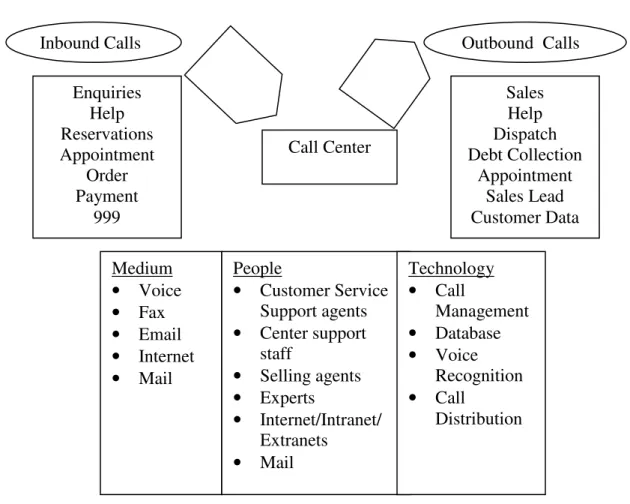
There are two types of call centers: They are (1) Inbound and (2) Outbound. At least 79% of call centers are inbound - where they serve the organization’s own customers. Twenty-one percent of call centers on the other hand serve outbound customers. Figure 1 below shows the Armistead, Kiely, Hole and Prescott (2002), call center systems model.
Figure 1: Call Center Systems Model
Inbound Calls Outbound Calls
Enquiries Help Reservations Appointment Order Payment 999 Sales Help Dispatch Debt Collection Appointment Sales Lead Customer Data Medium • Voice • Fax • Email • Internet • Mail People • Customer Service Support agents • Center support staff • Selling agents • Experts • Internet/Intranet/ Extranets • Mail Technology • Call Management • Database • Voice Recognition • Call Distribution Call Center
The typical technologies used in most call centers are telephones, supplemented by fax and email. Some organizations though use advanced technologies such as a voice, email, fax, voice over internet protocol (VoIP), media blending, and electronic customer relationship management in their call centers.
Today the call center industry offers employment in various countries in these industries. In Holman et al.’s (2007) study of call centers in 17 countries alone the number of call center employees stood at 450,000.
Why are there so many people employed in this sector? Call centers are typically personalized remote services by call center agents in terms of business, information, queries and others. It is undeniable that one of the key success factors of a call center is the contact personal itself besides the technology. Since the customer contact employees or popularly known as the call center agents are the link between the entire organization and the external customer (Zeithml & Bitner, 2000), they are able to influence the service quality perception of the customers.
Thus the ability of the organization in recognizing and adopting the right measures to ensure the call center agents provide quality services in their interactions with customers is essential. The external customers will identify the service provided by the call center agents as the service provided by the organization.
1.1 Asian call center industry including Malaysia
According to Computerworld (March 2008), Malaysia has shown the strongest growth rate compared to all its ASEAN counterparts. Call center industry growth rate in Malaysia is 17% compared to only 15% for the ASEAN region. The growth rate in Singapore is 8%; India is 10% while Thailand is 15%.
According to the Call Center Industry Benchmark Report, in 2003 alone there were 250 organizations with 575 call centers throughout Malaysia. Total call center seats in Malaysia in 2008, is about 33,000. The average seats per center in the year 2008, is expected to be 167 compared to only 90 last year. Why the buzz for call centers? Well, according to Callcenters.net, 67% of the total contact centers in Malaysia are serving local consumers. At the same time, there is an increase in number of outsourced based contact center work. In addition to that, the availability of locals in Malaysia who speak numerous languages like Mandarin, Bahasa Melayu, Cantonese, Tamil and others is very attractive for global companies. This feature has made Malaysia the potential Asia Pacific Regional Hub for call centers.
The annual wage for a contact center agent in Malaysia is about RM15, 000 compared to RM12, 000 in Philippines and only RM8, 400 in India. Therefore, the annual wage in Malaysia is still higher compared to these two countries. Thus, there is a slight disadvantage in attracting English Language work from the US and Europe.
In terms of education level, 49% of those who work in call centers in Malaysia have only a secondary education level. Based on the findings of the 2006 Asian Contact Center Industry Benchmarking Report, it was found that 56% of the Asian contact centers are established as customer service centers, 15% are dedicated to outbound sales, 14% for technical support, 12% to inbound sales and 2% to collections.
Seventy three percent of customer interactions in Asian organizations are handled through the contact centers. This constitutes 62% of contacts handled by the telephone and 11% handled by the email or web. About 26% of all the organization’s contact is handled by the branch or retail network.
The average number of both inbound and outbound calls handled by an agent per shift is 82 calls. According to this report, customer complains comprise of 11% of the total transaction volume handled by Asian contact centers. The average sales conversion rates from inbound calls that are an opportunity to sell is 28%, while the sales conversion for outsourced center is 35%.
The average level of absenteeism in Asian Contact centers is 11 days sick leave per annum. Malaysia and Singapore are found to have the lowest level of absenteeism with 8 days per annum compared to 15 days in India. Meanwhile the average turnover rate in Asia is 22% per annum, with the highest in India (35%) and lowest in Philippines (17%).
According to the statistics of agents who left the Asian Contact Center in 2006, only 38% moved to work in other contact centers while the balance 62% left the contact center industry completely.
Telecommunications, transport and freight, banking, finance and the insurance sector, represent 67% of all call center seats from the principal industry sectors in Malaysia. The government agencies and other private listed organizations are also beginning to place importance on call center. Therefore, the employment rate in the industry is increasing steadily. Labour, thus has been identified as the major expense in operating contact centers in Malaysia, which comprises 53% of the total budget.
1.2 Challenges in the Call Center Industry in Asia
According to the 2006 Asian Contact Center Industry Benchmark Report, there are several key challenges in the Asian call center industry. Firstly, human resource is a major concern, as the agent turnover rate is 22% per annum in Asia. Such a high turnover rate poses high monetary and operational costs to the organization in terms of recruitment and training of agents.
Secondly, the speed of technology developments in the world constantly pressures organizations to upgrade their technological infrastructures. This is essential for call centers to keep in pace with other call centers that are fast picking up the outbound calls market.
The next challenge for Asian call centers is to improve customer satisfaction. Increase in customer awareness and consumer rights is increasing pressuring in the service industry to produce high levels of service quality. This is because the numbers of highly educated Asian is in the increase. Furthermore, call centers provide the link between the organization’s output and the customers. All customer dissatisfaction that arises from any part of the organization may be directed to call center agents. Thus, the challenge of linking the backroom activities of the organization and the call center itself arises.
The other challenges include increasing sales for business development, financial, budget constraints and lastly restructuring of organizations.
1.3 Objectives of the Study
Discussion on the statistics of the industry in Malaysia and Asia in the previous section, mention that 53% of the total budget at call centers is attributed to labour costs. Furthermore, the average call center turnover rate in Asia is about 22%. With that account, the management human resource is important in every competitive call center.
Past researchers have found another important issue in call center involving deployment of labour, which is the measurement of performance. The quality versus quantity issue has been found critical in call centers. Another similar issue is the efficiency versus productivity of call centers. The high technological advancement in the industry has often, prompted call center agent’s productivity measures e correlated as quality outputs of the call center. Measurements such as waiting time, number of calls attended number of abandoned calls, time taken to attend each call and others are currently widely used as key performance outputs of call centers.
These measurements put much negative pressures on call center agents. Constant monitoring and repeated focus on efficiency of call center agents by managers in organizations have resulted in creating a highly stressed environment. In fact, the repeated focus on efficiency is often at the expense of the employee. Wallace, Eagleson and Waldersee (2000), have termed this situation in the call center as the ‘sacrificial human strategy’. It must be noted too that working in call centers has been found to be one of the most stressful jobs (Wallace et al., 2000).
Therefore, with the industry, fast growing in Malaysia, it is important that call center managers fully understand their role in managing the human resource management of call center agents. This would help them to maximize outputs and increase the quality of service to their customers. It is with those objectives that this study was undertaken and aimed to provide evidence to the following relationships:
1.3.1 The relationship between the internal service climate environment of the organization and attitudes of the call center agents in terms of their intrinsic motivation
1.3.2 The relationship between the internal service climate environment of the organization and behaviours of the call center agents in terms of their organizational commitment
1.3.3 The relationship between intrinsic motivation of call center agents with the quality of service provided by them in call centers
1.3.4 The relationship between organizational commitment of call center agents with the quality of service provided by them in call centers
1.3.5 The relationship between the internal service climate with the service quality delivery in call centers due to attitudes and behaviour in terms of intrinsic motivation and organizational commitment of call center agents
1.4 The Importance of the Study
Call centers in Malaysia are growing at a steady rate especially in the service industry. In fact, many utility and telecommunication companies are increasing their intake of agents in a very positive trend. The high number of call center agents being employed poses a concern especially to whether the service organizations would actually implement positive organizational reforms and that will ensure quality service is delivered to customers through their “ambassadors”.
At the end of the day, customer outcomes such as satisfaction and loyalty will be determined by these call center agents. It is therefore important that service organizations in Malaysia understand the importance of factors that would lead to service quality delivered by the call center agents.
Many researches on call centers have been done in United Kingdom and India. In fact many studies like Mukerjee and Malhotra (2006), Dean (2002), Schneider and Bowen (1995) and others have linked organizational commitment, employee satisfaction with service quality delivered by employees. Other research such as Schneider, White and Paul (1998), have linked service climate to organizational commitment and satisfaction.
As mentioned earlier, labour costs is the highest contributor to call center budget. Employee turnover rate has been found to be considerable high in Asia. This study was aimed to relate past studies done in other countries with the Malaysian environment and
to assist organizations to identify the key employee management factors that will eventually lead to quality service to external customers.
Like most call centers all over the world, call centers in Malaysia are also placing much attention on the efficiency and productivity measures. The difficulty in measuring the qualitative measures of service provided by the call center agents has proven to create a very unhealthy turnover rate in Asian call centers. Organizations spend a lot of money annually on recruitment and training; therefore, it is important for them to improve on the service climate at the call centers to reduce related labour costs in addition to creating high service quality for customers.
1.5 Scope of the Study
The scope of the study is to study the relationship between service climate, intrinsic motivation, organizational commitment and service quality in Malaysian call centers. The study is limited to two organizations from different industries.
Service quality in this study is limited to employee perception against the standard of service quality outlined by the organization.
1.6 Organization of Chapters
Chapter 1 describes the overall background of the call center industry including in Asia and Malaysia. The challenges and significance of the study is discussed. Chapter 2 explores the literature review on the research subject. Other relevant studies are also discussed based on findings of previous researchers. In Chapter 3, the research methodology is discussed in detail. The problem statement and theoretical framework from the literature review is developed into testable hypothesis. In addition to that, the survey method used in the research is discussed in depth including the development of measures. In Chapter 4, the analysis of data and interpretation of the data including demographic and variables is discussed. Finally, in Chapter 5, conclusions and recommendations are made.
1.7 Summary
The call center industry in Malaysia is growing at an extremely high rate. As discussed earlier, the number of seats in Malaysia is expected to grow to 33,000 by the end of 2008. In order for call centers in Malaysia to compete with other global call centers, it is essential for call center managers and organizations to pursue the key success factors in terms of call center human resource management. This research was aimed to study some essential relationships that will assist call center managers to focus on interventions to improve service quality at their call centers.
CHAPTER 2
LITERATURE REVIEW
2.0 Introduction
Taylor and Bain’s (1999) definition of a call center is a dedicated operation in which computer-utilizing employees receive inbound or make outbound telephone calls. According to Taylor and Bain (1999), the calls are processed and controlled by either an automatic call distribution (ACD) or predictive dialing system. Another research by Robinson and Morley (2006) identified the characteristics of a call center as the integration of telephone and visual display unit technologies. The most recent addition to call center technology is to use inter-active voice response (IVR).
There have been numerous researches regarding call centers since the 1990s. Some of the previous research done are regarding measures of quality and work quantity, factors that affect call center management, organizational commitment, human resource management, job satisfaction, service quality and service climate in call centers. These issues have been found as the main success factors of call centers.
With the advancement in technology today, call centers are focusing on statistics such as waiting time, number of abandoned calls, number of calls and time taken by call center agents to attend each call. In fact, there is so much argument and discussion about the dilemma that call centers face in balancing between quality and quantity outputs. Taylor and Bain (1999) also argued that in their research on whether priority should be given to
quantitative output or quality of services in call centers. It must be mentioned that further confusion could also arise between quantitative and qualitative measures to draw the line clearly on the difference between productivity and service quality. Frenkel and Donough (1996), as well as Wallace et al. (2000), concurred with their findings. According to Frenkel and Donough, the perceived focus on productivity in call center contradicts with the management of employees as professionals in delivering quality customer service. They further described the working routines in call centers as tightly structured where agents just sat and attended to calls. The agents were also only allowed to take breaks at predetermined times. Wallace et al. (2000) also found that efficiency and service in call centers is more conspicuous than in most other service delivery channels.
Robinson and Morley (2005), found the mismatch between achieving excellent customer service and the actual measurements of productivity at call centers. It was mentioned in this research that many call center managers were managing aspects of the call center operations that had nothing or little to do with customer service excellence. The metrics employed concentrated on the call itself and not the outcome of the call from the perspective of the customers.
Other authors such as Roth and Jackson (1995), Jack, Bedics and McCary (2006), as well as Varca (2006) had identified four key resources to manage a successful call center. The four resources are efficient labour deployment, effective technology advantage, capacity management, and demand management
On the other hand, service quality in call centers as described by Jack et al. (2006) is based on inputs (human relations and individual psychological perspective), delivery (top management perspective), and performance outcome (service marketing perspective).
High levels of service by the organizations will depend on ways it is able to leverage labour, technology, capacity and demand management. The four resources must be balanced to ensure that customers expectation of high service in terms of service quality, convenience, speed, accuracy, and value are met (Berkeley, 2005).
Batt and Moynihan (2002) described the management of frontline employees as the biggest challenge for call center managers. This was supported by Jack et al. (2006) who said that labour is crucial in achieving high service quality in call centers. Therefore, organizations that are able to hire, motivate, train, evaluate, and reward employees in call centers will result in high productivity and customer satisfaction (Batt & Moynihan, 2002; Roth & Jackson, 1995). Call centers must also ensure that the employees are knowledgeable, honest, polite, and empathetic (Jack et al., 2006).
Gupta, McDaniel and Herathet (2005), found that sustaining structures, which include leadership involvement, organizational culture, and organizational commitment were related to service quality delivery and customer satisfaction. Resources and systems that support the service delivery process were defined to be part of the sustaining structures suggested by Jack et al. (2006).
Therefore, Wallace et al. (2000) had identified the strategy used in call centers to combat the conflict between efficiency and service as the “sacrificial human resource strategy.” It is considered sacrificial because the management sacrifices the enthusiasm and motivation of call center agents. On the other hand, it is strategic because, it involves a coherent set of management activities and attitudes. Call center agents are expected to absorb emotional costs by sacrificing their enthusiasm to provide efficient service without any cost to organization. Wallace et al. (2000) further described that this strategy is a conscious misalignment between the task demands and call center agent’s intrinsic motivation that results in stress, burnout as well as turnover intentions among the agents.
Wallace et al. (2000) concedes that to be successful in implementing the sacrificial human resource strategy, call centers must be efficient in recruiting call center agents, as the turnover rate in this industry is high. The organization must ensure that they are skilled in selecting intrinsically motivated call agents. In addition, call center managers should be able to design work tasks that will allow the newly recruited call agents to adapt quickly to their work with minimum organizational specific knowledge. Lastly, a good system of monitoring call center outputs and call center agents’ performance must be in place.
With a strong focus on efficiency, the work environment of call centres can be very stressful on employees. Therefore, the management must ensure that the work environment does not create barriers to delivery of excellent service quality to customers. Employee frustrations regarding the degree of decision-making, flexibility, and
appropriateness of supervisor must be addressed to improve the satisfaction among employees (Holdsworth & Cartwright, 2002). Thus, call centers should create a supportive service climate at the workplace.
2.1 Service Climate, Intrinsic Motivation, Commitment and Service Quality 2.1.1 Service Climate
Before the definition for service climate is made, it is important to appreciate the meaning of work climate. Work Climate is the perceptions of the environment in the organization that is of personal value to its employees (Brown & Leigh,1996). The authors further explain that in understanding work climate it is interpreted in terms of individual meaning and value rather than the organization. An earlier research by Burke, Borucki, and Hurley (1992) conceptualized work climate as an environment with social and situational components like safety, innovation, customer service, support, cost cutting, and others.
Therefore, work climate encompasses a wide area of management outcomes as perceived by the employees. Work climate is important, as it is the perception that will eventually shape the behavioral and attitudinal responses of employees (James & Jones, 1974). Burke et al. (1992), further conceptualized work environment as perceptions of organisations’ concern for customers, and employees. It is the concern for customers that is known as the service climate.
Other authors that found that service climate is the major components of work climate are Yoon, Beatty, and Suh (2001). Schneider (1998), defined service climate as the shared perceptions of employees concerning the practices, procedures, and the kinds of employee behaviours that are rewarded and supported with respect to customer service and service quality delivery. It is the message that employees get regarding the importance of service in their organization everyday (Schneider & Bowen, 1995). Schneider, Wheeler, and Cox, (1992) have also suggested that service climate is built on the foundations of caring for both customers and employees.
A positive service climate is likely to enhance employees’ effort and control in their work. Therefore, these employees will tend to spend more time and energy at work related activities (Brown & Leigh, 1996).
Variables used by Schmit and Allen (1995) to measure service climate are management, supervisor, monetary and service support. These variables support the statement that basic human capital and human resource management is critical in the success of call centres.
Schneider and Bowen (1985) found that human resource management (HRM) to be the most important factor involved in the success of service climate. Schneider and Bowen (1985) described five dimensions of HRM in their research. The first dimension was work facilitation, which is the organizational and job attributes that
assist the employee to perform his or her job effectively. The second dimension is supervision that includes constant feedback and communication with supervisors or managers. According to the authors, supervision is the availability of reward systems in the organisation that encourage good practices. Their next dimension was, organizational career facilitation, which included employee development and growth programmes. Besides, that the image that organisations projects to their external stakeholders known as the organizational status of organisations is another important dimension described by the authors. The last dimension is new employee socialisation. It includes orientation programmes for new employees to familiarise themselves with the organisation and the job.
2.1.2 Intrinsic Motivation
Another important issue in call centers is the level of job satisfaction among call center agents. Locke (1976) defines job satisfaction as a pleasurable and positive emotional feeling that is reflected by the appraisal of one’s job or job experience. Frequently, job satisfaction is reflected when job values are achieved.
Kantsperger and Kunz (2005), discovered that a high level of employee satisfaction is related to task orientation and high level of intrinsic motivation to foster customer satisfaction. In addition to that, Saura, Contri, Taulet, and Vela´zquez (2005), found that the measurement of job satisfaction could explain employee behaviour including their loyalty, motivation and other company-related variables such as service quality, efficiency, productivity, and consumer evaluation of the service.
According to Mahesh and Kasturi (2006), intrinsic motivation is an important factor of employee satisfaction of job performance. The difference between “satisfaction” and “motivation” is clearly distinguished by Mahesh (1993). He suggested that employees that are intrinsically motivated tend to have higher psychological needs. These employees have a reduced threshold on their “lower-level” needs. Thus, intrinsically motivated employees are able to be satisfied in situations that are risky, and difficult. People who are intrinsically motivated are also motivated by high targets and are not affected by negative feedback. Mahesh (1993) further conceded that satisfaction is a part of intrinsic motivation, but intrinsic motivation goes beyond satisfaction.
This is inline with Higgs (2004) who defined motivation as one of the constructs for emotional intelligence. According to this author, motivation means that one has the drive and energy to attain challenging goals or targets.
Besides that, McGregor’s (1960) theory Y and McClelland’s (1961) achievement motivation theory each stressed on the importance of an internal desire to succeed in undertaking challenging tasks and in seeking responsibility. Mahesh (1993) found that agents in call centers who were intrinsically motivated were those who were dissatisfied with extrinsic rewards provided by their organizations.
Schneider and Bowen (1995), have identified three characteristics of intrinsically satisfying jobs. They are the jobs that allow workers to feel personally responsible for their work, the jobs that provide outcomes which are intrinsically meaningful or otherwise experienced as worthwhile to the individuals; and finally the job that provide feedback about what has been accomplished.
2.1.3 Organizational Commitment
According to Mowday, Porter and Steers (1982) organizational commitment is the relative strength of an individual's identification with and involvement in a particular organization. Generally, most authors have examined organisational commitment with turnover intentions as reported by Griffeth, Hom, and Gaertner (2000), in their meta analysis.
Allen and Meyer (1990) developed three different components of commitment. Firstly, they defined affective commitment as the willingness of employees to remain with their organisations because they want to. Secondly, they suggested that continuance commitment as the willingness of employees to remain in the organisation because they need or are obliged to. Normative commitment, according to the authors, is the desire of employees to remain in the organisation because they ought to do so, due to high opportunity costs of leaving their current jobs or appointments.
Allen and Meyer (1990) explained that each employee experiences a psychological state of each of these three components of commitment in various degrees and
stages of their career. Mowday et al. (1982) found that each of the three components of commitment developed independently as a function of different antecedents. Affective commitment is developed in relation to personal characteristics of employees, work experiences, job characteristics or structural characteristics. According to Allen and Meyer (1990), work experience whereby, the employees feel comfortable with their organisations and competent in the work reflect the willingness to remain in the organisation. Continuance commitment is concerned with the magnitude and number of investments employees have made in their existing organisations. Employees who have invested a large amount of time and energy in their organization would perceive that they lack alternatives to leave the existing organisations. Normative commitment is highly influenced by the individual’s experience before and after joining the organization. Normative commitment is the feeling of being loyal to the organization because they are obliged to do so. Allen and Meyer (1990) concluded in their research that employees that are comfortable in their roles and job expressed greater affective commitment than others did.
Other authors such as Bosshoff and Mels (1994) that suggested that committed employees will dedicated more time, energy and talents to their organization compared to those that were not. Dean (2000), concurred with Allen and Meyer that organizational commitment is about how employees feel about their organisations and their desire to remain in them.
Interestingly out of the three components of commitment, only affective commitment has been the most popular ( e.g., Boshoff & Mels, 1995; Sergeant & Frenkel, 2000).
2.1.4 Service Quality
Quality of service cannot be separated by the quality of service provider (Lewis, 1989). Parasuraman, Zeithaml and Berry (1988), defined service quality as a multidimensional construct that is able to assess the ability of the organization to provide excellent services to their customers or clients. Other authors such as Hesket et al. (1997) as well as Zeithaml, Parasuraman and Berry (1990) have defined service quality as the outcome of internal organizational policies and practices that are fundamental to the service provided by the organisation. This outcome will in the long run influence customer value, satisfaction, and loyalty. In the service industry, the customer-contact employees acting as ambassadors of the organizations determine the outcome of the service quality delivered to customers.
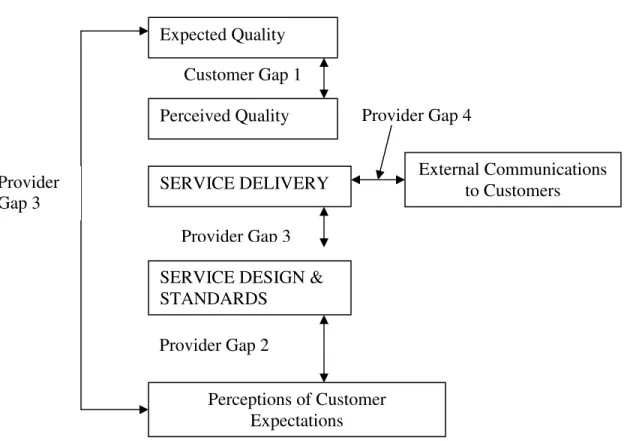
Quality is defined by Parasuraman et al. (1988) as the difference between customers’ expectation and their perception of the service delivered. The SERVQUAL model (Parasuraman et al., 1988) which is also known as the Gaps model is used to define quality.
In their model, Gap 3 is the relevant gap that measures service quality. This service performance gap, is the difference between the actual services delivered to the
customers compared to the firm’s service quality specification. The following Figure 2 was adapted from Parasuraman et al.’s (1985) model.
Figure 2 : Service Performance Gap
Source : Bienstock, DeMoranville and Smith (2003) Customer Gap 1
Expected Quality
Perceived Quality
SERVICE DELIVERY
SERVICE DESIGN & STANDARDS Provider Gap 3 Perceptions of Customer Expectations Provider Gap 2 External Communications to Customers Provider Gap 4 Provider Gap 3
2.2 Service Climate and Intrinsic Motivation
The focus on efficiency and productivity in call centers is found by authors to affect call center agents psychologically. The work environment in most call centers is stressful to call center agents. There are several findings about the stress at the workplace such as those experienced by frontliners in the call centers. Stress has been found to relate in low motivation, burnout and resistance among the call center agents (Houligan, 2000).
Wallace et al. (2000) suggested that to deliver service quality, call centers should carefully select intrinsically motivated employees. This finding is in line with Higgs (2004) concurred by establishing the relationship between emotional intelligence and performance of call center agents. This study proposes that an individual’s motivation level should be considered during the selection and recruitment of call center agents. The selection of highly motivated individual in the organization would allow it to avoid incurring additional expenses such as in conducting programmes for its employees. Motivated employees are more likely to be able to absorb the pressures from burnout, and stress and therefore reduce the rate of turnover intentions.
Thus, organizations may consider to implement this strategy in their call center management. Obviously, this is not the only way to manage call centers. Call center managers must focus on creating a positive service climate in their call centers that can foster the intrinsic motivation of call center agents.
Routhman and Joubert (2007), found in their research that positive employee outcomes such as wellness, vigour and dedication are related to job resources, organizational support and advancement opportunity. Meanwhile, Brown and Leigh (1996) found a positive relationship between psychological climate and job involvement. According to these authors, the characteristics of job involvement include autonomy, skill variety, task identity, significance , supervisory behaviors such as consideration , participation and individual differences such as internal motivation and work ethics. Therefore internal motivation of employees has been found to be related to service climate by them.
In addition to that, Schneider and Bowen (1985) found a direct relationship between service climate and the customer’s perception of service by an organization. However, in a subsequent study ,Schneider and Bowen (1992) found a positive relationship between job satisfaction and service climate. In another study, Yoon et al. (2001) argued that service quality is related to employees’ attitudinal and behavioral responses. The measurement for service quality used by Yoon et al. (2000) was the perception of employees of a Korean retail bank. As discussed in the definition of service climate, Yoon et al. (2001) found that both service climate and supportive management contribute to employees’ job satisfaction and work effort, and they indirectly relate to on customers’ perceptions of employees’ service quality.
Other authors such as Deci and Ryan (1985) suggested that the control, freedom of choice, and sense of security engendered by supportive management are likely to enhance motivation and induce greater job involvement. Meanwhile, Little and Dean (2006) found
that service quality capability (SQC) which is the extent to which employees are satisfied with their ability to deliver service quality to customers is related to service climate only through dimensions of HRM.
The motivation behind employee behaviours and attitudes can be explained using the social exchange theory. According to Lee and Peccei (2006), social exchanges in organizations are determined by the extent to which employees perceive they are being fairly in the organization. As the name social exchange suggests, there is a social contract or commodity for an exchange in terms of organizational commitment. Lee and Peccei’s (2006) study model is consistent with Allen and Meyer‘s (1990) study on organizational commitment .
Service climate created in the organization is important to ensure that employees are able to identify and feel responsible towards the organisations’ quality goals. The organizations should value the contributions of their employees and the latter would reciprocate with commitments towards delivering better service quality (Lee & Peccei, 2006).
2.3 Service Climate and Organizational Commitment
Some authors have suggested in the research, organizational commitment is linked very closely with turnover intentions of employees in an organization. On the other hand, Boshoff and Mels (1994) noted from their study that committed employees will dedicate more time, energy and talents to the organization. Therefore, it is crucial for service
managers to look back at past research to whether creating the right service climate will enhance organizational commitment and in turn result in a high level of service quality output.
Mukerjee and Malhotra (2006) examined the relationship of role clarity and organizational commitment by using role clarity dimensions that include organizational support, facilitation and feedback. The results of their study showed positive relationships between all the three dimensions and role clarity and also between role clarity with organizational commitment. Since the three dimensions are also consistent with service climate dimensions the finding by the author suggests that service climate is related to organizational commitment.
Little and Dean (2006), studied some call centers in Australia and they used the three factors of global service climate, such as managerial practices, customer feedback, and human resource management. Surprisingly, Little and Dean (2006) found that customer service orientation had no relationship with the global service climate. The authors found that service climate is highly dependent to HRM practices but not customer orientation. The outcome of the research by Little and Dean (2006) found that service quality climate is positively related to organizational commitment in call centers.
The importance of HRM practices have also been highlighted by Schneider and Bowen (1985). They suggested that the way employees feel about their organization acts as a
sustainable edge in a highly competitive industry. With highly committed employees, competitors will find it impossible to imitate service delivered to customers.
Peccei and Rosanthal (2000) found a positive relationship between service climate and individuals' commitment in the customer service. Service climate can be further enhanced to increase organizational commitment by improving training opportunities, daily appraisals including feedback between employer and employees, as well as improving job designs that allow employee discretion (Bowen & Lawler, 1992).
As defined earlier too, commitment and work effort are closely related based on previous studies. Yoon et al. (2001) found that both service climate and supportive management contribute to employees’ job satisfaction and work effort. Since work effort and organizational commitment are interrelated, this provides yet another support of the relationship between service climate and organizational commitment. Another research by Lux, Jex, and Hansen (1996), also found that service climate is related to organizational commitment.
2.4 Intrinsic Motivation and Service Quality
Previous studies on the relationship between job satisfaction and performance have examined the positive aspects of work satisfaction (e.g., Mahesh and Kasturi, 2006; Schneider and Bowen, 1993) .
Dimensions of intrinsic motivation include negative sounding items like difficult, challenging, risky and pressure. Several authors have found support the relationship between intrinsic motivation and service quality. Mahesh and Kasturi (2006) found a positive relationship between intrinsic motivation and the effectiveness of call center agents. According to them, employees who are intrinsically motivated are able to perform tasks in using a variety of behaviours and skills to manage their emotions and stress levels. Therefore, call centre managers should consider employees’ intrinsic motivation in order to obtain quality service outcomes.
Young, Worchel and Woehr (1998), noted that past research by Baard, Deci and Ryan (2004) found employees that experience a sense of intrinsic satisfaction from their work are more committed in their jobs and have increased work performance. Meanwhile Travis (2006), found that increased work performance and high job commitments are related to the service industry where the front liners are assumed to be intrinsically drawn to their work.
From a public social management perspective, public service workers are intrinsically motivated as they see their efforts positively affect a social service. Hence, it is expected that the greater the sense of personal responsibility and perceived service quality, the more likely employees are to report feelings of being intrinsically satisfied.
As mentioned earlier, most previous studies (e.g.,Malhotra & Mukherjee, 2004; Mukherjee & Malhotra, 2006) have related the positive aspects of the job thus studying
the relationship between job satisfaction and service quality. Contrary to the relationships above, one research that did not find any relationship between intrinsic motivation and service quality is Travis (2006). On the other hand, he found that only extrinsic motivation is related to service quality.
2.5 Organizational Commitment and Service Quality
According to Zeithaml et al.(1990), service quality would fail if employees are unwilling or unable to perform services at the required levels. Therefore, the attitude and behaviours of frontline employees are important to produce superior service quality (Schneider & Bowen, 1995). The commitment of front line employees will determine the service quality delivered by call centers (Sergeant & Frenkel, 2000).
As explained by Zeithaml et al. (1990), Boshoff and Mels (1995) and also Boshoff and Tait (1996), the willingness of employees to accept and support goals and objectives of organisations would be reflected in the manner they are committed, and the level of service quality delivered.
Several other studies have found positive relationships between organizational commitment and service quality (e.g., Bosshoff & Mels, 1994; Malhotra & Mukherjee, 2004; Mukerjee & Malhotra, 2006; ,Zeithaml et al., 1990; Bosshoff & Allen, 1998)
2.6 Conclusion
There are several studies in the past on service climate, service quality, and employee attitudes such as job satisfaction, intrinsic motivation, and commitment. However, none have been done in the Malaysian call centres. The next chapter would establish the research framework and hypotheses . The research methodology are also described.
CHAPTER 3
DEVELOPMENT OF RESEARCH FRAMEWORK AND HYPOTHESES
3.0 Introduction
This study investigated the relationships of service climate, organizational commitment, intrinsic motivation and service quality delivered by call center agents in Malaysia. This chapter will discuss the development of the research framework and hypotheses based on the literature review in Chapter 2.
3.1 Problem Statement
Chapter 2 highlights the stressful work environment faced by employees of call centers. In Malaysia, many service organizations have started using call centres, to serve their customers’ queries and concerns 24 hours a day, 7 days in a week. The number of people employed in call centres for various service industries have increased in recent years.
The performance and efficiency of call centres seem to be related to customer satisfaction. Some service organizations have found it challenging to balance their backroom employee’s service delivery with the responses of their call center agents. Call center agents act as front liners for the organizations. They represent the entire organisations’ function when they face customers. Poor service delivery of call centre agents can affect high customer complains and low customer satisfaction. Poor
communication within departments in the organization may also result in call center agents to take the bulk of the pressure from both the management and customers.
Unless call center managers, foresee this issue, it would be difficult to ensure that the role of the call center agents is understood especially in the way they fit to the whole organization. Do call center managers have a role to play to ensure that organizations are able to create a sufficiently positive service environment throughout the organization to support call center agents? What is the outcome of this positive climate on the call center agents ?
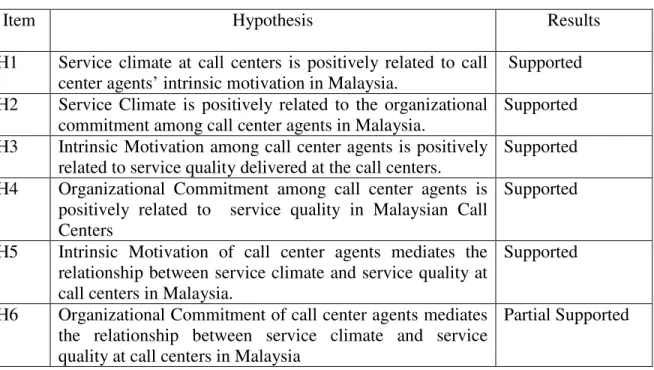
This research is thus, aimed at examining the relationships of service climate, employee intrinsic motivation, organization commitment and service quality among call center agents in Malaysia . The following relationships were investigated :
1. Between service climate and intrinsic motivation of call center agents.
2. Between service climate and organizational commitment of call center agents. 3. Between intrinsic motivation and service quality of call center agents.
4. Between organizational commitment and service quality of call center agents. 5. If intrinsic motivation mediates the relationship between service climate and
service quality.
6. If organizational commitment mediates the relationship between service climate and service quality.
3.2 Definition of Primary Variables 3.2.1 Dependent Variable
The dependent variable in this study is service quality. Since service quality is a measurable outcome of internal organizational practices and policies, it will represent customer’s value and satisfaction regarding the organisation. In this research, service quality is measured in terms of employee perspective and not customer perspective similar to several previous studies (e.g., Boshoff & Mels, 1995; Boshoff & Tait, 1996; Hartline & Ferrell, 1996).
3.2.2 Independent Variable
The independent variable in this study is service climate. Schneider and Bowen’s (1995) definition of service climate described in Chapter 2 is used as the basis of this variable. Service climate should make employees feel that their organizations value customers and the delivery of quality services.
3.2.3 Mediating Variables
Past studies have shown that job satisfaction and organizational commitment mediate the relationships between service climate and service quality. However, in this study, intrinsic motivation is used as a mediating variable to investigate the mediating effect of intrinsic motivation which is a higher level of job satisfaction. Organisational commitment is also used as another mediating variable to investigate its mediation on the relationship between service climate and service quality in the Malaysian context.
3.3 Research Framework
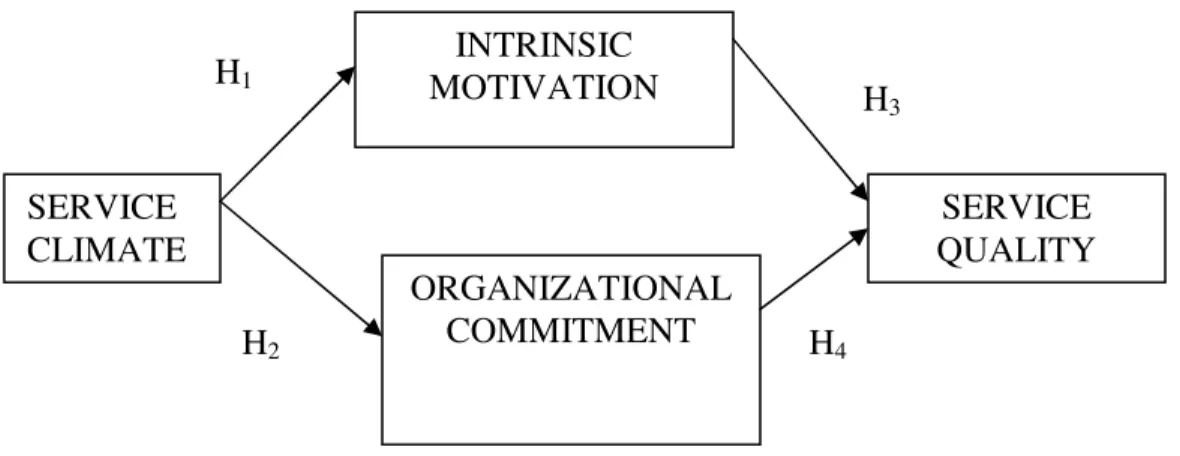
The aim of this study was to identify the relationship between creating a positive service climate and service quality among call center agents in Malaysia. It also examined two mediating variables, namely intrinsic motivation and organizational commitment are mediating the relationhip between service quality and service climate. The research framework developed is shown in Figure 3 below :
Figure 3 : Research Framework
Hypotheses H5 is the relationship between service climate and service quality mediated by intrinsic motivation.
Hypotheses H6 is the relationship between service climate and service quality mediated by organizational commitment. INTRINSIC MOTIVATION ORGANIZATIONAL COMMITMENT SERVICE QUALITY SERVICE CLIMATE H1 H3 H2 H4
3.4 Hypotheses Development
From the research framework in the previous section, six (6) hypotheses were proposed. They are :
3.4.1 Relationship between service climate and intrinsic motivation
As mentioned in Chapter 2, Routhman and Joubert (2007), found that positive employee outcomes such as wellness, vigour and dedication are related to job resources, organizational support and advancement opportunity. Brown and Leigh (1996) also found a positive relationship between the psychological climate and job involvement.
Other findings by Schneider and Bowen (1992), and Yoon et al. (2000) found a positive relationship between job satisfaction and service climate. Yoon et al. (2001), specifically found that both service climate and supportive management contribute to employees’ job satisfaction and work effort, and indirectly to customers’ perceptions of employee service quality. Organizations that value the contributions of their employees are likely to be rewarded by intrinsic quality commitments (Lee & Peccei, 2006).
Therefore, it is hypothesised that :
Hypothesis 1 (H1) : Service climate is positively related to call center agents’
3.4.2 Relationship between service climate and organizational commitment
Bosshoff and Mels (1994) suggested that committed employees will dedicate more time, energy, and talents to the organization. Mukerjee and Malhotra (2006) found a positive relationship between role clarity with organizational commitment. Role clarity is an antecedent of service climate.
In a study of Australian call centers by Little and Dean (2006) found that three factors related to Global Service Climate which such as managerial practices, customer feedback, and human resource management are positively related to organizational commitment in call centers.
Schneider and Bowen (1985) also found that service climate especially HRM practices is positively related to organizational commitment. They noted that the way employees feel about their organization is an advantage to the organization as it acts as sustainable edge in highly competitive industry. Peccei and Rosanthal (2000) found positive relationships between customer service climate and individuals' attitudinal and behavioral commitment to customer service. Lux et al., (1996) also found that service climate is related to organizational commitment.
Therefore, in the context of call centre agents in Malaysia, it is proposed that : Hypothesis 2 (H2) : Service Climate is positively related to the organizational
3.4.3 Relationship between Intrinsic Motivation and Service Quality
Several authors have found positive relationships between job satisfaction and service quality (e.g.,Mahesh & Kasturi, 2006; Malhotra & Mukerjee, 2004; Schneider & Bowen, 1993). Mahesh and Kasturi (2006), for example, found a positive relationship between intrinsic motivation and effectiveness of call center agents. They concluded that intrinsically motivated employees performed tasks by using a variety of behaviours and skills to manage their emotions and stress levels.
Young et al. (1998) as well as Baard et al. (2004), found that employees with a sense of intrinsic satisfaction from their work are more committed in their jobs and have increased work performance than those that are not. According to Travis (2006), these outcomes are related to the service industry where the front liners are commonly assumed to be intrinsically drawn to their work. It is expected that the greater the sense of personal responsibility and perceived service quality, the more likely are employees to report feeling intrinsically satisfied (Crewson, 1997; Perry, 2000).
Thus, hypothesis 3 is proposed in this study :
Hypothesis 3 (H3) : Intrinsic motivation among call center agents is positively
3.4.4 Relationship between Organizational Commitment and Service Quality
Zeithaml et al. (1990) suggested that service quality would fail when employees are unwilling or unable to perform services at the required levels. Schneider and Bowen (1995) stressed the importance of frontline employees’ attitudes and behaviours in order to create superior service quality. Other authors also agreed that the commitment of frontline employees would determine the delivery of service quality (e.g., Sergeant & Frenkel, 2000; Zeithaml et al., 1990 ; Boshoff & Mels, 1994 ; Boshoff & Tait, 1996; Malhotra & Mukerjee, 2004; Mukerjee & Malhotra, 2006; Boshoff & Allen, 1998).
Therefore, the fourth hypothesisproposed in this study was :
Hypothesis 4 (H4) : Organizational commitment among call center agents is
positively related to service quality
3.4.5 The mediating relationships between service climate and service quality Hypothesis 5 and Hypothesis 6 below were developed to examine the relationship between the independent variable and the dependent variable by using two mediators, namely, intrinsic motivation and organizational commitment.
Hypothesis 5 (H5) : Intrinsic motivation of call center agents mediates the
Hypothesis 6 (H6) : Organizational commitment of call center agents mediates the
relationship between service climate and service quality.
3.5 Conclusion
In this chapter, the problem statement of the research was explained. Past studies was used as the basis of the problem statement and for the formulation of the research framework in this study. Four variables in the study namely service climate, intrinsic motivation, organizational commitment and service quality were explained in this chapter. Finally, six (6) hypotheses were developed based on the literature review.
In the next chapter, the methodology used in to examine the relationships established in this chapter is explained.
CHAPTER 4
METHODOLOGY
4.0 Introduction
In this chapter, the methodology used to examine the relationships between service climate, intrinsic motivation, organizational commitment and service quality is discussed in depth. Since a quantitative method was used in this research, thus, a survey was designed using reliable measures adopted from previous research. Data collection procedures and the research instruments used in the survey is also detailed in this chapter. In addition to that, data analysis techniques that was used to analyse the data obtained in the survey is explained.
4.1 Sample Design
The sample for this research was constructed by selecting two large organizations in Malaysia that provided call centre services. The two organizations were chosen as they represented two different sectors, namely from the electricity sector and the telecommunications sector.
Convenience sampling method was used in the survey as call centre agents that participated in the survey were chosen from these two organizations that were agreeable to participate in this research. A total of 125 surveys were distributed among call center agents in each of the two organizations. Thus from a total of 250, only 196 surveys were
returned, recording a rate of return of 78.4%. Fifty-four questionnaires were not returned by the call center supervisors and a few reasons were cited for non-willingness by call center agents to participate in the survey. The reasons include not being comfortable with the language used in the survey (English), fearing non-confidentiality and time constraints between works.
Managers and call centre supervisors were not invited to participate in the survey as the objective of the research was to examine the call center agents perceptions of the service climate, intrinsic motivation, organizational commitment and service quality in their organization.
For the purpose of convenience, the survey was conducted throughout call centres in the two organizations located in Penang, Klang Valley , Johor and Kuantan .
4.2 Data Collection Procedures
Data was collected by first asking for permission to carry out the research in the two organisations chosen to participate in the survey. The two organizations were chosen as they were from two different sectors had a large customer base. As soon as approval was obtained from the organizations to participate in the study, 125 questionnaires were distributed to each organizations. Five call centre supervisors had assisted to distribute the questionnaires to call centres agents at their call centres. Thus, these supervisors acted as mediators to clarify questions regarding the survey and also to collect completed forms.
During the data collection period, pens were offered as tokens to respondents who returned completed questionnaire forms. The offering of the token, increased the response rate.
The respondents were not required to state their names or their departments to protect their confidentiality. In addition to that, the supervisors were only allowed to collect the completed forms that were dropped by the respondents in a survey box. This was done to reduce the biasness in the response. In total, the data collection period took over three weeks.
4.3 Research Instrument
The questionnaire design was made up of two sections. The first section consisted of forty-one items based on four constructs, namely service climate, intrinsic motivation, organizational commitment and service quality. Meanwhile, the second section consisted of ten demographic questions such as gender, age, ethnicity, education level, lengt in the organization, employment type, job responsibility and others.
4.3.1 Research Measures
The measures used in this research were adopted from previous studies to ensure . their validity and reliability. The following provides an overview of each of the measures.
4.3.1.1 Service Climate
The service climate measure was adopted from Schneider and Bowen (1998). Schneider and Bowen’s measure had seven items (α = .88). There were three dimensions in their service climate measures namely, customer orientation, managerial practices and customer feedback. In Schneider and Bowen’s measure respondents were asked to state their perceptions of each items based on a five- point Likert scale whereby, 1= never; 2 = slightly; 3 = sometimes; 4 = considerable and 5 = always. All the items were positively worded.
In order to ensure a consistent survey response from respondents, a slight modification was done on Schneider and Bowen’s (1998) measure in this survey, The wordings were modified so that a responsed using a seven-point Likert scale whereby 1 = strongly disagree; 2= moderately disagree; 3 = slightly disagree; 4 = neither agree nor disagree; 5 = slightly agree ; 6= moderately agree; 7 = strongly agree. Some examples of the items in the modified measures are : My organization provides job knowledge and skills of employees to deliver superior quality work and service; my organizaton measures and tracks work and service quality; the managers in my organisation support service quality efforts.
4.3.1.2 Intrinsic motivation
Intrinsic motivation measures were adopted from Mahesh and Kasturi (2006). All fifteen items in the original measures were used ( α = .91). They included items describing various dimensions such as enjoyment, perceived competence,
importance, pressure, perceived choice, usefulness, and relateness. All the items were positively worded. The original scales of measurements by Mahesh and Kasturi (2006), respondents were asked to state their perceptions of each items on a five-point Likert scale whereby, 5= strongly disagree ; 4 = disagree ; 3 = Neutral ; 2 = Agree ; 1= Strongly Agree).
In order to ensure a consistent survey response from respondents, a slight modification was done on Mahesh and Kasturi’s (2006) measure in this survey, The five-point Likert scale was extended to a seven-point Likert scale whereby, 1 = strongly disagree; 2= moderately disagree; 3 = slightly disagree; 4 = neither agree nor disagree; 5 = slightly agree ; 6= moderately agree; 7 = strongly agree. Some examples of the items in intrinsic motivation measures are : I talk with pride among my friends and acquaintances about my job; Working here is fun; I take the difficulties on the job as a challenge; This job brings out the best in me; I set high targets for myself.
4.3.1.3 Organizational commitment
Only the component of affective commitment was studied in this research. All the eight items in this survey were adopted from Allen and Meyer’s (1990) study (α = .87). Out of the eight items, four were positively worded and four were negatively worded.The respondents were required to state their response using a 7 point Likert scale whereby, 1 = strongly Disagree; 2= Moderately Disagree; 3 =
Slightly Disagree; 4 = Neither Agree nor Disagree; 5 = Slightly Agree ; 6= Moderately Agree; 7 = Strongly Agree). Some examples of the items in this measure are : I would be happy to spend the rest of my career with this organisation; I enjoy discussing my organisation with people outside it; I do not feel a sense of “belonging” to this organisation; The organisation has a great deal of personal meaning for me.
4.3.1.4 Service Quality
In this study, Malhotra and Mukherjee’s, (2004) eleven-items measure of service quality that were adapted form the SERVQUAL instrument (Parasuraman et al., 1988) were used. The dimensions included in the measures were reliability, responsiveness, assurance and empathetic. The “tangibles” dimension was not included as it was not applicable to the service delivered by call center agents. Malhotra and Mukherjee (2004), modified these scale and used only the “perceptions” items. This is supported by Cronin and Taylor (1992;1994).
The scale of measurement used by Malhotra and Mukherjee, (2004) for service quality was based on a five-point, Likert scale ranging from “strongly agree” to “strongly disagree”. All the items were positively worded. Some examples of the items are : I can understand the specific needs of my customers; I perform the service right the first time; I give prompt service to my customers; I treat all my customers courteously.
In order to ensure a consistent survey response from respondents, a similiar modification to the intrinsic motivation measure on this measure. The five-point Likert scale was also extended to a seven-point Likert scale whereby, 1 = strongly disagree; 2= moderately disagree; 3 = slightly disagree; 4 = neither agree nor disagree; 5 = slightly agree ; 6= moderately agree; 7 = strongly agree.
4.4 Data Analysis Techniques
The data collected from the sample (n=196) were analysed by using the Statistical Programme for Social Sciences (SPSS) version 14.0. The following data analysis techniques was used :
4.4.1 Descriptive analysis
A descriptive report of the demographic characteristics of the respondents (n=196) were analysed to assess the gender, age, ethnicity, education level, length of service in the organization, number of companies worked for in the last 5 years, status of employment, job responsibility, business core function of their organisation.
4.4.2 Preliminary analysis
Preliminary analysis for normality distributions of the data was obtained. The skewness and kurtosis results described the data’s to the normality distribution. Skewness between -2 and +2 was considered normal while kurtosis value between -3 and +3 was considered normal.
4.4.3 Reliability analysis
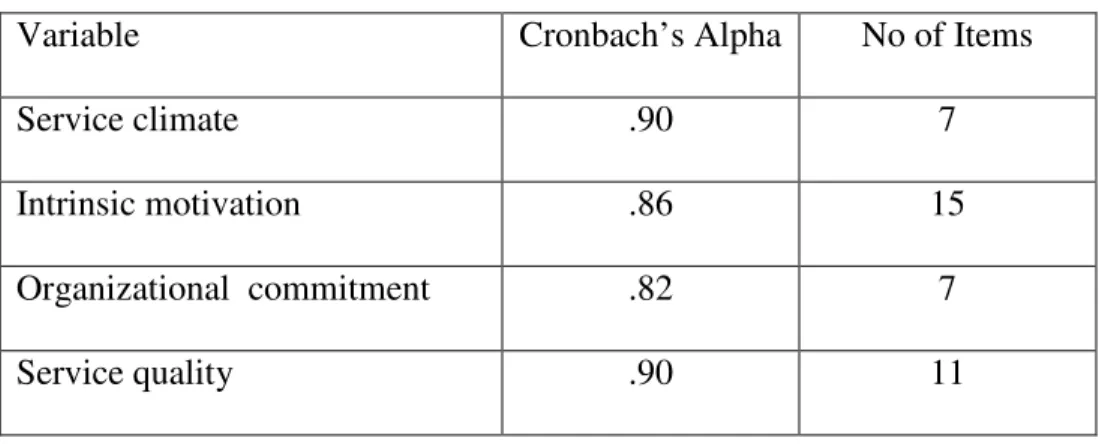
The reliability of the measures were tested. The total Cronbach’s alpha values for each of the four variables were found whereby, a score of .70 and above was considered reliable. To increase the reliability of the scales, some items were deleted from measures when their presence led to Cronbach's alpha values of less than .70 to increase the reliability of the scales.
4.4.4 Correlation analysis
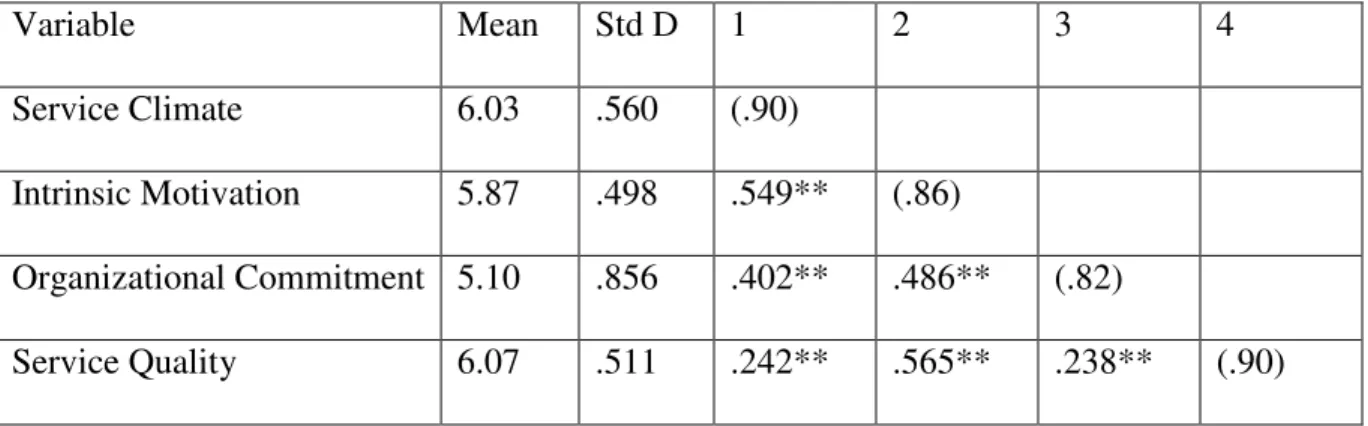
Correlation analysis was conducted as a preliminary test to check the strength and direction of he relationship between constructs. A significance level of .05 was used in this analysis.
4.4.5 Multiple Hierarchical Regression Analysis
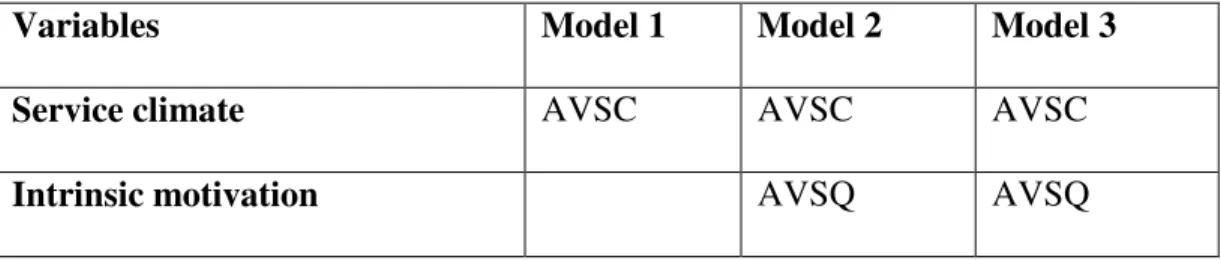
Multiple hierarchical regression analysis was used to confirm the linearity, normality and homoscedasticity of the data obtained from the survey. Testing of the hypotheses was conducted using this technique. This technique would also assist to show the presence of the mediating variable between constructs.
Baron and Kenny’s (1986) approach in investigating the presence of mediating variables was used in this research.