I
mproving
I
mplicit
P
arallelism
Jose´ ManuelCalderon´ Trilla
Doctor of Philosophy
University of York Computer Science
A B S T R A C T
We propose a new technique for exploiting the inherent parallelism in lazy functional programs. Known as implicit parallelism, the goal of writing a sequential program and having the compiler improve its performance by determining what can be executed in parallel has been studied for many years. Our technique abandons the idea that a compiler should accomplish this feat in ‘one shot’ with static analysis and instead allow the compiler to improve upon the static analysis using iterative feedback.
We demonstrate that iterative feedback can be relatively simple when the source language is a lazy purely functional programming language. We present three main contributions to the field: the auto-matic derivation of parallel strategies from a demand on a structure, and two new methods of feedback-directed auto-parallelisation. The first method treats the runtime of the program as ablack boxand uses the ‘wall-clock’ time as a fitness function to guide a heuristic search on bitstrings representing the parallel setting of the program. The second feedback approach isprofile directed. This allows the compiler to use profile data that is gathered by the runtime system as the pro-gram executes. This allows the compiler to determine which threads are not worth the overhead of creating them.
Our results show that the use of feedback-directed compilation can be a good source of refinement for the static analysis techniques that struggle to account for the cost of a computation. This lifts the burden of ‘is this parallelism worthwhile?’ away from the static phase of compilation and to the runtime, which is better equipped to answer the question.
TA B L E O F C O N T E N T S Abstract 2 Table of Contents 3 List of Figures 6 List of Tables 8 Acknowledgements 9 Declaration 10 1 i n t r o d u c t i o n 11
1.1 Lazy Languages and Parallelism . . . 12
1.2 Goals and Contributions of this Thesis. . . 14
1.3 Thesis Roadmap. . . 14
I The Idea 15 2 pa r a l l e l i s m i n a f u n c t i o na l l a n g ua g e 17 2.1 A Short History of Graph Reduction . . . 17
2.2 Functional Programming and Parallelism . . . 19
2.3 Sequential Reduction Machines . . . 20
2.4 Parallel Reduction Machines . . . 25
2.5 Approaches to Parallelism . . . 26
2.6 Summary of the Chapter . . . 39
3 b i r d’s e y e v i e w o f o u r t e c h n i q u e 41 3.1 F-lite: a Lazy Purely Functional Core Language . . . . 41
3.2 Overview of the Compiler . . . 48
3.3 Summary. . . 55
II The Discovery and Placement of Safe Parallelism 56 4 f i n d i n g s a f e pa r a l l e l i s m 57 4.1 Original Motivation vs. Our Motivation . . . 59
4.3 Two-Point Forward Analysis . . . 63
4.4 Four-Point Forward Analysis . . . 71
4.5 Projection-Based Analysis . . . 80
4.6 Summary. . . 91
5 d e r i vat i o n a n d u s e o f pa r a l l e l s t r at e g i e s 92 5.1 Expressing Need, Strategically . . . 93
5.2 Deriving Strategies from Projections . . . 95
5.3 Using Derived Strategies . . . 99
III Experimental Platform, Benchmark Programs, and Results 103 6 e x p e r i m e n ta l p l at f o r m 104 6.1 Defunctionalisation (Higher-Order Specialisation) . . . 105
6.2 Keeping Track of all the Threads . . . 108
6.3 Trying forpar: Switching off Parallelism . . . 110
6.4 Benchmark Programs. . . 111
7 r u n-t i m e d i r e c t e d s e a r c h 113 7.1 Heuristic Algorithms . . . 113
7.2 Research Questions . . . 117
7.3 Experimental Setup and Results . . . 118
7.4 Summary of Bitstring Searching . . . 124
8 p r o f i l e d i r e c t e d s e a r c h 125 8.1 par-Site Health . . . 126
8.2 Search Algorithm . . . 127
8.3 Experimental Results and Discussion . . . 128
8.4 Transfer to GHC. . . 134
8.5 Limitations . . . 135
8.6 Summary of Profile-Directed Search . . . 137
IV Conclusions and Future Directions 140 9 c o n c l u s i o n s 141 10 f u t u r e d i r e c t i o n s 144 10.1 Specialising on Depth . . . 145
10.2 Hybrid Approaches. . . 147
Appendices 149 a b e n c h m a r k p r o g r a m s 149 a.1 SumEuler. . . 149 a.2 MatMul. . . 150 a.3 Queens . . . 151 a.4 Queens2 . . . 152 a.5 SodaCount . . . 154 a.6 Tak . . . 157 a.7 Taut . . . 158 b l a z i f y e x p r e s s i o n s 161 Bilbiography 162
L I S T O F F I G U R E S
Figure1 Eager and Lazy evaluation order for squaring
a value. . . 20
Figure2 G-Code execution example . . . 21
Figure3 Simple parallel graph reduction model . . . . 25
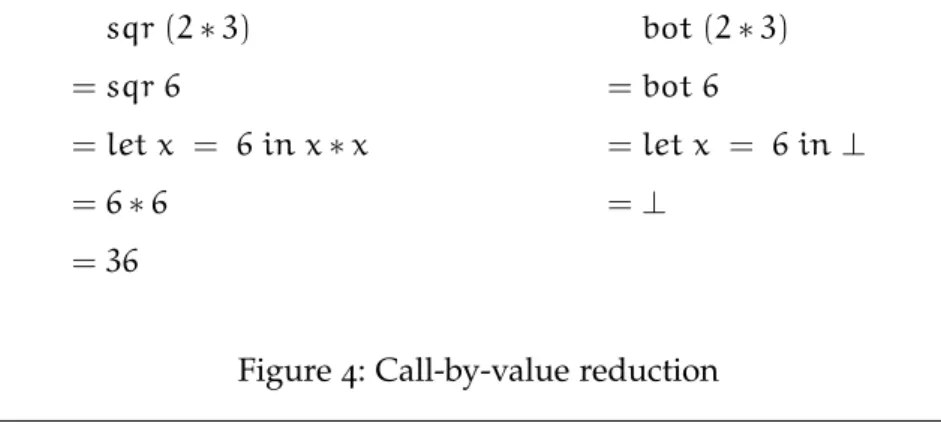
Figure4 Call-by-value reduction. . . 43
Figure5 Call-by-name reduction . . . 43
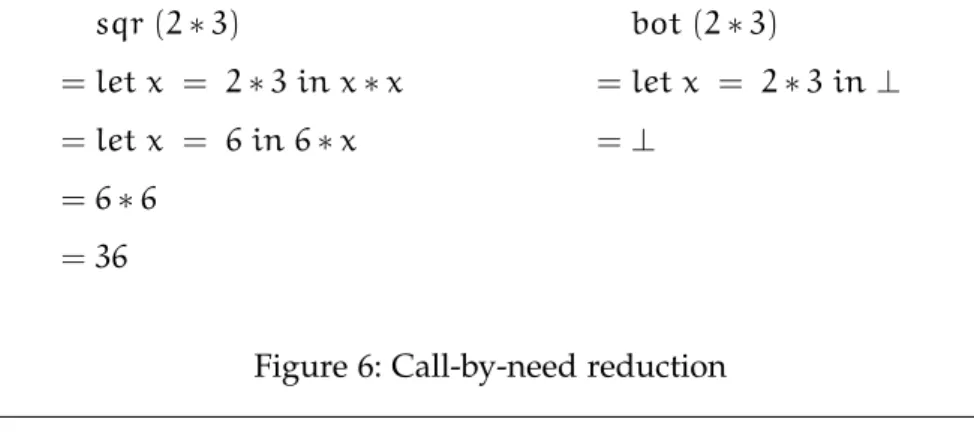
Figure6 Call-by-need reduction . . . 44
Figure7 Normal order reduction . . . 44
Figure8 Eager (left) and Lazy (right) evaluation order forconst . . . 45
Figure9 Abstract Syntax for F-lite. . . 47
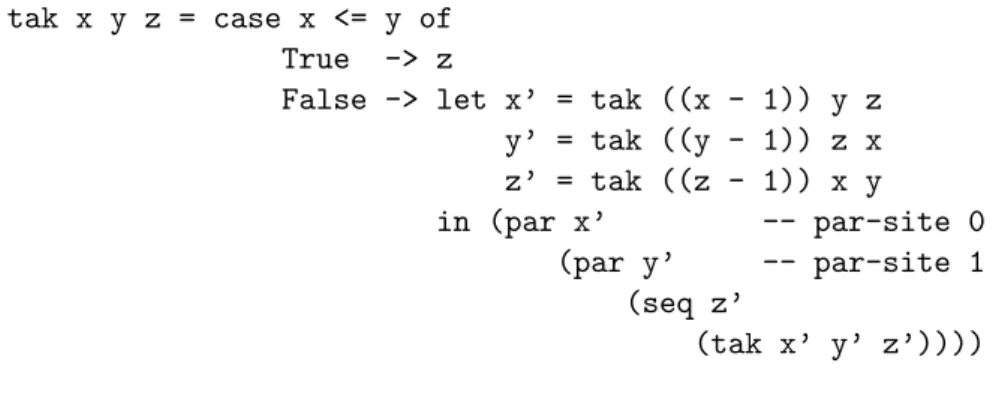
Figure10 Source listing for Tak . . . 49
Figure11 Source listing for Tak after analysis, transfor-mation, andparplacement . . . 49
Figure12 Semantics ofseqandpar. . . 61
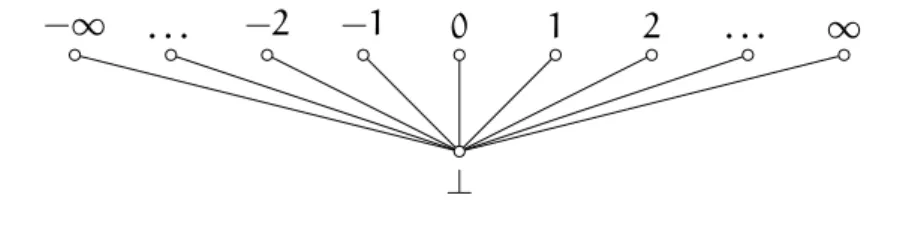
Figure13 Flat Domain . . . 65
Figure14 Two-point Domain . . . 65
Figure15 Themeet(u) andjoin(t) for our lattice . . . . 66
Figure16 An Abstract Semantics for Strictness Analysis on a Two-Point Domain . . . 67
Figure17 Domain for pairs of flat-domain values . . . . 72
Figure18 Wadler’s Four-point Domain . . . 74
Figure19 Definition ofcons#for a Four-Point Domain . 74 Figure20 Modification toAfor List Constructors . . . . 75
Figure21 Abstraction of Case Expressions on Lists . . . 77
Figure22 Abstract Syntax for Contexts of Demand . . . 83
Figure23 Projections for the4-point Domain . . . 85
Figure24 Conjunction and Disjunction for Projections1 86 Figure25 Conjunction and Disjunction for Projections2 87 Figure26 Conjunction and Disjunction for Projections3 88 Figure27 Projection-based Strictness Analysis . . . 90
Figure28 Using Evaluation Transformers . . . 95
Figure29 Rules to generate strategies from demand con-texts . . . 96
Figure31 Speedups against number of fitness evaluations
forQueens2andSodaCount . . . 123
Figure32 Statistics on the number of reductions carried out by the threads aparsite sparks off . . . . 126
Figure33 SumEulerspeedup . . . 132
Figure34 Queensspeedup . . . 132
Figure35 Queens2speedup . . . 133
Figure36 Tautspeedup . . . 133
Figure37 A tree representation of a recursive computation145 Figure38 Lazify an F-lite Expression . . . 161
L I S T O F TA B L E S
Table 1 Performance ofTakwith differentparsettings 54 Table 2 Analysis of length# and sum# Using 4-point
Domains . . . 78 Table 3 Analysis ofappend#xs#ys#Using4-point
Do-mains . . . 79 Table 4 The Evaluation Transformer forappend . . . . 94 Table 5 Results from using heuristic search . . . 121 Table 6 Profile-Directed Search with an overhead of10
reductions . . . 130 Table 7 Profile-Directed Search with overheads of100
reductions . . . 130 Table 8 Profile-Directed Search with an overhead of1000
reductions . . . 130 Table 9 Naive transfer to GHC . . . 134
A C K N O W L E D G E M E N T S
Less than a year ago I was going to quit my PhD. I had struggled throughout the process and had decided that I was not cut out for it. It was not the first time I almost quit, and it was not the first time that Prof. Runciman convinced me to press on and get my work out into the world. I cannot imagine a better supervisor. I feel grateful every day that he thought I was worth keeping around.
During my six years in the UK my partner, Danielle,wasdeported. It is a testament to her level of support for me that she went through the process ofcoming backto the country that deported her so that we would not have to live apart. It was not easy, but it has been worth it.
My parents have never stopped me from following my curiosity. You would think that after asking to go to music school and then switching to CS for grad school they’d make me pick something and stick with it. I am so thankful to have the supportive and understand-ing parents that I have.
Layla and Mike, for having the cutest baby. I can’t wait to spend more time with you three.
The members of York’s PLASMA group have been a constant source of joy and knowledge. I owe them many thanks. Matt Naylor, who patiently answered all my silly questions during my first year. Jason Reich, who was always enthusiastic about everyone’s work. Chris Bak for empathising with my PhD progress and playing board games with me. Glyn Faulkner for getting me excited about different lan-guages and technologies. And Rudy and Michael for humoring me while I pitch them my half-baked language ideas.
Simon Poulding provided tons of insight into heuristic search and stats. Mike Dodds for keeping his door open to me.
Ian, Gary, Jamie, and Gareth always made me feel welcome when I would intrude on RTS breaks. Russell for understanding that some-times I just want to watch TV and vent. Jimmy for always hearing me out and his steadfast confidence in me. Alan for his joke. Sam and Dani for always being such gracious hosts.
Rich, Chris, and Tara for helping me feel less homesick.
Danielle again, for putting up with who I am but always helping me be better.
D E C L A R AT I O N
I, Jos´e Manuel Calder ´on Trilla, declare that this thesis is a presenta-tion of original work and I am the sole author. This work has not previously been presented for an award at this, or any other, Univer-sity. All sources are acknowledged as references.
Earlier versions of parts of this thesis were published in the follow-ing papers:
1. Jos´e Manuel Calder ´on Trilla and Colin Runciman: Improving Implicit Parallelism in Haskell ’15: Proceedings of the 2015ACM SIGPLAN Symposium on Haskell, pg153-164, ACM,2015
2. Jos´e Manuel Calder ´on Trilla, Simon Poulding, and Colin Runci-man: Weaving Parallel Threads in SSBSE ’15: Search-Based Soft-ware Engineering, pg62-76, Springer,2015
The first paper was conceived, implemented, and written by myself with significant guidance and input from Prof. Runciman.
The second paper’s central idea was my own. Prof. Runciman, Simon Poulding, and myself developed the ‘plan of attack’. I then implemented the experimental platform and ran the experiments. Si-mon Poulding performed the statistical analysis of the results. The paper itself was written jointly by Simon Poulding and myself.
1
I N T R O D U C T I O NThe always dubious “feed in an arbitrary program and watch it run faster” story is comprehensively dead.
–Peyton Jones[1999]
There is a very common refrain that programmers use. It goes some-thing like this: “If you want a [X] program, you must [Y]”. We can choose appropriate X’s and Y’s to prove a point about the difficulty of programming. Here are some common examples:
• “If you want a fast program, you must write it in C”
• “If you want an efficient program, you must write it in assem-bler”
• “If you want a performant program, you must use cache-conscious structures”
• “If you want a parallel program, you must write a parallel pro-gram”
This thesis is concerned with the last of these examples. What does it mean? For many, the idea that a compiler can automatically parallelise a program that was written in a sequential manner is a pipe-dream. This version of the refrain attempts to emphasise the point that utilising parallelism requires active thought and action by the programmer, we can not get parallelism ‘for free’.
We seek to show that this is not always the case. We do this by attempting the inverse of the refrain: writing a compiler that is able to take asequentialprogram and transform it into a better performing1
parallel program. A system that can achieve this goal is said to take advantage of a program’simplicit, orinherent, parallelism.
Implicit Parallelism
The potential parallelism that is present in a program without
the need for any annotations, calling of parallel functions, or use of parallel libraries.
It is worth noting that this is no longer the standard meaning [Be-likov et al., 2013]. Increasingly, researchers take implicit parallelism to meansemi-implicit parallelism. Under their meaning implicit par-allelism often refers to techniques that provide parpar-allelism for a pro-grammer through an abstract interface. We feel that implicit paral-lelism should refer to techniques requiring zero input from the pro-grammer, and we will use semi-implicit parallelism to refer to tech-niques that require the programmer toopt in.
1.1 l a z y l a n g ua g e s a n d pa r a l l e l i s m
Advocates of purely functional programming languages often cite easy parallelism as a major benefit of abandoning mutable state [Hughes, 1983; Peyton Jones, 1989]. This idea drove research into the theory and implementation of compilers that take advantage of implicit par-allelism in a functional program. Additionally, when research into implicit parallelism was more common, the work was often based on novel architectures or distributed systems, not commodity hardware [Peyton Jones et al.,1987;Hammond and Michelson,2000].
Despite this research effort, the ultimate goal of writing a program in a functional style and having the compiler find the implicit par-allelism still requires work. We believe there are several reasons why previous work into implicit parallelism has not achieved the results that researchers hoped for. Chief amongst these is that the static placement of parallel annotations is not sufficient for creating well-performing parallel programs [Hammond and Michelson, 2000; Hogen et al.,1992;Tremblay and Gao,1995;Harris and Singh,2007]. This work explores one route to improvement: the compiler can use runtime profile data to improve initial decisions about parallelism in much the same way a programmer would manually tune a parallel program.
In the case of custom hardware, research was unable to keep up with huge improvements in sequential hardware. Today most com-mon desktop workstations are parallel machines; this steers our moti-vation away from the full utilisation of hardware. Many programmers today write sequential programs and run them on parallel machines. We argue that even modest speedups are worthwhile if they occur ‘for free’.
Historically Moore’s law has often provided a ‘free lunch’ for those looking to run faster programs without the programmer expending any engineering effort. Throughout the 1990s in particular, an ef-fective way of having a faster x86 program was to wait for Intel™ to release its new line of processors and run the program on your new CPU. Unfortunately, clock speeds have reached a plateau and we no longer get speedups for free [Sutter, 2005]. Increased perfor-mance now comes from including additional processor cores on mod-ern CPUs. This means that programmers have been forced to write parallel and concurrent programs when looking for improved wall-clock performance. Unfortunately, writing parallel and concurrent programs involves managing complexity that is not present in single-threaded programs. The goal of this work is to convince the reader that not all hope is lost. By looking for the implicit parallelismin pro-grams that are written as single-threaded propro-grams we can achieve performance gains without programmer effort.
Our work focuses on F-Lite [Naylor and Runciman,2010]: a pure, non-strict functional language that is suitable as a core language of a compiler for a higher-level language like Haskell. We have chosen to use a non-strict language because of the lack of arbitrary side-effects [Hughes,1989], and many years of work in the area of implicit paral-lelism [Hogen et al.,1992;Hammond, 1994;Jones and Hudak,1993] however we feel that many of our techniques would transfer well to other language paradigms.
With the choice of a lazy functional language we introduce a ten-sion, the evaluation order for lazy languages can be seen to be at odds with the goal of only evaluating expressions when they are needed (which is an inherently sequential evaluation order). For this reason we must usestrictness analysisin order to statically determine what ex-pressions in a program are definitely needed, allowing us to evaluate them in parallel. We note that even eager languages would require some form of analysis because eager languages tend to allow arbi-trary side-effects, necessitating the careful introduction of parallelism in order to avoid altering the order-dependent semantics of eager pro-grams.
In short, this work argues that static analysis is necessary but not sufficient for the automatic exploitation of implicit parallelism. We argue thatsomeform of runtime feedback is necessary to better utilise the parallelism that is discovered via static analysis.
1.2 g oa l s a n d c o n t r i b u t i o n s o f t h i s t h e s i s
The primary contribution of this thesis is to demonstrate that using search techniques based on dynamic execution of an automatically parallelised program is a robust way to help diminish thegranularity problem that is difficult for static analysis to overcome.
Our contributions can be seen as follows:
• A method to automatically derive parallel strategies from a de-mand context
• A novel use of heuristic search techniques in representing the possible parallelism in a program as a multi-dimensional search space
• The use of runtime profiles to disableautomatically introduced parallelism in a program
We show that for some programs, the combination of search and static analysis can achieve speed-ups without the need for program-mer intervention.
1.3 t h e s i s r oa d m a p
The thesis is divided into three broad parts:
PartIexplores the central concepts and the overall idea. In Chapter 2we review the work on parallel functional programming, discussing the benefits and drawbacks to different approaches of writing (or not writing!) parallel programs. Chapter3 provides an overview of our technique and a standard vocabulary for the rest of the work.
Part II is devoted to the static aspects of our approach. This in-cludes a review of strictness analysis and the motivation for utilising a projection-based analysis in Chapter 4. We present our technique for exploiting the results of strictness analysis in Chapter5.
In PartIII we first describe our experimental platform in Chapter 6, then discuss two experiments: Chapter7 experiments with using heuristic search techniques based on the overall runtime of a pro-gram and in Chapter 8we provide the compiler with access to more detailed runtime profiles.
Lastly, PartIV discusses our conclusions (Chapter 9) and possible future work (Chapter10).
Part I
The Idea
2
PA R A L L E L I S M I N A F U N C T I O N A L L A N G U A G EFully automatic parallelization is still a pipe dream.
–Marlow[2013]
This chapter explores previous approaches to parallelism in a func-tional language, both implicit and explicit. We do this so that we may better understand the trade-offs we accept when utilising implicit par-allelism and the difficulties involved.
Plan of the Chapter
The chapter is organised as follows. We begin in Section2.1by giving a brief overview of the history of graph reduction as a method for the execution of functional programs. Section 2.2 discusses the benefits that functional languages provide for parallelisation; we will focus on call-by-need (or lazy) semantics. We then explore the various meth-ods for the implementationof lazy languages for sequential machines in Section 2.3. Understanding how lazy languages can be executed we will then show in Section2.4how the techniques can be extended to allow for parallel execution.1
We then turn our attention to the programmer’s view of parallelism in a lazy language. Section 2.5 explores the current state of the art for parallel programming (both explicit and implicit parallelism) in a lazy functional language. We also explore the explicitly parallel techniques because they inform the way we approach implicit parallelism.
2.1 a s h o r t h i s t o r y o f g r a p h r e d u c t i o n
1978Turing Award winner, John Backus, used his acceptance speech to ask the question: “Can Programming be liberated from the von
1 One of the nice things about side-effect-free languages is that this step is not too
Neumann Style?” [Hudak et al., 2007]. The crux of his argument was that the traditional and ubiquitous architecture of the day was not suitable for the eventual shift to parallelism and the performance gains that could be achieved through parallelism’s use. This fed the interest in novel computer architectures that would more readily sup-port parallelism.
More declarative languages, and particularly functional languages, were seen as being better suited to Backus’ challenge than more tra-ditional imperative languages. This is because many imperative lan-guages were designed for the simplicity of compilation. They free the programmer from repetitive bookkeeping, such as saving registers for function calls and saving the intermediate computations in an expres-sion, but do not conceal all aspects of the underlying machine. Most crucially, they allow arbitrary mutation and side-effects. This limits the amount of parallelism possible because the result of a function call can depend on more than the values of the passed arguments.
Work had already been carried out on non-von Neumann architec-tures before that time. However, much of it was in the form of abstract machines that functioned ‘on top’ of the von Neumann architecture [Turner,2012].
In the early1970s the idea of graph reduction is introduced [Wadsworth, 1971] and with it, the concept of lazy evaluation was ready to be for-malised. Lazy evaluation has its roots in papers by Henderson and Morris, and Friedman and Wise [Turner,2012]. People began to think of ways to better implement graph reduction machines. A big break-through for software reduction was Turner’s SKI-Combinator reduc-tion scheme in1979[Turner,2012;Clack,1999].
In the 1980s we saw a great interest in parallel architectures for functional languages. The two main conferences in the field were ‘LISP and Functional Programming’ (which was held on even years) and ‘Functional Programming and Computer Architecture’ (which was held on odd years).
Several novel architectures were developed with the hopes that they could surpass stock hardware in their performance. This line of re-search continued through the 1980s and into the early 1990s [Harri-son and Reeve,1987;Peyton Jones et al.,1987;Clack,1999;Hammond, 1994].
The G-Machine in1984showed that lazy functional languages (which had always been considered inefficient and bound to being inter-preted) could be implemented in an efficient manner on stock
hard-ware via the compilation of supercombinators to machine code. How-ever, the abstract machine could also be used in the implementation of a novel architecture itself [Augustsson and Johnsson,1989a].
The1990s saw a decline in the amount of research aimed at parallel functional programming. This was mainly due to the results from earlier research being less successful than had been hoped (some novel architectures did see good results, but they could not keep up with the improvements seen in the sequential hardware sphere) [Hammond,1994;Clack,1999].
The late1990s and the2000s saw a resurgence in the interest in par-allel functional programming because of the ubiquity of multi-core computers today. Generally, many of the techniques discussed ear-lier are used, (GHC using the STG-Machine, for example) [Goldberg, 1988;Harris et al.,2005].
While still suffering from the von Neumann bottleneck, using mul-tiple cores in lazy functional languages is widely considered to be a success. Many high-level abstractions have been introduced that pro-vide the programmer with powerful tools to exploit their multi-core systems. Strategies [Trinder et al., 1998], parallel skeletons [Ham-mond and Reb ´on Portillo,2000], the Par-Monad [Marlow et al.,2011], and Repa [Keller et al., 2010] are among the most prominent suc-cesses. We will explore these in more depth in Section 2.5.
2.2 f u n c t i o na l p r o g r a m m i n g a n d pa r a l l e l i s m
Research into parallelism in lazy purely functional languages has a long history that dates back to the early work on lazy functional lan-guages [Hughes, 1983; Augustsson and Johnsson, 1989b; Plasmeijer and Eekelen,1993;Peyton Jones,1989].2
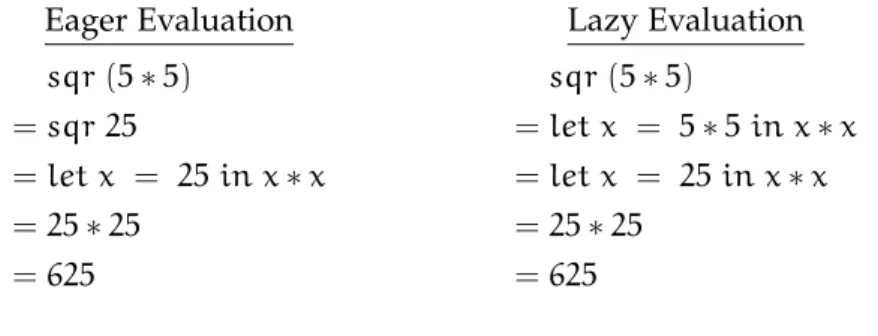
We are able to illustrate the issue with a simple example. The two reductions of sqr in Figure 1 illustrate the key differences between lazy evaluation and eager, or strict, evaluation.
In the case of eager evaluation the argument to sqr is evaluated before entering the function body. For lazy evaluation the argument is passed as a suspended computation that is only forced when the value is needed (in this case when x is needed in order to multiply x∗x). Notice that under lazy evaluation 5∗5is only evaluated once, even though it is used twice in the function. This is due to thesharing
Eager Evaluation sqr(5∗5) =sqr 25 =let x = 25 in x∗x =25∗25 =625 Lazy Evaluation sqr(5∗5) =let x = 5∗5 in x∗x =let x = 25 in x∗x =25∗25 =625
Figure1: Eager and Lazy evaluation order for squaring a value.
of the result. This is why laziness is often described as call-by-need with sharing[Hammond and Michelson,2000].
In the case of sqr in Figure 1, both eager and lazy evaluation re-quired the same number ofreductionsto compute the final result. This is not always the case; take the following function definitions
bot :: Int → Int bot x = x+botx
const :: a → b → a const x y = x
In an eager language the expression const 5 bot will never ter-minate, while it would return 5 in a lazy language as only the first argument toconstis actuallyneededin its body.
2.3 s e q u e n t i a l r e d u c t i o n m a c h i n e s
2.3.1 G-Machine
Unlike conventional register machines, theG-Machine is a stack-based machine designed to perform normal ordergraph reduction. The key point for the G-Machine [Augustsson and Johnsson, 1989a] is that it extended the idea that Turner introduced with the compilation of functional programs to SKI combinators. But instead of relying on pre-determined combinators, why not use the high-level declarations defined by the programmer? By compiling code for each of these, we
@ 3 @ Add 2 @ 3 @ Add 2 New Stack Frame
(After an Eval) Unwind
@ 3 @ Add 2 Unwind (Having reached a global, we load its
code) @ 3 @ Add 2 Push 1 @ 3 @ Add 2 Push 1 @ 3 @ Add 2 Add 5 3 @ Add 2 Update 2 5 # 3 @ Add 2 Pop 2 5 # a) b) c) e) g) d) f) h)
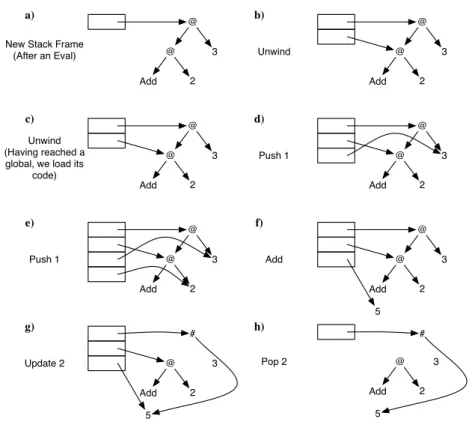
Figure2: Walk-through of theG-Code for Add2 3
are able to produce efficient code for each top-level function, whereas before we only had efficient code for each pre-determined combina-tor. These top-level function definitions were coinedsupercombinators by Hughes [Hughes,1983]. Each supercombinator is required not to contain any lambdas on the right-hand side. In order to accomplish this for the G-Machine, Augustsson and Johnsson expanded on the lambda-lifting technique first outlined by Hughes [Augustsson and Johnsson,1989a;Hughes,1983].
Each supercombinator is compiled to what is essentially a reverse postfix notation for the right-hand side of the function definition. The resulting code constructs the graph representation of the func-tion body and then reduces that graph to weak head normal form (WHNF).
In Figure 2 we walk through a simple G-Machine reduction. At (a) we have a reduction about to take place, the top of the stack is pointing to the root of the expression. In (b) the GCode instruction Unwind is executed, placing a pointer to the application node’s func-tion value on the stack. Unwinding continues until a global funcfunc-tion is encountered. When unwind reaches a global function, as in (c), the G-Machine loads the code for that function and executes it. The
code forAddis Push1, Push1, Add, Update2, Pop2, Unwind3. The first three instructions are what actually add the two arguments, with the last three instructions being used to update the graph and begin unwinding again. Push 1 pushes a pointer to the argument of the application node pointed to by the address located at stack address1 (the stack addressing starts at0). This is done twice at (d) and (e) in order to have pointers to both arguments at the top of the stack. Then we have the Add instruction which dereferences the top two pointers and adds the resulting values, the resulting value is then pushed onto the stack; this is seen at (f). With the result now on the stack, updating takes place, (g). The Update instruction takes a value (which is the arity of the function being evaluated) and updates the stack pointer that originally pointed to the root of the expression. The pointer is replaced by an indirection node, which, in turn, is set to point to the same value as the top stack pointer. With the updating finished the expression’s original graph is no longer needed. Therefore, we can pop all of the intermediate pointers on the stack, which will always be equal to the arity of the expression. At (h) we are left with the updated pointer that can now be used by the calling function. We ex-ecute the Unwind instruction again, entering theG-Machine into its unwind state, which will ensure that proper stack dumping occurs when there is nothing left to evaluate (such as in this case).
2.3.2 SpinelessG-Machine
The standardG-Machine updates the shared graph after every reduc-tion step. While this is conceptually simple and easy to implement, such frequent rewrites in the heap can be seen as wasteful. The Spine-less G-Machine improves on this by only updating the graph when loss of sharing is a possibility [Burn et al., 1988]. It is known as ‘spineless’ because the chain of application nodes that would make up the spine in the standard G-Machine is not built up in the heap. Instead it is exclusively accumulated on the stack until an update is required. The key point in this variant of the G-Machine is that up-dating should be associated with the potential loss of sharing and not with a reduction [Burn et al.,1988].
3 This version of Add will only work with primitives as its arguments. In order to
accept expressions there would need to be an Eval instruction added after every Push.
The way this was accomplished was by adding a new type of ap-plication node called a “SAP” node (for shared apap-plication). A SAP node indicates that the node is ‘updatable’ and that the result of any reduction at that node should be updated in the graph.
The mechanism for the updates is slightly different for functions than it is for values. First let us look at how functions are handled. When a SAP node is pushed onto the stack during an unwinding a new stack frame is created. When a pointer outside of the bounds of the stack frame is required we can take this as a signal that the reduc-tion occurring at the updatable node has resulted in a funcreduc-tion that ‘fails’ the arity test. We then rewrite the subgraph at the SAP node since we know that sharing could be lost if we continued otherwise. For values the update is triggered when the value has been reduced to its base-value form.
The remaining task for the Spineless G-Machine is to determine which application nodes should be a SAP node, and which should be a standard AP node. The authors give three different strategies for identifying which nodes should be marked as SAP. The simplest strategy is that all nodes should be marked as sharing nodes; this ensures that no sharing will be lost but will find the same wasteful re-writing that the standardG-Machine exhibited. The next strategy involves simple static sharing analysis to identify the nodes where the arguments will definitely not be shared, so all other nodes are marked as sharing nodes. Lastly, a dynamic method is suggested that attempts to identify as few sharing nodes as possible, subject to safety (therefore minimising the re-writing) while adding an over-head cost of having to check when a shared subgraph is created. The authors call this mechanism “dashing” and argue that the savings of having as few re-writes as possible make the overhead cost of dashing worthwhile [Burn et al.,1988].
2.3.3 STG-Machine
A few years after the design of the SpinelessG-Machine, another en-hancement was introduced, the Spineless Tagless G-Machine. This descendant of the G-Machine is a fully realised SpinelessG-Machine that eliminates the need for tagged nodes by using a uniform rep-resentation for all values in its graph reprep-resentation. All values are represented on the heap as closures.
Each closure consists of a code pointer and zero or more pointer fields used to point to the values of free variables. The code the clo-sure points to is what determines the behaviour of that node in the graph. When the code for a closure is entered, the free variables can be accessed via an environment pointer that points to the original node in the graph (which has the pointer fields mentioned above) [Peyton Jones, 1992]. Because there is no tag on a node, the only way of determining the purpose of the node is to enter the closure. As expressed by Peyton Jones “each closure (including data values) is represented uniformly, and scrutinized only by entering it.” [Pey-ton Jones,1992].
The STG-Machine uses the self-updating model when having to update a subgraph. Instead of updating after every reduction, as in the G-Machine, each closure is responsible for updating itself when an update is necessary. In the case of a thunk, entering the closure will result in the thunk being overwritten and the resulting closure’s code will simply return the value that has already been evaluated.
The STG-Machine became the basis for GHC and has had many improvements over the years [Hudak et al., 2007]. Interestingly, one of the improvements to the STG-Machine was the introduction of tags. The elegance of being able to treat every node the same has a cost on the performance on modern architectures [Marlow et al., 2007]. Because so much of the performance in modern CPUs comes from the speed of its cache (therefore avoiding the memory bottleneck) the indirections that arise from the code pointers in each closure have a significant cost on performance. As stated in the introduction to their 2007paper [Marlow et al.,2007]:
The tagless scheme is attractive because the code to eval-uate a closure is simple and uniform: any closure can be evaluated simply by entering it. But this uniformity comes at the expense of performing indirect jumps, one to enter the closure and another to return to the evaluation site. These indirect jumps are particularly expensive on a mod-ern processor architecture, because they fox the branch-prediction hardware, leading to a stall of10or more cycles depending on the length of the pipeline.
As much as we would like to focus on elegant abstractions and distance ourselves from any low-level concerns, there will always be
Task Pool
Graph
G-Machine G-Machine G-Machine G-Machine
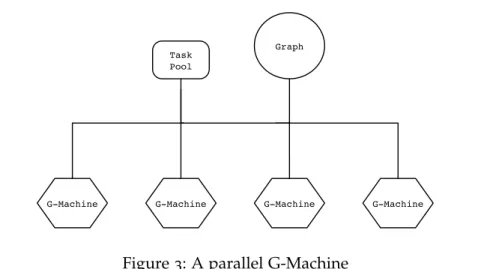
Figure3: A parallel G-Machine
somefocus on performance, and that will sometimes require compro-mises to accommodate hardware realities.
2.4 pa r a l l e l r e d u c t i o n m a c h i n e s
Having looked at theG-Machine as a sequential abstract machine we can now look at how graph reduction can occur on parallel architec-tures. The simplest parallel variant would be a parallelG-Machine. It turns out that once a sequential graph reduction has been accounted for there is not much to add in order to provide facilities for parallel evaluation. If one were to use a shared graph then almost all commu-nication could take place via that graph.
The spark pool4
is where idle processors can look for subgraphs that have been sparked off for evaluation. This simple-yet-functioning model is actually the basis for the implementation described in chap-ter 6 [Peyton Jones and Lester, 1992]. This model is not specific to the G-Machine, but can be used with any of the graph reduction machines, indeed GHC uses a similar model that is extended with thread-local heaps [Marlow et al., 2009]. A worker thread allocates from its local heap, when a thread’s heap has overflowed the garbage collector stops all running threads and moves local-heap data to the shared heap.
4 Asparkis a pointer to an expression that has thepotentialto be executed in parallel.
This allows the runtime system to ‘throttle’ the amount of parallelism in a program, when utilisation of the parallel machines is low, sparks are more likely to ‘catch’ than
2.4.1 hν,Gi-Machine
A departure from the stack-based approach of the G-Machine, here we have a packet-based abstract machine [Augustsson and Johnsson, 1989b;Harrison and Reeve,1987]. The packets (or frames as they are called in the original paper) are similar to the closures we have seen for the STG-Machine (although thehν,Gi-Machine was described and implemented first [Augustsson and Johnsson,1989b]). One difference is that on top of the code pointer and pointer to its arguments, each node contains a dynamic pointer that points to the caller of the ex-pression the packet represents. Each node also contains a block of free ‘working space’ in each packet (we will see why in a moment). The key difference is the way that the hν,Gi-Machine deals with its stack. As opposed to having a central stack, each packet has its own, using the free space allocated with the creation of the packet as its local stack. Therefore the stack for a task is always in the heap with the task itself [Augustsson and Johnsson,1989b]. This is in contrast to the standard G-Machine, where the stack resides ‘in’ the machine itself and the tasks use that stack until they are blocked, at which point the task’s stack is transferred to the heap until the task is awo-ken. Thehν,Gi-Machine avoids any complications of dealing with the stack by distributing the stack amongst the graph. The stack frame at any point in the graph is accessed through the linked list of packets pointing to their caller.
2.5 a p p r oa c h e s t o pa r a l l e l i s m
When looking at parallel programming, it is important to make the distinction between concurrency and parallelism. Concurrency em-bodies the idea of multiple workers (threads, computers, agents, etc.) making progress on independent tasks. A standard example for con-currency is a modern web-server. Each connection to the web-server can be thought of as an independent sub-task of the program. The web-server does not have to be run on a multi-core machine for the concurrency to take place. A single-core machine is capable of run-ning concurrent threads through scheduling and context switching.
Parallelism describes the simultaneous execution of tasks with the purpose of achieving a gain in performance. Tasks that can be easily divided into independent sub-tasks can easily be made into parallel algorithms. For example, if one wanted to compute the monthly
av-erage temperature for a given year, each month could be computed independently. If enough of these independent computations happen simultaneously there can be a substantial improvement in the pro-gram’s wall-clock speed. Ideally, the increase in performance would scale at the same rate as the available parallel machinery (2x per-formance with two processors, 5x performance with 5 processors). Unfortunately, there are some unavoidable factors that prevent this ideal from being realised [Hughes, 1983; Hudak et al., 2007; Ham-mond, 1994]. The most basic fact preventing this ideal is that the executing machinery (whether virtual or physical) will necessarily in-troduce some overhead in the generation and management of paral-lel threads of execution [Peyton Jones and Lester,1992]. Beyond that, it is unusual for a program to be perfectly parallel except in trivial cases. Most parallel programs exhibit non-uniform parallelism and complex data dependencies. This results in programs where parallel threads vary greatly in their processing time and contain threads of execution that will depend on the results of other threads. This re-sults in threads having to wait for the result of another thread before commencing (known as blocking).
2.5.1 Haskell
Haskell is a lazy functional language benefiting from constant devel-opment since its inception in 19875 [Hudak et al.,2007; Jones, 2003]. Haskell as defined by the Haskell Report [Jones, 2003] does not fea-ture parallelism as part of the language. However, functional pro-gramming has a long history of parallel implementations and Haskell is no different in this regard. Even the early implementations of Haskell had facilities for parallel computation.
h a s k e l l pa r a l l e l i s m The Glasgow Haskell Compiler (GHC) has extensive parallelism and concurrency support; this is part of what makes the compiler a popular implementation [Hudak et al., 2007]. While our eventual goal is to have access to compilers that take advantage of the implicit parallelism in our programs, it is use-ful to understand the tools and libraries that enable programmers to useexplicitparallelism in their Haskell programs. Some of these
tech-5 1987was when the academic community decided that an ‘standard’ language was
needed to unify the study of lazy functional programming[Hudak et al.,2007],
niques are well-established and have decades of use and experience to draw from.
2.5.2 Explicit Parallelism withparandseq
The most popular Haskell compiler, GHC [Hudak et al., 2007], is able to compile and run parallel Haskell programs ‘out of the box’. This ability is limited to theshared memory processors, also known as symmetric multiprocessors (SMP), that are nearly ubiquitous with the rise of multi-core architectures in modern CPUs. The GHC project provides several ways to utilise parallel-capable machines.
The first method is through the parandseq6
combinators. The seq combinator has the following type.
seq:: α → β → β
An expression of the form seq a b first forces the evaluation of its first argument to WHNF7
and then returns its second argument. This allows a programmer to express sequential evaluation.
It is important to realise that GHC’s implementation of seq is not guaranteed to force the evaluation of its first argument beforeits sec-ond argument, though it does guarantees that seq ⊥ b results in ⊥. The compiler may find an optimisation that circumvents the sequenc-ing created by the combinator. In order to provide a combinator that doesprovide this guarantee GHC provides thepseq8
combinator. In the literature, the par combinator appears in one of two forms [Hudak et al., 2007; Hughes, 1983]. In order to differentiate between the two forms we will refer to the earlier version as theapplicativepar, or parApand the more recent (and more common) version asHaskell par.9
Haskell partakes the same form as seq and has the same type sig-nature. The combinator takes two arguments, sparks off the first for evaluation in parallel, and returns the second.
6 Whileseqwas introduced into Haskell for Haskell ’98[Jones,2003] it was used for
many years before that [Hudak et al.,2007]. One of the earliest descriptions was by
Hughes who introduced asynchcombinator that performed the same function in
1983[Hughes,1983].
7 For an expression to be in Weak Head Normal Form it must be evaluated such that
the outermost constructor is known, but not necessarily any further. To say that a function is in WHNF means that the function is partially applied.
8 The ‘p’ inpseqstands for parallel. The idea being that parallel programs are more
likely than sequential programs to require thatseqguarantees its behaviour.
9 The reason we will be referring to this as Haskell par is because most users will
par :: α → β → β par a b= b
The applicative parAp expresses a function application whose pa-rameter has been sparked off to be evaluated in parallel. Semantically, this means that the applicative par has the following form
parAp :: (α → β) → α → β parAp f x= f x
Interestingly, the version of par that an implementation chooses does not change the expressiveness. Each version of parcan actually be defined in terms of the other. Defining the applicative par in terms of Haskell par gives us
parAp f x = par x(f x)
In order to define Haskell par in terms of applicative par we must use theKcombinator
K x y = x
par x y= parAp(K y)x
The benefit ofparApis that you get the sharing of the parallel com-putation without needing to give a name to a subexpression. For example, the following use ofparApis very typical.
parAp f (g10)
This does as you would expect: evaluate g10 and share that with f. In order to achieve the same effect using Haskellparwe must give g10a name.
let
x = g10
in
par x(f x)
While language implementors may have strong preferences for one over the other, there are a few good arguments for the use of Haskell par. Haskellparis the simpler of the two versions, using it as an infix combinator makes it easy to spark an arbitrary number of expressions easily,a‘par‘b‘par‘c, and the use-case for applicativeparcan be easily expressed using Haskellpar, as shown above.
w r i t i n g a p r o g r a m w i t h p a r a n d s e q Now that we have our essential combinators we are able to define a parallel algorithm. One of the big sellers of functional programming is the wonderfully concisequicksortdefinition
quicksort :: (Ordα) ⇒ [α] → [α]
quicksort(x:xs) = lesser ++ x:greater
where
lesser = quicksort[y | y ← xs, y 6 x]
greater= quicksort[y | y ← xs, y > x]
quicksort = []
The obvious way to parallelise this algorithm is to ensure that each of the two recursive calls can be executed in parallel. This is a com-mon form of parallelism known as ‘divide and conquer’ [Hamcom-mond and Reb ´on Portillo,2000]. This can be done by changing the second line to
quicksort(x:xs) = greater‘par‘(lesser ++ x:greater)
The issue with the above is that while the left-hand side is sparked off in parallel, it will only be evaluated to WHNF if the spark catches. This will result in only the firstconsof the list. The rest of the list will only be evaluated if/whengreateris needed.10
This fails to exploit all of the parallelism we desire and highlights the sometimes conflicting nature of parallelism and laziness.
In order to help us attain the parallelism we are aiming for, we can introduce a function force that ensures that its parameters are evalu-ated fully. As found in the textbook “Real World Haskell” [O’Sullivan et al.,2009]
force :: [α] → ()
force list= force0list‘pseq‘() where
force0( :xs) = force0xs force0[] = ()
This function takes a list and enforces spine-strictness. As long as the list is not an infinite structure, the use of this function is safe. With this function in hand we could adapt our basic parallelquicksort into a better performing one.
An interesting point is that this definition of force can be much simpler:
10 Because of laziness it is possible that greater will never be needed. An example
force :: [α] → ()
force( :xs) = force xs force[] = ()
Because the function is fully saturated, the recursive call will con-tinue evaluating through the entirety of the list. This only goes to show that even experts sometimes misunderstand when combinators like seqandpseqare needed.
parQuicksort :: (Ordα) ⇒ [α] → [α]
parQuicksort(x:xs) = force greater‘par‘(force lesser‘pseq‘(lesser + +x:greater)) where
lesser = parQuicksort[y | y ← xs, y 6 x]
greater= parQuicksort[y | y ← xs, y > x]
parQuicksort = []
Notice that there were a few more changes than just calling force with the parallel spark. By also forcing the evaluation ofgreater and lesser before appending the two lists we ensure that bothgreater and lesser are constructed completely. While this version of a parallel quicksort does execute its recursive calls in parallel, it has come at a cost. First, the resulting list is no longer lazy. Using this function for determining the head of the resulting list would result in the en-tire list being computed. While the loss of laziness can sometimes be a worthwhile trade-off (particularly if the entire list will be required anyway) for an increase in speed, the second major cost is that this parallelquicksortdoes not result in a faster program!
Despite the added functions to ensure that laziness did not get in the way of our desired parallelism, the parallel sorting was actually slower than the sequential sort. Running a parallelquicksorton a two core machine, O’Sullivan found that this algorithm actually resulted in a23% decrease in performance [O’Sullivan et al.,2009]. The reason for the slowdown comes up often in the design of parallel algorithms: there is a minimum amount of work a thread must perform in order to make the expense of sparking off the thread worthwhile.11
This is-sue highlights what is known as granularity [Plasmeijer and Eekelen, 1993]. While the sparking of threads is relatively cheap in a system such as GHC, there is still a cost, and if the amount of work a thread performs is very little, the cost may not be worth it.
11 On modern multi-core machines there are additional factors that can affect whether
One way of tackling this issue is by introducing the notion ofdepth to the function. An additional parameter can be be added to the function that acts as a count for the depth.
parQuicksort(x:xs)depth = ifdepth 6 0
then
quicksort(x:xs) else
. . . hparQuicksortwith (depth-1)i In this version we check to see if the desired maximum depth has been reached and, if so, then the recursive call is to the standard sequential sorting algorithm. If the max depth is not reached then we use the body of the parQuicksort defined above, with the depth argument to each recursive call being(depth − 1). The desired maxi-mum depth is determined by the value given as the depth argument at the top-level call of the function. This method of controlling the granularity is a useful one and allows for easy experimentation on the maximum depth for the problem at hand. The downside is that it contributes yet another concern for the programmer to worry about.
Managing the granularity of a parallel program is one of the big-ger challenges facing parallel functional programming [Peyton Jones, 1989]. Whether decided by the programmer (with annotations) or by the compiler implicitly, the question of “is this task worth it?” will always come up when deciding what tasks should be sparked.
2.5.3 Explicit Parallelism with theParMonad
One of the main benefits of using par and seq is that they provide a simple interface for expressing parallel computation without the need to worry about concurrency issues such as task/thread creation and synchronisation. Task communication is via the same mecha-nism that allows for lazy evaluation [Peyton Jones, 1989]. However, laziness can be difficult to reason about and gaining the maximum benefit from parallelism can often require the forcing of values be-yond WHNF, much like what was done with theforcefunction in the previous section. This motivated another approach to deterministic parallelism: theParMonad [Marlow et al.,2011].
TheParMonad makes the following trade-off: for the cost of mak-ing the dependencies between computations explicit and prohibitmak-ing the use of shared lazy structures, users gain predictable performance
and the ability to reason about when evaluation takes place. The library provides an API for dataflow parallelism in Haskell.
Internally theParMonad is implemented using I-Structures [Arvind et al., 1989] in the form of IVars, which provide the mechanism for communication between tasks. IVarare mutable cells with write-once semantics. The disciplined use of I-Structures in the Par Monad is what ensures deterministic parallelism.
To illustrate the data-flow nature of theParMonad we can use its API to write a function that computes two calls tofib in parallel (this code is adapted fromMarlow[2013, pg.59]).
twoFib m n= runPar$do
i ← new j ← new
fork(put i(fib m))
fork(put j(fib n))
a ← get i b ← get j return(a, b)
TheParMonad provides us with an API that is quite explicit about the data-flow of the program. This allows the library to schedule the threads as appropriate. The function put takes an IVar and a value that can be forced and writes the value to the IVar. By being so explicit about the structure of the program the library allows for intuitive reasoning about the parallel performance.
2.5.4 Semi-Implicit Parallelism with Strategies
This section will look at Parallel Strategies to illustrate how a pro-grammer can write the algorithm they want (for the most part) and then use strategies to specify how that algorithm should be paral-lelised. Strategies become central to our technique and are mentioned throughout this thesis, as they are used as the method of introducing parallelism into a program.
Strategies came in two waves; the first wave was introduced by Trinder et al.[1998] in ”Algorithm+Strategy=Parallelism”. This in-carnation of strategies is simple to understand and easy to use effec-tively. The second wave was an adaptation of the idea that addressed an issue caused by the garbage collector, but the main idea remains the same [Marlow et al.,2010].
The type declaration for a Strategy is
typeStrategyα = α → ()
The key point to take away from this is that strategies do not, and can not, affect thevalueof the computation.
It is possible to define strategies that do not introduce parallelism, but instead ensure that evaluation is carried out to some degree. For example, the strategy for doing nothing
r0 :: Strategy a r0 = ()
And for evaluating the argument to WHNF rwhnf :: Strategyα
rwhnf x= x‘seq‘()
These strategies are not often used on their own, but are used in conjunction with other strategies to achieve a goal. For example, ap-plying a strategy to each element of a list can be expressed as
seqList :: Strategyα → Strategy[α]
seqList strat[] = ()
seqLIst strat(x:xs) = strat x‘seq‘(seqList strat xs)
parList :: Strategyα → Strategy[α]
parList strat[] = ()
parList strat(x:xs) = strat x‘par‘(parList strat xs)
Both of these functions are common strategies for working on lists. In the first case, seqListelements in the list are sequentially evaluated using stratInparListeach element is evaluated in parallel using strat this gives no guarantee of the evaluation order, only that the sparks will point to each element of the list.
In order to use a strategy, the function using was defined; taking an expression and a strategy, it bridges the gap between the specified algorithm and the desired strategy.
using :: α → Strategyα → α using x s= s x‘seq‘x
This allows us to defineparMapas
parMap :: Strategyβ → (α → β) → [α] → [β]
parMap strat f xs= map f xs‘using‘parList strat
With this we can evaluate all the elements of a list to whatever level the first argument specifies.
2.5.5 Semi-Implicit Parallelism with Skeletons
There are many cases where the structure of two programs are the same even though they are computing different results. As men-tioned above,quicksortshares a structure with many algorithms known as ‘divide and conquer’. Algorithmic skeletons allow for the re-use of structuralparallelism between programs [Hammond and Reb ´on Por-tillo,2000].
To a functional programmer, skeletons are higher-order functions that are passed the computation specific actions of a program and ensure that the actions are parallelised according to the pre-defined structural parallelism. Hammond and Reb ´on Portillo [2000] intro-duce skeletons for thedivide and conquer,farm(like a genericparMap), pipe, andreduce (like a generic parallel fold) patterns. The divide and conquer skeleton is defined as follows:
dc triv solve divide conq x
| triv x = solve x
| otherwise= conq(solveAll triv solve divide conq(divide x)) where
solveAll xs=
Collection.map(dc triv solve divide conq)xs‘using‘parColl all The process is rather simple, dc takes a predicate triv that deter-mines whether the input value,x, is trivial. If so, we use the function solvefor the trivial case. Whenxis not trivial we must split the prob-lem into smaller chunks using divide. With the problem divided, we use solveAll which recursively calls dc in parallel over all of the di-vided parts of the problem. The parallelism is introduced using a Strategy in solveAll. Lastly,conqis used to combine the results of the sub-problems.
There are two restrictions on the use ofdc. The first is that the result be a member of the classEvaluablewhich has three member functions, none, outer, and all. These functions correspond to strategies with various degrees of evaluation: none performs no evaluation of the value, outer evaluates to WHNF, and all evaluates to normal form. The second is that the container type must be a member ofCollwhich provides a uniform interface formaping over its elements.
Skeletons provide a powerful tool when working with problems that are known to be parallelisable. If a programmer can recognise which skeleton is appropriate for their problem domain they can
fo-cus on the aspects that are specific to their problem and let the skele-ton manage the parallelism [Hammond and Reb ´on Portillo,2000].
2.5.6 Semi-Implicit Parallelism via Rewriting
Some recent work has shown promising results with the use of rewrit-ing. The programmer uses pre-selected functions (which is what makes these techniques semi-implicit) and the compiler uses pre-defined rewrite rules to convert the high-level function to low level parallel code [Steuwer et al.,2015]. This technique frees the program-mer from concerning themselves with the low-level optimisation tech-niques, which in the case of GPU programming are often vendor spe-cific. The compiler writers provide different sets of rewrite rules for each of the provided high-level functions. The compiler then searches the space of rewrite rules, allowing it to tune the performance of each function to a specific GPU. Because this search is done offline, the programmer can freely use any of the provided parallel functions knowing that whatever GPU the program runs on, an efficient se-quence of rewrite rules is known to go from the high-level source to the target GPU.
This technique, like ours, can be seen as applying search-based techniques to the problem of knowing when parallelism can be ac-complished. The benefit of their method is that it is restricted to a finite set of pre-determined parallel functions.
Another rewriting approach uses aproof of the program in separa-tion logic, to automatically parallelise the program where it is safe, having the safety guaranteed by the provided proof [Hurlin, 2009]. The proof can be transformed as the program is transformed pro-viding assurance that the resulting program has the same semantic behaviour. This technique does save the programmer from having to manually parallelise the code, at the cost of requiring that the al-gorithm has a separation proof. In any instance where such a proof is required for any other reason, this technique can be seen as ‘free’. Otherwise the cost of proving separation could be limit the viability of this method.
2.5.7 Implicit Parallelism
While explicit parallelism has many advantages and can show great performance increases, many desire the ability to express a functional
program withouthaving to specify where parallelism can take place. This idea, that parallelism can be achieved without programmer in-tervention, is known as implicit parallelism. For non-strict languages it is not possible to parallelise all possible expressions because doing so may introduce non-termination that would not have occurred oth-erwise. Strictness Analysisis usually used to determine which expres-sions are neededand therefore safe to parallelise. Strictness analysis will be covered in far more detail in Chapter4, but we will provide a high-level overview here to provide some context.
Strictness Analysis for Implicit Parallelism
Laziness can work against our desire to exploit possible parallelism in functional programs. Because of this, researchers have discovered that using static analysis at compile time in order to discover strict portions of a program can yield promising results. This analysis has been namedstrictness analysis [Mycroft,1980;Loogen,1999; Pey-ton Jones, 1989]. A trivial example is that of the addition of two expressions, such as the fibonacci sequence.
nfib n
| n 6 0 = 0
| n ≡ 1 = 1
| otherwise= nfib(n−1) + nfib(n−2)
Because the (+) function is strict in both its arguments we know that both recursive calls to nfib will be required. This fact (that we know that the arguments to a function will be required by the func-tion) is what enables us to exploit the parallelism that is inherent in the program.
Parallelism obtained by strictness analysis has been deemed conser-vative parallelism [Peyton Jones, 1989]. This is due to the idea that sparking an expression that will definitely be required by the pro-gram is not seen as risky. However, keep in mind that while it is known as conservative parallelism it does not mean that there is any shortage of parallel tasks, it only refers to the fact that nospeculative parallelism will be undertaken. Throughout this thesis we will some-times refer to conservative parallelism as safe parallelism. This is to reinforce that the key is avoiding the introduction of non-termination where there was none in the original program.
One of the issues with standard strictness analysis when used for implicit parallelism is that it does not take into account thecontextin
which an expression takes place. Take the standard recursive defini-tion ofappend:
append[]ys = ys
append(x:xs)ys= x : append xs ys
In general the first argument is needed, but only to the outermost constructor. However, when append is used in certain contexts, like returning its result to a function that requires a finite list:
length(append xs ys)
hereappendactually requires both of its arguments to be finite. This notion of context has been dealt with in two main ways in the lit-erature: Evaluation Transformers and Projection-Based Strictness Anal-ysis. We will examine Evaluation Transformers in Chapter 5, and Projection-Based Strictness Analysis in Chapter 4. In short both of these techniques allow the compiler or runtime system to take advan-tage of the information that an expression’s context provides regard-ing how defined a value must be.
Many of the attempts at automatic parallelisation used the tech-nique pioneered byHogen et al.[1992], which uses strictness analysis to identify safe parallelism andevaluation transformers[Burn,1987] to good effect. The main setback of this popular approach is that there is no method for refining the initial placement of parallelism. Strict-ness analysis is not equipped to determine the benefit of evaluating an expression in parallel, only thesafety. We refer to this problem as thegranularity problemthroughout the thesis.
Feedback-Directed Implicit Parallelism
Harris and Singh [2007] proposed using iterative feedback in order to assist the compiler in determining which expressions are expensive enough to warrant evaluation in parallel. Their approach forgoes the use of strictness analysis to place parallelism into a program. Instead they utilise runtime profiling to measure the lifetime of thunks in the heap and the relationship between the thunks. They can then study dependency graph between thunks and determine which thunks are worthwhile for parallelism.
Because each thunk has a unique allocation site, they are able to provide an estimate for the ‘total work’ performed by an allocation site. They define this measure as t/a wheret is the amount of time
that at least one thunk from that allocation site is being evaluated, and ais the number of thunks allocated during that time. This pre-vents an allocation site from being deemed worthwhile because of a long lifetime but in reality it creates numerous thunks each requiring a small amount of work, flooding the runtime system with small-grained tasks [Harris and Singh,2007, Section3].
2.6 s u m m a r y o f t h e c h a p t e r
In this chapter we have provided an broad introduction to the field of parallel functional programming. The literature includes work on runtime systems, static analyses, and library design. Over time pro-gramming with par and seq directly has proven to be difficult, the level of abstraction is too high for reasoning about performance but too low to be able to generalise one program’s parallel implementa-tion to another.
Parallel Strategies solve this problem to some degree, allowing the algorithm to be separated from the parallelism permits programmers to reuse their intuitions about which Strategies may be worthwhile for different problem domains. Strategies still suffer from the fact that lazy programs can be difficult to reason about however, and often do not provide the speedups a programmer might expect.
The Par monad attacks the problem from the other direction. By giving programmers a clearer view of when evaluation is occurring, performance can be more easily predicted. This comes at the slight cost of requiring the program to be more explicit in some cases12
and that all structures be evaluated to normal form.
While much of the recent work in parallel functional programming has been in explicit or semi-implicit techniques there has been a re-cent resurgence in interest for fully implicit parallelism. The tech-nique inHarris and Singh[2007] produced promising results but suf-fered from difficulties scaling to larger programs. Our work seeks to benefit from the insight presented in loc. cit. that using runtime profiles can help solve the granularity problem, but instead of using iterative feedback to find parallelism, we use the feedback to prune the parallelism that has been introduced by strictness analysis.
12 The library does provide some high-level functions that allow the programmer to
use theParmonad without needing to write their code in the monad itself, but on
Our work can be seen as a combination of the most successful meth-ods to date: static analysis for the placement of parallelism [Hogen et al., 1992] and feedback iteration to improve the static placement [Harris and Singh,2007].
3
B I R D ’ S E Y E V I E W O F O U R T E C H N I Q U EI thought the “lazy functional languages are great for implicit par-allelism” thing died out some time ago
–Lippmeier[2005]
This chapter is meant to accomplish two important goals: to provide a common vocabulary for the rest of the thesis and to familiarise the reader with the ‘gist’ of our proposed technique. In regards to the first goal we will introduce the syntax of F-lite and define terms that will be used throughout the rest of the thesis. By offering an overview of our technique, the reader will also possess context for each of the later chapters.
That being said, this chapter can be skipped if the reader is com-fortable with functional languages and compilers.
Plan of the Chapter
The chapter begins by defining the syntax and semantics of F-lite and Folle in Section 3.1which are higher-order and first-order languages respectively. Section 3.2 presents a high-level view of our compiler and its organisation.
3.1 f-l i t e: a l a z y p u r e ly f u n c t i o na l c o r e l a n g ua g e The use of a small functional language as the internal representation of a compiler is a common technique in functional compilers [Plasmei-jer and Eekelen,1993;Peyton Jones and Lester,1992;Augustsson and Johnsson,1989a;Dijkstra et al.,2009]. By using a small core language as an internal representation, source language features are simply syntactic sugar that is translated to a simpler but no less expressive language. This provides compiler writers with a smaller surface area for analysis and transformation. This has been used to great effect
in the Glasgow Haskell Compiler (GHC) which uses a small core lan-guage similar to ours [Peyton Jones and Marlow,2002;Peyton Jones and Santos,1998].
3.1.1 Why be Lazy?
Functional languages vary widely in their syntax, features, and type systems, but almost all functional languages are either strict (eager) or non-strict (and usually lazy) in their evaluation model. It is important to understand the distinction between these two systems. Because functional languages can be seen as enriched lambda calculi, we can study different evaluation orders1
by demonstrating them on a simple lambda calculus. There are a few evaluation strategies that can be used with the lambda calculus:
1. Call-by-value 2. Normal-order
a) Call-by-name b) Call-by-need
Call-by-name and call-by-need are bothsubsetsof normal-order re-duction [Abramsky, 1990]. The differences between these strategies can be easily illustrated using the following function definitions:
sqr x = x∗x bot = ⊥
Now assume we want to evaluate the expressions sqr(2∗3) and bot(2∗3). We can manually reduce each of these expressions using each of the evaluation orders.
1 Many texts describe them asevaluation strategies. We use the term ‘order’ to avoid
confusion with parallel strategies, which are a different concept that play a central role in this thesis.
sqr(2∗3) =sqr 6 =let x = 6 in x∗x =6∗6 =36 bot(2∗3) =bot 6 =let x = 6 in⊥ =⊥
Figure4: Call-by-value reduction
c a l l-b y-va l u e Note that the argument to sqr and bot is evalu-ated beforewe enter the function’s body.
sqr(2∗3) =let x = (2∗3)in x∗x =let x = (2∗3)in(2∗3)∗x =let x = (2∗3)in 6∗x =6∗(2∗3) =6∗6 =36 bot(2∗3) =let x = 2∗3 in⊥ =⊥
Figure5: Call-by-name reduction
c a l l-b y-na m e Here reduction delays the evaluation of a func-tion’s argument until its use. However, the result of evaluating a value is not shared with other references to that value. This results in computing2∗3twice.
sqr(2∗3) = let x = 2∗3 in x∗x = let x = 6 in 6∗x = 6∗6 = 36 bot(2∗3) =let x = 2∗3 in⊥ =⊥
Figure6: Call-by-need reduction
c a l l-b y-n e e d This is designed to avoid the duplication of work that is often a result of call-by-name evaluation. Notice that in this evaluation(2∗3) is bound toxas before but the result of computing the value of x the first timeupdatesthe binding. This is why call-by-need is often referred to as call-by-namewith sharing, orlazy.
An important point is that for languages without arbitrary side-effects call-by-name and call-by-need are semantically equivalent. Call-by-need is an optimisation for theimplementationof reduction.
sqr(2∗3) = let x = 2∗3 in x∗x = let x = 2∗3 in 6∗x = let x = 2∗3 in 6∗6 = 36 bot(2∗3) =⊥
Figure7: Normal order reduction
n o r m a l o r d e r This method of evaluation is the only method that obeys the semantic property that λ → ⊥ ≡ ⊥. This is because normal order reduction will evaluate under a lambda [Abramsky, 1990].