
DATA MIGRATION FROM STANDARD SQL TO NoSQL
A Thesis Submitted to the College of Graduate Studies and Research In Partial Fulfillment of the Requirements
For the Degree of Master of Science In the Department of Computer Science
University of Saskatchewan Saskatoon
By
MUHAMMAD MUGHEES
i Permission to Use
In presenting this thesis in partial fulfilment of the requirements for a Postgraduate degree from the University of Saskatchewan, I agree that the Libraries of this University may make it freely available for inspection. I further agree that permission for copying of this thesis in any manner, in whole or in part, for scholarly purposes may be granted by the professor or professors who supervised my thesis work or, in their absence, by the Head of the Department or the Dean of the College in which my thesis work was done. It is understood that any copying or publication or use of this thesis or parts thereof for financial gain shall not be allowed without my written permission. It is also understood that due recognition shall be given to me and to the University of Saskatchewan in any scholarly use which may be made of any material in my thesis.
Requests for permission to copy or to make other use of material in this thesis in whole or part should be addressed to:
Head of the Department of Computer Science 176 Thorvaldson Building
110 Science Place
University of Saskatchewan
Saskatoon, Saskatchewan (S7N 5C9) Canada
ii ABSTRACT
Currently two major database management systems are in use for dealing with data, the Relational Database Management System (RDBMS) also knows as standard SQL databases and the NoSQL databases. The RDBMS databases deal with structured data and the NoSQL databases with unstructured or semi-structured data. The RDBMS databases have been popular for many years but the NoSQL type is gaining popularity with the introduction of the internet and social media. Data flow from SQL to NoSQL or vice versa is very much possible in the near future due to the growing popularity of the NoSQL databases.
The goal of this thesis is to analyze the data structures of the RDBMS and the NoSQL databases and to suggest a Graphical User Interface (GUI) tool that migrates the data from SQL to NoSQL databases. The relational databases have been in use and have dominated the industry for many years. In contrast, the NoSQL databases were introduced with the increased usage of the internet, social media, and cloud computing. The traditional relational databases guarantee data integrity whereas high availability and scalability are the main advantages of the NoSQL databases. This thesis presents a comparison of these two technologies. It compares the data structure and data storing techniques of the two technologies. The SQL databases store data differently as compared to the NoSQL databases due to their specific demands. The data stored in the relational databases is highly structured and normalized in most environments whereas the data in the NoSQL databases are mostly unstructured. This difference of the data structure helps in meeting the specific demands of these two systems. The NoSQL DBs are scalable with high availability due to the simpler data model but does not guarantee data consistency at all times. On the other hand the RDBMS systems are not easily scalable and available at the same time due to the complex data model but guarantees data consistency. This thesis uses CouchDB and MySQL to represent the NoSQL and standard SQL databases respectively. The aim of the
iii
research in this document is to suggest a methodology for data migration from the RDBMS databases to the document-based NoSQL databases.
Data migration between the RDBMS and the NoSQL systems is anticipated because both systems are currently in use by many industry leaders. This thesis presents a Graphical User Interface as a starting point that enables the data migration from the RDBMS to the NoSQL databases. MySQL and CouchDB are used as the test databases for the relational and NoSQL systems respectively. This thesis presents an architecture and methodology to achieve this objective.
iv
ACKNOWLEDGMENTS
I would like to take this opportunity to thank my supervisor, Dr. Ralph Deters whose encouragement, continuous guidance and deep knowledge about the thesis topic kept me motivated and focused during the research. I would also like to thank Dr. Julita Vassileva who helped me with the initial idea and provided valuable information about the system I have developed for this research topic. My wife was instrumental in supporting me and it would have not been possible without her help and support.
v TABLE OF CONTENTS page ABSTRACT ... ii LIST OF TABLES ... ix LIST OF FIGURES ...x
LIST OF ABBREVIATIONS ... xiii
INTRODUCTION ...1
1.1 Rationale for data migration ...1
1.2 Overview ...3
1.2.1 Key-Value Stores ...4
1.2.2 Wide Column Store / Column Families ...5
1.2.3 Document Stores: ...5
1.2.4 Graph Models: ...6
PROBLEM DEFINITION ...8
2.1 Introduction to Data Migration from Relational SQL to NoSQL databases ...8
2.2 Description ...9
2.3 Research Goal ...11
2.3.1 Goal one: Migration ...11
2.3.2. Goal two: Identical Functionalities ...11
2.3.3 Goal three: Performance ...12
2.3.4 Goal four: Code Comparison ...12
LITERATURE REVIEW ...13
3.1 Relational Models ...14
3.1.1 Primary Key Concept ...17
3.1.2 Foreign Key ...17
3.1.3 Normalization in the relational model ...18
3.1.3.1 First Normal Form (1NF) ...18
3.1.3.2 Second Normal Form (2NF)...19
3.1.3.3 Third Normal Form (3NF) ...19
3.1.4 Process of Normalization ...19
3.1.5 Data integrity and reliability ...20
3.1.5.1 Atomicity ...21
vi
3.1.5.3 Isolation ...21
3.1.5.4 Durability ...21
3.2 Structured Query Language (SQL) ...23
3.3 NoSQL databases ...27 3.3.1 Key-Value Stores ...30 3.3.2 Columnar Databases: ...32 3.3.2.1 Column ...32 3.3.2.2 SuperColumn ...33 3.3.2.3 Column Family ...33 3.3.3 Document Store (DS) ...36 3.3.4 Graph Model: ...39 3.3.5 MapReduce ...42 3.3.6 CAP Theorem ...44 3.4 Data Migration ...47
3.4.1 Choosing a NoSQL database for the Conference System ...50
3.5 Conclusion ...55
DATA MIGRATION ARCHITECTURE ...57
4.1 Types and scenarios in relational database ...58
4.1.1 Table with primary key ...58
4.1.1.1 Single Column primary key ...58
4.1.1.2 Composite primary key ...59
4.1.2 Tables with a single foreign key ...59
4.1.3 Tables with multiple foreign keys ...60
4.1.4 One-to-one relationship ...61
4.1.5 One-to-many relationship ...61
4.1.6 Many-to-many relationship ...62
4.2 Migrating from relational MySQL to NoSQL CouchDB ...62
TEST BED: CONFERENCE SYSTEM ...66
5.1 Introduction to the Conference System (CS) ...66
5.1.1 System requirements and workflow...67
5.2 RDBMS Conference System Data Model ...68
5.3 CocuhDB Data Model for Conference System ...70
5.3.1 Views ...72
5.3.1.1 Permanent Views ...73
5.3.1.2 Temporary Views ...73
IMPLEMENTATION ...74
6.1 Data Migration Steps ...75
EVALUATION...86
7.1 Evaluation Goals ...86
vii
7.1.2 Can the same operation be performed in both systems and achieve the same result? .87
7.1.3 What is the speed difference for performing the same operation in both systems? ....87
7.1.4 How complex is the code for the same operation in both systems? ...87
7.2 Experiment Goals ...88
7.2.1 Has the data migrated successfully to CouchDB? ...88
7.2.1.1 Data migration from single table in multiple CouchDB documents ...88
7.2.1.2 Data migration from multiple tables in multiple CouchDB documents ...90
7.2.2 Can the same operation be performed in both systems and achieve the same result? .90 7.2.3 What is the speed difference for same operation performed on both systems? ...91
7.2.4 How complex is the code for the same operation in both systems? ...91
RESULTS ...92
8.1 Has the data migrated successfully? ...92
8.1.1 Data population and extraction in MySQL ...92
8.1.2 Data migration into the CouchDB ...93
8.1.2.1 Data migration from single MySQL table into CouchDB documents ...93
8.1.2.2 Data migration from multiple MySQL tables into the CouchDB documents ...96
8.2 Can the same operation be performed in both systems and achieve the same results? ...98
8.2.1 Verify data after SELECT operation ...98
8.2.2 Verify data after the UPDATE operation ...100
8.2.3 Verify data after DELETE operation ...102
8.3 Compare the speed of various operations ...103
8.3.1 SELECT operation time comparison ...104
8.3.2 INSERT operation time comparison ...106
8.3.3 UPDATE operation time comparison ...108
8.3.4 DELETE operation time comparison ...111
8.4 Determine the code complexity ...114
CONCLUSION AND FUTURE WORK ...119
9.1 Conclusion ...119
9.2 Future Work ...124
LIST OF REFERENCES ...128
DATA MODEL OF CONFERENCE SYSTEM ...133
A1. Users...133 A2. Conferences ...133 A3. Documents ...133 A4. Doc_author ...133 A5. Reviewed_documents ...133 A6. Review_status ...133 A7. Reviewed_doc_hierarchy ...134 A8. Assign_doc ...134 A9. Assignments ...134
viii A10. Comments ...134 A11. Roles...134 A12. User_role ...134 A13. Survey ...134 A14. Evaluation_by_author ...135 A15. Assignment_doc ...135 A16. Grades ...135
ix
LIST OF TABLES
Table page
Table 3 - 1: Relational Model terminologies and explanation ...16
Table 3 - 2: NoSQL distinguishing properties ... 30
Table 3 - 3: Characteristics of various NoSQL databases ... 52
Table 6 - 1: A record in MySQL ... 81
Table 8 - 1: SELECT operation times comparison in tabular form ... 104
Table 8 - 2: INSERT operation times comparison in tabular form ... 107
Table 8 - 3: UPDATE operation times comparison in tabular form ... 109
Table 8 - 4: DELETE operation times comparison in tabular form ... 111
x
LIST OF FIGURES
Figure page
Figure 2 - 1: Data storage in RDBMS ... 9
Figure 2 - 2: Data storage in NoSQL ... 10
Figure 2 - 3: How data migrate from RDBMS to NoSQL... 11
Figure 3 - 1: Illustrates Data Model Structure ... 15
Figure 3 - 2: An illustration of Foreign Key ... 17
Figure 3 - 3: Possible process flow of normalization ... 20
Figure 3 - 4: Key-Value document structure in CouchDB ... 31
Figure 3 - 5: Columnar database storage structure ... 36
Figure 3 - 6: Same data representation stored in RDBMS and columnar structure ... 36
Figure 3 - 7: Documents stored document store ... 38
Figure 3 - 8: Document structure in JSON format ... 38
Figure 3 - 9: Graph and basic components ... 40
Figure 3 - 10: Graph traversing ... 41
Figure 3 - 11: Usage of index in Graph database ... 42
Figure 3 - 12: An overview of MapReduce process ... 44
Figure 3 - 13: An illustration of CAP theorem and NoSQL DBs compliance ... 47
Figure 3 - 14: MVCC locking mechanism in CouchDB ... 54
Figure 4 - 1: A table with single column primary key ... 59
Figure 4 - 2: Relational table with composite primary key ... 59
xi
Figure 4 - 4: Table with multiple foreign keys ... 61
Figure 4 - 5: Data Migration Architecture ... 64
Figure 5a - 1: Conference System Data Model (part 1) ... 69
Figure 5b - 1: Conference System Data Model (part 2) ... 70
Figure 5 - 1: Simplest form of key-value pair ... 71
Figure 5 - 2: Object as complex component of key-value structure ... 72
Figure 5 - 3: An array as complex component of key-value structure ... 72
Figure 6 - 1: High level implementation architecture ... 75
Figure 6 - 2: PHP code with embedded structure of the CouchDB document ... 76
Figure 6 - 3: Mapping RDBMS table with CouchDB document ... 79
Figure 6 - 4: Structure of a CouchDB document ... 80
Figure 6 - 5: MySQL record as CouchDB document after data migration ... 82
Figure 6 - 6: Structure of USERS table in MySQL ... 83
Figure 6 - 7: Structure of DOCUMENTS table in MySQL ... 83
Figure 6 - 8: Structure of REVIEWED_DOCUMENTS table in MySQL ... 83
Figure 6 - 9: Structure of REVIEW_STATUS table in MySQL ... 84
Figure 6 - 10: Mapping multiple table fields in CouchDB document ... 85
Figure 7 - 1: Data Migration Process flow ... 89
Figure 8 - 1: Data migration tool ... 94
Figure 8 - 2: CS form showing data from single MySQL table ... 94
Figure 8 - 3: Migrated data from USERS table inside CouchDB documents ... 95
Figure 8 - 4: Documents assigned to reviewers in MySQL ... 96
Figure 8 - 5: Documents assigned to reviewers in CouchDB ... 97
Figure 8 - 6: Documents and author information in MySQL ... 99
xii
Figure 8 - 8: CouchDB Users’ information ... 101
Figure 8 - 9: CouchDB record after update operation ... 102
Figure 8 - 10: Users’ information in CouchDB after the DELETE operation ... 103
Figure 8 - 11: SELECT operation time comparison ... 106
Figure 8 - 12: INSERT operation time comparison ... 108
Figure 8 - 13: UPDATE operation time comparison ... 110
Figure 8 - 14: DELETE operation time comparison ... 113
xiii
LIST OF ABBREVIATIONS
ACID Atomicity, Consistency, Isolation, Durability
API Application Programming Interface
BASE Basically Available, Soft state, Eventually consistent CAP Consistency, Availability, and Partition tolerance
CC Cloud Computing
CDB CouchDB
DB Database
DBMS Database Management System
DM Data Migration
DMT Data Migration Tool
DC Distributed Computing
DS Data Store
GUI Graphical User Interface
IT Information Technology
JSON Java Script Object Notation
NoSQL Not Only SQL
RDBMS Relational Database Management System
REST Representational State Transfer
SQL Structured Query Language
1 CHAPTER 1 INTRODUCTION
1.1 Rationale for data migration
The introduction of the internet, social web sites, and cloud computing has challenged the supremacy of the relational databases as the ultimate choice of database management system. Factors such as cost, volume of data, variety of data and the pace at which the data is being created and consumed play an important role in deciding how and where the data should be stored and managed.
Features like high availability, scalability, and replication are all available in the traditional relational databases but they usually come with a high cost. The main factors for the popularity of the NoSQL databases include cheap hardware, easy scalability, and high availability.
Most of the data that comes from social web sites, clouds, and mobile phones is unstructured with varying nature. The data created and consumed using these resources is also huge in volume and requires regular scalability with high availability. These tasks can still be achieved with the traditional RDBMS databases but at a high cost which makes the NoSQL databases the database of choice as they are cheaper comparatively.
The general impression is that only big social web sites like Facebook, Twitter, Google, and Foursquare are concerned due to their specific requirements but that is not totally true. The Web sites already using the RDBMS for storing and managing the data will start to feel the heat when the number of users and data will starts growing beyond expectations and thus makes it hard to keep up with the data requirement. The key factors for the popularity of NoSQL as compared to the RDBMS systems are as follows:
Low cost
2 Easily Scalable
Highly available
The NoSQL approach takes advantage of all the above mentioned factors at the cost of data consistency. Due to compliance to the Atomicity, Consistency, Isolation, Durability (ACID) principles, the RDBMS systems guarantee data integrity and consistency at all times but they are not easily scalable. NoSQL systems compromise data consistency to achieve better performance, scalability and high availability. For applications where data consistency is not important the RDBMS systems does not necessarily remain a good choice. “Relational database technology has served us well for 40 years, and will likely continue to do so for the foreseeable future to support transactions requiring ACID guarantees. But a large, and increasingly dominant, class of software systems and data do not need those guarantees,” [49]. Thus organizations running databases currently on the RDBMS systems may feel a need to migrate from RDBMS to NoSQL databases when data grows beyond the capacity of one server and costly vertical scaling is required. The same situation is expected with a distributed RDBMS system with growing data issues.
Considering the factors discussed above it is safe to assume that there will be future data migration requirements from the relational to the NoSQL databases. Foreseeing this future requirement, this thesis focuses on data migration approach from the RDBMS to the NoSQL databases.
3 1.2 Overview
Over the years the relational database management systems (RDBMS) have been the leading technology in the IT world. The RDBMS has dominated the industry since its inception when E. F. Codd introduced it in 1970 [15]. Several different approaches have been in practice besides the relational concept. The hierarchical and the network data models were introduced in 1960 and implemented by “Integrated Data Store of Honeywell (network model) and Information Management System (IMS) by IBM (Hierarchical Model)” [48]. Being dominant the RDBMS systems embraced and merged other prevailing ideas. The object-based data model was merged with the RDBMS to form the object-relational model.
This approach of using the relational systems in all scenarios came under scrutiny with the introduction of the web. The relational data model works well with the traditional applications where the data is not massive and distributed. Despite being on top for several years the capability of the RDBMS for processing and handling large amount of data remains in question. However, handling and processing huge amounts of data is almost mandatory for big organizations such as Google, Amazon, Twitter, LinkedIn and Facebook. In short, the RDBMS systems are not the suitable candidate for processing the large amounts of data where the data is distributed over a network in a cluster of servers or over a grid in different geographical locations. A new approach under the flag of the NoSQL database was introduced to mitigate some of the problems not handled elegantly by the RDMBS. In 1998 Carl Strozzi first time used the term NoSQL for his open source relational database "Strozzi NoSql" that did not use the Structured Query Language (SQL) to access and manipulate the data [51]. Instead they used Application Programming Interface (API) with various plugins and libraries or RESTFul API with Hypertext Transfer Protocol (HTTP) protocol. This is the reason why they are called “NoSQL” databases.
4
NoSQL is a database management system that is entirely different from the RDBMS in many ways. The primary reason for using the NoSQL DBs is their flexibility, scalability, speed, and high availability. For these reasons NoSQL is making its space in the industry, however, it is still not mature enough and lacks ‘standards’. “For any of the new databases, you may have Pig, Hive, SPARQL, Mongo Query Language, Cypher, or others. These languages have little in common.” [37]. The NoSQL system meets the requirements of the corporations who deal with terabytes of data. The data is mostly stored in a distributed environment and does not need schemas or join operations to retrieve data. There is no concept of primary or foreign keys in NoSQL since the data is not stored in tables and is not relational. The data in the NoSQL CouchDB is stored in the form of documents. Each document is similar to a row in a table and the group of documents represents a logical table. It takes the advantage of horizontal scaling to improve performance by adding new machines in the system and distributing the additional load equally.
Since the introduction of the NoSQL idea, numerous databases have been designed depending on the requirements of these systems. These databases have been categorized into different groups. The next section discusses and compares the current NoSQL designs in use by the Information Technology (IT) industry.
The category of the NoSQL DBs depends on how the data is stored. Currently the NoSQL DB is categorized in four major categories [52] as follows:
1.2.1 Key-Value Stores
Key-Value Stores allow applications to store data in a schema-free environment such as a hash table. Hash tables contain a value for a particular key. The data consists of a key as a string and real data which forms the value part in the pair. The data type of stored data depends on the
5
programming language and it can be any data type supported by the language. Examples of data types are string, integer, array or object. The data stored in such fashion alleviates the need of a fixed data model and structured data. Amazon was the first to implement the key value structure to resolve their data availability and scalability issues using the Dynamo storage system [23]. Key-Value Stores are useful in environments with distributed hash tables and caching which Dynamo has implemented to improve high read performance and "consistent hashing to partition its key space across its replicas and to ensure uniform load distribution" [23].
1.2.2 Wide Column Store / Column Families
A Wide Column Store also uses a key-value pair but the key is two dimensional. In this type of structure a column key and a row key is required to access a stored value. A timestamp can also be added as part of the key as practiced in Google's Big Table [13]. This type of model is suitable for huge amounts of data in distributed environment as implemented by Google’s Big table. Facebook's messenger services also use Hbase to support billions of messages per day [5].
1.2.3 Document Stores:
As the name suggests Document Stores consists of documents. This model is very useful for horizontal scalability which allows the addition of cheap commodity servers or resources from the cloud as the database grows. Document Stores are similar to the Key-Value Stores and takes advantage of hashed tables. The key-value pair is stored in distributed hash tables (DHT) in hash buckets. An index is created on the key-value pairs in these buckets for search purposes. The hash value is a unique number generated from the data. The algorithm for creating hash values distributes the key-value pairs evenly among hash buckets [50]. This means that if the DHT have 4 hash buckets and 20 key-value pairs then each hash bucket will have 5 key-value pairs.
6
This model makes the parallelization very easy with the addition of more hash buckets when more servers are added due to data growth.
The Document Stores are useful for web-based applications with data distributed in a network or over a grid.
1.2.4 Graph Models:
Graph DBs consist of nodes, relationships among nodes and their properties. Graph models are more easily scalable over many servers than SQL DBs. The main feature of a graph database is its improved ability to handle relationships compared to a relational model. The Graph DB traverses through huge numbers of edges in a fraction of the time of a relational join due to direct links between nodes [30]. The graph DBs uses the concept of vertex (node), edge (relationship) and property. Graph DBs stores data with nodes and edges using a graph algorithm. This model is useful where the data model is recursive. An example of these attributes is as follows:
Node: Employee
Property: first name, last name, designation and department Relationship: Employee part of a department
The Graph databases are useful for social networking web sites such as Twitter that uses FlockDB to store the graph data about relationships between users, information about who’s following whom and more [35].
Due to the increased popularity of the NoSQL DBs and the existing wide usage of the RDBMS, the possibility of future data migration between them is highly likely. The task of data migration is difficult due to the entirely different data model. Information in the relational databases is structured and stored in tables while the information in the NoSQL DBs is either unstructured or semi-structured. However, data migration between the relational and the NosQL
7
DBs is possible. This thesis proposes a methodology for the data migration from MySQL to CouchDB that allows us to move the same data from MySQL into CouchDB. The data is not changed after migration. CouchDB stores and displays information in document form.
The key contributions of this paper are:
• Introducing data migration architecture between the RDBMS and the NoSQL database. • Developing a DMT (data migration tool).
• Proposing a data migration methodology
The advantages of this tool are multipurpose. It simplifies and automates the process of data migration. At the same time it opens new doors for future development and improvement of this approach.
The rest of the thesis is organized as follows: The next chapter defines the problem of data migration from relational to NoSQL systems followed by a literature review of related work. Chapter 4 presents the architecture and methodology proposed for data migration from the relational MySQL DB to the NoSQL CouchDB. Chapter 5 introduces the conference system developed and used for this research and the reason why it was selected as the prototype. Chapter 6 presents implementation details of this research and Chapter 7 evaluates the thesis research. The experiment and results are covered in Chapter 8 and finally Chapter 9 summarizes the conclusion and future works.
8 CHAPTER 2 PROBLEM DEFINITION
2.1 Introduction to Data Migration from Relational SQL to NoSQL databases
Relational and NoSql DBs use two entirely different technologies. One of the main differences is the data model of the two systems. The relational databases keep information in tables and join them with the help of primary and foreign keys. They are usually highly normalized and owned by a schema. The NoSQL DB on the other hand, stores information differently e.g. the graph database stores data in graph structures whereas the CouchDB stores data in documents. The stored information in the NoSQL DBs is schema free and highly denormalized. Due to the contradictory nature of the two systems it is a challenge to migrate data from the relational to the NoSQL DBs or vice versa.
There are several relational and NoSQL DBs currently in use. This thesis focuses migrating from the MySQL DB to the NoSQL CouchDB document based database. The rationale for choosing MySQL is that it meets all the requirements of the modern relational databases and easy to manage.
The four main categories of the NoSQL DBs consist of Key-Value, Column Family, Document Databases and Graph DBs. The CouchDB is a document oriented database management system that stores data in uniquely named documents. The document is stored as a Java Script Object Notation (JSON) object with key-value pair and supports semi-structured data that offers some advantage towards the data migration problem. The key-value approach in the CouchDB documents allows for building a database out of the same components that a relational database has internally. This approach allows more control and flexibility over database design.
9
This also means that in the document-oriented DBs no schema update is required when the data management requirement changes.
2.2 Description
The way the RDBMS stores data is very different from how it is stored in the NoSQL DBs due to the specific demands. The data stored in relational databases is highly structured and normalized in most environments whereas the data in NoSQL is mostly unstructured. This difference of data structure helps meet the specific demands of these two systems. The NoSQL DBs are scalable with high availability due to the simpler data model but do not guarantee data consistency at all times. On the other hand the relational SQL systems are not easily scalable with high availability due to the complex data model but guarantees data consistency.
The information in the RDBMS is stored in tables and the tables are interconnected with each other through Primary Key (PK) and Foreign Key (FK). This interconnection is facilitated by the SQL using various types of joins. Figure 2-1 below presents a top level view of how tables are stored in the RDBMS.
10
As mentioned earlier the data is stored in the form of the JSON documents inside the NoSQL CouchDB. Figure 2-2 below presents how the data is stored in CouchDB in documents.
Figure 2 - 2: Data storage in NoSQL
The problem of data migration from the RDBMS to the NoSQL DBs becomes more complex due to entirely different data models and data storage techniques of these two systems. The migrated data in the NoSQL DBs should be able to handle the same operations performed in the RDBMS with the same results. This problem of data migration is exemplified in figure 2-3 below.
11
Figure 2 - 3: How data migrate from RDBMS to NoSQL
The problem of data migration is not trivial due to the complexity of data storage structures. It requires migrating data from the relational tables to the NoSQL documents. The challenge is how to handle RDBMS normalization and convert the structure to highly de-normalized and semi-structured or un-structured NoSQL.
2.3 Research Goal 2.3.1 Goal one: Migration
G1: The main goal is to provide a mechanism and to develop a tool to migrate data from a relational MySQL database to a NoSQL CouchDB using a common language such as PHP.
2.3.2. Goal two: Identical Functionalities
G2: The second goal is to ensure that identical operations can be performed against both databases and get identical results.
12 2.3.3 Goal three: Performance
G3: The third goal is to compare the performance of various operations performed in identical conditions in the two systems.
2.3.4 Goal four: Code Comparison
G4: The fourth goal of this research is to determine the complexity of the code written for performing the same operations in RDBMS and NoSQL databases.
13 CHAPTER 3 LITERATURE REVIEW
Knowledge of the internal structures of the RDBMS and NoSQL systems is very important to achieve the goal G1 of this thesis. Internal structure refers to the techniques for how the data is stored in a database. The information about the structure of the database, database objects and the data model form the foundation for understanding data flow in a system. The RDBMS systems revolve around the relational model presented by E.F.Codd [15]. The literature review introduces us with the various concepts presented over the years by E.F.Codd and others. The concepts of normalization [15] and ACID properties plays the role of backbone in RDBMS systems. These concepts are used to develop the basic strategy of data migration from RDBMS to other systems.
The NoSQL databases have different advantages based on their data model structure. There are various types of NoSQL databases and each one of them stores data differently. This thesis focuses on migrating data to the NoSQL CouchDB database. The CouchDB stores information in JSON documents [42]. Information about data storage in the NoSQL databases in general and the CouchDB in particular is necessary to devise a firm strategy to achieve the goal G1. The literature review in the following sections helps us to get as much information as possible to contribute towards the goal G1.
The literature review also looks into the possibilities of finding related information for performance comparison for the same operations to meet the goal G3 mentioned earlier. Similarly it also tries to find related work to meet the goal G4 for code complexity.
This research aims at comparing traditional relational databases with NoSQL DBs. The research also focuses on providing a solution to migrate data from RDBMS to NoSQL DBs. This chapter discusses the relational and NoSQL models to give a better understanding of the
14
differences in both approaches and thus enabling a better comparison and suggesting a migration method.
3.1 Relational Models
Storing and accessing data has always been challenging. It is essential to organize stored information in such a manner that makes the task of managing and accessing data easy. The future performance of a system heavily depends on how the system was initially designed. Organization and modeling of data plays an important role in how easy or difficult it is to manage the data.
In the late 1960s the Hierarchical data model was used to store information in the form of tree structures. A brief discussion about this model is available in [21, 65]. IBM's Information Management System (IMS) is an example of hierarchic system [21]. The Network data model was another model used along with hierarchical model.
In 1970 E.F. Codd presented the idea of the relational model [15]. The relational model stressed the idea of organizing data in the form of two-dimensional tables called "relations". A relation consists of domain set know as attributes or column having tuples with data for each domain. In the other words a relation is a ‘set’ of rows or tuples. The idea of presenting the relational model was multipurpose. The relational model was designed to address the following issues as discussed in [15]:
1. Hide from users how data is organized in a machine
2. Protect users activities and applications programs from internal data changes and growing data types
15
The relational model was aimed at storing information in databases using relations (tables). This means software that allows storing, accessing, and modifying information stored in a computer system (Server). However, this model is used by other types of software too such as the symbol table which is a data structure used by a compiler or interpreter [62].
An analysis of the relational model reveals that there are certain components of a relational model. They are identified as relation, entity, domain, attribute, tuple, and attribute value. These integrated components define the data structure in a relational model.
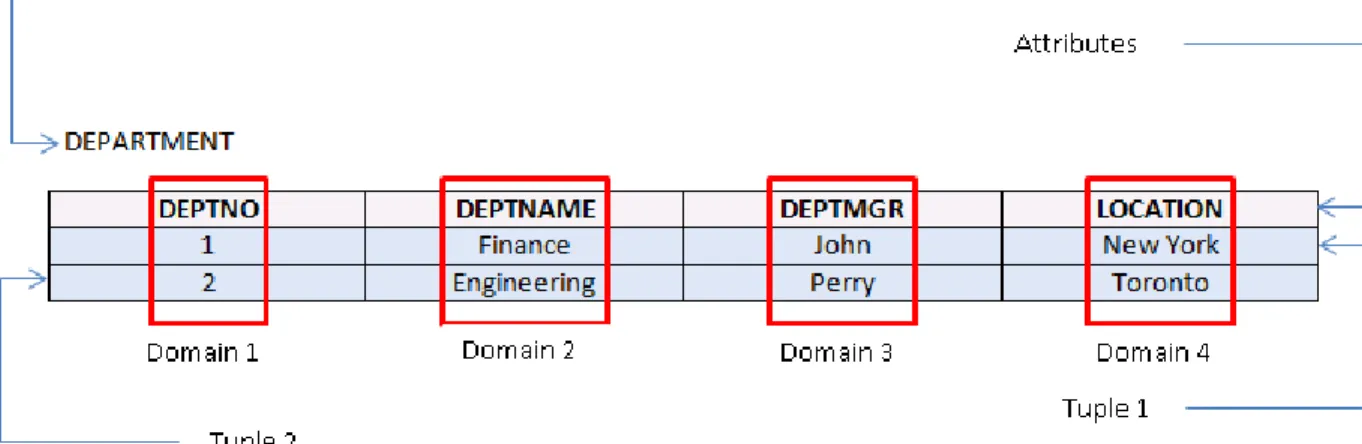
Figure 3-1 helps in understanding the relational model and its components.
Figure 3 - 1: Illustrates Data Model Structure
The domain in the relational model refers to a set of all allowable values for a specific attribute of a particular type. The table below explains relational model terminologies in addition to the domain.
16
Relational Model Terminology Explanation
Relation Table in a database
Domain Type of column in a table
Attribute Column of a table
Attribute value Column value
Tuple Row of a table
Entity Name of a table
Degree Number of columns in a table
Cardinality Number of rows in a table
Table 3 - 1: Relational Model terminologies and explanation
Using the definitions as explained in Table 3-1 the degree of relation in Figure 3-1 above is 4 and the cardinality is 2.
E. F. Codd also specified the properties of the relation when the relational model idea was presented. The properties as specified in [15, 16] can be explained as follows:
1. Each row in a relation (table) represents a tuple. 2. Order of rows is not important.
3. No duplicate rows are part of a relation i.e. all rows are distinct. 4. The order of columns (attribute) is not important [16].
5. All table values are atomic i.e. “nondecomposable by the database management system)” [16].
17
In 1985, E. F. Codd published a list of 12 rules that concisely defines a truly relational database management system [54].
3.1.1 Primary Key Concept
The relational model states that duplicate rows are not allowed in a table to avoid ambiguity [16]. Primary Key (PK) may be defined as a column with unique values that uniquely identifies each record in a table. A primary key consists of a single column or a combination of multiple columns. The Primary key ensures that there is no redundant data. An example of PK is the ‘DEPTNO’ attribute of the ‘DEPT’ table in Figure 3.1.
3.1.2 Foreign Key
It is common in a relational database that a relation is required to reference its own values or values in another relation. “A foreign key value represents a reference to the tuple containing the matching candidate key value (the referenced tuple)” [21].
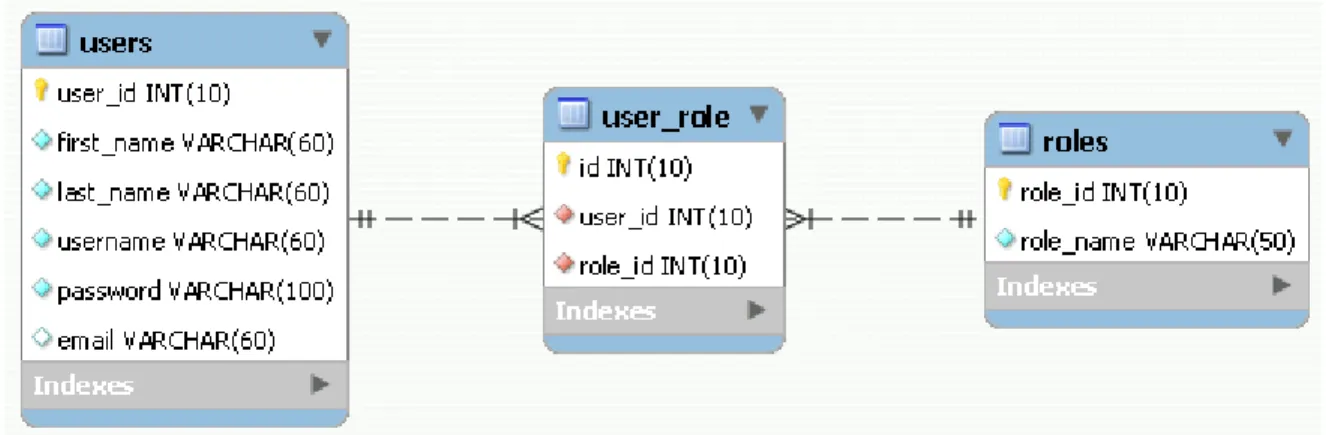
Figure 3-2 below gives a pictorial view for foreign key referencing. The attributes ‘user_id’, and ‘role_id’ of table ‘USER_ROLE’ are the foreign keys and reference ‘user_id’ of table ‘USERS and ‘role_id’ of table ‘ROLES respectively.
18 3.1.3 Normalization in the relational model
Codd initially described the problem of complex domains [15] that can be decomposed into independent sub-domains but related with each other through PKs and FKs. The process was referred to as normalization. This process ensures that data is isolated for each sub-domain and each sub-domain holds data that only relates to that domain, however, all of them are related to each other through foreign keys. The process of decomposing domains into sub-domains implies that a table is divided into more tables which in turn makes the database operations relatively simple and eradicates data redundancy. Codd further discussed the process of normalization in his succeeding paper [17, 18] and introduced three types of normal forms [18].
More research continued with the problem of normalization and to what degree to normalize. This work resulted in more types of normal forms or modification in the existing work [24–26, 41, 43, 45]. However, this paper discusses the first three normal forms knows as First Normal Form (1NF), Second Normal Form (2NF), and Third Normal Form (3NF) as most of the RDBMS meet the requirements of first three normal forms whereas 4NF and 5NF are more for academic purposes.
3.1.3.1 First Normal Form (1NF)
First normal form (1NF) is the first step in the normalization of data and it was developed as a three step process by E. F. Codd. This normal form requires that all values in a column of a table are atomic. A table is said to be in 1NF if and only if each attribute of the table is atomic.
19 3.1.3.2 Second Normal Form (2NF)
Again, introduced by E. F. Codd, second normal form requires that the relation must be in 1NF and any non-key column is fully dependent on the entire primary key (a primary key could be a composite key).
3.1.3.3 Third Normal Form (3NF)
Third normal form states that a table is in 3NF if the table is in 2NF and that the non-primary key columns of the table are only dependent on the primary key and do not depend on each other.
3.1.4 Process of Normalization
The normalization process played a great role in the success of RDBMS. The process of normalization decomposes the information into smaller relations and establishes meaningful relationships between them. The normalization process reduces the data redundancy and offers more flexibility to the structure. Codd [13] initially presented the idea of normalization.
20
Figure 3 - 3: Possible process flow of normalization [1]
Although normalization is a most widely used process, it is not necessarily an ideal process in each situation. It has been observed that normalization plays important role in Online Transaction Processing (OLTP) systems, however, when it comes to decision making Online Analytical Processing (OLAP) systems such as data warehouses then the fully normalized structure is not helpful.
3.1.5 Data integrity and reliability
All RDBMS systems guarantee data consistency. Data consistency is very important as wrong or corrupted data could be detrimental for any business. The RDBMS attains the data
21
consistency through the Atomicity, Consistency, Isolation, and Durability (ACID) [21] properties. The acronym ACID refers to the four properties in the context of DB transaction processing. They are defined as follows [21]:
3.1.5.1 Atomicity
“Transaction are atomic (all or nothing)” [21]. A transaction completes as a whole unit. Either it completes successfully or rolls back without making any change. In other words, if any part of a transaction fails then the whole transaction fails without making any changes.
3.1.5.2 Consistency
Transactions guarantee database consistency. Transactions achieve consistency by keeping the database consistent after a transaction completes successfully.
3.1.5.3 Isolation
Each running transaction is independent of the other concurrent transactions and they do not see the changes made by another incomplete transaction.
3.1.5.4 Durability
When a transaction completes the changes in the database remains the same even in case of disaster, errors, or failures.
Keeping the data consistent in a distributed environment is more challenging than on a standalone database. Similarly it is easy to scale the RDBMS on a single server through vertical scalability but when it comes to scale over multiple servers in a distributed environment then the situation becomes more difficult. Nonetheless, modern database vendors have invested lots of
22
resources for providing highly scalable systems that are also high performance and highly available. Oracle addresses the scalability challenges for both structured (relational) and unstructured data (document, images, multimedia, XML) capable of dealing with Petabytes of data [34]. Microsoft also elaborates how they addressed the issue of high scalability and performance using VMware vSphere™ 4 [60].
The introduction of the web has brought revolutionary changes towards data storage techniques. Scalability and high availability are preferred over data consistency. The nature of web based data is mostly distributed and the RDBMS system is not considered an ideal candidate for huge amounts of the distributed data. According to David A. Grier "If web was considered to be a database, it would fall well outside of Codd's framework" [31]. It further states that the development of the web was based on Codd's ideas and this is obvious from the databases that support the Web. Structural relationships introduced by E.F. Codd, however formed the foundation of information organization [31].
23
3.2 Structured Query Language (SQL)
The relational model has many advantages that made it popular and dominant as soon as it was introduced in the IT industry. In order to access the database an interface was required and that interface was a language starting from sublanguage [15] and passed through several phases to become the modern Structured Query Language (SQL).
Structured Query Language (SQL) is the language used to interact with the RDBMS databases and the object-relational DBs. Most Graphical User Interfaces (GUI) use SQL behind the scene. Any action performed through the GUI runs SQL commands performing certain tasks on behalf of the user. SQL is very much simple English language instructions in a structured fashion.
There are various forms of SQL adopted in the industry. The IBM databases use SQL. Oracle Corporation uses a proprietary extension of SQL in the form of the Procedural Language/ Structure Query Language (PL/SQL). Microsoft uses Transact SQL to interact with SQL Server. Other popular databases that use SQL are MySQL, Paradox, and Postgress. However, all these different flavors are based on the industry standard ANSI SQL.
Dr. E. F. Codd presented the relational data model during his research at the IBM laboratory [15] and SQL is closely knit with the emergence of relational databases. SQL has a history behind its reputation. It is a cornerstone of any DBMS system [8]. SQL was first developed by Donald D. Chamberlin and Raymond F. Boyce during 1970s [11]. Initially it was called Structured English Query Language (SEQUEL) and designed to retrieve and manipulate information in the IBM’s prototype relational database system, the System R [59]. The name of the language was changed later to SQL because another company already had registered proprietary rights for the acronym “SEQUEL”.
24
Very quickly SQL attained the role of the de facto language for RDBMS as major vendors designed their systems with SQL as the standard language. The popularity of SQL raised the need for a standard to be followed by all. In 1980s The American National Standards Institute (ANSI) and the International Standards Organization (ISO) worked together and developed the first version of the SQL standard under the name of SQL-86 (SQL1). Updating and revision of the SQL standard has been a continuing process since then and the latest version available is ISO/IEC 9075-11:2011 [37].
Despite that the ANSI and ISO standard has been in place for a long time now, database vendors still do not fully follow these standards. They have their own versions of SQL extensions to support their systems. One of the reasons for non-conformity is that the database vendors keep introducing new features and to achieve their desired goals they keep expanding SQL dialects thus resulting in non-standard SQL [32]. Oracle introduced the PL/SQL and Microsoft has Transact SQL, however, all of them still support the basic and major commands of SQL.
Many vendors realized the importance of SQL and embraced it in their products thus increasing the popularity of SQL. The propagation of SQL and the rate of growth of its implementation forced the American National Standards Institute (ANSI) to develop a standard for SQL. The International Standards Organization also recognized the demand of SQL and together with ANSI they released standards for SQL in 1986, 1989, 1992, 1999, 2003 and ISO/IEC 9075-11:2011 [37]. The rationale for a standard was to provide a common platform for future developments and easy migration to third-party applications without changing the SQL code. The standard also helps reducing dependency on the specific vendor. Even after the SQL standard was introduced, several flavors of SQL continue to persist. This was mainly due the
25
user community demands of a specific database vendor to meet certain capabilities before the birth of SQL standard [38].
Oracle was the first company to introduce the RDBMS system using SQL. The pattern was followed by databases such as DB2, INFORMIX, UNIFI and more. As a result SQL became the standard language for RDBMS systems.
There is a strong relationship between RDBMS and SQL. As discussed earlier Dr. E. F. Codd introduced the relational model of data that suites most forms of data storage structures. Dr. E. F. Codd also described how to interact with a relational database using a language. This language allows data manipulation in a relational model [50]. SQL is a similar language that is equivalent to SQUARE language in functionality but targets those users who are more comfortable with an English like language than mathematical notation for data retrieval [11].
The main reasons motivating the emergence of SQL were the high cost for software development and to enable a common user to interact with databases. Developing software is based on a life cycle that not only involves the initial development phase but it also requires constant modification and maintenance of the software to stay abreast of ever changing requirements. Also most software is used by users who have no or limited knowledge about computers and software. It was a challenge to simplify the explanation to improve the understanding about software and computers for such users. The evolution of Structured Query Language was mainly based on these two critical problems [11].
The RDBMS systems are blamed for slow performance as the number of joins increases. Another argument against them is that they do not map well with complex data programming structures such as XML due to their hierarchical structure. However, the benefits of RDBMS
26
system are simply taken for granted as the relational technology made it possible for organizations to support their information system on low cost hardware [31].
The RDBMS systems have been in use as the main data storage technology since its inception and have been implemented widely in most commercial and industrial sectors. The popularity and usefulness of the RDBMS remained firm until the introduction of the cloud computing idea. The scenario has changed for the RDBMS since cloud computing started penetrating the industry. This put a high demand on working with really huge amounts of data with a painless scalability option. The RDBMS systems are required to provide better scalability when dealing with large data. However, following ACID rules is a big hurdle for the RDBMS systems to achieve this task. The RDBMS uses a locking mechanism to ensure data consistency but this causes scalability to be a problem in a distributed environment. The web based services further deteriorates this situation as it makes it harder to achieve consistency, availability, and scalability at the same time. This concept is well defined by Dr. Brewer’s CAP theorem [61].
Security becomes another issue with the advent of the internet. Web based data requires more security and privacy than traditional application data. New laws were introduced to protect personal information and all organizations are required to follows data protection legislation since 2004 [40]. Basically software vendors are required to exchange personal information as encrypted data [21].
27
3.3 NoSQL databases
Over the years relational database management systems (RDBMS) have been the leading technology in IT world. The RDBMS has dominated the industry since its inception by E. F. Codd presented in 1970 [15]. Several different approaches have been in practice besides the relational concept. Hierarchical and Network data models were introduced in 1960 and implemented by “Integrated Data Store of Honeywell (network model) and Information Management System (IMS) by IBM (Hierarchical Model)” [48]. Being dominant the RDBMS systems embraced and merged other prevailing ideas. Object-based data model was merged with RDBMS to form an object-relational model.
This approach of using relational systems in all scenarios was questioned with the introduction of the web. The Relational data model works well with traditional applications where data is not massive and distributed. Despite being on top for several years the capability of RDBMS for processing and handling large amount of distributed data remains in question. However, handling and processing huge amounts of distributed data is almost mandatory for huge IT companies such as Google, Amazon, Twitter, LinkedIn and Facebook. In short the RDBMS systems are not a suitable candidate for processing large amounts of data where data is distributed over a network in a cluster of servers or over a grid in different geographical locations. A new approach under the flag of NoSQL was introduced to mitigate some of the problems not handled elegantly by RDMBS.
The first time the term NoSQL was used was in 1998 when Carl Strozzi [51] used the term NoSQL for his open source relational database "Strozzi NoSql". Structured Query Language (SQL) was not used to access and manipulate data [51]. Instead, the Application Programming
28
Interface (API) was used with various plugins and libraries or RESTFul API with HTTP protocol. This is the reason why they are called “NoSQL” databases.
The NoSQL DB is a database management system that is entirely different from the RDBMS in many ways. The primary reasons for using a NoSQL DBs are their flexibility, speed, scalability, and high availability. For these reasons NoSQL is making its space in the industry, however, it is still not mature enough and lacks ‘standards’. “For any of the new databases, you may have Pig, Hive, SPARQL, Mongo Query Language, Cypher, or others. These languages have little in common.” [64]. The NoSQL system meets the requirements of corporations who deal with terabytes of data. The data is mostly stored in a distributed environment and does not need schemas or join operations to retrieve data. There is no concept of Primary or Foreign keys in NoSQL since it does not store data in tables and has no constraints. Data in the NoSQL CouchDB is stored in the form of documents. Each document is similar to a row in a table and groups of documents represent a logical table. It uses the advantage of horizontal scaling to improve performance by facilitating the addition of new machines in the system and distributing the additional load equally.
The transaction consistency in the RDBMS DBs is acquired through the ACID properties. The NoSQL databases on the other hand mostly rely on a different concept known as BASE. BASE stands for Basically Available, Soft State, and Eventually Consistent. The BASE concept is defined as follows:
Basically Available: there may be faults but not a fault of the whole system. Soft state: copies of data items may be inconsistent
29
Eventually consistent: all the nodes will be consistent when no more updates take
place for a long duration allowing all updates to propagate and bring the system eventually to a consistent state.
The BASE design ensures availability but at the cost of inconsistent data. The BASE approach is helpful in designing more scalable database systems, thus allowing more options to add required hardware easily when data grows.
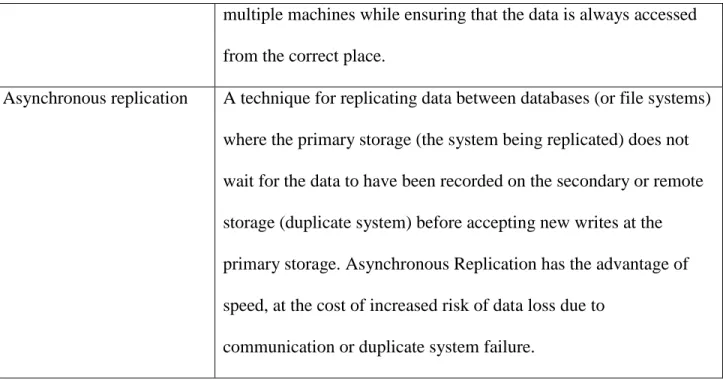
Table 3-2 below represents the main differences with a brief explanation in tabular form as defined in [10, 39, 69].
NoSQL Feature Description
Structured/Semi-structured The data in NoSLQ is mostly unstructured or semi-structured. Schema-less Data is not stored in any schema. Instead data is stored in records
and each record has various fields which may change from record to record.
BASE properties RDBMS systems are mostly ACID compliant whereas NoSQL DBs support BASE properties.
Scalability Horizontal scalability is the capability of the system to accept the addition or removal of machines/servers and integrate them in a single unit.
Elasticity Elasticity is the ability of the system to add new hardware without any downtime or interruptions in the services.
Sharding Shard means a small part of a whole, so the process of sharding partitions large database in smaller and faster chunks across multiple servers. The idea behind sharding is to split data among
30
multiple machines while ensuring that the data is always accessed from the correct place.
Asynchronous replication A technique for replicating data between databases (or file systems) where the primary storage (the system being replicated) does not wait for the data to have been recorded on the secondary or remote storage (duplicate system) before accepting new writes at the primary storage. Asynchronous Replication has the advantage of speed, at the cost of increased risk of data loss due to
communication or duplicate system failure.
Table 3 - 2: NoSQL distinguishing properties
Since the introduction of the NoSQL idea numerous databases have been designed depending on the requirements. These databases have been grouped in different categories. Next section discusses and compares current NoSQL designs in use by the industry.
The category of NoSQL depends on how the data is stored. Currently NoSQL DBs are organized into four major categories [52] as follows:
3.3.1 Key-Value Stores
The Key Value Stores allow applications to store data in a schema-free environment as a typical Hash table. Hash tables contain a value for a particular key. The key can be system generated or defined by the programmer. The data consists of a key as a string and real data which forms the value part of the pair. The data type of the stored data depends on the programming language and it can be any data type supported by the language. Examples of the
31
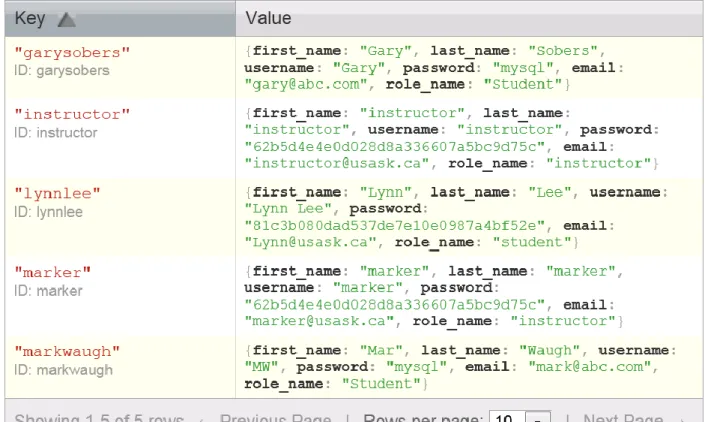
data types are string, integer, array or object. Data stored in such a fashion alleviates the need of a fixed data model and structured data. Amazon was the first to implement key value structure to resolve their data availability and scalability issues using the Dynamo storage system [23]. Key-value stores such as Dynamo are useful in environments with Distributed Hash tables and caching to improve high read performance and "consistent hashing to partition its key space across its replicas and to ensure uniform load distribution" [23]. The key-value structure has been implemented by but not limited to Oracle Berkeley DB [53], Redis [58], MongoDB [57], memcached [33], and Kyoto Cabinet [36]. Figure 3-4 below represents an example of a key-value structure in the CouchDB Futon API. The identifiers for the documents are created as meaningful names rather than system generated strings.
32 3.3.2 Columnar Databases:
The data is stored in columns instead of rows in a Columnar Database. It stores it in a key-value pair but the key is two dimensional. In this type of structure a column key and a row key are required to access a stored value. A timestamp can also be added as part of the key as practiced in Google's Big Table [13]. This type of model is suitable for the handling of huge amounts of distributed data storage as implemented by Google’s Big Table. Facebook's messenger services also use Hbase to support billions of messages per day [5].
In this design, a row-by-row approach keeps all the information together in a single entity. On the other hand a column-by-column approach stores together all information about an attribute.
To understand the data structure of a Columnar Database, there are a few important concepts to understand.. These concepts include column family, super column and column. They are defined as follows:
3.3.2.1 Column
A Column in columnar database is simply a tuple with key-value pair. This is the smallest unit as a data container. Google's Big Table also includes a timestamp [13]. An example of Column in JSON notation is as follows [70]:
{ // this is a column
name: “phoneNumber”, value: “1234567890”, timestamp: “250920131413” }
33 3.3.2.2 SuperColumn
SuperColumn is a tuple/row consisting of a name and a value. Timestamp is not part of the SuperColumn like the regular Column tuple [27]. The value part is a map containing any number of columns and keyed by the column's name.
A SuperColumn is like a catalogue or collection of other columns to group together multiple columns. Grouping multiple columns using SuperColumn denormalizes the entire row into one SuperColumn [3]. Data stored separately in a column family as a row can also be grouped within a SuperColumn family as a SuperColumn. This strategy improves the performance for the lookup of such data using the value instead of a row key [3]. A simple example of SuperColumn is as follows [70]:
clinicAddress: { // this is a super column street: “543 xyz”,
city: “Saskatoon”, zip: “A1B 2C3” }
Regular columns and SuperColumns are both key-value based structures. But the main difference is that the value of a regular column is a "string" whereas the SuperColumn value is a map of columns. Also SuperColumn doesn’t have a timestamp component.
3.3.2.3 Column Family
Column Families define how the data is stored on disk. Columns or super columns can be part of a column family.
34
Column keys are grouped into sets called "column families". A Column Family can be considered the counterpart to a table in a relational database. Columns of certain data types are defined in a relational table and then the data is stored in the form of rows/records inserted by the applications. Each row/record contains the same fixed columns.
A Column Family in a columnar database is a collection of rows that contain any number of columns, in a sparse fashion allowing different collection of columns for each row. The column family name is used as prefix for all the column members of a column family. For example, employee:salary and employee:name are both members of the employee column family. The column family can be static or dynamic. In a static Column Family the column metadata is pre-defined for each column whereas a dynamic Column Family allows the application to supply column names to store data.
The columnar data structure looks similar to that of a relational database but the story is different under the hood. In a relational model a row is stored as one record whereas in a columnar structure data is stored by column so data from individual columns are stored together. The order of the data stored in columns is maintained so all parts of a logical row are stored at their respective position in the individual column. This means that for instance if the first name of a person is stored at the 5th position in 'first_name' column then the corresponding last name will be stored at the 5th position in 'last_name' position maintaining the integrity of data. The example below explains the concept of column family [70]:
clinicAddress= { // this is a ColumnFamily
northClinic: { // this is the key to this Row inside the CF // more required column in this row
35 city: “Saskatoon”,
zip: “A1B 2C3” }
southClinic: { // this is the key to another row in the CF // more required in this row
clinicName: "southclinic", clinicType: "children hospital", street: “543 xyz”,
city: “Saskatoon”, zip: “A1B 2C3” }
}
The space allocation as well as the definition of the column is not required unlike the RDBMS structure. The Columnar Database allows adding columns without any burden on the system. A column may be a part of one row and not the other. Similarly a row may have one or more columns. This data structure makes the data retrieval very fast because all the data for a particular attribute is available under a single column. Moreover all columns do not need to be searched if the data is required from only one column. The Columnar Database is also fast for aggregation tasks such as counting the number of employees in a department. Figure 3-5 below illustrates the data structure inside a columnar database for column families and groupings of like column data as mentioned in [55].
36
Figure 3 - 5: Columnar database storage structure [55]
The figure above shows Keys with corresponding values but they can store more complex data. This idea is projected in figure 3-6 below comparing the Columnar DB data model with the RDBMS model [55].
Figure 3 - 6: Same data representation stored in RDBMS and columnar structure [55]
3.3.3 Document Store (DS)
The Document Stores allow storing the data in the form of documents. In the RDBMS the data is stored in relational tables and it uses join operations. But the DS consists of several documents each of which is independent of each other and does not belong to any schema. The
37
fact that all documents are independent of each other makes the programmer’s life easy as it relieves them from data dependency and integrity issues. Each document can contain the same or different fields so it eliminates the need for the field value of NULL. If a field is expecting a null value then it is not a part of the document.
All the documents are distinguished using a unique identifier (UID) that is assigned to each document when it is created. These identifiers can be system generated or defined by the programmers. These UIDs works like a PK in RDBMS and ensures the uniqueness of the documents within the database.
As the name suggests Document Stores consist of documents. This model is very useful for horizontal scalability and allows the addition of cheap commodity servers or resources from the cloud as the database grows. The document stores are similar to key-value stores and takes advantage of hashed tables. The key-value pairs are stored in distributed hash tables (DHT) in hash buckets. An index is created on the key-value pairs in these buckets for search purposes. The hash value is a unique number generated from the data. The algorithm for creating hash values distributes the key-value pairs evenly among hash buckets [50]. This means that if the DHT has 4 hash buckets and 20 key/value pairs are stored then each hash bucket will have 5 key/value pairs.
This model makes the parallelization very easy with the addition of more hash buckets when more servers are added due to data growth.
The Document Stores are useful in Web-based applications with data distributed in a network or over a grid. Figure 3-7 [44] below shows how a relation saved in RDBMS is stored in a DS.
38
Figure 3 - 7: Documents stored document store [44]
A clearer picture showing the document contents looks like figure 3-8 below [44].
Figure 3 - 8: Document structure in JSON format [44]
The document model above shows two records in de-normalized JSON format. The records are independent of each other and atomic in nature which makes record movement across servers simple without worrying about the movement of partial data.
39 3.3.4 Graph Model:
The Graph Databases store and manage graph data and the related indexes. The graphs consist of nodes, relationships among nodes and their properties. Instead of storing data in SQL tables, graph models are used to store the sata which is easily scalable over many servers. The main feature of a graph database is how it handles relationships compared to a relational model. The Graph DB traverses through huge numbers of edges in a fraction of the time of relational joins due to direct links between nodes [30]. The Graph DBs use the concepts of vertex (node), edge (relationship) and property. The Graph Model stores data with nodes and edges using a Graph algorithm. This model is useful where the data model is recursive. An example of attributes is as follows:
Node: Employee
Property: first name, last name, designation and department Relationship: Employee part of a department
The graph databases are useful for social networking web sites such as Twitter that uses FlockDB to store graph data about relationships between users, information about who’s following whom and more [35]. Other implementations of Graph DBs are Neo4j, AllegroGraph, Graph DB and InfiniteGraph [2].
The basic structure of a graph consists of nodes and relationships. The nodes have properties and the related data is recorded in Nodes. Relationships also have properties and are used to organize nodes. A random graph structure develops when relationships are defined between different nodes. The resulting structure may be tree like, list, map or a complicated entity that can be further transformed into a more complex structure.
![Figure 3 - 3: Possible process flow of normalization [1]](https://thumb-us.123doks.com/thumbv2/123dok_us/10224307.2926288/34.918.114.810.105.607/figure-possible-process-flow-normalization.webp)
![Figure 3 - 6: Same data representation stored in RDBMS and columnar structure [55]](https://thumb-us.123doks.com/thumbv2/123dok_us/10224307.2926288/50.918.143.776.528.791/figure-data-representation-stored-rdbms-columnar-structure.webp)
![Figure 3 - 9: Graph and basic components [67]](https://thumb-us.123doks.com/thumbv2/123dok_us/10224307.2926288/54.918.316.598.323.767/figure-graph-basic-components.webp)
![Figure 3 - 10: Graph traversing [67]](https://thumb-us.123doks.com/thumbv2/123dok_us/10224307.2926288/55.918.185.735.118.609/figure-graph-traversing.webp)
![Figure 3 - 12: An overview of MapReduce process [46]](https://thumb-us.123doks.com/thumbv2/123dok_us/10224307.2926288/58.918.216.697.111.466/figure-overview-mapreduce-process.webp)
![Figure 3 - 13: An illustration of CAP theorem and NoSQL DBs compliance [63]](https://thumb-us.123doks.com/thumbv2/123dok_us/10224307.2926288/61.918.110.817.108.577/figure-illustration-cap-theorem-nosql-dbs-compliance.webp)
