POUR L'OBTENTION DU GRADE DE DOCTEUR ÈS SCIENCES
acceptée sur proposition du jury: Prof. C. Koch, président du jury Prof. A. Ailamaki, directrice de thèse
Dr S. Chaudhuri, rapporteur Dr G. Graefe, rapporteur Prof. K. Aberer, rapporteur
Toward timely, predictable and cost-effective data analytics
THÈSE N
O7140 (2016)
ÉCOLE POLYTECHNIQUE FÉDÉRALE DE LAUSANNE
PRÉSENTÉE LE 3 NOVEMBRE 2016À LA FACULTÉ INFORMATIQUE ET COMMUNICATIONS
LABORATOIRE DE SYSTÈMES ET APPLICATIONS DE TRAITEMENT DE DONNÉES MASSIVES PROGRAMME DOCTORAL EN INFORMATIQUE ET COMMUNICATIONS
Suisse 2016
PAR
"Learn from yesterday, live for today, hope for tomorrow. The important thing is not to stop questioning." —Albert Einstein
To Ivan, my husband, my friend, my soul mate, for encouraging me to pursue my dreams, and never letting me give up.
To Mia, our beautiful daughter, for lightening up my days and making me look once again at life as a miracle.
To Tamara, my "big" sister and partner in crime, for being there whenever I needed her, and to my parents, Dijana and Petar, for letting me fly.
Acknowledgements
Although this thesis has only one name written under the tittle as the author, nothing could be further from the truth. This thesis would have not been possible without the help and support of my advisors, my collaborators, my friends, and my family, all of who helped me throughout this journey in their own ways.
First and foremost, I would like to thank my advisor,Anastasia Ailamaki, for being an advisor in the real sense of the word. For teaching me ins and outs of database systems, teaching me how to plan and manage my time, and for teaching me life - to be present in each moment and do my best always. She is the best role model one could have.
Even though the name ofStratos Idreosdoes not show as a "co-advisor", he was practically my second advisor with whom I had the luck to collaborate with. Stratos helped me define my own research line, and encouraged me to jump out of the safe zone of well-defined research. Many decisions made in this long journey would have been impossible without his input. I am also indebted toGoetz Graefe, for organizing a seminar on "Robust Query Processing" and getting me interested in the topic of robustness in query processing. Goetz was also kind enough to accept to be my thesis committee member, and moreover to follow and help with my research for several years.
On that note, I am also thankful toHarumi Kunofor inviting me to the seminar. If it was not for her, I would probably not get to be obsessed with the robustness topic in DBMS.
I sincerely thankSurajit Chaudhuri, for giving me a chance to do an internship with Microsoft Research and spend a lovely summer in Redmond. Moreover, despite his busy schedule, Surajit accepted to be on my committee and help excel my research.
I would also like to thank my other mentors from the Data Management, Exploration and Mining group,Vivek NarasayyaandChristian König, for their patience and guidance.
Karl Abereris another committee member to whom I am extremely grateful for devoting his time to follow my research progress, despite having more than a dozen of his own students.
Acknowledgements
I thankChristoph Kochfor accepting to be the thesis jury president and a member of my candidacy exam committee.
I thank my collaborators for our fruitful discussions that resulted in the chapters of this thesis, in the chronological order,Ioannis Alagiannis, Miguel Branco, Stratos Idreos, Thomas Hei-nis, Farhan Tauheed, Marcin Zukowski, Campbell FraserandRaja Appuswamy.Ioannisand Stratoswere the driving force behind the NoDB system.Miguelpractically forced us to build an amazing demo of the NoDB system. He was also kind enough to listen to and provide feedback on all my rumbling about ideas while they were still in a premature phase.Marcin andCampbelltogether withMartina-Cezara Albutiuhelped crystallizing the ideas about Smooth Scan during the seminar on Robust Query Processing.Rajainitiated the work on cold storage and has been an amazing collaborator since then.
I would also like to thank my previous managerMaja Domazetovic, ProfessorMiroslav Ha-jdukovicand ProfessorIvan Lukovicfor getting me interested in databases and for being supportive when I decided to leave Serbia.
I would like to thank the members of the DIAS lab for creating a wonderful working environ-ment which made me jump out of my bed in the morning with a smile on my face. The DIAS ladies: I thankDanica Porobic, Pinar Tozun, Mirjana Pavlovic, Eleni Tzirita Zacharatou, Erietta Liarou, Stella Giannakopoulou, for numerous lunches, coffees, discussions, that all made me feel like at home. Special thanks toDanica, who was my "partner in crime" from the first day at EPFL and who proofread and provided feedback on the countless paper submissions. Now the DIAS gentlemen:Thomas Heinis, Farhan Tauheed, Adrian Popescu, Ioannis Alagiannis, Manos Athanassoulis, Radu Stoica, Ippokratis Pandis, Ryan Johnson, Debabrata Dash, Miguel Branco, Manos Karpathiotakis, Matt Olma, Iraklis Psaroudakis, Utku Sirin, Darius Sidlauskas, Raja Appuswamy, Satya Valluri, Cesar Torcato, Ben Gaidioz, Angelos Anadiotis, Odysseas Pa-papetrou, Lionel Sambuc, Georgios Psaropoulos, Xuesong Lu, andTahir Azim, all contributed to this thesis in their own way, by asking hard questions, proofreading, polishing my talks or simply discussing things over a glass of wine, lunch or a cup of coffee. I thankIoannis Alagiannis, who was a perfect office mate, and my first "guide" into the PhD journey. I thank Angelos Anadiotis, my second office mate, for his patience, and for all good pieces of advice he shared with me probably when I needed them the most, in the last year of my PhD. Thanks to Alejandro Javier Rivasfor trying out numerous ideas I had as his student semester projects. I am also grateful toErika RaetzandDimitra Tsaoussis-Melissargos, for their indispensable help with administrative intricacies, documents translations and proofreading. Special thanks to Benfor translating the abstract in French.
I would like to thank my Serbian friends, who made the transition to Switzerland super smooth -Bilja, Laza, Natasa, Zlatko, Milos, Mica, Danica, Mira, Baki, Mara, Pedja, Mima, Drazen,
Acknowledgements
many more whom I have forgotten to mention - thank you all!
I thank my parents,DijanaandPetar, for everything they gave me and for all their love and support. I specially thank them for letting me go wherever I wanted, despite their hearts breaking every time I would move to a new place. My sisterTamara, has probably had the biggest influence on my life. She was my big sister, my role model, my partner in crime, and most importantly she kept my sanity throughout my life crises. I am blessed with having such a person in my life.
There are no words to express gratitude to my husbandIvan, for being by my side for as long as I remember. I would not be on this path if it was not for him. I would not be who I am if it was not for him. And I would not aspire to achieve greater things and go beyond my comfort zone if it was not with him being by my side. Thank you!
Finally, I would like to thank our baby girlMia, for making my life a pure joy since she has joined us. I thank her for all her smiles, hugs, funny faces and the nights during which she let me sleep.
This research has been supported by grants from the School of Computer and Communication Sciences, EPFL, Swiss National Science Foundation: EURYI Award, “Efficient Data Management for Scientific Applications" (PE002-117125/1), Office of Naval Research Global, UK: “From Rats to Humans: Exascale Data Management for Brain Simulations" (SDN: N6290912MD07010), and the European Union Seventh Framework Programme (ERC-2013-CoG), under grant agreement no 617508 (ViDa).
Abstract
Modern industrial, government, and academic organizations are collecting massive amounts of data at an unprecedented scale and pace. The ability to performtimely, predictable and cost-effectiveanalytical processing of such large data sets in order to extract deep insights is now a key ingredient for success. These insights can drive automated processes for advertisement placement, decision making, or lead to major scientific breakthroughs in what is known as the fourth paradigm of data-driven scientific discovery.
....
Traditional database systems (DBMS) are, however, not the first choice for servicing these modern applications, despite 40 years of database research. This is due to the fact that mod-ern applications exhibit different behavior from the one assumed by DBMS: a) timely data exploration as a new trend is characterized by ad-hoc queries and a short user interaction period, leaving little time for DBMS to do good performance tuning, b) accurate statistics representing relevant summary information about distributions of ever increasing data are frequently missing, resulting in suboptimal plan decisions and consequently poor and un-predictable query execution performance, and c) cloud service providers - a major winner in the data analytics game due to the low cost of (shared) storage - have shifted the control over data storage from DBMS to the cloud providers, making it harder for DBMS to optimize data access.
....
This thesis demonstrates that database systems can still provide timely, predictable and cost-effective analytical processing, if they use anagileandadaptiveapproach. In particular, DBMS need to adapt at three levels (toworkload,dataandhardwarecharacteristics) in order to stabilize and optimize performance and cost when faced with requirements posed by modern data analytics applications. Workload-drivendata ingestion is introduced as a means to enable efficient data exploration and reduce the data-to-insight time (i.e., the time to load the data and tune the system) by doing these steps lazily and incrementally as a side-effect of posed queries as opposed to mandatory first steps. Using workload as a driving force for data ingestion and performance tuning presents an autonomous way to decouple user interests from the overall data growth. Data-drivenruntime access path decision making alleviates suboptimal query execution, postponing the decision on access paths from query optimization, where statistics are heavily exploited, to query execution, where the system can obtain more details about data distributions.Hardware-drivenquery execution enables the usage of cold storage devices (CSD) as a cost-effective solution for storing the ever increasing
Abstract
customer data as such a model hides the non-uniform access latency of CSD, and thereby opens up doors to a class of inexpensive database-as-a-service-over-cold-storage offerings.
....
In particular, in this thesis we first present the design and implementation of a novel paradigm called NoDB that skips data loading and provides query processing capabilities over raw data files as a principled way of servicing data exploration queries and reducing the data-to-insight time. NoDB builds auxiliary design structures (positional maps, caches and incremental statistics) that are progressively refined and tailored to hide the overhead of raw data access. We then show that access path morphing from one physical alternative to another to fit the ob-served data distributions, introduced with Smooth Scan, provides near-optimal performance over the entire selectivity range, removing the need for access path decisions altogether, hence substantially improving the predictability of DBMS. Lastly, to benefit from cold storage devices that offer substantial storage cost savings, we present Skipper, an end-to-end database-as-a-service architecture built on top of CSD. Skipper uses an out-of-order CSD-driven query execution model based on multi-way joins coupled with efficient cache and I/O scheduling policies to hide the non-uniform access latencies of CSD.
....
This thesis advocates runtime adaptivity as a key to dealing with raising uncertainty about workload characteristics that modern data analytics applications exhibit. Overall, the tech-niques introduced in this thesis through the three levels of adaptivity (workload, data and hardware-driven adaptivity) increase the usability of database systems and the user satisfac-tion in the case of big data explorasatisfac-tion, making low-cost data analytics reality.
Keywords:Database management systems, data analytics, data exploration, raw data access, robust query execution, predictable query performance, adaptive query processing, hardware-software codesign, cold storage devices
Résumé
De nos jours, que ce soit dans l’industrie, au niveau des gouvernements ou dans le milieu aca-démique, s’est développé une activité de collecte de données à des niveaux d’échelle (quantité et cadence) sans précédent. Dans ce contexte, parvenir à bâtir pour un coût raisonnable des outils efficaces d’analyse à la demande de ces masses de données est un atout clé, car on peut alors en extraire des informations ouvrant la voie à l’automatisation de stratégies marketing, assistant la prise de décision, ou permettant à des équipes de recherche de progresser vers des découvertes scientifiques majeures.
....
Il s’avère que malgré 40 ans de recherche derrière eux, les systèmes de gestion de base de données (SGBD) traditionnels ne sont pas en tête des choix quant à la mise en oeuvre de ces nouveaux outils. Cela vient du fait que les SGBD sont inadaptés au profil bien particulier de ces applications. a) l’exploration à la demande des données se caractérise en général par son besoin d’interactivité important ainsi que par la variété des requêtes ad-hoc typiques de l’exploration, donc offre peu de place à l’optimisation des requêtes par le SGBD. b) les données, en quantité croissante, ne sont en général jamais accompagnées d’informations statistiques pourtant nécessaires à l’optimisation des plans d’exécution, provoquant du coup l’exécution des requêtes selon des plans sous-optimaux, donc aux performances mauvaises et de plus difficiles à prédire. c) le développement des services decloud, grands gagnants dans ce contexte grâce à leur offre d’espace de stockage en ligne peu onéreux, a naturellement déplacé la problématique de la gestion du stockage des fichiers vers ces mêmes clouds, enlevant de ce fait aux SGBD la possibilité d’optimiser l’accès aux données.
....
Cette thèse démontre que les systèmes de gestion de base de données peuvent en fait bien offrir un support efficace et rentable à l’analyse de ces immenses masses de données, à la condition qu’ils optent pour une exécution adaptative à trois niveaux : selon les requêtes, selon les données et selon la technologie matérielle (hardware), ceci afin de stabiliser et optimiser non seulement leur performance mais aussi leur coût, et ainsi faire face aux besoins des nou-velles applications d’analyse. Le chargement des données selon les requêtes réduit l’intervalle de temps entre la production d’une donnée et son utilisation par l’analyste. Nous proposons d’effectuer cette étape par un mécanisme incrémental exécuté de manièreparesseuseau cours de l’exécution d’une requête, plutôt qu’en amont du travail d’analyse. Cette stratégie d’adaptation aux requêtes permet de servir l’intérêt de l’analyste indépendemment des pro-blématiques découlant de la taille grandissante des données. Puis, plutôt que de réaliser la
Résumé
sélection du chemin d’accès lors de l’étape d’optimisation selon des propriétés statistiques qui doivent donc être connues à l’avance, nous proposons d’effectuer cette sélection dynamique-ment pendant l’exécution au cours de laquelle les propriétés des distributions peuvent être analysées de manière plus fine. Ceci minimise le risque d’exécution d’un plan sous-optimal. Enfin le modèle consistant à adapter l’exécution des requêtes au matériel sous-jacent permet désormais de considérer les systèmes decold storage (CSD)comme une solution rentable au stockage des données, car il permet d’occulter la non-uniformité de la latence d’accès inhérente aux CSD. Ceci ouvre la voie à nouvelle classe de bases de données en ligne peu onéreuses utilisant les CSD.
....
Plus précisément dans cette thèse nous commençons par présenter ledesignet l’implémen-tation d’un nouveau paradigme appelé NoDB qui n’inclue pas d’étape de chargement des données car il effectue les requêtes directement sur les fichiers bruts, ceci afin de minimiser le temps d’accès aux données après la production des fichiers. NoDB compose des structures de données (index de position, caches et statistiques incrémentales) qui s’affinent au fur et à mesure de l’exécution des requêtes, permettant de compenser le surcoût dû à la lecture des fichiers bruts. Nous décrivons ensuite un système dynamique de choix du chemin d’accès (leSmooth Scan), qui sélectionne l’un ou l’autre chemin en fonction de ce que Smooth Scan constate de la distribution des données. Smooth scan obtient des performances proches des meilleurs systèmes quelles que soit les propriétés de sélectivité, déchargeant ainsi la base de donnée de la sélection statique du chemin d’accès en amont de l’exécution, et permettant d’améliorer du même coup la prédictibilité du système. Enfin, pour profiter des systèmes decold storagequi permettent de réduire significativement les coûts de stockage, nous pré-sentons Skipper, un service de base de données de bout en bout où l’exécution des requêtes est basée sur desmultiway joinset un système efficace de cache et d’ordonnancement des entrées/sorties qui occulte la latence non-uniforme de ces supports de stockage.
....
Cette thèse préconise l’adaptation en cours d’exécution comme élément clé face au caractère incertain de la charge de calcul de ces outils d’analyse nouveaux. D’une manière générale les techniques que nous présentons à travers les trois niveau d’adaptation mentionnés (requêtes, données et matériel) améliorent la performance et le ressenti par l’utilisateur d’une base de donnée dans un cadre debig data, pour faire de l’analyse de données à un coût raisonnable une réalité.
Mots-clés : systèmes de gestion de base de données, analyse de données, exploration de don-nées, accès aux données brutes, exécution robuste de requêtes, performance prédictible des requêtes, traitement adaptatif de requêtes,codesignlogiciel/matériel, systèmescold storage.
Contents
Acknowledgements i
Abstract (English/Français) v
Table of Contents ix
List of Figures xiii
List of Tables xvii
1 Introduction 1
1.1 From data to valuable insights . . . 1
1.2 Data analytics . . . 2
1.2.1 Timely data analytics. . . 3
1.2.2 Predictable data analytics . . . 3
1.2.3 Cost-effective data analytics . . . 4
1.3 Why not Database Management Systems . . . 4
1.3.1 Predefined vs. ad-hoc workload . . . 5
1.3.2 The implications of big data volume & velocity . . . 5
1.3.3 Storage as a separate entity . . . 5
1.4 Thesis Statement and Contributions. . . 6
1.5 Thesis Impact . . . 7
1.6 Thesis Organization . . . 8
I Background 11 2 A Look Inside the DBMS 13 2.1 The relation model . . . 13
2.2 Components of a DBMS . . . 14
3 Query Processing 17 3.1 Metadata information in the system catalog . . . 17
3.2 Query optimization. . . 18
3.2.1 Plan enumeration. . . 18
Contents
3.2.3 Result size estimation . . . 20
3.2.4 Improving statistics with histograms . . . 22
3.3 Query execution. . . 23
3.3.1 Data organization on external storage. . . 23
3.3.2 Execution operators . . . 24
3.4 Perils of query processing . . . 27
4 Physical Database Design 29 4.1 Automated physical designers . . . 30
4.2 Perils of physical design . . . 31
4.2.1 Query optimizer as a single source of truth . . . 31
4.2.2 Testing physical database designers’ predictability . . . 33
4.2.3 The need for lightweight tuning . . . 41
5 Improving Query Performance through Corrective Actions 43 5.1 Runtime statistics refinement. . . 43
5.2 Dynamic plan change . . . 44
5.3 Robust plan selection. . . 45
5.4 Adaptive operators . . . 45
6 Database Storage 47 6.1 Database storage tiering . . . 47
6.2 Proliferation of cold data. . . 49
6.2.1 Cold data in the archival tier . . . 50
6.2.2 Application-hardware mismatch . . . 50
6.3 Cold storage devices . . . 51
II Quest for timely, predictable and cost-effective data analytics 55 7 Timely and Interactive Data Analytics 57 7.1 Introduction . . . 58
7.2 Reducing data-to-insight time by querying raw data files. . . 60
7.2.1 Raw query processing . . . 60
7.2.2 The NoDB paradigm . . . 61
7.3 PostgresRaw: From the NoDB idea to practice . . . 62
7.3.1 Minimizing data transformation overhead . . . 63
7.3.2 Reducing the cost of data roundtrips . . . 64
7.3.3 Avoiding raw data access . . . 67
7.3.4 Improving quality of plans with incremental statistics . . . 68
7.3.5 Putting it all together . . . 69
7.4 Experimental Evaluation. . . 69
7.4.1 Micro-benchmarks . . . 71
Contents
7.4.3 Querying scientific data . . . 80
7.4.4 Statistics in PostgresRaw. . . 81
7.5 Trade-offs and opportunities of raw query processing . . . 82
7.6 Related work. . . 83
7.7 Conclusions . . . 86
8 Predictable Data Analytics 87 8.1 Introduction . . . 88
8.2 Background . . . 92
8.3 Intra-operator adaptivity with Smooth Scan . . . 93
8.3.1 Morphing Mechanism . . . 94
8.3.2 Morphing Policies . . . 96
8.3.3 Morphing Triggering Point . . . 96
8.4 Introducing Smooth Scan into PostgreSQL . . . 97
8.4.1 Design Details . . . 97
8.4.2 Interaction with Query Processing Stack . . . 99
8.5 Modeling Smooth Scan. . . 100
8.6 Competitive Analysis . . . 104
8.6.1 Greedy Policy . . . 105
8.6.2 Selectivity Increase Driven Policy . . . 108
8.6.3 Elastic Policy. . . 109
8.7 Experimental Evaluation. . . 112
8.7.1 Experimental Setup . . . 112
8.7.2 TPC-H analysis . . . 112
8.7.3 Fine-grained analysis over the entire selectivity range . . . 114
8.7.4 Sensitivity analysis of Smooth Scan . . . 116
8.7.5 Smooth Scan on SSD . . . 121
8.7.6 Cost model analysis . . . 122
8.7.7 The benefit of mid-operator runtime adaptivity . . . 124
8.7.8 Statistics collection as opposed to intra-operator adaptivity . . . 125
8.8 Related work. . . 126
8.9 Concluding remarks . . . 128
9 Data Analytics for a Penny 131 9.1 Introduction . . . 132
9.2 Scope and Background. . . 134
9.3 The case for cold storage tier . . . 135
9.3.1 Price implications of CST . . . 135
9.3.2 Performance implications of CST . . . 136
9.3.3 A case for CSD-driven query execution . . . 139
9.4 Skipper: Query Processing on CSD . . . 140
9.4.1 Skipper Architectural Simulator . . . 142
Contents
9.4.3 Cache management . . . 146
9.4.4 Client proxy . . . 147
9.4.5 Scheduling disk group switches . . . 148
9.5 Experimental Evaluation. . . 153
9.5.1 Experimental Setup . . . 153
9.5.2 Experimental Results. . . 154
9.6 Related work. . . 162
9.7 Outlook and conclusions . . . 163
10 Concluding Remarks and Future Ahead 165 10.1 Thesis contributions and lessons learned . . . 165
10.2 Thesis impact . . . 166
10.3 Looking ahead . . . 167
A An appendix 169 A.1 TPC-H Query Plans . . . 169
A.1.1 Q1 . . . 169 A.1.2 Q4 . . . 170 A.1.3 Q6 . . . 170 A.1.4 Q7 . . . 171 A.1.5 Q14 . . . 173 Bibliography 202 Curriculum Vitae
List of Figures
2.1 Components of a DBMS . . . 15
3.1 Clustered Index . . . 24
3.2 Unclustered Index . . . 25
4.1 Impact of physical design: Performance improvement after creating a set of indexes, normalized by the original execution time . . . 30
4.2 The interaction between the physical designer and optimizer . . . 31
4.3 Negative impact of physical design: Performance degradation after creating a set of indexes, normalized by the original execution time . . . 32
4.4 The cause of performance degradation of Q9. . . 32
4.5 RE Ewith TPC-H SF100 . . . 37
4.6 System-A: Relative estimation error in databases of different size. . . 38
4.7 System-A: Actual improvement when increasing the space budget . . . 38
6.1 Storage tiering for enterprise databases . . . 48
6.2 Cost benefits of storage tiering . . . 49
6.3 CSD in the storage tiering hierarchy . . . 52
6.4 Pelican rack schematic . . . 53
7.1 Reducing data-to-insight time and improving user interaction with NoDB . . . 62
7.2 Overheads inherent to query processing over raw data files . . . 62
7.3 An example of indexing a raw file with a positional map . . . 65
7.4 Mapping between the attributes and their positions in the positional map . . . 66
7.5 Increasing the number of pointers in PM . . . 71
7.6 Scalability of PM . . . 71
7.7 The effect of the positional map and caching. . . 72
7.8 Adapting to changes in the workload . . . 74
7.9 Comparing the performance of PostgresRaw with other DBMS . . . 75
7.10 PostgresRaw performance compared to other DBMS as a function of selectivity decrease: a) selectivity 100-1%, b) selectivity 1% . . . 76
7.11 PostgresRaw performance compared to other DBMS as a function of projectivity decrease: a) projectivity 100-1%, b) projectivity 1% . . . 77
List of Figures
7.12 PostgresRaw performance compared to other DBMS as a function of: a)
selectiv-ity and b) projectivselectiv-ity increase . . . 78
7.13 PostgreSQL Vs. PostgresRaw when running two TPC-H queries that access most tables . . . 79
7.14 Performance comparison between PostgreSQL and PostgresRaw when running TPC-H queries . . . 79
7.15 PostgresRaw vs PostgreSQL over a scientific data set . . . 80
7.16 Execution time in PostgresRaw with statistics collection support . . . 82
8.1 Non-robust performance due to selectivity misestimates in a state-of-the-art commercial DBMS when running TPC-H . . . 89
8.2 Access path selection in DBMS . . . 90
8.3 Runtime reoptimization . . . 90
8.4 Access Paths in a DBMS . . . 92
8.5 Targeted behavior of Smooth Scan . . . 94
8.6 Smooth Scan access pattern. . . 95
8.7 The Worst Case Result Distributions for Smooth Scan alternatives . . . 106
8.8 The competitive analysis of the Greedy policy for the highest page miss rate . . 106
8.9 Competitive analysis of Selectivity Increase Smooth Scan when compared against Oracle . . . 109
8.10 Competitive analysis of Elastic Smooth Scan for the worst case for the Selectivity Increase driven policy . . . 110
8.11 Improving performance of TPC-H queries with Smooth Scan . . . 113
8.12 Smooth Scan vs. alternative access paths for a query with and without an or d er b yclause . . . 115
8.13 Sensitivity analysis of Smooth Scan modes . . . 117
8.14 Maximum morphing region size (num. of pages) . . . 117
8.15 Morphing policies. . . 118
8.16 Triggering choices. . . 118
8.17 Handling skew. . . 119
8.18 Analysis of auxiliary data structures . . . 120
8.19 Memory sensitivity of Result Cache . . . 121
8.20 Smooth Scan on SSD . . . 122
8.21 Comparing the analytical model with actual execution . . . 123
8.22 Switch Scan performance cliff and overall benefit . . . 124
8.23 Statistics collection alternatives in DBMS-X as an alternative to run-time adaptiv-ity: a) basic statistics, b) single-column histograms, c) joint-distribution histograms125 9.1 Cost savings of CSD as a replacement for the HDD-based capacity tier . . . 136
9.2 PostgreSQL over CSD vs HDD. . . 138
9.3 Latency sensitivity . . . 138
9.4 Event timeline . . . 139
List of Figures
9.6 CSD-driven vs. traditional execution . . . 145
9.7 Cache management policies . . . 145
9.8 Scheduling policies . . . 151
9.9 L2-norm . . . 151
9.10 Cum. workload execution time . . . 151
9.11 Simulator results (L2-Norm, Max. Stretch and Cumulative workload time): K variation as a function of number of issued queries . . . 152
9.12 Average exec. time comparison . . . 155
9.13 Cumulative exec. time of mixed workload . . . 155
9.14 Avg. exec. time breakdown for 5 clients . . . 156
9.15 Sensitivity to CSD group switch latency . . . 156
9.16 Local vs remote execution . . . 157
9.17 MJoin sensitivity to: a) layout b) cache size c) data set size . . . 158
9.18 Fairness vs. efficiency: a) L2-Norm b) Cumulative workload time . . . 160
List of Tables
3.1 Cost model parameters . . . 25
3.2 Access path selection formulas . . . 26
3.3 Join implementations formulas. . . 26
4.1 Metrics descriptions . . . 34
4.2 Predictability when using the TPC-H 10GB . . . 36
4.3 Predictability when increasing workload size. . . 39
6.1 Acquisition cost in $/GB and fraction of data stored in each device type for various tiering configurations as reported by [230].The tier corresponding to each device is shown in parentheses, withPstanding for performance,Cfor capacity, andAfor archival . . . 49
8.1 Smooth Scan: Cost model parameters . . . 101
8.2 I/O Analysis . . . 113
9.1 Data layout and Execution subplans . . . 140
9.2 Scheduling policies implemented by the simulator . . . 151
1
Introduction
1.1 From data to valuable insights
The evolution of computing power, followed by the decreasing costs of computation and storage infrastructure, has revolutionized all scientific fields and enterprises, placing the ability to collect unprecedented amounts of data at its core [127,130,131,213,228]. To illustrate, according to [130], the amounts of machine-generated data are growing exponentially and are estimated to reach the value of 44 ZB (1021) by 2020. Real progress, however, depends on how efficiently we can ‘extract value from chaos’, i.e., transform data into useful information. New insights in sciences and ground-breaking advances in industry now depend upon our ability to analyze massive and complex data sets, in what is calledthe fourth paradigmof scientific discovery through data-driven computing [125].
The new-coined termbig datais associated with data management challenges related to the storage, organization and analysis of large-scale data. In particular, big data is a concept that refers to the inability of traditional data architectures to efficiently cope with characteristics of new data sets [235]. The five V’s (namelyvolume,velocity,variety,veracityandvalue) are typically used to define the properties of large-scale data [60,128,165,261].
• Volumerefers to the sheer size of generated data in every domain. According to [130], 32 billion devices will be plugged in and generating data by 2020. The number of devices - also referred to as “things” (e.g., tablets, smart phones, cars, telescopes, and anything with a sensor) - which are able to connect to the Internet is already approaching 200 billion. 14 billion of those devices are actually connected to each other, creating the “Internet of Things” (IoT). Furthermore, as reported in [220], data amounts are increasing by 60% annually. To illustrate, enterprise data is doubling every 3 years, Twitter processes 7 TB of data every day, Facebook processes 10 TB each day, while the CERN Hadron Collider laboratory generates 40 TB every second [47].
• Velocityrefers to the speed requirement for collecting, processing, and exploiting the data usually generated by sensors. Many analytical algorithms can process vast
quanti-Chapter 1. Introduction
ties of information if there is time for the job to run overnight. But for real-time tasks such as equipment reliability monitoring, outage prevention or security monitoring, an overnight period is too long, motivating companies to build an infrastructure for streaming data and relatively large volume data movement.
• Varietyrefers to the different types of data collected from various devices. Unlike in the past when data analysis mostly focused on structured data organized in relational tables, nowadays there is a strong need to harness different types of data including messages, social media conversations, photos, sensor data, video or voice recordings, and bring them together with more traditional, structured data.
• Veracityrefers to the trustworthiness of the data. With many forms of big data, quality and accuracy are less controllable. Big data and analytics technology, however, have to allow to work with such data. Luckily, the data volumes often make up for the lack of quality or accuracy.
• Valuerefers to the ability to turn collected data into valuable information that gives insights and drives decision making processes. Data can deliver value in almost any area of business or society. It helps companies to better understand and serve customers; examples include the recommendations made by Amazon, eBay, etc. It can improve health care by being able to predict disease outbreaks, or to estimate risks of developing a disease (and potentially preventing it by proactive actions). Similarly, predictive analytics can enable power companies to make a wide range of forecasts such as the availability of energy at a certain period in time, its potential price, or estimate when power failures are likely to happen [127].
1.2 Data analytics
The examples of applications which utilize large-scale data to bring significant business value are endless. Recognizing an opportunity, industries are nowadays seeing data as a market differentiator, as information has become their biggest asset [139,163,247]. This trend is prevalent in industries such as telecommunications, internet search firms, marketing firms, etc. who see data as a key driver for monetisation and growth, putting an emphasis on efficient data analytical processing more than ever.
On-line Analytical Processing (OLAP) applications have been crucial to businesses since the 1980s. The recent trends related to the pace of data generation and the consequent needs for storing and analyzing data created a new set of requirements for OLAP. As enterprises are: a) using new types of data sources, b) new ways to analyze data, and c) new methodologies for applying data analysis to increase the business revenue, they started moving from predefined to exploratory, and real-time analytics1. Moreover, enterprises are also increasingly putting an emphasis on self-service business intelligence and analytics, giving executives and other 1 In this thesis, we refer to such applications by the namemodern data analytics applications.
1.2. Data analytics
non-database-savvy users easy-to-use software tools for data discovery and timely decision-making [130]. Therefore, in order to be competitive on the market, new data analytics services have to betimely,predictable, andcost-effective. As a matter of fact, these requirements form the core of the big data problem, because the characterstics of large-scale data sets (the V’s) make them impractical to process and analyze with traditional database technologies; big data demands innovativetime- andcost-effectiveforms of processing for enhanced insight anddecision making [94,139,239].
In this thesis, we set a path toward enabling timely, predictable and cost-effective data analyt-ics, while focusing on the self-manageability aspects of such services.
1.2.1 Timely data analytics
The temporal dimension is extremely important when it comes to extracting useful informa-tion from the data. For example, smart grid and smart meters systems generate vast amounts of data from various sensors and require near-real-time responses [127]. Similarly, Amazon needs to propose "similar items" in real time, otherwise the user may lose interest. Data explorationis a new class of timely data analytics applications that emphasizes theinteraction between users and data. Users do not know in advance what they are searching for, and decide on future requests driven by previous discoveries. Since the user is at the center of the system, this interaction has to happen in real time [8,111,162].
Data warehouses (DW) are designed based on a predefined information demand, meaning that the analytical queries they support are predetermined and do not go beyond queries that the schema of the data warehouse supports. Unlike data warehousing and business intelligence (BI), in data exploration the information demand is unknown a priori, and the goal of discovery is to reveal things that users of the system maybe did not even think about. System design tailored for data exploration thus needs to plan for the unknown, while giving the user a fully interactive experience [132,138].
1.2.2 Predictable data analytics
Nowadays, business analytics systems deliver unpredictable performance [27]. When an analyst submits a query, (s)he does not know whether to wait for the response, perform some other activity while waiting, or even check for the response next day, since the query might run from mere seconds to hours. Even more worrisome is the fact that a query might complete in seconds one day, and take hours the next day, while the only change to the query might be a different choice of parameters [170].
Stability and predictability, that imply that similar query inputs should have similar execution performance, are major goals for industrial vendors toward respecting service level agree-ments (SLA) [106,174]. This is exemplified in cloud environments, offering paid-as-a-service functionality governed by SLA, where SLA violations result in severe penalties for service
Chapter 1. Introduction
providers. In such settings, the system’s ability to efficiently operate in the face of unex-pected and especially adverse run-time conditions becomes more important than achieving extremely fast execution for one query while possibly suffering from severe degradation for another [106,108,109].
1.2.3 Cost-effective data analytics
As the world is realizing the business potential of exploiting the value of data, the storage assets of most companies are growing quickly. Moreover, many organizations have to manage some form of long-term archiving. Enterprises have regulatory and business requirements to retain everything from email to customers’ transactions, hospitals create archives of all digital assets related to patients, governments have to provide long-term (even infinite) access to important information [229].
Big data can be a powerful way to identify business opportunities, however, as the volumes of data collected are vast, traditional storage methods are becoming prohibitively expensive and do not scale effectively [58,126,156]. Businesses have already realized that purchasing dedicated hardware for the workload peak-performance and simultaneously over-provisioning to accommodate the future is not cost-effective [156]. For instance, according to a recent report [70], the storage cost dominates the overall cost of a data warehouse built for a large industrial diesel engine sensor processing system, contributing more than 75% to the total system cost. To minimize the cost, more and more businesses are thus moving their data into the cloud, where customers are paying storage and processing costs for the right-provisioning level, i.e., only for the amount of resources they actually need [74,250]. In addition to being cost-effective (since the hardware is shared among multiple customers) and removing the need for buying over-provisioned hardware, the cloud offers reliability and infinite elasticity, making it an attractive platform for data analytics services [71,185].
1.3 Why not Database Management Systems
Database management systems (DBMS) have been a predominant tool for extracting useful knowledge from data due to 40 years of research into finding efficient algorithms to do this extraction. Modern applications, however, have shifted the trend toward custom made systems each tailored for a specific use case, leaving database management systems out of the loop when it comes to analytical processing and exploration over big data [177]. This is attributed to the fact that modern applications exhibit different behavior from the traditional assumptions employed by database systems, thus making DBMS an inefficient tool for the given task. The rest of the section discusses the most important discrepancies.
1.3. Why not Database Management Systems
1.3.1 Predefined vs. ad-hoc workload
Traditional database systems provide fast query execution performance at the expense of a relatively long initialization step. Before being able to process queries, DBMS need to load the data and then often require a tuning step, a procedure that relies on the given workload characteristics to create a set of statistics representing data distributions and physical design structures (e.g. indexes, materialized views) which are subsequently used to optimize data accesses. Modern applications, and data exploration in particular, are characterized by ad-hoc workload characteristics, where the query sequence is driven by the previous actions rather than being predefined. In such a setting, an optimal physical design becomes a moving target rather than a one-time investment, making the tuning procedure an expensive and not-necessarily useful step [103,132,133,134,135,137]. Without a proper tuning, however, DBMS exhibit poor performance [33].
1.3.2 The implications of big data volume & velocity
As the Internet-of-Things, and similar data lakes continue to grow in size, it is inevitable that thebig datatrend is here to stay. What this implies for the traditional DBMS workflow is the fact that data is becoming too big for the DBMS to know all of its relevant properties. Gathering all possible statistics to capture data distributions is becoming an expensive procedure, especially given the fact that with ad-hoc queries it is not known what portions of the data will actually be useful. Without having accurate and up-to-date statistics that capture data characteristics (e.g. domain of values, min-max, histograms, etc.), DBMS are likely going to suffer from poor performance, simply because query optimizers use these statistics when deciding on the execution strategy to access the data [20]. Without proper statistics, the DBMS is going to choose suboptimal plans (i.e., suboptimal strategies to access the data), resulting in poor performance [24,31,83,108,148,149,150,155,168,170,175,186].
1.3.3 Storage as a separate entity
Traditionally, DBMS have assumed that the storage subsystem has full control overhowand wherethe data is stored. While these assumptions are still valid for in-house database solutions, both of them are invalidated in cloud-hosted database applications and virtualized enterprise data centers [216]. In the latter case, customers (tenants) share storage and computation resources [71,221]. Databases offered as a service usually run in virtual machines over shared storage [86,185]. To ensure proper load balancing and reliability, the storage manager (a separate entity) has now full control over the data placement. Without knowing where and how data is laid out, it will be challenging for a DBMS to optimize data access.
Chapter 1. Introduction
1.4 Thesis Statement and Contributions
Considering the requirements of modern applications, and the inability of DBMS to adapt to a fast-changing pace, where query, data and hardware characteristics are frequently changing and/or are not known prior to query execution, DBMS have lost the race against custom designed solutions tailored for modern data applications. This thesis helps bridge the gap between the traditional DBMS technology and the requirements of modern data analytics applications.
Thesis Statement
As traditional DBMS rely on predefined assumptions about the workload, the data and the storage, changes cause loss of performance and unpredictability. Query execution must adapt at three levels (to workload, data and hardware) to stabilize and optimize
performance and cost.
The focus of this thesis is to minimize the cost of data analytics, while maximizing predictability. With this work, we show that DBMS can still providetimely,predictable, andcost-effective data analytics capabilities, if theyadapttheir query execution strategies. To achieve this goal, DBMS have to respond to the following three technological challenges:
1. To enable timely data exploration, DBMS have toreduce the data-to-insight time(i.e., the time to load the data and tune the system).
2. To enable predictable data analytics, DBMS have toalleviate suboptimal query execution as a result of incomplete statistics.
3. To reduce the storage cost, DBMS have to open up toshared-storagesolutions and consider new(low-cost) hardware.
This thesis addresses all three technological challenges using the intellectual insights described in the following:
• Runtime adaptivityis key when dealing with raising uncertainty about data, workload or hardware characteristics. In particular, query execution adaptation is needed at three levels (workload,dataandhardware) in order to stabilize and optimize performance and cost when faced with requirements posed by modern data analytics applications. • Workload-drivendata ingestion provides a means to enable efficient data exploration
and reduce the data-to-insight time by doing these steps lazily and incrementally as a side-effect of posed queries and only for the data the user cares about.
1.5. Thesis Impact
• Data-drivenruntime access path decision making alleviates suboptimal query execu-tion, postponing the decision on access paths from query optimizaexecu-tion, where statistics are heavily exploited, to query execution, when the system can obtain more details about data distributions and hence can better fit the access path choice.
• Hardware-drivenquery execution hides the non-uniform access latency of CSD, en-abling the usage of CSD as a cost-efficient solution for storing the ever increasing customer data base.
Based on the insights, this thesis makes the following technological contributions:
• We present the design and implementation of a novel paradigm called NoDB that completely avoids data loading and provides query processing capabilities over raw data files with performance competitive with that of traditional DBMS. NoDB builds auxiliary design structures (positional maps, caches, and incremental statistics) that are refined progressively and are tailored to hide the overhead of raw data access.
• We present the design and implementation of a hybrid access path operator called Smooth Scan that uses the knowledge of data distributions obtained at runtime tomorph between access path alternatives, i.e., between an index access and sequential scan, providing thereby near-optimal performance throughout the entire range of possible operator selectivities. In this way, the access path decisions depend only on the actual query and its selectivity, and not on the accuracy of statistics present in the system, which significantly increases the repeatability across multiple query invocations and improves the predictability of the system.
• To benefit from cold storage devices that offer substantial storage cost savings over tra-ditional HDD-based storage, we present Skipper, an end-to-end database-as-a-service architecture built on top of CSD. Skipper employs an out-of-order CSD-driven query exe-cution model based on multi-way joins coupled with efficient cache and I/O scheduling policies to hide the non-uniform access latencies introduced with CSD.
1.5 Thesis Impact
The long term impact of this thesis reaches beyond relational DBMS (RDBMS), as the ideas introduced in the thesis can be exploited to address the perils of big data in general:
• Decoupling users’ interest from the data growth by workload monitoring is a natu-ral way of dealing with data proliferation. Therefore, adaptive indexing and caching, where (partial) indexes/caches are progressively built and refined could equally improve performance of NoSQL solutions.
• Data monitoring and continuous data access decision making helps in dealing with un-certainty about data properties that large-scale data sets exhibit. Access path morphing
Chapter 1. Introduction
is a non-invasive strategy that allows shifts in access path choices without penalties on performance.
• Hardware-driven query execution is a promising path to hiding non-uniform hardware access latencies, which opens up DBMS (and other data-intensive applications) to a broader spectrum of (low-cost) storage solutions.
• The cost and performance analysis of Skipper over CSD demonstrates that CSD can flatten the storage tiering hierarchy of enterprise databases, by introducing the Cold Storage Tier as a replacement for both the high-cost capacity tier and the archival tier, which will substantially reduce the cost of storage hierarchy for enterprise databases. • Skipper’s architecture could benefit cloud service providers as they can increase revenue
by offering inexpensive data analytics services over CSD.
1.6 Thesis Organization
The remainder of this thesis is organized as follows:
PartI(Chapter2to Chapter6)gives a necessary background on the topics discussed in this thesis.Chapter2provides a quick look on the internals of a DBMS.Chapter3discusses the traditional query processing life-cycle from query optimization to query execution, illustrating what are the problems with the current execution model with respect to the characteristics of modern applications discussed in Section1.3. We then describe the traditional database tuning procedure inChapter4, both in offline and online settings, and examine current state-of-affairs in physical design. Similar to the previous case, we discuss the problems of the current tuning procedure with respect to modern data applications. Chapter5gives a background on the existing state-of-the-art in adaptive query processing, which is the processing model advocated in this thesis. Lastly,Chapter6discusses storage techniques in enterprise data centers, with a special attention given tocold storage devices, which are the storage devices we analyze inChapter9.
Chapter7introduces our efforts in enabling interactive and timely data exploration. We demonstrate that data loading is a major bottleneck toward enabling timely data exploration and present the NoDB paradigm in building database systems that completely skips data loading leaving data files in their original raw format. To be competitive with traditional DBMS, NoDB progressively builds auxiliary design structures (e.g. positional indexes, caches and incremental statistics) as a side-effect of the user’s queries run on the system.
Chapter8focuses on the predictability aspects of query processing. We first isolate suboptimal access path decisions proposed by the optimizer as a major bottleneck toward achieving predictable performance. We then introduce Smooth Scan, a new paradigm in building access path operators that employs continuous adaptation and morphing at runtime by transforming from one physical alternative to another (i.e., from an index access to sequential scan) based
1.6. Thesis Organization
on the observed data distributions (selectivity factors). We show that a system with Smooth Scan requires no access path decisions taken by the optimizer up front nor does it need accurate statistics to provide near-optimal performance.
Chapter9focuses on the monetary aspects of data analytics. To decrease the cost of data analytics services, we use cold storage devices as primary storage for the enterprise and cloud-hosted databases. This chapter describes Skipper, a new CSD-targeted query execution framework that employs an out-of-order CSD-driven query execution model based on multi-way joins in combination with efficient cache management and I/O scheduling strategies to hide the non-uniform access latencies of cold storage devices. As a result, Skipper offers performance comparable to the performance of systems storing data on HDD, while having a significantly lower cost.
Chapter10 offers conclusions, summarizes the thesis contributions and its impact, and presents possible future steps toward building fully adaptive hands-free database systems which will be able to service modern data applications.
Part I
2
A Look Inside the DBMS
Adatabaseis defined as a collection of data [203], usually describing the activities of different organizations. Various companies generate data in various formats that all could be considered a database in some form. Adatabase management system(DBMS) is a software designed to assist in managing these large collections of data. Considering the value of gained insights from the data, DBMS are becoming increasingly popular in businesses. From the user’s perspective, the use of a DBMS has several important advantages over writing application-specific code to manage a database. These are primarily:
• Data Independence:The DBMS provides an abstract view of the data (in the form of relations) that hides the details of the actual data format and storage.
• Efficient Data Access: DBMS use sophisticated techniques developed in the past 40 years to efficiently store and access the data.
• Reduced Application Development Time:DBMS support a set of functions common to many applications accessing the data. In addition, they offer a high-level interface to the data (SQL), facilitating fast development.
• Concurrent Access and Data Integrity: A DBMS gives users an impression they are alone in the system, while the DBMS seamlessly schedules concurrent accesses to the data. Moreover, since the data can be accesses only through the DBMS, it is easy to impose different integrity constraints on the data.
Given all the advantages, it is clear why DBMS are an indispensable tool in many business domains.
2.1 The relation model
Their success and wide adoption DBMS owe to the declarative nature of expressing requests, which is very much akin to the way humans think of information. A database user typically
Chapter 2. A Look Inside the DBMS
expresseswhatinformation he wants, while the DBMS decides onhowto extract this infor-mation. This flexibility DBMS owe to Edgar Codd who introduced the Relational Model in 1970 [65], which shaped the database arena to this day. The Relational Model, which is based on first-order logic, represents data items usingtuples(rows) which when grouped together representrelations(tables1). Each tuple contains multipleattributes(columns) and has a unique key that helps distinguish between different tuples. The relation is described by a heading, which is an unordered set of attributes corresponding to the columns of the relation. The number of tuples in a relation defines itscardinality, and the number of attributes defines itsdegree. For example, astudentsrelation in the database of a university would contain one entry for each student of the university. Each tuple would then contain specific information expressed through a number of attributes for a given student, e.g., name, address, telephone number, year of study, etc.
In the Relational Model the logical organization of the data (in the form of tuples and relations) is decoupled from the physical organization of the data (the way how data is organized on disk or any other storage device). Together with declarative languages such as SEQUEL [48], the relational model allowed database users to make declarative requests for accessing data. The system was then responsible to choose the way how data is physically accessed. This flexibility coming from decoupling the physical and logical layer freed the application for the first time from caring about physical storage, which opened the door to impressive performance. The first system that adopted Codd’s Relational Model was an IBM research prototype known as the Peterlee Relational Test Vehicle (PRTV) [238]. IBM later produced System R [20], the first commercially viable relational database system (RDBMS2) whose design is the basis for many modern DBMS. System R featured concurrency control, supported efficient updates, had a query optimizer (a component in charge of optimizing data access), and was the first system to implement the SQL language [48], a declarative language which is now adopted by all modern DBMS.
2.2 Components of a DBMS
Although low level implementation details of different DBMS may vary, from System R[20] until this day nearly every DBMS system comprised of the same high level components. The standardization of the internal database architecture contributed to the fast and successful development of DBMS, since it allowed researchers to port promising techniques over the years from one system to another and it significantly facilitated the transfer of research insights into commercial products.
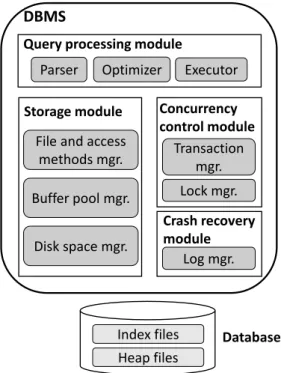
The main building blocks of a typical DBMS, as shown in Figure2.1, are thequery processing module,storagemodule,concurrency controlmodule andcrash recoverymodule. Each of the modules comprises several components whose roles we discuss next.
1 In this thesis, as well as in the database literature, termsrelationandtableare used interchangeably. 2 In this thesis we consider relational DBMS whenever referred to DBMS.
2.2. Components of a DBMS DBMS Index files Heap files Database Concurrency control module File and access
methods mgr. Buffer pool mgr.
Disk space mgr.
Storage module Concurrency
control module Transaction mgr. Lock mgr. Crash recovery module Log mgr.
Query processing module
Parser Optimizer Executor
Figure 2.1: Components of a DBMS
The query processing module, which is in charge of processing queries issued by the users, consists of aparser, aquery optimizerand aquery executor3. When a database user issues a query, the parser, as a first component in the query flow, is responsible for syntactically analyzing the query, making sure it is consistent with the databaseschema4. The parsed query is then sent to the query optimizer, which uses the properties of the relation algebra and information about how the data is stored to transform the query into an efficientquery execution plan(usually referred to as anoptimal plan5) for evaluating the query. A query execution plan is represented as a tree of relational operators. Upon receiving this plan, the query execution engine activates the chosen algorithms (the implementations of relational operators) to execute the query. The relational operators may require data from the storage module6.
The storage module comprises thefile and access methodslayer,buffer poolmanager, anddisk spacemanager. The file and access methods layer works withfiles, which, in a DBMS, are a collection ofpages. Two types of files are supported:heap files, or files of unordered pages, and 3 Many DBMS have an additional component between the query parser and the optimizer, called thequery rewriter, which is in charge of simplifying the query (e.g., nesting is unnested, query predicates are simplified, etc.). Nonetheless, the database literature often considers this component as part of the optimizer [142], hence we chose not to show it separately.
4 Database schema is a set of relations with their mutual relationships described throughforeign keys.
5 Although called anoptimal plan, there are many cases when the query optimizers actually do not manage to find the optimal plan. The last is due to the fact that the optimizers employ differentheuristicstoprunethe space of possible choices, missing thereby potentially optimal plans.
Chapter 2. A Look Inside the DBMS
indexesthat assume some form of ordering among pages. The buffer pool manager brings the pages in from disk to main memory as needed in response to page read requests, maintaining the illusion that a particular page resides in memory. The lowest layer of the DBMS software, the disk space manager, deals with management of space on disk, where the data is stored. Higher layers allocate, deallocate, read, and write pages through routines provided by this layer, while this layer works directly withblockson disk.
The DBMS provides concurrency control mechanisms by carefully scheduling and coordinat-ing user requests. DBMS components associated with concurrency control are thetransaction manager and thelockmanager. The transaction manager schedules the execution of transac-tions and ensures that transactransac-tions request and release locks according to a suitable locking protocol, while the lock manager keeps track of requests for locks and grants locks on database objects when they become available.
Lastly, the crash recovery module is responsible for maintaining a log of all database changes and restoring the system to a consistent state after a crash.
Since the work presented in this thesis is related mostly to the query processing module, we discuss its components in more detail in the following section.
3
Query Processing
Once entered into the query processing module, SQL queries are represented as trees of relational operators. The relational operators of a tree can be transformed in many ways (e.g. by applying commutativity or associativity on the operator inputs), and furthermore each relational operator has multiple algorithms to implement its logic. We discuss some of the operator implementations in Section3.3. The distinction between the logic of a relation operator (i.e., what it does) and its actual implementation (i.e., how it does it) is usually made through a notion oflogical operatorand its correspondingphysical operator. Having the last in mind, aquery execution plan1is defined as a tree of physical operators. The procedure of finding an efficient query execution plan for a given query is calledquery optimization.
3.1 Metadata information in the system catalog
In order to find the most efficient query execution plan, the query optimizer uses metadata information (i.e.,statistics) describing data characteristics to quantify thecost of different operator orderings and their physical implementations. The metadata information is stored in thesystem catalogof a DBMS discussed next.
A DBMS stores information about every table, index and view it contains in a special set of tables calledcatalog tablesthat together form the system catalog. Although the specific pieces of information kept by different systems may vary, overall there is a minimum set of information kept by every DBMS [203]. For each table, a DBMS stores: a) its table name, the file name in which data is stored and the file structure (e.g. is it a heap file or indexed), b) for each attribute of a table, its name and type, c) for each index on the table, its name, d) integrity constraints such as primary and foreign key constraints. For each index, its name, structure (e.g. B+ tree, or Hash) and the search key attributes are stored. Similarly, for each view a DBMS stores its name and definition. This metadata information is used during query parsing to check whether the query syntax is valid (e.g., whether all tables and attributes of the query exist in the database).
Chapter 3. Query Processing
Additionally, a DBMS maintainsstatisticsrepresenting data distributions of a table or an index. Statistics are a crucial component heavily exploited by the query optimizer, since the optimizer uses them directly during query compilation2to quantify alternative choices. The following information is commonly stored: a)table cardinality, defined as the number of tuples in a table, b)table size, defined as the number of pages the table occupies, c)index cardinality, defined as the number ofdistinctkey values of the table, d)index size, defined as the number of pages of an index, e)index height, defined as the number of non-leaf levels3for each tree index, f )index range, defined through a minimum and maximum present key value.
3.2 Query optimization
Query optimization is a crucial process in the query workflow, mostly because the perfor-mance of a given query greatly depends on the quality of the query optimizer; the difference in cost between the best and worst plan could be several orders of magnitude [142]. Query optimization is a two-step procedure [49] consisting of: a)plan enumerationin which alterna-tive plans are created through the transformations on the query tree, b)plan costingin which the cost of each alternative is derived4. The final output of query optimization is a plan with the smallest cost. In the following we discuss each phase in more detail.
3.2.1 Plan enumeration
Plan enumeration considers alternative plans that are allequivalent, i.e., they produce the same output for all possible inputs. Equivalence is maintained by respecting the rules of relational algebra. For instance, the join operation is commutative and associative, meaning that a join between tables A and B, defined as AxB always produces the same output as BxA. Similarly, associativity states that a three-table join (AxB)xC produces the same output as Ax(BxC). Therefore, any two of the plans (AxB)xC, (BxA)xC, (BxC)xA produce the same result, allowing the optimizer to consider all of them (and many more) when performing plan costing. Additionally, for each join operation, a number of physical join implementations is considered. Similarly, all available access paths are considered for each of the input relations. We discuss physical operators in Section3.3.
The space of possible plans generated for a query is calledsearch space. To narrow the search space, which is exponential in the number of relations [191], plan enumeration algorithms usually rely on Bellman’s Principle of Optimality [29], i.e., they generate an optimal tree for a
2 Query compilation timeis the time during which query optimization happens. Similarly, the database literature definesquery execution timeas the time during which the query is actually executed, i.e., query execution time follows query compilation time.
3 Non-leaf levels contain only search key values, while leaf levels of an index additionally contain pointers to actual tuples stored in the heap file.
4 Some DBMS interleave these two steps, i.e., they explore parts of the search space driven by the costing of so far considered (sub)plans.
3.2. Query optimization
set of relations by considering optimal sub-trees only. Depending on how algorithms explore the search space, they could roughly be divided into three groups5:
• Top-downapproaches produce plans by transforming the original tree into a new tree (i.e., plan). Top-down plan enumeration comes in two flavors: a) enumeration-based [77,88,89], and b) transformation-based algorithms [98,101,104,195,218]. In the former case, plan enumeration is carefully driven by the shape of the query tree (e.g. clique, star, chain, cyclic query etc.); (sub) plans are explored in the order decided by their children, i.e., subplans will be considered once their children are explored. In the transformation-based approaches, plan exploration is achieved through a set of transformations on the original plan. New plans come from applying commutativity and associativity over the existing plans.
Top-down approaches are attractive since they produce an initial plan fast (at each point in time a valid plan is considered and then refined) and are highly amenable for pruning (e.g., branch-and-bound pruning [77,90]). Their drawback is a high memory consumption attributed to the memoization procedure that keeps the memo structure containing all explored alternatives (including the sub-optimal ones) throughout the plan exploration lifetime. Furthermore, while easier to implement, transformation-based approaches are susceptible to generating duplicates [195].
• Bottom-upapproaches [115,171,179,180,215,245], originally proposed in System R [215], employ dynamic programming to build plans incrementally, i.e., they optimize single relations first, then using this information they optimize two-relation joins, then three-relation joins until they produce an optimal tree containing all relations of the query. Since at each point in time only optimal children of a plan are considered, no duplicates are generated. However, the time to produce a full plan is greater than the time to produce a full (but maybe not an optimal) plan with a top-down procedure. Moreover, plan pruning amenability of bottom-up approaches is much lower than the pruning amenability of the top-down algorithms, since with top-down the entire subtrees could be pruned out [77,90]. Due to algorithm complexity, this approach is viable up to ten-relation joins. For a greater number of tables common wisdom is to use heuristics or randomized approaches.
• Randomizedalgorithms consider plans as points in the search space; the points are connected through the edges that are defined by a set of moves [224]. The randomization is introduced in the way how the search space is explored. Iterative improvement [144,233] begins with a random point in the search space after which it moves through the points reachable by a single move. A plan with a lower cost than the starting point is chosen as a new start. Simulated annealing [145] is a variant of iterative improvement that avoids being trapped in a local minimum, by allowing the plan sampling to proceed even if the plan cost is higher than the plan cost of the starting plan. Random sampling 5 First two groups are deterministic algorithms, while the third one employs randomization.