Performance analysis and improvement
of PostgreSQL
Martin Lindblom, Fredrik Strandin
MASTER’S THESIS | LUND UNIVERSITY 2015
Department of Computer Science
Faculty of Engineering LTH
ISSN 1650-2884 LU-CS-EX 2015-01Performance analysis and improvement of
PostgreSQL
Martin Lindblom
[email protected]Fredrik Strandin
[email protected]January 21, 2015
Master’s thesis work carried out at
the Department of Computer Science, Lund University.
Supervisor: Jonas Skeppstedt,[email protected]
Abstract
PostgreSQL is a database management system, used in many different ap-plications throughout the industry. As databases often are the bottlenecks in the performance of applications, their performance becomes crucial. Better performance can either be achieved by using more and faster hardware, or by making the software more efficient.
In this master thesis we do a performance analysis of the PostgreSQL database server from the perspective of compiler optimizations, file systems and software prefetching.
We will also show how a data structure used in PostgreSQL can benefit from manually introducing software prefetching, as it is hard for the compiler to predict cache misses and insert prefetching instructions in a profitable way.
Acknowledgements
We would like to thank Jonas Skeppstedt for his excellent guidance during our work with this master thesis.
We would also like to thank Café Finn Ut for providing proper coffee. This thesis would have never been possible without them.
Contents
1 Introduction 7 1.1 Report structure . . . 7 1.2 Problem statement . . . 7 1.3 PostgreSQL introduction . . . 8 1.4 Compiler introduction . . . 8 1.4.1 Compilers . . . 8 1.4.2 Optimizing compilers . . . 81.5 File system introduction . . . 9
1.6 Prefetching . . . 10 1.7 Benchmarking . . . 10 1.8 Related work . . . 11 1.9 Contributions . . . 11 2 Approach 13 2.1 Benchmarking . . . 13 2.2 Compiler optimizations . . . 14 2.3 File systems . . . 14 2.4 Scaling . . . 15 2.5 Software prefetching . . . 15 3 Evaluation 17 3.1 Performance measurements . . . 17 3.2 Compiler optimizations . . . 17 3.2.1 Individual optimizations . . . 17
3.2.2 Cache misses between-O2and-O3. . . 18
3.3 File systems . . . 18
3.4 Scaling . . . 18
4 Discussion 25 4.1 Compiler optimizations . . . 25 4.1.1 Individual optimizations . . . 25 4.2 File systems . . . 26 4.3 Scaling . . . 27 4.4 Software prefetching . . . 28 5 Conclusions 29 Bibliography 31 Appendix A Code listings 35 A.1 Patch for xlog.c . . . 35
A.2 Linux: remove of prefetch . . . 36
Chapter 1
Introduction
In this report we will show how PostgreSQL performs under different file systems, compil-ers, and compiler optimizations. We will also present a proof of concept of using software prefetching to increase the performance of the PostgreSQL server. This chapter will give an introduction to the report’s structure and the subjects we will address in this thesis.
1.1
Report structure
We will begin this report with our problem statement that guided us during this Master Thesis, followed by an introduction to PostgreSQL, file systems, optimizing compilers and prefetching.
In the following chapters we will describe our process of evaluation and present our findings, reflections and conclusions. In the appendix we will describe our lab equipment and setup and also present a proof of concept to improve PostgreSQL’s performance.
1.2
Problem statement
In modern application development, database servers play a crucial part in the overall per-formance. To allow the databases to perform better, you can either optimize the database server, or modify the environment that the database server is running under.
The environment consists of both hardware, and software in the form of compiler en-vironment, file systems, operating systems, instruction set architecture, et cetera.
To study all of these aspects is not reasonable in a Master Thesis, and therefore we have formulated questions we want to answer. The two main questions we wanted to answer with this thesis are the following:
• Are there possibilities to improve the performance of PostgreSQL without making any changes in how PostgreSQL is designed?
• How much does the following environment aspects affect the performance of Post-greSQL?
– Compilers
– Compiler optimizations
– File systems
We will not go into greater detail about why different specific environments aspects affect the performance in certain ways. The design and implementation of file systems and optimizing compilers are both subjects of their own that take great amounts of effort to study and understand. Our time constraints did not allow us to study these subjects in detail.
1.3 PostgreSQL introduction
PostgreSQL is an object-relational database management system and runs on all major operating systems. It implements the majority of the SQL:2011 standard [16] and it is ACID-compliant. The transaction model is based on multi-version concurrency control to avoid locking issues and dirty reads.
The history of PostgreSQL started in the late 1970’s when its ancestor, Ingres, began as a project at the University of California, Berkeley. It has since then evolved and be-came PostgreSQL in 1996 when support for SQL was added. Today, PostgreSQL is an open source project that is maintained by the PostgreSQL Global Development Group, an international group of companies and individuals.
1.4 Compiler introduction
In this section we will introduce the compilers used in this study. We will also give an introduction to optimizing compilers, and how these are utilized.
1.4.1 Compilers
A compiler is used to turn human readable code into binary code that a computer can interpret. On Linux, which was the operating system used in the lab environment (see appendix B), the most common compilers areGNU Compiler Collection[6] (hereinafter calledGCC) andClang[4] (a C language family front end forLLVM).
1.4.2 Optimizing compilers
An optimizing compiler has the possibility to introduce changes in the code so that the speed increases for the computations performed by the compiled program. The changes introduced must not affect the result of these computations.
These optimizations are grouped intooptimization levelsby the different compiler ven-dors, for the convenience of the programmer. The optimization levels can be enabled by using one of the following compiler flags:
1.5 File system introduction
-O1 Enable simple optimizations
-O2 Enable most optimizations, but without involving a space-speed trade-off
-O3 Enable all standard compliant optimizations
Both GCC and Clang are optimizing compilers, and they have the same distinction
between the optimization levels. Both compilers also provides the possibility to select individual optimizations from any of these levels by specifying them with compiler flags.
1.5
File system introduction
A file system is a way of organizing how data is stored and retrieved. In our experiments we have focused on some popular file systems for locally attached block devices in the form ofhard disk drives(HDD) andsolid-state drives(SSD).
In our experiments we used the following file systems: • ext2
• ext4 • Btrfs • XFS
• ZFS On Linux
ext2 and ext4 are file systems of the same family, but from different generations. We were interested in seeing how and/or if the journaling added in ext3 (the generation before ext4) would affect the performance.
Btrfs is a file system developed by Oracle, Fujitsu and Red Hat, focusing on large scale storing. It has support for pooling, snapshots and checksums of data, and uses copy-on-write. It is a relatively new file system, considered stable by multiple Linux distributions since the summer of 2012 [3, 2]. The on-disk format became stable in August 2014 [1].
XFS is a relatively old file system, introduced in 1994 for IRIX. It has for its age support for advanced features like journaling.
ZFS is an advanced file system originally developed by Sun Microsystems, later ac-quired by Oracle. Due to licensing issues, the original implementation has not been ported to the Linux kernel. Instead a project was started to write a compatible implementation, calledZFS On Linux[5]. This implementation is still in its early stages, is not considered fully stable, and lacks optimizations. We chose to include it anyway, to see how it com-pares to more mature file systems. Throughout this document we will refer to ZFS On Linux as ZFS, if nothing else is stated.
1.6 Prefetching
In a modern computer there are multiple kinds of memory at different levels. These mem-ories work with different speeds and are of different sizes. Having the right data in the right place is vital for optimal performance.
The computers used for this thesis (see appendix B) have the following levels of mem-ory:
• CPU internal registers • L1, L2 and L3 caches • RAM memory
The number of instruction cycles needed for accessing memory increases about tenfold for every level, starting with one instruction cycle for accessing a CPU register. Trying to load data not stored in registers therefore becomes increasingly expensive depending on where it is first found.
To mitigate this, the system can instruct the memory management to fetch data prior to its usage. This is done either by hardware prefetching, or manual software prefetching. To increase the perceived speed of a CPU, manufacturers have developed hardware prefetching. Commonly these prefetching algorithms do stride analysis. If data is loaded from RAM with even strides, and cache misses occur, then the CPU prefetches the data with the same stride distance. This obviously only works when data is stored in a con-secutive part of memory, with a repeatable pattern between elements, for example in an array [9].
As there are multiple popular ways to store data in memory that do not use even spac-ing between elements, or are guaranteed to even use the same part of memory, there are software prefetching instructions available for most popular instruction sets/CPU architec-tures [10].
Adding software prefetching is not always beneficial though. It is hard to time the fetching correctly, and you risk dropping data from the cache that is actually more impor-tant to keep cached. The Linux kernel removed their use of software prefetching from their linked list implementation, as it was not beneficial in the majority of use cases [12].
Compilers can also insert software prefetching but they have problems performing analysis of recursive data structures i.e pointer-based data structures such as linked lists, trees, graphs et cetera. The fact that these structures are linked together with pointers is part of the problem. One cannot prefetch a future node before all intermediate nodes and the current node are fetched. This means that it is hard to hide the latency of fetching a future node, and this problem is described as thepointer-chaser problem[14].
1.7 Benchmarking
When benchmarking a database server there are a lot of functionality, use cases and work-flows that could be covered. But as it is not possible, nor effective, to test all possible cases, everyone has to decide which approach is best.
1.8 Related work
Another aspect of benchmarking databases is standardizations, so the results become comparable between different database servers and engines. Transaction Processing
Per-formance Council, hereinafterTPC, is a non-profit standardization organization for database
benchmarking, founded in 1988. Throughout the years they have published multiple bench-marks of different kinds.
PostgreSQL is distributed together with its own benchmarking program called pg-bench [19]. It is designed to test a scenario loosely based on the TPC-B benchmark, which is a benchmark designed to measure the throughput in terms of how many transac-tions per second a system can perform. The TPC-B benchmark is designed byTPC.
1.8
Related work
Sehgal et. al have evaluated file system performance, and found thatext2performs 20% worse thanext3andXFSwhen testing database workloads (Online Transaction Process-ing), due to fact that journaling improves random write performance [15].
Zhou et. al have done a study about the interplay between file systems and SSD per-formance. In contrast to Sehgal et. al’s findings, they found thatext2 performs well in comparison toext3 and that bothext2and ext3perform well in comparison to other file systems. Their results show thatext2performs very well with a database workload, but it is very dependent on block sizes. [21].
The reason behind the difference in ext2 performance between the reports could be that Zhou et. al tested on SSD disks, which performs well on random writes, and that the benchmarking methods are different.
We were not able to find any related work on the subject of memory cache misses in PostgreSQL.
1.9
Contributions
Chapter 2
Approach
The goal of this master thesis is to analyze PostgreSQL performance and behavior in dif-ferent environments and see if there is a possibility to improve the performance. We will examine PostgreSQL performance in three different perspectives:
• How optimizing compilers affects code performance • How different file systems affects PostgreSQL performance
• Can we improve PostgreSQL performance with the help of software prefetching? In this chapter we will describe how to benchmark PostgreSQL performance, followed by our approach when evaluating PostgreSQL from these previously mentioned aspects.
2.1
Benchmarking
We usedpgbenchfor benchmarking the database. Each transaction performed contains the following SQL commands:
1 BEGIN;
2 UPDATE pgbench_accounts SET abalance = abalance + :delta 3 WHERE aid = :aid;
4 SELECT abalance FROM pgbench_accounts 5 WHERE aid = :aid;
6 UPDATE pgbench_tellers SET tbalance = tbalance + :delta 7 WHERE tid = :tid;
8 UPDATE pgbench_branches SET bbalance = bbalance + :delta 9 WHERE bid = :bid;
10 INSERT INTO pgbench_history (tid, bid, aid, delta, mtime) 11 VALUES (:tid, :bid, :aid, :delta, CURRENT_TIMESTAMP); 12 END;
The variables in the transactions are decided at random.
The TPC-B benchmark is designed to stress test the core functionality of a database system and one could argue that the benchmark does not apply to the complex database
structures common in the industry of today. We use this benchmark because it is testing the core functionality, as we want to find performance improvements that could be applied to a wide range of the use cases of a database system.
In our lab environment we used two machines. One was used as the database server and the other machine was used to run the pgbench program issuing the queries over the network. This setup was used in order to avoid making the client’s querying to take CPU time from the database server. In this way we could have a larger number of clients connect to the database server without causing unrelated CPU load for the database server. This approach is recommended by the PostgreSQL Global Development Group [19]. For the hardware and software specifications of the lab equipment see appendix B.
2.2 Compiler optimizations
The PostgreSQL Global Development Group recommends GCC when compiling from source, but it is known that PostgreSQL can be built using a variety of compilers [18]. When PostgreSQL is installed from source it is built with the -O2 flag (see 1.4.2) as standard. This means that the compiler performs most optimizations that do not involve a space-speed trade-off [7].
We want to investigate whether there is a possibility to improve the performance if we compile under another optimization level. It is known that there is no guarantee that compiling under optimization level -O3 will improve performance. Therefore we will also study how PostgreSQL’s performance is affected when individual optimizations from the-O3group are enabled. Are there optimizations that have a heavy negative impact on the performance? If this is the case, they could be omitted, allowing other optimizations to improve the performance.
2.3 File systems
Figure 2.1: Partitions and file systems on Machine 1
sdb- Solid-state drive sdb1- extended partition sdb5- ext2, 40 GiB sdb6- ext4, 40 GiB sdb7- Btrfs, 40 GiB sdb8- XFS, 40 GiB sdb9- ZFS, 40 GiB
sdc- Hard disk drive
sdc1- extended partition sdc5- ext2, 345 GiB sdc6- ext4, 345 GiB sdc7- Btrfs, 350 GiB sdc8- XFS, 350 GiB sdc9- ZFS, 345 GiB
The partitions on disks were organized as seen in figure 2.1. The partitions on the SSD held the Write-Ahead Logs (WAL), which were symbolically linked into the corresponding folder on the HDD. Placing the WAL on the SSD avoids making disk I/O a performance bottleneck, as SSD disks are faster than regular HDD’s. The PostgreSQL documentation
2.4 Scaling
recommends this approach as writing to the WAL is the main source of PostgreSQL disk I/O [17].
2.4
Scaling
We are also interested in seeing how the file systems perform when we scale up the database size. We especially want to study what happens when the database size becomes larger than the RAM memory. Then PostgreSQL must reach disk memory, which will increase the read ratio from disk, and we want to study how the file systems handles these high read rates.
Withpgbenchit is easy to scale up the database size by using the-s(scale factor) option. We will test the file systems on four different scale factors:
• 100, which corresponds to a database size of ~1.5 GB • 1000, which corresponds to a database size of ~15 GB • 5000, which corresponds to a database size of ~75 GB • 10000, which corresponds to a database size of ~150 GB
Our lab equipment had a 64 GB RAM memory, so the database will be larger than the RAM memory when we use a scaling factor of ~4200 and larger.
We benchmarked the file systems 8 times om scale factor 100 and 1000, and 4 times on scale factor 5000 and 10000. The reason why we ran fewer times on the larger databases is due to the time needed to construct and set up those large data sets.
2.5
Software prefetching
Cache misses are measured with the help of Cachegrind [20]. Cachegrind is a part of the Valgrind tool package and it simulates the interaction between a program and a machine’s cache hierarchy. As our target machine has 3 cache-levels (see appendix B), Cachegrind simulates the first-level and the last-level caches [20]. Cache misses on intermediate levels are not simulated.
Chapter 3
Evaluation
In this chapter we will present the results of the benchmarks performed in the studies for this thesis.
3.1
Performance measurements
We measure the performance of PostgreSQL by running the benchmarking program pg-benchand see how manyTransactions Per Second(TPS) PostgreSQL can serve. In order to produce some stable results we letpgbenchrun for 60 minutes, this to allow caches to heat up and to average out noise. This is how the PostgreSQL Global Development Group recommends usingpgbench[19].
3.2
Compiler optimizations
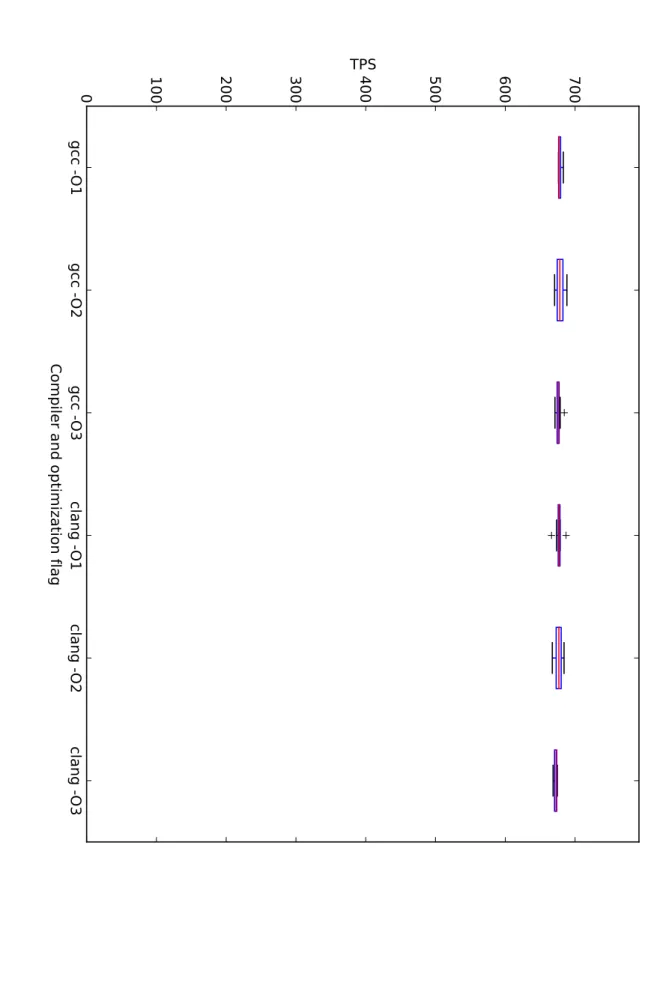
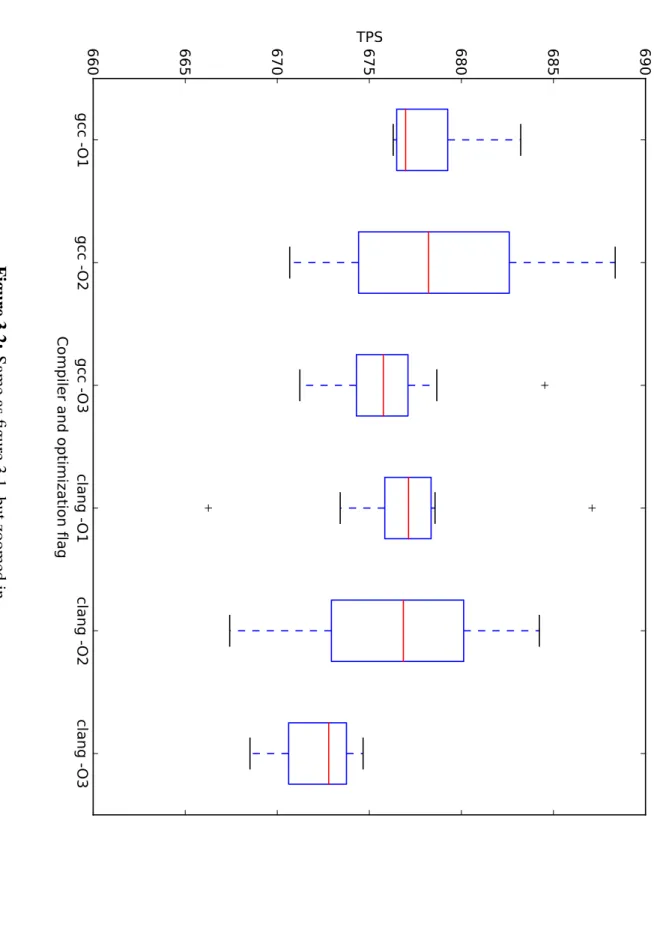
To study how PostgreSQL performs depending on compiler and optimization level, we let thepgbench program run eight times per compiler and optimization level. Figure 3.1 shows a box plot summarizing the results for theGCCcompiler andClangcompiler. The tests were carried out using theext4file system.
3.2.1
Individual optimizations
To study in more detail how PostgreSQL performs depending on the optimization level we let thepgbenchprogram run six times per individual flag from theO3optimization level. All of these tests were done using theGCCcompiler. Figure 3.3 shows a box plot summarizing these results.
3.2.2 Cache misses between
-O2
and
-O3
To further understand the difference in performance between optimization level 2 and 3, we analyzed the amount of instruction cache misses between the levels. Instruction cache misses are a regular problem when using -O3. Table 3.1 shows the average ratio of in-struction cache misses on the first and last cache levels.
Table 3.1: Cache instruction miss ratio for first and last cache levels.
Opt. level I1mr/Ir ILmr/Ir
-O2 0.0221 1.2386e−6
-O3 0.0233 1.3276e−6
The first column in table 3.1 shows the optimization levels. The second and third column shows the ratio of instruction cache read misses on the first and last cache level to the total amount of instructions read, respectively.
3.3 File systems
In this test we compiled PostgreSQL withGCCon optimization level 2 (-O2). Then we ran thepgbenchprogram eight times per file system as described in section 3.1. Figure 3.4 shows a box plot summarizing these results.
3.4 Scaling
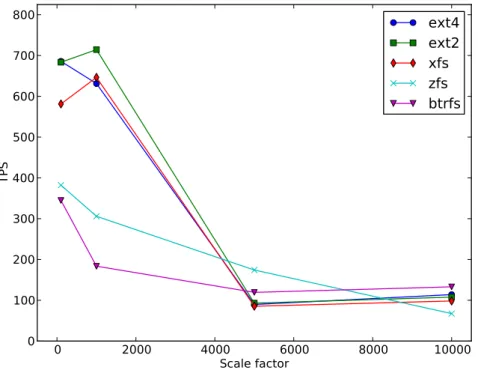
In fig. 3.5 we see the median results of benchmarking the file systems on different scale factors.
3.5 Software prefetching
When analyzing the PostgreSQL server with Cachegrind, we found some parts of the source code where cache misses were particularly present. One of the functions where the program had a particularly high amount of cache read misses wereXLogInsertin
xlog.c.
By reading through the code it came clear that XLogInsert does a CRC32 checksum calculation on data split up in parts stored in a linked list. Normally the CPU takes care of prefetching by doing stride analysis on cache misses. But because linked lists do not store data with equal distances between elements, it becomes impossible for the stride analysis to predict where the upcoming elements are stored in memory.
Therefore we decided to try and manually introduce software prefetching into Post-greSQL’s code inXLogInsert. We used the function__builtin_prefetching[8] that is provided by GCC and Clang, which on X86 architecture corresponds to theprefetchtX -instructions provided by the SSE instruction sets.
3.5 Software prefetching
In figure 3.6 we can see the impact of this change. There is a 0.54% performance increase on average. A patch-file with the changes is attached in appendix A.1.
gcc -O1
gcc -O2
gcc -O3
clang -O1
clang -O2
clang -O3
Compiler and optimization flag
0
100
200
300
TPS
400
500
600
700
Figur e 3.1: TPS results when P os tg reSQL is compiled with GCC and Clang on different optimization le vels3.5 Software prefetching
gcc -O1
gcc -O2
gcc -O3
clang -O1
clang -O2
clang -O3
Compiler and optimization flag
660
665
670
TPS
675
680
685
690
Figur e 3.2: Same as figure 3.1 ,but zoomed in.-ftree-vectorize -finline-functions -fpredictive-commoning -ftree-partial-pre -fgcse-after-reload -fvect-cost-model -funswitch-loops -fipa-cp-clone
Optimization flag
640 650 660TPS
670 680 690 700 Figur e 3.3: TPS results when P os tg reSQL is compiled under O2 and individual flags from the O3 optimization le vel3.5 Software prefetching ext2 ext4 xfs zfs btrfs Filesystem 0 100 200 300 400 500 600 700 TPS
Figure 3.4: PostgreSQL TPS on different file systems
0 2000 4000 6000 8000 10000 Scale factor 0 100 200 300 400 500 600 700 800 TPS
ext4
ext2
xfs
zfs
btrfs
Figure 3.5: Median TPS for different file system on different scale factors
pf nopf Prefetching/No prefetching 670 675 680 685 690 695 TPS
Chapter 4
Discussion
In this chapter we will do an in depth analysis of the results presented in the previous chapter.
4.1
Compiler optimizations
We notice that both compilers produce similar results. WithGCCwe make a slight perfor-mance gain if we compile on-O2compared to-O1. WithClangthere is an even slighter difference, but the other way around. All in all the difference between -O1and -O2 is negligible.
There is a performance loss if we compile with-O3 compared to-O1and-O2, for both compilers. EspeciallyClangperforms badly, with peak performance not even achiev-ing median performance for either-O1or-O2.
4.1.1
Individual optimizations
As we mentioned in the previous section, there is a noticeable performance loss between -O2level and the-O3level. As we can see in figure 3.3, the median level of the performance is around 670 transactions per second independent of what optimization flag we use, which is lower than if we compile with-O2alone.
The optimization with the lowest median TPS is-ftree-partial-pre, which is a more aggressive form of partial redundancy elimination (PRE). PRE introduces more machine instructions and could be introducing instruction cache misses to the program, decreasing the performance.
Another optimization with bad performance is-finline-functions, which is an optimization that declares that the compiler should consider all functions for inlining, and not just the ones declared inlined by the programmer.
Inlining functions means that the code size increases and code sections that used to fit in the cache could now have increased in size, thus causing cache misses and slowdowns. Secondly, as function inlining causes code duplication, this increases the instruction cache usage as duplicate copies may be stored in the cache, causing cache misses. Compilers use heuristics to select which functions to inline, but this method does not work in all cases.
In conclusion, all of the optimizations on level-O3decreases the performance of Post-greSQL and it is therefore not possible to omit some of the flags to gain a performance in-crease. The flags are either decreasing the performance e.g. -finline-functionsand
-ftree-partial-pre, or give very unreliable performance results e.g. -fgcse-after-reload and-fvect-cost-model. The performance loss introduced by -finline-functionsand-ftree-partial-preare most likely caused by instruc-tion cache misses, as indicated by the data in table 3.1. None of these flags reaches the median TPS we reach if we compile with-O2.
4.2 File systems
Our study show that selecting the right file system will have an impact on how well Post-greSQL will perform. We see that ZFS and btrfsperform bad, and the ext-file systems perform well.
ZFS’sbad performance is not surprising. ZFSon Linux is a project not yet fully stable,
and the originalZFSproject developed by Sun, was set out to create a file system with focus on data integrity and recoverability, with reduced performance as a trade-off [11].
The other file system that performs poorly isbtrfs, and one explanation could be that the file system is very new and still lacks some optimizations that the other file systems have.
Our study also shows that XFS is outperformed by the ext-systems. This is quite surprising as XFS is about the same age as ext2, and when it came out it was a high-performance file system with features unusual for the early 1990’s.
We can see that bothext2andext4 outperform the other file systems. This could be due to many reasons, for example, XFS is older than ext4 and it has a different kind of file structure. Or, it could be that the extfile systems are based on a simpler design and are therefore faster. In order to understand why XFS, ZFS andbtrfs are slower than the ext systems we have to look into the file system internals, which is out of scope for this project.
In fig. 4.1 we can see thatext4performs slightly better thanext2. Asext4implements journaling and journal checksumming, ext4 has several advantages over ext2, faster re-covery, better reliability and as our study shows, better performance. Together with the results forXFS(which also implements journaling) we can see that the performance does not depend on whether it supports journaling or not as much as we originally thought.
The great impact the choice of file system has on performance is attributed to the
Durability-aspect in having an ACID-compliant database server. The database server calls
fsync() after every change in the database, and before sending back an acknowledge-ment to the client, to assert durability of the query. fsync()is a system call to assert that changes to files are not just written to the RAM-cache, but also written to the actual block device. Normally the operating system does this asynchronically at regular intervals.
4.3 Scaling
ext2
ext4
Filesystem
670
675
680
685
690
695
700
TPS
Figure 4.1: PostgreSQL TPS performance on ext2 and ext4
4.3
Scaling
Our study show thatext2andext4perform better when the database is small, and thatbtrfs performs worst. When we use scaling factor 1000 we can observe a large performance in-crease for bothext4andxfs. This could be due to that the database size has become large enough to no longer suffer from update contention, that is that transactions are blocking each other when they are updating the database. This is however not the entire explana-tion as the database should be large enough to eliminate update contenexplana-tion, even on scale factor 100. If this contention existed we would have noticed a similar behavior on all file systems and not only on theext4andxfsfile systems. Further investigation of this bump in performance on these file systems is out of scope for this thesis.
We can also observe a large performance drop when we increase the scale factor to 5000. On this scale factor the database is too large to fit in RAM memory, sopostgres
must reach disk memory to access database content, which takes up to several millisec-onds. We can also notice thatZFSperforms significantly better than the other file systems on this scale factor.
When we use a scale factor of 10000 we see a slight increase in performance for all file systems exceptZFS. As we mentioned earlier,ZFSis not yet optimized and this could be the explanation behind this low performance on large databases. The explanation behind the slight increase in performance on the other file systems is out of scope for this thesis.
We can also notice thatbtrfsnow outperforms all other systems, and it could be due to the fact thatbtrfsis a more modern file system, designed to handle larger amounts of data.
4.4 Software prefetching
As seen in the results, software prefetching increases the performance when added in the right place. There are probably more data structures in PostgreSQL that would benefit from this kind of change. But finding places where this kind of optimizations are beneficial is time consuming, and needs great attention to details about the data structures and timing. Before considering introducing this change upstream, more testing is needed. Prefetch-ing is highly dependent on the hardware, especially the size of the CPU cache. If for ex-ample the software prefetching makes other data getting dropped from the cache in an unfavorable way, the change could instead be of harm for the overall performance.
Before we were able to find a beneficial solution, we had to try a couple of different solutions. One of these worked like the one previously used in the Linux kernel [12, 13] for linked lists. In Linux there is an implementation of linked lists, with helper macros for looping over the list. Before Linux 3.0 there was a prefetch-instruction in this macro so that the next item was supposed to be in the cache. But the overall performance was actually degraded. It is still possible to manually prefetch in certain locations if it is predicted to benefit the performance. The default behavior of prefetching was removed in 2011 [13] with the patch in appendix A.2.
The solution previously used by Linux was neither beneficial for PostgreSQL. But as we moved the prefetch instructions to an earlier stage, when the linked list is constructed, the computer got enough time to fetch the data and put it in the cache. During this stage the program had access to all pointers, and could therefore avoid the pointer-chaser problem usual for recursive data structures described in section 1.6.
Chapter 5
Conclusions
In theProblem statement, section 1.2, we stated the following questions:
• Are there possibilities to improve the performance of PostgreSQL without making any changes in how PostgreSQL is designed?
• How much does the following environment aspects affect the performance of Post-greSQL?
– Compilers
– Compiler optimizations
– File systems
The answer to the first question could be seen as an obvious yes. Most large code bases are open for optimizations, at least for some use cases. This is also the case for PostgreSQL, which we can prove with the proposed introduction of software prefetching in appendix A.1.
To answer the second question, all of the environment aspects mentioned do unsur-prisingly affect the performance of PostgreSQL. What we found interesting is how much the choice of file system affects the performance. Choosing the right file system over the wrong can almost double the number of transactions the database server can handle per second.
The compiler and compiler optimizations also affect the performance, but much less than the choice of file system. The single worst choice in regard to these aspects is to use
-O3optimization.
The best combination of choices in regard to the environment aspects we chose to study are the following:
Compiler optimizations: -O2
Bibliography
[1] BTRFS Wiki Main Page – Stability Status. https://btrfs.wiki.kernel.
org/index.php/Main_Page#Stability_status, (accessed: December 3, 2014).
[2] Fedora Project Wiki – Btrfs. http://fedoraproject.org/wiki/Btrfs,
(accessed: December 3, 2014).
[3] Release Notes for SUSE Linux Enterprise Server 11 Service Pack 2 – 3.1.1.
Support for the btrfs File System. http://www.novell.com/linux/
releasenotes/x86_64/SUSE-SLES/11-SP2/#fate-306585, (ac-cessed: December 3, 2014).
[4] clang: a C language family frontend for LLVM. http://clang.llvm.org/,
(accessed: December 6, 2014).
[5] ZFS on Linux. http://zfsonlinux.org/, (accessed: December 6, 2014).
[6] Free Software Foundation, Inc. GCC, the GNU Compiler Collection. https:// gcc.gnu.org/, (accessed: December 6, 2014).
[7] Free Software Foundation, Inc. GCC 4.8.3 Manual Chapter 3.10. Options That
Control Optimization. https://gcc.gnu.org/onlinedocs/gcc-4.8.
3/gcc/Optimize-Options.html, (accessed: November 18, 2014).
[8] Free Software Foundation, Inc. GCC 4.8.3 Manual Chapter 6.55. Other
Built-in Functions Provided by GCC. https://gcc.gnu.org/onlinedocs/
gcc-4.8.3/gcc/Other-Builtins.html, (accessed: November 20, 2014). [9] Intel Corporation.Intel®64 and IA-32 Architectures Optimization Reference Manual,
ch. 3.7.2. Number 248966-030. September 2014.
[10] Intel Corporation.Intel®64 and IA-32 Architectures Optimization Reference Manual,
[11] Jeff Bonwick, Matt Ahrens, Val Henson, Mark Maybee, Mark Shellenbaum. The zettabyte file system. Technical report, 2003.
[12] Jonathan Corbet. The problem with prefetch. http://lwn.net/Articles/ 444336/, (accessed: December 12, 2014).
[13] Linus Torvalds. list: remove prefetching from regular list iterators. https: //git.kernel.org/cgit/linux/kernel/git/torvalds/linux. git/commit/?id=e66eed651fd18a961f11cda62f3b5286c8cc4f9f, (accessed: December 15, 2014).
[14] Chi-Keung Luk and Todd C. Mowry. Compiler-based prefetching for recursive data structures. InProceedings of the Seventh International Conference on Architectural
Support for Programming Languages and Operating Systems, 1996.
[15] Priya Sehgal, Vasily Tarasov, and Erez Zadok. Evaluating performance and energy in file system server workloads. InFAST’10 Proceedings of the 8th USENIX conference
on File and storage technologies, 2010.
[16] The PostgreSQL Global Development Group. PostgreSQL 9.3.5 Documentation
-Appendix D. SQL Conformance. http://www.postgresql.org/docs/9.
3/static/features.html.
[17] The PostgreSQL Global Development Group. PostgreSQL 9.3.5 Documentation
-Chapter 29.5. WAL Internals. http://www.postgresql.org/docs/9.3/
static/wal.html, (accessed: November 17, 2014).
[18] The PostgreSQL Global Development Group. PostgreSQL 9.3.5 Documentation
-Chapter 15.2. Requirements. http://www.postgresql.org/docs/9.3/
static/install-requirements.html, (accessed: November 18, 2014). [19] The PostgreSQL Global Development Group. PostgreSQL 9.3.5
Documenta-tion Chapter G.1. pgbench. http://www.postgresql.org/docs/9.3/
static/pgbench.html, (accessed: November 19, 2014).
[20] Valgrind Developers. Valgrind User Manual Chapter 5. Cachegrind: a cache
and branch-prediction profiler. http://valgrind.org/docs/manual/
cg-manual.html, (accessed: November 20, 2014).
[21] Ke Zhou, Ping Huang, Chunhua Li, and Hua Wang. An empirical study on the inter-play between filesystems and ssd. In2012 IEEE Seventh International Conference
Appendix A
Code listings
A.1
Patch for xlog.c
1 diff --git a/src/backend/access/transam/xlog.c b/src/backend/access/transam/xlog.c
2 index 164b22f..25e410b 100644
3 --- a/src/backend/access/transam/xlog.c 4 +++ b/src/backend/access/transam/xlog.c 5 @@ -838,6 +838,10 @@ begin:;
6 elog(PANIC, "can backup at most %d blocks per xlog record",
7 XLR_MAX_BKP_BLOCKS);
8 }
9 +
10 + /* Prefetch data for usage in COMP_CRC32 later on. */ 11 + __builtin_prefetch(rdt->data, 0, 1);
12 +
13 /* Break out of loop when rdt points to last chain item */ 14 if (rdt->next == NULL) 15 break; 16 @@ -889,6 +893,9 @@ begin:; 17 rdt->len = sizeof(BkpBlock); 18 write_len += sizeof(BkpBlock); 19
20 + /* Prefetch data for usage in COMP_CRC32 later on. */ 21 + __builtin_prefetch(rdt->data, 0, 1); 22 + 23 rdt->next = &(dtbuf_rdt2[i]); 24 rdt = rdt->next; 25 26 @@ -906,6 +913,9 @@ begin:; 27 rdt->len = bkpb->hole_offset; 28 write_len += bkpb->hole_offset; 29
30 + /* Prefetch data for usage in COMP_CRC32 later on. */ 31 + __builtin_prefetch(rdt->data, 0, 1); 32 + 33 rdt->next = &(dtbuf_rdt3[i]); 34 rdt = rdt->next; 35 36 @@ -914,6 +924,9 @@ begin:; 37 write_len += rdt->len; 38 rdt->next = NULL; 39 }
40 +
41 + /* Prefetch data for usage in COMP_CRC32 later on. */ 42 + __builtin_prefetch(rdt->data, 0, 1);
43 }
44
45 /*
Listing 1: Patch that adds prefetching into the XLogInsert -function inxlog.c. This patch is based on the tagREL9_3_5
in the official PostgreSQL git repository.
A.2
Linux: remove of prefetch
1 From e66eed651fd18a961f11cda62f3b5286c8cc4f9f Mon Sep 17 00:00:00 2001 2 From: Linus Torvalds <[email protected]>
3 Date: Thu, 19 May 2011 14:15:29 -0700
4 Subject: [PATCH] list: remove prefetching from regular list iterators 5
6 This is removes the use of software prefetching from the regular list 7 iterators. We don't want it. If you do want to prefetch in some 8 iterator of yours, go right ahead. Just don't expect the iterator to do 9 it, since normally the downsides are bigger than the upsides.
10
11 It also replaces <linux/prefetch.h> with <linux/const.h>, because the 12 use of LIST_POISON ends up needing it. <linux/poison.h> is sadly not 13 self-contained, and including prefetch.h just happened to hide that. 14
15 Suggested by David Miller (networking has a lot of regular lists that 16 are often empty or a single entry, and prefetching is not going to do 17 anything but add useless instructions).
18
19 Acked-by: Ingo Molnar <[email protected]>
20 Acked-by: David S. Miller <[email protected]> 21 Cc: [email protected]
22 Signed-off-by: Linus Torvalds <[email protected]> 23
---24 include/linux/list.h | 26 +++++++++++---25 include/linux/rculist.h | 6
+++---26 2 files changed, 14 insertions(+), 18 deletions(-) 27
28 diff --git a/include/linux/list.h b/include/linux/list.h
29 index 9ac1114..cc6d2aa 100644 30 --- a/include/linux/list.h 31 +++ b/include/linux/list.h 32 @@ -4,7 +4,7 @@ 33 #include <linux/types.h> 34 #include <linux/stddef.h> 35 #include <linux/poison.h> 36 -#include <linux/prefetch.h> 37 +#include <linux/const.h> 38 39 /*
40 * Simple doubly linked list implementation.
41 @@ -367,18 +367,15 @@ static inline void list_splice_tail_init(struct list_head *list, 42 * @head: the head for your list.
43 */
44 #define list_for_each(pos, head) \
45 - for (pos = (head)->next; prefetch(pos->next), pos != (head); \ 46 - pos = pos->next)
47 + for (pos = (head)->next; pos != (head); pos = pos->next) 48
49 /**
50 * __list_for_each - iterate over a list
51 * @pos: the &struct list_head to use as a loop cursor. 52 * @head: the head for your list.
A.2 Linux: remove of prefetch
53 *
54 - * This variant differs from list_for_each() in that it's the 55 - * simplest possible list iteration code, no prefetching is done. 56 - * Use this for code that knows the list to be very short (empty 57 - * or 1 entry) most of the time.
58 + * This variant doesn't differ from list_for_each() any more. 59 + * We don't do prefetching in either case.
60 */
61 #define __list_for_each(pos, head) \
62 for (pos = (head)->next; pos != (head); pos = pos->next)
63 @@ -389,8 +386,7 @@ static inline void list_splice_tail_init(struct list_head *list, 64 * @head: the head for your list.
65 */
66 #define list_for_each_prev(pos, head) \
67 - for (pos = (head)->prev; prefetch(pos->prev), pos != (head); \ 68 - pos = pos->prev)
69 + for (pos = (head)->prev; pos != (head); pos = pos->prev) 70
71 /**
72 * list_for_each_safe - iterate over a list safe against removal of list entry 73 @@ -410,7 +406,7 @@ static inline void list_splice_tail_init(struct list_head *list, 74 */
75 #define list_for_each_prev_safe(pos, n, head) \ 76 for (pos = (head)->prev, n = pos->prev; \ 77 - prefetch(pos->prev), pos != (head); \ 78 + pos != (head); \
79 pos = n, n = pos->prev) 80
81 /**
82 @@ -421,7 +417,7 @@ static inline void list_splice_tail_init(struct list_head *list, 83 */
84 #define list_for_each_entry(pos, head, member) \ 85 for (pos = list_entry((head)->next, typeof(*pos), member); \ 86 - prefetch(pos->member.next), &pos->member != (head); \ 87 + &pos->member != (head); \
88 pos = list_entry(pos->member.next, typeof(*pos), member)) 89
90 /**
91 @@ -432,7 +428,7 @@ static inline void list_splice_tail_init(struct list_head *list, 92 */
93 #define list_for_each_entry_reverse(pos, head, member) \ 94 for (pos = list_entry((head)->prev, typeof(*pos), member); \ 95 - prefetch(pos->member.prev), &pos->member != (head); \ 96 + &pos->member != (head); \
97 pos = list_entry(pos->member.prev, typeof(*pos), member)) 98
99 /**
100 @@ -457,7 +453,7 @@ static inline void list_splice_tail_init(struct list_head *list, 101 */
102 #define list_for_each_entry_continue(pos, head, member) \
103 for (pos = list_entry(pos->member.next, typeof(*pos), member); \ 104 - prefetch(pos->member.next), &pos->member != (head); \ 105 + &pos->member != (head); \
106 pos = list_entry(pos->member.next, typeof(*pos), member)) 107
108 /**
109 @@ -471,7 +467,7 @@ static inline void list_splice_tail_init(struct list_head *list, 110 */
111 #define list_for_each_entry_continue_reverse(pos, head, member) \ 112 for (pos = list_entry(pos->member.prev, typeof(*pos), member); \ 113 - prefetch(pos->member.prev), &pos->member != (head); \ 114 + &pos->member != (head); \
115 pos = list_entry(pos->member.prev, typeof(*pos), member)) 116
117 /**
118 @@ -483,7 +479,7 @@ static inline void list_splice_tail_init(struct list_head *list, 119 * Iterate over list of given type, continuing from current position.
120 */
121 #define list_for_each_entry_from(pos, head, member) \ 122 - for (; prefetch(pos->member.next), &pos->member != (head); \
123 + for (; &pos->member != (head); \
124 pos = list_entry(pos->member.next, typeof(*pos), member)) 125
126 /**
127 diff --git a/include/linux/rculist.h b/include/linux/rculist.h
128 index 900a97a..e3beb31 100644
129 --- a/include/linux/rculist.h 130 +++ b/include/linux/rculist.h
131 @@ -253,7 +253,7 @@ static inline void list_splice_init_rcu(struct list_head *list, 132 */
133 #define list_for_each_entry_rcu(pos, head, member) \
134 for (pos = list_entry_rcu((head)->next, typeof(*pos), member); \ 135 - prefetch(pos->member.next), &pos->member != (head); \ 136 + &pos->member != (head); \
137 pos = list_entry_rcu(pos->member.next, typeof(*pos), member)) 138
139
140 @@ -270,7 +270,7 @@ static inline void list_splice_init_rcu(struct list_head *list, 141 */
142 #define list_for_each_continue_rcu(pos, head) \
143 for ((pos) = rcu_dereference_raw(list_next_rcu(pos)); \ 144 - prefetch((pos)->next), (pos) != (head); \ 145 + (pos) != (head); \
146 (pos) = rcu_dereference_raw(list_next_rcu(pos))) 147
148 /**
149 @@ -284,7 +284,7 @@ static inline void list_splice_init_rcu(struct list_head *list, 150 */
151 #define list_for_each_entry_continue_rcu(pos, head, member) \ 152 for (pos = list_entry_rcu(pos->member.next, typeof(*pos), member); \ 153 - prefetch(pos->member.next), &pos->member != (head); \ 154 + &pos->member != (head); \
155 pos = list_entry_rcu(pos->member.next, typeof(*pos), member)) 156
157 /** 158 --159 2.1.3
Listing 2: The patch with which prefetching was removed from Linux implementation of linked lists.
Appendix B
Environment setup
During the experiments we used two machines with the setup described in table B.1.
Table B.1: Hardware and software specifications for lab-equipment.
Machine 1 Machine 2
CPU Intel Core i7-3930K @ 3.2 GHz Intel Core i7 @ 2.93 GHz
RAM 64 GB 16 GB
OS Fedora 20 Mageia 4
Linux kernel 3.16.6 3.14.18
SSD INTEL SSDSC2BW24 N/A
HDD WDC WD2003FZEX 7200 RPM WDC WD5000AAKS 7200 RPM
Machine 1was used as the database server andMachine 2was used to run thepgbench
program issuing the queries over the network.
Throughout the project we used the following versions of the compilers: • GCC 4.8.3
PostgreSQL är en populär databasserver som används i stora delar av industrin.
Databasservrar används för att lagra, bearbeta och hämta uppgifter åt t.ex.
fö-retag, organisationer och universitet som de förlitar sig på i sitt arbete. Ofta blir
dock dessa databaser flaskhalsen i hur snabbt arbete kan utföras, och därför har vi
analyserat och förbättrat en populär databasserver.
Vad är det då som påverkar prestanda, och vad är enkelt att påverka? Vi har i vårt arbete valt att titta på två fak-torer. Den första är filsystemet - hur informationen är lagrad på hårddisken. Det finns en uppsjö med filsystem som vänder sig till olika behov, vissa är väldigt enkla, andra har extremt komplicerade funktioner för att vara säker på att ens filer inte förstörs eller råkar försvinna. Det man ser här är att ju fler funktioner, desto långsam-mare blir filsystemen - i de flesta fallen. Dock fann vi ett undantag från denna regel i filsystemet ext4, som preste-rade bättre än sin föregångare ext2, trots nya funktioner som till exempel journalföring.
Den andra aspekten vi tittade på var kompilatorer och de optimeringar som de kan göra. En kompilator är det verktyg som översätter programmerarens kod till en binärfil - ettor och nollor som datorn kan förstå. I samband med detta kan kompilatorn göra optimeringar i programmet som gör att koden kör snabbare. Alla ty-per av optimeringar är dock inte bra för alla program, då olika program beter sig på olika sätt. Därför har man lagt optimeringarna i olika nivåer beroende på hur ag-gressivt de optimerar. Aggressiva optimeringar kan öka kodstorleken vilket kan försämra prestandan. Det finns även ett flertal olika kompilatorer som beter sig olika, där vi har valt att jämföra GCC och Clang. GCC är mer än 15 år äldre än Clang, vilket har sina för- och nackdelar. GCC är dåligt strukturerad vilket gör det svårt för utvecklarna att lägga till nya funktioner, men har å andra sidan använts väldigt länge och därmed
blivit mer mogen. Det senare syntes tydligt i våra re-sultat som visade på att GCC fortfarande producerar bättre och snabbare program. Vår studie visar också att PostgreSQL är ett program som presterar bäst om man inte optimerar allt för aggressivt.
Vi ville också se om vi kunde få PostgreSQL att bli snabbare genom att ändra i koden. För att göra detta utnyttjar vi att moderna datorer har buffertar mellan arbetsminnet och processorn. Dessa buffertar kallas för cacheminnen och är extremt snabba att jobba med, men små eftersom dom är dyra att tillverka. Därför kan man hjälpa datorn att välja vad som ska hämtas in i cachen härnäst, så att den data man vill jobba med ligger redo att användas när den behövs. Dock är detta riskfyllt, och kräver att man har full koll på hur lång tid det tar att hämta datan. Gör man det för sent hjälper det inte, och ger konstiga effekter i cacheminnet som påverkar senare beräkningar negativt. Gör man det för tidigt så riske-rar datan att skrivas över igen innan den ska användas. Efter analys av hur PostgreSQL beter sig, och hur det är skrivet, kunde vi slutligen hitta en del av koden där vi kunde ge denna typ av hjälp till datorn så att Post-greSQL blev 0.5% snabbare.
Sammanfattningsvis kan vi konstatera att Post-greSQL presterar bäst på ext4-filsystem, kompilerad med GCC på optimeringsnivå 2, samt att PostgreSQL kan fördelaktigt tipsa processorn om vad för data som ska användas.
STUDENTER Martin Lindblom, Fredrik Strandin
HANDLEDARE Jonas Skeppstedt (LTH)
EXAMINATOR Per Andersson (LTH)