Stergioulas, A and Johnson, MI (2008) A systematic review with procedural assessments and
meta-analysis of low level laser therapy in lateral elbow tendinopathy (tennis elbow). BMC musculoskeletal
disorders, 9. 75 - ?. DOI: https://doi.org/10.1186/1471-2474-9-75
Link to Leeds Beckett Repository record:
http://eprints.leedsbeckett.ac.uk/1070/
Document Version:
Article
Creative Commons: Attribution 3.0
The aim of the Leeds Beckett Repository is to provide open access to our research, as required by
funder policies and permitted by publishers and copyright law.
The Leeds Beckett repository holds a wide range of publications, each of which has been
checked for copyright and the relevant embargo period has been applied by the Research Services
team.
We operate on a standard take-down policy.
If you are the author or publisher of an output
and you would like it removed from the repository, please
contact us
and we will investigate on a
case-by-case basis.
Open Access
Research article
A systematic review with procedural assessments and
meta-analysis of Low Level Laser Therapy in lateral elbow
tendinopathy (tennis elbow)
Jan M Bjordal*
1,2, Rodrigo AB Lopes-Martins
3, Jon Joensen
1,2,
Christian Couppe
4, Anne E Ljunggren
2, Apostolos Stergioulas
5and
Mark I Johnson
6Address: 1Institute of Physiotherapy, Faculty of Health and Social Sciences, Bergen University College, Moellendalsvn. 6, 5009 Bergen, Norway, 2Department of Public Health and Primary Health Care, Section of Physiotherapy Science University of Bergen, Kalfarveien 31, 5018 Bergen, Norway, 3Department of Pharmacology, Institute of Biomedical Sciences, University of São Paulo. Av. Prof. Lineu Prestes, 1524, Butantan, 05508-900São Paulo – SP, Brazil, 4University of Copenhagen – Institute of Sportsmedicine, Bispebjerg Hospital, Bispebjerg Bakke 23, 2400 Copenhagen NV, Denmark, 5Faculty Human Movement & Quality Life, University of Peloponnese, 23100 Sparta, Greece and 6Faculty of Health, Centre for Pain Research, Leeds Metropolitan University, Leeds, LS2 8AJ, UK
Email: Jan M Bjordal* - [email protected]; Rodrigo AB Lopes-Martins - [email protected]; Jon Joensen - [email protected];
Christian Couppe - [email protected]; Anne E Ljunggren - [email protected]; Apostolos Stergioulas - [email protected]; Mark I Johnson - [email protected]
* Corresponding author
Abstract
Background: Recent reviews have indicated that low level level laser therapy (LLLT) is ineffective in lateral elbow tendinopathy (LET) without assessing validity of treatment procedures and doses or the influence of prior steroid injections.
Methods: Systematic review with meta-analysis, with primary outcome measures of pain relief and/or global improvement and subgroup analyses of methodological quality, wavelengths and treatment procedures.
Results: 18 randomised placebo-controlled trials (RCTs) were identified with 13 RCTs (730 patients) meeting the criteria for meta-analysis. 12 RCTs satisfied half or more of the methodological criteria. Publication bias was detected by Egger's graphical test, which showed a negative direction of bias. Ten of the trials included patients with poor prognosis caused by failed steroid injections or other treatment failures, or long symptom duration or severe baseline pain. The weighted mean difference (WMD) for pain relief was 10.2 mm [95% CI: 3.0 to 17.5] and the RR for global improvement was 1.36 [1.16 to 1.60]. Trials which targeted acupuncture points reported negative results, as did trials with wavelengths 820, 830 and 1064 nm. In a subgroup of five trials with 904 nm lasers and one trial with 632 nm wavelength where the lateral elbow tendon insertions were directly irradiated, WMD for pain relief was 17.2 mm [95% CI: 8.5 to 25.9] and 14.0 mm [95% CI: 7.4 to 20.6] respectively, while RR for global pain improvement was only reported for 904 nm at 1.53 [95% CI: 1.28 to 1.83]. LLLT doses in this subgroup ranged between 0.5 and 7.2 Joules. Secondary outcome measures of painfree grip strength, pain pressure threshold, sick leave and follow-up data from 3 to 8 weeks after the end of treatment, showed consistently
Published: 29 May 2008
BMC Musculoskeletal Disorders 2008, 9:75 doi:10.1186/1471-2474-9-75
Received: 29 January 2008 Accepted: 29 May 2008
This article is available from: http://www.biomedcentral.com/1471-2474/9/75 © 2008 Bjordal et al; licensee BioMed Central Ltd.
significant results in favour of the same LLLT subgroup (p < 0.02). No serious side-effects were reported.
Conclusion: LLLT administered with optimal doses of 904 nm and possibly 632 nm wavelengths directly to the lateral elbow tendon insertions, seem to offer short-term pain relief and less disability in LET, both alone and in conjunction with an exercise regimen. This finding contradicts the conclusions of previous reviews which failed to assess treatment procedures, wavelengths and optimal doses.
Background
Lateral elbow tendinopathy (LET) or "tennis elbow" is a common disorder with a prevalence of at least 1.7% [1], and occuring most often between the third and sixth dec-ades of life. Physical strain may play a part in the develop-ment of LET, as the dominant arm is significantly more often affected than the non-dominant arm. The condition is largely self-limiting, and symptoms seem to resolve between 6 and 24 months in most patients [2].
A number of interventions have been suggested for LET. Steroid injections, non-steroidal anti-inflammatory drugs or a regimen of physiotherapy with various modalities, seem to be the most commonly applied treatments [3]. However, treatment effect sizes seem to be rather small, and recommendations have varied over the years. In sev-eral systematic reviews over the last decade [4,5], gluco-corticoid steroid injections have been deemed effective, at least in the short-term. But in later well-designed trials evi-dence is found that intermediate and long-term effects of steroid injections groups yield consistently and signifi-cantly poorer outcomes than placebo injection groups, and physiotherapy or wait-and-see groups [6,7]. Never-theless, steroid injections have been considered as the most thoroughly investigated intervention, with 13 rand-omized controlled trials comparing steroid injections to either placebo/local anaesthetic or another type of inter-vention [5]. Non-steroidal anti-inflammatory drugs (NSAIDs) have been found to achieve smaller short-term effect sizes than steroid injections [8], and topical applica-tion seems to be the best medicaapplica-tion administraapplica-tion route [8] For oral administration of NSAIDs for LET, evidence is inconclusive from two heterogeneous trials only [9]. The positive short-term results of anti-inflammatory therapies in LET appear to partly contradict the recent paradigm in tendinopathy research, where LET is thought to be mainly a degenerative disorder with minimal inflammation [10,11].
Exercise therapy and stretching exercises have been used either alone or in conjunction with manipulation tech-niques or physical interventions. Although the sparse evi-dence makes it difficult to assess the separate effect of active exercises or stretching [12], four studies have found that either exercises alone [13], or in conjunction with a
physiotherapy package, are more effective than placebo ultrasound therapy or wait-and-see controls. Also exercise therapy, particularly eccentric exercises, have been found effective in the intermediate term in tendinopathies of the Achilles, patellar or shoulder tendons [14-17]. There is some evidence suggesting that joint manipulation or mobilisation techniques either of the wrist, elbow or cer-vical spine may contribute to short-term effects in LET [18-20].
Among the physical interventions, ultrasound therapy has been considered to offer a small benefit over placebo from two small trials [12], but a well-designed and more recent trial did not find significant effects of ultrasound therapy in LET [21]. Reviewers have arrived at different conclu-sions for the effect of acupuncture [22,23]. In reviews of physical interventions for LET, conclusions may vary between reviews because of differences in the treatment procedures. A good example of this is the negative conclu-sion of the LET review for extracorporeal shockwave ther-apy (ESWT) by Buchbinder et al. [24], where a later review with in-depth assessments of treatment intervention pro-tocols [25], found that a subgroup of trials with proper treatment procedures and adequate timing of outcomes gave a positive result.
and could be induced by all wavelengths between 630 and 1064 nm with slight variations in therapeutic dose-ranges according to the wavelength used. The anti-inflammatory effect was seen in higher therapeutic dose-ranges than the biomodulatory effect on fibroblast cells and collagen fibre production. Diagnostic ultrasonography of tendinopa-thies has revealed that partial ruptures and tendon matrix degeneration are underdiagnosed if only physical exami-nations are made. Consequently, the stimulatory LLLT-effect on collagen fibre production should probably be beneficial for tendon repair. Another interesting feature was that LLLT with too high power densities or doses (above 100 mW/cm2), seemed to inhibit fibroblast
activ-ity [29] and collagen fibre production [30]. Six years ago we showed in a systematic review of tendinopathy, that the effect of LLLT is dose-dependent [31]. At the time, the accompanying editoral suggested that the advanced review design could become the new standard for review-ing empirical therapies with unknown optimal doses and procedural differences [32]. Steroids induce a down-regu-lation of cortisol receptors, and we recently discovered that the cortisol antagonist mifepristone completely diminished the anti-inflammatory effect of LLLT [33]. All these recent findings from the LLLT literature, prompted the World Association for Laser Therapy (WALT) to pub-lish dosage recommendations and standards for the con-ductance of systematic reviews and meta-analyses last year [34]. One of the issues that has lacked attention is the validity of LLLT-application procedures in tendinopathy. To our knowledge there are only three valid irradiation techniques for LLLT in tendinopathies: a) direct irradia-tion of the tendon, b) irradiairradia-tion of trigger points and c) irradiation of acupuncture points.
In this perspective and as our previous tendinopathy review [31] is becoming outdated, there seems to be a need for a new in-depth review of the effects of LLLT in LET where possible confounders are analyzed and sub-group analyses are performed.
Methods
Literature searchA literature search was performed on Medline, Embase, Cinahl, PedRo and the Cochrane Controlled Trial Register as advised by Dickersin et al. [35] for randomised control-led clinical trials. Key words were: Low level laser therapy OR low intensity laser therapy OR low energy laser ther-apy OR phototherther-apy OR HeNe laser OR IR laser OR GaAlAs OR GaAs OR diode laser OR NdYag, AND tendo-nitis OR lateral epicondylitis OR lateral epicondylopathy OR tennis elbow OR elbow tendonitis OR lateral epi-condylalgia OR extensor carpi radialis tendonitis. Hand-searching was also performed in national physiotherapy and medical journals from Norway, Denmark, Sweden,
Holland, England, Canada and Australia. Additional information was gathered from researchers in the field.
Inclusion criteria
The randomised controlled trials were subjected to the following seven inclusion criteria:
1) Diagnosis: Lateral elbow tendinopathy, operational-ised as pain from the lateral elbow epicondyle upon finger or wrist extension
2) Treatment: LLLT with wavelengths in the range 632 – 1064 nm, irradiating either the tendon pathology, acu-puncture points or trigger points
3) Design: Randomised parallel group design or crossover design
4) Blinding: Outcome assessors should be blinded
5) Control group: Placebo control groups or control groups receiving other non-laser interventions with at least 10 persons per group
6) Specific endpoints for pain intensity or global improve-ment of health measured within 1 – 52 weeks after inclu-sion.
Outcome measures
Primary outcome measures
measured after the end of treatment, either as:
a) pain intensity on a 100 mm visual analogue scale (VAS) defined as the pooled estimate of the difference in change between the means of the treatment and the placebo con-trol groups, weighted by the inverse of the pooled stand-ard deviation of change for each study, i.e. weighted mean difference (WMD) of change between groups. The vari-ance was calculated from the trial data and given as 95% confidence intervals [95% CI] in mm on VAS, or
b) improved global health status. This was defined as any one of the following categories: "improved", "good", "bet-ter", "much improved", "pain-free", "excellent". The num-bers of "improved" patients were then pooled to calculate the relative risk for change in health status. A statistical software package (Revman 4.2) was used for calculations.
Secondary outcome measures
c) painfree grip strength (dynamometer, vigorimeter)
d) pain pressure threshold (algometer)
f) follow-up results at more than 1 week after the end of treatment for pain intensity (WMD) and/or improved glo-bal health status (RR) as described for the primary out-come measures
Due to possibility of measurement by different scales, the results for outcomes c) and d) are defined as the unitless pooled estimate of the difference in change between the mean of the treatment and the placebo control groups, weighted by the inverse of the pooled standard deviation of change for each study, i.e. standardised mean difference (SMD) of change between groups. The variance are calcu-lated from the trial data and given as 95% confidence intervals.
Analysis of bias, including methodological quality, funding source and patient selection
Positive bias direction, caused by flaws in trial methodology, funding source
Trials were subjected to methodological assessments by the 10 point Delphi/PedRo checklists [36]. as trials of weaker methodology have been found to exaggerate results in a positive direction [37]. As profit funding has been shown to affect trial conclusions in a positive direc-tion [38], analysis of funding sources was also performed.
Negative bias direction, caused by poor prognosis or effective co-interventions
LET patients with long symptom duration and high base-line pain intensity are found to have significantly poorer prognosis in a trial with symptom durations of 8 to 21 weeks [2]. Recent steroid injections have been reported to negatively affect prognosis in LET over a period of 3–12 months after injections [6]. Patient selection of known responders only has been shown to inflate trial results with 38% [39], and consequently the inclusion of non-responders to treatments is likely to deflate effect sizes. Exercise therapy has been found effective in LET [13] and other tendinopathies [17], and the use of exercise therapy as a co-intervention may also deflate effect sizes or erase positive effects of LLLT. Consequently, we decided to ana-lyze the included trials for presence of long symptom duration, treatment and treatment failures prior to inclu-sion, and effective co-interventions.
Results
Literature search results
The literature search identified 1299 potentially relevant articles that were assessed by their abstracts. 1119 abstracts were excluded as irrelevant, 180 full trial reports were evaluated, and 18 trials met the inclusion criterion for randomisation (Figure 1).
However a further three randomised trials had to be excluded for not meeting the a priori trial design criteria
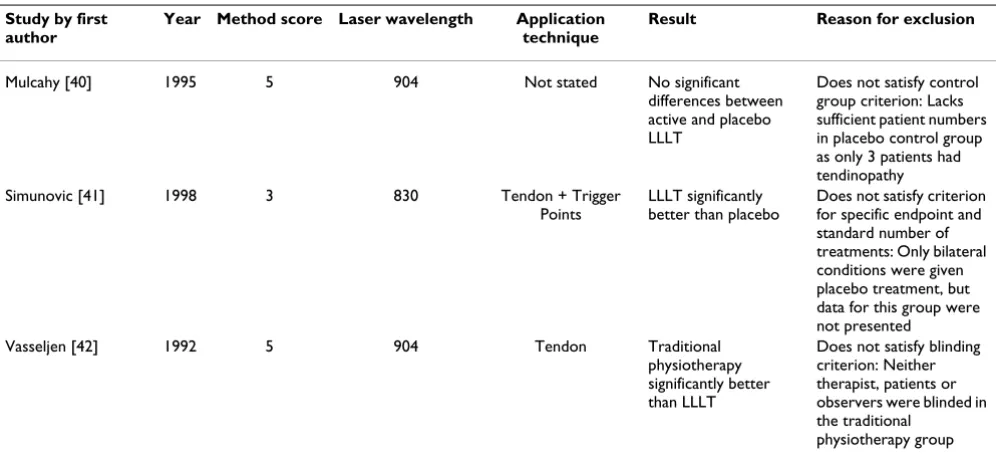
for sample size in control group, specific endpoints or blinding. The results of this assessment are summarised in Table 1.
Analysis of treatment procedures
The remaining 15 trials were then evaluated for adequacy of their treatment procedures for active laser and placebo laser for adherence to either of the three valid application techniques (inclusion criterion 2). This resulted in the exclusion of 2 trials (Table 2, Figure 2).
Publication bias
The five excluded RCTs [40-44] were taken into the publi-cation bias analysis by a graphical plot as advised by Egger [45]. Four [40-42,44] out of the five excluded trials with grave methodological and procedural flaws, were small and reported negative results. Three trials with negative results for LLLT were performed by the same research group [40,46,47] although this group also reported a pos-itive outcome [50]. Three of these trials met the eligibility criteria for this review and were included in the meta-anal-ysis [46,47,50]. The five largest trials [43,48-51] all pre-sented positive results, although Simunovic et al. [43] was excluded from our meta-analyses for variable timing of endpoints as stated above. Significant asymmetry was noted in the funnel plot, indicating a considerable degree of negative publication bias (Figure 3).
Bias analysis of 13 included trials
Positive bias detection – poor methodological quality and for-profit funding sources
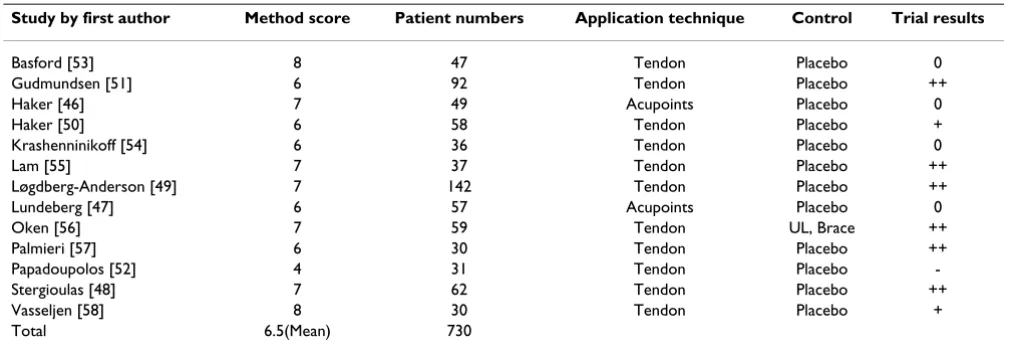
The final study sample consisted of 730 patients in 13 tri-als. The mean and median methodological score was 6.5, and only one trial did not satisfy half or more methodo-logical criteria [52]. Two trials used the acupoints applica-tion technique [46,47], while the remaining eleven trials used the tendon application technique. None of the trials stated funding from laser manufacturing companies or had authors with affiliations to laser manufacturers. The trial characteristics and the sum methodological scores are listed in Table 3.
Subgroup analysis for methodological quality
subgroup analysis by methodological quality to be unnec-essary to perform.
Negative bias detection – inclusion of patients with poor prognostic factors and effective co-interventions
Three trials reported details confirming enrolment of patients without poor prognosis [48,55,56]. In two of these trials [55,56], both active and placebo groups received concurrent exercise therapy, which may have deflated effect size. Seven trials reported demographic data affirmative on the inclusion of LET patients with poor prognosis, which are likely to deflate effect sizes. Results for possible confounding factors which may deflate effect sizes are summarized in Table S4, Additional file 1.
Assessment of LLLT procedures and treatment variables
There was considerable heterogeneity in the treatment procedures and LLLT doses used in the included trials. Treatment characteristics for the 11 trials which used
direct irradiation of tendon pathology are listed in Table S5, Additional file 1.
Treatment characteristics for trials which used acupoint irradiation are listed in Table S6, Additional file 1.
Outcomes and effect sizes
Dichotomized trial results
Eight out of thirteen trials (62%) reported one or more outcome measures in favour of LLLT over placebo. Eleven trials used the tendon application technique, and eight (73%) of these trials reported positive results for one or more outcome measures (Table 3). All seven trials using 904 nm wavelength and the tendon application tech-nique yielded positive results [48-51,55-57], whereas three trials using lasers with 820/30 nm [58,52]and 1064 nm [59] wavelengths found no significant effect of LLLT. A single trial administering LLLT with a wavelength of 632 nm [60], also found significantly better results for the LLLT group. In the two trials where LLLT was administered to acupuncture points [46,47], no significant differences between LLLT and placebo were found for any of the out-come measures.
Meta-analyses of effects
Primary outcomes
Continuous data for pain relief was available from 10 tri-als in a way which made statistical pooling possible. At the first observation after the end of the treatment period, LLLT was significantly better than controls with a WMD of 10. 2 mm [95% CI: 3.0 to 17.5] in favour of LLLT on a 100 mm VAS (p = 0.005). In a subgroup of five trials [48,50,55-57] where 904 nm LLLT was administered directly to the tendon, LLLT reduced pain by 17.2 mm [95% CI: 8.5 to 25.9] more than placebo (p = 0.0001). One trial [60] with 632 nm LLLT, showed significantly better results for LLLT than a wrist brace and ultrasound therapy, but none of the results from trials with wave-lengths of 820 nm or 1064 nm, or acupoint application technique were significantly different from placebo. The results are summarized in Figure 4.
Seven trials [46,49-51,55,57,58] presented data in a way which allowed us to pool data for global improvement. LLLT was significantly better than placebo with an overall relative risk for improvement at 1.36 [95% CI: 1.16 to 1.60] (p = 0.002). In a subgroup of five trials [49-51,55,57] where 904 nm LLLT was used to irradiate the symptomatic tendon, the relative risk for global improve-ment was significantly better than placebo at 1.53 [95% CI 1.28 to 1.83] (p < 0.0001). In the remaining two trials [46,58] where LLLT was administered to acupoints or with 820 nm wavelength, the relative risk for global improve-ment was not significantly different from placebo at 0.80
Quorum flow chart
Figure 1
[95% CI 0.50 to 1.22]. The results are summarized in Fig-ure 5.
Secondary outcomes
Painfree grip strength showed significantly better results after LLLT than placebo with SMDs of 0.66 [95% CI: 0.42 to 0.90] [p < 0.0001). When trials were subgrouped by application technique and wavelengths, only trials with irradiation of tendons and wavelengths 632 nm [60] or 904 nm [48,49,56,57], showed positive results versus control with SMDs at 1.09 [95% CI: 0.42 to 1.76] and 1.30 [95% CI: 0.91 to 1.68], respectively. The results are summarized in Figure 6.
Two trials with 904 nm wavelength using application technique with tendon irradiation [50,56] reported a small, but significantly elevated pain pressure threshold with SMD at 0.34 [95% CI: 0.04 to 0.63] (p = 0.02), The results are summarized in Figure 7.
Sick leave
One trial with 904 nm LLLT administered directly over the tendon insertion, presented sick leave data [51]. The rela-tive risk for not being sicklisted after treatment was signif-icantly in favour of LLLT at 2.25 [95% CI: 1.25 to 4.06] (p = 0.0005).
Follow-up
Six of the trials provided continuous follow-up data on a 100 mm VAS measured between 3 and 8 weeks after the end of treatment [47,48,56,57,59,60]. The combined WMD was 11.30 mm [95% CI: 7.5 to 16.1] in favour of
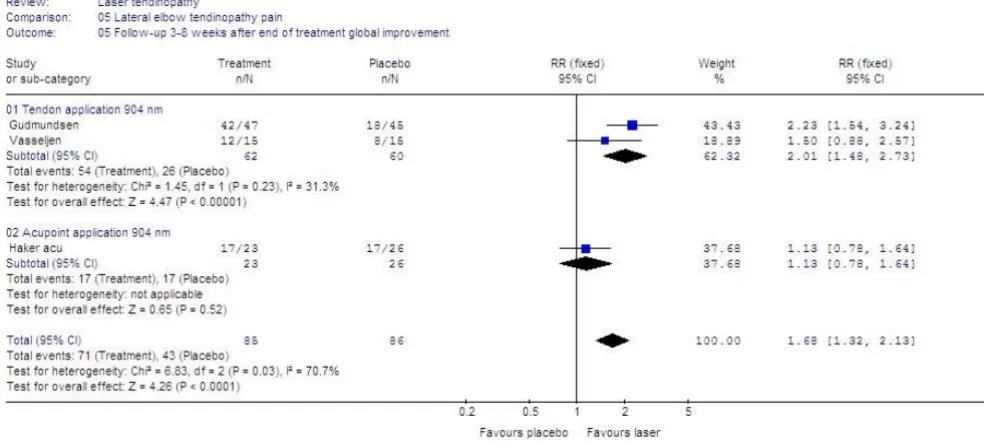
LLLT. For global improvement, three trials [46,51,57] pro-vided data suitable for statistical pooling, and the RR was calculated to 1.68 [95% CI: 1.32 to 2.13] in favour of LLLT. Subgroup analyses showed that three trials [48,56,57] administering 904 nm LLLT directly over the tendon, WMD improved to 14.3 [95% CI: 7.3 to 21.3] and RR for improvement to 2.01 [95%CI: 1.48 to 2.73] in favour of LLLT, while a single trial [60] with 632 nm wave-length and the same application procedure reported WMD of 14.0 [95%CI: 7.0 to 20.6]. The results are sum-marized in Figures 8 and 9.
Only two trials using the tendon application technique with 904 nm wavelengths reported follow-up results beyond 8 weeks. They reported persisting significant improvement after LLLT for PFS at 3 months (SMD 0.40 [95%CI: 0.05 to 0.75]) [49], and significantly less patients with no or minor pain at work at 5.5 months (RR = 2.1 [95%CI: 1 to 4.3]) [57], respectively. Other outcomes were not significantly different beyond 8 weeks. For the two trials using acupoint irradiation [46,47], no signifi-cant differences were found at any of the follow-up ses-sions.
Side-effects and compliance
[image:7.612.56.554.99.330.2]Treatment was generally well tolerated and no adverse events were reported. Compliance was high ranging from 100% to 91% in all but two trials [48,58]. One of these tri-als [48] had a considerably longer treatment period (8 weeks) than the other trials (median 3 weeks), and all withdrawals were caused by lack of effects. In another trial [58] using 830 nm wavelength, an exceptionally high
Table 1: Randomised LLLT-trials excluded for not meeting trial design criteria for diagnosis, blinding or specific endpoints.
Study by first author
Year Method score Laser wavelength Application technique
Result Reason for exclusion
Mulcahy [40] 1995 5 904 Not stated No significant differences between active and placebo LLLT
Does not satisfy control group criterion: Lacks sufficient patient numbers in placebo control group as only 3 patients had tendinopathy Simunovic [41] 1998 3 830 Tendon + Trigger
Points
LLLT significantly better than placebo
Does not satisfy criterion for specific endpoint and standard number of treatments: Only bilateral conditions were given placebo treatment, but data for this group were not presented
Vasseljen [42] 1992 5 904 Tendon Traditional physiotherapy significantly better than LLLT
Does not satisfy blinding criterion: Neither therapist, patients or observers were blinded in the traditional
physiotherapy group
withdrawal/dropout rate of 15% occurred after a single treatment session without any given reason.
Discussion
In this review, we found that most RCTs of LLLT for LET were of acceptable methodological quality. This finding is in line with previous reviews [12,23,27], although there were some differences between reviewers in methodolog-ical scores for individual trials. RCTs of LLLT are of similar methodological quality and include similar sample sizes as RCTS included in recent reviews of corticosteroid injec-tions [5] and topical or oral NSAIDs [8]. Two of the previ-ous reviews of LLLT for LET found only six RCTs [12,23], whereas an earlier review found ten RCTs [27], and excluded one RCT for methodological shortcomings [43]. We used broader searching criteria in our review and had no language restrictions. This resulted in 18 potentially
eligible RCTs. We excluded one RCT for not meeting the inclusion criteria of specific endpoints [43] and another two RCTs for complete lack of blinding [44] and a lack of an LET control group [42]. None of the previous LET reviews assessed the LLLT regimen for procedural errors, while our procedural assessments resulted in exclusion of another two RCTs with grave procedural errors, such as leaving the tendon insertion and acupoints unirradiated [40] and giving adequate LLLT to the placebo group [61]. These exclusions resulted in 13 RCTs being eligible for our review which is twice the number of RCTs included in two of the previously published reviews[12,23].
Previous LET-reviews of LLLT [12,23,27] and pharmaco-logical interventions like NSAID [8] or corticosteroid injections [5] have not assessed possible bias from for-profit funding sources or publication bias. Our analysis
Photograph showing laser therapy procedure with laser head in skin contact in trial by Haker et al
Figure 2
Table 2: Randomised LLLT-trials excluded for not meeting criteria of valid procedures for active laser and placebo laser treatment.
Study by first author Method score Wave-length Application technique Result Reason for exclusion
Haker [43] 6 904 Tendon No significant differences Photograph in trial report shows that the laser probe was kept in skin contact and thereby violated the manufacturers'
recommendation of a keeping the laser head at a distance of 10 cm. This violation caused a central blind spot of ca 3 cm2
which left the tendon pathology unexposed to LLLT (See Figure 2)
Siebert [44] 6 904 + 632 Tendon No significant differences Active laser treatment to the placebo group received red 632 nm LLLT, which we calculated to be (2.25J), which again is an adequate LLLT dose. Consequently this trials lacks a placebo or non-laser control group
Trial characteristics given by first author, method score, laser wavelength, laser application technique, trial results and reason for exclusion.
Funnel plot of published trial results given by WMD for pain relief over placebo measured on 100 mm VAS (x-axis), and sample size (y-axis)
Figure 3
[image:9.612.60.549.354.670.2]Table 3: Included randomised LLLT-trials.
Study by first author Method score Patient numbers Application technique Control Trial results
Basford [53] 8 47 Tendon Placebo 0
Gudmundsen [51] 6 92 Tendon Placebo ++
Haker [46] 7 49 Acupoints Placebo 0
Haker [50] 6 58 Tendon Placebo +
Krashenninikoff [54] 6 36 Tendon Placebo 0
Lam [55] 7 37 Tendon Placebo ++
Løgdberg-Anderson [49] 7 142 Tendon Placebo ++
Lundeberg [47] 6 57 Acupoints Placebo 0
Oken [56] 7 59 Tendon UL, Brace ++
Palmieri [57] 6 30 Tendon Placebo ++
Papadoupolos [52] 4 31 Tendon Placebo
-Stergioulas [48] 7 62 Tendon Placebo ++
Vasseljen [58] 8 30 Tendon Placebo +
Total 6.5(Mean) 730
Trial characteristics by first author, method score, laser application technique, control group type, trial results. The abbreviations used are determined by the following categories: (-) means a result in favour of the control group, (0) means a non-significant result, (+) means a positive result for LLLT in at least one outcome measure, and (++) means a consistent positive results for more than one outcome measure.
End of treatment results for LLLT measured as the WMD pain reduction on 100 mm VAS
Figure 4
revealed that bias from for-profit funding was largely absent in the available LLLT material and that trials were performed by independent research groups receiving funding from internal sources or non-profit organisa-tions. This feature of the LLLT literature is definitely differ-ent from pharmacological pain treatmdiffer-ents where up to 83% of trials may be industry-funded [62]. A second fea-ture of the LLLT-literafea-ture is that publication bias seems to go in a negative direction. This is distinctly different from the drug trials [63,64] where positive results have been found to account for up to 85% of the published trials in single journals [63], although this bias seems to be lesser or absent in high impact journals [64]. Our review sug-gests that LLLT trials reporting negative results are more likely to be published than trials with positive results. To our knowledge we are the first to demonstrate such bias, but such negative publishing bias is probably not unique to LLLT, and it may also be present for other electrophys-ical agents including TENS and acupuncture. We were sur-prised to see how large well-designed positive trials of LLLT [51,50] were published in unlisted journals or jour-nals with low-impact factor, and how small negative trials
[46], often with grave methodological [42] or procedural flaws [40] were published in higher ranking journals. This may reflect a predominance of RCTs designed using drug-research methodology paradigms without due considera-tion given to adequacy of the technique used in delivering LLLT, leading to under dosing and negative outcome bias [65]. In addition, it has been that documented drug spon-sorship of research activities may influence guideline pan-els, journal editors and referees [66,67] leading to negative views on non-drug treatments such as LLLT as reflected in editorials in pain journals [68] and national medical journals [69].
Despite these concerns, we believe that the positive over-all results of this review need to interpreted with some caution. They arise from a subgroup of 7 out of the 13 included trials [48-51,55-57]. These 7 trials had a nar-rowly defined LLLT regimen where lasers of 904 nm wave-length with low output (5–50 mW) were used to irradiate the tendon insertion at the lateral elbow using 2–6 points or an area of 5 cm2 and doses of 0.25–1.2 Joules per point/
area. The positive results for this subgroup of trials were
[image:11.612.57.548.90.395.2]End of treatment results for LLLT measured as global improvement
Figure 5
consistent across outcomes of pain and function, and sig-nificance persisted for at least 3–8 weeks after the end of treatment, in spite of several factors which may have deflated effect sizes.
For the red 632 nm wavelength which has a poorer skin penetration ability [70], a single trial [60] with a higher dose (6 Joules) seemed to be equally effective as the lower doses of 904 nm used in the seven positive trials. These
[image:12.612.59.544.94.371.2]End of treatment results for LLLT measured as the SMD for pain-free grip strength
Figure 6
End of treatment results for LLLT measured as the SMD for pain-free grip strength. Trials are subgrouped by application technique and wavelengths, and their combined results are shown as total at the bottom of the table. Plots on the right hand side of the middle line indicate that the LLLT effect is superior to the control treatment.
End of treatment results for LLLT measured as the SMD for pain pressure threshold
Figure 7
LLLT-doses are well within the therapeutic windows for reducing inflammation, increasing fibroblast activity and collagen fibre synthesis, and the dosage recommenda-tions suggested by WALT [71].
The negative results for the 830 nm GaAlAs and 1064 nm NdYag lasers can be attributed to several factors such as too high doses, too high power density or the inclusion of patients with poor prognosis from long symptom dura-tion and prior steroid injecdura-tions. These wavelengths have previously been found effective in some tendon animal studies and in other locations such as shoulder tendin-opathies [72,73]. At this time it is not possible to draw firm conclusions about the clinical suitability of wave-lengths 820, 830 and 1064 nm in LET treatment, but the lack of evidence of effects indicates that they cannot be recommended as LET treatment before new research find-ings have established their possible effectiveness. The lack of effect for these lasers may also serve as a reminder that higher doses is not always best. We have been witnessing a tendency where newly developed lasers with these wave-lengths are being marketed with ever-increasing power and power densities. This may be inappropriate because current knowledge about LLLT mechanisms and
dose-response patterns at higher powers is inconsistent or lack-ing.
The positive results for combining LLLT of 904 nm wave-length with an exercise regimen, are encouraging. We would have thought that exercise therapy could have erased possible positive effects of LLLT, but the results showed an added value in terms of a more rapid recovery when LLLT was used in conjunction with an exercise regi-men. This may indicate that exercise therapy can be more effective when inflammation is kept under control. Add-ing LLLT to regimens with eccentric and stretchAdd-ing exer-cises reduced recovery time by 4 and 8 weeks in two trials [48,56]. For this reason, LLLT should be considered as an adjunct, not an alternative, to exercise therapy and stretch-ing.
Based on the above findings, LLLT should be considered as an alternative therapy to commonly used pharmacolog-ical agents in LET management. Cochrane-based reviews of NSAIDs [8] and corticosteroid injections [5] have found evidence of short-term effects within 4 and 6 weeks, respectively. The short-term reduction in pain intensity after corticosteroid injections may appear to have a more
Follow-up results at 3–8 weeks after end of treatment for LLLT measured as the WMD for pain reduction on 100 mm VAS
Figure 8
rapid onset and may also be larger in effect size than after LLLT. But on the other hand, the available LLLT-material is confounded by factors capable of deflating effect sizes. In this perspective, there is a need for more high quality trials with head-to-head comparison of short-term effects between LLLT and corticosteroid injections. In the longer term, NSAIDs seems to be ineffective and corticosteroid injections seem to be harmful both at 26 and at 52 weeks [6]. For LLLT there are some significant long-term effects found at 8, 12 and 24 weeks after the end of treatment.
Conclusion
The available material suggests that LLLT is safe and effec-tive, and that LLLT acts in a dose-dependent manner by biological mechanisms which modulate both tendon inflammation and tendon repair processes. With the recent discovery that long-term prognosis is significantly worse for corticosteroid injections than placebo in LET, LLLT irradiation with 904 nm wavelength aimed at the tendon insertion at the lateral elbow is emerging as a safe and effective alternative to corticosteroid injections and NSAIDs. LLLT also seems to work well when added to exercise and stretching regimens. There is a need for future trials to compare adjunctive pain treatments such as LLLT with commonly used pharmacological agents.
Competing interests
The authors declare that they have no competing interests.
Authors' contributions
JMB had the original idea, which was developed through lengthy discussions with contributions from RABL-M, JJ, CC, AEL, AS and MIJ. The literature search, including handsearching, was performed by all members of the author team. The first draft was written by JMB, RABL-M and JJ, and revised by AS and MIJ. Methodological assess-ments of trials were performed by JMB, AEL, CC, AS. The statistical analysis was performed by JMB, RABL-M, JJ and MIJ. The final linguistic revision was performed by MIJ and all members of the author team read and commented on the manuscript before submission.
Additional material
Acknowledgements
The study was funded internally by Bergen University College in providing working hours for the first author, Jan M. Bjordal. The funding body played no role in the study design, the collection, analysis, interpretation of data, in the writing of the manuscript or the decision to submit the manuscript
[image:14.612.56.548.93.316.2]Additional file 1
Tables 4-6. Click here for file
[http://www.biomedcentral.com/content/supplementary/1471-2474-9-75-S1.doc]
Follow-up results at 3–8 weeks after the end of treatment measured as the relative risk for global improvement for LLLT com-pared to placebo
Figure 9
for publication. None of the other authors received any funding for the per-formance of the study.
References
1. Shiri R, Viikari-Juntura E, Varonen H, Heliovaara M: Prevalence and determinants of lateral and medial epicondylitis: a popula-tion study. Am J Epidemiol 2006, 164(11):1065-74.
2. Smidt N, Lewis M, DA VDW, Hay EM, Bouter LM, Croft P: Lateral epicondylitis in general practice: course and prognostic indi-cators of outcome. J Rheumatol 2006, 33(10):2053-59.
3. Peterson M, Elmfeldt D, Svardsudd K: Treatment practice in chronic epicondylitis: a survey among general practitioners and physiotherapists in Uppsala County, Sweden. Scand J Prim Health Care 2005, 23(4):239-41.
4. Assendelft WJJ, Hay EM, Adshead R, Bouter LM: Corticosteroid injections for lateral epicondylitis: a systematic review. British Journal of General Practice 1996, 46:209-216.
5. Smidt N, Assendelft WJ, Windt DA van der, Hay EM, Buchbinder R, Bouter LM: Corticosteroid injections for lateral epicondylitis: a systematic review. Pain 2002, 96(1–2):23-40.
6. Bisset L, Smidt N, Windt DA Van der, Bouter LM, Jull G, Brooks P, et al.: Conservative treatments for tennis elbow do subgroups of patients respond differently? Rheumatology (Oxford) 2007,
46(10):1601-5.
7. Smidt N, Windt DA van der: Tennis elbow in primary care. BMJ 2006, 333(7575):927-8.
8. Green S, Buchbinder R, Barnsley L, Hall S, White M, Smidt N, et al.:
Non-steroidal anti-inflammatory drugs (NSAIDs) for treat-ing lateral elbow pain in adults. Cochrane Database Syst Rev 2002:CD003686.
9. Labelle H, Guibert R: Efficacy of diclofenac in lateral epicondyli-tis of the elbow also treated with immobilization. The Uni-versity of Montreal Orthopaedic Research Group. Arch Fam Med 1997, 6(3):257-62.
10. Alfredson H, Lorentzon R: Chronic tendon pain: no signs of chemical inflammation but high concentrations of the neu-rotransmitter glutamate. Implications for treatment? Curr Drug Tar-gets 2002, 3(1):43-54.
11. Khan KM, Cook JL, Kannus P, Maffulli N, Bonar SF: Time to aban-don the "tendinitis" myth. BMJ 2002, 324(7338):626-7. 12. Smidt N, Assendelft WJ, Arola H, Malmivaara A, Greens S,
Buch-binder R, et al.: Effectiveness of physiotherapy for lateral epi-condylitis: a systematic review. Ann Med 2003, 35(1):51-62. 13. Pienimäki TT, Tarvainen TK, Siira PT, Vanharanta H: Progressive
Strengthening and Stretching Exercises and Ultrasound for Chronic Lateral Epicondylitis. Physiotherapy 1996,
82(9):522-530.
14. Visnes H, Bahr R: The evolution of eccentric training as treat-ment for patellar tendinopathy (jumper's knee): a critical review of exercise programmes. Br J Sports Med 2007,
41(4):217-23.
15. van Tulder M, Malmivaara A, Koes B: Repetitive strain injury. Lan-cet 2007, 369(9575):1815-22.
16. Woodley BL, Newsham-West RJ, Baxter GD: Chronic tendinopa-thy: effectiveness of eccentric exercise. Br J Sports Med 2007,
41(4):188-98. discussion 199.
17. Kingma JJ, de Knikker R, Wittink HM, Takken T: Eccentric over-load training in patients with chronic Achilles tendinopathy: a systematic review. Br J Sports Med 2007, 41(6):e3.
18. Bisset L, Beller E, Jull G, Brooks P, Darnell R, Vicenzino B: Mobilisa-tion with movement and exercise, corticosteroid injecMobilisa-tion, or wait and see for tennis elbow: randomised trial. Bmj 2006,
333(7575):939.
19. Vicenzino B, Paungmali A, Buratowski S, Wright A: Specific manip-ulative therapy treatment for chronic lateral epicondylalgia produces uniquely characteristic hypoalgesia. Man Ther 2001,
6(4):205-12.
20. Struijs PA, Damen PJ, Bakker EW, Blankevoort L, Assendelft WJ, van Dijk CN: Manipulation of the wrist for management of lateral epicondylitis: a randomized pilot study. Phys Ther 2003,
83(7):608-16.
21. D'Vaz AP, Ostor AJ, Speed CA, Jenner JR, Bradley M, Prevost AT, et al.: Pulsed low-intensity ultrasound therapy for chronic lat-eral epicondylitis: a randomized controlled trial. Rheumatology (Oxford) 2006, 45(5):566-70.
22. Green S, Buchbinder R, Barnsley L, Hall S, White M, Smidt N, et al.:
Acupuncture for lateral elbow pain. Cochrane Database Syst Rev 2002:CD003527.
23. Bisset L, Paungmali A, Vicenzino B, Beller E: A systematic review and meta-analysis of clinical trials on physical interventions for lateral epicondylalgia. Br J Sports Med 2005, 39(7):411-22. dis-cussion 411–22.
24. Buchbinder R, Green SE, Youd JM, Assendelft WJ, Barnsley L, Smidt N: Systematic review of the efficacy and safety of shock wave therapy for lateral elbow pain. J Rheumatol 2006, 33(7):1351-63. 25. Rompe JD, Maffulli N: Repetitive shock wave therapy for lateral elbow tendinopathy (tennis elbow): a systematic and qualita-tive analysis. Br Med Bull 2007, 83:355-78.
26. de Bie RA, Verhagen A, de Vet HC, Lenssen T, van der Wildenberg FA, Kootstra G, et al.: Efficiacy of 904 nm laser therapy in mus-culoskeletal disorders. Phys Ther Rev 1998, 3(2):1-14.
27. Stasinopoulos DI, Johnson MI: Effectiveness of low-level laser therapy for lateral elbow tendinopathy. Photomed Laser Surg 2005, 23(4):425-30.
28. Lopes-Martins R, Penna SC, Joensen J, Iversen VV, Bjordal JM: Low level laser therapy (LLLT) in Inflammatory and Rheumatic Diseases: A review of Therapeutic Mechanisms. Current Rheu-matology Reviews 2007, 3:147-54.
29. Houreld NN, Abrahamse H: Laser light influences cellular viabil-ity and proliferation in diabetic-wounded fibroblast cells in a dose- and wavelength-dependent manner. Lasers Med Sci 2008,
23(1):11-8.
30. van Breugel HHFI, Bar PR: Power density and exposure time of HeNe laser irradiation are more important than total energy dose in photobiomodulation of human fibroblast in vitro. Lasers in Medicine and Surgery 1992, 12:528-537.
31. Bjordal J, Couppé C, Ljunggreen A: Low level laser therapy for tendinopathy. Evidence of a dose-response pattern. Physical Therapy Reviews 2001, 6(2):91-99.
32. Baxter DG: Editorial. Physical Therapy Reviews 2001, 6(2):83. 33. Lopes-Martins RA, Albertini R, Lopes-Martins PS, de Carvalho FA,
Neto HC, Iversen VV, et al.: Steroid Receptor Antagonist Mife-pristone Inhibits the Anti-inflammatory Effects of Photoradi-ation. Photomed Laser Surg 2006, 24(2):197-201.
34. WALT: Standards for the design and conduct of systematic reviews with low-level laser therapy for musculoskeletal pain and disorders. Photomed Laser Surg 2006, 24(6):759-60.
35. Dickersin K, Scherer R, Lefebvre C: Identifying relevant studies for systematic reviews. BMJ 1994, 309:1286-1291. 12 November 1994
36. Maher CG, Sherrington C, Herbert RD, Moseley AM, Elkins M: Reli-ability of the PEDro scale for rating quality of randomized controlled trials. Phys Ther 2003, 83(8):713-21.
37. Schulz KF, Chalmers I, Hayes RJ, Altman DG: Empirical evidence of bias. Dimensions of methodological quality associated with estimates of treatment effects in controlled trials. Jama 1995, 273(5):408-412.
38. Kjaergard LL, Als-Nielsen B: Association between competing interests and authors' conclusions: epidemiological study of randomised clinical trials published in the BMJ. BMJ 2002,
325(7358):249.
39. Bjordal JM, Klovning A, Ljunggren AE, Slordal L: Short-term effi-cacy of pharmacotherapeutic interventions in osteoarthritic knee pain: A meta-analysis of randomised placebo-control-led trials. Eur J Pain 2007, 11(2):125-38.
40. Haker E, Lundeberg T: Lateral epicondylalgia (tennis elbow): Report of noneffective midlaser treatment. Arch Phys Med Rehab 1991, 72(12):984-988.
41. Siebert W, Seichert N, Siebert B, Wirth CJ: What is the efficacy of "soft" and "mid" lasers in therapy of tendinopathies? A dou-ble-blind study. Arch Orthop Trauma Surg 1987, 106(6):358-63. 42. Mulcahy D, McCormack D, McElwain J, Wagstaff S, Conroy C: Low
level laser therapy: a prospective double blind trial of its use in an orthopaedic population. Injury 1995, 26(5):315-317. 43. Simunovic Z, Trobonjaca T, Trobonjaca Z: Treatment of medial
Publish with BioMed Central and every scientist can read your work free of charge "BioMed Central will be the most significant development for disseminating the results of biomedical researc h in our lifetime."
Sir Paul Nurse, Cancer Research UK
Your research papers will be:
available free of charge to the entire biomedical community
peer reviewed and published immediately upon acceptance
cited in PubMed and archived on PubMed Central
yours — you keep the copyright
Submit your manuscript here:
http://www.biomedcentral.com/info/publishing_adv.asp
BioMedcentral
44. Vasseljen O: Low-level laser versus traditional physiotherapy in the treatment of tennis elbow. Physiotherapy 1992,
78(5):329-34.
45. Egger M, Davey Smith G, Schneider M, Minder C: Bias in meta-analysis detected by a simple, graphical test. BMJ 1997,
315(7109):629-34.
46. Haker E, Lundeberg T: Laser treatment applied to acupuncture points in lateral humeral epicondylagia: a double – blind study. Pain 1990, 43:243-247.
47. Lundeberg T, Haker E, Thomas M: Effect of laser versus placebo in tennis elbow. Scand J Rehabil Med 1987, 19:135-8.
48. Stergioulas A: Effects of low-level laser and plyometric exer-cises in the treatment of lateral epicondylitis. Photomed Laser Surg 2007, 25(3):205-13.
49. Haker E, Lundeberg T: Is low-energy laser treatment effective in lateral epicondylalgia ? Journal of Pain and Symptom Management 1991, 6(4):241-246.
50. Løgdberg-Andersson M, Mutzell S, Hazel Å: Low level laser ther-apy of tendinitis and myofascial pain. A randomised double-blind controlled study. Laser Therapy 1997, 9:79-86.
51. Gudmundsen J, Vikne J: Laserbehandling av epicondylitis humeri og rotatorcuffsyndrom. Nor Tidskr Idrettsmed 1987,
2:6-15.
52. Papadopoulos ES, Smith RW, Cawley MID, Mani R: Low-level laser therapy does not aid the management of tennis elbow. Clin Rehabil 1996, 10:9-11.
53. Juni P, Witschi A, Bloch R, Egger M: The hazards of scoring the quality of clinical trials for meta-analysis. Jama 1999,
282(11):1054-60.
54. van Tulder MW, Koes B, Malmivaara A: Outcome of non-invasive treatment modalities on back pain: an evidence-based review. Eur Spine J 2006, 15(Suppl 1):S64-81.
55. Palmieri B: Stratified double blind crossover study on tennis elbow in young amateur athletes using infrared lasertherapy.
Medical Laser Report 1984, 1:1.
56. Lam LK, Cheing GL: Effects of 904-nm Low-Level Laser Ther-apy in the Management of Lateral Epicondylitis: A Rand-omized Controlled Trial. Photomed Laser Surg 2007, 25(2):65-71. 57. Vasseljen O Jr, Hoeg N, Kjeldstad B, Johnsson A, Larsen S: Low level laser versus placebo in the treatment of tennis elbow. Scand J Rehabil Med 1992, 24(1):37-42.
58. Krasheninnikoff M, Ellitsgaard N, Rogvi-Hansen B, Zeuthen A, Harder K, Larsen R, et al.: No effect of low power laser in lateral epi-condylitis. Scandinavian Journal of Rhematology 1994, 23:260-263. 59. Basford JR, Sheffield CG, Cieslak KR: Laser therapy: a
rand-omized, controlled trial of the effects of low intensity Nd:YAG laser irradiation on lateral epicondylitis. Arch Phys Med Rehabil 2000, 81(11):1504-10.
60. Oken O, Kahraman Y, Ayhan F, Canpolat S, Yorgancioglu ZR, Oken OF: The Short-term Efficacy of Laser, Brace, and Ultrasound Treatment in Lateral Epicondylitis: A Prospective, Rand-omized, Controlled Trial. J Hand Ther 2008, 21(1):63-8. 61. Siebert W, Seichert N, Siebert B, Wirth CJ: What is the efficacy of
'soft' and 'mid' lasers in therapy of tendinopathies? Arch Orthop Traum Su 1987, 106:358-63.
62. Bjordal JM, Ljunggren AE, Klovning A, Slordal L: Non-steroidal anti-inflammatory drugs, including cyclo-oxygenase-2 inhibitors, in osteoarthritic knee pain: meta-analysis of randomised pla-cebo controlled trials. BMJ 2004, 329(7478):1317-21.
63. Hall R, de Antueno C, Webber A: Publication bias in the medical literature: a review by a Canadian Research Ethics Board.
Can J Anaesth 2007, 54(5):380-8.
64. Olson CM, Rennie D, Cook D, Dickersin K, Flanagin A, Hogan JW, et al.: Publication bias in editorial decision making. Jama 2002,
287(21):2825-8.
65. Hunter DJ, Felson DT: Osteoarthritis. BMJ 2006,
332(7542):639-42.
66. Jordan KM, Arden NK, Doherty M, Bannwarth B, Bijlsma JW, Dieppe P, et al.: EULAR Recommendations 2003: an evidence based approach to the management of knee osteoarthritis: Report of a Task Force of the Standing Committee for International Clinical Studies Including Therapeutic Trials (ESCISIT). Ann Rheum Dis 2003, 62(12):1145-1155.
67. Angell M: The truth about the drug companies: How they deceive us and what to do about it. Random House, New York, USA; 2004:1-260.
68. Devor M: What's in a laser beam for pain therapy? Pain 1990,
43:139.
69. Jensen EM: Laserbehandling – kan det nytte? Ugeskrift for Læger 1994, 156(49):7325.
70. Enwemeka CS: Attenuation and penetration depth of red 632.8 nm and invisible infrared 904 nm light in soft tissues.
Laser Therapy 2001, 13:95-101.
71. WALT, Laser dosage recommendations 2005 [http:// www.walt.nu/dosage-recommendations.html].
72. Saunders L: The efficiacy of low level laser therapy in shoulder tendinitis. Clinical Rehabilitation 1995, 9:126-134.
73. Saunders L: Laser versus ultrasound in the treatment of supraspinatus tendinosis. Physiotherapy 2003, 89(6):365-373.
Pre-publication history
The pre-publication history for this paper can be accessed here: