expert coach consensus. Journal of sports sciences, 24 (6). 549 - 564. ISSN 0264-0414 DOI: https://doi.org/10.1080/02640410500189173
Link to Leeds Beckett Repository record: http://eprints.leedsbeckett.ac.uk/374/
Document Version: Article
The aim of the Leeds Beckett Repository is to provide open access to our research, as required by funder policies and permitted by publishers and copyright law.
The Leeds Beckett repository holds a wide range of publications, each of which has been checked for copyright and the relevant embargo period has been applied by the Research Services team.
We operate on a standard take-down policy. If you are the author or publisher of an output and you would like it removed from the repository, please contact us and we will investigate on a case-by-case basis.
2
Running Head: Validation of The Coaching Schematic 3
Keywords: coach development, decision-making, coaching process 4
Andy Abraham – Bell College 5
Dave Collins - UK Athletics 6
Russell Martindale - Napier University 7
Abstract 9
Current research in coaching development infers that coaching is predominantly a 10
decision making process. The same and other research is not, however, informing the 11
coaching development process due to a lack of a big picture approach. Consequently, 12
there is a need for a model of coaching. In this paper we offer such a model in the form 13
of a schematic that reflects the coaching process from both a content and information-14
processing stance. To assess the validity of the schematic 16 expert coaches were 15
interviewed to elicit a complete description of their coaching process. The coaches were 16
then shown a copy of the schematic and asked to comment on its design and content 17
with respect to its accuracy in reflecting their coaching process. Following analysis of 18
the interviews 6 general categories emerged; Roles, Goals, Typical Actions, Required 19
Knowledge, Support for the Schematic and Factors Influencing Development. The first 20
four categories clearly displayed an implicit support for the schematic. Furthermore, all 21
coaches offered explicit support for the schematic. Such a level of support confirmed 22
that the schematic was valid and could form the basis of focused interventions in 23
coaching development. 24
Introduction 26
Examination of recent research in the area of coaching practice and development 27
reveals a position which directly (e.g., Abraham and Collins, 1998, Cushion et al., 2003, 28
Lyle, 2002, Strean et al., 1997) or indirectly (e.g., Potrac et al., 2000, Côté et al., 1995b) 29
infers that coaching is, fundamentally, a decision making process. However, while such 30
a position has been reached, the same and other related research has yet to effectively 31
inform coaching development. In short, work to date has been specific but too 32
prescriptive (e.g., Krane et al., 1991), holistic but overly complex (e.g., Lyle, 2002, 33
Lyle, 1999) or holistic but lacking a mechanism for development (e.g., Côté et al., 34
1995b, Côté et al., 1995a, Côté and Salmela, 1996). It is perhaps for this reason that 35
current coaching development initiatives in America, Canada and the UK make no 36
reference to any big picture plan or model in their development approaches. Indeed, it 37
could be argued that their development programmes are somewhat eclectic in their 38
approach to programme design (Potrac et al., 2000). In fact, coaching associations in 39
both the UK and Canada (Canadian Coaching Association, 2005, SportscoachUK, 40
2004) are currently developing coach development programs using a competency based 41
approach. While theoretical research is available that highlights the pros and cons of this 42
approach from a generic perspective (Thomson, 2000), we are not aware of any 43
empirical research in the area of coaching that would establish this approach as being 44
optimal. Perhaps the current situation is best summed up by Vickers et al. (2004) who 45
have suggested that “a model of coaching is required that has at its heart sound 46
theoretical and research foundations, which are applicable to all sports, coaches and age 47
groups” (p. 105). While we certainly agree with this statement we would suggest that, in 48
fact, a schematic that is transferable across multiple situations and contexts through 49
appropriate. Furthermore, such a schematic can inform coaching development and 51
practice more effectively as it should reflect the whole coaching process. It is worth 52
noting here though that the typical coaching process of „plan, implement and review‟ 53
(Smith et al., 1997) maybe a little too simplistic to really reflect the dynamic nature of 54
coaching practice and development (NB. this statement does not preclude the use of this 55
idea as a starting point for novice coaches). We would argue that a schematic should 56
have more to do with Kolb's (1984) four stage experiential learning process cycle; 57
concrete experience, reflective observation, abstract conceptualisation, active 58
experimentation, since this process is more reflective of a dynamic and ongoing practice 59
and development cycle (Thomson, 2000). Consequently, the ultimate aim of this study 60
was to validate a coaching schematic that, through its design and content, would 61
accurately reflect the coaching process in its entirety. However, prior to outlining the 62
development and testing of the schematic there are, first, a number of philosophical and 63
theoretical issues worthy of consideration. 64
Why Do We Need Schematics and What Characterizes a Good One? 65
In contrast to the current situation in coaching, research examining practice and 66
development in similar but more established paradigms such as teaching reveal simple 67
conceptual models that characterize the qualities required in an effective schematic. In 68
short, these models have met a crucial goal in that they summarized current theoretical, 69
empirical and practical positions (Sternberg, 2003) in order to efficiently and effectively 70
inform the development of teaching and educational practice (e.g., Entwistle et al., 71
2000, Berliner, 1991). Furthermore, research examining the definition of a profession1 72
would both support and add to these characteristics. For example, Carr (1999) states that 73
a defining characteristic of a professional practitioner is someone who has theoretically 74
as well as practically grounded expertise, allowing a high degree of individual 75
autonomy and independence of judgement resulting in effective practice. This, in turn, 76
identifies the need for a schematic to reflect a judgement process. Biggs and Collis 77
(1982) identify that quality judgement involves making multiple connections within a 78
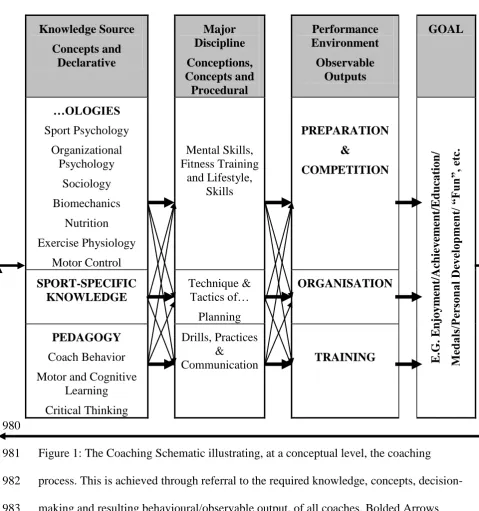
knowledge domain (displayed by the arrows in figure 1). Furthermore Davies (1994), 79
Johnson et al. (1981) and Zeitz and Spoehr (1989) identify that experts refer to a broad 80
range of domains of knowledge when solving of problems. This would suggest that a 81
schematic should reflect an intra and multi/inter disciplinary decision making process 82
within a theoretical and practical framework. Finally a schematic needs to be 83
transferable, that is, a schematic should be applicable irrespective of the situation or 84
context. This may actually be simpler than it sounds. Given that current situations or 85
contexts increase the degrees of freedom (Abraham and Collins, 1998) that in turn affect 86
the way in which goals are achieved, these essentially represent problems for the coach 87
to overcome, e.g. player injury, keeping things fresh in the middle of the season. 88
Therefore, so long as the schematic is broad enough in its approach to allow for 89
judgement to deal with these degrees of freedom it should be transferable. 90
It is through considerations such as these that the need for a schematic becomes 91
essential, we suggest, as a structure for the operationalization and enhancement of the 92
coaching process; in short, unless you know how the process works, how can you 93
optimally develop it? Accordingly, a clear and appropriately simple schematic will 94
offer us the basis for genuine and scientifically supported performance enhancement in 95
coaching. Such ideas led us, in conjunction with other active coach researchers, to 96
summarize current sport science, coaching, educational and cognitive psychology 97
research relevant to coaching development to develop a coach decision-making 98
behavioural/observable output, requirements of all coaches. In essence, reflecting the 100
whole coaching process. This approach is summarized in Figure 1. While we have little 101
doubt that the schematic is comprehensive in its coverage and that its development is 102
theoretically, empirically, in that its development has referred to empirical research 103
(e.g., Rutt-Leas and Chi, 1993), and intuitively supported and therefore has content 104
validity, it is important for the model, indeed all academic models, to be considered and 105
judged for its ecological validity by „quality‟ practitioners (Gilbert and Trudel, 2004a). 106
In pursuing such crucial validation however, there are three important methodological 107
considerations which must be addressed in order to ensure that the approach adopted is 108
appropriate to the stated purpose. 109
110
INSERT FIGURE 1 ABOUT HERE 111
112
Consideration 1: Matching Schematics to Knowledge Objects 113
Validating a schematic such as figure 1 is actually quite difficult since it is 114
unlikely that an exact match exists in the minds of expert coaches. The schematic is a 115
necessarily tidy and concise conceptual description of knowledge areas, concepts and 116
performance environments that, we suggest, reflects the coaching process. However, 117
research in parallel environments (e.g. teaching and learning processes in higher 118
education; (Entwistle and Walker, 2000) suggests such concepts are “experientially… 119
much too tidy”, and that, when thinking about their behaviour, professionals more 120
usually make use of broader and more global structures known as Knowledge Objects 121
(Entwistle and Martin, 1994, Entwistle and Entwistle, 2003). Knowledge objects are 122
said to occur when there has been an integration of a breadth and depth of knowledge 123
between concepts and conceptions in more depth later). Furthermore, such structures 125
don‟t underpin thoughts and decisions, but rather represent the mental workspace where 126
thoughts and decisions are made. Importantly, these objects are likely to be 127
idiosyncratic and this has major implications for testing the validity of the schematic. 128
Our argument would be that if the schematic were an accurate reflection of all expert 129
coaches‟ knowledge objects, the idiosyncrasy should only relate to the storage and 130
retrieval of knowledge as opposed to the broad content and use of the knowledge and 131
concepts identified in the schematic. Given this position and since we are trying to 132
generate (not force!) an agreement from coaches, we will have to guide the retrieval 133
process to the extent that we are, ultimately, going to have to show the coaches the 134
schematic. Both these methodological considerations would mitigate against the use of 135
the grounded theory approach typically employed (at least to date) to generate 136
“academic” models such as Côté et al's (1995b). Obviously we are not going to 137
deliberately lead, but if a “pure” grounded approach was taken we may get so many 138
varying accounts that developing a strong concise model becomes increasingly difficult 139
or even impossible. However, if we get a strong and implicit, “best fit” agreement from 140
expert coaches through demonstrable use of the schematic structures in their decision 141
making, and these coaches then give an explicit “thumbs up” to the schematic, and these 142
coaches come from a representative cross sample of sports, the schematic is supported 143
and a significant step towards forming a structure and basis for coaching development 144
will be taken. In short, we contend that the use of a “grounded then led” approach 145
Consideration 2: Concepts and Conceptions: Probing for Knowledge that 147
Underpins Decision Making 148
We referred earlier to the existence of concepts and conceptions and the 149
importance of understanding the distinction between the two. Concepts can be defined 150
through the formality of their broad procedural categorizing/scaffolding system, their 151
specific procedural knowledge, and the declarative knowledge which underpins them 152
(Abraham and Collins, 1998, Anderson, 1982). Almost always communicated through 153
structured, academic-style training, concepts are particularly useful in the professional 154
development process since they both short circuit and direct experiential learning. As 155
such, concepts are the goal of our examination of expert coaches, in order to generate a 156
curriculum for coach education. 157
In contrast, conceptions often represent an internalising of concepts, applied to a 158
particular context that is meaningful to the practitioner. In order to make sense of any 159
factual concepts they possess, and to create meaningful new knowledge in memory, 160
practitioners will look for and reflect on (Cushion et al., 2003, Gilbert and Trudel, 1999, 161
Gilbert and Trudel, 2001, Gilbert and Trudel, In press-b) patterns, orders, links, 162
similarities and conflicts with previous experiences in order to develop a conception or 163
a group of conceptions to help them make sense of delivered material and/or 164
experiences (Entwistle et al., 2000, Kolb, 1984). Such conceptions are generally 165
organized and framed around beliefs or rules about how that conception is implemented 166
in the field (Gilbert and Trudel, 1999). For example, Calderhead (1996) has stated that 167
teachers‟ conceptions about learning have been shown to focus on two broad beliefs, 168
namely the importance of active involvement and/or the need for an emotionally secure 169
environment in which failure was non threatening. However, if these beliefs are 170
and more quickly prepared. Furthermore, the declarative knowledge provided with the 172
concept offers a structure to the professionals‟ subsequent critical reflection, generating 173
a higher quality and more consistent development from ongoing experience (Thomson, 174
2000). Consequently, a conception is produced that is “filing cabinet” like in its 175
organization, allowing for explicit reasoning and decision-making. 176
Unfortunately, formal educational processes such as the one suggested above are 177
comparatively rare, at least in the generation of coaches from whom experts would 178
(currently at any rate) be largely drawn. In the vast majority of coaches, progressing to 179
the level of expert will have involved experience as being the significant contributing 180
factor to the development of the conceptions required to be an expert (Cushion et al., 181
2003). Accordingly, and as a direct consequence of the lack of explicit concept 182
teaching, conceptions are developed through trial and error and other typical weak 183
problem solving methods (Anderson, 1987) leading to tacit knowledge being developed 184
within the conception. The direct knock on effect is that there will be some actions 185
developed and taken because of a tacit decision achieved without any conscious 186
reasoning (Kerr, 1995, Sternberg et al., 1993). Furthermore, other decisions may be 187
based on semi tacit knowledge; that is, so long as there is a meaningful context the 188
practitioner will be able to describe the decision making process and knowledge 189
underpinning an action, or at least this knowledge can be probed for. However, in the 190
absence of a meaningful context and/or the guiding rule, it may well be impossible for 191
the practitioner to verbalize the knowledge used in a decision. In fact, the reasons 192
underlying a decision may only become obvious when the practitioner is asked to 193
describe why an alternative action wasn‟t taken. In the absence of such probing, asking 194
a practitioner to describe what they think, or what is occurring in a context may lead to a 195
(Cote et al., 1995a, Cote et al., 1995b) work with expert gymnastic coaches, using a 197
grounded theory approach identified that training was an important context for these 198
participants. However, when Côté et al.‟s “consequences for intervention” results are 199
examined there is no mention of instruction and yet this behaviour has been observed in 200
all levels of coaches in just about all behavioural observation studies e.g. (Claxton, 201
1988, Smith and Smoll, 1996). Of course this could mean that these coaches do not use 202
this behaviour. What is more likely, however, is that they do use it but their explicit 203
awareness, and thus their ability to access and retrieve this knowledge (c.f. our earlier 204
comments), of its use is quite low and/or its use gets clumped together with “feedback” 205
because of a lack of definition and differentiation to the verbal behaviours used during 206
coaching. Furthermore, we would argue that while the most significant work in this area 207
since Côté et al‟s work by Jones et al. (2003, 2004), provides excellent in depth insight 208
into the thoughts of elite coaches from a number of sports, it also suffers from similar 209
problems to Côté et al‟s work. Consequently, significant probing, alternative giving and 210
in depth discussion of decisions taken is essential if we are to generate the clear 211
conceptual knowledge that offers the best vehicle for developing coaching prowess in 212
others. Accordingly, this approach was employed with the participants in this study. 213
Consideration 3: Are the Participants really Expert and is the Schematic actually 214
needed? 215
In their groundbreaking study, examining all of the current research in coaching 216
science, Gilbert and Trudel (2004a) identified that too few studies developed findings 217
from coaches who exhibited styles or practices that should be copied. Consequently, 218
there is a need to exhibit just „how good‟ coaches used in studies actually are. This is 219
actually very difficult in the absence of a gold standard, meaning that the confirmation 220
standard is one of the goals of the current UK Coaching Certificate (SportscoachUK, 222
2004) development in the UK. However until this development is complete we had to 223
resolve this problem through identification and development of criteria and then finding 224
people to fit the criteria. For example, Gilbert and Trudel (2004b) identified a model 225
youth team coach as someone who demonstrated interest in the theory and practice of 226
coaching, was respected in the local sporting community, was a good leader, teacher 227
and organizer, and who kept winning in perspective while encouraging children to 228
respect the rules of the game, competitors and officials. Once these criteria were set, 229
coaches were selected using a reputational case selection sampling procedure (Miles 230
and Huberman, 1994). Consequently, in the present study the criteria used for peer 231
identification of coaches considered to be experts were a) recognised as being expert 232
coaches b) their consistent use of a critical thinking approach (Strean et al., 1997), c) 233
their roles as mentors to developing coaches and finally d) those currently working with 234
both elite and developmental athletes. The peers who were asked were members of the 235
UK Sport Institute coach development team, performance directors and sport scientists. 236
By choosing these criteria we are relying to a certain extent on an intuitive feel of 237
people „in the know‟ to identify expert coaches. To support this selection process we 238
also provided more explicit criteria that would support this intuitive feel to ensure an 239
expert is selected. 240
Of course our selection procedure used to access expert coaches is open to 241
debate but we would argue that the selection criteria used was rigorous enough to ensure 242
that expert coaches were selected. We would, however, encourage an open debate in the 243
literature to discuss what, explicitly, constitutes an expert coach so that more explicit 244
Once the coaches have been identified as being expert we can then meet the final 246
check on the validity of the schematic. Even if we get agreement from the coaches that 247
the model does reflect their job, if the coaches became expert without the schematic is it 248
even needed? This will actually depend on how these coaches became expert. If the 249
coaches have developed through a clear developmental pathway then the model‟s 250
importance will be diminished, however, if there appears to be no coherent pattern to 251
their development and the schematic can provide this coherent basis then its importance 252
will be enhanced. Although this study will, obviously, be delimited by the 253
demographics of the coaches selected, we will go on to examine issues relating the 254
transferability and relevance of the schematic across the coaching spectrum in the 255
Discussion and Conclusion section. 256
Summary and Research Questions 257
Returning to the question originally set, we hope that the importance of an 258
ecologically valid schematic has become obvious, in that it can codify experts‟ 259
knowledge and decision making, both explicit and implicit, enabling their effective 260
communication to other coaches. However, in order to effectively achieve this goal 261
there needs to be a methodology that takes account of theoretical and empirical research 262
examining knowledge storage and retrieval as identified in the three considerations. 263
Taking account of these considerations led to the design of a methodology that reflected 264
the objectives of the investigation. For our present purpose, this related to exploring the 265
match between a theoretically derived schematic with the knowledge objects used by a 266
sample of representative practitioners. Accordingly, we used open-ended and 267
subsequently more direct questions to address three issues pertaining to the veracity and 268
1. What are the typical rules, processes and content of a knowledge object required 270
for expert coaching? 271
a. What are the roles and objectives set by/for the elite coaches? 272
b. What are the decision making process used 273
c. What knowledge is required to perform these decisions and, therefore, to 274
achieve these roles and objectives? 275
2. Does the content and flow of the model accurately match the thought process 276
and decision making of expert coaches? 277
3. Does the model represent a good basis for focused development of these 278
processes? 279
280
Methods 281
Participants
282
Based on the selection procedure outlined above, sixteen expert coaches working within 283
the UK took part in this study. To ensure that the quality of coaches involved in this 284
study remained high across all sports, the coaches must have been coaching for a 285
minimum of 10 years whilst also meeting the following criteria: 286
United Kingdom Sports Institute Coaching Team and/or Performance Director 287
and/or Sport Academic were asked to recommend coaches who they thought 288
displayed the following characteristics 289
o Respected within their own sport for being top quality expert level 290
coaches 291
o Evidence of a critical thinking (will challenge norms and assumptions, 292
Strean et al, 1997) approach to their coaching 293
o Currently working with elite and developmental (i.e. those who have 295
aspirations of becoming elite) athletes 296
In response to Gilbert and Trudel's (2004a) call to more clearly describe who the 297
coaches are, the sixteen coaches, 14 male and 2 female, covered thirteen different sports 298
as follows; athletics, canoeing, curling, cycling, equestrian, soccer (2), hockey, judo, 299
netball, rugby (3), shooting, swimming, triathlon. Four of these coaches were non-UK 300
nationals; 2 of the coaches were European while the other 2 coaches were Australasian. 301
All of the coaches were recruited by personal contact by one of the research team. After 302
an explanation of the purposes of the research, and assurances of anonymity, all coaches 303
consented to take part in the study 304
Procedures
305
In order to answer the research questions each coach underwent an interview lasting 306
between 75 – 100 minutes. The interview took place at a time and place convenient to 307
the coach. Each coach was sent a copy of the basic questions that were to be asked at 308
least 5 days in advance of the visit by the interviewer. The original set of questions were 309
deliberately broad so that the original answer given to each question was not led in any 310
way. By taking this approach we were allowing for the scope of each coaches‟ 311
conceptions within the knowledge object to emerge. Following this original question 312
and answer, follow up probes and prompts were used in order to ensure that a complete 313
description was given. The original broad set of questions are outlined below. In 314
addition to the reasoning supporting the questioning approach outlined above, questions 315
1 – 7 also allowed the development of the meaningful context so important to getting 316
complete descriptions of knowledge objects and conceptions. In a further attempt to 317
coaching session allowing the coach to be in an environment s/he would already be in 319
the knowledge object mind set being examined. 320
1. Could you tell me about your role as an elite coach and therefore the goals and 321
priorities that brings? 322
2. Are there any other goals that you bring to the role? 323
3. Could you tell me about where your aims/goals come from and who‟s needs do 324
you try to fulfil/prioritise? 325
4. Could you tell me about the types and levels of planning that you do 326
5. Could you take me through the process you go through when you plan from start 327
to end 328
6. Once you have your various plans (e.g., long, medium and short) what do you 329
do with them? 330
7. Could you tell me about the complexity of what you are trying to achieve? 331
8. What bodies of knowledge (e.g. physiology for a cycling coach) do you need to 332
know about to be effective as an elite coach, and in what ways does it help you? 333
9. At this point in the interview we will show you a model. We will give you a few 334
minutes to have a look at and consider the model and then we would like to 335
comment on it. 336
10. Could you tell me about where all your knowledge has come from? 337
We took the decision to delay showing the model to the coaches until after we had 338
explored all aspects of the coaching process. This was implemented for two reasons; 339
firstly, we could check if the coaches implicitly and explicitly supported the schematic. 340
Secondly and consequently, the knock on effect of this implicit then explicit would be 341
to act as a further check on whether the coaches were giving “impression managed” 342
Two interviewers conducted interviews. Prior to commencement, both interviewers 344
ran through pilot interviews with expert coaches who were made aware of the aims of 345
the project. Feedback was then sought from these coaches as to the efficacy of the 346
interview script and interview process and also to check on whether the coaches had felt 347
led to a conditioned response. Both coaches suggested that the questions with 348
supporting prompts and probes did lead them to giving a full and complete response. 349
Importantly, neither coach felt that they had been led to give a response that did not 350
reflect their own ideas or thoughts. Consequently, each interviewer had an interview 351
script with the same questions and each question had a list of potential probes and 352
prompts. This enabled both interviewers to make sure that the same prompts and probes 353
were used in all interviews. Copies of the full interview transcript are available upon 354
request. 355
Analysis of Qualitative Data
356
The analysis of the interviews was based on sound qualitative research techniques, 357
through inductive followed by confirmatory deductive techniques (recommended by 358
Patton, 1990 and Scanlan et al., 1989). Interviews were analysed using Atlas ti 4.2. data 359
analysis software. Raw data themes were identified and built up into meaningful themes 360
and categories (see Figure 2). The analysis involved three researchers independently 361
familiarizing themselves with all of the data by reading transcriptions and listening to 362
interview tapes. After analysing the data, raw data themes and categories were verified 363
and checked through triangulation. 364
Following the approaches suggested by Krane et al. (1997), transcripts within 365
each category were content analysed by the one member of the coaching team who had 366
completed the interviews. Consequently, data were examined both inductively then 367
schematic presented in figure 1. Subsequently, samples of these data sets were re-369
examined by the other members of the research team, with questioning and debate used 370
to explore any issues of contention. 371
Finally, once the analysis was completed a draft report with results, discussion 372
of results and conclusions was written and circulated to all of the participants. All 373
participants were requested to read through the report and respond via email or 374
telephone if they felt that the report did not accurately reflect the events or their 375
thoughts. No such modifications were requested. 376
377
Results 378
Overview of results
379
INSERT FIGURE 2 ABOUT HERE 380
The typical method of displaying results from interview-based fieldwork/research is 381
through developing a table of 1st, 2nd and 3rd order themes that become progressively 382
more hierarchical. These themes and hierarchy “dropped out” of the raw interview data 383
following the analysis procedure already discussed. In order to make it easier for the 384
reader to get to the point these data are presented in Figure 2. To summarise figure 2 we 385
will present and describe the results in an order to provide answers to each of the 386
research questions in turn. As we describe the results it should become obvious to the 387
reader that implicit support was generated prior to showing the schematic to the 388
coaches. This support is then made explicit in the responses of the coaches once they 389
What are the roles and objectives set by/for the expert coaches?
391
Roles.
392
Upon analysis of the data there were no surprises that one of the major roles that these 393
coaches take is exactly what it says on the tin; namely acting as a coach in its purest 394
sense and helping athletes achieve their potential as described by this individual sport 395
coach. „So my job is to get them to achieve what I see as being their particular model 396
technically, but it fits with what I see as clearly to be the right model.‟ In addition to 397
this role, one further aspect emerged; namely, that these coaches very much saw 398
themselves as being a programme leader/manager. However, their descriptions of 399
leadership go beyond the definitions typically applied by researchers in sport (e.g., 400
Chelladurai, 1990). The following quote displays how these expert coaches are leaders 401
of a team of support staff and a team/group of athletes and therefore take on the 402
responsibility for all the human resource issues that brings. 403
The major input, obviously I'm a facilitator first and foremost because I run 404
the whole programme and I bring…it's like anything, you want to bring in a 405
psychologist. Unless you know a little bit about these things, you're maybe 406
not necessarily going to get the best person to suit the team. 407
Goals and objectives. 408
In line with much of the research examining goals and their development, the coaches in 409
this study are setting both process and outcome goals. All of the coaches involved in the 410
study were fully aware that the bottom line measure of their performance was 411
eventually results achieved. For example, the following quote displays how this team 412
sport coach‟s job depends on achieving medals since the financial support for his job is 413
Well if I want to keep my job we have to win medals at major championships. 415
So no matter what other ideas you have when you come into a job that is, 416
focused around that, you need to win medals. It's money for medals and we 417
are a core sport funded by lottery. 418
In order to achieve these goals, however, all of the coaches recognised the 419
importance of setting individual performance goals that, if they are achieved, will 420
support the achievement of the outcome goal. For example, the following quote from an 421
individual sport coach identifies that individuals have to be developed in order to meet 422
the overall goal. 423
I try to think, and most of my colleagues try to think that it (the program) is 424
centred around the athlete because if the athletes don't win medals, we have 425
got no programme and we are out of a job. We try to satisfy the athlete's 426
needs. It's like an athlete centred approach. 427
In order to support this athlete-centred, performance approach six different types 428
of process goals were commonly set by the coaches. The first four of these relate 429
specifically to performance and are often referred to, or classed by, using the following 430
terms; technical, tactical, physical and mental goals. Typically, there were goals 431
emphasized by the coaches that reflected the sport that they were coaching. So for 432
example, the quote below comes from a throwing coach where having good technique 433
and the power to implement that technique is very important. The second quote comes 434
from a individual continuous skill sport (Schmidt and Wriseberg, 1999) sport where 435
technique was considered to be already developed by the time this coach took on 436
athletes. The final quote comes from a team sport coach where all aspects of 437
Yes, yes. It‟s very process goal. If I was honest and I sat down and thought 439
and wrote a thesis about it the way that the (technical performance) model sits 440
in me is a series of positions which can only be achieved if you have a 441
physical capability of achieving this. So what we‟re training fits snugly into 442
what I want to achieve. And the process by which that‟s achieved is this and 443
it‟s all in there. If you can‟t do it like this I can make you do it better because 444
I can see what you‟re doing. 445
446
“Yes, it can be physical it can be psychological. It can be tactical.” 447
448
…the priority is just the continued development of the player and in whatever 449
area he needs to be supported, whether it is his skill or his confidence or his 450
decision-making ….but I think in a team game there are so may variables, 451
speed, strength, power, skill, timing, decision-making and so on and so on. 452
453
In addition to these process goals the some of the coaches were setting 454
value/learning and lifestyle goals that are behavioural and metacognitive in their 455
underpinnings as exemplified by this quote from a team sport coach 456
When we bring a team in to the Institute we sit down with them and we, 457
before we get any contracts out we look for commitment from them and they 458
can challenge us for the same amount of commitment going the other way. 459
Irrespective of the types of goals being set, one thing is already becoming 460
apparent. All of the quotes used so far demonstrate how coaches very rarely consider 461
process. This is something we will return to when we present the results relating to 463
decision-making. 464
Conflict between winning and developing 465
While there will be a later section on decision making, it is worthwhile considering the 466
issue of the conflict between winning and developing at this point to keep within the 467
context of the situation. The issue of conflict between goals was brought up by several 468
of the coaches. There was a recognition that, ultimately, winning is the bottom line as 469
already described and that they have to work within the constraints of the system. 470
However, greater conflict occurs when the expectations placed on the coaches from 471
external sources go beyond what the coaches‟ think is reasonable, such as this team 472
sport coach. 473
Yes there‟s conflict because you know, you don‟t get time. That‟s the thing. 474
People will say, even now, people say that‟s okay but we want you to bring 475
some young players through. And you go okay, give me five years and I‟ll 476
bring some young [country] players through. I can‟t bring them through in six 477
months and win. I don‟t give them time to learn. 478
The method of dealing with this type of conflict irrespective of the level of 479
incompatibility is normally through resetting goals and working within the constraints 480
of the system. Such methods begin to display the decision making process that occur to 481
support typical actions by expert coaches. The next section of results will go on to 482
display the typical range of actions taken across all sports and the types of decision 483
What are the Typical Actions and Decision Making Processes Used by Expert
485
Coaches?
486
Typical actions: Planning. 487
The previous section identified that the coaches involved in this study set process and 488
outcome goals and this therefore would represent the first set of typical actions taken by 489
them. Further to this, long, medium and short time periods are placed on goals produced 490
and the planning required for their achievement. However, depending on the 491
competition structure, these time frames differ between sports and the language may not 492
be used or even liked. For example the next quote is a typical response from a coach 493
who is preparing athletes for major competitions that are based a four yearly cycle; „but 494
when she has her goal setting next month, her annual goal setting and review, we will 495
definitely be looking 3 or 4 years ahead, you know we are talking about a pathway to 496
the Olympics‟. This would represent a long-term goal setting approach. Identifying 497
medium and short-term goals as a road map to the long-term goal then supported this 498
approach.In contrast, sports where there is a weekly competition the time frame 499
decreases as displayed by the next quote from a team sport coach. „If you've been true to 500
what you've said you're going to do and continue true to it, then there's no reason why 501
you can't retain your intensity right to the end (of the season). So that's the long-term 502
planning over the season.‟ 503
Typical actions: Goal development through performance analysis 504
In addition to setting goals, all of the coaches identified that they consistently used 505
performance analysis to support this development. The major methods used by the 506
coaches‟ are, typically, ongoing performance analysis and end of season reviews. In 507
completing these tasks some of the coaches appeared to be relying solely on their expert 508
you see, I think in these more difficult things, psychological or whatever, you get a feel 510
as you work with the player week in week out. Sometimes it is just what you see, you 511
know, your eye that is better‟. In contrast, other coaches were using the expert eye but 512
with the aid of video playback while other coaches were using very objective levels of 513
analysis such as this team sport coach; „what we're really doing here is collecting a lot 514
of data on the players so we can try and highlight the areas of inconsistency or 515
weakness by using different software programmes that we've written up with an 516
institute analyst‟. 517
Typical actions: Effective use of support staff 518
All of the coaches made use of support staff in athlete development. This support could 519
come from either assistant coaches and/or sport science/medicine support. In either case 520
the coach would identify how to make best use of the support to achieve set goals. 521
The reason I've worked closely to sports psychologists is because they are the 522
specialists and because I think it's important that the athlete has a third party so 523
that if there are really serious doubts, issues or problems, they can talk through 524
it. It doesn't matter how much they trust me, if they have a third party they can 525
work through it actually helps my coaching role because I then don't get bogged 526
down in things which then start to impede me from working with a larger group 527
Decision making processes: Hierarchical, consequence considered, integrated 528
As identified in the methodology section, one of the aims of the interview design was to 529
develop a context that was meaningful to the coaches. By doing this we were able to 530
identify the thinking and decision-making methods used to carry the actions identified 531
above. The most apparent mode of thinking used by the coaches was both hierarchical 532
and nested in nature. That is, the coaches would start off with an idea to deal with the 533
and development of goals and plans outlined above and further outlined by the quote 535
from individual sport coach below. 536
At the moment with the elite coaching of the (Sport) team I'm looking at all of 537
those things, I'm doing administration, organisation and certainly all of the 538
technical stuff and the detailed technical coaching for those guys. I'm doing 539
all the other back-up support work and acting as the conduit really for the 540
other support guys we've got working with those (performers). 541
In essence, this approach breaks a complex situation down into meaningful chunks. A 542
phenomenon identified in experts in other domains such as chess (Chase and Simon, 543
1973) and teaching (Entwistle and Walker, 2000). Furthermore, this breaking down of 544
problems follows the breadth first approach to problem solving observed in experts in 545
medicine (Johnson et al., 1981) and computer programming (Zeitz and Spoehr, 1989). 546
The second approach identified from the analysis was that the coaches were 547
making decisions based on an integration of different knowledge sources, c.f. our 548
comments about knowledge structures being developed by and integration of concepts 549
and conceptions, as evidenced by the quote below. 550
Are you familiar with the move towards synoptic papers at A level? Synoptic 551
papers basically draw knowledge from all areas to answer a central question. 552
That is what the good coach does. They have to be good at the synoptic work. 553
They have to be able to draw things from different sports. They have to be 554
able to bring different sciences etc to answer the central question or problem. 555
That's what good coaches can do. You can't pigeon-hole things for a coach 556
and if I was looking for an elite coach that's what I would be seeing, 557
somebody who could bring a whole lot of different knowledge to solve 558
The final decision making consideration to emerge was the idea that decisions 560
could only be “best fit”, and that in order to make these decisions the consequences of 561
the decisions were considered. This process is exemplified by the following quote from 562
an individual sport coach;
563
All the other „ologies and isms and all the rest of it, well my personal view is 564
that you need to have as broad a background as you can and have a broad 565
range of knowledge. It's very rare that you push a button that says psychology 566
or you push a button that says physiology or technical. Everything that you 567
do has an implication psychologically or physiologically or whatever and you 568
need to know how things work, the 'what ifs' so if you press that button what 569
happens to that, what happens to that? 570
In summary, process goals such as technical, tactical, physical, mental, lifestyle 571
and attitudinal are typically set. When deciding on these goals the coaches were taking 572
account of several factors including the outcome and process, the individual and where 573
applicable the individual within a team, external expectancies, and the short medium 574
and long term requirements. In order to arrive at these goals, the coaches were all using 575
some level of performance analysis in order to develop meaningful targets. All of these 576
actions are underpinned by a hierarchical, integrated and consequence considered 577
decision-making process. 578
Required Knowledge
579
When responding to the question asking about what the coaches needed to know to 580
perform their role effectively it became apparent that a broad range of knowledge was 581
Sport Specific 583
Far and away the first stated required knowledge source was that the coach needed to 584
have an extremely good level of sport specific knowledge as exemplified by the next 585
quote from an individual sport coach; “I would say that your sport specific knowledge is 586
your biggest knowledge base.” It may seem obvious but you can‟t make decisions about 587
performance if you don‟t understand performance. 588
Pedagogy: Communication and skill acquisition 589
The next most frequently mentioned required body of knowledge was pedagogy. The 590
term pedagogy was never directly used by any of the coaches prior to seeing the model. 591
However the terms skill acquisition and communication were widely used and we 592
deductively placed them within the category of pedagogy. The following two quotes by 593
two different team sport coaches are typical of the responses given by all of the coaches; 594
„You've got to be able to understand how to construct the practice and increase the 595
information load appropriately „til it becomes realistic and full on‟. „You have to be able 596
to communicate with players in a way that they believe in the, you know, they believe 597
in your knowledge‟. 598
‘Ologies 599
The next level of required knowledge can be put under the heading of „ologies. These 600
are the three basic components of sport science. The most often referred to „ology was 601
physiology; the next being psychology and the least often referred to required 602
knowledge was biomechanics. While no explicit reason was put forward for this, it is 603
likely that user friendliness and typical setting up of support (i.e. getting the fitness guy 604
in first) has led to this situation. The following quotes are typical of the responses 605
gained, the first and third quote are team sport coaches while the second is from an 606
You do have to have a knowledge of physiology, you do have to have a 608
knowledge of nutrition. But not as much as you used to have because most 609
clubs now have nutritionists, sports scientists, certainly physiotherapists with 610
a sports science background, whatever. So a lot of that is taken away from the 611
coaches. A lot of that is taken away. But when I first came in you had to go 612
***** fitness, physiology and nutrition. But I went and done a years course at 613
college on food, food and nutrition. And when you‟re doing the various 614
coaching courses that you do, parts of physiology and stuff and you gain 615
minimal knowledge I suppose in comparison to proper sports scientists, 616
proper physiologists very minimal but maybe enough to just give you an idea 617
of what‟s required. 618
619
As I said, whether it‟s sport psychology or just psychology in general, man 620
management, call it what you like but basically that, that psychology aspect of 621
the knowledge of players and how to handle players, how to deal with 622
performers and the sport specific knowledge are the most important things. 623
624
Also with biomechanics we've got to be able to make up a clear model as far 625
as what makes up a good technique, whether it be kicking or passing or 626
tackling. There needs to be a clear expectation that if something goes awry 627
you know what to look for straight away. 628
The final two areas, only mentioned to a small extent, were management and life skills. 629
Does the content and flow of the model accurately match the thought process and
630
decision making of expert coaches?
Implicit support 632
One of the reasons behind the interview design was to see if support for the model “fell 633
out” of the responses given by the coaches before they were even introduced to it. We 634
would suggest that the results reported thus far do support the model. That is, coaches 635
do develop goals that are applied in nature (i.e. technical goals as opposed to 636
biomechanical goals), they analyse and plan for performance, they make decisions from
637
a hierarchical, integrated consequence considered approach, and they do all of this from 638
a knowledge base. However, while that was our consideration, an individual coach 639
summed this up very well. 640
This isn‟t much different to what we‟ve been talking about is it? You‟ve got 641
your “ologies”, your mental skills, fitness training that sort of stuff which is 642
what you‟re talking about whatever, and the coaching bits and the drills and 643
the practices. 644
Explicit support 645
While it was important to get a level of implicit support for the model, the real crux of 646
the validation of the schematic would come when the coaches could comment 647
specifically on the model: specifically whether they thought the model accurately 648
reflected the requirements and decision making of expert coaching. This exemplar 649
quote, from a team sport coach, displays that the coaches thought the Model did reflect 650
content process and complexity of coaching process. 651
It does (reflect what I do) but because it reflects what I do and I have done it, 652
hands on and I am doing it and improving on it, I can understand that. 653
Someone who doesn't, wouldn't necessarily quite so easily. Because it is 654
complex, how does all that come together and I suppose I liken it to, when 655
kind of unrelated explanation because it is not a simple thing. Pulling in this 657
support and that support and focussing on the player and what does that mean 658
and before you know you spend half an hour telling someone what you have 659
done. You can't just say I am a [sport] coach and just leave it at that. That 660
here (referring to the schematic), that's it. I just think that if this was 661
something that you were producing for coaching, league coaches, whatever, 662
that some sort of examples, this is what this means this is what that means 663
would just clarify it but it sums up what is done, what I do. It is complex 664
though isn't it. 665
What this quote also clearly identifies is the non-systematic manner in which these 666
coaches have organised their knowledge, highlighting the concerns put forward in 667
Consideration 2. While this clearly does not affect their decision-making in context it
668
does create problems if these coaches are put in a position of being „gatekeepers to 669
knowledge‟ (Cushion et al, 2003) for other coaches, such as mentors or tutors, in a 670
coach education context. 671
Does the model represent a good basis for focused development of these processes?
672
There were a variety of development methods acknowledged by the coaches when they 673
were asked where their knowledge had come from. However what quickly becomes 674
clear is that their development has occurred through serendipitous methods as opposed 675
to a structured program – in short, these coaches are magpies and not filing cabinets as 676
clearly identified within the previous quote. 677
Knowledge sources and development: Experience, courses, other coaches, 678
serendipitous 679
It will be of no surprise that performing and coaching experience represent two of the 680
learned from their experience because of their self-reflective nature as exemplified by 682
the following quote from an individual sport coach. 683
I think again it's just that raw brush with knowledge and having been there, 684
you've seen so many situations and you've had to deal with them that if you've 685
got half a brain you learn how to deal with them. Sometimes it doesn't work 686
so at least you know you don't do that again, and you think that, "perhaps I 687
should have done this," etc so the feedback is important. 688
In addition to learning from experience, formal coach education qualifications 689
were also cited as being a source of knowledge, although, as the next quote from an 690
individual sport coach suggests, some reservations were expressed about the usefulness 691
of some of these courses. This finding would complement the findings of Jones et al. 692
(2003) when interviewing an expert football coach. 693
Whilst I'll probably be the first person to criticise the governing body award 694
courses I suppose they give me a grounding, just a very very basic grounding. 695
I think they were key. Unfortunately that's all they gave me was a very very 696
basic working knowledge to start with in the employment. 697
Furthermore, academic qualifications were perceived to be important by several 698
of the coaches; however, they were recognised as only being part of the overall 699
development picture. The quote below from an individual sport coach also reinforces 700
the need for a reflective and critical thinking approach to ensure the most is made of 701
experience. 702
Two definite pathways. First of all the degree. Well, going back before that, 703
the club level Coach Award I took before the degree, the Sport Science 704
degree. That was the basic understanding - anatomy, exercise physiology and 705
apply; some of the stuff was outdated. There are some different ideas for 707
training. For example, endurance work for a ****** was frowned upon on 708
my degree and yet in the field the sprinter, a ***** needs it. Yes I think the 709
two distinct pathways, the degree - I don't think you could do this job without 710
the Sport Science background, the Sport Science degree and yet it isn't the be-711
all and end-all. There is a lot in the job, learning. Trial and error, once you 712
are I the job, trial and error with the athletes. 713
Gaining knowledge from others was another method of development described 714
by the coaches and was very often seen as being invaluable as described by this team 715
sport coach. 716
I would think that [coach‟s name] influenced me a great deal. With the work 717
that he did and the way that he did it. In other words making the practices 718
more enjoyable and going both ways. In other words it wasn't attack versus 719
defence and you all walk out and go again like phases of play which is how 720
I've been taught to coach, but he went maybe down the right side and back up 721
the right side or end to end so the practices flowed more. They were still 722
practices but they flowed more. And also with the detail. The little details 723
and little things he was doing I learnt all the time from him. 724
All of the coaches identified the importance of constantly trying to search out 725
information that could enhance their coaching and that, consequently, much of their 726
development had come through serendipitous means such as reading books, encounters 727
with sport scientists, other coaches and experiences outside sport. This approach is 728
typified by the following quote from an individual sport coach. 729
I read a lot of research stuff and I read a lot about sports, I listen to a lot of the 730
than I do. I just find that fascinating. I'm just like a sponge like that, 732
everywhere absorbing and picking up all the stuff and sometimes I think I'll 733
try it. Other people take away things that I do, what goes around comes 734
around. I like to think I'm reasonably open-minded and I just keep listening 735
and watching. 736
Discussion and Conclusions 737
Before discussing results in the context of answering the research questions posed, it is 738
worth revisiting some issues that dropped out of the introduction and, therefore, the 739
methodological approach adopted. We obviously took an approach that could be 740
interpreted as leading the participants during the interview. We were keen therefore to 741
display that this approach actually generated meaningful focused responses as opposed 742
to forced answers. Having completed the study we would certainly assert our belief that 743
the former was the case, and this contention would be supported by the response given 744
in the pilot interviews where the participants were explicitly asked if they felt they had 745
been led to give a response that did not reflect their thoughts and understandings. In 746
fact, we would argue that the approach taken, especially the alternative giving 747
questions, led to more focused interviews where a full exploration of conceptions was 748
achieved and misunderstandings were quickly addressed and resolved. Additionally, 749
and as previously stated, following the draft report being sent to them, none of the 750
coaches reported that, the results and their interpretation did not reflect their thoughts 751
and understandings of the coaching process. The next question, therefore, is how 752
transferable are the results to expert coaching in elite and pre elite settings in general? 753
Given the representative spread of sports, nationality and number of coaches we would 754
argue that the transferability of the findings is strong. Consequently, the following 755
What are the typical rules, processes and content of a knowledge object required for
757
expert coaching?
758
Coaches identify and develop outcome and process goals taking a hierarchical 759
approach. 760
The coaches within this study considered themselves to be leaders of a group of 761
performers and support staff whose combined job it was to achieve an outcome goal 762
that was either externally set or expected. In order to achieve the outcome goals, the 763
coaches all adhered to a number of hierarchical rules that would deliver the goals. In 764
general, one rule centred on the need to develop the performance of the athletes through 765
the identification and setting of individual performance goals in technical, 766
tactical/strategic, physical, mental, lifestyle, and metacognitive areas. In order to 767
achieve these performance goals, the coaches were all planning for the short and 768
medium and long term. Within this planning, coaches planned how to make best use of 769
their physical and human resources within competition and training, and the athletes‟ 770
time away from these environments. 771
Coaches use a hierarchy to make decisions in an integrated fashion. 772
This use of a hierarchical set of rules helps organize the coaches‟ decision making. This 773
appeared to be crucial to the coaches because of the complexity of achieving the goals 774
outlined. By taking a hierarchical approach the coaches take account of a broad range of 775
information relating to identifying the problem and then developing a solution to the 776
problem. Such a process has been referred to as being a breadth first approach to 777
problem solving (Abraham and Collins, 1998, Zeitz and Spoehr, 1989, Johnson et al., 778
1981). Indeed, even with the process mapped out the coaches were making decisions 779
within this structure that called upon several, sometimes competing knowledge bases, at 780
Biggs and Collis (1982) who have identified problem solving procedures with school 782
children. In this work they noted that children with higher level problem solving skills 783
would connect a greater number of concepts within a domain to first understand and 784
then solve problems. While this work has not yet been extended to coaches it would 785
appear that these coaches are using similar approaches. Furthermore, this appears to be 786
not only within domains but also between domains of knowledge. Finally, the coaches 787
also acknowledge that one decision can have multiple consequences in terms of 788
achieving the set goals. Obviously examining the decision making processes of coaches 789
was not the sole objective of this paper. However, we do believe that there is sufficient 790
evidence here to suggest that the number and interconnected nature of the arrows in 791
figure 1 are representative of the methods of decision making used by expert coaches. 792
Therefore the explicit development of problem solving and decision making must be 793
part of coach development programmes. We would suggest though that further work 794
such as Gilbert et al (1999) is needed to get a more in depth understanding of expert 795
problem solving and decision making within a coaching context. 796
Coaches use a broad range of knowledge sources to underpin their decision-making. 797
The two most important sources of knowledge identified by the coaches were Sport 798
Specific and Pedagogic in nature. Simply put, it is very hard to develop performance if 799
you don‟t know the make up of that performance and you don‟t know how to teach that 800
performance. This finding reflects research in teaching by Berliner (1991) who suggests 801
that an effective teacher needs a knowledge of content (i.e. the subject to be taught) and 802
pedagogy, methods of teaching and learning. However, the incomplete nature of these
803
ideas for coaching is brought to light by the idea that the coaches further identified the 804
need to have knowledge of physiology, psychology, and biomechanics. The level and 805
perceived efficacy. However, the stated importance of having at least a working 807
knowledge acknowledges that sport science is now an important factor in the decision 808
making of coaches developing pre elite and elite athletes. But it is important to note that 809
this knowledge is used to understand their athletes better, supporting Potrac et al's 810
(2000) notion that teaching the sport sciences to coaches must go beyond a technical 811
rationality in order that this knowledge is fully understood and integrated to the 812
coaching process. 813
Does the Content and Flow of the Model Accurately Match the Thought Process and
814
Decision Making of Expert Coaches?
815
The conclusion developed to the questions above clearly supports the schematic at an 816
implicit level. That is, on the basis of the results discussed so far, a schematic not 817
dissimilar to figure 1 could easily be developed. However, as stated in the introduction 818
to the paper we were never going to get anything other than a best fit through interview 819
because of the idiosyncratic nature of knowledge development. It was, therefore, 820
important that there was also a high level of explicit support for the schematic from all 821
of the coaches. Indeed some of the coaches found that the model actually allowed them 822
to get a better understanding of what they were doing. Such an explicit level of support 823
confirms that the schematic does indeed accurately match the thought process and 824
decision making of expert coaches. 825
Does the model represent a good basis for focused development of these processes?
826
It is clearly apparent from the results that there were a broad range of methods of 827
development across the coaches, such as coaching courses, academic qualifications, 828
playing and coaching experience, reading etc., and that there was a genuine desire 829
amongst all of the coaches to become better and continually improve. However, what 830
development methods together. Consequently, the interdisciplinary nature of the 832
decision making of these coaches has developed through their own diligence as opposed 833
to an explicit, “big picture” approach. In short, these coaches are knowledge magpies 834
and not filing cabinets! Therefore, since the schematic is an accurate match to the 835
knowledge, thought processes and decision making of expert coaches, it does represent 836
a good basis for the focused development of expert coaches working with elite and sub 837
elite athletes. However, to be truly useful the schematic must be able to transfer to the 838
development of an „intermediate‟ volunteer coach or the development of the expert 839
coach working with young pre pre-elite athletes etc. Our argument would be that, given 840
the broad range of concepts and conceptions and knowledge within the schematic it 841
should represent a good starting point, through context specific targeting of the most 842
relevant factors, for the design of effective coach development curricula and practices 843
for volunteer through to expert coaches. This is especially important when the, 844
admirable, idea of current coach education practice in the UK is that a Level 1 (novice) 845
coach should be able to progress all the way through to level 5 (expert) 846
(SportscoachUK, 2004). Ideally then, this progress would be mapped out from the same 847
big picture. Our future work will look to exploit this training potential across the ability 848
spectrum. 849
Abraham, A. and Collins, D. (1998) Examining and extending research in coach 851
development. Quest,50, 59-79. 852
Anderson, J. R. (1982) Acquisition of a cognitive skill. Psychological Review,89, 369-853
406. 854
Anderson, J. R. (1987) Skill acquisition: Compilation of weak-method problem 855
solutions. Psychological Review,94, 192-210. 856
Berliner, D. C. (1991) Educational psychology and pedagogical expertise: New findings 857
and new opportunities for thinking about training. Educational Psychologist,26, 858
145-155. 859
Biggs, J. B. and Collis, K. F. (1982) Evaluating the quality of learning: The solo 860
taxonony (structure of the observed learning outcome), Academic Press,
861
Sydney. 862
Calderhead, J. (1996) Teachers: Beliefs and knowledge. In Handbook of educational 863
psychology (edited by, D. C. Berliner and R. Calfree),pp.709-725. Macmillan,
864
New York. 865
Canadian Coaching Association. (2005). National coaching certification program: 866
Program overview. February 11th 2005, from 867
http://www.coach.ca/e/nccp/index.htm
868
Carr, D. (1999) Professional education and professional ethics. Journal of Applied 869
Philosophy,16, 33-46.
870
Chase, W. G. and Simon, H. A. (1973) The mind's eye in chess. In Visual information 871
processing(edited by, W. G. Chase),pp.215-227. Academic Press, New York.
872
Chelladurai, P. (1990) Leadership in sports: A review. International Journal of Sport 873
Psychology,21, 328-354.
Claxton, D. B. (1988) A systematic observation of successful and