GE-International Journal of Management Research
Vol. 5, Issue 2, February 2017 Impact Factor- 5.779 ISSN(O): 2321-1709, ISSN(P): 2394-4226© Associated Asia Research Foundation (AARF)
Website: www.aarf.asia Email : [email protected] , [email protected]
CONSUMER BEHAVIOUR TOWARDS APPAREL BRANDS IN
CHENNAI
Mohanraj, P*, Gopalakrishnan, S** *Associate Professor, NIFT, Chennai. **Head-Resource Centre, NIFT, Chennai.
ABSTRACT
Indian consumers were known to exhibit a distinctively higher preference for imported goods
and foreign brands. In this study, Consumer Behaviour Towards Apparel Brands were
considered based on ten factors such as Brand name, Product Category, Criteria for Apparel
Purchase, General shopping pattern, Shopping frequency, Spending Pattern on Apparel,
Preference of Shopping, Factors Influencing on Shopping, Preference of Fabric type, Effect
on Discount offers and Current Fashion Trends. About 250 questionnaires were distributed
among the respondents in a shopping mall that has been randomly selected, of which 238
(95.2%) were responded. Highly preferred brand by the consumers were ‘Only’ and ‘Zara’
(13% each of the Category). It is followed by Jockey (11.3%) , Adidas (10.5%), Allen Solly
(10.5%) and Levis (10.5%) Men’s wear was most preferred. It is followed by woman’s wear
and kids’ wear. Casual shopping and occasions was the shopping pattern among the
respondents. Nearly 74% spent in below Rs. 4000/- in a month. Knitted apparels were
preferred more than woven apparels. Discount offers and current fashion trend plays a
decisive role in the shopping of apparels besides the worth of purchase. Consumer
Behaviour towards Apparel Brands not only relay on brand, it has other impact factors also.
KEY WORDS: Consumer behaviour, apparel brand, shopping and spending patter, current
trend, consumer behaviour in shopping mall, mode of shopping.
INTRODUCTION
countries. The increased popularity of such international brands and the relatively similar big city customer profiles across countries (Quelch, 1999).
Several apparel brands like Tommy Hilfiger, Marks & Spencer, Peter England, Zara, Mango, Polo have marked fashion retailing in India offering world class fashion and shopping experience through shopping malls or through their franchised separate showrooms. Fashion is defined by the involvement of a product category which it represents the identity of the consumers with its brand traits (Aagerup, 2011). Hence, fashion basically represents a consumer‟s outlook that has a positive influence on their style and status. Brand popularity is also one of the factors that influence the consumer preferences. Kinra (2006) reviewed that consumers tend to have positive brand image perceptions towards international brand of products. Major push to the Indian fashion has come from factors like increasing number of deep pocketed consumers and retail spaces such as malls and boutiques, fashion consciousness among the age group of below 45. Though there are many local brands, foreign brands have always caught the fancy of consumers here.
REVIEW OF RELATED LITERATURE
The concept of shopping confidence reflects consumers‟ belief in their ability to shop for clothing and select the right products for themselves. Brand or store loyalty describes a consumer‟s tendency to continue to patronize the brand and /or online store they prefer, which also suggests self confidence in the consumer‟s ability to evaluate alternatives. In this study, convenience consciousness refers to consumers‟ preference to put minimal effort into the clothing purchase process. Convenience therefore implies concern for ease-of-use issues such as accessibility and simplicity of navigation (Gehrt et al., 2007; Workman & Cho, 2012).
The Studies on customer based, brand equity of apparel products among USA and Korea (Jung & Sung, 2008), Malaysian consumers (Gharleghi, 2013) and Pakistan consumers (Ismail, Masood and Mehmood, 2012) indicates that the consumer preferences were based on country of origin, quality, promotion, lifestyle and price.
OBJECTIVE
The objective of the study were
To identify the Brand name preferred by the consumers
To know the type of Product Category preferred by the consumers, To identify the Criteria for Apparel Purchase,
To know the General shopping pattern of the consumers,
To identify the Shopping frequency and Spending Pattern on Apparel, To know the Preference of Shopping by the consumers
To identify the Factors Influencing on Shopping by the consumer, To know the Preference of Fabric type among the consumers ,
To elucidate the Effect on Discount offers and Current Fashion Trends.
HYPOTHESES
The following hypotheses were formulated based on the objectives.
There exist significant difference in the Brand name preferred by the consumers There exist differences in Product Category preferred by the consumers,
There exist certain Criteria for Apparel Purchase,
There exist uniformity in General shopping pattern of the consumers,
There exist differences in the Shopping frequency and Spending Pattern on Apparel, The Preference of Shopping varies among the consumers
There exist influencing factors in Shopping by the consumer,
There exist difference in the Preference of Fabric type among the consumers , There exist impact on Effect on Discount offers and Current Fashion Trends.
SAMPLE
DATA ANALYSIS
Consumer Behaviour towards Apparel Brands were considered based on ten factors such as Brand name,Product Category, Criteria for Apparel Purchase, General shopping pattern, Shopping frequency, Spending Pattern on Apparel, Preference of Shopping, Factors influencing on Shopping, Preference of Fabric type , Effect on Discount offers and Current Fashion Trends.
Brand Name
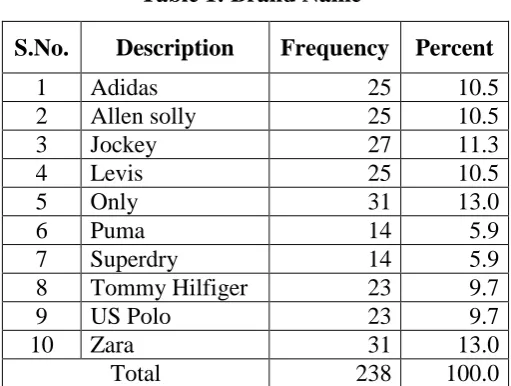
[image:4.595.172.428.274.467.2]The shopping mall, in which the study carried out were marketing number of brands, of which 10 brands were studied. The customers‟brands on these ten brands were ascertained and the same has been shown in Table 1.
Table 1: Brand Name
„Only‟ and „Zara‟ were the two popular brands that has been preferred by 13% each of the Category. It is followed by Jockey (11.3%) and Adidas, Allen Solly and Levis (10.5%). 9.7% prefer US Polo and Tommy Hilfiger. Least preference was given for Puma and Superdry (5.9%).
Product Category
The product categories preferred by the respondents were shown in Table 2. Table 2: Product Category
S. No Category Frequency Percent
1 Men‟s Wear 117 49.2
2 Women‟s Wear 112 47.1
3 Kid‟s Wear 9 3.8
Total 238 100.0
S.No. Description Frequency Percent
1 Adidas 25 10.5
2 Allen solly 25 10.5
3 Jockey 27 11.3
4 Levis 25 10.5
5 Only 31 13.0
6 Puma 14 5.9
7 Superdry 14 5.9
8 Tommy Hilfiger 23 9.7
9 US Polo 23 9.7
10 Zara 31 13.0
It is inferred from the Table 2 that out of 238 respondents, 117 (49.2%) preferred men‟s wear, 112 (47.1%) preferred woman‟s wear and 9 (3.8%) preferred kids wear.
Criteria for Apparel Purchase
[image:5.595.118.479.198.359.2]The criteria for apparel purchase have been analysed based on the variables such as: - design, brand, material plus quality, price, comfort plus fit, design plus material quality and all the variables. The opinions of the respondents were given in Table 3.
Table 3: Criteria for apparel purchase
S. No Description Frequency Percent
1 Design 41 17.2
2 Brand 28 11.8
3 Material and Quality 84 35.3
4 Price 19 8.0
5 Comfort and Fit 49 20.6
6 All 12 5.0
7 Design and material quality and comfort fit 5 2.1
Total 238 100.0
It can be seen from Table 3 that out of 234 respondents, 84 (35.3%) indicated material plus quality as their first preference followed by preferred for comfort and fit(49, 20.6%) and design (41, 17.2%). Least preference was given for design, material quality and comfort fit together (2.1%).
General Shopping Pattern
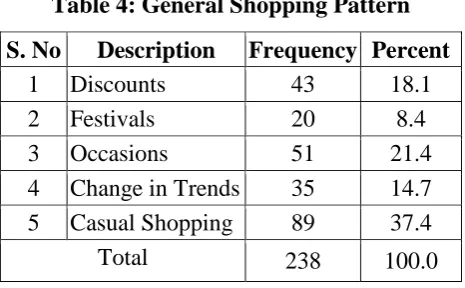
The criteria for general shopping pattern have been analysed based on five variables such as discounts, festivals, occasions, change in trends and casual shopping. The opinions of the respondents were given in Table 4.
Table 4: General Shopping Pattern
S. No Description Frequency Percent
1 Discounts 43 18.1
2 Festivals 20 8.4
3 Occasions 51 21.4
4 Change in Trends 35 14.7 5 Casual Shopping 89 37.4
[image:5.595.182.415.549.693.2]It is observed from Table 4 that out of 238 respondents, 89 (37.4%) respondents preferred casual shopping and 51 (21.4%) respondents preferred shopping during occasions. The least preference was given to shopping during festivals by 20 (8.4%) respondents.
Shopping frequency
[image:6.595.177.417.208.389.2]The criteria for shopping frequency have been analysed based on the variables such as:- once in month, once in 2 months, quarterly, half yearly and during sale periods. The opinions of the respondents were given in Table 5.
Table 5: Shopping Frequency
S. No. Description Frequency Percent
1 Once in a month 94 39.5 2 Once in 2 months 75 31.5
3 Quarterly 38 16.0
4 Once in 6 months 21 8.8
5 During a sale 10 4.2
Total 238 100.0
It can be seen from Table 5 that 94 (39.5%) respondents preferred shopping of apparel once in a month followed by 75 (31.5%) respondents preferred apparel shopping once in 2 months and the least preference were given by 10 (4.2%) respondents for shopping during a sale. Spending Pattern on Apparel
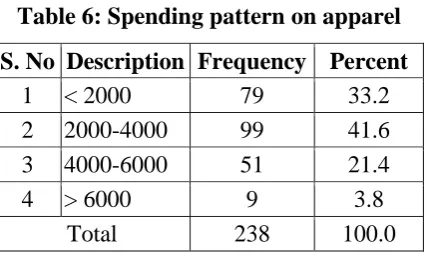
The spending pattern on apparel by the respondents are given in Table 6 Table 6: Spending pattern on apparel
S. No Description Frequency Percent
1 < 2000 79 33.2
2 2000-4000 99 41.6
3 4000-6000 51 21.4
4 > 6000 9 3.8
Total 238 100.0
[image:6.595.193.408.495.623.2]Preference of Shopping
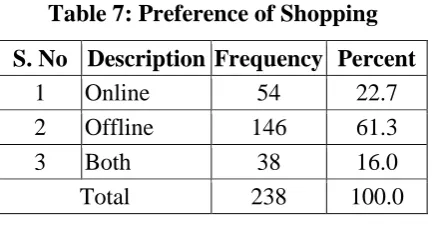
[image:7.595.191.410.78.191.2]The mode of shopping whether online or offline or both were analysed and is given Table 7. Table 7: Preference of Shopping
S. No Description Frequency Percent
1 Online 54 22.7
2 Offline 146 61.3
3 Both 38 16.0
Total 238 100.0
It is noted from Table 7 that out of 238 respondents 146 (61.3%) respondents preferred shopping in visiting the retail stores physically and 54 (22.7%) respondents preferred E-shopping whereas about 38 (16%) respondents were comfortable in both modes.
Factors Influencing on Shopping
[image:7.595.88.509.404.457.2]The factors influencing for apparel purchase have been analysed based on the variables such as: - window display and fabric knowledge. The opinions of the respondents were given in Table 8.
Table 8: Factors Influencing on Shopping
S.No. Description Yes No
1 Influence on window display 184 77.3% 54 22.7% 2 Knowledge on Fabric Type Woven or Knits 178 74.8% 60 25.2%
It is noted from Table 8 that out of 238 respondents, 184 (77.3%) indicated that window display is a decisive factor in shopping and 178 (74.8%) respondents indicated that fabric type whether woven or knits is also another decisive factor in their shopping.
Preference of Fabric type whileApparel Shopping
The preference of fabric type in apparel shopping by the respondents were analysed and is given Table 9.
Table 9: Preference of Fabric type while Shopping
Description Knit Woven
Preference 113 64.2% 63 35.8%
shopping. It can be inferred from the above that the comfort is more in knitted apparels than in woven apparels perhaps because of its characteristics.
Effect and Fashion Trends
The effect on discount offers and current fashion trends while shopping have been analysed and is given in Table 10.
Table 10: Effect on Discount offers and Current Fashion Trends while Shopping
S.No Description Yes No
1 Effect on discount offers while choosing the brand 163 68.5% 75 31.5% 2 Effect on current fashion trends 160 67.2% 78 32.8%
3 Worth of Purchase 215 90.3% 23 9.7%
It can be seen from Table 10 that out of 238 respondents, 215 (90.3%) respondents indicated that there is value for the money in their apparel purchase. Further 163 (68.5%) respondents preferred discount offerswhile shopping whereas 75 (31.5%) respondents indicated that discount offers didn‟t have any effect in their shopping. Similarly 160 (67.2%) respondents indicated that current fashion trends is important factor in their shopping and 78 (32.8%) respondents indicated that current fashion trends didn‟t have any effect in their shopping. It is inferred that discount offers and current fashion trends plays a decisive role in the shopping of apparels. Today worth of purchase also considered as a vital factor.
FINDINGS
Consumer Behaviour towards Apparel Brands were considered based on ten factors such as Brand name, Product Category, Criteria for Apparel Purchase, General shopping pattern, Shopping frequency, Spending Pattern on Apparel, Preference of Shopping, Factors Influencing on Shopping, Preference of Fabric type, Effect on Discount offers and Current Fashion Trends.
The shopping mall, in which the study carried out were marketing number of brands, of which 10 brands Adidas, Allen solly, Jockey, Levis. Only, Puma, Superdry, Tommy Hilfiger, US Polo and Zara were taken up for the study.
Highly preferred brand by the consumers were „Only‟ and „Zara‟ (13% each of the Category). It is followed by Jockey (11.3%) , Adidas (10.5%), Allen Solly (10.5%) and Levis (10.5%). Least preferred brands were Puma and Superdry.
Material plus quality (84, 35.3%) as their first preference among seven Criteria for apparel purchase considered for the study followed by comfort and fit (49, 20.6%) and design (41, 17.2%). Least preference was given for design, material quality and comfort fit together (2.1%).
In the case of general shopping pattern, casual shopping and during occasions were given top priority. The least preference was given to shopping during festivals.
The Shopping frequencies were once in a month or once in 2 months.
Nearly 41.6% spent in the range of Rs.2000-4000/-, and 33.2% spent less than Rs.2000/- in a month.
Nearly 61.3%preferred shopping by visiting the retail stores physically and 22.7% through online. Only 16% respondents were comfortable in both online and offline modes.
64.2% preferred knitted apparels and 35.8%preferred woven apparels.
90.3% looks for value for the money in their apparel purchase. Further 68.5% preferred discount offers and 67.2% relay on current fashion trends. 31.5% indicated that discount offers didn‟t have any effect in their shopping. It is inferred that discount offers and current fashion trends plays a decisive role in the shopping of apparels.
CONCLUSION
References
1. Aagerup, U .(2011),“The influence of real women in advertising on mass market fashion brand perception”, Journal of Fashion Marketing and Management, pp. 486-502.
2. Gehrt, K.C., Onzo, N., Fujita, K., &Rajan, N.R. (2007), “The emergence of Internet shopping in Japan: Identification of shopping orientation-defined segment”, Journal of Marketing Theory and Practice, 15, 167-177.doi:10.2753/MTP1069-6679150206 3. Gharleghi, Behrooz (2013), “Malaysian young consumer preferences in choosing
international fashion brand”, Journal of Human and Social Science Research, 1 (1), 31-38.
4. Ismail, Zeenat; Masood, Sarah; Tawab, ZainabMehmood (2012), “Factors Affecting
Consumer Preference of International Brands over Local Brands”, International
Proceedings of Economics Development & Research, 31, 54-59.
5. Jung and Sung (2008), “Consumer‐based brand equity : Comparisons among Americans and South Koreans in the USA and South Koreans in Korea”, Journal of Fashion Marketing and Management: An International Journal, 12(1), 24-35
6. Kim, H., &Karpova, E. (2010), “Consumer attitudes toward fashion counterfeits: Application of the theory of planned behaviour”, Clothing and Textile Research Journal, 28, 79-94. doi: 10.1177/0887302X09332513
7. Kinra, N. (2006), “The effect of country-of-origin on foreign brand names in the Indian market”, Marketing Intelligence & Planning, 15-30.
8. Liebermann, Y., &Stashevsky, S. (2009), “Determinants of online shopping: Examination of an early stage online market”, Canadian Journal of Administrative Sciences, 26, 316-331. Doi:10.1002/cjas.12
9. Ling, K. C., Chai, L. T., &Piew, T. H. (2010), “The effects of shopping orientations: Online trust and prior online purchase experience toward customers‟ online purchase intention”, International Business Research, 3, 63-76. Doi:10.5539/ibr.v3n3p63 10.Quelch, John (1999), “Global Brands: Taking Stock”, Business strategy review, 10
(1), 1-14. DOI: 10.1111/1467-8616.00085
12.Shaw, Deirdre and Shiu, Edward (2003), "Ethics in consumer choice: a multivariate modelling approach", European Journal of Marketing, Vol. 37 Iss: 10, pp.1485 - 1498 13.Sung, H., Jeon, Y. (2009), “A profile of Koreans: Who purchases fashion goods
online?”, Journal of Fashion Marketing and Management, 13, 79-97. doi:10.1108/13612020910939897