BIORTHOGONALIZATION
DAVID K. RUCHReceived 16 February 2006; Revised 21 July 2006; Accepted 25 July 2006
We present a backward biorthogonalization technique for giving an orthogonal projec-tion of a biorthogonal expansion onto a smaller subspace, reducing the dimension of the initial space by droppingdbasis functions. We also determine which basis functions should be dropped to minimize theL2distance between a given function and its
projec-tion. This generalizes some recent results of Rebollo-Neira.
Copyright © 2006 Hindawi Publishing Corporation. All rights reserved.
In [3], Rebollo-Neira gives a backward biorthogonalization technique for projecting a biorthogonal expansion onto a subspace, reducing the dimensionNof the initial space by droppingd=1 basis function. In this note, we generalize this method to reduce the space by an arbitrary numberdof basis functions,d < N. Proposition 3.4 in [3] indi-cates which single basis function is to be removed in order to minimize theL2distance
between a function f and its orthogonal projection into the reduced space. We will also generalize this result inProposition 7. If more than one basis function is to be dropped, Rebollo-Neira recommends iterating thed=1 process. We show viaExample 8that in some circumstances iterating thed=1 processktimes leads to results inferior to using Proposition 7and droppingk=dbasis functions simultaneously.
We begin with a Hilbert spaceHand anN-dimensional subspaceV. Assume biorthog-onal bases ofV given by{xi}N
i=1 and{xi}Ni=1 such thatxi,xj =δi j. Now dropd basis elements from each set, without loss of generality the firstdelements for notational pur-poses, and form the reduced subspacesV =span{xi}Ni=d+1andV=span{xi}di=1. We wish
to modify thexi so that the projection fromV toV is orthogonal. We next recursively construct the sequence{vi}d
i=1⊂Vby
v1=x1, vi=xi− i−1
=1
xi,v
v,v
v, i≤d. (1)
Hindawi Publishing Corporation
International Journal of Mathematics and Mathematical Sciences Volume 2006, Article ID 87392, Pages1–5
We observe that the set{vi}d
i=1forms an orthogonal basis ofVby construction. We then
construct the sequence{xi}Ni=d+1by
xi=xi−d
=1
xi,v
v,vv
(2)
and setU=span{xi}Ni=d+1. We will see that this formula generalizes the dual modification
of [3, Theorem 3.1] ford≥1. Note that each xi is created to be orthogonal to Vby subtracting fromxiits projection ontoV.
Proposition 1. The spacesUandVare orthogonal complements inV,V=V⊕V. Proof. Choosei, jsuch thatj≤d < iand use the definition ofxi and the orthogonality of{vi},
xi,vj=xi,vj−d
=1
xi,v
v,v
v,vj=xi,vj−xi,vj=0. (3)
ThusUandVare orthogonal subspaces ofV, and their dimensions add toN. We next verify thatUandVare actually the same space.
Lemma 2. The spacesUandVare orthogonal complements inV, andU=V.
Proof. By (1), we can write vj =nj=1anxn for some constants an, so the original biorthogonality conditionxi,xj =δi j says that, for j < i,vj,xi =
j
n=1anxn,xi =0.
ThusV andVare orthogonal subspaces ofV, and their dimensions add toN. By the
previous proposition,U=V.
Next we give the desired biorthogonal bases of the reduced subspaceV.
Proposition 3. The reduced spacesU andV are identical and have biorthogonal bases
{xi}Ni=d+1and{xj}Nj=d+1.
Proof. UsingLemma 2and (2), we have fori,j > d≥,
xi,xj
=xi,xj
−d
=1
xi,v
v,v
v,xj
=δi j−
d
=1
xi,v
v,v·0=δi j. (4) In order to give an explicit method for determining which basis functions to drop to minimize the residual, we give a formula for the projection operator.
Proposition 4. The orthogonal projection ofVontoV isP(·)=iN=d+1xi(·)xi.
Proof. ByProposition 3,P(w)=wfor allw∈V and Range(P)=V. From Propositions 1and3,Vis the null space ofP, and Range(P) andV=Null(P) are orthogonal, soPis
The following generalizes [3, Corollary 3.2] to give the coefficients ofP(f) for the case d≥1.
Theorem 5. If f =N
i=1cixi, whereci= xi,f, then
P(f)= N
i=d+1
cixi, whereci=ci−d
=1
xi,v
v,v
v,f. (5)
Proof. We calculate, using (2),
P(f)=
N
i=d+1
xi(f)xi= N
i=d+1
xi,f
− d =1
xi,v
v,v
v,f
xi. (6)
soP(f)=Ni=d+1cixi, where
ci=ci−d
=1
xi,v
v,v
v,f. (7)
The following generalizes [3, Corollary 3.3] for the cased≥1.
Corollary 6. If f =N
i=1cixi, whereci= xi,f, then
f2=
P(f) 2+ d
i=1
1 v i 2 i
k=1
ckvi,xk
2
. (8)
Proof. Since V =V ⊕V, we can write f =P(f)⊕projV(f), where projV(f)=
d
i=1vi/vi,f(vi/vi) is the projection of f ontoVusing the orthogonal basis{vi}. Thus by Parseval and thenLemma 2, we have
f2= P(f) 2+ d
i=1 vi v i ,f
vi
v i
2= P(f) 2+ d
i=1
1
v i
2vi,f
2
= P(f) 2+ d
i=1
1 v i 2 i
k=1
ckvi,xk
2
.
(9)
Next we generalize [3, Proposition 3.4] for the cased≥1.
Proposition 7. By reindexing the originalxiandxito examine all possible
N d
combina-tions ofdcomponents dropped from the original basis ofV and to minimize theL2distance
between f andP(f), choose the set ofdbasis elementsxithat minimizes d
i=1
1 v i 2 i
k=1
ckvi,xk
2
. (10)
1 2 3 4 1
2 3
0.5 1 1.5 2
0.5
1
1.5
(a)
1 2 3 4
1 2 3
0.5 1 1.5 2
0.5
1
1.5
[image:4.468.135.336.69.391.2](b)
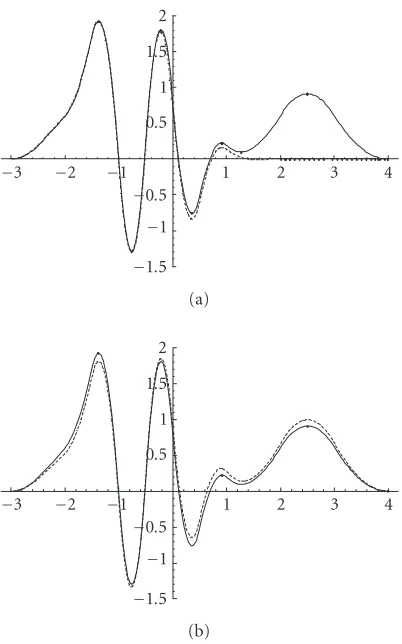
Figure 1. Drop two basis functions: iteratively (a), and simultaneously (b), forExample 8.
Example 8. For simplicity, we consider a function f(t) in the four-dimensional subspace V with basis functions generated from cardinal spline wavelets. LetB3(x) be the
stan-dard quadratic cardinal spline supported on [−1, 2] and letw(t) be the standard associ-ated wavelet for the Riesz basis ofL2(R) generated byB
3(x) as mentioned in [1] or [2].
LetV=span{x1,x2,x3,x4}, wherex1(t)=B3(t+ 2)/B3,x2(t)=B3(t−2)/B3,x3(t)=
(B3(t−2) +B3(t+ 2) + 0.2B3(t))/B3, x4=w(t). The function f can be expressed as
f(t)=0.7x1(t) + 0.5x2(t) + 0.4x3(t) +x4(t). We wish to dropd=2 basis elements and
obtain the best two-dimensional approximation to f. If we iteratively drop one basis ele-ment at a time usingProposition 7withd=1, then we removex3and thenx2leaving
pro-jectionP(f)=0.9x1+x4as shown inFigure 1(a) with residual errorf−P(f)2=0.82.
However, if we simultaneously drop two elements withd=2, then we instead dropx1
andx2leaving projectionP(f)=1.1x3+x4as shown inFigure 1(b) with residual error f −P(f)2=0.03. As can be seen from these errors and the plots inFigure 1, there is a
When the value ofNdis large, the computational expense of choosing the optimal set of basis elements to be dropped can be quite large. Investigation of this issue merits further study.
References
[1] I. Daubechies, Ten Lectures on Wavelets, CBMS-NSF Regional Conference Series in Applied Mathematics, vol. 61, SIAM, Pennsylvania, 1992.
[2] P. R. Massopust, D. K. Ruch, and P. J. Van Fleet, On the support properties of scaling vectors, Applied and Computational Harmonic Analysis 3 (1996), no. 3, 229–238.
[3] L. Rebollo-Neira, Backward adaptive biorthogonalization, International Journal of Mathematics and Mathematical Sciences 2004 (2004), no. 35, 1843–1853.
David K. Ruch: Department of Mathematical and Computer Sciences, Metropolitan State College of Denver, Denver, CO 80217-3362, USA