International Research Journal of Human Resources and Social Sciences Impact Factor- 2.561
Vol. 3, Issue 2, Feb 2016 ISSN(O): (2349-4085) ISSN(P): (2394-4218)
© Associated Asia Research Foundation (AARF)
Website: www.aarf.asia Email : [email protected] , [email protected]“PURPOSE OF USING THE e-RESOURCES WITH RESPECT TO
RESEARCH SCHOLARS
”
Dr. Vasanthpriyadharsan G.M.
Principal, JSR College of Education, Madathukulam Post & Taluk,Tamil Nadu-642113.
ABSTRACT
Information and Communication Technology (ICT) has been have an essential tool in
researchers’ academic and research development. Especially, the research scholars use and
apply internet based e-resources (electronic resources) for their research development. So,
e-resources are the prominent role of research scholars’ academic performance and
attainment. This paper describes the knowledge utilisation and satisfaction levels of research
scholars with regard to the e-resources. The study is involved in knowing the scholastic or
knowledge of the scholars of a Bharathiar University in Tamil Nadu in using the available
knowledge and the utility of e–resources. The study reveals that most of the research scholars
of different departments are using e-resources with different purposes. Most of the research
scholars are utilizing e-resources with their research and development.
Key words: ICT, e-resources, knowledge utilisation, satisfaction levels, research scholars, Bharathiar University, Tamil Nadu, Departments.
INTRODUCTION
information to fulfil the requirements of the different category of users in a better way. Especially research scholars use internet based e-resources to collect the review of related literature available all over the world. So e-resource is booming popular in higher education in the world market and there is a massive movement for global e-resources. In India especially, higher education has tremendous growth in providing quality education based on e-resources. It is right time to evaluate or assess the users of electronic resources. In the research field the quality of research must be enhanced by the knowledge and use of internet based e- resource. So it is clear that the internet based e–resource is inevitable in the research field. The present study is involved in knowing the scholastic or knowledge of the scholars of a Bharathiar University in Tamil Nadu in using the available knowledge and the utility of e–resources.
e
–RESOURCES: MEANINGMaterial consisting of data or computer programs enclosed for reading and manipulation by a computer by the use of a peripheral device directly connected to the computer, such as the CD– Rom drive, or remotely via a network, such as the Internet. The category includes software applications, electronic texts, bibliographic database, institutional repositories, websites, e-books, collections of e–journals, etc. e–resources somewhat not publicly available free of charge usually require licensing and authentication. On-line bibliographical resources and Internet, which can be accessed around the globe, through computer is called as electronic resources.
PURPOSE OF E–RESOURCES
They are 1. Content 2. Ease of use, 3. Updating 4. Maintenance 5. Standard (Quality) 6. Equipment 7. Output.
MAJOR TYPES OF e–RESOURCES
e–resources can be classified into two major types. They are 1. On - line e–resources and 2. Off - line e-resources
On line e–resources are as a digital view or electronic view through internet. And they are with storage devices. They are e–journal, e–book, e–database, e–thesis and dissertations, e–images, e–bibliographies, e–blog, and e–proceedings etc.
e–journal, e–database, etc. That is any electronic product that delivers collections of data, whether a text referring to full text bases, e–journals, image collections, and other multimedia products. These may be delivered on CD/DVD Rom, on tape, via the Internet and so on. The benefit of these large sources is that they cover many subjects and thus facilitate a multidisciplinary approach.
REVIEW OF RELATED LITERATURE
Anna Gakibayo et al. (2013), This study assessed the utilization of electronic
information resources in Mbarara University Library by the students by bringing out objectives namely; identifying the availability of e-resources in Mbarara University library, determining the extent of using e-resources and lastly proposing strategies to promote the usage of e-resources by students.
Tunji. M. et., al. (2011). This study examined the user perception of the electronic resources by the academic staff of the University of Ilorin. The sample consists of 250 academic staff selected from eight (8) out of the twelve (12) faculties that made up of the university. Data were collected through an electronic resource user perception survey (ERUPS). Responses were received from 225 (90%) academic staff of the eight faculties. Analysis revealed that the frequency of the use of electronic resources was low. Reasons alluded to were lack of time; lack of awareness to electronic resources; power shortage, ineffective communication channels, slow network and inadequate searching skills. The study recommended adequate Information and Communication Technologies (ICT) training to all categories of academic staff and provision of adequate power supply.
Nishi Singh and Subhash Chand. (2014), The present study suggested the use and satisfaction level of the users of Advanced Institute of Technology & Management Aurangabad, Palwal, Haryana (India). A questionnaire collected from 250 users with the data on preferred use of print information resources and level of user satisfaction of print and electronic resources, library services and facilities. The findings reveal that the users mainly use the textbooks compared to other print information resources. Users are more satisfied with the availability of Textbooks, Reference Books, News Papers, Magazines, Journals, Online/Offline Databases, Internet Facility, Photocopy Service, Scanning Facility, Book Lending Services, Reading Room and Furniture.
Chennai, Tamil Nadu. A total of 175 (distributed 25 questionnaire in each department) Well-structured questionnaire was distributed to the undergraduates. the majority of the respondents were well aware of e-Journals and only few respondents were having no idea about the use of e–Journals. It was observed that majority of respondents were using the Electronic version whereas only few of them were using both versions. Many problems are faced by the students even though majority of the respondents were fully satisfied with the accessibility of e–Journals.
The Present study involved that how much these e-resources are being used and what is the effectiveness of this electronic era on the non-electronic era has to be examined. The main aim of this study is to supplement the results obtained in many earlier studies, which had provided interesting general information on the use of the e–resources.
SCOPE OF THE STUDY
The present research study is to focus on the Master of Philosophy (M.Phil.) and Doctor of philosophy (Ph.D.) research scholars of various departments of the Bharathiar University, Coimbatore, Tamil Nadu, India. This study aims to know how they are utilizing the knowledge of research scholars with respect to the e–resources.
OBJECTIVES OF THE STUDY
To determine if the knowledge (information) utilisation of e-resources with respect to research scholars are contingent on the background variables; namely Department, Gender, Accommodation, Age, Academic course pursued, Years of pursuing research study.
HYPOTHESIS OF THE STUDY
There is no association between the below mentioned background variables and knowledge (information) utilisation of e-resources with respect to the research scholars. Department, Gender, Accommodation, Age, Academic courses pursued, Years of pursuing research study.
RESEARCH METHODOLOGY FOR THE STUDY
Investigator has adopted the descriptive study and survey method. The method has been adopted most appropriate for the study because it can measure research scholars background, knowledge, experience and what they know about e–resources and types of e–resources and it was well suited to the research objectives and hypothesis taken up for the study.
the 29 departments at Bharathiar University, Tamil Nadu, India.
SAMPLING TECHNIQUE & SAMPLES
The investigator used the convenient sampling technique i.e non-probability sampling technique. The investigator selected the sample of 445 research scholars from 29 different departments.
Department wise frequency distribution of the total scores
S.No Department Frequency Valid Percentage Cumulative Percentage
1. Science 174 39.1 39.1 2. Applied Science
and Technology
103 23.1 62.2
3. Arts 97 21.8 84.0
4. Education and Management
53 11.9 96.0
5. Social Science 18 4.0 100.0
Total 445 100.0
STATISTICAL TECHNIQUES USED IN THE STUDY
The present study involved non–parametric tests. The collected data were analyzed with the help of Statistical Package for Social Sciences (SPSS). Statistical methods like percentage analysis and Chi - Square tests were used.
TESTING THE SIGNIFICANCE OF HYPOTHESIS
The probability (p) indicates the level of statistical significance. The significant level is p equal to 0.05 and less than 0.05. Lesser the probability (p) higher would be the significance. The results of analysis are presented under the different headings. The Chi-
Square (
2
Determine if the purpose of using the e-resources is contingent with respect to the
department of the research scholars
Null hypothesis (H0): There is no association between the department and the purpose of
using the e-resources with respect to the research scholars.
Alternative hypothesis (H1): There is an association between the department and the
purpose of using the e-resources with respect to the research scholars.
Table 2 Department andpurpose of using the e-resourceswith respect to research
scholars
Department Purpose of using the e–resources N (%) Total 2
- test; df and LOS research and development Publishing journal / book
studying career
develop
-ment
all other
Science 66 (14.8%) 15 (3.4%) 14 (3.1%) 4 (.9%) 75 (16.9%) 0 (.0%) 174 (39.1%) 26.203 ;20 P>0.05 Applied Science and Technology 28 (6.3%) 8 (1.8%) 8 (1.8%) 2 (.4%) 57 (12.8%) 0 (.0%) 103 (23.1%)
Arts 35
(7.9%) 4 (.9%) 5 (1.1%) 1 (.2%) 52 (11.7%) 0 (.0%) 97 (21.8%) Education and Management 17 (3.8%) 6 (1.3%) 2 (.4%) 4 (.9%) 23 (5.2%) 1 (.2%) 53 (11.9%) Social Science 8 (1.8%) 0 (.0%) 2 (.4%) 1 (.2%) 7 (1.6%) 0 (.0%) 18 (4.0%)
Total 154 (34.6%) 33 (7.4%) 31 (7.0%) 12 (2.7%) 214 (48.1%) 1 (.2%) 445 (100%)
LOS - Level of significance – 5% Level
Table 2 reveals that, 214 (48.1%) respondents are using e-resources for all purposes whereas 154 (34.6%) are using e-resources for research and development purpose. Out of 174 (39.1%) of scholars of science department, 75 (16.9%) are using e-resources for all purposes. From the result, it is observed that the scholars of the department of science were using e-resources for all purposes more than the other categories. The Chi-Square test for independence is
significant at 5% level of significance. The value of
2
is 26.203 and the degree of freedom
variation among the department and purpose of using the e-resources with respect to research scholars.
Determine if the purpose of using the e-resources is contingent with respect to the
gender of the research scholars
Null hypothesis (H0): There is no association between the gender and the purpose of using
the e-resources with respect to the research scholars.
Alternative hypothesis (H1): There is association between the gender and the purpose of
using the e-resources with respect to the research scholars.
Table 3 Gender andthepurpose of using the e-resourceswith respect to research
scholars
Gender Purpose of using the e – resources N (%) Total 2
- test;
df and
LOS
research and
develop-ment
Publishing
journal /
book
studying career
develop-ment
all others
Male 79
(17.8%)
21
(4.7%)
12
(2.7%)
7
(1.6%)
93
(20.9%) 0
(.0%)
212
(47.6%) 8.163 ;5 P>0.05 Female 75
(16.9%)
12
(2.7%)
19
(4.3%)
5
(1.1%)
121 (27.2%)
1
(.2%)
233 (52.4%)
Total 154 (34.6%)
33
(7.4%)
31
(7.0%)
12
(2.7%)
214 (48.1%)
1
(.2%)
445
(100%)
LOS - Level of significance – 5% Level
Table 3 reveals that, 214 (48.1%) respondents are using e-resources for all purposes whereas 154 (34.6%) are using the e-resources for research and development purpose. Out of 233 (52.4%) female scholars, 121 (27.2%) are using e-resources for all purposes. From the result, it is observed that female scholars are using the e-resources for all purposes more than the male scholars. The Chi-Square test for independence is significant at 5% level of
significance. The value of
2
is 8.163 and the degree of freedom (df) is 5. The value of p
shows statistically significant (P>0.05). So, the null hypothesis is accepted. Alternative hypothesis is not accepted. This implies that there is no significant variation among the gender and purpose of using the e-resources with respect to the research scholars.
Determine if the purpose of using the e-resources is contingent with respect to the
academic courses being pursued with regard to the research scholars
Null hypothesis (H0): There is no association between the academic courses being pursued
Alternative hypothesis (H1): There is association between the academic courses being
pursued andthepurpose of using the e-resources with respect to the research scholars. Table 4 Academic courses being pursued andthepurpose of using the e-resourceswith
respect to research scholars
Academic
courses
being
pursued
Purpose of using the e – resources N (%) Total 2
- test;
df and LOS
research
and
develop-ment
Publish
-ing
journal /
book
studying career
develo-pment
all other
M.Phil 58
(13.0%)
11
(2.5%)
19
(4.3%)
7
(1.6%)
85
(19.1%) 0
(.0%)
180
(40.4%)
9.10;5 P>0.05 Ph .D 96
(21.6%)
22
(4.9%)
12
(2.7%)
5
(1.1%)
129 (29.0%)
1
(.2%)
265 (59.6%)
Total
154 (34.6%)
33
(7.4%)
31
(7.0%)
12
(2.7%)
214 48.1%)
1
(.2%)
445
(100%)
LOS - Level of significance – 5% Level
Table 4 discloses 214 (48.1%) respondents are using e-resources for all purposes whereas 154 (34.6%) are using that for research and development purposes. Out of 265 (59.6%) Ph.D scholars, 129 (29%) are using e-resources for all purposes. From the result, it is observed that Ph.D scholars are using e-resources for all purposes more than the M.Phil scholars. The
Chi-Square test for independence is significant at 5% level of significance. The value of
2 is
9.10 and the degree of freedom (df) is 5. The value of p shows statistically significant (P>0.05). So, the null hypothesis is accepted. Alternative hypothesis is not accepted. This implies that there is no significant variation among the academic courses being pursued and the purpose of using the e-resources with respect to the research scholars.
Determine if the purpose of using the e-resources is contingent with respect to the
accommodation of the research scholars
Null hypothesis (H0): There is no association between the accommodation and the purpose
of using the e-resources with respect to the research scholars.
Alternative hypothesis (H1): There is association between the accommodation and the
Table 5 Accommodation andthe purpose of using the e-resourceswith respect to
research scholars
Accomm-odation
Purpose of using the e – resources N (%) Total 2
- test;
df and
LOS
research
and
develop-ment
Publish-ing
journal /
book
studying career
developm
ent
all others
Days
scholars
68
(15.3%)
16
(3.6%)
16
(3.6%)
7
(1.6%)
95
(21.3%) 0
(.0%)
202
(45.4%) 1.571; 6 P>0.05 Hostel
scholars
86 (19.3%)
17
(3.8%)
15
(3.4%)
5
(1.1%)
119 (26.7%)
1
(.2%)
243 (54.6%)
Total 154 (34.6%)
33
(7.4%)
31
(7.0%)
12
(2.7%)
214 (48.1%)
1
(.2%)
445
(100%)
LOS - Level of significance – 5% Level
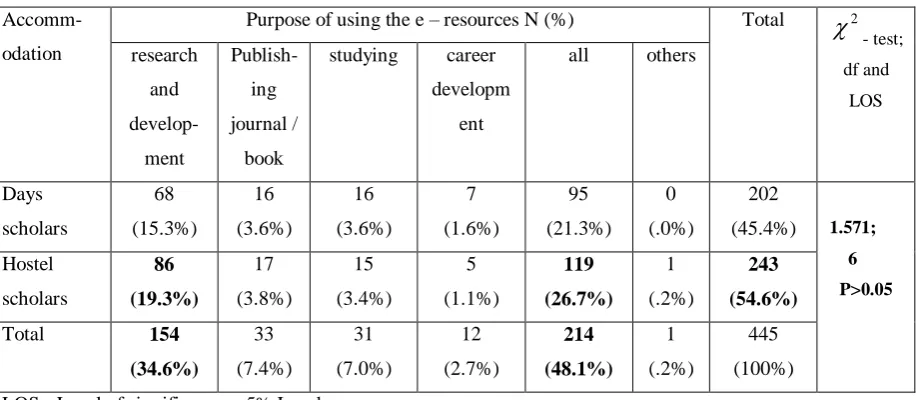
Table 5 shows that, 214 (48.1%) respondents are using e-resources for all purposes whereas 154 (34.6%) are using that for research and development purposes. Out of 243 (54.6%) hostel scholars, 119 (26.7%) are using e-resources for all purposes. From the result, it is observed that hostel scholars are using e-resources all purposes more than the day scholars. The
Chi-Square test for independence is significant at 5% level of significance. The value of
2 is
1.571 and the degree of freedom (df) is 6. The value of p shows statistically significant (P>0.05). So, the null hypothesis is accepted. Alternative hypothesis is not accepted. This implies that there is no significant variation among the accommodation and the purpose of using the e-resources with respect to the research scholars.
Determine if the purpose of using the e-resources is contingent with respect to the age of
the research scholars
Null hypothesis (H0): There is no association between the age and the purpose of using the
e-resources with respect to the research scholars.
Alternative hypothesis (H1): There is association between the age and thepurpose of using
Table 6 Age andthepurpose of using the e-resourceswith respect to the research
scholars
Age Purpose of using the e – resources N (%) Total 2
- test; df and LOS research and develop-ment Publishing journal / book
studying career
develop-ment
all other
Less than 25 years 80 (18.0%) 11 (2.5%) 19 (4.3%) 9 (2.0%) 100 (22.5%) 0 (.0%) 219 (49.2%) 17.715; 15 P>0.05 Between
26 to 30
years 61 (13.7%) 19 (4.3%) 8 (1.8%) 3 (.7%) 102 (22.9%) 1 (.2%) 194 (43.6%) Between
31 to 40
years 12 (2.7%) 2 (.4%) 3 (.7%) 0 (.0%) 10 (2.2%) 0 (.0%) 27 (6.1%) Above 41 years 1 (.2%) 1 (.2%) 1 (.2%) 0 (.0%) 2 (.4%) 0 (.0%) 5 (1.1%)
Total 154 (34.6%) 33 (7.4%) 31 (7.0%) 12 (2.7%) 214 (48.1%) 1 (.2%) 445 (100%)
LOS - Level of significance – 5% Level
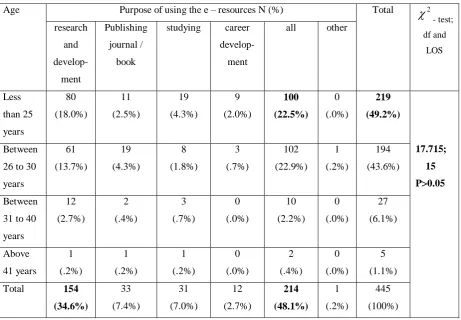
Table 6 shows that, 214 (48.1%) respondents are using the e-resources for all purposes whereas 154 (34.6%) are using the e-resources only for the research and development purposes. Out of 219 (49.2%) scholars who are less than 25 years of age, 100 (22.5%) are using e-resources for all purposes. From the result, it is observed that scholars who are less than 25 years of age are using e-resources more than the other categories. The Chi-Square test
for independence is significant at 5% level of significance. The value of
2
is 17.715 and the
degree of freedom (df) is 15.The value of p shows statistically significant (P>0.05). So, the null hypothesis is accepted. Alternative hypothesis is not accepted. This implies that there is no significant variation among the age and purpose of using the e-resources with respect to research scholars.
Determine if the purpose of using the e-resources is contingent with respect to the year
of pursuing the research study with regard to the research scholars
Null hypothesis (H0): There is no association between the years of pursuing research study
Alternative hypothesis (H1): There is association between the years of pursuing research
[image:11.595.67.535.116.390.2]study andthepurpose of using the e-resources with respect to the research scholars. Table 7 Years of pursuing research study andpurpose of using the
e-resourceswith respect to research scholars
Years
of
pursuing
research
study
Purpose of using the e – resources Total 2
- test; df and LOS research and develop -ment Publish -ing journal / book Study -ing career develop -ment
all other
Less than one year 50 (11.2%) 4 (.9%) 16 (3.6%) 6 (1.3%) 68 (15.3%) 0 (.0%) 144 (32.4%) 20.439;1 5 P>0.05
1 to 3
years 84 (18.9%) 21 (4.7%) 15 (3.4%) 5 (1.1%) 121 (27.2%) 1 (.2%) 247 (55.5%)
4 to 6
years 18 (4.0%) 8 (1.8%) 0 (.0%) 1 (.2%) 23 (5.2%) 0 (.0%) 50 (11.2%) Above 6 years 2 (.4%) 0 (.0%) 0 (.0%) 0 (.0%) 2 (.4%) 0 (.0%) 4 (.9%)
Total 154 (34.6%) 33 (7.4%) 31 (7.0%) 12 (2.7%) 214 (48.1%) 1 (.2%) 445 (100%)
LOS - Level of significance – 5% Level
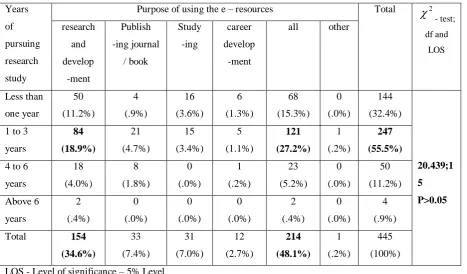
Table 7 shows that, 214 (48.1%) respondents are using e-resources for all purposes whereas 154 (34.6%) are using e-resources for the research and development purpose. Out of 247 (55.5%) scholars who are 1 to 3 years of pursuing research study, 121 (27.2%) are using e-resources for all purposes. From the result, it is observed that scholars who are 1 to 3 years of pursuing research study are using e-resources more than the other categories. The
Chi-Square test for independence is significant at 5% level of significance. The value of
2 is
20.439 and the degree of freedom (df) is 15. The value of p shows statistically significant (P>0.05). So, the null hypothesis is accepted. Alternative hypothesis is not accepted. This implies that there is no significant variation among the years of pursuing research study and the purpose of using the e-resources with respect to the research scholars.
RESULTS AND DISCUSSIONS OF THE STUDY
The Purpose of using the e-resources
Out of 445 (100%) scholars, 214 (48.1%) are using the e-resources for all purposes. 154
12 (2.7%) are using for career development and the remaining 1(.2%) uses e-resources for other purposes. Among the scholars and different departments 174 (39.1%) scholars belong to Science department. 103 (23.1%) are from Applied Science and Technology. 97 (21.8%) are from Arts. 53 (11.9%) are from Education and Management and 18 (4%) are from Social Science department. The scholars of Science department are using e-resources more than the other scholars. The Chi-Square test shows that there is no relationship between the department and the purpose of using the e-resources with respect to the research scholars.
The study shows the gender wise difference with regard to the utility of
e-resources. Among the total scholars 233 (52.4%) are female and 212 (47.6%) are male. Female scholars are using e-resources more than the male scholars. The chi-square test shows that there is no relationship between the gender and the purpose of using the e-resources with respect to the research scholars.
There are 265 (59.67%) Ph.D. scholars and 180(40.4%) M.Phil scholars. The data show
that Ph.D. scholars are using the e- resources more than the M.Phil scholars. According to the chi- square test there is no relationship between the academic courses being pursued and the purpose of using the e-resources with respect to the research scholars.
The study shows the association between the scholars of different accommodations. There
are 243 (54.6%) hostel scholars and 202 (45.4%) day scholars. Hostel scholars are using e-resources more than the day scholars. This is due to the availability of time and other facilities like laboratories, departments and the easy access to web-resources. The chi-square test shows that there is no relationship between the accommodation and purpose of using the e-resources with respect to the research scholars.
The study shows the relationship between the age and the usage of e- resources. From the
data we find that 219 (49.2%) scholars are less than 25 years. 194 (43.6%) are between 26 to 30 years of age. 27 (6.1%) are between 31 to 40 years and 5 (1.1%) are above 41 years. From the study we know that the scholars who are less than 25 years of age are using e- resources more than others. The quickness in working on the e-resources and the exposure on different kinds of e-resources are the reasons for this. According to the
chi-square test there is no relationship between the age and the purpose of using the e-resources with respect to the research scholars.
The scholars with regard to the different durations of pursuing the research study vary in
data show that the scholars of 1- 3 years of pursuing the research study are using the e-resources more than the other scholars. According to the chi-square test there is no relationship between the years of pursuing research study and the purpose of using the e-resources with respect to the research scholars.
FINDINGS OF THE STUDY
Out of 445 (100%) research scholars, maximum of the respondents of Bharathiar
University use the computer and e-resources properly. 174 (39.1%) scholars are from Science department. 103 (23.1%) scholars are from Applied Science and Technology. 97 (21.8%) scholars are from Arts. 53 (11.9%) scholars are from Education and Management. 18 (4%) scholars are Social Science.
214 (48.1%) research scholars are using the e-resources for all purposes. Especially, 154
(34.6%) scholars use the e-resources for research and development.
CONCLUSIONS OF THE STUDY
The study reveals that most of the research scholars of different departments are using e-resources with different purposes. Maximum scholars are using e-resources for research & development and for all purposes. Maximum scholars are using the e-resources for getting information and for making the review of related literature. The modern world is a scientific and technological world and today it is everybody’ concerned. The study shows that the knowledge utilization of internet based electronic resources has created a great importance upon the users of the research scholars of Bharathiar University in their research activities and their academic development works. The rapid developments in ICT have facilitated the divergence and convergence of new electronic resources and devices. The study discussed in a variety of ways and forms in various kinds of electronic resources. Most of the research scholars are utilizing e-resources with their research and development. Research scholars expect training, and awareness programs. The scholars are interested to have this kind of studies which will provide good exposure to them.
REFERENCES
1. Al-Saleh, & Yasir Nasser. (2004). Graduate Students’ Information Needs from
Electronic Information Resources in Saudi Arabia. Dissertation, Florida State
University, Summer 2004.
2. Arikrishnan., R. (2010). E–Resources for Engineering and Technology: An Overview.
University News. Vol. 48 (33). August 16-22.
4. Baljinder Kaur., (2009). Use and Impact of Electronic Resources in Engineering and technological Institutions in India. (Doctoral thesis, Thapar University) India.
5. Bashir Ahmad. (2009). Electronic Information Resources and Services in Agriculture: A Study. University News. Vol. 47 (27). July 06-12.
6. Bashorun et., al. (2011). User Perception of Electronic Resources in the University of Ilorin, Nigeria (UNILORIN). Journal of Emerging Trends in Computing and Information Sciences. Vol. 2(11), (pp.554-562).
7. Best J.W., & Khan., J.V. (1998). Research in Eduction. New delhi: Prentice Hall of India ltd.
8. Dhanavandan., S. et., al. (2012). Use of Electronic Resources at Krishnasamy College of Engineering and Technology Library, Cuddalore. Library Philosophy and Practice. ISSN 1522-0222 Retrieved from http://unllip.unl.edu/LPP/
9. Egberongbe., H.S. (2011). The Use and Impact of Electronic Resources at the University of Lagos. Library Philosophy and Practice. ISSN 1522-0222.
10. Francisca., S. & Mary Rani. (2010). Internet Knowledge of Research Scholars and their Usage. EduTracks. October. 2010.
11. Garrett E.Henry., (1961). Statistics in Psychology and Education. Paragon International Publishers, New delhi.
12. Ibrahim., A.E. (2004). Use and User Perception of Electronic Resources in the United Arab Emirates University (UAEU). Libri. Vol. 54. (pp.18-29).ISSN 0024-2667.
13. International Conference on E-Resources in Higher Education: Issues, Developments, opportunities and Challenges. Bharathidasan University. February 19 th - 20 th , 2010. 14. Kaur., A. (2009). Use of e-resources by Teachers and Researchers of the science and
Engineering & Technology Faculties in Guru Nanak Dev University: A Survey.
Proceeding of the National Convention on Knowledge, Library and Information
Networking (NACLIN) held at University of Jammu, Jammu. (pp.267-285).
15. Madhusudhan, M. (2010). Use of Electronic Resources by Research Scholars of Kurukshetra University. The Electronic Library, Vol. 28(4), (pp.492-506).
16. Miller., R.H. (2000). Electronic Resources and Academic Libraries, 1980-2000: A Historical Perspective. Library Trends, Vol. 48(4), (pp. 645-670).
17. Praveen Shukla., & Rajani Mishra., (2011). Use of E – Resources by Research
Scholars of Institute of Technology, Banaras Hindu University, India. International