LANE CLARK
Received 23 March 2004 and in revised form 8 November 2005
The number of local maxima (resp., local minima) in a treeT∈᐀nrooted atr∈[n] is
denoted byMr(T) (resp., bymr(T)). We find exact formulas as rational functions ofn
for the expectation and variance ofM1(T) andmn(T) whenT∈᐀nis chosen randomly
according to a uniform distribution. As a consequence, a.a.s.M1(T) andmn(T) belong
to a relatively small interval whenT∈᐀n.
1. Introduction
The extension of permutation statistics to labelled trees is the subject of a number of articles. Generating functions for the number of labelled trees of several types according to the number of ascents and descents are given in [4]. A functional equation satisfied by the generating function for the number of labelled trees according to the number of descents and leaves is given in [5]. Central and local limit theorems for the number of ascents or of descents in uniformly random labelled trees are given in [1]. A functional equation satisfied by the generating function for the number of labelled trees according to the number of inversions is given in [7]. Related results are contained in [6]. A formula for the expected number of inversions of a uniformly random labelled tree is given in [9]. Formulas for the expectation and variance of the number of inversions of a uniformly random labelled tree are given in [2].
Local extrema (in the literature as local maxima and local minima; peaks and troughs; collectively turning points; related to phases) in permutations have a long history; see [10] and references there in. The examination of local maxima (equivalently, local min-ima) in permutations is more recent. A recurrence relation and a generating function for the number of permutations according to the number of local maxima are given in [10]. A central limit theorem for the number of local maxima in a uniformly random permutation also is given in [10]. In this note, we extend local extrema in permutations to labelled trees and examine local maxima (equivalently, local minima) in uniformly random labelled trees.
Forn≥2, let᐀ndenote the set of trees with vertex set [n] := {1,...,n}. WhenT1,T2∈
᐀n,T1=T2 if and only ifT1andT2have the same edge set. LetT∈᐀n,r∈[n], and
Copyright©2005 Hindawi Publishing Corporation
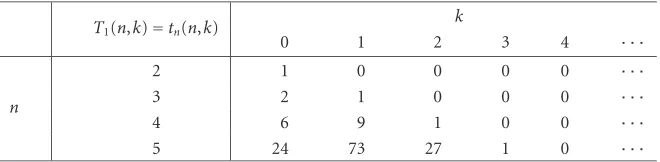
Table 1.1
T1(n,k)=tn(n,k) k
0 1 2 3 4 ···
n
2 1 0 0 0 0 ···
3 2 1 0 0 0 ···
4 6 9 1 0 0 ···
5 24 73 27 1 0 ···
distincti,j,k∈[n]. We sayTrooted atrhas alocal maximum at pathi jkif and only if
j > i,kand the path inT fromrtokcontains the pathi jk. Similarly,Trooted atrhas alocal minimum at pathi jkif and only if j < i,kand the path inTfromrtokcontains the pathi jk. LetMr(T)=Mr,n(T) (resp.,mr(T)=mr,n(T)) denote the number of local
maxima (resp., local minima) ofT∈᐀nrooted atr. ThenMr(T),mr(T)∈ {0,...,n−2}.
LetTr(n,k) (resp.,tr(n,k)) denote the number of trees in᐀nrooted atrwith precisely klocal maxima (resp.,klocal minima). ThenTr(n,k)=tr(n,k)=0 fork∈ {0,...,n−2} andn−k=20Tr(n,k)=
n−2
k=0tr(n,k)=nn−2. As with the other statistics extended to labelled
trees, rootsr=1,nare appropriate. The values ofT1(n,k)=tn(n,k) (seeLemma 2.1) are
given inTable 1.1for 2≤n≤5 and 0≤k≤n−2.
We work in the probability spaceΩnconsisting of all trees in᐀n, where each tree is
chosen randomly according to a uniform distribution. Hence, Pr(T)=1/nn−2forT∈᐀ n.
A propertyQof trees in{᐀n}holdsasymptotically almost surely(a.a.s.) on{Ωn}if and
only if limn→∞Pr(T∈᐀n:Thas propertyQ)→1 asn→ ∞.
The parametersMrandmrare then random variables onΩnwhose exact expectations E(Mr),E(mr) and variancesσ2(Mr),σ2(mr) we find as rational functions ofn(r=1,n).
FromTheorem 2.5,
EM1=Emn=2n
3−3n2−5n+ 6
6n2 ,
σ2M1
=σ2mn=7n5−20n4+ 75n3−40n2−322n+ 300
60n4 .
(1.1)
As a consequence, a.a.s. on{Ωn},
EM1
−ω(n)σM1
< M1,mn< E
M1
+ω(n)σM1
, (1.2)
whereω(n)→ ∞arbitrarily slowly asn→ ∞. (SeeCorollary 2.6for this and further re-sults.)
We mention that should (M1−E(M1))/σ(M1)−→d N(0, 1), we could only conclude the
above inequality forM1,mna.a.s. on{Ωn}. Of course, asymptotic normality ofM1,mn
gives more information about the distribution ofM1,mnthan their a.a.s. properties.
2. Results
We first show that local maxima in trees rooted atrand local minima in trees rooted at
n+ 1−rare equidistributed.
Lemma2.1. Forr∈[n],
Tr(n,k)=tn+1−r(n,k) (0≤k≤n−2). (2.1)
Proof. The bijectioni→n+ 1−i(i∈[n]) induces a bijectionT∈᐀n→T∈᐀n, where T T. Thenr,...,i,j,k(with j > i,k) is a path inT if and only ifn+ 1−r,...,n+ 1−
i,n+ 1−j,n+ 1−k(withn+ 1−j < n+ 1−i,n+ 1−k) is a path inT. Hence,Mr(T)=
mn+1−r(T). Consequently,Tr(n,k)=tn+1−r(n,k) for 0≤k≤n−2.
In view ofLemma 2.1, we consider onlyM1.
Let (x)0=x0=1 (x∈R) and (x)k=(x)···(x−k+ 1) (k≥1,x∈R). Forn∈Nand a,x∈R, let
En(x)= n
k=0 xk
k!, Pn(x)=
n
k=0
(n)kxk, Qn,a(x)= n
k=0
(n)k(k+a)xk,
Rn(x)= n
k=0
(n)k(k+ 1)(k+ 7)xk.
(2.2)
We require the following technical result which allows us to calculate the exact expecta-tion and variance ofM1as rational functions ofn.
Lemma2.2. Forn,m−1∈N,
Pn 1
m
= n!
mnEn(m), (2.3)
forn−1,m−1∈N, anda∈R,
Qn,a
1
m
= n!
mn(n+a)En(m)− n!
mn−1En−1(m), (2.4)
and forn−2,m−1∈N,
Rn 1
m
= n!
mn
n2+ 8n+ 7E
n(m)−mnn−!1(2n+ 7)En−1(m) + n!
mn−2En−2(m). (2.5) Proof. (All derivatives are with respect to realx). First,
xnP n
x−1
n! =
n
k=0 xn−k
(n−k)!=En(x) (2.6)
so that
and hence
Pn 1
m
= n!
mnEn(m). (2.8)
Next, (2.7) gives
Qn,a(x)=xPn(x) +aPn(x)
=n!xn(n+a)Enx−1−n!xn−1En− 1x−1,
(2.9)
and hence
Qn,a
1
m
= n!
mn(n+a)En(m)− n!
mn−1En−1(m). (2.10)
Finally, (2.7) gives
Rn(x)=x2Pn(x) + 9xPn(x) + 7Pn(x)
=n!xnn2+ 8n+ 7E n
x−1−n!xn−1(2n+ 7)E n−1
x−1
+n!xn−2E n−2
x−1,
(2.11)
and hence
Rn 1
m
= n!
mn
n2+ 8n+ 7E
n(m)−mnn−!1(2n+ 7)En−1(m) + n!
mn−2En−2(m). (2.12)
Corollary2.3. Forj,n−1∈Nwith0≤j≤n,
Qn−j,j 1
n
=n. (2.13)
Proof. For 0≤j≤n−1, our result follows fromLemma 2.2. Forj=n, our result follows
from the definition ofQn−j,j(x).
We require the following result of Moon [8].
Theorem2.4 (Moon [8]). LetF be a forest with vertex set[n]havingωcomponents of orders p1,...,pω. Then the number of distinct trees in᐀n containing F is pnω−2, where p=p1... pω.
We now give our main result. HereM1=M1,n. Theorem2.5. ForΩn(n≥2),
EM1
=2n3−3n2−5n+ 6
6n2 ,
EM2 1
=20n6−39n5−115n4+ 495n3−175n2−1266n+ 1080
180n4 ,
(2.14)
hence,
σ2M 1
=VarM1
=7n5−20n4+ 75n3−40n2−322n+ 300
Proof. The theorem can be seen to be true for 2≤n≤5 usingTable 1.1. Assumen≥6. Let
In,1= {(i,j,k) : 1≤k < i < j≤n},In,2= {(i,j,k) : 1≤i < k < j≤n}, andIn=In,1∪In,2.
For (i,j,k)∈InandT∈᐀n, let
X(i,j,k)(T)=
1, i jkis a local maximum inTrooted at 1;
0, otherwise; (2.16)
hence,
M1=
(i,j,k)∈In
X(i,j,k). (2.17)
We remind the reader thati j, jk are always edges in a tree by using thick lines in our diagrams.
Expectation ofM1. We consider the following two cases according to the pathSofTfrom 1 throughi jk. OnlyE(X(i,j,k))=0 need to be considered.
Case 1(i=1). Here
S :
1 a≥0 i j k
internal vertices
There are (a+ 4)nn−a−5trees in᐀
ncontaining a specific treeSbyTheorem 2.4; there are
(n−4)aspecific trees containingavertices between 1,i; and there are 2 n−1
3
choices for (i,j,k). Hence,
(i,j,k)∈In 1=i
EX(i,j,k)
=(n−1)3
3n3 n−4
a=0
(n−4)aa+ 4 na =
(n−1)3
3n2 (2.18)
byLemma 2.2.
Case 2(i=1). Here
S :
1=i j k
There are 3nn−4 trees in᐀
ncontaining a specific treeSbyTheorem 2.4; and there are n−
1 2
choices for (j,k). Hence,
(1,j,k)∈In
EX(i,j,k)
=3(n−1)2
From (2.18), (2.19),
EM1=(n−1)3
3n2 +
3(n−1)2
2n2 =
2n3−3n2−5n+ 6
6n2 . (2.20)
Variance ofM1. Here
M2 1=
(i,j,k)∈In X(i,j,k)
2
=M1+
((i1,j1,k1),(i2,j2,k2))∈In∗
X(i1,j1,k1)X(i2,j2,k2), (2.21)
whereIn∗= {((i1,j1,k1), (i2,j2,k2))∈In×In: (i1,j1,k1)=(i2,j2,k2)}.
First, we describe how we calculateE(M12)−E(M1).
We first consider 3·2=6 cases according to #{i1,j1,k1,i2,j2,k2} =6, 5, or 4, and,
whether 1∈ {i1,j1,k1,i2,j2,k2}or 1∈ {i1,j1,k1,i2,j2,k2}. In each of these six cases, we
further partition as described below.
For ((i1,j1,k1), (i2,j2,k2))∈In∗, we consider the possible subtreesS=S((i1,j1,k1),(i2,j2,k2))
of [n] determined by the path from 1 to the second coordinatei2j2k2relative to the path
from 1 to the first coordinatei1j1k1. The possible subtreesS=S((i2,j2,k2),(i1,j1,k1)) are
in-cluded above by definition. Only E(X(i1,j1,k1)X(i2,j2,k2))=0 need to be considered. This
gives nine types of subtrees of [n] total among these six cases.
For the symmetric types 1, 3, 5, 7, and 9,S“looks like”S. We count the numbertS
of treesT∈᐀n containingS=S((i1,j1,k1),(i2,j2,k2)) and the numberiS of such ((i1,j1,k1),
(i2,j2,k2)). The productiStScounts each treeT∈᐀ncontainingStwice; once forSand
once forS. For each such treeT,X(i1,j1,k1)(T)X(i2,j2,k2)(T)=1=X(i2,j2,k2)(T)X(i1,j1,k1)(T).
For the asymmetric types 2, 4, 6, and 8,S“looks different” thanS. We introduce sub-typesSx
((i1,j1,k1),(i2,j2,k2))andS y
((i1,j1,k1),(i2,j2,k2))so thatT∈᐀ncontainsSx=S x
((i1,j1,k1),(i2,j2,k2))if
and only ifTcontainsSy=Sy
((i2,j2,k2),(i1,j1,k1)); note the different orders. We count the
num-bertSzof treesT∈᐀ncontainingSzand the numberiSz of such ((i1,j1,k1), (i2,j2,k2)) for z=x,y. The sumiSxtSx+iSytSy counts each treeT∈᐀ncontainingSxandSy; once forSx
and once forSy. For each such treeT,X(
i1,j1,k1)(T)X(i2,j2,k2)(T)=1=X(i2,j2,k2)(T)X(i1,j1,k1)(T).
For each type, the above count(s) are divided bynn−2then simplified usingLemma 2.2
andCorollary 2.3. Summing over the types of a particular casei(1≤i≤6) gives
((i1,j1,k1),(i2,j2,k2))∈In∗ casei
EX(i1,j1,k1)X(i2,j2,k2). (2.22)
The sum over all six cases is thenE(M21)−E(M1).
In what follows, (n−1)6=En−7(n)=0 forn=6 andEn−9(n)=0 forn=6, 7, 8 as
Case 3(#{i1,j1,k1,i2,j2,k2} =6, 1∈ {i1,j1,k1,i2,j2,k2}). Type 1. Here
S1
((i1,j1,k1),(i2,j2,k2)) x=i1,j1,k1
:
1 x i1
i2
j1 j2
k1 k2
a≥0 internal vertices
b≥0 internal vertices
There are (a+b+ 7)nn−a−b−8 trees in᐀
ncontaining a specific treeS1 byTheorem 2.4;
there are (n−7)a+bspecific trees containingavertices between 1,i1andbvertices between x,i2; there are a+ 1 choices forx; and there are 2
n−
1 3
·2n−34such pairs ((i1,j1,k1),
(i2,j2,k2)). Observe thatTcontainsS1((i1,j1,k1),(i2,j2,k2))fora,b,xif and only ifTcontains S1
((i2,j2,k2),(i1,j1,k1))fora,b,x. Hence, (each such pair appears once)
((i1,j1,k1),(i2,j2,k2))∈I∗ n TType 1
EX(i1,j1,k1)X(i2,j2,k2)
=(n−1)6
9n6
(a,b)∈N2 0≤a+b≤n−7
(n−7)a+b(a+ 1)(naa++bb+ 7)
=(n−1)6
9n6 n−7
a=0
(n−7)aa+1 na
n−a−7
b=0
(n−a−7)ba+b+7 nb
=(n−1)6
9n5 n−7
a=0
(n−7)aa+ 1 na
=(n−1)6
9n5
n−6(n−7)!
nn−7 En−7(n)
=(n−1)6
9n4 −
2(n−1)! 3nn−2 En−7(n)
(2.23)
byLemma 2.2, andCorollary 2.3.
Type 2. First subtypes 21, 22, 23are
S21
((i1,j1,k1),(i2,j2,k2)) i2=1,i1
:
1 x=i2 i1 j1 k1
j2 k2
S22
((i1,j1,k1),(i2,j2,k2)) i2,j2=1,i1
:
1 i2 x=j2 i1 j1 k1
k2
a≥0 other internal vertices
S23
((i1,j1,k1),(i2,j2,k2)) i2,j2,k2=1,i1
:
1 i2 j2 x=k2 i1 j1 k1
a≥0 other internal vertices
In each of the subcases, we have replaced one of thea+ 1 edgesuvbetween 1,i1, with
the pathux=i2v,ui2x=j2vorui2j2x=k2v, where the rest of the pathi2j2k2 is as
in-dicated. In each of these three subcases, there are (a+ 7)nn−a−8 trees in᐀
ncontaining
a specific treeS21,S22,S23 byTheorem 2.4; there are (n−7)
aspecific trees containinga
other vertices between 1,i1; there area+ 1 choices forx, equivalently,uv; and there are
2n−31·2n−34such pairs ((i1,j1,k1), (i2,j2,k2)). Next, subtype 24is
S24
((i1,j1,k1),(i2,j2,k2)) x=i1,j1ork1
:
1 i1
i2
j1 j2
k1 k2
x
a≥0 internal vertices
b≥0 internal vertices
There are (a+b+ 7)nn−a−b−8 trees in᐀
ncontaining a specific treeS24 byTheorem 2.4;
there are (n−7)a+bspecific trees containingavertices between 1,i1andbvertices between x,i2; there are 3 choices forx=i1,j1, or k1; and there are 2
n−1
3
·2n−34 such pairs ((i1,j1,k1), (i2,j2,k2)). Observe thatT containsS2((1,2 or 3i1,j1,k1),(i2,j2,k2)) fora,xif and only ifT
containsS24
((i2,j2,k2),(i1,j1,k1))fora,b,x. Hence, (each such pair appears once)
((i1,j1,k1),(i2,j2,k2))∈I∗ n TType 2
EX(i1,j1,k1)X(i2,j2,k2)
=(n−1)6 9n6
3
n−7
a=0
(n−7)a(a+ 1)(naa+ 7)+ 3
(a,b)∈N2 0≤a+b≤n−7
=(n−1)6
3n6
n−7
a=0
(n−7)a(a+ 1)(naa+ 7)+ n−7
a=0
(n−7)a na
n−a−7
b=0
(n−a−7)ba+nbb+ 7
=(n−1)6
3n6
( n−7)!
nn−8 (n−5)En−7(n)−
(n−7)!
nn−8 (2n−7)En−8(n) +
(n−7)!
nn−9 En−9(n)
=(n−1)6
3n6
2( n−7)!
nn−8 En−9(n) + 4n−14
=2(n−1)!
3nn−2 En−9(n) + (4n−14)
(n−1)6
3n6
(2.24)
byLemma 2.2andCorollary 2.3. (The first 3 above is number of subcases and the second 3 is the number of choices forx.)
Summing (2.23), (2.24) gives the following equation:
((i1,j1,k1),(i2,j2,k2))∈I∗ n #{i1,j1,k1,i2,j2,k2}=6,1∈{i1,j1,k1,i2,j2,k2}
EX(i1,j1,k1)X(i2,j2,k2)
=(n−1)6
9n4 −
2(n−1)!
3nn−2 En−7(n) +
2(n−1)!
3nn−2 En−9(n) + (4n−14)
(n−1)6
3n6
=(n−1)6
9n4 −
2 3
(n−1)6
n5 +
(n−1)7
n6 −(2n−7)
(n−1)6 n6
=(n−1)6
9n4 .
(2.25)
Case 4(#{i1,j1,k1,i2,j2,k2} =5, 1∈ {i1,j1,k1,i2,j2,k2}). Type 3. Here
S3
((i1,j1,k1),(i2,j2,k2)) :
1 i1=i2 j1 k1
j2 k2
a≥0 internal vertices
There are (a+ 6)nn−a−7trees in᐀
ncontaining a specific treeS3byTheorem 2.4; there are
(n−6)aspecific trees containingavertices between 1,i1; and there are 16
n−1
5
elementsj1,j2, and there are 2·2=4 pairs with j1> k1> j2orj2> k2> j1). Observe that T containsS3
((i1,j1,k1),(i2,j2,k2))if and only ifT containsS 3
((i2,j2,k2),(i1,j1,k1)). Hence, (each such
pair appears once)
((i1,j1,k1),(i2,j2,k2))∈I∗ n TType 3
EX(i1,j1,k1)X(i2,j2,k2)
=2(n−1)5 15n5
n−6
a=0
(n−6)aan+ 6a =2(n15−n1)4 5
(2.26)
byCorollary 2.3.
Type 4. First subtypes 41, 42are
S41
((i1,j1,k1),(i2,j2,k2)) :
1 i1 j1=i2 k1
j2 k2
a≥0 internal vertices
S42
((i1,j1,k1),(i2,j2,k2)) :
1 i1 j1 k1=i2
j2 k2
a≥0 internal vertices
In either subcase, there are (a+ 6)nn−a−7trees in᐀
ncontaining a specific treeS41,S42by Theorem 2.4; there are (n−6)a specific trees containingavertices between 1,i1; there
are 24n−51such pairs ((i1,j1,k1), (i2,j2,k2)) total (for 5 elements in{2,...,n}; there are
6 + 2=8 pairs with j2> i2=j1or j2> k2> i2=j1for 41; there are 2·6=12 pairs with
largest elementsj1,j2; and there are 2·2=4 pairs withj1> i1> j2orj2> k2> j1for 42).
Next subtypes 43, 44are
S43
((i1,j1,k1),(i2,j2,k2)) :
1 i2 i1=j2 j1 k1
k2
S44
((i1,j1,k1),(i2,j2,k2)) :
1 i2 j2 i1=k2 j1 k1
a≥0 internal vertices
In either subcase, there are (a+ 6)nn−a−7 trees in᐀
ncontaining a specific treeS43,S44
byTheorem 2.4; there are (n−6)aspecific trees containingavertices between 1,i2; and
there are 24n−51such pairs ((i1,j1,k1), (i2,j2,k2)) total (for 5 elements in{2,...,n}, there
are 6 + 2=8 pairs with j1> i1=j2 or j1> k1> i1=j2 for 43; there are 2·6=12 pairs
with largest elements j1, j2, and there are 2·2=4 pairs with j2> i2> j1or j1> k1> j2
for 44). Observe thatTcontainsS4((ii1,j1,k1),(i2,j2,k2))if and only ifTcontainsS 4i+2
((i2,j2,k2),(i1,j1,k1))
fori=1, 2. Hence, (each such pair appears once)
((i1,j1,k1),(i2,j2,k2))∈I∗ n TType 4
EX(i1,j1,k1)X(i2,j2,k2)
=2(n−1)5
5n5 n−6
a=0
(n−6)aa+ 6
na =
2(n−1)5
5n4
(2.27)
byCorollary 2.3. (The number of subcases has been accounted for.) Summing (2.26), (2.27) gives the following equation:
((i1,j1,k1),(i2,j2,k2))∈I∗ n #{i1,j1,k1,i2,j2,k2}=5,1∈{i1,j1,k1,i2,j2,k2}
EX(i1,j1,k1)X(i2,j2,k2)
=2(n−1)5 15n4 +
2(n−1)5
5n4 =
8(n−1)5
15n4 .
(2.28)
Case 5(#{i1,j1,k1,i2,j2,k2} =4, 1∈ {i1,j1,k1,i2,j2,k2}). Type 5. Here
S5((i1,j1,k1),(i2,j2,k2)) :
1 i1=i2 j1=j2 k1
k2
a≥0 internal vertices
There are (a+ 5)nn−a−6trees in᐀
ncontaining a specific treeS5byTheorem 2.4; there are
(n−5)aspecific trees containingavertices between 1,i1; and there are 6
n−
1 4
((i1,j1,k1), (i2,j2,k2)). Observe thatTcontainsS5((i1,j1,k1),(i2,j2,k2))if and only ifTcontains S5((i2,j2,k2),(i1,j1,k1)). Hence, (each such pair appears once)
((i1,j1,k1),(i2,j2,k2))∈I∗ n #{i1,j1,k1,i2,j2,k2}=4,1∈{i1,j1,k1,i2,j2,k2}
EX(i1,j1,k1)X(i2,j2,k2)
=(n−1)4
4n4 n−5
a=0
(n−5)aan+5a =(n4−1)n3 4
(2.29)
byCorollary 2.3.
Case 6(#{i1,j1,k1,i2,j2,k2} =6, 1∈ {i1,j1,k1,i2,j2,k3}). Type 6. First subtypes 61, 62, 63are
S61
((i1,j1,k1),(1,j2,k2)) :
x=1=i2 i1 j1 k1
j2 k2
a≥0 internal vertices
S62
((i1,j1,k1),(1,j2,k2)) :
1=i2 x=j2 i1 j1 k1
k2
a≥0 internal vertices
S63
((i1,j1,k1),(1,j2,k2)) :
1=i2 j2 x=k2 i1 j1 k1
a≥0 internal vertices
In each of these three subcases, there are (a+ 6)nn−a−7 trees in ᐀
n containing a
spe-cific treeS61,S62,S63 byTheorem 2.4; there are (n−6)
aspecific trees containinga
ver-tices between x, i1; and there are
n−
1 2
subtype 64is
S64
((1,j1,k1),(i2,j2,k2)) x=1,j1ork1
:
1=i1 j1 k1
i2 j2 k2
x
a≥0 internal vertices
There are (a+ 6)nn−a−7trees in᐀
ncontaining a specific treeS64byTheorem 2.4; there
are (n−6)aspecific trees containingavertices betweenx,i2; there are 3 choices forx=
1,j1, ork1; and there are
n−
1 2
·2n−33such pairs ((1,j1,k1), (i2,j2,k2)). Observe thatT
containsS61,2,3
((i1,j1,k1),(1,j2,k2))fora,xif and only ifTcontainsS 64
((1,j2,k2),(i1,j1,k1))fora,x. Hence,
(each such pair appears once)
((i1,j1,k1),(i2,j2,k2))∈In∗ #{i1,j1,k1,i2,j2,k2}=6,1∈{i1,j1,k1,i2,j2,k2}
EX(i1,j1,k1)X(i2,j2,k2)
=(n−1)5
6n5
3
n−6
a=0
(n−6)aa+ 6 na + 3
n−6
a=0
(n−6)aa+ 6 na
=(n−1)5 n4
(2.30)
byCorollary 2.3. (The first 3 and second 3 above are the number of subcases, i.e., choices forx.)
Case 7(#{i1,j1,k1,i2,j2,k2} =5, 1∈ {i1,j1,k1,i2,j2,k2}). Type 7. Here
S7((1,j1,k1),(1,j2,k2)) :
1=i1=i2 j1 k1
j2 k2
There are 5nn−6 trees in᐀
ncontaining a specific treeS7 byTheorem 2.4; and there are n−
1 2
·n−3
2
such pairs ((1,j1,k1), (1,j2,k2)). Observe thatTcontainsS7((1,j1,k1),(1,j2,k2))if
and only ifTcontainsS7
((1,j2,k2),(1,j1,k1)). Hence, (each such pair occurs once)
((1,j1,k1),(1,j2,k2))∈I∗ n TType 7
EX(1,j1,k1)X(1,j2,k2)
=5(n−1)4
Type 8. First subtypes 81, 82are
S81
((1,j1,k1),(i2,j2,k2)) :
1=i1 j1=i2 k1
j2 k2
S82
((1,j1,k1),(i2,j2,k2)) :
1=i1 j1 k1=i2
j2 k2
In either subcase, there are 5nn−6trees in᐀
ncontaining a specific treeS81,S82byTheorem 2.4; and there are 8n−41such pairs ((1,j1,k1), (i2,j2,k2)) total (for 4 elements in{2,...,n},
there are 2 + 1=3 pairs with j2> j1=i2orj2> k2> i2=j1for 81; and there are 2 + 2 +
1=5 pairs with largest elements j1,j2orj2> k2> j1for 82). Next subtypes 83, 84are
S83
((i1,j1,k1),(1,j2,k2)) :
1=i2 j2=i1 j1 k1
k2
S84
((i1,j1,k1),(1,j2,k2)) :
1=i2 j2 k2=i1 j1 k1
In either subcase, there are 5nn−6trees in᐀
ncontaining a specific treeS83,S84byTheorem 2.4; and there are 8n−41such pairs ((i1,j1,k1), (1,j2,k2)) total (for 4 elements in{2,...,n},
there are 2 + 1=3 pairs with j1> j2=i1orj1> k1> i1=j2for 83; and there are 2 + 2 +
1=5 pairs with largest elements j1, j2 or j1> k1> j2for 84). Observe thatT contains S8i
((1,j1,k1),(i2,j2,k2))if and only ifT containsS 8i+2
((i2,j2,k2),(1,j1,k1)) fori=1, 2. Hence, (each such
pair occurs once)
((i1,j1,k1),(i2,j2,k2))∈I∗ n TType 8
EX(i1,j1,k1)X(i2,j2,k2)
=5(n−1)4
3n4 +
5(n−1)4
3n4 =
10(n−1)4
(The number of subcases has been accounted for.) Summing (2.31), (2.32) gives the fol-lowing equation:
((i1,j1,k1),(i2,j2,k2))∈I∗ n #{i1,j1,k1,i2,j2,k2}=5,1∈{i1,j1,k1,i2,j2,k2}
EX(i1,j1,k1)X(i2,j2,k2)
=5(n−1)4
4n4 +
10(n−1)4
3n4 =
55(n−1)4
12n4 .
(2.33)
Case 8(#{i1,j1,k1,i2,j2,k2} =4, 1∈ {i1,j1,k1,i2,j2,k2}). Type 9. Here
S9((1,j1,k1),(1,j2,k2)) :
1=i1=i2 j1=j2 k1
k2
There are 4nn−5 trees in᐀
ncontaining a specific treeS9 byTheorem 2.4; and there are
2n−31such pairs ((1,j1,k1), (1,j2,k2)). Observe thatT containsS9((1,j1,k1),(1,j2,k2)) if and
only ifTcontainsS9
((1,j2,k2),(1,j1,k1)). Hence, (each such pair occurs once)
((i1,j1,k1),(i2,j2,k2))∈I∗ n #{i1,j1,k1,i2,j2,k2}=4,1∈{i1,j1,k1,i2,j2,k2}
EX(i1,j1,k1)X(i2,j2,k2)
=4(n−1)3
3n3 . (2.34)
After all this preparation, we are now able to find the second moment and the variance ofM1. From (2.21), summing (2.20), (2.25), (2.28)–(2.30), (2.33), (2.34) gives
EM2 1
=2n3−3n2−5n+ 6
6n2 +
(n−1)6
9n4 +
8(n−1)5
15n4 +
(n−1)4
4n3
+(n−1)5
n4 +
55(n−1)4
12n4 +
4(n−1)3
3n3
=20n6−39n5−115n4+ 495n3−175n2−1266n+ 1080
180n4 .
(2.35)
Hence, (2.20), (2.35) give
σ2M
1=VarM1=7n
5−20n4+ 75n3−40n2−322n+ 300
60n4 . (2.36)
As a consequence ofTheorem 2.5, a.a.s. on{Ωn},M1(T) andmn(T) belong to a
rela-tively small interval forT∈᐀n. Again,M1=M1,n. Corollary2.6. For{Ωn},
PrM1−E
M1< ω(n)σ
M1
whereω(n)→ ∞arbitarily slowly asn→ ∞. Hence, a.a.s. on{Ωn}, n
3−ω(n)n
0.5< M 1<n
3+ω(n)n
0.5, (2.38)
whereω(n)→ ∞arbitarily slowly asn→ ∞. Proof. By Chebyshev’s inequality,
PrM1−E
M1≥ω(n)σ
M1
≤ 1
ω2(n)−→0 asn−→ ∞, (2.39)
provided thatω(n)→ ∞asn→ ∞. This implies our result.
Acknowledgment
I wish to thank both referees for comments and suggestions. The detailed report by one referee in particular led to this much improved version of the note.
References
[1] L. H. Clark,Ascents and descents in random trees, preprint, 2004. [2] ,Inversions in random trees, preprint, 2004.
[3] R. Durrett, Probability. Theory and Examples, The Wadsworth & Brooks/Cole Statis-tics/Probability Series, Wadsworth & Brooks/Cole Advanced Books & Software, California, 1991.
[4] O. E˘gecio˘glu and J. B. Remmel,¨ Bijections for Cayley trees, spanning trees, and theirq-analogues, J. Combin. Theory Ser. A42(1986), no. 1, 15–30.
[5] I. M. Gessel,Counting forests by descents and leaves, Electron. J. Combin.3(1996), no. 2, Re-search Paper 8, 1–5.
[6] I. M. Gessel, B. E. Sagan, and Y.-N. Yeh,Enumeration of trees by inversions, J. Graph Theory19 (1995), no. 4, 435–459.
[7] C. L. Mallows and J. Riordan,The inversion enumerator for labeled trees, Bull. Amer. Math. Soc. 74(1968), 92–94.
[8] J. W. Moon,Counting Labelled Trees, Canadian Mathematical Monographs, no. 1, Canadian Mathematical Congress, Quebec, 1970.
[9] ,The expected number of inversions in a random tree, Proc. Louisiana Conf. on Com-binatorics, Graph Theory and Computing (Louisiana State Univ., Baton Rouge, La, 1970), Louisiana State University, Louisiana, 1970, pp. 375–382.
[10] D. Warren and E. Seneta,Peaks and Eulerian numbers in a random sequence, J. Appl. Probab.33 (1996), no. 1, 101–114.
Lane Clark: Department of Mathematics, College of Science, Southern Illinois University Carbon-dale, CarbonCarbon-dale, IL 62901-4408, USA