CUSTOMER RELATIONSHIP MANAGEMENT: A FUNCTION OF THE
EMPLOYEE ATTRIBUTES
Adil Zahoor Research scholar
The Business School, University of Kashmir, 190006.
ABSTRACT
The business environment, in recent times, has witnessed a paradigm shift in the orientation of marketers towards customers. Primarily induced by the severity of competition, such a movement from transactional to relationship marketing paved way for the emergence of, among other things, Customer Relationship Management. Given its significant contribution, CRM, under contemporary business scenario, serves as a corner stone for the financial success of any company especially those operating in the service sector. In this backdrop, it remains essential for any service organization to identify antecedents of CRM and their contribution in relationship management. However, little evidence is found in the literature on CRM that pertains to study of this area. Consequently, the present study attempts to investigate the effect of drivers of CRM (attitude and Knowledgeability of employees in the present study) on the customer relationship management of a company in Indian retail banking context. The empirical results reveal a significant impact of the drivers on CRM. Finally, conclusions and implications for practitioners and the limitations of the study are also drawn.
Key words: Customer Relationship Management, Banking industry, Attitude, Knowledgeability.
INTRODUCTION:
Pérez, & Griman, 2007), with progressing times, the approach towards CRM witnessed significant development and changing definitions. For example, (Hobby, 1999) defines CRM as “a management approach that enables organizations to identify, attract and increase retention of profitable customers by managing relationships with them.” The same idea is corroborated by (Bradshaw & Brash, 2001; Massey, Montoya-Weiss, & Holcom, 2001) who said that CRM is the enhanced retention of profitable customers by adopting a management approach that identifies, attracts, develops, and maintains successful customer relationships. Moreover, CRM may also be thought of as a dynamic process leveraging on market intelligence (Zablah, Bellenger, & Johnston, 2004) to create and maintain symbiotic relationships with strategically significant customers (Buttle, 2001) by integrating technological advancements into business processes (Kim, Suh, & Hwang, 2003).
Because of its increased popularity and indispensable significance in the contemporary business scenario, researchers overtime have concentrated their attention on understanding the dynamics and effects of CRM. This resulted in the identification of various dimensions of CRM which include customer acquisition (Gouthier & Schmid, 2003), knowledge management application (Alavi & Leidner, 2001), information technology (Feinberg & Kadam, 2002; Peppard, 2000; Ryals & Payne, 2001), customer communication (Cuthbertson & Laine, 2004), customer interaction (Kalafatis, 2002; Metcalf, Frear, & Krishnan, 1992; Zablah, Bellenger, & Johnston, 2004), customer transaction (Hart, Hogg, & Banerjee, 2004), customer response (Alavi & Leidner, 2001; Zablah, Bellenger, & Johnston, 2004). Besides the identification of above stated dimensions of CRM, its impact on the performance of an organization has also been studied (Reinartz, Krafft, & Hoyer, 2004; Shang & Lu, 2012; ElKordy, January 2014).
RESEARCH GAP
The above stated two main approaches to the study of customer relationship management, although covering a broad spectrum of the researchable issues related to CRM, have not sufficiently focused on the drivers of CRM. This leaves a significant research gap that requires to be plugged. As a consequence, this study attempts to examine the impact of employee attributes (attitude and knowledge in this case) on customer relationship management in the context of Indian banking industry.
The present study will contribute to the existing literature on CRM by way of examining the impact of attitude and knowledge of employees on building stronger relationships with customers. Despite the fact that previous researches have studied the dimensions of CRM, attitude and knowledge of employees has seldom been the focus of any of such researches. Secondly, as far as the knowledge of the researcher is concerned, such kind of a relationship has been studied for the first time in the context of Indian banking sector.
ATTITUDE AND CUSTOMER RELATIONSHIP MANAGEMENT
Locke (1976) defines job satisfaction as “a pleasurable or positive emotional state resulting from
the appraisal of one‟s job or job experiences”. On the other hand, positive attitude towards work increases job satisfaction that in turn improves employee performance (Linz, 2002). Moreover, literature reveals that employee satisfaction leads to positive customer perception.
Subsequently, a subtle relationship can be inferred from the above literature that signifies an individual‟s liking or disliking for any behavior particularly towards job, i.e. attitude (Mowday, Porter, & Steers, 1979), has an effect on employee job performance in terms of quantity and quality expected from him/her (Khan, Razi, Ali, & Asghar, 2011) which in turn impacts the perception of customers regarding the organization. Such a perception is the governing force for the nature and strength of relationship (or not) of the customer with the organization.
dimensions of SERVQUAL model by Parasuraman et al, (1988) measure the behavioral aspect of employees.
In light of the above literature reflecting a linkage between employee attitude and customer relations, the following hypothesis is proposed
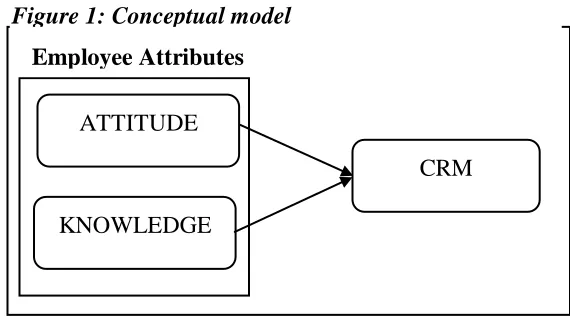
H1: Positive employee attitude leads to better relationship with customers.
KNOWLEGDE AND CUSTOMER RELATIONSHIP MANAGEMENT
One of the fundamental assumptions underlying customer relationship management is the higher profits will flow as an outcome of improved customer knowledge. In fact knowledge has been identified as the starting point of CRM by (Kim, Suh, & Hwang, 2003). Moreover, (Nonaka, 1998) noted knowledge serves as the only certain source of lasting competitive advantage under the contemporary turbulent economic conditions. In his study, (Hennig-Thurau, 2004) observed that employees‟ knowledge has a significant impact on customer satisfaction which ultimately leads to better relations.
Employee Attributes Figure 1: Conceptual model
tacit knowledge is owned by individuals. The present study is primarily focused on explicit knowledge.
In view of the above linkage between knowledge and CRM, the following hypothesis is proposed
H2: Employee knowledge leads to better customer relationships.
In context of the above stated literature and the proposed hypothesis, the following conceptual model can be suggested.
METHODOLOGY
Different issues pertaining to the methodology adopted for examination of the impact of employee attributes (attitude and knowledge in present study) on the customer relationship management are discussed below.
Data Collection, Sample and Research Instrument
Primary data was collected from different branches of two prestigious banks operating in India. One private sector and the other public sector. Two different banking sectors were included in the study for the purpose of comparative analysis. The branches from which data was collected are located in the valley of Kashmir. Moreover the fact that service sector has the maximum contribution to the GDP of India i.e. 57% (2012) and also provides employment to 27% of the workforce asks for a special attention towards this sector. Also the fact remains that banking industry reflects a typical service organization, the study has been focused on Indian banks. Simple random sampling was used for collecting the data from different parts of Kashmir
ATTITUDE
KNOWLEDGE
(North, South and Central Kashmir). This approach was used in order to make sure that respondents from rural, semi-urban and urban population are included in the sample.
Out of 195 questionnaires distributed across three different strata, 158 were usable for the purpose of analysis (response rate of 81.0%). These included 44 questionnaires from North
Kashmir (out of 65), 61 questionnaires from Central Kashmir (out of 65) and 53 questionnaires from South Kashmir (out of 65). Regression analysis has been used to test the hypothesized relationships.
Items from previously developed scales were used to measure variables included in the study. All items were taken from the scale developed by Rootman (2007). A five point Likert scale was used
throughout the study to obtain the perception of respondents on each item, ranging from (1) strongly disagree to (5) strongly agree. Before administering the questionnaire to the entire
sample, a pilot test was conducted to check the reliability of the measures by adopting inter-item consistency measure of Cronbach‟s alpha. The alpha value for independent variables i.e. attitude and knowledge came out to be 0.79 and 0.81 respectively and for the dependent variable i.e. CRM, Cronbach‟s alpha equaled 0.82. These values comfortably exceeded the minimum acceptable level of 0.7 (Nunnally, 1978) signaling that no changes are required.
ANALYSIS AND RESULTS
The analysis of present study consists of two stages. In the first stage, regression analysis is used to examine the impact of attitude and knowledge on Customer Relationship Management. In the second stage, a comparison of the drivers of CRM in the sample banks is studied using mean scores and supported by z-test.
Effect of Employee Attributes on CRM
The analysis of the data collected, pertaining to independent variables/drivers of CRM (attitude and knowledge) and the dependent variable (customer relationship management), was conducted using SPSS 19. The relationship between attitude and CRM as well as between knowledge and CRM is proved using standardized regression coefficients with the help of regression equation as shown below
𝒚𝟏 = 𝒃𝟏𝒙𝟏+ 𝒃𝟐𝒙𝟐+ 𝒆; Where, 𝑦1 = customer relationship management; 𝑥1 = attitude
The results obtained, as shown in Table 1, in terms of estimated R2 revealed that a variation of 32% in customer relationship is explained by employee attributes. Precisely, given the regression coefficients and p values, the impact of attitude on customer relationship management (b = 0.33 and p < 0.001) surpasses the impact created by knowledge (b = 0.21 and p < 0.05). As a consequence, the overall results of the present study present sufficient evidence to support H1 and H2 that employee attributes (attitude and knowledge) have a significant impact on Customer Relationship Management.
Table 1: Regression Analysis results: Impact of employee attributes/drivers of CRM on Customer relationship Management D riv er s of C R M
Employee Attributes Customer Relationship Management
(Dependent variable)
Attitude 0.33*
Knowledge 0.21**
R2 0.32
Note: * < .001; ** < .05 and ns = not significant
Comparison of Drivers of CRM in the Sample Banks
The results of the analysis conducted for a comparative study of the banks included in the present research is shown in Table 2.
Table 2: A comparison of Drivers of CRM in J&K bank and SBI
Employee Attributes
J&K bank SBI
Gap (%) z-value Mean
score
Std. dev.
% of mean score
Mean score
Std. dev.
% of mean score
Attitude 3.27 0.873 65.4 3.98 0.725 79.6 14.2 0.94ns Knowledge 3.05 0.156 61.0 4.01 0.257 80.2 19.2 3.83*
Aggregated 63.2 79.9 16.7
Note: ns = not significant; * p<0.001
standard deviation figures of the respective banks (SBI = 0.725; J&K bank = 0.873) which exhibit a lesser variability in case of SBI as compared to J&K bank. As far as the knowledge of employees is concerned, again SBI (mean score = 4.01; % age of mean score = 80.2) seems to be sufficiently better placed in comparison to J&K bank (mean score = 3.05; % age of mean score = 61.0). However, this time the values of standard deviation (SBI = 0.275; J&K bank = 0.156) do not corroborate the betterment of SBI over J&K bank as the volatility in the responses of customers of SBI is higher than that of J&K bank. Moreover, the gap of 14.2% with reference to attitude between J&K bank and SBI is statistically insignificant (z = 0.94; p > 0.0.05). However, a 19.2% gap in knowledge is statistically significant (z = 3.83; p < 0.001).
DISCUSSION, CONCLUSION AND MANAGERIAL IMPLICATION
The present study focused on the empirical investigation of the impact of employee attributes (attitude and knowledge) on customer relationship management. The obtained results supported the predictions that both the attitude as well as knowledge have a significant impact on CRM. These findings are in tandem with previous works (e.g. Rootman, 2007). Moreover, the fact that CRM is impacted upon relatively more by attitude than knowledge calls for a greater attention of managers to focus on the behavioral dimension of their employees. Necessary steps must be initiated in business organizations that will lead to enhanced job satisfaction, improved work engagement, better organizational culture etc. These factors tend to enrich employee attitudes and consequently leads to better customer relations. Any organizational action suspected to create a cognitive dissonance among the employees must be prevented at the very beginning. More precisely, results show the J&K bank authorities need to lay their focus on the improvement of attitudes of their employees.
At the same time the importance of knowledge of employees must not be overlooked. The explicit
of service standards (Sutton & Rafaeli, 1988). This leads to better customer satisfaction and strengthened relationships. Moreover, one of the fundamental premises of CRM i.e. customization of products and services can be effectively achieved only when employees have complete and correct knowledge of all the market offerings of their organization and the individualistic needs of their customers. This knowledge is subject to their understanding of market information, the generation of which is an integral part of marketing research and its efficacy of dissemination depends on the internal marketing orientation of the company.
LIMITATIONS AND FUTURE RESEARCH
Firstly, independent variables in the present study were restricted only to employee attributes (attitude and knowledge). Therefore, other organizational dimensions like communication, personality of employee, organizational culture, service orientation require immediate research attention. Secondly, the present study was focused only on two banks operating in India and hence may limit the scope of generalization. Finally, data was collected only from the branches located in the valley of Kashmir. Thus for more encompassing results, it is required that future research rests on a relatively wider sample base.
REFERENCES
Alavi, M., & Leidner, D. E. (2001). Review: Knowledge management and knowledge Management systems: Conceptual foundations and research issues. MIS Quarterly, 25(1), 107-136.
Alter, S. (2002). Information systems: The Foundation of E-business, Pearson Education, Upper Saddle River, NJ.
Anton, J. (1996). Customer Relationship Management,. New York: Prentice Hall.
Anton, J., & Hoeck, M. (2002). E-Business Customer Service. Santa Monica, CA: The Anton Press,.
Bitran, G. R., & Hoech, J. (1990). The humanization of services: Respect the movement of truth. Sloan Management Review, winter, 89-96.
Buttle, F. A. (2001). The CRM value chain. Marketing Business, 52-55.
Cuthbertson, R., & Laine, A. (2004). The role of CRM within retail loyalty marketing. Journal of Targeting, Measurement and Analysis for Marketing, 12(3), 290-304.
ElKordy, M. (January 2014). The impact of CRM capability dimensions on organizational performance. European Journal of Business and Social Sciences, 2(10) , 128-146.
Feinberg, R., & Kadam, R. (2002). E-CRM web service attributes as determinants of customer satisfaction with retail web sites. International Journal of Service Industry Management, 13(5), 432-451.
Gouthier, M., & Schmid, S. (2003). Customers and customer relationships in service firms: The perspective of the resource-based view. Marketing Theory, 3(1), 119-143.
Grant, R. M. (1996), “Toward a knowledge based theory of the firm”, Strategic Management Journal, 17, 109-122.
Guchait, P., Namasivayam, K., & Wa Lei, P. (2010). Knowledge management in service encounters: Impact on customers‟ satisfaction evaluations. Emerald Group.
Hansen, M. T., Nohria, N., & Tierney, T. (1999), what‟s your strategy for managing Knowledge? Harvard Business Review, 106-116.
Hart, S., Hogg, G., & Banerjee, M. (2004). Does the level of experience have an effect on CRM programs? Exploratory research findings. Industrial Marketing Management, 33(6), 549-560.
Hennig-Thurau, T. (2004). Customer orientation of service employees, its impact on customer satisfaction, commitment, and retention. International Journal of Service Industry Management, 15(5), 460-478.
Hobby, J. (1999). Looking after the one who matters. Accountancy Age, 28, 28-30.
Khan, H., Razi, A., Ali, S., & Asghar, A. (2011). A study on relationship between organizational job commitment, and its determinants among CSRs and managerial level employees of Pakistan (Telecommunication sector). Interdisciplinary Journal of Contemporaty Research in Business, 3(11), 269-284.
KREIMER, PROF. MICHAEL. "Displayed Products Are Marketed Easily- A Buyer-Psychic Study." Scholedge International Journal of Business Policy & Governance ISSN 2394-3351 [Online], 1.2 (2014): 8-12.
Kim, J., Suh, E., & Hwang, H. (2003). A model for evaluating the effectiveness of CRM using the balanced scorecard. Journal of Interactive Marketing, 17(2), 5-19.
Koh, S. C., Gunasekaran, A., Thomas, A., & Arunachalam, S. (2005). The application of knowledge management in call centers. Journal of Knowledge Management, 9(4), 56-69.
Lee, Abumusa. "A Review Of The Recent Trends in The Shopping." Scholedge International Journal of Business Policy & Governance ISSN 2394-3351 [Online], 1.3 (2014): 16-23.
Linz, S. (2002). Job satisfaction among Russian workers. Working paper, William Davidson Institute, University of Michigan.
Locke, E. A. (1976). The nature and causes of job satisfaction. In: M. D. Dunnette (Ed.), Handbook of Industrial and Organizational Psychology Chicago, IL: Rand, 1297-1349.
Massey, A. P., Montoya-Weiss, M., & Holcom, K. (2001). Re-engineering the customer relationships: leveraging knowledge assets at IBM. Decision Support Systems, 32(2), 155-170 .
Mendoza, L., Marius, A., Pérez, M., & Griman, A. (2007). Critical success factors for a customer relationship management strategy. Information and Software Technology, 49, 913–945.
Metcalf, L. E., Frear, C. R., & Krishnan, R. (1992). Buyer-seller relationships: an application of the IMP interaction Model. European Journal of Marketing, 26(2), 27-46 .
Mowday, R., Porter, L., & Steers, R. (1979). The Measurement of organizational commitment. Journal of Vocational Behavior, 14(2), 224-247.
Nonaka, I. (1994). A dynamic theory of organizational knowledge creation. Organization Science, 5(1), 14-37.
Nonaka, I. (1998). The knowledge-creating company. Harvard Business Review, July/August,, 21-46.
Nonaka, I., & Konno, N. (1998). The concept of „ba‟: building a foundation for knowledge creation. California Management Review, 40(3), 40-54.
Nunnally, J. C. (1978). Psychometric Theory. New York, NY: McGraw-Hill.
Pathirage, C. P., Amaratunga, D. G., & Haigh, R. P. (2007). Tacit knowledge and organizational performance: construction industry perspective”. Journal of Knowledge Management, 11(1), 115-126.
Peppard, J. (2000). Customer relationship management (CRM) in financial services. European Management Journal, 18(3), 312-327.
Polanyi, M. (1958). Personal Knowledge. Chicago, IL: The University of Chicago Press.
Reinartz, W., Krafft, M., & Hoyer, W. D. (2004). The Customer Relationship Management Process: Its Measurement and Impact on Performance. Journal of Marketing Research, XLI, 293-305.
Ryals, L., & Payne, A. (2001). Customer relationship management in financial services: towards information-enabled relationship marketing. Journal of Strategic Marketing, 9(1), 3-27.
Shang, K. C., & Lu, C. H. (2012). Customer relationship management and firm performance: an empirical study of freight forwarder services. Journal of Marine Science and Technology, 20(1), 64-72.