How to cite this paper: Zhang, P.P. and Liu, S.Y. (2016) Solvent Effects on the UV Absorption Spectrum of Carmofur. Detec-tion, 4, 25-31. http://dx.doi.org/10.4236/detection.2016.41004
Solvent Effects on the UV Absorption
Spectrum of Carmofur
Peipei Zhang, Shuyu Liu*
College of Chemistry and Chemical Engineering, Shanghai University of Engineering Science, Shanghai, China
Received 24 December 2015; accepted 19 January 2016; published 22 January 2016
Copyright © 2016 by authors and Scientific Research Publishing Inc.
This work is licensed under the Creative Commons Attribution International License (CC BY).
http://creativecommons.org/licenses/by/4.0/
Abstract
In this article, we reported that carmofur could be induced by some solvent to produce conforma-tional alteration. Ultraviolet (UV) spectra were used to study the conformation alteration of car-mofur. Upon the addition of acid in the some solvent, UV spectroscopy of carmofur could change gradually. When base was added to this system, UV spectroscopy of carmofur could return to the original state, and the change process was reversible. The variable temperature 1H and 13C-NMR spectrum were used to testify that temperature did not have any effect on the conformation alte-ration of carmofur in Acetonitrile: Trifluoroacetic-acid (9:1). These two conformers of carmofur were structurally stable in Acetonitrile: Trifluoroacetic-acid (9:1).
Keywords
Solvent-Induced, Carmofur, Conformation, UV Spectra
1. Introduction
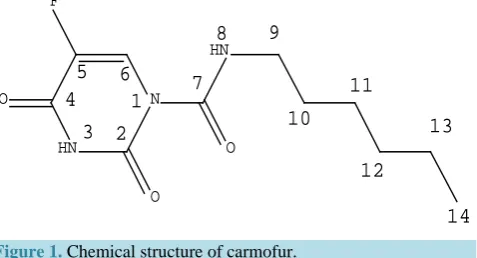
1-Hexylcarbamoyl-5-fluorouracil or carmofur (HCFU) (Figure 1) has an antineoplastic effect and is used to treat patients with solid tumors, such as breast and gastrointestinal carcinomas [1]. Carmofur appeared to be the most promising antitumor agent when administered orally in that carmofur retains well balanced lipo- and hy-dro-philicity, and decomposed moderately in a tumor [2]. Nevertheless, carmofur still has toxicity and limited antitumor activity in clinically. It is considered that the chemical structure of carmofur relates to the rapid uptake of carmofur, because the hexylcarbamoyl structure (C-N bond) facilitates rapid absorption through the gastroin-testinal tract and blood-ascities barrier [2].
At present, the catalysis of carmofur’s conformational alteration in organic solvent by chemical equivalent
Figure 1. Chemical structure of carmofur.
amounts of acid has not been demonstrated. Here, we studied acid/base induced conformational alteration of carmofur in solvent via using UV-Vis spectroscopy [3]-[9]. We reported that UV spectroscopy of carmofur in the some solvent changed gradually with the addition of acid. The above experimental result revealed that carmofur could be induced to produce chemical conformational alteration phenomena under the condition of acid solution.
2. Materials and Methods
2.1. MaterialsCarmofur was obtained from Shanghai Oriental Pharmaceutical Science and Technology Co. Ltd. Acetonitrile (CH3CN), Methanol (CH3OH), Ethanol (CH3CH2OH) and Acetic acid (CH3COOH) were purchased from
Shanghai crystal pure biological technology co., Ltd. Trifluoroacetic-acid (TFA), Formic acid (HCOOH), Trie-thylamine (Et3N) and ammonium solution (NH3, 25%) were purchased from Shanghai Ling Feng Chemical
Reagent Co., Ltd. Sodium hydroxide (NaOH) is purchased from Sinopharm Chemical Reagent Co., Ltd.
2.2. Experimental Instrument
In our study, some instruments were used as follows DMX 500 Nuclear Magnetic Resonance Spectrometer (Brucker Germany), Shimadzu UV-1601PC instrument (Japan Shimadzu), AB135-s electronic balance (Swit-zerland METTLER TOLEDO), Color plate (Yixing crystal optical instrument co., LTD.) and pipetting gun (Shanghai Hanlin Experimental Instrument Co., Ltd.).
2.3. UV Spectroscopy Condition
Scanning wavelength: 200 nm - 400 nm; Absorbance range: 0.0 - 2.0. All the Experimental data were recorded at 298 K.
2.4. Experiment Method
Solvent: Acetonitrile (CH3CN), Methanol (CH3OH), Ethanol (CH3CH2OH).
Acid: Trifluoroacetic-acid (TFA), Acetic acid (CH3COOH), Formic acid (HCOOH), Base: Triethylamine
(Et3N), Sodium hydroxid solution (0.2 g/ml), Ammonium solution (NH3, 25%).
UV measurements were made on a spectrometer. Firstly, we measured precisely1ml carmofur solution (1 mg carmofur dissolved in 10 ml acetonitrile) by the pipetting gun, addition to 2 ml solvent. Then, a certain amount of acid was added to the above acetonitrile solution of carmofur respectively. The base was added to carmofur dissolved in acetonitrile containing a certain equivalent of acid.
The variable–temperature 1H and 13C NMR of carmofur were recorded on the same equipment in Acetonitrile: Trifluoroacetic-acid (9:1) at −10˚C, 10˚C, 20˚C, 40˚C, 60˚C, 70˚C.
3. Results and Discussions
3.1. UV Spectroscopy AnalysisIn the process of UV absorption spectra test, we found that UV spectroscopy of carmofur could change clearly
HN
N F
O
O
HN
O
5 6
1
2 3
4 7
8 9
10 11
12
13
in CH3CN. Upon titration of the carmofur solution with TFA, the absorption band centered at λmax = 213 nm
gradually disappears (Figure 2). Because of the addition of trifluoroacetic acid, the solvent polarity and dipole increased, resulting in the polarity of the solute increased. It also caused the maximum wavelength red shift and decreased the absorbance. The result showed that π bonding orbital of carmofur structure jumped into anti- bonding orbital. When Et3N was added to the protonated solution, the original spectrum centered at λmax = 213
nm is steadily regained. This is because anti-bonding orbital of carmofur structure jumped back into π bonding orbital. From this change phenomenon, it is apparent to show that the acid/base switching process in CH3CN is
fully reversible.
The result indicated the addition of TFA in CH3CN could induce conformational alteration of carmofur and
Et3N could make the altered conformation of carmofur back to the original conformation. The acid/base induced
amide conformational alteration process was reversible. We found that NaOH (0.2 mg/cm3) and NH3 also could
make the altered conformation of carmofur back to the original conformation. (Figure 2)
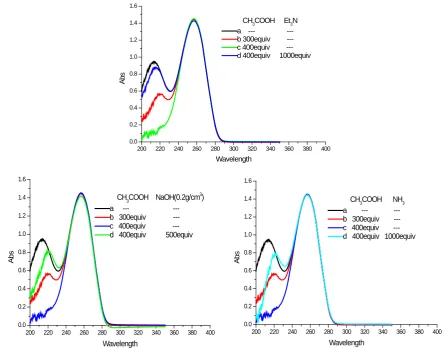
InFigure 3, the UV spectra indicated the addition of CH3COOH in CH3CN could induce conformational
al-teration of carmofur. In the protonated solution by CH3COOH, Et3N/NaOH (0.2 mg/cm3)/NH3 could make the
altered conformation of carmofur back to the original conformation.
InFigure 4, the UV spectra indicated the addition of HCOOH in CH3CN could induce amide conformational
alteration of carmofur. In the protonated solution by HCOOH, Et3N/NaOH (0.2 mg/cm3)/NH3 could make the
altered conformation of carmofur back to the original conformation.
There are the same phenomenon of carmofur in solvents such as CH3CH2OH and CH3OH. The addition of
HCOOH/TFA/CH3COOHin CH3CH2OH/CH3OH could induce conformational alteration of carmofur. In the
[image:3.595.98.532.337.683.2]
Figure 2. Change in the UV spectra in the solvent of CH3CN. The equivalents of TFA was added to a, then the equivalents of TFA was added to b, until there was no observable change c. Et3N, NaOH (0.2 mg/cm
3
) or NH3was added c to switch the system back d, respectively.
200 250 300 350 400
0.0 0.2 0.4 0.6 0.8 1.0 1.2 1.4 1.6 1.8
Ab
s
Wavelength
TFA Et3N a b 90equiv c 200equiv ---d 200equiv 200equiv
200 220 240 260 280 300 320 340 360 380 400
0.0 0.2 0.4 0.6 0.8 1.0 1.2 1.4 1.6
Ab
s
Wavelength
TFA NaOH(0.2g/cm3) a b 250equiv c 350equiv ---d 350equiv 1000equiv
200 220 240 260 280 300 320 340 360 380 400
0.0 0.2 0.4 0.6 0.8 1.0 1.2 1.4 1.6
Ab
s
Wavelength
Figure 3. Change in the UV spectra in the solvent of CH3CN.300 equivalents of CH3COOH was added to a, then 400 equi-valents of CH3COOH was added to b, until there was no observable change c. Et3N, NaOH (0.2 mg/cm3) or NH3 was added c to switch the system back d, respectively.
protonated solution, Et3N/NaOH/NH3could make the altered conformation of carmofur back to the original
con-formation.
In addition, we also did likewise experiment with inorganic acid, such as sulfuric acid, hydrochloric acid and phosphoric acid. When sulfuric acid, hydrochloric acidor phosphoric acid was added to the carmofur solution respectively, UV spectroscopy of carmofur had no obvious change. Inorganic acid (sulfuric acid, hydrochloric acid and phosphoric acid) could not induce conformational alteration of carmofur.
3.2. Variable-Temperature 1H and 13C NMR Analysis
In the variable temperature 13C-NMR spectrum of carmofur in Acetonitrile: Trifluoroacetic-acid (9:1), we found that 13C-NMR spectrum of carmofur contains two kinds of data at room temperature (Figure 5). The result showed that there were two conformers of carmofur in Acetonitrile: Trifluoroacetic-acid (9:1) at room tempera-ture, which is due to the partially double-bond character of carmofur’s amide bond at 20˚C. Meawhile, in the va-riable temperature 1H-NMR spectrum of carmofur in Acetonitrile: Trifluoroacetic-acid (9:1), 1H-NMR spectrum of carmofur appeared only a set of data at room temperature (Figure 6). The phenomena showed 1H-NMR spec-trum of two conformers of carmofur were the same.
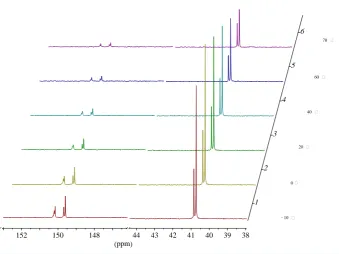
Along with the gradual increase in temperature to 70˚C, 13
C-NMR spectrum of carmofur revealed that these two kinds of data remain the same proportion and have no any other changes (Figure 7). When discreasing temperature to −10˚C, these two kinds of data still had no any changes (Figure 7). As we can see from Figure 6,
1
H-NMR spectrum of carmofur appeared no any changes at the different temperature. The above experimental
200 220 240 260 280 300 320 340 360 380 400
0.0 0.2 0.4 0.6 0.8 1.0 1.2 1.4 1.6
Ab
s
Wavelength
CH3COOH Et3N a ---b 300equiv --- c 400equiv --- d 400equiv 1000equiv
200 220 240 260 280 300 320 340 360 380 400
0.0 0.2 0.4 0.6 0.8 1.0 1.2 1.4 1.6
Ab
s
Wavelength
CH3COOH NaOH(0.2g/cm3)
a b 300equiv c 400equiv ---d 400equiv 500equiv
200 220 240 260 280 300 320 340 360 380 400
0.0 0.2 0.4 0.6 0.8 1.0 1.2 1.4 1.6
Ab
s
Wavelength
Figure 4. Change in the UV spectra in the solvent of CH3CN. 230 equivalents of HCOOH was added to a, then 460 equiva-lents of HCOOH was added to b, Until there was no observable change c. Et3N, NaOH (0.2 mg/cm3), NH3 were added c to switch the system back d, respectively.
Figure 5. Variable temperature13C-NMR spectrum of carmofur.
200 250 300 350 400
0.0 0.5 1.0 1.5 2.0
A
bs
Wavelength
HCOOH Et
3N
a b 230equiv c 460equiv d 460equiv 400equiv
200 250 300 350 400
0.0 0.5 1.0 1.5 2.0
A
bs
Wavelength
HCOOH NaOH (3)0.
a b 230equiv c 460equiv d 460equiv 250equiv
200 250 300 350 400
0.0 0.5 1.0 1.5 2.0
A
bs
Wavelength
HCOOH NH
3
a b 230equiv c 460equiv d 460equiv 600equiv
0 20 40 60 80 100 120 140 160
(ppm)
1 2
3 4
5 6
60℃ 70℃
40℃
20℃
0℃
[image:5.595.144.490.461.705.2]Figure 6. Variabletemperature1H-NMR spectrum of carmofur.
Figure 7. Variable temperature13C-NMR partial enlargedspectrum of carmofur.
phenomena testified that temperature did not have any effect on these two conformers of carmofur in Acetoni-trile: Trifluoroacetic-acid (9:1). These two conformers of carmofur were structurally stable in AcetoniAcetoni-trile: Trif-luoroacetic-acid (9:1).
4. Conclusions
The result indicated that the addition of acid (Trifluoroacetic-acid, Acetic acid, Formic acid) in the some solvent (Acetonitrile, Methanol, Ethanol) could induce conformational alteration of carmofur and the base (Triethyla-mine, Sodium hydroxidesolution (0.2 g/cm3), Ammonium solution (25%)) could make the altered conformation
1 2 3 4 5 6 7 8 9 10 11
(ppm)
1 2
3 4
5 6
70℃
60℃
40℃
20℃
- 10℃
0℃
38 39 40 41 42 43 44 148
150 152
(ppm)
1 2
3 4
5 6
60℃ 70℃
40℃
20℃
0℃
[image:6.595.143.483.341.595.2]of carmofur back to the original conformation. The conformational alteration process was reversible. Moreover, inorganic acid (Trifluoroacetic-acid, Acetic acid, Formic acid) could induce the conformation alteration of car-mofur, but inorganic acid (sulfuric acid, hydrochloric acid, phosphoric acid) could not.
The variable temperature 13C-NMR spectrum also testified that there were two conformers of carmofur in Acetonitrile: Trifluoroacetic-acid (9:1) at room temperature. And the variable temperature 1H and 13C-NMR spectrum indicated that temperature did not have any effect on these two conformers of carmofur in Acetonitrile: Trifluoroacetic-acid (9:1). These two conformers of carmofur were structurally stable in Acetonitrile: Trifluo-roacetic-acid (9:1).
Acknowledgements
The study was financed by the graduate research and innovation funding (14KY0412). We would like to thank Shanghai University of Engineering Science for financial support.
References
[1] Liu, Y.W., Wang, C.X., Zheng, C.Y., Wang, Z.Y., Wu, H.X. and Qu, S.S. (2001) Microcalorimetric Study on the En-hanced Antitumor Effects of 1-Hexylcarbamoyl-5-fluorouracil by Combination with Hyperthermia on K-562 Cell Line.
Thermochimica Acta, 369, 51-57. http://dx.doi.org/10.1016/S0040-6031(00)00754-1
[2] Maehara, Y., Kusumoto, H., Anai, H., Kusumoto, T., Hiramoto, Y. and Sugimachi, K. (1987) 1-Hexylcarbamoyl-5- fluorouracil Is More Cytostatic than 5-Fluorouracil against Human Tumors in Vitro. European Journal of Cancer and
Clinical Oncology, 23, 1511-1515. http://dx.doi.org/10.1016/0277-5379(87)90094-0
[3] Landge, S.M. and Aprahamian, I. (2009) apH Activated Conformational Rotary Switch: Controlling the E/Z Isomeri-zation in Hydrazones. Journal of the American Chemical Society, 131, 18269-18271.
http://dx.doi.org/10.1021/ja909149z
[4] Okamoto, I., Terashima, M., Masu, H., Nabeta, M., Ono, K., Morita, N., Katagiri, K., Azumaya, I. and Tamura, O. (2011) Acid-Induced Conformational Alteration of Cis-Preferential Aromatic Amides Bearing N-Methyl-N-(2-pyridyl) Moiety. Tetrahedron, 67, 8536-8543. http://dx.doi.org/10.1016/j.tet.2011.08.085
[5] Gardner, R.R., Mckay, S.L. and Gellman, S.H. (2000) Solvent-Dependent Stabilization of the E Conformation of Pro-pargylic Secondary Amides. Organic Letters, 2, 2335-2338. http://dx.doi.org/10.1021/ol006096j
[6] Liao, C.Y., Chan, K.T., Chang, Y.C., Chen, C.Y., Tu, C.Y., Hu, C.H. and Lee, H.M. (2007) Unexpected Solvent In-duced Z/E Isomerization and Catalytic Application of a Bis-Bidentate Nickel(II) Complex with N-Heterocyclic Car-bene and Amido Functionalities. Organometallics, 26, 5826-5833. http://dx.doi.org/10.1021/om700607m
[7] Koshevoy, I.O., Chang, Y.C., Karttunen, A.J., Haukka, M., Pakkanen, T. and Chou, P.T. (2012) Modulation of Metal-lophilic Bonds: Solvent-Induced Isomerization and Lumine-Scence Vapochromism of a Polymorphic Au-Cu Cluster.
Journal of the American Chemical Society, 134, 6564-6567. http://dx.doi.org/10.1021/ja3018994
[8] Li, P., Alduhaish, O., Arman, H.D., Wang, H.L., Alfooty, K. and Chen, B. (2014) Solvent Dependent Structures of Hydrogen-Bonded Organic Frameworks of 2,6-Diaminopurine. American Chemical Society, 14, 3634-3638.
http://dx.doi.org/10.1021/cg500602x
[9] Mijin, D.Ž., Ušćumlića, G.S., Perišić-Janjićb, N.U. and Valentić, N.V. (2006) Substituent and Solvent Effects on the UV/Vis Absorption Spectra of 5-(3- and 4-Substituted arylazo)-4,6-dimethyl-3-cyano-2-pyridones.Chemical Physics