http://dx.doi.org/10.4236/jeas.2016.61004
How to cite this paper: Fuchigami, K., Fujimura, H., Teramae, M. and Nakatsuka, T. (2016) Precision Synthesis of a Long-Chain Silane Coupling Agent Using Micro Flow Reactors and Its Application in Dentistry. Journal of Encapsulation and Adsorption Sciences, 6, 35-46. http://dx.doi.org/10.4236/jeas.2016.61004
Precision Synthesis of a Long-Chain Silane
Coupling Agent Using Micro Flow Reactors
and Its Application in Dentistry
Kiyomi Fuchigami*, Hidefumi Fujimura, Mitsuji Teramae, Toshiyuki Nakatsuka Research and Development Department, Shofu Inc., Kyoto, Japan
Received 26 January 2016; accepted 22 March 2016; published 25 March 2016
Copyright © 2016 by authors and Scientific Research Publishing Inc.
This work is licensed under the Creative Commons Attribution International License (CC BY). http://creativecommons.org/licenses/by/4.0/
Abstract
In dentistry, a wide range of materials is available for restorative treatment; a typical product of such restorative materials mainly consists of radically polymerizable monomer(s) and inorganic filler(s) (for added physical strength), as well as a surface modifier (e.g. silane coupling agent) for improved affinity between monomer and filler. It is favorable to use an optimal surface modifier depending on the respective restorative materials. However, commercially available surface mod-ifiers, which are synthesized by the ton, are not always suited for what is required for properties of the many different dental restorative materials. As a potential solution to such a problem, we focused on the latest technology, “micro flow reactors” that enabled an on-demand low-volume synthesis of many types of surface modifiers. Using micro reaction fields of such flow reactors, we synthesized a novel long-chain silane coupling agent. Compared to the control system synthesized using a conventional reaction flask, the novel system enabled significant reduction in reaction time without inducing any major side reactions. A dental composite resin that was treated with the novel coupling agent exhibited higher toughness, suggesting that such a silane coupling agent was an effective surface modifier.
Keywords
Micro Flow Reactor, Precision Synthesis, Composite Resins, Molecular Design, Urethanization, Hydrosilylation
1. Introduction
agents that contain radically polymerizable groups [1]. Such a surface treatment improves affinity of filler for radically polymerizable monomers to increase filler content, and thus enhancing physical properties including compressive strength and flexural strength of a resulting composite resin. It is for this reason that, for dental composite resins, 3-Methacryloxypropyltrimethoxysilane (γ-MPS) has been conventionally used as a silane coupling agent [2]-[7]. However, γ-MPS has some drawbacks: due to its short alkylene chains, it cannot suffi-ciently hydrophobize the filler surface, and also cannot give sufficient fracture toughness to a cured composite resin [8]; and has a low affinity for radically polymerizable monomers, such as urethane-based or glycidyl me-thacrylate-based binder resins, because γ-MPS has only one linking group, namely an ester group, in a molecule.
Many researchers have been tackling these problems caused by the short alkylene chains. For example, Japan Patent No. H2-134307 describes a method for synthesizing a long-chain (alkylene) silane coupling agent con-taining an ester group as an only linking group using reaction flasks. Another example is Japan Patent No. H6-33290, which decribes a method for distilling a synthesized long-chain silane coupling agent. Since both of the silane coupling agents claimed in the said patents are synthesized by means of batch-type reaction flasks, the synthesized molecules are exposed to heat for a long period of time. Consequently, a large amount of polymeri-zation inhibitor needs to be added to avoid unnecessary polymeripolymeri-zation, in addition to a post-synthesis distilla-tion procedure for purificadistilla-tion to eliminate the residual polymerizadistilla-tion inhibitor.
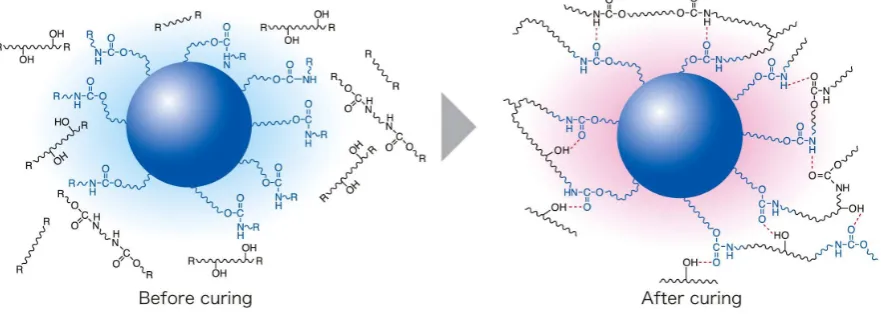
In order to solve all these problems, we design a molecule that contains a urethane group and sufficiently long alkylene chains to synthesize a novel long-chain (alkylene) silane coupling agent (L-SCA). The concept of its effect is illustrated in Figure 1 and Figure 2. With a urethane linkage in a molecule, L-SCA synthesized in this study forms hydrogen bonding between urethane bonds of urethane-based binder resin and hydroxyl groups of glycidyl methacrylate-based binder resin as shown in Figure 2. This contributes to an increase in fracture toughness of a resultant cured composite resin [8].
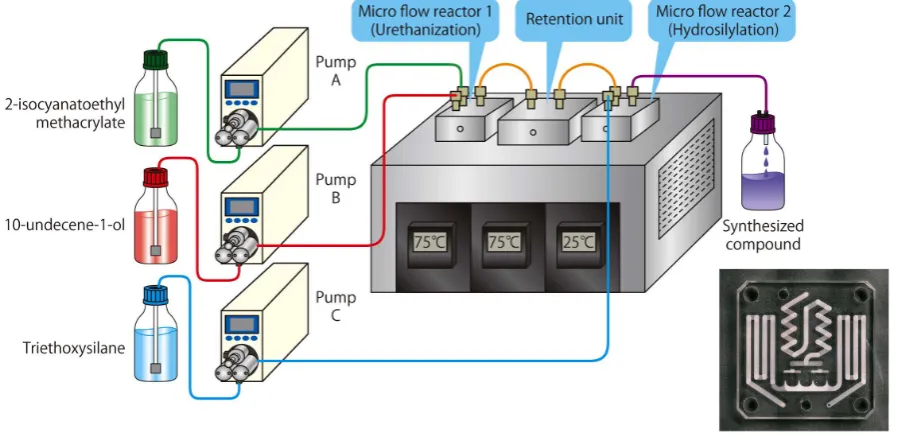
Since the above-mentioned conventional batch-type reaction method requires continuous heating until all the reactive substrates disappear, the occurrence of side reactions is unavoidable. However, owing to the latest mi-croprocessing technology, reaction fields with the size of only a few tens of microliters have enabled a conti-nuous precision synthesis of a uniform compound with almost no occurrence of so-called “hot spots”. Therefore, for the synthesis of L-SCA in the present study, we used micro flow reactors, as shown in Figure 3, to perform urethanization and hydrosilylation in a continuous manner in each micro reaction field of 32 µL, which substan-tially reduced side reactions as well as environmental burdens.
2. Experimental
2.1. Reagents
[image:2.595.93.534.547.704.2]2-isocyanatoethyl methacrylate (MOI; Tokyo Chemical Industry, Japan), 10-undecene-1-ol (Tokyo Chemical Industry, Japan), Dibutyl tin(IV) dilaurate (Wako Pure Chemical Industries, Japan), p-methoxyphenol (Tokyo Chemical Industry, Japan), Triethoxysilane (Tokyo Chemical Industry, Japan), and Platinum(0)-1,3-divinyl- 1,1,3,3-tetramethyl disiloxane complex solution (2 wt% in xylene; Sigma-Aldrich, USA) were used without
Figure 2. Molecular state of composite resin before and after curing (novel silane coupling agent used).
Figure 3. Schematic diagram of micro flow reactors.
further purification.
2.2. Analytical Instruments
Analytical instruments used in this study were: a Fourier transform infrared spectrometer (FT/IR-6300; JASCO, Japan) for infrared/near-infrared spectral measurement; a barrier discharge ionization detector/gas chromato-graph (BID-GC-2010 Plus; Shimadzu, Japan) for gas chromatochromato-graphy measurement; an NMR spectrometer (JEOL ESC-400; JEOL, Japan) for 1H-NMR analysis; a rheometer (MCR301; Anton Paar, Austria) for dynamic viscoelasticity measurement; and a universal testing machine (Instron 5567; Instron, USA) for mechanical strength measurement.
Settings for BID-GC analysis: GC column: Agilent J&W GC Columns DB-1 (length: 30 M, ID: 0.25 mm, film thickness: 0.25 µm); Vaporizing chamber temperature: 270˚C; Linear velocity of He carrier gas: 30.0 cm/sec; Purge flow rate: 3.0 mL/min; Split ratio: 1:50.0; Temperature programming: 40˚C-5 min hold, 40˚C - 270˚C, heating rate: 10˚C/min, 270˚C-60 min hold; BID temperature: 270˚C.
Settings for FT-IR analysis: Transmission method using KBr plates; Resolution: 4 cm−1; Measuring range:
400 - 4500 cm−1.
[image:3.595.88.537.269.491.2]2.3. Synthesis of L-SCA and Its Precursor
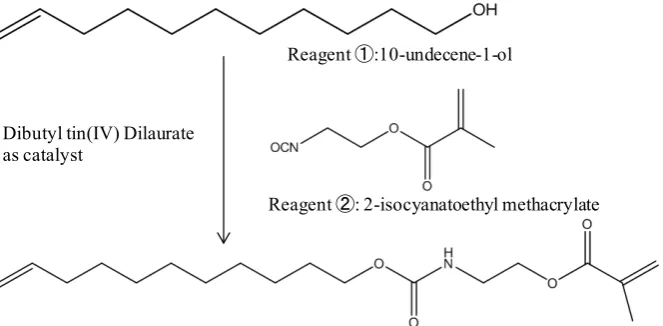
Figure 4 shows the reagents used and chemical schemes of the reactions for synthesis of L-SCA and its precur-sor. Synthesis reactions to determine the optimal reaction temperature and reaction time were performed as fol-lows: reagent 1 (containing a reaction catalyst) and reagent 2 were placed in a separate gas tight glass syringe and delivered into micro flow reactor 1 (for urethanization) with a syringe pump at the flow rate of 1.75 - 5.25 mmol/h at the reaction temperature of 70˚C - 80˚C with the heating time (retention time in the retention unit) adjusted by the flow rate, and then a precursor obtained was introduced to micro flow reactor 2, while reagent 3 (containing a reaction catalyst) placed in another gas tight glass syringe was also delivered into micro flow reactor 2 (for hydrosilylation) at the flow rate of 1.75 - 5.25 mmol/h at the reaction temperature of 25˚C. The precursor and a target compound obtained were analyzed and identified by gas chromatography (BID-GC), FT-IR and 1H-NMR.
2.4. Preparation of Dental Flowable Composite Resins (Low Viscosity Composite Resins) and Evaluation of Their Physical Properties
[image:4.595.152.484.362.525.2]1) Silane treatment of 0.4 µm filler
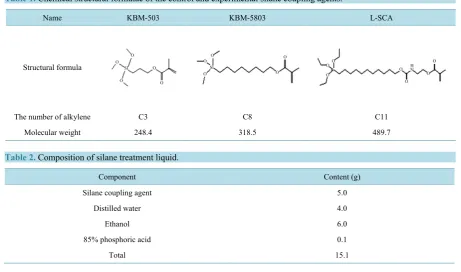
[image:4.595.139.478.551.678.2]Table 1 shows chemical structural formulae of the experimental and two commercially-available control si-lane coupling agents (KBM-5803 and KBM-503; Shin-Etsu Chemical, Japan). Using these sisi-lane coupling agents, silane treatment liquid (see Table 2) was prepared, and uniformly added to 100 g of 0.4 µm filler (GM32087 UF-0.4; Schott, Germany) sieved through an 80-mesh sieve, so that the content of silane coupling agent was 5 wt% in the mixture. The filler with uniformly-dispersed silane treatment liquid was subjected to a coupling reaction for 3 h at 115˚C, dried and then sieved again through the 80-mesh sieve. Each of the resulting
Figure 4. Chemical schemes of reactions (1. Urethanization; 2. hydrosilylation).
O HN
O
O
O
Si O O
O
Reagent ①:10-undecene-1-ol
Reagent ②: 2-isocyanatoethyl methacrylate
Precursor compound: 2-((undec-10-enyloxy)carbonylamino)ethyl methacrylate
Reagent ③: Triethoxysilane
Target compound (L-SCA): 4,4-diethoxy-17-oxo-3,16-dioxa-18-aza-4-silaicosan-20-yl methacrylate Dibutyl tin(IV) Dilaurate
as catalyst
Platinum(0)-1,3-divinyl-1,1,3,3-tetramethyl disiloxane as catalyst
O SiH
Table 1. Chemical structural formulae of the control and experimental silane coupling agents.
Name KBM-503 KBM-5803 L-SCA
Structural formula
The number of alkylene C3 C8 C11
Molecular weight 248.4 318.5 489.7
Table 2. Composition of silane treatment liquid.
Component Content (g)
Silane coupling agent 5.0
Distilled water 4.0
Ethanol 6.0
85% phosphoric acid 0.1
Total 15.1
fillers was used as silane-treated filler.
2) Preparation of dental flowable composite resins (low viscosity composite resins)
Using the respective silane-treated fillers, UDMA-based and Bis-phenol A-GMA (Bis-GMA)-based flowable composite resins (filler content: 50 wt%) were prepared (Table 3 and Table 4), and their physical properties (viscosity, flow value, flexural strength and compressive strength) were evaluated.
3) Test methods for evaluating physical properties of flowable composite resins
2.4.1. Viscosity
The viscosity of each flowable composite resin prepared was measured using a rheometer. The measurement conditions are shown in Table 5.
2.4.2. Flow Value (Flowability)
Each uncured paste sample of the prepared flowable composite resins (0.2 g each) was placed on a glass plate, covered by another glass plate, and then 400 g of load was applied on the specimen. The load was removed after 1min, and vertical and horizontal distances on the spread of the specimen were measured. The above procedure was performed twice in total, and the obtained values were averaged to represent the flowability of each compo-site resin.
2.4.3. Three-Point Flexural Strength
Each test composite resin paste was filled in a mold (2 × 2 × 25 mm) used for preparing flexural test specimens, with a cover glass placed with pressure on the surface of the paste, and light-cured from top and bottom sides through each cover glass for 3 min/side using a dental curing unit (Solidilite V; Shofu, Japan). The cured test specimens were stored in 37˚C ion-exchanged water for 24 h, and subjected to three-point flexural testing (at a crosshead speed of 1mm/min using Instron 5567).
2.4.4. Compressive Strength
Table 3. Composition of UDMA-based flowable composite resin.
Component Material name Content (g) Blending ratio (%)
Filler 0.4 µm filler 15.0 50.0
Radically polymerizable monomers UDMA/TEGDMA = 70/30 13.5 45.0
Silica gel nanoparticles R8200 1.5 5.0
Table 4. Composition of Bis-GMA-based flowable composite resin.
Component Material name Content (g) Blending ratio (%)
Filler 0.4 µm filler 15.0 50.0
Radically polymerizable monomers Bis-GMA/TEGDMA = 60/40 13.5 45.0
Silica gel nanoparticles R8200 1.5 5.0
Table 5. Conditions for viscosity measurement using a rheometer.
Item Setting
Measuring jig 20 mm-diameter parallel plate (PP20)
Measuring temperature 25˚C
Number of revolutions 1 to 30 rpm
Gap 1 mm
Japan). The cured test specimens were stored in 37˚C ion-exchanged water for 24 h, and subjected to compres-sive strength testing (at a crosshead speed of 1 mm/min using Instron 5567).
3. Results and Discussion
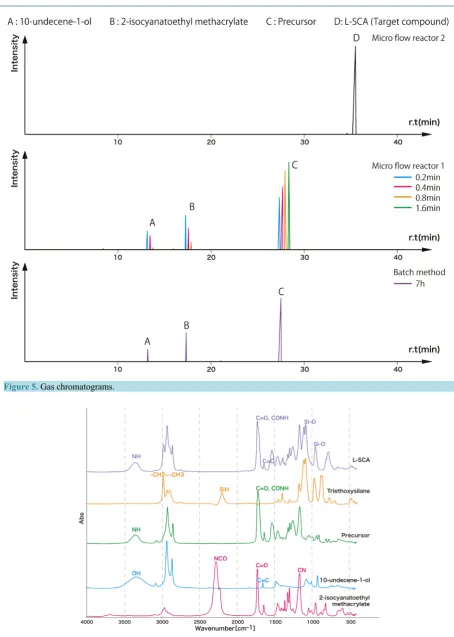
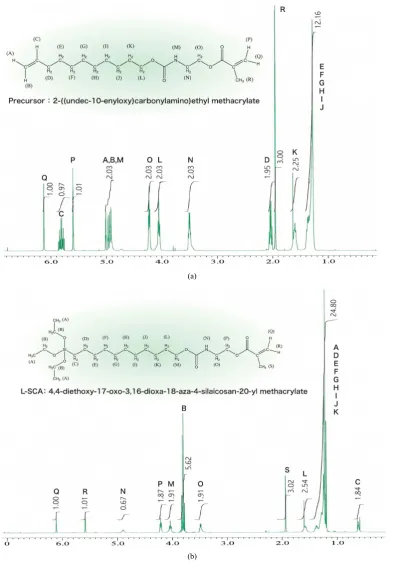
Before the results of analysis using BID-GC are shown in Figure 5. The urethanization reaction using the micro flow reactor 1 was completed in approx. 1.5 min at 75˚C, whereas by the conventional batch method with a reaction flask and a dropping funnel the reaction was not completed, with the raw materials left unreacted in the flask even at 8 h after completion of adding 2-isocyanatoethyl methacrylate. This suggested that molecules syn-thesized by the conventional batch method were exposed to heat for such an unnecessarily long period of time that urethane bonds formed were decomposed, which leads to high risks of side reactions and consequent yel-lowing of a precursor. With the experimental device, the subsequent reaction of hydrosilylation successfully occurred without any side reactions in the precisely temperature-controlled micro reaction field (32 µL) of the micro flow reactor 2 in a manner that silane was correctly added to a terminal alkene. These facts were also evi-dent from the FT-IR (Figure 6) and 1H-NMR (Figure 7(a) and Figure 7(b)) results.
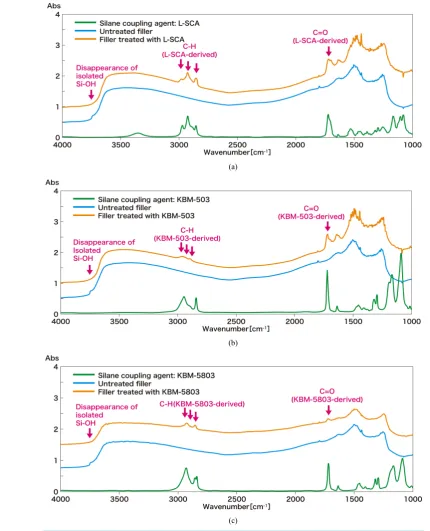
Figures 8(a)-(b) show diffuse reflectance FT-IR analysis results of the respective glass fillers that were sur-face-treated with L-SCA (synthesized using the micro flow reactors) and the two control silane coupling agents KBM-5803 and KBM-503. It was confirmed that the absorption (at 3740 cm−1) of the isolated silanol groups on
the filler surface disappeared by their condensation with the silane coupling agents. All the silane-treated glass fillers exhibited the absorption of the functional groups (alkylene: 2800 - 2900 cm−1, carbonyl: 1650 - 1700
cm−1) derived from the respective silane coupling agents used; particularly the intensity of the alkylene
absorp-tion became more notable with the increase of the number of alkylene. These results confirmed that the glass fillers used in this study were adequately treated with the respective silane coupling agents.
Figure 5. Gas chromatograms.
(a)
(b)
Figure 7. (a) Precursor characterized by 1H-NMR; (b) L-SCA characterized by 1H-NMR.
[image:8.595.120.514.84.648.2](a)
(b)
(c)
Figure 8. (a) FT-IR analysis results (for filler treated with L-SCA); (b) FT-IR analysis results (for filler
treated with KBM-503); (c) FT-IR analysis results (for filler treated with KBM-5803).
[image:9.595.79.510.84.616.2](a) (b)
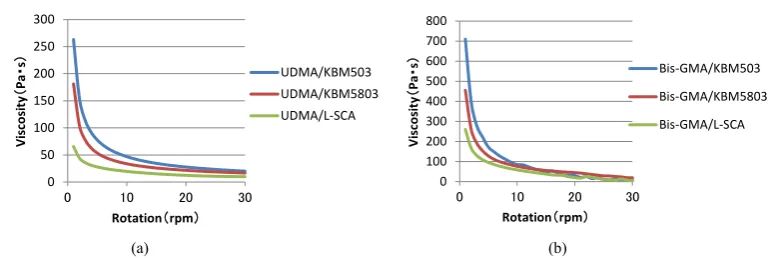
[image:10.595.119.510.81.210.2]Figure 9. (a) Viscosity of UDMA/TEGDMA-based CR, compared according to silane coupling agent used; (b) Viscosity of Bis-GMA/TEGDMA-based CR, compared according to silane coupling agent used.
Table 6. Results of flow value measurement.
Silane coupling agent used Flow value (mm)
UDMA/TEGDMA-based CR Bis-GMA/TEGDMA-based CR
L-SCA 36.0 29.0
KBM-5803 30.0 25.0
KBM-503 29.0 24.0
Table 7. (a) Three-point flexural strength; (b) Three-point flexural modulus; (c) Three-point flexural fracture energy. (a)
Silane coupling agent used
n = 6 Flexural strength (MPa)
UDMA/TEGDMA-based CR Bis-GMA/TEGDMA-based CR
Mean S.D. Mean S.D.
L-SCA 132a 5 136b 20
KBM-5803 133a 6 138b 7
KBM-503 129a 8 130b 8
*Significant difference between values marked with different letters (p < 0.05).
(b)
Silane coupling agent used
n = 6 Flexural modulus (GPa)
UDMA/TEGDMA-based CR Bis-GMA/TEGDMA-based CR
Mean S.D. Mean S.D.
L-SCA 4.8a 0.1 5.9b 0.1
KBM-5803 4.9a 0.1 6.1b,c 0.1
KBM-503 5.1a 0.1 6.2c 0.2
*Significant difference between values marked with different letters (p < 0.05).
(c)
Silane coupling agent used
n = 6 Fracture energy (Kgf-mm)
UDMA/TEGDMA-based CR Bis-GMA/TEGDMA-based CR
Mean S.D. Mean S.D.
L-SCA 4.7a 0.8 2.8b 1.2
KBM-5803 4.4a 1.0 2.7b 0.7
KBM-503 3.4a 0.9 1.9b 0.4
*Significant difference between values marked with different letters (p < 0.05).
0 50 100 150 200 250 300
0 10 20 30
Vi sc osi ty ( Pa ・ s )
Rotation(rpm)
UDMA/KBM503 UDMA/KBM5803 UDMA/L-SCA 0 100 200 300 400 500 600 700 800
0 10 20 30
Vi sc osi ty ( Pa ・ s )
Rotation(rpm)
[image:10.595.87.537.257.330.2] [image:10.595.86.540.372.466.2]flowable composite resins. In other words, L-SCA and KBM-5803, which have the larger number of alkylene (C11 and C8, respectively) than KBM-503 (C3), have more distance between the filler and the rigid binder resin network; the carbon chains, which create the distance, bend flexibly to absorb stress, resulting in high fracture toughness. Meanwhile, although there was no marked difference in the number of alkylene between L-SCA (C11) and KBM-5803 (C8), L-SCA showed significantly higher physical properties when the highly polar bind-er resin, i.e. Bis-GMA, was present. This was clearly due to an intbind-eraction between the polar group (hydroxyl) of Bis-GMA and the urethane group within a molecule, which achieved our intended effects.
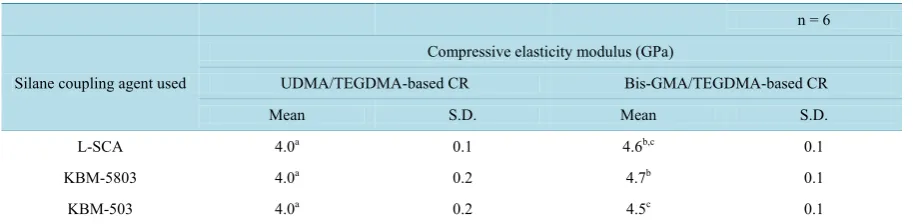
Finally, the results of compressive strength testing on the experimental flowable composite resins are shown in Table 8(a) and Table 8(b). There was no significant difference in compressive strength among all the groups of UDMA/TEGDMA-based flowable composite resins, whereas for the Bis-GMA/TEGDMA-based flowable composite resins, the L-SCA group had a significantly higher compressive strength than the control groups. This was likely to be due to the effect of the long alxylene chains of L-SCA, in combination with the effect that L-SCA, which was bound to the inorganic filler, formed a hydrogen bond with the binder resin (radically poly-merizable monomer) as shown in Figure 2; in particular, the hydroxyl group of Bis-GMA is highly polar, as mentioned above, to form a strong hydrogen bond with the urethane linkage portion.
4. Conclusion
In this study, we conducted a continuous precision synthesis of a long-chain (alxylene) silane coupling agent using micro flow reactors. The conventional batch reaction method using a reaction flask required the reaction time of more than 8 h at 75˚C, while our experimental synthesis method took 1.5 min to complete a urethaniza-tion reacurethaniza-tion at 75˚C. Our method has enabled the production of the pure compound, causing no side reactions, as is evident from the analyses using BID-GC (Figure 5), FT-IR (Figure 6) and 1H NMR (Figure 7(a) and Figure 7(b)). With a urethane linkage and long-chain alkylene groups in a molecule, the novel silane coupling agent synthesized in this study exhibited a high affinity for urethane-based binder resin as well as glycidyl me-thacrylate-based binder resin. Furthermore, our method using the micro flow reactors facilitated the synthesis of the compound with less environmental burden, because after the reaction procedure, cleaning of the flow reactor channels could be done with only a small amount of organic solvent such as acetone. It was confirmed that the
Table 8. (a) Compressive strength; (b) Compressive elasticity modulus. (a)
Silane coupling agent used
n = 6 Compressive strength (MPa)
UDMA/TEGDMA-based CR Bis-GMA/TEGDMA-based CR
Mean S.D. Mean S.D.
L-SCA 330a 27 453c 28
KBM-5803 312a 45 372b 17
KBM-503 336a 48 362b 24
*Significant difference between values marked with different letters (p < 0.05).
(b)
n = 6
Silane coupling agent used
Compressive elasticity modulus (GPa)
UDMA/TEGDMA-based CR Bis-GMA/TEGDMA-based CR
Mean S.D. Mean S.D.
L-SCA 4.0a 0.1 4.6b,c 0.1
KBM-5803 4.0a 0.2 4.7b 0.1
KBM-503 4.0a 0.2 4.5c 0.1
[image:11.595.87.546.445.566.2] [image:11.595.86.543.597.709.2]micro flow reactors allowed for not only a synthesis of 100 µL/min of the compound using gas-tight syringe pumps by screening of various conditions, but also a continuous synthesis of 5 L/day of the compound using HPLC pumps. The outcome of this study may greatly contribute to the synthesis of novel compounds, including silane coupling agents, to be used in the ever-evolving field of dentistry.
References
[1] Masuhara, E. and Fujisawa, S. (1979) Shika Juuten-you Rejin (Dental Composite Resins). Ishiyaku Publishing, Inc., Tokyo.
[2] Nishiyama, N. and Hayakawa, T. (1987) Silane Coupling Agents. Journal of Adhesive Dentistry, 5, 129-133.
[3] Arai, K., Yagi, K., Sakamoto, I., Asada, M. and Hashimoto, H. (1973) Characteristics of the Precipitations from Com-mercial Composite Resins during Storage in Water. JDMA, 30, 22-28.
[4] Söderholm, K.J. (1981) Degradation of Glass Filler in Experimental Composites. Journal of Dental Research, 60, 1867-1875. http://dx.doi.org/10.1177/00220345810600110701
[5] Nishiyama, N., Katsuki, H., Hayakawa, T., Horie, K., Tanioka, Y., Teshima, H. and Akaiwa, Y. (1985) Study on Sur-face Treatment of Silica Filler, Part 4. Japanese Journal ofDental Materials, 4, 60-61.
[6] Nagae, T. (1979) Shiran Kappuringu Zai (Silane Coupling Agents). Kogyo Zairyo, 27, 34-38.
[7] Sakanashi, K. and Nishiyama, N. (1984) Studies on the Treatment of Glass Surface. Japanese Journal ofDental Mate-rials, 3, 284-294.