Munich Personal RePEc Archive
Role of Community Based Organizations
in Rural Development: A Case Study of
Selected CBOs in District Swat.
Hussain, Anwar Hussain and Khattak, Naeem Ur Rehman
Khattak and Khan, Abdul Qayyum Khan
Pakistan Institute of Development Economics
2008
Online at
https://mpra.ub.uni-muenchen.de/42011/
THE ROLE OF COMMUNITY BASED ORGANIZATIONS
IN RURAL DEVELOPMENT: A CASE STUDY OF
SELECTED CBOs IN DISTRICT SWAT
ANWAR HUSSAIN*, NAEEM-UR-REHMAN KHATTAK* and ABDUL QAYYUM KHAN**
* Department of Economics, University of Peshawar, Peshawar – Pakistan ** Air Weapons Complex, Pakistan Ordnance Factory, Wah Cantt – Pakistan
ABSTRACT
The study was conducted in Swat district during 2008 to assess the role of Community Based Organizations (CBOs) in the rural community development of the district. For the analysis, secondary data was used collected from five CBOs of tehsil Kabal (Swat). The results indicated that Shahbaz Welfare Society (Akhunkalay)provided vaccination to 38 patients free of cost, and 111 patients on concession. Al-Khidmat Welfare Organization (trained 160 tailors; 240 farmers; and 56 in handicrafts manufacturing. Al-Khair Welfre Society (Totano Bandai) provided student scholarships for 10, books purchase for 27, school uniform for 35 students, free tuition to 450 students and free school admission to ten. Rokhana Sema (Aligrama) provided training to 17 female primary school teachers, while 9 and 6 persons were given TBA and LHVs/FMTs training respectively. Seeds at subsidized rates were provided to 75 farmers and another 45 farmers were trained. Youth Organization (Galoch) constructed 4 waiting rooms on bus stops, constructed 2 tube wells and 22 cemented streets. The results show that CBOs are making a difference in lives of the people in the sample area. More resources needs to be made available to enable CBOs further their activities for the development of rural communitiess
Key Words: CBOs, Community, Impact, LHVs/FMTs, People Centre Modes, Socioeconomic, Rural Development
Citation: Hussain, A., N.R. Khattak and A.Q. Khan. 2008. The role of community based organizations in rural development (A case study of selected CBOs in District Swat). Sarhad J. Agric. 24(4): 749-753.
INTRODUCTION
Community-based organizations (CBOs) are not for profit, organizations on a local and national level, facilitating community efforts for community development. CBOs works through people-centered modes of development such as availability of micro-finance, community participation in development ensuring community health education and infrastructure improves over time.
The purpose of CBOs is to plan, implement, and monitor social and economic development programs and provide technical and financial help to the communities. CBOs positively affects the process of rural change i.e. increase in income, improvement in health, nutrition and literacy status of the populations. Some of the programs that can ensure bring changes in the rural communities are: availability of micro-finance for micro-enterprise, health and education, sustainable agriculture, animal husbandry, safe water and sanitation.
A number of researchers have highlighted the significance of CBOs and the contribution these organizations make in national social and economic development in general and rural communities in particular. Non-Governmental Organizations [NGOs] are viewed as non for profit organizations that are involved at grass roots to empower the disadvantaged segments of the population (Clark, 1999). Similarly the role of Non-Governmental Organizations (NGOs) in the planning and management of rural development projects has been analyzed (Berg, 1987). Uphoff's (1984) suggests five key activity areas in which NGOs can make their contributions i.e. natural resources management, rural infrastructure, human resources development, agricultural development and non-agricultural enterprise. UNCHS, 1986, observed that many of the rural poor are locked into a circle involving lack of money, inadequate equipment, time consuming and health-impairing methods of transport, lack of flexibility and exploitation by transporters and middlemen. Mullen, 1991,some NGOs around the world are using viable, effective modes of transport for the delivery of rural services. Clements, 1995, studied that improvements in transport and communications technology, has enabled at least some rural communities to attract small scale ‘flexible’ economic activity.
Anwar Hussain et al. The role of community based organizations in rural development… 750
Donovan, 1992, World Bank 1994, Lipton and Ravallion, 1995, Booth, Hanmer and Lovell, 2000). Different studies conducted the impact of CBOs but focus has not been given in district Swat to conduct such like study. In present study attempt has been made to highlight the impact of CBOs on rural development. The present study will provide guideline for Government and rural economists to focus on the study area and to take active part in its development through supporting Community Based Organizations in the study area.
MATERIALS AND METHODS
The study was conducted in Swat Distract of NWFP during 2007. Information is based on secondary data collected from the Government Record of five CBOs in the tehsil Kabal (Swat). These CBOs are: Shahbaz Welfare Society (Akhunkalay), Al-Khidmat Welfare Organization (Ghakhe Bandai), Al-Khair Welfare Society (Totano Bandai), Rokhana Sema (Aligrama) and Youth Organization (Galoch) were selected. Shahbaz Welfare Society (Akhunkalay) is mostly working in health sector. Al-Khidmat Welfare Organization is providing job related training for various occupations according the market needs.. Al-Khair Welfare Society aim is to improve literacy level in the area. Since its inception, the organization is working on reducing illiteracy especially among children and women, neglected segment of the society. Some of the organization programs provides training in the areas of tailoring, farming and handicrafts. Rokhana Sema is not only worked in the area of education but also in other areas such as awareness creation, health facilities provision and alleviation of poverty through seeds and fertilizer distribution. Youth Organization worked in the field of non-formal education and infrastructure development, water and sanitation. The study is based on secondary data, collected from official documents of these five CBOs. For the analysis, pie charts, simple averages, percentages, classification and tabulation were used.
RESULTS AND DISCUSSION
Shabaz Welfare Society (Akhundkalay)
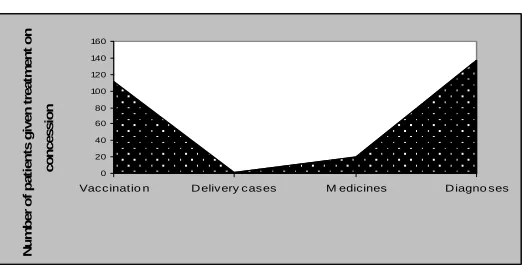
Without any compensation the CBO gave vaccination to 38 patients, dealt 2 delivery cases, 16 were given medicines and diagnosed 10 patients free of costs as given in Fig. 1. On concession basis, the CBO vaccinated 111 patients, dealt 1 delivery case, 20 were given medicines and diagnosed 137 patients, as given in Fig. 2. While on full payment, only 2 penitents were given medicines and 5 were diagnosed as evident from Fig. 3.
0 5 10 15 20 25 30 35 40
[image:3.612.173.439.390.516.2]V accinat io n Delivery cases M ed icines Diag no ses
Fig. 1 Number of patients given treatment free of cost
0 20 40 60 80 100 120 140 160
Vac c inatio n D eliv ery c as es M edicines D iagno ses
N u m b e r o f p a ti e n ts g iv e n t re a tm e n t o n c o n c e s s io n
[image:3.612.178.439.539.673.2]0 1 2 3 4 5 6
[image:4.612.171.440.73.202.2]V accinat io n Delivery cases M ed icines Diag no ses
Fig. 3 Number of patients given treatment on full payment
Al-Khidmat Welfare Organization (Ghakhe Bandai)
It was observed that each village had a compulsory handicrafts center for women. It was the major source of income of the rural poor people. They had a good market in urban areas. Most of the beneficiaries have started their own small enterprise. Out of the total beneficiaries, the CBO gave tailoring training to 35%, farming training to 53% of the total beneficiaries and handicrafts training to 12% the total beneficiaries, as given in Fig. 4.
Tailoring 35%
Farming 53%
[image:4.612.171.441.319.454.2]Handic raf ts 12%
Fig. 4 Number of beneficiaries trained
Al-Khair Welfare Society (Totano Bandai)
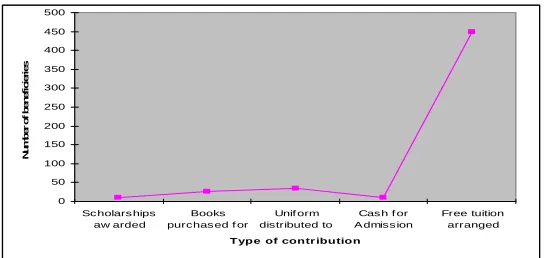
The data indicates that the organization had made significant contribution particularly in arranging free tuition for 450 poor students. Cash for admission were given to 10 students; books were purchased for 27 students; scholarships were awarded to 10 and school uniforms were provided to 35 students. The statistics for number of beneficiaries trained are given in Fig. 5.
0 50 100 150 200 250 300 350 400 450 500
Sc holars hips aw arded
Books purchas ed f or
Unif orm distributed to
Cas h f or A dmiss ion
Free tuition arranged
Type of contr ibution
N
u
m
b
e
r
o
f
b
e
n
e
fi
c
ie
ri
e
s
[image:4.612.188.460.541.670.2]Anwar Hussain et al. The role of community based organizations in rural development… 752
Rokhana Sema (Aligrama)
During 2007, 17 Female Primary School Teacher were benefited from the teacher-training program. While, 9 and 6 persons were given TBA and LHVs/FMTs training respectively as shown in Fig. 6.
0 2 4 6 8 10 12 14 16 18
Female Primary Sc hool Teacher
TBA s in Primary Health Care
LHV s /FMTs in Public Health
Num be r of pe ople s be ne fite d
[image:5.612.173.439.119.248.2]T y p e o f tr a in in g g iv e n
Fig. 6 Role of Rokhana Sema (Aligrama) in capacity building
This CBO also played an important role in poverty alleviation through provision of good quality seeds, subsidies fertilizer and agriculture training. According to Fig. 7, 75 farmers were provided seeds at subsidized rates, 19 farmers were given fertilizer at subsidized rates and 45 peoples were given training during 2007.
0 10 20 30 40 50 60 70 80
Provision of seeds Fertilizer provided Agriculture training
Contribution in agriculture s e ctor
[image:5.612.171.442.318.444.2]N u m b e r o f b e n e fi c ie ri e s
Fig. 7 Contribution of Rokhana Sema in Agricultural sector
Youth Organization (Galoch)
During 2007, it has played role in education and water and sanitation. According to Fig. 8, this CBO constructed 4 waiting rooms on roads sides both for males and females of the area. Two tube wells were installed for providing clean drinking water. Non-formal education was given to 140 students. Twenty two cemented streets were constructed in villages.
0 10 20 30 40 50 60 70 80 90 100 110 120 130 140 150 Construction of w aiting rooms on road sides
Tub w heels Installed f or drinking w ater
Building of latrines Provision of Non-f ormal Education Construction of streets in villages
Type of contr ibution
N u m b e r o f p ro v is io n s
CONCLUSION AND RECOMMENDATIONS
The facts and figures indicated that Shahbaz Welfare Society (Akhunkalay) worked in health sector, providing vaccination to 38 patients free of cost and 111 patients with concession. It also provided medicine to the poor peoples free of cost. Al-Khidmat Welfare Organization gave tailoring training to 160 people, 240 farmers and 56 children in handicrafts centers. Al-Khair Welfre Society (Totano Bandai) provided Scholarships to 10 students. Books were purchased for 27 students. School uniform was given to 35 students. Ten students were admitted free of cost. Free tuition was arranged which benefited 450 students. Rokhana Sema (Aligrama) provided training to 17 female primary school teachers while 9 and 6 persons were given TBA and LHVs/FMTs training respectively. Seeds at subsidized rates were provided to 75 farmers and 45 farmers were trained. Youth Organization (Galoch) constructed 4 waiting rooms on roads sides both for males and females of the area. Two tub wells were installed for providing clean drinking water. Non-formal education was given to 140 students. Twenty two cemented streets were constructed in villages. The selected CBOs played positive role towards the socioeconomic development of the research area. The main areas in which they played their role are education, health, trainings and construction. But still there is a need to extend their activities for socioeconomic development of district Swat. The government should provide proper funds to these CBOs for this purpose.
REFERENCES
Ahmed, R. and C. Donovan. 1992. Issues of infrastructural development:A synthesis of the Literature. Washington, D.C. Int. Food Policy Res. Instt.
Berg, R.J. 1987. Non-governmental organizations: New force in third world development and politics. CASID, East Lansing, Michigan.
Booth, D., L. Hanmer and E. Lovell. 2000. Poverty and transport: A report prepared for the World Bank in collaboration with DFID. London: Overseas Dev. Instt.
Clark, J. 1999. The role of non-profit organizations in development: The experience of the World Bank. NGO Unit, World Bank, USA.
Clements, A. S. 1995. Employment growth and housing shortage: A case study of Wongan Hills. B.A. (Hons) Thesis, Perth: Curtin Univ. of Technol.
Govt. of Pakistan. 1999. Distt. Census Report 1998. Population Census Org. Statistics Div. Islamabad.
Lipton, M. and M. Ravallion. 1995. Poverty and policy. In Behrman, J. and T.N. Srinivasan, (Eds.), Handbook of Dev. Eco. 9: 2551-2657. Amsterdam, New York and Oxford: Elsevier Sci.
Mullen, J. 1991. Mobility Haiti project. Instt. for Transport. and Dev. Policy. Summer Report.
NIPS. 2001. Pakistan population data sheet. An estimate of population by provinces and Distt. of Pakistan 2001, 2004, 2011, and 2021. Islamabad: Nat. Instt. of Pakistan Study.
United Nations Center for Human Settlements (HABITAT). 1986. Transport for urban and rural areas, OP-HS-86. Nairobi, Kenya.