Adaptation as an Aspect in Pervasive Computing
Awais Rashid, Gerd Kortuem
Computing Department, Lancaster University, Lancaster LA1 4YR, UK
{awais | kortuem} @comp.lancs.ac.uk
Abstract. Adaptation is one of the key characteristics of pervasive computing
applications. However, implementing adaptation using conventional development techniques is challenging as adaptation requirements tend to affect multiple elements of a pervasive environment. In this paper, we present our experience with implementing adaptation using aspect-oriented programming (AOP). We argue that the use of AOP not only provides an improved modularisation of the adaptation concern but also makes it easier to adapt the pervasive application to both changes in data and reorganisation of the pervasive environment itself.
1. Introduction
Pervasive computing aims at realising the vision of the information society where computers are embedded within the environment and applications seamlessly interact and exchange information with each other and the users. Though most modern day software systems, especially those servicing volatile business domains such as banking and e-commerce, need to be adaptable to changing requirements, adaptation is an even more crucial characteristic of pervasive computing applications. New interaction mechanisms, devices or services may be added to a pervasive environment requiring them to be adapted to the specific characteristics of the environment. Similarly, the existing elements may be reorganised or adapted on the fly to react to changes in user behaviour and data/information imparted or manipulated by the pervasive environment. This last characteristic of pervasive computing environments is often referred to as context-awareness [4, 5] and is a major focus of research in pervasive computing.
Implementing adaptation in a pervasive environment is a challenging task as the adaptation concern affects multiple elements (devices, services, etc.) in the environment. The problem is further compounded by the fact that the elements are geographically distributed and in many instances there is no central node controlling the operation of the pervasive environment.
Aspect-oriented programming (AOP) [3, 7] has been proposed as a means to effectively modularise such crosscutting properties, i.e., properties that have a broadly scoped effect on a system. AOP techniques provide abstractions and constructs to modularise such properties, specify their composition relationships and compose them with other elements of a system. The composition relationships are specified using a join point model which identifies well-defined points within a system where an aspect may be composed. The composition process is often referred to as weaving.
maturity of the language, its compiler and availability of effective tool support1.
Section 2 in this paper describes the pervasive navigation environment in more detail. Section 3 discusses the aspectisation of the adaptation concern using AspectJ. Section 4 reflects on our experience and concludes the paper.
2. Navigation Application
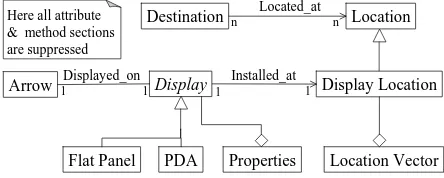
The pervasive environment we are developing involves a set of display devices (e.g., flat LCD panels, PDAs, etc.) to be deployed at strategic public locations across the Lancaster University campus. The environment is aimed at supporting a range of applications including, but not limited to, displaying news, disseminating information on upcoming events and assisting visitors (and also staff and students) in navigating their way around campus. We have chosen to focus on the navigation application for the purpose of the prototype aspect-oriented implementation discussed in this paper. Visitors, staff and students often need to find their way to various destinations around campus. The destination can be a physical location such as a building, department or a lecture theatre or it can be an event such as a conference being hosted in a particular building. The destination is often dynamic as a particular event may have been moved to a different building or various sessions relating to the same event might be taking place in multiple buildings or the event may be held in different buildings on different days of the week. Similarly, though less dynamic than navigation information relating to events, a department may move to a different building or expand to take up additional space in another building. Similarly, alternative routes may need to be displayed in case a particular path is blocked due to building or renovation works or when the navigating person has special requirements such as wheelchair accessibility. Furthermore, each new display added to the environment must adapt its specific properties to those of the environment. Displays may also be moved as the environment expands or new applications, usage scenarios and services are added. The UML diagram of the environment is shown in Fig. 1.
Arrow
Destinationn Located_at n Location
Display
Flat Panel PDA
Display Location
Installed_at
1 1
1 1
Displayed_on
Location Vector Properties
[image:2.595.186.408.489.578.2]Here all attribute & method sections are suppressed
Fig. 1. UML diagram of the pervasive environment
The objects represented by the various classes in Fig. 1 are as follows:
• Destination: A destination on campus, e.g., building, department, event, etc.
• Location: A location based on coordinates on the campus map.
1 Due to limited space, we do not provide an introduction to the AspectJ syntax. Readers not familiar
• Display Location: The location on the campus map where a display has been installed.
• Location Vector: A vector pointing outwards from the display. Used to determine which way a display is facing and whether it has been moved.
• Display: An abstract class representing a display in the environment.
• Flat Panel: A specific type of display, the flat LCD panel.
• PDA: A specific type of display, personal digital assistant.
• Properties: The specific characteristics of an individual display.
• Arrow: The data to be displayed to assist with navigation (in this case a simple arrow pointing in the direction to be followed).
3. Aspectising Adaptation
When modularising adaptation we need to address three specific facets of adaptation within our pervasive environment. The first two are application independent and relate to any application deployed in the environment while the third is specific to the navigation application:
1. Display management: As the environment expands more displays will be incorporated into it. All new displays must have their specific properties adapted for use within the pervasive environment. Furthermore, although the UML diagram in Fig. 1 only shows two specific types of displays, Flat Panel and PDA, it is conceivable that other types of display devices may be added to the environment as they become available.
2. Content management: The navigation content (an arrow in this case) is only one type of content to be displayed on the devices. There are other types of content that also need to be delivered to the devices. Furthermore, as new displays are added, the content already being displayed within the environment has to be made available on them as well.
3. Display adaptation: As a new destination is added or an existing destination changed (e.g., change of venue for an event), the displays need to be adapted to guide the users to the correct destination. Furthermore, if a display is moved to a different location it should be adapted to display the content in a correct fashion based on its new location.
We have modularised each of these facets of the adaptation concern using AspectJ aspects.
3.1 Display Manager Aspect
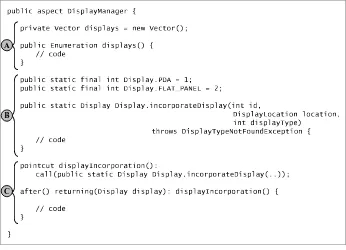
The 'LVSOD\0DQDJHU aspect (cf. Fig. 2) encapsulates all functionality relating to incorporation of new displays or adaptation of their properties to the pervasive environment. The aspect maintains a collection of all GLVSOD\V incorporated into the environment and has a public method to traverse the collection (cf. label (A) in Fig. 2). This is useful for other elements of the system, especially the &RQWHQW0DQDJHU aspect, which needs to access all the displays in the system from time to time as new content becomes available.
LQFRUSRUDWH'LVSOD\ method instantiates the right type of class as a new display is incorporated. If a suitable display type does not exist, a 'LVSOD\7\SH1RW)RXQG([FHSWLRQ is thrown.
The GLVSOD\,QFRUSRUDWLRQ pointcut (cf. label (C) in Fig. 2) captures all calls to the static method introduced into the 'LVSOD\ class. An DIWHU advice then adds the incorporated display to the GLVSOD\V collection in the aspect as well as adapts the properties of the newly incorporated display to the pervasive environment.
Note that although the 'LVSOD\0DQDJHU aspect affects only a single class, nevertheless it encapsulates a coherent concern. This use of an aspect is, therefore, very much in line with good separation of concerns practice.
SXEOLFDVSHFW 'LVSOD\0DQDJHU ^
SULYDWH9HFWRUGLVSOD\V QHZ9HFWRU
SXEOLF(QXPHUDWLRQGLVSOD\V^ FRGH
`
SXEOLFVWDWLFILQDO LQW 'LVSOD\3'$ SXEOLFVWDWLFILQDO LQW 'LVSOD\)/$7B3$1(/
SXEOLFVWDWLF'LVSOD\'LVSOD\LQFRUSRUDWH'LVSOD\LQW LG
'LVSOD\/RFDWLRQ ORFDWLRQ LQWGLVSOD\7\SH
WKURZV'LVSOD\7\SH1RW)RXQG([FHSWLRQ ^ FRGH
`
SRLQWFXWGLVSOD\,QFRUSRUDWLRQ
FDOOSXEOLFVWDWLF'LVSOD\'LVSOD\LQFRUSRUDWH'LVSOD\
DIWHUUHWXUQLQJ'LVSOD\GLVSOD\ GLVSOD\,QFRUSRUDWLRQ^
FRGH `
` A
B
[image:4.595.125.471.274.524.2]C
Fig. 2. The Display Manager aspect
3.2 Content Manger Aspect
the instantiation of all sub-classes of the 'LVSOD\ class. An DIWHU advice then pushes the available content onto the newly instantiated display.
SXEOLFDVSHFW &RQWHQW0DQDJHU ^
GHFODUHSDUHQWV$UURZLPSOHPHQWV&RQWHQW
SRLQWFXWFRQWHQW$GGLWLRQ&RQWHQWF
FDOOSXEOLFDGG&RQWHQW&RQWHQW DUJVF
DIWHU&RQWHQWF FRQWHQW$GGLWLRQF^
FRGH `
SRLQWFXWSXVK&RQWHQW2Q1HZ'LVSOD\FDOO'LVSOD\QHZ
DIWHUUHWXUQLQJ'LVSOD\GLVSOD\ DGDSW1HZ'LVSOD\3URSHUWLHV^
FRGH `
` A
B
[image:5.595.140.453.177.367.2]C
Fig. 3. The Content Manager aspect
3.3 Display Adaptation Aspect
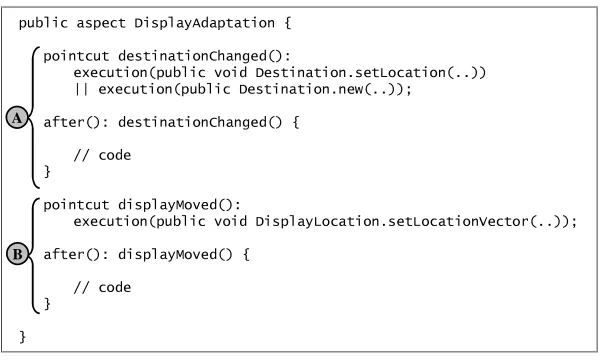
While the 'LVSOD\0DQDJHU and &RQWHQW0DQDJHU aspects are application independent and handle adaptation facets that span across applications in the pervasive environment, the 'LVSOD\$GDSWDWLRQ aspect, shown in Fig. 4, is specific to the navigation application. The GHVWLQDWLRQ&KDQJHG pointcut in this aspect (cf. label (A) in Fig. 4) captures the change in location of an existing destination or the creation of a new destination. An DIWHU advice for the pointcut invokes the adaptation rules for the displays to adapt the content accordingly.
SXEOLFDVSHFW 'LVSOD\$GDSWDWLRQ ^
SRLQWFXWGHVWLQDWLRQ&KDQJHG
H[HFXWLRQSXEOLFYRLG'HVWLQDWLRQVHW/RFDWLRQ __H[HFXWLRQSXEOLF'HVWLQDWLRQQHZ
DIWHU GHVWLQDWLRQ&KDQJHG^
FRGH `
SRLQWFXWGLVSOD\0RYHG
H[HFXWLRQSXEOLFYRLG 'LVSOD\/RFDWLRQVHW/RFDWLRQ9HFWRU
DIWHU GLVSOD\0RYHG^
FRGH `
` A
B
[image:5.595.148.448.482.662.2]The GLVSOD\0RYHG pointcut (cf. label (B) in Fig. 4) identifies that a display has been moved by capturing the change in its location vector2. An associated DIWHU advice
then proceeds to adapt the content of the moved display and any neighbouring displays accordingly.
4. Discussion and Conclusion
The three aspects in section 3 clearly demonstrate that AOP constructs provide an effective means to modularise both application independent and application specific facets of adaptation in a pervasive environment. The use of aspects makes it easier to not only adapt the environment to changes in content but also makes it possible to react to the reorganisation of the displays in an effective fashion. Furthermore, any changes to the adaptation characteristics of the environment or the navigation application are localised within the aspects hence avoiding changes to multiple elements of the system that would have otherwise been required.
There are also interesting observations to be made about design of aspect-oriented systems. Firstly, the use of &RQWHQW as an application independent point of reference makes it possible to decouple the &RQWHQW0DQDJHU from application specific content. This is similar to the use of a Persistent Root Class in [8] to decouple the persistence concern from application-specific data. Also, similar to [8], we can observe that the notion of one large AspectJ aspect (or one in any other AOP technique) modularising a crosscutting concern does not make sense. The three aspects and the &RQWHQW interface together modularise adaptation. This further strengthens the argument initially presented in [8] that developers should utilise aspect-oriented and object-oriented abstractions together in a coherent framework to modularise a crosscutting concern. While different classes and AspectJ aspects modularise specific facets of a crosscutting concern, it is the framework binding them together that, in fact, aspectises the concern in question.
Though our experience and observations in this paper are based on AspectJ, we are of the view that they will apply to other aspect-oriented approaches as well. As such we aim to employ other AOP frameworks such as JBoss [6] and AspectWerkz [2] for implementation of the same application in the future for comparative evaluation.
References
[1] "AspectJ Project", http://www.eclipse.org/aspectj/, 2004.
[2] "AspectWerkz Home Page", http://aspectwerkz.codehaus.org, 2004.
[3] T. Elrad, R. Filman, and A. Bader (eds.), "Theme Section on Aspect-Oriented Programming", Communications of ACM, Vol. 44, No. 10, 2001.
[4] H. W. Gellersen, A. Schmidt, and M. Beigl, "Multi-Sensor Context-Awareness in Mobile Devices and Smart Artifacts", Mobile Networks and Applications, Vol. 7, No. 5, 2002.
[5] A. Harter, A. Hopper, P. Steggles, A. Ward, and P. Webster, "The Anatomy of a Context-Aware Application", ACM/IEEE MobiCom Conf., 1999.
[6] "JBoss Aspect Oriented Programming Webpage", http://www.jboss.org/products/aop.
[7] G. Kiczales et al., "Aspect-Oriented Programming", ECOOP, 1997, Springer-Verlag, Lecture Notes in Computer Science, 1241, pp. 220-242.
[8] A. Rashid and R. Chitchyan, "Persistence as an Aspect", 2nd International Conference on Aspect-Oriented Software Development, 2003, ACM, pp. 120-129.
2 Change in location vector is the most appropriate way to identify that a display has been moved as