Comparison of Routing Protocols in WSN using NetSim
Simulator: LEACH Vs LEACH-C
Padmalaya Nayak,
Ph.D ProfessorDept. of IT, GRIET
Pallavi Shree
M. Tech student GRIET, Hyderabad
ABSTRACT
The tremendous growth of Wireless Sensor Network (WSN) in various applications such as military, defence, civil, health care, agriculture etc. has created a lot of interest among the research community for past few years. WSNs have several characteristics and constraints. Routing, Fusion, Localization is the key factors and very crucial issues that need to be considered due to the severe energy constraints. So, efficient energy management is the biggest challenge for the enhancement of the network lifetime. Many studies have been proven to extend the lifetime of the WSN. Among these, clustering based routing protocols have achieved a significant position to utilize the energy efficiently and effectively. LEACH is the most fundamental clustering based energy efficient distributed routing protocol that provides a long platform to the researchers to compare, extend, modify, analyse with other clustering routing protocols. LEACH-C is another centralized cluster-based routing protocol which is closely related to LEACH protocol. Even though few articles present the comparison result of these two protocols briefly using NS-2 Simulator, as of our knowledge, it has not been analysed more with NetSim Simulator. So, in this paper, we have made an attempt to verify the inherent properties of two existing clustering routing protocols such as LEACH and LEACH-C in depth by using NetSim Simulator.
Keywords
WSN, LEACH, LEACH-C, NetSim Simulator
1.
INTRODUCTION
The advancement of VLSI technology and wireless communication makes the tiny sensor nodes to communicate efficiently to form an ad hoc network and to perform very small tasks to complex tasks such as environment monitoring to life-signs in hospital patients. Human relied on wired sensors and will be relying on wireless sensors due to the huge applications in different area of social activities. One of the biggest advantages of WSN is that the ability to work in unattended harsh environments where human presence is nearly impossible. Therefore, sensor nodes are dropped randomly by means of helicopter to form an ad hoc network in the area of interest [4] [10] [11]. During deployment, possibly hundreds or thousands of short-life span battery operated sensors are densely deployed. So, it is quite possible to have some faulty sensor nodes. To design and manage such type of networks, where battery cannot be recharged require scalable solution for architectural design and management policies. So, design of energy aware routing algorithms at each layer of the network protocol stack to extend the lifetime of the network. Particularly, energy aware routing protocols have been received great deal of attention as wireless communication itself
into two major groups such as flat and hierarchical. In flat routing protocol, each node performs the same role. Directed diffusion [3-4], SPIN [23], Energy aware routing [19] are the few example of flat based routing. Dividing the sensor networks into groups have been widely used to handle the performance issues. Few widely used clustering based routing protocols are discussed in the next section.
Remainder of the paper is organized as follows. Section 2 reviews the existing literature. Section 3 discusses briefly about LEACH and LEACH-C protocol. Section 4 presents the experimental set-up and discusses the simulation result followed by a concluding remark in Section 5. Section 6 discusses about the future work.
2.
BACKGROUND DISCUSSION
Clustering is one of the major design issue not only used for organizing WSNs but also significantly affects the network performance. The main purpose of clustering is to consume energy effectively and efficiently where a huge number of tiny sensor nodes are involved within a cluster for local communication. Further, during the communication there are lot of issues such as limited energy, network lifetime, environmental abilities, and application dependencies need to be considered. Recently, there have been many protocols discussed in the literature to handle various issues for WSNs [9-19].To be specific, Clustering is classified into two major categories such as distributed and centralized. Again, in distributed clustering, many heuristic algorithms have been proposed. Initially, the very first algorithm named as LCA [5-6] was developed for wired sensors, but later researcher extended it to wireless sensor networks. LCA algorithm works by assigning a unique ID number to each node and the node having highest unique ID number is elected as a CH. In LCA-2 [18], the author has attempted to eliminate unnecessary election of CHs by adding a new concept of covered and uncovered to elect the CH. The idea is to elect the CH having the lowest ID whose neighbours are not elected as cluster heads. If any node’s neighbour is elected as a cluster head, then a node is called as a covered node. In [1] the author has proposed a Max-Min D- distributed Clustering algorithm that distributes the load uniformly among the CHs. In [7], distributed weight based energy efficient clustering algorithm (DWEHC), many parameters such as degree of node, transmission power, mobility, and remaining battery power of the node have been considered to elect the CH. When a sensor node loses the connectivity to a particular CH, a new procedure has to be followed to find the new clustering topology.
LEACH is considered as one of first clustering algorithm whose improvement has significant effect on network performance. Many hierarchical schemes such as TL-LEACH [22], EECS [16], and HEED [28] are present in the literature. In TL-LEACH, the author has incorporated two levels of CHs along with the sensor nodes. One is primary CH and another is secondary. Communication takes place from primary to secondary CHs and secondary CHs communicate with the non-cluster nodes. Energy efficient non-clustering scheme (EECS) finds a new technique to elect the CH. Each node broadcasts its residual energy level to all the neighbours. If any node does not find any node with higher energy level than itself, it will be the CH. In Hybrid Energy Efficient distributed algorithm (HEED), the author has considered two parameters such as hybrid of energy and communication cost to elect the CH. Few well known clustering techniques follow grid schemes. PEGASIS [20], GROUP [13] are the example of such grid schemes. The idea behind Power efficient gathering in sensor information systems (PEGASIS) is that if no. of nodes participates in a communication from source to sink in a chain like fashion, then only one node will be transmitting in a particular time frame. Data fusion occurs at all the transmitting nodes. GROUP has been proposed in [20]. Cluster grids are formed dynamically or randomly by one of the sinks. Data packets are sent through grid seeds to CH, while travelling from sink to source nodes. For detail information one can refer [20].
Few variants of LEACH protocol such as LEACH-C [25], BCDCP [13], DMSTRP [21], and LEACH-F [9] are present in the literature but these protocols work based on centralized approach. As of our knowledge, few papers [7] [22] show the comparison results of LEACH and LEACH-C protocol briefly using NS2 simulator. Motivation behind this work is that as LEACH and LEACH-C provides the basic platform for research in both the case (distributed and centralized architecture) there is a genuine need to elaborate these two protocols in detail with different types of open source as well as professional tools. So, we have tried with NetSim simulator, which is a professional simulator to analyse these two protocols.
3.
OVERVIEW OF LEACH AND
LEACH-C PROTOLEACH-COL
The biggest challenge in WSN is to consume less energy so that the longevity of the network can be extended as the small sensor nodes comprising a network are limited with low battery power, low communication and computational capabilities. Again, they are deployed in a hostile environment. Routing plays a crucial role in WSN as because communication itself is a major source of energy consumption. Low Energy Adaptive Clustering Hierarchy (LEACH) [25, 26] is one of such first cluster based routing protocol over the traditional routing protocol, which tries to distribute energy uniformly throughout the network. In LEACH, the whole network is divided into number of groups known as clusters and a cluster head (CH) is elected in each cluster. All the non-CH nodes send the data to the CH only within a cluster. The CH gathers the data from each node & performs some data aggregation operations and sends to the remote BS. So CH is more energy sensitive than any other nodes. If the same CH could have been fixed throughout the network lifetime, it would have drained the energy quickly. All other nodes could have lost the communication link to the CH. To avoid this, LEACH uses a
distributed randomized rotation mechanism for the CH position among the sensor nodes to distribute the energy uniformly at each sensor node. The working principle of LEACH is divided into number of rounds. Each round consists of two phases; set up phase and steady state phase. Set up phase takes care of cluster formation and all the nodes send the data to CH and from CH to BS takes places in steady state phase.
In set up phase, a random number is selected by each node that ranges from 0 to 1 for CH competition. A threshold value is decided and if any selected number is less than threshold value T (n), that particular node becomes the CH. The threshold value T (n) is defined in equation (1) [26].
(1)
r is the round, p is the probability of the nodes to be the cluster heads, G is a set of nodes not getting a chance at all to be the CH in the last 1/p rounds. Although LEACH protocol tries to balance the load equally at each node, still there is a lack which are discussed below.
In LEACH, CH is elected based on a randomized probabilistic model. So, in each round, there is a chance of two CHs placed nearby can be elected that leads the overall energy depleted in the network.
There is no certainty that in each round one ideal number of CHs can be elected.
More CPU cycles are consumed because threshold value is calculated and a random number is generated in each round.
If the CH position will be decided near the border of the network, more energy will be dissipated by the other nodes to send the data to CH.
As LEACH relies on probabilistic model, there is a possibility in each round that more than one cluster heads are elected or no cluster head is elected. Further, the cluster head may be selected at the boundary of the network that leads towards non-uniform energy distribution.
In summary, LEACH protocol uses distributed algorithm to balance the network load at each senor node. But, LEACH-C [25] uses a centralized architecture and maintains two phases like LEACH with some basic difference in the set-up phase. Steady state phase is similar to LEACH protocol. Moreover, LEAH-C is the enhance version of LEACH protocol. BS selects the CH on the basis of location information and energy level of all the sensor nodes. To ensure even distribution of load among the sensor nodes, BS calculates an average energy level and if any nodes energy level is below that average energy level, that node does not get a chance to be a CH for that present round. Once CH is elected, BS provides the ID of the CH to the remaining nodes to form the clusters. However, it increases the network overhead as the initial communication between BS and all the sensor nodes spend some time and energy in set up phase. Many studies show that [13] [21] the centralized architecture is well suitable under low load and but under high load it performs poorly. This fact motivated us to compare LEACH and LEACH-C protocols in detail which is discussed in the following sections. Table 1 shows a brief comparison result of both the protocols.
3.1
LEACH and LEACH-C Protocol : A
brief Comparison
Table 1.LEACH Vs LEACH-C
Attributes LEACH LEACH-C
Architecture Distributed Centralized
Election of CHs
CHs are elected rotation-wise by the
nodes based on a probabilistic approach
CHs are elected by BS w.r.t nodes
energy and distance to BS No. of CHs
(desired) Not-guaranteed Guaranteed
Set up phase
At least each node gets a chance to be the
CH.
There is no guarantee for each node to be the CH
Life time
Less More
Startup energy
dissipation Less More
Data signals
received Less More
Total energy
dissipation More Less
Network
Overhead Less More
4.
SIMULATION AND ANALYSIS:
4.1 Experimental Setup
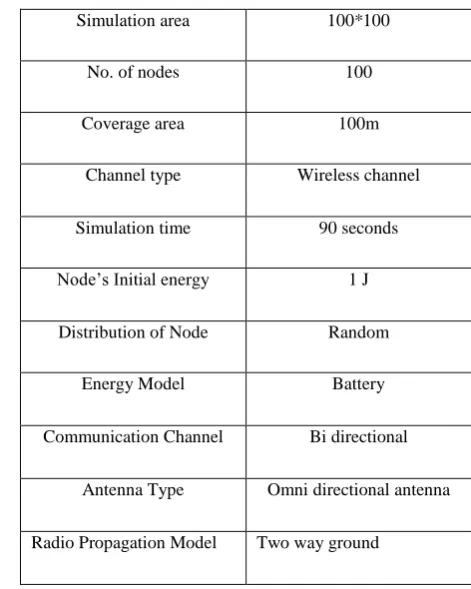
[image:3.595.294.530.88.383.2]To conduct the experiments on LEACH and LEACH-C protocol, we have used a sensor field of 100 nodes which are randomly distributed between (x=0, y=0) and (x=100, y=100). Fig.1. depicts our proposed sensor field. The BS is located at (x=50, y=50) in a 100m*100*m field. The channel bandwidth is set to 1Mb/s and message length is considered as 500 bytes long with the header length 25 bytes. The initial energy of each node starts with 1 joule. The optimum number of clusters used in our simulations is 4. The duration of each round is 10s. We have run the simulations for 100s. The simulation parameters are given in Table 2.
Table 2. Simulation Parameters
Simulation area 100*100
No. of nodes 100
Coverage area 100m
Channel type Wireless channel
Simulation time 90 seconds
Node’s Initial energy 1 J
Distribution of Node Random
Energy Model Battery
Communication Channel Bi directional
Antenna Type Omni directional antenna
Radio Propagation Model Two way ground
4.2
Results and Discussion
In order to clearly analyse and understand the properties of LEACH and LEACH-C protocol, we have focused on some performance metrics which are measured by NetSim Simulator. In our experiments, first, we attempt to see the total number of data packets delivered to BS over some period of time. Second, we tried to find the time period over which the first node dies because the lifetime of the whole network depends on the lifetime of each sensor node. Third, we have emphasized on total number of alive nodes to check how much duration they can survive in a sensor field w.r.t time and no. of rounds. Finally, we have changed the location of BS to see the effect on the lifetime of the network. Results obtained from the simulations based on our parameters of interest are plotted from Fig. 2 to Fig. 10 successively.
4.3
Performance Metrics
4.3.1. Total no. of data signals delivered at BS over
time
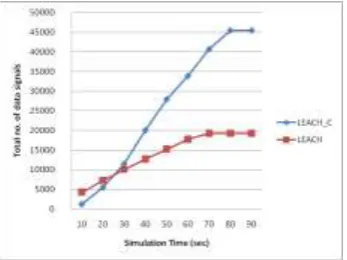
Figure 2 shows that LEACH-C delivers 40% more data signals to the BS than LEACH with the increasing simulation time. This is because LEACH-C has global knowledge about the network topology. BS knows the location and energy of each node in the network. So, BS can form good no. of clusters.
4.3.2. Average energy dissipation over time
[image:3.595.55.287.589.721.2]4.3.3. First node dies over time
We have considered first node dies as one of the parameter for simulation as the whole lifetime of network relies on each sensor node’s lifetime. Figure 4 conveys the message that in LEACH, first node dies fast compared to LEACH-C. The reason is same as Fig.2. Due to the lack of topology information and non-uniform cluster formation might force the first node to exhaust more battery power.
4.3.4. No. of alive nodes over different rounds
Figure 5 shows the comparison results of no. of nodes alive with respect to the number of rounds. It has been observed that LEACH-C is more stable than LEACH and it survives for longer period of time.4.3.5. No. of alive nodes over time
Figure 6 shows that no. of alive nodes decreases fast in LEACH compared LEACH-C reasoning the same that uneven distribution and undesired no. of cluster heads might be formed in LEACH.
4.3.6. No. of Packets transmitted and Packet
delivery ratio
Figure7 and Figure 8 proofs that total no. of packets transmitted is more in LEACH-C than LEACH and LEACH-C is efficient than LEACH in terms of packet delivery ratio.
4.3.7. Location of BS v/s average energy dissipation
It is observed from the Figure 9 that BS location has significant effect on the total energy dissipation. As BS moves farther, the distance between the node and BS increases and cluster head consumes more energy to deliver the message to BS. When BS moves nearer to cluster head, the CH dissipates less energy to deliver the message.4.3.8. Location of BS v/s Lifetime of network
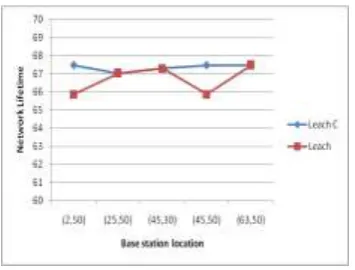
[image:4.595.331.517.65.528.2]Figure 10 briefs that BS location also effect network lifetime. When BS moves from one location to other, there is an increase or decrease of life time in an uneven manner. This concludes that BS location also influence the lifetime of the network.
Figure 2: Total no. of data signals delivered at BS over time
Figure 3: Average energy dissipation over time
[image:4.595.340.514.72.204.2]Figure 4: First node dies over time
Figure 5: Total no. of alive nodes at different rounds
[image:4.595.85.259.486.616.2] [image:4.595.337.514.551.683.2]Figure 7:No. of Packets transmitted overtime
[image:5.595.83.259.71.202.2]Figure 8: Packet delivery ratio over time
Figure 9: Impact of BS location over total energy dissipation
Figure 10: Impact of BS location over Network Lifetime
5.
CONCLUSION
This paper presents an in depth analysis about two clustering
lifetime by balancing the load at each node. Clustering based routing protocol is one such example. LEACH is considered as one of the first distributed cluster formation protocol. This protocol does not provide any guarantee about the placements of CHs and number of CHs. As the cluster formations are adaptive, and poor set up phase in a given round does not greatly influence the overall performance of the network. In the other hand, LEACH-C uses a centralized algorithm to produce the clusters by distributing the CHs uniformly throughout the network in set up phase. Steady state phase of LEACH-C is identical to LEACH protocol. A brief taxonomy of these protocols has been presented in this paper. For simulation and analysis, NetSim simulator has been used. Our simulation result well agrees that LEACH-C performs better than LEACH. But, due to the limitations of the simulator, the scalability issue could not be handled, which is under progress.
6.
FUTURE WORK
In this paper, attempt has been made to analyse deeply two existing energy efficient routing protocols using NetSim Simulator as these protocols stand as the pillar for supporting new energy efficient protocols. As LEACH is the concrete distributed protocol and LEACH-C is built up with centralized architecture, our future work includes to develop a new routing protocol by considering the above discussed performance parameters, which could be more efficient then LEACH & LEACH-C protocol
7.
REFERENCES
[1] Amis, R. Prakash, T. Vuong, and D. Huynh, “Max-Min D-Cluster Formation in Wireless Ad Hoc Networks,” IEEE INFOCOM, March 2000.
[2] B. Deosarkar, N. Yaday, and R. P. Yadav, “Clusterhead selection in clustering algorithms for wireless sensor networks: a survey,” in Proceedings of the International Conference on Computing, Communication and Networking, Tamilnadu, India, December 2008.
[3] C. Intanagonwiwat, R. Govindan, D. Estrin, Directed diffusion: a scalable and robust communication paradigm for sensor networks, in: Proceedings of the 6th Annual ACM/IEEE International Conference on Mobile Computing and Networking (MobiCom_00), Boston, MA, August 2000.
[4] D. Estrin et al., Next century challenges: scalable coordination in sensor networks, in: Proceedings of the 5th annual ACM/IEEE International Conference on Mobile Computing and Networking (MobiCom_99), Seattle, WA, August 1999.
[5] D.J. Baker, A. Ephremides, J.A. Flynn, The design and simulation of a mobile radio network with distributed control, IEEE Journal on Selected Areas in Communications (1984) 226–237.
[6] D.J. Baker, A. Ephremides, The architectural organization of a mobile radio network via a distributed algorithm, IEEE Transactions on Communications, COM-29 (11) (1981) 1694– 1701.
[image:5.595.83.261.547.682.2]Comparison of LEACH & LEACH-C Protocols Using NS2” Procedia Technology 4 (2012) 163 – 170.
[9] Guangyan Huang, Xiaowei L, and Jing He. Dynamic Minimal Spanning Tree Routing Protocol for Large Wireless Sensor Networks. 0-7803-9514-X/06 IEEE ICIEA 2006
[10] I.F. Akyildiz et al., Wireless sensor networks: a survey,computer Networks 38 (2002) 393-422
[11] H. Wang, et al., Target classification and localization in habitat monitoring, in: Proceeding of IEEE international conference on Acoustics, Speech, and signal Processing (ICASSP 2003), Hong Kong China. April 2003
[12] K. Khamforoosh and H. Khamforoush, “A new routing algorithm for energy reduction in wireless sensor networks,” in Proceedings of the 2nd IEEE International Conference on Computer Science and Information Technology (ICCSIT ’09), pp. 505–509, August 2009.
[13] L. Yu, N. Wang, W. Zhang, and C. Zheng, GROUP: A Grid-Clustering Routing Protocol for Wireless Sensor Networks, East China Normal University.
[14] M. B. Yassein, A. Al-zou’bi, Y. Khamayseh, and W. Mardini, “Improvement on LEACH protocol of wireless sensor network,” Journal of Digital Content Technology and Its Applications, vol. 3, no. 2, pp. 260–264, 2009.
[15] M. Bani Hani and Abdalraheem A. Ijjeh “A Survey on LEACH-Based Energy Aware Protocols for Wireless Sensor Networks” Journal of Communications Vol. 8, No. 3, March 2013
[16] M. Ye, C. Li, G. Chen, and J. Wu, EECS: An Energy Efficient Clustering Scheme in Wireless Sensor Networks, National Laboratory of Novel Softaware Technology, NanjingUniversity,China.
[17] M. Ettus, “System capacity, latency, and power consumption in multihop-routed SS-CDMA wireless networks,”in Proc. Radio and Wireless Conf. (RAWCON), Colorado Springs, CO, Aug. 1998, pp. 55–58.
[18] P. Tsigas, “Project on Moblie Ad Hoc Networking and Clustering for the Course EDA390 Computer Communication and Distributed Systems,” Manual for University Course.
[19] R. Shah, J. Rabaey, Energy aware routing for low energy ad hoc sensor networks, in: Proceedings of the IEEE Wireless Communications and Networking Conference (WCNC), Orlando, FL, March 2002.
[20] S. Lindsey and C. S. Raghavendra, PEGASIS: Power-Efficient Gathering in Sensor Information Networks, Computer sy stems Research Department, the Aerospace Corporation.
[21] Siva D. Murugunathan, Daniel C. F. MA, Rolly I. Bhasin, abraham O. Fapojuwo. A Centralized Energy- Efficient Routing Protocol for Wireless Sensor Networks. 0163-6804/05, IEEE Radio Communications, March 2005
[22] V. Loscri, G. Morabito, and S. Marano, A Two-Level Hierarchy for Low- Energy Adaptive Clustering Hierarchy, DEIS department, University of Calabria.
[23] W. Heinzelman, J. Kulik, H. Balakrishnan, Adaptive protocols for information dissemination in wireless sensor networks, in: Proceedings of the 5th Annual ACM/IEEE International Conference on Mobile Computing and Networking (MobiCom_99), Seattle, WA, August 1999.
[24] W. Heinzelman. Application-Specific Protocol Architectures for Wireless Networks. Ph.D Thesis, Massachusetts Institute of Technology, June2000.
[25] W. R. Heinzelman, A. Chandrakasan and H. Balakrishnan,“An application-specific protocol architecture for wireless microsensor networks,” in IEEE Transactions on Wireless Communications, Oct. 2002, pp. 660 – 670
[26] W. R. Heinzelman, A. Chandrakasan, and H. Balakrishnan, “Energy- Efficient communication Protocol for Wireless Sensor Networks,” Proceedings of the 33th Hawaii International Conference on System Sciences (HICSS), 2000.
[27] X. H. Wu and S. Wang, "Performance comparison of LEACH and LEACH-C protocols by NS2," in Proc. 9th International Symposium on Distributed Computing and Applications to Business, Engineering and Science. Hong Kong, China, 2010, pp. 254-258.