BIROn - Birkbeck Institutional Research Online
Liu, J. and Zhou, L. and Dong, F. and Hudson-Edwards, Karen A. (2017)
Enhancing As(V) adsorption and passivation using biologically formed
nano-sized FeS coatings on limestone:
implications for acid mine drainage
treatment and neutralization. Chemosphere 168 , pp. 529-538. ISSN
0045-6535.
Downloaded from:
Usage Guidelines:
Please refer to usage guidelines at or alternatively
1
Enhancing As(V) adsorption and passivation using biologically formed
nano-sized FeS coatings on limestone: Implications for acid mine drainage
treat-ment and neutralization
Jing Liu1, Lei Zhou1, Faqin Dong1 and Karen A. Hudson-Edwards2*
1
The Key Laboratory of Solid Waste Treatment and Resource Recycle, Ministry of Education, Southwest
University of Science and Technology, Mianyang, 621010 China.
2
Department of Earth and Planetary Sciences, Birkbeck, University of London, Malet St., London WC1E
7HX, UK. *Corresponding author. Email: [email protected]. Tel: +44-(0)203-073-8030
Submitted to: Chemosphere
Manuscript number: CHEM41980
Date of submission of revised version: 13 October 2016
Keywords: Fe-reducing bacteria, sulfate-reducing bacteria, sorption;
2
AbstractThe iron-reducing bacterium Acidiphilium cryputum JF-5 and a sulfate reducing bacterium (SRB)
collect-ed and purificollect-ed from the mine drainage of a copper mine in the northwest of Sichuan Province, China,
were used to biologically synthesize nano-sized FeS-coated limestone to remove As(V) from solution. The
adsorption efficiency of As(V) is improved from 6.64 μg/g with limestone alone to 187 μg/g with the FeS
coated limestone in both batch and column experiments. The hydraulic conductivity of the columns are
also improved by the presence of the nano-sized FeS coatings, but the solution neutralization performance
of the limestone can be reduced by passivation by gypsum and Fe(III) precipitates. Calculations for
FeS-coated limestone dissolution experiments show that the process can be described as nCa.sol=At 1/2
-nCa,gyp.
The results suggest that FeS-coated limestone may be an effective medium for remediating As(V)-bearing
3
1. IntroductionNano-sized FeS materials offer great potential for removing contaminants due to their superior adsorption
performance compared to other minerals (Gong et al., 2016). These reactive FeS materials can be used for
treating various contaminants, especially redox-sensitive elements such as arsenic, uranium and
chromi-um. Nano-sized FeS materials not only serve as effective adsorbents, but also as reductants, and they
re-move the contaminants from waters mainly via chemical adsorption and reductive precipitation.
Permeable reactive barrier (PRB) technology is a widely practiced remediation scheme which treats
contaminated groundwater with a permeable wall. Limestone is the most common filling material of PRB,
and is used for remediating acid mine drainage (AMD) due to its neutralization ability and low cost
(Cravotta and Trahan, 1999; Soler et al., 2008; Liu et al., 2013). However, two potentially negative
geo-chemical issues determine the service time of limestone-filled PRBs. The first relates to the performance
of the system. The potential for contaminant adsorption on limestone on contaminants commonly is lower
than on other adsorbents such as zero valent iron (Manning et al, 2002, Kanni et al. 2005,Richard et al.
2009, Wilkin et al. 2009) and oxyhydroxysulfate minerals such as schwertmannite. Davis et al. (2007), for
example, showed that the adsorption capacity of limestone on As(V) is 0.01 mg/g below pH 8. Kanel et al.
(2005) investigated As(III) sorption on zero valent iron at pH 7, and estimated the maximum adsorption
capacity to be 3.5 mg/g, whereas Carlson et al. (2002) and Song et al. (2015) both reported maximum
ad-sorption capacities of As(V) on schwertmannite up to 175-183 mg/kg. To improve the adad-sorption
perfor-mance, the technology of surface modification has been used. This involves coating the limestone with
metal-bearing phases to increase the surface area and improve adsorption. Common coatings used are iron
and aluminium hydroxides (Liu et al., 2014b; Henke, 2009). The adsorption of As(V) by aluminium
hy-droxide coated limestone has been shown to be 0.15 mg/g, which is a significant improvement over the
limestone alone (6.6-10.0 µg/g; Liu et al., 2013; Davis et al., 2007; Ohki et al., 1996; Hossain and Islam,
2008).
The second geochemical issue is the passivation of limestone due to the formation of secondary
min-erals, such as iron hydroxide (Fe(OH)3) and gypsum (CaSO4·2H2O; Soler et al., 2008; Hammack et al.,
1994). To prevent this, a reducing layer can be inserted in front of the limestone-filled PRB. This will
re-duce Fe3+(aq) in AMD to Fe 2+
sys-4
tem. This passive treatment is commonly called a reducing and alkalinity producing system (RAPS), and it
was previously known as a successive alkalinity producing system (SAPS; Lottermoser, 2010). The
reduc-ing layer used is often naturally-occurrreduc-ing organic materials such as mushroom compost Lee et al., 2010)
and pea manure (Khan Eusuf Zai et al., 2010). These materials improve the quantity of effluent water and
extend the longevity of the PRB, but it is necessary to replace the organic layer monthly or yearly
depend-ing on the water chemistry and permeability (Robb and Robinson, 1995; Newcombe and Brennan, 2010)
and allow a longer retention time due to bacterial reduction (Lottermoser, 2010).
In view of above two issues, a novel biologically-formed FeS-coated limestone was investigated for
this study. The nano-sized FeS coating is produced using both Fe-reducing and sulfate-reducing bacteria
(Acidiphilium cryptum JF-5 and Desulfovibrio vlugaris miyazaki SRB, respectively), both of which are
common bacteria in AMD Lee et al., 2010; Johnson and Hallberg, 2003). Acidiphilium cryptum JF-5 can
reduce Fe3+ into Fe2+ via an enzyme catalyzed reaction, as follows (Küsel et al., 1999):
C6H12O6 + 24 Fe 3+
+ 24 OH- →6 CO2 + 24 Fe 2+
+ 18H2O (1)
Sulfate reducing bacteria reduce SO4
2-, which is the most common anion in AMD that forms as a product
of the oxidation of pyrite (FeS2). The process can be described as follow:
C6H12O2 + 3 H2SO4 → 6 CO2 + 6 H2O + 3 H2S (2)
Thus, biologically formed FeS precipitates can be formed by these two bacteria. The probable chemical
reaction is:
m Fe2+ + n S2- → FemSn (3)
Previous research suggests that inorganically-synthesized FeS and FeS-coated sand are likely to
im-prove the performance of limestone-filled PRB systems (Han et al., 2011; Jeong et al., 2011; Renock et al.,
perfor-5
mance, as SRB has been shown to result in the removal of metals such as Zn from low pH (3.8 to 4.2)
mine waste waters and in the formation of sulfides (Kimura et al., 2006). JF-5 and SRB both survive well
in acid environments such as AMD, which is a common type of inlet water that enters limestone-bearing
PRBs (Wilmoth, 1974). In addition, Fe3+ is a common dissolved ion in AMD and when it precipitates as
ferric sulfate precipitates and hydroxides (e.g., schwertmannite, ferrihydrite) the resultant phases can
cause clogging of the PRB (Liu et al, 2013; Wang et al., 2014).
Natural and synthetic iron sulfide minerals have been used for immobilizing and capturing arsenic
(Renock et al., 2009; Gallegos et al., 2007; Parkman et al., 1999). Renock et al. (2009) synthesized abiotic
nanoparticles of FemSn and mixed these with As(III) in anoxic solutions at pH 5 and 9. They found that the
uptake of arsenic in FemSn resulted in the oxidation of the As-bearing FenSm to As-bearing greigite (Fe3S4),
a precursor to pyrite. Mackinawite (FeS), which is inorganically prepared and is used to remove arsenic in
groundwater, reduces As(III) into zero-valent arsenic As(0), surface clusters and a realgar (AsS)-like
pre-cipitate (Hayes et al., 2009). FeS has also been synthesized by reacting Fe(II) with sulfate produced during
biotic sulfate reduction, and this has been shown to be a feasible scheme for the remediation of AMD
(Hayes et al., 2009; Zagury et al., 2006; Luptakova and Kusnierova, 2005). In addition, FeS-based
sys-tems may have better hydraulic conductivity than syssys-tems using zero valent iron (Henderson and Demond,
2013).
However, the potential importance of biotic FeS synthesized using JF-5 and SRB on the performance of
limestone-bearing PRBs has not been systematically explored. Such knowledge would benefit the
con-struction of in situ biotic PRB systems if the two types of bacteria can be made to flow through the
lime-stone barrier. However, the adsorption capacity of biologically formed FeS on limelime-stone and its
neutraliza-tion ability need to be determined in the laboratory prior to a field trial. In this paper we report on the
ca-pacity of biologically formed FeS-coated limestone and pristine limestone for the adsorption of As(V) and
the effects of FeS passivation on neutralization using batch and column experiments. Additionally, the
ef-fect of the biologically-formed FeS coating on hydraulic conductivity was investigated. This
understand-ing is essential for the future design and application of in situ biologic PRB (ISB-PRB).
6
2.1 Limestone collection and bacteria cultureLimestone was collected from the strata of the Permian Jialingjiang Formation in Sichuan province,
China. The limestone is uniform and micritic. XRD analysis shows that it is composed solely of calcite,
with no impurities were discovered at the limit of detection. XRF analysis shows that its chemical
compo-sition is Mg0.1Ca0.9CO3.
Acidiphilium cryputum JF-5 is a common iron-reducing bacterium, which was firstly found by Kirsten
Küsel. JF-5 grows well in solutions of pH 2.1 to 5.8, which are typical of AMD (Nordstrom, 2011).
Aci-diphilium cryputum JF-5 was kindly provided by Kirsten Küsel of Friedrich Schiller University Jena. The
Acidiphilium cryptum JF-5 were cultured in 1000 mL of culture media known to be favourable for its
growth (Küsel, pers comm., 2015). This media contains 917 mL Tryptone soya broth (Fe-TSB) (0.5 g per
1000 mL), 10 mL glucose (18.016 g per 1000 mL), 70 mL ferric sulfate solution (19.995 g per 1000 mL),
1 mL vitamin solution (100 mg vitamin B12, 80 mg P- amino acid, 20 mg D- biotin, 200 mg niacin, 100
mg Ca-D- Pantothenate, 200 mg aneurin hydrochloride and 300 mg Pyridoxal chloropyramine
hydrochlo-ride per 1000 mL, respectively), and 1 mL of a mixed solution of tungstate and selenite (0.5 g NaOH, 3
mg Na2SeO3 5·H2O and 4 mg Na2WO4·2 H2O per 1000 mL, respectively). All of these solutions were
ster-ilized under an ultraviolet lamp.
Sulfate reducing bacteria were collected and purified from the mine drainage of a copper mine in the
northwest of Sichuan Province, China. The SRB were enriched and cultivated based on Deutsche
Sammlung von Mikroorganismen und Zellkulturen specifications (DSMZ-63) GmbH (German collection
of microorganisms and cell cultures) (http://www.dsmz.de/microorganisms). The culture solution is
com-posed of three sub-solutions (A, B and C). Solution A was prepared by dissolving 0.5 g K2HPO4, 1 g
Na2SO4, 2 g CaCl2·2H2O, 2 g MgSO4·7H2O, 2 g DL-Na-lactate, 1 g yeast extract and 1 g Resazurin in 980
mL ultra-pure water. Solution B was prepared by dissolving 0.5g FeSO4·7H2O in 10 mL ultra-pure water.
Solution C was prepared by mixing 0.1 g ascorbic acid and 10 mL ultra-pure water. Solution A was boiled
for several minutes, and then pure N2 was injected while cooling the solution to room temperature.
Solu-tions A and B were then added to solution C and the pH was adjusted to 7.8. The mixed solution was taken
up into a 150 mL inoculation bottle until it become gray-white in colour. The bottle was then sealed and
7
syringe into the mixed solution for inoculation in an anaerobic glove box. The bacteria were cultured for
3-7 days. The culturing of the SRB was considered complete when the solution gave off a rotten egg
(hy-drogen sulfide) smell.
2.2 Generation and evaluation of the FeS coating
The reaction time of JF-5 and SRB and ratios of these two bacteria cultures are the main factors
con-trolling the quantity of FeS coating. To optimize these factors trial experiments were carried out varying
the contact time and ratios of bacteria. 0.5 g of limestone was added to each of three 20 mL crimp top
vi-als. 0.25, 0.5 and 1 mL of culture media with JF-5 was added to the three vials, respectively. An excess of
reduced forms of sulfur (S2- or others) was maintained relative to the amount of reduced iron (Fe2+). In
other words, the SRB was used to completely reduce S6+ (from sulfate) in solution, and different quantities
of FeS on limestone were synthesized by respectively adjusting the amount of JF-5 bacteria added and the
ageing time. The specific steps are as follow: a constant volume of 18 mL of SRB-generated solution was
added to the above three screw cap vials. Afterwards, the vials were placed in an anaerobic glove box to
remove O2 in the vials. The vials were sealed with film, shaken by hand several times, and stored for 3
days (T1; 0.25 mL JF-5 bacteria), 7 days (T2; 0.5 mL JF-5 bacteria) and 7 days (T3; 1 mL JF-5 bacteria),
respectively. These three groups of experiments thus represent different ratios of JF5 to SRB and different
ageing times, which we regard to be the most important factors determining the performance of FeS in
PRB systems. All experiments were carried out in duplicate. The standard deviation from each group of
parallel experiment is between 5% and 8%. The resulting supernatants were passed through 0.45 µm
fil-ters and analysed for Fe2+ and total Fe using the phenanthroline spectrophotometric method (Lenore et al.,
1989). The residual FeS coated limestone was digested with 1M HCl and analysed for Fe2+ and total Fe. A
parallel blank experiment was also carried out to determine the trace concentration of Fe in the HCl.
2.3 As(V) adsorption comparison of pristine limestone and biologically formed FeS coated limestone
2.3.1 Batch adsorption experiments
The preliminary experiments described above informed the development of corresponding batch
bac-8
terial solutions ratios which produced the most FeS (1 mL JF-5 and 18 mL SRB) were poured into the
vi-als and different quantities of As(V)-bearing stock solutions (0.1, 0.5, 2.5, 10, 25 and 50 mg/L) were
in-jected in the vials using a pipette. These As(V) stock solutions were prepared from a 1 g/L As(V) stock
solution, which in turn was generated by dissolving 4.1644 g sodium arsenate heptahydrate
(Na2HAsO4·7H2O, Alfa Aesar company) in ultra-pure water. The initial pH values of the 0.1, 0.5, 2.5, 10,
25 and 50 mg/L As(V) stock solutions were adjusted to 2 using 10% v/v HCl.
To investigate the effect of different loads of the biologically-formed FeS on As(V) adsorption, two
groups of suspension solutions were kept for 3 and 7 days in an anaerobic glove box, and these were
la-beled C1 and C2, respectively. Subsequently, the supernatants were passed through 0.45 μm filters, and the
residual total As in solution was measured by ICP-OES (iCAP6500 ThermoFisher) to estimate the amount
of adsorbed As(V). We appreciate that ICP-OES is not capable of measuring the concentrations of
differ-ent As species, and reduction of the As(V) to As(III) by the FeS may have occurred during these and our
other experiments. We have not measured the speciation of As in the As-sorbed FeS. Therefore, we refer
to the post-sorption experiment As as As only, and the pre-experiment As as As(V). All batch experiments
with the biologically-formed FeS coatings were carried out in duplicate, and the corresponding standard
deviation is shown as error bars in the figures below. Parallel As(V) sorption experiments were also
per-formed with pristine limestone as a control, and these were labelled C0.
2.3.2 Column adsorption experiments
To comprehensively evaluate the practicality of treating acidic As-containing waste water with
biologi-cally formed nano-sized FeS coatings on limestone, column experiments were carried out. The inside
di-ameter and height of the Plexiglas column were 8.9 and 39.9 cm, respectively. Both ends of the column
were covered with nylon netting to avoid the loss of limestone particles. Two water pressures sensors were
set on the side of column and connected to a data logger (Campbell Scientific Company, USA) and a
computer to record the water pressure and voltage change. The exported voltage was measured using the
Loggernet software provided with the data logger, and using the relation between the exported voltage and
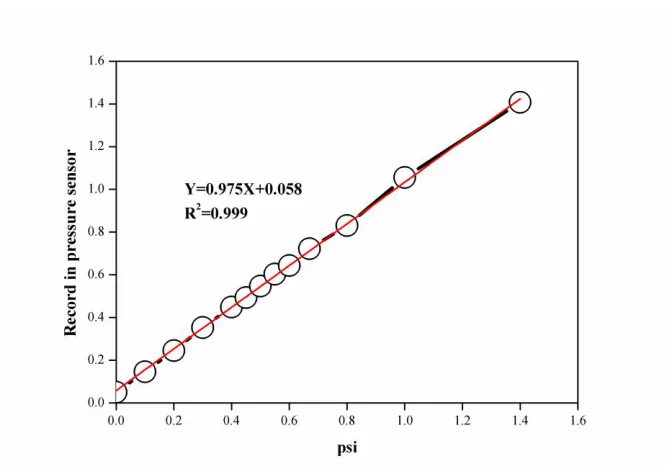
standard mercury pressure gauge, which has a strong linear relation (R2=0.999) (Supplementary material).
9
of Y=0.975X+0.058. As these coefficients are implanted in the Loggernet software, the final water
pres-sure can be directly recorded. The columns were filled with coarser-grained limestone (more than 10
mesh) than that used in the batch experiments, to allow observation of the developing hydraulic
conduc-tivity and to avoid leakages. The total mass of limestone added to each column was 2.35 kg, the average
corresponding pore volume was 750 mL, the column porosity is 43.8% and the linear velocity is 1.0 cm/h.
The pore volume of the column was measured by quantifying the volume of water required to saturate the
limestone-filled column. A peristaltic pump maintained a constant flow rate of 50 mL/h. The solutions
were passed from the bottom to the top of the column to reduce the effects of bubbles produced from the
dissolution of limestone on the flow rate. 100 mL effluent samples were collected using a fraction
collec-tor. The in situ biological FeS coating process was carried out after the limestone grains were packed in
the columns. Firstly, 700 mL of the prepared SRB bacteria solution was passed through the
limestone-filled column at a constant flow rate of 50 mL/h, and then 500 mL of the JF-5 bacteria solution was
flowed through the column at the same flow rate. The system was then aged for 6 days, during which time
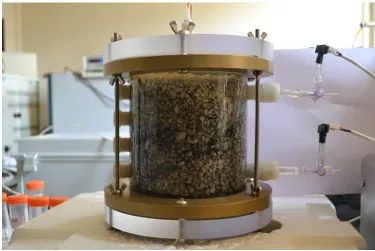
black precipitates slowly formed (Fig. 1). This in situ coating process is regarded to be more practical than
using a batch experiment, and to have more potential use in PRB technologies.
The chemical compositions of the solutions used in the column adsorption experiments is 0.5 mg/L
As(V) (assumed to be typical of average AMD waters) and 51.6 mg/L SO4
2-, and these were generated
from Na2HAsO4·7H2O and Na2SO4. We appreciate that this sulfate concentration is lower than that
typi-cally found in AMD waters (usually 100 to 10,000 mg/L; Nordstrom, 2011), but the sulfate in our
experi-ments was used as a sulfur source for the SRB, rather than to simulate AMD. The initial pH of solution
was set to 2 using HCl (10% v/v). The pH of the effluent samples was measured with a pH meter
(Sartori-us Germany PB 21), and these samples were filtered through a 0.45 μm membrane and analyzed for As
and Fe by ICP-OES (iCAP6500 ThermoFisher). The column experiment samples were labelled with the
prefix C1 (JF5+SRB). To further understand the difference in performances of FeS coatings produced by
different combinations of the bacteria, an additional group of column experiments using only 700 mL SRB
solution and 500 mL Fe(II) solution (equivalent to the total mass of iron in C1 based on calculation of the
bacterial culture) were carried out using the same flow sequence. These samples were labelled with the
10
and this was labelled C0.
Fig. 1. Black FeS coatings formed in situ on limestone in column experiments. The FeS in the photo
was generated by successively injecting SRB and JF-5 bacterial solutions and ageing the mixture for 6
days.
2.4 Neutralization evaluation
10 g limestone was added to each of two 50 mL centrifugal test tubes. 5 mL of the JF-5 culture media and
50 mL of the SRB culture media were added to these test tubes. The tubes were aged for 3 and 7 days,
re-spectively, based on previous trial and batch experiments, as these times resulted in the production of
suf-ficient biologically formed FeS coatings (approximately 2.1 mg Fe per g limestone) for subsequent work.
When the coating process was complete, the supernatant solution was removed by vacuum filtration and
the solid mixture, comprising the FeS-coated limestone and suspended FeS particles, was taken up into a
glass reactor. 1000 mL of ultra-pure water (18 MΩ Millipore), to which NaNO3 up to a concentration of
0.01 M was added to create a background electrolyte, was transferred into the reactor. The pH of this
solu-tion was adjusted to 2 using dilute H2SO4 to create a synthetic acid solution. The dynamic pH variation of
[image:11.595.115.490.111.362.2](Met-11
ter Toledo T50). The agitation rate was 250 rotations/min and the temperature was controlled at 25℃. Five
mL samples of the suspension were collected at 10, 30, 60, 120, 180 and 240 min and passed through a
0.45 μm filter. Their Ca, Mg and Fe concentrations were analysed by ICP-OES to understand the
dissolu-tion of the FeS-coated limestone. The two groups of dissoludissolu-tion experiments were labeled with the prefix
C1 (3 days ageing) and C2 (7 days ageing), and these represent different degree of FeS-coating on
lime-stone. A control experiment using pristine limestone was also performed for 4 h and labeled C0.
2.5 Sample characterization
Arsenic-adsorbed FeS-coated limestone sample were collected immediately after the conclusion of the
batch experiments, and these were subjected to in situ infrared spectroscopy using an Attenuated Total
Reflection (ATR) Fourier Transform Infrared Spectroscopy (ATR-FTIR, Frontier) with a diamond ATR
accessory. Spectra ranging from 400 to 4000 cm-1 were obtained by co-addition of 64 scans with a
resolu-tion of 1 cm-1 and a mirror velocity of 0.6329 cm/s. SEM images of these nano-sized FeS particles were
obtained by field emission scanning electron microscopy (Zeiss Supra 55). In order to limit oxidation,
SEM images were obtained within 2 h after freeze-drying the samples under vacuum conditions for 24 h
(cf., Labconco, USA).
Fresh FeS particles were separated from the suspension solution by centrifugation at 10,000 rpm for 5
min (Eppendorf, Centrifuge 5804 R). The particles were washed with O2-free ultra-pure water, centrifuged
at same rate and then freeze-dried under vacuum conditions for 24 h (cf., Labconco, USA). Powder X-ray
diffraction (XRD) of the freeze-dried FeS particles was performed on a X’Pert PRO X-ray diffractometer
in 2θ mode using CuK radiation.
3. Results and Discussion
3.1 Evaluation of coating quantity
The mixture of the biologically formed, nano-sized FeS and limestone is termed FeS-coated limestone
in this study, due to difficulties in the accurate identification of individual FeS phases. Some of the FeS
particles do not coat the limestone, but rather are suspended in solution. The FeS-coated limestone general
12
(Sayama et al., 2002; Rashmi et al., 2014).The amount of FeS coating increases with increasing amounts of JF-5 used in the synthesis and
in-creased duration time of the experiments (Fig. 2). The Fe content in the solid increases by c. 20 times as
the addition of JF-5 increases from 0.25 mL to 0.5 mL and the duration time increases from 3 days (T1) to
5 days (T2). Between T2 and T3, however, the Fe content in the T3 solid contains only 3 times more Fe than
the T2 solid. The probable reasons for these variations are the limited Fe source and life cycle of JF-5. Our
preliminary study showed that JF-5 grew well when cultured for 5 days and experienced a plateau stage of
2 days based on the optical density and Fe(II) concentration measurement (Supplementary Material Fig.
S2). Artificial binding agents such as carboxymethyl cellulose and biopolymers could yield a greater
quan-tity of nano-sized FeS coatings on limestone and improve their stability Cravotta and Trahan, 1999; Gong,
2014; Gong et al., 2012).
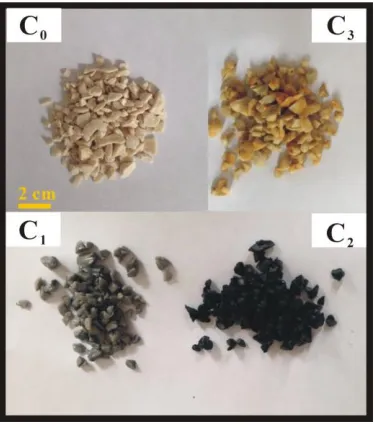
The different FeS-coated limestone samples are shown in Fig. 3. The pristine limestone is uniform and
composed of microcrystalline calcite. It is creamy yellow-colored, and is often called ‘bean curd jelly-like’
locally (C0 in Fig.3). The limestone becomes yellow due to Fe(III) precipitates formed during the
treat-ment of AMD. The FeS-coated limestone is black, and it darkens as the coating thickness increases (see C1
and C2 in Fig. 3, corresponding to T1 and T2). The size of the FeS particles varies between several 10s of
nm and 200 nm in diameter, and the shapes are blocky (Fig. 4). The molar ratio of Fe to S in these
precipi-tates is 2.84:1 based on EDX-SEM elemental analysis of five points on one sample (Fig. S3). Some
nano-size FeS particles attach to the JF-5 bacteria (Fig. 4), suggesting that the formation of these FeS particles
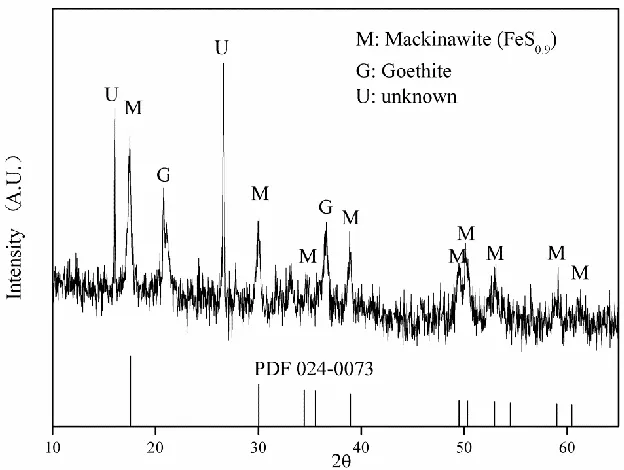
is related to the activity of JF-5. Most of the XRD diffraction peaks of the black FeS particles match those
of mackinawite (PDF024-0073) (Fig. S4). A goethite impurity is also evident, and is attributed to partial
oxidation of the FeS, and two peaks at 15-30º 2θ match those of (C14H6N20)n which is probably cause by
bacterial metabolic activity. In the column experiments, the black precipitates slowly form after injection
13
Fig. 2. Fe concentrations/contents in supernatant and limestone (mg/g) for T1 (0.25 Ml JF-5+18 Ml SRB,
3days), T2 (0.5 ml JF-5 +18 ml SRB, 5 days), T3 (1 mL JF-5 +18 mL SRB, 7 days).
Fig. 3. Photographs of biologically formed FeS-coated limestone. C0: pristine limestone; C1:
biologically-formed FeS coated limestone aged for 3 days; C2: biologically-biologically-formed FeS-coated limestone aged for 7
[image:14.595.206.393.323.537.2]14
[image:15.595.149.465.61.272.2]Fig. 4. SEM photomicrograph of nano-sized FeS particles and a JF-5 bacterium.
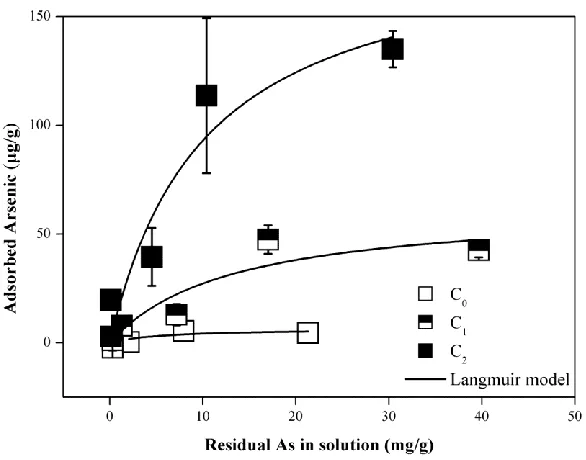
Fig. 5. Isothermal adsorption of pristine and FeS-coated limestone. Error bars represent the standard
devi-ation from the average of two parallel for each batch of biological FeS-coated limestone (C0: pristine
lime-stone, C1: 1 mL JF-5 + 18 mL SRB for 3 days, C2 JF-5 + 18 mL SRB for 7 days; initial pH 5.7).
3.2 Adsorption capacity of FeS-coated limestone
Based on our trial experiments to evaluate the quantity of the FeS coating on the limestone, the ratio of
[image:15.595.146.439.337.567.2]15
The coating times were set at 3 and 7 days, and these were labelled as C1 and C2, respectively.The
maxi-mum As(V) adsorption of pristine limestone is 6.64 μg/g (calculated by applying the Langmuir model to
the experimental data). This is close to the result of Davis et al. (2007), who reported a maximum
adsorp-tion of As(V) on limestone of 10 μg/g. Once the FeS coating had formed on the limestone for 3 days, its
maximum adsorption rapidly increased by 10 times the value of pristine limestone, to 62.9 μg/g (C1 in Fig.
5). The adsorption capacity further increased to 187 μg/g when the coating time was extended to 7 days
(C2 in Fig. 5). This increasing adsorption capacity is attributed to the presence of increased amounts of the
nano-sized FeS, which likely has a greater surface area and higher adsorption capacity than the limestone
alone. Our results are comparable with those of Han et al. (2011), who inorganically synthesized FeS
par-ticles on sand, with an average coating of 1.26 mg FeS / g sand (compared to our 2.14 mg FeS / g
lime-stone). Han et al. (2011) calculated the maximum capacity of coated sand for As(III) (not As(V), as used
initially in our experiments) to be 41.7 mg/g FeS at pH 5, but this value is determined by normalizing the
data to the amount of the FeS, not to the amount of sand, as we have done in an analogous manner with
our limestone. Recalculation of our results to align with those of Han et al. (2011) gives a value of 87.3
mg/g FeS, which is still double the value determined by these authors. The reasons for this discrepancy
may be our use of bacteria to generate the FeS, and the different arsenic species used in the two sets of
experiments.
3.3 Column transport and hydraulic gradient
Breakthrough curves not only describe the contaminant transport behavior in porous media, but also
re-flect the retention ability of the media for the contaminants. Breakthrough curve methodologies can help
to evaluate the adsorption performance of the filling material in column experiments better than in batch
experiments due to the controlled flow rate of the former, especially in large columns (e.g., with 2.35 kg of
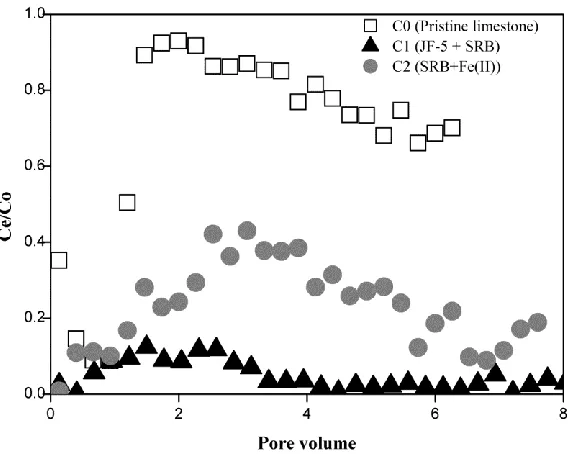
material in each column). Three breakthrough curves of As(V) in different conditions are shown in Fig. 6.
For pristine limestone, the concentration of As(V) in effluent at 2 pore volumes is closed to 0.5 mg/L,
which suggests that the column has lost its adsorption capacity. For columns whose FeS coatings were
generated with both JF-5 and SRB (C1 samples), the concentrations of As(V) in effluents at whole
meas-ured pore volumes (8) do not exceed 0.1 mg/L, showing the excellent treatment performance of these
re-16
duced S species generated by the SRB can directly precipitate with Fe(II) to form a FeS precipitate on the
limestone. The results show that the performance of the SRB-generated coatings (C2 samples) are inferior
to those generated by both JF5 and SRB (C1 samples) (Fig. 6). We do not know the reason for this
differ-ence in performance. The FeS particles were uniformly distributed on limestone throughout the column,
which further confirms that the potential application of in situ biotic PRB is feasible from an operational
point of view.
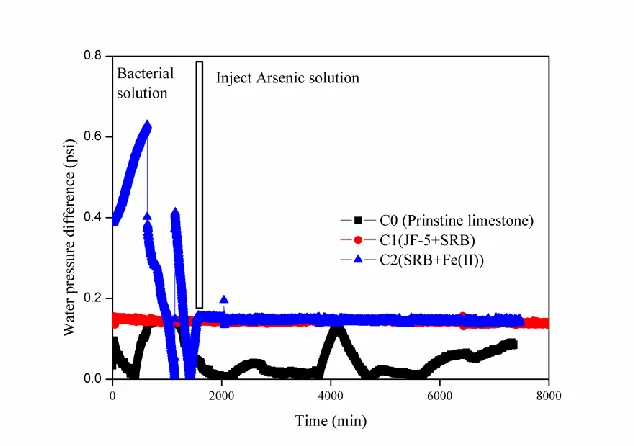
Hydraulic gradients also determine the service time of PRBs. Passivation of the limestone by
second-ary Fe hydroxides and gypsum is one of main factors resulting in decreases in hydraulic conductivity
(Soler et al., 2008; Hammarstrom et al., 2003). In this study, the hydraulic conductivity was assumed to be
equal to the difference of water pressure between the top and bottom sensors, and this is attributed to the
constant flowing volume for each column provide by the peristaltic pump. The hydraulic conductivity of
As(V) transport in the pristine limestone system was better than in the JF5+SRB or SRB-only systems
(Fig. 7). This is attributed to the lack of Fe-bearing precipitates in the pristine limestone column and the
dissolution of this limestone in the acidic (pH = 4) solutions. The FeS-coated limestone can maintain a
very stable hydraulic conductivity. The SRB+Fe(II) column experiment hydraulic conductivities fluctuate
considerably in the first stage (when the bacterial solution is injected), reaching values high as 0.70 psi,
and this is attributed to the formation of iron-bearing precipitate and to clogging by the bacteria. This rapid
clogging is not observed in the column experiments involving solutions from both JF-5 and SRB.
Com-pared to the rapid abiotic formation of FeS (C2), biologically formed FeS could be more uniformly
distrib-uted and require more time to form, and this may help to stabilize the hydraulic gradient.
Abiotically-formed FeS-coated limestone also shows stable hydraulic conductivity in the middle and later stages
(4000-7800 min), similar to that in the columns with JF-5 and SRB.
Good hydraulic conductivity can be attributed to lack of clogging by secondary phases in a PRB and
thus, can improve the long-term service life of the PRB. Pulse flushing and adding organic layers in front
of the limestone-filled PRB are methods used in the field to reduce the passivation of the limestone
(Cravotta and Trahan, 1999; Caraballo et al., 2009). Existing studies show that precipitation of iron and
sulfate ions results in clogging of PRBs (Soler et al., 2008; Liu et al., 2013; Caraballo et al., 2009; Booth
17
amount of Fe in the system and to the flow rate (Booth et al., 1997). In this study, JF-5 and SRB reduce
Fe3+ and SO4
2-, respectively2-, into reduced Fe and S species that form the FenSm, and this in turn prevents
the formation of Fe hydroxides and gypsum. Fe(II)-bearing compounds are more difficult to precipitate,
according to the Eh-pH diagram for the Fe-H2O system (Santomartino and Webb, 2007). Thus, JF-5
theo-retically results in the formation of aqueous Fe(II) species that precipitate with reduced S species to form
FeS particles, which in turn will benefit hydraulic conductivity. Our column experiments have confirmed
this assumption, but further laboratory studies on the hydraulic conductivity and removal performance in
the presence of Fe3+, SO4
and As(V) need to be carried out to fully elucidate the roles of these ions on
[image:18.595.152.438.314.541.2]PRB efficiency.
Fig. 6. As(V) breakthrough of As(V) in pristine limestone (C0) and biologically formed nano-size
18
Fig. 7. Hydraulic gradient of three groups of columns (pressure difference = absolute of difference of
pressure sensors in the top and bottom, 1 psi = 0.0689476 par).
3.4 Effect of nano sized FeS coating on neutralization capacity of limestone
High concentrations of Fe3+ and SO4
in AMD often result in the passivation of limestone-filled PRBs by
surface precipitates and secondary minerals such as Fe(OH)3 (ferric hydroxide) and CaSO4.2H2O
(gyp-sum). Such passivation directly affects the neutralization ability of a PRB. The variation of pH values of
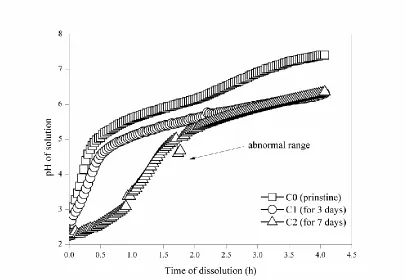
the C0, C1 and C2 solutions is given in Fig. 8. Pristine limestone has the highest neutralisation rate after
the first 0.5 h (likely due to the solution being far from saturation), but a pH plateau is experienced before
2 h. The release of Ca into solutions also slows (Fig. 9). The solution pH for C0 gently increases after 2 h
and reaches 7.4 (from the starting pH of 2.2). This rise is attributed to the hydrolysis of CO3 in solution.
Increases in the amount of biological nano-FeS results in slower rates of limestone neutralization over the
first 2 h (compare C1 and C2, Fig. 8). The passivation of limestone results in a final pH of 6.3 at the end of
the experiment (4 h), which is 1.1 pH lower than in the pristine limestone. This final pH value is nearly
same as that due to the hydrolysis of CO3 in solution, and this should be taken into account in related field
19
Fig. 8. Effect of biological nano-sized FeS coatings on the neutralization ability of AMD.
In experiment C2, the solution pH slightly decreased, from 5.01 to 4.74, between 1.69 h and 1.84 h.
This was not observed in experiments C0 and C1. The explanation for this is the oxidation of FeS coating
on limestone, which affects the pH solution. The probable chemical reaction is described as follows:
FeS + 5/2 O2 + H2O → FeOOH + SO4
+ 2 H+ (4)
This proposed reaction is supported the XRD data that suggests that FeS alters to goethite (Fig. S4), and
by the aqueous Fe concentrations, which rapidly decrease after 1 h (Fig. S5) while the solution pH is more
than 3.2, indicating that iron hydroxides likely begin to precipitate.
Fick’s First Law was used to develop a kinetic dissolution model for the limestone (reaction 5). The
concentrations of Ca ions along surface normal line of limestone (both pristine and coated limestone)
[image:20.595.90.496.63.343.2]20
(5)In reaction (5), J is the diffusive element flux of limestone per unit area during dissolution, D is the
mo-lecular diffusion coefficient, CB is the concentrations of Ca 2+
or H+ ions in the bulk solution and x is the
thickness of the FeS coating on the limestone surface. The variation in the thickness of the coating (x) is in
turn related to the total moles of Ca released from limestone (nCa.T), the proportion of gypsum (fgyp) (which
takes up released Ca), the porosity of the coating and of the secondary gypsum (φ), the uncoated area of
limestone (AR) and the molar volume of the coating (Vm). These relationships can be described by the
fol-lowing reaction, assuming that the surface area of limestone is constant and does not decrease by
dissolu-tion:
(6)
The flux of Ca2+ from the limestone surface is equal to the half of rate of release of H+ based on equation
(5) so that:
(7)
This relationship, and those in equations (5) and (6), can be combined to give an equation describing the
rate of Ca release:
21
This can be integrated to(9)
This equals:
(10)
Solving for nCa.T(t0=0, t=t) gives:
(11)
The constant A can be defined as:
(12)
This allows the total amount of Ca release from the limestone to be calculated as:
nCa.T=At 1/2
(13)
Because the total Ca involves into two parts (dissolved (nCa.sol) and precipitates (nCa.gyp)), equation (13) can
be modified to:
nCa.sol=At 1/2
22
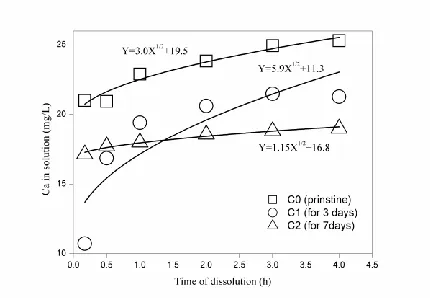
Therefore, the Ca in solution can be measured, the plot of nCa.sol and t 1/2
can be drawn and the
correspond-ing coatcorrespond-ing model can be built. The resultant dissolution model for pristine and FeS-coated limestone is
given in Fig. 9. All of the Ca dissolution data are described very well using this model, as the correlation
coefficient is more than 0.90. Based on the estimated nCa.gyp (19.5 for C0, 11.3 for C1 and 16.8 for C2), it is
suggested that a larger volume of secondary gypsum occur on the pristine limestone surfaces than on the
[image:23.595.191.406.217.366.2]FeS-coated limestone.
Fig. 9. Calcium release into solution during dissolution of pristine limestone (C0) and biologically
formed nano-size FeS-coated limestone (C1 and C2) and their kinetic model based on Fick’s diffusion law.
3.5 Mechanism of As removal by biologically formed nano-sized FeS-coated limestone
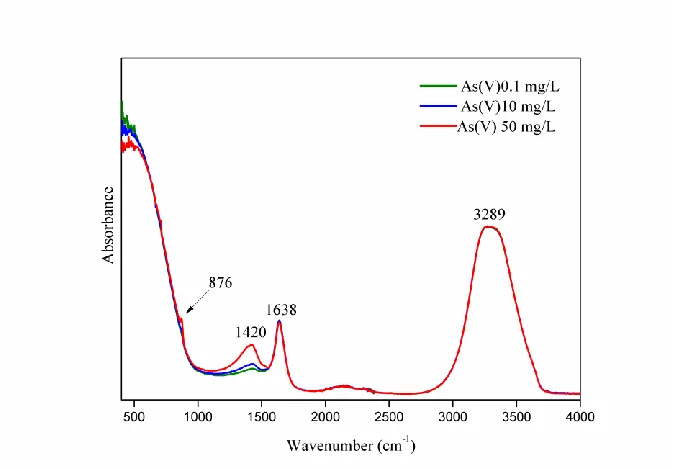
Attenuated total reflection Fourier-transformation infrared spectroscopy (FTIR) can be used investigate
molecular-level surface adsorption. Because the nano-sized FeS is easily oxidized, in situ ATR-FTIR of
adsorbed As(V) on FeS in supernatant was obtained within 1 h of the experiments (Fig. 10). A free AsO4
3-unit is tetrahedral, which has four fundamental vibrations (Nordstrom, 1997). These include the
non-degenerate symmetric stretching model ν1(A1) at 818 cm -1
, the doubly degenerate bending mode ν2 (E) at
350 cm-1, the triply degenerate antisymmetric stretching mode ν3 (F2) at 786 cm -1
and the triply
degener-ate antisymmetric bending mode ν4 (F2) at 405 cm -1
. Only one weak band at 876 cm-1 is observed in the
FTIR spectroscopy, however, and the intensity of this band increases with the initial As(V) concentrations
used in the experiment. The band is assigned to the symmetric stretching vibration of AsO43-, indicating
that chemical adsorption may be one of the removal mechanisms. The same position of the FTIR band was
ob-23
served (Fig. 9), and this is assigned to the ν3 vibration of CO3
2-. Vibrations at 1638 and 3289 cm -1
are
[image:24.595.129.467.112.346.2]at-tributed to the ν1 and ν2 vibrations of liquid water molecular, respectively.
Fig. 10. ATR-FTIR spectra of As(V)-adsorbed FeS-coated limestone for different As(V) initial
concentra-tions.
4. Conclusions
For the first time, JF-5 and SRB have been used to biologically synthesize nano-sized FeS-coated
lime-stone to remove As(V) from solution. Our major findings are that:
1) JF-5 and SRB can form nano-sized FeS. The quantity of this FeS coating increases with aging time, and
the highest amounts are achieved in seven days;
2) biologically formed nano-sized FeS coatings improve the adsorption performance of As(V) on
lime-stone. The maximum adsorption of As(V) is 187 μg/g compared to that for pristine limestone (6.64 μg/g).
Column experiments also shows nano-sized FeS coated limestone has better retention ability on As(V)
than limestone;
3) In situ, nano-sized FeS on limestone, formed by flowing JF-5 and SRB bacteria through columns,
ex-hibits more stable hydraulic conductivity than FeS formed by Fe(II) and SRB. Nano-sized FeS has a high
potential for improving the hydraulic conductivity of PRB systems, especially when influent waters
24
used as a novel alternative for the Successive Alkalinity Producing System;
4) adsorption and hydraulic conductivity are both improved by the nano-sized FeS coatings, but the
neu-tralization ability of the limestone can be reduced by passivation. Dynamic dissolution experiments show
that the neutral terminus of the biologically-formed nano-sized FeS coated limestone is 1.1 pH unit lower
than that of pristine limestone. The dissolution process of the FeS-coated limestone can be described by
the equation nCa.sol=At1/2-nCa,gyp;
5) infrared spectroscopy suggests that chemical adsorption may be one of the removal mechanisms of
As(V) by the biologically formed nano-sized FeS.
Acknowledgments
This study was supported by the National Natural Science Foundation of China (Grant 487 No.
41372051). We thank the two anonymous reviewers whose comments greatly helped to improve the
man-uscript.
References
An, B., Zhao, D., 2012. Immobilization of As(III) in soil and groundwater using a new class of
polysac-charide stabilized Fe–Mn oxide nanoparticles. J. Hazard. Mater. 211, 332-341.
Booth, J., Hong, Q., Compton, R.G., Prout, K., Payne, R.M., 1997. Gypsum overgrowths passivate calcite
to acid attack. J. Colloid Interf. Sci. 192, 207-214.
Carlson, L., Bigham, J.M., Schwertmann, U., Kyek, A., Wagner, F., 2002. Scavenging of As from acid
mine drainage by schwertmannite and ferrihydrite: a comparison with synthetic analogues. Environ.
Sci. Technol. 36, 1712-1719.
Caraballo, M.A., Rötting, T.S., Macías, F., Nieto, J.M., Ayora, C., 2009. Field multi-step limestone and
MgO passive system to treat acid mine drainage with high metal concentrations. Appl. Geochem. 24,
2301-2311.
Cravotta, C.A.III., Trahan, M.K., 1999. Limestone drains to increase pH and remove dissolved metals
from acidic mine drainage. Appl. Geochem. 14, 581-606.
25
limestone-based material. Miner. Eng. 59, 71.Gallegos, T.J., Hyun, S.P., Hayes, K.F., 2007. Spectroscopic investigation of the uptake of arsenite from
solution by synthetic mackinawite. Environ. Sci. Technol. 41, 7781-7786.
Goldberg, S., C.T. Johnston C.T., 2001. Mechanisms of arsenic adsorption on amorphous oxides evaluated
using macroscopic measurements, vibrational spectroscopy, and surface complexation modelling. J.
Colloid Interface Sci. 234, 204-216.
Gong, Y., 2014. Immobilization of mercury by carboxymethyl cellulose stabilized iron sulfide
nanoparti-cles: Reaction mechanisms and effects of stabilizer and water chemistry. Environ. Sci. Technol. 48(7),
3986-3994.
Gong, Y., Tang, J., Zhao, D., 2016. Application of iron sulfide particles for groundwater and soil
remedia-tion: a review. Water Res. 89, 309-320.
Gong, Y., Liu, Y., Xiong, Z., Kaback, D. Zhao, D., 2012. Immobilization of mercury in field soil and
sed-iment using carboxymethyl cellulose stabilized iron sulfide nanoparticles. Nanotechnology 23(29)
294-301.
Hammack, R., Edenborn, H., Dvorak, D., 1994. Treatment of water from an open-pit copper mine using
biogenic sulfide and limestone: a feasibility study. Water Res. 28, 2321-2329.
Hammarstrom, J.M., Sibrell, P.L., Belkin, H.E., 2003. Characterization of limestone reacted with
acid-mine drainage in a pulsed limestone bed treatment system at the Friendship Hill National Historical
Site, Pennsylvania, USA. Appl. Geochem. 18, 1705-1721.
Han, Y.-S., Gallegos, T.J., Demond, A.H., Hayes, K.F., 2011. FeS-coated sand for removal of arsenic (III)
under anaerobic conditions in permeable reactive barriers. Water Res. 45, 593-604.
Hayes, K.F., Adriaens, P., Demond, A.H., Olson, T., Abriola, L.M., 2009. Reduced Iron Sulfide Systems
for Removal of Heavy Metal Ions from Groundwater, DTIC Document.
Henderson, A.D., Demond, A.H., 2013. Permeability of iron sulfide (FeS)-based materials for
groundwa-ter remediation. Wagroundwa-ter Res. 47, 1267-1276.
Henke, K., 2009. Arsenic: Environmental Chemistry, Health Threats and Waste Treatment. John Wiley &
26
Hossain, M.S., Islam, M.R., 2008. Experimental and numerical modeling of arsenic transport in limestone.
Energy Sources Pt. A 30(13), 1189-1201.
Jeong, H.Y., Han, Y.-S., Park, S.W., Hayes, K.F., 2011. Aerobic oxidation of mackinawite (FeS) and its
environmental implication for arsenic mobilization. Geochim. Cosmochim. Acta 74, 3182-3198.
Johnson, D.B., Hallberg, K.B., 2003. The microbiology of acidic mine waters. Res. Microbiol. 154,
466-473.
Kanel, S.R., Manning, B., Charle, L., Choi, H., 2005. Removal of arsenic (III) from groundwater by
na-noscale zero-valent iron. Environ. Sci., Technol. 39(5), 1291-1298.
Khan Eusuf Zai, A., Horiuchi, Matsui, T., Meherunnesa, D., 2010. Residual effects of compost and green
manure of pea with other organic wastes on nutrient-use efficiency of successive rice after wheat.
Comm. Soil Sci. Plant Anal. 41, 2154-2169.
Kimura, S., Hallberg, K.B., Johnson, D.B., 2006. Sulfidogenesis in low pH (3.8-4.2) media by a mixed
population of acidophilic bacteria. Biodegradation 17, 159-167.
Köber, R., Welter, E., Ebert, M., Dahmke,A., 2005. Removal of arsenic from groundwater by zerovalent
iron and the role of sulfide. Environ. Sci. Technol. 39, 8038-8044.
Küsel, K., Dorsch, T., Acker, G., Stackebrandt, E., 1999. Microbial reduction of Fe (III) in acidic
sedi-ments: isolation of Acidiphilium cryptum JF-5 capable of coupling the reduction of Fe (III) to the
oxi-dation of glucose. Appl. Environ. Microbiol. 65, 3633-3640.
Lee, S. Kim, S., Jeon, B., Bhatnagar, A., Ji, S., Youngwook, C., Lee, G., 2010. Activity of sulfate reducing
bacteria in successive alkalinity producing system: part I-effect of temperature. Res. J. Chem. Environ.
14, 67-73.
Lenore, S., Clesceri, A.E.G., Rhodes, R., 1989. Trussell Standard Methods for the Examination of Water
and Wastewater (17th edition), American Public Health Association.
Liu, J., Cheng, H., Zhao, Dong, F., Frost, R.L., 2013. Effect of reactive bed mineralogy on arsenic
reten-tion and permeability of synthetic arsenic-containing acid mine drainage. J. Colloid Interf. Sci. 394,
530-538.
Liu, J., Huang, X., Liu, J., Wang, W., Zhang, W., Dong, F., 2014a. Adsorption of arsenic (V) on bone char:
27
Liu, J., Huang, X., Liu, J., Wang, W., Zhang, W., Dong, F., 2014b. Experimental and model studies on
comparison of As (III and V) removal from synthetic acid mine drainage by bone char. Miner. Mag. 78,
73-89.
Lottermoser, B.G., 2010. Mine Wastes: Characterization, Treatment and Environmental Impacts, Third
Edition, Springer, Berlin, Heidelberg, 2010.
Luptakova, A., Kusnierova, M., 2005. Bioremediation of acid mine drainage contaminated by SRB.
Hy-drometallurgy 77, 97-102.
Manning, B.A., Hunt, M.L., Amrhein, C., Yarmoff, J.A., 2002. Arsenic(III) and arsenic(V) reactions with
zerovalent iron corrosion products. Environ. Sci. Technol. 36, 5455-5461.
Newcombe, C.E., Brennan, R.A., 2010. Improved passive treatment of acid mine drainage in mushroom
compost amended with crab-shell chitin. J. Environ. Engineer. 136, 616-625.
Nordstrom, D.K., 1997. Aqueous environmental geochemistry. Ground Water 35, 919-920.
Nordstrom, D.K., 2011. Mine waters: acidic to circumneutral. Elements 7, 393-398.
Ohki, A., Nakayachigo, Naka, K., Maeda, S., 1996. Adsorption of inorganic and organic arsenic
com-pounds by aluminium‐loaded coral limestone. Appl. Organomet. Chem. 10, 747-752.
Parkman, R.H., Charnock, J.M., Bryan, N.D., Livens, F.R., Vaughan, D.J., 1999. Reactions of copper and
cadmium ions in aqueous solution with goethite, lepidocrocite, mackinawite, and pyrite. Am. Mineral.
84, 407-419.
Rashmi, R.D., Umlong, I.M., Das, B., Borah, K., Thakur, A.J., Raul, P.K., Banerjee, S., Singh, L., 2014.
Removal of iron and arsenic(III) from drinking water using iron oxide-coated sand and limestone.
Appl. Water Sci. 4(2), 175-182.
Renock, D., Gallegos, T., Utsunomiya, S., Hayes, K., Ewing, R.C., Becker, U., 2009. Chemical and
struc-tural characterization of As immobilization by nanoparticles of mackinawite (FeSm). Chem. Geol. 268,
116-125.
Robb, G.A., Robinson, J.D.F., 1995. Acid drainage from mines. Geograph. J. 161, 47-54.
Santomartino, S., Webb, J.A., 2007. Estimating the longevity of limestone drains in treating acid mine
28
Sayama, H., Tanaka, S., Ito, M., Machinaga, O., 2002. Calcination process of limestone coated with iron
oxide and aluminum oxide. J. Soc. Inorg. Mat. 9, 218-223.
Soler, J.M. Boi, M., Mogollón, J.L., Cama, J., Ayora, C., Nico, P.S., Tamura, N., Kunz, M., 2008.The
pas-sivation of calcite by acid mine water. Column experiments with ferric sulfate and ferric chloride
solu-tions at pH 2. Appl. Geochem. 23, 3579-3588.
Song, J., Jia, S.-Y., Ren, H.-T., Wu, S.-H., Han, X., 2015. Application of a high surface-area
schwertman-nite in the removal of arsenate and aresschwertman-nite. Int. J. Environ. Sci. Technol. 12, 1559-1568.
Wang, J., Sickinger, M., Ciobota, V., Herrmann, M., Rasch, H., Rösch, P., Popp, J., Küsel, K., 2014.
Re-vealing the microbial community structure of clogging materials in dewatering wells differing in
phys-ico-chemical parameters in an open-cast mining area. Water Res. 63, 222-233.
Wilkin, R.T., Acree, S.D., Ross, R.R., Beak, D.G., Lee, T.R., 2009. Performance of a zerovalence iron
re-active barrier for the treatment of arsenic in groundwater: Part 1. Hydrogeochemical studies. J.
Con-tam. Hydrol. 106, 1-14.
Wilmoth, R.C., 1974. Limestone and limestone-lime neutralization of acid mine drainage, Mining
pollu-tion Control Branch Industrial Waste Treatment Research Laboratory, U.S. Environmental Protecpollu-tion
Agency, Cincinnati, Ohio, 45268, pp. 1-78.
Zagury, G.J., Kulnieks, V.I., Neculita, C.M., 2006. Characterization and reactivity assessment of organic
substrates for sulphate-reducing bacteria in acid mine drainage treatment. Chemosphere 64, 944-954.
29
Fig. S1. Calibration of exported voltage and actual pressure.
By measuring the optical density (OD) values and concentration of Fe(II) species in JF-5 bacteria, we
are able to understand the growth of JF-5. The OD and concentration of Fe(II) of JF-5 bacteria solution as
function of time is shown in Fig. S2. The growth of A. cryptum JF-5 basically has reached to stationary
phase when cultured in 5-7 days. Ferrous ions are dominant species of iron in solution after 5 days.
[image:30.595.146.439.478.675.2]30
Fig. S3. SEM-EDX of biologically-formed nano-sized FeS precipitates.