N A N O E X P R E S S
Aromatic Borozene
N. Gonzalez SzwackiÆV. WeberÆC. J. Tymczak
Received: 13 May 2009 / Accepted: 26 May 2009 / Published online: 11 June 2009 Óto the authors 2009
Abstract Based on our comprehensive theoretical investigation and known experimental results for small boron clusters, we predict the existence of a novel aromatic inorganic molecule, B12H6. This molecule, which we refer
to as borozene, has remarkably similar properties to the well-known benzene. Borozene is planar, possesses a large first excitation energy, D3h symmetry, and more
impor-tantly is aromatic. Furthermore, the calculated anisotropy of the magnetic susceptibility of borozene is three times larger in absolute value than for benzene. Finally, we show that borozene molecules may be fused together to give larger aromatic compounds with even larger anisotropic susceptibilities.
Keywords AromaticBoron Boron hydrides Ab initioFreeONNICSPlanar molecules
Introduction
Why certain molecules are more stable than others is not always easy to understand. Nature’s diversity does not always permit a simple answer for the structure of all compounds. However, a very useful concept in structural stability is aromaticity [1,2], which was first developed to account for the properties of organic compounds involving
ring structures such as benzene (C6H6) and more recently
extended to inorganic systems [3]. However, the question arises whether aromatic hydrocarbons are the only struc-tures where an ‘‘aromatic ring’’ acts as a building block and plays a key role in their stability. In this study, we predict the existence of a novel inorganic molecule, B12H6, that
has remarkably similar properties to benzene. This mole-cule, which we call borozene for brevity, is planar, pos-sesses a large first excitation energy, exhibits a highly aromatic character, and similar to benzene is a building block of possibly much larger aromatic compounds.
Small all-boron clusters, Bn(n\20) have been widely investigated both experimentally and theoretically [4–9]. All these studies indicate that small boron clusters assume in most cases quasi-planar structures and in some special cases even perfectly planar structures. In contrast, neutral and anionic boron hydrides, BnHn?m, are all known to have three-dimensional deltahedral structures [10]. There is yet little known about the structure of small boron hydrides where the number of hydrogen atoms is smaller than the number of boron atoms (see ref. [11] and references therein). One such example is the recently studied r-aromatic and
p-antiaromatic B7H2 cluster, which is fully planar [11].
It was experimentally established that one of the most stable all-boron clusters is made up of twelve boron atoms, is quasi-planar in shape, and possesses a large first exci-tation energy of 2.0 eV [4]. The B12structure consists of 13
B3triangles with 12 outer triangles surrounding a central
one; the atoms forming the central triangle are situated above a nine-member boron ring making B12 a convex
structure of C3v symmetry [4–6, 9]. Our calculations
revealed that the B12cluster has three outer boron pairs that
are 5% shorter than the average B–B bond lengths between the rest of the boron atoms. This suggests the presence of strong covalent bonds between those atoms. However, it is N. G. SzwackiC. J. Tymczak (&)
Department of Physics, Texas Southern University, Houston, TX 77004, USA
e-mail: [email protected]
V. Weber
Department of Physical Chemistry, University of Zurich, 8057 Zurich, Switzerland
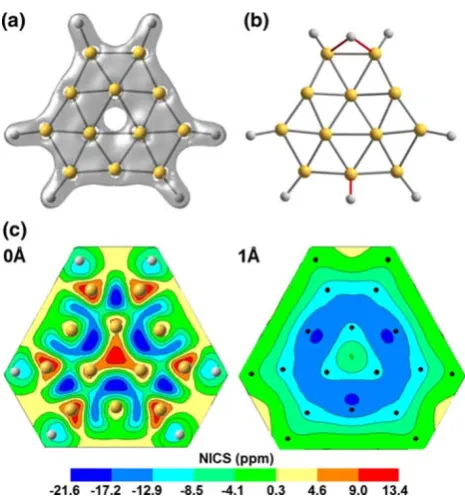
possible to increase the B–B bond lengths of the three outer pairs by 17% by attaching hydrogen atoms to the outer boron atoms (see Fig.1a). The unexpected consequence of this is that the molecule becomes perfectly planar. This finding motivated us to investigate the interaction between B12 cluster and up to four hydrogen molecules.
Computational Details
The structure and electronic properties of all clusters were obtained at the X3LYP/6-311G(d,p) level of theory using tight convergence criteria as implemented in FreeON (formerly known as MondoSCF), a suite of programs using Gaussian basis sets and all-electron Hartree–Fock, density functional theory or hybrid approach for self-consistent electronic structure calculations [12–17]. The initial search for the most stable structures of the boron hydride B12Hn have been done at the X3LYP/6-31G(d,p) level of theory starting from the energy-minimum structure of B12Hn-2and
the low-lying isomers in each case have been reoptimized using the 6-311G(d,p) basis set. The obtained local energy-minimum structures are well separated in energy from its higher isomers by at least 22 kcal/mol in the case of B12Hn, where nB 6, and 17 kcal/mol in the case of the B12H8
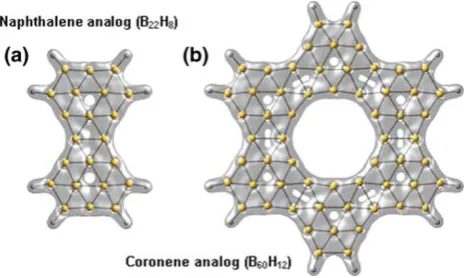
cluster. The B22H8 and B60H12 clusters, which result
from the fusion of two and six B12H6molecules,
respec-tively, were fully optimized using symmetry-unrestricted calculations.
To ensure that the structures for the neutral and nega-tively charged B12H6 molecules correspond to a local
minima of energy, the nature of the stationary points where checked by vibrational frequency calculations. In addition, several tests have been done for neutral B12H6optimizing
this molecule starting from structures with randomly dis-placed atoms. For all tested cases, the substructure of boron atoms became planar after optimization to within 0.012 and 0.014 A˚ at the X3LYP/6-311??G(d,p) and UHF-MP2/6-311??G(d,p) levels of theory, respectively. Precise cal-culations at the X3LYP/6-311G(d,p) level of theory and using very tight convergence criteria revel, however, that the fully planar B12H6molecule is the most energetically
favorable structure. Similar tests were done for B22H8and
B60H12, and after optimization at the X3LYP/6-311G(d,p)
level of theory both substructures of boron atoms became planar to within 0.016 A˚ .
The first singlet excitation energy, nuclear magnetic resonance (NMR) shielding tensors, and magnetic suscep-tibility tensors were calculated using the Gaussian03 package [18]. This package was also used to further opti-mize the B12H6molecule using the 6-311??G(d,p) basis
set. To obtain the nucleus independent chemical shift (NICS) values (from the NMR shielding tensors), we have used the GIAO (gauge-independent atomic orbital) method and the magnetic susceptibility tensors were calculated using the CSGT (continuous set of gauge transformations) method. All computations have been performed at the X3LYP/6-311??G(d,p) level of theory except for the B60H12cluster, for which we have used the RHF/6-31G(d,p)
level of theory. The anisotropy of magnetic susceptibility is defined as the difference between out-of-plane and the average in-plane components of the susceptibility tensor.
The MOs of B12H6 and C6H6 were calculated at the
RHF/6-311??G(d,p) level of theory using the GAMESS-US package [19]. The same package was used to calculate the p–p interaction between molecules in borozene and benzene dimmers at the MP2/6-311G(d,p) and RHF-MP2/6-311??G(d,p) levels of theory, respectively. The counterpoise correction was applied to account for the basis set superposition error.
Results and Discussion
[image:2.595.53.286.53.303.2]The search for the stable structures of B12Hn, withn B6 is simplified by the fact that the most energetically favorable configurations, as far as we can determine, are those where the hydrogen atoms are directly attached to the outer boron
Fig. 1 aPlot of the structures and total electronic densities of B12H6.
Note that the density of electrons is weaker at the center of the ‘‘boron ring.’’bQuasi-planarCsstructure of B12H8, which is the energetically
preferred configuration for B12with 4 H2molecules, attached to it.c
A contour plot of NICS(x, y) for B12H6in plane (left) and at 1 A˚
atoms of the molecule. We have established that the most likely stable configuration for B12H2is when the hydrogen
atoms are attached to one of the outer short-bonded boron pairs of the B12 cluster. The energetically preferred
con-figuration for B12H4 is when the hydrogen atoms are
attached to one of the two remaining outer short-bonded boron pairs in the B12H2. Finally, the B12H6cluster has all
short B–B pairs, from B12, with hydrogen atoms attached
to them. Only B12H6is a fully planar molecule, whereas
B12H2and B12H4 are quasi-planar with Cs symmetry. In
Fig.1a, we have shown the structure of B12H6. The
hydrogenation energy, defined as DE=E(B12Hn) -E(B12Hn-2)-E(H2) where E is the total energy, is
-44 kcal/mol for n =2, -45 kcal/mol for n =4, and -51 kcal/mol forn=6. We have found, however, that if a fourth H2molecule is attached to B12H6the hydrogenation
energy increases to-2 kcal/mol (i.e., the H2 molecule is
weakly bound to B12H6). It is also important to mention
that our DE values are about two times larger than the predicted energy of hydrogenation of the B7 cluster [11], which is an additional indication of unusual stability of the B12structure. The B12H8molecule is shown in Fig.1b and
can be described as a distorted B12H6cluster with two extra
(one terminal and one bridging) hydrogen atoms attached to it. The B–H bond lengths are 1.36 and 1.21 A˚ for the bridging and terminal hydrogen atoms, respectively, whereas the remaining B–H distances in B12H8and in all
other described earlier B12Hn(nB6) clusters are the same
and equal to 1.18 A˚ . The last value is very close to the calculated bond lengths B–H=1.19 A˚ in borane, BH3.
Although no single measure of aromaticity is without limitations, the anisotropy of the magnetic susceptibility (AMS) is an important indicator of diatropicity [20]. The B12H6molecule has very important properties: it is planar
with D3h symmetry; it possesses a large first excitation
energy of 2.6 eV and a large AMS of -208.2 cgs-ppm. Also, the B12H6molecule can be a building block of larger
planar molecules with similar structural and physical characteristics. In Fig.2a, b are shown what we call boron analogs of naphthalene (B22H8) and coronene (B60H12),
which are fusions of two and six B12H6, clusters,
respec-tively (It should be pointed out that the idea of boron analogs of both benzene and naphthalene are not new, since the all-boron B12molecule was previously indicated
[4] to be an analog of benzene and very recently also an all-boron analog of naphthalene was proposed [7].). Also of interest, the HOMO–LUMO (HOMO, highest occupied molecular orbital; LUMO, lowest unoccupied molecular orbital) gap decreases with cluster size. The gap values are 3.6, 2.4, 1.3 eV for B12H6, B22H8, B60H12, respectively.
Furthermore, the absolute AMS value increases with cluster size; the AMS values are -294.3, -454.7 for B22H8, B60H12, respectively. This and other values for the
studied boron hydrides are summarized in Table1. In this table, we have also included the calculated values for B12
with enforced planarity (D3h) and the fully relaxed
struc-ture (C3v). We have in addition included the values for
three hydrocarbons for comparison. It should be noted that the absolute value of AMS for B12H6is three times larger
than our value for benzene (-67.5 cgs-ppm) and 7% larger than the value for theC3vB12cluster (-192.9 cgs-ppm).
To gain information about the individual contributions of the B3triangles to the overall aromaticity of the B12H6
molecule, we have studied its two-dimensional NICS map. In Fig.1c, we have shown the contour plot of NICS(x, y) in plane (left) and at 1 A˚ above the B12H6molecule (right). It
is clearly seen from the left part of the figure that the NICS values are negative inside the twelve outer B3triangles of
the molecule, suggesting a flow of a global diatropic cur-rent around the central triangle. The central part of the molecule has a paratropic current flowing inside the inner B3triangle which is not overwhelmed by a diatropic
cur-rent due to an electron charge transfer from the center of
Fig. 2 Plot of the structures and total electronic densities ofaB22H8,
andbB60H12. In both molecules, all B–H distances are the same and
[image:3.595.309.543.59.198.2]equal to 1.18 A˚
Table 1 Molecular symmetry, HOMO–LUMO energy gaps, and the
isotropic and anisotropic values of magnetic susceptibility for the studied planar boranes and hydrocarbons
Structure Symmetry HOMO–LUMO gap (eV)
Magnetic susceptibility (cgs-ppm)
Isotropy Anisotropy
B12 C3v 3.73 -105.4 -192.9
B12 D3h 3.58 -107.6 -213.6
B12H6 D3h 3.67 -92.0 -208.2
B22H8 D2h 2.38 -147.9 -294.3
B60H12 D6h 1.30 -286.5 -454.7
C6H6 D6h 6.86 -53.0 -67.5
C10H8 D2h 4.93 -90.4 -128.5
C24H12 D6h 4.13 -251.1 -474.5
For comparison, we have also included our results for B12 with
[image:3.595.306.544.542.694.2]the structure towards the outer boron triangles after hydro-genation. Also, this antiaromatic region is spatially localized since the NICS values are negative at 1 A˚ (see the right part of Fig.1c) and 2 A˚ above and below the center of the B12H6
molecule (NICS(1)= -3.9 ppm; NICS(2)= -5.2 ppm). The benzene dimer is the simplest prototype of the aromatic p–p interactions which is an important weak interaction present in aromatic supramolecular systems [12]. Since the number of p electrons in borozene and benzene is the same and the molecular orbital (MO) picture for these electors is very similar (see Fig.3), we may expect that the strength of the aromatic–aromatic interac-tion in a borozene dimer is comparable to that of the benzene dimer. To investigate this, we have considered the simplest case where the molecules in the dimer have the parallel ‘‘sandwich’’ configuration. In Fig.4, we plotted the association energy versus the distance between the molecules in the B12H6 and C6H6 dimmers. From this
figure, we can see that the association energy for the borozene dimmer, in its equilibrium position, is about five times larger than the corresponding energy for the benzene dimer. This result suggests a stronger polarization contri-bution from borozene’s p-MOs, which we theorize is a consequence of more delocalizedp-electrons in the boro-zene dimer with respect to the benboro-zene dimer.
Finally, we have also calculated the electron affinity (EA) and the ionization energy (IE) for B12H6. The values
are summarized in Table2 calculated at two levels of theory. The agreement between the values obtained using the hybrid functional and MP2 is quite good. The EA values are positive what means that the B12H6 molecule is
stable with respect to B12H6and a free electron. However,
an addition of an electron to B12H6costs energy since the
EA is negative and large (see Table2). A removal of one electron from B12H6costs a lot of energy since the vertical
IE values are very large: 8.52 and 8.72 eV for X3LYP and
Fig. 3 Comparison of thepmolecular orbitals of benzene with the
correspondingpmolecular orbitals of B12H6
Fig. 4 Potential energy curves for B12H6and benzene dimers versus
[image:4.595.304.544.56.256.2]the center-to-center distance between the monomers. The association energies are-1.99 and-9.81 kcal/mol and the equilibrium distances are 3.8 and 3.9 A˚ for C6H6and B12H6, respectively
Table 2 Vertical electron affinities and ionization energies for B12H6
and B12H6calculated using the 6-311??G(d,p) basis set
Electron affinity (eV) Ionization energy (eV)
B12H6 B12H6 B12H6 B12H6
X3LYP 1.69 (1.80) -2.57 8.52 1.97 (1.80)
UHF-MP2 1.52 (1.71) -2.18 8.72 1.89 (1.71)
The numbers in brackets correspond to the adiabatic values for EA and IE. All values have been obtained from differences in total energies
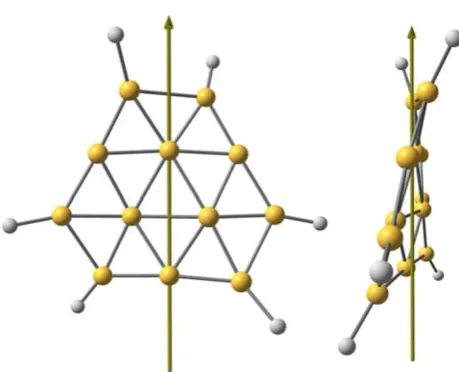
Fig. 5 Front (left) and side (right) views of the negatively charged
[image:4.595.56.285.58.221.2] [image:4.595.306.544.364.429.2] [image:4.595.309.539.499.685.2]MP2, respectively. The structure of B12H6 is shown in
Fig.5. This molecule has C2 symmetry and the axis of
rotation is shown in the figure. TheD3hsymmetry of B12H6
is reduced here to C2 since the charged molecule is
‘‘twisted’’ along the shown axis.
Although the specific route for the synthesis of the B12H6 (or B12H6) structure is not yet known, it is clear
from our investigation that to some extent the chemistries of B12H6and benzene may be very similar, suggesting that
similar methods could be employed to synthesize this and related compounds. Given the technological importance of benzene and its derivatives, we believe that the B12H6
molecule will have a significant technological impact and deserves further extensive study.
Acknowledgments We would like to thank Dr. Daniel Vrinceanu
for his helpful discussion and Brad Mazock for computational sup-port. This project was supported by the Robert A. Welch Foundation (Grant J-1675) and the NIH-RCMI Program (Grant RR03045).
References
1. D. Lloyd, J. Chem. Inf. Comput. Sci. 36, 442 (1996). doi:
10.1021/ci950158g
2. P.v.R. Schleyer, H. Jiao, Pure Appl. Chem.68, 209 (1996). doi:
10.1351/pac199668020209
3. X. Li, A.E. Kuznetsov, H.-F. Zhang, A.I. Boldyrev, L.-S. Wang, Science291, 859 (2001). doi:10.1126/science.291.5505.859
4. H.-J. Zhai, B. Kiran, J. Li, L.-S. Wang, Nat. Mater.2, 827 (2003). doi:10.1038/nmat1012
5. D.Y. Zubarev, A.I. Boldyrev, J. Comput. Chem.28, 251 (2007). doi:10.1002/jcc.20518
6. A.N. Alexandrova, A.I. Boldyrev, H.-J. Zhai, L.-S. Wang, Coord. Chem. Rev.250, 2811 (2006). doi:10.1016/j.ccr.2006.03.032
7. A.P. Sergeeva, D.Y. Zubarev, H.-J. Zhai, A.I. Boldyrev, L.-S. Wang, J. Am. Chem. Soc.130, 7244 (2008). doi:10.1021/ja802494z
8. J.-i. Aihara, H. Kanno, T. Ishida, J. Am. Chem. Soc.127, 13324 (2005). doi:10.1021/ja053171i
9. I. Boustani, Int. J. Quantum Chem.52, 1081 (1994). doi:10.1002/ qua.560520432
10. W.N. Lipscomb, Inorg. Chem. 3, 1683 (1964). doi:10.1021/ ic50022a005
11. A.N. Alexandrova, E. Koyle, A.I. Boldyrev, J. Mol. Model.12, 569 (2006). doi:10.1007/s00894-005-0035-5
12. M.O. Sinnokrot, E.F. Valeev, C.D. Sherrill, J. Am. Chem. Soc.
124, 10887 (2002). doi:10.1021/ja025896h
13. C.K. Gan, C.J. Tymczak, M. Challacombe, J. Chem. Phys.121, 6608 (2004). doi:10.1063/1.1790891
14. K. Ne´meth, M. Challacombe, J. Chem. Phys.121, 2877 (2004). doi:10.1063/1.1771636
15. C.J. Tymczak, M. Challacombe, J. Chem. Phys. 122, 134102 (2005). doi:10.1063/1.1853374
16. C.J. Tymczak, V.T. Weber, E. Schwegler, M. Challacombe, J. Chem. Phys.122, 124105 (2005). doi:10.1063/1.1869470
17. A.M.N. Niklasson, C.J. Tymczak, M. Challacombe, Phys. Rev. Lett.97, 123001 (2006). doi:10.1103/PhysRevLett.97.123001
18. M.J. Frisch, G.W. Trucks, H.B. Schlegel, G.E. Scuseria, M.A. Robb, J.R. Cheeseman, J.J.A. Montgomery, T. Vreven, K.N. Kudin, J.C. Burant, J.M. Millam, S.S. Iyengar, J. Tomasi, V. Barone, B. Mennucci, M. Cossi, G. Scalmani, N. Rega, G.A. Petersson, H. Nakatsuji, M. Hada, M. Ehara, K. Toyota, R. Fukuda, J. Hasegawa, M. Ishida, T. Nakajima, Y. Honda, O. Kitao, H. Nakai, M. Klene, X. Li, J.E. Knox, H.P. Hratchian, J.B. Cross, V. Bakken, C. Adamo, J. Jaramillo, R. Gomperts, R.E. Stratmann, O. Yazyev, A.J. Austin, R. Cammi, C. Pomelli, J.W. Ochterski, P.Y. Ayala, K. Morokuma, G.A. Voth, P. Salvador, J.J. Dannenberg, V.G. Zakrzewski, S. Dapprich, A.D. Daniels, M.C. Strain, O. Farkas, D.K. Malick, A.D. Rabuck, K. Raghavachari, J.B. Foresman, J.V. Ortiz, Q. Cui, A.G. Baboul, S. Clifford, J. Cioslowski, B.B. Stefanov, G. Liu, A. Liashenko, P. Piskorz, I. Komaromi, R.L. Martin, D.J. Fox, T. Keith, M.A. Al-Laham, C.Y. Peng, A. Nanayakkara, M. Challacombe, P.M.W. Gill, B. Johnson, W. Chen, M.W. Wong, C. Gonzalez, J.A. Pople,Gaussian 03, Revision E.01(Gaussian, Wallingford, 2004)
19. M.W. Schmidt, K.K. Baldridge, J.A. Boatz, S.T. Elbert, M.S. Gordon, J.H. Jensen, S. Koseki, N. Matsunaga, K.A. Nguyen, S. Su, T.L. Windus, M. Dupuis Jr., J. AM, J. Comput. Chem.14, 1347 (1993). doi:10.1002/jcc.540141112
20. P. Lazzeretti, Phys. Chem. Chem. Phys. 6, 217 (2004). doi: