BIROn - Birkbeck Institutional Research Online
Kohli, Maitrei and Magoulas, George and Thomas, Michael (2019) Evolving
Connectionist Models to capture population variability across language
development: modelling children’s past tense formation. Artificial Life , ISSN
1064-5462. (In Press)
Downloaded from:
Usage Guidelines:
Please refer to usage guidelines at or alternatively
*contact author
Evolving Connectionist Models to Capture Population Variability Across Language Development: Modelling
Children’s Past Tense Formation
Abstract
Children’s acquisition of English past tense has been widely studied as testing ground for theories of
language development, mostly because it comprises a set of quasi-regular mappings. English verbs
are of two types: regular verbs, which form their past tense based on a productive rule, and irregular
verbs, which form their past tenses through exceptions to that rule. Although many connectionist
models exist for capturing language development, few consider individual differences. In this paper,
we explore the use of populations of Artificial Neural Networks (ANNs) that evolve according to
Behavioural Genetics principles in order to create computational models capable of capturing the
population variability exhibited by children in acquiring English past tense verbs. Literature in the
field of Behavioural Genetics views variability in children’s learning in terms of genetic and
environmental influences. In our model, the effects of genetic influences are simulated through
variations in parameters controlling computational properties of ANNs, and the effects of
environmental influences are simulated via a filter applied to the training set. This filter alters the
quality of information available to the artificial learning system and creates a unique subsample of
the training set for each simulated individual. Our approach uses a population of twins to disentangle
genetic and environmental influences on past tense performance and to capture the wide range of
variability exhibited by children as they learn English past tenses. We use a novel technique to create
the population of ANN-twins based on the biological processes of meiosis and fertilisation. This
approach allows modelling of both individual differences and development (within the lifespan of an
individual) in a single framework. Finally, our approach permits the application of selection on
developmental performance on the quasi-regular task across generations. Setting individual
differences within an evolutionary framework is an important and novel contribution of our work.
We present an experimental evaluation of this model focusing on individual differences in
performance. The experiments led to several novel findings including: divergence of population
attributes during selection to favour regular verbs, irregular verbs, or both; evidence of canalisation,
analogous to Waddington’s developmental epigenetic landscape, once selection starts targeting a
particular aspect of task domain; and limiting effect on the power of selection in the face of
stochastic selection (roulette wheel), sexual reproduction, and a variable learning environment for
each individual. Most notably, the heritability of traits showed an inverse relationship to
optimisation. Selected traits show lower heritability as the genetic variance of the population
reduces. The simulations demonstrate the viability of linking concepts such as heritability of
individual differences, cognitive development, and selection over generations within a single
computational framework.
Maitrei Kohli*
Department of Computer science & information systems, Birkbeck, University of London; Malet Street,
London WC1E 7HX, U.K., [email protected]
George D. Magoulas Department of Computer science &
information systems, Birkbeck, University of London; Malet Street,
London WC1E 7HX, U.K., [email protected]
Michael S.C. Thomas
Department of Psychological Sciences, Birkbeck, University of London; Malet
Street, London WC1E 7HX, U.K., [email protected]
Keywords
1. Introduction
In artificial life systems, interactions between evolution and learning have attracted considerable attention in the literature, and several computational models have been proposed to investigate the way evolution affects learning. In this work, we focus on language learning, an area where computational models have made several contributions towards a better understanding of language development and evolution [15, 28, 43].
Language learning is considered one of the most complex tasks. Nevertheless, most children acquire it naturally, effortlessly, and quickly compared to other areas of cognitive development. Language is like the majority of complex systems which exist in nature and which empirically exhibit hierarchical structure [42].
Two opposing theories of language acquisition dominate the linguistic and psycholinguistic communities (refer to [55] for a review). The nativist approach, proposed by Chomsky [5,6], and promoted by Pinker, claims that the linguistic capability at least with respect to grammar is innate; therefore, certain linguistic universals are inherited by language learners, encoded in the genome by some prior process of evolutionary selection; only the established parameters need little tweaking in order for language to be fully acquired [30].
The second view is the emergentist approach. It asserts that language emerges as a result of various challenging constraints, which are all consistent with other general cognitive abilities. No dedicated provisions for universal grammar are required. According to this view, the complexity of language emerges from the exposure of relatively simple developmental processes to a massive and complex environment [24, 25].
properties of computations in the brain and statistical properties of the linguistic environment to which it has been exposed [17]. Computational models have been extensively applied to investigate the mechanisms of language development, including simulating early phonological development, lexical segmentation, vocabulary development, the acquisition of pronouns, the development of inflectional morphology, syntax comprehension, syntax production, metaphor comprehension, and reading [50]; (for reviews, see [4]; [26]).
One particular focus of research has been the field of inflectional morphology, which considers the alteration of the phonological forms of words to change their meaning (such as tense for verbs and number for nouns). Within this field, the acquisition of English past tense has drawn a great deal of attention, under the assumption that it taps the main cognitive processes involved in the acquisition and use of morphological knowledge [17]. Children’s acquisition of English past tense has been the focus of great deal of empirical research, mostly due to its quasi-regular mappings [50].
written and spoken forms of English for another example of a quasi-regular domain within language, [33]).
Due to this dual and fuzzy nature, there is an ongoing debate in the field of language development about the processing structures necessary to acquire the domain, and whether it has a duality to reflect the structure of the problem space (refer to [51] for a review). Is it necessary for the system to contain a prior processing assumption that the domain includes a productive rule, requiring symbolic computational structures? If so, how are the exception cases accommodated? Or can productivity emerge from undifferentiated associative mechanisms exposed to quasi-regular domains?
There are two main theories. The first is a dual-route account, proposed by Pinker [29], according to which two separate mechanisms are involved in learning the mappings: a rule-based system for learning regular mappings, and a rote-memory system, which supports the irregular mappings. Rumelhart and McClelland [41] challenged this dual-mode model by proposing a model based on the principles of parallel distributed processing. Their alternative model demonstrated that a two-layered feed-forward neural network could learn mappings between phonological representations of verbs and their corresponding past tense forms. Both regular and irregular, as well as demonstrating productivity of the rule to novel verbs. This model, though extremely influential, had several drawbacks (refer to [18], for details).
The line of research inspired by Rumelhart and McClelland employed artificial neural networks to simulate a wide range of past-tense acquisition related phenomena. However, the majority of this work was concerned with capturing the developmental profile of the average child. Recently artificial neural network models have been extended to explore causal factors of atypical development, for example, in the cases of Developmental Language Disorder and Williams syndrome [19]. To our knowledge, very little work has been concerned with capturing the wide range of variability that typically developing children exhibit in acquiring this aspect of language. Thomas, Forrester and Ronald [50] modelled the effects of socio-economic status (SES) on language development, combining development and individual differences in a single framework. The key innovation of this model was that it addressed individual differences arising from variations in SES of the families in which children are raised. Such variation was simulated as a modulation of language environment with which children interact, but importantly, captured against a background of variation in the computational power of each individual’s language-learning systems.
illustrative cognitive domain, has for example explored the relationship of statistical gene-behaviour associations (as reported in Genome Wide Association Studies) to developmental mechanisms. The specification of a genetic level in the model allows simulation of identical and fraternal twins, thereby simulating the kinds of twin study designs used to assess the heritability of high-level behaviour [48].
Genetic algorithms were initially proposed to simulate biological evolution and in that context they have found several applications in artificial life. However, they quickly gained prominence as global search methods and have been extensively applied for optimisation, where selection across generations aims to improve the performance of learning systems on a target task. By contrast, the existing multi-scale models take the presence of genetic variation as a starting point. This raises the following questions: where does the existing genetic variation in populations come from? How does this variation respond to the operation of selection? How do measures of heritability alter across generation through the operation of selection? What are the implications of using a quasi-regular domain as the target problem for optimisation? What parts of the problem domain are optimised across generations and what factors determine this? The relationship between learning and genetic inheritance is a crucial concern in the study of artificial life [27, 28].
and different from others proposed in literature. In this context, we present our synergistic approach to capture population variability stemming from genetic and environmental influences and to analyse effects of selection on behavioural outcomes.
This approach not only captures the heterogeneity observed in acquiring a new ability but also helps in understanding how the quality of environment interacts with intrinsic constraints, leading to an individual’s overt behaviour. It shows, for example, the different behaviours emerging due to interaction of quality of training set with good (or poor) learning rate (i.e., ability to learn, similar to neuroplasticity) and good (or poor) numbers of hidden units (i.e., capacity to learn, somewhat similar to neurogenesis). It also highlights how applying selection results in changes in overt behaviour across generations.
Although intrinsic and extrinsic parameters vary independently in this formulation, gene-environment interactions can occur. According to principles of Behavioural Genetics, both genes (intrinsic factors) and environment (training datasets) interact throughout development to shape differences in individual behaviours (performance) [37]. Here, connectionist networks contain a range of parameters that can increase or decrease the ability and/or capacity of the network to acquire a new ability but the structure, or the quality, of the environment affects the way these intrinsic parameters behave. For example, within a modelling context, a certain number of ANN hidden units may be highly beneficial for a specific condition of the environment (say number of training examples available) but if these conditions were to change drastically (say, a large expansion of the training set), the same number of hidden units may not be able to accommodate the change. Thus, the system’s performance will alter.
Apart from having genetic and environmental variation, our model also incorporates “selection” and its effects. As is shown later in the paper, applying selection on performance
on the English past tense problem leads to two novel findings: (i) selection can stochastically target different aspects of a quasi-regular task depending on different initial conditions, potentially producing divergent populations. This in turn results in emergence of different and varied behavioural (performance) patterns, while still optimising on the target task; (ii) the amount of performance variation explained by genetic similarity, the so-called heritability metric [20] plays an important role in identifying which aspect of this quasi-regular task is being targeted by selection.
and the past tense dataset used in the simulations. Finally, we present the results and discuss their implication.
2. Behavioural Genetics Inspired Hybrid Computational Model
Behavioural Genetics (BG) is a field of study that examines the role of genetics in individual differences in human behaviour. Behaviour is the most complex phenotype as it reflects the functioning of the complete organism; it is dynamic and changes in response to the environment [35]. This field is concerned with the study of individual differences, i.e. knowing what factors make individuals within a group differ from one another. It also estimates the importance of genetic and environmental factors that cause individual differences. Thus, the behaviour or phenotype is the result of genetic factors together with environmental factors.
Twin-studies are the workhorse for behavioural genetic research. The twin design provides a quasi-experimental scenario triggered to measure respective contributions of nature and nurture to individual differences [20]. Twins are matched for age, family and other social influences. They are either genetically identical (genetic relatedness of 1.0 for monozygotic, MZ, or identical twins) or as similar as siblings (genetic relatedness of 0.5 for dizygotic, DZ, or fraternal twins) and, to an approximation, share the same environment (applicable for both MZ and DZ twins based on the Equal Environments Assumption) [37]. The difference in the similarity in performance between MZ or DZ twin pairs, along with assumptions about their similarity of environment, allows inferences to be drawn about the influence of genetic relatedness on behaviour [36]. If MZ twins are more similar in a trait than DZ twins – and the environment plays an equivalent role in making each pair similar – then the greater similarity of MZ twins must stem from their greater genetic similarity.
proportion of observed or phenotypic variance that can be explained by genetic variance [20]. There has been increasing acceptance that in humans, many high-level behaviours show marked heritability [20], a finding that would have been surprising to many researchers in the latter part of the 20th Century. For our purposes, the measure of heritability derived from the twin method is useful because it is a single metric derived from performance that scales however large the number of parameters by which the heritable influence is delivered in the underlying mechanism. Thousands of gene variants may influence thousands of parameters which combine in complex ways to shape behaviour, but by measuring trait similarity in twins, a single measure of genetic influence is available.
In twin designs, environmental influences are defined as being of two types, shared (or between-family) and non-shared (or unique and within-family). Shared, or between-family environmental influences are those that serve to make members of a family similar to each other and different from members of other families. Shared environmental influences include family structure, socioeconomic status, and parental education to name a few [34]. By contrast, non-shared, or within-family environmental influences are factors that serve to make individuals different from one another. These environmental influences do not operate on a family-by-family basis but rather on an individual-by-individual basis. Examples include peer groups, perinatal traumas, and parental treatment [34, 37]. Measurement error in twin designs also contributes to the non-shared environment.
doubling the difference in correlations between MZ and DZ twins gives an estimate of heritability.
Our base model, prior to implementing sources of variation and the use of twins, was inspired by that proposed by Plunkett and Marchman [39]. They suggested that both the regular and the exception verbs could be acquired by an otherwise undifferentiated three-layer Backpropagation network, trained to associate representations of the phonological form of each verb stem to a similar representation of its past tense. This became our base model; we introduced the sources of variations, relying on the Rprop algorithm [40] for training; and then introduced selection across generations of twin pairs. Table 1 provides a high-level description of the BG inspired past-tense model and each step in the table is discussed in sections below [21].
1. Simulate variations in genetic influences
Encode neurocomputational parameters into genome
Calibrate range of variation of each of these parameters 2. Simulate variations in environmental influences
Apply SES-based filter to dataset to generate unique training subset for each twin pair 3. Generate initial population of ANN twins, such that each individual is an ANN
characterised by its own genetic and environmental influences. Set 4. REPEAT
(a) Train each individual (ANN twin) using some local search mechanism
(b) Evaluate Fitness of each individual ANN according to training performance result for regular verbs, irregular verbs and combined performance. Also calculate heritability by comparing similarity of identical and fraternal twin pairs
(c) Select parents from based on their fitness on combined (overall) performance (d) Apply search operators to parents to produce offspring which form 5. UNTIL, termination criterion is met
Table 1: High-level description of BG-inspired English past-tense model
Simulating variations due to genetic influences: Artificial neural networks depend on a
number of hidden units and the learning rate (or the initial learning rate of Rprop) have been used in almost all applications involving ANNs. These are formational parameters, since the former corresponds to how the network is built and thus relates to a network’s capacity to learn, whereas the latter governs how networks adapt and hence provides a network with the ability to learn. These parameters would thus be influential in distinguishing between fast and slow learners.
We also used another parameter, the slope, or steepness, of the logistic threshold function within the artificial neurons. This corresponds to the activation dynamics acting within each network. Modulation of this parameter leads to steeper or shallower slopes in the threshold function. A shallow slope negates the opportunity of a processing unit to make large output changes in response to small changes in input; a steep slope ultimately leads to very sensitive but binary response characteristics subject to entrenchment effects. Therefore, too shallow or too steep values of this parameter will hinder the learning process [31, 49].
In order to constrain learning, these properties were encoded into a genome. The genome was the measure of the base composition of an individual. In other words, it served as a set of instructions about how to form an organism of a particular species or group. Encoding parameters in the genome allowed the individuals in a population to have a different genotype, that is, different values of each of the free parameters but from within the same fixed range. It thus led to variability in a population by giving each network a different ability/capacity to learn new tasks. As described in the next section, the artificial genome was comprised of binary genes, where the values of several genes were used to determine the value of each parameter, a scheme called polygenic coding [48].
Simulating variations due to environmental influences: Variations in shared environmental
differences in the SES of the families in which children are raised. SES effects can be implemented in three main ways: by manipulating the quality and quantity of the information available, by altering the motivation of the learner to utilise the available information through differences in reward and punishment schedules, or by manipulating the computational properties of learning systems (as, for instance, differences in stress levels or diet might influence brain processes in children) [50].
For this work, we focus on EF as a manipulation of the quality and quantity of information available to the learners. We assumed that, in principle, there is a perfect environment, or full training set, available to any learner. This comprised all of the verbs available in the language and their accepted past tense forms. We then modelled an individual’s EF by a number selected at random from the range 0.6–1.0. This gives a probability that any given verb in the full training set would be included in that individual’s training set. The range 0.6-1.0 defines the range of variation of EF in the population, and ensures that all individuals are exposed to more than half of the past tense domain. Twin pairs raised in the same family were exposed to the same training set, such that EF would lead to effects of shared environment. The variance in performance that cannot be inferred from shared environment is representative of effects of unique or non-shared environmental influences. In the absence of measurement error (because none was added), unique environment effects arose due stochastic factors such as the initial weights of ANNs or the random order of presentation of training items.
The learning speed and fast convergence of many feedforward neural networks depend to some extent on their initial values of weights and biases [45, 56]. For this reason, in our approach, initial values of weights were one way to capture unique environments. The initialisation method used in this work is similar to that proposed by [3] and uses the interval: [−
wherein is chosen in a way that weight variance corresponds to the points
function [45]; and din is fan-in of neuron or the total number of inputs of a neuron in the network.
3. Model Implementation Methodology to Capture Individual Differences
Using the concepts explained in the previous sections, we built a model to learn English past tenses and also capture individual differences in performance. The starting point of this work was to estimate the proportion of variance attributed by variances in structural parameters (genes), training set (shared environment), and initial weights (non-shared environment). The methodology adopted can be summarised as follows:
Design ANNs: the first step was to design ANNs incorporating neuro-computational parameters that constrained their ability to learn. We selected three free parameters, each of which corresponded to how the network is built: number of hidden units; the slope of logistic activation function; and how it adapts, the initial learning rate of Rprop.
Calibrate range of variation: in the second step, the range of variation of each of these
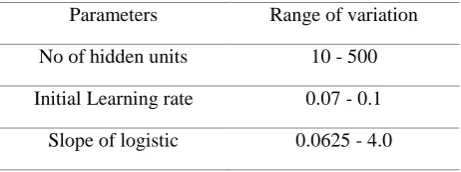
as the upper and the lower bound used for converting the genotype (encoded values) into its corresponding phenotype (real values). For the encoding, we used binary representation, whereby each gene had two variants or alleles, with 10 bits per parameter, split into two chromosomes. Paired chromosomes allowed sexual reproduction to be simulated. In turn, this permitted networks to be generated with different degrees of relatedness, either MZ or DZ twins, and enabled utilisation of the twin design to estimate heritability. The parameters and their range of variation are given in Table 2.
Parameters Range of variation
No of hidden units 10 - 500
Initial Learning rate 0.07 - 0.1 Slope of logistic 0.0625 - 4.0
Table 2: Genome representing ANN parameters and their ranges
Breed the population: the next step concerned creating the population of ANN twins using
the genome. We simulated the biological processes of meiosis and fertilisation to create 50 pairs of MZ and 50 pairs of DZ twins (refer to [7] for details about biological meiosis and fertilisation). Table 3 presents the algorithm used for creating population of ANN twins.
1. Generate initial population of members at random
2. Split the population members into two groups of size representing fathers and mothers 3. REPEAT
(a) For each parent, split genome into two equal halves resulting in two chromosomes per individual such that each chromosome carries half the information for each encoded parameter
(b) Apply crossover m times on each chromosome pair, every crossover resulting in either two sperms or two eggs
(c) Combine the sperms and eggs using positional recombination such that half of the encoded genetic information comes from sperm and other half from egg resulting possible offspring
(d) Verify the genetic similarity between twin pairs and accordingly choose MZ and DZ twins pairs, picking only one offspring per crossover
4. UNTIL population of desired size is obtained
Table 3: Meiosis and fertilisation based method for creating population of ANN twins
design. The offspring genotypes were converted to phenotypes using the parameter values given in Table 2.
Although in biology, meiosis creates two sperm/two eggs from the crossover operation, the likelihood of both of the pair ending up in organisms is very small. If this happened, the mean genetic similarity of the population would start to be affected. We therefore only selected one of the pair of sperm/eggs generated by the crossover to generate offspring, while the other was discarded.
To verify the genetic similarity between twin pairs, we used the Hamming distance metric to assess the similarity amongst offspring. Let us assume that 2m = 6, and crossover is applied three times, leading to: xover1 results in offspring (o1, o2); xover2 results in (o3, o4) and xover3 leads to offspring (o5, o6). First, we randomly pick any one offspring out of the possible six; let us assume that is o1. Because of the reasons explained above, we discard o1’s corresponding offspring, o2. Next, the similarity of o1 is checked with the remaining four offspring using the Hamming distance formula. The offspring that is at most 50% similar is chosen as o1’s corresponding DZ twin, assume o4. This implies that (o1, o4) form a pair of DZ twins. Subsequent to o4’s selection, its corresponding twin from crossover, o3 is discarded. Now, out of the remaining two twins, any one is chosen randomly and replicated, and they comprise the MZ twin pair.
therefore always took place between unrelated individuals, preserving the mean genetic similarity within populations across generations.
Apply variation in the environment: an individual’s EF was modelled by a randomly chosen
number between 0.6-1.0. This gave a probability that any given pattern in the full training set was included in that individual’s training set. This filter was applied at each generation to create unique training subsets for all members of the population in that generation. The range 0.6-1.0 defined the range of variation of environmental quality, and ensured that all individuals were exposed to more than half of the training dataset. In accord with the Equal Environments Assumption [36], twin pairs raised in the same family were assigned the same training subset.
ANN training and performance assessment: the population of twin ANNs was trained on the
past-tense data set using the Rprop algorithm [1, 40]. Rprop is a training algorithm for supervised learning in feed forward neural networks. It takes into account only the sign of the partial derivative over all patterns and maintains a separate learning rate for each weight that is adapted during training. It is a superior algorithm in terms of convergence speed, accuracy as well as robustness with respect to the training parameters and therefore is a very popular choice for the training of multilayer feed-forward neural networks in various applications and is included in several packages, e.g. R and Matlab. Rprop works as follows: every time, t, the partial derivative of the error E with respect to a weight wij(t) changes its sign, which indicates
that the last weight update was too big and the algorithm has jumped over the local minimum, the update-value ij(t) is decreased by multiplying with a user defined factor . If the
derivative retains its sign, the update value is slightly increased by multiplying with a factor
in order to accelerate convergence in shallow regions. Additionally, in case of a change in
achieved by setting the derivative ( 1) t w E ij
= 0 in the adaptation rule, which leads no
update. Lastly, the update-values are calculated and all the weights are updated after the gradient information of the whole pattern set is computed. For a detailed explanation of the Rprop algorithm and of its variants, the reader is referred to section 2 of Anastasiadis et al. [1] and to [40].
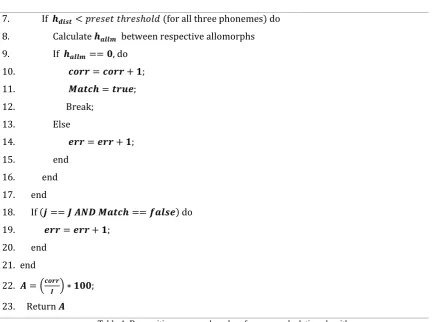
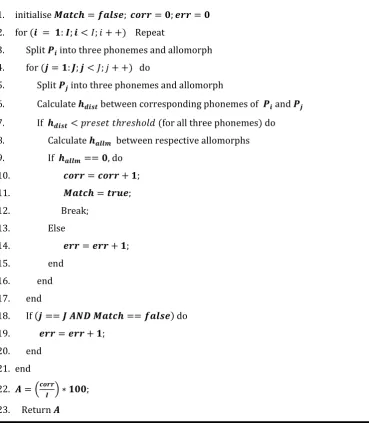
In this work, the performance was assessed on the full training set, as well as, on another novel dataset that was created to test the generalisation ability of the networks (see below). The continuous outputs produced by networks were converted to binary by applying a threshold. Then the performance was assessed using recognition accuracy based on Hamming distanceas explained below in Table 4.
Input: Actual output of network,
Desired output,
Output: Performance accuracy,
Variables: total number of patterns in
total number of patterns in
a pattern in , where
a pattern in , where
Hamming distance between phonemes of and
Hamming distance between allomorphs (or the last 5 bits) of and
1. initialise
2. for Repeat
3. Split into three phonemes and allomorph
4. for do
5. Split into three phonemes and allomorph
7. If (for all three phonemes) do
8. Calculate between respective allomorphs
9. If , do
10.
11. ;
12. Break;
13. Else
14.
15. end
16. end
17. end
18. If do
19.
20. end
21. end
22.
[image:21.595.70.514.60.382.2]23. Return
Table 4: Recognition accuracy based performance calculation algorithm
Selection: based on the performance of the networks on the full training set, members were
As a result of sexual reproduction, the best properties of parents did not always get transferred to offspring. This is for two reasons: (i) an individual (parent) can only pass one copy of each gene to its offspring. Therefore, there is an equal chance that either a maternally inherited gene or a paternally inherited gene will get transmitted to the offspring [20]. Since, after selection for the breeding pool, the members breed randomly, the best properties do not always get transferred effectively, since the advantageous gene may not be inherited. (ii) Inherited traits must combine with environmental conditions during the offspring’s development to produce its behavioural phenotype. Inheritance of strong learning abilities may not be associated with good performance if the offspring is exposed to an impoverished learning environment. It is the combination of inherited liabilities and environmental conditions that make each individual unique [16].
Repeat: the entire process was iterated until ANN parameters did not markedly change across
generations or performance started to converge, i.e. the learning error reached a small value.
4. English Past Tense Dataset
binary format. As an example, consider the word bag and its past tense bagged. It would be represented as: first phoneme /b/ 0100111000000000000; second phoneme /ae/ 1011101000001001000; and the third phoneme /g/ 0100100010000000000. So, the word bag becomes:
0100111000000000000 1011101000001001000 0100100010000000000.
Its past tense, bagged is made by adding an extra 5 bit suffix to the original verb. The suffix, /ed/ in our example, is represented as 00101. A detailed schematic of the phonological coding scheme can be found in Thomas (2018), Figure3, available here:
https://www.ncbi.nlm.nih.gov/pmc/articles/PMC6075940/figure/f0015/ [46].
In the training dataset, there were 410 regular and 98 irregular verbs. Regular verbs followed the add –ed rule, with three different phonetic versions of the –ed inflection, /ed/, /d/, and /t/. There were three types of irregular verbs, vowel change, no change, and arbitrary. In the dataset, out of 410 regulars, there were 271 /ed/ verbs, 90 /d/ verbs, 49 /t/ verbs. As this was an imbalanced dataset, generating a classifier was challenging as the classifiers tend to map/label every pattern with the majority class.
phonemes were changed such that the conformity to phonotactics was violated. This use of novel verbs is standard practice for generalisation testing in context of tense formation [18].
5. Experimental Design
In order to explore the behaviour of the model in different lineages, i.e. sequences of development, selection and breeding, three replications of the model were tested, each having a twenty-generation duration. The experiments were conducted on Condor, a platform that supports running high throughput computing on large collections of distributive owned computing resources [44]. It follows a master-slave type configuration, which has proved suitable for training neural network architectures [32].
Each lineage was characterised by its own initial population (produced with random binary genomes) and unique initial weights. The evolutionary methodology was then applied to each of these model instantiations, such that they all shared the same range of variation for genetic and shared environmental influences. At the same time, however, they were unique, for each of them began with a different initial population created from random binary genomes. The three replications (r1, r2, and r3) of the model permitted evaluation of the robustness of the
method. Once the genomes and parameters were generated for the initial set of 50 MZ and 50 DZ twins in a lineage, these were instantiated as three-layered feed-forward networks and were trained using the batch version of the Rprop algorithm [1, 40]. The stopping condition was an error goal (mean squared error) of 10-5 within 1000 epochs.
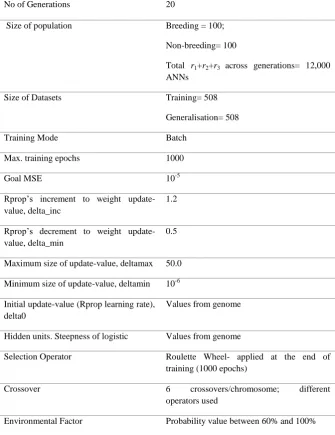
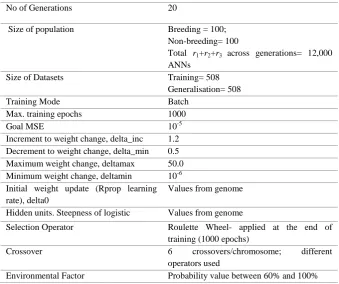
Table 5 summarises the settings used in the experimental design. Empirical data from young children performing the past tense task [18, 49], were used to benchmark the performance of the proposed model, which has been the subject of considerable research in the literature.
No of Generations 20
Size of population Breeding = 100;
Non-breeding= 100
Total r1+r2+r3 across generations= 12,000
ANNs
Size of Datasets Training= 508
Generalisation= 508
Training Mode Batch
Max. training epochs 1000
Goal MSE 10-5
Rprop’s increment to weight update-value, delta_inc
1.2
Rprop’s decrement to weight update-value, delta_min
0.5
Maximum size of update-value, deltamax 50.0
Minimum size of update-value, deltamin 10-6
Initial update-value (Rprop learning rate), delta0
Values from genome
Hidden units. Steepness of logistic Values from genome
Selection Operator Roulette Wheel- applied at the end of
training (1000 epochs)
Crossover 6 crossovers/chromosome; different
operators used
[image:25.595.130.466.170.606.2]Environmental Factor Probability value between 60% and 100%
Table 5: Experimental settings
6. Results & Discussion
verbs, and between 34% and 40% for irregular verbs. The model was able to efficiently generalise the past tense rule in novel items with the mean accuracy rate of around 60%. The performance of the model compares well with empirical data for children reported in the literature [2, 52]. The behavioural data in [2] comprise of performance results of 442 6-year old children on past tense test. They were tested on 11 regular verbs and 8 irregular verbs. The average accuracy achieved by children on regular verbs was 90%, whereas the average accuracy for irregular verbs was 38%. It is also consistent with the performance reported in the developmental study of [52] for 5-7 year old children: for regular verbs, accuracy rates were 60% (5 year olds), 75% (6 year olds) and 80% (7 year olds); for irregular verbs, accuracy rates were 25% (5 year olds), 58% (6 year olds) and 50% (7 year olds).
We compared the model’s performance with two other past-tense models from [49] and [18]. In the former model, 1000 networks were trained for 1000 epochs in various degrees of environmental and genetic variation scenarios. The experimental setting that closely matched our experiments, referred to as G-wide and E-narrow, resulted in average accuracy of 80% for regular verbs and 38% for irregular verbs. In latter case, the model comprised of networks trained for 400 epochs, with results averaged over 10 replications with different random seeds. The results corresponding to 6 year olds fall in the range of 60%-80% in case of regular verbs and between 20%-40% for irregular verbs, achieved in the window of 51-70 epochs. Their model also achieved over 80% generalisation accuracy.
non-breeding populations), trajectory analysis was used to assess overall patterns in the component linear regressions [47].
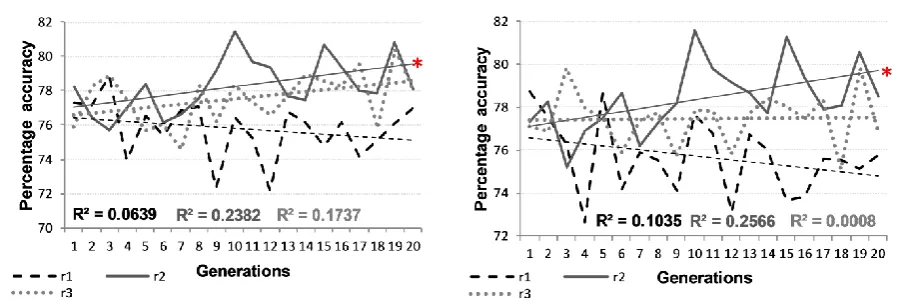
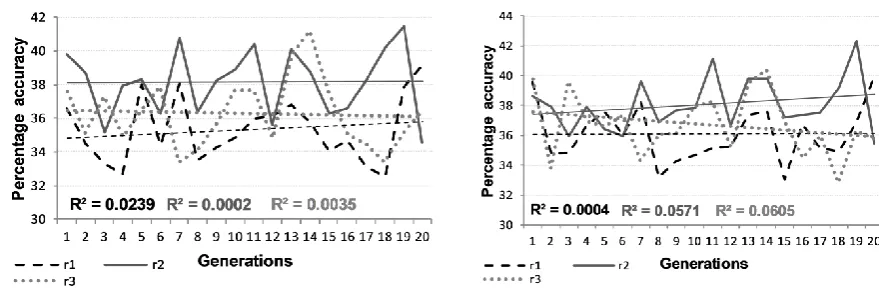
Figure 1 depicts the mean accuracy with which breeding and non-breeding twin populations formed past tenses for regular verbs across a sequence of generations, for three replications with differential initial genomes. These graphs summarise the results from 12,000 networks. Figure 2 shows equivalent data for irregular verbs, while Figure 3 represents the generalisation results. In each case, a zigzagged line indicates the mean accuracy level of the 100 networks for each population at each generation, while a straight line represents the general trend observed in that replication scenario. The trend line was derived from a linear regression line based on the least squares method, predicting mean performance level from generation number. R2 values were relatively small, reflecting the non-monotonic changes in performance over generations. This is in line with changes in mean trait levels in animal populations following selective breeding, such as the open field behaviour of mice [11, 37]. A star in these figures signifies replications where the change over generations was statistically significant at the p<.05 level using linear methods.
Figure 1: Mean performance per generation for breeding (left) and non-breeding (right) twin populations on regular verbs. The three lines
Figure 2: Mean performance per generation for breeding (left) and non-breeding (right) twin populations on irregular verbs. The three lines
show three different lineages. Statistically reliable (p<.05) trend lines are marked with a star (*)
Figure 3: Mean generalisation accuracy per generation for breeding (left) and non-breeding (right) twin populations. The three lines show
three different lineages. Statistically reliable (p<.05) trend lines are marked with a star (*)
We initially considered performance of application of the past tense rule, comparing the measures of regular verb performance against generalisation, for the three replications and breeding versus non-breeding populations (12 trajectories). A fully factorial ANCOVA revealed no overall change in performance across the generations (F(1,108)=2.23, p=.138,
p2=.020). However, this masked a differential pattern between replications, with some
showing rising performance and others no change (F(2,108)=8.65, p<.001, p2=.138). This
pattern was common across measures and breeding/non-breeding populations. Regular verb performance was reliably higher than generalisation (F(1,108)=6288.30, p<.001, p2=.983).
different levels of accuracy (F(2,108)=3.27, p=.042, p2=.057). Comparison to regular verb
performance indicated that the relationship between performance and generation was reliably modulated by measure (F(2,108)=4.53, p=.013, p2=.077). Regular verb performance was
also reliably higher than irregular verb performance (F(1,108)=9958.42, p<.001, p2=.989).
Most notable in Figures 1 to 3 is the presence of some downward trends in performance over generations, despite the operation of selection. Selection should serve to improve performance over generations, since genes conveying an advantage in learning are more likely to be transmitted to the next generation. The probabilistic nature of this transmission – the mode of sexual reproduction does not guarantee that the advantageous genes of an individual selected to breed will appear in the offspring, and the selection mechanism is itself probabilistically related to final performance level – accounts for the slow change in population mean performance over generations. It does not account for why performance should become worse over generations.
The explanation is suggested by the fact that opposite trends were observed for regular verbs and irregulars (with generalisation patterning with regular verbs). When performance across generations was worsening for regular verbs, it was improving for irregular verbs, and vice versa. This is most evident in a comparison of replication 1, where irregulars showed a trend to improve over generations but regulars to worsen, and replication 3, where regulars showed a trend to improve but irregulars worsen (3-way interaction of verb type by generation by replication: F(1,36)=4.64, p=.038, p2=.114).
performance of the population on the other mapping type as well. However, it is known that the two types of mappings are differentially sensitive to different parameters in ANNs. For example, regular mappings benefit from steeper sigmoid functions, while irregular mappings require more hidden units [48]. The combination of (a) selection by mean performance that could either be driven by stronger regular or irregular verb performance, and (b) parameters that favour learning of either regular or irregular mappings, together sets the stage for possible divergence of gene pools over generations. Even in the face of selection, some lineages may become specialised for regular verbs at the expense of irregular verbs, while other lineages may become specialised for irregular verbs at the expense of regular verbs. Yet others may show increased performance in both verb types across generations. Which path a given starting population follows will depend on the distribution of parameters created by the initial genomes, the set of individual environments, and stochastic factors involved in selection and breeding. Once genes are lost from the population that are beneficial for the non-preferred verb type, these cannot be regained. Selection can only then improve performance by continuing to select for genes for the preferred verb type.
over generations in selection of genes for parameter values more appropriate to one or other verb type.
Changes in the frequency of different gene variants (here, binary values of 0 or 1) in the gene pool should alter the range of genetic variation across generations, since any effective operation of selection would reduce genetic diversity. Given that the range of environmental variation (EF of 0.6 to 1.0) remained consistent across generations, genetic diversity could explain less of the phenotypic variation, and a corresponding reduction in heritability would be expected. To test this idea, we examined correlations in performance between MZ and DZ network twin pairs, using Falconer’s equations to derive estimates of heritability [37]. Heritability was estimated as twice the difference between MZ and DZ correlations; unique environmental effects as the extent to which MZ correlations were less than 1; and shared environment effects as the remaining variance (i.e., 1-{heritability}-{unique environment}). Strictly speaking, these equations assume an additive model, which only holds for MZ correlations that are no more than twice DZ correlations. In our results the correlations sometimes violated this condition. However, for consistency, we plot heritability estimates according to the same formulae across conditions, though the values sometimes range outside of the range 0 to 1 as the assumptions of the additive model become violated. The plotted data should therefore be seen as proportional to the heritability and environmentability observed in populations, rather than direct estimates under an additive model.
Figure 4 shows the estimates of heritability (variance due to genetic factors) for regular (4a) and irregular verbs (4b). These six trajectories were compared in a fully factorial ANCOVA. Heritability reliably reduced over generations (F(1,54)=5.54, p=.022, p2=.093), and this
Figure 4(a): Heritability or proportion of variance due to
genetic (or structural) factors for Regular Verbs. The three lines
show three different lineages. Statistically reliable (p<.05) trend
lines are marked with a star (*)
Figure 4(b): Heritability or proportion of variance due to
genetic (or structural) factors for Irregular Verbs. The three
lines show three different lineages. Statistically reliable (p<.05)
trend lines are marked with a star (*)
If a lineage becomes increasingly optimised on a task (or a specific aspect of the task domain), the range of the intrinsic parameters relevant to that task (so-called domain-relevant parameters) should decrease across generations, as only the genes producing the preferred parameter values are retained. For example, if populations are improving on irregular verbs, which require more capacity to hold non-systematic mappings, then across generations, networks with larger number of hidden units would have a greater chance to get selected in the breeding pool. Across generations, the variability in the range of number of hidden units would reduce. By contrast, the range of variation in other parameters less relevant to irregular verb performance would be less affected. Optimisation and heritability should therefore have an inverse relationship in this case.
In replication/lineage 1, regular verb performance and rule generalisation dropped across generations while irregular verb performance improved. Heritability for regular verbs was initially higher than that for irregular verbs, centred on 0.4 and it then increased across generations, implying lack of selection for parameter sets specialised for regularity. By contrast, heritability of irregular verbs was lower, centred on 0.2, and decreased with generations, implying selection for, and a narrowing of the range of, parameter sets specialised for irregularity. Note that this process of specialisation caused overall accuracy to drop, because irregular verbs form a minority of the dataset (there were only 98 irregular verbs compared to 410 regular verbs).
In replication/lineage 2, regular verb performance, irregular verb performance, and generalisation all increased across generations. Heritability of regular verbs dropped from around 0.8 to around zero. A similar pattern was observed for irregular verbs, with heritability dropping from high values to almost zero. In this lineage, optimisation caused a narrowing of the range of genetic variation relevant to learning of both regular and irregular verbs.
In replication/lineage 3, regular verb performance and generalisation improved while irregular verb performance dropped. The heritability of regular verbs decreased from 0.6 to 0.2 while the heritability of irregulars remained stable, at around 0.2. These two observations suggest that the range of intrinsic parameters being targeted by selection initially
Figure 5: Negative association between heritability
and population mean performance on regular verbs
accommodated both regular and irregulars, but as generations progressed, there was a narrowing in this range for parameters more suited to regular verbs.
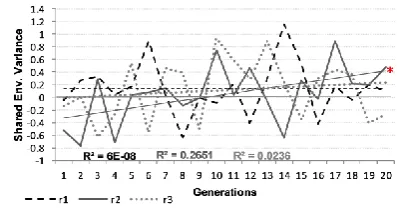
When heritability of a particular aspect of the task reduces, it implies that variance in performance is less due to genetic factors and more due to shared and non-shared environmental factors. Figures 6(a) and 6(b) display the variance due to shared environmental factors, in this case the filtered training datasets. The effect of shared environment reliably changed over generations (F(1,54)=8.42, p=.005, p2=.135) though this was driven primarily
by replication 2, illustrated by an interaction of - population × generation (F(2,54)=3.65, p=.033, p2=.119). The pattern was common across regular and irregular verbs. Figures 6(c) -
6(f) confirm that, though stochastically sampled, the range and mean level of EF was constant across generations for all lineages.
Figure 6(a): Proportion of variance due to shared environmental factors - Regular Verbs
Figure 6(b): Proportion of variance due to shared environmental factors - Irregular Verbs
[image:34.595.78.275.380.486.2] [image:34.595.321.520.381.486.2] [image:34.595.89.261.575.704.2] [image:34.595.334.508.575.704.2]Figure 6(e): Percentage of EF per generation replication3 Figure 6(f): Percentage of EF per replication
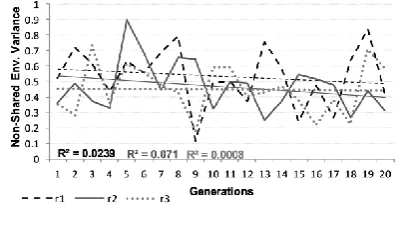
Figures 7(a) and 7(b) represent the variance in performance due to non-shared environmental factors or initial weights in our implementation. Analyses revealed no reliable effects, with non-shared environmental effects consistent across generations and modulated neither by measure type nor by replication population. The figures show that the differences in initial weights led to large variability in behavioural outcomes. In cases when intrinsic factors were not very suitable to the task domain, having good initial weights might give networks a fighting chance, exaggerating the impact of intrinsic stochastic factors.
Figure 7(a): Proportion of variance due to non-shared
environmental factors - Regular Verbs
Figure 7(b): Proportion of variance due to non-shared
environmental factors - Irregular Verbs
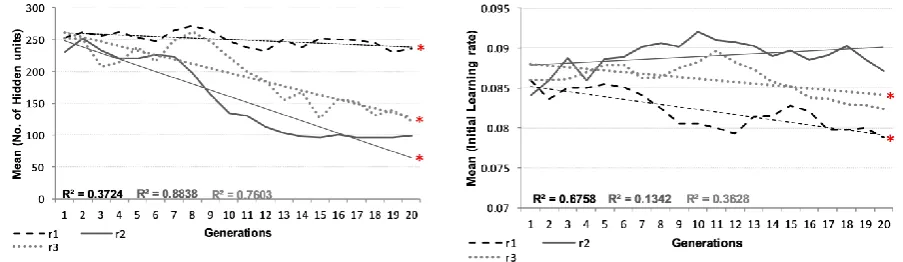
[image:35.595.337.508.80.217.2] [image:35.595.89.262.82.211.2] [image:35.595.319.520.491.615.2] [image:35.595.77.278.492.611.2]the current simulations, relatively few parameters were encoded in the genome and permitted to vary across populations and between generations. Our final step of analysis, then, was to examine the change in mean parameter values for a given lineage across generations. This should reveal the domain-relevant parameters that were selected, in those cases where performance on one verb type was enhanced at the expense of the other, and therefore in turn reveal the drivers behind changes in heritability. Figure 8 depicts changes in mean parameter values for number of hidden units, initial learning rate, and slope of the logistic activation function. For hidden units, there was a reliable reduction in number across generation (F(1,54)=190.55, p<.001, p2=.779), with the reduction occurring at different rates across the
three replication populations (F(2,54)=33.79, p<.001, p2=.556).
For learning rate, the same pattern was observed: reduction across generations (F(1,54)=22.69, p<.001, p2=.296) modulated by replication, with the reduction appearing in
Figure 8 (a): Change in the mean value of the number of hidden
units per generation Figure 8 (b): Change in the mean value of the initial learning rate per generation
[image:36.595.77.529.358.489.2] [image:36.595.187.417.527.659.2]only two of the three replications (F(2,54)=12.22, p<.001, p2=.312). Lastly, for slope of
logistic activation, there was an increase in two of the populations across generations and a reduction in the other (main effect of generation: F(1,54)=12.99, p<.001, p2=.325;
interaction of generation*replication: F(2,54)=61.06, p<.001, p2=.693). Overall, replication
1 and 3 showed a common pattern of reduction in hidden units, reduction of learning rate, and increase in temperature. For replication 1, the reduction in hidden was milder, the learning rate fell lower, and the temperate rose higher. Replication 2 showed a different pattern of a greater fall in hidden units, no change in learning rate, and a drop in temperature (i.e. slope of logistic activation).
The three chosen parameters provided networks with capacity to learn (more hidden units can accommodate more input-output mappings) and/or ability to learn (optimum values of initial learning rate and steepness of logistic activation allow discovery of connection weights for those mappings). Irregular verbs belong to category of non-systematic mappings, which are more demanding on computational capacity. Figure 9 depicts the variation in the ranges of the three parameters across generations. In Figure 9, on every box, the central mark is the median, the edges of the box are the 25th and 75th percentiles, the whiskers extend to the most extreme data points not considered outliers and the outliers are marked separately by '+'. The height of the box represents the inter quartile range (IQR) of the data set, which is the difference between the 75th percentile and 25th percentile. The lines at the end of the whiskers mark the highest and lowest values of the data set that are within 1.5 times the inter quartile range of the box edge.
Lineage/replication 1 improved irregular performance at the expense of regular, and this was reflected by maintenance of high levels of hidden units. Learning rates declined, while genes for steeper logistic slopes were selected.
Regular verbs have systematic input-output mappings, which are less demanding on computational capacity. Lineage/replication 2 improved regular performances at the expense of irregular verbs, and this was reflected by an increase in learning rate. Both hidden unit numbers and logistic slope declined.
Variations in the range of hidden units Variation in the range of initial learning rate Variation in the range of slope of logistic activation Lineage
1
Lineage 2
Lineage 3
7. Findings
Research in artificial life has been interested in the relationship between evolution and learning as complementary optimisation techniques for ANN [9, 28]. Evidence suggests that evolution can select network parameters and starting states that improve learning outcomes. Here we considered this relationship in a model where heritable network properties were passed between generations via a simulated process of sexual reproduction, where networks were exposed to learning environments of variable quality, and where the problem domain was quasi-regular, providing greater challenges for optimisation. The main findings were as follows: (i) Applying selection on the individual’s performance level in a quasi-regular task
quasi-regular task being targeted by selection. Highly heritable behaviour indicates that the trait is not being selected for, whereas behaviour with reducing heritability implies selection and optimisation. Therefore an inverse relationship exists between heritability and optimisation. (v) When selection operated, a higher proportion of variance due to shared environmental factors (filtered training sets) was associated with stronger learning. (vi) Non-shared environmental factors (initial weights) led to notable proportions of behavioural variance. This effect was larger when intrinsic properties were not particularly suitable and chance superior initial weight configurations were necessary to have good learning outcomes.
Finally, like all simulations that employ stochastic factors, the results would benefit from further replications, here of lineage on the one hand, and extended selection across generations on the other hand to ensure that convergence has been achieved. In the training of a single ANN, regular verbs are learnt first; with continued training, learning of irregular verbs follows as these exception mappings are accommodated around the connectivity that supports the regular past tense rule [39, 41]. However, evolution is not like development. Once the genes are lost for the computational properties that enable learning of irregulars alongside regulars, this potential cannot be regained by further selection over more generations. Additional trials in the context of transfer learning reported in [22] reveal that this behaviour is also encountered in other datasets.
8. Conclusion
reproduction methods. Our model was able to identify the causal factors leading to behavioural / performance variability within the population. The model demonstrated that divergent behavioural outcomes can emerge when selection is applied on a quasi-regular task, where selection of parameters becomes more specialised in one aspect of the task across generations. Importantly, the model showed that heritability and optimisation have an inverse relationship, with heritability identifying which aspects of the task domain are being targeted by selection. Several avenues require further investigation, including replication across lineages and more extended selection to verify convergence. Theoretically, more complex genome representations may allow encoding more computational parameters and increased genetic variability. Alternative selection schemes may alter divergence of population genotypes over generations, as might non-random assignment of environments to genotypes (gene-environment correlations) which is observed to occur in human populations [20].
REFERENCES
1. Anastasiadis, A. D., Magoulas, G. D., & Vrahatis, M. N. (2005). New globally convergent training scheme based on the resilient propagation algorithm. Neurocomputing, 64, 253-270
2. Bishop, D. V. M. (2005). DeFries–Fulker analysis of twin data with skewed distributions: Cautions and recommendations from a study of children’s use of verb inflections. Behavior Genetics, 35(4), 479-490.
3. Bottou, L. Y. (1988). Reconnaissance de la parole par reseaux multi-couches. In Proceedings of the
International Workshop Neural Networks Application, Neuro-Nimes, 88, EC2 and Chambre de Commerce
et d'Industrie de Nimes, 197-217.
4. Chater, N., Christiansen, M.H. (2008). Computational models of psycholinguistics. In R. Sun (Ed.),
Cambridge handbook of computational psychology (pp. 477-504). Cambridge University Press.
5. Chomsky, N. (2014). Aspects of the Theory of Syntax, 11. MIT Press.
6. Chomsky, N. (1980). Rules and representations. Behavioural and Brain Sciences 3, 1-61. New York: Harcourt Brace Jovanovich, Inc.
8. Cottrell, G. W., & Plunkett, K. (1991). Learning the past tense in a recurrent network: Acquiring the mapping from meaning to sounds. Proceedings of the 13th Annual Conference of the Cognitive Science Society (pp. 328–333). Kristian J. Hammond and Dedre Gentner (eds.), Hillsdale, NJ: Lawrence Erlbaum Associates.
9. Crispo, E. (2007). The Baldwin effect and genetic assimilation: revisiting two mechanisms of evolutionary change mediated by phenotypic plasticity. Evolution: International Journal of Organic Evolution, 61(11), 2469-2479.
10. Daugherty, K., & Seidenberg, M. S. (1992). Rules or connections? The past tense revisited. Proceedings of the 14th Annual Conference of the Cognitive Science Society (pp. 259–264). Kristian J. Hammond and Dedre Gentner (eds.), Hillsdale, NJ: Lawrence Erlbaum Associates.
11. DeFries, J. C., Gervais, M. C., & Thomas, E. A. (1978). Response to 30 generations of selection for open-field activity in laboratory mice. Behavior genetics, 8(1), 3-13.
12. Falconer, D. S., & Mackay, T. F. C. (1996). Introduction to quantitative genetics. Harlow, Essex, UK: Longmans Green, 3.
13.Ferrell Jr, J. E. (2012). Bistability, bifurcations, and Waddington's epigenetic landscape. Current biology, 22(11), R458-R466.
14.Fromkin, V., Rodman, R., & Hyams, V. (2011). An Introduction to language (11th ed.). Boston, MA: Wadsworth, Cengage Learning.
15. Gong, T., & Shuai, L. (2013). Computer simulation as a scientific approach in evolutionary linguistics. Language Sciences, 40, 12-23.
16. Griffiths, P. E. (2009). The distinction between innate and acquired characteristics. In Stanford Encyclopedia of Philosophy. (Stanford, CA: Metaphysics Research Laboratory, Stanford University),
accessible at: http://plato.stanford.edu/entries/innate-acquired/
17. Karaminis, T., & Thomas, M. S. C. (2015). The Multiple Inflection Generator: A generalized connectionist
model for cross-linguistic morphological development. Available at
http://www.bbk.ac.uk/psychology/dnl/old_site/personalpages/KT_TheMultipleInflectionGenerator.pdf.
19. Karmiloff-Smith, A. & Thomas, M. S. C. (2003). What can developmental disorders tell us about the neurocomputational constraints that shape development? The case of Williams syndrome. Development and psychopathology, 15(4), 969-990.
20. Knopik, V. S., Neiderhiser, J. M., DeFries, J. C., & Plomin, R. (2016). Behavioral genetics. Macmillan Higher Education.
21. Kohli, M., Magoulas, G. D., & Thomas, M. (2012). Hybrid computational model for producing English past tense verbs. In International Conference on Engineering Applications of Neural Networks (pp. 315-324). C. Jayne, S. Yue, and L. Iliadis (eds.), Springer, Berlin, Heidelberg.
22. Kohli, M., Magoulas, G. D., & Thomas, M. S. (2013, September). Transfer learning across heterogeneous tasks using behavioural genetic principles. In 2013 13th UK Workshop on Computational Intelligence
(UKCI) (pp. 151-158). Yaochu Jin and Spencer Angus Thomas (eds.), IEEE Press.
23. Lupyan, G., & McClelland, J. L. (2003). Did, made, had, said: Capturing quasi-regularity in exceptions. In Proceedings of the Annual Meeting of the Cognitive Science Society, 25, 740–745.
24. MacWhinney, B. (1998). Models of the emergence of language. Annual review of psychology, 49(1), 199-227.
25. MacWhinney B. (2005). A unified model of language acquisition. Handbook of bilingualism: Psycholinguistic approaches (pp. 49–67). In: Kroll JF, De Groot AMB, editors. New York: Oxford University Press.
26. Mareschal, D., & Thomas, M. S. (2007). Computational modeling in developmental psychology. IEEE Transactions on Evolutionary Computation, 11(2), 137-150.
27. Mitchell, M., & Forrest, S. (1994). Genetic algorithms and artificial life. Artificial life, 1(3), 267-289. 28. Munroe, S., & Cangelosi, A. (2002). Learning and the evolution of language: The role of cultural variation
and learning costs in the Baldwin effect. Artificial life, 8(4), 311-339.
29. Pinker, S. (1984): Language learnability and language development. Cambridge, MA: Harvard University Press.
30. Pinker, S. (1994). The language instinct: The new science of language and mind, 7529. Penguin UK. 31. Plagianakos, V. P., Magoulas, G. D., & Vrahatis, M. N. (2006). Evolutionary training of hardware
32. Plagianakos, V. P., Magoulas, G. D., & Vrahatis, M. N. (2006). Distributed computing methodology for training neural networks in an image-guided diagnostic application. Computer methods and programs in biomedicine, 81(3), 228-235.
33. Plaut, D. C., McClelland, J. L., Seidenberg, M. S., & Patterson, K. (1996). Understanding normal and impaired word reading: computational principles in quasi-regular domains. Psychological review, 103(1), 56.
34. Plomin, R., & DeFries, J. C. (1980). Genetics and intelligence: Recent data. Intelligence, 4(1), 15-24. 35. Plomin, R. (1990). The role of inheritance in behavior. Science, 248(4952), 183-188.
36. Plomin, R., & Spinath, F. M. (2004). Intelligence: genetics, genes, and genomics. Journal of personality and social psychology, 86(1), 112.
37. Plomin, R., DeFries, J. C., & McClearn, G. E. (2008). Behavioral genetics. Macmillan.
38. Plunkett, K., & Marchman, V. (1993). From rote learning to system building: Acquiring verb morphology in children and connectionist nets. Cognition, 48(1), 21-69.
39. Plunkett, K., & Marchman, V. (1991). U-shaped learning and frequency effects in a multi-layered perception: Implications for child language acquisition. Cognition, 38(1), 43-102.
40. Riedmiller, M., & Braun, H. (1993). A direct adaptive method for faster backpropagation learning: The RPROP algorithm. In Proceedings of the IEEE international conference on neural networks (pp. 586-591). IEEE Press. San Francisco, CA.
41. Rumelhart, D., & McClelland, J. (1986). On learning the past tenses of English verbs. In J. McClelland, D. Rumelhart, & PDP research group, Parallel distributed processing: Explorations in the microstructure of
cognition, II, 216–271. Cambridge, MA: MIT Press.
42. Simon, H. (1962). A. 1962. The architecture of complexity. Proceedings of the American Philosophical Society, 106(6), 467-482.
43. Smith, A. D. (2014). Models of language evolution and change. Wiley Interdisciplinary Reviews: Cognitive Science, 5(3), 281-293.
44. Thain, D., Tannenbaum, T., & Livny, M. (2005). Distributed computing in practice: the Condor experience. Concurrency and computation: practice and experience, 17(2‐4), 323-356.