
International Journal of Emerging Technology and Advanced Engineering
Website: www.ijetae.com (ISSN 2250-2459,ISO 9001:2008 Certified Journal, Volume 4, Issue 6, June 2014)
835
A Study of Characteristic and Use of Pond Ash for Construction
K. M. Bagwan
1, Dr. S. S. Kulkarni
21Dept of Civil Engg., KJEI, KJ College of Engineering and Management Research, Pisoli, Pune, Maharashtra, India. 2Professor and Director, KES, Rajarambapu Institute of Technology, Sakharale, Islampur, Maharashtra, India.
Abstract—This paper includes study of present status of
ash generation and its utilization. The concrete prepared with variable quantity of ash from ash ponds of thermal power station. The pond ash is used as replacement of cement (25 to 45%). The properties concrete in fresh and hardened state was tested and it is found that as a percentage of pond ash increases, the compressive strength of concrete reduces. It is also observed that early age compressive strength of pond ash concrete is low but it is gradually rises as age of concrete increases and it gives good later age strength. For all proportions slump was maintained in range from 100mm to 130mm. The investigation shows a scope for use of pond ash in concrete.
Keywords— Pond ash, Compressive strength, Fly ash,
Slump, Properties.
I. INTRODUCTION
India’s major source of power generation is through thermal power plants. These thermal plants require coal as a fuel for power generation. During the process of power generation fly ash and bottom ash is produced. Lot of research has been done on utilization of fly ash but very little emphasis is given on pond ash. The finer fraction of the ash, called as flyash, gets collected in the electrostatic precipitators (ESP) while the ash that is collected at the base of the boiler is called as bottom ash. In India, the flyash and bottom ash are mixed with water and dumped in ponds called as pond ash. The ash lying in ponds occupy more than 40000 hectares of land, which otherwise would have been fruitfully used for developmental purpose [13]. The chemical, mineralogical and physical properties of the ash lying in ponds vary because of non-standardization of thermal power plant equipment and variable quality of coal. The ash obtained from the ESP is presently utilized in cement, concrete, brick manufacturing and for refilling low lying areas. The remaining ash disposed in ponds stand un-utilized and creates environmental and health hazard problems. Power generation in India is likely to go up from 1,12,090 MW to 2,12,000 MW in the year 2012 [1]. Every year about 65 to 75 million tonnes of ash continue to remain unutilized and dumped in ash ponds and the quantity of ash in ash ponds has increased from about 450 million tonnes in 1999-2000 to more than 900 million tonnes in 2005-2006 [15].
Approximately 30 percent of all coal ash is handled wet and disposal of as pond ash [3]. For disposal of this ash requires huge land which may be agricultural or forest. It is estimated that by the year 2015, the disposal of coal ash would require 1000 square km. area or one meter square of land per person in India [12].
One of the effective ways to utilize this waste material is to use it in concrete as a partial replacement of Portland cement and thereby contribute to the sustainable development of the construction industry.
II. PRESENT STATUS OF USE OF ASH IN CONCRETE
International Journal of Emerging Technology and Advanced Engineering
Website: www.ijetae.com (ISSN 2250-2459,ISO 9001:2008 Certified Journal, Volume 4, Issue 6, June 2014)
836
III. EXPERIMENTALPROGRAMSignificance
The research work reported in this paper was undertaken to develop concrete using pond ash collected from ash ponds of Parali, Beed Thermal power generating station in India.
Materials
The materials used were as follows.
Cement
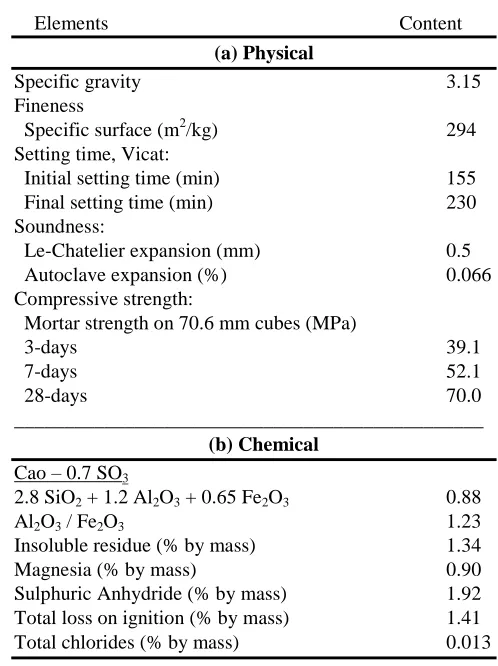
The 53 grade Portland Cement (PC) was used. It conforms to IS 12269:1987 (Bureau of Indian Standards 1987) specifications. The physical and chemical properties of the PC are given in Table 1.
Ash
The pond ash used in this study has been collected from different locations of Parali Thermal Power Station, Parali, Beed, Maharashtra, India. Fig. I shows disposal of pond ash and ash pond. Pond ash was used on as-received basis. The physical and chemical properties of pond ash collected from above source are given in Table 2. in slurry form
[image:2.612.317.566.166.499.2]Fig. I a) Disposal of pond ash b) Ash pond
Table 1.
Physical and Chemical properties of Cement
Elements Content
(a) Physical
Specific gravity 3.15
Fineness
Specific surface (m2/kg) 294 Setting time, Vicat:
Initial setting time (min) 155 Final setting time (min) 230 Soundness:
Le-Chatelier expansion (mm) 0.5 Autoclave expansion (%) 0.066 Compressive strength:
Mortar strength on 70.6 mm cubes (MPa)
3-days 39.1
7-days 52.1
28-days 70.0
_______________________________________________
(b) Chemical
Cao – 0.7 SO3
2.8 SiO2 + 1.2 Al2O3 + 0.65 Fe2O3 0.88
Al2O3 / Fe2O3 1.23
Insoluble residue (% by mass) 1.34
Magnesia (% by mass) 0.90
Sulphuric Anhydride (% by mass) 1.92 Total loss on ignition (% by mass) 1.41 Total chlorides (% by mass) 0.013
Aggregate
International Journal of Emerging Technology and Advanced Engineering
Website: www.ijetae.com (ISSN 2250-2459,ISO 9001:2008 Certified Journal, Volume 4, Issue 6, June 2014)
837
Superplasticizer
[image:3.612.47.289.225.412.2]A commercially available ConplastSP430SRV complies with the requirement of ASTM C 494-80 as a Type G Retarding, High Range Water Reducing Admixture was used.
Table 2.
Physical and Chemical properties of Pond ash
Elements Content a IS Reqt.
(a) Physical
Fineness-passing 45 µm (%) 40.0 - Specific gravity 1.8 -
(b) Chemical
Silicon dioxide, SiO2 61.08 Minimum 35.00
Aluminum oxide, Al2O3 +
Ferric oxide, Fe2O3 32.13
(SiO2+Al2O3+Fe2O3) 93.21 Minimum 70.00
Calcium Oxide, CaO 1.98
Magnesium Oxide, MgO 0.43 Maximum 5.00 Sulfur Tri Oxide, SO3 0.54 Maximum 2.75
Sodium oxide, Na2O 0.25 Maximum 1.50
Loss on ignition 2.2 Maximum 12.00
a IS 3812:1981 = Specification for fly ash for use as
Pozzolana and admixture (Bureau of Indian Standards 1981) and
[image:3.612.47.290.500.715.2]IS 1727:1967 = Methods of test for pozzolanic materials (Bureau of Indian Standards 1967).
Table 3.
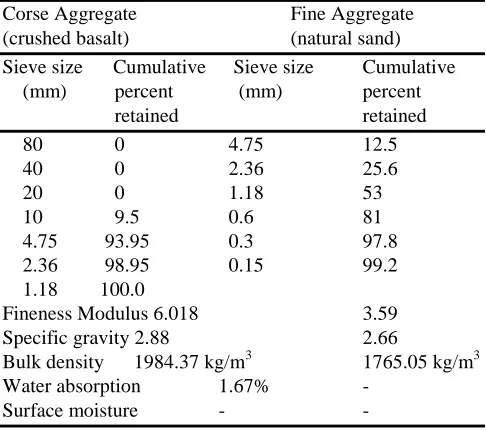
Grading and Properties of Coarse and Fine aggregate
Corse Aggregate Fine Aggregate (crushed basalt) (natural sand)
Sieve size Cumulative Sieve size Cumulative (mm) percent (mm) percent
retained retained
80 0 4.75 12.5 40 0 2.36 25.6 20 0 1.18 53 10 9.5 0.6 81 4.75 93.95 0.3 97.8 2.36 98.95 0.15 99.2 1.18 100.0
Fineness Modulus 6.018 3.59 Specific gravity 2.88 2.66
Bulk density 1984.37 kg/m3 1765.05 kg/m3 Water absorption 1.67% -
Surface moisture - -
IV. CONCRETE MIXTURES
Concrete mix designed for M25 grade concrete. Concrete mix design is the procedure of obtaining various ingredients such as cement, aggregate, water and admixtures, if any, in the most optimal manner so as to produce a concrete at minimal cost having specified properties in fresh as well as in hardened state. Mix was designed as per stipulations laid down in IS 456:2000 and IS 10262:2009 (Bureau of Indian Standards).
The trial mixes was carried out for selection of control concrete and finally mix with 0.49 water cement ratio was finalized. During mix design water absorption and surface moisture of coarse and fine aggregate were taken into account. The concrete mixtures were prepared replacing cement in different proportions with pond ash. The replacement level of pond ash with cement was 25%, 35%, and 45%. Table 5. show concrete mix proportions used in present study.
For all mixtures, slump was maintained between 100-130mm. The water content was varied to keep the slump in the desired range. The laboratory pan mixer of one bag capacity was used for mixing concrete.
Initially all lumps in ash were broken then required quantity of cement and pond ash was mixed with half the quantity of required coarse and fine aggregate till uniform color is obtained. After getting uniform color, ¾ quantities of water and remaining aggregate were mixed and then superplasticizer if required was added. The total mix was completed within 4-5 minutes.
Properties of concrete in fresh state
The properties of concrete in fresh state such as slump and density were observed.
Properties of concrete in hardened state
International Journal of Emerging Technology and Advanced Engineering
Website: www.ijetae.com (ISSN 2250-2459,ISO 9001:2008 Certified Journal, Volume 4, Issue 6, June 2014)
[image:4.612.48.566.156.254.2]838
Table 5. Concrete Mix Proportions
Batch quantity kg/m3 Pond ash
Mix number $ w/b Water Cement Percentage Quantity FA CA
Control 0.49 181 368 - - 645 1271
M1 0.49 181 276 25 92 645 1271
M2 0.49 181 239 35 129 645 1271
M3 0.49 181 202 45 166 645 1271
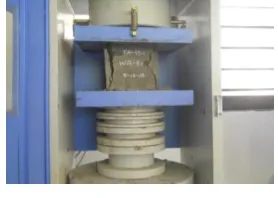
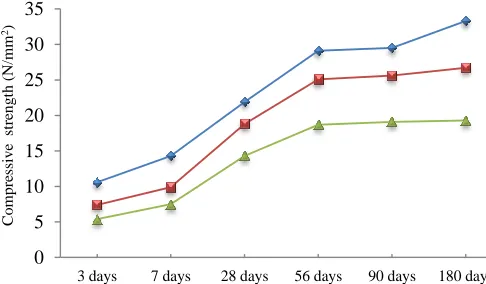
[image:4.612.98.237.302.401.2] [image:4.612.45.575.594.685.2]$ w/b = water/binder = water /(cement + pond ash), FA = Fine aggregate, CA = Coarse aggregate Note: At 45% replacement of pond ash, superplasticizer dose of 0.5% of cement weight was required to maintain desired workability (i.e. 100-130mm). Fig.II Testing of Pond ash concrete cube V. RESULTS AND DISCUSSIONS By observing physical and chemical properties of pond ash given in Table 2, it is known that specific gravity of pond ash is less than general value of specific gravity of cement which reduces density of concrete. Fineness of pond ash passing through 45 µm is 40% which indicates coarseness of pond ash. It was observed that the workability of concrete obtained in the desired range (i.e. 100-300mm) for first two replacement level of pond ash namely 25% and 35%. But at 45% replacement level, workability of concrete in term of slump was less than 100mm and hence superplasticizer dose was added. The dosage of superplasticizer was started from 0.1%, 0.2%, 0.3%, 0.4% and 0.5%. Finally it was observed that at 0.5% dosage desired workability has obtained. Compressive strength of concrete cubes made of different percentage of pond ash is shown in Table 6. Number indicated in bracket shows the compressive strength of cube in comparison to 28 days strength. From the table it is seen that the compressive strength of cubes goes on decreasing as percentage of pond ash increases because of less availability of binding material. For a particular percentage replacement early age (3, 7 and 28 days) compressive strength is relatively lower but it rises as age increases and same thing is represented in Fig II. The reaction of pond ash occurs slowly at early ages with calcium hydroxide which is liberated during hydration of cement but as rate of reaction increased it forms stable calcium silicate and aluminate hydrates. This reaction improves strength and durability of concrete. The results of compressive strength obtained confirms by earlier investigations made by Bharati (2012), Bapat (2006), Bhangale (2013), Chai (2003). Table 6. Replacement analysis of Pond ash Compressive strength (MPa) at various days Sr Mix Repl of pond Slump Density No No ash in % (mm) (kg/m3) 3 7 28 56 90 180
1 Control - 120 2460 21(65)* 24(75) 32(100) 38(118) 44(137) 46(143) 2 M1 25 120 2440 11(50) 14(64) 22(100) 29(132) 29.5(134) 33(151) 3 M2 35 115 2390 7(35) 10(50) 20(100) 25(125) 25.6(128) 26.7(133) 4 M3 45 110 2360 5(35) 8(57) 14(100) 19(136) 19.1(136) 19.3(138)
Repl = Replacement
International Journal of Emerging Technology and Advanced Engineering
Website: www.ijetae.com (ISSN 2250-2459,ISO 9001:2008 Certified Journal, Volume 4, Issue 6, June 2014)
839
0 5 10 15 20 25 30 353 days 7 days 28 days 56 days 90 days 180 days
[image:5.612.60.303.141.283.2]C o mp re ssi v e st re n g th ( N /mm 2)
Fig. II Compressive strength of pond ash concrete at different age
VI. CONCLUSION
From the observations and discussions on test results, following conclusions can be made.
Workability of concrete for 25 and 35 percentage replacement is in the desired range but for 45% replacement level workability of concrete decreases and hence a superplasticizer dose is required. As pond ash contributes to increased surface area, it demands slightly increased water content or addition of admixture.
Early age compressive strength of pond ash concrete is low but later on it continuously increases which indicates that this concrete can be safely used to make concrete with low strength. Fig. III shows relative compressive strength of pond ash concrete for different replacement. The use of pond ash concrete in high volume in mass concrete construction helps us reduce environmental pollution and sustainable development of construction industry. If proper replacement level and procedure is used then pond ash concrete may be used for highway embankments, mass concreting, Plain Cement Concreting (PCC), etc.
Pond ash concrete has high potential to be used as pozzolanic material but more research is required to study other properties and later age strength of concrete.
Acknowledgment
Authors would like to thanks to Director/Principal and Management of KES, Rajarambapu Institute of Technology, Sakharale and KJ College of Engineering and Management Research, Pune for their support and encouragement in research activities.
0 5 10 15 20 25 30 35
3 days 7 days 28 days 56 days 90 days 180 days
[image:5.612.335.551.142.276.2]C o mp re ssi v e st re n g th (N /mm 2)
Fig. III Relative compressive strength of pond ash concrete for different replacement.
REFERENCES
[1] Arumugam K, Ilangovan R, James Manohar D, ―A study on
characterization and use of Pond Ash as fine aggregate in Concrete‖, International Journal of Civil And Structural Engineering, Volume 2, No 2, November 2011, pp.466-474.
[2] Ashis Kumar Bera; Ambarish Ghosh; and Amalendu Ghosh,
―Compaction Characteristics of Pond Ash‖, Journal of Materials in Civil Engineering, ASCE, April 2007, pp.349-357.
[3] Bharathi Ganesh, H.Sharada Bai, R.Nagendra, ―Effective utilization
of pond ash for sustainable construction – need of the hour‖, International Journal of Earth Sciences and Engineering ISSN 0974-5904, Volume 04, No 06 SPL, October 2011,pp.151-154.
[4] Bureau of Indian Standards (1959), ―Method of test for strength of
concrete.‖ IS 516:1959, New Delhi, India.
[5] Bureau of Indian Standards (1963), ―Methods of test for aggregates
for concrete-Mechanical properties.‖ IS: 2386 (Part IV): 1963, New Delhi, India.
[6] Bureau of Indian Standards (1967), ―Methods of test for pozzolanic
materials.‖ IS1727:1967, New Delhi, India.
[7] Bureau of Indian Standards (1976), ―Method of test for determining
setting time of concrete by penetration resistance.‖ IS 8142:1976, New Delhi, India.
[8] Bureau of Indian Standards (1982), ―Recommended guidelines for
concrete mix design.‖ IS: 10262: 2009, New Delhi, India.
[9] Bureau of Indian Standards (1987), ―Specification for 53 grade
ordinary Portland cement.‖ IS12269:1987, New Delhi, India. [10] Bureau of Indian Standards (2000), ―Code of practice for plain and
reinforced concrete (3rd revision).‖ IS 456:2000, New Delhi, India.
[11] Chai Jaturapitakkul and Raungrut Cheerarot, ―Development of
Bottom Ash as Pozzolanic Material‖, Journal of Materials in Civil Engineering, ASCE, Vol.15, Jan/Feb 2003, pp.48-53.
International Journal of Emerging Technology and Advanced Engineering
Website: www.ijetae.com (ISSN 2250-2459,ISO 9001:2008 Certified Journal, Volume 4, Issue 6, June 2014)
840
[13] J. D. Bapat; S. S. Sabnis; C. V. Hazaree; and A. D. Deshchowgule,
―Ecofriendly Concrete with High Volume of Lagoon Ash‖, Journal of Materials in Civil Engineering, ASCE, Vol. 18, May/June 2006, pp.453-461.
[14] Maharashtra State Power Generation Co. Ltd., ―Fly ash Utilization of MahaGenco TPS‖, June 2010, 1-17.
[15] Ministry of Environment and Forests (MoEF) Notification, New
Delhi, 3rd April, 2007, published in The Gazette of India:
Extraordinary [Part II-Sec.3(ii)].
[16] Nader Ghafoori and Yuzheng Cai, ―Laboratory- made roller
compacted concretes containing dry bottom ash: Part I – Mechanical properties‖, ACI Material Journal, Vol. 95, No.2, March-April 1998.
[17] Nader Ghafoori and Yuzheng Cai, ―Laboratory- made roller
compacted concretes containing dry bottom ash: Part II – Long term durability‖, ACI Material Journal, Vol. 95, No.3, March-April 1998.
[18] Report of Centre for fly ash research and management (C-FARM)
web link, www.c-farm.org.
[19] State Environment Related issues Department of Forests, Ecology
and Environment, Government of Karnataka, ―ENVIS Newsletter‖, Vol.2 No. 6, January 2007, 1-5.
![[LVIC LIMSI]: Using Syntactic Features and Multi polarity Words for Sentiment Analysis in Twitter](data:image/gif;base64,R0lGODlhAQABAIAAAP///wAAACH5BAEAAAAALAAAAAABAAEAAAICRAEAOw==)