International Journal of Emerging Technology and Advanced Engineering
Website: www.ijetae.com (ISSN 2250-2459,ISO 9001:2008 Certified Journal, Volume 4, Issue 7, July 2014)
192
A Review on Effect of High Strain Rate on Mechanical
Behavior of Al based MMCs
S. P. Nawale
1, R. T. Vyavahare
2, A. S. Aradhye
31 2,3
Department of Mechanical Engineering, SPSPM’s SKN Sinhgad COE, Korti, Pandharpur, India
Abstract— In recent years Metal matrix composites
(MMCS) are relatively new range of materials possessing
several characteristics that make them useful in situations where low weight, high strength, high stiffness, and an ability to operate at elevated temperatures are required. Aluminum
based MMCS exhibit an attractive combination of mechanical
and physical properties such as high stiffness and low density,
which favours their utilization in many structural
applications. The ability to withstand dynamic loading is an important design criteria for many structures in aerospace, automotive, marine and civil engineering applications. Thus,
increasing the structural applications of Al MMCS is the
driving force for the need to adequately understand its deformation and dynamic behavior under various types of dynamic loading conditions. Kolsky introduced the SHPB technique for dynamic testing of specimens. In this investigation an attempt has been made to provide an extensive literature review on the effect of high strain rate on
mechanical behavior of Al MMCS.
Keywords—Metal Matrix Composites (MMCs), High Strain Rate, Split Hopkinson Pressure Bar (SHPB), Dynamic Loads,
Flow stress-strain behavior.
I. INTRODUCTION
Metal matrix composites (MMCs) are the forerunners amongst different classes of composites. Over the past two decades metal matrix composites (MMCs) have been transformed from a topic of scientific and intellectual interest to a material of broad technological and commercial significance. Metal-matrix composites (MMCs) are attractive engineering materials since their properties can be enhanced or tailored through the addition of selected reinforcement. Aluminium based MMCs have received increasing attention in recent decades as engineering materials with most of them possessing the advantages of high strength, hardness and wear resistance. In particular, light-weight aluminum- matrix composites (AMCs) have been the focus of much study an account of their outstanding specific properties at room or elevated temperatures. These properties make aluminum-matrix composites strong candidates for a wide range of applications in automobile, aerospace and defense industries (fig. 1).
However, the most demanding uses of AMCs are dependent on the high-strain-rate properties. To achieve the high performance required in the material's projected applications, a good understanding of the dynamic deformation and fracture behaviour of AMCs under different dynamic loading is essential.
[image:1.612.324.564.295.476.2]
Figure 1: Possible scenarios where materials encounter high strain rate conditions.
International Journal of Emerging Technology and Advanced Engineering
Website: www.ijetae.com (ISSN 2250-2459,ISO 9001:2008 Certified Journal, Volume 4, Issue 7, July 2014)
193
II. SPLIT HOPKINSON PRESSURE BAR TECHNIQUE
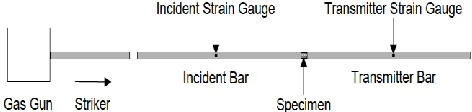
Many techniques have been devised in attempts to study material behavior at high rates of loading. Of these, the split Hopkinson pressure bar (SHPB) technique is probably the most prominent (fig. 2). The concept behind the mechanism was initially introduced by Bertram Hopkinson [1] in 1914. Hopkinson developed a method to measure the pressure produced by a blow such as that produced by a bullet or the detonation of an explosive. The work done by Hopkinson was revisited by Robertson [2] in 1921 and later by Landon and Quinney [3] in 1923. Eventually in 1948, Davies [4] modified the technique to use condensers for measuring the displacements in the pressure bar. These could be related to the pressures in the explosion given that the elastic limit of the bar was not exceeded. This advancement made significant improvement in the certainties of the pressure histories.
[image:2.612.50.286.407.463.2]In 1948, Kolsky [5] added a second pressure bar to the setup. Between two bars, he sandwiched a thin specimen. On the input bar, he used a cylindrical condenser microphone to measure the amplitude of the pressure pulse produced by firing a detonator at the free end of the input bar.
Figure 2: Schematic of a Compressive Split Hopkinson Bar Apparatus
A striker bar is used to impact the end of the bar known as the incident bar. A gas gun is the most common method used to propel the striker. As a result of the impact, an elastic compression wave is generated in the incident bar. Strain gauges located on both the incident and transmitter bars are used to measure the waves as they travel along the respective bars. The reflected pulse (εr) yields information
on the strain rate involved in the specimen ant the transmitted wave (εt) gives the stress in the specimen. The
stress (σ), strain (ε) and strain rate (έ) in the specimen are given by;
A, L, E and C0 are cross-sectional area, length, modulus
and elastic respectively, and s and b refer to the specimen and bar respectively. For the equations to be used for SHPB testing following assumptions must be valid: (a) the material deforms homogeneously during the test; (b) the wave propagates through the bars with minimal dispersion and finally, (c) the stress in the bars never exceeds the elastic limit of the bar material.
III. PREVIOUS WORK DONE ON HIGH STRAIN RATE
MATERIAL BEHAVIOR OF AL BASED MMCS
I. W. Hall et al. [6] had experimentally tested the different metal matrix composites at strain rates from quasi-static to high strain rate up to 3000 s-1. Two further techniques were applied during the SHPB testing in this study. First, Longitudinal strain during the test was restricted using; loose-fitting, high strength steel collars placed around the cylindrical test pieces. The second technique was to reload, in the SHPB, samples that had already been pre-strained to a level determined either by the collars or by selection of the striker bar velocity. He obtained the typical stress-strain curves of Short fiber-reinforced MMC, whisker –fiber-reinforced MMC and Particulate reinforced MMC at increasing strain rates from quasi-static to high strain rate up to 3000 s-1. He found that short fiber-reinforced MMC’S showed significantly greater strain rate sensitivity of the flow stress than the unreinforced alloy. He summarized that Whisker reinforced MMC showed rate insensitive flow stress behavior at 5% strain and experienced decreasing flow stress at high strain rates. And for Particulate-reinforced MMC was observed to be rate sensitive at all strain values.
International Journal of Emerging Technology and Advanced Engineering
Website: www.ijetae.com (ISSN 2250-2459,ISO 9001:2008 Certified Journal, Volume 4, Issue 7, July 2014)
194
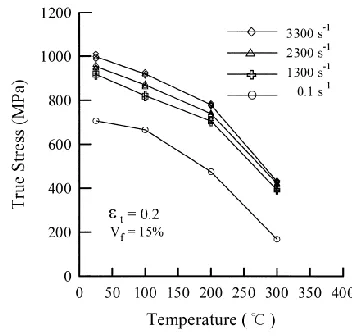
[image:3.612.353.529.134.302.2]The effects of temperature and strain rate on the properties of carbon-fiber-reinforced 7075 aluminum ally MMC was studied by Woei-Shyan Lee et al. [8]. He studied the mechanical properties and fracture behavior of 7075-T6 aluminum alloy reinforced with 0.15 Vf of laminated carbon fiber for the effects of strain rate between 10-1 s-1 to 3.3×10³ s-1 and temperature between 25-450°C. He obtained Stress-strain curves of Al fiber-reinforced MMC deformed at 25, 200, 300°C under strain rate ranging from 10-1 s-1 to 3.3×10³ s-1. He observed that the flow stress of composite is sensitive to both strain rate and temperature, and that temperature increase noticeably reduces the strain-rate dependence of the flow stress (fig 3 & 4). Fracture strain was found to be greater at low strain rates, increasing, however, with strain rate and temperature in the dynamic range. He observed that at strain rates below 103 s-1, the strain rate had only a slight influence on the flow stress and above 103 s-1, the strain-rate sensitivity increased rapidly, and stress is a linear function of strain rate. He also summarised that ductile fracture occurs more frequently with an increasing temperature and strain.
[image:3.612.55.270.385.567.2]Figure 3: Relationship between flow stress and strain rate.
Figure 4: Variation of flow stress as a function of temperatures
K. T. Ramesh et al. [9] studied the mechanical response of an A359/SiCp MMC and the A359 aluminum matrix to
dynamic shearing deformations by using a new design of the thin-walled tubular specimen for the torsional Kolsky bar. This approach has been used to characterize the high shear strain rate (103 s-1) behavior of an A359/SiCp and its
corresponding A359 monolithic alloy with the torsion Kolsky bar. He studied and observed the tensile stress-strain curves for both materials for quasi-static and high strain rate loading and characterized the torsional response and the damage mode associated with the shearing stress state in these MMCs. He observed that the flow stress of the composite in shear increases in the presence of SiC particles which results in strengthening of the composites, whereas the failure strain is reduced. High strain rate response of Aluminum 6092/B4C composites were studied
by K. T. Ramesh et al. [10]. Aluminum 6092/B4Cp (boron
International Journal of Emerging Technology and Advanced Engineering
Website: www.ijetae.com (ISSN 2250-2459,ISO 9001:2008 Certified Journal, Volume 4, Issue 7, July 2014)
195
He observed that the fabrication route affects the strength of the matrix material as a result of changes in the microstructure. He found that Monolithic matrix material produced by extrusion shows higher strength than similar materials that had undergone sintering and HIPing.
Experimental study on tensile behavior of carbon fiber and carbon fiber reinforced aluminum at different strain rates was carried out by Yuanxin Zhou et al. [11]. Dynamic and quasi-static tensile behaviors of carbon fiber and unidirectional carbon fiber reinforced aluminum composites were investigated. The high-rate tensile tests were carried out using the bar-bar tensile impact apparatus (BTIA). The experimental results were obtained which show that carbon fiber is a strain rate sensitive material. He observed the Strength loss in carbon fiber in carbon fiber reinforced aluminum. High temperature processing not only decreased the strength of fiber, but also change scatted of strength. A one-dimensional statistical constitutive equation was established to describe tensile stress–strain relationship of the composite at different strain rates.
Wojciech MOCKO et al. [12] developed the constitutive model of the Al MMC reinforced by a silicon carbide. They carried out experimental investigation of Al based MMCs reinforced by silicon carbide of volume fraction equal to 0%, 10%, 20% and 30% to capture the stress-strain curves over wide range of strain, strain rate. In this paper the experimental results were compared with data calculated by means of the analytical model. Images from the optical microscope investigations were studied and they observed the damage of reinforcement gains in the prestrained material. It was assumed that softening effects of specimen due to reinforcement particle damage are proportional to strain and reinforcement volume fraction.
Compressive behavior of high particle content B4C/Al
composite at elevated temperature was studied by Xian-feng LI and et al. [13]. Compressive properties of the aluminum matrix composite reinforced with 55% B4C particles were characterized using Gleeble 3500 thermal-mechanical testing machine. He experimentally obtained the compressive stress-strain curves at the temperature ranging from 298 to 773 K and strain rate ranging from 1×10⁻³ to 5 s-1. He observed that the ultimate compressive strength, whatever the strain rate is, decreases when the temperature of the specimen increases from 293 to 773 K. He also found that the flow stress of the composite increases as the strain rate increases from 1×10⁻³ to 5 s-1. He concluded that the composite fails from the creep phenomenon to multiple micro-cracking with the increase of the strain rate.
IV. CONCLUSION AND RECOMMENDATIONS FOR FUTURE
WORK
The current Literature review reveals that, extensive work has been done to find out the mechanical behavior of Al based MMC materials over wide range of strain rates by changing the fraction of volume of reinforcement. In all literature review it is observed that, the flow stress-strain behavior of the Al based MMC is found to be dependent on both strain rate and fiber volume fraction. In future there is need to manufacture Al based Particulate MMC material reinforced with Fly Ash of different volume fraction and to evaluate the dynamic mechanical behavior of Al-fly Ash MMC under high strain rate using SHPB technique.
REFERENCES
[1] Hopkinson, B. A, ―Method of measuring the pressure produced in the detonation of high explosives or by the impact of bullets‖. Philosophical Transactions of the Royal Society of London. Series A, Containing Papers of a Mathematical or Physical Character, 213, 437-456, 1914.
[2] Robertson, R., ―Some properties of explosives‖. Journal of the Chemical Society, Transactions, 119, 1-29, 1921.
[3] Landon, J. W. and Quinney, H., ―Experiments with the Hopkinson pressure bar‖. Philosophical Transactions of the Royal Society of London. Series A, Containing Papers of a Mathematical or Physical Character, 103, 622-643, 1923.
[4] Davies, R. M., ―A critical study of the Hopkinson pressure bar‖. Philosophical Transactions of the Royal Society of London. Series A, Mathematical and Physical Sciences, 240, 375-457, 1948. [5] Kolsky, H.,―An investigation of the mechanical properties of
materials at very high rates of strain‖. Proceedings of the Physical Society. Section B, 62, 676-700, 1949.
[6] M. Guden and I. W. Hall, ―Dynamic properties of metal matrix composites: a comparative study‖. Material Science and Engineering, A 242, 141-152, 1998.
[7] Woei-Shyan Lee and Wu-Chung Sue, ―Dynamic compressive strength and filure of carbon fiber reinforced Aluminum metal matrix composite‖. Department of Mechanical Engineering, National Cheng Kung University, Taiwan 701,
[8] Woei-Shyan Lee, Wu-Chung Sue and Chi-Feng Lin, ―The Effects of temperature and strain rate on the properties of carbon-fiber-reinforced 7075 aluminum alloy metal matrix composite‖. Composite science and Technology, 60, 1975-1983, 2000.
[9] Yulong Li, K. T. Ramesh and E. S. C. Chin, ―The mechanical response of an A359/SiCp MMC and the A359 aluminum matrix to
dynamic shearing deformations‖. Material Science and Engineering, A 382, 162-170, 2004.
[10] H. Zhang, K. T. Ramesh and E. S. C. Chin, ―High strain rate response of aluminum 6092/B4C composites‖. Material Science and
International Journal of Emerging Technology and Advanced Engineering
Website: www.ijetae.com (ISSN 2250-2459,ISO 9001:2008 Certified Journal, Volume 4, Issue 7, July 2014)
196
[11] Yuanxin Zhou, Ying Wang, Shaikh Jeelani and Yuaming Xia, ―Experimental study on Tensile behavior of carbon fiber and carbon fiber reinforced Aluminum at different strain rates‖. IMS/4: International conference on the applications of traditional and high performance material in harsh environment, 2010.
[12] Wojciech Mocko, Zbigniew L. and Kowalewski, ―Mechanical properties of the A359/SiCp metal matrix composite at wide range of strain rates‖. Applied Mechanics and Materials, Vol. 82, pp 166-171, 2011.
[13] Bin LIU, Wen-mao HUANG, Hao-wei WANG, Ming-Liang WANG and Xian-feng LI, ―Compressive behavior of high particle content B4C/Al composite at elevated temperature‖. Transactions of