Harmonising nursing terminologies using
a conceptual framework
Jansen, K, Kim, TY, Coenen, A, Saba, V and Hardiker, NR
http://dx.doi.org/10.3233/9781614996583471
Title
Harmonising nursing terminologies using a conceptual framework
Authors
Jansen, K, Kim, TY, Coenen, A, Saba, V and Hardiker, NR
Type
Article
URL
This version is available at: http://usir.salford.ac.uk/id/eprint/43558/
Published Date
2016
USIR is a digital collection of the research output of the University of Salford. Where copyright
permits, full text material held in the repository is made freely available online and can be read,
downloaded and copied for noncommercial private study or research purposes. Please check the
manuscript for any further copyright restrictions.
Harmonising Nursing Terminologies
Using a Conceptual Framework
Kay JANSENa1, Tae Youn KIMb, Amy COENENa, Virginia SABAc, Nicholas HARDIKERd
aInternational Council of Nurses, Switzerland, University of Wisconsin-Milwaukee, USA bInternational Council of Nurses, Switzerland, University of California Davis, USA cUniformed Services University, Bethesda, MD & SabaCare Inc., Arlington, VA, USA
dInternational Council of Nurses, Switzerland and University of Salford, UK
Abstract.The International Classification for Nursing Practice (ICNP®) and the Clinical Care Classification (CCC) System are standardised nursing terminologies that identify discrete elements of nursing practice, including nursing diagnoses, interventions, and outcomes. While CCC uses a conceptual framework or model with 21 Care Components to classify these elements, ICNP, built on a formal Web Ontology Language (OWL) description logic foundation, uses a logical hierarchical framework that is useful for computing and maintenance of ICNP. Since the logical framework of ICNP may not always align with the needs of nursing practice, an informal framework may be a more useful organisational tool to represent nursing content. The pu rp ose of thi s stud y wa s t o c la ssi fy IC NP nu rsi n g d ia gn oses using the 21 Care Components of the CCC as a conceptual framework to facilitate usability and inter-operability of nursing diagnoses in electronic health records. Findings resulted in all 521 ICNP diagnoses being assigned to one of the 21 CCC Care Components. Further research is needed to validate the resulting product of this study with practitioners and develop recommendations for improvement of both terminologies.
Keywords. Nursing diagnosis, International Classification for Nursing Practice, Clinical Care Classification, nursing terminology, electronic health records
Introduction
The Clinical Care Classification (CCC) is a terminology that includes nursing diagnoses, outcomes, and interventions organised by 21 Care Components to support documentation of the nursing process. A nursing care component (e.g., Cardiac, Medication) is a navigational or high-level abstract concept or component of the framework within which 176 CCC nursing problems are organised [1]. Similar to CCC, the International Classification for Nursing Practice (ICNP) is used to represent nursing diagnoses, outcomes, and interventions. ICNP is a much larger and more sophisticated terminology that uses a formal ontological approach for organisation. That is, concepts are classified according to their related formal properties [2]. Differences in content coverage and structural foundation mean that these two nursing terminologies have the potential to complement one another. The CCC conceptual framework of 21 high-level categories
1Kay Jansen. E-mail: [email protected].
W. Sermeus et al. (Eds.) © 2016 IMIA and IOS Press.
This article is published online with Open Access by IOS Press and distributed under the terms of the Creative Commons Attribution Non-Commercial License.
might provide a means of bringing the two terminologies together and examining shared meaning and organisation using a unified, systematic approach.
A harmonisation agreement between the International Council of Nurses (ICN) and SabaCare was established in 2012 [3]. As part of the initial harmonisation project, a subset (n=176) of ICNP nursing diagnoses judged as problems were mapped to the CCC System as the target terminology. This phase of harmonisation resulted in 93% coverage (n=164) by ICNP to an equivalent CCC nursing diagnosis or problem [4]. As part of on-going efforts, the purpose of this study was to further examine ICNP nursing diagnosis concepts that did not have an equivalent in CCC. The research aim was to classify the ICNP nursing diagnoses or problems into one of the 21 Care Components (the conceptual framework) of the CCC. It is expected that resulting outcomes will become a foundation for enhancing the quality of both terminologies and supporting the harmonisation effort.
Methods
In this study, ICNP 2015 Release was a source terminology with 805 nursing diagnoses that are judged as either negative or positive. Since CCC Version 2.5 only includes problems, the ICNP concepts were limited to include only those diagnoses judged as negative (n=521). This includes ICNP nursing diagnoses that were either actual problems or potential problems (e.g. risks). Of the 521 ICNP concepts, 164 diagnoses were previously mapped to CCC problems identified in 21 Care Components [4]. Accordingly the remaining 357 ICNP nursing diagnoses became the unique source concepts for this study, requiring manual search of placement within the CCC framework.
In order to classify the 357 ICNP nursing diagnoses with a negative judgment (those representing nursing problems) into the 21 Care Components, two members of the project team independently assigned each ICNP concept to one of the CCC 21 Care Components. Formal ICNP concept definitions and the textual definitions of the CCC Care Components guided this process. Although researchers initially identified multiple categories in the CCC Components for ICNP concepts, the decision was made to be mutually exclusive in categorisation; one category per ICNP concept. It also was decided to ‘force” each ICNP concept into one of the 21 Care Components. In other words if a match was not immediately apparent, the experts were directed to classify the concept into the best fit using the 21 categories. The experts independently completed the classification and then compared findings to identify any disagreements. When an agreement was not met, a third member of the team was consulted and discussion ensured consensus.
Results
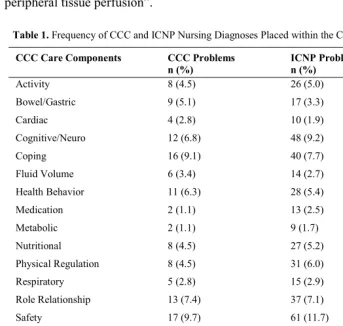
Table 1 shows a frequency distribution of all CCC and ICNP nursing diagnoses problems assigned to one CCC Care Component. The total frequency reported (n=521) included those ICNP diagnoses with an equivalent CCC problem (n=164) from a previous study [4] and the additional 357 diagnoses categorised in this study). The range of problems or diagnoses per Care Component varied widely. For example, the Care Component “Tissue Perfusion” included only one CCC diagnosis and three ICNP diagnoses while “Safety” included 17 CCC problems and 61 ICNP diagnoses. The CCC Care Component with the most ICNP concepts was “Safety”. Examples of ICNP concepts in the Safety
K. Jansen et al. / Harmonising Nursing Terminologies Using a Conceptual Framework
component included “Tendency to wander” and “Risk for radiation exposure”. The second most frequently assigned Component was “Role Relationship”. Examples of concepts in this category included “Lack of family support” and “Conflicting cultural beliefs”. The least frequently used CCC category was: “Tissue Perfusion”. ICNP diagnoses in this category included “Risk for ineffective tissue perfusion” and “Impaired peripheral tissue perfusion”.
Table 1.Frequency of CCC and ICNP Nursing Diagnoses Placed within the CCC Conceptual Framework
CCC Care Components CCC Problems
n (%)
ICNP Problem or Nursing Diagnoses n (%)
Activity 8 (4.5) 26 (5.0)
Bowel/Gastric 9 (5.1) 17 (3.3)
Cardiac Cognitive/Neuro Coping Fluid Volume Health Behavior Medication Metabolic Nutritional Physical Regulation Respiratory Role Relationship Safety Self-Care Self-Concept Sensory Skin Integrity Tissue Perfusion Urinary Elimination Life Cycle TOTAL 4 (2.8) 12 (6.8) 16 (9.1) 6 (3.4) 11 (6.3) 2 (1.1) 2 (1.1) 8 (4.5) 8 (4.5) 5 (2.8) 13 (7.4) 17 (9.7) 8 (4.5) 10 (5.7) 12 (6.8) 7 (3.9) 1 (.57) 7 (3.9) 10 (5.7) 176 (100) 10 (1.9) 48 (9.2) 40 (7.7) 14 (2.7) 28 (5.4) 13 (2.5) 9 (1.7) 27 (5.2) 31 (6.0) 15 (2.9) 37 (7.1) 61 (11.7) 16 (3.1) 39 (7.5) 22 (4.2) 18 (3.5) 3 (0.6) 19 (3.6) 28 (5.4) 521 (100)
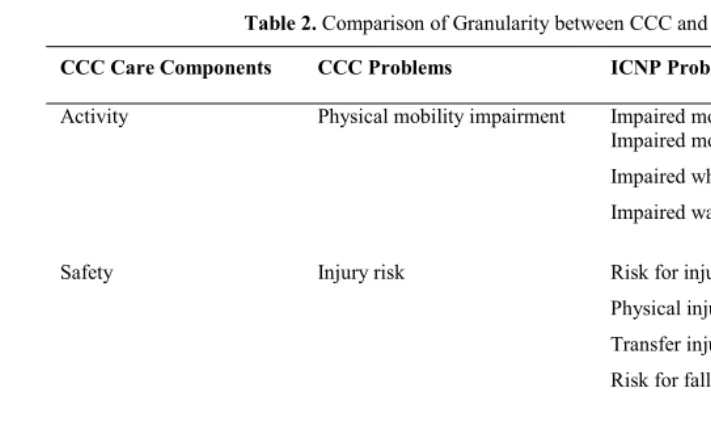
Table 2.Comparison of Granularity between CCC and ICNP
CCC Care Components CCC Problems ICNP Problem or Nursing Diagnoses
Activity Physical mobility impairment Impaired mobility (exact match) Impaired mobility in bed
Impaired wheelchair mobility
Impaired walking
Safety
Sensory
Injury risk
Pain
Risk for injury (exact match)
Physical injury from abuse
Transfer injury
Risk for fall-related injury
Pain (exact match)
Allodynia
Phantom pain
Hyperalgesia
Abdominal pain
Although consensus was reached among the experts, there was considerable discussion about a number of concepts that both experts had difficulty assigning to one of the 21 Care Components. Two major difficulties appeared with: (a) concepts that might fit more than one category and (b) concepts that could not easily fit any category. Examples of ICNP concepts that fit multiple Care Components included “Agitation” which was classified as a Cognitive Component based on the CCC definition “elements involving the mental and cerebral processes”. “Agitation” also was considered as a possible candidate for the “Coping” Component, defined as “elements that involve the ability to deal with responsibilities, problems, or difficulties. An example of an ICNP nursing diagnosis that did not easily classify into any Care Component was “Lack of access to transportation”. The decision was to assign this concept to the Care Component “Health Behavior”.
Discussion
The findings of this study suggest that the CCC 21 Care Components provide a comprehensive framework for nursing problems. The wide range in the number of ICNP concepts per Care Component (3 to 61) raised some questions about the granularity or specificity of the Components. There also were challenges to classifying a number of ICNP concepts suggesting the need for further research. A framework that is comprehensive enough to capture the scope of nursing and yet also parsimonious and thus able to be applied in practice will always be evolving as the science of the profession evolves. Continuing to test these frameworks can advance the understanding of both the science of nursing and the ability to represent the knowledge of the practice in tools and resources such as terminologies.
K. Jansen et al. / Harmonising Nursing Terminologies Using a Conceptual Framework
This study examined the use of a conceptual framework or model, the CCC Care Components, to classify ICNP nursing diagnosis or patient problem concepts. This project moves us closer to a broader harmonisation of nursing content. In addition, this new classification structure provides an alternative view of ICNP, with diagnostic classes grouped according to the CCC conceptual framework. This project augments the previous equivalency table (1:1 mappings) between CCC and ICNP nursing diagnoses [5]. Data collected and stored using either ICNP or CCC can assist in practitioners’ decision-making to improve patient safety, health care quality, and care coordination across settings and healthcare providers.
The classification rules were strict for this study because it was the first attempt at using the CCC Care Components to organise ICNP nursing diagnoses. This initial set of ICNP nursing diagnoses or problems categorised by the 21 Care Component Framework of the CCC will require further review. The plan is to proceed with external validation by experts and potential testing in practice. Mutual improvement to both CCC and ICNP is expected through further research and may for example include consideration of new Care Components.
Acknowledgments
The authors would like to thank the International Council of Nurses and SabaCare, Inc. in supporting this study.
References
[1] V.K. Saba, Clinical Care Classification (CCC) System Version 2.5 User’s Guide, 2nd ed., Springer Publishing Company, New York, NY, 2012.
[2] International Council of Nurses (ICN). International Classification for Nursing Practice (ICNP). (June 2014). ICN, 2014. Available from: http://www.icn.ch/what-we-do/international-classification-for-nursing-practice-icnpr/
[3] International Council of Nurses (ICN). Harmonizing nursing terminology internationally: Collaboration
between the International Council of Nurses and SabaCare. (June 2012). ICN, 2012. Available from:
http://www.icn.ch/images/stories/documents/news/press_releases/2014_PR_02_ICNP_SNOMED.pdf [4] A. Coenen, F. Paese, V. Saba, K. Jansen, N. Hardiker, & T.Y. Kim. Harmonizing Nursing Terminologies.
In I. Sarkar, A. Georgiou and P. Marques, (Eds). Medinfo2015: eHealth-enabled Health, Proceedings of the 15thWorld Congress on Health & Biomedical Informatics. (pp.776-779). Amsterdam: IOS Press.
[5] A. Coenen, V. Saba, K. Jansen, N. Hardiker, & T.Y. Kim. CCC-ICNP Equivalency Table for Nursing