Jordanian construction sector
Arif, M, AlZubi, M, Gupat, A, Egbu, CO, Walton, R and Islam, RUBINA
http://dx.doi.org/10.1108/ECAM0920150144
Title
Knowledge sharing maturity model for Jordanian construction sector
Authors
Arif, M, AlZubi, M, Gupat, A, Egbu, CO, Walton, R and Islam, RUBINA
Type
Article
URL
This version is available at: http://usir.salford.ac.uk/38458/
Published Date
2017
USIR is a digital collection of the research output of the University of Salford. Where copyright
permits, full text material held in the repository is made freely available online and can be read,
downloaded and copied for noncommercial private study or research purposes. Please check the
manuscript for any further copyright restrictions.
For Peer Review
Knowledge Sharing Maturity Model for Jordanian Construction Sector
Journal: Engineering, Construction and Architectural Management Manuscript ID ECAM-09-2015-0144.R1
Manuscript Type: Original Article
Keywords:
Knowledge sharing, Knowledge management, knowledge transfer, Construction management, knowledge management systems, Project management
Abstract:
For Peer Review
Knowledge Sharing Maturity Model for Jordanian Construction Sector Abstract
Purpose - This purpose of the paper is to present a maturity model developed to assess Knowledge Sharing (KS) for the Jordanian construction sector.
Design/methodology/approach - The research was conducted in three stages. The first stage consisted of the review of literature and documenting variables from the literature that
highlight influence on KS in organisations. The second stage was designed for maturity
model development by identifying the cultural factors that affect KS in the Jordanian
construction sector through questionnaires and interviews. Factor analysis was used to find
possible relationships between the cultural variables followed by semi-structured interviews.
In the third stage the initial maturity model was refined through another set of semi-structured
interviews.
Findings – The model presented in the paper includes three levels of maturity.The first level identifies whether the variable barely exists in company’s KS practices. The second level
shows the occasional techniques which the company uses to increase KS activities. The final
level demonstrates the importance of the variable in affecting KS as being fundamentally
ingrained in the company’s vision, mission, strategy and operations.
Originality/value -The research has developed a model that can be used to measure the KS in an organisation. Although the model has been applied to the construction industry, it can
easily be modified to fit other sectors. 3
For Peer Review
1. Introduction
In today’s business environment knowledge management (KM) is considered a key
part of an organizational strategy in order to effectively use the in-house expertise and create
sustainable competitive advantage. Nowadays, companies are facing an environment
characterized by levels of complexity, globalization and dynamism. Furthermore, the
dynamic global business market is distinguished by the rapid growth in the construction
sector; globalization consequences and various world trade agreements have created a
revolution in the business environment. Hari et al., (2005) stated that construction
organizations have been managing knowledge informally for years, but the challenges facing
today’s industry mean that most organizations need a more structured, coherent approach to
knowledge management (KM). Therefore, construction companies need to pay greater
attention to their knowledge base and the way they use their existing knowledge to compete.
Sharing of knowledge or knowledge sharing (KS) is a major challenge for organizations due
to variety of reasons and there is a need for understanding the main factors that have an
impact on KS to be able to apply knowledge retention practices effectively. KS activities are
of utmost importance for knowledge retention because when the employees leave or are let
go by the organizations the knowledge and expertise goes with them (Bender and Fish, 2000).
When the economy declines or for any other reason companies have to cut costs, mass layoff
is the first measure (but maybe not the best) companies take to cut costs. If a KS framework
is in place the knowledge which may have been lost with the exiting employees can be
retained in the organisation. Several scholars have pointed out the impact of culture on KS
activities (Arif et al., 2009; Ma and Wang, 2008; Al-adaileh, 2011; and Issa and Haddad
2008; Riega 2005; Sackmann and Friesl 2007; Siakas, et al., 2010). Arif et al., (2015) argued
national culture (NC) as one of the major barriers to effective KS. Magnier-Watanabe and
Senoo (2010) found organizational characteristics to be a stronger prescriptive factor in KM
compared to NC.
This paper is divided into six sections. The next section presents a review of relevant
literature which was done to determine current KS practices in Arab countries and identify
the variables that impact KS. Since literature about Jordan was limited and work culture is
similar in the Arab world, inputs from Arab countries could easily be adopted for Jordan.
Section 3 documents the research methodology followed for the development of maturity
models. Following the methodology section, the factor analysis and semi-structured interview
results of Stage one are presented. Next, the initial maturity model is presented followed by 3
For Peer Review
maturity model refinement where the results of semi-structured interviews conducted in the
second stage are presented.
The fifth section outlines the final maturity model and summarizes the research and discusses
the findings. Finally key conclusions of this research are presented.
2. Literature review
Arab management systems are hugely influenced by the Arabic language, the
extended family, tribes, history, and traditional values. Islam also remains the most important
aspect of Arab culture and is considered to be a symbol of identity (Sabri, 2004; Agnala,
1998). Undesirable behaviors, uncertainty and risk are avoided and the long term survival of
business is one of the main priorities of top managements of Jordanian organizations (Sabri,
2004).Lok and Crawford (2004) explain that culture strongly affects leadership style and has
an impact on their outcome, organizational commitment, expectation, subordinate
performance, and job satisfaction. Hofstede (2001) characterizes the Arab business culture by
high power distance, high uncertainty avoidance, collectivism and masculinity. Trust in
organizational terms is usually fostered on a leadership level and cascaded down. The flatter
the organization, the less there will be issues around trust (Plessis, 2006). Plessis (2006)
states that recognition is a very important empowerment tool that encourages people to
participate in KS activities. Gopalakrishnan and Santoro (2004) argue that both
organizational structure and organizational culture (OC) have been identified as necessary
elements for any KM initiatives’ success. The current business environments are
characterized by globalization, dynamism, and increasing levels of complexity due to rapid
changes in technology and its connected intricate knowledge (Siakas et al., 2010). However,
the construction sector has been slow to recognize the benefits of Information Technology
(IT) as a major communication tool (Egbu, 2001). Tlaiss and Kauser (2011) state that
understanding of social networks in the Arab world is limited with only a handful of studies
that have provided evidence of how social connections can support career advancement.
Family businesses can be defined as businesses where at least two family members are
involved both as owners and managers (Simon and Hitt, 2003). According to Weir and
Hutchings (2005), this combination may play a rather different role in Jordan and Arab
business organizations for the evident reason that the business organization as such is usually
structured in terms of familial structures and the discourse of the family and its internal and
external relations is readily applied. Haddad and Issa (2008) highlight the importance of 3
For Peer Review
management support to be included as part of the work process and mentoring in KS, and
indicate that organizational support and culture have a bigger effect than IT on KS.Employee
relationships are an index for examining the satisfaction, respect, confidence, justice and trust
relationships between employee and employer. Knowledge Sharing creates useful
relationships and project interest has to be put above personal interest (Siakas et al., 2010).
Power distance (PD) is the degree of acceptance or perception of normality in terms of
inequality among people of a country. This dimension varies over a continuum from favoring
equality (low PD) to accepting inequality (high PD) (Ribiere et al., 2010) and Arab countries
are considered high-PD (Klein et al., 2009). Klein et al., (2009) defined uncertainty
avoidance (UA) as the degree to which members of a society feel uncomfortable with
uncertainty and ambiguity, and they found that Arab countries have high-UA. Workers in
individualist societies envision knowledge creation as an intervention of individual effort,
while workers in collectivist societies think of the integration and modification of existing
knowledge as a group effort (Yoo and Torrey, 2002). Autonomy from a corporation
perspective is the extent to which an individual or group of individuals has the freedom,
independence, and discretion to determine what actions are required and how best to execute
them (Manz, 1992). In the context of knowledge, all members of an organization should be
allowed to act autonomously as far as circumstances permit (Nonaka and Takeuchi, 1995).
Cultures that are high in masculinity may have less knowledge transfer between
organizational members if the competition is between individuals and no difference if
competitiveness is between organizations (Rivera-Vazquez et al., 2009).
As discussed above, a variety of cultural factors are presented in the literature that
affects KS from both an organizational and national culture perspective. Hofstede (2001)
presented 13 variables related to Arab culture that have an impact on KM issues with five of
those variables including, power distance, uncertainty avoidance, masculinity/femininity, and
autonomy having an impact on KS as supported by subsequent studies (Siakas and
Georgiadou, 2010; Chen et al., 2010; Liu, 2009; Megdadi, 2009; Rivera-Vazquez et al.,
2009). In addition to the five NC variables, eleven OC variables have been chosen from the
literature including, leadership behavior, organizational structure, organizational form,
reward system, recognition, communication technology, social networking, relationship
between employees, trust, and management commitment.
A Maturity Model is a phased approach to improving business processes over a considerable period of time. Maturity is achieved at the advanced level when processes are not only being managed well, but staffs are involved in continuous process improvement on a daily basis (Martin et al., 2005). Maturity 3
For Peer Review
models in areas involving process and high performance delivery are proving to be useful because they allow individuals and organisations to self-assess the maturity of various aspects of their processes against benchmarks (Neuhauser, 2004). One of the earliest examples of maturity models is Maslaw’s hierarchy of needs (Maslow, 1954). Kuznets (1965) developed a models to document economic growth and Nolan (1979) developed a maturity model for IT implementation in organisations. More recently, maturity models have been developed for a range of applications. Albliwi et al., (2014) presented a detailed review of literature on maturity models in business process management. Based on the levels in the maturity model, patterns of organisational evolution and change can be predicted. Maturity models typically represent theories about how an organization’s capabilities evolve in a stage-by-stage manner along an anticipated, desired, or logical path (Roglinger
et al., 2012). Some other applications of maturity models recently have been applied to hospital information system (De Carvalho et al., 2016), e-government (Karokola et al., 2012), process improvement (Forstner et al., 2014), and enterprise network (Manzanedo et al., 2012) to name a few.
In the area of KM, Lotti (2014) presented a maturity model using equations to calculate the probability of the company to fit in to a certain level of maturity. The model gives an
organization the ability to evaluate the level of its maturity and assess ways to achieve higher
levels. Serna (2012) suggested that knowledge should be managed along with the human
experience of knowledge itself and that proper management of such knowledge is required.
An application of a maturity model with a number of small and medium enterprises in Brazil
is presented by Oliveira et al. (2014). One of major findings of Oliveira et al., (2014) is the
need to invest in knowledge documentation and better relationships with business partners. A
model to manage transdisciplinary knowledge and to strengthen the social benefits of
transdisciplinary research is presented by Serna (2015). Khatibian et al., (2010) presented an
amalgamated model by combining three different published maturity models as an
assessment instrument for evaluating knowledge management maturity level of the
organizations. Using the ideas of quality management and process engineering, Paulzen et al.,
(2002) developed a new model called Knowledge Process Quality Model to assess and
improve KM structures and better control knowledge processes.. Hendriks (1999) presented a
model to study the impact of information and communication technology (ICT) on
motivational factors of KS. Hendriks (1999) concludes that ICT should be related to
motivation for KS, KS should be recognized as an umbrella term for different concepts, and
other factors should also be considered explicitly for effective KS. Cabrera and Cabrera
(2005) presented how the people management practices and socio-psychological factors
positively impact KS in an organisation. Ipe (2003) presented a model for KS between 3
For Peer Review
individuals, factors that impact KS, and the relationships between those factors. Bartol and
Srivastava (2002) studied the role of monetary rewards on encouraging KS and determined
that rewards are important to KS. The Bartol and Srivastava (2002) study also provided
guidelines on how to implement rewards for effective KS for four different mechanisms. Hall
(2001) presented strategies to make intranet input-friendly, factors that promote intranet
contributions by the employees, and information contributed by the employees to the intranet
can be used/managed effectively. However, the research by Hofstede (2001) suggests that
there would be a significant impact of culture on management practices and processes and KS
is one of them. Therefore, it is important to incorporate the cultural aspects in a KS maturity
model and incorporate culture specific evaluation parameters. Therefore, this paper presents the development of a knowledge sharing maturity model for Jordan. The key research question is what the main variables are and what their different maturity levels that should be used to assess KS in Jordanian construction organisations are.
3. Methodology
This paper presents a maturity model developed to assess KS for the Jordanian
construction sector. The research was conducted in three stages. The first stage consisted of
the review of literature and documenting variables from the literature that highlight influence
on KS in organisations. Papers that highlight some specific variables about Arab culture that
have impact on KS in organisations were also reviewed for this research. This led to the
development of an initial list of variables. The next step was to choose a way forward and
examine relevant data collection and analysis methodologies. The two commonly used basic
research methods are: the quantitative and qualitative methods. According to Bryman and
Bell (2015), the quantitative method requires the collection of statistical/numerical data
demonstrating a view of the relationship between theory and research. Quantitative methods
are understood to be easily replicable due to use of standard mathematical formulas. On the
other hand, “the qualitative method tends to be concerned with words rather than numbers”
Bryman and Bell, (2015). The findings of qualitative research are focused acknowledging the
qualities of phenomena rather than their mathematical measurement. The qualitative method
covers the subject of study holistically. It produces a wealth of detailed data on a small
sample and the data collection is not restricted to predetermined categories or themes (Hyde,
2000). For this research the establishment of correlations between variables in order to
organize the knowledge sharing variables into smaller number of groups was important. This 3
For Peer Review
approach required the use of a quantitative methodology specifically factor analysis. Factor
analysis is a collection of methods used to examine how underlying constructs influence the
responses on a number of measured variables (DeCoster, 1998). Exploratory factor analysis
(EFA) attempts to discover the nature of the constructs influencing a set of responses
(DeCoster, 1998). Factor Analysis was used to describe the variability among the indicators
initially identified through literature review using a questionnaire survey. This enabled in the
reduction of the number of indicators and the formation of three factor groups as presented in
figure 1. This is stage two of the paper. This stage was designed for maturity model
development by identifying the cultural factors that affect KS in the Jordanian construction
sector through questionnaires and interviews. This also led to the development of maturity
levels to assess the cultural impact through interviews. Factor analysis was used to find
possible relationships between the cultural variables. In addition, semi-structured interviews
which are a qualitative technique were conducted in stage one to verify the questionnaires
data and to understand how cultural factors affect KS. Semi-structured interviews allow much
more flexibility of response, with a conversational style between the interviewer and the
interviewee (Fergusson and Langford, 2006). The interviews also helped to develop maturity
levels able to assess that impact. The initial maturity model was developed in stage two. In
the third stage the initial maturity model was refined through another set of semi-structured
interviews. Since both quantitative and qualitative methods were used, the overall approach
for this paper could be classified as mixed methods approach.
4. Factor Analysis and Semi-Structured Interviews
A survey was conducted at the 2010 Jordanian Builders Conference. Participants were
chosen from five of the biggest construction companies in Jordan. To obtain appropriate data,
middle and high level managers that were familiar with KS activities were chosen. The
respondents had to rank each variable in terms of the effect on KS by using a five point Likert
scale with response options ranging from “strongly agree” to “strongly disagree.” A total of
153 responses were received, of which 103 participants were male and 50 were female. The
social research software SPSS was used to statistically analyze the data. An Exploratory
Factor Analysis (EFA) was conducted to develop mutual exclusive categories of variables.
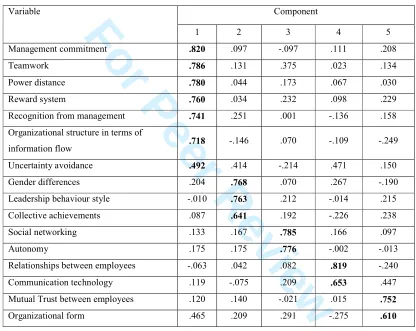
Table 1 shows the rotated component matrix with the factor loading for each variable. The
five main factors and the variables included in each factor are as follows: 3
For Peer Review
Factor 1: Management Commitment, Teamwork, Power Distance, Reward System,
Recognition from Management, Organizational Structure, and Uncertainty Avoidance
Factor 2: Gender Differences, Leadership Behavior Style, and Collective Achievements
Factor 3: Social Networking and Autonomy
Factor 4: Relationships between Employees and Communication Technology
[image:10.612.97.513.218.549.2]Factor 5: Mutual Trust between Employees and Organizational Form
Table 1: Rotated Component Matrix
Variable Component
1 2 3 4 5
Management commitment .820 .097 -.097 .111 .208
Teamwork .786 .131 .375 .023 .134
Power distance .780 .044 .173 .067 .030
Reward system .760 .034 .232 .098 .229
Recognition from management .741 .251 .001 -.136 .158 Organizational structure in terms of
information flow .718 -.146 .070 -.109 -.249
Uncertainty avoidance .492 .414 -.214 .471 .150
Gender differences .204 .768 .070 .267 -.190
Leadership behaviour style -.010 .763 .212 -.014 .215
Collective achievements .087 .641 .192 -.226 .238
Social networking .133 .167 .785 .166 .097
Autonomy .175 .175 .776 -.002 -.013
Relationships between employees -.063 .042 .082 .819 -.240
Communication technology .119 -.075 .209 .653 .447
Mutual Trust between employees .120 .140 -.021 .015 .752
Organizational form .465 .209 .291 -.275 .610
After completing factor analysis, interviews were arranged with four senior managers in
construction companies. This was done to understand how the organizational and national
culture variables affect KS in the construction sector in Jordan and to support the data that
was collected from the questionnaires. Semi-structured interviews were organized and
questions were designed to understand the impact of the variables on KS. Open ended
questions on how each variable impact KS and how these variables are dealt with were asked.
Respondents were given three different solutions to choose from including, good, medium or
bad. The intent was to identify maturity levels for each variable which helped in designing 3
For Peer Review
the proposed maturity model. All participants agreed that all the variables in the questionnaire
affect KS practices. The feedback from the participants is discussed next.
Leadership behavior: The participants agreed that a leader can create a friendly environment
between employees or suitable work environment to share knowledge smoothly and give
employees the chance and time to talk through their ideas about certain issues. On the other
hand, if he/she could not manage the bonding relations among employees, this would
unfortunately create sensitive relations among employees and between employees and their
leaders.
Reward system and recognition: Due to the relationship between these variables, the
participants suggested combining these two variables onto one as a motivation variable.
According to Plessis (2006) rewards go hand in hand with recognition. Employees want to be
recognized and rewarded for the contribution of intellectual capital that they make towards
the knowledge base of the organization, and also for the way they assist in improving the
innovativeness of the organization through new and creative solution building. The
participants agreed that motivation affects KS as employees may feel unwilling to share
information when they are not recognized or rewarded for their achievements. The
participants thought that a reward system should be inclusive to all employees in the
company and that there should be proof that there is a reward/recognition for sharing
knowledge.
Collectivism and teamwork: The participants suggested combining collectivism and
teamwork. According to the participants’ experience, they recommended that all employees
should work as one team in the company, and there should be a team organizer to make sure
that all employees work as a team and support communication between teams to increase
information exchange.
Gender differences: Three participants suggested that there are no differences between
employees in the work place which can affect KS. However, one participant (female)
suggested that different genders affect KS. From her point of view, she was not willing to
share knowledge with her male colleagues if she felt that they were anti-feminist which has
an effect on relationships between employees and their trust in each other. To overcome this 3
For Peer Review
problem, the company should strengthen the equal rights for both female and male employees
through training sessions on how to get along with both genders.
Organizational structure: Two participants agreed that for efficient information exchange, it
is important to ask the right person and recommend a hierarchical structure for information
flow in a construction company. However, another two participants pointed out that
hierarchical procedure can slow the information flow and sometimes knowledge has to be
shared as quickly as possible. It can be argued that none of the structures completely support
KS practices. A combination of the two structures with the following traits is proposed:
• The structure should support information flow by creating communication channels
between departments.
• The structure should be suitable for employees at different levels to send and receive
information easily.
Organizational form: Since most of the construction companies in Jordan are family owned,
family members have more power and better incentives than others, even if they are in lower
positions. The participants recommended that the owner should hire people based on their
abilities and not based on personal relationships and all employees should be treated equally.
Also, if the owner receives information from a relative, the owner should verify the
information by listening to the other party.
Mutual Trust: The participants suggested that a company should strive to create a trustful
environment in the workplace to increase KS practices between the management and the
workforce which can be done through meetings and seminars to solve trust issues. All
participants agreed that this variable is very important for KS and has a relation to other
variables such as organizational form, leadership behavior and gender. However, sometimes
it is not important for all employees to know certain information. Such information might be
confidential or too important to be shared which can negatively affect company performance,
goals and vision.
Communication Technology: Based on the survey we found that the companies provide
employees with basic communication technology such as telephones, internet, PC/laptops and
mobile phones, but they are not available for all employees especially at project sites. 3
For Peer Review
According to the participants, this affects KS in terms of cost, time, and effort. If there is a
direct connection between project sites and the head office through an internet server
available to all employees, then this helps in increasing KS.
Social networking: Participants use social networking for personal life but were not aware of
use of social networking for KS. It can be argued that the use of social networking in the
Jordanian construction sector is limited and some companies are not aware of the benefits of
social networking in terms of KS.
Power distance: Jordanian society accepts inequality of power distributions (high power
distance) with more powers to family members which adversely impacts KS. The participants
suggested that the company’s policy should emphasize employing the right person for the
right position, regardless of relationship with the owner.
Uncertainty avoidance: According to the participants, when employees avoid issues they are
not familiar with or they do not have enough information about them, that can affect KS
negatively. Sometimes employees do not have the required information to complete their
tasks and on the other hand, the participants argued that it is not necessary to keep all
employees updated with what is going on in the company. The company can solve this
problem by training sessions, job manuals, and through daily meetings and memos.
Relationships between employees (outside the company): Relationship between employees is
the key for trust, and when there is trust between employees there is increased KS. Good
relationships create a trustful and friendly work environment. However, female employees do
not like outside relationships with male employees because of the conservative nature of
Jordanian society. Companies may encourage better relationships among employees by
organizing activities outside the company such as a party or dinner hosted by the
management.
Autonomy: According to the participants, autonomy can affect KS practices in terms of the
degree of freedom that employees perceive in decision making. It can be argued that the
leadership behavior determines the level of autonomy within organizations. However, the
participants pointed out that the employees do not have always the freedom to share their
ideas with the management, which indicates low empowerment. The Jordanian construction 3
For Peer Review
sector can be categorized as high autonomy, and that affects empowerment among employees
to share their knowledge. The participants suggested that the company should increase
empowerment for all employees despite their position.
Management commitment: According to the participants, the management has to support and
encourage employees to share knowledge. Management supports certain positions which
depend on the employee experience and the value of knowledge. Top management support is
not inclusive. For example, civil engineers or designers with years of experience are seen as a
company assets and may be treated differently. All the participants suggested daily meetings,
seminars, memos and supportive technology that the management should to adopt to increase
KS.
Based on the interviews, we concluded that all variables included in the questionnaire
affect KS practices in the construction industry in Jordan. Most respondents were familiar
with the importance of KS and the variables discussed and they suggest that companies
should give more attention to those variables and KS practices. Relationships between some
variables were also discovered after discussions with the participants. Since recognition and
reward systems shared the same goal, which is motivating employees in sharing knowledge;
the two variables were combined as a motivation variable affecting KS. Also, team work can
be affected by collectivism in terms of KS; therefore, we combined both variables as
collective achievements. Thus, the cultural variables were reduced from 16 to 14.
The factor analysis output categorized the 16 variables into five groups but based on
the mergers explained above and rearrangement of some of the variables the groups where
reduced to three. Factor analysis results showed that the first group included management
commitment, teamwork, power distance, reward system, recognition, organizational
structure, and uncertainty avoidance relate to management variables. Hence we categorized
the seven variables as the management variables group. The second, third and fourth groups
also contained seven variables including gender differences, leadership behavior, collective
achievements, social networking, autonomy, relationship between employees, and
communication technology. All these variables relate to communication and hence we
categorized the seven variables as the communication variables group. The last group
contained two variables including mutual trust and organizational form. However, since the
first group deals with management variables, leadership behavior was moved into the first
group. As discussed above, reward system and recognition were merged and renamed 3
For Peer Review
motivation. Teamwork from the first group is merged with collectivism as collective
achievements. The three groups are shown in figure 1.
Figure 1: Groups/factors after semi-structured interviews
5. Model development
For developing the model relationships and the interactions between the cultural
variables were considered. The impact of variables on KS was incorporated with the three
maturity levels. For example, the third level of organizational form variable shows the
interaction between this variable and power distance. Arab countries are high power distance
which means the people accept unequal power distribution in the society. Since most
construction companies in Jordan are family businesses managerial positions are granted to
family members and relatives, even if they are not suited for those jobs. Family members
have more power even if they are at lower positions in hierarchy. To avoid this problem a
third level was designed to ensure equal rights for all employees even for relatives or family
members as part of the company’s values and strategy. The interview questions were
designed to assess the cultural impact by giving three solutions to participants on how to
avoid an impact. The participants had to rate three suggested solutions for each variable as
good, medium or bad. The reason for choosing three levels was to make it easier for
participants to distinguish between the levels. The more levels one has, the more difficult it
becomes to distinguish characteristics at each level and it becomes more difficult to see the Group 1:
Management Variables
Management commitment Power distance Leadership behavior Motivation
Organizational structure Organizational form Uncertainty avoidance
Group 2: Communication
Variables
Relationship between employees
Gender differences Communication technology Social networking Collective achievements
Group 3: Trust Variables
Mutual trust Autonomy 3
For Peer Review
difference. The first level identifies whether the variable barely exists in company’s KS
practices. The second level shows the occasional techniques which the company uses to
increase KS activities. The final level demonstrates the importance of the variable in affecting
KS as being fundamentally ingrained in the company’s vision, mission, strategy and
operations.
The model required further refinement to make it practical for the Jordanian
construction sector. So the next step was to refine the proposed model through more
interviews. Six middle and high level managers were interviewed after reviewing their
position, responsibilities, decision making power and awareness of KS principles to collect
significant information to support the research findings. All of the participants worked as
project managers, held at least a Bachelor’s degree in civil engineering with more than 10
years of work experience, and acknowledged KS practices. The interviews took
approximately forty minutes each to complete. In addition, the proposed framework was
introduced to participants and questions asked relating to the contents of maturity levels for
each variable and their relevance to the participants.
The first question in the interview focused on the variable groups to validate variable
assignment to groups. Four participants agreed that each variable was in the right place but
two participants were not sure whether some variables belonged to their group. One belief
was that the organizational form is related to the management variables category. Another
belief was that relationship between employees variable is more closely related to the trust
variables group. Thus, relationship between employees variable was moved from the
communication to the trust variables group and organizational form variable moved into the
management variables group.
The second question was on the clarity of the definitions for variables. The participants
recommended improving the definitions of power distance and uncertainty avoidance. The
participants were then asked about the contents of three maturity levels for each variable. In
terms of the motivation variable, the participants found level 2 was not clear enough, thus
more explanation was needed. Some other variable definitions including, leadership behavior
style (level 2), power distance (level 1), and autonomy (level 1, 2 and 3) were also suggested
to be improved. The uncertainty avoidance variable was not clear to participants in terms of
maturity levels. They believed that sometimes employees should not know everything in the
company since some items are sensitive and could negatively affect the company’s goals.
Also, there was a suggestion from participants that training sessions should be added in level
2 of the management commitment variable. The final comment about maturity levels was 3
For Peer Review
about the collective achievements variable. According to participants, there were no links
between levels 2 and 3 and they believed that both levels asked the same question or
concentrated on the same activity.
The participants were also asked if the three maturity levels were enough to assess the
impact of cultural variables on KS. Additional KS practices where recommended to
participants that could be added in the framework to find suitable practices or enough
maturity. But the participants agreed that the three maturity levels were enough to assess that
impact in their companies. The final question was whether they had further comments on the
framework. Two participants suggested that personality and monitoring variables should be
included in the framework. One participant argued that all variables in the framework affect
KS and they can be controlled only in a suitable environment without personality issues. It
can be seen from both answers that focusing on the personality variable is difficult to assess.
Based on the feedback from the participants the initial framework was modified to give more
clarity and to make it more appropriate for the Jordanian construction sector. Table 2 shows
the refined framework, and highlights the changes that were made according to the
participants’ recommendations. If for any variable, the answer at level 1 is a “no”, then that
means that it is at a level 0 and it needs to establish a system to incorporate that variable
within the organization. 3
For Peer Review
Table 2: The Refined Framework
Variables Level 1 Level 2 Level 3
Barely exist but not implemented
Occasional use by the company
Fundamentally ingrained in the company vision, mission, strategy, and operations
Management Variables:
Motivation: How does the company motivate
employees to share knowledge?
Is there a reward for KS? Before Refinement: Is it all
inclusive?
Is the reward system just participatory or
based on the value of KS?
After Refinement: Is it
inclusive for all employees?
Management commitment: How do top
managers support knowledge sharing practices to
provide a suitable environment for KS practices in
the workplace?
Does it support KS? Is it
one of the management
properties?
Before Refinement: Do they
emphasize KS through regular
memos/meeting?
Is it part of the vision, mission, and strategy
of the company?
After Refinement: Do they
emphasise KS through regular
memos/meeting or training
sessions?
Leadership behaviour Style: How do leaders
behave to encourage and support employees to
share knowledge?
Are leaders task-oriented
or people-oriented?
Before Refinement: If
people-oriented, do leaders involve
other employees in decision
making?
Do leaders enhance employees through
sharing vision, strategy and values rather
than power and control?
After Refinement:If the firm is
people-oriented, do leaders
http://mc.manuscriptcentral.com/ecaam 3
For Peer Review
involve subordinates in decisionmaking?
Power distance: The extent to which members of
a society accept that power in institutions and
organisations is and should be distributed
unequally.
Before Refinement:Is
the power distributed
equally in the company?
If no, do employees accept that
situation and share knowledge?
Is the company’s policy emphasis on
employing the right person for the right
position?
After Refinement:Is the
power/decision making
distributed equally in the
company?
Uncertainty Avoidance: The degree to which
members of a society feel uncomfortable with
uncertainty and ambiguity, and support beliefs
promising dimensions that will affect sharing new
information among the company members (Klein,
et al., 2009).
Are all employees up to
date with what is going
on in the company?
Does the company make clear
any uncertain issues to all
employees through seminars,
meetings and memos?
Does the company have a manual or job
description for each job in the company
operation? And is it part of the company’s
strategy and procedures to share the new
knowledge to employees in a short time?
Organizational Structure: Division of tasks
between individual employees, groups or
departments and locations. To control the work of
an entity, procedural methods and measures are
adopted which support KS activities.
Does it support
information flow?
Is it suitable for all employees
from different levels to send and
receive information easily?
Is it part of the company procedures which
supports ease of information flow with fewer
boundaries between divisions?
After Refinement: Organizational Form
(Family business): How do family members in the
company affect knowledge sharing activities and
Are top managers related
to the company’s owner?
If yes, this might affect
If yes, do they share the whole
information with others?
Does the company’s vision, value and
strategy stress that all employees are equal,
even relatives (business is business)?
http://mc.manuscriptcentral.com/ecaam 3
For Peer Review
how do employees react with them in terms ofknowledge exchange?
KS, top managers might
give wrong information
to the owner to keep
his/her position.
Communication Variables:
Autonomy: The extent to which an individual or
group of individuals has the freedom,
independence and discretion to determine what
actions are required and how best to execute them,
and how this kind of freedom affect KS activities
within the company (Migdadi, 2009).
Before Refinement: Do
employees prefer to
manage themselves?
If yes, is it for all employees of
any level?
Is it part of the company’s strategy and
processes provide independence for
individuals and groups to share knowledge?
After Refinement: Do
employees prefer to
manage themselves and
take responsibilities?
If yes, is it for all employees at
any level or just for certain
positions?
Is it at individual or group
level?
Is it part of the company’s strategy and
processes to give autonomous personal
responsibilities through participated decision
making to increase knowledge sharing?
Before Refinement: Relationships between
employees (outside the company): The social
activities which employees do outside the company
to strengthen the connection between them to
increase KS and the company role support these
activities.
Are employees doing
social activities outside
the company?
Does the company do outside
activities for employees to
strengthen the communication
between staff?
Is it part of the company’s strategy to build
strong relationships between employees to
share knowledge?
Communication technology: The amount of
communication technology the company provides
to increase KS among employees such as laptop,
Does the company
provide all employees
with the basic
Is it up to date? Are there
training sessions for the new
technology?
Does the company have an annual budget for
up grading communication technology?
http://mc.manuscriptcentral.com/ecaam 3
For Peer Review
phone, fax, PC, and internet. technology for KS?Social networking: The interaction between
groups of people who share a common interest;
using social contacts to network. Using internet
network groups to network and communicate
between each other for faster and easier to access
information exchange.
Is it accessible to all
employees for
knowledge exchange?
Is there social networking
between outside locations and
company’s headquarter office?
Do the company’s management keep up
dating social network systems in the
company to raise KS activities among
employees?
Gender differences: Focuses on the degree the
society reinforces, or does not reinforce, the
traditional masculine work role model of male
achievement, control, and power which affects
female members in sharing knowledge.
Are both genders equal
in the work place in
terms of KS?
If not, does the company
encourage sharing knowledge
between male and female
members through training
sessions in how to work with
different genders?
Does the company’s policy/regulation stress
equal rights for both male and female staff to
increase knowledge sharing?
Collective achievements: Focuses on the degree
the society reinforces collective achievements and
interpersonal relationships.
Do employees work as a
team or individually?
Before Refinement: Does the
company emphasise teams
working together through
working at the same task to
exchange information?
Before Refinement: Is it part of the
company’s values, mission, procedures and
strategy to make sure all employees in the
company work together as one team through
continual meetings/memos?
After Refinement: Does the
company emphasise team work
through seminars/meetings to
exchange information or
After Refinement: Is it part of the company’s
values, mission, procedures and strategy to
make sure all employees or teams in the
company work together as one team through
http://mc.manuscriptcentral.com/ecaam 3
For Peer Review
experience? strengthening the communication channels
between teams and training sessions to
increase knowledge sharing?
Trust Variables:
Mutual trust between employees Are there trust issues
between employees
affecting KS?
Does the company set up
seminars/meetings to solve trust
issues to increase KS?
Is it at an individual or group
level?
Do the company’s policies create a trusting
environment to make sure knowledge
sharing is perceived fair and willingly
recognized among employees?
After Refinement: Relationships between
employees (outside the company): The social
activities which employees do outside the company
to strengthen the connection between them to
increase KS and the company role support these
activities.
Are employees doing
social activities outside
the company?
Does the company do outside
activities for employees to
strengthen the communication
between staff?
Is it part of the company’s strategy to build
strong relationships between employees to
share knowledge?
Before Refinement: Organizational Form
(Family business): How do family members in the
company affect knowledge sharing activities and
how do employees react with them in terms of
knowledge exchange?
Are top managers related
to the company’s owner?
If yes, this might affect
KS, top managers might
give wrong information
to the owner to keep
his/her position.
If yes, do they share the whole
information with others?
Does the company’s vision, value and
strategy stress that all employees are equal,
even relatives (business is business)?
http://mc.manuscriptcentral.com/ecaam 3
For Peer Review
6. Results and Discussion
In summary, the research was conducted through two data collection stages. The first
stage included two steps for maturity model development. The first step was conducted
through self-administered questionnaires, and the data was analyzed by using the computer
software package SPSS. The descriptive analysis provided the research with significant
results in terms of identifying the cultural variables that affect KS in the Jordanian
construction sector. The results showed that the selected cultural variables do affect KS
practices; however, the awareness of OC factors is higher compared to NC factors. The
results of factor analysis showed that the investigated helped grouping the variables. Further
investigation was required to validate factor analysis results. The second step was designed to
support the results gathered from questionnaires through semi-structured interviews. The
results gave a better understanding of the cultural factors in affecting KS and confirmed some
relationships between variables. From the questionnaire and interview results a maturity
model was developed. In the second stage modifications including, maturity levels content
and factor definitions were made to the suggested framework. These considerations were
therefore taken into account for the final development and refinement of the maturity model.
Arif et al., (2015) have presented relative importance of the three factors in KS. They
concluded that the most important factor is trust, which is followed by the management
factors and finally the communication factors. 3
For Peer Review
Figure 2: Schematic Representation of the Maturity Model Elements
Figure 2: Schematic Description of the Maturity Model Priorities
Figure 2 shows the three cultural factors groups that affect KS practices within
construction organisations, and classifies each group in terms of its contribution or influence
on KS. The management factors are focused on encouraging employees to share their
knowledge, by adopting managerial strategies and techniques. Leadership behaviour and
management commitment factors are responsible to enhancing KS as a cultural value among
subordinates through encouragement, support and build up strong relations with them. In
terms of the motivation factor, rewarding or recognising KS contribution will motivate
employees to increase KS activities within organisations. The other factors including
organisational form (family business), power distance, uncertainty avoidance and
organisational structure allow the company to create an environment that encourages the
company members to share knowledge. Organisational form (family business) describes the
relationship between family members or relatives with other employees in terms of KS. Most
of the powerful positions are given to family members even if they are not suitable for that
job, and family members do share knowledge with people they trust the most. Therefore, this
type of form should close the gap between family members and other employees, and
encourage them to share their knowledge despite of their relation to the owner. In addition, Management
Factors Communication
Factors
Trust Factors
Communication Technology
Social Networking
Autonomy
Gender Differences
Collective Achievement
s Management
Commitment Mutual
Trust
Relationship between employees
Uncertainty Avoidance
Power Distance
Organisational Form Organisational
Structure Leadership
Behaviour Motivation 3
For Peer Review
the power within organisations has to be distributed equally among the company members
which creates a trustful environment to share knowledge. On the other hand, the
organisational structure type is supporting the information flow within firms in order to send
and receive the knowledge at the right time, and to the right person which increases KS
activities. Therefore, it is expected that when the organizational structure is less formalized,
less centralized, and more integrated, social interaction among organizational members is
more favourable which increases knowledge sharing activities. In terms of uncertainty
avoidance, sometimes employees feel unconformable with uncertain issues that affects
negatively on the company’s performance and minimize KS practices. To avoid uncertainty
within organisations, employees have to be continually updated with changes through memos
or meetings, and provided with instructions (job manual) to gain knowledge and share it with
others. It can be argued that the management factors create an encouragement environment
in order to increase KS.
On the other hand, the communication factors facilitate KS practices and increases the
communication channels inside and outside the company by adopting techniques and tools
that support KS effectively. For instance, through communication technology and social
networking it becomes easier for employees to send or receive knowledge in the right time, at
the right place, and for the right person. Moreover, gender differences, autonomy and
collective achievements reduce the gap between employees. Gender differentiation can affect
negatively on KS practices such as in an Arab culture where female employees have limited
rights compared to males. These differences have an influence on the relationships and trust
between employees to share knowledge. Organisations with high level of autonomy, the gap
between managers and subordinates are smaller compared with low autonomy organisations.
High level of autonomy gives opportunity for employees to share decision making, take
responsibility and build strong relationships between managers and subordinates which
supports KS. In terms of collective achievements, working in teams or as one team within
organisations provides a chance for employees to exchange information with colleagues and
gain more experience or knowledge to complete tasks.
Trust factors is considered a core group for KS, without mutual trust and strong relationships
between employees knowledge can be difficult to be shared. The relationship between
employees is the key for mutual trust in terms of KS; people are not willing to share
information with others that they do not trust. Mutual trust can be achieved by building strong
relationships between employees through social activities that can be internal or external to 3
For Peer Review
the company. It can be argued that the trust factors group is essential for successful KS
implementation, and the other two groups depends on the trust factors to increase KS. By
covering the three groups, organisations can install KS as a culture value among employees.
Through this research the key research question has been answered. The model can be used in
several ways. It could possibly be used as a scoring tool with each maturity level scored at 1,
2, and 3 respectively. If an organization does not have a variable that is being assessed at all,
then it could be scored a “0.” The aim of this model is to provide an overall score but to
assess the level and identify opportunities for improvement. Therefore an organization could
be at level 2 of maturity along one variable and level 1 of another variable and that is all that
can be determined about the organization. What is not going to be achieved is an overall
rating of the organization for KS. Arif et al., (2015) presented the relative importance of the
factors but the relative importance of the variables within a factor has not been identified, so
they could be either assumed to be of equal importance or the organization using this
maturity model could develop an importance scale. The second implication is that this model
helps identify the opportunity of improvement and the way to achieve this improvement. This
could be used as a decision tool by organisations to assess what they want to improve and
how. As Akre (2012) pointed out about maturity models, not every organization using a
maturity model would want to achieve the highest level of maturity along all parameters.
However, a maturity model gives a firm the visibility to decide what to improve and how.
It is also important to list limitations of this research. The first limitation is that the
variables within a factor have not been prioritized and it is assumed that all variable have
equal impact on knowledge sharing. The second limitation of this research is that it does not
present an application of the maturity model on a case study. These two areas of research
should be undertaken by future researchers.
7. Conclusion
KS is an important element for any organisation. This research has developed a
maturity model for assessing the KS for the Jordanian construction sector. A range of
variables were documented from literature and then were classified into three categories. The
most important of these variable being trust. Initiatives and systems that lead to the
improvement of trust between employees is the most important factor for KS. Activities and
events both on a social level and formal events at work are quite important when it comes to
developing trust among employees. The second most important factor is the management 3
For Peer Review
factor. Seven variables makeup the management factor and include power distance,
uncertainty avoidance, motivation, leadership behavior, management commitment,
organizational structure and organizational form. The third factor is the communication factor
which includes variables such as autonomy, social networking, collective achievement,
communication technologies and gender differences affect the communication factor in
Jordanian construction section. The model presented in table 2 could be used to assess KS in
any construction sector organization in Jordan. The model presented can also be used to
identify opportunities for improvement. The maturity model presents three levels of maturity.
If a firm is assessed as an organization at level 2 for a certain variable, it can strategize ways
to advance to level 3. If the finding is that even at level 1 the answer is “no” then the
organization is at a level 0 and should work at incorporating that variable within the
organization. This maturity model will help organisations in identifying their level of
maturity and the opportunities for improvement.
References
Agnala, A.A. (1998), “Management development in the Arab world”, Education and
Training, Vol.40 No 4/5, pp. 179-180.
Akre, V. (2012), “An Evaluative Framework To Measure The Maturity Of Free/Open Source Software (F/Oss) From User Perspectives”, Unpublished PhD Thesis, University of Salford.
Al-Adaileh, R.M. (2011), “The impact of organisational culture on knowledge sharing: the
context of Jordan’s Phosphate Mines Company”, International Research Journal of Finance
and Economics, Vol. 63.
Albliwi, S.A., Antony, J., and Arshed, N. (2014, December), “Critical literature review on maturity models for business process excellence”, In Industrial Engineering and Engineering Management (IEEM) proceedings of the IEEE International Conference, 2014, pp. 79-83
Arif, M., Mohammed, A., and Gupta, A. (2015), “Understanding knowledge sharing in the
Jordanian construction industry”, Construction Innovation, Vol. 15 No. 3, pp. 333 – 354.
Arif, M., Egbu, C., Alom, O. and Khalaf, M.A. (2009), “Measuring knowledge retention: a
case study of a construction consultancy in the UAE”, Engineering Construction and
Architectural Management, Vol. 16 No. 1, pp 92-108.
Bartol, K.M., and Srivastava, A. (2002), “Encouraging knowledge sharing: The role of
organizational reward systems”, Journal of Leadership & Organizational Studies, Vol. 9 No.
1, pp. 64-76. 3
For Peer Review
Bender, S. and Fish, A. (2000), “the transfer of knowledge and the retention of expertise: the
continuing need for global assignment”, Journal of Knowledge Management, Vol. 4 No. 2,
pp. 125-137.
Bryman, A., and Bell, E. (2015), “Business research methods”, Oxford university press. Cabrera, E.F., and Cabrera, A. (2005), “Fostering knowledge sharing through people
management practices”, The International Journal of Human Resource Management, Vol. 16
No. 5, pp. 720-735.
Chen, J., Sun, P.Y.T. and McQueen, R.J. (2010), “‘The impact of national cultures on
structured knowledge transfer”, Journal of Knowledge Management, Vol. 14 No. 2, pp.
228-42.
de Carvalho, J.V., Rocha, Á., and de Vasconcelos, J.B. (2016), “Maturity models for hospital information systems management: Are they mature?”, In Innovation in Medicine and Healthcare, 2015, Springer International Publishing, pp. 541-552.
DeCoster, J. (1998), “Overview of factor Analysis” available online at
http://www.stat-help.com/notes.html, last accessed 24th October 2011
Fergusson, H., & Langford, D. (2006), “Strategies for managing environmental issues in
construction organizations”, Engineering, Construction and Architectural Management, Vol.
13 No 2, pp. 171-185.
Forstner, E., Kamprath, N., and Röglinger, M. (2014), “Capability development with process maturity models–Decision framework and economic analysis”, Journal of Decision Systems, Vol, 23 No. 2, pp. 127-150.
Gopalakrishnan, S., and Santoro, M. D. (2004), “Distinguishing between knowledge transfer
and technology transfer activities: the role of key organizational factors”, Engineering
Management, IEEE Transactions, Vol, 51 No. 1, pp. 57-69.
Haddad, J. and Issa, R.R.A. (2008), “Perceptions of the impacts of organisational culture and
information technology on knowledge sharing in construction”, Construction Innovation,
Vol. 8 No. 3, pp. 182-201.
Hall, H. (2001), “Input-friendliness: motivating knowledge sharing across intranets”, Journal
of Information Science, Vol. 27 No. 3, pp. 139-146.
Hari, S., Egbu, C. and Kumar, B. (2005), “A knowledge capture awareness tool: An empirical
study on small and medium enterprises in the construction industry”, Engineering,
Construction and Architectural Management, Vol. 12 No. 6, pp. 533-567. 3