and emission patterns of wild black
fronted titi monkeys
Duarte, M, Kaizer, M, Young, RJ, Rodrigues, M and SousaLima, R
http://dx.doi.org/10.1007/s1032901706294
Title
Mining noise affects loud call structures and emission patterns of wild
blackfronted titi monkeys
Authors
Duarte, M, Kaizer, M, Young, RJ, Rodrigues, M and SousaLima, R
Type
Article
URL
This version is available at: http://usir.salford.ac.uk/43756/
Published Date
2017
USIR is a digital collection of the research output of the University of Salford. Where copyright
permits, full text material held in the repository is made freely available online and can be read,
downloaded and copied for noncommercial private study or research purposes. Please check the
manuscript for any further copyright restrictions.
Mining noise affects loud call structures and emission patterns
1
of wild black-fronted titi monkeys
2
Duarte, M.H.L.1,2, Kaizer, M.C.1,3, Young, R.J3, Rodrigues, M.2, Sousa-Lima, R.4,5
3
1 Conservation, Ecology and Animal Behaviour Group – Laboratório de Bioacústica, Mestrado em
4
Zoologia de Vertebrados e Museu de Ciências Naturais, Pontifícia Universidade Católica de Minas Gerais.
5
Rua Dom José Gaspar, 290, Bairro Coração Eucarístico, Belo Horizonte, Minas Gerais, Brasil, CEP
6
30535-901.
7
2 Laboratório de Ornitologia, Departamento de Zoologia, Universidade Federal de Minas Gerais, Avenida
8
Presidente Antônio Carlos, 6627, Bairro Pampulha, Belo Horizonte, Minas Gerais, Brasil, CEP
31270-9
901. [email protected]
10
3 School of Environment and Life Sciences, Peel Building, University of Salford Manchester, Salford,
11
M5 4WT, UK. [email protected]
12
4 Laboratório de Bioacústica (LaB), Departamento de Fisiologia, Universidade Federal do Rio Grande do
13
Norte, Avenida Senador Salgado Filho, 3000, Bairro Lagoa Nova, Natal, RN, 59078-970, Brazil.
14
15
5 Bioacoustics Research Program, Lab of Ornithology, Cornell University, 159 Sapsucker Woods Road,
16
Ithaca, NY 14850, USA. [email protected]
17
18
Short title: Noise affects titi monkeys’ loud calls
19
* Correspondence to: Marina Henriques Lage Duarte
20
Laboratório de Bioacústica, Museu de Ciências Naturais, Pontifícia Universidade Católica de Minas
21
Gerais. Rua Dom José Gaspar, 290, Bairro Coração Eucarístico, Belo Horizonte, Minas Gerais, Brasil,
22
CEP 30535-901.
23
[email protected]; Telephone +55 31 3319-4058
24
25
26
28
Abstract
29
Human activity has resulted in increased anthropogenic noise on soundscapes. Noise pollution can
30
constrain acoustic communication and prevent effective animal communication. Our aim was to
31
investigate how the black-fronted titi monkey (Callicebus nigrifrons) is affected by noise produced by
32
mining activity in a fragment of Atlantic forest in Brazil. We installed two passive acoustic monitoring
33
devices to record 24h/day, 7 days every two months, for a year, one unit close to an opencast mine and
34
the other 2.5km away. Both sites presented similar habitat structures and were inhabited by groups of C.
35
nigrifrons. Sound pressure levels measurements were undertaken six times for 20 minutes on different
36
days at both sites. The number of Callicebus loud calls was quantified at both sites by analyzing the
37
recorded files. The site close to the mine presented higher noise levels than the one further away. More
38
black-fronted titi loud calls were detected at the far site and many vocalisations (20.32%) from the site
39
close to the mine were masked by noise. Duration of loud calls was longer at the site far from the mine
40
and the diel pattern of vocalisations was different between the two sites. Our results indicate that mining
41
noise can constrain Callicebus long distance vocal activity, probably, because their loud calls occupy a
42
similar frequency band of the noise. Given that vocalisations are important regulators of social behavior
43
in primates, consideration should be given to the impact of mining noise on their behavior in impact
44
evaluations and mitigation recommendations.
45
46
Keywords: Animal communication, anthropogenic activity, primates, social behavior, sound masking
47
Introduction
49
Acoustic communication is essential in the lives of many species as they use such signals to
50
transmit biologically relevant information; for example, to find reproductive partners (Brumm et al. 2009),
51
to escape from predators (Chan et al. 2010) and defend resources (Zuberbuehler et al. 1997). However,
52
the sound produced by human activities (anthropogenic noise) has become a common impact on animal
53
communication systems (Slabbekoorn and Ripmeester 2008; Barber et al. 2009; Laiolo 2010). Noise can
54
interfere with the propagation and detection of signals by masking animal sounds and thus, preventing
55
effective species communication (Foote et al. 2004; Bee and Swanson 2007). Noise pollution can also
56
affect the behaviour of many species. Studies have shown that animals avoid foraging in noisy areas
57
(Schaub et al. 2008), increase their vigilance behaviour in presence of noise (Delaney et al. 1999; Karp
58
and Root 2009), select quiet areas to perform their daily activities (Sousa-Lima and Clark 2009, Duarte et
59
al. 2011) and can be distracted by noise, thereby increasing the risk of predation (Chan et al. 2010). Noise
60
can also cause physiological stress (Campo et al. 2005, Kight and Swaddle 2011) and impact on
61
ecological aspects of animals lives such as population distribution (Reijen et al. 1998; Bejder et al. 2006),
62
species abundance (Bayne et al. 2008) and diversity (Proppe et al. 2013).
63
Animal survival can be severely impaired by anthropogenic noise and many studies have
64
documented a range of adaptive responses to minimize the immediate impact of noise of communication
65
systems including: changes in frequency (Slabbekoorn and Peet 2003; Parks et al. 2007; Nemeth and
66
Brumm 2009), amplitude (Brumm 2004; Brumm et al. 2009; Hage et al. 2013), calling rate (Sun and
67
Narins 2005) number of notes (Slabbekoorn and Boer-Visser 2006), timing (Fuller et al. 2007) and
68
duration of the calls (Brumm et al. 2004). The direct impact of noise on animal behaviour and ecology,
69
and incidental costs of maintaining an efficient communication system through compensatory
70
mechanisms can impose fitness costs on affected individuals (senders and receivers) and consequently on
71
their survival and reproduction (Chan et al. 2010; Schroeder et al. 2012), and lead to population-level
72
changes.
73
Beyond the effect of deforestation caused by mining, one less obvious impact on wildlife is the
74
noise produced by such activity. Mining noise, especially if produced at the same frequencies that animals
75
use in their vocalisations can mask important calls and, consequently, greatly reduce the efficiency of
76
animal communication (Bee and Swanson 2007, Alvarez-Berríos and Aide 2015; Duarte et al. 2015) .
77
However, the effects of mining noise on animals have been poorly documented, especially in the
Neotropical region. Smith et al. (2005) showed that diamond mines affect tundra birds by lowering
79
breeding bird densities. In India, stone mining and crushing affected bird species diversity and population
80
density in the areas adjacent to crushers (Saha and Padhy 2011). Thus, studies involving mining noise
81
impact in terrestrial mammals and their communication systems are still lacking, and the noise effects on
82
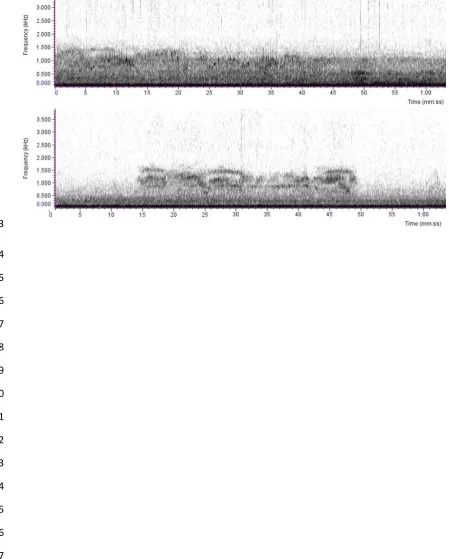
this group must be better understood, in particular with respect to the primates that use acoustic
83
communication for a variety of vital processes.
84
Species of titi monkeys (genus Callicebus) exchange loud calls (duets) to either defend territories
85
or food resources in their home-ranges; thus, these vocalisations are important regulators of their social
86
behaviour (Robinson 1979, 1981; Kinsey and Robinson 1983; Price and Piedade 2001; Caselli et al.
87
2014). Primates of the genus Callicebus live in monogamous family groups, consisting of a reproductive
88
pair and up to four generations of offspring (Kinzey and Becker 1983; Mendoza and Mason 1986;
89
Valeggia et al. 1999). Titi monkeys are morphologically cryptic primates, which hinders surveying them
90
using traditional methods such as linear transects (Aldrich et al. 2008). Mated pairs of Callicebus species
91
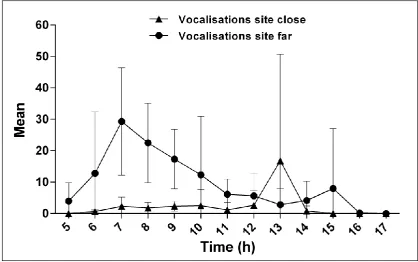
regularly emit loud and coordinated calls (duets), which permit researchers to use an alternative and
92
potentially more accurate method to monitor populations based in call surveys (Melo and Mendes 2000;
93
Aldrich et al. 2008). Duetting is commonly used by many bird and primate species for both within and
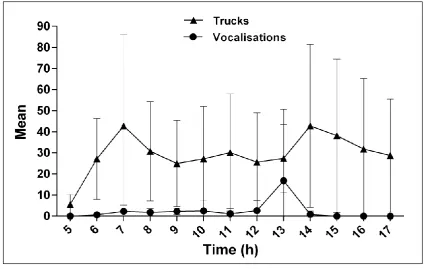
94
between group communication (Hall 2004; Oliveira and Ades 2004). Studies of Callicebus species show
95
that their duets have a role in group location and avoidance of intergroup aggressive encounters (C.
96
lucifer, previously C. torquatus, Kinzey and Robinson 1983; C. personatus, Kinzey and Becker 1983;
97
Price and Piedade 2001), in territory establishment and probably mate defense (C. ornatus, previously C.
98
moloch, Mason 1968; Robinson 1979, 1981). Black-fronted titi monkeys (C. nigrifrons) loud calls are
99
used during intergroup communication to regulate access to important food resources, such as fruits.
100
There is also some evidence that loud calls are used for mate defense (Caselli et al. 2014).
101
Typically, titi monkeys vocalise mostly at dawn, but also during the day when another group is
102
sighted or heard (Kinzey et al. 1977; Kinzey and Robinson 1983; Melo and Mendes 2000). For C.
103
nigrifrons mostly loud calls are emitted more often from their core area or near from important food
104
resources in their home range that usually is around 8 ha in Atlantic forest (Santos 2008, Caselli 2008,
105
Santos 2012). Large areas demand more time and energy to patrol (Schoener 1987), and black-fronted titi
106
monkeys advertise the occupancy of its territory via loud call emissions and do not use patrol and mark
107
range boundaries (Santos 2012; Caselli 2013).
Many of the forests in South America, where titi monkeys live suffer from large scale mining
109
(Estrada 2009). In the state of Minas Gerais, Brazil, mining is an important economic activity and is
110
commonly conducted close to Atlantic forest, one of the world’s richest biodiversity hotspots (Myers et al.
111
2000). The Atlantic forest is one of the most impacted habitats of the world retaining only 7% of its
112
primary vegetation (Myers et al. 2000) and is home to the black-fronted titi monkey (Callicebus
113
nigrifrons); an endemic primate classified as Near Threatened on the IUCN’s Red List (Veiga et al. 2008).
114
Black-fronted titi monkey loud calls are characterized by different syllables composed by
115
components of high frequencies that ranges from 3 to 12 kHz and of low frequency that is near to 1 kHz
116
(Caselli et al., 2014). Due to spectral characteristics of titi monkey loud calls such as high amplitude and
117
low frequency, these calls can be heard over long distances (Melo and Mendes 2000; Caselli et al. 2014).
118
Unfortunately, the same acoustic characteristics that were adaptive for long distance communication are
119
now bringing these sounds into competition with mining noise.
120
In this study, we investigated how the noise produced by one of the largest opencast mines of the
121
world affects acoustic communication of C. nigrifrons in an Atlantic forest fragment in Southeast Brazil.
122
Here we tested the following hypotheses: (1) noise levels are different in the sites close and far from the
123
mine; (2) emission rate, duration and diel pattern of titi monkey loud vocalisations would change between
124
the areas due to noise exposure.
125
Methods
126
Study area
127
This study was conducted at Peti environmental station, which is located in an Atlantic forest
128
fragment of approximately 605 hectares. The reserve is located in the upper Rio Doce Basin (altitude
129
range: 630-806m) in the municipalities of São Gonçalo do Rio Abaixo and Santa Bárbara, Minas Gerais
130
state, Brazil (19°53’57’’S and 43°22’07’’W), one of the most fragmented Atlantic forest regions of Brazil
131
(Machado and Fonseca 2000). Peti environmental station harbors approximately 46 species of mammals
132
(Paglia et al. 2005), 231 species of birds (Faria et al. 2006) and 29 species of anurans (Bertoluci et al.
133
2009).
134
A large part of the reserve is covered by secondary arboreal vegetation, and is surrounded by a
135
matrix mainly composed by Eucalyptus, small farms and areas of exposed soil due to the activities of the
136
Brucutu mine. Mining activity occupies an area of approximately 8km2 and produces noise through road
137
traffic, heavy machinery, sirens and explosions during the day and night (Roberto 2010). Brucutu’s iron
ore extraction started in 1992 and to increase the capacity of iron production, expansion projects started in
139
2004 placing Brucutu among the largest opencast mines in the world (Roberto 2010).
140
Data collection
141
To record black-fronted titi monkey loud calls, two song meters (SM2, Wildlife Acoustics) were
142
installed into the home range of two groups of titi monkeys. One group inhabited a forest fragment close
143
to a mine site and the song meter was installed at a distance of 100m from the closest mining road (Fig.1).
144
Another group inhabited a forest fragment 2,500m far from the mine and the song meter was installed
145
100m away from a low traffic (‘quiet’) road (to control for a potential border effect at both sites in the
146
same Atlantic forest fragment). The positions of geographic barriers such as roads and a river that
147
surround close and far sites suggest that the group which inhabit the close site is isolated from the group
148
that inhabit the far site. Both sites were habitat matched; they presented similar floristic compositions and
149
habitat structures.
150
The passive acoustic monitoring devices were programmed to record 24h/day during seven days
151
every two months from October 2012 to August 2013, in a total of six sessions and 2,016 hours of
152
recordings. Each SM2 was fixed on a tree 1.5m above the ground, leaving the two lateral microphones
153
free from any surface that could be an obstacle to incoming sound waves. They were configured to record
154
in wave format at a sampling rate of 44,100Hz, at 16 bits, and with a 36% microphone gain. Pilot studies
155
had found that this configuration to be optimal for recording the soundscape of the Atlantic forest (Pieretti
156
et al. 2015). The loud calls of titi monkeys can be detected up to 500 m away, with a ‘critical distance’ of
157
about 250 m (Robinson, 1981).
158
The sound pressure levels at both sites were characterized by using B&K2270 (Denmark) sound
159
level meter configured on the A curve to conduct six measurements of 20 minutes length in at both sites,
160
from 0600 to 1800 hours on weekdays. This research adhered to the Brazilian legal requirements and to
161
the American Society of Primatologists (ASP) Principles for the Ethical Treatment of Non Human
162
Primates.
163
Data analyses
164
To test for a difference in noise levels between the sites close and far from the mine we
165
extracted data from the sound level pressure measurements and analyzed them using BZ 5503 software
166
(Bruel and Kjaer). To avoid bias in the measured levels we excluded all recordings, which included loud
167
animal sounds (i.e., animals close to the microphone).
The rate of emission and the duration of black-fronted titi monkey loud calls were measured in
169
both sites during seven days by session from 0500 to 1700 hours totalizing 1,092 analyzed hours. All
170
sound files used for analyses had to be visually and aurally checked in Raven Pro 1.5, since we try to use
171
the band limited energy detector but this resulted in a large number of false positives and misses. We also
172
manually detected all the loud calls, which were partially masked by anthropogenic noise at the site close
173
to the mine (Fig. 2).
174
To verify a possible association between the noise produced by mining truck traffic at the site
175
close to the mine (the road of far site was not trafficked by mining trucks) and the occurrence of the loud
176
calls, we quantified all trucks passing from 0500 to 1700 hours at the road in front of the sampling site.
177
This procedure was done by audio and visual identification of the trucks’ noise pattern in spectrograms.
178
An FFT size of 1024 points was used for all analyses in Raven Pro 1.5.
179
We used a nonparametric statistical approach with our data analyses since data did not meet the
180
requirements for parametric statistics even after data transformations. All the statistical analyses were
181
performed in Statistica version.8.0.
182
Results
183
Sound pressure (noise) levels were significantly higher at the site close to the mine
(Mann-184
Whitney U-test: U=1, Z=2.72, N=6, p<0.01), as expected (Table 1).
185
Black-fronted titi monkeys emitted more loud calls than expected at the site far from the mine
186
(Chi-squared test: X2= 339.96, df=1, P<0.001, N
close=187, Nfar=752). A considerable part (20.32%) of the
187
vocalisations found in the site close to the mine was partially masked by noise from mining activity (Fig.
188
2). Duration of loud calls were also significantly longer at the site far from the mine (Mann-Whitney U
189
test: U= 29142.5, Z= 12.40, Nclose=187, Nfar=752, P<0.01; Medianclose=1.77, Medianfar=16.33). The
190
temporal distribution pattern of the vocalisations was also different between the two sites (Fig. 3). At the
191
site far from the mine, titi monkeys were more vocally active early in the morning (from 0600 to 1000
192
hours, with peak vocal activity around 0700 hours), while at the site close to the mine they presented a
193
constant but very low activity from 0700 to 1000 hours with peak vocal activity occurring around 1300
194
hours.
195
The time period of highest truck passing activity coincided with the time period of the lower
196
number of loud vocalisations at the site close to the mine and the peak of loud calls also occurred when
there was a decrease in trucks passing (Fig 4). Despite this, a Spearman rank test showed no significant
198
correlation between the number of trucks and number of vocalisations (rs = -0.21, t= -0.71, P>0.05).
199
Discussion
200
Our results show that the emission rate, duration and diel pattern of loud calls emitted by
black-201
fronted titi monkeys is different between sites close to and far from mining activity. These changes in
202
vocal parameters of titi monkeys calls are similar to those exhibited by some animals to compensate the
203
impact of anthropogenic noise or as a response to avoid noise interference on their communication (Brum
204
et al. 2004; Sun and Narins, 2005; Egnor et al. 2007).
205
The higher rate of loud calls found at the far site could be explained by several non-exclusive
206
hypotheses, such as: (1) more titi monkey groups are present at the far site; (2) more encounters between
207
titi groups at the far site; (3) titi monkeys from the close site were reducing their emission of calls due to
208
masking caused by mining noise; (4) call emissions masked by noise decreasing detection of vocal
209
activity at the site close to the mine. However, field observations and habitat matching showed that there
210
should be a very similar numbers of groups at both sites. The area monitored by the passive acoustic
211
monitoring devices was the same at both sites. Thus, while there will be some differences between sites,
212
these are unlikely to be the major factors affecting differences in the rate of loud call emissions. In
213
addition, as observed for C. personatus, and C. torquatus, C. nigrifrons also do not call more often
214
from their home range boundaries and encounters with neighbouring groups are not frequent (Kinzey et al.
215
1977; Price and Piedade 2001, Santos 2012, Caselli 2013), since the regularly loud call emissions from
216
core area or from more valuable sites can be more economical strategy. Another noteworthy factor is the
217
longer duration of calls at the far site. This fact supports the third hypothesis: as it demonstrates the
218
probably impact of mining noise on titi monkey’s loud vocalisations.
219
A decrease of animal call rate in presence of noise has already been established in other studies
220
and can be interpreted as a response to avoid interference from anthropogenic noise (Miksis-Olds and
221
Tyack 2009; Sun and Narins 2005; Parks et al. 2007; Sousa-Lima and Clark 2008). This pattern may
222
indicate that animals wait until it is quiet to vocalize, exhibiting only minimal vocalisation effort during
223
periods of masking noise (Miksis-Olds and Tyack 2009; Sousa-Lima and Clark 2008). In this study, at the
224
close site many loud calls (20%) were partially masked by noise, thereby potentially disturbing the
225
exchange of acoustic information and preventing titi monkeys from communicating effectively (Lohr et al.
226
2003; Foote et al. 2004; Bee and Swanson 2007). One particularly important factor driving vocalisation
effort is the range over which the signaller and receiver must effectively communicate (Miksis-Olds and
228
Tyack 2009). In this context, when noise masks the vocalisations there is a decrease in the acoustic space
229
over which the information can reach.
230
The longer duration of titi monkey loud calls at the far site is further evidence of the noise
231
impact from mining. Research has already documented that some species adjust their vocal behaviour to
232
compensate for anthropogenic noise by increasing or decreasing the duration of the calls. Studies with
233
Saguinusoedipus showed a decrease in the average call duration to avoid masking noise (Egnor et al.
234
2007). However, common marmosets Callithrix jaccus increase the duration of their calls in presence of
235
noise and they use higher vocal frequencies (Brumm et al. 2004). Our results, suggest that there is more
236
available acoustic space at the far site, especially in the lower frequencies, which are naturally used by titi
237
monkeys. At the close site, noise from the mine overlap the titi monkeys’ loud calls and could be
238
excluding them from an acoustic niche. Thus, they probably are emitting calls with shorter duration to
239
communicate more effectively and/or to save energy since acoustic communication is an energetically
240
expensive behaviour and vocalisation effort is increased by increasing call duration (Miksis-Olds and
241
Tyack 2008).
242
The difference in the diel pattern of loud calls between the two sites can be also a consequence
243
of the mining noise disturbance on titi monkeys’ vocal behaviour. As observed in other primate species
244
such as Indris (Geissmann and Mütschler, 2006) and gibbons (Mitani, 1985), C. nigrifrons are vocally
245
active mainly during the first hours of the day (outside encounters) (Melo and Mendes 2000, Caselli
246
2013). Because of the higher humidity and lower temperatures in the first hours of the morning, these
247
primates concentrate the emission of loud calls in this period of the day, when transmission of sound
248
presumed to be more efficient (Mitani 1985; Wiley and Richards 1978). In our study, this natural pattern
249
was observed only at the far site. At the site close to the mine, animals displayed very low vocal activity
250
in the first hours of the day and peak of activity at 1300 hours. Many mammals affected by anthropogenic
251
noise have limited developmental capacity to change the acoustic parameters of their calls to avoid the
252
masking by noise such as some birds can do (Weiss et al. 2014). On the other hand, mammals may avoid
253
noise with other behavioural modifications, such as vocalizing during periods of low noise (Rabin et al.
254
2003) or moving to quieter areas (Duarte et al. 2011).
255
Loud vocalisations are key factors involved in the regulation of titi monkey social behavior
256
(Caselli et al 2014). One consequence of the masking of such calls can be increased territory invasion by
neighboring group and consequently increased rates of inter-group agonistic encounters. Such changes
258
could impact on the survival and reproductive success of the affected individuals, and result in disruptions
259
with potential population-level consequences. In addition, studies with birds show that species with lower
260
frequencies calls are more likely to avoid roads than those that emit calls at higher frequency, indicating
261
how noise may change the organization of avian communities (Rheindt 2003; Francis et al. 2009). Similar
262
effect could happen to titi monkeys communities that can prevent to use suitable habitats to avoid overlap
263
of noise. Considering that C. nigrifrons is a “Near Threatened” endemic primate (Veiga et al. 2008), this
264
effect is very concern for species conservation in long term.
265
Lastly, our results suggest that, apparently, there is no noise effect on titi monkeys loud calls at
266
site that is 2,500m distant from the opencast mine. This information provide insight that can help into
267
developing distance regulations for areas of environmental compensation and/or biologically important,
268
and highlight the importance of considering noise pollution when determining reserve locations (Madliger
269
2012).
270
Finally, here, we have shown for the first time how a noise disturbance can affects
black-fronted-271
titi monkey communication. Our results provide important information to be considered during the
272
elaboration of conservation strategies in natural areas affected by mining activity. Furthermore, we
273
suggest that noise monitoring plans for wildlife should be part of the process of licensing large scale
274
anthropogenic activities such as mining.
275
276
Acknowledgements
277
We thank all of the staff at the environmental station of Peti, especially Leotacílio da Fonseca. We are
278
also grateful to Marina Scarpelli and Renan Duarte for their help during data acquisition and the engineer
279
Krisdany Cavalcante for help with the noise level measurements. Grateful for Martin Fisher and
280
anonymous reviewers for comments on the manuscript. MHLD and MCK were supported by a Fundação
281
de Amparo à Pesquisa de Minas Gerais (FAPEMIG) postgraduate and technical scholarship respectively.
282
MR, RJY and RSL received financial support from FAPEMIG and Conselho Nacional de Pesquisa
283
(CNPq).
284
References
286
287
Alvarez-Berríos NL, T Mitchell Aide (2015) Global demand for gold is another threat for tropical
288
forests. Environ Res Lett 10
289
290
Aldrich BC, Molleson L, Nekaris KAI (2008) Vocalizations as a conservation tool : an auditory survey of
291
the Andean titi monkey Callicebus oenanthe Thomas, 1924 (Mammalia: Primates: Pitheciidae) at
292
Tarangue, Northern Peru. Contrib Zool 77: 1–6
293
294
Barber JR, Crooks KR, Fristrup, KM (2009) The costs of chronic noise exposure for terrestrial organisms.
295
Trends Ecol Evol 25:180-189
296
297
Bayne EM, Habib L, Boutin S (2008) Impacts of chronic anthropogenic noise from energy-sector activity
298
on abundance of songbirds in the boreal forest. Conserv Biol 22: 1186-1193
299
300
Bee MA, Swanson EM (2007) Auditory masking of anuran advertisement calls by road traffic noise.
301
Anim Behav 74: 1765-1776
302
303
Bejder L, Samuels A, Whitehead H, Gales, N (2006) Interpreting short-term behavioural responses to
304
disturbance within a longitudinal perspective. Anim Behav 72: 1149-1158
305
306
Bertoluci J, Canelas MAS, Eisemberg CC, Palmuti CF de S, Montingelli GG (2009) Herpetofauna of
307
Estação Ambiental de Peti, an Atlantic Rainforest fragment of Minas Gerais State, southeastern Brazil.
308
Bio Neot 9: 147-155
309
310
Brumm H (2004) The impact of environmental noise on song amplitude in a territorial bird. Journal of
311
Anim Ecol 73: 434-440
312
313
Brumm H, Voss K, Köllmer I, Todt D (2004) Acoustic communication in noise: regulation of call
314
characteristics in a New World monkey. J Exp Biol 207: 443-448
316
Brumm H, Schmidt R, Schrader L (2009) Noise-dependent vocal plasticity in domestic fowl. Anim Behav
317
78: 741-746
318
319
Campo JL, Gil MG, Dávila SG (2005) Effects of specific noise and music stimuli on stress and fear
320
levels of laying hens of several breeds. Appl Anim Behav Sci 91: 75-84
321
322
Caselli CB (2008) Ecologia alimentar, padrão de atividade e uso de espaço por Callicebus
323
nigrifrons (Primates: Pitheciidae). Dissertation, Universidade Estadual de Campinas
324
325
Caselli CB (2013) Comportamento territorial de Callicebus nigrifrons Spix, 1823 (PITHECIIDAE):
326
influência da disponibilidade de frutos e possíveis funções das vocalizações de longo alcance. Thesis,
327
Universidade Estadual de Campinas
328
329
Caselli CB, Mennill DJ, Bicca-Marques JC, Setz EZF (2014) Vocal behavior of black-fronted titi
330
monkeys (Callicebus nigrifrons): acoustic properties and behavioral contexts of loud calls. Am J of Prim
331
76: 788–800
332
333
Chan AAY-H, Giraldo-Perez P, Smith S, Blumstein DT (2010) Anthropogenic noise affects risk
334
assessment and attention: the distracted prey hypothesis. Biol Lett 6: 458-61
335
336
Delaney DK, Gurbb TG, Seibr P, Pater LL, Reiser MH (1999) Effects of helicopter noise on Mexican
337
spotted owls. J Wildl Manage 63: 60–76
338
339
Duarte MHL, Vecci MA, Hirsch A, Young RJ (2011) Noisy human neighbours affect where urban
340
monkeys live. Biol Lett 7: 840-842
341
342
Duarte MHL, Sousa-Lima RS, Young RJ, Farina A, Vasconcelos M, Rodrigues M, Pieretti N (2015) The
343
impact of noise from open-cast mining on Atlantic forest biophony. Biol Conserv 191: 623-631
Egnor SER, Wickelgren JG, Hauser MD (2007) Tracking silence: adjusting vocal production to avoid
345
acoustic interference. J Comp Physiol 193, 477-483
346
347
Estrada A (2009) Primate Conservation in South America: The Human and Ecological Dimensions of the
348
Problem. In: Garber PA, Estrada A, Bicca-Marques JC, Heymann EW, Strier KB (Ed), South American
349
primates. Springer, New York, pp 463-505
350
351
Faria CM, Rodrigues M, do Amaral FQ, Módena É, Fernandes AM (2006) Aves de um fragmento de
352
Mata Atlântica no alto Rio Doce, Minas Gerais: colonização e extinção. Rev Bras Zool 23: 1217-1230
353
354
Foote AD, Osborne RW, Hoelzel AR (2004) Whale-call response to masking boat noise. Nature 428: 910
355
356
Francis CD, Ortega CP, Cruz A (2009) Noise pollution changes avian communities and species
357
interactions. Curr Biol 19:1415–1419
358
359
Fuller RA, Warren PH, Gaston KJ (2007) Day time noise predicts nocturnal singing in urban robins. Biol
360
Lett 3: 368-70
361
362
Geissmann T, Mütschler T (2006) Diurnal distribution of loud calls in sympatric wild indri (Indri indri)
363
and ruffed lemurs (Varecia variegata): implications for call functions. Primates 47: 393-396
364
365
Hage SR, Jiang T, Berquist SW, Feng J, Metzner W (2013) Ambient noise induces independent shifts in
366
call frequency and amplitude within the Lombard effect in echolocating bats. Proceedings of the National
367
Academic of Sciences of the United States of America 110: 4063-4068
368
369
Hall ML (2004) A review of hypotheses for the functions of avian duetting. Behav Ecol Soc 55: 415- 430
370
371
Karp DS, Root TL (2009) Sound the stressor: how Hoatzins (Opisthocomus hoazin) react to ecotourist
372
conversation. Biodiv Conserv 18: 3733–3742
373
Kight CR, Swaddle JP (2011) How and why environmental noise impacts animals: an integrative,
375
mechanistic review: Environmental noise and animals. Ecol Lett 14: 1052-1061
376
377
Kinzey WG, Becker M (1983) Activity pattern of the masked titi monkey, Callicebus personatus.
378
Primates 24: 337–343
379
380
Kinzey WG, Robinson JG (1983) Intergroup loud calls, range size, and spacing in Callicebus torquatus.
381
Am J Phys Anthr 60: 539–544
382
383
Kinzey WG, Rosenberger AL, Heisler PS, Prowse DL, Trilling JS (1977) A preliminary field
384
investigation of the yellow handed titi monkey, Callicebus torquatus torquatus, in northern Peru.
385
Primates18: 159–181
386
387
Laiolo P (2010) The merging significance of bioacoustics in animal species conservation. Biol Conserv
388
143: 1635-1645
389
390
Lohr B, Wright TF, Dooling RJ (2003) Detection and discrimination of natural calls in masking noise by
391
birds: estimating the active space signal. Anim Behav 65: 763-777
392
393
Machado RB, Fonseca GAB (2000) The avifauna of rio Donde Valley, southeastern Brazil, a highly
394
fragmented area. Biotrop 32: 914-924
395
396
Madliger CL (2012) Toward improved conservation management: a consideration of sensory ecology.
397
Biodivers Conserv 21:3277–3286
398
399
Mason WA (1968) Use of space by Callicebus groups. In: Jay PC (Ed), Primates: studies in adaptation
400
and variability. Holt, Rinehart and Winston, New York, pp 200-216
401
Melo FR, Mendes SL (2000) Emissão de gritos longos por grupos de Callicebus nigrifrons e suas
403
reações a playbacks. In: Alonso C, Langgut A (Eds), A Primatologia no Brasil – 7. Sociedade Brasileira
404
de Primatologia and Editoria Universitária, João Pessoa, pp 215-222
405
406
Mendoza SP, Mason WA (1986) Parental division-of-labor and differentiation of attachments in a
407
monogamous primate (Callicebus moloch). Anim Behav 34: 1336–1347
408
409
Miksis-Olds JL, Tyack PL (2009) Manatee (Thichechus manatus) vocalization usage in relation to
410
environmental noise levels. J Acoust Soc Am 125: 1806-1815
411
412
Mitani JC (1985) Gibbon song duets and intergroup spacing. Behav 92: 59-96
413
414
Myers N, Mittermeier RA, Mittermeier CG, Fonseca GAB, Kent J (2000) Biodiversity hotspots for
415
conservation priorities. Nature 403: 853-858
416
417
Nemeth E, Brumm H (2009) Blackbirds sing higher-pitched songs in cities: adaptation to habitat
418
acoustics or side-effect of urbanization? Anim Behav 78: 637-41
419
420
Oliveira DA, Ades C (2004) Long‐distance calls in Neotropical primates. Anais da Academia Brasileira
421
de Ciências 76: 393-398
422
423
Paglia AP, Lopes MOG, Perini FA, Cunha HM (2005) Mammals of the Estação de Preservação e
424
Desenvolvimento Ambiental de Peti (EPDA-Peti), São Gonçalo do Rio Abaixo, Minas Gerais, Brazil.
425
Lundiana. 6: 89-96
426
427
Parks ES, Clark CW, Tyack PL (2007) Short-and long-term changes in right whale calling behavior: The
428
potential effects of noise on acoustic communication. J Acoust Soc Am 122: 3725-3731
429
Pieretti N, Duarte MHL, Sousa-Lima RS, Young RJ, Rodrigues M, Farina A (2015) Determining
431
temporal sampling schemes for passive acoustic studies in different tropical environments. Trop Conserv
432
Sci 8: 215-234
433
434
Price EC, Piedade HM (2001) Ranging behavior and intraspecific relationships of masked titi monkeys
435
(Callicebuspersonatus personatus). Am J Prim 53: 87–92
436
437
Proppe DS, Sturdy CB, St Clair CC (2013) Anthropogenic noise decreases urban songbird diversity and
438
may contribute to homogenization. Glo Chang Biol 19: 1075-1084
439
440
Rabin LA, McCowan B, Hooper SL, Owings DH (2003) Anthropogenic noise and its effect on animal
441
communication: an interface between comparative psychology and conservation biology. Int J Psyc16:
442
172–192
443
444
Reijen R, Foppen R, Braak CT, Thissen J (1998) The effects of car traffic and breeding bird populations
445
in woodland III Reduction of density in relation to the proximity of main roads. J Appl Ecol 32: 187–202
446
447
Rheindt FE (2003) The impact of roads on birds: does song frequency play a role in determining
448
susceptibility to noise pollution? J Ornithol 144:295–306
449
450
Roberto JB (2010) Influência dos diversos tipos litológicos nas operações de concentração da instalação
451
de beneficiamento de Brucutu. Master dissertation, Universidade Federal de Minas Gerais
452
453
Robinson JG (1979) Vocal regulation of use of space by groups of titi monkeys Callicebus moloch.
454
Behav Ecol Sociobiol 5: 1–15
455
Robinson JG (1981) Vocal regulation of inter‐ and intra‐group spacing during boundary encounters in the
456
titi monkey, Callicebusmoloch. Primates 22: 161–172
457
458
Saha DC, Padhy PK (2011) Effect of air and noise pollution on species diversity and population density
459
of forest birds at Lalpahari, West Bengal, India. Sci Tot Environ 409: 5328-5336
461
Santos GP (2008) Padrão de atividades, dieta e área de vida de Callicebus nigrifrons (Spix, 1823).
462
Dissertation, Pontifícia Universidade Católica de Minas Gerais
463
464
Santos RV (2012) Área de vida e uso do espaço por Callicebus nigrifrons Spix, 1823 (Primates:
465
Pitheciidae). Master dissertation, Pontifícia Universidade Católica de Minas Gerais
466
467
Schaub A, Ostwald J, Siemers, BM (2008) Foraging bats avoid noise. J Exp Biol 211: 3174-3180
468
469
Schoener TW (1987) Time budgets and territory size: some simultaneous optimization models for energy
470
maximizers. Am Zool 27:259-291
471
472
Schroeder J, Nakagawa S, Cleasby IR, Burke T (2012) Passerine birds breeding under chronic noise
473
experience reduced fitness. Plos One 7
474
475
Slabbekoorn H, Peet M (2003) Birds sing at a higher pitch in urban noise. Nature 424: 267
476
477
Slabbekoorn H, den Boer-Visser A (2006) Cities change the songs of birds. Curr Biol 16: 2326–31
478
479
Slabbekoorn H, Ripmeester EA (2008) Birdsong and anthropogenic noise: implications and applications
480
for conservation. Mol Ecol 17: 72-83
481
482
Smith AC, Virgl JA, Panayi D, Armstrong AR (2005) Effects of a diamond mine on Tundra breeding
483
birds. Arctic 58: 295-304
484
485
Sousa-Lima R, Clark C (2008) Modeling the effect of boat traffic on the fluctuation of humpback whale
486
singing activity in the Abrolhos National Park, Brazil. Can Acoust 36: 174-181
487
488
Sousa-Lima RS, Clark CW (2009) Whale sound recording technology as a tool for assessing the effects of
489
boat noise in a Brazilian marine park. Park Sci 26: 59
491
Sun JWC, Narins PM (2005) Anthropogenic sounds differentially affect amphibian call rate. Biol
492
Conserv 121: 419-427
493
494
Veiga LM, Kierulff CM, de Oliveira MM, Mendes SL (2008) Callicebus nigrifrons. The IUCN Red List
495
of Threatened Species Version 20143 <wwwiucnredlistorg> Accessed 17 December 2014
496
497
Valeggia CR, Mendoza SP, Fernandez-Duque E, Mason WA, Lasley B (1999) Reproductive biology of
498
female titi monkeys (Callicebus moloch) in captivity. Am J Prim 47: 183–195
499
500
Weiss DJ, Hotchkin CF, Parks SE (2014) Modification of spectral features by nonhuman primates
501
Behavioral and brain. Science 37: 574-576
502
503
Wiley RH, Richards DG (1978) Physical constraints on acoustic communication in the atmosphere:
504
implications for the evolution of animal vocalizations. Behav Ecol Soc 3: 69-94
505
506
Zuberbuehler K, Noe R, Seyfarth RM (1997) Diana monkey long-distance calls: Messages for
507
conspecifics and predators. Anim Behav 53: 589-604
508
509
510
511
512
513
514
515
516
517
518
519
Table 1. Equivalent sound pressure levels (Leq) at sites close to and far from an opencast mine site near
521
Peti environmental station, southeast Brazil.
522
Measurement Close Leq dB(A)
Far Leq dB(A) 1 42.6 33.8 2 38.7 30.3 3 42.0 30.1 4 60.9 37.2 5 42.9 38.8 6 41.2 33.3
523
Fig. 1 Sites close to and far from the Brucutu mine at Peti Environmental station, southeast Brazil. Red
524
lines represent the geographic barriers between the sites
525
526
527
528
[image:20.595.69.509.407.644.2]Fig. 2 Sound spectrograms of black-fronted titi monkey loud call, at Peti Environmental Station southeast
530
Brazil, showing masking by noise mining activities (top) at a location close to a mine site, and non
531
masked call (bottom) far from a mine site
532
533
534
535
536
537
538
539
540
541
542
543
544
545
546
[image:21.595.63.513.167.727.2]Fig. 3 Daily distribution of the mean (±SD) number of loud calls emitted by black-fronted titi monkeys
548
at sites close to and far from an opencast mine site near Peti environmental station, southeast, Brazil
549
550
551
552
553
554
555
556
557
558
559
560
[image:22.595.93.512.135.397.2]Fig. 4 Daily distribution of mean mining truck activity (number passing a fixed point) and mean
562
frequency of loud calls of black-fronted titi monkey close to an opencast mine site near Peti
563
Environmental station, southeast Brazil