
International Journal of Emerging Technology and Advanced Engineering
Website: www.ijetae.com (ISSN 2250-2459, ISO 9001:2008 Certified Journal, Volume 3, Issue 8, August 2013)
72
A Rule Based Approach for Implementing the Marketing
Decision Model
Priya Ugiwal
1, Renuka Nagpal
2, Rajni Seghal
31
Student, Amity University, Noida
2,3
Assistant Professor, Amity University, Noida Abstract - Today we have numerous technology
developments coming up every other day to help human beings in different ways and simplify their life. Fuzzy Logic is one such development. Probability and Fuzziness deal with uncertainty about information. But both theories should be combined in order to get a better understanding of reality, since many circumstances, present in human decision making are poorly defined. Recent relevance of linguistic issues in the so-called soft sciences is recognizing this. Fuzzy logic provides a simple way to arrive at a definite conclusion based upon vague, ambiguous, imprecise, noisy, or missing input information. This concept has been used in this paper for finding the market value of products manufactured by Cadbury Company. Market value involves analyzing a number of factors. These factors are not well defined and keep changing according to political, social, technological and economic issues. It is in such cases that fuzzy logic comes to aid.
Keywords - Fuzzy Logic, Fuzzy Rule Based Expert System, Defuzzification, Marketing Decision Model, Market Value.
I. INTRODUCTION
Marketing Decision Model involves analyzing or finding the market value of the products produced by a company. Market value of a product can be determined by looking at the sales of product. Increase in sales of the product implies product is being liked and accepted. This in turn implies that the market value of the product is good. Hence, the market value of the product can be directly related to the sales of the product. The parameters which have been taken into account to find the market value of Cadbury product, in this paper, are Price, Quality, Brand Loyalty, Flavor and Packaging. The concept of Fuzzy Logic has been used for implementing the Marketing decision Model.
Fuzzy Logic is an approach to computing based on "degrees of truth" rather than the usual "true or false" (1 or 0) Boolean logic on which the modern computer is based. Fuzzy Logic is conceived as a better method for many control system applications since it mimics human control logic. It can be built into anything from small, hand-held products to large computerized process control systems. It uses an imprecise but very descriptive language to deal with input data like a human operator [1].
II. LITERATURE REVIEW
The two key elements of this research are the Market Value of Cadbury Products and fuzzy rule based expert system. These elements are described below in regards to the relevant literature. Also included in this is the relationship between Marketing Decision Model and Fuzzy Logic.
A.Marketing decision Model:
Many marketing decisions are made in complex environment where numerous variables affect the outcomes. Market response to these variables is frequently non linear and incorporates carryover effects. Since decision making under these conditions is a difficult cognitive task, managers often rely on heuristics such as setting advertising budgets as a fixed percentage of sales instead of structuring the problem to analyze and evaluate alternative courses of actions. While model based approaches have solutions, but it is often difficult to construct and operate valid models of these environment. The models are either too simple and are not valid representation of the real world or too complex that the managers themselves do not understand it and give up the idea of using them. To circumvent these problems, Little (1970) suggested a model building approach which he termed as Decision calculus. Little identified six model design criteria that have since been translated into a four step procedure for the implementation and development of marketing decision models. In the first step the manager verbalizes his implicit model of the situation to be analyzed, specifying the variables that affect the criterion variable as well as the general relationships between these variables. In the next step the model builder translates this
verbal description into a formal mathematical tool [2].
International Journal of Emerging Technology and Advanced Engineering
Website: www.ijetae.com (ISSN 2250-2459, ISO 9001:2008 Certified Journal, Volume 3, Issue 8, August 2013)
73
B.Fuzzy rule based expert system:
The world of information is surrounded by uncertainty and imprecision. The human reasoning process can handle inexact, uncertain, and vague concepts in an appropriate manner. Usually, the human thinking, reasoning, and perception process cannot be expressed precisely. These types of experiences can rarely be expressed or measured using statistical or probability theory. Fuzzy logic provides a framework to model uncertainty, the human way of thinking, reasoning, and the perception process. In a classical set theory, an element may either belong to set or not. In fuzzy set theory, an element has a degree of membership. Fuzzy systems were first introduced by Zadeh (1965). A fuzzy expert system is simply an expert system that uses a collection of fuzzy membership functions and rules, instead of Boolean logic, to reason about data [3]. The rules in a fuzzy expert system are usually of a form similar to the following:
If A is low and B is high then X = medium; where A and Bare input variables, X is an output variable.
Here low, high, and medium are fuzzy sets defined on A, B, and X respectively. The antecedent (the rule’s premise) describes to what degree the rule applies, while the rule’s consequent assigns a membership function to each of one or more output variables.
C.Fuzzy logic and marketing Decision Model:
In today's rapidly changing and highly uncertain environment, the strategic decisions have an extremely complex and fuzzy nature. In the meantime, the enterprises have tendency to appreciate the new product development activities in order to fulfill the customer demands adequately. So it is important to improve the accuracy of decision-making under uncertainty. We first identify the decision points in the development process and the uncertainty factors affecting those points. Next, we determine the necessary decision models and techniques to help the decision makers to reduce their risks. Finally, we propose an integrated approach based on fuzzy logic to shape the decisions and illustrate with an application in software development [11]. Recently, fuzzy logic mathematics has started to change the perspectives in many management and marketing areas. Analyzing business data using the fuzzy logic approach can help marketers and managers to probe new insights in their data. It helps managers to develop a group decision making model to establish customer preferences.
Overall, researchers should work on improving data analysis techniques in a way that provides more information regarding customers’ preferences. In this context it is important to indicate that fuzzy logic can be very useful in giving more precise information regarding customers’ preferences [4]. Overall, fuzzy logic can advance data analysis in business research and can help researchers to probe new insights in their data as fuzzy logic can improve consumer behavior research by providing international marketers with more accurate insights. Fuzzy logic can help in developing the research of consumer behavior by giving accurate insights to local and global international marketers regarding every single customer preferences.
III. ALGORITHM FOR CREATING THE RULE BASE
The algorithm we used for preparing the rule base consists of the following steps:
1. Survey the literature on Cadbury products.
2. Identify the factors that affect market value of Cadbury products.
3. Assemble a database for the value of these factors. 4. Select a clustering technique and identify clusters of
these factors.
5. Design an inference engine for the rule base, based on the identified clusters.
6. Fuzzify the inputs (that is, estimate market value using the rule base).
7. Defuzzification.
IV. FACTORS FOR ESTIMATING THE MARKET VALUE
The five factors (chosen according to the survey) that affect the market value of the Cadbury products are as follows:
A. Price
International Journal of Emerging Technology and Advanced Engineering
Website: www.ijetae.com (ISSN 2250-2459, ISO 9001:2008 Certified Journal, Volume 3, Issue 8, August 2013)
74
B. QualityQuality is an important aspect as it is what every customer or buyer desires for while buying a product. This is the factor which is given the top preference while purchasing the goods .If the quality of the product is maintained then the sales of the product will continue to be good. This will keep ensuring a good market value of the product in spite of increasing competition. One crucial point is the possibility that a high quality product might undercut a lower quality product and drive its sales to zero [6]. In marketing implications, the functional quality is seen to be a very important dimension of a perceived service [15].
C. Brand Loyalty
The importance of brand loyalty has been recognized in the market literature for about three decades. Brand Loyalty leads to certain advantages such as reduced marketing costs, more new customers and greater trade influence [7]. This factor also affects the sales and in turn the market value of the products when the competition is high. In case of chocolate products people have been brand loyal to Cadbury and that has also attributed to its top position in the market since years. Good Quality and flavors are important factors that have helped Cadbury maintain brand loyalty among its customers or users.
D. Packaging
This too plays an important role in sales and marketing of a product. The more attractive the packaging, the more are the buyers. Empirical results from a virtual reality simulation show that package pictures increase shoppers’ attention to the brand. The package pictures are especially useful for private label brands to improve consumers’ perceptions of the brand and enter the consideration set [8]. When it comes to chocolates, children are the majority buyers or consumers and they give more preference to the looks and packaging of products. Hence it is important that this too is kept in mind while strategizing sales of a product.
E. Flavor
This is the aspect which differentiates the chocolate products of different brand from one other. The more the flavor of the product is interesting, likeable and suits the taste of the consumer, the more are the product’s sale and market value.
If the flavor and the taste of the chocolate are interesting, new, refreshing and tempting, then people will buy the products even if the price increase a bit, so that they can fulfill their temptations and relish the taste again. Recent research, however, suggests that product assortment can play a key role, not only in satisfying wants, but also in influencing buyer wants and preferences. The retailers can use the assortment as a factor that buyers consider to decide whether they should make the purchase or not [9].
Hence, all five factors have an important role and influence on the sales of the Cadbury product in the market and all these five aspects affect the market value of the product in some way or another. Now member functions have been defined for each of the factor and rules have been formulated to implement it in matlab software to get the desired results.
V. THE PROPOSED MODEL
To evaluate the market value, we have five main linguistic variables i.e. Quality, Price, Brand loyalty, Packaging and Flavors. All these variables are different in nature and contribute to market value of Cadbury product. To get market value, we have used fuzzy logic and defined the linguistic values for linguistic variables. The range taken for all the linguistic variables is [0, 30].
Fuzzy logic, proposed by Zadeh in 1965, provides the best mathematical tool for managing ambiguous, uncertain and doubtful data. It also provides methods for handling imprecision and information granularity. The major fuzzy logic modules are defined further. The first stage is fuzzification, which transforms classification tables into continuous classifications. These are then processed in the fuzzy domain with an inference engine based on a knowledge base (rule base and data base) supplied by domain experts. Finally, the defuzzification process transforms fuzzy numbers back into single real number values [10][12]. Specifically, our fuzzy model works as follows:
1. Inputs are given as crisp values of parameters. 2. Membership functions are determined for the
parameters.
3. Fuzzy rules are fired based on the inputs and their membership functions.
International Journal of Emerging Technology and Advanced Engineering
Website: www.ijetae.com (ISSN 2250-2459, ISO 9001:2008 Certified Journal, Volume 3, Issue 8, August 2013)
75
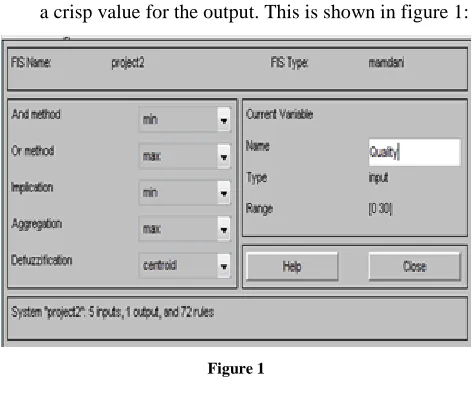
5.The fuzzy MIN operator is applied to find the degree [image:4.612.50.286.227.425.2]of membership for firing a rule. Our model uses Mamdani-style inferences, one of the two commonly used fuzzy inference mechanisms (the other mechanism is that of Sugeno-style inferences). The model uses MAX aggregation to integrate the effects of all the rules that are fired. The model’s defuzzification uses the centroid technique to produce a crisp value for the output. This is shown in figure 1:
Figure 1
VI. EXPERIMENTATION
To find the factors or parameters on which the market value of Cadbury products depend, a survey was conducted. The survey included 75 people irrespective of the age and consisted of both young and elderly people. The questionnaire of the survey included questions to find out the preference of the people regarding the chocolate company, the preference they give to different factors, the factors that affect their purchase of the chocolates and some other questions. The rules of Fuzzy Logic have been formulated on the basis of this analysis and on data found on different internet sites. After conducting the analysis, it was concluded that there are five factors, according to people, that affect the market value of Cadbury products and they are the price, the quality, the brand loyalty, the flavor and the packaging. Different member functions have been used for each of the five factors. All 72 rules were entered to create a rule base. Rules were fired depending on the particular set of inputs, using Mamdani-style inferences.
VII. RULE BASE FOR THE PROPOSED MODEL
As soon as input data is fuzzified, processing is carried out in fuzzy domain. The model integrates the effect of Quality, Price, Brand Loyalty, Packaging and Flavors onto single predictable parameter i.e. the Market Value, which is based on literature collected and survey done for Cadbury products. In the proposed fuzzy model, we are considering five inputs, each containing different number of member functions. The total number of rules come out to be 72.
Total Number of Rules= [3 (Quality)*3 (Price)*2 (Flavor)* 2 (Packaging)* 2 (Brand Loyalry)] = 72
In this paper Mamdani method is used for defining fuzzy rule due to its simplicity and wide use in research applications, which is used for nonlinear equations. Some of the rules are listed below in table1.
Table 1
R n o
Input Variables Output
Variable
Quality Price Brand
Loyalty
Packagin g
Flavo r
1 Best High Loyal Attractiv
e
Good Good
2 Neutral High Loyal Attractiv
e
Good Average
3 Low High Loyal Attractiv
e
Good Poor
4 Best Average Loyal Attractiv
e
Good Good
5 Neutral Average Loyal Attractiv
e
Good Average
.
.
[image:4.612.326.569.329.653.2]International Journal of Emerging Technology and Advanced Engineering
Website: www.ijetae.com (ISSN 2250-2459, ISO 9001:2008 Certified Journal, Volume 3, Issue 8, August 2013)
76
VIII. MEMBERSHIP FUNCTION FOR INPUT AND OUTPUTPARAMETER
The linguistic values for variable Quantity are Low, Neutral and Best, for variable Price are Low, Average and High, for variable Brand Loyalty are Loyal and Disloyal, for variable Packaging are Attractive and Unattractive and for variable Flavor are Good and Bad. The linguistic values for variable market value are Poor, Average and Good. A sample figure representing the membership functions for market value is shown in figure 2.
Figure 2
The Inference Table is given as follows:
[System] Name='project2' Type='mamdani' Version=2.0 NumInputs=5 NumOutputs=1 NumRules=72 AndMethod='min' OrMethod='max' ImpMethod='min' AggMethod='max' DefuzzMethod='centroid'
[Input1] Name='Quality' Range=[0 30] NumMFs=3
MF1='Low':'trimf',[0 5.5 11] MF2='Neutral':'trimf',[9 15 21] MF3='Best':'trimf',[19 24.5 30]
[Input2] Name='Price' Range=[0 30]
MF2='Average':'trimf',[9 15 21] MF3='High':'trimf',[19 24.5 30]
[Input3]
Name='BrandLoyalty' Range=[0 30] NumMFs=2 [Input4]
Name='Packaging' Range=[0 30] NumMFs=2
MF1='Unattractive':'trimf',[0 8.25 16.5] MF2='Attractive':'trimf',[13.5 21.75 30]
[Input5] Name='Flavors' Range=[0 30] NumMFs=2
MF1='Bad':'trimf',[0 8.25 16.5] MF2='Good':'trimf',[13.5 21.75 30]
[Output1]
Name='MarketValue' Range=[0 30] NumMFs=3
MF1='Poor':'trimf',[0 5.5 11] MF2='Average':'trimf',[9 15 21] MF3='Good':'trimf',[19 24.5 30]
IX. EVALUATION OF THE MODEL
The rules can also be viewed as follows and we can see the change in market value of the Cadbury products according to the rules because as and when we change the values of the linguistic variables, the market value changes. For example if we give Quality= 22.5, Price= 21, Brand
International Journal of Emerging Technology and Advanced Engineering
Website: www.ijetae.com (ISSN 2250-2459, ISO 9001:2008 Certified Journal, Volume 3, Issue 8, August 2013)
[image:6.612.48.293.124.346.2]77
Figure 3
X. DEFUUZIFICATION
Defuzzification is the process of producing a quantifiable result in fuzzy logic, given fuzzy sets and corresponding membership degrees. It is typically needed in fuzzy control systems. These will have a number of rules that transform a number of variables into a fuzzy result, that is, the result is described in terms of membership in fuzzy sets.
Defuzzification is interpreting the membership degrees of the fuzzy sets into a specific decision or real value.
After obtaining the fuzzified outputs , we defuzzified them to obtain a crisp value for the output .
XI. CONCLUSION
This paper proposed a rule based approach to determine the market value of Cadbury products. In this model the input variables are Quality, Price, Brand Loyalty, Packaging and Flavors. The sub characteristics have been defined and 72 rules have been formulated on the basis of literature collected and survey done for Cadbury products. The Market Value of the product can be improved by considering the defined characteristics and for this purpose; the developed fuzzy model will help the Cadbury Company in increasing the value of its product in market and keep up its sale.
REFERENCES
[1] Kirti Tyagi , Arun Sharma. A rule-based approach for estimating the reliability of component-based systems . Advances in Engineering Software. Vol 54, 24-29(2012).
[2] Chakravarti, Dipankar, Andrew Mitchell, and Richard Staelin: Judgment based marketing decision models: Problems and possible solutions. The Journal of Marketing. 45(4), 13-21 (1981).
[3] Abraham, Ajith .: Rule-Based Expert Systems. Handbook of Measuring System Design. ISBN: 0-470-02143 8 (2005): 909-919.Fitzhenry and Whiteside publication.
[ 4 ] Saeb Farhan Al Ganideh ,Mohammad Niamat Elahee, Mohammad Aljanaideh :Using Fuzzy Logic to Analyze Marketing Data: The Impact of Socio-psychological Variables on the National Identity of Jordanians. Journal of Advanced Social Research.Vol.12, 23-26(2012).
[5] Dodds, William B., and Kent B. Monroe.:The effect of brand and price information on subjective product evaluations. Journal: Advances in consumer research.12(1), 85-90(1985).
[6] Steven Berry, Joel Waldfogel: Product Quality and Market Size.The Journal of Industrial Economics Volume. 58(1), 1–31(2010). [7] Chaudhuri, Arjun, and Morris B. Holbrook: The chain of effects
from brand trust and brand affect to brand performance: the role of brand loyalty. The Journal of Marketing .65 (2), 81-93(2001). [8] Underwood, Robert L., Noreen M. Klein, and Raymond R. Burke:
Packaging communication: attentional effects of product imagery. Journal of Product & Brand Management .10(7) , 403-422(2001). [9] Simonson, Itamar: The effect of product assortment on buyer
preferences. Journal of Retailing.75 (3), 347-370 (1999).
[10] 10.Ying Bai and Dali Wang: Fundamentals of Fuzzy Logic Control – Fuzzy Sets, Fuzzy Rules and Defuzzifications. Advanced Fuzzy Logic Technologies in Industrial Applications. ISBN: 978-1-84628-468-7. Springer London publisher.
[11] B y k zkan, l in, and Orhan eyz og lu A fuzzy-logic-based decision-making approach for new product development. International Journal of Production Economics. 90(1) , 27-45(2004). [12] Paul P. Wang, Da Ruan, Etienne E. Kerre. Fuzzy Logic A spectrum
of Theoretical and Practical Issues. ISBN:3540712577 9783540712572. Springer Publishing Company.
[13] Zeithaml, Valarie A. Consumer perceptions of price, quality, and value: a means-end model and synthesis of evidence. The Journal of Marketing .Vol 52, 2-22(1988).
[14] Berger, Paul D., and Nada I. Nasr. Customer lifetime value: marketing models and applications. Journal of interactive marketing .12(1), 17-30(1998).
![Figure 3 [6] Steven Berry, Joel Waldfogel: Product Quality and Market Size.The Journal of Industrial Economics Volume](https://thumb-us.123doks.com/thumbv2/123dok_us/8726276.885526/6.612.48.293.124.346/figure-steven-waldfogel-product-quality-journal-industrial-economics.webp)
