International Journal of Emerging Technology and Advanced Engineering
Website: www.ijetae.com (ISSN 2250-2459,ISO 9001:2008 Certified Journal, Volume 5, Issue 3, March 2015)
566
Encryption then Compression Based on Image Fusion, Chaotic
Map and DNA Subsequence Operation
Y. Allen Daniel
1, Harish. J
2, Aswin.S
3, S. Sankar
4 1,2,3,4KCG College of Technology, Chennai, TN, IndiaAbstract—Traditional image encryption methods are not
suitable for image encryption due to different storage format of an image and moreover they use only shuffling and substitution and hence can be easily compromised.This paper deals with image encryption and compression based on Chaotic map and DNA Subsequence Operation and hence overcomes the drawback of existing techniques.
Keywords—Chaotic Maps, Decoding, Decryption, DNA
Encryption, Encoding, Encryption, Image Fusion.
I. INTRODUCTION
In today’s world, computer network plays a major role in people’s communication. People nowadays share and transfer variety of multimedia information through the network. Even though network carries lot of benefit with it the openness of the network is a major drawback. So, one has to give more attention to security and confidentiality of the information. In the case of text data security lot of encryption techniques are available whereas when it comes to image very less number of techniques are available. Even the traditional image encryption methods are not suitable for image encryption due to different storage format of an image. Hence new research algorithms of image encryption are needed urgently.
The existing chaos based algorithm operate on two stages: the shuffling stage and the substitution stage. In the shuffling stage, the position of the pixels from the original image is changed by chaotic sequences [2] or by some matrix transformation, such as Arnold transformation, magic square transformation, and so forth. These shuffling algorithm can be easily realized. Since these shuffling algorithms just involve changing the position of the pixels but not changing the pixel values it leads to histogram of the encrypted image same as the original image, thus the security of the image is threatened by statistical analysis.
The substitution stage involves slightly higher order encryption algorithm. In the substitution stage, the pixel values are changed by chaotic sequences [17-25] Most of these encryption methods are directly implemented by overlaying a chaotic sequence generated by a single chaotic map and pixel grey value from the image.
Compared to the method of shuffling the method of substitution is more efficient and more secure as it involves changing the pixel values. Even such shuffling when applied as a one and only encryption technique leads to weaker encrypted image. Thereby in order to improve the security shuffling and the substitution are combined by some researchers [3, 4].In this paper we use image encryption based on DNA Subsequence Operation along with the use of chaotic map and image fusion.
The Graphics fusion technique is used for image enhancement. In image fusion we combine two or more images into a single image. The resulting image will be more informative than the previous image.
DNA Subsequence operation is also used in encryption. We do not use biological operation to implement image encryption, but adopt the rule of DNA subsequence operation such as truncation operation, deletion operation, transformation operation and so forth, then combine DNA subsequence operation with chaos system to scramble the location and the value of pixel point from the image.
II. PROPOSED SYSTEM
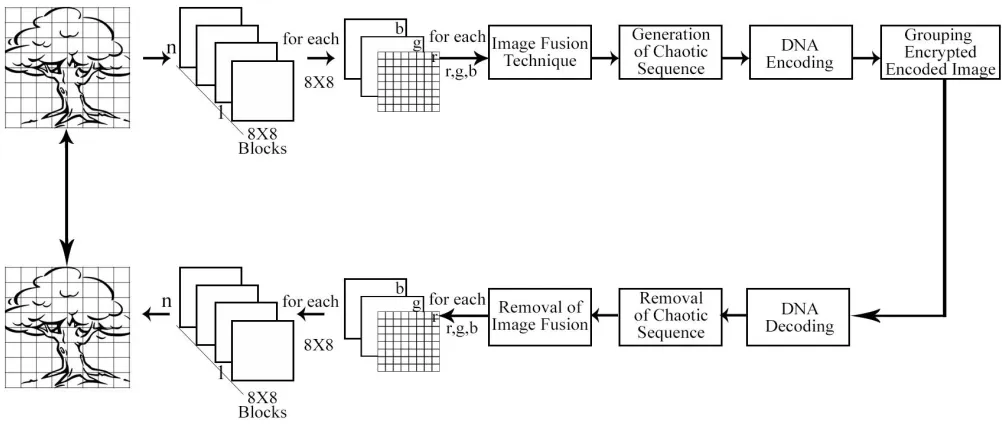
The image initially undergoes image fusion where two or more similar images are combined into a single image and the fused image is more informative than the input images. This is used for image enhancement. After image fusion the Chaotic map is used to generate the chaotic sequence. Then the chaotic sequence is then used for DNA Encoding. The image is the sent to the receiver in encrypted form. At the receiver end the image is initially decoded using the DNA Subsequence operation. It is followed by realization of the chaotic sequence then the splitting up of the fused image is done to get back the original image. The steps are depicted diagrammatically in figure 2.
A.Image Fusion
International Journal of Emerging Technology and Advanced Engineering
Website: www.ijetae.com (ISSN 2250-2459,ISO 9001:2008 Certified Journal, Volume 5, Issue 3, March 2015)
567
Graphics fusion technique – Original Image + Key Image (Registered Images).It is shown in equation 1:
…(1)
Where w is parameter which can have a value between 0 and 1, K(i, j) is the pixel values of the key-image ,O(i, j) is the pixel values of the original-image, and E(i, j) is the pixel values of the fusion-image.
B.Encryption using Chaotic Map
The proposed system introduces a non linear chaotic map [28]. The chaotic map is described by the following equation 2:
...(2)
The image encryption algorithm is based on the proposed NCA map. It uses chaotic sequence generated by NCA map to encrypt image data with different keys for
different images. Original chaotic sequence {x0,x1,x2, . . .}
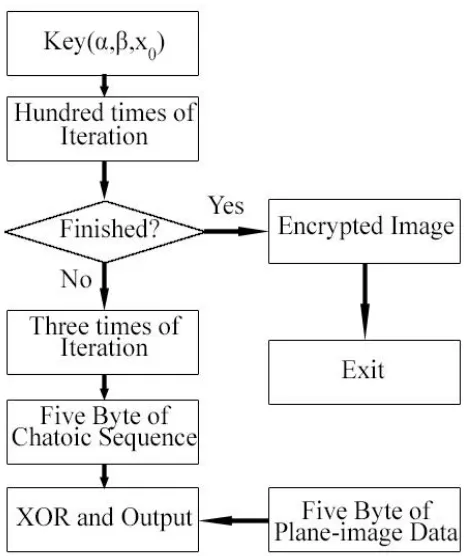
consists of decimal fractions. However images are all digital. So a map is defined to transform the chaotic sequence to another sequence which consists of integers. Then plain-image image can be encrypted by use of XOR operation with the integer sequence .It is depicted in the below figure 1 [28].The encryption steps are as follows:
Step 1: Set encryption key for the plain-image, including structural parameters a, b and initial value x0.
Step 2: Do 100 times of chaotic iteration as formula, and obtain the decimal fraction x100.
Step 3: If the encryption work is finished, then go to step 6; otherwise do three times of chaotic iteration; and as a result, a decimal fraction, such as x103, will be generated, which is a double value and we choose its first 15 significant digits.
Step 4: Divide the 15 digits into five integers with each integer consisting of three digits. For each integer, do mod 256 operation, and another 5 bytes of data will be generated.
[image:2.612.329.562.238.516.2]Step 5: Do XOR operation using the 5 bytes of data with 5 bytes of image data (grey value or color RGB value). Output the calculation result to the object image and go to step 3.
International Journal of Emerging Technology and Advanced Engineering
Website: www.ijetae.com (ISSN 2250-2459,ISO 9001:2008 Certified Journal, Volume 5, Issue 3, March 2015)
[image:3.612.62.563.143.355.2]568
Fig. 2. System Architecture
C.DNA Encoding
1) Encoding and Decoding: A single DNA sequence is made up of four nucleic acid bases: A (adenine), C (cytosine), G (guanine), and T (thymine), where A and T are complements, and C and G are complements. Let binary number 0 and 1 be complements, so 00 and 11 are complements, and 01 and 10 are complements. Thus we can use these four bases: A, T, G, and C to encode 01, 10, 00, and 11, respectively. Usually, each pixel value of the 8 bit grey image can be expressed to 8 bits binary stream. The binary stream can be encoded to a DNA sequence whose length is 4. For example: if the first pixel value of the original image is 75, convert it into a binary stream [01001011]. By using the above DNA encoding rule to encode the stream, we can get a DNA sequence [AGTC], whereas we use A, T, G, and C to express 01, 10, 00, and 11, respectively. We can get a binary sequence [01001011].
2) DNA Subsequences Operation: In this section we use the idea of [27] to define the DNA subsequence and the corresponding operation. We define that a DNA sequence P contains m strands of DNA subsequences according to the
order, in the Pk , the number of bases is k (m < k). The
expression is Pk= PmPm-1… P2 P1. The number of bases for
the corresponding DNA subsequences is lm, lm-1… l2, l1,
respectively.Apparently,
...(3)
Based on the above DNA subsequence expression namely equation 3, we have described the following five kinds of DNA subsequence operation; they are elongation
operation, truncation operation, deletion operation,
insertion operation, and transformation operation.
DNA subsequence elongation operation: Suppose there is an original DNA sequence P1, the subsequence P2, whose length is l, is elongated to the tail of P1. After elongation operation, we can get a new DNA sequence P1’=P1P2. The expression is as follows:
P1 + P2→ P1P2.
DNA subsequence truncation operation: The truncation
operation and the elongation operation are contrary.
Truncating the end of the subsequence P2 in the DNA
sequence P1P2, we will obtain a newDNA sequence P’=P1
The expression is as follows:
P1P2 - P2→ P1.
DNA subsequence deletion operation: Suppose there is an original DNA sequence P= P3P2P1. Deleting the
subsequence P2, then we willobtain a new DNA sequence
P’= P1P32. The expression is as follows:
P3P2P1- P2→ P3P1.
International Journal of Emerging Technology and Advanced Engineering
Website: www.ijetae.com (ISSN 2250-2459,ISO 9001:2008 Certified Journal, Volume 5, Issue 3, March 2015)
569
We suppose that there is an original DNA sequence P= P3P1, inserting a subsequence P2, whose length is l2, into P. The expression is as follows:
P3P1+ P2→ P3P2P1.
DNA subsequence transformation operation: In this operation the locations of two subsequences are
transformed. If the original DNA sequence is
P=P5P4P3P2P1. Transforming the locations of P4and P2, we will get a new DNA sequence P’= P5P2P3P4P1. The expression is as follows:
P5P4P3P2P1→ P5P2P3P4P1.
We introduced five kinds of DNA subsequence
operations, where the inverse operation of elongation
operation istruncation operation and the inverse operation
of deletion operation is insertion operation. In our
algorithm, we use elongation operation, truncation
operation, deletionoperation, and transformation operation and combined with the use of the chaotic map we will
realize the image encryption algorithm. However, the
insertion operation isjust used in the decryption process.
III. RESULTS
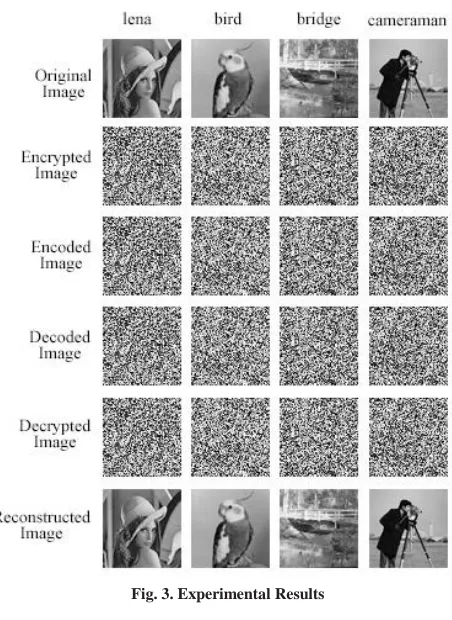
[image:4.612.330.556.134.444.2]The results are depicted in the below given figure 3.From the figure we can see that the encrypted image is more secure compared to any other encryption technique and also that the reconstructed image is same as the original image.
Fig. 3. Experimental Results
IV. CONCLUSIONS
International Journal of Emerging Technology and Advanced Engineering
Website: www.ijetae.com (ISSN 2250-2459,ISO 9001:2008 Certified Journal, Volume 5, Issue 3, March 2015)
570
REFERENCES
[1] Qiang Zhang, Xianglian Xue, and Xiaopeng WeiA, 2012 ―Novel
Image Encryption Algorithm Based on DNA Subsequence Operation‖The Scientific World Journal(Volume 2012, Article ID 286741, 10 pages)
[2] H.E.Ren, Z. Shang, Y. Wang, and J. Zhang, 2007 ―A chaotic algorithm of image encryption based on dispersion sampling,‖ in Proceedings of the 8th International Conference on Electronic Measurement and Instruments (ICEMI ’07), vol. 2, pp. 836–839, August 2007.
[3] C. Fu and Z. Zhu, 2008 ―A chaotic image encryption scheme based
on circular bit shift method,‖ in Proceedings of the 9thInternational Conference for Young Computer Scientists (ICYCS’08), vol. 522, pp. 3057–3061, November 2008.
[4] H.E.Ren,J.Zhang,X.J.Wang,andZ.W.Shang, 2007 ―Block sampling
algorithm of image encryption based on chaotic scrambling,‖ in Proceedings of the International Conference on Computational Intelligence and Security Workshops (CIS ’07), vol. 109, pp. 773– 776, December 2007.
[5] Y.H.Zhang,B.S.Kang,andX.F.Zhang, 2006 ―Image encryption
algorithm based on chaotic sequence,‖ in Proceedings of the 16th International Conference on Artificial Reality and Telexistence— Workshops (ICAT ’06), vol. 29, pp. 221–223, December 2006.
[6] S. Lian, ―Efficient image or video encryption based on
spatiotemporal chaos system,‖ 2009 Chaos, Solitons and Fractals, vol. 40, no. 5, pp. 2509–2519, 2009.
[7] S. Lian, J. Sun, and Z. Wang, 2005 ―A block cipher based on a suitable use of the chaotic standard map,‖ Chaos, Solitons and Fractals, vol. 26, no. 1, pp. 117–129, 2005.
[8] S. Lian, 2009 ―A block cipher based on chaotic neural networks,‖ Neurocomputing, vol. 72, no. 4–6, pp. 1296–1301, 2009.
[9] Y. Z. F. Zuo, Z. Zhai, and C. Xiaobin, 2008 ―A new image
encryption algorithm based on multiple chaos system,‖ in Proceedings of the International Symposium on Electronic Commerce and Security (ISECS ’08), vol. 142, pp. 347–350, August 2008.
[10] J.M.Liu,S.S.Qiu,F.Xiang,andH.J.Xiao, 2008 ―Acryptosystem based
on multiple chaotic maps,‖ in Proceedings of the International Symposium on Information Processing (ISIP ’08) and International Pacific Workshop on Web Mining and Web Based Application (WMWA ’08), vol. 99, pp. 740–743, May 2008.
[11] G. Jakimoski and L. Kocarev, 2001―Analysis of some recently
pro-posed chaos-based encryption algorithms,‖ Physics Letters A,vol. 291, no. 6, pp. 381–384, 2001.
[12] G.´Alvarez, F. Montoya, M. Romera, and G. Pastor, 2003
―Cryptana-lysis of an ergodic chaotic cipher,‖ Physics Letters A, vol. 311, no. 2-3, pp. 172–179, 2003.
[13] S. Mohamed and R. S. Alaa-eldin, 2001 ―Methods of attacking chaotic encryption and countermeasures,‖ in Proceedings of the IEEE Interntional Conference on Acoustics, Speech, and Signal Processing, pp. 1001–1004, Salt Lake, Utah, USA, May 2001.
[14] C. T. Clelland, V. Risca, and C. Bancroft, 1999 ―Hiding messages in
DNA microdots,‖ Nature, vol. 399, no. 6736, pp. 533–534,1999.
[15] Gehani, T. LaBean, and J. Reif, 1999 ―DNA-based cryptography,‖in
Proceedings of the DIMACS Workshop on DNA Based Computers, June 1999.
[16] N. Kang, ―A pseudo DNA cryptography method,‖
http://arxiv.org/abs/0903.2693.
[17] Y. Zhai, S. Lin, and Q. Zhang, 2008 ―Improving image encryption
using multi-chaotic map,‖ in Proceedings of the Workshop on Power Electronics and Intelligent Transportation System (PEITS’08), vol. 10, pp. 143–148, August 2008.
[18] X. Zhang and W. Chen, 2008 ―A new chaotic algorithm for image
encryption,‖ in Proceedings of the International Conference on Audio, Language and Image Processing (ICALIP ’08), pp. 889–892, July 2008.
[19] L. Wang, Q. Ye, Y. Xiao, Y. Zou, and B. Zhang, 2008 ―An image
encryption scheme based on cross chaotic map,‖ in Proceedingsof
the 1st International Congress on Image and Signal Processing (CISP ’08), vol. 3, pp. 22–26, May 2008.
[20] Peng, D. Zhang, and X. Liao, 2009―A digital image encryption algorithm based on hyper-chaotic cellular neural network,‖Fundamenta Informaticae, vol. 90, no. 3, pp. 269–282, 2009.
[21] C. C¸ okal and E. Solak, 2009―Cryptanalysis of a chaos-based
imageencryption algorithm,‖ Physics Letters A, vol. 373, no. 15, pp.1357–1360, 2009.
[22] J.D.WatsonandF.H.C.Crick, 1953―Molecularstructureof nucleic
acids: a structure for deoxyribose nucleic acid,‖ Nature, vol. 171, no. 4356, pp. 737–738, 1953.
[23] W. C. Chen, Z. Y. Chen, Z. H. Chen et al., 2001 ―Operational rules
of the digital coding of DNA sequences in high dimension space,‖Acta Biophysica Sinica, vol. 17, no. 3, pp. 542–549, 2001.
[24] Haojiang Gao *, Yisheng Zhang, Shuyun Liang, Dequn Li, 2005―A new chaotic algorithm for image encryption‖State Key Laboratory of Plastic Forming Simulation, Huazhong University of Science and Technology, 16 August 2005
[25] T. Gao and Z. Chen, 2008―A new image encryption algorithm based
on hyper-chaos,‖Physics Letters A, vol. 372, no. 4, pp. 394– 400,2008.
[26] S.J.Xu,J.Z.Wang,andS.X.Yang, 2008 ―Animprovedimage encryption
algorithm based on chaotic maps,‖ Chinese Physics B, vol. 17, no. 11, pp. 4027–4032, 2008.
[27] S. Behnia, A. Akhshani, H. Mahmodi, and A. Akhavan, 2008 ―A
novel algorithm for image encryption based on mixture of chaotic maps,‖ Chaos, Solitons and Fractals,vol.35,no.2,pp. 408–419, 2008.
[28] Y. Xiao and L. Xia, 2008 ―A new hyper-chaotic algorithm for image