understood in design
Codinhoto, R, Koskela, LJ, Tzortzopoulos, P and Kagioglou, M
Title
How analysis and synthesis have been understood in design
Authors
Codinhoto, R, Koskela, LJ, Tzortzopoulos, P and Kagioglou, M
Type
Conference or Workshop Item
URL
This version is available at: http://usir.salford.ac.uk/9372/
Published Date
2006
USIR is a digital collection of the research output of the University of Salford. Where copyright
permits, full text material held in the repository is made freely available online and can be read,
downloaded and copied for noncommercial private study or research purposes. Please check the
manuscript for any further copyright restrictions.
HOW ANALYSIS AND SYNTHESIS HAVE BEEN
UNDERSTOOD IN DESIGN
Ricardo Codinhoto1, Lauri Koskela2, Patricia Tzortzopoulos3, Mike Kagioglou4
ABSTRACT
In the disciplines related to the design of products and services, such as New Product Development and Design Science, there is a lack of a commonly accepted theoretical and methodical basis. This papers starts with the proposition that the ancient method of analysis and synthesis, developed originally by Greek geometers, is the basis of models that have been used to classify and describe the ill structured design problem.
In this paper, we examine the possibility of improving our understanding of the design process and therefore lean design management by bringing to light a discussion about the concepts of analysis and synthesis and how these have been interpreted through time. Also, how this concept has been used within engineering design methods. To do so, we investigate how analysis and synthesis have been understood in the literature, indicating similarities and differences between ancient and current understandings.
KEY WORDS
Analysis and synthesis, design process, engineering design.
1
The University of Salford, School of Construction & Property Management, Salford M5 4WT, United Kingdom, E-mail: [email protected]
2
The University of Salford, School of Construction & Property Management, Salford M5 4WT, United Kingdom, E-mail: [email protected]
3
The University of Salford, School of Construction & Property Management, Salford M5 4WT, United Kingdom, E-mail: [email protected]
4
INTRODUCTION
It is evident that analysis and synthesis (A&S) are important in any field of research or cognitive activity. Their importance is mainly related to the fact that analysis and synthesis as a method may provide a strong systematic rationale to support research and the development of products and services. However, A&S as a structured method originally developed in ancient Greece has been almost forgotten (Koskela and Kagioglou, 2006).
The method of analysis was developed by ancient Greek geometers. Its first documented use dates from around 300 BC and its influence can be found in both ancient and current research (Beaney, 2003a). At that time A&S was constituted by several different features. These features have stimulated discussion throughout time, although the discussion regarding the rationale established at the beginning seems to be diluted these days. Currently, it seems that A&S is generally associated to a method that is mostly related to decomposition i.e. to divide things into smaller constituent parts. However, it has been argued that decomposition is not the only feature of the method.
Academically, many scientists, for instance, Descartes, Newton, Kant and Popper contributed to the discussion regarding the method of analysis. More recently and within the construction domain, these scientists inspired Koskela and Kagioglou (2006) who have started an investigation regarding the current configuration of the method of analysis and synthesis in design theories and methods. The authors argued that the design field may be suffering from most damaging epistemological dilution as A&S has not been used as a systematic and structured method.
In practice analysis has been used in many different domains including psychology, chemistry, physics and mathematics. A&S has also been used to support design activities. For instance Hubka and Eder (1996) describe that circuit, benefit, protocol, morphological, cluster and value analysis have long been applied to engineering design.
Aiming to contribute to the discussion regarding the method of analysis and synthesis in design, this paper focuses on answering the following question: which concept(s) and logic of analysis and synthesis have been used within different models of the design process over time?
The justification for this research is based mainly on three assumptions: first, mapping the current concept(s) of the method of analysis within design theory and identifying gaps in comparison to the ancient method may help us to identify a direction for building up a stronger rational method for designing. Secondly, a stronger rational method may support the reduction of waste within the design process and consequently, add value to both product and process. Finally, and more importantly, the method of analysis and synthesis may constitute a theoretical foundation for lean design management.
The research method adopted is a literature review, which has focused on two main themes: a) the understanding of the ancient method of analysis and synthesis; b) the current concept of the method of analysis and synthesis as adopted in design theory. Engineering design methods were selected to support the discussions regarding the current understanding of analysis and synthesis.
The first section of this paper presents a brief description of the ancient method of analysis and synthesis and its development through time. Six main features of the method as identified in the literature are highlighted. The paper then presents a brief description of theories related to engineering design methods as presented in the literature. Following, a comparison between ancient Greek method and current understanding in design is made. Finally, conclusions are presented.
THE ANCIENT METHOD OF ANALYSIS AND SYNTHESIS General view of the ancient method of analysis and synthesis
The method of analysis and synthesis was developed and widely used by the early Greek geometers, the foremost representative of which is Euclid (Heath 1981). However, the only existing wider description of the method is from a later period, around 300 AD, when the Greek geometer Pappus defined analysis and synthesis as a structured method5.
Basically the method presented by Pappus is characterised as a complex web of methodologies (Beaney, 2003). Regressive analysis is one, but not the unique method considered in Pappus description. Beaney (2003b) argues that interpretation (also known as transformative analysis) and resolution (i.e. decompositional analysis) can be included into Pappus’ method. These three main logical forms of analysis (i.e. regressive, transformative and decompositional) can be roughly described as follows. First, by regressive analysis Pappus refers to working back to first principles, or in geometry to axioms, by means of which a problem can be solved. Second, the idea of transforming or interpreting refers to the translation of the statements to be analysed into their ‘correct’ logical form as presented by Frege and Russell in Beaney (2003a). Another example of transformative analysis is the use of auxiliary lines to solve a problem in geometry. Finally, decomposition involves decomposing a concept into its constituent parts (Beaney, 2003a)6.
Aristotle also discusses the method of analysis. His main contribution is distinguishing the understanding of “the fact” from the understanding of ‘the reason why’ the fact happens (Smith, 2004). Beaney (2003a) states that Aristotle’s conception of analysis was influential into subsequent conceptions of analysis. Aristotle considered the logic of discovery and logic of proof in his conception. The first looks into effects (in analysis) and the second looks into causes (synthesis).
The method of analysis was also known to medieval scholars through the books written by Euclid. Among others, Descartes subscribed to and applied the method of analysis. Descartes
5
Pappus’ definition is reported by Koskela and Kagioglou (2006) as translated by Heath (1981) and Hintikka and Remes (1974)
6
(1637), in his Discourse on Method, gives the following account about the rules he was applying – the first two falling into analysis and the last two into synthesis:
The first was never to accept anything as true that I did not know to be evidently so: that is to say, carefully to avoid precipitancy and prejudice, and to include in my judgements nothing more than what presented itself so clearly and so distinctly to my mind that I might have no occasion to place it in doubt.
The second, to divide each of the difficulties that I was examining into as many parts as might be possible and necessary in order best to solve it.
The third, to conduct my thoughts in an orderly way, beginning with the simplest objects and the easiest to know, in order to climb gradually, as by degrees, as far as the knowledge of the most complex, and even supposing some order among those objects which do not precede each other naturally.
And the last, everywhere to make such complete enumerations, and such general reviews that I would be sure to have omitted nothing.
Despite many considerable contributions to the method of analysis, it seems that after the great scientists, who propelled the Enlightenment into speed, the attention of the subsequent generations of scholars turned to imitating the example of them, in the true sense of a paradigm, and the method of analysis was transmitted in a rather superficial and impoverished form, as a generic method (Koskela and Kagioglou, 2006).
Koskela and Kagioglou (2006) argue that as a consequence, in the 20th century, it seems that even if many features of analysis were routinely applied in a most diverse group of scientific endeavours, the roots and the totality of the method of analysis were not commonly known. According to the same authors, this can be seen in well known textbooks as Pahl and Beitz (1996) on engineering design and Pugh (1991). For instance, a common current deviation from the ancient method is to state that creativity occurs mainly in synthesis, as presented by Roozenburg and Eekels (1995). However, Koskela and Kagioglou also emphasise that there are exceptions, for instance, “How to solve it” by Polya (2004, first edition in 1945) makes the connection to the ancient method.
To conclude, it’s possible to argue that researchers in trying to identify the smallest parts of the process of A&S, have created a complex web of classifications that may be meaningless as a whole. This fact may establish the reason why we should go back to the first principles, aiming to understand the core concepts within the method of A&S and to identify the reasons why A&S have deviated from the original model. Aiming to highlight the features of A&S as presented by ancient Greek geometers, a short discussion is presented in the next section.
Features of the ancient method of analysis
Koskela and Kagioglou (2006), described six features of the method of analysis and synthesis, presented as follows:
• Secondly, two categories of analysis can be established: theoretical and problematical. The aim of the problematical analysis is to carry out the process of finding a solution. For instance, in architectural design to realize the process of establishing the architectural concept that will guide the development of the architect’s ideas. On the other hand, the theoretical analysis is related to establishing the proof of the solution found e.g. to develop the architectural design based on the established concept.
• Thirdly, there are two directions of inferences needed: backwards for the resolution and forwards for the proof. To infer backwards looking for the resolution means to establish for instance, the constituent parts, the sequence of how “things” happen and explanation of why things happen regarding the analysed thing. On the other hand, to work forward means to test if the inferred elements and its connections works as predicted.
• Fourthly, the method of analysis does not ensure that a solution can be found. Thus, the method leads to an iterative approach i.e. the problem is reviewed, and the analysis starts again.
Based on (Hintikka and Remes 1974) and (Beaney 2003a), it can be argued that analysis consists of at least two other different lines or types of reasoning, i.e.:
• Fifthly, analysis involves decomposition i.e. breaking down concepts into their basic constituents (Hintikka & Remes 1974).
• Thus, sixthly, analysis involves transformation; where the original problem is translated into another logical form, aiming to facilitate its solution (Beaney, 2003a). The issue of transformation within analysis is considerably complex. Therefore, the discussion regarding transformation will not take place in this paper.
As argued by Koskela and Kagioglou (2006), these six features do not exhaust the ancient understanding of the method of analysis, but provide a suitably concise starting point for our present purposes.
The understanding of analysis and synthesis in engineering design
The cognitive aspects of the design activity as presented in engineering design methods can be generally described as an attempt to model how designers think during designing. One of the assumptions behind this attempt is that a fundamental model exists and the designer can be trained to follow it.
information and perceptions of the world and the use of logic of any kind to build up design solutions. The Figure 1a and 1b below show Simon’s view of the process of analysis and synthesis.
Other conceptions of analysis and synthesis within the design process can be found in the models developed by Archer (1984), Cross (1989), Suh (1990), Hubka and Eder (1996) and Lawson (2006). The models proposed by these authors have some variation, but regarding analysis and synthesis, the core concept is based mainly on regressive analysis. The models also describe loops of iteration where the absence of an answer or the impossibility to solve the design problem leads the designer to go back to the problem and revise it. This general view is presented in Figure 2.
The arrows at the beginning (as an input) and at the end (as an outcome) represent respectively the problem and the solution. The process of analysis in itself is roughly described by these authors as a regressive analysis focused on the identification of axioms. Despite the richness of their description, again, the authors do not make reference to the ancient geometers who originally developed the method of analysis and synthesis, or to the debate that has been taking place in academia for over two thousand years.
[image:7.612.120.483.163.279.2]Figure 1b: Analysis and synthesis within the design process after Simon (1969) Figure 1a: The design process after
[image:7.612.197.438.477.561.2]Simon (1969)
Figure 2: General process of analysis and synthesis in Archer (1984), Cross (1989) and Lawson (2006).
field, has at least partially drifted away from the ancient understanding. Therefore, there is confusion and contradiction among different authors when they refer to A&S within design.
THE APPLICATION OF A&S TO CURRENT DESIGN METHODS
This section looks closely at engineering design literature to identify whether the six features of the ancient method of analysis and synthesis have been considered in this domain. Deviations from the original meaning and emerging ideas are also highlighted.
The start and end points
In the ancient method of analysis and synthesis the start and end points of analysis are considered qualitatively different. At the starting point of analysis, we don’t know if the analysed ‘thing’ is possible or can be done, whereas the end point is something already known (Koskela and Kagioglou, 2006).
Aiming to facilitate the discussion regarding the start and end points in analysis within design, parts of the texts written by the referred authors are presented below.
• “…analysis involves the exploration of relationships, looking for patterns in the information available, and the classification of objectives. Analysis is the ordering and structuring of the problem. Synthesis on the other hand is characterised by an attempt to move forward and create a response to the problem – the generation of solutions” (Lawson, 2006)
• “…designing usually takes place in answer to a perceived need.” (Hubka and Eder, 1996)
• “…the design process starts with the establishment of functional requirements …” “…this product is then analysed and compared with the original set of functional requirements (FRs).” (Suh, 1990)
• “…design begins with a need.” (Archer, 1984)
• Analysis: listing of all design requirements and the reduction of these to a complete set of logically related performance specification.” (Cross, Naughton
et al., 1981)
• “…the science of the artificial relates to how things ought to be…” (Simon, 1969)
According to the cited authors the starting point of analysis within design is a need, a goal, a problem or the establishment of functional requirements. The cited authors do not stress that the starting point is something not known, although it often can be implied. Therefore, the current conception does not fit very well with the ancient method of analysis and synthesis.
Two types of analysis
As mentioned above, there are two forms of analysis: theoretical, for establishing the proof, and problematical, for finding a solution.
concept and design solution. This does not mean that the need, concept and the design solution should be fixed.
On the other hand, the theoretical kind within the design process possibly means that a specific or contextual situation can both be explained (by the adopted general principles) and solved, because the general principles provide the rationale to solve it. Again, this does not necessarily mean that the explanations (solution) and the proof represent the best answer for the problem.
Based on the discussion above, the texts presented below are used to conduct the discussion regarding the current view related to this feature:
• “While the core of the Vee is sequential, concurrent development is an essential part of the process. The concurrent “off-core” analyses, investigations, developments, and tests are engineering studies necessary to manage opportunities and risks inherent in higher level “on-core” requirements” (Forsberg and Mooz, 1998)
• “…problem and solution are better seen as two aspects of a description of the design situation rather than separate entities.” (Lawson, 2006)
• “Especially in engineering, designing is goal-directed. Goals include attempting to resolve an issue…” “Trying to find a set of reasonably logical steps and progressions that can suggest ways to rationalize designing would thus make sense.” (Hubka and Eder, 1996)
• “…the design process begins with the recognition of a societal need. The need is formalized, resulting in a set of FRs (functional requirements).” “Once the need is formalized, ideas are generated to create a product (or an organizational structure). This product is then analyzed and compared with the original set of FRs.” (Suh, 1990)
• “…the reduction of these to a complete set of logically related performance specifications.” “…building up complete designs…” (Cross, 1989)
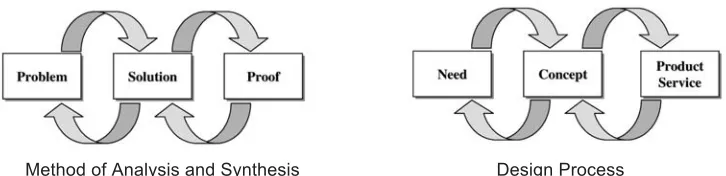
Two issues emerge regarding problematical and theoretical analysis (and synthesis) within the design process based on the quotes above: Firstly, the aim of problematical analysis is to find the structure, order, rationale that explains the most. Secondly, the rationale adopted should explain the relation between problem and solution (in designing, the concept and the product or the need and the concept) as presented in Figure 3.
Therefore, the statement of the product concept in the design process can be understood as a ‘generic’ solution for the ‘perceived need’ (problem). In establishing the concept, the designer ‘goes back’ to clients and customers needs as an attempt to identify priorities, constraints, conflicts and rules related to the investigated problem. Then the designer moves forward, either through a creative leap or systematically, and the result is a concept, i.e. a candidate solution. In proving that the concept provides a valid solution, the designer analyzes the concept solution into the smallest elements, and synthesizes them back into the final design, simultaneously taking care that all the client requirements are being met.
Iteration
The method of analysis does by no means ensure that a solution can be found. Rather, the method leads to an iterative approach: we may be compelled to return to the problem and revise it, and start afresh. There are two possible reasons for the lack of a solution for a problem: the problem may be impossible or the solution was not invented yet.
Within design, the iteration between analysis and synthesis will be investigated from the following quotations:
• “…design consists of analysis, synthesis and evaluation linked in an iterative cycle…” “…designers are often solution focused and work by generating ideas about whole or partial solutions. These solutions are sometimes developed and sometimes abandoned” (Lawson, 2006)
• “…designers move rapidly to early solution conjectures, and use these conjectures as a way of exploring and defining problem-and-solution together.” (Cross, 2004) • “Designing must also be iterative - exploring forward into more advanced (usually concrete) design stages, to repeat (backwards) for review, expansion, completion and correction.” (Hubka and Eder, 1996)
• “When the product does not fully satisfy the FRs, then one must either come up with a new idea, or change the FRs to reflect the original need more accurately. This iterative process continues until the designer produces an acceptable result.” (Suh, 1990)
• “Often, where the optimum solution of one sub-problem compels the acceptance of a poor solution in the other, the designer is forced to decide which of the two must take priority. This entails putting the whole complex of sub-systems into an order of importance…” (Archer, 1984)
[image:10.612.128.491.112.200.2]Looking within design, the iterative process between analysis and synthesis can be viewed in both i.e. backwards between problem and solution, as well as forwards between solution and proof (Figure 3). Thus, despite there being no reference to the ancient geometers the iterative method is evident both in the ancient method of analysis and the current view of the design process.
Figure 3: Iteration in the method of analysis and synthesis and in the design process
Decomposition
Even if not explicitly discussed in Pappus’ account, a decompositional (also called configurational) analysis is usually involved in the method of analysis (Hintikka & Remes 1974). In the context of geometry, the question is about investigating from which parts (lines, angles, points, etc.) a figure is made up, and which relations exists between those parts (e.g. opposite, complementary). In fact, it is in this meaning of breaking down into parts that the term analysis is today most often used. However, to bring to light the current conceptualisation in design, the following were considered.
• “Analysis involves the exploration of relationships, looking for patterns in the information available and the classification of objectives.” (Lawson, 2006)
• “During designing, a system may need to be broken down (decomposed) into sub-systems. Each sub-system can be regarded as a different design problem.” (Hubka and Eder, 1996)
• “In practice, creative designing seems to proceed by oscillating between sub-solution and sub-problem areas, as well as by decomposing the problem and combining sub-solutions.” (Cross,1997)
• “…we must establish the FRs from the needs.’ ‘This definitional step requires insight into the problem, and a knowledge base encompassing issues related to the problem.” (Suh, 1990)
• “In practice, of course, the designer cannot define the factors in his particular problem… A single design is a complex of a thousand or more sub-problems.” (Archer, 1984)
• “…the inner environment of the design problem is represented by a set of given alternatives of action.” “…at each stage in the design process, the partial design reflected in these documents serves as a major stimulus for suggesting to the designer what he should attend next. This direction to new sub-goals permits in turn new information to be extracted from memory and reference sources and another step to be taken towards the development of design.” (Simon, 1969) It is clear that there are similarities between the ancient and current views of decomposition. However, in design, designers are not just looking for ‘what is there’ but also for ‘what is not there’. The concept (or solution) may consider the addition of benefits e.g. through making explicit, visible or more evident in the concept something that could be there implicitly (Levitt, 1990; Kotler, 1998). Another difference, as pointed out by Koskela and Kagioglou (2006) might be the fact that the modern view sees the decomposed parts as independent, whereas the ancient approach also covered the relationships between the decomposed parts.
Two directions of analysis
To work backwards or to adopt a regressive approach can be described as follows: “…involving the working back from ‘what is sought’, taken as assumed, to something more fundamental by means of which it can then be established, through its converse, synthesis.” (Beaney, 2003a)
In design it may be considered as looking back for causes by their effects. For instance, considering ‘the perceived need’ as an effect, the analyst will be looking for the cause or causes of that need. For instance, people need flexible rooms because the use of the rooms is changing frequently and the use is changing frequently because products and processes are in constant development. Therefore, products and process development may explain the necessity for flexibility.
However, looking at engineering design methods, it seems that the process of analysis consists of regression, i.e. regressive inferences. This view can be substantiated by the quotations below.
• “Trying to find a set of reasonably logical steps and progressions that can suggest ways to rationalize designing would thus make sense.” (Hubka and Eder, 1996) • “FRs and DPs have hierarchies, and they can be decomposed.” (Suh, 1990)
• “This entails putting the whole complex of sub-systems into an order of importance…” (Archer, 1984)
• “This direction to new sub-goals permits in turn new information to be extracted from memory and reference sources and another step to be taken towards the development of design.” (Simon, 1969)
The admittance of hierarchies, steps, priorities, goals and sub-goals, refers to the identification of the constituent parts of the problem. Therefore, it is obvious that regression takes part in the design process as in the method of analysis and synthesis. However, it is not clear how the designer infers the sequence of inferences from the ‘perceived need’. Also, how regression and decomposition come together is an issue little addressed. Lastly, inferences forward are rarely mentioned in the design literature. An exception can be found in Forsberg et al. (1996) and Codinhoto et al. (2006).
SUMMARISING THE DISCUSSION
Table 1 - Comparison of ancient and current views of A&S
CONCLUSIONS
Through the investigation conducted in this paper it must be concluded that some features of the ancient method of analysis and synthesis have been considered within the current views of analysis and synthesis in design. However, it seems that analysis and synthesis as a method within current engineering design methods lacks completeness and structure. On the one hand, regarding completeness, the main point is related to the failure to utilise all three main forms of reasoning as well as both directions of them. On the other hand, it is not made clear where to start and finish, regarding both analysis and synthesis.
Moreover, in science, analysis has a specific meaning and relates to a specific method; however, currently it has been used as a synonym of examination, investigation and interpretation, therefore, causing confusion. Finally, within the design field, despite many descriptions regarding the process (or method) of analysis and synthesis, none of them refers to the original method, thus thwarting the use of all prior knowledge accumulated around analysis and synthesis.
REFERENCES
Archer, L. B., (1984) Systematic method for designers, Developments in Design Methodology. N. Cross. Chichester, Wiley.
Beaney, M. (2003a) Analysis, The Stanford Encyclopaedia of Philosophy (Summer 2003 Edition). E. N. Zalta. 2005, URL = <http://plato.stanford.edu/archives/sum2003/entries/ analysis/>.
Only one direction is usually recognized
Start / End Two types of
analysis Iteration Decomposition
Two directions of inferences
Investigated features of the ancient method of A&S
Starting: we do not know whether it is possible or can be done Ending: something already known Theoretical and problematic form of analysis
The method is iterative: we may be compelled to return to the problem and revise it, and start afresh
“In the context of geometry, the question is about investigating from which parts… a figure is made up, and which relations exists between those parts…” Backwards for the solution; forwards for the proof The application of A&S within the current view
It has a somewhat different conception and does not well fit into the ancient method.
The two types of analysis are recognized, but they are not understood as variants of one and the same method.
It is evident within the current view of A&S.
Beaney, M. (2003b) Ancient conceptions of analysis: a supplement to Analysis, The Stanford
Encyclopaedia of Philosophy (Summer 2003 Edition), E. N. Zalta (ed.), URL = <http://
plato.stanford.edu/archives/sum2003/entries/analysis/>.
Codinhoto, R., Koskela, L. J., Kagioglou, M. (2006) [online] Product Development Life Cycle: the potential use of the “V” Model within construction, Abstract available from < http:// www.obom.org/PAGES/EGLCabstractCodinhoto.html> (accessed on 12th June 2006)
Cross, N. (1989) Engineering Design Methods, John Wiley & Sons Ltd.
Cross, N. (1997) Descriptive models of creative design: application to an example, Design Studies 18: 427-455.
Cross, N. (2004) Expertise in design: an overview, Design Studies 25: 427-441.
Cross, N., J. Naughton, et al. (1981) Design method and scientific method, Design Studies 2(4): 195-201.
Descartes, R. (1637) Descartes: Discourse on Method and Meditations, Penguin Books. Forsberg, K, & Mooz, H, 1998, Systems engineering for faster, cheaper, better. Center for Systems Management, Inc. Available at www.csm.com
Forsberg, K, Mooz, H, & Cotterman, H, 1996, Visualizing Project Management, John Wiley &Sons, US.
Heath, T. L., (1981). A History of Greek Mathematics, New York, Dover Publications. Hintikka, J., Remes, U. (1974). The Method of Analysis. Its Geometrical Origin and Its General Significance, Boston Studies in the Philosophy of Science, Vol. XXV, D. Reidel, Dordrecht, 144 p., 1974.
Hubka, V., W. E. Eder (1988). Theory of technical systems: a total concept theory for
engineering design, Germany, Springer-Verlag.
Hubka, V.; W. E. Eder (1996). Design Science, London, Springer Verlag.
Koskela, L. J.; Kagioglou, M., (2006). The proto-theory of design: the method of analysis of the ancient geometers, International Design Conference - Design 2006, Dubrovnik - Croatia, May 15 - 18, 2006.
Kotler, P. (1998). Administração de Marketing: análise, planejamento, implementação e controle. 5.ed. São Paulo, Atlas.
Lawson, B. (2006). How Designers Think: the design process demystified, Architectural Press. Levitt, T. (1990) Imaginação de Marketing, 2.ed, São Paulo: Atlas.
Niiniluoto, I., (1990). Edgar Allan Poe ja geometrinen analyysi [Edgar Allan Poe and geometric analysis], in: ”Maailma, minä ja kulttuuri”, I. Niiniluoto, Otava, Helsinki,. Oxford, Oxford University Press.
Pahl, G.; Beitz, W. (1996). Engineering Design, Springer.
Plato (380BC) Meno, Translated by Benjamin Jowett, available in: http://classics.mit.edu/ Plato/meno.html
Polya, G. (2004). How to solve it, Princeton University Press. Pugh, S. (1991) Total Design, Addison-Wesley, Wokingham.
Ritchie, T. (1991) Analysis and Synthesis: On Scientific Method, Based on a Study by Bernhard Riemann, Systems Research, Vol. 8, No. 4, pp. 21-41.
Roozenburg, N. F. M.; Eekels, J. (1995) Product Design: fundamentals and Methods, Chichester, John Wiley & Sons Ltd.
Smith, R. (2004) Aristotle’s Logic, The Stanford Encyclopaedia of Philosophy, E. N. Zalta (ed.), URL = http://plato.stanford.edu/archives/fall2004/entries/aristotle-logic/.