
EFFICIENCY OPTIMIZATION OF A DIRECT TORQUE CONTROL (DTC) INDUCTION MOTOR DRIVE
SIM SY YI
UNIVERSITI TUN HUSSEIN ONN MALAYSIA STATUS CONFIRMATION FOR DOCTORAL THESIS
EFFICIENCY OPTIMIZATION OF A DIRECT TORQUE CONTROL (DTC) INDUCTION MOTOR DRIVE
ACADEMIC SESSION : 2015/2016
I, SIM SY YI, agree to allow this Doctoral Thesis to be kept at the Library under the following terms:
1. This Doctoral Thesis is the property of the Universiti Tun Hussein Onn Malaysia. 2. The library has the right to make copies for educational purposes only.
3. The library is allowed to make copies of this report for educational exchange between higher educational institutions.
4. ** Please Mark (√)
CONFIDENTIAL (Contains information of high security or of great importance to Malaysia as STIPULATED under the
OFFICIAL SECRET ACT 1972)
RESTRICTED (Contains restricted information as determined by the Organization/institution where research was conducted)
FREE ACCESS
Approved by,
(WRITER’S SIGNATURE) (SUPERVISOR’S SIGNATURE)
Permanent Address:
NO 4, LORONG J, JALAN MASJID, 83000, BATU PAHAT, JOHOR.
Date : ___________________________ Date: _____________________________
NOTE:
** If this Doctoral Thesis classified as CONFIDENTIAL or RESTRICTED, please attach the letter from the relevant authority/organization stating reasons and duration for such classifications.
This thesis has been examined on date 14 December 2015 and is sufficient in fulfilling the scope and quality for the purpose of awarding the Degree of Doctor of Philosophy.
Chairperson:
Prof. Madya Dr. Mohamad Nor bin Mohamad Than Faculty of Electrical and Electronic Engineering University Tun Hussein Onn Malaysia
Examiners:
Prof. Dr. Nasrudin bin Abd Rahim
Deputy Vice Chancellor (Research & Innovation) University of Malaya
Dr. Shamsul Aizam bin Zulkifli
EFFICIENCY OPTIMIZATION OF A DIRECT TORQUE CONTROL (DTC) INDUCTION MOTOR DRIVE
SIM SY YI
A thesis submitted in
fulfilment of the requirement for the award of the Doctor of Philosophy
Faculty of Electrical and Electronic Engineering Universiti Tun Hussein Onn Malaysia
I hereby declare that the work in this project report is my own except for quotations and summaries which have been duly acknowledged
Student : ……….……….
SIM SY YI
Date : ……….……….
Supervisor : ……….……….
DR WAHYU MULYO UTOMO
ACKNOWLEDGEMENT
First of all, I would like to take this opportunity to express my deepest gratitude to my research supervisors; Dr. Wahyu Mulyo Utomo and Associate Professor. Dr .Zainal Alam Bin Haron, who has persistently and determinedly assisted me during the whole course of this research. It would have been very difficult to complete this research without the enthusiastic support, insight and advice given by my supervisors.
My utmost thank also goes to my family. Words cannot be expressed for how grateful I am to my parents for all the support that gave me throughout my academic
years. Without them, I might not be the person I am today.
ABSTRACT
ABSTRAK
TABLE OF CONTENTS
TITLE i
DECLARATION ii
DEDICATION iii
ACKNOWLEDGEMENT iv
ABSTRACT v
ABSTRAK vi
TABLE OF CONTENTS viii
LIST OF TABLES xiii
LIST OF FIGURES xiv
LIST OF SYMBOLS AND ABBREVIATIONS xxi
LIST OF APPENDICES xxiii
CHAPTER 1 INTRODUCTION
1.1 Introduction 1
1.2 Research Background 1
1.4 Research Objectives 4
1.5 Research Scope 4
1.6 Thesis Outline 5
CHAPTER 2 LITERATURE REVIEW
2.1 Introduction 7
2.2 Variable Speed Drive (VSD)-Induction Motor Drive System
7
2.2.1 Scalar Control 10
2.2.2 Vector Control 11
2.2.2.1 Field Oriented Control (FOC)
12
2.2.2.2 Direct Torque Control (DTC)
14
2.3 Efficiency Optimization of Induction Motor 17
2.4 Efficiency Optimization Technique 21
2.4.1 Search Control Technique (Physics-based)
23
2.4.2 Loss Model Technique (Model based technique)
23
2.4.3 Hybrid Control Technique 24 2.5 Review of Existing Previous Work 25
2.5.2 Efficiency Optimization of Vector Control Induction Motor Drives System
29
2.5.3 Result Comparison 39
2.6 Gap of Study 42
CHAPTER 3 RESEARCH METHODOLOGY
3.1 Introduction 44
3.2 Control Strategy of the Proposed Efficiency Optimization of DTC IM Drive System
44
3.2.1 Flux and Torque Estimator Block 45 3.2.2 Flux and Torque Controller 47 3. 3 Proposed ANN Efficiency Optimization
Control Strategy
48
3.4 Learning Algorithm of Proposed ANNEO Controller
52
3.5 Proposed ANN Speed Controller 58
CHAPTER 4 RESEARCH DESIGN AND RESULTS
4.1 Introduction 62
4.2 Overview of Systems Development 63 4.3 Simulation Model with the Implementation of
MATLAB/ SIMULINK
64
4.3.1 Direct Torque Controller Block 66 4.3.2 Space Vector Pulse Width
Modulation Inverter Block
67
4.3.3 Input Power and Efficiency Evaluation Block
4.3.4 Proposed ANN Efficiency Optimization Controller Block
68
4.3.5 Proposed ANN Speed Controller Block 69 4.4 Hardware Development and Implementation 69
4.4.1 The Real-time Interface Integration with dSPACE
70
4.4.1.1 Feedback of the Motor Speed Signal
72
4.4.1.2 Feedback of the Motor Current Signal
72
4.4.2 The Experiment Set-up 73
4.5 Results and Discussion 74
4.5.1 Simulation Tests for Efficiency Improvement of the Proposed ANNEO Controller.
75
4.5.2 Experimental Verification of the Efficiency Improvement of the Proposed ANNEO Controller
84
4.5.3 Results Discussion on Efficiency Improvement of the Proposed ANNEO Controller tests
93
4.4.4 Simulation Tests for Step Speed Variation
104
4.5.5 Experimental Verification of Speed Variation
106
4.5.6 Results Discussion on Speed Variations Tests
108
4.5.7 Simulation Tests for Constant Speed with Load Disturbance
109
4.5.8 Experimental Verification of Constant Speed with Load Disturbance
4.5.9 Results Discussion on Constant Speed with Load Disturbance Tests
114
CHAPTER 5 CONCLUSION AND FUTURE WORK
5.1 Conclusion 116
5.2 Future Work 117
LIST OF PUBLICATIONS 119
REFERENCES 123
APPENDIX 135
LIST OF TABLES
2.1 Gap of study for the efficiency optimization IM drives from several recent works where the input power is used as the objective function of the EO controller
43
4.1 Resulting flux level determined by the adaptive ANNEO for different operating points ( Simulation )
93
4.2 Resulting flux level determined by the adaptive ANNEO for difference operating points ( Experiment )
93
4.3 Efficiency of the DTC with Constant Flux and Optimum Flux reference corresponding to different speeds and torques ( Simulation )
94
4.4 Efficiency of the DTC with Constant Flux and Optimum Flux reference corresponding to different speeds and torques ( Experiment )
95
4.5 Settling time comparison for the speed variation on
simulation and experimental tests.
109
4.6 Speed deviation comparison for the sudden load
disturbance on simulation and experimental tests
LIST OF FIGURES
2.1 Block diagram of a variable speed induction motor drive system
9
2.2 General classification of IM control methods 9
2.3 Indirect vector control method 13
2.4 Direct vector control method 13
2.5 Hysteresis controlled of DTC induction motor drive 15 2.6 Block Diagram of a SVPWM-DTC IM drive system 17 2.7 Torque production with three different flux level in the light
load condition. (a)-nominal flux, (b) medium flux (optimum flux) and (c) low flux
19
2.8 Types of losses of converter drive system with the flux variation
20
2.9 Efficiency improvement by the flux program at variable torque with constant speed
21
2.10 Categories of efficiency optimization control 22 2.11 Induction motor drive operated under real-time Efficiency
Optimization Technique
22
2.12 ωrand Teas the input of the optimization control block 30
2.13 ωr ,Te, Pin as well as the ∆ω as the inputs of the optimization
control block
33
2.14 Utilize the Te as the input to the optimization control block 35
2.15 Input to the optimization control block accordingly to the input power, Pin and output power, Pout
38
3.1 Block Diagram of an efficiency optimization control system of DTC IM drives
3.2 Block Diagram of an efficiency optimization control system of DTC IM drives
47
3.3 Architecture of proposed ANNEO controller 50 3.4 Architecture of proposed ANN speed controller 59 4.1 The general testing diagram of the proposed ANNEO DTC 64 4.2 Complete Simulink block of the proposed efficiency
optimization control for the direct torque control induction motor drive system
65
4.3 Simulink circuit of the Direct Torque Control block 66 4.4 Simulink circuit of the SVPWM control technique for the
three phase’s inverter
67
4.5 Simulink block for the efficiency and input power evaluation. 68 4.6 Simulink circuit for the proposed ANN efficiency
optimization controller
69 4.7 Simulink circuit for the proposed ANN speed controller 69 4.8 The connection between Matlab and dSPACE 70 4.9 Real-time interface model with dSPACE I/O Blocks 71 4.10 The experimental set-up of proposed efficiency optimization
control for the direct torque control induction motor drive system
73
4.11 Simulation results of the system performance for the speed at 500rpm and a 0.2Nm load torque applied where the proposed ANNEO controller is activated at the time =0.5s: (a) before the ANNEO controller is activated; (b) after the ANNEO controller is activated
76
4.12 Simulation result of the d-q stator flux circle at 500rpm and a 0.2Nm load torque applied, before and after the proposed ANNEO controller activated
76
4.13 Simulation results of the system performance for the speed at 500rpm and a 0.8Nm load torque applied where the proposed ANNEO controller is activated at the time =0.5s: (a) before the ANNEO controller is activated; (b) after the ANNEO controller is activated
4.14 Simulation result of the d-q stator flux circle at 500rpm and a 0.2Nm load torque applied, before and after the proposed ANNEO controller is activated
77
4.15 Simulation results of the system performance for the speed at 800rpm and a 0.2Nm load torque applied where the proposed ANNEO controller is activated at the time =0.5s: (a) before the ANNEO controller is activated; (b)after the ANNEO controller is activated
78
4.16 Simulation result of the d-q stator flux circle at 500rpm and a 0.2Nm load torque applied, before and after the proposed ANNEO controller is activated
78
4.17 Simulation results of the system performance for the speed at 800rpm and a 0.8Nm load torque applied where the proposed ANNEO controller is activated at the time =0.5s: (a) before the ANNEO controller is activated; (b) after the ANNEO controller is activated
79
4.18 Simulation result of the d-q stator flux circle at 800 rpm and a 0.8Nm load torque applied, before and after the proposed ANNEO controller is activated
79
4.19 Simulation results of the system performance for the speed at 1100rpm and a 0.2Nm load torque applied where the proposed ANNEO controller is activated at the time =0.5s: (a) before the ANNEO controller is activated; (b) after the ANNEO controller is activated
80
4.20 Simulation result of the d-q stator flux circle at 1100rpm
and a 0.2Nm load torque applied, before and after the proposed ANNEO controller is activated
80
4.21 Simulation results of the system performance for the speed at 1100rpm and a 0.8Nm load torque applied where the proposed ANNEO controller is activated at the time =0.5s: (a) before the ANNEO controller is activated; (b) after the ANNEO controller is activated
4.22 Simulation result of the d-q stator flux circle at 1100rpm and a 0.8Nm load torque applied, before and after the proposed ANNEO controller is activated
81
4.23 Simulation results of the system performance for the speed at 1400rpm and a 0.2Nm load torque applied where the proposed ANNEO controller is activated at the time =0.5s: (a) before the ANNEO controller is activated; (b) after the ANNEO controller is activated
82
4.24 Simulation result of the d-q stator flux circle at 1400rpm and a 0.2Nm load torque applied, before and after the proposed ANNEO controller is activated
82
4.25 Simulation results of the system performance for the speed at 1400rpm and a 0.8Nm load torque applied where the proposed ANNEO controller is activated at the time =0.5s: (a) before the ANNEO controller is activated; (b) after the ANNEO controller is activated
83
4.26 Simulation result of the d-q stator flux circle at 1400rpm and a 0.8Nm load torque applied, before and after the proposed ANNEO controller is activated
83
4.27 Experimental results of the system performance for the speed at 500rpm and a 0.2Nm load torque applied where the proposed ANNEO controller is activated at the time =10s
(a): before the ANNEO controller is activated; (b): after the ANNEO controller is activated
85
4.28 Experimental results of the system performance for the speed at 500rpm and a 0.8Nm load torque applied where the proposed ANNEO controller is activated at the time =10s. (a): before the ANNEO controller is activated; (b): after the ANNEO controller is activated
86
4.29 Experimental results of the system performance for the speed at 800rpm and a 0.2Nm load torque applied where the proposed ANNEO controller is activated at the time =10s.
(a): before the ANNEO controller is activated; (b): after the ANNEO controller is activated
4.30 Experimental results of the system performance for the speed at 800rpm and a 0.8Nm load torque applied where the proposed ANNEO controller is activated at the time =10s. (a): before the ANNEO controller activated; (b): after the ANNEO controller activated
88
4.31 Experimental results of the system performance for the speed at 1100rpm and a 0.2Nm load torque applied where the proposed ANNEO controller is activated at the time =10s. (a): before the ANNEO controller is activated; (b): after the ANNEO controller is activated
89
4.32 Experimental results of the system performance for the speed at 1100rpm and a 0.8Nm load torque applied where the proposed ANNEO controller is activated at the time =10s. (a): before the ANNEO controller is activated; (b): after the ANNEO controller is activated
90
4.33 Experimental results of the system performance for the speed at 1400rpm and a 0.2Nm load torque applied where the proposed ANNEO controller is activated at the time =10s. (a): before the ANNEO controller is activated; (b): after the ANNEO controller is activated
91
4.34 Experimental results of the system performance for the speed at 1400rpm and a 0.8Nm load torque applied where the proposed ANNEO controller is activated at the time =10s. (a): before the ANNEO controller is activated; (b): after the ANNEO controller is activated
92
4.35 The efficiency comparison for rated flux and optimal flux value for the speed of (a) 1400rpm, (b) 1100rpm, (c) 800rpm
and (d)500rpm corresponding to different torques value (simulation)
97
4.36 The efficiency comparison for rated flux and optimal flux value for the speed of (a) 1400rpm, (b) 1100rpm, (c) 800rpm
and (d)500rpm corresponding to different torques value (experimental)
4.37 The efficiency comparisons for rated flux and optimal flux value for different load torques, (a) 0.2Nm, (b) 0.4Nm, (c) 0.6Nm and (d) 0.8Nm corresponding to different speed value (simulation)
101
4.38 The efficiency comparisons for rated flux and optimal flux value for different load torques, (a) 0.2Nm, (b) 0.4Nm, (c) 0.6Nm and (d) 0.8Nm corresponding to different speed value (experimental)
103
4.39 The speed, current and torque response for a step speed variation under the 0.2Nm load torque applied: (a) online learning ANNSC, (b) offline learning ANNSC
105
4.40 The speed, current and torque response for a step speed variation under the 0.8Nm load torque applied: (a) online learning ANNSC, (b) offline learning ANNSC
106
4.41 The speed and current response for a step speed variation under the 0.2Nm load torque applied: (a) online learning ANNSC, (b) offline learning ANNSC
107
4.42 The speed and current response for a step speed variation under the 0.8Nm load torque applied: (a) online learning ANNSC, (b) offline learning ANNSC
107
4.43 The speed, current and torque response for a constant speed of 500rpm with load disturbance of 0.2Nm and 0.8Nm at the time of 0.7s, and 1s: (a) online learning ANNSC, (b) offline learning ANNSC
110
4.44 The speed, current and torque response for a constant speed of 800rpm with load disturbance of 0.2Nm and 0.8Nm at the time of 0.7s, and 1s: (a) online learning ANNSC, (b) offline learning ANNSC
110
4.45 The speed, current and torque response for a constant speed of 1100rpm with load disturbance of 0.2Nm and 0.8Nm at
the time of 0.7s, and 1s: (a) online learning ANNSC, (b) offline learning ANNSC
4.46 The speed, current and torque response for a constant speed of 1400rpm with load disturbance of 0.2Nm and 0.8Nm at the time of 0.7s, and 1s: (a) online learning ANNSC, (b) offline learning ANNSC
111
4.47 The speed and current responses at constant speed of 500rpm with load disturbance of 0.2Nm and 0.8Nm at the time of 6s, and 10s: (a) online learning ANNSC, (b) offline learning ANNSC
112
4.48 The speed and current responses at constant speed of 800rpm with load disturbance of 0.2Nm and 0.8Nm at the time of 6s, and 10s: (a) online learning ANNSC, (b) offline learning ANNSC
113
4.49 The speed and current responses at constant speed of 1100rpm with load disturbance of 0.2Nm and 0.8Nm at the time of 6s, and 10s: (a) online learning ANNSC, (b) offline learning ANNSC
113
4.50 The speed and current responses at constant speed of 1400rpm with load disturbance of 0.2Nm and 0.8Nm at the time of 6s, and 10s: (a) online learning ANNSC, (b) offline learning ANNSC
LIST OF SYMBOLS AND ABBREVIATIONS
f - Frequency
Idq - d-q Axis Current Ls - Stator Self Inductances Lr - Rotor Self Inductances
Lm - Mutual Inductances
p - Pole
Pin - Input Power
Pout - Output Power
Rs - Stator Resistance
Rr - Rotor Resistance
Te - Torque
Vdq - d-q Axis Voltage
ѰrefANN - Optimum Flux reference Ѱref0 - Rated Flux reference
ANNEO - Artificial Neural Network Efficiency Optimization ANNSC - Artificial Neural Network speed controller
DTC - Direct Torque Control FOC - Field Oriented Control GA - Genetic Algorithms
IM - Induction Motor
LMC - Loss-Mode-Based Control PWM - Pulse Width Modulation
SC - Search Control
SVPWM - Space Vector Pulse Width Modulation
VC - Vector Control
LIST OF APPENDICES
A Modeling of induction Motor 135
B Space Vector Pulse Width Modulation technique ( SVPWM )
141
C Motor Parameters 153
D C++ Program for the Proposed Drive System 154
CHAPTER 1
INTRODUCTION
1.1 Introduction
In this chapter, the introduction of this research will be explained in detail which consists of the research background towards the focusing of the research study, problem statements, research objectives, research scopes and research outline.
1.2 Research Background
4488TWh per year of electricity consumption. It is estimated that a full implementation of efficiency improvement options could reduce worldwide electricity demand by about 7% (IEA 2008). The end‐users now spend USD 565 billion per year on electricity used in the electric motor drive, by 2030, that could rise to almost USD 900 billion [1], [2].
Electric motors drive both core industrial processes, they are utilized throughout all industrial branches though main applications vary. With only some exceptions, electric motors are the main source for the provision of mechanical energy in industry. In recent years, many studies have identified large energy efficiency potentials in electric motors and motor systems with many saving options showing very short payback period and high cost effectiveness [3].
Induction Motor (IM), is diffusely used in electrical devices and particularly consume a large fraction of all electric power. Thus, they are responsible for more energy consumed by the electric motor and as a prime target for efficiency improvement. According to IEA’s estimates, about 68% of electricity consumed by electric motors are used by the medium size motor, which rated from 0.75kW to 375kW, the vast majority of which are induction motors. Therefore, efficiency improvement in IM has been getting much attention in recent years. Increasing efficiency on IM gives significant to energy saving. The efficiency optimization is important not only from the viewpoint of energy saving but also from broad perspective of environmental pollution control [1].
Control, (LMC) [5]–[13]. Primary idea of both techniques is to make the flux amplitude change with the change of IM operating conditions, even though these two types have dissimilar achievement and implementation way [14]–[16].
1.3 Problem Statements
Basically, when an IM is operated at a rated condition, i.e. rated load torque and rated speed, the efficiency of motor is high and gives the best transient response. However, in many applications, a motor operates far from its rated operating point, particularly at light load, which is a condition that many machines experience for a significant portion of their service life. At light load, the reference flux magnitude is held to its initial value, and this cause the efficiency decreased to a large extent. At this light load condition, rated flux operation causes excessive core loss, thus impairing the drive efficiency due to the imbalance between iron and copper losses.
It is well known that for a given operating point, the efficiency of IM can be improved by minimizing its losses. This can be achieved by reducing appropriate level of magnetic flux or by programming the flux to obtain the balance between the copper and iron losses.
Primary challenge of the efficiency optimization control of the IM drive system at variable load operation is to obtain the optimum flux value. This optimum flux value ensures a minimum input power that leading to maximum efficiency of the drives systems, at any operating point over the centire torque and speed range. Meanwhile, it is also important to remain the good primeval characteristics of speed response. In addition, the IM drive is normally claimed as unreliable and sensitive to the environmental changes due to its non-linear characteristics. Thus, designing a robust efficiency optimization control needs to take into account of temperature variation, magnetic saturation and load disturbances.
1.4 Research objectives
An investigation to determine the system efficiency as well as the drive performance over a wide speed range has been done. The proposed control strategy should be able to improve the overall efficiency while at the same time, preserving the superior transient performance of the drive. The aim of this research is to develop an efficiency optimization of a DTC induction motor drive system.
The objectives of this research are:
i. to design and simulate the proposed DTC induction motor drive using Matlab/Simulink simulation package.
ii. to develop a controlled program of optimum DTC induction motor drive along with the proposed ANNEO and ANNSC controller by using dSPACE DS1103 Real-time Digital Signal Controller.
iii. to evaluate the effectiveness and robustness of the proposed controllers towards the system’s efficiency improvements and the system performances by simulation and experimentally.
1.5 Research Scope
The scope of this research is to focus on the efficiency optimization of the DTC induction motor drives while at the same time preserves the excellent speed performances. The scope of this research will be conducted according to the following stage:
i Simulation model development
ii Controller program development
- A controller for the efficiency optimization DTC motor drive system to improve its efficiency is designed.
- The speed controller to deal with the uncertainties of the system such as the speed variation and dynamic response load disturbance is designed.
iii Hardware development
- The prototype of the proposed efficiency optimization of a DTC induction motor drive system is built.
- The interface of dSPACE DS1103 Real-time Digital Signal Controller board for the proposed DTC motor drive is constructed.
- The performances of the developed optimization DTC motor drive is evaluated.
1.6 Thesis Outline
The outlines of the structure for this thesis are given as follow:
Chapter 2 presents the overview of control method for the induction motor, the DTC control technique are further discussed. The basic principle of the efficiency optimization control of the IM drives as well as the concept of various efficiency improvement algorithm is provided. In addition, the reviews of previous and currently research conducted in efficiency optimization vector control of induction motor drives systems are presented.
of the conventional PID based speed controller (SC), back propagation ANN based speed controller, ANNSC is proposed in order to allow better performance. Generally, the weight updating can be done in two primary ways, namely the online and offline training. Both online and offline training will be applied to the proposed ANNSC in this research to verify its validity. The control algorithm of the neural network is given in details.
Chapter 4 provides the minutiae explanation for both simulation and hardware implementation in this research. The proposed controllers are simulated by using Matlab-Simulink. The experimental hardware setup is controlled through the dSPACE DS1103 Real-time Digital Signal Controller and interfaced by the ControlDesk 5.1. In addition, the promising performance of the proposed controllers is obtained through simulation and then verified by the relevant experiment results. Further analysis and discussion on the obtained result are provided.
CHAPTER 2
LITERATURE REVIEW
2.1 Introduction
This chapter presents an overview of efficiency optimization for variable speed induction motor drive, followed by its theoretical background. The fundamentals knowledge of induction motor modeling with the involved transformation is first described. Then, the fundamental efficiency optimization control approach is described. Background studies of the available control method that have been implemented in IM drive system are discussed further. Review of previous work for various types of efficiency optimization control method for a variable speed drive as well as the advantages and disadvantages are also presented.
2.2 Variable Speed Drive (VSD) - Induction motor drive system
Before semiconductor and fast microprocessor or digital signal processor become available, DC motors have been used extensively for the past decade. Even though DC motor is more expensive, it provided simpler control structure due to its inherent decoupled control of torque and flux. Meanwhile, the induction motors were commonly applied as fixed speed machine due to their fixed connection to fixed frequency and voltage supply. However, main drawbacks of DC motor were the presence of brushes and commutators and thus signify the limitation of its workplace [17]–[19].
Compared with DC Motor, the induction motor has distinct advantages, such as having no commutator and brushes required, thus, leading to the facts as a maintenance-free motor, ruggedness, lower rotor inertia, simpler protection, economical, compactness [20]–[23]. The main drawback that makes AC motors retreat from the industry was the inherent coupling between torque and flux.
Developing of new control principle, algorithm, and modern control have led to a new generation of variable speed induction motor drives. The advent of power electronic converters with forced commutation in 1960s and later with the power semiconductors (BJT, GTO, and IGBT) made possible the use of the induction motor as a variable speed drive in the last two decades [24], [25].Variable speed drives have facilitated the revolution of industrial automation leading to higher productivity and better quality in various industries and home appliances.
Figure 2.1: Block diagram of a variable speed induction motor drive system [25]– [27].
The development of variable speed AC drives was tardy until the 1980s when the rapid improvement in power electronics as well as the microprocessors revolution has made the complex control algorithm possible. These advanced control methods have made the induction motor possible for high performance and comparable with that of the DC machine. This made the AC machines the dominating machine in the drives market and seeing wider use in variable-speed applications [28], [29], [30].
[image:35.595.141.505.543.722.2]Plenty of control methods for induction motor in the field of electric motor drives have been drawing the attention of the researcher. Various control methods for IMs have been proposed. Generally, IM control methods can be divided mainly into open and closed loop control technique, which are also known as scalar and vector control [28], [31]–[33]. The general classification of IM control methods is presented in Figure 2.2.
Figure 2.2: General classification of IM control methods [28], [31]–[33]. IM
Control methods
Scalar based controller
Vector based controller
Field oriented control - FOC
Direct torque control - DTC Controller
Power
Converter IM
Mechanical Load
IM control methods are divided depending on what quantities they are control. If magnitude of parameters is inspected and controlled, the control technique is assigned as a scalar control. This technique is mainly implemented through direct measurements of the machine parameter. It is usually employed in low-performance variable speed drives. For high-performance variable speed drive systems, vector control is implemented, in which the control variables consider the inspection and controlled by the instantaneous values of positions of the controlled parameter, thus permitting high dynamic performance of the drive. These techniques are realised in both direct measurements and estimation of the machine parameter [32], [34], [35].
2.2.1 Scalar Control
At the beginning, a study on efficiency controller has been done for scalar control, sometimes known as constant Volts/Hertz method. Scalar Control is the simplest control method for the controlling the IM. Optimization of this method is based on the relationship valid for steady states, with assumption that rated flux is proportional to the voltage over constant frequency. The philosophy is to control the amplitude and frequency of the stator voltage in order to keep the stator flux constant through motor speed range [33].
2.2.2 Vector Control
To obtain better dynamic and high precision, scalar control has been phased out by more effective control methods. At present, the highlight is on vector control in order to achieve decoupling in high-performance IM drives which offer far better dynamic performance than those with scalar control. Vector control (VC) are aimed for independent control of the machine torque and flux producing stator currents [40].
The vector control is based on the relationship valid for dynamic states, not only the magnitude and frequency (angular speed), but also its instantaneous positions of voltage and current are controlled. Thus, the vector control system acts on the position of the space vectors and provides their correct orientation for both steady state and transient conditions. This ensure dynamically decouples fast flux and torque control and belongs to high-performance control implemented in a closed-loop fashion [28], [31], [39], [41], [42]. Vector control presents several benefits, such as precise speed regulation, a wide range of speed control and fast dynamic response.
Essentially, the control problem is reformulated to resemble the control of a DC motor. Thus, the advantage of the DC motor control of being able to decouple the flux and torque is thereby opened up. The vector control algorithm is based on two fundamental ideas. The first is the flux and torque producing currents. An induction motor can be modeled and controlled most simply using two quadrature currents rather than the familiar three phase currents applied to the motor. These two currents are called direct (Id), and quadrature (Iq), and they are responsible for producing flux and
torque respectively in the motor. By definition, the Iq current is in phase with the stator
flux, and Id is at right angles. Of course, the actual voltages applied to the motor and
These two main control methods can be further divided into a few number of different control strategies depending on their functionality [39]. The vector control can be implemented in many different ways but only several basic schemes that are offered on the market. The most popular strategies among them are Field Oriented Control (FOC) and Direct Torque Control (DTC) and Direct Torque Control - Space Vector Pulse Width Modulation (DTC-SVM) [29], [31], [33], [34], [39].
In early 1970s, the appearance of the Field oriented control (FOC) allowed a considerable increase of dynamic performance of the induction motors [44]. Theoretically, FOC that based on Fleming's law [45] makes the control performance of induction motor as good as the DC motor’s where torque and flux are decoupled and hence could be controlled independently. However, during the practical practice of engineering application, the actual performance of vector control will be worse than predicted due to the effect of factors such as inaccurate control model and variable motor parameters [46]. Several methods are investigated to inquire into this problem and some improved techniques such as flux observer, rotor resistance identification are adopted in order to reduce the effect of this variation so that the control performance of FOC can be satisfied in most of applications [44], [45]. The Direct Torque Control was first introduced by Takahashi around the mid-1980s has found great success with the notion to reduce the dependence on parameters of induction motor and increase the precision and the dynamic of flux and torque response [47].
2.2.2.1 Field Oriented Control (FOC)
The basic schemes of indirect and direct methods of FOC are shown in Figures 2.3 and 2.4. The direct FOC method depends on the generation of unit vector signals from the stator or air-gap flux signals. The air-gap signals can be measured directly or estimated from the stator voltage and current signals. The stator flux components can be directly computed from stator quantities. In these systems, the rotor speed is not required for obtaining rotor field angle information. In the indirect FOC method, the rotor field angle and thus the unit vectors are indirectly obtained by summation of the rotor speed and slip frequency [28].
[image:39.595.173.474.266.395.2]
Figure 2.3: Indirect vector control method [28].
Figure 2.4: Direct vector control method [28].
The FOC consists of controlling the stator currents represented by a vector. This control is based on projections which transform a three phase time and speed dependent system into a two coordinates, d and q coordinates time invariant system. These projections lead to a structure similar to that of a DC machine control.
Field orientated controlled machines need two constants as input references which are the torque component that aligned with the q coordinate and the flux
V I
Inverter IM
FOC
Slip
1/s Ψ*
Te*
θ
+ +
FOC Inverter IM
Ψ Vector Measurement
/Estimation θ
V I Ψ*
Te*
ω ω
[image:39.595.182.443.472.586.2]component that aligned with d coordinate. As FOC is simply based on projections, the control structure handles instantaneous electrical quantities. This makes the control accurate in every working operation, and independent of the limited bandwidth mathematical model.
Fundamental requirements for the FOC are the knowledge of two currents and the rotor flux position. Knowledge of the rotor flux position is the core of the FOC. In fact, if there is an error in this variable the rotor flux is not aligned with d-axis and the current components are incorrectly estimated. In the induction machine, the rotor speed is not equal to the rotor flux. The basic method is the use of the current model. Thanks to FOC it becomes possible to control, directly and separately, the torque and flux of the induction motors. Field oriented controlled induction machines obtain every DC machine advantage is instantaneous control of the separate quantities allowing accurate transient and steady state management.
2.2.2.2 Direct Torque Control (DTC)
Direct Torque Control, DTC is a suitable technology for the high performance electric drive system and is characterized by simple algorithms, fast dynamic response, and strong robustness. It was introduced in the middle of 1980’s and was considered as an alternative technique to the FOC. It was first introduced for IM by Takahashi and Noguchi [47] in 1984 and the Direct Self Control method by Depenbrock [46], [48], [49] in 1985.
DTC scheme is very simple in its basic, which consists of DTC controller, torque and flux calculator, and Voltage Source Inverter (VSI). In recent years, the use of DTC strategies has become more universal and popular for induction motor drives and seems to have very rapid growth and development. The methods were characterized by their simplicity, good performance, and robustness. The control philosophy of DTC is to control directly the inverter state to maintain the stator flux and torque within hysteresis band limits which requires no current regulator loops while similar performance of the FOC can be achieved at the same time or much better.
parameter dependence, simpler implementation, and quicker dynamic torque response. It only needs to know the stator resistance and terminal quantities (v and i) in order to perform stator flux and torque estimations. The configuration of DTC is simpler than FOC system due to the absence of frame transformer, current controlled inverter and position encoder, which introduces delays and requires mechanical transducer.
[image:41.595.173.455.289.397.2]The configuration of the conventional DTC drive as proposed by Takashi is shown in Figure 2.5. It consists of two loops, the magnitude of stator flux and the torque respectively. Hence, DTC performs the separate control of the stator flux and torque, which is known as decouple control.
Figure 2.5: Hysteresis controlled of DTC induction motor drive [47].
The three level hysteresis comparator take the output error between the estimated torque T and the reference torque Trefwhile the error from the estimated stator flux Ψ
and reference flux magnitude Ψrefis fed into the two-level hysteresis comparator [50].
The estimated values are calculated by means of the adaptive motor model [51]. The pair of hysteresis comparators is used to minimize torque and flux errors to zero. Besides, it also determines the appropriate voltage vector selection and the period of voltage vector selected.
The position of the stator flux is sync with the resulting torque error and flux error of the hysteresis block are used as the input for the selection table. The position of the stator flux is divided into six different sections. The decent voltage vector is selected based on the selection table. The selection table blocks are responsible for proper inverter switching state selection at each sampling time in order to confirm the torque and flux errors lays within hysteresis band [52].
As a matter of fact, the fundamental concept of DTC is to produce the appetent torque by diametrically manipulate the stator flux vector. The instantaneous value of
the stator flux and torque are calculated from the stator variable by utilizing a close loop torque and flux calculator. By selecting appropriate inverter state, independent and direct control of stator flux and torque can be achieved. Meanwhile, the stator voltage and currents are indirectly controlled and therefore, currents feedback loops are unnecessary [53], [54].
The major problems in conventional hysteresis-based DTC was the performance of the system directly dependent on estimation of stator flux and torque, thus, improper estimation will result in incorrect voltage vector selection. In addition, conventional hysteresis-based DTC also produces high torque ripples, stator current distortion in terms of low-order harmonics and variable switching frequency due to its hysteresis comparators [18]. Variety methods have been proposed to overcome these issues, space vector modulation technique was one of the enticing candidates.
Although DTC is gaining its popularity, there are some drawbacks that can be rectified to improve the performance. The space vector depends on the reference torque, and flux is used to solve this problem [55]. Reference voltage vector is then realized using a voltage vector modulator. DTC based on SVPWM not only preserve its transient virtue but also yields the superior performance in the steady state over a wide speed range.
The SVPWM technique is somewhat similar to the Sine 3rd harmonic PWM technique, but the means of implementation is different. It is used to emerge desire voltage or current for motor phase signal. This control method is progressively welcomed for the AC drive motor applications since it establish smallest harmonic currents and produce largest output voltage with same DC bus voltage. Commonly, PWM control technique compares the three phase’s sinusoidal waveforms with a triangle carrier to produce switching position patterns. The space vector theory denotes some extra enhancements for both harmonic copper loss and output crest voltage. The maximum output voltage produced is 2 3=1.155 times larger based on space vector theory as compared to traditional sinusoidal modulation. This makes possibilities for higher voltage to feed the motor than the easier sub-oscillation modulation method. Higher torque at high speed with high efficiency can be achieved by this modulator [56], [57].
import a constant switching frequency signal to VSI by the stator reference voltage vectors which produce from the flux and torque errors [58]. Block scheme of the DTC-SVPWM is presented in Figure 2.6.
Figure 2.6: Block Diagram of a SVPWM-DTC IM drive system [56]–[58].
As shown in Figure 2.6, the motor speed ω is compared with the desired speed reference ωref, the resulting speed errors is fed into the proposed controller to generate
the torque reference value, Tref. The output errors, Terr between the estimated torque T
and the reference torque Tref, as well as the errors from estimated stator flux Ψ and
reference flux magnitude Ψref, is fed into the torque and flux controller respectively.
The estimated values are calculated by means of the adaptive motor model.
The 3 phase’s current, Iabcis required to transform to the 2 phase’s current, Idqby
the Clarke transformation. The two phase’s voltage, Vdq is generated through the torque
and flux controller from respective errors and convert back to the three phase’s voltage to feed the SVPWM blocks.
2.3 Efficiency Optimization of Induction Motor
Induction motors, particularly those are widely used in electrical devices, consume large fraction of electric power. Thus, they responsible for most energy consumption and as prime target for improvement in efficiency [59]. In order to realize the efficiency improvement, some researches enhanced it by using high-quality materials [60]–[62], design and construction techniques. However, there is another promising algorithm that can be applied directly to a drive controller, which is the expert control algorithm. It
0 Torque controller Flux controller SVPWM IM Flux and Torque Estimator Speed controller T Terr ωref ω
ωerr Tref*
contributes the most to improve drive performance, especially when the motor operates at non-rated condition, which is low speed and light load [5], [63]. The foundation of such a control can be described as follow.
Basically, when an induction motor operates at rated condition, i.e. rated load torque and speed, the efficiency of the motor is quite high and gives the best transient response. However, in many applications, a motor operates far from the rated operating point, particularly at light load where the reference flux magnitude is held on its initial value, and this causes problems. At light load, rated flux operation causes excessive core loss, thus impairing the efficiency of the drive due to imbalance between iron and copper losses. For a given operating point, the induction motor efficiency can be improved by minimizing losses and reducing the magnetic flux level appropriately or by programming the flux to obtain balance between the copper and iron losses [6], [25], [52], [64]–[66]. Due to the fact that electromagnetic losses in a machine is a direct function of magnetic flux, thus, with proper adjustment of flux, the appropriate balance between iron and copper losses can then be achieved [7], [63], [66]–[68]. In this condition, the motor flux is more than necessary for the development of required torque. Therefore, to improve the motor efficiency, its air gap flux must be reduced.
The strategy to reduce drive losses to minimum or in other words, to obtain minimum power input by adjusting flux level according to motor load, is called energy-optimal control [69], [70]. This control strategy is also known as efficiency optimization control or loss minimization controls, some named it as part load optimization as well.
The fundamental control strategy of efficiency optimization control is hereafter explained. Electromagnetic torque of the induction motor can be approximated by [43], [71].
r m
e k I I
T = (2.1)
Where : Te= electromagnetic torque. K=constant.
For a given load torque, the motor’s electromagnetic torque can be obtained by the combination of magnetizing current and torque producing rotor current. Therefore, it is possible to achieve same torque with different combination of flux and current value. The motor is normally designed to work with optimum near rated load. However, for every speed and load condition, there exists an optimum flux level where maximum efficiency can be achieved [67], [72].
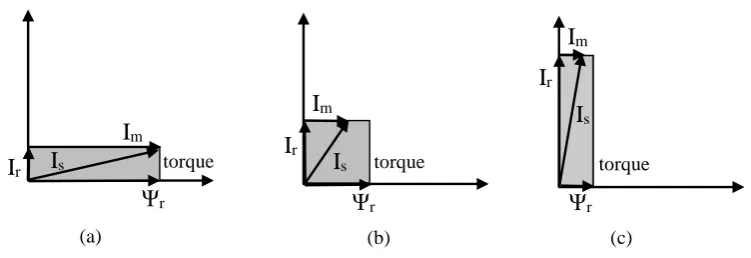
[image:45.595.128.504.317.446.2]Generally, low efficiency achievement during low load condition is due to inappropriate flux level selection. The efficiency improvement can be achieved by proper flux adjustment. Illustration of relationship between flux level and electromagnetic torque is shown in Figure 2.7.
Figure 2.7: Torque production with three different flux level in the light load condition. (a)-nominal flux, (b) medium flux (optimum flux) and (c) low flux [67], [72].
As depicted in Figure 2.7, a vector diagram of low loaded motor at three different rotor flux levels, which are nominal, medium and low are presented. The developed electromagnetic torque, represented by the shaded areas, is proportional to ΨrIr, for all
the three cases. At nominal flux, as shown in Figure 2.7 (a), the rotor current, Iris small
but the stator current, Is and magnetizing current, Imis large. Thus, rotor copper losses
are low but both stator copper and core losses are high.
When rotor flux is reduced to half of its nominal value, as shown in Figure 2.7 (b), the magnetizing current, Im and stator current, Isare reduced. However, the rotor
current, Iris doubled to create same amount of electromagnetic torque. This reduces
core and stator copper losses considerably but increases rotor copper losses. As a result, motor losses in Figure 2.7 (b) are smaller than the one in Figure 2.7 (a).
Ψr Im
Ir Is torque Ir
Ψr Im
Is torque
Ψr Im
Is Ir
torque
However, if rotor flux is reduced even more, which is shown in Figure 2.7 (c), the core losses will still decrease but as both rotor and stator copper losses increase again, hence, it increases total losses again. A clearer depiction of the relationship between flux level and losses are show in Figure 2.8 [71].
[image:46.595.177.454.174.403.2]
Figure 2.8: Types of losses of converter drive system with the flux variation [71].
For certain steady state, in light load condition and at certain speed, typical losses in a converter drive system and its variation with the adjustable flux is presented in Figure 2.8. When flux, Ψr is reduced from rated value, core loss will decrease, but
copper and converter losses increase. However, the total loss decreases to a minimum which leads to maximum efficiency. However, one can observe that total losses increase again after optimum value. Thus, it is desirable to set rotor flux at Ψr
(optimum) so that overall drive system efficiency is optimum.
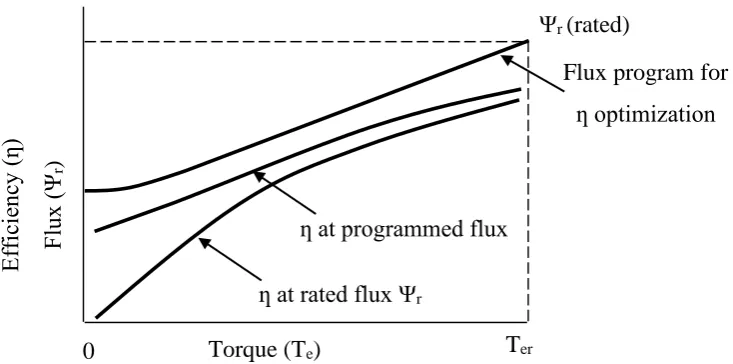
Figure 2.9 shows typical optimum flux program for variable torque and constant speed and compares corresponding efficiency with that of rated flux. Note that at rated torque condition, the flux should be set close to rated value, and there is no significant efficiency improvement. The improvement of efficiency becomes larger as the torque is decreased.
Time Torque
Speed Total Loss
Copper loss
Converter loss Core loss Flux (Ψr) →Decreasing
↑
Ψr (rated)
↑
Figure 2.9: Efficiency improvement by the flux program at variable torque with constant speed [71].
On the basic of the flux reduction in the three cases in Figures 2.7 and 2.8, it can be concluded that, for a given load, minimum losses can be achieved by the proper adjustment of flux to obtain optimum flux level.
Nevertheless, flux reduction has a lot of limitations. For a given operating point, when the flux is reduced, stator frequency will increase, hence, the pull-out torque of the motor will be reduced and make it more sensitive to sudden load disturbances. Thus, the speed for vector controlled motor drive will drop significantly and only when the motor field has been restored, the motor speed can be recovered. Therefore, when designing efficiency optimization control, it is important to ensure that the drive can withstand load disturbances with optimum flux obtained.
2.4 Efficiency Optimization Technique
A number of strategies have been published on efficiency optimization control for IM drives system, especially at light load. In general, the optimal efficiency control techniques or Loss Minimization Technique for IM drives in real time are commonly classified by two categories namely, (1) Search Control (SC), and (2) Loss-Mode-Based Control (LMC) as shown in Figure 2.10. The primary idea is to make flux amplitude varies with the change of IM operating conditions even though these two
Ter Torque (Te)
0
Flux program for ƞ optimization Ψr (rated)
ƞ at programmed flux ƞ at rated flux Ψr
Ef
fici
en
cy
(ƞ
)
Fl
ux (
Ψr
types have dissimilar achievement and implementation way [5]–[9], [14], [15], [73]– [78]. Afterward, the third technique, (3) Hybrid, which uses both techniques mentioned above was invented. It improves each technique's disadvantages to achieve a better performance [14], [15], [42]. On the other hand, certain replace the SC approach with others such as Minimum Stator Current (MSC) [79], estimation of iron losses [80] , and power-factor improvement method [4], [64]. However, this method is suboptimal and cannot produce maximum efficiency. Figure 2.11 show a typical IM motor drive operates under control of real-time efficiency optimization control technique.
[image:48.595.178.473.277.418.2]
Figure 2.10: Categories of efficiency optimization control [5]–[9].
Figure 2.11: Induction motor drive operated under real time Efficiency Optimization Technique [14].
Control Algorithm
Inverter + DC bus -
Sensors/ Estimators
Induction Machine
Commands
Efficiency Optimization Vector Control of IM
Search Control (SC)
Hybrid Control
Loss Model- Based Control (LMC)
Efficiency Optimization
[image:48.595.153.443.495.612.2]2.4.1 Search Control Technique (Physics-based technique)
SC utilized measured IM input power, Pinor DC-link power in optimization process.
It drives the control input to minimize Pin from the current and voltage measurements,
regardless of the motor rating or parameter. For a given output power, Pin=Po+Ploss,
minimizing Pin is equivalent to minimizing Plossfor a given Po [81].
This approach based on varying the flux up to the point where the measuring power input is minimum for one point of operation [42]. More detail, at steady state, for a given load torque and speed, the flux level (or its equivalent variables) iteratively search until minimum input power is achieved. This method has the merit of robustness to parameter variation while the effects of parameter changes are expressed in loss model and hybrid strategies. In addition, it does not require any model of the system and thus search process is simple and is applicable universally to any motors [15], [79].
The drawback of this approach is relatively long response time, flux convergence to its optimal value is too slow and its performance is dependent on the quality of power input measurement. In addition, noise and disturbances are not measured accurately in measured signal. Thus, the optimal flux cannot be assured, and maximum efficiency cannot be obtained. Moreover, the torque and flux ripples will be produced because in real-time drive system, the stable state will not be achieved when search process is slow. In simple way, the search controller utilizes feedback to measure input power and iteratively change flux level until minimum input power is detected [5], [14], [15], [42], [79], [82], [83].
2.4.2 Loss Model Technique (Model based technique)
demanded [6], [8], [42], [82], [84]–[86]. Since the LMC do not rely on any hardware modification on existing drives, makes it more popular and universal than minimum power input (search) based efficiency controller [42].
However, the performance of LMC depends on the accuracy of modeling of motor drive and losses. There is always a trade-off between accuracy and complexity in the development of loss model [9]. In addition, this approach is not robust to parameter variation due to temperature changes and magnetic circuit saturation, it requires exact knowledge of parameter for controlled machine to achieve true optimal operation, the power loss modeling and calculation of the optimal control can be very complex [15]. Considering that, both fundamental losses and harmonic losses produced by inverter should be taken into consideration. Incorporating with the afore mentioned parameter variation phenomena, therefore, the model of the drive system is complex, and simplified model will result in suboptimal output [79].
In a compendious way, loss-model-based controllers use a functional loss model to compute losses and to select an optimum flux level that minimizes this loss. This method is faster than search methods but sensitive to parameter variations [82], [87]. Among loss minimization algorithm for an induction motor, a loss model based approach has the advantages of fast response and high accuracy [9].
2.4.3 Hybrid Control Technique
The hybrid Control technique combines the features from both search and loss model control techniques, which proposes mixing good characteristics of two optimization strategies. Hybrid techniques require a motor or system model to search for minimum power loss, and then use electromechanical principles and mathematical characteristics to achieve optimality. It combines both advantages of the mentioned approach but also rectifies the disadvantages. The two main examples of hybrid techniques among several possible combinations of search and loss model based control
characteristics are: (i) applying Perturb and Observe (P&O) on Ploss model, and (ii) using
a parameter-dependent estimator with a search control technique [81].
![Figure 2.1: Block diagram of a variable speed induction motor drive system [25]–](https://thumb-us.123doks.com/thumbv2/123dok_us/8761448.894222/35.595.208.506.80.227/figure-block-diagram-variable-speed-induction-motor-drive.webp)
![Figure 2.3: Indirect vector control method [28].](https://thumb-us.123doks.com/thumbv2/123dok_us/8761448.894222/39.595.182.443.472.586/figure-indirect-vector-control-method.webp)
![Figure 2.5: Hysteresis controlled of DTC induction motor drive [47].](https://thumb-us.123doks.com/thumbv2/123dok_us/8761448.894222/41.595.173.455.289.397/figure-hysteresis-controlled-dtc-induction-motor-drive.webp)
![Figure 2.6: Block Diagram of a SVPWM-DTC IM drive system [56]–[58].](https://thumb-us.123doks.com/thumbv2/123dok_us/8761448.894222/43.595.155.480.162.270/figure-block-diagram-svpwm-dtc-im-drive.webp)
![Figure 2.8: Types of losses of converter drive system with the flux variation [71].](https://thumb-us.123doks.com/thumbv2/123dok_us/8761448.894222/46.595.177.454.174.403/figure-types-losses-converter-drive-flux-variation.webp)
![Figure 2.10: Categories of efficiency optimization control [5]–[9].](https://thumb-us.123doks.com/thumbv2/123dok_us/8761448.894222/48.595.153.443.495.612/figure-categories-efficiency-optimization-control.webp)
