A finite element model to identify
electrode influence on current distribution
in the skin
Sha, N, Kenney, LPJ, Heller, B, Barker, AT, Howard, D and Moatamedi, M
http://dx.doi.org/10.1111/j.15251594.2008.00615.x
Title A finite element model to identify electrode influence on current distribution in the skin
Authors Sha, N, Kenney, LPJ, Heller, B, Barker, AT, Howard, D and Moatamedi, M
Type Article
URL This version is available at: http://usir.salford.ac.uk/12630/ Published Date 2008
USIR is a digital collection of the research output of the University of Salford. Where copyright permits, full text material held in the repository is made freely available online and can be read, downloaded and copied for noncommercial private study or research purposes. Please check the manuscript for any further copyright restrictions.
A finite element model to identify electrode influence on current distribution in
the skin
N. Sha1, L.P.J. Kenney1, B.H. Heller2, A.T. Barker3, D. Howard1, M. Moatamedi4
1. CRHPR, University of Salford, Salford, UK
2. Centre for Sport and Exercise Science, Sheffield Hallam University, Sheffield, UK
3. Dept of Medical Physics and Clinical Engineering, Royal Hallamshire Hospital, Sheffield, UK
4. Institute for Materials Research, University of Salford, Salford, UK
Corresponding author:
Laurence Kenney
Address: Brian Blatchford Building, University of Salford, Salford, M6 6PU, UK; E-mail: [email protected];
Tel: 0044-(0)161-295-2289
Abstract
Discomfort experienced during surface functional electrical stimulation (FES) is
thought to be partly a result of localised high current density in the skin underneath
the stimulating electrode. This paper describes a finite element (FE) model to predict
its application to the identification of electrode properties that may act to reduce
sensation. The FE model results showed that the peak current density was located in
an area immediately under the stratum corneum, adjacent to a sweat duct. A
simulation of surface FES via a high resistivity electrode showed a reduction in this
peak current density, when compared with that with a low resistivity electrode.
Key words
Current density, finite element modelling, functional electrical stimulation, sensation, surface electrode.
Introduction
Functional electrical stimulation (FES), applied via surface electrodes, can be used to partially restore motor function which has been lost as a result of, for example, a stroke, spinal cord injury, or cerebral palsy 1,2. However, FES is still used by relatively small numbers of patients. One aspect contributing to the low uptake is the discomfort experienced when current is passed through the skin 2. Alternative approaches to reducing this discomfort have been widely examined, including varying the stimulus waveform and pulse width 3,4. There is some evidence that changing electrode properties can affect the sensation 5-7 and this paper examines this area in detail.
stimulation. For a long straight neuron axon, typically found in peripheral motor nerves, the gradient of electric field along the nerve (representing stimulation intensity) is probably the best measure of whether the nerve will respond to stimulation 8. However, sensory receptors in the skin are convoluted and vary widely in their orientation with respect to the local electric field. Hence the sensory receptors will experience an electric field gradient along their length that is dependent both on the varying magnitude of the electric field and the orientation of the particular receptor within the field. As the orientation is unknown, the magnitude of the electric field, which is proportional to current density for a given medium resistivity, may reasonably be adopted as a measure of stimulation intensity for skin receptors 4. A value of 0.1mA/cm2 has been cited as a representative estimate of the current density threshold for stimulation of most sensory receptors 4.
This paper describes the development of a FE model, which represents the anatomical structures in the skin and below, and the application of this model to explore the effect of a high impedance layer between the skin and the electrode. It was hypothesised that the introduction of such a layer would increase the impedances of all possible current pathways, reducing the effect of impedance differences between pathways and hence reducing peak current densities.
Methods
Prior to developing the model, a preliminary study was carried out to verify the hypothesis that a high impedance layer would reduce peak current densities. A pin array was constructed of discrete current paths, most of which were highly resistive, but with a single low resistance path. This experiment demonstrated that a high impedance layer between the current source and the pins would reduce the ratio of current through the low impedance path to that through the high impedance paths 10.
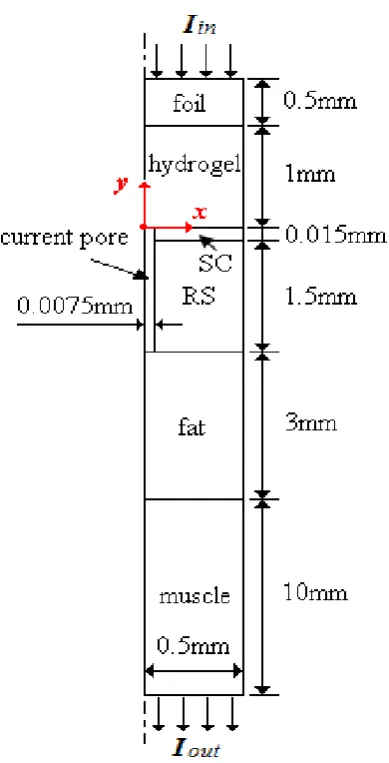
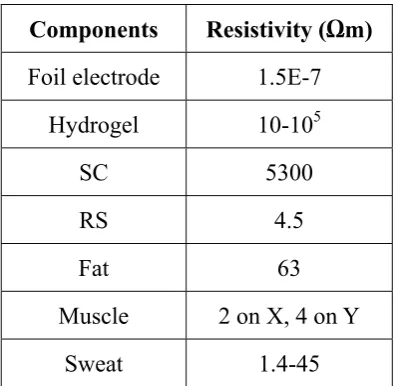
to be 0.5mm. The current pore traverses skin, fat and muscle. Representative values for the thickness of each component, together with the width of the current pore were taken from the literature 12,13. Bone, blood vessels and sensory nerves were assumed to have negligible effect on the parameters of interest and were not explicitly included in the model. A metal foil stimulating electrode was modelled overlying a hydrogel layer on the skin surface. Differentiation between the materials in the model was achieved through assigning appropriate resistive properties to the elements representing the different media (see table 1). Apart from the SC, the other tissue properties are dominated by resistivity. To account for the capacitive properties of the SC, an equivalent resistivity was calculated at 1.67kHz (The pulse width was defined as 300μs for stimulation, and thus the equivalent frequency was approximately 1.67kHz.) to include both its resistive and capacitive properties. A convergence study was carried out to ensure the FE mesh-density was sufficiently fine.
laterally, i.e. via any outer surface of the model other than the foil electrode surface and the muscle bottom. Hence, the boundary conditions for the nodes on the model edges were defined as open-circuit to prevent current entering or exiting the model.
Results
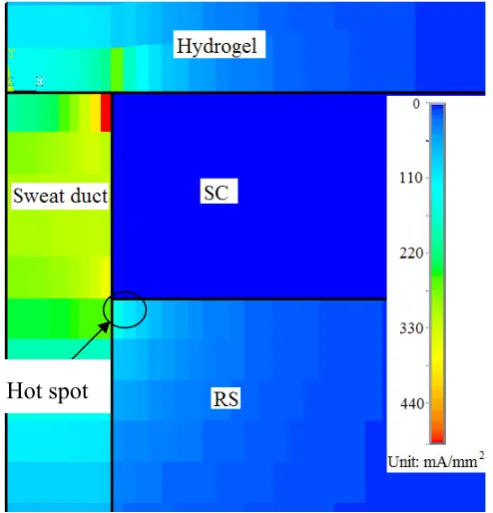
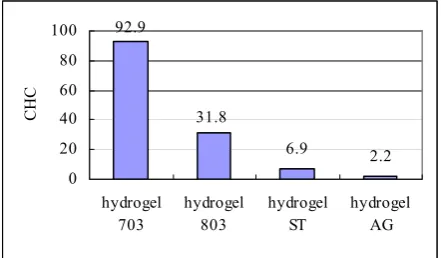
As sensory receptors are normally located in the dermis, the current density distribution in the RS was assumed to determine sensation. The FE model predicted that the peak current density (hot spot) in the RS was located in the top corner of the RS layer, adjacent to the SC and the sweat pore (see figure 2). The non-uniformity of current distribution was quantified using a current hogging coefficient (CHC), which was defined as the ratio between the peak current density and the mean current density in the RS. The effects of four variables (hydrogel resistivity, hydrogel thickness, sweat duct resistivity, and SC thickness) on CHC were predicted by the FE model, as shown in figures 3, 4 and 5. Four different hydrogels were modelled, corresponding to commercially available samples (see tables 2 and 3), and their effects on CHC were plotted (figure 6).
Discussion
distribution for the range of hydrogel thicknesses modelled.
The resistivity of the sweat duct can be assumed to vary with the amount of sweat in the duct. Figure 4 suggests that current hogging peaks when the resistivity of the sweat duct is similar to that of the rest of the skin but the effect is not large. Hence, either sweaty skin or dry skin would be associated with somewhat more uniform current distribution in the RS during electrical stimulation.
Figure 5 shows that the thinner the SC the less current hogging occurs in the vicinity of a current pore. This suggests that reducing the thickness of the SC before stimulation will not only reduce the skin impedance, but also improve the uniformity of current distribution.
Four commercial hydrogels with a range of resistivities (see figure 6) were modelled. The results showed that current hogging reduced with increased hydrogel resistivity. The highest resistivity (hydrogel AG) resulted in a current hogging coefficient of 2.2, some 40 times lower than that found with the lowest resistivity hydrogel (hydrogel 703). This implies that the sensation associated with stimulation may be reduced by use of a high resistivity electrode.
current density can result, such as the electrode edge effect 4,7. Secondly, no in-vivo validation of the model was conducted because of the difficulties of doing so without using unacceptably invasive methods. However the results of 6 tend to support the results presented here.
Conclusions
The FE model described here was used to predict the current density distribution in the skin during electrical stimulation due to the presence of a current pore. It can be used to predict the magnitude of the non-uniformity of the current density caused by anatomical parameters, such as SC thickness and sweat duct resistivity, and electrode parameters, such as hydrogel thickness and resistivity. The results suggest that a high resistivity stimulating electrode could reduce the discomfort associated with transcutaneous electrical stimulation, which is in agreement with our previously published experimental results 6.
Acknowledgments
The authors would like to acknowledge the support of the UK Overseas Research Studentship scheme.
References
2. Burridge JH. Does the Drop-foot stimulator improve walking in hemiplegia?
Neuromodulation. 2001;4(2):77-83.
3. Prausnitz MR. The effects of electric current applied to skin: A review for transdermal drug delivery. Advanced Drug Delivery Reviews.
1996;18(3):395-425.
4. Reilly JP. Applied bioelectricity from Electrical Stimulation to Electropathology. New York: Springer - Verlag, Inc.; 1998.
5. Panescu D, Webster JG, Stratucker RA. A nonlinear finite element model of the electrode-electrolyte-skin system. IEEE transactions on Biomedical Engineering. 1994;41(7):681-7.
6. Sha N, Kenney L, Heller B, Barker A, Howard D, Wang W. The effect of the impedance of a thin hydrogel electrode on sensation during functional electrical stimulation. Medical Engineering and Physics. In press.
7. Livshitz LM, Mizrahi J, Einziger PD. Interaction of array of finite electrodes with layered biological tissue: effect of electrode size and configuration. IEEE Transaction on Neural Systems and Rehabilitation Engineering. 2001
Dec;9(4):355-61.
8. Rattay F. Analysis of models for external stimulation of axons. IEEE Transactions on Biomedical Engineering. 1986;33(10):974-7.
9. Cullander C, Guy RH. Visualization of iontophoretic pathways with confocal microscopy and vibrating probe electrode. Solid State Ion. 1992;53-56
10. Sha N. A surface electrode array-based system for functional electrical stimulation [PhD thesis]: University of Salford, 2008.
11. Panescu D, Cohen KP, Webster JG. The mosaic characteristics of the skin
IEEE transaction of Biomedical Engineering. 1993;40(5):434-9.
12. Bannister LH, Berry MM, Collins P, Dyson M, Dussek JE, Ferguson WJ. Gray's Anatomy: Pearson Professional Limited; 1995.
Figure 2:Current density distribution showing the hot spot in the RS. Hydrogel resistivity: 55Ωm
Hot spot
1 10 100 1000
1 10 100 1000 10000 100000
Hydrogel resistivity (ohm.m)
CHC
0.3mm 0.9mm 1mm 1.5mm
Figure 3:Effect of hydrogel thickness and resistivity on CHC (all 4 curves are overlaid)
[image:13.595.103.324.442.576.2]0 40 80 120 160
0 10 20 30 40 50
Sweat duct resistivity (ohm.m)
CH
[image:14.595.177.402.119.236.2]C
[image:14.595.173.396.309.432.2]Figure 4:Effect of sweat duct resistivity on CHC SC: 0.015mm, Hydrogel: 100Ωm
Figure 5:Effect of SC thickness on CHC Sweat: 1.4Ωm, Hydrogel: 100Ωm
0 40 80 120 160
0 0.01 0.02 0.03
SC thickness (mm)
CHC
Figure 6:Effect of hydrogel samples on CHC SC: 0.015mm, Sweat: 1.4Ωm
[image:14.595.182.403.525.654.2]Components Resistivity (Ωm)
Foil electrode 1.5E-7 Hydrogel 10-105
SC 5300 RS 4.5 Fat 63 Muscle 2 on X, 4 on Y
[image:15.595.199.397.70.263.2]Sweat 1.4-45
Table 1: Resistivities of the model components [10, 11]
Hydrogel name Approx thickness (mm) Resistivity (Ωm) Hydrogel 703 0.9 55 Hydrogel 803 0.9 206
[image:15.595.119.481.319.436.2]Hydrogel ST 0.5 1363 Hydrogel AG 0.3 25185
Table 2: Properties of the hydrogel samples
Hydrogel name Product code Suppliers
Hydrogel 703 AG703 Axelgaard manufacture Co., Ltd. USA Hydrogel 803 AG803 Axelgaard manufacture Co., Ltd. USA
Hydrogel ST SRBZAB-05SB Sekisui Plastics, Co., Ltd. Japan Hydrogel AG AG3AM03M-P10W05 Sekisui Plastics, Co., Ltd. Japan
[image:15.595.93.504.490.608.2]